

- Industry Size (2026)
- USD 1.1 Bn
- Forecast (2036)
- USD 3.4 Bn
- CAGR (2026 to 2036)
- 11.8%
Fermentation-Based Bioplastic Building Blocks for Health and Hygiene Products Market Forecast and Outlook 2026 for 2036
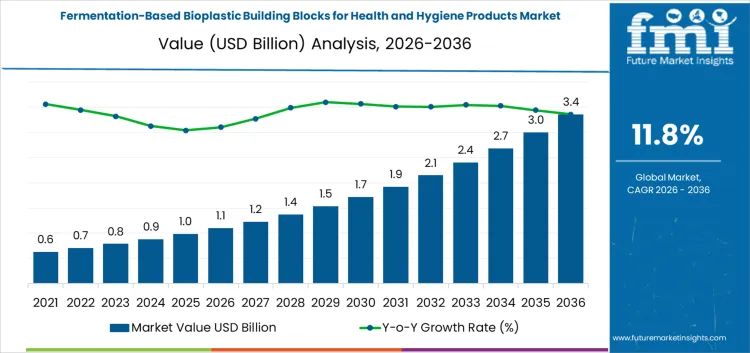
The fermentation-based bioplastic building blocks for health and hygiene products market is expected to grow steadily from 2026 to 2036. Starting at USD 1.1 billion in 2026, the market is projected to reach USD 3.4 billion by 2036, reflecting a compound annual growth rate (CAGR) of 11.8%. This growth is driven by increasing consumer demand for sustainable alternatives to traditional plastic packaging in health and hygiene products, such as personal care items, medical packaging, and hygiene products. Fermentation-based bioplastics, made from renewable resources, offer an eco-friendly option with improved biodegradability, aligning with the growing emphasis on sustainability in the health and hygiene sector.
The market’s expansion is supported by advancements in fermentation technology, which are improving the cost-efficiency and performance of bioplastic building blocks. As consumers and regulatory bodies demand more environmentally responsible products, the health and hygiene industry is adopting bioplastics to reduce its environmental impact. Additionally, as sustainability becomes a key focus for brands in the personal care and health sectors, demand for bioplastics in product packaging is expected to rise. Over the forecast period, the market is expected to continue growing steadily, driven by these trends and innovations in sustainable material production.
Quick Stats of the Fermentation-Based Bioplastic Building Blocks for Health and Hygiene Products Market
- Fermentation-Based Bioplastic Building Blocks for Health and Hygiene Products Market Value (2026): USD 1.1 billion
- Fermentation-Based Bioplastic Building Blocks for Health and Hygiene Products Market Forecast Value (2036): USD 3.4 billion
- Fermentation-Based Bioplastic Building Blocks for Health and Hygiene Products Market Global Forecast CAGR (2026-2036): 11.8%
- Fermentation-Based Bioplastic Building Blocks for Health and Hygiene Products Market Leading Segment: Funding Source Type (Government & Public Research Grants) 42%
- Key Growth Regions in Fermentation-Based Bioplastic Building Blocks for Health and Hygiene Products Market: USA
- Top Players in Fermentation-Based Bioplastic Building Blocks for Health and Hygiene Products Market: NatureWorks LLC, Corbion N.V., Cargill Incorporated, TotalEnergies Corbion, DuPont de Nemours, Inc., BASF SE, Genomatica, Inc., Novozymes A/S, Arkema (Bio-Chemicals), Danimer Scientific
What is the Growth Forecast for the Fermentation-Based Bioplastic Building Blocks for Health and Hygiene Products Market through 2036?
The growth rate volatility index for the fermentation-based bioplastic building blocks for health and hygiene products market highlights the market's predictable and stable growth trajectory, with minor fluctuations expected during the forecast period. From 2026 to 2031, the market will grow from USD 1.1 billion to USD 2.2 billion, reflecting a steady acceleration. During this phase, the volatility index is likely to show moderate fluctuations, driven by initial adoption and technological advancements in fermentation processes. While the growth will remain strong, factors such as production scalability, cost optimization, and market entry by new players may contribute to short-term volatility.
From 2031 to 2036, the market will continue to grow, increasing from USD 2.2 billion in 2031 to USD 3.4 billion in 2036. This period will see a lower volatility index as the market stabilizes, with the adoption of fermentation-based bioplastics becoming more widespread in the health and hygiene sectors. The growth rate will remain consistent, driven by continued demand for sustainable packaging solutions and ongoing innovation in bioplastic technologies. The volatility index during this phase will reflect the maturity of the market, with steady growth patterns as the technology becomes integrated into standard practices in health and hygiene product manufacturing.
Fermentation-Based Bioplastic Building Blocks for Health and Hygiene Products Market Key Takeaways
| Metric | Value |
|---|---|
| Industry Sales Value (2026) | USD 1.1 billion |
| Industry Forecast Value (2036) | USD 3.4 billion |
| Industry Forecast CAGR (2026-2036) | 11.8% |
What Is Driving the Demand for Fermentation-Based Bioplastic Building Blocks for Health and Hygiene Products?
Historical demand for fermentation-based bioplastic building blocks originates from the broader shift in materials science toward renewable and biodegradable polymers that replace fossil-derived plastics in consumer goods, packaging, and personal care applications. Microbial fermentation has been used to produce key monomers such as lactic acid, which is polymerized into polylactic acid (PLA), and other bio-based intermediates that serve as building blocks for biodegradable polymers. These fermentation-derived monomers are produced from renewable feedstocks using engineered microbes, enabling bio-based alternatives to petrochemical precursors in bioplastics. Fermentation technology has developed over decades in biochemical and industrial biotechnology research, with increasing focus on using sugars, biomass residues, and other renewable resources to create monomers for sustainable polymer production. These bio-based polymers have been applied in films, rigid packaging, and consumer products where biodegradable materials are needed, and their integration into health and hygiene formats has grown alongside broader bioplastics research and commercialization. This foundational work set the stage for demand in fermentation-sourced building blocks tailored to specialized applications.
Future demand for fermentation-based bioplastic building blocks in health and hygiene products is expected to expand as sustainability mandates, regulatory frameworks, and corporate commitments influence material selection in personal care, medical disposables, and hygiene packaging. The bioplastics market has shown robust expansion, with forecasts indicating significant growth in bio-based polymers for packaging and related use cases, including personal care and hygiene applications, driven by plastic regulation and demand for eco-friendly solutions. Fermentation-derived monomers contribute to polymers such as PLA and polyhydroxyalkanoates that can meet performance requirements in films, rigid components, and disposable hygiene formats, supporting product portfolios that align with circular economy and biodegradability criteria. Growth factors include rising consumer preference for sustainable materials in health and hygiene segments, regulatory pressure to reduce reliance on fossil plastics, and innovation in microbial fermentation and strain engineering to improve yield, scalability, and cost competitiveness of renewable monomer production. Collaboration between industry and research entities continues to focus on expanding applications of fermentation-sourced bioplastics across consumer goods and medical-grade products, reinforcing uptake in emerging sustainability-driven markets.
What are the Leading Segments in the Global Fermentation-Based Bioplastic Building Blocks for Health and Hygiene Products Market?
The global fermentation-based bioplastic building blocks for health and hygiene products market is segmented by monomer type and funding source type. Among monomer types, lactic acid & PLA precursors lead the market, capturing 38% of the share, followed by succinic & other dicarboxylic acids, bio-diols & glycols, FDCA & furanic intermediates, and other fermentation-derived monomers. Lactic acid and PLA precursors are preferred due to their well-established use in producing biodegradable and sustainable bioplastics, particularly in health and hygiene applications. On the funding source side, government & public research grants dominate, holding 42% of the share, followed by corporate R&D investment, public-private partnerships, academic innovation programs, and venture/impact capital. Government grants are favored for their long-term support of sustainable innovation and bioplastic research initiatives.
What Drives the Growth of Lactic Acid & PLA Precursors in the Fermentation-Based Bioplastic Building Blocks for Health and Hygiene Products Market?
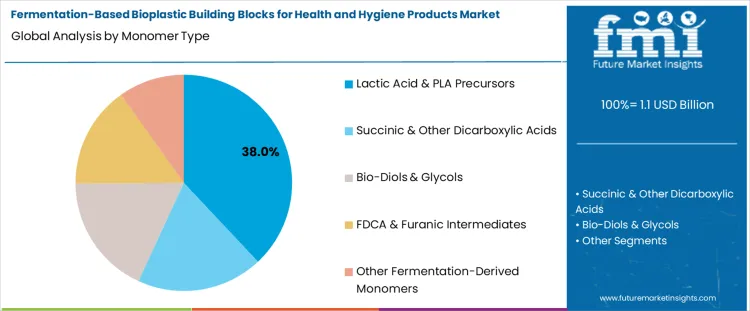
Lactic acid & PLA precursors are the leading monomer type in the fermentation-based bioplastic building blocks for health and hygiene products market, holding 38% of the share. This demand is driven by the growing use of polylactic acid (PLA) in the health and hygiene sector, where sustainability and biodegradability are becoming increasingly important. PLA is produced from renewable feedstocks such as corn and sugarcane, making it a biodegradable alternative to petroleum-based plastics. In health and hygiene products, such as biodegradable wipes, hygiene packaging, and medical equipment, PLA offers the necessary durability and performance characteristics, along with the added benefit of being compostable. As consumer awareness around plastic waste grows, the demand for PLA and its precursors has increased, especially in sectors like personal care and healthcare, where packaging and disposable products are common. The shift toward eco-friendly alternatives in the health and hygiene industry further fuels the growth of lactic acid and PLA precursors, solidifying their dominant position in the market.
What is Driving the Demand for Government & Public Research Grants in the Fermentation-Based Bioplastic Building Blocks for Health and Hygiene Products Market?
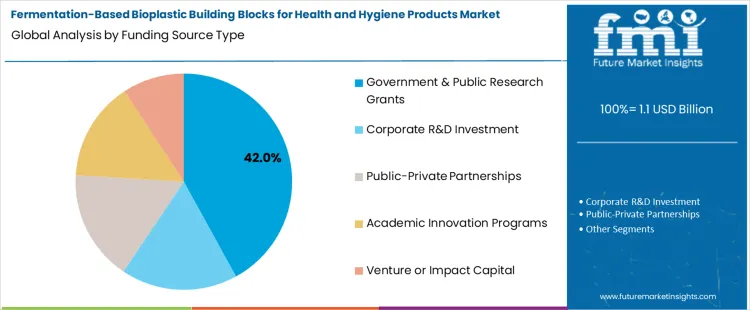
Government & public research grants are the leading funding source type in the fermentation-based bioplastic building blocks for health and hygiene products market, capturing 42% of the share. This demand is driven by the increasing recognition of the need for sustainable solutions in the plastic and healthcare industries. Governments, particularly in regions like the EU and North America, are allocating funding to support the development of environmentally friendly materials, including bioplastics, as part of their broader sustainability agendas. These grants provide essential financial support for research and development efforts to advance fermentation-based bioplastics, helping to scale up production technologies and improve the performance of bioplastics in various applications. Public research grants also encourage collaboration between governments, research institutions, and industries to drive innovation in bioplastics. As environmental regulations tighten and industries seek to reduce their carbon footprints, government and public research funding will continue to play a critical role in supporting the development and commercialization of bioplastics for health and hygiene products.
What are the Key Dynamics in the Fermentation-Based Bioplastic Building Blocks for Health and Hygiene Products Market?
The fermentation-based bioplastic building blocks for health and hygiene products market is defined by the use of bio-derived intermediates to produce polymers for items such as wipes, packaging, disposable medical components, and personal care applicators. Building blocks manufactured through microbial fermentation are assessed on purity, performance in end-use applications, and compatibility with processing equipment. Regulatory frameworks that govern medical-grade materials and biodegradability standards influence adoption. Supply chains for biomass feedstock and fermentation capacity affect how intermediates are commercialized. Demand for material traceability, product safety, and defined lifecycle outcomes shapes how manufacturers prioritize renewable inputs in health and hygiene categories.
What are the Main Drivers Supporting Growth in This Market?
Growth in this market is supported by regulatory emphasis on reducing fossil-based plastic use and environmental burden in single-use health and hygiene products. Policies that favor renewable content, biodegradability, and reduced carbon intensity prompt manufacturers to explore fermentation-derived alternatives. Advances in biotechnology and fermentation processes improve yields of key monomers and reduce production costs, making bio-based intermediates more competitive. End-users seek materials that meet stringent performance requirements for hygiene, sterilisability, and consumer safety. Corporate sustainability commitments in the health and consumer goods sectors reinforce interest in building blocks that align with environmental criteria without compromising product integrity.
What Restraints Are Limiting Market Expansion?
High production cost relative to conventional petrochemical building blocks remains a restraint, particularly in cost-sensitive segments of hygiene and disposable applications. Biomass feedstock availability and quality vary by region, creating uncertainty in supply chains and cost structures. Technical challenges in scaling fermentation processes to meet industrial volumes can delay broader commercial deployment. Integration of new bio-based intermediates into established polymerization and manufacturing lines can require processing adjustments, increasing complexity for producers. Divergent regulatory definitions and certification requirements for bioplastics and hygiene product materials across regions add compliance challenges for suppliers with multi-market ambitions.
What Emerging Trends Are Shaping the Future of This Market?
Emerging trends include improvements in microbial strain design and metabolic engineering that increase productivity of fermentation platforms and expand the range of accessible building blocks. Development of hybrid material strategies that combine fermentation-derived monomers with recyclable or compostable polymers is gaining attention to balance performance with circularity. Digital tools for lifecycle assessment and material selection are supporting procurement decisions and quantifying environmental benefits. Collaboration among biotechnology developers, polymer manufacturers, and health and hygiene brands is increasing to align material specifications with functional requirements. There is growing interest in establishing standardized testing and certification frameworks for fermentation-derived bioplastic inputs to support regulatory compliance and market transparency.
What is the Country-Wise Analysis of the Fermentation-Based Bioplastic Building Blocks for Health and Hygiene Products Market?
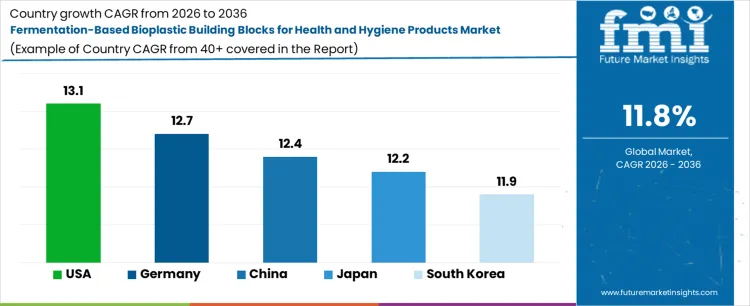
The fermentation-based bioplastic building blocks for health and hygiene products market is growing as industries increasingly seek sustainable alternatives to traditional petroleum-based plastics. These bioplastics, derived from renewable resources through fermentation processes, offer a eco-friendlier solution for products in the health and hygiene sectors, including packaging for cosmetics, toiletries, and medical items. Developed markets like the USA, Germany, and Japan are leading the adoption of these sustainable materials due to their strong commitment to environmental sustainability, consumer demand for greener alternatives, and regulatory pressures to reduce plastic waste. Emerging markets such as China and South Korea are also experiencing growth, driven by large-scale manufacturing, government policies promoting sustainable solutions, and increasing consumer awareness of the environmental impact of plastic. As sustainability continues to be a priority globally, the market for fermentation-based bioplastic building blocks in health and hygiene products is set to expand significantly.
| Country | CAGR (2026-2036) |
|---|---|
| USA | 13.1% |
| Germany | 12.7% |
| China | 12.4% |
| Japan | 12.2% |
| South Korea | 11.9% |
What is the Growth Outlook for the Fermentation-Based Bioplastic Building Blocks for Health and Hygiene Products Market in the USA?
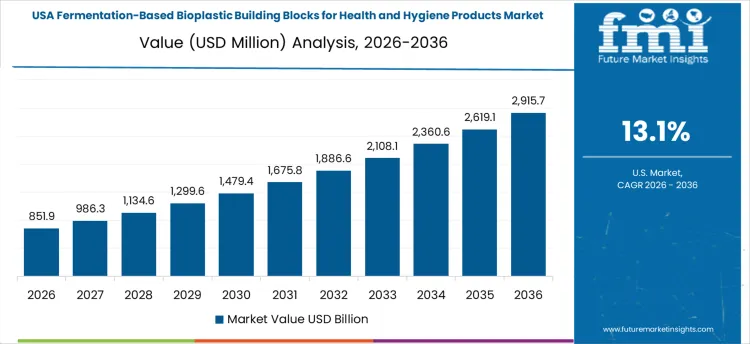
The fermentation-based bioplastic building blocks for health and hygiene products market in the USA is projected to grow steadily, with a projected CAGR of 13.1% from 2026 to 2036. The USA is a global leader in innovation and sustainability, and industries in the health and hygiene sector are increasingly adopting bioplastics as a solution to reduce the environmental impact of packaging and products. Consumer demand for eco-friendly alternatives is growing, and the U.S. government is supporting green technologies, including bioplastic production, through various incentives and policies. The shift toward bioplastics in the health and hygiene sector is driven by the need for more sustainable packaging solutions that align with environmental goals. As awareness of plastic pollution increases, the market for fermentation-based bioplastic building blocks in the USA is expected to grow steadily in the coming years.
What is the Market Outlook for the Fermentation-Based Bioplastic Building Blocks for Health and Hygiene Products Market in Germany?
Germany is expected to see steady growth in the fermentation-based bioplastic building blocks for health and hygiene products market, with a projected CAGR of 12.7% from 2026 to 2036. Germany is a global leader in sustainability and green technologies, with the demand for bioplastics rising across various industries, including health and hygiene. The German government’s focus on reducing plastic waste and promoting sustainable materials is driving the adoption of fermentation-based bioplastics in the health and hygiene sector. As businesses and consumers alike seek eco-friendly solutions, the market for bioplastics in packaging for health and hygiene products is expanding. With strong regulatory support and growing consumer interest in sustainable products, the market for fermentation-based bioplastic building blocks in Germany is expected to continue growing steadily.
What is the Growth Forecast for the Fermentation-Based Bioplastic Building Blocks for Health and Hygiene Products Market in China?
China is projected to experience steady growth in the fermentation-based bioplastic building blocks for health and hygiene products market, with a projected CAGR of 12.4% from 2026 to 2036. China’s large manufacturing base and growing consumer demand for sustainable products are driving the adoption of bioplastics in the health and hygiene sector. The Chinese government’s focus on reducing plastic waste and improving sustainability in manufacturing is contributing to the growth of the bioplastics market. With increasing awareness of the environmental impact of plastic packaging, both consumers and businesses are turning to more sustainable alternatives. As the demand for bioplastics continues to grow across industries, the market for fermentation-based bioplastic building blocks in China’s health and hygiene sector is expected to expand steadily.
What is the Market Outlook for the Fermentation-Based Bioplastic Building Blocks for Health and Hygiene Products Market in Japan?
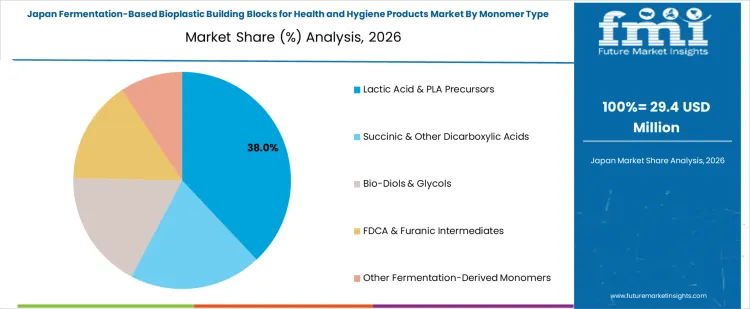
Japan is expected to see steady growth in the fermentation-based bioplastic building blocks for health and hygiene products market, with a projected CAGR of 12.2% from 2026 to 2036. Japan has a strong commitment to sustainability, and industries are increasingly adopting bioplastics as an alternative to traditional plastics. In the health and hygiene sector, bioplastics made from fermentation-based building blocks are becoming more popular, particularly for packaging personal care products, medical items, and toiletries. The Japanese government’s support for environmental initiatives and increasing consumer demand for eco-friendly products are key factors driving the growth of bioplastics in the country. As Japan continues to prioritize sustainable practices, the market for fermentation-based bioplastic building blocks in health and hygiene products is expected to grow steadily.
What is the Growth Forecast for the Fermentation-Based Bioplastic Building Blocks for Health and Hygiene Products Market in South Korea?
South Korea is projected to experience steady growth in the fermentation-based bioplastic building blocks for health and hygiene products market, with a projected CAGR of 11.9% from 2026 to 2036. South Korea’s commitment to environmental sustainability and green technologies is driving the demand for bioplastics, including those used in health and hygiene products. The country’s industries are increasingly adopting bioplastics in packaging solutions to meet both regulatory requirements and consumer demand for more sustainable products. The South Korean government has introduced policies to promote the use of renewable materials and reduce plastic waste, which is further driving the growth of the bioplastics market. As the demand for eco-friendly packaging in the health and hygiene sector increases, the market for fermentation-based bioplastic building blocks in South Korea is expected to grow steadily.
What is the Competitive Landscape for the Fermentation-Based Bioplastic Building Blocks for Health and Hygiene Products Market?
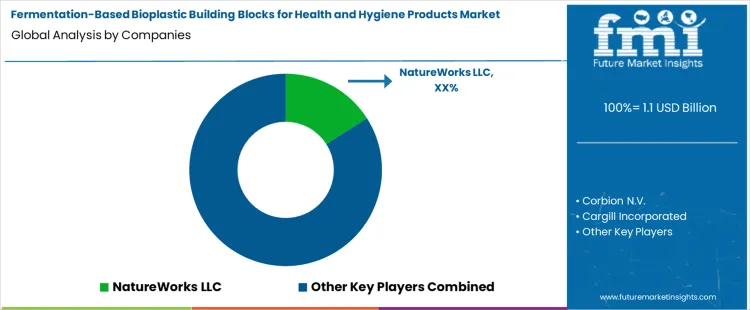
The fermentation-based bioplastic building blocks for health and hygiene products market is rapidly expanding as industries move towards more sustainable materials, driven by the need for eco-friendly alternatives in consumer products. NatureWorks LLC leads the market with its innovative fermentation-based bioplastic building blocks, offering high-performance, renewable, and biodegradable solutions used in health and hygiene products. Their commitment to sustainability, product innovation, and reducing plastic waste has positioned them as a dominant player in this sector. Corbion N.V., Cargill Incorporated, and TotalEnergies Corbion are significant competitors, each providing bioplastic building blocks derived from renewable resources for various applications, including health and hygiene products. Corbion N.V. specializes in fermentation-derived materials, while Cargill Incorporated offers sustainable solutions for the production of bioplastics, and TotalEnergies Corbion focuses on providing bio-based polymers for a range of industries.
DuPont de Nemours, Inc., BASF SE, and Genomatica, Inc. further contribute to the competitive landscape by offering advanced fermentation-based bioplastic building blocks. DuPont leverages its expertise in material science to develop sustainable bioplastics, while BASF SE emphasizes innovation in bio-based polymers for use in health and hygiene products. Genomatica, Inc. focuses on the fermentation processes to produce bio-based chemicals, including building blocks for bioplastics. Novozymes A/S, Arkema (Bio-Chemicals), and Danimer Scientific also play key roles by developing fermentation-based technologies and solutions for health and hygiene applications. These companies compete by focusing on sustainability, performance, and the ability to meet the growing demand for bioplastics in health and hygiene products. As consumer awareness and regulations surrounding sustainability continue to rise, the market for fermentation-based bioplastic building blocks in health and hygiene products is expected to expand, driving further competition and innovation.
Key Players of the Fermentation-Based Bioplastic Building Blocks for Health and Hygiene Products Market
- NatureWorks LLC
- Corbion N.V.
- Cargill Incorporated
- TotalEnergies Corbion
- DuPont de Nemours, Inc.
- BASF SE
- Genomatica, Inc.
- Novozymes A/S
- Arkema (Bio‑Chemicals)
- Danimer Scientific
Scope of the Report
| Items | Values |
|---|---|
| Quantitative Units (2026) | USD Billion |
| Monomer Type | Lactic Acid & PLA Precursors, Succinic & Other Dicarboxylic Acids, Bio-Diols & Glycols, FDCA & Furanic Intermediates, Other Fermentation-Derived Monomers |
| End Use Application | Biodegradable Wipes & Fibers, Disposable Hygiene Products, Medical & Healthcare Supplies, Personal Care Packaging, Specialized High-Performance Products |
| Funding Source Type | Government & Public Research Grants, Corporate R&D Investment, Public-Private Partnerships, Academic Innovation Programs, Venture/Impact Capital |
| Companies | NatureWorks LLC, Corbion N.V., Cargill Incorporated, TotalEnergies Corbion, DuPont de Nemours, Inc., BASF SE, Genomatica, Inc., Novozymes A/S, Arkema (Bio-Chemicals), Danimer Scientific |
| Regions Covered | North America, Latin America, Western Europe, Eastern Europe, South Asia & Pacific, East Asia, Middle East & Africa |
| Countries Covered | United States, Canada, Mexico, Brazil, Argentina, Germany, France, United Kingdom, Italy, Spain, Netherlands, China, India, Japan, South Korea, ANZ, GCC Countries, South Africa |
| Additional Attributes | Dollar by sales by monomer type, end use application, funding source type, and region. Includes analysis of market trends in fermentation-based bioplastic building blocks for health and hygiene products, performance in biodegradable wipes, fibers, disposable hygiene, medical supplies, and personal care packaging, evaluation of funding and innovation sources, cost and production dynamics, regulatory and sustainability frameworks influencing adoption, competitive positioning and market share of key companies, technological innovations in fermentation and monomer production, and assessment of impact on product performance, biodegradability, lifecycle outcomes, and market acceptance. |
Fermentation-Based Bioplastic Building Blocks for Health and Hygiene Products Market Segmentation
Monomer Type
- Lactic Acid & PLA Precursors
- Succinic & Other Dicarboxylic Acids
- Bio-Diols & Glycols
- FDCA & Furanic Intermediates
- Other Fermentation-Derived Monomers
End Use Application
- Biodegradable Wipes & Fibers
- Disposable Hygiene Products
- Medical & Healthcare Supplies
- Personal Care Packaging
- Specialized High-Performance Products
Funding Source Type
- Government & Public Research Grants
- Corporate R&D Investment
- Public-Private Partnerships
- Academic Innovation Programs
- Venture/Impact Capital
Region
- Asia Pacific
- China
- Japan
- South Korea
- India
- Australia & New Zealand
- ASEAN
- Rest of Asia Pacific
- Europe
- Germany
- United Kingdom
- France
- Italy
- Spain
- Nordic
- BENELUX
- Rest of Europe
- North America
- United States
- Canada
- Mexico
- Latin America
- Brazil
- Chile
- Rest of Latin America
- Middle East & Africa
- Kingdom of Saudi Arabia
- Other GCC Countries
- Turkey
- South Africa
- Other African Union
- Rest of Middle East & Africa
Frequently Asked Questions
How big is the fermentation-based bioplastic building blocks for health and hygiene products market in 2026?
The global fermentation-based bioplastic building blocks for health and hygiene products market is estimated to be valued at USD 1.1 billion in 2026.
What will be the size of fermentation-based bioplastic building blocks for health and hygiene products market in 2036?
The market size for the fermentation-based bioplastic building blocks for health and hygiene products market is projected to reach USD 3.4 billion by 2036.
How much will be the fermentation-based bioplastic building blocks for health and hygiene products market growth between 2026 and 2036?
The fermentation-based bioplastic building blocks for health and hygiene products market is expected to grow at a 11.8% CAGR between 2026 and 2036.
What are the key monomer types in the fermentation-based bioplastic building blocks for health and hygiene products market?
The key monnomer types in fermentation-based bioplastic building blocks for health and hygiene products market are lactic acid & PLA precursors, succinic & other dicarboxylic acids, bio‑diols & glycols, FDCA & furanic intermediates and other fermentation‑derived monomers.
Which funding source type segment to contribute significant share in the fermentation-based bioplastic building blocks for health and hygiene products market in 2026?
In terms of funding source type, government & public research grants segment to command 42.0% share in the fermentation-based bioplastic building blocks for health and hygiene products market in 2026.
Preview the report firsthand - request a free sample
Get SampleGet the brochure for pricing and purchase details.
Get PDFTable of Content
- Executive Summary
- Global Market Outlook
- Demand-side Trends
- Supply-side Trends
- Technology Roadmap Analysis
- Analysis and Recommendations
- Market Overview
- Market Coverage / Taxonomy
- Market Definition / Scope / Limitations
- Market Background
- Market Dynamics
- Drivers
- Restraints
- Opportunity
- Trends
- Scenario Forecast
- Demand in Optimistic Scenario
- Demand in Likely Scenario
- Demand in Conservative Scenario
- Opportunity Map Analysis
- Product Life Cycle Analysis
- Supply Chain Analysis
- Investment Feasibility Matrix
- Value Chain Analysis
- PESTLE and Porter’s Analysis
- Regulatory Landscape
- Regional Parent Market Outlook
- Production and Consumption Statistics
- Import and Export Statistics
- Market Dynamics
- Global Market Analysis 2021 to 2025 and Forecast, 2026 to 2036
- Historical Market Size Value (USD Million) Analysis, 2021 to 2025
- Current and Future Market Size Value (USD Million) Projections, 2026 to 2036
- Y-o-Y Growth Trend Analysis
- Absolute $ Opportunity Analysis
- Global Market Pricing Analysis 2021 to 2025 and Forecast 2026 to 2036
- Global Market Analysis 2021 to 2025 and Forecast 2026 to 2036, By Monomer Type
- Introduction / Key Findings
- Historical Market Size Value (USD Million) Analysis By Monomer Type , 2021 to 2025
- Current and Future Market Size Value (USD Million) Analysis and Forecast By Monomer Type , 2026 to 2036
- Lactic Acid & PLA Precursors
- Succinic & Other Dicarboxylic Acids
- Bio‑Diols & Glycols
- FDCA & Furanic Intermediates
- Other Fermentation‑Derived Monomers
- Lactic Acid & PLA Precursors
- Y-o-Y Growth Trend Analysis By Monomer Type , 2021 to 2025
- Absolute $ Opportunity Analysis By Monomer Type , 2026 to 2036
- Global Market Analysis 2021 to 2025 and Forecast 2026 to 2036, By End Use Application
- Introduction / Key Findings
- Historical Market Size Value (USD Million) Analysis By End Use Application, 2021 to 2025
- Current and Future Market Size Value (USD Million) Analysis and Forecast By End Use Application, 2026 to 2036
- Biodegradable Wipes & Fibers
- Disposable Hygiene Products
- Medical & Healthcare Supplies
- Personal Care Packaging
- Specialized High‑Performance Products
- Biodegradable Wipes & Fibers
- Y-o-Y Growth Trend Analysis By End Use Application, 2021 to 2025
- Absolute $ Opportunity Analysis By End Use Application, 2026 to 2036
- Global Market Analysis 2021 to 2025 and Forecast 2026 to 2036, By Funding Source Type
- Introduction / Key Findings
- Historical Market Size Value (USD Million) Analysis By Funding Source Type, 2021 to 2025
- Current and Future Market Size Value (USD Million) Analysis and Forecast By Funding Source Type, 2026 to 2036
- Government & Public Research Grants
- Corporate R&D Investment
- Public‑Private Partnerships
- Academic Innovation Programs
- Venture or Impact Capital
- Government & Public Research Grants
- Y-o-Y Growth Trend Analysis By Funding Source Type, 2021 to 2025
- Absolute $ Opportunity Analysis By Funding Source Type, 2026 to 2036
- Global Market Analysis 2021 to 2025 and Forecast 2026 to 2036, By Region
- Introduction
- Historical Market Size Value (USD Million) Analysis By Region, 2021 to 2025
- Current Market Size Value (USD Million) Analysis and Forecast By Region, 2026 to 2036
- North America
- Latin America
- Western Europe
- Eastern Europe
- East Asia
- South Asia and Pacific
- Middle East & Africa
- Market Attractiveness Analysis By Region
- North America Market Analysis 2021 to 2025 and Forecast 2026 to 2036, By Country
- Historical Market Size Value (USD Million) Trend Analysis By Market Taxonomy, 2021 to 2025
- Market Size Value (USD Million) Forecast By Market Taxonomy, 2026 to 2036
- By Country
- USA
- Canada
- Mexico
- By Monomer Type
- By End Use Application
- By Funding Source Type
- By Country
- Market Attractiveness Analysis
- By Country
- By Monomer Type
- By End Use Application
- By Funding Source Type
- Key Takeaways
- Latin America Market Analysis 2021 to 2025 and Forecast 2026 to 2036, By Country
- Historical Market Size Value (USD Million) Trend Analysis By Market Taxonomy, 2021 to 2025
- Market Size Value (USD Million) Forecast By Market Taxonomy, 2026 to 2036
- By Country
- Brazil
- Chile
- Rest of Latin America
- By Monomer Type
- By End Use Application
- By Funding Source Type
- By Country
- Market Attractiveness Analysis
- By Country
- By Monomer Type
- By End Use Application
- By Funding Source Type
- Key Takeaways
- Western Europe Market Analysis 2021 to 2025 and Forecast 2026 to 2036, By Country
- Historical Market Size Value (USD Million) Trend Analysis By Market Taxonomy, 2021 to 2025
- Market Size Value (USD Million) Forecast By Market Taxonomy, 2026 to 2036
- By Country
- Germany
- UK
- Italy
- Spain
- France
- Nordic
- BENELUX
- Rest of Western Europe
- By Monomer Type
- By End Use Application
- By Funding Source Type
- By Country
- Market Attractiveness Analysis
- By Country
- By Monomer Type
- By End Use Application
- By Funding Source Type
- Key Takeaways
- Eastern Europe Market Analysis 2021 to 2025 and Forecast 2026 to 2036, By Country
- Historical Market Size Value (USD Million) Trend Analysis By Market Taxonomy, 2021 to 2025
- Market Size Value (USD Million) Forecast By Market Taxonomy, 2026 to 2036
- By Country
- Russia
- Poland
- Hungary
- Balkan & Baltic
- Rest of Eastern Europe
- By Monomer Type
- By End Use Application
- By Funding Source Type
- By Country
- Market Attractiveness Analysis
- By Country
- By Monomer Type
- By End Use Application
- By Funding Source Type
- Key Takeaways
- East Asia Market Analysis 2021 to 2025 and Forecast 2026 to 2036, By Country
- Historical Market Size Value (USD Million) Trend Analysis By Market Taxonomy, 2021 to 2025
- Market Size Value (USD Million) Forecast By Market Taxonomy, 2026 to 2036
- By Country
- China
- Japan
- South Korea
- By Monomer Type
- By End Use Application
- By Funding Source Type
- By Country
- Market Attractiveness Analysis
- By Country
- By Monomer Type
- By End Use Application
- By Funding Source Type
- Key Takeaways
- South Asia and Pacific Market Analysis 2021 to 2025 and Forecast 2026 to 2036, By Country
- Historical Market Size Value (USD Million) Trend Analysis By Market Taxonomy, 2021 to 2025
- Market Size Value (USD Million) Forecast By Market Taxonomy, 2026 to 2036
- By Country
- India
- ASEAN
- Australia & New Zealand
- Rest of South Asia and Pacific
- By Monomer Type
- By End Use Application
- By Funding Source Type
- By Country
- Market Attractiveness Analysis
- By Country
- By Monomer Type
- By End Use Application
- By Funding Source Type
- Key Takeaways
- Middle East & Africa Market Analysis 2021 to 2025 and Forecast 2026 to 2036, By Country
- Historical Market Size Value (USD Million) Trend Analysis By Market Taxonomy, 2021 to 2025
- Market Size Value (USD Million) Forecast By Market Taxonomy, 2026 to 2036
- By Country
- Kingdom of Saudi Arabia
- Other GCC Countries
- Turkiye
- South Africa
- Other African Union
- Rest of Middle East & Africa
- By Monomer Type
- By End Use Application
- By Funding Source Type
- By Country
- Market Attractiveness Analysis
- By Country
- By Monomer Type
- By End Use Application
- By Funding Source Type
- Key Takeaways
- Key Countries Market Analysis
- USA
- Pricing Analysis
- Market Share Analysis, 2025
- By Monomer Type
- By End Use Application
- By Funding Source Type
- Canada
- Pricing Analysis
- Market Share Analysis, 2025
- By Monomer Type
- By End Use Application
- By Funding Source Type
- Mexico
- Pricing Analysis
- Market Share Analysis, 2025
- By Monomer Type
- By End Use Application
- By Funding Source Type
- Brazil
- Pricing Analysis
- Market Share Analysis, 2025
- By Monomer Type
- By End Use Application
- By Funding Source Type
- Chile
- Pricing Analysis
- Market Share Analysis, 2025
- By Monomer Type
- By End Use Application
- By Funding Source Type
- Germany
- Pricing Analysis
- Market Share Analysis, 2025
- By Monomer Type
- By End Use Application
- By Funding Source Type
- UK
- Pricing Analysis
- Market Share Analysis, 2025
- By Monomer Type
- By End Use Application
- By Funding Source Type
- Italy
- Pricing Analysis
- Market Share Analysis, 2025
- By Monomer Type
- By End Use Application
- By Funding Source Type
- Spain
- Pricing Analysis
- Market Share Analysis, 2025
- By Monomer Type
- By End Use Application
- By Funding Source Type
- France
- Pricing Analysis
- Market Share Analysis, 2025
- By Monomer Type
- By End Use Application
- By Funding Source Type
- India
- Pricing Analysis
- Market Share Analysis, 2025
- By Monomer Type
- By End Use Application
- By Funding Source Type
- ASEAN
- Pricing Analysis
- Market Share Analysis, 2025
- By Monomer Type
- By End Use Application
- By Funding Source Type
- Australia & New Zealand
- Pricing Analysis
- Market Share Analysis, 2025
- By Monomer Type
- By End Use Application
- By Funding Source Type
- China
- Pricing Analysis
- Market Share Analysis, 2025
- By Monomer Type
- By End Use Application
- By Funding Source Type
- Japan
- Pricing Analysis
- Market Share Analysis, 2025
- By Monomer Type
- By End Use Application
- By Funding Source Type
- South Korea
- Pricing Analysis
- Market Share Analysis, 2025
- By Monomer Type
- By End Use Application
- By Funding Source Type
- Russia
- Pricing Analysis
- Market Share Analysis, 2025
- By Monomer Type
- By End Use Application
- By Funding Source Type
- Poland
- Pricing Analysis
- Market Share Analysis, 2025
- By Monomer Type
- By End Use Application
- By Funding Source Type
- Hungary
- Pricing Analysis
- Market Share Analysis, 2025
- By Monomer Type
- By End Use Application
- By Funding Source Type
- Kingdom of Saudi Arabia
- Pricing Analysis
- Market Share Analysis, 2025
- By Monomer Type
- By End Use Application
- By Funding Source Type
- Turkiye
- Pricing Analysis
- Market Share Analysis, 2025
- By Monomer Type
- By End Use Application
- By Funding Source Type
- South Africa
- Pricing Analysis
- Market Share Analysis, 2025
- By Monomer Type
- By End Use Application
- By Funding Source Type
- USA
- Market Structure Analysis
- Competition Dashboard
- Competition Benchmarking
- Market Share Analysis of Top Players
- By Regional
- By Monomer Type
- By End Use Application
- By Funding Source Type
- Competition Analysis
- Competition Deep Dive
- NatureWorks LLC
- Overview
- Product Portfolio
- Profitability by Market Segments (Product/Age /Sales Channel/Region)
- Sales Footprint
- Strategy Overview
- Marketing Strategy
- Product Strategy
- Channel Strategy
- Corbion N.V.
- Cargill Incorporated
- TotalEnergies Corbion
- DuPont de Nemours, Inc.
- BASF SE
- Genomatica, Inc.
- Novozymes A/S
- Arkema (Bio‑Chemicals)
- Danimer Scientific
- NatureWorks LLC
- Competition Deep Dive
- Assumptions & Acronyms Used
- Research Methodology


