

- Industry Size (2026)
- USD 580 Mn
- Forecast (2036)
- USD 2150.2 Mn
- CAGR (2026 to 2036)
- 14%
Fermentation-Derived Bioplastic Building Block Intermediates Market Forecast and Outlook 2026 to 2036
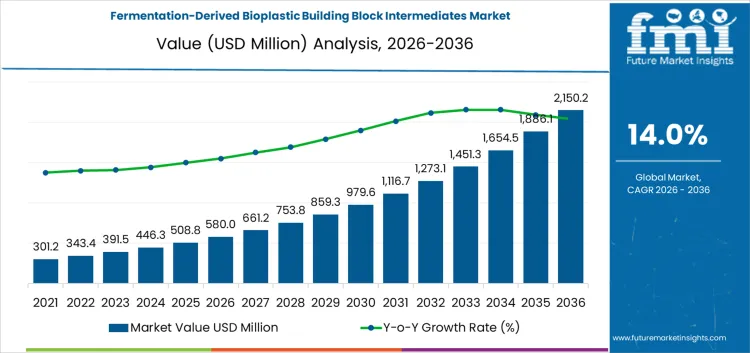
The fermentation-derived bioplastic building block intermediates market is projected to grow from USD 580 million in 2026 to USD 2,150.2 million by 2036, reflecting a compound annual growth rate (CAGR) of 14%. The industry’s performance will be heavily influenced by the cost structures involved in producing bioplastics, where raw material costs, production scale, and technology investment play significant roles. Suppliers with efficient production processes and the ability to leverage economies of scale will have greater pricing control, positioning them to capture higher value. Margin concentration will likely shift toward larger, established players who can manage the higher costs associated with fermentation processes and ensure product consistency. Smaller entrants may face challenges in achieving profitability without achieving similar scale, limiting their ability to compete on pricing alone. The ability to innovate while controlling costs will be crucial for value capture, with companies able to scale production without sacrificing quality best positioned to lead in this growing market.
Quick Stats of the Fermentation-Derived Bioplastic Building Block Intermediates Market
- Fermentation-Derived Bioplastic Building Block Intermediates Market Value (2026): USD 580 million
- Fermentation-Derived Bioplastic Building Block Intermediates Market Forecast Value (2036): USD 2,150.2 million
- Fermentation-Derived Bioplastic Building Block Intermediates Market Global Forecast CAGR (2026-2036): 14%
- Fermentation-Derived Bioplastic Building Block Intermediates Market Leading Segment: End Use Application (Bioplastics & Packaging) 49%
- Key Growth Regions in Fermentation-Derived Bioplastic Building Block Intermediates Market: USA
- Top Players in Fermentation-Derived Bioplastic Building Block Intermediates Market: Braskem S.A., Corbion N.V., Cargill Incorporated, BASF SE, DuPont de Nemours, Inc., Genomatica, Inc., Avantium N.V., Novozymes A/S, Royal DSM N.V., Roquette Frères
What is the Growth Forecast for the Fermentation-Derived Bioplastic Building Block Intermediates Market through 2036?
The Year-on-Year (YoY) growth analysis for the fermentation-derived bioplastic building block intermediates market reveals consistent, strong growth throughout the forecast period. From 2026 to 2027, the market will grow from USD 580 million to USD 661 million, reflecting an increase of USD 81 million. This early-stage growth is driven by increasing awareness and adoption of bioplastics as a sustainable alternative to conventional plastics. The market will continue to expand in the following years, with notable YoY growth, reaching USD 754 million in 2028, representing an additional USD 93 million from the previous year.
As the market matures, the YoY growth will remain strong but gradually stabilize. From 2029 to 2030, the market will increase by USD 121 million, from USD 860 million to USD 981 million, driven by further innovations in fermentation technologies and the increasing application of bioplastics across various industries. The growth rate will continue to be robust through the 2030s, with USD 131 million added in 2031, and USD 149 million in 2032. The steady growth pattern reflects the growing integration of fermentation-derived intermediates in bioplastic production, supported by the global shift toward sustainable, renewable materials. As the market reaches maturity, it will continue to benefit from advancements in fermentation processes, scaling efficiencies, and increased regulatory support for eco-friendly materials.
Fermentation-Derived Bioplastic Building Block Intermediates Market Key Takeaways
| Metric | Value |
|---|---|
| Industry Sales Value (2026) | USD 580 million |
| Industry Forecast Value (2036) | USD 2,150.2 million |
| Industry Forecast CAGR (2026-2036) | 14% |
What Is Driving the Demand for Fermentation-Derived Bioplastic Building Block Intermediates Market?
Historical demand for fermentation-derived bioplastic building block intermediates grew from long-standing reliance on microbial and biochemical processes to produce chemicals that serve as precursors for polymers and other materials. Fermentation technology has been used by the chemical industry to produce a range of products including organic acids, alcohols, and other compounds that function as chemical building blocks. Microorganisms convert renewable feedstocks such as sugars and starches into compounds like lactic acid, which can be polymerised to form polylactic acid (PLA), and other monomers relevant to bioplastics production. This approach developed alongside early adoption of fermentation for bulk chemicals and bioproducts in the 20th century, when fermentative routes offered alternatives to petrochemical synthesis and enabled production of renewable organic acids and alcohols. Broader interest in bio-based materials grew from research into sustainable polymers made from renewable monomers rather than fossil feedstocks, creating a foundation for using fermentation-derived intermediates in bioplastics design. These historical developments supported early innovation in renewable monomer pathways and the integration of fermentation products into polymer synthesis.
Future demand for fermentation-derived bioplastic building block intermediates is expected to be shaped by rapid expansion of the bioplastics market and increasing regulatory and consumer focus on sustainable materials. The global bioplastics market is projected to grow at a high compound annual growth rate, with capacity and value expected to increase significantly through 2032 as bioplastics replace conventional plastics in packaging and other applications. Growth factors include rising demand for bio-based alternatives to petrochemical plastics, increasing environmental regulations that support reduced carbon footprint and circular economy practices, and advances in microbial biotechnology that enhance yields and cost efficiency of fermentation processes for monomers and intermediates. Technical development in fermentation technologies and metabolic engineering expands the range of achievable bio-based building blocks, supporting polymer diversity and performance needs. Challenges include economic competitiveness with fossil-based intermediates and scaling production infrastructure to meet industrial demand. Continued investment in biorefinery capacity and fermentation research is likely to influence broader adoption of fermentation-derived building blocks in bioplastics supply chains.
What are the Leading Segments in the Global Fermentation-Derived Bioplastic Building Block Intermediates Market?
The global fermentation-derived bioplastic building block intermediates market is segmented by feedstock source and end-use application. Among feedstock sources, sugar-based feedstocks lead the market, capturing 46% of the share, followed by lignocellulosic biomass, agricultural by-products/wastes, and other renewable feedstocks. Sugar-based feedstocks are preferred for their high availability and efficiency in fermentation processes used to produce bioplastics. On the end-use application side, bioplastics & packaging dominate the market, holding 49% of the share, followed by automotive & durable goods, textiles & fibers, agriculture & films, and other industrial polymers. Bioplastics & packaging represent the largest segment due to the growing demand for sustainable alternatives to conventional plastic in packaging solutions.
What Drives the Growth of Sugar-Based Feedstocks in the Fermentation-Derived Bioplastic Building Block Intermediates Market?
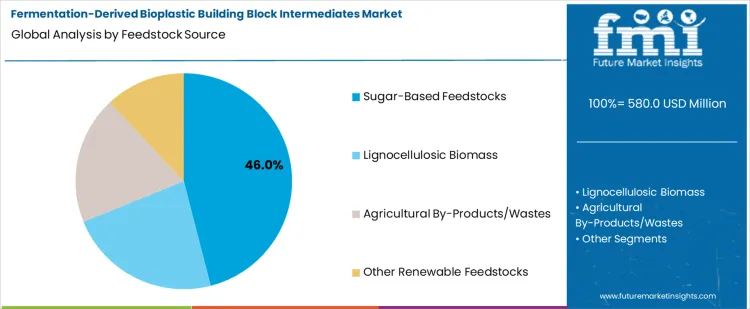
Sugar-based feedstocks are the leading feedstock source in the fermentation-derived bioplastic building block intermediates market, holding 46% of the share. This growth is driven by the high availability of sugar, particularly from crops such as sugarcane and corn, which are commonly used in fermentation processes to produce bioplastics. Sugar-based feedstocks are ideal for fermentation because they are rich in fermentable sugars, which yield higher yields of bioplastics compared to other feedstocks. Additionally, these feedstocks offer a well-established supply chain and manufacturing infrastructure, making them the preferred choice for large-scale bioplastic production. As demand for sustainable packaging solutions continues to grow, the use of sugar-based feedstocks is expected to remain strong. The rising emphasis on reducing plastic waste and the environmental impact of conventional plastics is further driving the adoption of bioplastics derived from sugar-based feedstocks in industries such as packaging and consumer goods. As bioplastics gain popularity as eco-friendly alternatives, sugar-based feedstocks will continue to be a dominant component in the market for fermentation-derived bioplastic building blocks.
What is Driving the Demand for Bioplastics & Packaging in the Fermentation-Derived Bioplastic Building Block Intermediates Market?
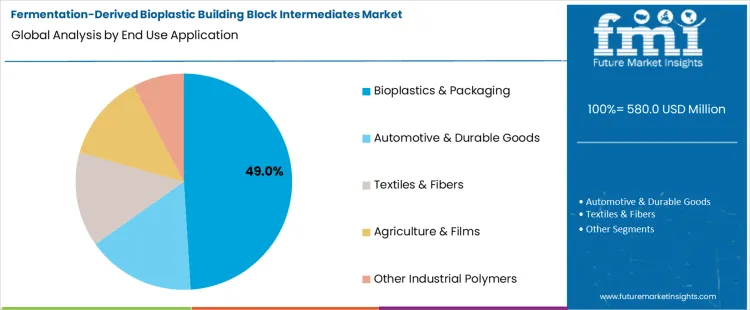
Bioplastics & packaging is the leading end-use application in the fermentation-derived bioplastic building block intermediates market, holding 49% of the share. This demand is driven by the growing concern over plastic waste and the increasing shift toward sustainable materials. Bioplastics offer a viable solution to reduce reliance on petroleum-based plastics, especially in packaging, which represents a significant portion of plastic consumption globally. As consumer demand for environmentally friendly products rises, companies are increasingly turning to bioplastics as an alternative for packaging solutions. These bioplastics, derived from renewable sources such as sugar-based feedstocks, provide a sustainable option that can be composted or recycled, reducing their environmental footprint. Regulatory pressures on reducing single-use plastics and the growing preference for eco-conscious packaging are further boosting the demand for bioplastics in the packaging industry. As sustainability becomes a primary focus in product development, the use of fermentation-derived bioplastics in packaging will continue to grow, maintaining its dominance in the market.
What are the Key Dynamics in the Fermentation-Derived Bioplastic Building Block Intermediates Market?
The fermentation-derived bioplastic building block intermediates market is influenced by efforts to replace petrochemical feedstocks with bio-based monomers and platform chemicals for plastics production. Intermediates such as organic acids and bio-based monomers produced via microbial fermentation serve as precursors for biodegradable plastics and biopolymers, supporting value chains focused on sustainable material solutions. These intermediates are evaluated for purity, scalability, and compatibility with downstream polymerization processes. Regulation encouraging renewable content and reduced reliance on fossil resources affects how industries adopt fermentation routes. Supply chains for biomass feedstock and fermentation technology also affect market activity.
What are the Main Drivers Supporting Growth in This Market?
A driving factor for this market is increasing industrial and regulatory emphasis on sustainable material production, with industries seeking alternatives to conventional plastics to reduce environmental impact. Fermentation processes enable production of renewable building blocks, expanding the range of bio-based monomers for plastic synthesis and supporting growth in biodegradable and bio-based plastics applications. Market interest in circular economy objectives and waste reduction further supports adoption of fermentation-derived intermediates. Research and development in fermentation technology, including metabolic engineering, are enhancing yields and lowering production costs, reinforcing the role of bio-based feedstocks as building blocks for bioplastics. Fermentation chemicals overall are growing as demand for bio-based inputs rises across sectors.
What Restraints Are Limiting Market Expansion?
Market expansion can be limited by high production costs and feedstock variability, which create economic challenges relative to established petrochemical building blocks. Availability and cost of biomass input affect fermentation economics, particularly in regions without developed biorefinery infrastructure. Technical hurdles in scale-up and consistent quality of fermentation-derived monomers can deter adoption in high-volume plastics manufacturing. Supply chain limitations for renewable feedstock and specialized fermentation equipment further constrain growth. Development of robust, cost-competitive fermentation platforms remains a barrier for some bio-based building block intermediates to achieve widespread commercial scale.
What Emerging Trends Are Shaping Future Development in This Market?
Emerging trends include advances in fermentation technology and synthetic biology that are expanding the portfolio of bio-based monomers and intermediates suitable for bioplastic production. Researchers increasingly focus on metabolic pathway optimisation to produce novel building blocks at higher yields and lower costs. Integration of biorefinery concepts that valorise waste biomass and lignocellulosic feedstocks supports broader sustainability goals. There is growing linkage between the fermentation-derived intermediates market and the broader bioplastics sector, which is projected to grow as demand rises for biodegradable and renewable polymer solutions. Industry collaboration to improve fermentation processes and build infrastructure at commercial scale is also influencing market direction.
What is the Country-Wise Analysis of the Fermentation-Derived Bioplastic Building Block Intermediates Market?
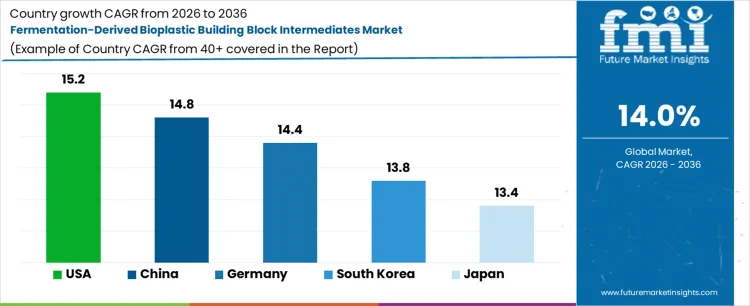
The fermentation-derived bioplastic building block intermediates market is experiencing significant growth, driven by the increasing demand for sustainable and eco-friendly alternatives to conventional petroleum-based plastics. These intermediates, derived through fermentation processes, are used to produce bioplastics, which are gaining popularity due to their lower environmental impact. Developed markets like the USA, Germany, South Korea, and Japan are seeing steady demand for these bioplastics, driven by stringent environmental regulations and growing consumer demand for sustainable products. Emerging markets like China are also experiencing rapid growth, fueled by the country’s focus on reducing plastic waste and improving sustainability in manufacturing. As global efforts to reduce plastic pollution and promote circular economies intensify, the market for fermentation-derived bioplastic building block intermediates is expected to expand significantly.
| Country | CAGR (2026-2036) |
|---|---|
| USA | 15.2% |
| China | 14.8% |
| Germany | 14.4% |
| South Korea | 13.8% |
| Japan | 13.4% |
What is the Growth Outlook for the Fermentation-Derived Bioplastic Building Block Intermediates Market in the USA?
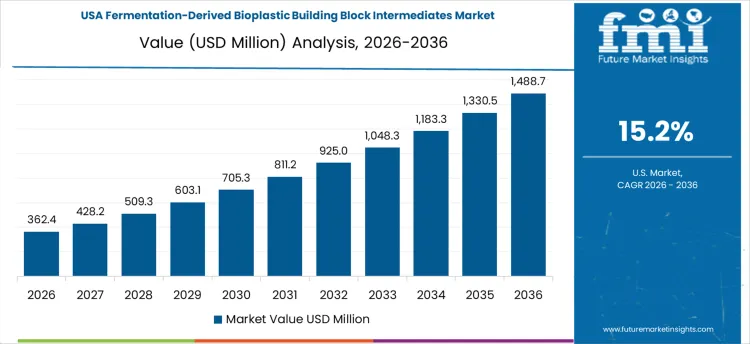
The fermentation-derived bioplastic building block intermediates market in the USA is expected to grow steadily, with a projected CAGR of 15.2% from 2026 to 2036. The USA is a global leader in sustainability and innovation, and the demand for bioplastics is increasing as businesses and consumers focus more on eco-friendly products. The U.S. government has also introduced policies to encourage the development and use of sustainable materials, further driving the adoption of fermentation-derived bioplastics. These building block intermediates are being used to produce bioplastics that offer a viable alternative to traditional plastics, addressing environmental concerns about plastic waste. As sustainability continues to be a priority for industries in the USA, the market for fermentation-derived bioplastic building block intermediates is expected to experience steady growth in the coming years.
What is the Market Outlook for the Fermentation-Derived Bioplastic Building Block Intermediates Market in China?
China is projected to experience strong growth in the fermentation-derived bioplastic building block intermediates market, with a projected CAGR of 14.8% from 2026 to 2036. As one of the world’s largest plastic producers, China is increasingly focused on finding sustainable alternatives to conventional plastics due to growing environmental concerns and regulatory pressures. The Chinese government has set ambitious goals to reduce plastic pollution and enhance sustainability in manufacturing, driving demand for bioplastics. Fermentation-derived bioplastics are a promising solution, and their adoption is expected to grow rapidly in China’s manufacturing sectors. With the growing demand for eco-friendly alternatives, coupled with the government’s support for sustainable development, the market for fermentation-derived bioplastic building block intermediates is expected to expand significantly in China.
What is the Growth Forecast for the Fermentation-Derived Bioplastic Building Block Intermediates Market in Germany?
Germany is expected to see steady growth in the fermentation-derived bioplastic building block intermediates market, with a projected CAGR of 14.4% from 2026 to 2036. Germany’s commitment to sustainability and reducing environmental impact makes it a key market for bioplastics. The German government has been proactive in promoting the use of sustainable materials and has introduced regulations to reduce plastic waste. Bioplastics derived from fermentation offer an eco-friendly alternative to conventional plastics, and as German companies embrace more sustainable practices, the demand for fermentation-derived bioplastics is growing. With increasing consumer awareness and demand for green products, the market for fermentation-derived bioplastic building block intermediates in Germany is expected to grow steadily.
What is the Market Outlook for the Fermentation-Derived Bioplastic Building Block Intermediates Market in South Korea?
South Korea is projected to experience steady growth in the fermentation-derived bioplastic building block intermediates market, with a projected CAGR of 13.8% from 2026 to 2036. South Korea’s strong focus on sustainability and innovation, combined with government support for eco-friendly products, is driving the demand for bioplastics. As the country seeks to reduce plastic waste and carbon emissions, fermentation-derived bioplastics are becoming an increasingly popular alternative. The government’s push for green technologies, coupled with growing consumer demand for sustainable products, will continue to support the growth of the market. As the South Korean manufacturing sector adopts more sustainable practices, the market for fermentation-derived bioplastic building block intermediates is expected to grow steadily.
What is the Growth Forecast for the Fermentation-Derived Bioplastic Building Block Intermediates Market in Japan?
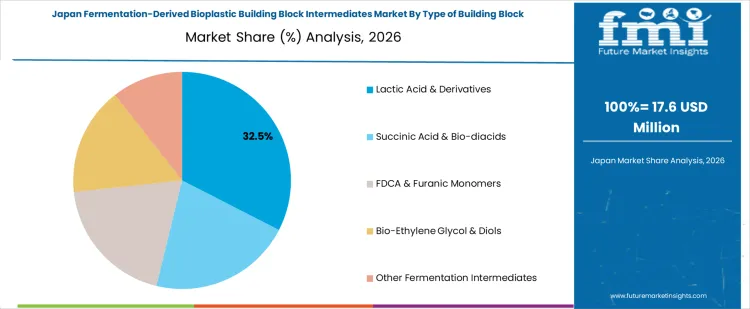
Japan is expected to see steady growth in the fermentation-derived bioplastic building block intermediates market, with a projected CAGR of 13.4% from 2026 to 2036. Japan’s commitment to environmental sustainability and reducing plastic pollution is driving the adoption of bioplastics. With increasing awareness about the environmental impact of traditional plastics, Japanese companies are focusing on innovative solutions like fermentation-derived bioplastics. The government has introduced policies to support the development and use of sustainable materials, contributing to the market’s growth. As Japan continues to prioritize sustainability in its industrial and consumer sectors, the demand for fermentation-derived bioplastics is expected to increase, driving the growth of the market for these building block intermediates.
What are the Growth Prospects for the Fermentation-Derived Bioplastic Building Block Intermediates Market Globally?
Globally, the fermentation-derived bioplastic building block intermediates market is set for substantial growth as the agricultural and industrial sectors increasingly seek sustainable alternatives to conventional plastics. With concerns over plastic pollution and environmental sustainability on the rise, fermentation-derived bioplastics provide a promising solution that can help reduce reliance on petroleum-based plastics. As governments around the world introduce stricter regulations to reduce plastic waste, the demand for bioplastics, particularly those derived from fermentation processes, is expected to grow. The market is driven by increasing investments in green technologies and innovations in sustainable manufacturing. As both developed and emerging economies adopt circular economy principles and focus on reducing environmental impacts, the market for fermentation-derived bioplastic building block intermediates is projected to expand significantly over the next decade.
What is the Competitive Landscape for the Fermentation-Derived Bioplastic Building Block Intermediates Market?
The fermentation-derived bioplastic building block intermediates market is growing rapidly as industries and consumers seek sustainable alternatives to petroleum-based plastics. Braskem S.A. leads the market with its innovative fermentation-derived bioplastic building block intermediates, offering eco-friendly, high-performance products that are key components in the production of bioplastics. Their strong focus on sustainability, technological innovation, and regulatory compliance has positioned them as a dominant player in this sector. Corbion N.V., Cargill Incorporated, and BASF SE are significant competitors, each providing advanced bioplastic intermediates derived from renewable resources. Corbion N.V. focuses on providing sustainable and high-quality building blocks for bioplastics, while Cargill delivers fermentation-based solutions designed to enhance bioplastic production. BASF SE contributes to the market with its sustainable, fermentation-derived intermediates that support the growing demand for eco-friendly alternatives to traditional plastics.
DuPont de Nemours, Inc., Genomatica, Inc., and Avantium N.V. further strengthen the competitive landscape by offering their own fermentation-derived bioplastic intermediates. DuPont specializes in sustainable materials for the bioplastics industry, while Genomatica focuses on biotechnology and fermentation processes for sustainable chemical production. Avantium N.V. offers advanced renewable and biodegradable materials made from fermentation-derived building blocks. Novozymes A/S, Royal DSM N.V., and Roquette Frères also contribute to the market by developing high-performance, eco-friendly intermediates that support the production of bioplastics. These companies compete by focusing on product innovation, sustainability, and the growing consumer demand for bioplastics as a solution to environmental concerns. As the push for sustainable, renewable materials continues, the fermentation-derived bioplastic building block intermediates market is expected to expand, fostering further competition and innovation in the sector.
Key Players of the Fermentation-Derived Bioplastic Building Block Intermediates Market
- Braskem S.A.
- Corbion N.V.
- Cargill Incorporated
- BASF SE
- DuPont de Nemours, Inc.
- Genomatica, Inc.
- Avantium N.V.
- Novozymes A/S
- Royal DSM N.V.
- Roquette Frères
Scope of the Report
| Items | Values |
|---|---|
| Quantitative Units (2026) | USD Million |
| Type of Building Block Intermediates | Lactic Acid & Derivatives, Succinic Acid & Bio-diacids, FDCA & Furanic Monomers, Bio-Ethylene Glycol & Diols, Other Fermentation Intermediates |
| Feedstock Source | Sugar-Based Feedstocks, Lignocellulosic Biomass, Agricultural By-Products/Wastes, Other Renewable Feedstocks |
| End Use Application | Bioplastics & Packaging, Automotive & Durable Goods, Textiles & Fibers, Agriculture & Films, Other Industrial Polymers |
| Companies | Braskem S.A., Corbion N.V., Cargill Incorporated, BASF SE, DuPont de Nemours, Inc., Genomatica, Inc., Avantium N.V., Novozymes A/S, Royal DSM N.V., Roquette Frères |
| Regions Covered | North America, Latin America, Western Europe, Eastern Europe, South Asia & Pacific, East Asia, Middle East & Africa |
| Countries Covered | United States, Canada, Mexico, Brazil, Argentina, Germany, France, United Kingdom, Italy, Spain, Netherlands, China, India, Japan, South Korea, ANZ, GCC Countries, South Africa |
| Additional Attributes | Dollar by sales by type of building block intermediate, feedstock source, end use application, and region. Includes analysis of market trends in fermentation-derived bioplastic building block intermediates, performance in biopolymer and industrial applications, cost and feedstock sourcing dynamics, regulatory and sustainability considerations affecting renewable intermediate adoption, technology and process innovation impacts, market share and competitive positioning of key companies, and evaluation of influence on product performance, environmental footprint, and industrial bioplastic value chains. |
Fermentation-Derived Bioplastic Building Block Intermediates Market Segmentation
Type of Building Block Intermediates
- Lactic Acid & Derivatives
- Succinic Acid & Bio-diacids
- FDCA & Furanic Monomers
- Bio-Ethylene Glycol & Diols
- Other Fermentation Intermediates
Feedstock Source
- Sugar-Based Feedstocks
- Lignocellulosic Biomass
- Agricultural By-Products/Wastes
- Other Renewable Feedstocks
End Use Application
- Bioplastics & Packaging
- Automotive & Durable Goods
- Textiles & Fibers
- Agriculture & Films
- Other Industrial Polymers
Region
- Asia Pacific
- China
- Japan
- South Korea
- India
- Australia & New Zealand
- ASEAN
- Rest of Asia Pacific
- Europe
- Germany
- United Kingdom
- France
- Italy
- Spain
- Nordic
- BENELUX
- Rest of Europe
- North America
- United States
- Canada
- Mexico
- Latin America
- Brazil
- Chile
- Rest of Latin America
- Middle East & Africa
- Kingdom of Saudi Arabia
- Other GCC Countries
- Turkey
- South Africa
- Other African Union
- Rest of Middle East & Africa
Frequently Asked Questions
How big is the fermentation-derived bioplastic building block intermediates market in 2026?
The global fermentation-derived bioplastic building block intermediates market is estimated to be valued at USD 580.0 million in 2026.
What will be the size of fermentation-derived bioplastic building block intermediates market in 2036?
The market size for the fermentation-derived bioplastic building block intermediates market is projected to reach USD 2,150.2 million by 2036.
How much will be the fermentation-derived bioplastic building block intermediates market growth between 2026 and 2036?
The fermentation-derived bioplastic building block intermediates market is expected to grow at a 14.0% CAGR between 2026 and 2036.
What are the type of building block intermediates segment in the fermentation-derived bioplastic building block intermediates market?
The type of building block intermediates segment in fermentation-derived bioplastic building block intermediates market are lactic acid & derivatives, succinic acid & bio‑diacids, FDCA & furanic monomers, bio‑ethylene glycol & diols, and other fermentation intermediates.
Which feedstock source segment to contribute significant share in the fermentation-derived bioplastic building block intermediates market in 2026?
In terms of feedstock source, sugar‑based feedstocks segment to command 46.0% share in the fermentation-derived bioplastic building block intermediates market in 2026.
Preview the report firsthand - request a free sample
Get SampleGet the brochure for pricing and purchase details.
Get PDFTable of Content
- Executive Summary
- Global Market Outlook
- Demand-side Trends
- Supply-side Trends
- Technology Roadmap Analysis
- Analysis and Recommendations
- Market Overview
- Market Coverage / Taxonomy
- Market Definition / Scope / Limitations
- Market Background
- Market Dynamics
- Drivers
- Restraints
- Opportunity
- Trends
- Scenario Forecast
- Demand in Optimistic Scenario
- Demand in Likely Scenario
- Demand in Conservative Scenario
- Opportunity Map Analysis
- Product Life Cycle Analysis
- Supply Chain Analysis
- Investment Feasibility Matrix
- Value Chain Analysis
- PESTLE and Porter’s Analysis
- Regulatory Landscape
- Regional Parent Market Outlook
- Production and Consumption Statistics
- Import and Export Statistics
- Market Dynamics
- Global Market Analysis 2021 to 2025 and Forecast, 2026 to 2036
- Historical Market Size Value (USD Million) Analysis, 2021 to 2025
- Current and Future Market Size Value (USD Million) Projections, 2026 to 2036
- Y-o-Y Growth Trend Analysis
- Absolute $ Opportunity Analysis
- Global Market Pricing Analysis 2021 to 2025 and Forecast 2026 to 2036
- Global Market Analysis 2021 to 2025 and Forecast 2026 to 2036, By Type of Building Block Intermediates
- Introduction / Key Findings
- Historical Market Size Value (USD Million) Analysis By Type of Building Block Intermediates , 2021 to 2025
- Current and Future Market Size Value (USD Million) Analysis and Forecast By Type of Building Block Intermediates , 2026 to 2036
- Lactic Acid & Derivatives
- Succinic Acid & Bio‑diacids
- FDCA & Furanic Monomers
- Bio‑Ethylene Glycol & Diols
- Other Fermentation Intermediates
- Lactic Acid & Derivatives
- Y-o-Y Growth Trend Analysis By Type of Building Block Intermediates , 2021 to 2025
- Absolute $ Opportunity Analysis By Type of Building Block Intermediates , 2026 to 2036
- Global Market Analysis 2021 to 2025 and Forecast 2026 to 2036, By Feedstock Source
- Introduction / Key Findings
- Historical Market Size Value (USD Million) Analysis By Feedstock Source, 2021 to 2025
- Current and Future Market Size Value (USD Million) Analysis and Forecast By Feedstock Source, 2026 to 2036
- Sugar‑Based Feedstocks
- Lignocellulosic Biomass
- Agricultural By‑Products/Wastes
- Other Renewable Feedstocks
- Sugar‑Based Feedstocks
- Y-o-Y Growth Trend Analysis By Feedstock Source, 2021 to 2025
- Absolute $ Opportunity Analysis By Feedstock Source, 2026 to 2036
- Global Market Analysis 2021 to 2025 and Forecast 2026 to 2036, By End Use Application
- Introduction / Key Findings
- Historical Market Size Value (USD Million) Analysis By End Use Application, 2021 to 2025
- Current and Future Market Size Value (USD Million) Analysis and Forecast By End Use Application, 2026 to 2036
- Bioplastics & Packaging
- Automotive & Durable Goods
- Textiles & Fibers
- Agriculture & Films
- Other Industrial Polymers
- Bioplastics & Packaging
- Y-o-Y Growth Trend Analysis By End Use Application, 2021 to 2025
- Absolute $ Opportunity Analysis By End Use Application, 2026 to 2036
- Global Market Analysis 2021 to 2025 and Forecast 2026 to 2036, By Region
- Introduction
- Historical Market Size Value (USD Million) Analysis By Region, 2021 to 2025
- Current Market Size Value (USD Million) Analysis and Forecast By Region, 2026 to 2036
- North America
- Latin America
- Western Europe
- Eastern Europe
- East Asia
- South Asia and Pacific
- Middle East & Africa
- Market Attractiveness Analysis By Region
- North America Market Analysis 2021 to 2025 and Forecast 2026 to 2036, By Country
- Historical Market Size Value (USD Million) Trend Analysis By Market Taxonomy, 2021 to 2025
- Market Size Value (USD Million) Forecast By Market Taxonomy, 2026 to 2036
- By Country
- USA
- Canada
- Mexico
- By Type of Building Block Intermediates
- By Feedstock Source
- By End Use Application
- By Country
- Market Attractiveness Analysis
- By Country
- By Type of Building Block Intermediates
- By Feedstock Source
- By End Use Application
- Key Takeaways
- Latin America Market Analysis 2021 to 2025 and Forecast 2026 to 2036, By Country
- Historical Market Size Value (USD Million) Trend Analysis By Market Taxonomy, 2021 to 2025
- Market Size Value (USD Million) Forecast By Market Taxonomy, 2026 to 2036
- By Country
- Brazil
- Chile
- Rest of Latin America
- By Type of Building Block Intermediates
- By Feedstock Source
- By End Use Application
- By Country
- Market Attractiveness Analysis
- By Country
- By Type of Building Block Intermediates
- By Feedstock Source
- By End Use Application
- Key Takeaways
- Western Europe Market Analysis 2021 to 2025 and Forecast 2026 to 2036, By Country
- Historical Market Size Value (USD Million) Trend Analysis By Market Taxonomy, 2021 to 2025
- Market Size Value (USD Million) Forecast By Market Taxonomy, 2026 to 2036
- By Country
- Germany
- UK
- Italy
- Spain
- France
- Nordic
- BENELUX
- Rest of Western Europe
- By Type of Building Block Intermediates
- By Feedstock Source
- By End Use Application
- By Country
- Market Attractiveness Analysis
- By Country
- By Type of Building Block Intermediates
- By Feedstock Source
- By End Use Application
- Key Takeaways
- Eastern Europe Market Analysis 2021 to 2025 and Forecast 2026 to 2036, By Country
- Historical Market Size Value (USD Million) Trend Analysis By Market Taxonomy, 2021 to 2025
- Market Size Value (USD Million) Forecast By Market Taxonomy, 2026 to 2036
- By Country
- Russia
- Poland
- Hungary
- Balkan & Baltic
- Rest of Eastern Europe
- By Type of Building Block Intermediates
- By Feedstock Source
- By End Use Application
- By Country
- Market Attractiveness Analysis
- By Country
- By Type of Building Block Intermediates
- By Feedstock Source
- By End Use Application
- Key Takeaways
- East Asia Market Analysis 2021 to 2025 and Forecast 2026 to 2036, By Country
- Historical Market Size Value (USD Million) Trend Analysis By Market Taxonomy, 2021 to 2025
- Market Size Value (USD Million) Forecast By Market Taxonomy, 2026 to 2036
- By Country
- China
- Japan
- South Korea
- By Type of Building Block Intermediates
- By Feedstock Source
- By End Use Application
- By Country
- Market Attractiveness Analysis
- By Country
- By Type of Building Block Intermediates
- By Feedstock Source
- By End Use Application
- Key Takeaways
- South Asia and Pacific Market Analysis 2021 to 2025 and Forecast 2026 to 2036, By Country
- Historical Market Size Value (USD Million) Trend Analysis By Market Taxonomy, 2021 to 2025
- Market Size Value (USD Million) Forecast By Market Taxonomy, 2026 to 2036
- By Country
- India
- ASEAN
- Australia & New Zealand
- Rest of South Asia and Pacific
- By Type of Building Block Intermediates
- By Feedstock Source
- By End Use Application
- By Country
- Market Attractiveness Analysis
- By Country
- By Type of Building Block Intermediates
- By Feedstock Source
- By End Use Application
- Key Takeaways
- Middle East & Africa Market Analysis 2021 to 2025 and Forecast 2026 to 2036, By Country
- Historical Market Size Value (USD Million) Trend Analysis By Market Taxonomy, 2021 to 2025
- Market Size Value (USD Million) Forecast By Market Taxonomy, 2026 to 2036
- By Country
- Kingdom of Saudi Arabia
- Other GCC Countries
- Turkiye
- South Africa
- Other African Union
- Rest of Middle East & Africa
- By Type of Building Block Intermediates
- By Feedstock Source
- By End Use Application
- By Country
- Market Attractiveness Analysis
- By Country
- By Type of Building Block Intermediates
- By Feedstock Source
- By End Use Application
- Key Takeaways
- Key Countries Market Analysis
- USA
- Pricing Analysis
- Market Share Analysis, 2025
- By Type of Building Block Intermediates
- By Feedstock Source
- By End Use Application
- Canada
- Pricing Analysis
- Market Share Analysis, 2025
- By Type of Building Block Intermediates
- By Feedstock Source
- By End Use Application
- Mexico
- Pricing Analysis
- Market Share Analysis, 2025
- By Type of Building Block Intermediates
- By Feedstock Source
- By End Use Application
- Brazil
- Pricing Analysis
- Market Share Analysis, 2025
- By Type of Building Block Intermediates
- By Feedstock Source
- By End Use Application
- Chile
- Pricing Analysis
- Market Share Analysis, 2025
- By Type of Building Block Intermediates
- By Feedstock Source
- By End Use Application
- Germany
- Pricing Analysis
- Market Share Analysis, 2025
- By Type of Building Block Intermediates
- By Feedstock Source
- By End Use Application
- UK
- Pricing Analysis
- Market Share Analysis, 2025
- By Type of Building Block Intermediates
- By Feedstock Source
- By End Use Application
- Italy
- Pricing Analysis
- Market Share Analysis, 2025
- By Type of Building Block Intermediates
- By Feedstock Source
- By End Use Application
- Spain
- Pricing Analysis
- Market Share Analysis, 2025
- By Type of Building Block Intermediates
- By Feedstock Source
- By End Use Application
- France
- Pricing Analysis
- Market Share Analysis, 2025
- By Type of Building Block Intermediates
- By Feedstock Source
- By End Use Application
- India
- Pricing Analysis
- Market Share Analysis, 2025
- By Type of Building Block Intermediates
- By Feedstock Source
- By End Use Application
- ASEAN
- Pricing Analysis
- Market Share Analysis, 2025
- By Type of Building Block Intermediates
- By Feedstock Source
- By End Use Application
- Australia & New Zealand
- Pricing Analysis
- Market Share Analysis, 2025
- By Type of Building Block Intermediates
- By Feedstock Source
- By End Use Application
- China
- Pricing Analysis
- Market Share Analysis, 2025
- By Type of Building Block Intermediates
- By Feedstock Source
- By End Use Application
- Japan
- Pricing Analysis
- Market Share Analysis, 2025
- By Type of Building Block Intermediates
- By Feedstock Source
- By End Use Application
- South Korea
- Pricing Analysis
- Market Share Analysis, 2025
- By Type of Building Block Intermediates
- By Feedstock Source
- By End Use Application
- Russia
- Pricing Analysis
- Market Share Analysis, 2025
- By Type of Building Block Intermediates
- By Feedstock Source
- By End Use Application
- Poland
- Pricing Analysis
- Market Share Analysis, 2025
- By Type of Building Block Intermediates
- By Feedstock Source
- By End Use Application
- Hungary
- Pricing Analysis
- Market Share Analysis, 2025
- By Type of Building Block Intermediates
- By Feedstock Source
- By End Use Application
- Kingdom of Saudi Arabia
- Pricing Analysis
- Market Share Analysis, 2025
- By Type of Building Block Intermediates
- By Feedstock Source
- By End Use Application
- Turkiye
- Pricing Analysis
- Market Share Analysis, 2025
- By Type of Building Block Intermediates
- By Feedstock Source
- By End Use Application
- South Africa
- Pricing Analysis
- Market Share Analysis, 2025
- By Type of Building Block Intermediates
- By Feedstock Source
- By End Use Application
- USA
- Market Structure Analysis
- Competition Dashboard
- Competition Benchmarking
- Market Share Analysis of Top Players
- By Regional
- By Type of Building Block Intermediates
- By Feedstock Source
- By End Use Application
- Competition Analysis
- Competition Deep Dive
- Corbion N.V.
- Overview
- Product Portfolio
- Profitability by Market Segments (Product/Age /Sales Channel/Region)
- Sales Footprint
- Strategy Overview
- Marketing Strategy
- Product Strategy
- Channel Strategy
- Cargill Incorporated
- BASF SE
- DuPont de Nemours, Inc.
- Genomatica, Inc.
- Avantium N.V.
- Novozymes A/S
- Royal DSM N.V.
- Roquette Frères
- Corbion N.V.
- Competition Deep Dive
- Assumptions & Acronyms Used
- Research Methodology


