

- Market Size (2026)
- USD 167.5 Mn
- Forecast (2036)
- USD 385.8 Mn
- CAGR (2026 to 2036)
- 8.7%
UV-Blocking Nanoparticle Additives for Agricultural Films Market Size, Forecast, and Outlook By FMI
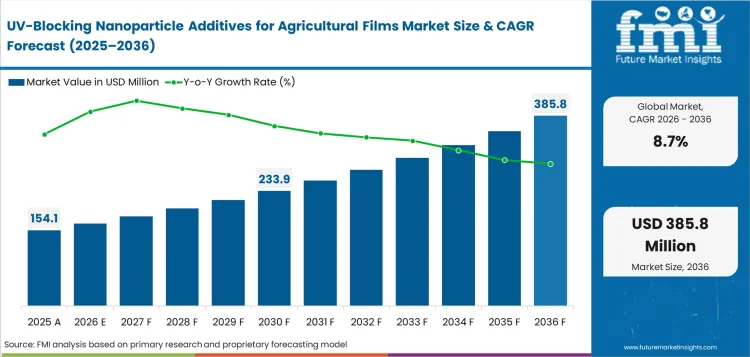
UV-blocking nanoparticle additives for the agricultural films market reached USD 154.1 million in 2025 and is expected to reach USD 167.5 million by 2026-end. Market value is projected to reach USD 385.8 million by 2036 after expanding at 8.7% CAGR between 2026 and 2036.
Summary of the UV-Blocking Nanoparticle Additives for Agricultural Films Market
- Demand and Growth Drivers
- Greenhouse film replacement supports additive demand as multi-season covers face direct ultraviolet exposure during crop cycles.
- Plasticulture quality control reinforces demand as film converters need optical performance and longer cover life in one formulation.
- Policy attention on agricultural plastics raises interest in additive systems with lower loading and better film recovery behavior.
- Product and Segment View
- Polyethylene is expected to lead the polymer matrix segment with 64.0% share in 2026, reflecting strong extrusion familiarity among film converters.
- Masterbatch is expected to lead additive form demand with 58.0% share in 2026, as pellet concentrates reduce dosing error during film production.
- Greenhouse films are expected to hold high-value demand as farms use UV stabilized films for longer sunlight exposure.
- Geography and Competitive Outlook
- China is expected to record a CAGR of 9.6% through 2036, backed by large protected cultivation clusters.
- India is projected to expand at 9.2% CAGR by 2036, as horticulture programs encourage protected structures.
- Companies combining dispersion control with UV-resistant masterbatches expertise strengthen converter relationships.
- Analyst Opinion
- Nikhil Kaitwade, Principal Consultant for Chemicals and Materials at FMI, says, “UV-blocking nanoparticle additives are becoming a formulation control point for agricultural films. Greenhouse film converters need ultraviolet screening with smooth extrusion. Mulch film and tunnel film face cost pressure and nanoparticle dispersion plus field durability evidence reduce material qualification risk.”
- UV-Blocking Nanoparticle Additives for Agricultural Films Market Value Analysis
- The UV-blocking nanoparticle additives for agricultural films market now extends beyond basic UV screening into performance-based film formulation.
- Use is rising as greenhouse films need longer cover life and mulch films need stronger sunlight resistance. The market gains from wider use of horticulture film across protected crop production.
- Masterbatch dosing in film plants favors steadier additive control during high-volume agricultural film production cycles.
- Pellet concentrates help converters manage nanoparticle loading and haze variation without slowing routine extrusion runs.
Key Takeaways, Market Size, and Forecast
- The UV-blocking nanoparticle additives for agricultural films market was valued at USD 154.1 million in 2025.
- By 2036, the UV-blocking nanoparticle additives for agricultural films market is expected to be worth USD 385.8 million.
- From 2026 to 2036, the market is projected to expand at a CAGR of 8.7%.
- The market is projected to create an incremental opportunity of USD 218.3 million between 2026 and 2036.
- In 2026, polyethylene is expected to account for 64.0% of polymer matrix demand.
- China at 9.6% CAGR and India at 9.2% CAGR are some of the industries with significant prospects.
Agricultural film makers are under pressure to block ultraviolet damage without reducing useful light inside greenhouse covers. According to BASF’s July 2024 Tinuvin NOR 211 AR release, buyers now look beyond basic UV screening and ask for resistance against sulfur and chlorine exposure. Crop chemicals can weaken film performance during repeated crop cycles, so additive selection now depends more on chemical-resistance evidence. Optical performance is another buying filter for greenhouse film suppliers. Gu et al. reported SiO₂/TiO₂ coated PE films with 86% maximum visible transmittance and 85% average visible transmittance. Such results help suppliers justify premium formulations during converter trials. Soil-contact films need a different approach because additive release can raise field-risk concerns. Li et al. found 5 wt% ZnO-PVC films induced phytotoxicity and advised ZnO loading below 1 wt%. Formulators need lower-dose packages and migration records for mulch film programs.
UV-Blocking Nanoparticle Additives for Agricultural Films Market Definition
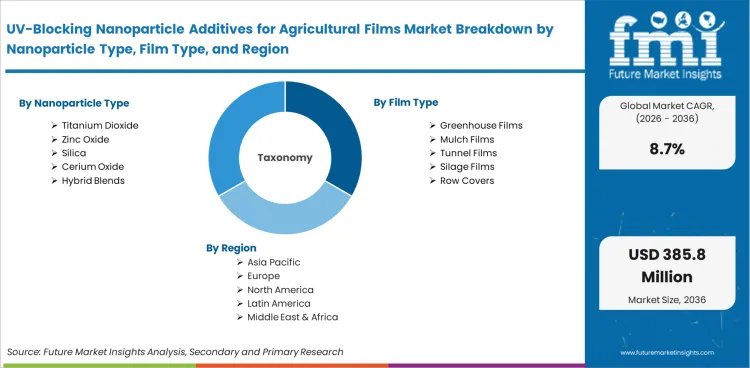
The UV-blocking nanoparticle additives for agricultural films market includes engineered nano-scale additives used to reduce ultraviolet damage in farm films. These additives serve greenhouse films, mulch films, tunnel films, silage films, and row covers. Scope includes titanium dioxide, zinc oxide, silica, cerium oxide, and hybrid blends used in polymer film systems. Finished films without nanoparticle UV systems and crop protection chemicals are outside the scope.
UV-Blocking Nanoparticle Additives for Agricultural Films Market Inclusions
Market scope covers all commercially traded UV-blocking nanoparticle additives for agricultural films categorized by nanoparticle type including titanium dioxide, zinc oxide, silica, cerium oxide, and hybrid blends; film type including greenhouse films, mulch films, tunnel films, silage films, and row covers; polymer matrix including polyethylene, polypropylene, EVA, PVC, and biopolymers; and additive form including masterbatch, liquid dispersion, powder blend, and coating slurry. Revenue scope covers 2026 to 2036. Stakeholders include nanoparticle additive manufacturers, masterbatch producers, polymer compounders, agricultural film converters, greenhouse film suppliers, mulch film producers, protected cultivation operators, horticulture growers, distributors, testing laboratories, and regulatory bodies.
UV-Blocking Nanoparticle Additives for Agricultural Films Market Exclusions
Scope does not include crop sprays, shade nets, irrigation tubing, non-nano UV absorbers, finished greenhouse structures, or packaging films used outside crop production.
UV-Blocking Nanoparticle Additives for Agricultural Films Market Research Methodology
- Primary Research: FMI analysts talked to film converters, masterbatch producers, additive formulators, greenhouse film manufacturers, and agricultural input distributors in major markets.
- Desk Research: Reviewed data from agricultural plastics guidance, protected cultivation statistics, company product portfolios, and polymer additive technical references.
- Market sizing and forecasting: Modeled additive use across film types and polymer matrices from a bottom-up demand model.
- Data validation: Cross-checked every three months against protected cultivation area, film replacement cycles, and company formulation coverage.
Why is the UV-Blocking Nanoparticle Additives for Agricultural Films Market Growing?
- Film converters are using nanoparticle additives earlier to reduce cover aging under intense sunlight exposure.
- Greenhouse operators are choosing films to balance UV screening with useful light entry for crop performance.
- Manufacturers are using masterbatch systems to reduce dosing errors and protect repeat production quality.
Protected cultivation makes a recurring base for ultraviolet screening additives. According to a June 2024 peer-reviewed release greenhouse cultivation covers at least 1.3 million hectares worldwide, with plastic film and glass systems included in the mapping. This area base shows film aging has direct cost impact for greenhouse operators and converter order cycles. Additive systems which preserve strength and optical behavior can protect replacement timing across exposed film applications.
Policy scrutiny is rising for agricultural plastics. According to an FAO report, COAG 29 reviewed the proposed voluntary code for plastics in agriculture in September 2024, and the provisional code was published in February 2025. This gives film-makers a stronger reason to document additive loading and end-of-life behavior. Nanoparticle additive suppliers need field evidence to connect UV blocking with lower release concerns.
Market Segmentation Analysis
- Titanium dioxide is estimated to account for 40.0% of nanoparticle type use in 2026 as film makers rely on proven UV scattering performance.
- Greenhouse films are expected to capture 42.0% share in 2026 since cover durability directly affects replacement cost for growers.
- Broad extrusion use keeps polyethylene at an expected 64.0% share of polymer matrix adoption in 2026.
- Masterbatch is estimated to represent 58.0% of additive form sales in 2026 through better dosing control during film production.
- Direct sales are projected to contribute 55.0% of channel revenue in 2026 as large converters need closer trial coordination.
The market for UV-blocking nanoparticle additives for agricultural films is divided into five primary segment groups based on nanoparticle type, film type, polymer matrix, additive form, and sales channel. Nanoparticle type includes titanium dioxide, zinc oxide, silica, cerium oxide, and hybrid blends. Film type includes greenhouse films, mulch films, tunnel films, silage films, and row covers. Polymer matrix includes polyethylene, polypropylene, EVA, PVC, and biopolymers. Additive form includes masterbatch, liquid dispersion, powder blend, and coating slurry. Sales channel includes direct sales, compounders, distributors, and film converters.
Insights into UV-Blocking Nanoparticle Additives for Agricultural Films Market by Nanoparticle Type
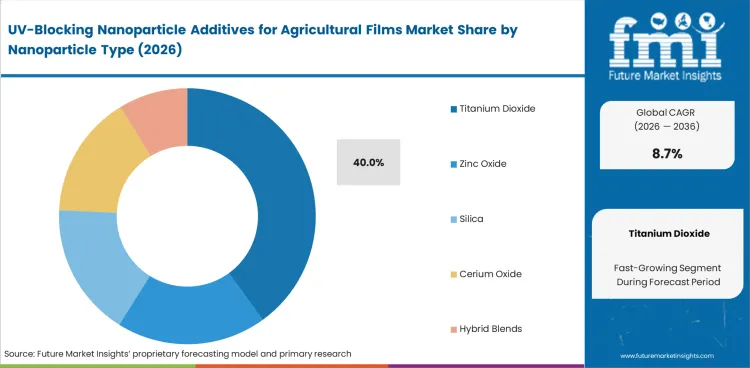
- In 2026, titanium dioxide is estimated to make up 40.0% of the nanoparticle type segment. This chemistry favors broad UV scattering across greenhouse films exposed to direct sunlight.
- Zinc oxide and silica options address selected film formulations requiring lower haze or stronger surface durability. Value improves in crop film projects needing tighter additive loading control.
Insights into UV-Blocking Nanoparticle Additives for Agricultural Films Market by Film Type
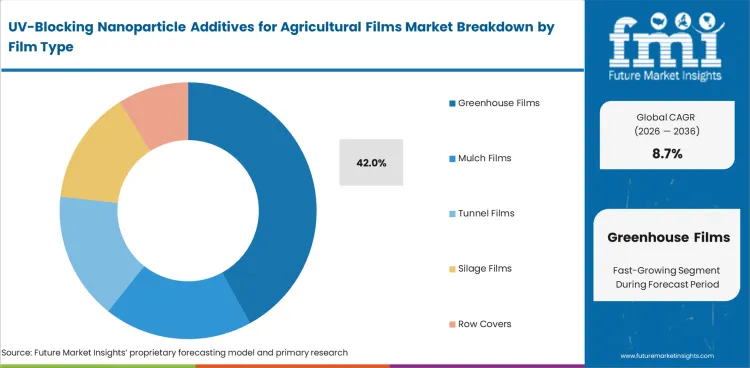
- In 2026, greenhouse films are expected to hold 42.0% of the film type segment. Multi-season cover use creates stronger need for UV protection and stable light transmission.
- Mulch films and tunnel films serve soil-cover and early crop protection needs. Use improves across farms seeking better weed control and reduced film breakdown.
Insights into UV-Blocking Nanoparticle Additives for Agricultural Films Market by Polymer Matrix
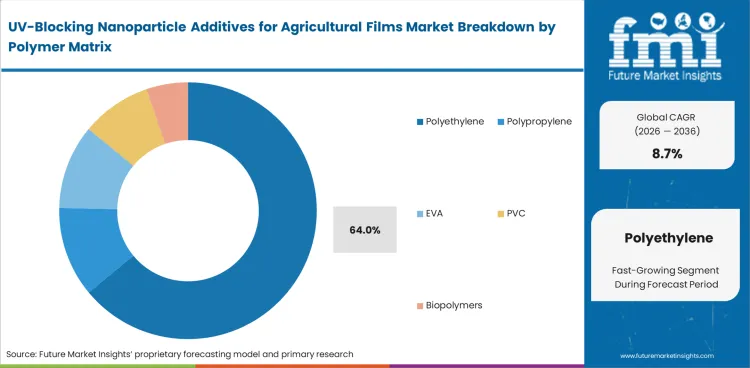
- In 2026, polyethylene is forecast to hold 64.0% share of the polymer matrix segment. Film converters prefer this resin for flexibility and stable processing during blown film extrusion.
- EVA and biopolymer formats address selected crop film needs requiring softness or improved end-of-life positioning. Their use improves where price tolerance and line compatibility are stronger.
Insights into UV-Blocking Nanoparticle Additives for Agricultural Films Market by Additive Form
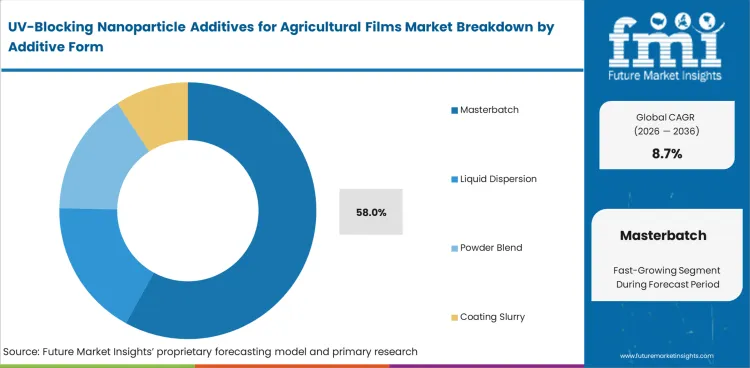
- In 2026, masterbatch is projected to account for 58.0% of the additive form segment. Pellet concentrates help converters control feeding accuracy and reduce handling loss during film production.
- Liquid dispersion and powder blend formats lift selected coating or compounding needs. Their value improves in production jobs requiring formulation flexibility and smaller batch control.
Insights into UV-Blocking Nanoparticle Additives for Agricultural Films Market by Sales Channel
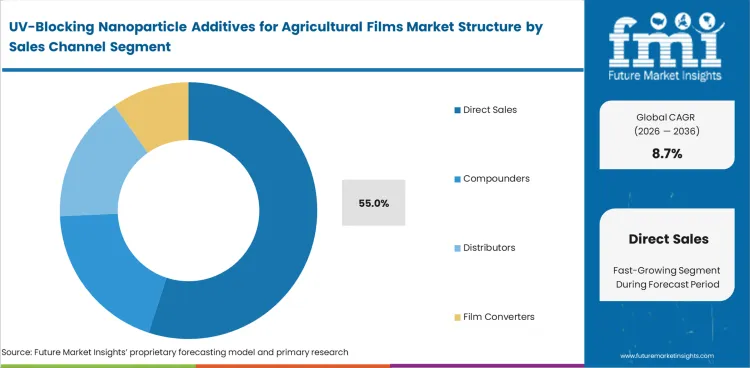
- In 2026, direct sales are expected to contribute 55.0% share of the sales channel segment. Large converters prefer direct sourcing for trial and tighter formulation control.
- Distributor sales increase smaller film producers needing faster local supply access. Film converter partnerships serve customized additive packages and site-specific production needs.
UV-Blocking Nanoparticle Additives for Agricultural Films Market Drivers, Restraints, and Opportunities
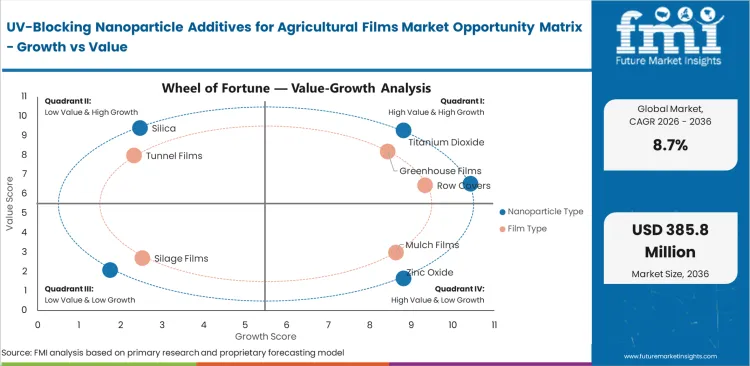
- Greenhouse cover aging enhances structured demand for ultraviolet screening across multi-season film applications.
- Poor nanoparticle dispersion causes haze risk and can limit use in high-transmission greenhouse covers.
- Soil exposure concerns increase the restraint for zinc oxide systems used in mulch and low-tunnel films.
- Bio-based films raise the opportunity for lower-loading nanoparticle systems which preserve film performance.
UV-blocking nanoparticle additives for agricultural films continue expanding as greenhouse and mulch film producers need stronger UV screening and longer cover life under direct sunlight. Cost pressure and concerns around nanoparticle dispersion can slow use in lower-cost film grades. Demand is sustained through masterbatch formats and protected cultivation applications.
Titanium Feedstock Deflation Is Softening TiO₂-Based UV Premiums
TiO₂ nanoparticle additives used in UV-blocking agricultural films are priced as specialty dispersions. The upstream feedstock signal is less inflationary. In February 2026, USGS estimated 2025 rutile at USD 1,140 per metric ton, down from USD 1,300 in 2024, while ilmenite and leucoxene fell to USD 400 from USD 497; titanium slag also moved lower to USD 880 from USD 970. This is important for film converters because TiO₂ pigment production absorbs over 95% of titanium mineral concentrates, with plastics among the primary downstream uses. The implication is a narrower justification for broad surcharge-style increases, although nano-surface treatment and dispersion quality can still protect premium grades.
Carrier Resin Volatility Is Repricing Masterbatch Margins
For UV-blocking nanoparticle additives sold as PE/EVA-compatible masterbatches, price movement depends on more than zinc oxide or TiO₂. The carrier resin and compounding cost can decide the delivered price to greenhouse and mulch-film buyers. In May 2026, EIA reported Brent averaged USD 117/b in April after a USD 138/b high on April 7 and expected prices near USD 106/b in May-June before easing to USD 89/b in 4Q26. Record-high late-2025 propane inventories were expected to pressure USA propane prices downward. Oil linked resin escalators stay defensive, and propane-exposed polymer inputs may offer negotiation room.
Analysis of UV-Blocking Nanoparticle Additives for Agricultural Films Market By Key Countries
.webp "Top Country Growth Comparison Uv Blocking Nanoparticle Additives For Agricultural Films Market Cagr (2026 2036)")
| Country | CAGR |
|---|---|
| China | 9.6% |
| India | 9.2% |
| Spain | 8.8% |
| Mexico | 8.5% |
| Turkey | 8.1% |
| USA | 7.4% |
| Netherlands | 6.8% |
Source: Future Market Insights, 2026.
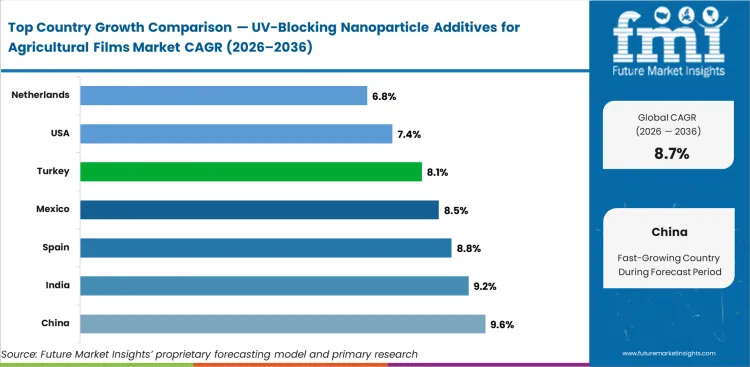
UV-Blocking Nanoparticle Additives for Agricultural Films Market CAGR Analysis By Country
- China is projected to record a 9.6% CAGR through 2036 as large greenhouse clusters create steady replacement demand for higher-performance films.
- India is expected to expand at 9.2% CAGR over the forecast period as protected cultivation funding expands plastic-covered horticulture systems.
- Spain is forecast at 8.8% CAGR for 2026 to 2036 as Almería-style greenhouse production keeps durability central to film selection.
- Mexico is projected to advance at 8.5% CAGR during the assessment period as export vegetable and berry producers depend on protected agriculture systems.
- Turkey is expected to grow at 8.1% CAGR across the forecast years with Mediterranean greenhouse belts driving demand for UV-resistant plastic films.
- USA demand is forecast to rise at 7.4% CAGR by 2036 as mature horticultural operations maintain controlled investment in protected production.
- Netherlands is projected to post 6.8% CAGR between 2026 and 2036 as high-value greenhouse farms prioritize premium films as area expansion stays slower.
Demand for UV-blocking nanoparticle additives for agricultural films is forecast to rise at 8.7% CAGR from 2026 to 2036. Country-level analysis covers the major markets contributing to this forecast, with the key markets listed below.
Demand Outlook for UV-Blocking Nanoparticle Additives for Agricultural Films Market in China
China’s UV-blocking nanoparticle additives for agricultural films industry is projected to record a CAGR of 9.6% through 2036. China accounted for 60.4% of global greenhouse coverage in the June 2024 greenhouse mapping study. This production scale supports demand for China UV-blocking nanoparticle additives for agricultural films. Film converters can gain from growers who need stronger covers for vegetable and fruit production near urban markets.
- Weifang is one of the two largest greenhouse clusters identified in the global greenhouse mapping study.
- China greenhouse clusters need PE cover films which resist high sunlight exposure across repeated crop cycles.
- Local film converters need additives compatible with hindered amine light stabilizers and nanoparticle UV blockers.
Sales Analysis of UV-Blocking Nanoparticle Additives for Agricultural Films Market in India
The UV-blocking nanoparticle additives for agricultural films sector in India is expected to expand at a CAGR of 9.2% during the assessment period. Government records listed 1,603 hectares under protected cultivation in 2024-25 across reported state data. This enhances demand for India UV-blocking nanoparticle additives for agricultural films as polyhouse and tunnel structures need durable cover materials. Local additive makers can gain from converters serving state horticulture programs.
- Uttarakhand reported 378 hectares under protected cultivation in 2024-25 in the parliamentary data table.
- MIDH covers polyhouse and shade net structures which use film and cover materials in horticulture programs.
- Karnataka reported 259 hectares under protected cultivation in 2024-25, adding another converter demand pocket.
Demand Analysis of UV-Blocking Nanoparticle Additives for Agricultural Films Market in Spain
Spain’s UV-blocking nanoparticle additives for agricultural films sector is forecast to grow at a CAGR of 8.8% by 2036. Spain’s ESYRCE 2024 results listed greenhouse area at 78,830.2376 hectares in the national land distribution data. This production scale raises demand for Spain UV-blocking nanoparticle additives for agricultural films. The Almería production base keeps film durability important for vegetable export systems.
- Almería forms one of the world’s largest greenhouse clusters in the June 2024 greenhouse mapping study.
- Spain accounted for 5.6% of global greenhouse coverage in the same peer-reviewed mapping release.
- Greenhouse vegetable exporters need cover films to balance UV blocking with visible light transmission.
Opportunity Analysis of UV-Blocking Nanoparticle Additives for Agricultural Films Market in Mexico
The UV-blocking nanoparticle additives for agricultural films segment in Mexico is expected to advance at 8.5% CAGR over the forecast years. Mexico’s 2018-2024 official SIAP management report identified 94,348 hectares of protected agriculture area in 2023. Protected farming base supports demand for Mexico UV-blocking nanoparticle additives for agricultural films. Export vegetable producers need covers to protect crops and limit early film failure.
- Baja California reported protected agriculture use in May 2024 crop cycle updates from the agriculture ministry.
- Sinaloa and Jalisco both have large areas dedicated to protected vegetable cultivation using greenhouses and shade structures.
- Export producers need UV-resistant covers that protect tomato and pepper quality during high-radiation seasons.
Future Outlook for UV-Blocking Nanoparticle Additives for Agricultural Films Market in Turkey
Turkey’s UV-blocking nanoparticle additives for agricultural films industry is projected to rise at 8.1% CAGR through 2036. Turkey’s Ministry-linked working paper reported 776 thousand decares of covered production area in 2024, with plastic greenhouses representing 452 thousand decares. Covered production supports demand for Turkey UV-blocking nanoparticle additives for agricultural films. Plastic greenhouse concentration gives additive suppliers a practical route into PE film programs.
- Antalya accounted for 317 thousand decares of covered production area in the 2024 Turkish data.
- Plastic greenhouses represented 58% of Turkey’s covered production area in 2024.
- Turkey recorded 9 million tons of covered production in 2024 across vegetables and fruit.
Demand Outlook for UV-Blocking Nanoparticle Additives for Agricultural Films Market in the USA
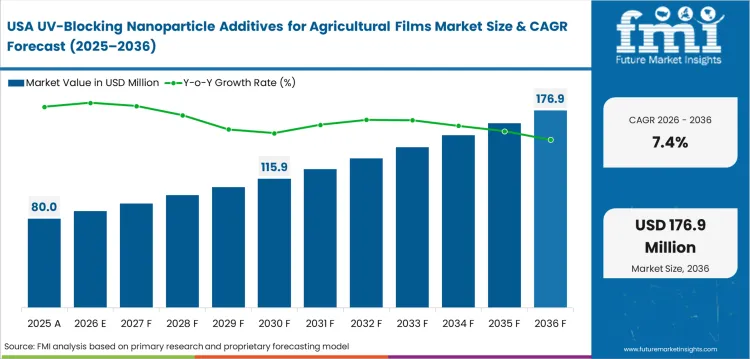
The USA UV-blocking nanoparticle additives for agricultural films industry is forecast at 7.4% CAGR through 2036. USA horticultural operations used 637 million square feet under plastic film protection in 2024. Plastic-film use supports demand for USA UV-blocking nanoparticle additives for agricultural films as protected food crops and specialty plants need durable cover materials. Film makers serving this base need additive systems to protect clarity and film strength.
- California sold USD 3.1 billion in horticultural products in 2024, making it a key protected crop state.
- Florida had 1,779 horticultural operations in 2024 and stayed to be an important protected production state.
- USA food crops grown under protection recorded USD 1.011 billion in sales during 2024.
In-depth Analysis of UV-Blocking Nanoparticle Additives for Agricultural Films Market in the Netherlands
The Netherlands UV-blocking nanoparticle additives for agricultural films market is expected to post 6.8% CAGR through 2036. CBS reported 625 farms growing greenhouse vegetables in 2023, down 29% from a decade earlier. The market has fewer operators and higher specification needs for Netherlands UV-blocking nanoparticle additives for agricultural films. Premium cover films can gain as energy cost and crop value make optical performance more important.
- Dutch greenhouse tomato area was 1.77 thousand hectares in 2023 according to CBS crop area data.
- Greenhouse vegetable production reached 1.63 million tonnes in 2023 according to CBS.
- Tomato, pepper, and cucumber farms form the main protected vegetable base in the Netherlands.
Competitive Landscape and Strategic Positioning
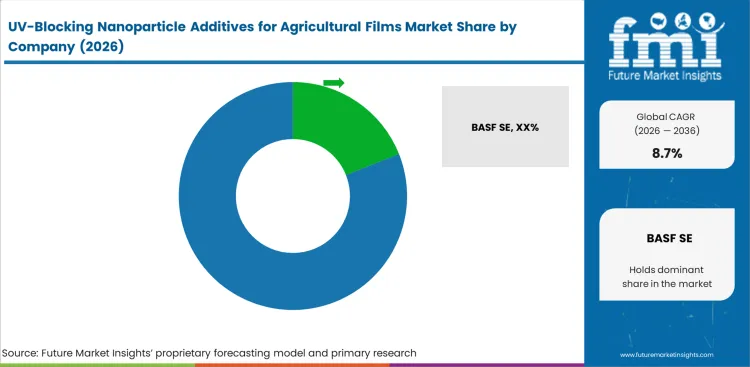
- BASF SE is an active supplier through polymer additive depth and light stabilizer systems for plasticulture applications.
- Ampacet Corporation and Avient Corporation use masterbatch design and converter support across film applications.
- Specialist providers focus on dispersion chemistry and custom UV packages. They deliver film-specific additive design.
The competitive landscape is shaped by global additive leaders leveraging strong masterbatch capabilities, dispersion expertise, and converter support to secure long-term relationships with agricultural film producers. BASF is positioned through its plastic additives portfolio and July 2024 Tinuvin NOR 211 AR launch for agricultural plastics exposed to UV radiation and inorganic chemicals. Ampacet offers agricultural masterbatch systems for greenhouse films and low tunnels.
Barriers include nanoparticle dispersion cost and field validation needs across film converters. Strategic priorities include haze control and additive loading discipline across long film production runs. Greenhouse film makers favor additive partners offering line-trial support and practical durability evidence.
Key Companies in the UV-Blocking Nanoparticle Additives for Agricultural Films Market
Global companies active in the UV-blocking nanoparticle additives for agricultural films market include:
- BASF SE, Ampacet Corporation, and Avient Corporation have established additive and masterbatch infrastructure for agricultural film programs.
- Evonik Industries AG, BYK-Chemie GmbH, and Croda International Plc serve manufacturers through dispersion chemistry and surface treatment knowledge.Tosaf Compounds Ltd., Sukano AG, and Kafrit Industries Ltd. serve specialist roles across agricultural masterbatches and film formulation.
Competitive Benchmarking: UV-Blocking Nanoparticle Additives for Agricultural Films Market
| Company | Nanoparticle Dispersion Depth | Agricultural Film Additive Range | Converter Trial Support | Geographic Footprint |
|---|---|---|---|---|
| BASF SE | High | High | Strong | Global presence across 93 countries with 234 production sites, giving it broad access to agricultural film converters in Europe, Asia, and North America. |
| Ampacet Corporation | Medium | High | Strong | Operates 21 manufacturing sites across 17 countries, with coverage in North America, Latin America, Europe, the Middle East, and Asia. |
| Avient Corporation | Medium | High | Strong | Global directory covers Asia, EMEA, Latin America, South America, and US/Canada, with manufacturing and innovation sites across major polymer regions. |
| Evonik Industries AG | High | Medium | Strong | Active in over 100 countries and operates production plants in 27 countries across six continents. |
| BYK-Chemie GmbH | High | Medium | Strong | Maintains globally networked production, sales, research, and distributor locations across major additive and plastics markets. |
| Croda International Plc | Medium | Medium | Moderate | Operates across 37 countries with 92 sites, including manufacturing, sales offices, and innovation centers. |
| Tosaf Compounds Ltd. | Medium | High | Moderate | Present in over 50 countries and operates 22 manufacturing facilities across the US, Peru, Europe, Turkey, and Israel. |
| Sukano AG | Medium | Medium | Moderate | Supplies customers through production sites on three continents and maintains five locations across Europe, Asia, and North America. |
| Kafrit Industries Ltd. | Medium | High | Moderate | Kafrit Group operates 10 production sites through nine companies, with activities across Israel, Germany, China, North America, and Sweden. |
Source: Future Market Insights, 2026.
Key Developments in UV-Blocking Nanoparticle Additives for Agricultural Films Market
- In July 2024, BASF launched Tinuvin NOR 211 AR for plasticulture films exposed to intense UV radiation and inorganic chemicals. The product adds to BASF’s agricultural plastics additive position.
- In 2026, Tosaf announced a new production site in Olkusz, Poland for color masterbatch supply. The site is scheduled to start operation in the second quarter of 2026.
Key Players in the UV-Blocking Nanoparticle Additives for Agricultural Films Market
Major Global Players:
- BASF SE
- Ampacet Corporation
- Avient Corporation
- Evonik Industries AG
- BYK-Chemie GmbH
- Croda International Plc
- Tosaf Compounds Ltd.
Specialist Players:
- Sukano AG
- Kafrit Industries Ltd.
- Techmer PM
Report Scope and Coverage
| Parameter | Details |
|---|---|
| Quantitative Units | USD 167.5 million to USD 385.8 million, at a CAGR of 8.7% |
| Market Definition | The market encompasses nano-scale UV-blocking additives used to protect agricultural films from ultraviolet damage. |
| Regions Covered | North America, Latin America, Europe, East Asia, South Asia and Pacific, Middle East and Africa |
| Countries Covered | USA, China, India, Spain, Mexico, Turkey, Netherlands, and 30 plus countries |
| Key Companies Profiled | BASF SE, Ampacet Corporation, Avient Corporation, Evonik Industries AG, BYK-Chemie GmbH, Croda International Plc, Tosaf Compounds Ltd., Sukano AG, Kafrit Industries Ltd., Techmer PM |
| Forecast Period | 2026 to 2036 |
| Approach | Hybrid bottom-up and top-down methodology starting with agricultural film demand and verified protected cultivation indicators |
UV-Blocking Nanoparticle Additives for Agricultural Films Market Breakdown By Nanoparticle Type, Film Type, Polymer Matrix, Additive Form, Sales Channel, And Region
UV-Blocking Nanoparticle Additives for Agricultural Films Market Segmented by Nanoparticle Type:
- Titanium Dioxide
- Zinc Oxide
- Silica
- Cerium Oxide
- Hybrid Blends
UV-Blocking Nanoparticle Additives for Agricultural Films Market Segmented by Film Type:
- Greenhouse Films
- Mulch Films
- Tunnel Films
- Silage Films
- Row Covers
UV-Blocking Nanoparticle Additives for Agricultural Films Market Segmented by Polymer Matrix:
- Polyethylene
- Polypropylene
- EVA
- PVC
- Biopolymers
UV-Blocking Nanoparticle Additives for Agricultural Films Market Segmented by Additive Form:
- Masterbatch
- Liquid Dispersion
- Powder Blend
- Coating Slurry
UV-Blocking Nanoparticle Additives for Agricultural Films Market Segmented by Sales Channel:
- Direct Sales
- Compounders
- Distributors
- Film Converters
UV-Blocking Nanoparticle Additives for Agricultural Films Market by Region:
- North America
- USA
- Canada
- Mexico
- Latin America
- Brazil
- Chile
- Rest of Latin America
- Europe
- Germany
- UK
- Italy
- Spain
- France
- Rest of Europe
- East Asia
- China
- Japan
- South Korea
- South Asia and Pacific
- India
- ASEAN
- Australia & New Zealand
- Rest of South Asia and Pacific
- Middle East and Africa
- Saudi Arabia
- Other GCC Countries
- South Africa
- Rest of Middle East and Africa
Research Sources and Bibliography
- American Association for the Advancement of Science. (2024, June 3). Greenhouses cover more and more of Earth’s surface. EurekAlert.
- Food and Agriculture Organization of the United Nations. (2025, February). A provisional voluntary code of conduct on the sustainable use and management of plastics in agriculture. FAO.
- United States Department of Agriculture, National Agricultural Statistics Service. (2026, February). 2024 Census of Horticultural Specialties highlights. USDA NASS.
- Government of India, Lok Sabha. (2026, March 17). Protected cultivation under Mission for Integrated Development of Horticulture. Parliament of India.
- Ministerio de Agricultura, Pesca y Alimentación. (2024). ESYRCE 2024: Avance de resultados. Government of Spain.
- Servicio de Información Agroalimentaria y Pesquera. (2024, August). Informe de Gestión Gubernamental 2018-2024. Government of Mexico.
- Ministry of Agriculture and Forestry of Türkiye. (2025). IV. Tarım Orman Şûrası: Bitkisel Üretim Çalışma Belgesi. Government of Türkiye.
- Statistics Netherlands. (2024, September 25). Area used to grow greenhouse vegetables has increased in ten years. CBS.
- BASF SE. (2024, July 18). BASF launches Tinuvin NOR 211 AR for sustainable farming practices. BASF.
- Tosaf Compounds Ltd. (2025). Tosaf combines perfectly matched UV stabilisers and color masterbatches for mulch films. Tosaf.
This Report Answers
- What is the current and future size of the UV-blocking nanoparticle additives for agricultural films market?
- How fast is demand expected to expand between 2026 and 2036?
- Which nanoparticle type is expected to lead demand by 2026?
- Which agricultural film type is expected to account for the highest demand by 2026?
- What factors are driving demand for UV-blocking additives in greenhouse and mulch films?
- How are agricultural plastics rules influencing nanoparticle additive qualification?
- Which countries are projected to record faster expansion through 2036?
- What is driving market expansion in China and India?
- Who are the key companies active in agricultural film UV additive systems?
- How does FMI estimate and validate the market forecast?
Frequently Asked Questions
What is the global market demand for UV-Blocking Nanoparticle Additives for Agricultural Films in 2026?
In 2026, the global market is expected to be worth USD 167.5 million across greenhouse and mulch film applications.
How big will the market for UV-Blocking Nanoparticle Additives for Agricultural Films be in 2036?
By 2036, the market is expected to be worth USD 385.8 million with steady use in protected cultivation films.
How much is demand expected to expand between 2026 and 2036?
Between 2026 and 2036, demand is expected to expand at a CAGR of 8.7%.
Which nanoparticle type segment is likely to lead global demand by 2026?
Titanium dioxide will make up 40.0% of the nanoparticle type segment in 2026.
What is causing demand to rise in China?
China is projected to record 9.6% CAGR through 2036, backed by large greenhouse coverage and frequent film replacement.
What is causing demand to rise in India?
India is projected to expand at 9.2% CAGR through 2036, backed by protected cultivation programs and polyhouse use.
What does this report mean by UV-Blocking Nanoparticle Additives for Agricultural Films Market definition?
The market includes nano-scale additives used to reduce ultraviolet damage in greenhouse films and other agricultural film formats.
How does FMI build the UV-Blocking Nanoparticle Additives for Agricultural Films forecast and check it?
FMI combines film demand, additive loading rates, country-level protected cultivation data, and company portfolio checks before finalizing forecasts.
Preview the report firsthand - request a free sample
Get SampleGet the brochure for pricing and purchase details.
Get PDFTable of Content
- Key Takeaways
- Market Size and CAGR
- Top Growth Driver
- Fastest Growing Segment
- Leading Region
- Key Companies
- Emerging Opportunities
- Executive Summary
- Global Market Outlook
- Demand-side Trends
- Supply-side Trends
- Technology Roadmap Analysis
- Analysis and Recommendations
- Analyst Perspective (What is happening? Why now? What should investors know?)
- Key Questions Answered
- How large is the market?
- What is the CAGR?
- What are key trends?
- Which region dominates?
- Who are the leaders?
- Market Overview
- Market Coverage / Taxonomy
- Market Definition / Scope / Limitations
- Research Methodology
- Chapter Orientation
- Analytical Lens and Working Hypotheses
- Market Structure, Signals, and Trend Drivers
- Benchmarking and Cross-market Comparability
- Market Sizing, Forecasting, and Opportunity Mapping
- Research Design and Evidence Framework
- Desk Research Programme (Secondary Evidence)
- Expert Input and Fieldwork (Primary Evidence)
- Tooling, Models, and Reference Databases
- Data Engineering and Model Build
- Quality Assurance and Audit Trail
- Market Background
- Market Dynamics (Drivers, Restraints, Opportunity, Trends)
- Scenario Forecast (Optimistic, Likely, Conservative)
- Impact Analysis
- AI Impact
- Sustainability Impact
- Regulatory Impact
- Technology Impact
- Consumer / Buyer Analysis
- Purchase Drivers
- Adoption Barriers
- Buyer Journey
- Opportunity Map Analysis
- Product Life Cycle Analysis
- Supply Chain Analysis
- Investment Feasibility Matrix
- Value Chain Analysis
- PESTLE and Porter's Analysis
- Regulatory Landscape
- Regional Parent Market Outlook
- Production and Consumption Statistics
- Import and Export Statistics
- Global Market Analysis and Forecast, 2021 to 2036
- Historical Market Size Value (USD Million) & Volume (Unit) Analysis, 2021 to 2025
- Current and Future Market Size Value (USD Million) & Volume (Unit) Projections, 2026 to 2036
- Y-o-Y Growth Trend Analysis
- Absolute $ Opportunity Analysis
- Global Market Pricing Analysis, 2021 to 2036
- Global Market Analysis and Forecast, By Nanoparticle Type, 2021 to 2036
- Introduction / Key Findings
- Historical Market Size Value (USD Million) & Volume (Unit) Analysis By Nanoparticle Type, 2021 to 2025
- Current and Future Market Size Value (USD Million) & Volume (Unit) Analysis and Forecast By Nanoparticle Type, 2026 to 2036
- Titanium Dioxide
- Zinc Oxide
- Silica
- Cerium Oxide
- Hybrid Blends
- Titanium Dioxide
- Y-o-Y Growth Trend Analysis By Nanoparticle Type, 2021 to 2025
- Absolute $ Opportunity Analysis By Nanoparticle Type, 2026 to 2036
- Global Market Analysis and Forecast, By Film Type, 2021 to 2036
- Introduction / Key Findings
- Historical Market Size Value (USD Million) & Volume (Unit) Analysis By Film Type, 2021 to 2025
- Current and Future Market Size Value (USD Million) & Volume (Unit) Analysis and Forecast By Film Type, 2026 to 2036
- Greenhouse Films
- Mulch Films
- Tunnel Films
- Silage Films
- Row Covers
- Greenhouse Films
- Y-o-Y Growth Trend Analysis By Film Type, 2021 to 2025
- Absolute $ Opportunity Analysis By Film Type, 2026 to 2036
- Global Market Analysis and Forecast, By Polymer Matrix, 2021 to 2036
- Introduction / Key Findings
- Historical Market Size Value (USD Million) & Volume (Unit) Analysis By Polymer Matrix, 2021 to 2025
- Current and Future Market Size Value (USD Million) & Volume (Unit) Analysis and Forecast By Polymer Matrix, 2026 to 2036
- Polyethylene
- Polypropylene
- EVA
- PVC
- Biopolymers
- Polyethylene
- Y-o-Y Growth Trend Analysis By Polymer Matrix, 2021 to 2025
- Absolute $ Opportunity Analysis By Polymer Matrix, 2026 to 2036
- Global Market Analysis and Forecast, By Additive Form, 2021 to 2036
- Introduction / Key Findings
- Historical Market Size Value (USD Million) & Volume (Unit) Analysis By Additive Form, 2021 to 2025
- Current and Future Market Size Value (USD Million) & Volume (Unit) Analysis and Forecast By Additive Form, 2026 to 2036
- Masterbatch
- Liquid Dispersion
- Powder Blend
- Coating Slurry
- Masterbatch
- Y-o-Y Growth Trend Analysis By Additive Form, 2021 to 2025
- Absolute $ Opportunity Analysis By Additive Form, 2026 to 2036
- Global Market Analysis and Forecast, By Sales Channel, 2021 to 2036
- Introduction / Key Findings
- Historical Market Size Value (USD Million) & Volume (Unit) Analysis By Sales Channel, 2021 to 2025
- Current and Future Market Size Value (USD Million) & Volume (Unit) Analysis and Forecast By Sales Channel, 2026 to 2036
- Direct Sales
- Compounders
- Distributors
- Film Converters
- Direct Sales
- Y-o-Y Growth Trend Analysis By Sales Channel, 2021 to 2025
- Absolute $ Opportunity Analysis By Sales Channel, 2026 to 2036
- Global Market Analysis and Forecast, By Region, 2021 to 2036
- Introduction
- Historical Market Size Value (USD Million) & Volume (Unit) Analysis By Region, 2021 to 2025
- Current Market Size Value (USD Million) & Volume (Unit) Analysis and Forecast By Region, 2026 to 2036
- North America
- Latin America
- Western Europe
- Eastern Europe
- East Asia
- South Asia and Pacific
- Middle East & Africa
- Market Attractiveness Analysis By Region
- North America Market Analysis and Forecast, By Country, 2021 to 2036
- Historical Market Size Value (USD Million) & Volume (Unit) Trend Analysis By Market Taxonomy, 2021 to 2025
- Market Size Value (USD Million) & Volume (Unit) Forecast By Market Taxonomy, 2026 to 2036
- By Country
- USA
- Canada
- Mexico
- By Nanoparticle Type
- By Film Type
- By Polymer Matrix
- By Additive Form
- By Sales Channel
- By Country
- Market Attractiveness Analysis
- By Country
- By Nanoparticle Type
- By Film Type
- By Polymer Matrix
- By Additive Form
- By Sales Channel
- Key Takeaways
- Latin America Market Analysis and Forecast, By Country
- Historical Market Size Value (USD Million) & Volume (Unit) Trend Analysis By Market Taxonomy, 2021 to 2025
- Market Size Value (USD Million) & Volume (Unit) Forecast By Market Taxonomy, 2026 to 2036
- By Country
- Brazil
- Chile
- Rest of Latin America
- By Nanoparticle Type
- By Film Type
- By Polymer Matrix
- By Additive Form
- By Sales Channel
- By Country
- Market Attractiveness Analysis
- By Country
- By Nanoparticle Type
- By Film Type
- By Polymer Matrix
- By Additive Form
- By Sales Channel
- Key Takeaways
- Western Europe Market Analysis and Forecast, By Country
- Historical Market Size Value (USD Million) & Volume (Unit) Trend Analysis By Market Taxonomy, 2021 to 2025
- Market Size Value (USD Million) & Volume (Unit) Forecast By Market Taxonomy, 2026 to 2036
- By Country
- Germany
- UK
- Italy
- Spain
- France
- Nordic
- BENELUX
- Rest of Western Europe
- By Nanoparticle Type
- By Film Type
- By Polymer Matrix
- By Additive Form
- By Sales Channel
- By Country
- Market Attractiveness Analysis
- By Country
- By Nanoparticle Type
- By Film Type
- By Polymer Matrix
- By Additive Form
- By Sales Channel
- Key Takeaways
- Eastern Europe Market Analysis and Forecast, By Country
- Historical Market Size Value (USD Million) & Volume (Unit) Trend Analysis By Market Taxonomy, 2021 to 2025
- Market Size Value (USD Million) & Volume (Unit) Forecast By Market Taxonomy, 2026 to 2036
- By Country
- Russia
- Poland
- Hungary
- Balkan & Baltic
- Rest of Eastern Europe
- By Nanoparticle Type
- By Film Type
- By Polymer Matrix
- By Additive Form
- By Sales Channel
- By Country
- Market Attractiveness Analysis
- By Country
- By Nanoparticle Type
- By Film Type
- By Polymer Matrix
- By Additive Form
- By Sales Channel
- Key Takeaways
- East Asia Market Analysis and Forecast, By Country
- Historical Market Size Value (USD Million) & Volume (Unit) Trend Analysis By Market Taxonomy, 2021 to 2025
- Market Size Value (USD Million) & Volume (Unit) Forecast By Market Taxonomy, 2026 to 2036
- By Country
- China
- Japan
- South Korea
- By Nanoparticle Type
- By Film Type
- By Polymer Matrix
- By Additive Form
- By Sales Channel
- By Country
- Market Attractiveness Analysis
- By Country
- By Nanoparticle Type
- By Film Type
- By Polymer Matrix
- By Additive Form
- By Sales Channel
- Key Takeaways
- South Asia and Pacific Market Analysis and Forecast, By Country
- Historical Market Size Value (USD Million) & Volume (Unit) Trend Analysis By Market Taxonomy, 2021 to 2025
- Market Size Value (USD Million) & Volume (Unit) Forecast By Market Taxonomy, 2026 to 2036
- By Country
- India
- ASEAN
- Australia & New Zealand
- Rest of South Asia and Pacific
- By Nanoparticle Type
- By Film Type
- By Polymer Matrix
- By Additive Form
- By Sales Channel
- By Country
- Market Attractiveness Analysis
- By Country
- By Nanoparticle Type
- By Film Type
- By Polymer Matrix
- By Additive Form
- By Sales Channel
- Key Takeaways
- Middle East & Africa Market Analysis and Forecast, By Country
- Historical Market Size Value (USD Million) & Volume (Unit) Trend Analysis By Market Taxonomy, 2021 to 2025
- Market Size Value (USD Million) & Volume (Unit) Forecast By Market Taxonomy, 2026 to 2036
- By Country
- Kingdom of Saudi Arabia
- Other GCC Countries
- Türkiye
- South Africa
- Other African Union
- Rest of Middle East & Africa
- By Nanoparticle Type
- By Film Type
- By Polymer Matrix
- By Additive Form
- By Sales Channel
- By Country
- Market Attractiveness Analysis
- By Country
- By Nanoparticle Type
- By Film Type
- By Polymer Matrix
- By Additive Form
- By Sales Channel
- Key Takeaways
- Key Countries Market Analysis
- USA
- Pricing Analysis
- Market Share Analysis, 2025
- By Nanoparticle Type
- By Film Type
- By Polymer Matrix
- By Additive Form
- By Sales Channel
- Canada
- Pricing Analysis
- Market Share Analysis, 2025
- By Nanoparticle Type
- By Film Type
- By Polymer Matrix
- By Additive Form
- By Sales Channel
- Mexico
- Pricing Analysis
- Market Share Analysis, 2025
- By Nanoparticle Type
- By Film Type
- By Polymer Matrix
- By Additive Form
- By Sales Channel
- Brazil
- Pricing Analysis
- Market Share Analysis, 2025
- By Nanoparticle Type
- By Film Type
- By Polymer Matrix
- By Additive Form
- By Sales Channel
- Chile
- Pricing Analysis
- Market Share Analysis, 2025
- By Nanoparticle Type
- By Film Type
- By Polymer Matrix
- By Additive Form
- By Sales Channel
- Germany
- Pricing Analysis
- Market Share Analysis, 2025
- By Nanoparticle Type
- By Film Type
- By Polymer Matrix
- By Additive Form
- By Sales Channel
- UK
- Pricing Analysis
- Market Share Analysis, 2025
- By Nanoparticle Type
- By Film Type
- By Polymer Matrix
- By Additive Form
- By Sales Channel
- Italy
- Pricing Analysis
- Market Share Analysis, 2025
- By Nanoparticle Type
- By Film Type
- By Polymer Matrix
- By Additive Form
- By Sales Channel
- Spain
- Pricing Analysis
- Market Share Analysis, 2025
- By Nanoparticle Type
- By Film Type
- By Polymer Matrix
- By Additive Form
- By Sales Channel
- France
- Pricing Analysis
- Market Share Analysis, 2025
- By Nanoparticle Type
- By Film Type
- By Polymer Matrix
- By Additive Form
- By Sales Channel
- India
- Pricing Analysis
- Market Share Analysis, 2025
- By Nanoparticle Type
- By Film Type
- By Polymer Matrix
- By Additive Form
- By Sales Channel
- ASEAN
- Pricing Analysis
- Market Share Analysis, 2025
- By Nanoparticle Type
- By Film Type
- By Polymer Matrix
- By Additive Form
- By Sales Channel
- Australia & New Zealand
- Pricing Analysis
- Market Share Analysis, 2025
- By Nanoparticle Type
- By Film Type
- By Polymer Matrix
- By Additive Form
- By Sales Channel
- China
- Pricing Analysis
- Market Share Analysis, 2025
- By Nanoparticle Type
- By Film Type
- By Polymer Matrix
- By Additive Form
- By Sales Channel
- Japan
- Pricing Analysis
- Market Share Analysis, 2025
- By Nanoparticle Type
- By Film Type
- By Polymer Matrix
- By Additive Form
- By Sales Channel
- South Korea
- Pricing Analysis
- Market Share Analysis, 2025
- By Nanoparticle Type
- By Film Type
- By Polymer Matrix
- By Additive Form
- By Sales Channel
- Russia
- Pricing Analysis
- Market Share Analysis, 2025
- By Nanoparticle Type
- By Film Type
- By Polymer Matrix
- By Additive Form
- By Sales Channel
- Poland
- Pricing Analysis
- Market Share Analysis, 2025
- By Nanoparticle Type
- By Film Type
- By Polymer Matrix
- By Additive Form
- By Sales Channel
- Hungary
- Pricing Analysis
- Market Share Analysis, 2025
- By Nanoparticle Type
- By Film Type
- By Polymer Matrix
- By Additive Form
- By Sales Channel
- Kingdom of Saudi Arabia
- Pricing Analysis
- Market Share Analysis, 2025
- By Nanoparticle Type
- By Film Type
- By Polymer Matrix
- By Additive Form
- By Sales Channel
- Türkiye
- Pricing Analysis
- Market Share Analysis, 2025
- By Nanoparticle Type
- By Film Type
- By Polymer Matrix
- By Additive Form
- By Sales Channel
- South Africa
- Pricing Analysis
- Market Share Analysis, 2025
- By Nanoparticle Type
- By Film Type
- By Polymer Matrix
- By Additive Form
- By Sales Channel
- USA
- Market Structure Analysis
- Competition Dashboard
- Competition Benchmarking
- Market Share Analysis of Top Players
- By Regional
- By Nanoparticle Type
- By Film Type
- By Polymer Matrix
- By Additive Form
- By Sales Channel
- Emerging Startups
- Innovation Benchmarking
- Competition Analysis
- Competition Deep Dive
- BASF SE
- Overview
- Product Portfolio
- Profitability by Market Segments (Product/Region/Sales Channel)
- Sales Footprint
- Strategy Overview
- Marketing Strategy
- Product Strategy
- Channel Strategy
- Ampacet Corporation
- Avient Corporation
- Evonik Industries AG
- BYK-Chemie GmbH
- Croda International Plc
- Tosaf Compounds Ltd.
- Sukano AG
- Kafrit Industries Ltd.
- Techmer PM
- BASF SE
- Case Studies
- Success Stories
- Recent Developments
- Competition Deep Dive
- Assumptions & Acronyms Used


