

- Industry Size (2026):
- USD 1900.0 Mn
- Forecast (2036):
- USD 3566.6 Mn
- CAGR (2026 to 2036)
- 6.5%
UV-Resistant Masterbatches Market Forecast and Outlook 2026 to 2036
The UV-resistant masterbatches market represents a crucial segment within the global additives industry, positioned for steady expansion from USD 1,900.0 million in 2026 to USD 3,566.6 million by 2036, achieving a compound annual growth rate of 6.5% throughout the forecast period.
This specialized market encompasses concentrated polymer compounds engineered with sophisticated ultraviolet stabilization systems that protect plastic products from photodegradation, color fading, and mechanical property deterioration caused by prolonged exposure to solar radiation.
Quick Stats for UV-Resistant Masterbatches Market
- UV-Resistant Masterbatches Market Value (2026): USD 1,900.0 million
- UV-Resistant Masterbatches Market Forecast Value (2036): USD 3,566.6 million
- UV-Resistant Masterbatches Market Forecast CAGR: 6.5%
- Leading UV System in UV-Resistant Masterbatches Market: HALS (38%)
- Key Growth Countries in UV-Resistant Masterbatches Market: China, USA., Germany, Japan, South Korea
- Key Players in UV-Resistant Masterbatches Market: Ampacet, Avient, Ravago, A. Schulman, BASF Color Solutions
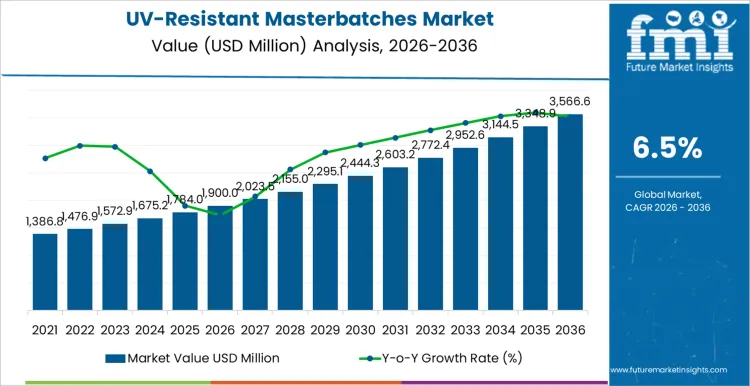
The market's growth trajectory reflects increasing awareness of polymer durability requirements across diverse applications where UV exposure represents a primary failure mechanism affecting product performance and service life.
UV-resistant masterbatches serve as critical enabling technologies for outdoor plastic applications where conventional polymers would rapidly deteriorate under solar radiation exposure, resulting in brittleness, discoloration, and structural failure that compromise product functionality and aesthetic appeal.
Modern UV stabilization systems incorporate sophisticated molecular mechanisms including light absorption, energy dissipation, and radical scavenging that interrupt the photodegradation process while maintaining polymer transparency and mechanical properties. The technology evolution encompasses both traditional UV absorbers that filter harmful radiation and advanced hindered amine light stabilizers that provide regenerative protection through radical scavenging mechanisms.
UV-Resistant Masterbatches Market Key Takeaways
| Metric | Value |
|---|---|
| Market Value (2026) | USD 1,900.0 million |
| Market Forecast Value (2036) | USD 3,566.6 million |
| Forecast CAGR 2026 to 2036 | 6.5% |
Why Is Climate Change Intensifying UV Protection Demands?
The escalating intensity of solar ultraviolet radiation due to atmospheric ozone depletion and climate change creates unprecedented challenges for outdoor plastic applications that drive increased demand for sophisticated UV protection technologies. Measurements indicate rising UV-B radiation levels in many geographic regions while changing weather patterns expose plastic products to more extreme environmental conditions including temperature fluctuations and humidity variations that accelerate photodegradation processes. Traditional UV protection systems designed for historical radiation exposure levels prove inadequate under current and projected environmental conditions that require enhanced stabilization strategies.
Geographic expansion of plastic applications into high-UV environments including desert regions, tropical climates, and high-altitude locations creates demanding exposure conditions that challenge conventional stabilization approaches. Agricultural applications face particular challenges as greenhouse effects and reflective surfaces can concentrate UV radiation while extended growing seasons increase cumulative exposure periods. Construction applications in equatorial regions require UV protection systems capable of maintaining performance under extreme radiation conditions that can exceed 1,500 watts per square meter during peak exposure periods.
How Is the Market Structured Across Polymer Technology Platforms?
The UV-resistant masterbatches market exhibits sophisticated segmentation reflecting diverse polymer chemistry requirements, stabilization technology approaches, and application-specific performance criteria that create distinct market segments with unique value propositions and technical requirements.
Market structure encompasses polymer base categories representing different substrate requirements, UV system classifications addressing specific protection mechanisms, and application segments reflecting varying exposure conditions and performance demands. This multidimensional segmentation reflects the specialized nature of UV protection where generic solutions prove inadequate for addressing specific polymer chemistry and environmental exposure requirements.
Which Polymer Platform Dominates Market Applications?
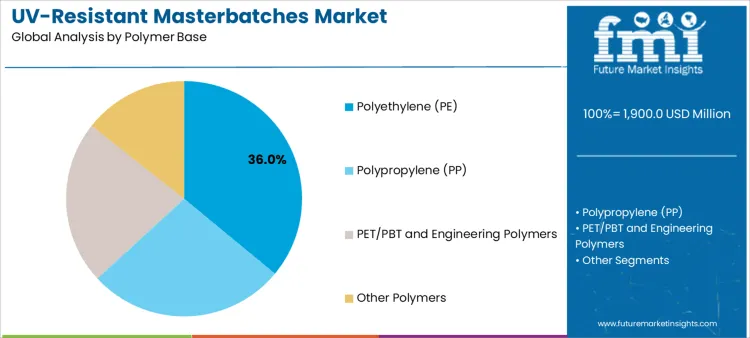
Polyethylene masterbatches command 36.0% market share, representing the largest segment due to polyethylene's widespread use in outdoor applications including agricultural films, packaging materials, and infrastructure products where UV protection constitutes a critical performance requirement. Polyethylene's semi-crystalline structure and processing characteristics create specific challenges for UV stabilizer incorporation while its diverse grade variations require tailored stabilization approaches for different applications. Low-density polyethylene films used in agricultural applications present particular formulation challenges due to thin gauge requirements and extreme outdoor exposure conditions.
Which UV Protection Technology Leads Market Performance?
Hindered Amine Light Stabilizers (HALS) dominate with 38.0% market share, representing the most effective UV protection technology for long-term outdoor applications due to their regenerative mechanism that provides sustained protection throughout polymer service life. HALS function through a catalytic cycle where nitroxide radicals formed during polymer degradation scavenge additional free radicals while regenerating active stabilizer species, creating self-sustaining protection mechanisms. This regenerative characteristic enables HALS to provide effective protection at relatively low concentrations while maintaining effectiveness throughout extended exposure periods.
Which Application Category Drives Market Expansion?
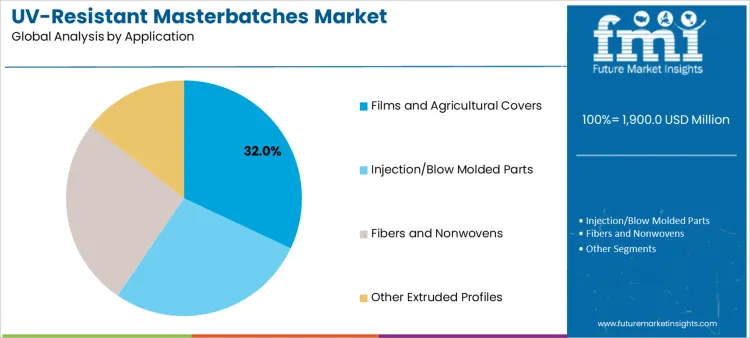
Films and agricultural covers dominate with 32.0% market share, representing applications where thin polymer sections face extreme UV exposure while requiring extended service life for economic viability. Agricultural greenhouse films typically require 3-5 years of service life under intense solar radiation while maintaining optical clarity for plant growth optimization. Mulch films used in crop protection face direct soil contact and concentrated UV exposure that challenge conventional stabilization systems while requiring cost-effective solutions for single-season applications.
Which End-Use Segment Leads Market Growth?
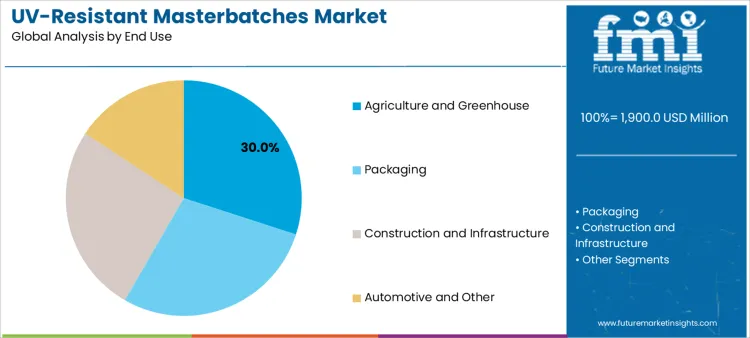
Agriculture and greenhouse applications dominate with 30.0% market share, reflecting the critical importance of UV protection for agricultural plastic products where polymer failure can result in significant crop losses and economic impact. Modern agriculture relies extensively on plastic films for crop protection, water conservation, and controlled environment cultivation where UV stabilization becomes essential for economic viability. Greenhouse applications often concentrate UV radiation through reflection and focusing effects that create more demanding exposure conditions than typical outdoor environments.
How are Regulatory Requirements Shaping Stabilizer Selection?
The evolving regulatory landscape for UV stabilizers creates complex compliance challenges that influence product development and market access while addressing environmental and health concerns related to specific stabilizer chemistries. Recent regulatory developments include restrictions on certain benzotriazole UV absorbers due to environmental persistence concerns while new approval requirements affect stabilizer selection for food contact applications. European Union regulations including REACH require comprehensive safety documentation while emerging restrictions on specific chemical classes affect long-term market availability.
Regulatory harmonization efforts across major markets attempt to coordinate approval processes while addressing regional differences in environmental and health assessment methodologies. Food contact regulations require extensive migration testing and safety assessment while environmental regulations increasingly consider bioaccumulation and ecological impact in approval decisions. These regulatory complexities favor suppliers with comprehensive regulatory expertise while creating barriers for smaller companies lacking extensive regulatory resources.
Do Raw Material Constraints Affect Market Growth?
The availability and cost of specialized UV stabilizer raw materials create supply chain vulnerabilities that can affect market growth while driving innovation in alternative chemistry approaches. Key raw materials including hindered amine intermediates and UV absorber precursors often have limited supplier bases while specialty chemical synthesis requires sophisticated manufacturing capabilities. Supply chain disruptions can significantly impact masterbatch production while long-term supply security influences technology development strategies.
Advanced UV stabilizer chemistry often requires specialized raw materials with limited availability that can create cost volatility and supply security concerns. Intellectual property restrictions on certain stabilizer chemistries affect raw material access while environmental regulations on chemical production can impact availability. These supply chain challenges drive development of alternative chemistry approaches while favoring suppliers with diverse technology portfolios and secure raw material access.
How Do Performance Requirements Drive Technology Innovation?
The increasingly demanding performance requirements for UV-resistant masterbatches drive continuous innovation in stabilizer chemistry and formulation technology while addressing diverse application challenges including extreme environmental conditions and extended service life requirements. Modern applications often require UV protection systems that maintain effectiveness for decades while meeting stringent performance criteria for color stability, mechanical properties, and regulatory compliance.
Advanced performance requirements include stabilizer systems that function effectively under concentrated UV exposure while maintaining compatibility with recycling processes and circular economy objectives. Multi-layer applications may require UV protection across different polymer layers while maintaining interlayer adhesion and overall product performance. These demanding requirements drive development of next-generation stabilizer technologies that provide enhanced effectiveness while addressing sustainability and regulatory considerations.
How Is the UV-Resistant Masterbatches Market Expected to Evolve Across Major Nations?
The global UV-resistant masterbatches market demonstrates distinct regional development patterns reflecting varying agricultural practices, construction standards, regulatory frameworks, and environmental conditions that influence UV protection requirements and market growth opportunities.
Regional market evolution encompasses both established industrial economies with mature UV protection requirements and emerging markets developing infrastructure and agricultural capabilities that create new demand for UV-resistant materials.
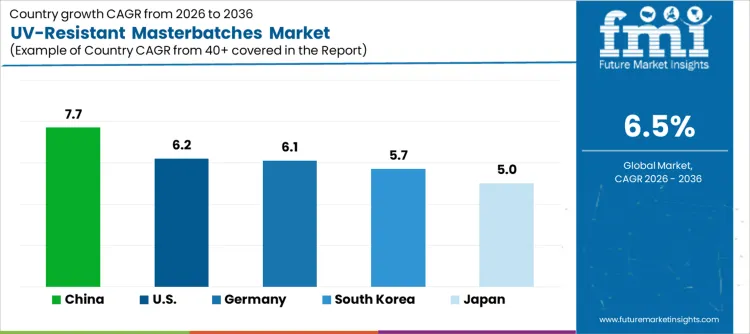
| Country | CAGR (%) |
|---|---|
| China | 7.7% |
| USA. | 6.2% |
| Germany | 6.1% |
| South Korea | 5.7% |
| Japan | 5.0% |
What Drives China's Market Leadership?
China's UV-resistant masterbatches market is projected to achieve a CAGR of 7.7%, representing the highest growth rate globally and reflecting the country's massive agricultural sector, expanding construction industry, and growing environmental awareness that drives demand for durable plastic products. Chinese agriculture increasingly adopts plastic mulch films, greenhouse covers, and irrigation systems requiring UV protection while urbanization drives construction applications including pipes, membranes, and building materials. Government initiatives promoting agricultural modernization and infrastructure development create sustained demand for UV-resistant plastic products.
Chinese manufacturing capabilities in polymer processing and additive production enable cost-effective UV masterbatch production while serving both domestic and export markets. The integration of advanced manufacturing technologies and quality control systems supports high-volume production while government environmental policies increasingly emphasize product durability and resource efficiency that favor UV-protected materials. Research institutions and companies collaborate on developing specialized UV protection technologies addressing specific Chinese market requirements.
How are US Agricultural and Infrastructure Needs Driving Growth?
The United States UV-resistant masterbatches market is projected to record a CAGR of 6.2%, reflecting the country's large-scale agricultural operations, extensive infrastructure requirements, and emphasis on product durability that creates substantial demand for UV protection technologies. American agriculture utilizes extensive plastic mulch, greenhouse, and irrigation systems while infrastructure applications include geosynthetics, pipes, and building materials requiring long-term UV resistance. The emphasis on sustainable agriculture and infrastructure durability drives adoption of UV-protected materials.
US regulatory requirements for agricultural and construction applications often mandate specific performance standards that require effective UV protection while environmental consciousness drives demand for durable products that reduce replacement frequency. Research institutions and companies advance UV protection technology through collaborative programs while established agricultural and construction practices create stable demand for proven UV masterbatch technologies.
What drives Germany's Engineering Excellence in UV Protection?
Germany's UV-resistant masterbatches market is likely to rise at a CAGR of 6.1%, reflecting the country's systematic approach to materials development and emphasis on product quality that creates demand for premium UV protection solutions. German applications often require UV masterbatches that meet stringent performance standards while addressing specific technical requirements including automotive components, industrial equipment, and precision agriculture systems. The focus on engineering excellence drives development of specialized UV protection technologies.
German chemical industry expertise enables development of advanced UV stabilizer chemistry while established quality standards ensure consistent performance across diverse applications. Research institutions and companies collaborate on fundamental UV protection research while building practical solutions for specific German market requirements. The emphasis on sustainability and circular economy principles drives development of UV protection systems that support product durability and recycling compatibility.
Why does South Korea Emphasize Technology Innovation?
South Korea's UV-resistant masterbatches market is projected to increase at a CAGR of 5.7%, driven by the country's advanced manufacturing capabilities and emphasis on technology innovation that creates opportunities for sophisticated UV protection solutions. Korean applications include automotive components, electronics enclosures, and precision agriculture systems requiring specialized UV protection while export markets demand high-performance materials meeting international standards.
Korean companies invest heavily in research and development capabilities while building expertise in advanced polymer processing and additive technologies. Government support for technology development includes funding for materials research and innovation programs while Korean manufacturers focus on premium market segments requiring advanced UV protection technologies. The emphasis on technological competitiveness creates opportunities for breakthrough UV protection innovations.
How does Japan's Quality Focus Shape Market Development?
Japan's UV-resistant masterbatches market is likely to expand at a CAGR of 5.0%, reflecting the country's emphasis on precision manufacturing and quality excellence that creates demand for premium UV protection solutions meeting exceptional performance standards. Japanese applications often require UV masterbatches that demonstrate superior color stability, mechanical property retention, and long-term durability while addressing specific market requirements including automotive precision, electronics reliability, and agricultural efficiency.
Japanese companies emphasize systematic optimization and continuous improvement approaches while building technological foundations for superior UV protection performance. Research institutions and corporate laboratories advance UV protection science through fundamental research while developing practical solutions for demanding Japanese market applications. The focus on quality and reliability creates opportunities for UV protection technologies that provide exceptional consistency and long-term performance.
How are Manufacturers Securing Market Share in UV-Resistant Masterbatches Market?
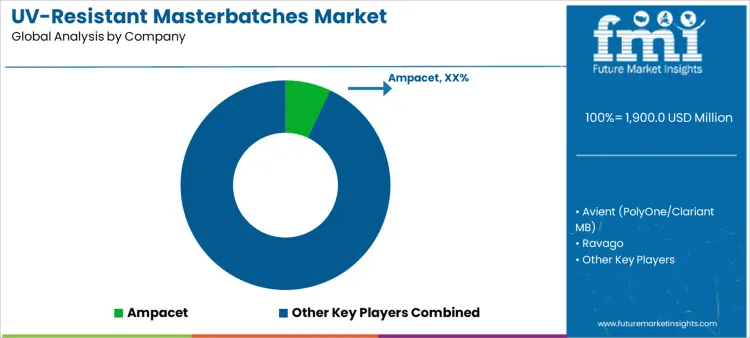
Competition in UV-resistant masterbatches is shaped by how well suppliers can deliver reliable weathering protection across different polymers, climates, and end-use demands. Large additive producers, specialist masterbatch compounders, and newer technology players all compete to offer UV packages that hold color and mechanical properties over time without pushing costs or processing problems. Buyers look for practical performance first, such as stable dispersion, low plate-out, consistent shade control, and predictable retention after outdoor exposure. Compliance also matters, especially where food-contact, packaging, or building-product rules apply, so suppliers that can support documentation and change control tend to qualify faster. Partnerships with converters and brand owners are common because outdoor performance needs to be proven in the customer’s exact resin, thickness, and process conditions.
Development work is focused on better stabilizer systems, smarter blends of UV absorbers and HALS, and masterbatch designs that match specific polymers like PE, PP, PET, and engineering plastics. Strong players invest in weathering labs, application trials, and regional production so they can supply multinational customers consistently. The real advantage comes from tailoring the UV package to the end use while keeping processing smooth and pricing competitive at volume.
Key Players in the UV-Resistant Masterbatches Market
- Ampacet
- Avient (PolyOne/Clariant MB)
- Ravago
- A. Schulman (LyondellBasell)
- BASF Color Solutions
- Gabriel-Chemie
- Polyplast Müller
- Ampacet India
- Ingenia Polymers
- Plastiblends
Scope of Report
| Items | Values |
|---|---|
| Quantitative Units | USD Million |
| Polymer Base Segments | Polyethylene (PE); Polypropylene (PP); PET/PBT and Engineering Polymers; Other Polymers |
| UV System Categories | HALS; UV Absorbers; Combination Systems; Other Stabilizer Packages |
| Application Types | Films and Agricultural Covers; Injection/Blow Molded Parts; Fibers and Nonwovens; Other Extruded Profiles |
| End Use Segments | Packaging; Agriculture and Greenhouse; Construction and Infrastructure; Automotive and Other |
| Regions Covered | North America, Europe, Asia Pacific, Latin America, Middle East & Africa |
| Key Countries | USA, Germany, China, South Korea, Japan |
| Key Companies Profiled | Ampacet, Avient, Ravago, A. Schulman, BASF Color Solutions, and others |
UV-Resistant Masterbatches Market by Segment
By Polymer Base:
- Polyethylene (PE)
- Polypropylene (PP)
- PET/PBT and Engineering Polymers
- Other Polymers
By UV System:
- HALS (Hindered Amine Light Stabilizers)
- UV Absorbers
- Combination Systems
- Other Stabilizer Packages
By Application:
- Films and Agricultural Covers
- Injection/Blow Molded Parts
- Fibers and Nonwovens
- Other Extruded Profiles
By End Use:
- Packaging
- Agriculture and Greenhouse
- Construction and Infrastructure
- Automotive and Other
Bibliography
- ASTM International. (2024). ASTM G154‑16: Standard practice for operating fluorescent ultraviolet (UV) lamp apparatus for exposure of nonmetallic materials. ASTM International.
- International Organization for Standardization. (2024). ISO 4892‑2:2024 — Plastics — Methods of exposure to laboratory light sources. ISO Publications.
- Plastics Additives & Compounding. (2024). UV stabilization technologies for outdoor polymer applications. Plastics Additives & Compounding, 26(2), 18–25.
Frequently Asked Questions
How big is the uv-resistant masterbatches market in 2026?
The global uv-resistant masterbatches market is estimated to be valued at USD 1,900.0 million in 2026.
What will be the size of uv-resistant masterbatches market in 2036?
The market size for the uv-resistant masterbatches market is projected to reach USD 3,566.6 million by 2036.
How much will be the uv-resistant masterbatches market growth between 2026 and 2036?
The uv-resistant masterbatches market is expected to grow at a 6.5% CAGR between 2026 and 2036.
What are the key product types in the uv-resistant masterbatches market?
The key product types in uv-resistant masterbatches market are polyethylene (pe), polypropylene (pp), pet/pbt and engineering polymers and other polymers.
Which uv system segment to contribute significant share in the uv-resistant masterbatches market in 2026?
In terms of uv system, hals (hindered amine light stabilizers) segment to command 38.0% share in the uv-resistant masterbatches market in 2026.
Preview the report firsthand - request a free sample
Get SampleGet the brochure for pricing and purchase details.
Get PDFTable of Content
- Executive Summary
- Global Market Outlook
- Demand-side Trends
- Supply-side Trends
- Technology Roadmap Analysis
- Analysis and Recommendations
- Market Overview
- Market Coverage / Taxonomy
- Market Definition / Scope / Limitations
- Market Background
- Market Dynamics
- Drivers
- Restraints
- Opportunity
- Trends
- Scenario Forecast
- Demand in Optimistic Scenario
- Demand in Likely Scenario
- Demand in Conservative Scenario
- Opportunity Map Analysis
- Product Life Cycle Analysis
- Supply Chain Analysis
- Investment Feasibility Matrix
- Value Chain Analysis
- PESTLE and Porter’s Analysis
- Regulatory Landscape
- Regional Parent Market Outlook
- Production and Consumption Statistics
- Import and Export Statistics
- Market Dynamics
- Global Market Analysis 2021 to 2025 and Forecast, 2026 to 2036
- Historical Market Size Value (USD Million) Analysis, 2021 to 2025
- Current and Future Market Size Value (USD Million) Projections, 2026 to 2036
- Y-o-Y Growth Trend Analysis
- Absolute $ Opportunity Analysis
- Global Market Pricing Analysis 2021 to 2025 and Forecast 2026 to 2036
- Global Market Analysis 2021 to 2025 and Forecast 2026 to 2036, By Polymer Base
- Introduction / Key Findings
- Historical Market Size Value (USD Million) Analysis By Polymer Base , 2021 to 2025
- Current and Future Market Size Value (USD Million) Analysis and Forecast By Polymer Base , 2026 to 2036
- Polyethylene (PE)
- Polypropylene (PP)
- PET/PBT and Engineering Polymers
- Other Polymers
- Polyethylene (PE)
- Y-o-Y Growth Trend Analysis By Polymer Base , 2021 to 2025
- Absolute $ Opportunity Analysis By Polymer Base , 2026 to 2036
- Global Market Analysis 2021 to 2025 and Forecast 2026 to 2036, By UV System
- Introduction / Key Findings
- Historical Market Size Value (USD Million) Analysis By UV System, 2021 to 2025
- Current and Future Market Size Value (USD Million) Analysis and Forecast By UV System, 2026 to 2036
- HALS (Hindered Amine Light Stabilizers)
- UV Absorbers
- Combination Systems
- Other Stabilizer Packages
- HALS (Hindered Amine Light Stabilizers)
- Y-o-Y Growth Trend Analysis By UV System, 2021 to 2025
- Absolute $ Opportunity Analysis By UV System, 2026 to 2036
- Global Market Analysis 2021 to 2025 and Forecast 2026 to 2036, By Application
- Introduction / Key Findings
- Historical Market Size Value (USD Million) Analysis By Application, 2021 to 2025
- Current and Future Market Size Value (USD Million) Analysis and Forecast By Application, 2026 to 2036
- Films and Agricultural Covers
- Injection/Blow Molded Parts
- Fibers and Nonwovens
- Other Extruded Profiles
- Films and Agricultural Covers
- Y-o-Y Growth Trend Analysis By Application, 2021 to 2025
- Absolute $ Opportunity Analysis By Application, 2026 to 2036
- Global Market Analysis 2021 to 2025 and Forecast 2026 to 2036, By End Use
- Introduction / Key Findings
- Historical Market Size Value (USD Million) Analysis By End Use, 2021 to 2025
- Current and Future Market Size Value (USD Million) Analysis and Forecast By End Use, 2026 to 2036
- Agriculture and Greenhouse
- Packaging
- Construction and Infrastructure
- Automotive and Other
- Agriculture and Greenhouse
- Y-o-Y Growth Trend Analysis By End Use, 2021 to 2025
- Absolute $ Opportunity Analysis By End Use, 2026 to 2036
- Global Market Analysis 2021 to 2025 and Forecast 2026 to 2036, By Region
- Introduction
- Historical Market Size Value (USD Million) Analysis By Region, 2021 to 2025
- Current Market Size Value (USD Million) Analysis and Forecast By Region, 2026 to 2036
- North America
- Latin America
- Western Europe
- Eastern Europe
- East Asia
- South Asia and Pacific
- Middle East & Africa
- Market Attractiveness Analysis By Region
- North America Market Analysis 2021 to 2025 and Forecast 2026 to 2036, By Country
- Historical Market Size Value (USD Million) Trend Analysis By Market Taxonomy, 2021 to 2025
- Market Size Value (USD Million) Forecast By Market Taxonomy, 2026 to 2036
- By Country
- USA
- Canada
- Mexico
- By Polymer Base
- By UV System
- By Application
- By End Use
- By Country
- Market Attractiveness Analysis
- By Country
- By Polymer Base
- By UV System
- By Application
- By End Use
- Key Takeaways
- Latin America Market Analysis 2021 to 2025 and Forecast 2026 to 2036, By Country
- Historical Market Size Value (USD Million) Trend Analysis By Market Taxonomy, 2021 to 2025
- Market Size Value (USD Million) Forecast By Market Taxonomy, 2026 to 2036
- By Country
- Brazil
- Chile
- Rest of Latin America
- By Polymer Base
- By UV System
- By Application
- By End Use
- By Country
- Market Attractiveness Analysis
- By Country
- By Polymer Base
- By UV System
- By Application
- By End Use
- Key Takeaways
- Western Europe Market Analysis 2021 to 2025 and Forecast 2026 to 2036, By Country
- Historical Market Size Value (USD Million) Trend Analysis By Market Taxonomy, 2021 to 2025
- Market Size Value (USD Million) Forecast By Market Taxonomy, 2026 to 2036
- By Country
- Germany
- UK
- Italy
- Spain
- France
- Nordic
- BENELUX
- Rest of Western Europe
- By Polymer Base
- By UV System
- By Application
- By End Use
- By Country
- Market Attractiveness Analysis
- By Country
- By Polymer Base
- By UV System
- By Application
- By End Use
- Key Takeaways
- Eastern Europe Market Analysis 2021 to 2025 and Forecast 2026 to 2036, By Country
- Historical Market Size Value (USD Million) Trend Analysis By Market Taxonomy, 2021 to 2025
- Market Size Value (USD Million) Forecast By Market Taxonomy, 2026 to 2036
- By Country
- Russia
- Poland
- Hungary
- Balkan & Baltic
- Rest of Eastern Europe
- By Polymer Base
- By UV System
- By Application
- By End Use
- By Country
- Market Attractiveness Analysis
- By Country
- By Polymer Base
- By UV System
- By Application
- By End Use
- Key Takeaways
- East Asia Market Analysis 2021 to 2025 and Forecast 2026 to 2036, By Country
- Historical Market Size Value (USD Million) Trend Analysis By Market Taxonomy, 2021 to 2025
- Market Size Value (USD Million) Forecast By Market Taxonomy, 2026 to 2036
- By Country
- China
- Japan
- South Korea
- By Polymer Base
- By UV System
- By Application
- By End Use
- By Country
- Market Attractiveness Analysis
- By Country
- By Polymer Base
- By UV System
- By Application
- By End Use
- Key Takeaways
- South Asia and Pacific Market Analysis 2021 to 2025 and Forecast 2026 to 2036, By Country
- Historical Market Size Value (USD Million) Trend Analysis By Market Taxonomy, 2021 to 2025
- Market Size Value (USD Million) Forecast By Market Taxonomy, 2026 to 2036
- By Country
- India
- ASEAN
- Australia & New Zealand
- Rest of South Asia and Pacific
- By Polymer Base
- By UV System
- By Application
- By End Use
- By Country
- Market Attractiveness Analysis
- By Country
- By Polymer Base
- By UV System
- By Application
- By End Use
- Key Takeaways
- Middle East & Africa Market Analysis 2021 to 2025 and Forecast 2026 to 2036, By Country
- Historical Market Size Value (USD Million) Trend Analysis By Market Taxonomy, 2021 to 2025
- Market Size Value (USD Million) Forecast By Market Taxonomy, 2026 to 2036
- By Country
- Kingdom of Saudi Arabia
- Other GCC Countries
- Turkiye
- South Africa
- Other African Union
- Rest of Middle East & Africa
- By Polymer Base
- By UV System
- By Application
- By End Use
- By Country
- Market Attractiveness Analysis
- By Country
- By Polymer Base
- By UV System
- By Application
- By End Use
- Key Takeaways
- Key Countries Market Analysis
- USA
- Pricing Analysis
- Market Share Analysis, 2025
- By Polymer Base
- By UV System
- By Application
- By End Use
- Canada
- Pricing Analysis
- Market Share Analysis, 2025
- By Polymer Base
- By UV System
- By Application
- By End Use
- Mexico
- Pricing Analysis
- Market Share Analysis, 2025
- By Polymer Base
- By UV System
- By Application
- By End Use
- Brazil
- Pricing Analysis
- Market Share Analysis, 2025
- By Polymer Base
- By UV System
- By Application
- By End Use
- Chile
- Pricing Analysis
- Market Share Analysis, 2025
- By Polymer Base
- By UV System
- By Application
- By End Use
- Germany
- Pricing Analysis
- Market Share Analysis, 2025
- By Polymer Base
- By UV System
- By Application
- By End Use
- UK
- Pricing Analysis
- Market Share Analysis, 2025
- By Polymer Base
- By UV System
- By Application
- By End Use
- Italy
- Pricing Analysis
- Market Share Analysis, 2025
- By Polymer Base
- By UV System
- By Application
- By End Use
- Spain
- Pricing Analysis
- Market Share Analysis, 2025
- By Polymer Base
- By UV System
- By Application
- By End Use
- France
- Pricing Analysis
- Market Share Analysis, 2025
- By Polymer Base
- By UV System
- By Application
- By End Use
- India
- Pricing Analysis
- Market Share Analysis, 2025
- By Polymer Base
- By UV System
- By Application
- By End Use
- ASEAN
- Pricing Analysis
- Market Share Analysis, 2025
- By Polymer Base
- By UV System
- By Application
- By End Use
- Australia & New Zealand
- Pricing Analysis
- Market Share Analysis, 2025
- By Polymer Base
- By UV System
- By Application
- By End Use
- China
- Pricing Analysis
- Market Share Analysis, 2025
- By Polymer Base
- By UV System
- By Application
- By End Use
- Japan
- Pricing Analysis
- Market Share Analysis, 2025
- By Polymer Base
- By UV System
- By Application
- By End Use
- South Korea
- Pricing Analysis
- Market Share Analysis, 2025
- By Polymer Base
- By UV System
- By Application
- By End Use
- Russia
- Pricing Analysis
- Market Share Analysis, 2025
- By Polymer Base
- By UV System
- By Application
- By End Use
- Poland
- Pricing Analysis
- Market Share Analysis, 2025
- By Polymer Base
- By UV System
- By Application
- By End Use
- Hungary
- Pricing Analysis
- Market Share Analysis, 2025
- By Polymer Base
- By UV System
- By Application
- By End Use
- Kingdom of Saudi Arabia
- Pricing Analysis
- Market Share Analysis, 2025
- By Polymer Base
- By UV System
- By Application
- By End Use
- Turkiye
- Pricing Analysis
- Market Share Analysis, 2025
- By Polymer Base
- By UV System
- By Application
- By End Use
- South Africa
- Pricing Analysis
- Market Share Analysis, 2025
- By Polymer Base
- By UV System
- By Application
- By End Use
- USA
- Market Structure Analysis
- Competition Dashboard
- Competition Benchmarking
- Market Share Analysis of Top Players
- By Regional
- By Polymer Base
- By UV System
- By Application
- By End Use
- Competition Analysis
- Competition Deep Dive
- Ampacet
- Overview
- Product Portfolio
- Profitability by Market Segments (Product/Age /Sales Channel/Region)
- Sales Footprint
- Strategy Overview
- Marketing Strategy
- Product Strategy
- Channel Strategy
- Avient (PolyOne/Clariant MB)
- Ravago
- A. Schulman (LyondellBasell)
- BASF Color Solutions
- Gabriel-Chemie
- Polyplast Müller
- Ampacet India
- Ingenia Polymers
- Plastiblends
- Ampacet
- Competition Deep Dive
- Assumptions & Acronyms Used
- Research Methodology


