

- Industry Size (2026)
- USD 778.9 Mn
- Forecast (2036)
- USD 1489.8 Mn
- CAGR (2026 to 2036)
- 6.70%
Odor-Scavenging Masterbatches Market Forecast and Outlook 2026 to 2036
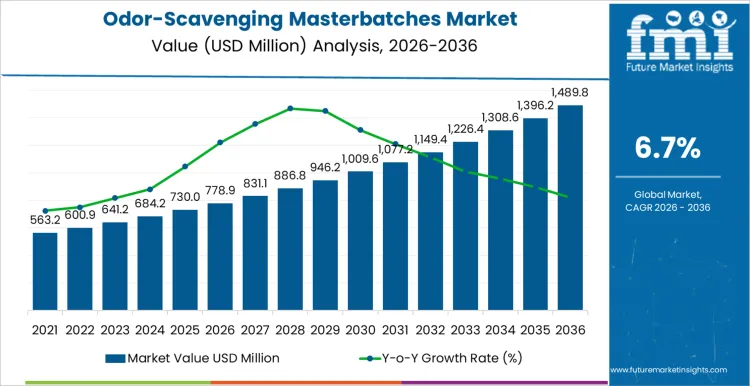
The odor-scavenging masterbatches market, sized at USD 778.9 million in 2026, is projected to reach USD 1,489.8 million by 2036 at a 6.70% CAGR. Global demand is unevenly distributed, with consumption concentrated in regions where recycled plastics usage, packaging volumes, and consumer quality expectations intersect. Asia Pacific leads in volume due to large-scale packaging and consumer goods manufacturing, supported by cost-efficient compounding and proximity to recycled resin supply. Latin America shows faster relative growth as recycled content adoption accelerates under warmer climatic conditions that intensify odor issues.
North America and Europe represent mature but specification-driven markets, where odor control is tightly linked to regulatory compliance, automotive interior standards, and premium packaging requirements. Geographic cost advantages influence sourcing decisions, favoring local or regional masterbatch producers to minimize logistics risk and ensure supply continuity. This concentration pattern anchors market growth to regional processing economics rather than uniform global adoption, reinforcing structurally uneven demand development.
Quick Stats for Odor-Scavenging Masterbatches Market
- Odor-Scavenging Masterbatches Market Value (2026): USD 778.9 Million
- Odor-Scavenging Masterbatches Market Forecast Value (2036): USD 1,489.8 Million
- Odor-Scavenging Masterbatches Market Forecast CAGR 2026 to 2036: 6.70%
- Leading Polymer Carrier in Odor-Scavenging Masterbatches Market: PE or PP-Based Masterbatches (52% share)
- Key Growth Regions in Odor-Scavenging Masterbatches Market: Asia Pacific, Europe, North America, Latin America, Middle East & Africa
- Top Key Players in Odor-Scavenging Masterbatches Market: Clariant, Avient Corporation, Ampacet Corporation, Ravago, Gabriel-Chemie, BASF, Americhem, Polyvel, Plastiblends India, PolyOne (legacy operations)
Odor-Scavenging Masterbatches Market Key Takeaways
| Metric | Value |
|---|---|
| Odor-Scavenging Masterbatches Market Value (2026) | USD 778.9 Million |
| Odor-Scavenging Masterbatches Market Forecast Value (2036) | USD 1,489.8 Million |
| Odor-Scavenging Masterbatches Market Forecast CAGR 2026 to 2036 | 6.70% |
How are Packaging Quality Expectations and Recycled Material Adoption Driving the Odor-Scavenging Masterbatches Market?
The odor-scavenging masterbatches market is expanding as packaging producers and consumer goods manufacturers focus on improving product sensory quality and shelf appeal. Unwanted odors originating from polymer resins, recycled content, or packaged goods can negatively affect consumer perception and limit application suitability. Odor-scavenging masterbatches neutralize or absorb volatile organic compounds responsible for unpleasant smells, enabling cleaner sensory profiles in packaging films, containers, and molded products used for food, personal care, and household applications.
Effectiveness across diverse polymer systems and processing conditions is a key factor influencing adoption. End users evaluate odor-scavenging masterbatches based on adsorption capacity, long-term stability, and compatibility with polyethylene, polypropylene, PET, and other commonly used resins. In recycled plastics, these additives play a critical role in mitigating residual odors from previous use cycles, supporting higher recycled content without compromising product quality. The ability to maintain mechanical properties and processability while delivering consistent odor control is central to formulation decisions.
Growth in circular packaging initiatives and higher consumer standards are further reinforcing market demand. Brand owners are increasingly committing to recycled and sustainable packaging formats, driving the need for additives that enhance material acceptability and performance. At the same time, regulatory scrutiny and quality assurance requirements are elevating expectations for packaging safety and consistency. For additive suppliers, competitive advantage increasingly depends on formulation expertise, regulatory compliance support, and close collaboration with converters positioning odor-scavenging masterbatches as a key enabler of high-quality, recycled, and consumer-ready plastic products.
How Is the Odor-Scavenging Masterbatches Market Structured by Polymer Carrier and Application?
The odor-scavenging masterbatches market is structured by polymer carrier and application, reflecting how resin compatibility and odor-generation intensity influence additive selection. By polymer carrier, PE or PP-based masterbatches represent the leading segment, as polyolefins are widely used in recycled compounds, packaging, and consumer goods where odor mitigation is critical. Other carrier systems include PET and additional polymer-based masterbatches, along with specialty carriers designed for specific processing or performance requirements. By application, recycled plastics compounds account for the largest share, followed by packaging films and rigid packaging, automotive components, consumer goods, and other uses where residual odors must be controlled to meet quality and regulatory expectations.
Why Do PE or PP-Based Masterbatches Lead Polymer Carrier Adoption in the Odor-Scavenging Masterbatches Market?
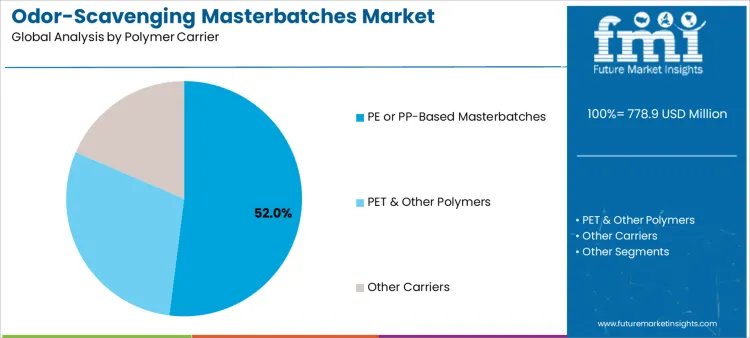
PE or PP-based masterbatches account for 52% share of the odor-scavenging masterbatches market because polyethylene and polypropylene dominate recycled plastics processing and high-volume packaging applications. These polymers frequently retain odors from post-consumer waste streams, making effective odor-scavenging solutions essential. Odor-scavenging additives disperse efficiently in polyolefin matrices, enabling consistent adsorption or neutralization of volatile organic compounds without disrupting melt flow or mechanical properties. Processors prefer PE and PP carriers due to broad compatibility, stable extrusion behavior, and ease of integration into existing compounding lines, reinforcing their leading position in the market.
Why Do Recycled Plastics Compounds Dominate Application Demand in the Odor-Scavenging Masterbatches Market?
Recycled plastic compounds hold 36% share of the odor-scavenging masterbatches market because post-consumer and post-industrial recycled resins often contain persistent odors that limit their use in higher-value applications. Odor issues can affect product acceptance, especially in packaging, household goods, and interior automotive components. Odor-scavenging masterbatches improve the sensory quality of recycled materials, enabling their use in applications with stricter performance and appearance requirements. Growing recycled content mandates and circular-economy initiatives are increasing reliance on odor-control additives. These volume drivers and quality constraints explain why recycled plastics compounds remain the leading application segment.
What Are the Key Dynamics of the Odor-Scavenging Masterbatches Market?
The odor-scavenging masterbatches market is driven by increasing demand for packaging and polymer products that actively neutralize or absorb undesirable smells, enhancing consumer experience and product appeal. Odor-scavenging masterbatches integrate functional additives such as activated carbon, cyclodextrins, or other odor-adsorbing agents into polymer matrices like polyethylene, polypropylene, and engineered resins. Growth in food packaging, hygiene products, automotive interiors, and consumer goods drives market expansion as brand owners prioritize freshness, comfort, and brand differentiation. For material suppliers and compounders, additive efficiency, compatibility with multiple resin systems, and regulatory compliance for food contact and safety are key selection criteria influencing adoption and long-term utilization.
How Do Application Trends and Industry Requirements Shape This Market?
Application trends and industry requirements are shaping the odor-scavenging masterbatches market as manufacturers seek tailored solutions that balance odor control with processing performance and material aesthetics. In food and fresh produce packaging, effective odor scavenging helps maintain product perception and extends shelf appeal without compromising barrier performance or clarity. Hygiene and personal care products leverage these masterbatches to capture volatile compounds during storage and use. In automotive and consumer segments, odor control improves interior comfort, especially in enclosed environments. Compatibility with high-speed extrusion and injection molding, consistent additive distribution, and minimal impact on mechanical properties are essential to meet stringent quality and performance benchmarks across diverse applications.
Why Do Cost, Processing, and Performance Limitations Restrain Market Growth?
Cost, processing, and performance limitations restrain market growth for odor-scavenging masterbatches, particularly in price-competitive and high-volume segments. High-efficiency scavenging agents and engineered carriers can increase raw material costs compared with standard masterbatches, limiting adoption where margins are thin. Achieving uniform dispersion of odor-adsorbing additives without adversely affecting polymer flow, clarity, or mechanical performance presents formulation challenges that can require process adjustments and longer qualification cycles. In some applications, limited odor control longevity or interactions with specific food chemistries further temper uptake. In price-sensitive markets, conventional packaging designs or alternative odor mitigation strategies may remain preferred, slowing broader market expansion.
How Is the Odor-Scavenging Masterbatches Market Growing Across Key Countries?
The odor-scavenging masterbatches market is expanding steadily as packaging, consumer goods, automotive, and industrial product manufacturers focus on improving product sensory quality and end-use acceptance. Odor-scavenging additives are incorporated into plastics to neutralize or absorb unwanted smells originating from recycled polymers, additives, or packaged contents. Country-wise growth varies based on adoption of recycled plastics, packaged food volumes, and quality expectations in finished products. High-growth markets are driven by large packaging and consumer goods production bases, while mature regions emphasize consistent odor control, compatibility with recycled resins, and stable performance across processing cycles.
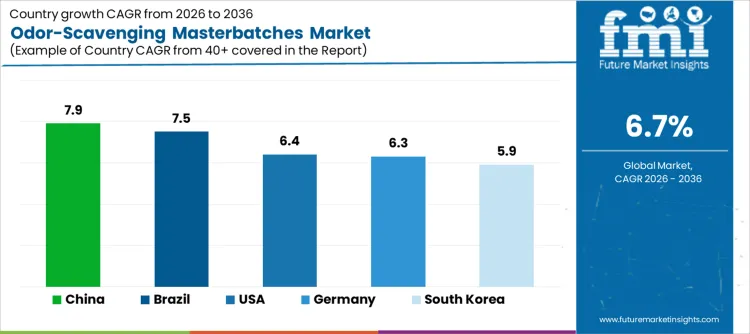
| Country | CAGR (%) |
|---|---|
| China | 7.9% |
| Brazil | 7.5% |
| United States | 6.4% |
| Germany | 6.3% |
| South Korea | 5.9% |
Why Is China Leading the Odor-Scavenging Masterbatches Market?
China’s odor-scavenging masterbatches market is expanding at a CAGR of 7.9% during 2026 to 2036, driven by large-scale use of recycled plastics in packaging, household products, and consumer goods. As recycled polyolefins and PET gain wider adoption, odor management has become critical to maintain product acceptance in food, personal care, and durable goods packaging. Chinese converters prioritize masterbatches that offer effective odor neutralization without affecting mechanical properties, color, or processing stability. Adoption is strong in flexible packaging, rigid containers, automotive interiors, and consumer product housings. Domestic additive suppliers benefit from scale, cost efficiency, and close alignment with plastics processors. Procurement decisions emphasize dispersion quality, consistency across batches, and compatibility with both virgin and recycled resin streams. Market growth is reinforced by increasing recycled content usage, rising packaging volumes, and growing focus on improving end-user product experience.
Why Is Brazil Emerging as a High-Growth Market for Odor-Scavenging Masterbatches?
Brazil’s odor-scavenging masterbatches market is growing at a CAGR of 7.5% during 2026 to 2036, supported by rising use of recycled plastics in packaging, consumer products, and automotive components. Odor control is particularly important in warm and humid conditions, where residual smells can intensify during storage and transport. Brazilian processors value masterbatches that deliver durable odor reduction while maintaining processability and cost efficiency. Adoption is strongest in food packaging, household containers, and molded consumer goods. Price-performance balance remains a key selection criterion. Procurement decisions often favor suppliers offering local availability, technical formulation support, and compatibility with commonly used recycled polymer grades. Market growth is supported by expanding packaging demand, increasing recycled plastic utilization, and improving quality expectations across consumer markets.
What Is Driving Demand for Odor-Scavenging Masterbatches in the United States?
The United States odor-scavenging masterbatches market is expanding at a CAGR of 6.4% during 2026 to 2036, driven by strong adoption of recycled plastics and high quality standards in packaging and consumer products. Odor-scavenging additives are widely used to address residual smells in recycled resin-based packaging, automotive interiors, and durable goods. USA. buyers emphasize predictable odor reduction performance, regulatory compliance, and minimal impact on material properties. Demand is strongest in food packaging, personal care packaging, and automotive plastic components. Procurement decisions prioritize supplier credibility, technical documentation, and long-term performance validation. Market growth is reinforced by rising recycled content mandates, premium packaging expectations, and continued investment in advanced additive solutions.
How Is Germany Supporting Growth in the Odor-Scavenging Masterbatches Market?
Germany’s odor-scavenging masterbatches market is growing at a CAGR of 6.3% during 2026 to 2036, supported by demand from packaging, automotive, and industrial plastics applications. German manufacturers focus on precision material performance and consistent sensory quality, especially when incorporating recycled polymers. Buyers prioritize masterbatches with controlled release behavior, stable dispersion, and reproducible odor-neutralizing efficiency. Adoption is driven by quality requirements rather than volume growth. Procurement decisions favor suppliers with certified quality systems, detailed testing data, and the ability to support customized formulations. Market growth is reinforced by Germany’s focus on high-quality plastic products and advanced polymer processing.
How Is South Korea Expanding Use of Odor-Scavenging Masterbatches?
South Korea’s odor-scavenging masterbatches market is expanding at a CAGR of 5.9% during 2026 to 2036, driven by demand from consumer goods, electronics housings, and packaging applications. Odor control is increasingly important in export-oriented products where sensory quality affects brand perception. Manufacturers emphasize masterbatch purity, compatibility with automated processing, and stable odor-neutralizing performance. Adoption is strongest in consumer packaging and electronics-related plastic components. Procurement decisions are influenced by supplier reliability, product consistency, and alignment with international quality standards. Market growth is supported by steady industrial output and increasing use of recycled polymers in high-value applications.
How Are Suppliers Competing in the Odor-Scavenging Masterbatches Market?
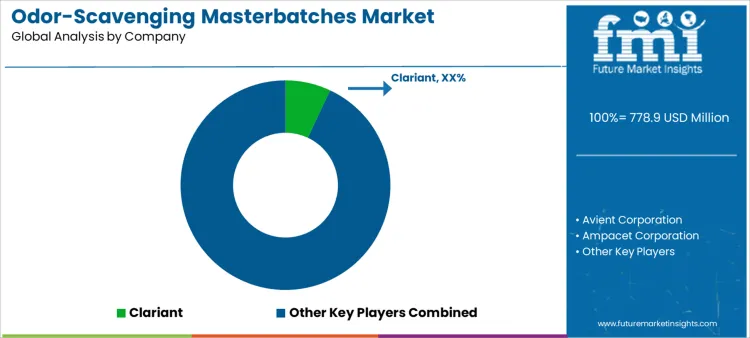
Competition in the odor-scavenging masterbatches market is shaped by additive efficacy, compatibility with diverse thermoplastics, and the ability to deliver long-lasting odor control without compromising mechanical properties. Masterbatches designed to neutralize or trap malodors are critical in applications such as flexible and rigid packaging, household goods, consumer appliances, and automotive interiors, where product experience and hygiene perception influence purchase decisions. Leading suppliers differentiate through tailored chemistry, optimized dispersion, and technical support that helps OEMs and compounders meet performance targets.
Clariant positions its odor-scavenging masterbatches around proprietary functional additives that capture and neutralize a broad range of volatile compounds. Product literature highlights stable performance through processing and service life, ease of integration with polyolefins, and minimal impact on color or clarity. Avient Corporation competes with customizable masterbatch solutions engineered for specific polymer matrices and end-use requirements, emphasizing strong odor control coupled with reliable melt flow and dispersion quality.
Global masterbatch and polymer specialists extend competitive reach through formulation breadth and supply reliability. Ampacet Corporation offers odor control masterbatches designed for high-speed extrusion and injection molding environments, with documentation focused on additive compatibility and process consistency. Ravago and Gabriel-Chemie differentiate through regional support and tailored solutions that align with local market needs.
Additive innovators and niche compounders strengthen the landscape. BASF integrates odor-scavenging functionalities within broader additive platforms, while Americhem emphasizes multi-functional masterbatches combining odor control with UV or anti-static performance. Polyvel, Plastiblends India, and the legacy PolyOne operations round out the market with cost-effective odor-control masterbatches optimized for emerging market applications. Across all suppliers, competitive advantage is defined by verified odor reduction performance, formulation support, and seamless integration into existing processing lines rather than pricing alone.
Key Players in Odor-Scavenging Masterbatches Market
- Clariant
- Avient Corporation
- Ampacet Corporation
- Ravago
- Gabriel-Chemie
- BASF (additive solutions)
- Americhem
- Polyvel
- Plastiblends India
- PolyOne legacy operations
Scope of Report
| Attribute | Details |
|---|---|
| Market Size Unit | USD Million |
| Polymer Carrier Covered | PE or PP-Based Masterbatches, PET & Other Polymers, Other Carriers |
| Application Covered | Recycled Plastics Compounds, Packaging Films & Rigid Packaging, Automotive & Consumer Goods, Other Uses |
| Countries Covered | China, Japan, South Korea, India, Australia & New Zealand, ASEAN, Rest of Asia Pacific, Germany, United Kingdom, France, Italy, Spain, Nordic, BENELUX, Rest of Europe, United States, Canada, Mexico, Brazil, Chile, Rest of Latin America, Kingdom of Saudi Arabia, Other GCC Countries, Turkey, South Africa, Other African Union, Rest of Middle East & Africa |
| Regions Covered | Asia Pacific, Europe, North America, Latin America, Middle East & Africa |
| Key Companies Profiled | Clariant, Avient Corporation, Ampacet Corporation, Ravago, Gabriel-Chemie, BASF, Americhem, Polyvel, Plastiblends India, PolyOne (legacy operations) |
| Additional Attributes | Dollar sales of odor-scavenging masterbatches are analyzed by polymer carrier and end-use application across recycled and virgin plastic formulations. The scope evaluates odor adsorption efficiency, long-term odor neutralization performance, compatibility with recycled resin streams, processing stability, and impact on mechanical and optical properties. Country-level analysis reflects rising use of recycled plastics, stricter quality expectations for packaging and automotive interiors, and increasing adoption of functional masterbatches to improve sensory performance of plastic products. |
Odor-Scavenging Masterbatches Market by Key Segments
Polymer Carrier:
- PE or PP-Based Masterbatches
- PET & Other Polymers
- Other Carriers
Application:
- Recycled Plastics Compounds
- Packaging Films & Rigid Packaging
- Automotive & Consumer Goods
- Other Uses
Region:
- Asia Pacific
- China
- Japan
- South Korea
- India
- Australia & New Zealand
- ASEAN
- Rest of Asia Pacific
- Europe
- Germany
- United Kingdom
- France
- Italy
- Spain
- Nordic
- BENELUX
- Rest of Europe
- North America
- United States
- Canada
- Mexico
- Latin America
- Brazil
- Chile
- Rest of Latin America
- Middle East & Africa
- Kingdom of Saudi Arabia
- Other GCC Countries
- Turkey
- South Africa
- Other African Union
- Rest of Middle East & Africa
Bibliography
- European Commission, Joint Research Centre. (2023). Odour emissions and volatile organic compounds in recycled plastic materials: Implications for packaging and consumer applications. Luxembourg: Publications Office of the European Union.
- European Food Safety Authority. (2024). Assessment of additives and functional materials used to mitigate odour and sensory contamination in recycled plastics intended for food contact. EFSA Journal, 22(4), e08912.
- United Nations Environment Programme. (2024). Improving the quality of recycled plastics: Odour control, contamination management, and material performance. Nairobi, Kenya: United Nations Environment Programme.
Frequently Asked Questions
How big is the odor-scavenging masterbatches market in 2026?
The global odor-scavenging masterbatches market is estimated to be valued at USD 778.9 million in 2026.
What will be the size of odor-scavenging masterbatches market in 2036?
The market size for the odor-scavenging masterbatches market is projected to reach USD 1,489.8 million by 2036.
How much will be the odor-scavenging masterbatches market growth between 2026 and 2036?
The odor-scavenging masterbatches market is expected to grow at a 6.7% CAGR between 2026 and 2036.
What are the key product types in the odor-scavenging masterbatches market?
The key product types in odor-scavenging masterbatches market are pe or pp-based masterbatches, pet & other polymers and other carriers.
Which application segment to contribute significant share in the odor-scavenging masterbatches market in 2026?
In terms of application, recycled plastics compounds segment to command 36.0% share in the odor-scavenging masterbatches market in 2026.
Preview the report firsthand - request a free sample
Get SampleGet the brochure for pricing and purchase details.
Get PDFTable of Content
- Executive Summary
- Global Market Outlook
- Demand-side Trends
- Supply-side Trends
- Technology Roadmap Analysis
- Analysis and Recommendations
- Market Overview
- Market Coverage / Taxonomy
- Market Definition / Scope / Limitations
- Market Background
- Market Dynamics
- Drivers
- Restraints
- Opportunity
- Trends
- Scenario Forecast
- Demand in Optimistic Scenario
- Demand in Likely Scenario
- Demand in Conservative Scenario
- Opportunity Map Analysis
- Product Life Cycle Analysis
- Supply Chain Analysis
- Investment Feasibility Matrix
- Value Chain Analysis
- PESTLE and Porter’s Analysis
- Regulatory Landscape
- Regional Parent Market Outlook
- Production and Consumption Statistics
- Import and Export Statistics
- Market Dynamics
- Global Market Analysis 2021 to 2025 and Forecast, 2026 to 2036
- Historical Market Size Value (USD Million) Analysis, 2021 to 2025
- Current and Future Market Size Value (USD Million) Projections, 2026 to 2036
- Y-o-Y Growth Trend Analysis
- Absolute $ Opportunity Analysis
- Global Market Pricing Analysis 2021 to 2025 and Forecast 2026 to 2036
- Global Market Analysis 2021 to 2025 and Forecast 2026 to 2036, By Polymer Carrier
- Introduction / Key Findings
- Historical Market Size Value (USD Million) Analysis By Polymer Carrier , 2021 to 2025
- Current and Future Market Size Value (USD Million) Analysis and Forecast By Polymer Carrier , 2026 to 2036
- PE or PP-Based Masterbatches
- PET & Other Polymers
- Other Carriers
- PE or PP-Based Masterbatches
- Y-o-Y Growth Trend Analysis By Polymer Carrier , 2021 to 2025
- Absolute $ Opportunity Analysis By Polymer Carrier , 2026 to 2036
- Global Market Analysis 2021 to 2025 and Forecast 2026 to 2036, By Application
- Introduction / Key Findings
- Historical Market Size Value (USD Million) Analysis By Application, 2021 to 2025
- Current and Future Market Size Value (USD Million) Analysis and Forecast By Application, 2026 to 2036
- Recycled Plastics Compounds
- Packaging Films & Rigid Packaging
- Automotive & Consumer Goods
- Other Uses
- Recycled Plastics Compounds
- Y-o-Y Growth Trend Analysis By Application, 2021 to 2025
- Absolute $ Opportunity Analysis By Application, 2026 to 2036
- Global Market Analysis 2021 to 2025 and Forecast 2026 to 2036, By Region
- Introduction
- Historical Market Size Value (USD Million) Analysis By Region, 2021 to 2025
- Current Market Size Value (USD Million) Analysis and Forecast By Region, 2026 to 2036
- North America
- Latin America
- Western Europe
- Eastern Europe
- East Asia
- South Asia and Pacific
- Middle East & Africa
- Market Attractiveness Analysis By Region
- North America Market Analysis 2021 to 2025 and Forecast 2026 to 2036, By Country
- Historical Market Size Value (USD Million) Trend Analysis By Market Taxonomy, 2021 to 2025
- Market Size Value (USD Million) Forecast By Market Taxonomy, 2026 to 2036
- By Country
- USA
- Canada
- Mexico
- By Polymer Carrier
- By Application
- By Country
- Market Attractiveness Analysis
- By Country
- By Polymer Carrier
- By Application
- Key Takeaways
- Latin America Market Analysis 2021 to 2025 and Forecast 2026 to 2036, By Country
- Historical Market Size Value (USD Million) Trend Analysis By Market Taxonomy, 2021 to 2025
- Market Size Value (USD Million) Forecast By Market Taxonomy, 2026 to 2036
- By Country
- Brazil
- Chile
- Rest of Latin America
- By Polymer Carrier
- By Application
- By Country
- Market Attractiveness Analysis
- By Country
- By Polymer Carrier
- By Application
- Key Takeaways
- Western Europe Market Analysis 2021 to 2025 and Forecast 2026 to 2036, By Country
- Historical Market Size Value (USD Million) Trend Analysis By Market Taxonomy, 2021 to 2025
- Market Size Value (USD Million) Forecast By Market Taxonomy, 2026 to 2036
- By Country
- Germany
- UK
- Italy
- Spain
- France
- Nordic
- BENELUX
- Rest of Western Europe
- By Polymer Carrier
- By Application
- By Country
- Market Attractiveness Analysis
- By Country
- By Polymer Carrier
- By Application
- Key Takeaways
- Eastern Europe Market Analysis 2021 to 2025 and Forecast 2026 to 2036, By Country
- Historical Market Size Value (USD Million) Trend Analysis By Market Taxonomy, 2021 to 2025
- Market Size Value (USD Million) Forecast By Market Taxonomy, 2026 to 2036
- By Country
- Russia
- Poland
- Hungary
- Balkan & Baltic
- Rest of Eastern Europe
- By Polymer Carrier
- By Application
- By Country
- Market Attractiveness Analysis
- By Country
- By Polymer Carrier
- By Application
- Key Takeaways
- East Asia Market Analysis 2021 to 2025 and Forecast 2026 to 2036, By Country
- Historical Market Size Value (USD Million) Trend Analysis By Market Taxonomy, 2021 to 2025
- Market Size Value (USD Million) Forecast By Market Taxonomy, 2026 to 2036
- By Country
- China
- Japan
- South Korea
- By Polymer Carrier
- By Application
- By Country
- Market Attractiveness Analysis
- By Country
- By Polymer Carrier
- By Application
- Key Takeaways
- South Asia and Pacific Market Analysis 2021 to 2025 and Forecast 2026 to 2036, By Country
- Historical Market Size Value (USD Million) Trend Analysis By Market Taxonomy, 2021 to 2025
- Market Size Value (USD Million) Forecast By Market Taxonomy, 2026 to 2036
- By Country
- India
- ASEAN
- Australia & New Zealand
- Rest of South Asia and Pacific
- By Polymer Carrier
- By Application
- By Country
- Market Attractiveness Analysis
- By Country
- By Polymer Carrier
- By Application
- Key Takeaways
- Middle East & Africa Market Analysis 2021 to 2025 and Forecast 2026 to 2036, By Country
- Historical Market Size Value (USD Million) Trend Analysis By Market Taxonomy, 2021 to 2025
- Market Size Value (USD Million) Forecast By Market Taxonomy, 2026 to 2036
- By Country
- Kingdom of Saudi Arabia
- Other GCC Countries
- Turkiye
- South Africa
- Other African Union
- Rest of Middle East & Africa
- By Polymer Carrier
- By Application
- By Country
- Market Attractiveness Analysis
- By Country
- By Polymer Carrier
- By Application
- Key Takeaways
- Key Countries Market Analysis
- USA
- Pricing Analysis
- Market Share Analysis, 2025
- By Polymer Carrier
- By Application
- Canada
- Pricing Analysis
- Market Share Analysis, 2025
- By Polymer Carrier
- By Application
- Mexico
- Pricing Analysis
- Market Share Analysis, 2025
- By Polymer Carrier
- By Application
- Brazil
- Pricing Analysis
- Market Share Analysis, 2025
- By Polymer Carrier
- By Application
- Chile
- Pricing Analysis
- Market Share Analysis, 2025
- By Polymer Carrier
- By Application
- Germany
- Pricing Analysis
- Market Share Analysis, 2025
- By Polymer Carrier
- By Application
- UK
- Pricing Analysis
- Market Share Analysis, 2025
- By Polymer Carrier
- By Application
- Italy
- Pricing Analysis
- Market Share Analysis, 2025
- By Polymer Carrier
- By Application
- Spain
- Pricing Analysis
- Market Share Analysis, 2025
- By Polymer Carrier
- By Application
- France
- Pricing Analysis
- Market Share Analysis, 2025
- By Polymer Carrier
- By Application
- India
- Pricing Analysis
- Market Share Analysis, 2025
- By Polymer Carrier
- By Application
- ASEAN
- Pricing Analysis
- Market Share Analysis, 2025
- By Polymer Carrier
- By Application
- Australia & New Zealand
- Pricing Analysis
- Market Share Analysis, 2025
- By Polymer Carrier
- By Application
- China
- Pricing Analysis
- Market Share Analysis, 2025
- By Polymer Carrier
- By Application
- Japan
- Pricing Analysis
- Market Share Analysis, 2025
- By Polymer Carrier
- By Application
- South Korea
- Pricing Analysis
- Market Share Analysis, 2025
- By Polymer Carrier
- By Application
- Russia
- Pricing Analysis
- Market Share Analysis, 2025
- By Polymer Carrier
- By Application
- Poland
- Pricing Analysis
- Market Share Analysis, 2025
- By Polymer Carrier
- By Application
- Hungary
- Pricing Analysis
- Market Share Analysis, 2025
- By Polymer Carrier
- By Application
- Kingdom of Saudi Arabia
- Pricing Analysis
- Market Share Analysis, 2025
- By Polymer Carrier
- By Application
- Turkiye
- Pricing Analysis
- Market Share Analysis, 2025
- By Polymer Carrier
- By Application
- South Africa
- Pricing Analysis
- Market Share Analysis, 2025
- By Polymer Carrier
- By Application
- USA
- Market Structure Analysis
- Competition Dashboard
- Competition Benchmarking
- Market Share Analysis of Top Players
- By Regional
- By Polymer Carrier
- By Application
- Competition Analysis
- Competition Deep Dive
- Clariant
- Overview
- Product Portfolio
- Profitability by Market Segments (Product/Age /Sales Channel/Region)
- Sales Footprint
- Strategy Overview
- Marketing Strategy
- Product Strategy
- Channel Strategy
- Avient Corporation
- Ampacet Corporation
- Ravago
- Gabriel-Chemie
- BASF (additive solutions)
- Americhem
- Polyvel
- Plastiblends India
- PolyOne legacy operations
- Clariant
- Competition Deep Dive
- Assumptions & Acronyms Used
- Research Methodology


