

- Industry Size (2026)
- USD 512.0 Mn
- Forecast (2036)
- USD 899.8 Mn
- CAGR (2026 to 2036)
- 5.8%
Waterborne Polyurethane Dispersions for Automotive Synthetic Leather Market Size, Market Forecast and Outlook By FMI
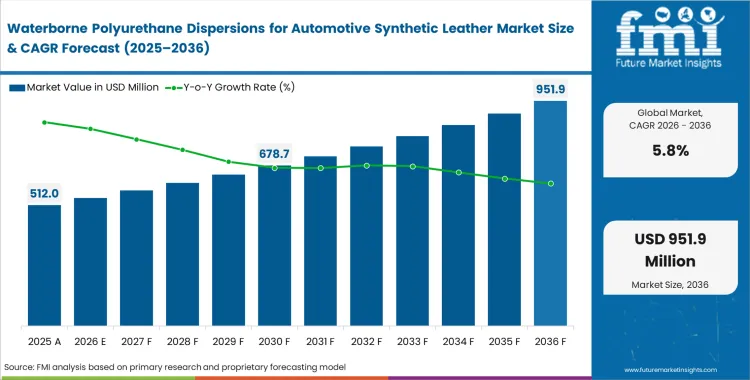
The waterborne polyurethane dispersions for automotive synthetic leather market was valued at USD 483.9 million in 2025. Demand is poised to cross USD 512.0 million in 2026, and reach USD 899.8 million by 2036, at a 5.8% CAGR over the forecast period. Expansion is driven by vehicle assembly constraints forcing Tier-1 interior suppliers to permanently replace solvent-heavy formulations with low-emission alternatives.
Summary of Waterborne Polyurethane Dispersions for Automotive Synthetic Leather Market
- The market is estimated at USD 512.0 million in 2026.
- The market is projected to reach USD 899.8 million by 2036.
- The market is expected to grow at a CAGR of 5.8% from 2026 to 2036.
- The forecast period represents an incremental opportunity of USD 387.8 million.
- Anionic segment leads the chemistry segment with a 54.0% share.
- Polyester dominates the resin type segment with a 46.0% share.
- Surface coat leads the layer type segment with a 41.0% share.
- Passenger cars dominate the vehicle type segment with a 78.0% share.
- OEM trim leads the sales channel segment with a 72.0% share.
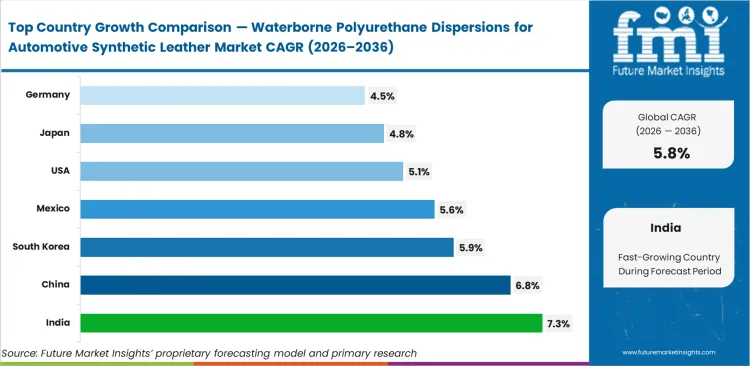
- India (7.3%), China (6.8%), and South Korea (5.9%) are among the fastest-growing markets.
Waterborne Polyurethane Dispersions for Automotive Synthetic Leather Market Key Takeaways
| Metric | Details |
|---|---|
| Industry Size (2026) | USD 512.0 million |
| Industry Value (2036) | USD 899.8 million |
| CAGR (2026 to 2036) | 5.8% |
Source: Future Market Insights (FMI) analysis, based on proprietary forecasting model and primary research
Waterborne polyurethane dispersions for automotive synthetic leather are gaining stronger commercial relevance as vehicle interiors move toward lower-emission material systems with tighter compliance thresholds. Growth is propelled by the need to reduce VOC release, improve cabin air quality performance, and align interior material selection with broader sustainability targets across passenger vehicle platforms. Automotive OEMs and tier suppliers are steadily reassessing conventional solvent-based coating systems, particularly in programs linked to electric vehicles, premium interiors, and export-oriented vehicle production. This shift is creating favorable conditions for waterborne polyurethane dispersions, especially in synthetic leather applications requiring soft touch, abrasion resistance, color consistency, and controlled surface finish.
Growth prospects remain closely tied to formulation performance under real manufacturing conditions. Drying efficiency, adhesion reliability, hydrolysis resistance, and process stability on existing coating lines continue to influence supplier selection and conversion speed. Producers capable of improving solid content, reducing curing complexity, and supporting scale-up on legacy equipment are likely to strengthen their market position. Demand is also expected to benefit from rising use of synthetic leather in seats, door trims, instrument panels, and armrests, particularly as automakers balance cost efficiency with premium interior appearance. FMI analysis indicates that long-term market expansion depends on regulatory alignment, coating-line adaptability, and the ability of suppliers to deliver consistent low-emission performance at commercial scale.
India is expected to register a 7.3% CAGR during the forecast period, due to domestic vehicle assembly scaling rapidly alongside abrupt interior emission standards. China is estimated to expand at a 6.8% CAGR as intense electric vehicle premiumization heavily drives relentless demand for zero-emission cabin materials. Growth in South Korea is poised to expand at a 5.9% CAGR, Mexico at a 5.6% CAGR, the United States at a 5.1% CAGR, Japan and Germany at a 4.8% and 4.5% CAGR respectively, because substitution pace diverges sharply across manufacturing hubs based entirely on localized oven-drying infrastructure capacity.
Segmental Analysis
Waterborne Polyurethane Dispersions for Automotive Synthetic Leather Market Analysis by Chemistry
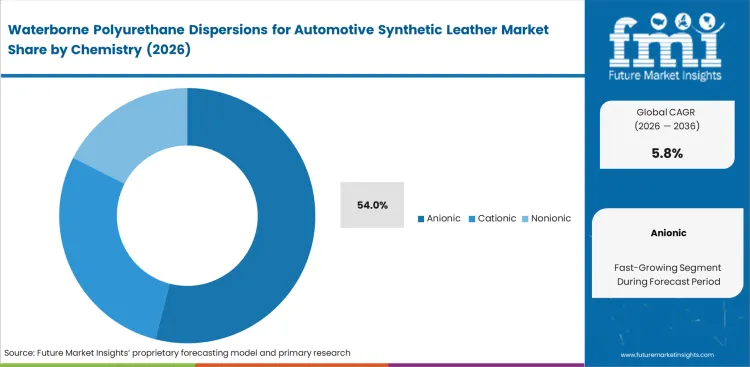
Compatibility with existing prime coats dictates formulation choices across trim manufacturing facilities, deeply influencing the entire chemistry selection process. The anionic segment is expected to hold 54.0% revenue share in 2026. Trim engineering heads specify these highly specialized mixtures because negative electrostatic charges stabilize polymer particles exceptionally effectively during high-speed roll application procedures.
Transitioning toward waterborne automobile coating demands incredibly reliable emulsion stability under continuous shear stress, requiring extremely rigorous laboratory testing before final factory deployment. Initial peel strength figures frequently appear highly impressive on technical datasheets, yet long-term adhesion stability over extended thermal cycling completely determines actual field survival. Process engineers selecting incompatible ionic charges or completely failing to properly evaluate dimethylolpropionic acid structures face absolutely catastrophic chemical delamination during intense summer heat exposure.
- Electrostatic stability mechanism: Negative electrostatic repulsion keeps polymer particles heavily separated during high-shear application processes, allowing process engineers to achieve uniform film thickness without premature coagulation.
- Durable adhesion profiling: Chemical bonding with polarized substrates ensures durable attachment across varying cabin temperatures, helping quality control directors actively avoid costly warranty claims tied to delamination.
- Water-based prime coat synergy: Superior chemical compatibility with existing water-based prime coats streamlines the manufacturing process, preventing the need for complete production line overhauls.
- Consistent flex-abrasion performance: The formulation provides exceptional mechanical flexibility, ensuring that heavily trafficked seating surfaces maintain integrity over a simulated ten-year vehicle lifespan.
Waterborne Polyurethane Dispersions for Automotive Synthetic Leather Market Analysis by Resin Type
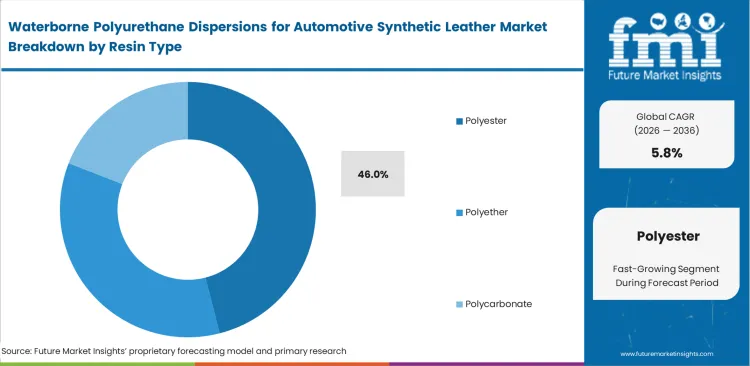
Cost constraints heavily influence material selection for high-volume vehicle programs, determining the exact speed new advanced polymers penetrate the automotive supply chain. The polyester segment is predicted to account for 46.0% revenue share in 2026. Procurement executives at Tier-1 suppliers consistently approve specific resins delivering highly necessary tensile strength for seat bolsters without breaking incredibly strict bill-of-material limits.
Purchasing teams evaluating global polyurethane resins paints coatings quickly discover acceptable baseline material performance often masks a profound, hidden vulnerability to humidity-driven chemical degradation over extended operational timeframes. Buyers specifying standard molecular architectures without successfully negotiating a highly durable, hydrolysis resistant waterborne PU leather coating risk severe material failures after three years of tropical deployment. These purchasing professionals must carefully balance upfront chemical resin costs against long-term product warranty liabilities to successfully maintain strict corporate profitability margins.
- Optimal tensile reinforcement: Tightly packed polymer chains generate substantial physical toughness for high-wear seating zones, helping seating design leads secure necessary scuff resistance for daily passenger ingress.
- Strict economic thresholding: Lower raw material costs keep total fabric pricing highly competitive against genuine hides, allowing purchasing officers to maintain required margin targets on mid-tier vehicle platforms.
- Broad processing compatibility: The chemical backbone seamlessly integrates into legacy roll-coating machinery, minimizing the capital expenditure required for factory upgrades.
- Predictable curing behavior: Thermal cross-linking occurs at reliable, consistent temperatures, allowing factory managers to accurately project daily throughput volumes without unexpected downtime.
Waterborne Polyurethane Dispersions for Automotive Synthetic Leather Market Analysis by Layer Type
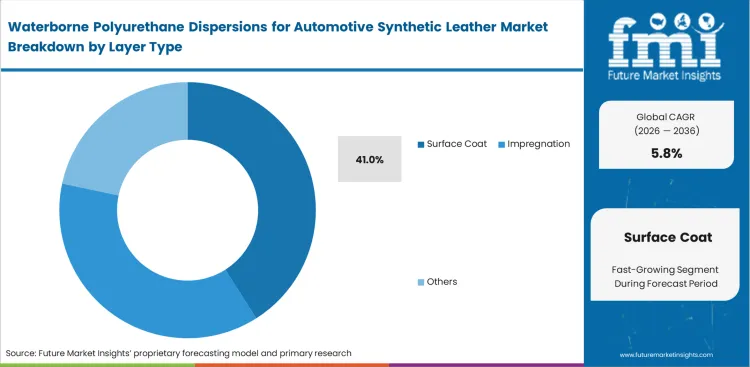
Strict aesthetic requirements shape the exact way new chemistries enter legacy production processes, forcing dedicated material scientists to prioritize top-layer modifications first. The surface coat segment is expected to hold 41.0% revenue share in 2026. Automotive design chiefs strongly demand precise gloss control alongside premium haptic feedback on top layers, heavily scrutinizing every single visible cabin surface. Aqueous dispersions formulated for soft touch polyurethane coatings successfully meet rigorous visual design standards while eliminating surface-level toxic solvent outgassing entirely from the vehicle interior.
Top-layer conversion appears nearly complete across global procurement networks, yet achieving highly successful waterborne PU impregnation for microfiber synthetic leather remains a persistent, highly complex chemistry hurdle. Converting base material layers requires entirely different fluid rheology control, causing current aqueous dispersion technology to struggle with providing highly efficient material penetration. Contractors delaying necessary top-coat transitions face immediate commercial disqualification from upcoming electric vehicle interior bids across the broader automotive manufacturing sector.
- Precise gloss regulation: Micro-silica additives suspended in dispersion matrices accurately scatter light to create matte finishes, enabling interior designers to eliminate unwanted glare on dashboard panels.
- Advanced haptic tuning: Specialized soft-segment ratios produce distinct leather-like drag on human skin, helping user experience directors achieve premium tactile sensations without using animal products.
- Enhanced scratch resistance: Specific crosslinking density determines how effectively topcoats deflect sharp impacts, ensuring that seating surfaces survive direct contact with metal zippers and keys.
- Direct regulatory compliance: Surface coats represent the primary source of historical volatile organic compound outgassing, making their immediate conversion the fastest route to passing strict vehicle indoor air quality tests.
Waterborne Polyurethane Dispersions for Automotive Synthetic Leather Market Analysis by Vehicle Type
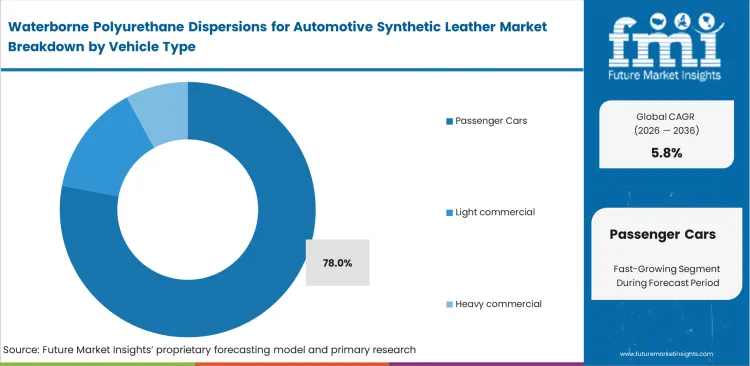
Cabin premiumization forces distinct material strategies across different transport categories, fundamentally shifting the traditional boundaries of modern automotive luxury. The passenger cars segment is estimated to secure 78.0% revenue share in 2026. Product planners consistently push suppliers for softer, exceedingly luxurious touchpoints across every visible surface inside the passenger cabin. Acoustic requirements for silent electric drivetrains strictly dictate softer trim panels, forcing profound resin adjustments unable to be matched by legacy solvent systems.
Formulators engineering automotive soft trim interior materials discover water-based systems uniquely excel at delivering the specific required micro-softness. Ignoring critical acoustic-tactile intersections leaves legacy suppliers heavily marginalized in future platform negotiations, causing original equipment manufacturers to refuse any compromise on interior cabin quietness.
- Acoustic dampening integration: Softer resin matrices proactively absorb high-frequency noise bouncing inside silent electric cabins, allowing NVH engineers to utilize seating fabrics as functional sound-deadening components.
- Aesthetic interior differentiation: Custom color-matching capabilities allow designers to flawlessly execute complex multi-tone interior themes, helping branding executives establish unique visual identities for luxury sub-brands.
- Thermal management capabilities: Specific formulations seamlessly integrate phase-change materials to regulate seating surface temperatures, empowering climate control directors to reduce HVAC energy loads and extend total vehicle range.
- Elevated consumer expectations: Retail buyers increasingly demand premium, sustainable, and animal-free interior materials as standard features, forcing automakers to aggressively transition their passenger vehicle supply chains.
Waterborne Polyurethane Dispersions for Automotive Synthetic Leather Market Analysis by Sales Channel
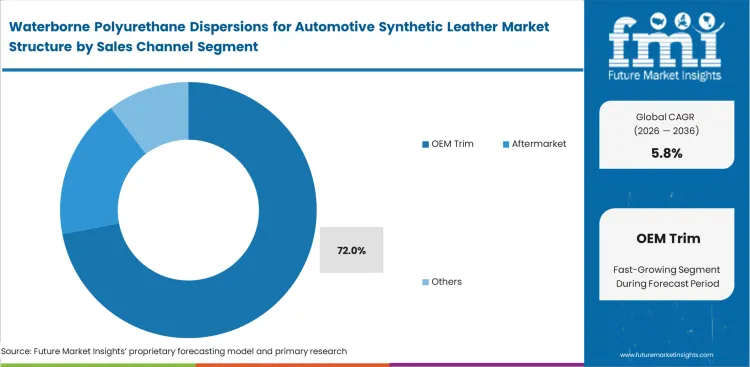
Validation timelines establish massive operational barriers to entry for unproven chemical technologies, deeply consolidating the supply base. The OEM trim segment is expected to hold 72.0% revenue share in 2026. Tier-1 engineering teams proactively dictate chemistry choices long before fabrics ever reach final assembly lines. Operations managers evaluating automotive synthetic leather PUD suppliers consistently demand grueling 24-month qualification cycles before altering established automotive interior trim parts contracts. Successful approval creates near-permanent vendor lock-in that aftermarket suppliers find impossible to penetrate. Chemical producers attempting to bypass OEM validation directly through aftermarket channels waste vital capital on low-volume replacement cycles that offer minimal long-term commercial returns.
- Rigorous validation protocols: Extreme temperature and UV exposure tests prove long-term polymer stability, allowing quality assurance heads to confidently verify materials are expected to survive ten-year vehicle lifespans.
- Guaranteed volume lock-in: Approved chemical formulations secure guaranteed volume contracts across multiple vehicle platforms, providing sales directors with predictable revenue streams to fund future capacity expansion.
- Complex supply synchronization: Just-in-time delivery requirements force chemical suppliers to localize production near Tier-1 facilities, helping supply chain managers actively minimize inventory holding costs across complex logistics networks.
- Standardized platform integration: Factory qualification ensures that the specified dispersion chemistry works seamlessly across global manufacturing hubs, eliminating regional formulation discrepancies for international automakers.
Waterborne Polyurethane Dispersions for Automotive Synthetic Leather Market Drivers, Restraints, and Opportunities
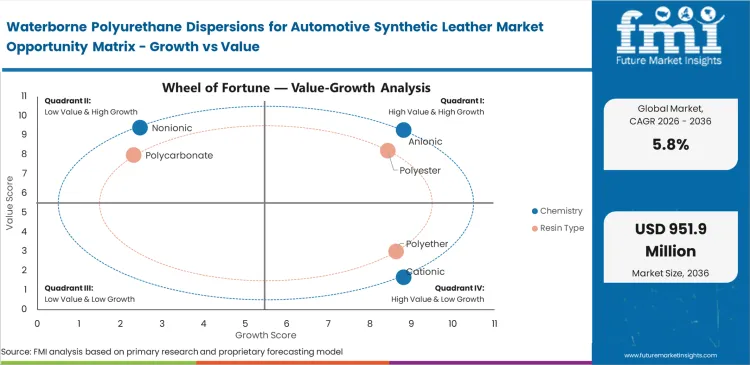
Strict cabin air quality regulations are forcing vehicle manufacturers to phase out high-emission interior materials at extraordinary speed across upcoming model programs. Close evaluation of low-VOC compliance across synthetic leather chemistry in passenger vehicles indicates a durable and accelerating shift toward water-based systems. Continued dependence on legacy solventborne chemistry creates a serious risk of platform exclusion under increasingly stringent in-cabin air quality validation protocols.
Interior trim engineering teams need validated low-emission chemistry packages in place early to maintain compliance across next-generation electric vehicle launches and platform approvals. Adoption of polyurethane PU adhesives alongside advanced aqueous coatings addresses this outgassing challenge directly, while also supporting cleaner process positioning during material qualification reviews. Any delay in this formulation transition raises the probability of contract losses, since leading automotive manufacturers remain unwilling to dilute corporate sustainability targets for lower-cost legacy inputs.
Installed coating line infrastructure continues to create substantial operational friction, limiting the speed of full market conversion across synthetic leather manufacturing facilities. Processing waterborne systems generally demands longer oven dwell times than rapid-flashing solvent alternatives, creating a clear productivity disadvantage on legacy lines. Plant managers running heavy aqueous resins on older manufacturing equipment often encounter immediate line-speed reductions, lower throughput efficiency, and greater process instability during scale-up. Capital expenditure committees regularly hesitate over costly oven extension programs, especially under fluctuating global vehicle production volumes and uncertain plant utilization assumptions.
Opportunities in the Waterborne Polyurethane Dispersions for Automotive Synthetic Leather Market
- Microfiber integration: Formulating highly breathable microfiber leather waterborne polyurethane systems allows sustainability directors to capture premium pricing margins from eco-conscious electric vehicle brands demanding authentic leather alternatives.
- Advanced seating upgrades: Engineering a highly robust car seat synthetic leather waterborne coating helps plant managers drastically reduce waterborne coatings energy costs and heavily improve total coating line throughput.
- Dashboard applications: Deploying custom dashboard synthetic leather waterborne PU empowers fleet managers to ensure highly durable, scratch-resistant, and low-glare surfaces for high-utilization shared autonomous mobility platforms.
Regional Analysis
Based on regional analysis, the waterborne polyurethane dispersions for automotive synthetic leather market is segmented into North America, Latin America, Europe, Asia Pacific, and Middle East & Africa across 40 plus countries.
.webp "Top Country Growth Comparison Waterborne Polyurethane Dispersions For Automotive Synthetic Leather Market Cagr (2026 2036)")
| Country | CAGR (2026 to 2036) |
|---|---|
| India | 7.3% |
| China | 6.8% |
| South Korea | 5.9% |
| Mexico | 5.6% |
| United States | 5.1% |
| Japan | 4.8% |
| Germany | 4.5% |
Source: Future Market Insights (FMI) analysis, based on proprietary forecasting model and primary research
Asia Pacific Waterborne Polyurethane Dispersions for Automotive Synthetic Leather Market Analysis
Rapid premiumization in domestic passenger platforms collides continuously with abrupt regulatory shifts toward low-emission manufacturing across the region. Vehicle assembly lines are scaling aggressively, actively forcing local supply chains to leapfrog legacy solvent technologies entirely. Tier-1 trim producers heavily skip intermediate steps, directly installing highly advanced drying infrastructure specifically engineered to handle water-based resins. FMI's analysis indicates this strategic localized capacity expansion effectively prevents the supply bottlenecks that frequently plague older manufacturing hubs. Acoustic engineers prioritizing low fogging interior trim adhesives for premium automotive cabins consistently demand identical low-emission profiles from seating surfaces, pushing formulation boundaries further.
- India: Rapidly scaling domestic vehicle assembly expansion forces immediate factory-level compliance with entirely new, extremely strict interior emission standards. Demand in India is expected to register a CAGR of 7.3% during the forecast period. Tier-1 procurement leads proactively secure long-term waterborne material contracts to successfully support highly ambitious regional production volume targets. Newly established manufacturing facilities are built specifically with extended oven-drying capabilities, effectively bypassing the severe retrofitting obstacles routinely seen throughout older international markets. Steadily expanding consumer purchasing power directly drives expansive demand for deeply upgraded, premium synthetic leather interior finishes across entry-level domestic vehicle platforms.
- China: Intense electric vehicle premiumization continuously drives relentless demand for incredibly luxurious, zero-emission cabin materials across fiercely competitive domestic brands. Procurement leaders systematically replace heavy legacy animal hides with advanced engineered synthetics to significantly reduce overall vehicle weight and substantially extend battery range. As the territory fundamentally defines the global trajectory, large-scale domestic automotive platforms actively export strictly enforced low-emission material standards worldwide. China is expected to register a CAGR of 6.8% during the forecast period. The localized presence of expansive chemical synthesis parks empowers domestic formulators to rapidly scale production capacities and heavily undercut imported resin pricing.
- South Korea: Dedicated quality assurance teams subject newly formulated synthetic leather samples to brutal thermal shock and flex testing, forcing chemical suppliers to deliver absolutely unmatched polymer resilience. Strategic buyers heavily utilize highly advanced local chemical engineering expertise to secure critical competitive positioning against fiercely competing foreign automakers. Deep financial investments placed into advanced micro-softness technologies allow local brands to effectively mimic the exact tactile signature associated with genuine premium leathers. Demand in South Korea is expected to grow at a CAGR of 5.9% during the forecast period, because export-focused automotive brands strictly demand extreme physical durability from interior coatings to effectively ensure survival across drastically diverse global climates.
- Japan: Sales in Japan is predicted to progress at a CAGR of 4.8% during the forecast period, as mature vehicle output bases focus intensely on replacement cycles and incredibly strict environmental compliance rather than seeking raw volume creation. Engineering leads heavily study automotive interior leather industry analysis in Japan and consistently prioritize ultra-reliable, long-term adhesion profiles over risky novel tactile experiments. Actual on-the-ground practitioner reality involves painstaking, multi-year validation cycles making rapid, disruptive chemistry swapping virtually impossible for unproven chemical suppliers. A deep-seated cultural emphasis on uncompromised manufacturing perfection ensures once a newly introduced waterborne chemistry achieves approval, the material remains locked securely into the supply chain for decades.
FMI's comprehensive report actively includes detailed market analysis for Taiwan and other critical regional manufacturing zones. Focus remains entirely on highly automated, precision coating applications designed to completely offset rapidly rising regional labor costs.
North America Waterborne Polyurethane Dispersions for Automotive Synthetic Leather Market Analysis
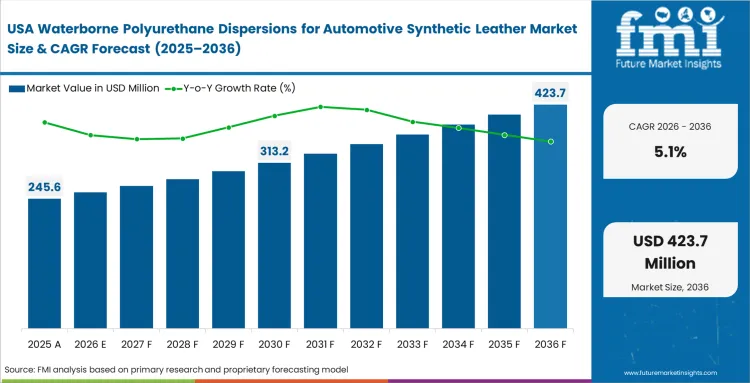
Deep cross-border supply chain integration heavily defines successful material procurement strategies across this continent. High-volume vehicle assembly plants rigidly demand localized resin delivery capabilities to properly maintain heavily optimized just-in-time manufacturing schedules. Chemical suppliers must proactively establish large-scale blending hubs near major automotive corridors to remain commercially competitive against deeply entrenched incumbents. Trim engineering teams focus heavily on massive SUV and commercial truck interiors, demanding extreme abrasion resistance suitable for heavy-duty daily use. According to FMI's estimates, perfectly balancing these intense physical durability requirements with increasingly strict low-VOC targets remains a central, highly complex chemical engineering challenge.
- Mexico: Demand for waterborne polyurethane dispersions for automotive synthetic leather in Mexico is expected to expand at a CAGR of 5.6% during the forecast period. This regional integration is strongly supported by rapidly expanding automotive manufacturing bases seamlessly pulling major Tier-1 trim suppliers directly into deeply integrated regional industrial parks. Local plant managers actively seek reliable, locally blended dispersion supplies to completely avoid costly cross-border logistics delays across the supply chain. The manufacturing zone transforms into a highly strategic primary operational hub once major chemical suppliers proactively establish massive bulk liquid storage infrastructure. Leveraging highly skilled, cost-effective regional labor allows trim contractors to successfully maintain strict profitability margins despite utilizing slightly more expensive waterborne resin formulations throughout the production cycle.
- United States: Material scientists actively specifying United States coated fabrics heavily demand high-performance surface coats profoundly resisting heavy wear while simultaneously meeting incredibly strict outgassing limits. Successful integration seamlessly delivers highly critical operational outcomes by consistently ensuring absolutely uninterrupted assembly line material flow across diverse manufacturing facilities. Waterborne polyurethane dispersions for automotive synthetic leather industry in the United States is expected to increase at a CAGR of 5.1% during the forecast period. This highly technical adoption is largely driven by exceptionally stringent technical specifications for upcoming, highly anticipated electric truck platforms forcing extensive, ground-up interior material redesigns. Corporate environmental sustainability mandates from major Detroit-based automakers heavily pressure the entire domestic supply chain to completely eradicate legacy toxic solvent utilization.
FMI's report includes detailed, highly specific analysis for Canada, where intense cold-weather performance testing remains an absolutely crucial, unavoidable qualification hurdle for any newly introduced interior material formulation.
Europe Waterborne Polyurethane Dispersions for Automotive Synthetic Leather Market Analysis
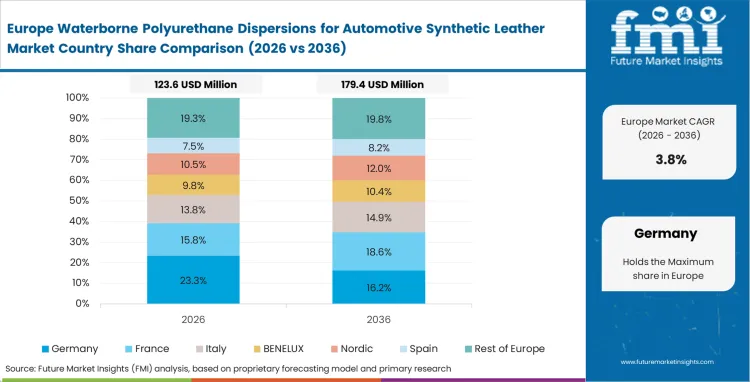
Highly restrictive environmental policies dictate modern chemical sourcing strategies across heritage automotive brands operating within this geography. Strict regulatory bodies mandate comprehensive chemical lifecycle tracking, aggressively pushing Tier-1 suppliers to eliminate legacy solvents entirely from their production lines. Advanced material testing facilities completely dominate this landscape, focusing heavily on circular economy integration and cutting-edge bio-based resin development. Chemical formulators meticulously align their innovations with stringent regional recycling targets to successfully secure highly lucrative, long-term OEM manufacturing contracts.
- Germany: Germany is set to advance at a CAGR of 4.5% during the forecast period. This highly regulated transition is supported by deep, highly respected automotive engineering traditions that heavily collide with incredibly strict, government-mandated corporate sustainability mandates. Procurement teams thoroughly analyzing demand for automotive interior leather in EU strictly enforce rigid, incredibly demanding lifecycle assessments on all incoming chemical materials. Quality assurance heads carefully balancing demand for dmpa in EU aggressively force chemical suppliers to definitively prove measurable, continuous emission reductions year over year. Heritage luxury vehicle brands absolutely demand completely bespoke, highly engineered resin formulations to perfectly maintain their incredibly exclusive, globally recognized tactile brand signatures.
FMI's report additionally includes detailed regional analysis for France and Italy, where highly specialized legacy luxury brands continuously demand bespoke resin formulations to maintain exclusive tactile signatures.
Competitive Aligners for Market Players
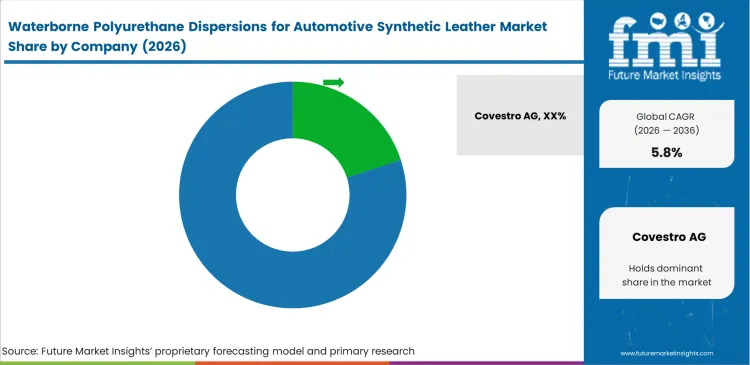
Covestro AG commands the majority of the market share, but competition in this highly technical niche is shaped entirely by OEM approval depth rather than simple unit pricing. Sourcing heads evaluating waterborne polyurethane dispersions for automotive synthetic leather market suppliers choose exclusively based on documented hydrolysis resistance and flex-fatigue survival over simulated ten-year vehicle lifespans. Formulators lacking incredibly extensive validation testing libraries simply cannot secure vital introductory meetings with major Tier-1 procurement teams. Establishing a commercially viable, highly robust portfolio of automotive interior leather chemistries requires massive upfront capital strictly for independent lab testing before generating any actual commercial revenue.
Established OEM approved synthetic leather polyurethane suppliers possess highly specialized, multi-million-dollar application testing centers that perfectly mimic actual roll-coating factory conditions. Challengers might successfully develop vastly superior polymer backbones inside test tubes, but failing to physically demonstrate high-speed factory line runnability immediately kills initial commercial deals. Supplying comprehensive PU artificial leather release paper compatibility data proves absolutely crucial during these highly practical factory-level trials. Experienced players deeply leverage these specialized testing facilities to directly solve pressing Tier-1 manufacturing problems, effectively embedding their technical support teams incredibly deep into daily buyer operations.
Key Players in Waterborne Polyurethane Dispersions for Automotive Synthetic Leather Market
- Covestro AG
- BASF SE
- Stahl Holdings B.V.
- Lubrizol Corporation
- DIC Corporation
- Mitsui Chemicals, Inc.
- Wanhua Chemical Group Co., Ltd.
Scope of the Report

| Metric | Value |
|---|---|
| Quantitative Units | USD 512.0 million to USD 899.8 million, at a CAGR of 5.8% |
| Market Definition | Waterborne polyurethane dispersions function as liquid polymer systems utilizing water as a primary continuous phase. These formulations bind microfiber matrices and generate durable topcoats, establishing critical low emission automotive interior materials. This chemistry replaces toxic solvent carriers while maintaining required abrasion resistance, flex fatigue tolerance, and hydrolysis stability essential for passenger cabin surfaces. |
| Segmentation | Chemistry, Resin Type, Layer Type, Vehicle Type, Sales Channel, Region |
| Regions Covered | North America, Latin America, Europe, Asia Pacific, Middle East & Africa |
| Countries Covered | United States, Canada, Germany, United Kingdom, France, Italy, Spain, Russia, China, Japan, South Korea, India, ASEAN, ANZ, Brazil, Mexico, GCC, South Africa |
| Key Companies Profiled | Covestro AG, BASF SE, Stahl Holdings B.V., Lubrizol Corporation, DIC Corporation, Mitsui Chemicals, Inc., Wanhua Chemical Group Co., Ltd. |
| Forecast Period | 2026 to 2036 |
| Approach | Global passenger and commercial vehicle production volumes. |
Source: Future Market Insights (FMI) analysis, based on proprietary forecasting model and primary research
Waterborne Polyurethane Dispersions for Automotive Synthetic Leather Market Analysis by Segments
Chemistry
- Anionic
- Cationic
- Nonionic
- Hybrid
Resin Type
- Polyester
- Polyether
- Polycarbonate
- Self-crosslinking
Layer Type
- Surface coat
- Base coat
- Foam layer
- Impregnation
Vehicle Type
- Passenger cars
- Light commercial
- Heavy commercial
Sales Channel
- OEM trim
- Tier suppliers
- Aftermarket
Region
- North America
- United States
- Canada
- Europe
- Germany
- United Kingdom
- France
- Italy
- Spain
- Asia Pacific
- China
- Japan
- South Korea
- Taiwan
- Singapore
- Latin America
- Brazil
- Mexico
- Argentina
- Middle East & Africa
- GCC Countries
- South Africa
- Israel
- Rest of Middle East & Africa
Bibliography
- Shi, Z., Sheng, Y., Wu, J., Cui, J., Lin, W., & Ngai, T. (2024, February). Porous waterborne polyurethane films templated from Pickering foams for fabrication of synthetic leather. Langmuir, 40(9), 4751-4761.
- Xue, M., Rao, X., Li, Y., & Fan, H. (2024, August). Waterborne polyurethane synthesized for leather with excellent wear and hydrolysis resistance enabled by bio-based poly(trimethylene carbonate) and L-lysine diisocyanate. Progress in Organic Coatings, 193, 108553.
- Xu, W., & Liu, D. (2024, April). High solid content waterborne polyurethane with high foaming rate to artificial leather: Synthesis and characterization. Progress in Organic Coatings, 189, 108332.
- Zhang, J., Yan, C., & Bao, Y. (2024, November). Preparation and application of waterborne cellulose acetate/waterborne polyurethane nanocomposite emulsion finishing agent for leather. Progress in Organic Coatings, 196, 108707.
- Zhou, J., Luo, F., Tang, L., & Guo, Z. (2024, December). Fabrication of polyurethane-polyacrylate hybrid latexes with high organosilicon content via phase inversion emulsion polymerization. Molecules, 29(24), 5870.
- Tian, X., He, M., Ding, C., Qian, N., Sun, Y., & Qi, D. (2025, March). Multifunctional waterborne polyurethane microfiber leather with breathable, moisture-wicking, antibacterial, weather-resistant, and high-strength. Progress in Organic Coatings, 200, 109021.
This bibliography is provided for reader reference and is not exhaustive. The full report contains the complete reference list and detailed citations.
This Report Addresses
- Specific OEM qualification cycles dictating chemical supplier entry barriers.
- Material durability requirements driving polyester resin adoption across seating programs.
- Structural bottlenecks preventing full conversion of deep-layer impregnation formulations.
- Tactile modifications required to meet acoustic dampening standards in electric vehicles.
- Operational line-speed reductions caused by extended waterborne drying oven times.
- Chemistry-specific flex fatigue tolerances necessary for passenger cabin longevity.
- Regional capacity limits forcing localized blending infrastructure investments near assembly plants.
- Hydrolysis vulnerability risks associated with baseline cost-optimized ester linkages.
Frequently Asked Questions
Explain the waterborne polyurethane dispersions for automotive synthetic leather market?
This market tracks highly specialized liquid polymer systems utilizing water carriers to construct and finish synthetic seating and trim fabrics. These advanced formulations provide deeply necessary integrity and highly premium tactile performance for vehicle interiors while completely eliminating legacy toxic solvent emissions tightly regulated by strict automotive indoor air quality standards.
Give me market size and CAGR for automotive synthetic leather waterborne PUD?
The overall market value reached USD 483.9 million in 2025 and is highly projected to scale to USD 899.8 million by 2036. This massive demand expansion represents a compound annual growth rate (CAGR) of 5.8% starting from a mathematically modeled base of USD 512.0 million in 2026.
What is waterborne polyurethane dispersion in automotive synthetic leather?
It is a highly critical, low-emission chemical binder system that permanently adheres delicate microfiber matrices together and forms incredibly durable topcoats without utilizing dangerous volatile organic compounds. Automotive interior trim engineers explicitly specify these aqueous dispersions to effectively achieve highly specific haptic softness, intense scratch resistance, and precise gloss levels across demanding dashboard and seating applications.
Is waterborne PU better than solvent PU for car interiors?
Waterborne systems definitively, outperform legacy solvent options in critical indoor air quality compliance testing and premium acoustic dampening softness. However, older legacy solvent systems still systematically offer vastly faster factory oven drying times, meaning direct waterborne integration fundamentally requires plant managers to heavily install extremely expensive, extended oven infrastructure to prevent crippling line-speed reductions.
Which companies supply waterborne PU dispersions for car interiors?
Leading, highly entrenched chemical formulators currently holding critical, deeply validated OEM approvals directly include Covestro AG, BASF SE, Stahl Holdings B.V., Lubrizol Corporation, DIC Corporation, Mitsui Chemicals, Inc., and Wanhua Chemical Group Co., Ltd. These massive corporate entities deeply maintain highly specialized application testing centers to actively secure incredibly lucrative Tier-1 manufacturing contracts.
Compare waterborne and solventborne PU in automotive synthetic leather?
Waterborne formulations utilize a pure water continuous phase, effectively reducing toxic chemical outgassing to near absolute zero, which remains vitally important for strict electric vehicle regulatory compliance. Conversely, solventborne systems heavily use volatile chemical carriers that flash off rapidly during high-speed production but inherently leave dangerous residual odors that repeatedly fail modern, highly stringent OEM cabin emission testing protocols.
Who are the top suppliers of waterborne PU for car seat synthetic leather?
Covestro AG leads the competitive space with an estimated 16.0% share, followed incredibly closely by BASF and Stahl. These highly dominant top suppliers compete largely on heavily documenting multi-year chemical hydrolysis resistance and flawlessly passing brutal physical flex-fatigue validations rather than aggressively competing strictly on simple bulk unit pricing.
How is low VOC compliance shaping synthetic leather chemistry in cars?
Stringent, highly punitive cabin air regulations forcefully compel corporate procurement teams to completely eliminate dangerous high-emission materials entirely from their supply chains. Persistently relying on legacy solventborne chemistry immediately invites total platform disqualification, drastically accelerating a massive pivot toward advanced water-based resins specifically engineered to flawlessly meet strict, government-mandated outgassing limits.
What drives 54.0% share for anionic formulations?
Intense negative electrostatic repulsion systematically keeps polymer particles safely separated during extremely high-shear roll application processes. Factory process engineers effortlessly achieve completely uniform film thickness without risking catastrophic premature coagulation. Deep chemical bonding with polarized interior substrates directly ensures incredibly durable attachment across wildly varying cabin temperatures, effectively preventing highly costly delamination warranty claims.
Why does polyester lead resin type selections?
Tightly packed molecular polymer chains predictably generate highly substantial physical toughness specifically engineered for high-wear automotive seating zones. Interior seating design leads proactively secure heavily necessary scuff resistance specifically for daily passenger ingress. Vastly lower raw material synthesis costs actively keep total synthetic fabric pricing highly competitive against genuine animal hides, deeply maintaining highly required corporate margin targets.
PU synthetic leather vs PVC synthetic leather automotive interiors?
Polyurethane synthetic leather systematically offers drastically superior tactile softness, intense material breathability, and highly crucial weight reduction compared to legacy polyvinyl chloride. Modern electric vehicle engineering teams prioritize advanced PU systems solely because heavy PVC completely struggles to adequately meet highly advanced acoustic dampening requirements and soaring luxury haptic consumer expectations.
How do acoustic requirements influence material choice?
Silent, battery-powered vehicle architectures completely remove masking internal engine noise, drastically amplifying any resulting tactile friction from cheap interior trim components. Automotive designers strictly require highly specific, engineered soft-touch dispersions to perfectly manage these highly sensitive acoustic profiles. Modern water-based systems uniquely excel at delivering this highly specific micro-softness compared to rigid legacy solvent alternatives.
Why do Tier-1 suppliers dictate chemistry choices?
Securing vital OEM approval requires flawlessly surviving absolutely brutal environmental laboratory testing protocols. Highly successful 24-month qualification testing cycles effectively create near-permanent, highly lucrative vendor lock-in. Independent chemical producers foolishly attempting to completely bypass stringent OEM validation directly through independent aftermarket channels simply waste vital corporate capital on incredibly low-volume, low-margin replacement cycles.
What operational friction slows total conversion?
Drying heavy waterborne systems requires vastly longer factory oven dwell times compared to rapid-flashing, highly volatile solvent alternatives. Stressed plant managers desperately attempting to heavily run these aqueous water-based resins on aging, legacy manufacturing equipment immediately face crippling factory line-speed reductions and incredibly severe daily throughput bottlenecks.
How does India outpace global growth rates?
Massive domestic vehicle assembly expansion forcefully dictates immediate factory compliance with completely new, highly strict interior emission standards. Tier-1 corporate procurement leads proactively secure incredibly massive, long-term waterborne material contracts to successfully support highly aggressive regional production targets, jumping directly to installing highly advanced, specialized drying infrastructure.
What challenge faces North America procurement?
High-volume assembly plants rigidly demand highly localized liquid resin delivery to perfectly maintain heavily optimized, just-in-time regional manufacturing schedules. Desperate chemical suppliers must forcefully establish massive, highly expensive liquid blending hubs situated closely near major international automotive corridors to simply remain commercially competitive, requiring incredibly significant, highly risky regional capital expenditure.
Why is dual-sourcing critical for large buyers?
Massive automotive suppliers aggressively resist systemic chemical lock-in by systematically forcing formulators to fully disclose highly specific functional additives during incredibly competitive bidding. Ruthless procurement directors actively, deliberately qualify highly capable dual-source options for completely identical automotive seating programs to forcefully maintain their critical pricing leverage against highly entrenched incumbent chemical giants.
What defines competitive success beyond unit pricing?
Massive incumbent chemical giants possess highly specialized, multi-million-dollar application testing centers perfectly mimicking actual high-speed roll-coating factory conditions. Smaller challengers might successfully develop vastly superior molecular polymer backbones, but completely failing to physically demonstrate high-speed factory line runnability permanently prevents highly lucrative commercial qualification.
How do bio-based materials change value propositions?
Synthesizing advanced dispersion backbones directly from highly renewable, sustainable aliphatic feedstocks allows corporate sustainability directors to effortlessly capture highly lucrative premium pricing from deeply eco-conscious electric vehicle brands. This strategic engineering thoroughly differentiates cheap commodity chemical supplies from highly specialized, incredibly high-margin advanced environmental formulations.
What role do low-temperature crosslinkers play?
Meticulously engineering advanced chemical crosslinkers that fully react at vastly lower thermal thresholds actively helps stressed plant managers heavily reduce crippling energy costs and drastically improve total daily coating line throughput. This advanced chemical engineering directly, successfully addresses the primary severe operational restraints deeply tied to terribly slow factory oven drying times.
How does China shape global material standards?
Intense, highly competitive electric vehicle premiumization drives absolutely relentless domestic demand for incredibly luxurious, totally zero-emission cabin materials. Massive domestic automotive platforms heavily utilizing these highly advanced synthetic leathers aggressively export these incredibly stringent material standards worldwide, systematically forcing massive global suppliers to flawlessly match highly demanding interior specifications.
Why is hydrolysis resistance crucial?
Cheap ester chemical linkages remain highly chemically susceptible to catastrophic moisture attack operating in extreme high-humidity environments. Highly stressed corporate warranty managers continuously face massively elevated interior replacement rates if cheap chemical formulations critically lack highly advanced stabilizing additives, making long-term anti-hydrolysis performance an absolutely primary, non-negotiable OEM qualification metric.
What prevents aftermarket suppliers from leading adoption?
Independent aftermarket channels completely rely on simply reverse-engineering already existing vehicle platforms rather than proactively leading any highly advanced chemical specification. Powerful OEM trim engineering entirely controls all incredibly strict initial material standards, completely meaning aftermarket adoption only follows many years after primary, highly integrated factory integration occurs.
What forces complete transitions away from solventborne systems?
Incredibly strict, highly punitive cabin air quality regulations forcefully compel nervous vehicle manufacturing directors to completely abandon dangerous high-emission materials. Completely failing highly strict indoor air quality testing forcefully halts entire multi-billion-dollar vehicle platform production lines, actively creating absolutely massive, totally unacceptable financial risk for exposed Tier-1 interior suppliers.
Preview the report firsthand - request a free sample
Get SampleGet the brochure for pricing and purchase details.
Get PDFTable of Content
- Executive Summary
- Global Market Outlook
- Demand-side Trends
- Supply-side Trends
- Technology Roadmap Analysis
- Analysis and Recommendations
- Market Overview
- Market Coverage / Taxonomy
- Market Definition / Scope / Limitations
- Research Methodology
- Chapter Orientation
- Analytical Lens and Working Hypotheses
- Market Structure, Signals, and Trend Drivers
- Benchmarking and Cross-market Comparability
- Market Sizing, Forecasting, and Opportunity Mapping
- Research Design and Evidence Framework
- Desk Research Programme (Secondary Evidence)
- Company Annual and Sustainability Reports
- Peer-reviewed Journals and Academic Literature
- Corporate Websites, Product Literature, and Technical Notes
- Earnings Decks and Investor Briefings
- Statutory Filings and Regulatory Disclosures
- Technical White Papers and Standards Notes
- Trade Journals, Industry Magazines, and Analyst Briefs
- Conference Proceedings, Webinars, and Seminar Materials
- Government Statistics Portals and Public Data Releases
- Press Releases and Reputable Media Coverage
- Specialist Newsletters and Curated Briefings
- Sector Databases and Reference Repositories
- FMI Internal Proprietary Databases and Historical Market Datasets
- Subscription Datasets and Paid Sources
- Social Channels, Communities, and Digital Listening Inputs
- Additional Desk Sources
- Expert Input and Fieldwork (Primary Evidence)
- Primary Modes
- Qualitative Interviews and Expert Elicitation
- Quantitative Surveys and Structured Data Capture
- Blended Approach
- Why Primary Evidence is Used
- Field Techniques
- Interviews
- Surveys
- Focus Groups
- Observational and In-context Research
- Social and Community Interactions
- Stakeholder Universe Engaged
- C-suite Leaders
- Board Members
- Presidents and Vice Presidents
- R&D and Innovation Heads
- Technical Specialists
- Domain Subject-matter Experts
- Scientists
- Physicians and Other Healthcare Professionals
- Governance, Ethics, and Data Stewardship
- Research Ethics
- Data Integrity and Handling
- Primary Modes
- Tooling, Models, and Reference Databases
- Desk Research Programme (Secondary Evidence)
- Data Engineering and Model Build
- Data Acquisition and Ingestion
- Cleaning, Normalisation, and Verification
- Synthesis, Triangulation, and Analysis
- Quality Assurance and Audit Trail
- Market Background
- Market Dynamics
- Drivers
- Restraints
- Opportunity
- Trends
- Scenario Forecast
- Demand in Optimistic Scenario
- Demand in Likely Scenario
- Demand in Conservative Scenario
- Opportunity Map Analysis
- Product Life Cycle Analysis
- Supply Chain Analysis
- Investment Feasibility Matrix
- Value Chain Analysis
- PESTLE and Porter’s Analysis
- Regulatory Landscape
- Regional Parent Market Outlook
- Production and Consumption Statistics
- Import and Export Statistics
- Market Dynamics
- Global Market Analysis 2021 to 2025 and Forecast, 2026 to 2036
- Historical Market Size Value (USD Million) Analysis, 2021 to 2025
- Current and Future Market Size Value (USD Million) Projections, 2026 to 2036
- Y-o-Y Growth Trend Analysis
- Absolute $ Opportunity Analysis
- Global Market Pricing Analysis 2021 to 2025 and Forecast 2026 to 2036
- Global Market Analysis 2021 to 2025 and Forecast 2026 to 2036, By Chemistry
- Introduction / Key Findings
- Historical Market Size Value (USD Million) Analysis By Chemistry , 2021 to 2025
- Current and Future Market Size Value (USD Million) Analysis and Forecast By Chemistry , 2026 to 2036
- Anionic
- Cationic
- Nonionic
- Anionic
- Y-o-Y Growth Trend Analysis By Chemistry , 2021 to 2025
- Absolute $ Opportunity Analysis By Chemistry , 2026 to 2036
- Global Market Analysis 2021 to 2025 and Forecast 2026 to 2036, By Resin Type
- Introduction / Key Findings
- Historical Market Size Value (USD Million) Analysis By Resin Type, 2021 to 2025
- Current and Future Market Size Value (USD Million) Analysis and Forecast By Resin Type, 2026 to 2036
- Polyester
- Polyether
- Polycarbonate
- Polyester
- Y-o-Y Growth Trend Analysis By Resin Type, 2021 to 2025
- Absolute $ Opportunity Analysis By Resin Type, 2026 to 2036
- Global Market Analysis 2021 to 2025 and Forecast 2026 to 2036, By Layer Type
- Introduction / Key Findings
- Historical Market Size Value (USD Million) Analysis By Layer Type, 2021 to 2025
- Current and Future Market Size Value (USD Million) Analysis and Forecast By Layer Type, 2026 to 2036
- Surface Coat
- Impregnation
- Others
- Surface Coat
- Y-o-Y Growth Trend Analysis By Layer Type, 2021 to 2025
- Absolute $ Opportunity Analysis By Layer Type, 2026 to 2036
- Global Market Analysis 2021 to 2025 and Forecast 2026 to 2036, By Vehicle Type
- Introduction / Key Findings
- Historical Market Size Value (USD Million) Analysis By Vehicle Type, 2021 to 2025
- Current and Future Market Size Value (USD Million) Analysis and Forecast By Vehicle Type, 2026 to 2036
- Passenger Cars
- Light commercial
- Heavy commercial
- Passenger Cars
- Y-o-Y Growth Trend Analysis By Vehicle Type, 2021 to 2025
- Absolute $ Opportunity Analysis By Vehicle Type, 2026 to 2036
- Global Market Analysis 2021 to 2025 and Forecast 2026 to 2036, By Sales Channel
- Introduction / Key Findings
- Historical Market Size Value (USD Million) Analysis By Sales Channel, 2021 to 2025
- Current and Future Market Size Value (USD Million) Analysis and Forecast By Sales Channel, 2026 to 2036
- OEM Trim
- Aftermarket
- Others
- OEM Trim
- Y-o-Y Growth Trend Analysis By Sales Channel, 2021 to 2025
- Absolute $ Opportunity Analysis By Sales Channel, 2026 to 2036
- Global Market Analysis 2021 to 2025 and Forecast 2026 to 2036, By Region
- Introduction
- Historical Market Size Value (USD Million) Analysis By Region, 2021 to 2025
- Current Market Size Value (USD Million) Analysis and Forecast By Region, 2026 to 2036
- North America
- Latin America
- Western Europe
- Eastern Europe
- East Asia
- South Asia and Pacific
- Middle East & Africa
- Market Attractiveness Analysis By Region
- North America Market Analysis 2021 to 2025 and Forecast 2026 to 2036, By Country
- Historical Market Size Value (USD Million) Trend Analysis By Market Taxonomy, 2021 to 2025
- Market Size Value (USD Million) Forecast By Market Taxonomy, 2026 to 2036
- By Country
- USA
- Canada
- Mexico
- By Chemistry
- By Resin Type
- By Layer Type
- By Vehicle Type
- By Sales Channel
- By Country
- Market Attractiveness Analysis
- By Country
- By Chemistry
- By Resin Type
- By Layer Type
- By Vehicle Type
- By Sales Channel
- Key Takeaways
- Latin America Market Analysis 2021 to 2025 and Forecast 2026 to 2036, By Country
- Historical Market Size Value (USD Million) Trend Analysis By Market Taxonomy, 2021 to 2025
- Market Size Value (USD Million) Forecast By Market Taxonomy, 2026 to 2036
- By Country
- Brazil
- Chile
- Rest of Latin America
- By Chemistry
- By Resin Type
- By Layer Type
- By Vehicle Type
- By Sales Channel
- By Country
- Market Attractiveness Analysis
- By Country
- By Chemistry
- By Resin Type
- By Layer Type
- By Vehicle Type
- By Sales Channel
- Key Takeaways
- Western Europe Market Analysis 2021 to 2025 and Forecast 2026 to 2036, By Country
- Historical Market Size Value (USD Million) Trend Analysis By Market Taxonomy, 2021 to 2025
- Market Size Value (USD Million) Forecast By Market Taxonomy, 2026 to 2036
- By Country
- Germany
- UK
- Italy
- Spain
- France
- Nordic
- BENELUX
- Rest of Western Europe
- By Chemistry
- By Resin Type
- By Layer Type
- By Vehicle Type
- By Sales Channel
- By Country
- Market Attractiveness Analysis
- By Country
- By Chemistry
- By Resin Type
- By Layer Type
- By Vehicle Type
- By Sales Channel
- Key Takeaways
- Eastern Europe Market Analysis 2021 to 2025 and Forecast 2026 to 2036, By Country
- Historical Market Size Value (USD Million) Trend Analysis By Market Taxonomy, 2021 to 2025
- Market Size Value (USD Million) Forecast By Market Taxonomy, 2026 to 2036
- By Country
- Russia
- Poland
- Hungary
- Balkan & Baltic
- Rest of Eastern Europe
- By Chemistry
- By Resin Type
- By Layer Type
- By Vehicle Type
- By Sales Channel
- By Country
- Market Attractiveness Analysis
- By Country
- By Chemistry
- By Resin Type
- By Layer Type
- By Vehicle Type
- By Sales Channel
- Key Takeaways
- East Asia Market Analysis 2021 to 2025 and Forecast 2026 to 2036, By Country
- Historical Market Size Value (USD Million) Trend Analysis By Market Taxonomy, 2021 to 2025
- Market Size Value (USD Million) Forecast By Market Taxonomy, 2026 to 2036
- By Country
- China
- Japan
- South Korea
- By Chemistry
- By Resin Type
- By Layer Type
- By Vehicle Type
- By Sales Channel
- By Country
- Market Attractiveness Analysis
- By Country
- By Chemistry
- By Resin Type
- By Layer Type
- By Vehicle Type
- By Sales Channel
- Key Takeaways
- South Asia and Pacific Market Analysis 2021 to 2025 and Forecast 2026 to 2036, By Country
- Historical Market Size Value (USD Million) Trend Analysis By Market Taxonomy, 2021 to 2025
- Market Size Value (USD Million) Forecast By Market Taxonomy, 2026 to 2036
- By Country
- India
- ASEAN
- Australia & New Zealand
- Rest of South Asia and Pacific
- By Chemistry
- By Resin Type
- By Layer Type
- By Vehicle Type
- By Sales Channel
- By Country
- Market Attractiveness Analysis
- By Country
- By Chemistry
- By Resin Type
- By Layer Type
- By Vehicle Type
- By Sales Channel
- Key Takeaways
- Middle East & Africa Market Analysis 2021 to 2025 and Forecast 2026 to 2036, By Country
- Historical Market Size Value (USD Million) Trend Analysis By Market Taxonomy, 2021 to 2025
- Market Size Value (USD Million) Forecast By Market Taxonomy, 2026 to 2036
- By Country
- Kingdom of Saudi Arabia
- Other GCC Countries
- Turkiye
- South Africa
- Other African Union
- Rest of Middle East & Africa
- By Chemistry
- By Resin Type
- By Layer Type
- By Vehicle Type
- By Sales Channel
- By Country
- Market Attractiveness Analysis
- By Country
- By Chemistry
- By Resin Type
- By Layer Type
- By Vehicle Type
- By Sales Channel
- Key Takeaways
- Key Countries Market Analysis
- USA
- Pricing Analysis
- Market Share Analysis, 2025
- By Chemistry
- By Resin Type
- By Layer Type
- By Vehicle Type
- By Sales Channel
- Canada
- Pricing Analysis
- Market Share Analysis, 2025
- By Chemistry
- By Resin Type
- By Layer Type
- By Vehicle Type
- By Sales Channel
- Mexico
- Pricing Analysis
- Market Share Analysis, 2025
- By Chemistry
- By Resin Type
- By Layer Type
- By Vehicle Type
- By Sales Channel
- Brazil
- Pricing Analysis
- Market Share Analysis, 2025
- By Chemistry
- By Resin Type
- By Layer Type
- By Vehicle Type
- By Sales Channel
- Chile
- Pricing Analysis
- Market Share Analysis, 2025
- By Chemistry
- By Resin Type
- By Layer Type
- By Vehicle Type
- By Sales Channel
- Germany
- Pricing Analysis
- Market Share Analysis, 2025
- By Chemistry
- By Resin Type
- By Layer Type
- By Vehicle Type
- By Sales Channel
- UK
- Pricing Analysis
- Market Share Analysis, 2025
- By Chemistry
- By Resin Type
- By Layer Type
- By Vehicle Type
- By Sales Channel
- Italy
- Pricing Analysis
- Market Share Analysis, 2025
- By Chemistry
- By Resin Type
- By Layer Type
- By Vehicle Type
- By Sales Channel
- Spain
- Pricing Analysis
- Market Share Analysis, 2025
- By Chemistry
- By Resin Type
- By Layer Type
- By Vehicle Type
- By Sales Channel
- France
- Pricing Analysis
- Market Share Analysis, 2025
- By Chemistry
- By Resin Type
- By Layer Type
- By Vehicle Type
- By Sales Channel
- India
- Pricing Analysis
- Market Share Analysis, 2025
- By Chemistry
- By Resin Type
- By Layer Type
- By Vehicle Type
- By Sales Channel
- ASEAN
- Pricing Analysis
- Market Share Analysis, 2025
- By Chemistry
- By Resin Type
- By Layer Type
- By Vehicle Type
- By Sales Channel
- Australia & New Zealand
- Pricing Analysis
- Market Share Analysis, 2025
- By Chemistry
- By Resin Type
- By Layer Type
- By Vehicle Type
- By Sales Channel
- China
- Pricing Analysis
- Market Share Analysis, 2025
- By Chemistry
- By Resin Type
- By Layer Type
- By Vehicle Type
- By Sales Channel
- Japan
- Pricing Analysis
- Market Share Analysis, 2025
- By Chemistry
- By Resin Type
- By Layer Type
- By Vehicle Type
- By Sales Channel
- South Korea
- Pricing Analysis
- Market Share Analysis, 2025
- By Chemistry
- By Resin Type
- By Layer Type
- By Vehicle Type
- By Sales Channel
- Russia
- Pricing Analysis
- Market Share Analysis, 2025
- By Chemistry
- By Resin Type
- By Layer Type
- By Vehicle Type
- By Sales Channel
- Poland
- Pricing Analysis
- Market Share Analysis, 2025
- By Chemistry
- By Resin Type
- By Layer Type
- By Vehicle Type
- By Sales Channel
- Hungary
- Pricing Analysis
- Market Share Analysis, 2025
- By Chemistry
- By Resin Type
- By Layer Type
- By Vehicle Type
- By Sales Channel
- Kingdom of Saudi Arabia
- Pricing Analysis
- Market Share Analysis, 2025
- By Chemistry
- By Resin Type
- By Layer Type
- By Vehicle Type
- By Sales Channel
- Turkiye
- Pricing Analysis
- Market Share Analysis, 2025
- By Chemistry
- By Resin Type
- By Layer Type
- By Vehicle Type
- By Sales Channel
- South Africa
- Pricing Analysis
- Market Share Analysis, 2025
- By Chemistry
- By Resin Type
- By Layer Type
- By Vehicle Type
- By Sales Channel
- USA
- Market Structure Analysis
- Competition Dashboard
- Competition Benchmarking
- Market Share Analysis of Top Players
- By Regional
- By Chemistry
- By Resin Type
- By Layer Type
- By Vehicle Type
- By Sales Channel
- Competition Analysis
- Competition Deep Dive
- Covestro AG
- Overview
- Product Portfolio
- Profitability by Market Segments (Product/Age /Sales Channel/Region)
- Sales Footprint
- Strategy Overview
- Marketing Strategy
- Product Strategy
- Channel Strategy
- BASF SE
- Stahl Holdings B.V.
- Lubrizol Corporation
- DIC Corporation
- Mitsui Chemicals, Inc.
- Covestro AG
- Competition Deep Dive
- Assumptions & Acronyms Used


