

- Industry Size (2025)
- USD 137.6 Mn
- Forecast (2035)
- USD 262.0 Mn
- CAGR (2025 to 2035)
- 6.7%
Polyurethane Dispersions Market Forecast and Outlook 2025 to 2035
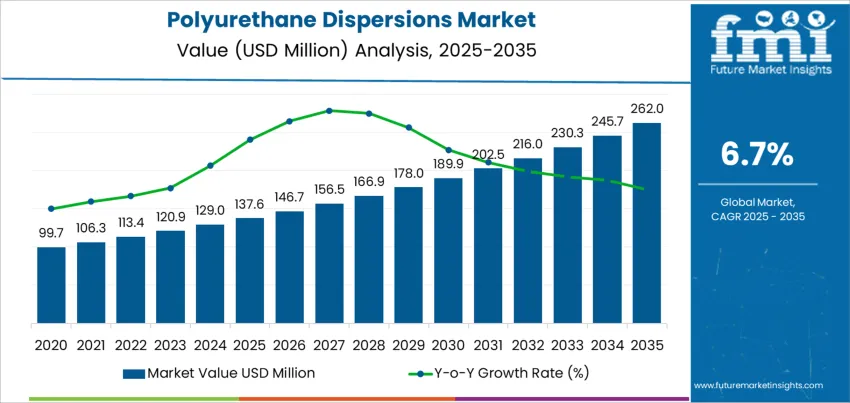
Growth in the polyurethane dispersions market stands at USD 137.6 million in 2025, projected to rise to USD 262.0 million by 2035 at a CAGR of 6.7%. Sales growth inertia reflects the strong carryover effect of long-term contracts in synthetic leather, performance textiles, and water-based coatings. Demand originating from footwear uppers, automotive interiors, and architectural coatings sustains baseline volume even during slower construction cycles. Buyers exhibit high repeat-purchase behavior due to formulation lock-in and qualification timelines. Through 2030, annual sales gains are reinforced by the steady replacement of solvent-borne systems across Asia and Europe. Inventory turnover remains stable as producers align output with predictable downstream consumption patterns across core industrial applications today and in the near term.
Beyond 2030, sales continue to shape revenue flow as existing application streams compound on a larger installed base. Market expansion from about USD 189.9 million in 2030 toward USD 262.0 million by 2035 is supported by persistent demand in flexible packaging coatings, furniture finishes, and industrial laminations. Switching costs for formulators remain high due to revalidation requirements and performance testing cycles. This sustains long-duration supply agreements and predictable order volumes. Producers prioritize capacity balancing, pre-polymer throughput control, and dispersion stability to protect uninterrupted deliveries. Distribution channels remain weighted toward direct contracts with multinational converters, while regional distributors serve niche users.
Quick Stats of the Polyurethane Dispersions Market
- Polyurethane Dispersions Market Value (2025): USD 137.6 million
- Polyurethane Dispersions Market Forecast Value (2035): USD 262.0 million
- Polyurethane Dispersions Market Forecast CAGR (2025–2035): 6.7%
- Leading Product Form in Polyurethane Dispersions Market: Powder (17.3%)
- Key Growth Regions in Polyurethane Dispersions Market: Asia Pacific, Europe
- Top Players in Polyurethane Dispersions Market: BASF SE, Croda International, Evonik Industries, Symrise (incl. IFF/Givaudan actives), Dow / Dow Inc., Ashland, Clariant, Seppic
What is the Growth Forecast for the Polyurethane Dispersions Market through 2035?
From 2025 to 2030, the polyurethane dispersions market expands from USD 137.6 million to USD 178.0 million, generating an absolute return of USD 40.4 million over five years. This implies a growth return ratio of roughly 1.29x on the 2025 base during the first half of the forecast period. Returns in this phase are driven by steady substitution of solvent-based systems in wood coatings, flexible packaging adhesives, automotive interiors, and synthetic leather finishing. Capital deployed into waterborne PUD capacity during this period delivers stable but measured returns, as pricing remains competitive and demand growth is grounded in regulatory-driven conversion rather than margin expansion.
From 2030 to 2035, the market advances from USD 178.0 million to USD 262.0 million, generating a higher absolute return of USD 84.0 million and lifting the growth return ratio to nearly 1.47x over the second half of the decade. This improvement reflects stronger value capture from higher-solids dispersions, abrasion-resistant grades, and specialty PUDs used in technical textiles, footwear, and performance laminations. Return dynamics strengthen as downstream users accept higher pricing for durability, chemical resistance, and application efficiency. The growth return profile thus shifts from volume-led compliance adoption toward value-led performance monetization through 2035.
Polyurethane Dispersions Industry Key Takeaways
| Metric | Value |
|---|---|
| Industry Value (2025) | USD 137.6 million |
| Forecast Value (2035) | USD 262.0 million |
| Forecast CAGR (2025–2035) | 6.7% |
How Is the Polyurethane Dispersions Market Advancing Across Coatings, Adhesives, and Functional Surface Technologies?
The polyurethane dispersions market developed as industries sought water based alternatives to solvent heavy polyurethane systems without losing film strength, flexibility, or chemical resistance. Early adoption was driven by wood coatings, automotive interior finishes, and furniture applications where surface durability mattered but solvent emissions became increasingly restricted. Water dispersed polyurethane allowed manufacturers to meet performance targets while shifting away from high volatile organic compound formulations. Over time, its role expanded into leather finishing, textile coatings, paper treatment, and packaging adhesives as processors recognized its balanced profile of abrasion resistance, elasticity, and adhesion. These characteristics allowed polyurethane dispersions to replace multiple resin types across different surface technologies rather than serve a single niche.
Future growth of the polyurethane dispersions market will be shaped by regulatory tightening on solvents, rising demand for low odor coatings, and surface engineering requirements in automotive, construction, and consumer goods. As interior materials become more complex and lightweight, demand will increase for coatings that combine scratch resistance with long term flexibility. Expansion is also expected in flexible packaging adhesives and high performance textile laminates. Barriers include sensitivity to moisture during application, higher formulation cost than some acrylic systems, and performance gaps in extreme chemical or heat exposure compared with solvent based polyurethanes. Long term growth will depend on continuous resin innovation, cost optimization, and performance parity with traditional high solids polyurethane systems.
How Are End Use Application and Product Form Structuring the Demand for Polyurethane Dispersions?
The demand for polyurethane dispersions is structured by end use application and product form. Skin care represents 9.2% of total demand, followed by body care, hair care, sun care, color cosmetics, men grooming, baby and kids care, and dermocosmetic and professional care. By product form, powder accounts for 17.3% of total consumption, followed by granules and agglomerates, flakes, pellets and prills, liquid solutions, high active concentrates, dispersions and suspensions, emulsions, pastes, gels, wax or solid block formats, and oils. Demand behavior is shaped by film toughness, abrasion resistance, flexibility under mechanical stress, transparency control, and compatibility with both decorative and protective cosmetic systems.
Why Does Skin Care Lead the Polyurethane Dispersions End Use Demand?
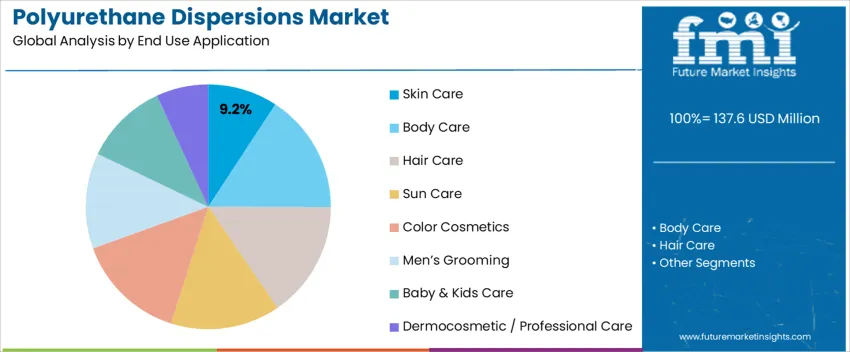
Skin care accounts for 9.2% of total polyurethane dispersion demand due to its ability to form durable, elastic films that protect the skin surface while preserving flexibility and comfort. Polyurethane films are used in long-wear treatments, anti-pollution creams, barrier serums, and transfer-resistant formulations where resistance to sweat, sebum, and mechanical friction is required. These films remain intact under facial movement without cracking or flaking, which supports sustained visual performance.
Skin care formulators value polyurethane dispersions for their transparency and low tack after drying. The films improve wear time for actives such as sunscreens, anti-aging agents, and pigments by limiting migration and erosion. Their resistance to repeated cleansing and humidity exposure supports use in extended-wear daily products. These surface protection capabilities, elastic film behavior, and durability advantages sustain skin care as the leading end use segment within polyurethane dispersion demand.
Why Does Powder Lead the Polyurethane Dispersions Product Form Demand?
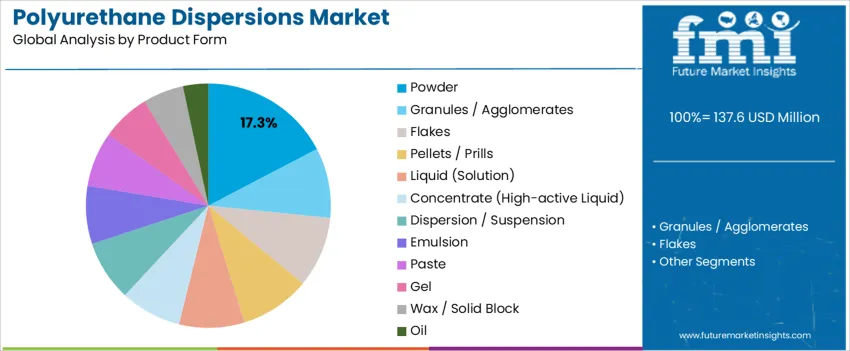
Powder accounts for 17.3% of total polyurethane dispersion demand due to its enhanced storage stability, reduced transport weight, and controlled reconstitution behavior during formulation. Powdered polyurethane allows manufacturers to activate film-forming performance only at the desired process stage, which improves batch volatility control and reproducibility across large production volumes. Low water content reduces hydrolytic degradation and preserves polymer chain integrity during extended warehousing.
Powder form also supports precise adjustment of film thickness, elasticity, and wear strength by enabling accurate concentration control during hydration. It integrates efficiently into emulsions, gels, and hybrid systems without the sedimentation risks associated with pre-diluted liquid dispersions. Packaging in moisture barrier containers maintains flow consistency during transport. These formulation control advantages, shelf stability benefits, and logistics efficiency factors position powder as the leading product form within the polyurethane dispersions demand structure.
Why Are Polyurethane Dispersions Increasingly Chosen As The “Middle Path” Between Solvent Systems And Hard Acrylics?
Polyurethane dispersions occupy a space where toughness, flexibility, and low odor can be combined without classic solvent loads or brittle film behavior. Coatings producers select PUDs when they need abrasion resistance and chemical durability but cannot accept cracking, strong smell, or long drying times. Furniture finishes, leather coatings, flexible plastics, fabric treatments, and industrial wood all use PUDs to gain resilience while keeping films elastic. Instead of replacing every resin type, PUDs often sit at the center of a blend, softening hard polymers and strengthening softer ones.
How Do Application Demands From Flooring, Leather, And Flexible Packaging Shape Performance Requirements?
Different end uses push PUD design in distinct directions. Wood flooring and sports hall finishes need high mar resistance and resistance to black heel marks. Leather coatings require soft hand, fold endurance, and resistance to body oils. Flexible packaging demands block resistance, printability, and good adhesion to treated films. These segments expect clear, non yellowing films that survive repeated bending and cleaning cycles. As a result, producers offer a wide set of backbones and particle structures rather than one generic PUD, and customers choose by very specific test methods.
Which Practical Constraints Prevent Polyurethane Dispersions From Replacing All Legacy Coating Systems?
Despite broad utility, PUDs do not solve every formulating problem. Water sensitivity during early drying stages limits use in very thick films without co binders. Some grades need external crosslinkers to reach chemical resistance targets, adding complexity at the point of use. Cost per kilogram remains higher than basic acrylic emulsions, which matters in commodity architectural paints. Certain harsh environments still favor solventborne systems or powder coatings. These practical boundaries keep PUDs focused on segments where flexibility, clarity, and mechanical strength justify the extra formulation effort.
How Are Hybrid Chemistries, 1K / 2K Choices, And Equipment Compatibility Steering Future Demand?
Growth in polyurethane dispersions is moving toward purposeful hybrids and tailored mixing systems rather than standalone single grades. Acrylic PUD hybrids target improved outdoor color stability, while polyester based types address toughness and adhesion to plastics. One component systems appeal where users want simple processing and moderate resistance, while two component PUDs serve high performance flooring, industrial, and automotive refinish uses. Equipment that once handled only solvent systems is being adapted for water compatible films, guiding demand toward PUDs that tolerate shear, variable drying conditions, and blended binder packages.
What Is the Global Growth Outlook for the Polyurethane Dispersions Industry by Country?
| Country | CAGR (%) |
|---|---|
| India | 9.0 |
| China | 8.3 |
| Japan | 7.7 |
| UK | 7.0 |
| Germany | 6.3 |
| USA | 5.7 |
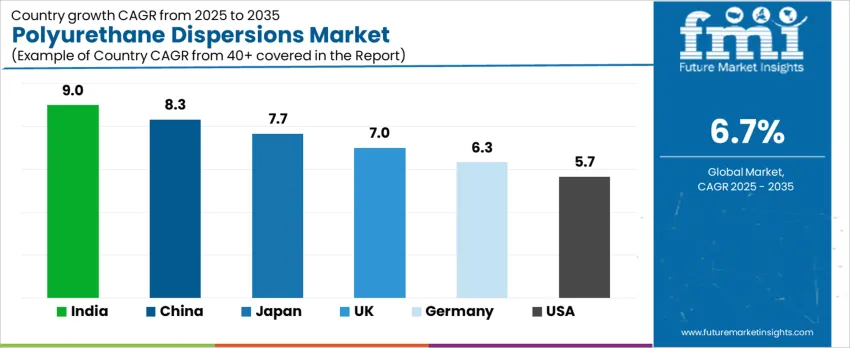
The polyurethane dispersions industry is showing steady global expansion across coatings, adhesives, textiles, and synthetic leather applications, with India recording growth at a 9.0% CAGR. Growth in India is supported by rising demand from infrastructure coatings, automotive interiors, footwear manufacturing, and flexible packaging applications. China follows at 8.3%, driven by large-scale production of water-based coatings, furniture finishes, and industrial adhesives across construction and manufacturing sectors. Japan at 7.7% reflects stable demand from automotive coatings, electronics protection, and specialty industrial applications. The UK and Germany record 7.0% and 6.3% growth, supported by architectural coatings, wood finishes, and performance textile coatings. The USA at 5.7% reflects a mature but steadily advancing market driven by automotive refinishing, packaging coatings, and industrial maintenance applications.
What Is Driving Polyurethane Dispersion Demand Growth Across Coatings and Textiles in India?
Polyurethane dispersion demand in India is expanding at a CAGR of 9.0% through 2035, driven by rising water-based coating adoption, synthetic leather production, and flexible packaging growth. Furniture coatings, automotive interior laminates, and textile finishing operations rely on polyurethane dispersions for their abrasion resistance and low-VOC performance. Domestic construction activity also supports steady demand for architectural coatings. Imports dominate high-performance grades, while local producers supply mid-range materials. Demand remains application-driven and compliance-aligned, shaped by environmental regulations, expanding furniture manufacturing, and rising demand for coated technical textiles.
- Synthetic leather drives steady dispersion consumption
- Furniture and wood coatings support repeat industrial demand
- Textile finishing sustains functional polymer usage
- Import reliance remains high for premium grades
How Is China Scaling Industrial Polyurethane Dispersion Production?
Growth in China reflects a CAGR of 8.3% through 2035 for polyurethane dispersion utilization, supported by large scale coatings plants, footwear manufacturing, and packaging film lamination. Automotive coatings, sports shoe uppers, and flexible packaging adhesives rely heavily on dispersion-based systems. Domestic chemical producers operate high-capacity plants for cost-efficient supply. Export oriented manufacturers also ship finished coated products globally. Demand remains production driven and volume oriented, aligned with manufacturing throughput, rising export orders, and continuous substitution of solvent based systems across industrial coating and adhesive operations.
- Footwear manufacturing anchors high volume usage
- Packaging lamination supports adhesive grade applications
- Automotive coatings expand technical demand
- Domestic production stabilizes bulk supply economics
Why Does Japan Maintain Strong Adoption of High Performance Polyurethane Dispersions?
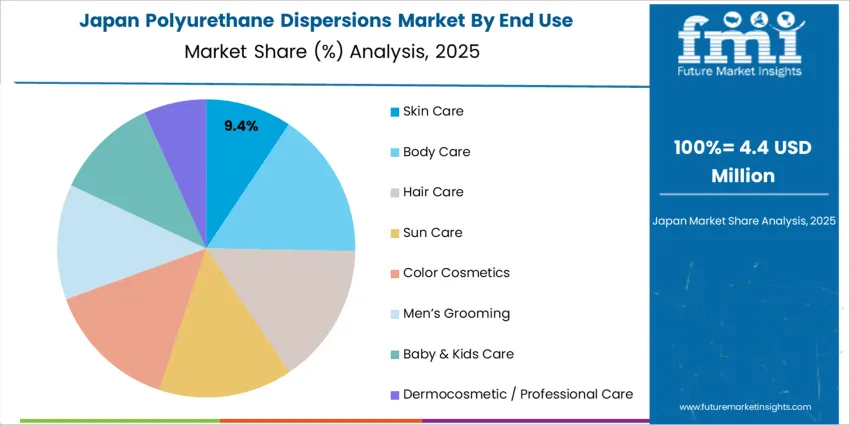
Demand in Japan is increasing at a CAGR of 7.7% through 2035 for polyurethane dispersion usage, sustained by advanced automotive interiors, electronics coatings, and premium synthetic leather manufacturing. These dispersions are applied in dashboard surfaces, protective electronic films, and high durability upholstery. Domestic formulators prioritize uniform particle size and long term mechanical stability. Demand stays quality driven and performance focused, supported by high reliability manufacturing standards, continuous automotive innovation, and steady integration of water based systems across regulated industrial coating segments.
- Automotive interiors drive high specification consumption
- Electronics coatings support controlled application volumes
- Premium synthetic leather sustains steady demand
- Domestic formulation standards ensure performance stability
What Is Supporting Polyurethane Dispersion Market Expansion in the United Kingdom?
Growth in the UK is advancing at a CAGR of 7.0% through 2035 for polyurethane dispersion demand, supported by architectural coatings, protective textile finishes, and flexible packaging growth. These dispersions are used in breathable outdoor fabrics, wood floor coatings, and medical packaging laminates. Construction refurbishment and home renovation activity sustain coating consumption. Imports dominate specialty formulations. Demand remains project driven and specification focused, shaped by renovation cycles, steady demand for protective textiles, and controlled growth in medical and food grade packaging applications.
- Architectural refurbishment coatings drive recurring demand
- Outdoor textiles support functional finishing usage
- Medical packaging laminates sustain technical volumes
- Imported dispersions dominate high performance formulations
How Is Germany Integrating Polyurethane Dispersions into Regulated Industrial Manufacturing?
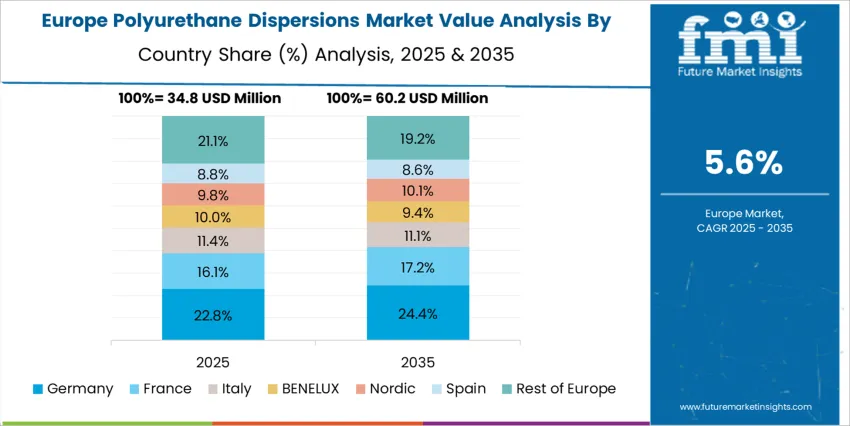
Growth in Germany reflects a CAGR of 6.3% through 2035 for polyurethane dispersion consumption, driven by automotive coatings, industrial protective finishes, and engineered textiles. These dispersions are used in seat upholstery coatings, conveyor belt fabrics, and abrasion resistant machine coatings. Strict environmental and safety standards guide material selection and process control. Domestic chemical producers supply regulated grades. Demand stays quality focused and compliance aligned, supported by automotive export activity, precision manufacturing standards, and steady investment in water based coating technologies across industrial processing sectors.
- Automotive seating and interior coatings anchor demand
- Engineered textiles support abrasion resistant applications
- Environmental compliance shapes formulation selection
- Domestic producers ensure stable regulated supply
What Is Driving Measured Polyurethane Dispersion Growth in the United States?
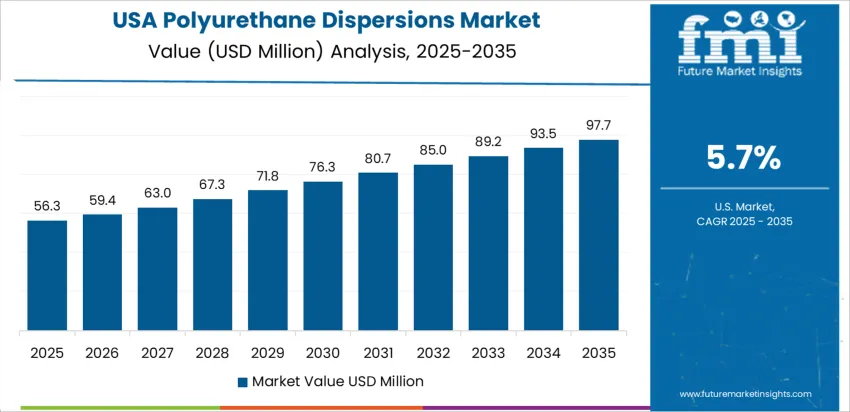
Expansion in the United States is moving at a CAGR of 5.7% through 2035 for polyurethane dispersion demand, supported by construction coatings, technical textiles, and packaging adhesive applications. These dispersions appear in roof coatings, sports equipment fabrics, food packaging laminates, and consumer goods finishes. Commercial refurbishment and infrastructure maintenance support stable coating consumption. Imports supply a portion of specialty grades. Demand remains application driven and regulation influenced, shaped by steady construction spending, gradual shift toward water based coatings, and consistent use of dispersion adhesives in packaging operations.
- Roof and infrastructure coatings drive volume demand
- Sports and industrial textiles support functional usage
- Packaging adhesives sustain steady industrial consumption
- Imported grades supplement specialty application needs
What Is Shaping Competition and Price Control Power in the Global Polyurethane Dispersions Market?
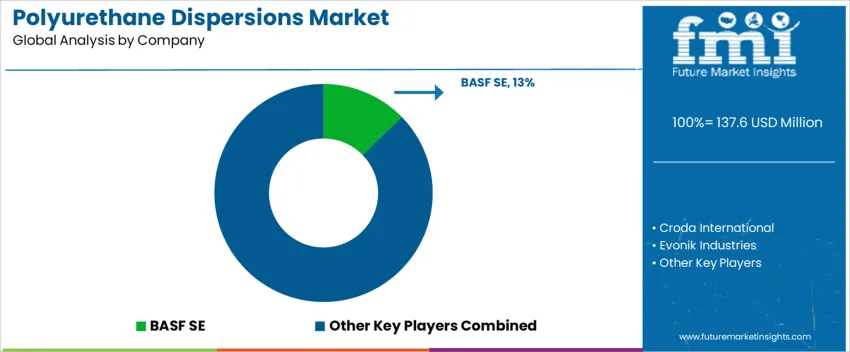
Competition in the global polyurethane dispersion market centers on a handful of large chemical and specialty ingredient companies offering broad product portfolios, regional production capacity, and global distribution networks. Firms such as BASF SE, Croda International, Evonik Industries, Dow Inc., and Clariant compete on volume, formulation range, and supply reliability. These companies supply water based and specialty dispersions for coatings, adhesives, textiles, and paper coatings sectors. Because they often hold long-term contracts with raw-material suppliers and maintain multiple production sites across regions, they can leverage economies of scale. This strength forces smaller suppliers and niche producers to compete mainly on customization, niche performance, or flexibility rather than price, limiting their influence on overall market pricing.
Price control power in this market depends heavily on access to raw materials, integration, and regulatory compliance costs. Major producers with integrated supply chains can buffer fluctuations in polyol and isocyanate feedstock prices, allowing them to stabilize or absorb cost changes without passing them fully to customers. When feedstock costs rise, smaller producers with limited sourcing flexibility face narrower margins or must increase prices, eroding competitiveness. Also, environmental and VOC emission regulations raise compliance costs and favour suppliers with water based PUD lines already certified under such standards. These factors combine to give large incumbent firms disproportionate influence over pricing and supply terms in the polyurethane dispersion market.
Key Players in the Global Polyurethane Dispersions Market
- BASF SE
- Croda International
- Evonik Industries
- Symrise (incl. IFF/Givaudan actives)
- Dow / Dow Inc.
- Ashland
- Clariant
- Seppic
- Others
Scope of the report
| Items | Values |
|---|---|
| Quantitative Units (2025) | USD million |
| End-Use Applications | Skin Care, Body Care, Hair Care, Sun Care, Color Cosmetics, Men’s Grooming, Baby & Kids Care, Dermocosmetic / Professional Care |
| Product Forms | Powder, Granules/Agglomerates, Flakes, Pellets/Prills, Liquid (Solution), Concentrate (High-active Liquid), Dispersion/Suspension, Emulsion, Paste, Gel, Wax / Solid Block, Oil |
| Regions Covered | Asia Pacific, Europe, North America, Latin America, Middle East & Africa |
| Countries Covered | China, Japan, South Korea, India, Australia & New Zealand, ASEAN, Germany, United Kingdom, France, Italy, Spain, Nordic, BENELUX, USA, Canada, Mexico, Brazil, Chile, Saudi Arabia, Turkey, South Africa, plus 40+ additional countries globally |
| Key Companies Profiled | BASF SE, Croda International, Evonik Industries, Symrise (incl. IFF/Givaudan actives), Dow Inc., Ashland, Clariant, Seppic, Lubrizol, Lonza, Inolex |
| Additional Attributes | Dollar by sales breakdown by region, country, end-use, and product form; global growth projections; multi-sector adoption (cosmetic, nutraceutical, functional food); extract bioactivity profiling; iodine and polyphenol standardization; contract harvesting; vertical integration; supply chain stability; regulatory compliance; sensory and bioavailability performance |
Global Polyurethane Dispersions Market Segmentation
End Use Application:
- Skin Care
- Body Care
- Hair Care
- Sun Care
- Color Cosmetics
- Men’s Grooming
- Baby & Kids Care
- Dermocosmetic / Professional Care
Product Form:
- Powder
- Granules / Agglomerates
- Flakes
- Pellets / Prills
- Liquid (Solution)
- Concentrate (High-active Liquid)
- Dispersion / Suspension
- Emulsion
- Paste
- Gel
- Wax / Solid Block
- Oil
Region
- Asia Pacific
- China
- Japan
- South Korea
- India
- Australia & New Zealand
- ASEAN
- Rest of Asia Pacific
- Europe
- Germany
- United Kingdom
- France
- Italy
- Spain
- Nordic
- BENELUX
- Rest of Europe
- North America
- United States
- Canada
- Mexico
- Latin America
- Brazil
- Chile
- Rest of Latin America
- Middle East & Africa
- Kingdom of Saudi Arabia
- Other GCC Countries
- Turkey
- South Africa
- Other African Union
- Rest of Middle East & Africa
Frequently Asked Questions
How big is the polyurethane dispersions market in 2025?
The global polyurethane dispersions market is estimated to be valued at USD 137.6 million in 2025.
What will be the size of polyurethane dispersions market in 2035?
The market size for the polyurethane dispersions market is projected to reach USD 262.0 million by 2035.
How much will be the polyurethane dispersions market growth between 2025 and 2035?
The polyurethane dispersions market is expected to grow at a 6.7% CAGR between 2025 and 2035.
What are the key product types in the polyurethane dispersions market?
The key product types in polyurethane dispersions market are skin care, body care, hair care, sun care, color cosmetics, men’s grooming, baby & kids care and dermocosmetic / professional care.
Which product form segment to contribute significant share in the polyurethane dispersions market in 2025?
In terms of product form , powder segment to command 17.3% share in the polyurethane dispersions market in 2025.
Preview the report firsthand - request a free sample
Get SampleGet the brochure for pricing and purchase details.
Get PDFTable of Content
- Executive Summary
- Global Market Outlook
- Demand-side Trends
- Supply-side Trends
- Technology Roadmap Analysis
- Analysis and Recommendations
- Market Overview
- Market Coverage / Taxonomy
- Market Definition / Scope / Limitations
- Market Background
- Market Dynamics
- Drivers
- Restraints
- Opportunity
- Trends
- Scenario Forecast
- Demand in Optimistic Scenario
- Demand in Likely Scenario
- Demand in Conservative Scenario
- Opportunity Map Analysis
- Product Life Cycle Analysis
- Supply Chain Analysis
- Investment Feasibility Matrix
- Value Chain Analysis
- PESTLE and Porter’s Analysis
- Regulatory Landscape
- Regional Parent Market Outlook
- Production and Consumption Statistics
- Import and Export Statistics
- Market Dynamics
- Global Market Analysis 2020 to 2024 and Forecast, 2025 to 2035
- Historical Market Size Value (USD Million) Analysis, 2020 to 2024
- Current and Future Market Size Value (USD Million) Projections, 2025 to 2035
- Y-o-Y Growth Trend Analysis
- Absolute $ Opportunity Analysis
- Global Market Pricing Analysis 2020 to 2024 and Forecast 2025 to 2035
- Global Market Analysis 2020 to 2024 and Forecast 2025 to 2035, By End Use Application
- Introduction / Key Findings
- Historical Market Size Value (USD Million) Analysis By End Use Application , 2020 to 2024
- Current and Future Market Size Value (USD Million) Analysis and Forecast By End Use Application , 2025 to 2035
- Skin Care
- Body Care
- Hair Care
- Sun Care
- Color Cosmetics
- Men’s Grooming
- Baby & Kids Care
- Dermocosmetic / Professional Care
- Y-o-Y Growth Trend Analysis By End Use Application , 2020 to 2024
- Absolute $ Opportunity Analysis By End Use Application , 2025 to 2035
- Global Market Analysis 2020 to 2024 and Forecast 2025 to 2035, By Product Form
- Introduction / Key Findings
- Historical Market Size Value (USD Million) Analysis By Product Form, 2020 to 2024
- Current and Future Market Size Value (USD Million) Analysis and Forecast By Product Form, 2025 to 2035
- Powder
- Granules / Agglomerates
- Flakes
- Pellets / Prills
- Liquid (Solution)
- Concentrate (High-active Liquid)
- Dispersion / Suspension
- Emulsion
- Paste
- Gel
- Wax / Solid Block
- Y-o-Y Growth Trend Analysis By Product Form, 2020 to 2024
- Absolute $ Opportunity Analysis By Product Form, 2025 to 2035
- Global Market Analysis 2020 to 2024 and Forecast 2025 to 2035, By Region
- Introduction
- Historical Market Size Value (USD Million) Analysis By Region, 2020 to 2024
- Current Market Size Value (USD Million) Analysis and Forecast By Region, 2025 to 2035
- North America
- Latin America
- Western Europe
- Eastern Europe
- East Asia
- South Asia and Pacific
- Middle East & Africa
- Market Attractiveness Analysis By Region
- North America Market Analysis 2020 to 2024 and Forecast 2025 to 2035, By Country
- Historical Market Size Value (USD Million) Trend Analysis By Market Taxonomy, 2020 to 2024
- Market Size Value (USD Million) Forecast By Market Taxonomy, 2025 to 2035
- By Country
- USA
- Canada
- Mexico
- By End Use Application
- By Product Form
- By Country
- Market Attractiveness Analysis
- By Country
- By End Use Application
- By Product Form
- Key Takeaways
- Latin America Market Analysis 2020 to 2024 and Forecast 2025 to 2035, By Country
- Historical Market Size Value (USD Million) Trend Analysis By Market Taxonomy, 2020 to 2024
- Market Size Value (USD Million) Forecast By Market Taxonomy, 2025 to 2035
- By Country
- Brazil
- Chile
- Rest of Latin America
- By End Use Application
- By Product Form
- By Country
- Market Attractiveness Analysis
- By Country
- By End Use Application
- By Product Form
- Key Takeaways
- Western Europe Market Analysis 2020 to 2024 and Forecast 2025 to 2035, By Country
- Historical Market Size Value (USD Million) Trend Analysis By Market Taxonomy, 2020 to 2024
- Market Size Value (USD Million) Forecast By Market Taxonomy, 2025 to 2035
- By Country
- Germany
- UK
- Italy
- Spain
- France
- Nordic
- BENELUX
- Rest of Western Europe
- By End Use Application
- By Product Form
- By Country
- Market Attractiveness Analysis
- By Country
- By End Use Application
- By Product Form
- Key Takeaways
- Eastern Europe Market Analysis 2020 to 2024 and Forecast 2025 to 2035, By Country
- Historical Market Size Value (USD Million) Trend Analysis By Market Taxonomy, 2020 to 2024
- Market Size Value (USD Million) Forecast By Market Taxonomy, 2025 to 2035
- By Country
- Russia
- Poland
- Hungary
- Balkan & Baltic
- Rest of Eastern Europe
- By End Use Application
- By Product Form
- By Country
- Market Attractiveness Analysis
- By Country
- By End Use Application
- By Product Form
- Key Takeaways
- East Asia Market Analysis 2020 to 2024 and Forecast 2025 to 2035, By Country
- Historical Market Size Value (USD Million) Trend Analysis By Market Taxonomy, 2020 to 2024
- Market Size Value (USD Million) Forecast By Market Taxonomy, 2025 to 2035
- By Country
- China
- Japan
- South Korea
- By End Use Application
- By Product Form
- By Country
- Market Attractiveness Analysis
- By Country
- By End Use Application
- By Product Form
- Key Takeaways
- South Asia and Pacific Market Analysis 2020 to 2024 and Forecast 2025 to 2035, By Country
- Historical Market Size Value (USD Million) Trend Analysis By Market Taxonomy, 2020 to 2024
- Market Size Value (USD Million) Forecast By Market Taxonomy, 2025 to 2035
- By Country
- India
- ASEAN
- Australia & New Zealand
- Rest of South Asia and Pacific
- By End Use Application
- By Product Form
- By Country
- Market Attractiveness Analysis
- By Country
- By End Use Application
- By Product Form
- Key Takeaways
- Middle East & Africa Market Analysis 2020 to 2024 and Forecast 2025 to 2035, By Country
- Historical Market Size Value (USD Million) Trend Analysis By Market Taxonomy, 2020 to 2024
- Market Size Value (USD Million) Forecast By Market Taxonomy, 2025 to 2035
- By Country
- Kingdom of Saudi Arabia
- Other GCC Countries
- Turkiye
- South Africa
- Other African Union
- Rest of Middle East & Africa
- By End Use Application
- By Product Form
- By Country
- Market Attractiveness Analysis
- By Country
- By End Use Application
- By Product Form
- Key Takeaways
- Key Countries Market Analysis
- USA
- Pricing Analysis
- Market Share Analysis, 2024
- By End Use Application
- By Product Form
- Canada
- Pricing Analysis
- Market Share Analysis, 2024
- By End Use Application
- By Product Form
- Mexico
- Pricing Analysis
- Market Share Analysis, 2024
- By End Use Application
- By Product Form
- Brazil
- Pricing Analysis
- Market Share Analysis, 2024
- By End Use Application
- By Product Form
- Chile
- Pricing Analysis
- Market Share Analysis, 2024
- By End Use Application
- By Product Form
- Germany
- Pricing Analysis
- Market Share Analysis, 2024
- By End Use Application
- By Product Form
- UK
- Pricing Analysis
- Market Share Analysis, 2024
- By End Use Application
- By Product Form
- Italy
- Pricing Analysis
- Market Share Analysis, 2024
- By End Use Application
- By Product Form
- Spain
- Pricing Analysis
- Market Share Analysis, 2024
- By End Use Application
- By Product Form
- France
- Pricing Analysis
- Market Share Analysis, 2024
- By End Use Application
- By Product Form
- India
- Pricing Analysis
- Market Share Analysis, 2024
- By End Use Application
- By Product Form
- ASEAN
- Pricing Analysis
- Market Share Analysis, 2024
- By End Use Application
- By Product Form
- Australia & New Zealand
- Pricing Analysis
- Market Share Analysis, 2024
- By End Use Application
- By Product Form
- China
- Pricing Analysis
- Market Share Analysis, 2024
- By End Use Application
- By Product Form
- Japan
- Pricing Analysis
- Market Share Analysis, 2024
- By End Use Application
- By Product Form
- South Korea
- Pricing Analysis
- Market Share Analysis, 2024
- By End Use Application
- By Product Form
- Russia
- Pricing Analysis
- Market Share Analysis, 2024
- By End Use Application
- By Product Form
- Poland
- Pricing Analysis
- Market Share Analysis, 2024
- By End Use Application
- By Product Form
- Hungary
- Pricing Analysis
- Market Share Analysis, 2024
- By End Use Application
- By Product Form
- Kingdom of Saudi Arabia
- Pricing Analysis
- Market Share Analysis, 2024
- By End Use Application
- By Product Form
- Turkiye
- Pricing Analysis
- Market Share Analysis, 2024
- By End Use Application
- By Product Form
- South Africa
- Pricing Analysis
- Market Share Analysis, 2024
- By End Use Application
- By Product Form
- USA
- Market Structure Analysis
- Competition Dashboard
- Competition Benchmarking
- Market Share Analysis of Top Players
- By Regional
- By End Use Application
- By Product Form
- Competition Analysis
- Competition Deep Dive
- BASF SE
- Overview
- Product Portfolio
- Profitability by Market Segments (Product/Age /Sales Channel/Region)
- Sales Footprint
- Strategy Overview
- Marketing Strategy
- Product Strategy
- Channel Strategy
- Croda International
- Evonik Industries
- Symrise (incl. IFF/Givaudan actives)
- Dow / Dow Inc.
- Ashland
- Clariant
- Seppic
- Others
- BASF SE
- Competition Deep Dive
- Assumptions & Acronyms Used
- Research Methodology


