

- Industry Size (2026)
- USD 806.4 Mn
- Forecast (2036)
- USD 2504.6 Mn
- CAGR (2026 to 2036)
- 12.00%
Conductive CNT Dispersions for Battery Electrodes Market Forecast and Outlook 2026 to 2036
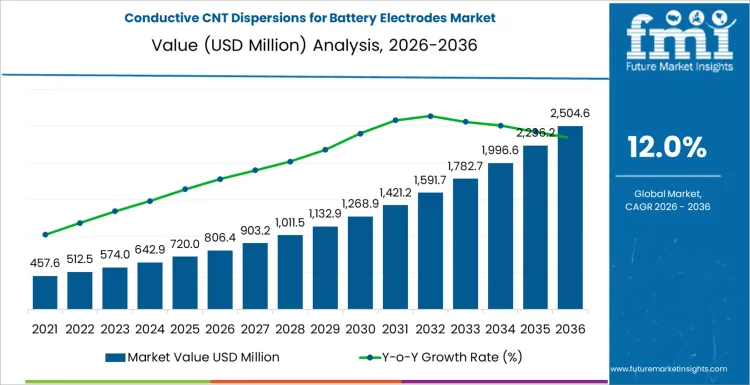
The market for conductive CNT dispersions for battery electrodes is projected to rise from USD 806.4 million in 2026 to USD 2,504.6 million by 2036, advancing at a 12.00% CAGR. The market is gaining momentum as battery manufacturers’ shift toward higher energy density designs, thicker electrodes, and faster charging architectures that demand more efficient conductive networks. Conductive carbon nanotube dispersions enable uniform electron transport at significantly lower loading levels than conventional carbon blacks, helping improve rate performance while preserving electrode integrity.
Their use is increasingly critical in high-nickel cathodes, silicon-rich anodes, and advanced lithium-ion systems where conductivity losses directly impact cycle life and power output. Adoption is closely tied to electrode manufacturing scalability. Pre-dispersed CNT systems reduce agglomeration risks, improve slurry stability, and enhance reproducibility across high-throughput coating lines used in gigafactories. As electric vehicle and energy storage production scales globally, demand is concentrating around dispersion technologies that balance conductivity efficiency, process compatibility, and long-term stability.
Quick Stats for Conductive CNT Dispersions for Battery Electrodes Market
- Conductive CNT Dispersions for Battery Electrodes Market Value (2026): USD 806.4 Million
- Conductive CNT Dispersions for Battery Electrodes Market Forecast Value (2036): USD 2,504.6 Million
- Conductive CNT Dispersions for Battery Electrodes Market Forecast CAGR 2026 to 2036: 12.00%
- Leading CNT Type in Conductive CNT Dispersions for Battery Electrodes Market: Multi-Walled CNT (56% share)
- Key Growth Regions in Conductive CNT Dispersions for Battery Electrodes Market: Asia Pacific, Europe, North America, Latin America, Middle East & Africa
- Top Key Players in Conductive CNT Dispersions for Battery Electrodes Market: LG Chem, CABOT Corporation, Showa Denko Materials, OCSiAl, Mitsubishi Chemical Group, Toray Industries, Jiangsu Cnano Technology, Applied Graphene/Advanced Nanotech players, Birla Carbon, Arkema
Conductive CNT Dispersions for Battery Electrodes Market Key Takeaways
| Metric | Value |
|---|---|
| Conductive CNT Dispersions for Battery Electrodes Market Value (2026) | USD 806.4 Million |
| Conductive CNT Dispersions for Battery Electrodes Market Forecast Value (2036) | USD 2,504.6 Million |
| Conductive CNT Dispersions for Battery Electrodes Market Forecast CAGR 2026 to 2036 | 12.00% |
How are High-Energy Battery Designs and Electrode Engineering Advancing the Conductive CNT Dispersions Market?
The conductive CNT dispersions for battery electrodes market is expanding rapidly as battery manufacturers pursue higher energy density, faster charging capability, and improved cycle life. Carbon nanotube (CNT) dispersions provide highly efficient conductive networks within electrode coatings, enabling reduced use of conventional conductive additives while maintaining uniform electron transport. As cathode and anode formulations evolve toward higher active material loadings and thicker electrodes, CNT dispersions are increasingly preferred for their ability to deliver conductivity at low addition levels without compromising mechanical integrity or coating uniformity.
Electrode process compatibility and dispersion stability are central to adoption decisions. End users evaluate CNT dispersions based on particle distribution, viscosity control, and compatibility with water-based and solvent-based electrode slurries. In lithium-ion batteries, uniform CNT dispersion supports improved adhesion between active materials and current collectors, reducing internal resistance and enhancing rate performance. The use of pre-dispersed CNT systems also simplifies electrode manufacturing by minimizing agglomeration risks and improving reproducibility in large-scale coating operations.
Scaling of electric vehicle and energy storage manufacturing is further reinforcing market growth. Gigafactory expansion and high-throughput electrode production lines require conductive additives that perform consistently under automated mixing and coating conditions. At the same time, next-generation battery chemistries such as high-nickel cathodes and silicon-rich anodes-are increasing the need for advanced conductive solutions that accommodate volume expansion and structural stress. For suppliers, competitive advantage increasingly depends on dispersion technology expertise, slurry optimization support, and the ability to tailor CNT systems to specific electrode architectures positioning conductive CNT dispersions as a critical enabler of next-generation battery performance.
How is the Conductive CNT Dispersions for Battery Electrodes Market Structured by CNT Type and Battery Application?
The conductive cnt dispersions for battery electrodes market is structured by cnt type and battery application, reflecting how conductivity requirements, dispersion stability, and cost considerations influence material selection. By cnt type, multi-walled cnt (mwcng) dispersions dominate the market, supported by their strong electrical conductivity and ease of dispersion at industrial scale. Other cnt types include single-walled cnt (swcnt) and other cnt variants used for specialized performance targets. By battery application, eV traction batteries represent the largest demand segment, followed by consumer and it batteries, stationary energy storage systems, and other battery formats requiring conductive networks within electrodes.
Why Do Multi-Walled CNT (MWCNT) Dispersions Lead CNT Type Adoption in the Conductive CNT Dispersions for Battery Electrodes Market?
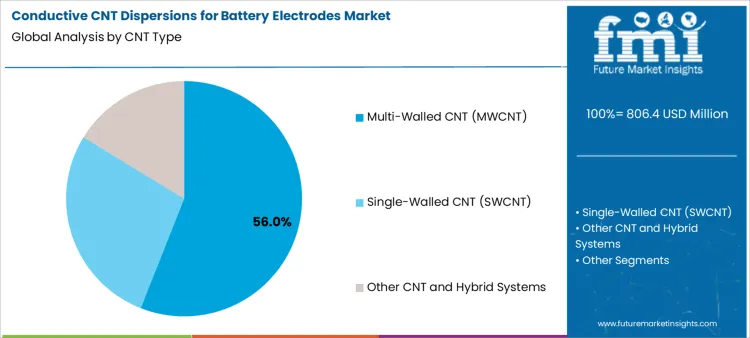
Multi-walled cnt dispersions account for 56% share of the conductive cnt dispersions for battery electrodes market because they provide an effective balance of electrical conductivity, mechanical reinforcement, and cost efficiency. MWCNTs form robust conductive networks at relatively low loading levels, improving electrode conductivity without significantly increasing formulation complexity. Battery manufacturers favor mwcnt dispersions due to their stable dispersion behavior in aqueous and solvent-based systems. Compatibility with existing slurry mixing and coating processes further supports adoption. These scalability, processing reliability, and performance advantages explain why multi-walled cnt dispersions remain the dominant cnt type.
Why Do EV Traction Batteries Dominate Application Demand In The Conductive CNT Dispersions For Battery Electrodes Market?
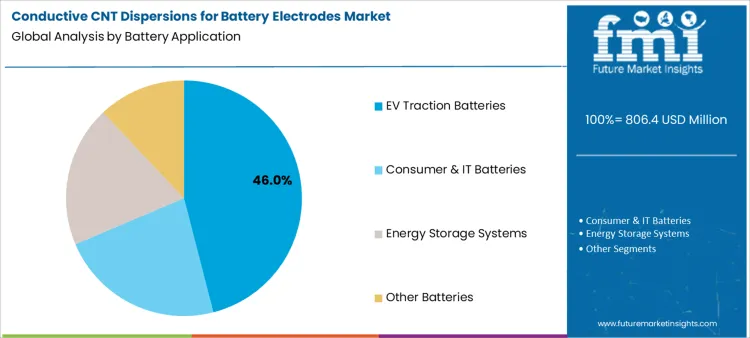
EV traction batteries hold 46% share of the conductive cnt dispersions for battery electrodes market because high-capacity battery packs require highly efficient electron transport within thick electrode structures. CNT dispersions improve conductivity, support fast charge-discharge rates, and enhance electrode durability under repeated cycling. Electric vehicle batteries use significantly more active material per unit than consumer electronics, increasing conductive additive demand. Rapid expansion of electric vehicle production amplifies consumption at gigafactory scale. These volume-driven production dynamics and performance-critical requirements explain why eV traction batteries remain the leading application segment.
What are the Key Dynamics of the Conductive CNT Dispersions for Battery Electrodes Market?
The conductive CNT dispersions for battery electrodes market is driven by rising demand for high-energy-density and fast-charging lithium-ion batteries used in electric vehicles, energy storage systems, and advanced consumer electronics. Conductive carbon nanotube dispersions enhance electrical conductivity, reduce internal resistance, and enable uniform electron pathways within electrode structures, supporting improved power performance and cycle life. Compared with traditional conductive additives, CNT dispersions allow lower loading levels while maintaining effective conductivity. For battery material suppliers and cell manufacturers, dispersion stability, conductivity efficiency, compatibility with electrode formulations, and scalability are key factors influencing adoption and long-term supplier selection.
How Do Application Trends and Industry Requirements Shape This Market?
Application trends and industry requirements are shaping the conductive CNT dispersions market as battery designs evolve toward thicker electrodes, higher areal loadings, and advanced active materials. In electric vehicle batteries, CNT dispersions support improved electrode integrity and reduced impedance under high current operation. Energy storage systems prioritize long cycle life and thermal stability, increasing demand for conductive networks that remain effective over extended use. Compatibility with water-based and solvent-based electrode processing, along with uniform coating and drying behavior, is essential for large-scale manufacturing. Suppliers that tailor CNT dispersion formulations to specific cathode and anode chemistries strengthen qualification outcomes.
Why Do Cost, Processing, and Qualification Challenges Restrain Market Growth?
Cost, processing, and qualification challenges restrain growth in the conductive CNT dispersions market, particularly in price-sensitive battery applications. CNT materials are more expensive than conventional carbon additives, and achieving consistent dispersion without agglomeration requires specialized processing and quality control. Integration into existing electrode manufacturing lines may require process adjustments, increasing validation time and cost. Battery manufacturers also conduct extensive testing to ensure long-term stability, safety, and compatibility, extending qualification cycles. These factors slow adoption among producers focused on cost optimization and high-volume production.
How is the Conductive CNT Dispersions for Battery Electrodes Market Growing across Key Countries?
The conductive CNT dispersions for battery electrodes market is expanding rapidly as battery manufacturers adopt advanced conductive networks to improve energy density, rate capability, and cycle life. CNT dispersions are increasingly used as alternatives to conventional carbon blacks in lithium-ion battery cathodes and anodes, enabling lower additive loading while maintaining electrical conductivity and mechanical integrity. Country-wise growth varies based on battery cell manufacturing scale, EV penetration, and adoption of next-generation electrode architectures. High-growth markets are driven by aggressive battery capacity expansion, while mature regions focus on performance optimization, dispersion stability, and integration with high-nickel and silicon-based electrodes.
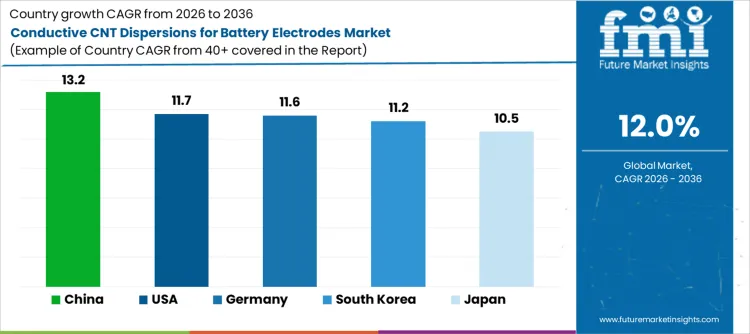
| Country | CAGR (%) |
|---|---|
| China | 13.2 |
| Brazil | 12.8 |
| United States | 11.7 |
| Germany | 11.6 |
| South Korea | 11.2 |
Why is China Leading the Conductive CNT Dispersions for Battery Electrodes Market?
China’s conductive CNT dispersions for battery electrodes market is expanding at a CAGR of 13.2% during 2026 to 2036, driven by the country’s dominant position in lithium-ion battery manufacturing and electric vehicle production. As battery producers push toward higher energy density and faster charging, CNT dispersions are increasingly adopted to replace or supplement traditional conductive additives in cathodes and anodes. Demand is strongest in high-nickel cathodes, LFP systems optimized for fast charging, and silicon-enhanced anodes. Chinese battery manufacturers prioritize CNT dispersions that offer uniform conductivity networks, stable rheology, and compatibility with water-based and solvent-based electrode slurries. Domestic suppliers benefit from close collaboration with cell makers and the ability to scale dispersion production rapidly. Procurement decisions emphasize dispersion consistency, batch-to-batch reliability, and compatibility with high-speed coating processes.
Why is Brazil Emerging as a High-Growth Market for Conductive CNT Dispersions?
Brazil’s conductive CNT dispersions for battery electrodes market is growing at a CAGR of 12.8% during 2026 to 2036, supported by rising investment in battery assembly, energy storage projects, and regional EV supply chains. While large-scale cell manufacturing is still developing, adoption of CNT dispersions is increasing in battery pack assembly, stationary storage systems, and pilot-scale electrode production. Brazilian buyers value CNT dispersions that enhance conductivity at low loading levels and integrate easily into existing electrode formulations. Adoption is strongest in energy storage systems, electric buses, and localized battery manufacturing initiatives. Cost-performance balance and supplier support play a critical role. Procurement decisions often favor suppliers offering technical assistance, formulation guidance, and regional distribution capabilities. Market growth is supported by gradual localization of battery value chains, expansion of renewable-linked storage projects, and increasing interest in higher-performance electrode materials.
What is Driving Demand for Conductive CNT Dispersions in the United States?
The United States conductive CNT dispersions for battery electrodes market is expanding at a CAGR of 11.7% during 2026 to 2036, driven by rapid growth in domestic battery manufacturing and advanced energy storage development. USA. battery producers are adopting CNT dispersions to support high-energy cathodes, silicon-rich anodes, and long-life battery systems used in EVs and grid storage. Buyers emphasize dispersion stability, reproducibility, and compatibility with automated electrode coating lines. Demand is strongest from gigafactories supplying EV OEMs and large-scale stationary storage projects. CNT dispersions are increasingly specified during early formulation stages to meet performance targets. Procurement decisions prioritize long-term supply reliability, technical validation, and integration support. Market growth is reinforced by continued investment in battery gigafactories, federal support for domestic battery production, and increasing adoption of advanced electrode chemistries.
How is Germany Supporting Growth in the Conductive CNT Dispersions Market?
Germany’s conductive CNT dispersions for battery electrodes market is growing at a CAGR of 11.6% during 2026 to 2036, supported by strong demand from automotive battery manufacturing and premium EV platforms. German battery developer’s focus on precision electrode engineering, where CNT dispersions help improve conductivity uniformity and mechanical stability. Buyers prioritize dispersions with tight particle size control, predictable rheology, and compatibility with high-quality electrode manufacturing processes. Adoption is driven by performance optimization rather than volume expansion, particularly in high-performance automotive batteries. Procurement decisions favor suppliers with validated dispersion technologies, strong quality systems, and reliable European supply. Market growth is reinforced by Germany’s leadership in automotive electrification and continued investment in localized battery cell production.
How is South Korea Expanding Use of Conductive CNT Dispersions?
South Korea’s conductive CNT dispersions for battery electrodes market is expanding at a CAGR of 11.2% during 2026 to 2036, driven by its leading position in global lithium-ion battery production. South Korean cell manufacturers increasingly use CNT dispersions to improve electrode conductivity while reducing additive content and enhancing cycle stability. Buyers emphasize dispersion homogeneity, long-term stability, and compatibility with high-throughput manufacturing. Adoption is strongest in high-energy EV batteries and export-oriented cell production. Procurement decisions are influenced by supplier reliability, technical collaboration, and ability to meet stringent quality specifications. Market growth is supported by continuous battery capacity expansion and ongoing innovation in electrode material design.
How are Companies Competing in the Conductive CNT Dispersions for Battery Electrodes Market?
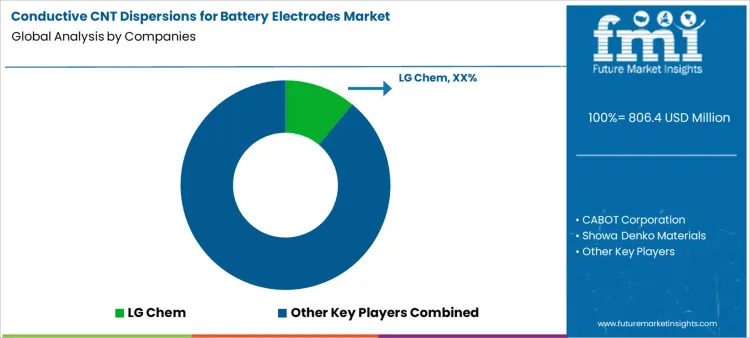
Competition in the conductive carbon nanotube (CNT) dispersions for battery electrodes market is driven by dispersion quality, electrical conductivity gains, and compatibility with high-energy electrode formulations attributes that matter to battery chemists, cell OEMs, and EV/lithium-ion manufacturers. Well-dispersed CNTs enhance electronic pathways, improve rate capability, and reduce reliance on traditional conductive additives. LG Chem positions its CNT dispersions through tightly controlled morphologies and surface treatments optimized for high-loading cathode and anode recipes. Its portfolio emphasizes consistent dispersion stability, minimal agglomeration, and scalable integration into slurry processes used in pouch and cylindrical cell production.
Material specialists and traditional carbon leaders strengthen competitive breadth through tailored nanotube chemistries and processing support. CABOT Corporation competes with high-performance CNT dispersions designed for robust conductivity and uniform network formation within electrodes, supported by formulation expertise and quality assurance frameworks. Showa Denko Materials and OCSiAl differentiate through engineered CNT products with controlled length, aspect ratio, and surface chemistry that facilitate dispersion at minimal processing steps. Mitsubishi Chemical Group and Toray Industries leverage deep polymer and carbon science to offer CNT dispersions integrated with binder systems for improved electrode cohesion and performance.
Regional innovators and additive specialists expand the competitive landscape. Jiangsu Cnano Technology and advanced nanotech players focusing on graphene/CNT hybrids compete on cost-effective, high-conductivity dispersions. Birla Carbon and Arkema add value through hybrid additive platforms that blend CNTs with carbon blacks or graphene for tailored electrode conductivity. Across the market, competitive advantage is defined by dispersion uniformity, electrode performance impact, and seamless integration into existing slurry and coating lines rather than raw CNT pricing alone.
Key Players in Conductive CNT Dispersions for Battery Electrodes Market
- LG Chem
- CABOT Corporation
- Showa Denko Materials
- OCSiAl
- Mitsubishi Chemical Group
- Toray Industries
- Jiangsu Cnano Technology
- Applied Graphene/Advanced Nanotech players (CNT focus)
- Birla Carbon (conductive additives)
- Arkema
Scope of Report
| Attribute | Details |
|---|---|
| Market Size Unit | USD Million |
| CNT Type Covered | Multi-Walled CNT (MWCNT), Single-Walled CNT (SWCNT), Other CNT |
| Battery Application Covered | EV Traction Batteries, Consumer & IT Batteries, Energy Storage Systems, Other Batteries |
| Countries Covered | China, Japan, South Korea, India, Australia & New Zealand, ASEAN, Rest of Asia Pacific, Germany, United Kingdom, France, Italy, Spain, Nordic, BENELUX, Rest of Europe, United States, Canada, Mexico, Brazil, Chile, Rest of Latin America, Kingdom of Saudi Arabia, Other GCC Countries, Turkey, South Africa, Other African Union, Rest of Middle East & Africa |
| Regions Covered | Asia Pacific, Europe, North America, Latin America, Middle East & Africa |
| Key Companies Profiled | LG Chem, CABOT Corporation, Showa Denko Materials, OCSiAl, Mitsubishi Chemical Group, Toray Industries, Jiangsu Cnano Technology, Applied Graphene/Advanced Nanotech Players, Birla Carbon, Arkema |
| Additional Attributes | Dollar sales of conductive CNT dispersions are analyzed by CNT type and battery application across lithium-ion and next-generation battery electrode systems. The scope evaluates dispersion stability, conductivity enhancement, loading efficiency, electrode rheology, and compatibility with aqueous and solvent-based formulations. Country-level analysis reflects growth in EV battery manufacturing, energy storage deployment, adoption of high-energy-density electrode designs, and investments in advanced conductive additive technologies to improve battery performance and cycle life. |
Conductive CNT Dispersions for Battery Electrodes Market by Key Segments
CNT Type
- Multi-Walled CNT (MWCNT)
- Single-Walled CNT (SWCNT)
- Other CNT
Battery Application
- EV Traction Batteries
- Consumer & IT Batteries
- Energy Storage Systems
- Other Batteries
Region
- Asia Pacific
- China
- Japan
- South Korea
- India
- Australia & New Zealand
- ASEAN
- Rest of Asia Pacific
- Europe
- Germany
- United Kingdom
- France
- Italy
- Spain
- Nordic
- BENELUX
- Rest of Europe
- North America
- United States
- Canada
- Mexico
- Latin America
- Brazil
- Chile
- Rest of Latin America
- Middle East & Africa
- Kingdom of Saudi Arabia
- Other GCC Countries
- Turkey
- South Africa
- Other African Union
- Rest of Middle East & Africa
Bibliography
- Wang, X., Li, Y., & Zhang, S. (2024). Dispersion strategies of carbon nanotubes for enhanced electrode conductivity in lithium ion batteries.
- . Zhao, Y., & Xu, K. (2024). Stability and rheology of carbon nanotube dispersions in water‑based electrode slurries.
- National Renewable Energy Laboratory. (2024). Electrode formulation and conductive network optimization for next‑generation lithium‑ion batteries.
- USA. Department of Energy. (2023). Advanced electrode materials for high‑energy lithium‑ion batteries. DOE Office of Energy Efficiency and Renewable Energy.
- International Renewable Energy Agency. (2023). Innovation landscape for batteries and energy storage. IRENA.
Frequently Asked Questions
How big is the conductive cnt dispersions for battery electrodes market in 2026?
The global conductive cnt dispersions for battery electrodes market is estimated to be valued at USD 806.4 million in 2026.
What will be the size of conductive cnt dispersions for battery electrodes market in 2036?
The market size for the conductive cnt dispersions for battery electrodes market is projected to reach USD 2,504.6 million by 2036.
How much will be the conductive cnt dispersions for battery electrodes market growth between 2026 and 2036?
The conductive cnt dispersions for battery electrodes market is expected to grow at a 12.0% CAGR between 2026 and 2036.
What are the key product types in the conductive cnt dispersions for battery electrodes market?
The key product types in conductive cnt dispersions for battery electrodes market are multi-walled cnt (mwcnt), single-walled cnt (swcnt) and other cnt and hybrid systems.
Which dispersion medium segment to contribute significant share in the conductive cnt dispersions for battery electrodes market in 2026?
In terms of dispersion medium, water-based segment to command 34.0% share in the conductive cnt dispersions for battery electrodes market in 2026.
Preview the report firsthand - request a free sample
Get SampleGet the brochure for pricing and purchase details.
Get PDFTable of Content
- Executive Summary
- Global Market Outlook
- Demand-side Trends
- Supply-side Trends
- Technology Roadmap Analysis
- Analysis and Recommendations
- Market Overview
- Market Coverage / Taxonomy
- Market Definition / Scope / Limitations
- Market Background
- Market Dynamics
- Drivers
- Restraints
- Opportunity
- Trends
- Scenario Forecast
- Demand in Optimistic Scenario
- Demand in Likely Scenario
- Demand in Conservative Scenario
- Opportunity Map Analysis
- Product Life Cycle Analysis
- Supply Chain Analysis
- Investment Feasibility Matrix
- Value Chain Analysis
- PESTLE and Porter’s Analysis
- Regulatory Landscape
- Regional Parent Market Outlook
- Production and Consumption Statistics
- Import and Export Statistics
- Market Dynamics
- Global Market Analysis 2021 to 2025 and Forecast, 2026 to 2036
- Historical Market Size Value (USD Million) Analysis, 2021 to 2025
- Current and Future Market Size Value (USD Million) Projections, 2026 to 2036
- Y-o-Y Growth Trend Analysis
- Absolute $ Opportunity Analysis
- Global Market Pricing Analysis 2021 to 2025 and Forecast 2026 to 2036
- Global Market Analysis 2021 to 2025 and Forecast 2026 to 2036, By CNT Type
- Introduction / Key Findings
- Historical Market Size Value (USD Million) Analysis By CNT Type, 2021 to 2025
- Current and Future Market Size Value (USD Million) Analysis and Forecast By CNT Type, 2026 to 2036
- Multi-Walled CNT (MWCNT)
- Single-Walled CNT (SWCNT)
- Other CNT and Hybrid Systems
- Multi-Walled CNT (MWCNT)
- Y-o-Y Growth Trend Analysis By CNT Type, 2021 to 2025
- Absolute $ Opportunity Analysis By CNT Type, 2026 to 2036
- Global Market Analysis 2021 to 2025 and Forecast 2026 to 2036, By Dispersion Medium
- Introduction / Key Findings
- Historical Market Size Value (USD Million) Analysis By Dispersion Medium, 2021 to 2025
- Current and Future Market Size Value (USD Million) Analysis and Forecast By Dispersion Medium, 2026 to 2036
- Water-Based
- Solvent-Based
- Binder and Polymer-Based
- Water-Based
- Y-o-Y Growth Trend Analysis By Dispersion Medium, 2021 to 2025
- Absolute $ Opportunity Analysis By Dispersion Medium, 2026 to 2036
- Global Market Analysis 2021 to 2025 and Forecast 2026 to 2036, By Battery Application
- Introduction / Key Findings
- Historical Market Size Value (USD Million) Analysis By Battery Application, 2021 to 2025
- Current and Future Market Size Value (USD Million) Analysis and Forecast By Battery Application, 2026 to 2036
- EV Traction Batteries
- Consumer & IT Batteries
- Energy Storage Systems
- Other Batteries
- EV Traction Batteries
- Y-o-Y Growth Trend Analysis By Battery Application, 2021 to 2025
- Absolute $ Opportunity Analysis By Battery Application, 2026 to 2036
- Global Market Analysis 2021 to 2025 and Forecast 2026 to 2036, By Customer Type
- Introduction / Key Findings
- Historical Market Size Value (USD Million) Analysis By Customer Type, 2021 to 2025
- Current and Future Market Size Value (USD Million) Analysis and Forecast By Customer Type, 2026 to 2036
- Cell Manufacturers
- Electrode Formulators
- R&D and Pilot Users
- Cell Manufacturers
- Y-o-Y Growth Trend Analysis By Customer Type, 2021 to 2025
- Absolute $ Opportunity Analysis By Customer Type, 2026 to 2036
- Global Market Analysis 2021 to 2025 and Forecast 2026 to 2036, By Region
- Introduction
- Historical Market Size Value (USD Million) Analysis By Region, 2021 to 2025
- Current Market Size Value (USD Million) Analysis and Forecast By Region, 2026 to 2036
- North America
- Latin America
- Western Europe
- Eastern Europe
- East Asia
- South Asia and Pacific
- Middle East & Africa
- Market Attractiveness Analysis By Region
- North America Market Analysis 2021 to 2025 and Forecast 2026 to 2036, By Country
- Historical Market Size Value (USD Million) Trend Analysis By Market Taxonomy, 2021 to 2025
- Market Size Value (USD Million) Forecast By Market Taxonomy, 2026 to 2036
- By Country
- USA
- Canada
- Mexico
- By CNT Type
- By Dispersion Medium
- By Battery Application
- By Customer Type
- By Country
- Market Attractiveness Analysis
- By Country
- By CNT Type
- By Dispersion Medium
- By Battery Application
- By Customer Type
- Key Takeaways
- Latin America Market Analysis 2021 to 2025 and Forecast 2026 to 2036, By Country
- Historical Market Size Value (USD Million) Trend Analysis By Market Taxonomy, 2021 to 2025
- Market Size Value (USD Million) Forecast By Market Taxonomy, 2026 to 2036
- By Country
- Brazil
- Chile
- Rest of Latin America
- By CNT Type
- By Dispersion Medium
- By Battery Application
- By Customer Type
- By Country
- Market Attractiveness Analysis
- By Country
- By CNT Type
- By Dispersion Medium
- By Battery Application
- By Customer Type
- Key Takeaways
- Western Europe Market Analysis 2021 to 2025 and Forecast 2026 to 2036, By Country
- Historical Market Size Value (USD Million) Trend Analysis By Market Taxonomy, 2021 to 2025
- Market Size Value (USD Million) Forecast By Market Taxonomy, 2026 to 2036
- By Country
- Germany
- UK
- Italy
- Spain
- France
- Nordic
- BENELUX
- Rest of Western Europe
- By CNT Type
- By Dispersion Medium
- By Battery Application
- By Customer Type
- By Country
- Market Attractiveness Analysis
- By Country
- By CNT Type
- By Dispersion Medium
- By Battery Application
- By Customer Type
- Key Takeaways
- Eastern Europe Market Analysis 2021 to 2025 and Forecast 2026 to 2036, By Country
- Historical Market Size Value (USD Million) Trend Analysis By Market Taxonomy, 2021 to 2025
- Market Size Value (USD Million) Forecast By Market Taxonomy, 2026 to 2036
- By Country
- Russia
- Poland
- Hungary
- Balkan & Baltic
- Rest of Eastern Europe
- By CNT Type
- By Dispersion Medium
- By Battery Application
- By Customer Type
- By Country
- Market Attractiveness Analysis
- By Country
- By CNT Type
- By Dispersion Medium
- By Battery Application
- By Customer Type
- Key Takeaways
- East Asia Market Analysis 2021 to 2025 and Forecast 2026 to 2036, By Country
- Historical Market Size Value (USD Million) Trend Analysis By Market Taxonomy, 2021 to 2025
- Market Size Value (USD Million) Forecast By Market Taxonomy, 2026 to 2036
- By Country
- China
- Japan
- South Korea
- By CNT Type
- By Dispersion Medium
- By Battery Application
- By Customer Type
- By Country
- Market Attractiveness Analysis
- By Country
- By CNT Type
- By Dispersion Medium
- By Battery Application
- By Customer Type
- Key Takeaways
- South Asia and Pacific Market Analysis 2021 to 2025 and Forecast 2026 to 2036, By Country
- Historical Market Size Value (USD Million) Trend Analysis By Market Taxonomy, 2021 to 2025
- Market Size Value (USD Million) Forecast By Market Taxonomy, 2026 to 2036
- By Country
- India
- ASEAN
- Australia & New Zealand
- Rest of South Asia and Pacific
- By CNT Type
- By Dispersion Medium
- By Battery Application
- By Customer Type
- By Country
- Market Attractiveness Analysis
- By Country
- By CNT Type
- By Dispersion Medium
- By Battery Application
- By Customer Type
- Key Takeaways
- Middle East & Africa Market Analysis 2021 to 2025 and Forecast 2026 to 2036, By Country
- Historical Market Size Value (USD Million) Trend Analysis By Market Taxonomy, 2021 to 2025
- Market Size Value (USD Million) Forecast By Market Taxonomy, 2026 to 2036
- By Country
- Kingdom of Saudi Arabia
- Other GCC Countries
- Turkiye
- South Africa
- Other African Union
- Rest of Middle East & Africa
- By CNT Type
- By Dispersion Medium
- By Battery Application
- By Customer Type
- By Country
- Market Attractiveness Analysis
- By Country
- By CNT Type
- By Dispersion Medium
- By Battery Application
- By Customer Type
- Key Takeaways
- Key Countries Market Analysis
- USA
- Pricing Analysis
- Market Share Analysis, 2025
- By CNT Type
- By Dispersion Medium
- By Battery Application
- By Customer Type
- Canada
- Pricing Analysis
- Market Share Analysis, 2025
- By CNT Type
- By Dispersion Medium
- By Battery Application
- By Customer Type
- Mexico
- Pricing Analysis
- Market Share Analysis, 2025
- By CNT Type
- By Dispersion Medium
- By Battery Application
- By Customer Type
- Brazil
- Pricing Analysis
- Market Share Analysis, 2025
- By CNT Type
- By Dispersion Medium
- By Battery Application
- By Customer Type
- Chile
- Pricing Analysis
- Market Share Analysis, 2025
- By CNT Type
- By Dispersion Medium
- By Battery Application
- By Customer Type
- Germany
- Pricing Analysis
- Market Share Analysis, 2025
- By CNT Type
- By Dispersion Medium
- By Battery Application
- By Customer Type
- UK
- Pricing Analysis
- Market Share Analysis, 2025
- By CNT Type
- By Dispersion Medium
- By Battery Application
- By Customer Type
- Italy
- Pricing Analysis
- Market Share Analysis, 2025
- By CNT Type
- By Dispersion Medium
- By Battery Application
- By Customer Type
- Spain
- Pricing Analysis
- Market Share Analysis, 2025
- By CNT Type
- By Dispersion Medium
- By Battery Application
- By Customer Type
- France
- Pricing Analysis
- Market Share Analysis, 2025
- By CNT Type
- By Dispersion Medium
- By Battery Application
- By Customer Type
- India
- Pricing Analysis
- Market Share Analysis, 2025
- By CNT Type
- By Dispersion Medium
- By Battery Application
- By Customer Type
- ASEAN
- Pricing Analysis
- Market Share Analysis, 2025
- By CNT Type
- By Dispersion Medium
- By Battery Application
- By Customer Type
- Australia & New Zealand
- Pricing Analysis
- Market Share Analysis, 2025
- By CNT Type
- By Dispersion Medium
- By Battery Application
- By Customer Type
- China
- Pricing Analysis
- Market Share Analysis, 2025
- By CNT Type
- By Dispersion Medium
- By Battery Application
- By Customer Type
- Japan
- Pricing Analysis
- Market Share Analysis, 2025
- By CNT Type
- By Dispersion Medium
- By Battery Application
- By Customer Type
- South Korea
- Pricing Analysis
- Market Share Analysis, 2025
- By CNT Type
- By Dispersion Medium
- By Battery Application
- By Customer Type
- Russia
- Pricing Analysis
- Market Share Analysis, 2025
- By CNT Type
- By Dispersion Medium
- By Battery Application
- By Customer Type
- Poland
- Pricing Analysis
- Market Share Analysis, 2025
- By CNT Type
- By Dispersion Medium
- By Battery Application
- By Customer Type
- Hungary
- Pricing Analysis
- Market Share Analysis, 2025
- By CNT Type
- By Dispersion Medium
- By Battery Application
- By Customer Type
- Kingdom of Saudi Arabia
- Pricing Analysis
- Market Share Analysis, 2025
- By CNT Type
- By Dispersion Medium
- By Battery Application
- By Customer Type
- Turkiye
- Pricing Analysis
- Market Share Analysis, 2025
- By CNT Type
- By Dispersion Medium
- By Battery Application
- By Customer Type
- South Africa
- Pricing Analysis
- Market Share Analysis, 2025
- By CNT Type
- By Dispersion Medium
- By Battery Application
- By Customer Type
- USA
- Market Structure Analysis
- Competition Dashboard
- Competition Benchmarking
- Market Share Analysis of Top Players
- By Regional
- By CNT Type
- By Dispersion Medium
- By Battery Application
- By Customer Type
- Competition Analysis
- Competition Deep Dive
- LG Chem
- Overview
- Product Portfolio
- Profitability by Market Segments (Product/Age /Sales Channel/Region)
- Sales Footprint
- Strategy Overview
- Marketing Strategy
- Product Strategy
- Channel Strategy
- CABOT Corporation
- Showa Denko Materials
- OCSiAl
- Mitsubishi Chemical Group
- Toray Industries
- Jiangsu Cnano Technology
- Applied Graphene/Advanced Nanotech players (CNT focus)
- Birla Carbon (conductive additives)
- Arkema
- LG Chem
- Competition Deep Dive
- Assumptions & Acronyms Used
- Research Methodology


