

- Market Size (2026)
- USD 163.6 Mn
- Forecast (2036)
- USD 321.8 Mn
- CAGR (2026 to 2036)
- 7.0%
Boron Nitride-Based Thermally Conductive Additives Market Size, Forecast, and Outlook By FMI
Summary of the Boron Nitride-Based Thermally Conductive Additives Market
- Demand and Growth Drivers
- Electronics thermal control needs lift demand for BN additives as chips and boards need heat movement without electrical leakage.
- EV battery pack design boosts demand as module materials need thermal transfer and dielectric safety in compact formats.
- High filler loading creates pricing pressure as compounders need conductivity gains without heavy viscosity penalties.
- Product and Segment View
- Hexagonal boron nitride is projected to account for 74.0% of the type segment in 2026 as compounders need thermal transfer with electrical insulation.
- Powder grades are anticipated to represent 64.0% of product form use during 2026 since resin processors value easier dosing and dispersion control.
- Thermoplastics are set to capture 43.0% of matrix demand for 2026 through molded housings and connector applications.
- Geography and Competitive Outlook
- China is expected to record 8.2% CAGR by 2036, due to chip output scale and deeper electronics manufacturing capacity.
- Taiwan’s market is projected to expand at 7.8% CAGR over 2026 to 2036 as advanced packaging raises thermal material needs.
- BN additive producers with broader grade options and polymer formulation support are better placed to win qualified electronics programs.
- Analyst Opinion
- Nikhil Kaitwade, Associate Vice President at FMI says, “Boron nitride additives now guide electronics and battery material formulation in applications that require heat transfer without electrical conduction. Particle size control with resin flow behavior can reduce thermal interface trial cycles while viscosity performance and qualification time shape supply agreement decisions.”
- Boron Nitride-Based Thermally Conductive Additives Market Value Analysis
- The boron nitride-based thermally conductive additives market is expanding beyond specialty filler use into a structured electronics material base.
- Demand is supported by higher use of thermal interface material systems across chips and battery packs.
- Market demand benefits from deeper use of boron nitride grades across thermally conductive polymer compounds.
- Thermal performance records document electrical insulation and assembly safety requirements. Electronics manufacturers use these records to manage reliability checks and qualification timelines.
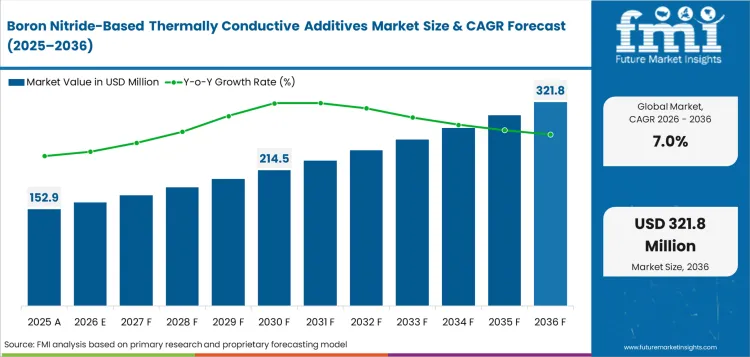
Key Takeaways, Market Size, and Forecast
- The boron nitride-based thermally conductive additives market was valued at USD 152.9 million in 2025.
- By 2036, the boron nitride-based thermally conductive additives market is expected to be worth USD 321.8 million.
- From 2026 to 2036, the market is projected to expand at a CAGR of 7.0%.
- The market is projected to create an incremental opportunity of USD 158.2 million between 2026 and 2036.
- In 2026, hexagonal boron nitride is expected to account for 74.0% by type segment.
- China at 8.2% CAGR and Taiwan at 7.8% CAGR are two prominent country markets.
Heat removal is becoming harder as electronics and EV components need insulation and thermal transfer in the same polymer part. Momentive’s January 2024 data shows why BN fillers are attractive because some BN-polymer materials reached 15 W/mK and retained volume resistivity above 10^15 ohm-cm. Such performance gives compounders a route to thermal parts that still protect electrical systems.
Processing has become as much important as filler chemistry. 3M’s July 2025 guide links CFA75 to 100 to 150 µm bond lines and recommends vacuum mixing to reduce air bubbles. ASTM D5470-17R24 adds qualification pressure by defining thermal impedance testing for electrical insulation materials from liquids to hard solids. Suppliers are likely to win through validated BN grades, clearer processing guidance and measurable heat-transfer data.
Boron Nitride-Based Thermally Conductive Additives Market Definition
The boron nitride-based thermally conductive additives market includes ceramic additives used to increase heat transfer in polymer systems. These additives serve thermoplastics, thermosets, and elastomers used in electronics and automotive assemblies. Scope includes hexagonal boron nitride, cubic boron nitride, and boron nitride nanotube additives. Finished pads, metal heat sinks, graphite fillers, and alumina fillers are outside the scope.
Boron Nitride-Based Thermally Conductive Additives Market Inclusions
Market scope covers all commercially traded boron nitride-based thermally conductive additives categorized by type, including hexagonal boron nitride, cubic boron nitride, and boron nitride nanotubes; product form, including powder, agglomerates, and platelets; matrix, including thermoplastics, thermosets, and elastomers; applications, including thermal interface materials, potting compounds, and heat spreaders; and end users, including electronics, automotive, and industrial sectors. Revenue scope covers 2026 to 2036. The key stakeholders include boron nitride additive manufacturers, boron feedstock suppliers, ceramic powder processors, polymer compounders, resin formulators, thermal interface material producers, electronics manufacturers, automotive battery system suppliers, industrial equipment firms, distributors, testing laboratories, and regulatory bodies.
Boron Nitride-Based Thermally Conductive Additives Market Exclusions
Scope does not include finished thermal pads, metal heat sinks, graphite additives, alumina fillers, aluminum nitride fillers, or standalone ceramic components.
Boron Nitride-Based Thermally Conductive Additives Market Research Methodology
- Primary Research: FMI analysts talked to polymer compounders, BN additive producers, electronics material users, and automotive thermal material specialists in selected markets.
- Desk Research: FMI combined data from technical references, supplier product portfolios, trade bodies, and adjacent electronic materials and chemicals demand indicators.
- Market Sizing and Forecasting: FMI added filler use across resin systems and application groups from the bottom up.
- Data Validation: FMI cross-checked every three months against semiconductor output, EV battery demand, BN grade availability, and company product coverage.
Why is the Boron Nitride-Based Thermally Conductive Additives Market Growing?
- Electronics manufacturers are using BN additives earlier to reduce heat failure risk in compact device assemblies.
- Battery pack material teams are choosing dielectric fillers for safer heat transfer around cells and modules.
- Compounders are using agglomerate and platelet blends to balance through-plane conductivity with resin flow.
Semiconductor value expansion is increasing the cost of thermal failure across chips and power modules. SIA announced global semiconductor sales reached USD 791.7 billion in 2025, up 25.6% compared with the 2024 total. The 2025 semiconductor sales scale raises the value of thermal materials used around packaging and board assemblies. BN additives gain attention as electronic parts need heat movement without current leakage.
Battery pack scale creates a second demand base for dielectric thermal fillers. IEA reported annual battery demand surpassed 1 TWh in 2024, and EV battery demand grew to above 950 GWh. The 2024 battery volume base increases use cases for thermal management materials for EV batteries in modules and housings. BN suppliers benefit as resin systems need thermal control without adding conductive carbon risk.
Market Segmentation Analysis
- Hexagonal boron nitride is estimated to capture 74.0% of type share in 2026 as dielectric polymer cooling needs stable heat transfer without current leakage.
- Powder grades are projected to represent 64.0% of product form use in 2026 since compounders value controlled dosing and easier dispersion.
- Thermoplastics are anticipated to hold 43.0% of the matrix segment in 2026 for molded housings requiring heat movement and insulation retention.
- Thermal interface materials are forecast to make up 36.0% of application share in 2026 through use in chips and module contact layers.
- Electronics is estimated to generate 46.0% of end-use revenue in 2026 as dense boards and packages need insulating heat-transfer additives.
The market for boron nitride-based thermally conductive additives is divided into five primary segment groups based on type, product form, matrix, application, and end use. Type includes hexagonal boron nitride, cubic boron nitride, and boron nitride nanotubes. Product form includes powder, agglomerates, and platelets. Matrix includes thermoplastics, thermosets, and elastomers. Application includes thermal interface materials, potting compounds, and heat spreaders. End use includes electronics, automotive, and industrial.
Insights into Boron Nitride-Based Thermally Conductive Additives Market by Type
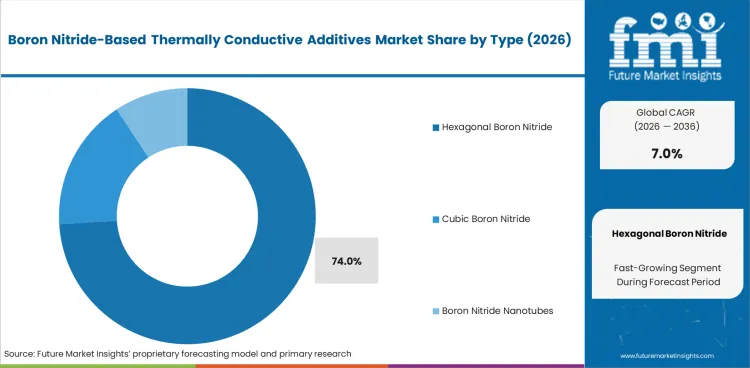
- In 2026, hexagonal boron nitride is expected to make up 74.0% of the type segment. Its platelet structure helps compounds move heat and preserve electrical insulation in filled polymer systems.
- Cubic boron nitride and nanotube grades serve selected high-performance programs needing hardness or stronger heat paths. Their use improves in advanced packaging and specialist thermal designs.
Insights into Boron Nitride-Based Thermally Conductive Additives Market by Product Form
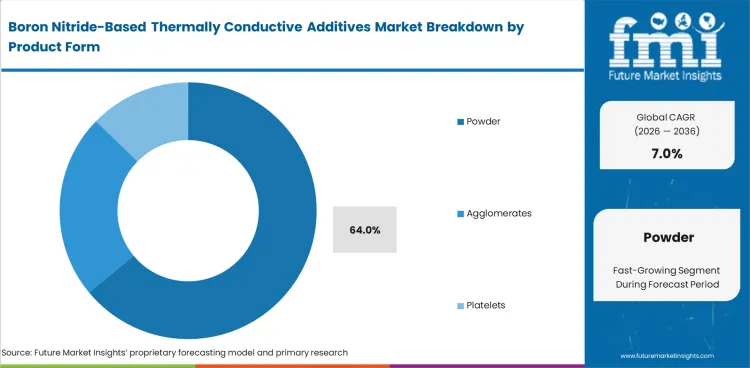
- Powder is projected to hold 64.0% of the product form segment in 2026. Powder grades allow easier dosing and dispersion across thermoplastic and thermoset compounding operations.
- Agglomerates and platelets address selected thermal interface needs. Their value improves in formulations requiring stronger through-plane heat transfer or surface-level heat spreading.
Insights into Boron Nitride-Based Thermally Conductive Additives Market by Matrix
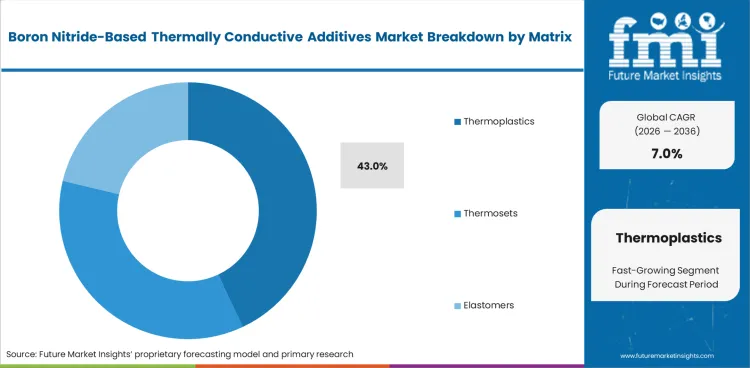
- In 2026, thermoplastics are expected to contribute 43.0% share of the matrix segment. Molded electronics housings need thermal performance without changing insulation behavior or processing speed.
- Thermosets and elastomers serve potting compounds and soft thermal interface materials. Their use improves in assemblies requiring gap filling and stable heat movement.
Insights into Boron Nitride-Based Thermally Conductive Additives Market by Application
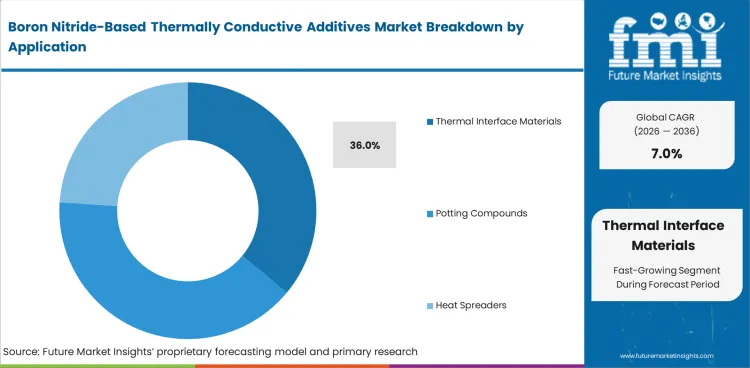
- Thermal interface materials are forecast to hold 36.0% of the application segment in 2026. Pads and gap fillers need BN particle control as contact quality affects thermal performance.
- Potting compounds and heat spreaders address selected electronics and automotive needs. Their value improves in assemblies requiring insulation and managed heat movement around components.
Insights into Boron Nitride-Based Thermally Conductive Additives Market by End Use
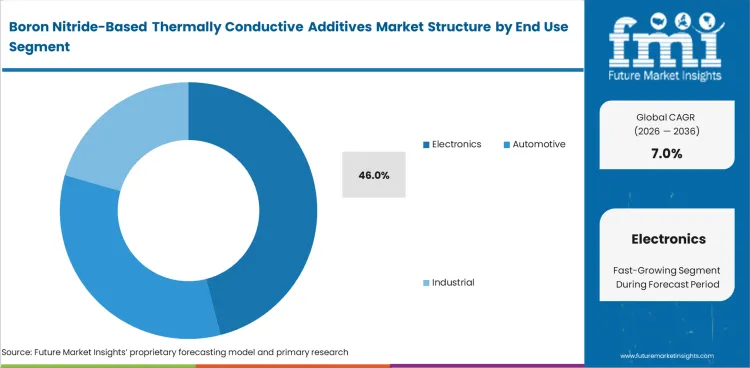
- In 2026, electronics are projected to account for 46.0% of the end-use segment. Chip packaging and board-level assemblies need dielectric fillers as heat density increases across device platforms.
- Automotive and industrial applications use BN additives in battery modules and power systems. Their value improves in parts requiring insulation and thermal stability under operating stress.
Boron Nitride-Based Thermally Conductive Additives Market Drivers, Restraints, and Opportunities
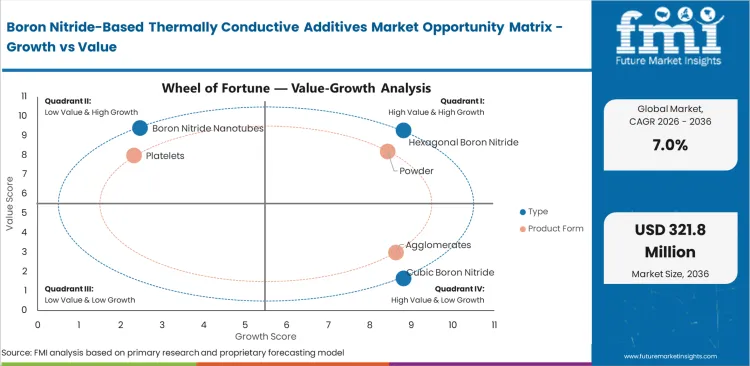
- Semiconductor packaging pressure is creating structured demand for BN-filled resins across high-power devices.
- High additive loading creates cost pressure for compounders serving price-sensitive molded component programs.
- BNNT-enhanced fillers create service opportunity for suppliers through higher conductivity per filler volume in advanced packaging.
Boron nitride-based thermally conductive additives are expanding as electronics and battery systems need heat transfer without electrical conduction. High filler loading and specialty material cost can slow broader use across price-sensitive polymer compounds. Growth continues through thermal interface materials and molded electronics applications.
Boron Feedstock Relief Has Limited Pass-Through
Boron nitride-based thermally conductive additive pricing has some upstream cost relief. Buyers should not expect broad discounting on qualified grades. In February 2026, USGS reported the average unit value of combined USA boron imports fell to USD 540 per metric ton in 2025 from USD 574 in 2024, while refined borax imports declined to 120 thousand metric tons from 150 thousand metric tons. Turkey accounted for 90% of USA boron import sources during 2021-2024. For additive suppliers, lower borate import values can ease base feedstock pressure, but price negotiations are influenced by purity and particle morphology. Grade negotiations reflect dielectric performance and supply concentration.
AI Packaging Demand Supports Grade Premiums
Pricing for boron nitride-based thermally conductive additives is likely to stay firmer in semiconductor and electronics applications than lower-specification polymer compounds. As per SEMI’s April 2026 report, worldwide semiconductor manufacturing equipment sales rose 15% to USD 135.1 billion in 2025, while test equipment billings surged 55% and assembly and packaging equipment sales increased 21% year over year. The increase matters because AI devices and HBM increase thermal interface and encapsulation requirements across advanced packaging applications. Additive buyers should expect premiums for surface treated BN and low contamination grades if commodity boron inputs soften. Long qualification cycles reduce near-term supplier switching leverage.
Analysis of Boron Nitride-Based Thermally Conductive Additives Market By Key Countries
.webp "Top Country Growth Comparison Boron Nitride Based Thermally Conductive Additives Market Cagr (2026 2036)")
| Country | CAGR |
|---|---|
| China | 8.2% |
| Taiwan | 7.8% |
| South Korea | 7.5% |
| India | 7.3% |
| United States | 6.8% |
| Japan | 6.4% |
| Germany | 5.8% |
Source: Future Market Insights, 2026.
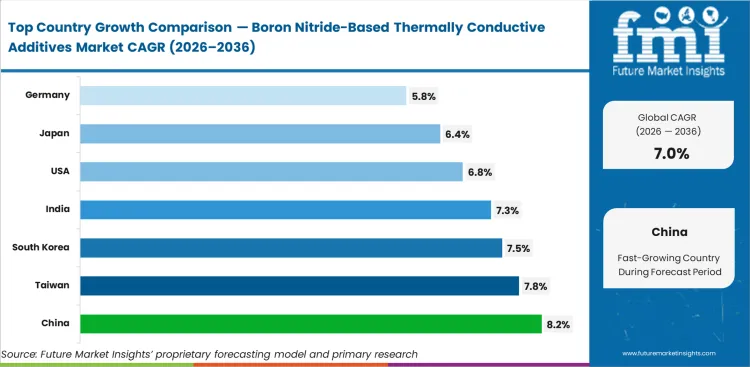
Boron Nitride-Based Thermally Conductive Additives Market CAGR Analysis By Country
- China is projected to record 8.2% CAGR by 2036 as IC output growth strengthens local electronics material use.
- Taiwan is forecast at 7.8% CAGR for the assessment period with advanced packaging density raising need for dielectric thermal fillers.
- South Korea is expected to expand at 7.5% CAGR over 2026 to 2036 as memory chip concentration increases material stress around AI hardware.
- India is projected to advance at 7.3% CAGR during the forecast years with electronics output and semiconductor packaging capacity improving.
- United States is forecast to grow at 6.8% CAGR by 2036 as data centers increase thermal control needs.
- Japan is expected to post 6.4% CAGR across the forecast period with semiconductor equipment depth strengthening high-purity material use.
- Germany at 5.8% reflects mature electronics output with disciplined expansion across industrial systems.
Demand for boron nitride-based thermally conductive additives is forecast to rise at 7.0% CAGR from 2026 to 2036. Country-level analysis covers the major markets contributing to this forecast, with the key markets listed below.
Demand Outlook for Boron Nitride-Based Thermally Conductive Additives Market in China
Boron nitride-based thermally conductive additives industry in China is projected to record a CAGR of 8.2% through 2036. China’s integrated circuit manufacturing base creates a large outlet for boron nitride-based thermally conductive additives. Electronics material suppliers can serve chip packaging and board assembly programs needing heat control without electrical leakage. Local compounders can serve chip and electronics makers needing dielectric heat-transfer materials.
- Local IC output backs demand for BN-filled resins used near power devices and board assemblies.
- Electronic component scale helps compounders test BN additives across molded housings and potting systems.
- Domestic materials qualification can reduce import exposure for thermal fillers used in polymer compounds.
Sales Analysis of Boron Nitride-Based Thermally Conductive Additives Market in Taiwan
Taiwanis expected to expand at a CAGR of 7.8% during the assessment period. Taiwan’s semiconductor industry generated above USD 165 billion in revenue in 2024 and accounted for about 20.7% of GDP. Taiwan’s foundry base supports local demand for boron nitride-based thermally conductive additives. Material producers serve packaging teams seeking heat transfer near dense chip assemblies.
- Foundry concentration raises demand for BN additives used in encapsulants and thermal spreader materials.
- Advanced packaging increases value for fillers with narrow particle size and controlled impurity profiles.
- Local chip design activity increases demand for specialty phase-change materials for electronics and related thermal compounds.
Demand Outlook for Boron Nitride-Based Thermally Conductive Additives Market in South Korea
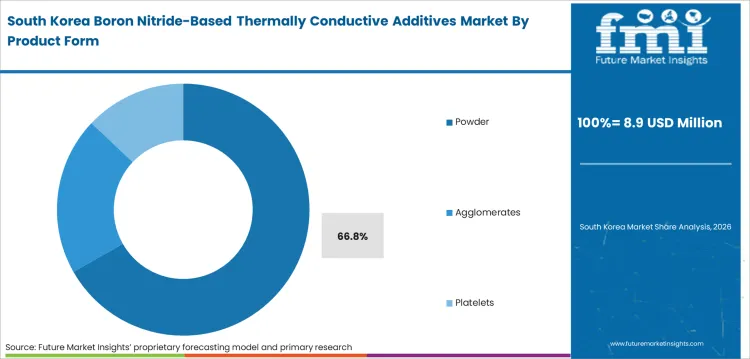
South Koreaindustry is forecast to grow at a CAGR of 7.5% by 2036. South Korea’s semiconductor export base creates a strong outlet for boron nitride-based thermally conductive additives. Memory chip concentration keeps thermal reliability important for packaging materials and heat-control compounds. BN suppliers can serve packaging compounds and module materials used near AI hardware.
- Memory chip output creates demand for high-purity fillers used around advanced packaging materials.
- Battery and electronics supply chains make South Korea an large customer base for dielectric thermal additives.
- BNNT development activity raises interest in advanced fillers for semiconductor packaging.
Opportunity Analysis of Boron Nitride-Based Thermally Conductive Additives Market in India
Indiais forecast to advance at 7.3% CAGR over the forecast years. India’s electronics production reached ₹11.3 lakh crore in 2024-25, and electronics exports reached ₹3.27 lakh crore during the same period. India’s manufacturing base supports local demand for boron nitride-based thermally conductive additives. Local resin compounders can serve electronics housings and thermal potting applications.
- Electronics output scale creates demand for thermoplastic compounds with heat-transfer and insulation properties.
- Approved semiconductor projects add packaging capacity and create a future customer base for BN-filled thermal materials.
- Local component schemes can increase use of plastic additive packages in higher-value electronics.
Future Outlook for Boron Nitride-Based Thermally Conductive Additives Market in the United States
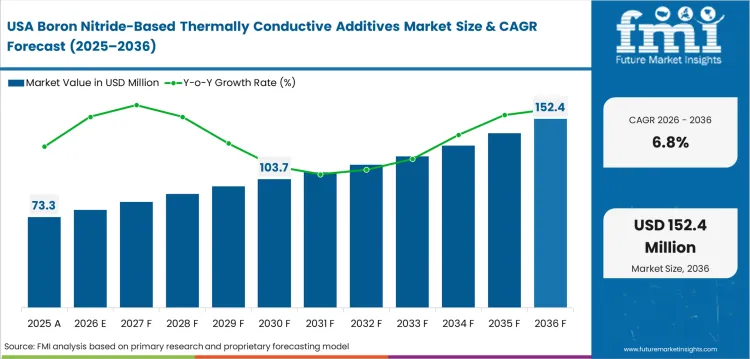
The USA boron nitride-based thermally conductive additives industry is expected to post 6.8% CAGR from 2026 to 2036. IEA stated the United States accounted for 45% of global data center electricity consumption in 2024. The 2024 share creates a large cooling burden across AI servers and power electronics. USA material buyers need BN fillers for insulating thermal paths in chips, boards, and server power systems.
- Data center load creates demand for dielectric thermal materials used in power modules and chip packaging.
- Advanced chip design favors suppliers with material data for heat spread and electrical insulation.
- Server power density supports cross-use of battery-pack TIM knowledge in adjacent thermal systems.
Demand Outlook for Boron Nitride-Based Thermally Conductive Additives Market in Japan
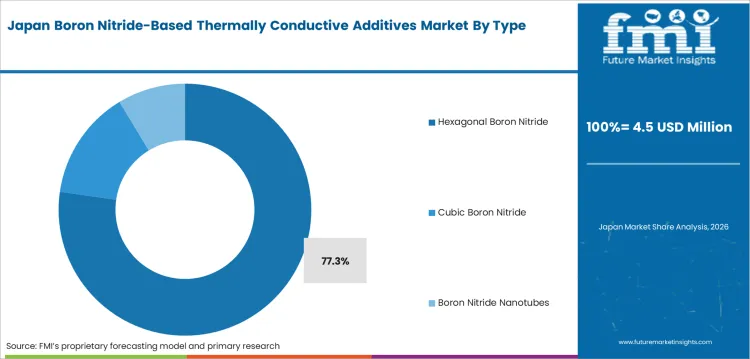
Japan’s boron nitride-based thermally conductive additives sector is expected to expand at 6.4% CAGR by 2036. SEAJ projected Japan’s semiconductor equipment sales increased 27% in 2024 and would rise 10% in 2025. Japan’s equipment base strengthens high-purity material demand and process know-how. BN producers can serve advanced electronics materials and thermal compounds linked to chip tool supply chains.
- Semiconductor equipment strength keeps high-purity material expectations high across local buyers.
- Electronics material producers value BN grades with clean chemistry and stable particle profiles.
- Thermal compounds benefit from Japan’s role in pyrolytic boron nitride and high-temperature ceramic systems.
In-depth Analysis of Boron Nitride-Based Thermally Conductive Additives Market in Germany
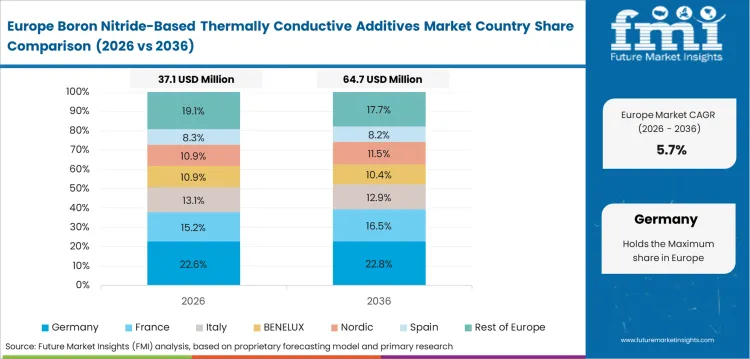
Germany is forecast to expand at 5.8% CAGR during the assessment period. ZVEI listed German electro and digital industry turnover at EUR 225.1 billion in 2025. Industrial electronics and automotive systems create a steady base for dielectric thermal fillers. German buyers value supplier records for resin stability and thermal performance over long service life.
- Industrial electronics create demand for thermally conductive insulation in drives and power modules.
- Automotive electrification adds use cases for BN-filled housings and potting materials in control units.
- Germany’s materials base connects BN additives with advanced functional materials used across industrial systems.
Competitive Landscape and Strategic Positioning
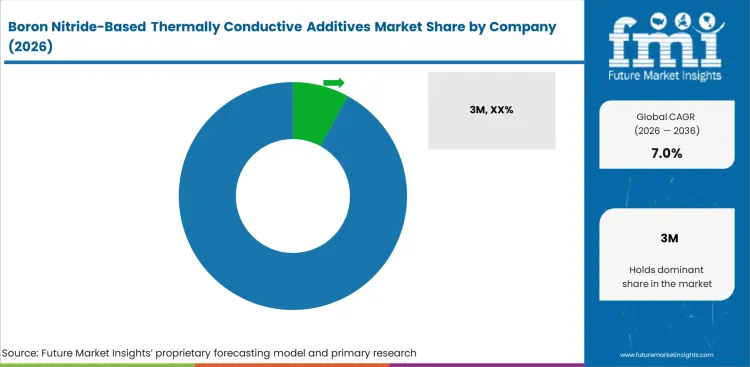
Boron Nitride-Based Thermally Conductive Additives Market Analysis By Company
- 3M is one of the leading company in the market owing to BN cooling filler grades used across thermosets and elastomers in thermal material programs.
- Saint-Gobain and Momentive Technologies offer powder portfolio depth and ceramic processing experience.
- Specialist providers focus on agglomerates and platelets designed for controlled heat paths in selected applications.
Boron nitride-based thermally conductive additive suppliers compete on filler chemistry and particle control. Application guidance influences buyer selection as compounders need predictable results before production trials. 3M, Saint-Gobain, and Momentive Technologies hold stronger positions through broader grade portfolios and formulation knowledge. Specialist suppliers offer particle design and faster sampling for application-specific programs.
3M holds a strong position through BN cooling fillers designed for adhesives and potting resins. Its product information states BN cooling fillers provide 400 W/K in-plane material conductivity. The same product information states these fillers can raise polymer conductivity by 2 to 8 times against alumina fillers. The 400 W/K conductivity helps compounders improve heat transfer without adding electrical conduction. Buyers value suppliers able to explain filler loading and viscosity effects before plant trials.
Momentive Technologies has a strong position through agglomerate h-BN powder grades for all-direction heat movement. In January 2024, Momentive Technologies described randomly oriented BN platelets in agglomerates as a path to isotropic thermal performance. The agglomerate structure helps thermal material users address through-plane heat transfer in filled composites. Suppliers with platelet and agglomerate portfolios can reduce formulation risk for compounders using electronics adhesives.
Denka’s October 2025 investment in a South Korean BNNT startup points toward higher-performance filler systems. Denka stated BNNT-enhanced fillers can improve semiconductor packaging material thermal conductivity by at least 20%. The company stated improvement can rise above 50% in selected cases. Denka’s investment strengthens advanced chip packaging programs seeking stronger heat transfer without higher filler volume.
Competitive strength now favors suppliers with proven grades and practical polymer guidance. Buyers will favor companies able to match BN structure with resin behavior before scale-up. Producers with high-purity powders and engineered agglomerates are better positioned to win electronics and semiconductor packaging programs.
Key Companies in the Boron Nitride-Based Thermally Conductive Additives Market
Global companies active in the boron nitride-based thermally conductive additives market include:
- 3M and Saint-Gobain have strong BN filler infrastructure for polymer compounding and thermal material formulation. 3M offers platelets and agglomerates for in-plane and through-plane heat transfer. Saint-Gobain offers platelet powders with high purity and tight particle size distribution for engineered materials.
- Momentive Technologies and Denka Company Limited serve electronics users through BN powder grades and high-purity material knowledge. Momentive offers over 70 standard and custom BN powder grades. Denka is developing BNNT-enhanced thermal fillers for semiconductor packaging applications.
- ZYP Coatings and Höganäs hold specialist positions across boron nitride powder handling and advanced ceramic material supply. These companies focus on sample availability, particle control, and technical guidance for users testing filled polymer systems.
Competitive Benchmarking: Boron Nitride-Based Thermally Conductive Additives Market
| Company | BN Grade Breadth | Polymer Filler Guidance | Electronics Material Fit | Geographic Footprint |
|---|---|---|---|---|
| 3M | High | High | Strong | Global, with strong presence in North America, Europe, and Asia Pacific |
| Saint-Gobain | High | High | Strong | Global, with established presence across Europe, North America, and Asia |
| Momentive Technologies | High | High | Strong | Global, with strong reach across North America, Europe, and East Asia |
| Denka Company Limited | Medium | Medium | Strong | Asia-led footprint, with strong presence in Japan, South Korea, China, and global export markets |
| ZYP Coatings | Medium | Medium | Moderate | North America focused, with export reach into selected industrial and electronics markets |
| Höganäs | Medium | Medium | Moderate | Global, with strong European base and sales reach across North America and Asia |
| Kennametal | Medium | Medium | Moderate | Global, with strong North American base and industrial reach across Europe and Asia |
| American Elements | Medium | Low | Moderate | Global distribution footprint, with North America as the main operating base |
Source: Future Market Insights, 2026.
Key Developments in Boron Nitride-Based Thermally Conductive Additives Market
- October 2025, Denka invested in a South Korean startup to strengthen the heat-dissipating thermal conductive filler business. The collaboration covers BNNT with heat-dissipating thermal conductive fillers for advanced thermal interface materials.
- January 2024, Momentive Technologies highlighted high-quality agglomerate h-BN powder for all-direction thermal performance. The company described spherical agglomerate shape as useful for isotropic thermal performance in filled composites.
Key Players in the Boron Nitride-Based Thermally Conductive Additives Market
Major Global Players:
- 3M
- Saint-Gobain
- Momentive Technologies
- Denka Company Limited
- Höganäs
- Kennametal
Specialist Players:
- ZYP Coatings
- American Elements
Report Scope and Coverage
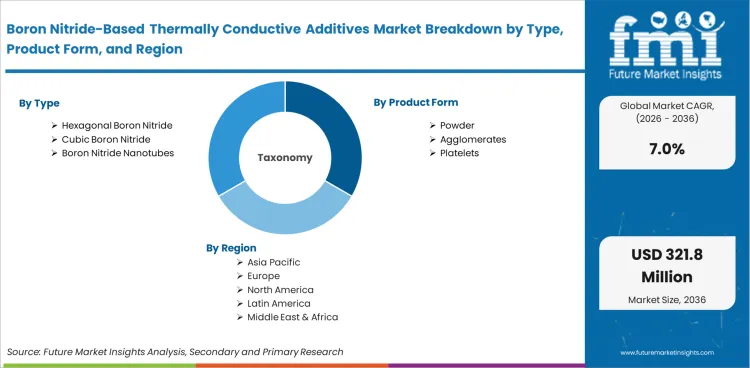
Boron Nitride-Based Thermally Conductive Additives Market Breakdown By Type, Product Form, Matrix, Application, End Use, and Region
| Parameter | Details |
|---|---|
| Quantitative Units | USD 163.6 million to USD 321.8 million, at a CAGR of 7.0% |
| Market Definition | The boron nitride-based thermally conductive additives market covers BN ceramic fillers used to improve heat transfer in electrically insulating polymers. |
| Regions Covered | North America, Latin America, Europe, East Asia, South Asia and Pacific, Middle East and Africa |
| Countries Covered | United States, China, Taiwan, South Korea, India, Japan, Germany, and 30 plus countries |
| Key Companies Profiled | 3M, Saint-Gobain, Momentive Technologies, Denka Company Limited, Höganäs, Kennametal, ZYP Coatings, American Elements |
| Forecast Period | 2026 to 2036 |
| Approach | Hybrid bottom-up and top-down methodology starting with filler use and verified electronics material patterns. |
Boron Nitride-Based Thermally Conductive Additives Market by Segments
Boron Nitride-Based Thermally Conductive Additives Market Segmented by Type:
- Hexagonal Boron Nitride
- Cubic Boron Nitride
- Boron Nitride Nanotubes
Boron Nitride-Based Thermally Conductive Additives Market Segmented by Product Form:
- Powder
- Agglomerates
- Platelets
Boron Nitride-Based Thermally Conductive Additives Market Segmented by Matrix:
- Thermoplastics
- Thermosets
- Elastomers
Boron Nitride-Based Thermally Conductive Additives Market Segmented by Application:
- Thermal Interface Materials
- Potting Compounds
- Heat Spreaders
Boron Nitride-Based Thermally Conductive Additives Market Segmented by End Use:
- Electronics
- Automotive
- Industrial
Boron Nitride-Based Thermally Conductive Additives Market by Region:
- North America
- USA
- Canada
- Mexico
- Latin America
- Brazil
- Chile
- Rest of Latin America
- Europe
- Germany
- UK
- Italy
- Spain
- France
- Rest of Europe
- East Asia
- China
- Japan
- South Korea
- South Asia and Pacific
- India
- ASEAN
- Australia & New Zealand
- Rest of South Asia and Pacific
- Middle East and Africa
- Saudi Arabia
- Other GCC Countries
- South Africa
- Rest of Middle East and Africa
Research Sources and Bibliography
- SEMI. (2026, April 7). SEMI reports global semiconductor equipment billings reached $135 billion in 2025, up 15% year-on-year. SEMI.
- USA Geological Survey. (2026, February). Boron. In Mineral commodity summaries 2026. USA Geological Survey.
- Semiconductor Industry Association. (2026, February 6). Global annual semiconductor sales increase 25.6% to USD 791.7 billion in 2025. SIA.
- International Energy Agency. (2025, May 14). Global EV Outlook 2025: Electric vehicle batteries. IEA.
- International Energy Agency. (2025, April 10). Energy and AI: Executive summary. IEA.
- SEMI. (2026, April 7). SEMI reports global semiconductor equipment billings reached USD 135 billion in 2025. SEMI.
- Press Information Bureau. (2026, February 3). Electronics Components Manufacturing Scheme. Government of India.
- Press Information Bureau. (2026, April 1). Government of India semiconductor manufacturing facilities statement. Government of India.
- International Trade Administration. (2025, December 1). Taiwan: Semiconductors including chip design for AI. USA Department of Commerce.
- International Trade Administration. (2025, November 20). Japan: Semiconductors. USA Department of Commerce.
- ZVEI. (2026, April). German electro and digital industry facts and figures. ZVEI.
- 3M. (2026). 3M Boron Nitride Cooling Fillers. 3M.
- Denka Company Limited. (2025, October 17). Denka investing in a South Korean startup to strengthen heat-dissipating thermal conductive filler business. Denka.
- Momentive Technologies. (2024, January 12). Momentive Technologies’ high quality agglomerate h-BN powder delivers high performance in all directions. Momentive Technologies.
- Saint-Gobain. (2026). Standard platelet powder. Saint-Gobain Boron Nitride.
This Report Answers
- What is the current and future size of the boron nitride-based thermally conductive additives market?
- How fast is the boron nitride-based thermally conductive additives market expected to expand between 2026 and 2036?
- Which type segment is expected to lead the market by 2026?
- Which product form is expected to account for the most demand by 2026?
- What factors support demand for BN thermally conductive additives globally?
- How are semiconductor packaging needs influencing adoption of dielectric thermal fillers?
- Why are electronics manufacturers the main demand base for BN additive suppliers?
- How are EV battery packs creating demand for thermally conductive insulating polymers?
- Which countries are projected to record faster expansion through 2036?
- What supports market expansion in China and Taiwan?
- Who are the key companies active in the boron nitride-based thermally conductive additives market?
- How does FMI estimate and validate the market forecast?
Frequently Asked Questions
What is the global market demand for Boron Nitride-Based Thermally Conductive Additives in 2026?
In 2026, the global market for boron nitride-based thermally conductive additives is expected to be worth USD 163.6 million.
How big will the market for Boron Nitride-Based Thermally Conductive Additives be in 2036?
By 2036, the market for boron nitride-based thermally conductive additives is expected to be worth USD 321.8 million.
How much is demand for Boron Nitride-Based Thermally Conductive Additives expected to expand between 2026 and 2036?
Between 2026 and 2036, demand for boron nitride-based thermally conductive additives is expected to expand at a CAGR of 7.0%.
Which type segment is likely to lead globally by 2026?
Hexagonal boron nitride is projected to make up 74.0% of the type segment in 2026.
What is causing demand to rise in China?
The China boron nitride-based thermally conductive additives market is projected to record 8.2% CAGR through 2036, backed by IC output and electronics manufacturing scale.
What is causing demand to rise in Taiwan?
The Taiwan boron nitride-based thermally conductive additives market is projected to expand at 7.8% CAGR through 2036, backed by advanced packaging and foundry activity.
What does this report mean by Boron Nitride-Based Thermally Conductive Additives Market definition?
The market includes BN ceramic additives used to improve heat transfer in electrically insulating polymer systems before final part manufacturing.
How does FMI make the Boron Nitride-Based Thermally Conductive Additives forecast and check it?
Forecasting models use a hybrid bottom-up and top-down approach, starting with filler use and checking it against electronics material demand patterns.
Preview the report firsthand - request a free sample
Get SampleGet the brochure for pricing and purchase details.
Get PDFTable of Content
- Executive Summary
- Global Market Outlook
- Demand-side Trends
- Supply-side Trends
- Technology Roadmap Analysis
- Analysis and Recommendations
- Market Overview
- Market Coverage / Taxonomy
- Market Definition / Scope / Limitations
- Research Methodology
- Chapter Orientation
- Analytical Lens and Working Hypotheses
- Market Structure, Signals, and Trend Drivers
- Benchmarking and Cross-market Comparability
- Market Sizing, Forecasting, and Opportunity Mapping
- Research Design and Evidence Framework
- Desk Research Programme (Secondary Evidence)
- Company Annual and Sustainability Reports
- Peer-reviewed Journals and Academic Literature
- Corporate Websites, Product Literature, and Technical Notes
- Earnings Decks and Investor Briefings
- Statutory Filings and Regulatory Disclosures
- Technical White Papers and Standards Notes
- Trade Journals, Industry Magazines, and Analyst Briefs
- Conference Proceedings, Webinars, and Seminar Materials
- Government Statistics Portals and Public Data Releases
- Press Releases and Reputable Media Coverage
- Specialist Newsletters and Curated Briefings
- Sector Databases and Reference Repositories
- FMI Internal Proprietary Databases and Historical Market Datasets
- Subscription Datasets and Paid Sources
- Social Channels, Communities, and Digital Listening Inputs
- Additional Desk Sources
- Expert Input and Fieldwork (Primary Evidence)
- Primary Modes
- Qualitative Interviews and Expert Elicitation
- Quantitative Surveys and Structured Data Capture
- Blended Approach
- Why Primary Evidence is Used
- Field Techniques
- Interviews
- Surveys
- Focus Groups
- Observational and In-context Research
- Social and Community Interactions
- Stakeholder Universe Engaged
- C-suite Leaders
- Board Members
- Presidents and Vice Presidents
- R&D and Innovation Heads
- Technical Specialists
- Domain Subject-matter Experts
- Scientists
- Physicians and Other Healthcare Professionals
- Governance, Ethics, and Data Stewardship
- Research Ethics
- Data Integrity and Handling
- Primary Modes
- Tooling, Models, and Reference Databases
- Desk Research Programme (Secondary Evidence)
- Data Engineering and Model Build
- Data Acquisition and Ingestion
- Cleaning, Normalisation, and Verification
- Synthesis, Triangulation, and Analysis
- Quality Assurance and Audit Trail
- Market Background
- Market Dynamics
- Drivers
- Restraints
- Opportunity
- Trends
- Scenario Forecast
- Demand in Optimistic Scenario
- Demand in Likely Scenario
- Demand in Conservative Scenario
- Opportunity Map Analysis
- Product Life Cycle Analysis
- Supply Chain Analysis
- Investment Feasibility Matrix
- Value Chain Analysis
- PESTLE and Porter’s Analysis
- Regulatory Landscape
- Regional Parent Market Outlook
- Production and Consumption Statistics
- Import and Export Statistics
- Market Dynamics
- Global Market Analysis 2021 to 2025 and Forecast, 2026 to 2036
- Historical Market Size Value (USD Million) Analysis, 2021 to 2025
- Current and Future Market Size Value (USD Million) Projections, 2026 to 2036
- Y-o-Y Growth Trend Analysis
- Absolute $ Opportunity Analysis
- Global Market Pricing Analysis 2021 to 2025 and Forecast 2026 to 2036
- Global Market Analysis 2021 to 2025 and Forecast 2026 to 2036, By Type
- Introduction / Key Findings
- Historical Market Size Value (USD Million) Analysis By Type , 2021 to 2025
- Current and Future Market Size Value (USD Million) Analysis and Forecast By Type , 2026 to 2036
- Hexagonal Boron Nitride
- Cubic Boron Nitride
- Boron Nitride Nanotubes
- Hexagonal Boron Nitride
- Y-o-Y Growth Trend Analysis By Type , 2021 to 2025
- Absolute $ Opportunity Analysis By Type , 2026 to 2036
- Global Market Analysis 2021 to 2025 and Forecast 2026 to 2036, By Product Form
- Introduction / Key Findings
- Historical Market Size Value (USD Million) Analysis By Product Form, 2021 to 2025
- Current and Future Market Size Value (USD Million) Analysis and Forecast By Product Form, 2026 to 2036
- Powder
- Agglomerates
- Platelets
- Powder
- Y-o-Y Growth Trend Analysis By Product Form, 2021 to 2025
- Absolute $ Opportunity Analysis By Product Form, 2026 to 2036
- Global Market Analysis 2021 to 2025 and Forecast 2026 to 2036, By Matrix
- Introduction / Key Findings
- Historical Market Size Value (USD Million) Analysis By Matrix, 2021 to 2025
- Current and Future Market Size Value (USD Million) Analysis and Forecast By Matrix, 2026 to 2036
- Thermoplastics
- Thermosets
- Elastomers
- Thermoplastics
- Y-o-Y Growth Trend Analysis By Matrix, 2021 to 2025
- Absolute $ Opportunity Analysis By Matrix, 2026 to 2036
- Global Market Analysis 2021 to 2025 and Forecast 2026 to 2036, By Application
- Introduction / Key Findings
- Historical Market Size Value (USD Million) Analysis By Application, 2021 to 2025
- Current and Future Market Size Value (USD Million) Analysis and Forecast By Application, 2026 to 2036
- Thermal Interface Materials
- Potting Compounds
- Heat Spreaders
- Thermal Interface Materials
- Y-o-Y Growth Trend Analysis By Application, 2021 to 2025
- Absolute $ Opportunity Analysis By Application, 2026 to 2036
- Global Market Analysis 2021 to 2025 and Forecast 2026 to 2036, By End Use
- Introduction / Key Findings
- Historical Market Size Value (USD Million) Analysis By End Use, 2021 to 2025
- Current and Future Market Size Value (USD Million) Analysis and Forecast By End Use, 2026 to 2036
- Electronics
- Automotive
- Industrial
- Electronics
- Y-o-Y Growth Trend Analysis By End Use, 2021 to 2025
- Absolute $ Opportunity Analysis By End Use, 2026 to 2036
- Global Market Analysis 2021 to 2025 and Forecast 2026 to 2036, By Region
- Introduction
- Historical Market Size Value (USD Million) Analysis By Region, 2021 to 2025
- Current Market Size Value (USD Million) Analysis and Forecast By Region, 2026 to 2036
- North America
- Latin America
- Western Europe
- Eastern Europe
- East Asia
- South Asia and Pacific
- Middle East & Africa
- Market Attractiveness Analysis By Region
- North America Market Analysis 2021 to 2025 and Forecast 2026 to 2036, By Country
- Historical Market Size Value (USD Million) Trend Analysis By Market Taxonomy, 2021 to 2025
- Market Size Value (USD Million) Forecast By Market Taxonomy, 2026 to 2036
- By Country
- USA
- Canada
- Mexico
- By Type
- By Product Form
- By Matrix
- By Application
- By End Use
- By Country
- Market Attractiveness Analysis
- By Country
- By Type
- By Product Form
- By Matrix
- By Application
- By End Use
- Key Takeaways
- Latin America Market Analysis 2021 to 2025 and Forecast 2026 to 2036, By Country
- Historical Market Size Value (USD Million) Trend Analysis By Market Taxonomy, 2021 to 2025
- Market Size Value (USD Million) Forecast By Market Taxonomy, 2026 to 2036
- By Country
- Brazil
- Chile
- Rest of Latin America
- By Type
- By Product Form
- By Matrix
- By Application
- By End Use
- By Country
- Market Attractiveness Analysis
- By Country
- By Type
- By Product Form
- By Matrix
- By Application
- By End Use
- Key Takeaways
- Western Europe Market Analysis 2021 to 2025 and Forecast 2026 to 2036, By Country
- Historical Market Size Value (USD Million) Trend Analysis By Market Taxonomy, 2021 to 2025
- Market Size Value (USD Million) Forecast By Market Taxonomy, 2026 to 2036
- By Country
- Germany
- UK
- Italy
- Spain
- France
- Nordic
- BENELUX
- Rest of Western Europe
- By Type
- By Product Form
- By Matrix
- By Application
- By End Use
- By Country
- Market Attractiveness Analysis
- By Country
- By Type
- By Product Form
- By Matrix
- By Application
- By End Use
- Key Takeaways
- Eastern Europe Market Analysis 2021 to 2025 and Forecast 2026 to 2036, By Country
- Historical Market Size Value (USD Million) Trend Analysis By Market Taxonomy, 2021 to 2025
- Market Size Value (USD Million) Forecast By Market Taxonomy, 2026 to 2036
- By Country
- Russia
- Poland
- Hungary
- Balkan & Baltic
- Rest of Eastern Europe
- By Type
- By Product Form
- By Matrix
- By Application
- By End Use
- By Country
- Market Attractiveness Analysis
- By Country
- By Type
- By Product Form
- By Matrix
- By Application
- By End Use
- Key Takeaways
- East Asia Market Analysis 2021 to 2025 and Forecast 2026 to 2036, By Country
- Historical Market Size Value (USD Million) Trend Analysis By Market Taxonomy, 2021 to 2025
- Market Size Value (USD Million) Forecast By Market Taxonomy, 2026 to 2036
- By Country
- China
- Japan
- South Korea
- By Type
- By Product Form
- By Matrix
- By Application
- By End Use
- By Country
- Market Attractiveness Analysis
- By Country
- By Type
- By Product Form
- By Matrix
- By Application
- By End Use
- Key Takeaways
- South Asia and Pacific Market Analysis 2021 to 2025 and Forecast 2026 to 2036, By Country
- Historical Market Size Value (USD Million) Trend Analysis By Market Taxonomy, 2021 to 2025
- Market Size Value (USD Million) Forecast By Market Taxonomy, 2026 to 2036
- By Country
- India
- ASEAN
- Australia & New Zealand
- Rest of South Asia and Pacific
- By Type
- By Product Form
- By Matrix
- By Application
- By End Use
- By Country
- Market Attractiveness Analysis
- By Country
- By Type
- By Product Form
- By Matrix
- By Application
- By End Use
- Key Takeaways
- Middle East & Africa Market Analysis 2021 to 2025 and Forecast 2026 to 2036, By Country
- Historical Market Size Value (USD Million) Trend Analysis By Market Taxonomy, 2021 to 2025
- Market Size Value (USD Million) Forecast By Market Taxonomy, 2026 to 2036
- By Country
- Kingdom of Saudi Arabia
- Other GCC Countries
- Turkiye
- South Africa
- Other African Union
- Rest of Middle East & Africa
- By Type
- By Product Form
- By Matrix
- By Application
- By End Use
- By Country
- Market Attractiveness Analysis
- By Country
- By Type
- By Product Form
- By Matrix
- By Application
- By End Use
- Key Takeaways
- Key Countries Market Analysis
- USA
- Pricing Analysis
- Market Share Analysis, 2025
- By Type
- By Product Form
- By Matrix
- By Application
- By End Use
- Canada
- Pricing Analysis
- Market Share Analysis, 2025
- By Type
- By Product Form
- By Matrix
- By Application
- By End Use
- Mexico
- Pricing Analysis
- Market Share Analysis, 2025
- By Type
- By Product Form
- By Matrix
- By Application
- By End Use
- Brazil
- Pricing Analysis
- Market Share Analysis, 2025
- By Type
- By Product Form
- By Matrix
- By Application
- By End Use
- Chile
- Pricing Analysis
- Market Share Analysis, 2025
- By Type
- By Product Form
- By Matrix
- By Application
- By End Use
- Germany
- Pricing Analysis
- Market Share Analysis, 2025
- By Type
- By Product Form
- By Matrix
- By Application
- By End Use
- UK
- Pricing Analysis
- Market Share Analysis, 2025
- By Type
- By Product Form
- By Matrix
- By Application
- By End Use
- Italy
- Pricing Analysis
- Market Share Analysis, 2025
- By Type
- By Product Form
- By Matrix
- By Application
- By End Use
- Spain
- Pricing Analysis
- Market Share Analysis, 2025
- By Type
- By Product Form
- By Matrix
- By Application
- By End Use
- France
- Pricing Analysis
- Market Share Analysis, 2025
- By Type
- By Product Form
- By Matrix
- By Application
- By End Use
- India
- Pricing Analysis
- Market Share Analysis, 2025
- By Type
- By Product Form
- By Matrix
- By Application
- By End Use
- ASEAN
- Pricing Analysis
- Market Share Analysis, 2025
- By Type
- By Product Form
- By Matrix
- By Application
- By End Use
- Australia & New Zealand
- Pricing Analysis
- Market Share Analysis, 2025
- By Type
- By Product Form
- By Matrix
- By Application
- By End Use
- China
- Pricing Analysis
- Market Share Analysis, 2025
- By Type
- By Product Form
- By Matrix
- By Application
- By End Use
- Japan
- Pricing Analysis
- Market Share Analysis, 2025
- By Type
- By Product Form
- By Matrix
- By Application
- By End Use
- South Korea
- Pricing Analysis
- Market Share Analysis, 2025
- By Type
- By Product Form
- By Matrix
- By Application
- By End Use
- Russia
- Pricing Analysis
- Market Share Analysis, 2025
- By Type
- By Product Form
- By Matrix
- By Application
- By End Use
- Poland
- Pricing Analysis
- Market Share Analysis, 2025
- By Type
- By Product Form
- By Matrix
- By Application
- By End Use
- Hungary
- Pricing Analysis
- Market Share Analysis, 2025
- By Type
- By Product Form
- By Matrix
- By Application
- By End Use
- Kingdom of Saudi Arabia
- Pricing Analysis
- Market Share Analysis, 2025
- By Type
- By Product Form
- By Matrix
- By Application
- By End Use
- Turkiye
- Pricing Analysis
- Market Share Analysis, 2025
- By Type
- By Product Form
- By Matrix
- By Application
- By End Use
- South Africa
- Pricing Analysis
- Market Share Analysis, 2025
- By Type
- By Product Form
- By Matrix
- By Application
- By End Use
- USA
- Market Structure Analysis
- Competition Dashboard
- Competition Benchmarking
- Market Share Analysis of Top Players
- By Regional
- By Type
- By Product Form
- By Matrix
- By Application
- By End Use
- Competition Analysis
- Competition Deep Dive
- 3M
- Overview
- Product Portfolio
- Profitability by Market Segments (Product/Age /Sales Channel/Region)
- Sales Footprint
- Strategy Overview
- Marketing Strategy
- Product Strategy
- Channel Strategy
- Saint-Gobain
- Momentive Technologies
- Denka Company Limited
- ZYP Coatings
- Höganäs
- Kennametal
- American Elements
- 3M
- Competition Deep Dive
- Assumptions & Acronyms Used


