

- Industry Size (2025)
- USD 97.3 Mn
- Forecast (2035)
- USD 194.5 Mn
- CAGR (2025 to 2035)
- 7.2%
Boron Nitride Market Forecast and Outlook 2025 to 2035
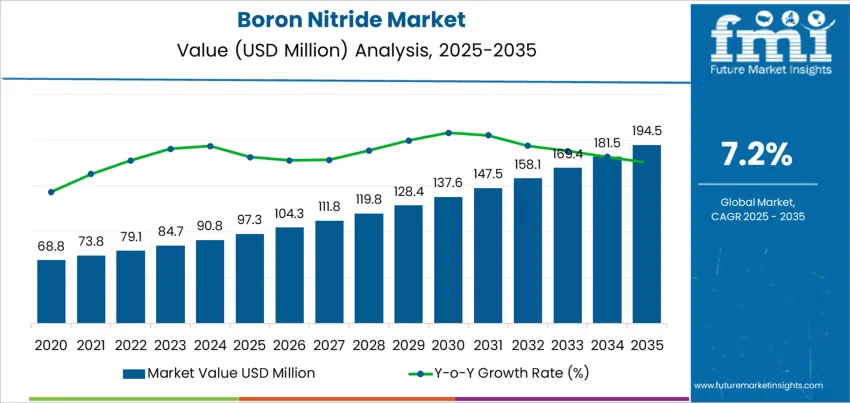
In 2025, the boron nitride market is valued at USD 97.3 million and is projected to reach USD 194.5 million by 2035 at a CAGR of 7.2%. Early growth is led by industrial processing demand across metallurgy, electronics manufacturing, lubricants, and high temperature ceramics. Hexagonal boron nitride accounts for the largest share due to its thermal stability, electrical insulation, and solid lubrication properties. Semiconductor fabrication, metal casting release agents, and high performance coatings drive stable bulk consumption. Industrial buyers procure primarily on tonnage based contracts rather than packaged specialty formats. Output growth through 2030 tracks steady expansion in furnace operations, refractory systems, and engineered lubrication systems across industrial manufacturing hubs.
From 2030 onward, market expansion reflects rising unit throughput rather than sharp pricing escalation. Market value advances from about USD 137.6 million in 2030 toward USD 194.5 million by 2035 as output volumes rise to meet demand from electric vehicles, power electronics, and thermal management materials. Tonnage based pricing remains dominant, though price bands widen for ultra-high purity and controlled particle grades used in electronic substrates. Producers focus on reactor scale optimization, nitridation efficiency, and powder classification accuracy to raise net output. Distribution networks remain direct to industrial processors with limited intermediary activity. Long-term value growth is shaped by production scale discipline, demand from thermal conductivity applications, and consistent capacity additions rather than short-term demand volatility.
Quick Stats of the Boron Nitride Market
- Boron Nitride Market Value (2025): USD 97.3 million
- Boron Nitride Market Forecast Value (2035): USD 194.5 million
- Boron Nitride Market Forecast CAGR (2025 to 2035): 7.2%
- Leading Product Form in Boron Nitride Market: Powder (16.7%)
- Key Growth Regions in Boron Nitride Market: Asia Pacific, Europe
- Top Players in Boron Nitride Market: BASF SE, Croda International, Evonik Industries, Symrise (incl. IFF/Givaudan actives), Dow / Dow Inc., Ashland, Clariant, Seppic
What is the Growth Forecast for the Boron Nitride Market through 2035?
The global boron nitride market expands from USD 97.3 million in 2025 to USD 128.4 million by 2030, recording an absolute increase of USD 31.1 million in the first half of the forecast period. This phase is strongly influenced by rising formulation demand from the personal care sector, where hexagonal boron nitride is used for soft-focus effects, slip enhancement, oil control, and light diffusion in color cosmetics and premium skincare. Its growing replacement of talc in face powders, foundations, and primer systems drives steady volume pull from cosmetics manufacturers. Pricing in this phase remains positioned in a mid-range structure, higher than commodity fillers but below advanced ceramic powders, enabling wide adoption without severe formulation cost escalation.
From 2030 to 2035, the market accelerates from USD 128.4 million to USD 194.5 million, adding USD 66.1 million in the second half of the decade. This back-weighted expansion reflects both deeper penetration into personal care emulsions, pressed powders, and hybrid skincare-makeup products, and rising demand from thermal management materials, lubricants, and high-temperature coatings. The mid-range pricing structure becomes a strategic advantage as formulators balance performance enhancement with cost discipline. Market expansion in this phase is reinforced by broader adoption in EV thermal interfaces, industrial release agents, and high-purity cosmetic grades, positioning boron nitride as a structurally embedded multi-industry functional material through 2035.
Boron Nitride Industry Key Takeaways
| Metric | Value |
|---|---|
| Industry Value (2025) | USD 97.3 million |
| Forecast Value (2035) | USD 194.5 million |
| Forecast CAGR (2025 to 2035) | 7.2% |
How Is the Boron Nitride Market Expanding Across Advanced Materials, Electronics, and Thermal Management Applications?
The boron nitride market developed from specialized industrial needs where conventional ceramics and graphite showed performance limits under extreme thermal and electrical conditions. Hexagonal boron nitride gained early relevance as a solid lubricant in high temperature environments where oils failed, while cubic boron nitride found use in cutting tools for hardened steels due to its extreme hardness. Over time, electronics and semiconductor manufacturers adopted boron nitride fillers for thermal interface materials because they conduct heat efficiently while remaining electrically insulating. This dual behavior created steady demand in power electronics, LED systems, and high density circuit packaging where heat dissipation without electrical risk is critical.
Future growth of the boron nitride market will be shaped by rising heat density in electronic devices, electrification of transport, and demand for high reliability materials in harsh operating environments. Electric vehicles, fast charging systems, and power control modules will increase use of boron nitride in thermal pads, coatings, and polymer composites. Demand will also expand in aerospace, metallurgy, and advanced manufacturing where chemical stability and thermal shock resistance matter. Barriers include high production cost, complex synthesis routes, and limited large scale suppliers for high purity grades. Regulatory pressure on industrial dust exposure and price sensitivity in commoditized applications will influence adoption speed. Long term growth will depend on scaling cost effective production while preserving purity and performance consistency across end uses.
How Are End Use Application and Product Form Structuring the Demand for Boron Nitride?
The demand for boron nitride is structured by end use application and product form. Skin care represents 10.2% of total demand, followed by body care, hair care, sun care, color cosmetics, men grooming, baby and kids care, and dermocosmetic and professional care. By product form, powder accounts for 16.7% of total consumption, followed by granules and agglomerates, flakes, pellets and prills, liquid solutions, high active concentrates, dispersions and suspensions, emulsions, pastes, gels, wax or solid block formats, and oils. Demand behavior is shaped by thermal conductivity control, slip enhancement performance, optical diffusion behavior, and compatibility with long wear cosmetic and personal care systems.
Why Does Skin Care Lead the Boron Nitride End Use Demand?
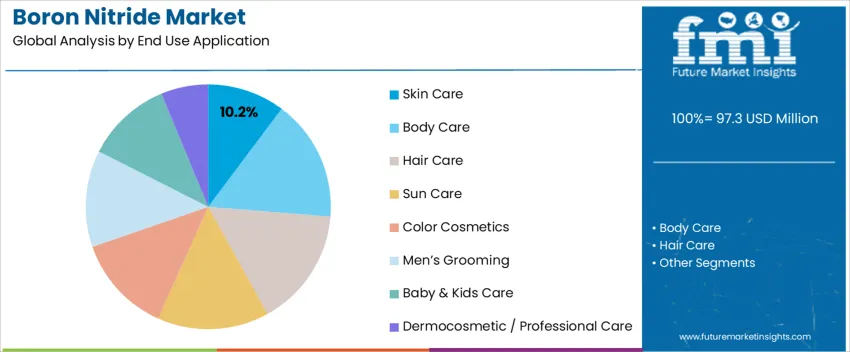
Skin care accounts for 10.2% of total boron nitride demand due to its unique combination of smooth tactile performance, oil control, and thermal diffusion capability. Boron nitride creates a silky, low friction skin feel that improves product spreadability while reducing greasy afterfeel. These attributes support its use in primers, moisturizers, anti aging creams, sunscreens, and mattifying serums where both comfort and wear stability are required.
Boron nitride also improves heat dissipation on the skin surface, which enhances comfort in long wear formulations exposed to high ambient temperatures. Its plate like particle structure provides a soft focus visual effect that reduces the appearance of fine lines without heavy optical fillers. The chemically inert nature of boron nitride limits reactivity with actives and fragrances. These sensorial optimization properties, thermal comfort contribution, and optical refinement effects sustain skin care as the leading end use segment within boron nitride demand.
Why Does Powder Lead the Boron Nitride Product Form Demand?
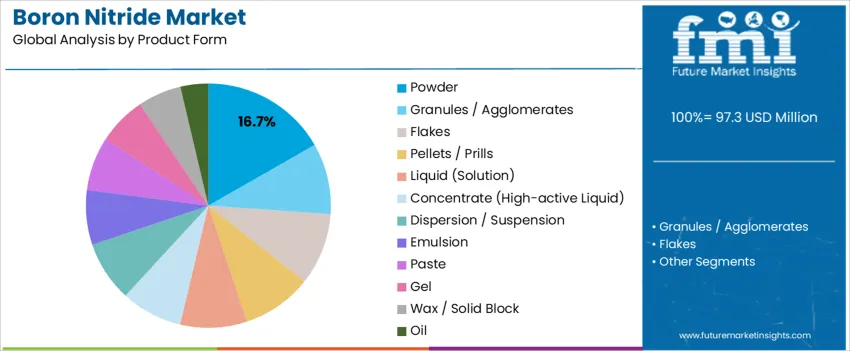
Powder accounts for 16.7% of total boron nitride demand due to its high purity consistency, controlled particle morphology, and superior process integration across cosmetic manufacturing platforms. Powdered boron nitride allows precise control over slip, diffusion, and oil absorption characteristics through narrow particle size selection. This precision is essential for achieving consistent skin feel and visual performance across repeated production cycles.
Powder form also shows high resistance to moisture, oxidation, and chemical interaction, which supports long term storage under standard warehouse conditions. It integrates efficiently into emulsions, pressed powders, loose powders, sticks, and hybrid gel systems without sedimentation risk. Packaging in lined drums and moisture barrier containers preserves flow properties and dispersion behavior during transport. These formulation predictability, structural stability, and sensory precision advantages position powder as the leading product form within the boron nitride demand structure.
Why Is Boron Nitride Chosen When Heat Must Move Without Electricity Following It?
Boron nitride occupies a rare functional position where high thermal conductivity coexists with electrical insulation. This makes it indispensable in systems that must dissipate heat without creating short circuits. Power electronics, EV battery modules, and LED lighting assemblies rely on boron nitride to move heat away from sensitive components while preserving electrical isolation. No common ceramic or polymer filler offers this exact balance. Demand is therefore rooted in thermal safety engineering rather than mechanical reinforcement or cosmetic effect. Boron nitride functions as a thermal firewall inside high-energy electronic environments.
How Do Its Multiple Crystal Forms Create Several Separate Markets Under One Name?
Boron nitride does not operate as a single uniform material. Hexagonal boron nitride behaves as a solid lubricant and thermally conductive filler. Cubic boron nitride functions as an ultra-hard cutting and grinding abrasive. Turbostratic and amorphous forms serve as dielectric spacers and coating enhancers. Each crystal form answers a completely different industrial problem. Supply chains, pricing logic, and processing routes do not overlap across these forms. What appears as one market is in practice several disconnected material economies grouped under one chemical identity.
Why Do Synthesis Energy Costs and Purity Control Limit Unrestricted Scaling?
Boron nitride production requires high-temperature synthesis, controlled atmosphere processing, and intensive purification. Small deviations introduce conductive impurities that destroy dielectric reliability. For abrasive grades, crystal integrity determines whether cutting edges hold under extreme load. These energy and purity demands prevent boron nitride from ever behaving like a low-cost filler. It remains structurally incompatible with price-driven mass substitution. This explains why its adoption grows through precision electronics, aerospace, and high-spec machining rather than through construction, plastics bulk loading, or consumer commodity goods.
How Is Its Role Expanding Quietly Inside Batteries, Thermal Interfaces, and Solid-State Devices?
New demand is forming inside battery separators, thermal interface pastes, and solid-state power modules. In batteries, boron nitride manages thermal runaway without introducing conductive risk. In interface materials, it allows heat to move across mismatched surfaces without metal fillers. In next-generation semiconductors, it acts as a stable insulating layer under extreme voltage density. These roles are internal and invisible to end users, yet they directly govern device reliability. Boron nitride growth is therefore embedded inside infrastructure technologies rather than visible consumer surfaces.
What Is the Global Growth Outlook for the Boron Nitride Industry by Country?
| Country | CAGR (%) |
|---|---|
| India | 9.7 |
| China | 9.0 |
| Japan | 8.2 |
| UK | 7.5 |
| Germany | 6.8 |
| USA | 6.1 |
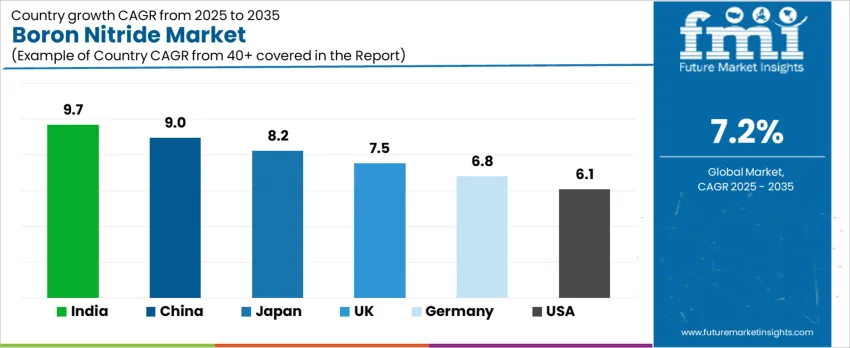
The boron nitride industry is expanding steadily across global manufacturing and advanced materials markets, with India leading at a 9.7% CAGR. Growth in India is supported by rising demand from ceramics, lubricants, and thermal management applications across electronics and automotive manufacturing. China follows at 9.0%, driven by large scale production of semiconductors, batteries, and industrial coatings where boron nitride is widely used. Japan at 8.2% reflects stable adoption in precision electronics, electric vehicle components, and specialty ceramics. The UK and Germany record 7.5% and 6.8% growth, supported by advanced engineering, aerospace materials, and research driven industrial usage. The USA at 6.1% reflects a mature but steadily advancing market driven by semiconductor fabrication, thermal interface materials, and high performance industrial applications.
What Is Driving Boron Nitride Demand Growth Across Electronics and Thermal Applications in India?
Expansion in India is progressing at a CAGR of 9.7% through 2035 for boron nitride demand, driven by rising electronics assembly, thermal management material adoption, and specialty ceramics manufacturing. Power electronics, LEDs, and lithium battery modules use boron nitride for heat dissipation and electrical insulation. Advanced lubricants and metal forming applications also support industrial usage. Domestic production remains limited to lower grades, while high performance variants rely on imports. Demand remains application driven and industrially anchored, shaped by electronics localization efforts, steady growth in EV battery assembly, and rising need for high temperature resistant materials.
- Power electronics drive thermal grade demand
- EV battery modules support insulation applications
- Specialty ceramics expand high temperature usage
- Import dependence dominates high purity supply
How Is China Scaling Large Scale Boron Nitride Manufacturing?
Growth in China reflects a CAGR of 9.0% through 2035 for boron nitride utilization, supported by large scale electronics manufacturing, refractory materials production, and battery thermal interface material processing. Boron nitride is used in mold release agents, thermal pads, and semiconductor processing equipment. Domestic chemical production ensures stable high volume output and cost efficiency. Export oriented suppliers serve global electronics, ceramics, and coatings manufacturers. Demand remains production driven and volume oriented, aligned with electric vehicle supply chain growth, semiconductor material output expansion, and continuous scale up of advanced industrial materials.
- Thermal interface materials anchor electronics demand
- Refractory components support steel and foundry usage
- Mold release agents sustain industrial processing demand
- Export shipments strengthen volume stability
Why Does Japan Sustain High Specification Boron Nitride Demand?
Demand in Japan is increasing at a CAGR of 8.2% through 2035 for boron nitride usage, supported by advanced semiconductor fabrication, aerospace materials development, and precision ceramics engineering. Boron nitride is applied in wafer handling systems, high temperature crucibles, and dry film lubricants for aerospace components. Tight purity and particle control shape material selection. Domestic producers focus on specialty grades for electronics and aerospace customers. Demand stays quality driven and technology focused, supported by continuous investment in chip manufacturing, strict material performance standards, and strong adoption across high reliability industrial systems.
- Semiconductor fabrication drives ultra high purity demand
- Aerospace lubrication supports specialty grade usage
- Precision ceramics sustain high temperature applications
- Domestic specialty production stabilizes quality consistency
What Is Supporting Boron Nitride Market Expansion in the United Kingdom?
Growth in the UK is advancing at a CAGR of 7.5% through 2035 for boron nitride demand, supported by aerospace research, advanced coatings development, and additive manufacturing materials. Boron nitride appears in thermal sprays, composite filler systems, and high temperature tooling. Research laboratories and aerospace suppliers drive steady technical consumption. Imports dominate high performance grade sourcing. Demand remains research driven and formulation focused, shaped by stable aerospace R and D activity, steady adoption in thermal spray coatings, and controlled expansion of advanced composite manufacturing.
- Aerospace coatings drive thermal protection demand
- Additive manufacturing supports composite filler usage
- Research laboratories sustain technical material uptake
- Imported sourcing dominates high grade supply
How Is Germany Integrating Boron Nitride into Advanced Industrial Manufacturing?
Growth in Germany reflects a CAGR of 6.8% through 2035 for boron nitride consumption, driven by automotive electrification, industrial furnace systems, and regulated electronics materials. Boron nitride is used in battery thermal barriers, sintering components, and high performance lubricants. Strict material testing, documentation, and process certification govern supplier qualification. Imports remain relevant for ultra pure grades. Demand stays quality focused and regulation aligned, supported by precision engineering traditions, steady EV powertrain production, and controlled use of thermal management materials across industrial manufacturing chains.
- Battery thermal barriers drive EV related demand
- High temperature furnaces support refractory applications
- Certification standards shape material qualification
- Precision engineering sustains long term consumption
What Is Driving Measured Boron Nitride Growth in the United States?
Expansion in the United States is moving at a CAGR of 6.1% through 2035 for boron nitride demand, supported by aerospace manufacturing, semiconductor research, and defense thermal management systems. Boron nitride appears in spacecraft insulation, radar electronics thermal pads, and advanced dry lubricants. Defense programs and space systems sustain steady technical material requirements. Imports supply most high purity electronic grades. Demand remains application driven and technically supported, shaped by long cycle aerospace contracts, consistent semiconductor research funding, and stable defense grade material procurement.
- Aerospace systems drive high temperature insulation demand
- Defense electronics support thermal interface usage
- Semiconductor research sustains ultra fine grade demand
- Import reliance dominates high purity boron nitride sourcing
What Is Driving the Global Demand for Boron Nitride and Who Are the Key Suppliers Supplying It
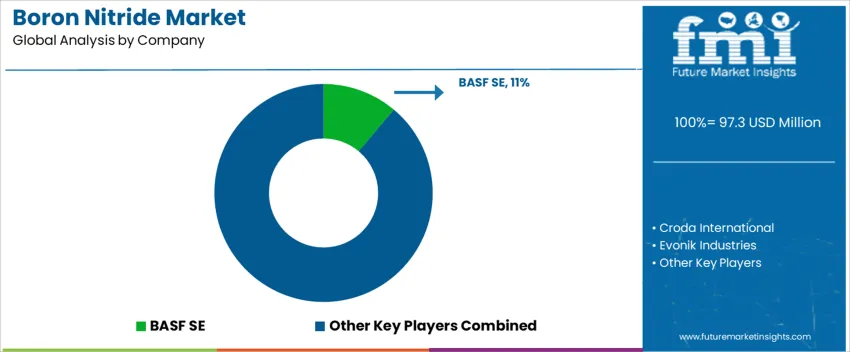
Global demand for boron nitride is increasing as industries seek materials that combine thermal stability, chemical inertness, electrical insulation, and mechanical versatility. Its capability to dissipate heat efficiently while remaining electrically insulating makes it especially valuable for thermal-management in electronics, semiconductors, power devices, and LED manufacturing. Boron nitride also serves as a high-temperature lubricant, a wear-resistant material in ceramics, and a stable filler or coating in metal-processing, aerospace and automotive applications. Cosmetics and personal-care producers use certain grades for their soft-focus effect, silky skin feel, and oil-control properties. Growing demand in electronics miniaturization, renewable-energy technologies, advanced manufacturing, and clean-label personal-care boosts its adoption across sectors.
Key global suppliers positioned to serve the boron nitride market include firms such as BASF SE, Croda International, Evonik Industries, Symrise (including IFF/Givaudan actives), Dow Inc., Ashland, Clariant, and specialized ingredient and material providers such as Seppic, Lubrizol, Lonza, and Inolex. Large chemical and specialty-materials companies supply bulk BN powders, plates, or slurries for industrial, electronic, coating, lubricant, and ceramic industries - ensuring scale, quality control, and supply stability. Specialty and niche suppliers offer high-purity or application-specific BN grades (e.g. cosmetic-grade powders, high-temperature lubricants, dielectric films) tailored to end-use requirements. This layered supply base enables broad availability of boron nitride across diverse industries and supports ongoing innovation in formulation, materials design, and application performance.
Key Players in the Boron Nitride Market
- BASF SE
- Croda International
- Evonik Industries
- Symrise (incl. IFF/Givaudan actives)
- Dow / Dow Inc.
- Ashland
- Clariant
- Seppic
- Others
Scope of the report
| Items | Values |
|---|---|
| Quantitative Units (2025) | USD million |
| End-Use Applications | Skin Care, Body Care, Hair Care, Sun Care, Color Cosmetics, Men’s Grooming, Baby & Kids Care, Dermocosmetic / Professional Care |
| Product Forms | Powder, Granules/Agglomerates, Flakes, Pellets/Prills, Liquid (Solution), Concentrate (High-active Liquid), Dispersion/Suspension, Emulsion, Paste, Gel, Wax / Solid Block, Oil |
| Regions Covered | Asia Pacific, Europe, North America, Latin America, Middle East & Africa |
| Countries Covered | China, Japan, South Korea, India, Australia & New Zealand, ASEAN, Germany, United Kingdom, France, Italy, Spain, Nordic, BENELUX, USA, Canada, Mexico, Brazil, Chile, Saudi Arabia, Turkey, South Africa, plus 40+ additional countries globally |
| Key Companies Profiled | BASF SE, Croda International, Evonik Industries, Symrise (incl. IFF/Givaudan actives), Dow Inc., Ashland, Clariant, Seppic, Lubrizol, Lonza, Inolex |
| Additional Attributes | Dollar by sales breakdown by region, country, end-use, and product form; global growth projections; multi-sector adoption (cosmetic, nutraceutical, functional food); extract bioactivity profiling; iodine and polyphenol standardization; contract harvesting; vertical integration; supply chain stability; regulatory compliance; sensory and bioavailability performance |
Boron Nitride Market Segmentation
End Use Application:
- Skin Care
- Body Care
- Hair Care
- Sun Care
- Color Cosmetics
- Men’s Grooming
- Baby & Kids Care
- Dermocosmetic / Professional Care
Product Form:
- Powder
- Granules / Agglomerates
- Flakes
- Pellets / Prills
- Liquid (Solution)
- Concentrate (High-active Liquid)
- Dispersion / Suspension
- Emulsion
- Paste
- Gel
- Wax / Solid Block
- Oil
Region
- Asia Pacific
- China
- Japan
- South Korea
- India
- Australia & New Zealand
- ASEAN
- Rest of Asia Pacific
- Europe
- Germany
- United Kingdom
- France
- Italy
- Spain
- Nordic
- BENELUX
- Rest of Europe
- North America
- United States
- Canada
- Mexico
- Latin America
- Brazil
- Chile
- Rest of Latin America
- Middle East & Africa
- Kingdom of Saudi Arabia
- Other GCC Countries
- Turkey
- South Africa
- Other African Union
- Rest of Middle East & Africa
Frequently Asked Questions
How big is the boron nitride market in 2025?
The global boron nitride market is estimated to be valued at USD 97.3 million in 2025.
What will be the size of boron nitride market in 2035?
The market size for the boron nitride market is projected to reach USD 194.5 million by 2035.
How much will be the boron nitride market growth between 2025 and 2035?
The boron nitride market is expected to grow at a 7.2% CAGR between 2025 and 2035.
What are the key product types in the boron nitride market?
The key product types in boron nitride market are skin care, body care, hair care, sun care, color cosmetics, men’s grooming, baby & kids care and dermocosmetic / professional care.
Which product form segment to contribute significant share in the boron nitride market in 2025?
In terms of product form , powder segment to command 16.7% share in the boron nitride market in 2025.
Preview the report firsthand - request a free sample
Get SampleGet the brochure for pricing and purchase details.
Get PDFTable of Content
- Executive Summary
- Global Market Outlook
- Demand-side Trends
- Supply-side Trends
- Technology Roadmap Analysis
- Analysis and Recommendations
- Market Overview
- Market Coverage / Taxonomy
- Market Definition / Scope / Limitations
- Market Background
- Market Dynamics
- Drivers
- Restraints
- Opportunity
- Trends
- Scenario Forecast
- Demand in Optimistic Scenario
- Demand in Likely Scenario
- Demand in Conservative Scenario
- Opportunity Map Analysis
- Product Life Cycle Analysis
- Supply Chain Analysis
- Investment Feasibility Matrix
- Value Chain Analysis
- PESTLE and Porter’s Analysis
- Regulatory Landscape
- Regional Parent Market Outlook
- Production and Consumption Statistics
- Import and Export Statistics
- Market Dynamics
- Global Market Analysis 2020 to 2024 and Forecast, 2025 to 2035
- Historical Market Size Value (USD Million) Analysis, 2020 to 2024
- Current and Future Market Size Value (USD Million) Projections, 2025 to 2035
- Y-o-Y Growth Trend Analysis
- Absolute $ Opportunity Analysis
- Global Market Pricing Analysis 2020 to 2024 and Forecast 2025 to 2035
- Global Market Analysis 2020 to 2024 and Forecast 2025 to 2035, By End Use Application
- Introduction / Key Findings
- Historical Market Size Value (USD Million) Analysis By End Use Application , 2020 to 2024
- Current and Future Market Size Value (USD Million) Analysis and Forecast By End Use Application , 2025 to 2035
- Skin Care
- Body Care
- Hair Care
- Sun Care
- Color Cosmetics
- Men’s Grooming
- Baby & Kids Care
- Dermocosmetic / Professional Care
- Y-o-Y Growth Trend Analysis By End Use Application , 2020 to 2024
- Absolute $ Opportunity Analysis By End Use Application , 2025 to 2035
- Global Market Analysis 2020 to 2024 and Forecast 2025 to 2035, By Product Form
- Introduction / Key Findings
- Historical Market Size Value (USD Million) Analysis By Product Form, 2020 to 2024
- Current and Future Market Size Value (USD Million) Analysis and Forecast By Product Form, 2025 to 2035
- Powder
- Granules / Agglomerates
- Flakes
- Pellets / Prills
- Liquid (Solution)
- Concentrate (High-active Liquid)
- Dispersion / Suspension
- Emulsion
- Paste
- Gel
- Wax / Solid Block
- Y-o-Y Growth Trend Analysis By Product Form, 2020 to 2024
- Absolute $ Opportunity Analysis By Product Form, 2025 to 2035
- Global Market Analysis 2020 to 2024 and Forecast 2025 to 2035, By Region
- Introduction
- Historical Market Size Value (USD Million) Analysis By Region, 2020 to 2024
- Current Market Size Value (USD Million) Analysis and Forecast By Region, 2025 to 2035
- North America
- Latin America
- Western Europe
- Eastern Europe
- East Asia
- South Asia and Pacific
- Middle East & Africa
- Market Attractiveness Analysis By Region
- North America Market Analysis 2020 to 2024 and Forecast 2025 to 2035, By Country
- Historical Market Size Value (USD Million) Trend Analysis By Market Taxonomy, 2020 to 2024
- Market Size Value (USD Million) Forecast By Market Taxonomy, 2025 to 2035
- By Country
- USA
- Canada
- Mexico
- By End Use Application
- By Product Form
- By Country
- Market Attractiveness Analysis
- By Country
- By End Use Application
- By Product Form
- Key Takeaways
- Latin America Market Analysis 2020 to 2024 and Forecast 2025 to 2035, By Country
- Historical Market Size Value (USD Million) Trend Analysis By Market Taxonomy, 2020 to 2024
- Market Size Value (USD Million) Forecast By Market Taxonomy, 2025 to 2035
- By Country
- Brazil
- Chile
- Rest of Latin America
- By End Use Application
- By Product Form
- By Country
- Market Attractiveness Analysis
- By Country
- By End Use Application
- By Product Form
- Key Takeaways
- Western Europe Market Analysis 2020 to 2024 and Forecast 2025 to 2035, By Country
- Historical Market Size Value (USD Million) Trend Analysis By Market Taxonomy, 2020 to 2024
- Market Size Value (USD Million) Forecast By Market Taxonomy, 2025 to 2035
- By Country
- Germany
- UK
- Italy
- Spain
- France
- Nordic
- BENELUX
- Rest of Western Europe
- By End Use Application
- By Product Form
- By Country
- Market Attractiveness Analysis
- By Country
- By End Use Application
- By Product Form
- Key Takeaways
- Eastern Europe Market Analysis 2020 to 2024 and Forecast 2025 to 2035, By Country
- Historical Market Size Value (USD Million) Trend Analysis By Market Taxonomy, 2020 to 2024
- Market Size Value (USD Million) Forecast By Market Taxonomy, 2025 to 2035
- By Country
- Russia
- Poland
- Hungary
- Balkan & Baltic
- Rest of Eastern Europe
- By End Use Application
- By Product Form
- By Country
- Market Attractiveness Analysis
- By Country
- By End Use Application
- By Product Form
- Key Takeaways
- East Asia Market Analysis 2020 to 2024 and Forecast 2025 to 2035, By Country
- Historical Market Size Value (USD Million) Trend Analysis By Market Taxonomy, 2020 to 2024
- Market Size Value (USD Million) Forecast By Market Taxonomy, 2025 to 2035
- By Country
- China
- Japan
- South Korea
- By End Use Application
- By Product Form
- By Country
- Market Attractiveness Analysis
- By Country
- By End Use Application
- By Product Form
- Key Takeaways
- South Asia and Pacific Market Analysis 2020 to 2024 and Forecast 2025 to 2035, By Country
- Historical Market Size Value (USD Million) Trend Analysis By Market Taxonomy, 2020 to 2024
- Market Size Value (USD Million) Forecast By Market Taxonomy, 2025 to 2035
- By Country
- India
- ASEAN
- Australia & New Zealand
- Rest of South Asia and Pacific
- By End Use Application
- By Product Form
- By Country
- Market Attractiveness Analysis
- By Country
- By End Use Application
- By Product Form
- Key Takeaways
- Middle East & Africa Market Analysis 2020 to 2024 and Forecast 2025 to 2035, By Country
- Historical Market Size Value (USD Million) Trend Analysis By Market Taxonomy, 2020 to 2024
- Market Size Value (USD Million) Forecast By Market Taxonomy, 2025 to 2035
- By Country
- Kingdom of Saudi Arabia
- Other GCC Countries
- Turkiye
- South Africa
- Other African Union
- Rest of Middle East & Africa
- By End Use Application
- By Product Form
- By Country
- Market Attractiveness Analysis
- By Country
- By End Use Application
- By Product Form
- Key Takeaways
- Key Countries Market Analysis
- USA
- Pricing Analysis
- Market Share Analysis, 2024
- By End Use Application
- By Product Form
- Canada
- Pricing Analysis
- Market Share Analysis, 2024
- By End Use Application
- By Product Form
- Mexico
- Pricing Analysis
- Market Share Analysis, 2024
- By End Use Application
- By Product Form
- Brazil
- Pricing Analysis
- Market Share Analysis, 2024
- By End Use Application
- By Product Form
- Chile
- Pricing Analysis
- Market Share Analysis, 2024
- By End Use Application
- By Product Form
- Germany
- Pricing Analysis
- Market Share Analysis, 2024
- By End Use Application
- By Product Form
- UK
- Pricing Analysis
- Market Share Analysis, 2024
- By End Use Application
- By Product Form
- Italy
- Pricing Analysis
- Market Share Analysis, 2024
- By End Use Application
- By Product Form
- Spain
- Pricing Analysis
- Market Share Analysis, 2024
- By End Use Application
- By Product Form
- France
- Pricing Analysis
- Market Share Analysis, 2024
- By End Use Application
- By Product Form
- India
- Pricing Analysis
- Market Share Analysis, 2024
- By End Use Application
- By Product Form
- ASEAN
- Pricing Analysis
- Market Share Analysis, 2024
- By End Use Application
- By Product Form
- Australia & New Zealand
- Pricing Analysis
- Market Share Analysis, 2024
- By End Use Application
- By Product Form
- China
- Pricing Analysis
- Market Share Analysis, 2024
- By End Use Application
- By Product Form
- Japan
- Pricing Analysis
- Market Share Analysis, 2024
- By End Use Application
- By Product Form
- South Korea
- Pricing Analysis
- Market Share Analysis, 2024
- By End Use Application
- By Product Form
- Russia
- Pricing Analysis
- Market Share Analysis, 2024
- By End Use Application
- By Product Form
- Poland
- Pricing Analysis
- Market Share Analysis, 2024
- By End Use Application
- By Product Form
- Hungary
- Pricing Analysis
- Market Share Analysis, 2024
- By End Use Application
- By Product Form
- Kingdom of Saudi Arabia
- Pricing Analysis
- Market Share Analysis, 2024
- By End Use Application
- By Product Form
- Turkiye
- Pricing Analysis
- Market Share Analysis, 2024
- By End Use Application
- By Product Form
- South Africa
- Pricing Analysis
- Market Share Analysis, 2024
- By End Use Application
- By Product Form
- USA
- Market Structure Analysis
- Competition Dashboard
- Competition Benchmarking
- Market Share Analysis of Top Players
- By Regional
- By End Use Application
- By Product Form
- Competition Analysis
- Competition Deep Dive
- BASF SE
- Overview
- Product Portfolio
- Profitability by Market Segments (Product/Age /Sales Channel/Region)
- Sales Footprint
- Strategy Overview
- Marketing Strategy
- Product Strategy
- Channel Strategy
- Croda International
- Evonik Industries
- Symrise (incl. IFF/Givaudan actives)
- Dow / Dow Inc.
- Ashland
- Clariant
- Seppic
- Others
- BASF SE
- Competition Deep Dive
- Assumptions & Acronyms Used
- Research Methodology


