

- Industry Size (2026):
- USD 990.1 Mn
- Forecast (2036):
- USD 2301.3 Mn
- CAGR (2026 to 2036)
- 8.8%
Specialty Phase-Change Materials for Electronics Market Forecast and Outlook 2026 to 2036
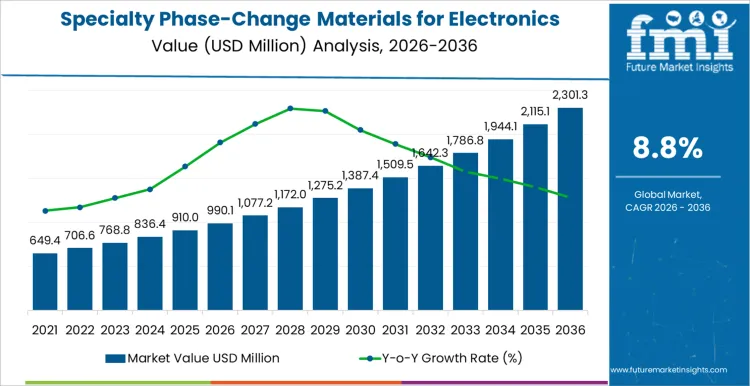
The specialty phase-change materials for electronics market, estimated from USD 990.1 million in 2026, to USD 2,301.3 million by 2036, at a CAGR of 8.8% as thermal stability becomes essential for high-density electronic platforms. Regulatory and compliance frameworks increasingly filter which PCM solutions reach commercial deployment. Materials must meet evolving requirements related to fire behavior, chemical safety, and thermal performance consistency over long service lives. Compliance costs escalate as certification programs demand multi-cycle thermal testing, aging studies, and documented integration behavior within electronic assemblies. These processes extend qualification timelines and raise entry barriers, particularly for novel PCM chemistries. Electronics OEMs respond by favoring suppliers that can reduce regulatory risk through proven formulations and comprehensive compliance documentation. As a result, vendor positioning is shaped less by theoretical thermal capacity and more by readiness for certification-driven procurement. Regulatory pressure therefore accelerates consolidation toward suppliers capable of supporting disciplined, audit-ready material approval pathways.
Quick Stats for Specialty Phase-Change Materials for Electronics Market
- Specialty Phase-Change Materials for Electronics Market Value (2026): USD 990.1 Million
- Specialty Phase-Change Materials for Electronics Market Forecast Value (2036): USD 2,301.3 Million
- Specialty Phase-Change Materials for Electronics Market Forecast CAGR 2026 to 2036: 8.8%
- Leading PCM Chemistry in Specialty Phase-Change Materials for Electronics Market: Paraffin-Based PCMs (42% share)
- Key Growth Regions in Specialty Phase-Change Materials for Electronics Market: Asia Pacific, Europe, North America, Latin America, Middle East & Africa
- Top Key Players in Specialty Phase-Change Materials for Electronics Market: Honeywell, Henkel (Bergquist), Laird Thermal Systems, Aavid Thermalloy (Boyd Corporation), Croda International, Microtek Laboratories, Rubitherm Technologies, Phase Change Energy Solutions, Outlast Technologies, Panasonic
Specialty Phase-Change Materials for Electronics Market Key Takeaways
| Metric | Value |
|---|---|
| Specialty Phase-Change Materials for Electronics Market Value (2026) | USD 990.1 Million |
| Specialty Phase-Change Materials for Electronics Market Forecast Value (2036) | USD 2,301.3 Million |
| Specialty Phase-Change Materials for Electronics Market Forecast CAGR 2026 to 2036 | 8.8% |
How Are Specialty Phase Change Materials Being Integrated into Thermal Control Strategies for Electronic Hardware?
In electronics manufacturing, specialty phase change materials are increasingly treated as operating components rather than optional inserts. Their adoption connects first to Electronics Cooling Systems, where designers need predictable heat absorption during power spikes. In module assembly lines linked to advanced packaging materials, these compounds are evaluated for interface conformity and long term stability under cycling loads. Material selection also reflects practices used in thermal interface materials, since contact resistance and pump out behavior influence device reliability. Some suppliers position these products alongside Energy Storage Materials, because latent heat capacity changes how thermal buffers are sized. Oversight often sits within specialty chemicals for Electronics, where contamination limits and batch control already follow strict rules. Buyers focus on melt point tolerance, phase transition repeatability, and packaging integrity because deviations appear as field failures, rework, or shortened service intervals.
Planning through 2036 places specialty phase change materials inside reliability engineering rather than experimental design work. Hardware producers compare options using thermal excursion frequency, warranty returns, and enclosure redesign costs instead of unit pricing. A material that shifts transition temperature or separates under vibration forces conservative derating across entire platforms. Procurement teams therefore emphasize supplier audit access, aging data, and transport stability. Manufacturing engineers track installation repeatability and residue control during assembly. Distribution choices also matter, since extended storage or rough handling can change usable performance before installation. Contracts increasingly specify acceptance bands for latent heat capacity, phase stability, and allowable bleed. Demand expands first in high density electronics, power conversion units, and compact enclosures where short thermal events set lifetime limits and where predictable heat buffering directly protects output targets, qualification schedules, and service obligations.
How Do Integration Risk and Production Constraints Shape Demand by PCM Chemistry and Form Factor in 2026?
Design teams usually encounter these materials only after mechanical layouts are frozen and cooling margins look thin. At that point, the choice is driven by what can be inserted without triggering a redesign of housings, fasteners, or assembly steps. This is why demand is concentrated in electronics thermal management systems and high density power conversion equipment, where short temperature excursions create reliability problems even when average temperatures look acceptable. By chemistry, usage is split among paraffin-based, salt-hydrate and inorganic systems, bio-based and advanced formulations, and other chemistries. By form factor, consumption spans encapsulated units, sheets and films, filled compounds and pastes, and other formats. Purchasing decisions follow mechanical fit, handling risk, and rework exposure more than any theoretical heat storage rating.
Why Do Paraffin-Based Systems Remain the Easiest to Deploy at Scale?
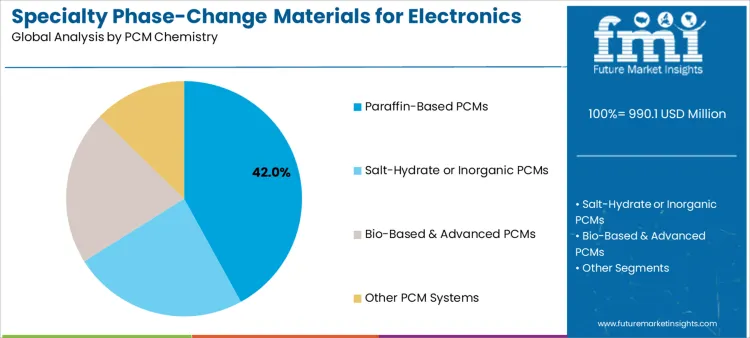
Warehouse managers notice the difference before design engineers do. Some chemistries need climate control, special containers, or rapid turnover. Others can sit on a shelf and still behave the same months later. Paraffin-based systems represent roughly 42% of demand because they fall into the second category. In consumer electronics assembly and industrial power modules, production teams prefer materials that tolerate ordinary storage, shipping, and shop-floor handling without extra procedures. Salt-hydrate and inorganic systems bring higher sensitivity to moisture and packaging integrity. Bio-based and advanced systems attract interest where environmental positioning or special performance targets matter, which keeps them in narrower programs. The chemistry mix reflects logistics and handling realities, not just thermal behavior.
Line supervisors care less about latent heat curves and more about whether the material will behave the same on the thousandth unit as it did on the first. Chemistries that change consistency, separate, or migrate under routine storage conditions create scrap and delays. Supply teams therefore push for options with stable shelf behavior and simple containment rules. Paraffin-based systems benefit from this pressure because their storage and handling profile is predictable across many sites and climates.
Why Do Consumer Electronics And IT Applications Dominate Demand In The Specialty Phase-Change Materials For Electronics Market?
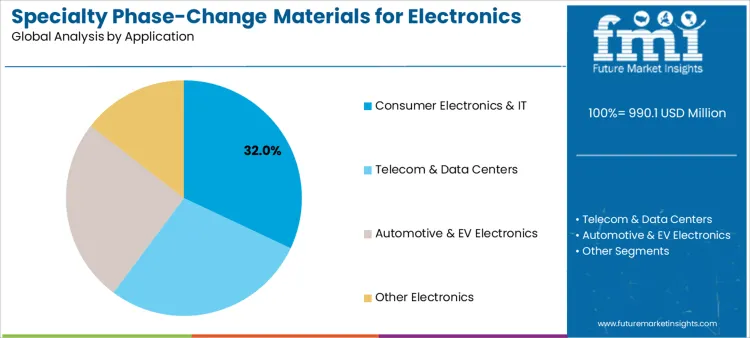
Consumer electronics and IT applications hold 32% share of the specialty phase-change materials for electronics market because devices such as smartphones, laptops, servers, and networking equipment experience frequent thermal spikes during operation. PCMs are used to manage short-term heat loads without increasing cooling system complexity. High production volumes and rapid product refresh cycles drive consistent material demand. Manufacturers prioritize compact and passive thermal solutions to maintain device performance and user comfort. These volume-driven deployment patterns and thermal management needs explain why consumer electronics and IT remain the leading application segment.
What Are the Key Dynamics of the Specialty Phase-Change Materials for Electronics Market?
The specialty phase-change materials for electronics market is driven by rising thermal management challenges in compact, high-power electronic devices used in data centers, electric vehicles, consumer electronics, and power electronics. Specialty PCMs absorb and release latent heat during phase transitions, helping regulate temperature spikes and improve device reliability without increasing system complexity. As electronic components operate at higher power densities, demand for passive and efficient thermal control solutions continues to grow. For material suppliers and electronics manufacturers, phase transition temperature accuracy, thermal capacity, stability over repeated cycles, and material compatibility are key factors influencing adoption.
How Do Application Trends and Industry Requirements Shape This Market?
Application trends and industry requirements are shaping the specialty PCM market as electronics designs prioritize miniaturization, energy efficiency, and long-term reliability. In consumer electronics and wearables, PCMs help manage transient heat loads while maintaining slim form factors. Electric vehicles and power electronics use PCMs to protect batteries, inverters, and control units from thermal stress. Data centers and telecom infrastructure increasingly integrate PCMs into cooling systems to manage peak thermal loads and reduce energy consumption. Manufacturers require PCMs that integrate easily into existing thermal management architectures, offer predictable performance, and meet safety and regulatory standards.
Why Do Material Integration and Cost Challenges Restrain Market Growth?
Material integration and cost challenges restrain growth in the specialty phase-change materials market, particularly in mass-market electronics. Encapsulation, leakage prevention, and long-term thermal stability require specialized material engineering, increasing development complexity and cost. Selecting PCMs with precise phase transition temperatures that remain stable over thousands of cycles adds to qualification timelines. Integration into established electronics manufacturing processes may require design modifications, slowing adoption. These factors limit use in highly cost-sensitive applications despite clear performance benefits.
How is the Specialty Phase-Change Materials for Electronics Market Growing across Key Countries?
The specialty phase-change materials (PCMs) for electronics market is expanding steadily as electronic devices generate higher heat loads while shrinking in size and increasing in power density. PCMs are used to absorb, store, and release heat during temperature spikes, protecting sensitive components and stabilizing performance in consumer electronics, power electronics, data centers, and telecom equipment. Country-wise growth varies based on electronics manufacturing scale, adoption of high-power devices, and integration of advanced thermal management architectures. High-growth markets are driven by large electronics production bases and rapid technology upgrades, while mature regions focus on reliability, material consistency, and system-level thermal optimization.
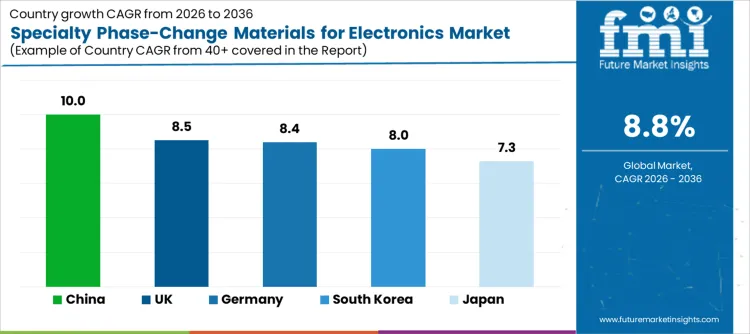
| Country | CAGR (%) |
|---|---|
| China | 10.0 |
| United Kingdom | 8.5 |
| Germany | 8.4 |
| South Korea | 8.0 |
| Japan | 7.3 |
Why Is China Leading the Specialty Phase-Change Materials for Electronics Market?
China’s specialty phase-change materials for electronics market is expanding at a CAGR of 10.0% during 2026-2036, driven by its dominant position in consumer electronics, telecom equipment, power electronics, and EV-related electronics manufacturing. As devices become more compact and operate at higher power levels, PCMs are increasingly used to manage transient heat loads and prevent thermal throttling. Adoption is strong in smartphones, servers, power modules, and communication infrastructure. Chinese manufacturers prioritize PCMs with precise melting points, high latent heat capacity, and compatibility with automated assembly processes. Domestic material suppliers benefit from scale advantages and close collaboration with electronics OEMs, enabling rapid customization for different device architectures. Procurement decisions emphasize thermal performance consistency, integration ease, and cost efficiency at volume. As China continues to expand electronics production and move toward higher-power device platforms, demand for specialty PCMs is expected to remain strong, supported by rising thermal management complexity across electronics value chains.
What Is Driving Demand for Specialty PCMs in the United Kingdom?
The United Kingdom specialty phase-change materials for electronics market is growing at a CAGR of 8.5% during 2026-2036, supported by demand from data centers, telecom infrastructure, defense electronics, and advanced industrial systems. PCMs are used to stabilize temperatures in equipment exposed to intermittent high loads or constrained airflow environments. UK buyers emphasize reliability, predictable phase-change behavior, and long service life. Demand is strongest in high-value electronics applications rather than mass consumer devices. PCMs are increasingly integrated into enclosures, heat spreaders, and hybrid thermal management systems. Procurement decisions prioritize supplier credibility, material qualification data, and compliance with stringent performance standards. Market growth is reinforced by investment in digital infrastructure, edge computing, and advanced electronics used in critical applications.
How Is Germany Supporting Growth in the Specialty Phase-Change Materials Market?
Germany’s specialty phase-change materials for electronics market is expanding at a CAGR of 8.4% during 2026-2036, driven by demand from automotive electronics, industrial automation, and power electronics. German manufacturers use PCMs to manage thermal spikes in inverters, control units, and high-reliability electronic systems. Buyers prioritize tight control over phase-change temperature, material stability, and repeatable performance under cycling conditions. Adoption is driven by performance optimization and reliability requirements rather than rapid volume expansion. Procurement decisions favor suppliers with strong technical documentation, proven material durability, and ability to support customized thermal solutions. Market growth is reinforced by Germany’s leadership in automotive electronics and industrial engineering.
How Is South Korea Expanding Use of Specialty Phase-Change Materials?
South Korea’s specialty phase-change materials for electronics market is growing at a CAGR of 8.0% during 2026-2036, driven by strong demand from consumer electronics, semiconductor equipment, and telecom devices. PCMs are increasingly used to manage heat in compact, high-performance devices where active cooling is limited. Manufacturers emphasize material purity, integration compatibility, and stable thermal cycling behavior. Adoption is strongest in export-oriented electronics and advanced device platforms. Procurement decisions are influenced by supplier reliability, consistency, and ability to meet tight thermal specifications. Market growth is supported by continued innovation in electronics design and increasing power density across devices.
How Is Japan Adopting Specialty Phase-Change Materials for Electronics?
Japan’s specialty phase-change materials for electronics market is expanding at a CAGR of 7.3% during 2026-2036, driven by demand from precision electronics, industrial equipment, and automotive electronics. Japanese manufacturers adopt PCMs cautiously, emphasizing long-term reliability and predictable performance. Buyers prioritize materials with stable phase-change behavior, low degradation, and compatibility with precision manufacturing processes. Adoption is concentrated in high-quality, long-life electronic systems rather than mass-volume products. Procurement decisions favor suppliers with established quality credentials, extensive testing data, and long-term supply assurance. Market growth is supported by steady demand for reliable thermal management solutions in advanced electronics and industrial applications.
How Are Companies Competing in the Specialty Phase-Change Materials for Electronics Market?
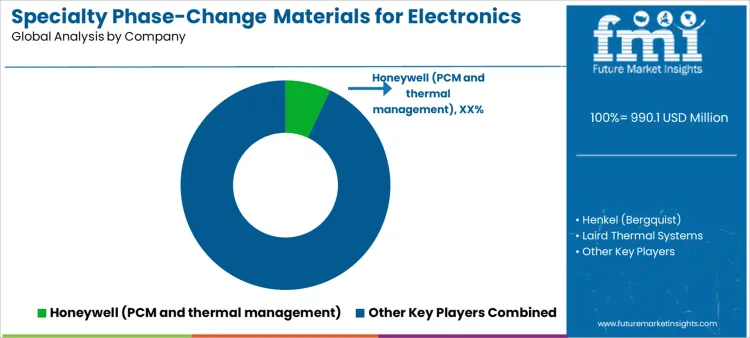
Competition in the specialty phase-change materials (PCMs) for electronics market is shaped by thermal energy storage capacity, transition temperature precision, and integration ease with heat spreaders, power modules, and compact assemblies. PCMs are increasingly specified where transient heat loads must be buffered to protect sensitive components, improve reliability, and enable higher power density without resorting to bulky active cooling. Suppliers differentiate through custom transition temperatures, encapsulation technologies, and proven performance in real-world electronic cooling scenarios.
Honeywell positions its PCM and thermal management offerings around engineered materials with well-controlled phase transition ranges and high latent heat capacity. Its materials are often integrated into thermal interface systems and passive cooling modules where consistent thermal performance matters. Henkel (Bergquist) competes by embedding PCMs within composite thermal interface solutions that combine phase-change absorption with mechanical compliance, making them attractive for power electronics and high-density PCB cooling.
System and solution providers broaden competitive appeal through application-oriented offerings. Laird Thermal Systems and Aavid Thermalloy (Boyd Corporation) emphasize validated PCM modules and hybrid heat spreaders tailored to specific heat flux profiles, with product materials underscoring improved transient heat buffering and ease of assembly. Panasonic leverages its broader thermal materials expertise to align PCM components with electronic and power systems, focusing on stable performance across temperature cycles.
Specialty PCM innovators and material developers expand the field. Croda International markets PCM products designed for energy absorption and thermal buffering, while Microtek Laboratories, Rubitherm Technologies, and Phase Change Energy Solutions compete through bespoke PCM chemistries with precisely tuned melt points. Outlast Technologies collaborates with electronics partners to integrate PCM functionality into thermal management systems, highlighting comfort and protection benefits in consumer and wearable electronics. Across all players, competitive advantage is defined by documented thermal performance, phase stability, and seamless integration into existing thermal management architectures rather than PCM cost alone.
Key Players in Specialty Phase-Change Materials for Electronics Market
- Honeywell (PCM and thermal management)
- Henkel (Bergquist)
- Laird Thermal Systems
- Aavid Thermalloy (Boyd Corporation)
- Croda International (PCM products)
- Microtek Laboratories
- Rubitherm Technologies
- Phase Change Energy Solutions
- Outlast Technologies (electronics PCM partners)
- Panasonic (thermal management materials)
Scope of Report
| Attribute | Details |
|---|---|
| Market Size Unit | USD Million |
| PCM Chemistry Covered | Paraffin-Based PCMs, Salt-Hydrate or Inorganic PCMs, Bio-Based & Advanced PCMs, Other PCM Systems |
| Application Covered | Consumer Electronics & IT, Telecom & Data Centers, Automotive & EV Electronics, Other Electronics |
| Countries Covered | China, Japan, South Korea, India, Australia & New Zealand, ASEAN, Rest of Asia Pacific, Germany, United Kingdom, France, Italy, Spain, Nordic, BENELUX, Rest of Europe, United States, Canada, Mexico, Brazil, Chile, Rest of Latin America, Kingdom of Saudi Arabia, Other GCC Countries, Turkey, South Africa, Other African Union, Rest of Middle East & Africa |
| Regions Covered | Asia Pacific, Europe, North America, Latin America, Middle East & Africa |
| Key Companies Profiled | Honeywell, Henkel (Bergquist), Laird Thermal Systems, Aavid Thermalloy (Boyd Corporation), Croda International, Microtek Laboratories, Rubitherm Technologies, Phase Change Energy Solutions, Outlast Technologies, Panasonic |
| Additional Attributes | Dollar sales of specialty phase-change materials for electronics are analyzed by PCM chemistry and end-use application across active and passive thermal management solutions. The scope evaluates latent heat capacity, phase transition temperature control, thermal cycling stability, encapsulation formats, and integration compatibility with electronic assemblies. Country-level analysis reflects rising power densities in electronics, data-center thermal challenges, growth of EV electronics, and increasing adoption of advanced thermal management materials to enhance device reliability and performance. |
Specialty Phase-Change Materials for Electronics Market by Key Segments
PCM Chemistry:
- Paraffin-Based PCMs
- Salt-Hydrate or Inorganic PCMs
- Bio-Based & Advanced PCMs
- Other PCM Systems
Application:
- Consumer Electronics & IT
- Telecom & Data Centers
- Automotive & EV Electronics
- Other Electronics
Region:
- Asia Pacific
- China
- Japan
- South Korea
- India
- Australia & New Zealand
- ASEAN
- Rest of Asia Pacific
- Europe
- Germany
- United Kingdom
- France
- Italy
- Spain
- Nordic
- BENELUX
- Rest of Europe
- North America
- United States
- Canada
- Mexico
- Latin America
- Brazil
- Chile
- Rest of Latin America
- Middle East & Africa
- Kingdom of Saudi Arabia
- Other GCC Countries
- Turkey
- South Africa
- Other African Union
- Rest of Middle East & Africa
Bibliography
- International Electrotechnical Commission. (2024). Thermal management of electronic equipment: Materials, methods, and performance requirements (IEC Technical Report). IEC.
- National Institute of Standards and Technology. (2023). Thermal transport and reliability considerations for advanced electronic materials. U.S. Department of Commerce.
- International Organization for Standardization. (2023). ISO/TR 16344: Thermal performance and safety of materials used in electronic assemblies. ISO.
Frequently Asked Questions
How big is the specialty phase-change materials for electronics market in 2026?
The global specialty phase-change materials for electronics market is estimated to be valued at USD 990.1 million in 2026.
What will be the size of specialty phase-change materials for electronics market in 2036?
The market size for the specialty phase-change materials for electronics market is projected to reach USD 2,301.3 million by 2036.
How much will be the specialty phase-change materials for electronics market growth between 2026 and 2036?
The specialty phase-change materials for electronics market is expected to grow at a 8.8% CAGR between 2026 and 2036.
What are the key product types in the specialty phase-change materials for electronics market?
The key product types in specialty phase-change materials for electronics market are paraffin-based pcms, salt-hydrate or inorganic pcms, bio-based & advanced pcms and other pcm systems.
Which application segment to contribute significant share in the specialty phase-change materials for electronics market in 2026?
In terms of application, consumer electronics & it segment to command 32.0% share in the specialty phase-change materials for electronics market in 2026.
Preview the report firsthand - request a free sample
Get SampleGet the brochure for pricing and purchase details.
Get PDFTable of Content
- Executive Summary
- Global Market Outlook
- Demand-side Trends
- Supply-side Trends
- Technology Roadmap Analysis
- Analysis and Recommendations
- Market Overview
- Market Coverage / Taxonomy
- Market Definition / Scope / Limitations
- Market Background
- Market Dynamics
- Drivers
- Restraints
- Opportunity
- Trends
- Scenario Forecast
- Demand in Optimistic Scenario
- Demand in Likely Scenario
- Demand in Conservative Scenario
- Opportunity Map Analysis
- Product Life Cycle Analysis
- Supply Chain Analysis
- Investment Feasibility Matrix
- Value Chain Analysis
- PESTLE and Porter’s Analysis
- Regulatory Landscape
- Regional Parent Market Outlook
- Production and Consumption Statistics
- Import and Export Statistics
- Market Dynamics
- Global Market Analysis 2021 to 2025 and Forecast, 2026 to 2036
- Historical Market Size Value (USD Million) Analysis, 2021 to 2025
- Current and Future Market Size Value (USD Million) Projections, 2026 to 2036
- Y-o-Y Growth Trend Analysis
- Absolute $ Opportunity Analysis
- Global Market Pricing Analysis 2021 to 2025 and Forecast 2026 to 2036
- Global Market Analysis 2021 to 2025 and Forecast 2026 to 2036, By PCM Chemistry
- Introduction / Key Findings
- Historical Market Size Value (USD Million) Analysis By PCM Chemistry , 2021 to 2025
- Current and Future Market Size Value (USD Million) Analysis and Forecast By PCM Chemistry , 2026 to 2036
- Paraffin-Based PCMs
- Salt-Hydrate or Inorganic PCMs
- Bio-Based & Advanced PCMs
- Other PCM Systems
- Paraffin-Based PCMs
- Y-o-Y Growth Trend Analysis By PCM Chemistry , 2021 to 2025
- Absolute $ Opportunity Analysis By PCM Chemistry , 2026 to 2036
- Global Market Analysis 2021 to 2025 and Forecast 2026 to 2036, By Application
- Introduction / Key Findings
- Historical Market Size Value (USD Million) Analysis By Application, 2021 to 2025
- Current and Future Market Size Value (USD Million) Analysis and Forecast By Application, 2026 to 2036
- Consumer Electronics & IT
- Telecom & Data Centers
- Automotive & EV Electronics
- Other Electronics
- Consumer Electronics & IT
- Y-o-Y Growth Trend Analysis By Application, 2021 to 2025
- Absolute $ Opportunity Analysis By Application, 2026 to 2036
- Global Market Analysis 2021 to 2025 and Forecast 2026 to 2036, By Region
- Introduction
- Historical Market Size Value (USD Million) Analysis By Region, 2021 to 2025
- Current Market Size Value (USD Million) Analysis and Forecast By Region, 2026 to 2036
- North America
- Latin America
- Western Europe
- Eastern Europe
- East Asia
- South Asia and Pacific
- Middle East & Africa
- Market Attractiveness Analysis By Region
- North America Market Analysis 2021 to 2025 and Forecast 2026 to 2036, By Country
- Historical Market Size Value (USD Million) Trend Analysis By Market Taxonomy, 2021 to 2025
- Market Size Value (USD Million) Forecast By Market Taxonomy, 2026 to 2036
- By Country
- USA
- Canada
- Mexico
- By PCM Chemistry
- By Application
- By Country
- Market Attractiveness Analysis
- By Country
- By PCM Chemistry
- By Application
- Key Takeaways
- Latin America Market Analysis 2021 to 2025 and Forecast 2026 to 2036, By Country
- Historical Market Size Value (USD Million) Trend Analysis By Market Taxonomy, 2021 to 2025
- Market Size Value (USD Million) Forecast By Market Taxonomy, 2026 to 2036
- By Country
- Brazil
- Chile
- Rest of Latin America
- By PCM Chemistry
- By Application
- By Country
- Market Attractiveness Analysis
- By Country
- By PCM Chemistry
- By Application
- Key Takeaways
- Western Europe Market Analysis 2021 to 2025 and Forecast 2026 to 2036, By Country
- Historical Market Size Value (USD Million) Trend Analysis By Market Taxonomy, 2021 to 2025
- Market Size Value (USD Million) Forecast By Market Taxonomy, 2026 to 2036
- By Country
- Germany
- UK
- Italy
- Spain
- France
- Nordic
- BENELUX
- Rest of Western Europe
- By PCM Chemistry
- By Application
- By Country
- Market Attractiveness Analysis
- By Country
- By PCM Chemistry
- By Application
- Key Takeaways
- Eastern Europe Market Analysis 2021 to 2025 and Forecast 2026 to 2036, By Country
- Historical Market Size Value (USD Million) Trend Analysis By Market Taxonomy, 2021 to 2025
- Market Size Value (USD Million) Forecast By Market Taxonomy, 2026 to 2036
- By Country
- Russia
- Poland
- Hungary
- Balkan & Baltic
- Rest of Eastern Europe
- By PCM Chemistry
- By Application
- By Country
- Market Attractiveness Analysis
- By Country
- By PCM Chemistry
- By Application
- Key Takeaways
- East Asia Market Analysis 2021 to 2025 and Forecast 2026 to 2036, By Country
- Historical Market Size Value (USD Million) Trend Analysis By Market Taxonomy, 2021 to 2025
- Market Size Value (USD Million) Forecast By Market Taxonomy, 2026 to 2036
- By Country
- China
- Japan
- South Korea
- By PCM Chemistry
- By Application
- By Country
- Market Attractiveness Analysis
- By Country
- By PCM Chemistry
- By Application
- Key Takeaways
- South Asia and Pacific Market Analysis 2021 to 2025 and Forecast 2026 to 2036, By Country
- Historical Market Size Value (USD Million) Trend Analysis By Market Taxonomy, 2021 to 2025
- Market Size Value (USD Million) Forecast By Market Taxonomy, 2026 to 2036
- By Country
- India
- ASEAN
- Australia & New Zealand
- Rest of South Asia and Pacific
- By PCM Chemistry
- By Application
- By Country
- Market Attractiveness Analysis
- By Country
- By PCM Chemistry
- By Application
- Key Takeaways
- Middle East & Africa Market Analysis 2021 to 2025 and Forecast 2026 to 2036, By Country
- Historical Market Size Value (USD Million) Trend Analysis By Market Taxonomy, 2021 to 2025
- Market Size Value (USD Million) Forecast By Market Taxonomy, 2026 to 2036
- By Country
- Kingdom of Saudi Arabia
- Other GCC Countries
- Turkiye
- South Africa
- Other African Union
- Rest of Middle East & Africa
- By PCM Chemistry
- By Application
- By Country
- Market Attractiveness Analysis
- By Country
- By PCM Chemistry
- By Application
- Key Takeaways
- Key Countries Market Analysis
- USA
- Pricing Analysis
- Market Share Analysis, 2025
- By PCM Chemistry
- By Application
- Canada
- Pricing Analysis
- Market Share Analysis, 2025
- By PCM Chemistry
- By Application
- Mexico
- Pricing Analysis
- Market Share Analysis, 2025
- By PCM Chemistry
- By Application
- Brazil
- Pricing Analysis
- Market Share Analysis, 2025
- By PCM Chemistry
- By Application
- Chile
- Pricing Analysis
- Market Share Analysis, 2025
- By PCM Chemistry
- By Application
- Germany
- Pricing Analysis
- Market Share Analysis, 2025
- By PCM Chemistry
- By Application
- UK
- Pricing Analysis
- Market Share Analysis, 2025
- By PCM Chemistry
- By Application
- Italy
- Pricing Analysis
- Market Share Analysis, 2025
- By PCM Chemistry
- By Application
- Spain
- Pricing Analysis
- Market Share Analysis, 2025
- By PCM Chemistry
- By Application
- France
- Pricing Analysis
- Market Share Analysis, 2025
- By PCM Chemistry
- By Application
- India
- Pricing Analysis
- Market Share Analysis, 2025
- By PCM Chemistry
- By Application
- ASEAN
- Pricing Analysis
- Market Share Analysis, 2025
- By PCM Chemistry
- By Application
- Australia & New Zealand
- Pricing Analysis
- Market Share Analysis, 2025
- By PCM Chemistry
- By Application
- China
- Pricing Analysis
- Market Share Analysis, 2025
- By PCM Chemistry
- By Application
- Japan
- Pricing Analysis
- Market Share Analysis, 2025
- By PCM Chemistry
- By Application
- South Korea
- Pricing Analysis
- Market Share Analysis, 2025
- By PCM Chemistry
- By Application
- Russia
- Pricing Analysis
- Market Share Analysis, 2025
- By PCM Chemistry
- By Application
- Poland
- Pricing Analysis
- Market Share Analysis, 2025
- By PCM Chemistry
- By Application
- Hungary
- Pricing Analysis
- Market Share Analysis, 2025
- By PCM Chemistry
- By Application
- Kingdom of Saudi Arabia
- Pricing Analysis
- Market Share Analysis, 2025
- By PCM Chemistry
- By Application
- Turkiye
- Pricing Analysis
- Market Share Analysis, 2025
- By PCM Chemistry
- By Application
- South Africa
- Pricing Analysis
- Market Share Analysis, 2025
- By PCM Chemistry
- By Application
- USA
- Market Structure Analysis
- Competition Dashboard
- Competition Benchmarking
- Market Share Analysis of Top Players
- By Regional
- By PCM Chemistry
- By Application
- Competition Analysis
- Competition Deep Dive
- Honeywell (PCM and thermal management)
- Overview
- Product Portfolio
- Profitability by Market Segments (Product/Age /Sales Channel/Region)
- Sales Footprint
- Strategy Overview
- Marketing Strategy
- Product Strategy
- Channel Strategy
- Henkel (Bergquist)
- Laird Thermal Systems
- Aavid Thermalloy (Boyd Corporation)
- Croda International (PCM products)
- Microtek Laboratories
- Rubitherm Technologies
- Phase Change Energy Solutions
- Outlast Technologies (electronics PCM partners)
- Panasonic (thermal management materials)
- Honeywell (PCM and thermal management)
- Competition Deep Dive
- Assumptions & Acronyms Used
- Research Methodology


