

- Industry Size (2026)
- USD 842.4 Mn
- Forecast (2036)
- USD 1818.7 Mn
- CAGR (2026 to 2036)
- 8.00%
Boron Nitride Additives Market Forecast and Outlook 2026 to 2036
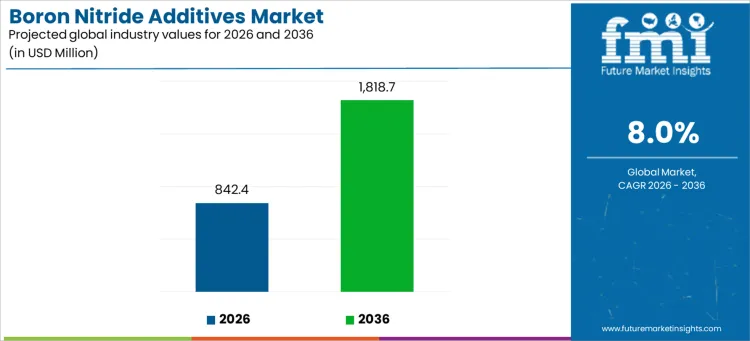
The boron nitride additives market is projected to expand from USD 842.4 million in 2026 to USD 1,818.7 million by 2036, registering a CAGR of 8.00%. Market control in this space is shaped by a small group of suppliers with deep expertise in boron nitride synthesis, particle engineering, and application-specific formulation support. Pricing power is defended through differentiated grades that deliver tightly controlled thermal conductivity, electrical insulation, and lubricity, which are difficult to replicate without significant process know-how.
Quick Stats for Boron Nitride Additives Market
- Boron Nitride Additives Market Value (2026): USD 842.4 Million
- Boron Nitride Additives Market Forecast Value (2036): USD 1,818.7 Million
- Boron Nitride Additives Market Forecast CAGR 2026 to 2036: 8.00%
- Leading Grade in Boron Nitride Additives Market: Hexagonal Boron Nitride (h-BN) (64% share)
- Leading Application in Boron Nitride Additives Market: Thermal Management Compounds (36% share)
- Key Growth Regions in Boron Nitride Additives Market: Asia Pacific, Europe, North America, Latin America, Middle East & Africa
- Top Key Players in Boron Nitride Additives Market: Saint-Gobain Boron Nitride, 3M Advanced Materials, Momentive Performance Materials, Denka Company, Henze BNP, ZYP Coatings, Showa Denko Materials, H.C. Starck Solutions, Mizushima Ferroalloy, Atlantic Equipment Engineers
Entry barriers remain high due to capital-intensive production routes, energy requirements, and the technical complexity involved in achieving consistent morphology and dispersion performance. Qualification cycles with electronics, automotive, and industrial customers further limit rapid supplier substitution, reinforcing vendor lock-in. While the market includes several regional and niche players, fragmentation narrows as customers prioritize reliability, documentation, and long-term supply assurance over short-term cost advantages. As demand grows in thermal management and high-performance materials, competitive positioning increasingly depends on technical validation and manufacturing consistency rather than volume alone.
Boron Nitride Additives Market Key Takeaways
| Metric | Value |
|---|---|
| Boron Nitride Additives Market Value (2026) | USD 842.4 Million |
| Boron Nitride Additives Market Forecast Value (2036) | USD 1,818.7 Million |
| Boron Nitride Additives Market Forecast CAGR 2026 to 2036 | 8.00% |
How are Thermal Management and Performance Reliability Requirements Accelerating the Boron Nitride Additives Market?
The boron nitride additives market is expanding as manufacturers across electronics, polymers, and industrial processing seek materials that deliver high thermal conductivity while maintaining electrical insulation. Hexagonal boron nitride offers a unique combination of heat dissipation, chemical inertness, and low friction, making it valuable in applications such as thermally conductive plastics, coatings, lubricants, and thermal interface materials. Growth in power electronics, electric vehicles, and high-performance industrial equipment is increasing demand for additives that can manage heat without compromising safety or material integrity.
Application-specific performance and dispersion behavior are key considerations in additive selection. End users evaluate boron nitride additives based on particle morphology, surface treatment, and compatibility with polymer matrices or fluid systems. Properly engineered boron nitride dispersions enhance heat transfer efficiency, reduce wear, and improve process stability in molding, extrusion, and coating operations. In lubricants and release agents, boron nitride contributes to reduced friction and improved durability under extreme temperature and pressure conditions.
Expansion of advanced manufacturing and regulatory emphasis on reliability are further supporting market growth. As devices become more compact and operate at higher power densities, the need for consistent thermal management materials is intensifying. At the same time, demand for long-lasting, low-maintenance components is driving adoption of high-performance additives. For suppliers, competitive advantage increasingly depends on particle engineering, formulation support, and the ability to tailor boron nitride additives for specific end-use environments positioning these materials as critical enablers of heat management and performance reliability across industries.
How Is The Boron Nitride Additives Market Structured By BN Grade And Application?
The boron nitride additives market is structured by BN grade and application, reflecting how thermal conductivity, lubricity, and chemical stability influence material selection. By BN grade, hexagonal boron nitride h-BN) represents the leading segment, as it combines high thermal conductivity with excellent electrical insulation and lubricating properties. Other grades include cubic and additional BN forms, as well as composite BN additives formulated for specialized performance needs. By application, thermal management compounds account for the largest demand, followed by lubricants and release agents, coatings and surface treatments, and other uses where heat dissipation and surface protection are critical.
Why Does Hexagonal Boron Nitride (h-BN) Lead Grade Adoption in the Boron Nitride Additives Market?
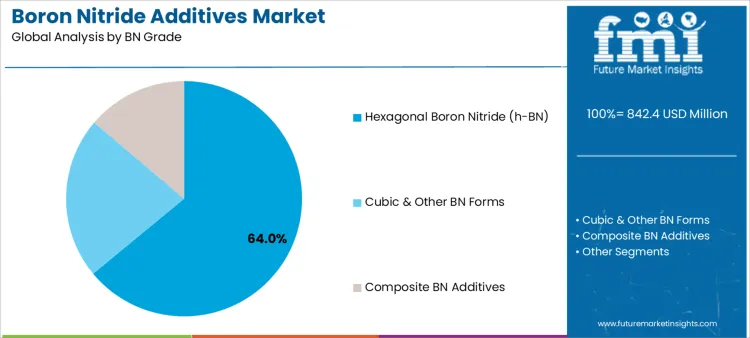
Hexagonal boron nitride accounts for 64% share of the boron nitride additives market because it offers a unique combination of high thermal conductivity, low friction, and chemical inertness. Its layered structure enables efficient heat transfer while maintaining electrical insulation, making it suitable for electronics, polymers, and advanced composites. Manufacturers favor h-BN due to its stability at high temperatures and compatibility with a wide range of matrices. Ease of dispersion and predictable performance support adoption across high-volume formulations. These thermal, mechanical, and processing advantages explain why h-BN remains the dominant BN grade.
Why Do Thermal Management Compounds Dominate Application Demand In The Boron Nitride Additives Market?
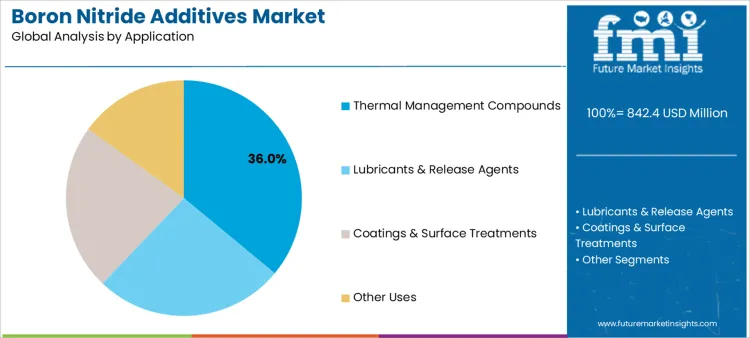
Thermal management compounds hold 36% share of the boron nitride additives market because electronic devices, batteries, and power systems require efficient heat dissipation to maintain reliability and performance. BN additives enhance thermal conductivity in greases, pastes, and polymer-based compounds without compromising electrical insulation. High power density in modern electronics increases reliance on advanced thermal interface materials. Continuous growth in electronics and energy applications sustains steady demand. These heat control requirements and high-performance expectations explain why thermal management compounds remain the leading application segment.
What Are the Key Dynamics of the Boron Nitride Additives Market?
The boron nitride additives market is driven by demand for multifunctional additives that deliver thermal conductivity, electrical insulation, lubricity, and chemical stability across polymers, coatings, lubricants, cosmetics, and electronic materials. Hexagonal boron nitride (h-BN) is widely used to enhance heat dissipation while maintaining dielectric properties, making it valuable in electronics, automotive components, and thermal management systems. Growth in electric vehicles, advanced electronics, and high-performance industrial materials supports market expansion. For material suppliers and formulators, particle size, morphology, purity, and dispersion behavior are key factors influencing material selection and long-term adoption.
How Do Application Trends and Industry Requirements Shape This Market?
Application trends and industry requirements are shaping the boron nitride additives market as manufacturers seek materials that combine thermal performance with process compatibility. In electronics and battery systems, boron nitride additives improve heat dissipation in encapsulants, adhesives, and thermal interface materials without compromising electrical insulation. In polymers and coatings, they enhance wear resistance, lubricity, and dimensional stability under high-temperature conditions. Cosmetic and personal care applications value boron nitride for its smooth feel and optical properties. Consistent quality, surface-modified grades, and compatibility with diverse matrices are essential for meeting application-specific performance requirements.
Why Do Cost, Dispersion, and Processing Challenges Restrain Market Growth?
Cost, dispersion, and processing challenges restrain growth in the boron nitride additives market, particularly in high-volume or price-sensitive applications. Producing high-purity, controlled-morphology boron nitride involves complex, energy-intensive processes that impact material cost. Achieving uniform dispersion in polymers and coatings can be technically demanding, and poor dispersion limits thermal and mechanical performance benefits. Higher loading levels may also affect viscosity and processability, requiring formulation adjustments and extended qualification timelines. These factors slow adoption where conventional fillers or additives offer lower-cost alternatives.
How is the Boron Nitride Additives Market Growing across Key Countries?
The boron nitride additives market is expanding steadily as manufacturers across plastics, coatings, lubricants, electronics, and advanced composites seek materials that deliver thermal conductivity, electrical insulation, lubricity, and chemical stability. Hexagonal boron nitride (h-BN) is widely used as a functional additive to improve heat dissipation, reduce friction, and enhance surface performance without compromising electrical properties. Country-wise growth varies based on adoption of advanced materials, electronics manufacturing intensity, and demand for high-performance formulations. High-growth markets are driven by expanding industrial and electronics production, while mature regions focus on precision grades, formulation compatibility, and consistent performance.
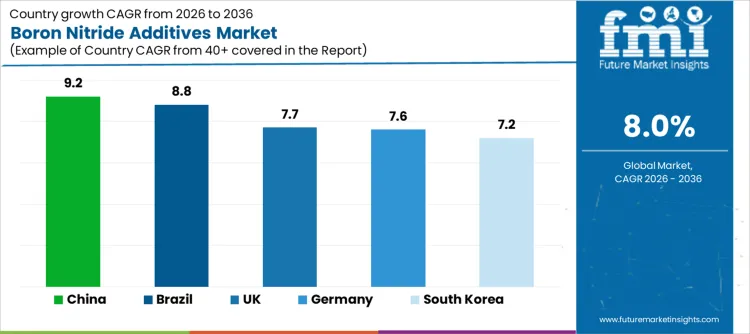
| Country | CAGR (%) |
|---|---|
| China | 9.2 |
| Brazil | 8.8 |
| United Kingdom | 7.7 |
| Germany | 7.6 |
| South Korea | 7.2 |
Why is China Leading the Boron Nitride Additives Market?
China’s boron nitride additives market is expanding at a CAGR of 9.2% during 2026-2036, driven by strong demand from plastics compounding, electronics manufacturing, coatings, and industrial applications. Boron nitride additives are increasingly used to enhance thermal conductivity in polymer components , improve lubricity in coatings, and provide heat management solutions in electronic assemblies. China’s large-scale manufacturing base and rapid adoption of advanced materials support sustained demand growth. Chinese manufacturers prioritize boron nitride grades that offer consistent particle size distribution, good dispersion behavior, and compatibility with thermoplastics, thermosets, and coating systems. Domestic suppliers benefit from expanding production capacity and cost-competitive supply, enabling wider adoption across industrial applications. Adoption is strongest in thermal interface materials, engineering plastics, and industrial coatings. Procurement decisions emphasize cost efficiency, supply reliability, and batch-to-batch consistency.
Why is Brazil Emerging as a High-Growth Market for Boron Nitride Additives?
Brazil’s boron nitride additives market is growing at a CAGR of 8.8% during 2026-2036, supported by rising demand from plastics processing, industrial coatings, lubricants, and automotive components. Boron nitride additives are valued for improving thermal stability, reducing friction, and enhancing durability in formulations used under demanding operating conditions. Brazilian buyers value additives that deliver reliable performance in warm and humid environments while maintaining formulation stability. Adoption is strongest in industrial lubricants, polymer compounds, and specialty coatings. Cost-performance balance remains a key purchasing factor as manufacturers evaluate higher-value additives. Procurement decisions often favor suppliers offering technical formulation support, regional availability, and consistent product quality. Market growth is supported by industrial expansion, increased use of performance additives, and gradual upgrading of material specifications across manufacturing sectors.
What is Driving Demand for Boron Nitride Additives in the United Kingdom?
The United Kingdom boron nitride additives market is expanding at a CAGR of 7.7% during 2026-2036, driven by demand from specialty polymers, coatings, and advanced industrial applications. Boron nitride additives are used to improve thermal management, surface finish, and wear resistance in high-value formulations. UK manufacturers emphasize controlled particle size, dispersion quality, and predictable performance. Demand is strongest in specialty coatings, engineered plastics, and industrial maintenance products rather than high-volume commodity applications. Procurement decisions prioritize supplier reliability, technical documentation, and consistent quality. Market growth is reinforced by steady demand for advanced materials in industrial and specialty manufacturing segments.
How Is Germany Supporting Growth in the Boron Nitride Additives Market?
Germany’s boron nitride additives market is growing at a CAGR of 7.6% during 2026-2036, supported by strong demand from automotive, industrial manufacturing, and advanced materials sectors. German manufacturers use boron nitride additives to enhance thermal conductivity, reduce friction, and improve durability in precision-engineered components and coatings. Buyers prioritize high-purity additives, narrow particle size distribution, and reproducible performance. Adoption is driven by performance optimization and quality requirements rather than volume expansion. Procurement decisions favor suppliers with certified quality systems, advanced processing capabilities, and the ability to support customized formulations. Market growth is reinforced by Germany’s focus on high-performance materials and precision manufacturing.
How Is South Korea Expanding Use of Boron Nitride Additives?
South Korea’s boron nitride additives market is expanding at a CAGR of 7.2% during 2026-2036, driven by demand from electronics, thermal management materials, and advanced polymer applications. Boron nitride additives are increasingly used in electronic components and polymer systems requiring efficient heat dissipation and electrical insulation. South Korean manufacturers emphasize additive purity, dispersion consistency, and compatibility with automated production processes. Adoption is strongest in electronics-related materials and export-oriented industrial products. Procurement decisions are influenced by supplier technical capability, product consistency, and alignment with advanced manufacturing standards. Market growth is supported by continued investment in electronics manufacturing and advanced material technologies.
How Are Suppliers Competing in the Boron Nitride Additives Market?
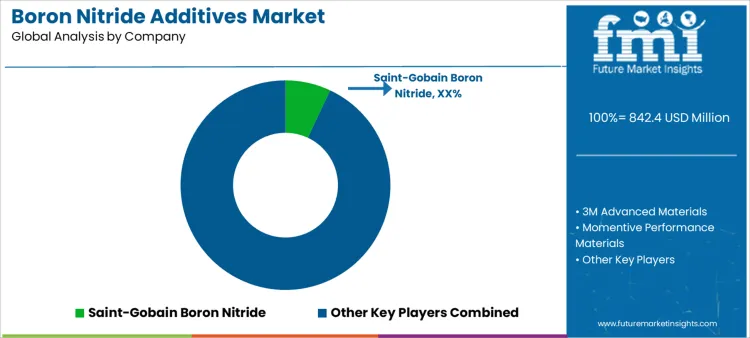
Competition in the boron nitride (BN) additives market is driven by particle morphology, thermal performance, and application-specific compatibility factors that matter to formulators in thermal management, coatings, polymers, and advanced composites. Boron nitride’s unique combination of high thermal conductivity, electrical insulation, and chemical stability makes it valuable where heat dissipation and dielectric performance are critical. Saint-Gobain Boron Nitride anchors the market with a broad range of BN grades from fine powders to big particle hBN engineered for high thermal conductivity fillers in electronics, thermal pastes, and polymer composites. Its portfolio emphasizes consistent crystal quality, controlled particle size, and reliable performance under thermal cycling.
Major engineered materials suppliers compete through specialized BN additives optimized for targeted applications. 3M Advanced Materials offers BN products paired with surface treatments that enhance dispersion in resins and elastomers, supporting uniform thermal pathways in high-power electronics. Momentive Performance Materials differentiates through BN additives tailored for silicone-based thermal interface materials that balance thermal conductivity with pliability and long-term stability. Denka Company and Showa Denko Materials compete with finely tuned BN powders and platelets designed for dielectric fillers in coatings and structural composites requiring high thermal performance.
Specialty and regional players broaden competitive depth through niche grades and technical support. Henze BNP and ZYP Coatings focus on BN dispersions and functional additives for surface coatings and lubricants. H.C. Starck Solutions brings high-purity BN powders with narrow distribution for precision applications, while Mizushima Ferroalloy addresses cost-effective supply. Atlantic Equipment Engineers complements the market by enabling BN powder processing and feed preparation. Across the market, competitive advantage is defined by BN additive performance, ease of incorporation, and documented thermal/dielectric gains rather than component pricing alone.
Key Players in Boron Nitride Additives Market
- Saint-Gobain Boron Nitride
- 3M Advanced Materials
- Momentive Performance Materials
- Denka Company
- Henze BNP
- ZYP Coatings
- Showa Denko Materials
- H.C. Starck Solutions
- Mizushima Ferroalloy (BN line)
- Atlantic Equipment Engineers
Scope of Report
| Attribute | Details |
|---|---|
| Market Size Unit | USD Million |
| BN Grade Covered | Hexagonal Boron Nitride (h-BN), Cubic & Other BN Forms, Composite BN Additives |
| Application Covered | Thermal Management Compounds, Lubricants & Release Agents, Coatings & Surface Treatments, Other Uses |
| Countries Covered | China, Japan, South Korea, India, Australia & New Zealand, ASEAN, Rest of Asia Pacific, Germany, United Kingdom, France, Italy, Spain, Nordic, BENELUX, Rest of Europe, United States, Canada, Mexico, Brazil, Chile, Rest of Latin America, Kingdom of Saudi Arabia, Other GCC Countries, Turkey, South Africa, Other African Union, Rest of Middle East & Africa |
| Regions Covered | Asia Pacific, Europe, North America, Latin America, Middle East & Africa |
| Key Companies Profiled | Saint-Gobain Boron Nitride, 3M Advanced Materials, Momentive Performance Materials, Denka Company, Henze BNP, ZYP Coatings, Showa Denko Materials, H.C. Starck Solutions, Mizushima Ferroalloy, Atlantic Equipment Engineers |
| Additional Attributes | Dollar sales of boron nitride additives are analyzed by BN grade and end-use application across thermal, tribological, and surface-engineering formulations. The scope evaluates thermal conductivity enhancement, electrical insulation, lubricity, particle morphology, and dispersion behavior in polymers, lubricants, and coatings. Country-level analysis reflects growth in electronics thermal management, advanced manufacturing, specialty coatings, and demand for high-performance solid lubricant and heat-dissipation solutions across industrial value chains. |
Boron Nitride Additives Market by Key Segments
BN Grade :
- Hexagonal Boron Nitride (h-BN)
- Cubic & Other BN Forms
- Composite BN Additives
Application :
- Thermal Management Compounds
- Lubricants & Release Agents
- Coatings & Surface Treatments
- Other Uses
Region :
- Asia Pacific
- China
- Japan
- South Korea
- India
- Australia & New Zealand
- ASEAN
- Rest of Asia Pacific
- Europe
- Germany
- United Kingdom
- France
- Italy
- Spain
- Nordic
- BENELUX
- Rest of Europe
- North America
- United States
- Canada
- Mexico
- Latin America
- Brazil
- Chile
- Rest of Latin America
- Middle East & Africa
- Kingdom of Saudi Arabia
- Other GCC Countries
- Turkey
- South Africa
- Other African Union
- Rest of Middle East & Africa
Bibliography
- Liu, Y., Zhang, X., & Li, J. (2023). Boron nitride‑based materials for thermal interface and polymer composite applications.
- Wang, D., & Chen, G. (2024). Advances in boron nitride fillers for heat dissipation and insulation in polymer composites. Composites Part B: Engineering, 273, 110450.
- National Renewable Energy Laboratory. (2024). Thermal management materials and systems for electronics and energy applications. USA. Department of Energy.
- International Energy Agency. (2024). Energy Technology Perspectives 2024: Materials for energy efficiency and advanced systems. IEA.
- Organisation for Economic Cooperation and Development. (2023). Advanced materials in industrial applications: Performance, sustainability, and policy implications. OECD Publishing.
Frequently Asked Questions
How big is the boron nitride additives market in 2026?
The global boron nitride additives market is estimated to be valued at USD 842.4 million in 2026.
What will be the size of boron nitride additives market in 2036?
The market size for the boron nitride additives market is projected to reach USD 1,818.7 million by 2036.
How much will be the boron nitride additives market growth between 2026 and 2036?
The boron nitride additives market is expected to grow at a 8.0% CAGR between 2026 and 2036.
What are the key product types in the boron nitride additives market?
The key product types in boron nitride additives market are hexagonal boron nitride (h-bn), cubic & other bn forms and composite bn additives.
Which application segment to contribute significant share in the boron nitride additives market in 2026?
In terms of application, thermal management compounds segment to command 36.0% share in the boron nitride additives market in 2026.
Preview the report firsthand - request a free sample
Get SampleGet the brochure for pricing and purchase details.
Get PDFTable of Content
- Executive Summary
- Global Market Outlook
- Demand-side Trends
- Supply-side Trends
- Technology Roadmap Analysis
- Analysis and Recommendations
- Market Overview
- Market Coverage / Taxonomy
- Market Definition / Scope / Limitations
- Market Background
- Market Dynamics
- Drivers
- Restraints
- Opportunity
- Trends
- Scenario Forecast
- Demand in Optimistic Scenario
- Demand in Likely Scenario
- Demand in Conservative Scenario
- Opportunity Map Analysis
- Product Life Cycle Analysis
- Supply Chain Analysis
- Investment Feasibility Matrix
- Value Chain Analysis
- PESTLE and Porter’s Analysis
- Regulatory Landscape
- Regional Parent Market Outlook
- Production and Consumption Statistics
- Import and Export Statistics
- Market Dynamics
- Global Market Analysis 2021 to 2025 and Forecast, 2026 to 2036
- Historical Market Size Value (USD Million) Analysis, 2021 to 2025
- Current and Future Market Size Value (USD Million) Projections, 2026 to 2036
- Y-o-Y Growth Trend Analysis
- Absolute $ Opportunity Analysis
- Global Market Pricing Analysis 2021 to 2025 and Forecast 2026 to 2036
- Global Market Analysis 2021 to 2025 and Forecast 2026 to 2036, By BN Grade
- Introduction / Key Findings
- Historical Market Size Value (USD Million) Analysis By BN Grade , 2021 to 2025
- Current and Future Market Size Value (USD Million) Analysis and Forecast By BN Grade , 2026 to 2036
- Hexagonal Boron Nitride (h-BN)
- Cubic & Other BN Forms
- Composite BN Additives
- Hexagonal Boron Nitride (h-BN)
- Y-o-Y Growth Trend Analysis By BN Grade , 2021 to 2025
- Absolute $ Opportunity Analysis By BN Grade , 2026 to 2036
- Global Market Analysis 2021 to 2025 and Forecast 2026 to 2036, By Application
- Introduction / Key Findings
- Historical Market Size Value (USD Million) Analysis By Application, 2021 to 2025
- Current and Future Market Size Value (USD Million) Analysis and Forecast By Application, 2026 to 2036
- Thermal Management Compounds
- Lubricants & Release Agents
- Coatings & Surface Treatments
- Other Uses
- Thermal Management Compounds
- Y-o-Y Growth Trend Analysis By Application, 2021 to 2025
- Absolute $ Opportunity Analysis By Application, 2026 to 2036
- Global Market Analysis 2021 to 2025 and Forecast 2026 to 2036, By Region
- Introduction
- Historical Market Size Value (USD Million) Analysis By Region, 2021 to 2025
- Current Market Size Value (USD Million) Analysis and Forecast By Region, 2026 to 2036
- North America
- Latin America
- Western Europe
- Eastern Europe
- East Asia
- South Asia and Pacific
- Middle East & Africa
- Market Attractiveness Analysis By Region
- North America Market Analysis 2021 to 2025 and Forecast 2026 to 2036, By Country
- Historical Market Size Value (USD Million) Trend Analysis By Market Taxonomy, 2021 to 2025
- Market Size Value (USD Million) Forecast By Market Taxonomy, 2026 to 2036
- By Country
- USA
- Canada
- Mexico
- By BN Grade
- By Application
- By Country
- Market Attractiveness Analysis
- By Country
- By BN Grade
- By Application
- Key Takeaways
- Latin America Market Analysis 2021 to 2025 and Forecast 2026 to 2036, By Country
- Historical Market Size Value (USD Million) Trend Analysis By Market Taxonomy, 2021 to 2025
- Market Size Value (USD Million) Forecast By Market Taxonomy, 2026 to 2036
- By Country
- Brazil
- Chile
- Rest of Latin America
- By BN Grade
- By Application
- By Country
- Market Attractiveness Analysis
- By Country
- By BN Grade
- By Application
- Key Takeaways
- Western Europe Market Analysis 2021 to 2025 and Forecast 2026 to 2036, By Country
- Historical Market Size Value (USD Million) Trend Analysis By Market Taxonomy, 2021 to 2025
- Market Size Value (USD Million) Forecast By Market Taxonomy, 2026 to 2036
- By Country
- Germany
- UK
- Italy
- Spain
- France
- Nordic
- BENELUX
- Rest of Western Europe
- By BN Grade
- By Application
- By Country
- Market Attractiveness Analysis
- By Country
- By BN Grade
- By Application
- Key Takeaways
- Eastern Europe Market Analysis 2021 to 2025 and Forecast 2026 to 2036, By Country
- Historical Market Size Value (USD Million) Trend Analysis By Market Taxonomy, 2021 to 2025
- Market Size Value (USD Million) Forecast By Market Taxonomy, 2026 to 2036
- By Country
- Russia
- Poland
- Hungary
- Balkan & Baltic
- Rest of Eastern Europe
- By BN Grade
- By Application
- By Country
- Market Attractiveness Analysis
- By Country
- By BN Grade
- By Application
- Key Takeaways
- East Asia Market Analysis 2021 to 2025 and Forecast 2026 to 2036, By Country
- Historical Market Size Value (USD Million) Trend Analysis By Market Taxonomy, 2021 to 2025
- Market Size Value (USD Million) Forecast By Market Taxonomy, 2026 to 2036
- By Country
- China
- Japan
- South Korea
- By BN Grade
- By Application
- By Country
- Market Attractiveness Analysis
- By Country
- By BN Grade
- By Application
- Key Takeaways
- South Asia and Pacific Market Analysis 2021 to 2025 and Forecast 2026 to 2036, By Country
- Historical Market Size Value (USD Million) Trend Analysis By Market Taxonomy, 2021 to 2025
- Market Size Value (USD Million) Forecast By Market Taxonomy, 2026 to 2036
- By Country
- India
- ASEAN
- Australia & New Zealand
- Rest of South Asia and Pacific
- By BN Grade
- By Application
- By Country
- Market Attractiveness Analysis
- By Country
- By BN Grade
- By Application
- Key Takeaways
- Middle East & Africa Market Analysis 2021 to 2025 and Forecast 2026 to 2036, By Country
- Historical Market Size Value (USD Million) Trend Analysis By Market Taxonomy, 2021 to 2025
- Market Size Value (USD Million) Forecast By Market Taxonomy, 2026 to 2036
- By Country
- Kingdom of Saudi Arabia
- Other GCC Countries
- Turkiye
- South Africa
- Other African Union
- Rest of Middle East & Africa
- By BN Grade
- By Application
- By Country
- Market Attractiveness Analysis
- By Country
- By BN Grade
- By Application
- Key Takeaways
- Key Countries Market Analysis
- USA
- Pricing Analysis
- Market Share Analysis, 2025
- By BN Grade
- By Application
- Canada
- Pricing Analysis
- Market Share Analysis, 2025
- By BN Grade
- By Application
- Mexico
- Pricing Analysis
- Market Share Analysis, 2025
- By BN Grade
- By Application
- Brazil
- Pricing Analysis
- Market Share Analysis, 2025
- By BN Grade
- By Application
- Chile
- Pricing Analysis
- Market Share Analysis, 2025
- By BN Grade
- By Application
- Germany
- Pricing Analysis
- Market Share Analysis, 2025
- By BN Grade
- By Application
- UK
- Pricing Analysis
- Market Share Analysis, 2025
- By BN Grade
- By Application
- Italy
- Pricing Analysis
- Market Share Analysis, 2025
- By BN Grade
- By Application
- Spain
- Pricing Analysis
- Market Share Analysis, 2025
- By BN Grade
- By Application
- France
- Pricing Analysis
- Market Share Analysis, 2025
- By BN Grade
- By Application
- India
- Pricing Analysis
- Market Share Analysis, 2025
- By BN Grade
- By Application
- ASEAN
- Pricing Analysis
- Market Share Analysis, 2025
- By BN Grade
- By Application
- Australia & New Zealand
- Pricing Analysis
- Market Share Analysis, 2025
- By BN Grade
- By Application
- China
- Pricing Analysis
- Market Share Analysis, 2025
- By BN Grade
- By Application
- Japan
- Pricing Analysis
- Market Share Analysis, 2025
- By BN Grade
- By Application
- South Korea
- Pricing Analysis
- Market Share Analysis, 2025
- By BN Grade
- By Application
- Russia
- Pricing Analysis
- Market Share Analysis, 2025
- By BN Grade
- By Application
- Poland
- Pricing Analysis
- Market Share Analysis, 2025
- By BN Grade
- By Application
- Hungary
- Pricing Analysis
- Market Share Analysis, 2025
- By BN Grade
- By Application
- Kingdom of Saudi Arabia
- Pricing Analysis
- Market Share Analysis, 2025
- By BN Grade
- By Application
- Turkiye
- Pricing Analysis
- Market Share Analysis, 2025
- By BN Grade
- By Application
- South Africa
- Pricing Analysis
- Market Share Analysis, 2025
- By BN Grade
- By Application
- USA
- Market Structure Analysis
- Competition Dashboard
- Competition Benchmarking
- Market Share Analysis of Top Players
- By Regional
- By BN Grade
- By Application
- Competition Analysis
- Competition Deep Dive
- Saint-Gobain Boron Nitride
- Overview
- Product Portfolio
- Profitability by Market Segments (Product/Age /Sales Channel/Region)
- Sales Footprint
- Strategy Overview
- Marketing Strategy
- Product Strategy
- Channel Strategy
- 3M Advanced Materials
- Momentive Performance Materials
- Denka Company
- Henze BNP
- ZYP Coatings
- Showa Denko Materials
- H.C. Starck Solutions
- Mizushima Ferroalloy (BN line)
- Atlantic Equipment Engineers
- Saint-Gobain Boron Nitride
- Competition Deep Dive
- Assumptions & Acronyms Used
- Research Methodology


