

- Industry Size (2026)
- USD 1.2 Bn
- Forecast (2036)
- USD 4.3 Bn
- CAGR (2026 to 2036)
- 13.5%
EV Conductive Tire Recycled Carbon Black Market Forecast and Outlook 2026 to 2036
The EV conductive tire recycled carbon black market is projected to reach USD 4.3 billion by 2036, growing at a CAGR of 13.5% from its 2026 valuation of USD 1.2 billion. Regional demand concentration will shape market trends, with key regions such as North America, Europe, and Asia Pacific leading the charge due to their strong automotive industries and growing electric vehicle adoption. Uneven adoption patterns will be driven by regional differences in electric vehicle infrastructure and government policies supporting sustainability.
Asia Pacific, with its robust manufacturing capabilities, will likely dominate supply, benefiting from lower production costs and established logistics networks. Conversely, markets in North America and Europe will see demand grow as regulatory frameworks incentivize eco-friendly practices, although these regions may face higher production and operational costs. Companies operating in these regions will need to leverage local advantages, such as cost-effective labor and material sourcing, to stay competitive in a growing global market.
Quick Stats for the EV Conductive Tire Recycled Carbon Black Market
- EV Conductive Tire Recycled Carbon Black Market Value (2026): USD 1.2 billion
- EV Conductive Tire Recycled Carbon Black Market Forecast Value (2036): USD 4.3 billion
- EV Conductive Tire Recycled Carbon Black Market Global Forecast CAGR 2026 to 2036: 13.5%
- EV Conductive Tire Recycled Carbon Black Market Leading Segment: Recycled Carbon Black (rCB) (58%)
- Key Growth Regions in EV Conductive Tire Recycled Carbon Black Market: China
- Top Players in EV Conductive Tire Recycled Carbon Black Market: Cabot Corporation, Orion Engineered Carbons, Birla Carbon, Continental Material Tech, Black Bear Carbon
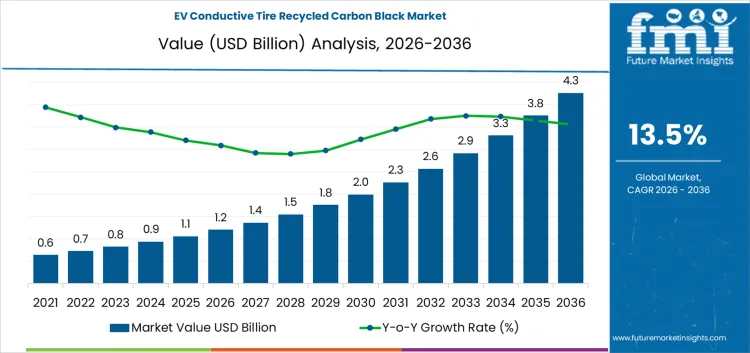
What is the Growth Forecast for the EV Conductive Tire Recycled Carbon Black Market through 2036?
The EV conductive tire recycled carbon black market is expected to show a consistent rolling CAGR over the next decade, reflecting both gradual acceleration and stable market growth. Starting from USD 1.2 billion in 2026, the market will see increases of approximately USD 0.2 billion annually during the first years. By 2027, the market is projected to reach USD 1.4 billion, followed by USD 1.6 billion in 2028 and USD 1.8 billion in 2029. This steady annual growth indicates a reliable market expansion driven by the increasing adoption of EVs and the growing demand for sustainable tire materials.
As the market matures, the rate of growth is expected to remain stable, with the market reaching USD 2 billion in 2030 and continuing its upward trend, reaching USD 3.8 billion by 2035. The market will continue its expansion until it hits USD 4.3 billion in 2036, driven by a combination of rising environmental concerns, growing EV adoption, and technological advancements in recycled carbon black production. The overall trajectory will be characterized by a rolling CAGR, with consistent annual growth over the forecast period.
EV Conductive Tire Recycled Carbon Black Market Key Takeaways
| Metric | Value |
|---|---|
| Industry Sales Value (2026) | USD 1.2 billion |
| Industry Forecast Value (2036) | USD 4.3 billion |
| Industry Forecast CAGR 2026 to 2036 | 13.5% |
What Is Driving the EV Conductive Tire Recycled Carbon Black Market?
Historically, the market for EV conductive tire recycled carbon black developed from efforts to improve tire performance while addressing environmental concerns tied to conventional carbon black. Traditional carbon black, produced from fossil feedstocks, has been the dominant reinforcing and conductive filler in tires because of its ability to enhance wear resistance, tensile strength, and electrical properties. Early electric vehicle tire designs prioritized rolling resistance and durability, with less emphasis on conductivity. As EVs proliferated, the need for conductive fillers increased to manage electrostatic charge and improve sensor integration in tire structures.
Recycling streams from end of life tires and production scrap emerged as sources of recycled carbon black, which offered a lower carbon alternative to virgin material. Initial adoption was concentrated in research settings and limited commercial trials where material scientists evaluated processing methods to retain desirable particle size distribution and structure for conductive applications in EV tires. This early phase generated performance data on compatibility with rubber matrices, mixing behavior, and impacts on tire longevity, informing interest among tire manufacturers considering sustainable material portfolios.
Future demand for EV conductive tire recycled carbon black is expected to be driven by wider adoption of electric vehicles, regulatory pressures to reduce carbon footprint in automotive supply chains, and advancements in tire design that integrate electrical functionality. As regulatory frameworks tighten emissions standards and mandate recycled content in vehicle components, tire makers will increasingly incorporate recycled carbon black to meet sustainability targets and reduce dependence on fossil based carbon black. Growth factors will include improvements in recycling technologies that yield higher quality, more consistent conductive carbon black suitable for high performance tire compounds, and expanded collection and processing infrastructure for end of life rubber.
The expanding EV market will also elevate demand for conductive tires that can dissipate charge, support embedded sensors, and improve safety. Challenges include competition with low cost virgin carbon black, technical complexity in achieving uniform conductivity in tires, and the need for standardized quality metrics for recycled material. Long term market expansion will depend on demonstrable performance parity with virgin conductive fillers, cost competitiveness, and alignment between automotive sustainability mandates and material innovation.
What are the Key Segments in the EV Conductive Tire Recycled Carbon Black Market?
The EV Conductive Tire Recycled Carbon Black (rCB) market is segmented into product types and end users. Product types include recycled carbon black (rCB), conductive polymer composites, hybrid rCB-graphene formulations, and others, with rCB being the dominant product, holding a 58% share. On the end-user side, tire OEMs account for the largest share, representing 52% of the market. Other end users include Tier-1 material suppliers, EV manufacturers, and aftermarket tire producers. The market is driven by the growing demand for sustainable and high-performance materials in the tire industry, especially with the increasing adoption of electric vehicles (EVs). Recycled carbon black, known for its environmental benefits and ability to enhance the conductivity and durability of tires, is gaining traction in both traditional and EV tire production. The market is expanding in regions such as North America, Europe, and Asia Pacific, driven by stringent environmental regulations and the automotive industry's shift toward sustainable manufacturing.
What is Driving Growth in the Recycled Carbon Black (rCB) Product Type?
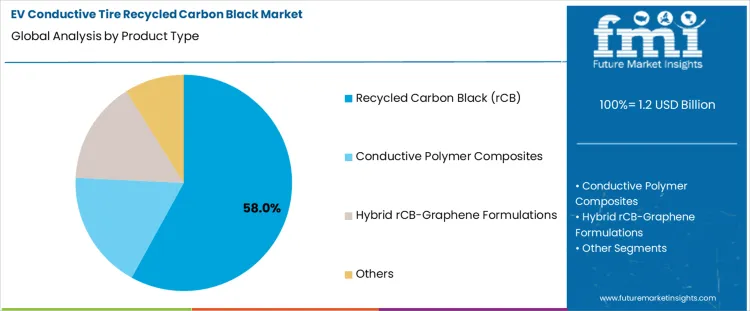
Recycled carbon black (rCB) is the leading product in the EV Conductive Tire Recycled Carbon Black market, accounting for 58% of the market share. The growth of rCB is primarily driven by its environmental benefits, as it is derived from waste tire material and provides a sustainable alternative to virgin carbon black, which is traditionally produced from petroleum-based resources. The increasing adoption of rCB is closely linked to the growing demand for sustainable solutions in the tire industry, particularly in the production of EV tires, where the need for high-performance, eco-friendly materials is critical. rCB not only reduces waste but also enhances the conductivity and durability of tires, making it an attractive option for tire manufacturers.
The push for recycling and reducing carbon footprints in automotive manufacturing aligns with government regulations in regions like Europe and North America, where environmental standards are becoming more stringent. Additionally, the use of rCB contributes to improved tire performance, such as better rolling resistance and longer tire life, further driving its adoption. As the tire industry, particularly the EV sector, seeks to align with sustainability goals, rCB is expected to continue to dominate the market, offering both performance and environmental advantages.
What is Driving the Demand for Tire OEMs in the EV Conductive Tire Recycled Carbon Black Market?
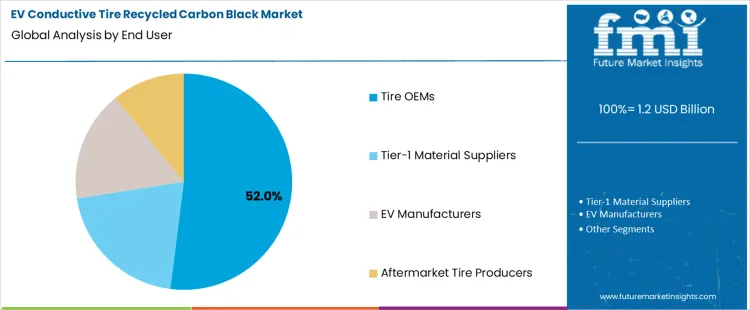
Tire OEMs represent the largest end-user segment in the EV Conductive Tire Recycled Carbon Black market, holding 52% of the market share. This growth is primarily driven by the increasing demand for sustainable and high-performance tires in the electric vehicle (EV) sector. As EV manufacturers prioritize the reduction of environmental impact in their supply chains, tire OEMs are under pressure to develop tires that not only meet performance standards but also align with sustainability goals. The use of recycled carbon black (rCB) in tire production offers a significant reduction in the carbon footprint compared to traditional carbon black, making it an ideal solution for eco-conscious OEMs.
Additionally, rCB enhances tire properties such as conductivity, wear resistance, and durability, which are crucial for EVs that require tires capable of handling higher torque and longer lifespans. The growth of the EV market, especially in regions like Europe, North America, and China, where green regulations are pushing for more sustainable manufacturing practices, is further boosting the demand for tires made with recycled materials. As the tire industry embraces circular economy principles and strives to meet increasingly stringent environmental standards, tire OEMs are expected to continue leading the market's growth, driving the adoption of rCB in tire production.
What are the Key Dynamics in the EV Conductive Tire Recycled Carbon Black Market?
The EV conductive tire recycled carbon black market is evolving as the automotive industry moves toward more sustainable and high-performance materials. Carbon black, an essential ingredient in tire manufacturing, is traditionally produced from fossil fuels, contributing to environmental concerns. However, with the shift toward electric vehicles (EVs), there is a growing focus on improving the performance and sustainability of EV tires. Recycled carbon black, derived from the recovery of used tires or industrial waste, is gaining traction as an eco-friendly alternative to traditional carbon black. Its conductive properties are particularly important in EV tires, where electrical conductivity plays a role in energy efficiency and safety. The market is driven by increasing demand for sustainable materials, regulatory pressures to reduce the carbon footprint of automotive manufacturing, and the need to enhance the performance of tires in electric vehicles, which require specific materials to manage high torque and ensure durability.
What are the Key Drivers of Growth in the EV Conductive Tire Recycled Carbon Black Market?
The primary drivers of growth in this market include the growing shift toward electric vehicles and the increasing focus on sustainability within the automotive industry. As EVs become more popular, manufacturers are focusing on optimizing every component, including tires, to improve energy efficiency, performance, and environmental impact. Recycled carbon black offers an effective way to reduce the carbon footprint of tire production while maintaining high performance, which makes it an attractive option for EV manufacturers. Additionally, stringent regulations on waste disposal and carbon emissions are pushing companies toward the adoption of recycled materials. Innovations in recycling technologies and the increasing availability of waste tires for carbon black recovery are also facilitating market growth. The increasing adoption of circular economy principles in automotive manufacturing, which prioritizes resource efficiency and waste reduction, is further driving demand for recycled carbon black in EV tire production.
What are the Key Restraints in the EV Conductive Tire Recycled Carbon Black Market?
Despite its potential, the EV conductive tire recycled carbon black market faces several challenges. The production of recycled carbon black on a large scale remains expensive and complex, especially when compared to traditional carbon black production methods. The consistency and quality of recycled carbon black can also vary, which may limit its use in high-performance applications like EV tires, where specific material properties are crucial for safety and efficiency. Additionally, the infrastructure for recycling and recovering carbon black from used tires is still developing, which may restrict the availability of recycled carbon black in some regions. The lack of standardization in recycled carbon black production and concerns about its long-term durability and performance in tires could also slow down its adoption. Furthermore, competition from alternative sustainable materials, such as silica and bio-based carbon black, presents additional challenges to the market’s growth.
What are the Key Trends in the EV Conductive Tire Recycled Carbon Black Market?
Several trends are shaping the EV conductive tire recycled carbon black market. One key trend is the increasing adoption of circular economy principles in the automotive industry, with more manufacturers looking to close the loop on tire waste and reduce their reliance on virgin materials. As part of this trend, the use of recycled carbon black is becoming a preferred solution for EV tire production due to its eco-friendly benefits and ability to meet the high-performance demands of EV tires. Innovations in recycling technologies, such as pyrolysis and advanced depolymerization techniques, are making it easier to produce high-quality recycled carbon black with consistent properties. Additionally, there is a growing focus on developing tires that are optimized for electric vehicles, which require specialized materials to handle the higher torque and weight associated with electric drivetrains. As the market for electric vehicles continues to expand, the demand for specialized components like conductive tires made from recycled carbon black is expected to grow, supporting the shift toward more sustainable and high-performance automotive materials.
What is the Country-Wise Analysis of the EV Conductive Tire Recycled Carbon Black Market?
The EV conductive tire recycled carbon black market is seeing significant growth globally, driven by the increasing demand for electric vehicles (EVs) and the growing need for sustainable tire materials. Recycled carbon black is used in tire production to enhance performance, improve conductivity, and reduce environmental impact. As the automotive industry shifts towards EVs, the demand for sustainable and high-performance materials in tire production is on the rise. Countries such as the USA, China, Germany, Japan, and India are leading the way in adopting these materials, each influenced by their respective automotive industries, environmental policies, and advancements in recycling technologies.
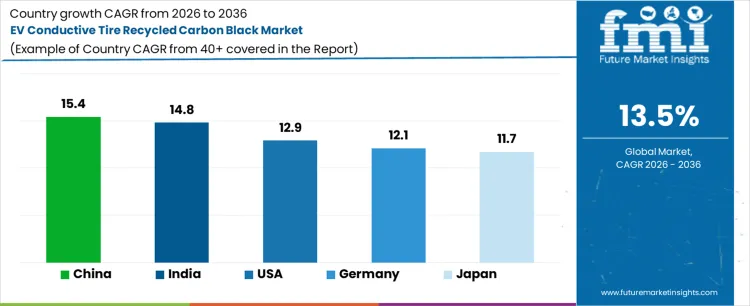
| Country | CAGR (%) |
|---|---|
| USA | 12.9 |
| China | 15.4 |
| Germany | 12.1 |
| Japan | 11.7 |
| India | 14.8 |
What is Driving the Growth of the EV Conductive Tire Recycled Carbon Black Market in the USA?
The EV conductive tire recycled carbon black market in the USA is growing at a CAGR of 12.9%. This growth is driven by the increasing adoption of electric vehicles, which require tires that offer better conductivity, safety, and sustainability. As the USA continues to invest in the transition to EVs, there is a growing demand for high-performance tire materials, including recycled carbon black. Recycled carbon black not only improves tire performance but also helps meet environmental goals by reducing waste and carbon emissions. The US automotive industry is increasingly prioritizing sustainable production methods, which is further boosting the adoption of recycled materials. As government incentives for EVs and sustainable technologies increase, the market for conductive tire recycled carbon black is expected to grow steadily.
How is the EV Conductive Tire Recycled Carbon Black Market Evolving in China?
China’s EV conductive tire recycled carbon black market is growing at a CAGR of 15.4%. As the world’s largest automotive market and a leader in EV production, China plays a crucial role in driving the demand for sustainable tire materials. The Chinese government has introduced several policies to promote green and sustainable automotive technologies, including incentives for EV production and the use of recycled materials in manufacturing. The demand for tires with improved conductivity for EVs is growing, leading to increased adoption of recycled carbon black. China’s automotive industry is rapidly transitioning to EVs, and with this shift comes a significant opportunity for recycled carbon black to enhance tire performance while meeting environmental goals. As the country’s recycling technologies continue to advance, the market for recycled carbon black in tires is expected to expand further.
What Factors are Shaping the EV Conductive Tire Recycled Carbon Black Market in Germany?
Germany’s EV conductive tire recycled carbon black market is growing at a CAGR of 12.1%. As a leader in automotive manufacturing, Germany’s automotive industry is shifting towards electric mobility, which is creating strong demand for sustainable and high-performance tire materials. The country’s stringent environmental regulations and focus on reducing the carbon footprint in manufacturing are also contributing to the growth of the market. Recycled carbon black is seen as an eco-friendly alternative to virgin carbon black, helping manufacturers reduce waste and meet sustainability targets. With Germany’s commitment to green automotive technologies, the demand for conductive tire recycled carbon black is expected to continue to grow, especially as the EV market expands.
How is the EV Conductive Tire Recycled Carbon Black Market Performing in Japan?
Japan’s EV conductive tire recycled carbon black market is growing at a CAGR of 11.7%. Japan’s automotive industry is rapidly transitioning to electric vehicles, which is fueling demand for advanced materials in tire production. Recycled carbon black, known for its improved conductivity and reduced environmental impact, is gaining traction in the tire manufacturing sector. Japan’s strong emphasis on sustainability and reducing waste in manufacturing aligns with the growing use of recycled materials. Additionally, as Japan works towards achieving its carbon neutrality goals, the adoption of sustainable tire materials like recycled carbon black is expected to increase. The market in Japan is poised for steady growth as the country continues to innovate in EV technologies and sustainable manufacturing practices.
What is Contributing to the Growth of the EV Conductive Tire Recycled Carbon Black Market in India?
India’s EV conductive tire recycled carbon black market is growing at a CAGR of 14.8%. The rapid growth of the electric vehicle market in India is driving the demand for high-performance tires that offer improved conductivity and sustainability. As India focuses on expanding its EV infrastructure and reducing its carbon footprint, the use of recycled carbon black in tire production is becoming increasingly popular. The Indian automotive industry is adopting sustainable manufacturing practices to meet government policies and global environmental standards. As the demand for EVs continues to rise in India, the need for recycled carbon black in tires is expected to grow significantly. Additionally, advancements in India’s recycling technologies are likely to further fuel market expansion.
What is the Competitive Landscape for the EV Conductive Tire Recycled Carbon Black Market?
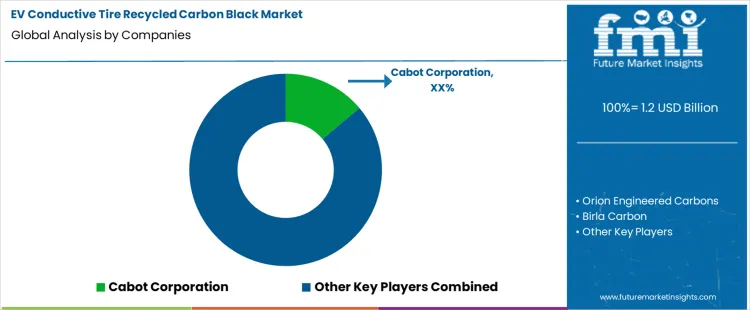
The EV conductive tire recycled carbon black market is increasingly driven by the demand for sustainable materials in the growing electric vehicle (EV) sector. Cabot Corporation leads the market, offering high-performance conductive carbon black solutions for tire applications. The company focuses on providing sustainable alternatives to traditional carbon black, with its innovative approach aligning with the industry’s push for eco-friendly materials. Orion Engineered Carbons is also a key player, providing a range of carbon black products that contribute to improved conductivity and durability in EV tires. Birla Carbon, a significant competitor, is advancing the use of recycled carbon black in its tire formulations, aiming to reduce environmental impact while maintaining product performance.
Continental Material Tech and Black Bear Carbon are positioning themselves as strong contenders in the market, with Black Bear Carbon particularly focused on the production of high-quality recycled carbon black from end-of-life tires, aligning with circular economy principles. These companies are continuously improving their carbon black offerings to meet the specific needs of the electric vehicle tire market.
To stay competitive, companies in the EV conductive tire recycled carbon black market are focusing on product innovation, sustainability, and strategic partnerships. Cabot Corporation continues to refine its offerings by developing new grades of carbon black with enhanced conductive properties, improving the overall performance of EV tires. Orion Engineered Carbons and Birla Carbon are investing in research and development to create more efficient processes for producing recycled carbon black.
These efforts aim to lower production costs and reduce environmental impact while meeting the stringent demands of the tire industry. Companies like Continental Material Tech and Black Bear Carbon are increasing their capacity for recycling used tires, capitalizing on the growing market for sustainable raw materials in EV tire manufacturing. As the demand for EVs continues to rise, these players are well-positioned to meet the market's evolving needs, reinforcing their positions in the competitive landscape of the EV conductive tire recycled carbon black market.
Key Players of the EV Conductive Tire Recycled Carbon Black Market
- Cabot Corporation
- Orion Engineered Carbons
- Birla Carbon
- Continental Material Tech
- Black Bear Carbon
- Others
Scope of the Report
| Items | Values |
|---|---|
| Quantitative Units (2026) | USD Billion |
| Product Type | Recycled Carbon Black (rCB), Conductive Polymer Composites, Hybrid rCB-Graphene Formulations, Others |
| Application | EV Passenger Vehicle Tires, Light Commercial EV Tires, Heavy EV & Bus Tires, Specialty High-Performance EV Tires |
| End User | Tire OEMs, Tier-1 Material Suppliers, EV Manufacturers, Aftermarket Tire Producers |
| Companies | Cabot Corporation, Orion Engineered Carbons, Birla Carbon, Continental Material Tech, Black Bear Carbon, Others |
| Regions Covered | North America, Latin America, Western Europe, Eastern Europe, South Asia and Pacific, East Asia, Middle East & Africa |
| Countries Covered | United States, Canada, Mexico, Brazil, Argentina, Germany, France, United Kingdom, Italy, Spain, Netherlands, China, India, Japan, South Korea, ANZ, GCC Countries, South Africa |
| Additional Attributes | Dollar sales by product type, application, end user, and region. Includes market trends towards sustainable tire manufacturing, cost-effectiveness, conductivity improvements in EV tires, regulatory compliance, and the role of recycled carbon black in enhancing tire performance and reducing environmental impact. |
EV Conductive Tire Recycled Carbon Black Market Segmentation
Product Type
- Recycled Carbon Black (rCB)
- Conductive Polymer Composites
- Hybrid rCB-Graphene Formulations
- Others
Application
- EV Passenger Vehicle Tires
- Light Commercial EV Tires
- Heavy EV & Bus Tires
- Specialty High-Performance EV Tires
- Others
End User
- Tire OEMs
- Tier-1 Material Suppliers
- EV Manufacturers
- Aftermarket Tire Producers
- Others
Region
- Asia Pacific
- China
- Japan
- India
- Australia & New Zealand
- ASEAN
- Rest of Asia Pacific
- Europe
- Germany
- United Kingdom
- France
- Italy
- Spain
- Nordic
- BENELUX
- Rest of Europe
- North America
- United States
- Canada
- Mexico
- Latin America
- Brazil
- Argentina
- Rest of Latin America
- Middle East & Africa
- Kingdom of Saudi Arabia
- Other GCC Countries
- South Africa
- Rest of Middle East & Africa
Bibliography
- National Renewable Energy Laboratory. (2023). Comparison of Select Thermochemical Conversion Options for Municipal Solid Waste to Energy. NREL Report Brief (NREL/BR-6A20-86461).
- Basel Convention. (2024). Technical Guidelines for the Environmentally Sound Management of Used and Waste Pneumatic Tyres. United Nations Environment Programme.
- European Commission, CORDIS. (2024). End-of-life tyres: from waste to a valuable resource. CORDIS (EU Research Results).
- ASTM International. (2023). Quality Control for Recovered Carbon Black. ASTM International (Standards & Publications Article).
- Central Pollution Control Board (CPCB), Government of India. (2025). Waste Tyre Extended Producer Responsibility (EPR) Portal and Compliance Updates. CPCB.
Frequently Asked Questions
How big is the ev conductive tire recycled carbon black market in 2026?
The global ev conductive tire recycled carbon black market is estimated to be valued at USD 1.2 billion in 2026.
What will be the size of ev conductive tire recycled carbon black market in 2036?
The market size for the ev conductive tire recycled carbon black market is projected to reach USD 4.3 billion by 2036.
How much will be the ev conductive tire recycled carbon black market growth between 2026 and 2036?
The ev conductive tire recycled carbon black market is expected to grow at a 13.5% CAGR between 2026 and 2036.
What are the key product types in the ev conductive tire recycled carbon black market?
The key product types in ev conductive tire recycled carbon black market are recycled carbon black (rcb), conductive polymer composites, hybrid rcb-graphene formulations and others.
Which application segment to contribute significant share in the ev conductive tire recycled carbon black market in 2026?
In terms of application, ev passenger vehicle tires segment to command 44.0% share in the ev conductive tire recycled carbon black market in 2026.
Preview the report firsthand - request a free sample
Get SampleGet the brochure for pricing and purchase details.
Get PDFTable of Content
- Executive Summary
- Global Market Outlook
- Demand-side Trends
- Supply-side Trends
- Technology Roadmap Analysis
- Analysis and Recommendations
- Market Overview
- Market Coverage / Taxonomy
- Market Definition / Scope / Limitations
- Market Background
- Market Dynamics
- Drivers
- Restraints
- Opportunity
- Trends
- Scenario Forecast
- Demand in Optimistic Scenario
- Demand in Likely Scenario
- Demand in Conservative Scenario
- Opportunity Map Analysis
- Product Life Cycle Analysis
- Supply Chain Analysis
- Investment Feasibility Matrix
- Value Chain Analysis
- PESTLE and Porter’s Analysis
- Regulatory Landscape
- Regional Parent Market Outlook
- Production and Consumption Statistics
- Import and Export Statistics
- Market Dynamics
- Global Market Analysis 2021 to 2025 and Forecast, 2026 to 2036
- Historical Market Size Value (USD Million) Analysis, 2021 to 2025
- Current and Future Market Size Value (USD Million) Projections, 2026 to 2036
- Y-o-Y Growth Trend Analysis
- Absolute $ Opportunity Analysis
- Global Market Pricing Analysis 2021 to 2025 and Forecast 2026 to 2036
- Global Market Analysis 2021 to 2025 and Forecast 2026 to 2036, By Product Type
- Introduction / Key Findings
- Historical Market Size Value (USD Million) Analysis By Product Type , 2021 to 2025
- Current and Future Market Size Value (USD Million) Analysis and Forecast By Product Type , 2026 to 2036
- Recycled Carbon Black (rCB)
- Conductive Polymer Composites
- Hybrid rCB-Graphene Formulations
- Others
- Recycled Carbon Black (rCB)
- Y-o-Y Growth Trend Analysis By Product Type , 2021 to 2025
- Absolute $ Opportunity Analysis By Product Type , 2026 to 2036
- Global Market Analysis 2021 to 2025 and Forecast 2026 to 2036, By Application
- Introduction / Key Findings
- Historical Market Size Value (USD Million) Analysis By Application, 2021 to 2025
- Current and Future Market Size Value (USD Million) Analysis and Forecast By Application, 2026 to 2036
- EV Passenger Vehicle Tires
- Light Commercial EV Tires
- Heavy EV & Bus Tires
- Specialty High-Performance EV Tires
- EV Passenger Vehicle Tires
- Y-o-Y Growth Trend Analysis By Application, 2021 to 2025
- Absolute $ Opportunity Analysis By Application, 2026 to 2036
- Global Market Analysis 2021 to 2025 and Forecast 2026 to 2036, By End User
- Introduction / Key Findings
- Historical Market Size Value (USD Million) Analysis By End User, 2021 to 2025
- Current and Future Market Size Value (USD Million) Analysis and Forecast By End User, 2026 to 2036
- Tire OEMs
- Tier-1 Material Suppliers
- EV Manufacturers
- Aftermarket Tire Producers
- Tire OEMs
- Y-o-Y Growth Trend Analysis By End User, 2021 to 2025
- Absolute $ Opportunity Analysis By End User, 2026 to 2036
- Global Market Analysis 2021 to 2025 and Forecast 2026 to 2036, By Region
- Introduction
- Historical Market Size Value (USD Million) Analysis By Region, 2021 to 2025
- Current Market Size Value (USD Million) Analysis and Forecast By Region, 2026 to 2036
- North America
- Latin America
- Western Europe
- Eastern Europe
- East Asia
- South Asia and Pacific
- Middle East & Africa
- Market Attractiveness Analysis By Region
- North America Market Analysis 2021 to 2025 and Forecast 2026 to 2036, By Country
- Historical Market Size Value (USD Million) Trend Analysis By Market Taxonomy, 2021 to 2025
- Market Size Value (USD Million) Forecast By Market Taxonomy, 2026 to 2036
- By Country
- USA
- Canada
- Mexico
- By Product Type
- By Application
- By End User
- By Country
- Market Attractiveness Analysis
- By Country
- By Product Type
- By Application
- By End User
- Key Takeaways
- Latin America Market Analysis 2021 to 2025 and Forecast 2026 to 2036, By Country
- Historical Market Size Value (USD Million) Trend Analysis By Market Taxonomy, 2021 to 2025
- Market Size Value (USD Million) Forecast By Market Taxonomy, 2026 to 2036
- By Country
- Brazil
- Chile
- Rest of Latin America
- By Product Type
- By Application
- By End User
- By Country
- Market Attractiveness Analysis
- By Country
- By Product Type
- By Application
- By End User
- Key Takeaways
- Western Europe Market Analysis 2021 to 2025 and Forecast 2026 to 2036, By Country
- Historical Market Size Value (USD Million) Trend Analysis By Market Taxonomy, 2021 to 2025
- Market Size Value (USD Million) Forecast By Market Taxonomy, 2026 to 2036
- By Country
- Germany
- UK
- Italy
- Spain
- France
- Nordic
- BENELUX
- Rest of Western Europe
- By Product Type
- By Application
- By End User
- By Country
- Market Attractiveness Analysis
- By Country
- By Product Type
- By Application
- By End User
- Key Takeaways
- Eastern Europe Market Analysis 2021 to 2025 and Forecast 2026 to 2036, By Country
- Historical Market Size Value (USD Million) Trend Analysis By Market Taxonomy, 2021 to 2025
- Market Size Value (USD Million) Forecast By Market Taxonomy, 2026 to 2036
- By Country
- Russia
- Poland
- Hungary
- Balkan & Baltic
- Rest of Eastern Europe
- By Product Type
- By Application
- By End User
- By Country
- Market Attractiveness Analysis
- By Country
- By Product Type
- By Application
- By End User
- Key Takeaways
- East Asia Market Analysis 2021 to 2025 and Forecast 2026 to 2036, By Country
- Historical Market Size Value (USD Million) Trend Analysis By Market Taxonomy, 2021 to 2025
- Market Size Value (USD Million) Forecast By Market Taxonomy, 2026 to 2036
- By Country
- China
- Japan
- South Korea
- By Product Type
- By Application
- By End User
- By Country
- Market Attractiveness Analysis
- By Country
- By Product Type
- By Application
- By End User
- Key Takeaways
- South Asia and Pacific Market Analysis 2021 to 2025 and Forecast 2026 to 2036, By Country
- Historical Market Size Value (USD Million) Trend Analysis By Market Taxonomy, 2021 to 2025
- Market Size Value (USD Million) Forecast By Market Taxonomy, 2026 to 2036
- By Country
- India
- ASEAN
- Australia & New Zealand
- Rest of South Asia and Pacific
- By Product Type
- By Application
- By End User
- By Country
- Market Attractiveness Analysis
- By Country
- By Product Type
- By Application
- By End User
- Key Takeaways
- Middle East & Africa Market Analysis 2021 to 2025 and Forecast 2026 to 2036, By Country
- Historical Market Size Value (USD Million) Trend Analysis By Market Taxonomy, 2021 to 2025
- Market Size Value (USD Million) Forecast By Market Taxonomy, 2026 to 2036
- By Country
- Kingdom of Saudi Arabia
- Other GCC Countries
- Turkiye
- South Africa
- Other African Union
- Rest of Middle East & Africa
- By Product Type
- By Application
- By End User
- By Country
- Market Attractiveness Analysis
- By Country
- By Product Type
- By Application
- By End User
- Key Takeaways
- Key Countries Market Analysis
- USA
- Pricing Analysis
- Market Share Analysis, 2025
- By Product Type
- By Application
- By End User
- Canada
- Pricing Analysis
- Market Share Analysis, 2025
- By Product Type
- By Application
- By End User
- Mexico
- Pricing Analysis
- Market Share Analysis, 2025
- By Product Type
- By Application
- By End User
- Brazil
- Pricing Analysis
- Market Share Analysis, 2025
- By Product Type
- By Application
- By End User
- Chile
- Pricing Analysis
- Market Share Analysis, 2025
- By Product Type
- By Application
- By End User
- Germany
- Pricing Analysis
- Market Share Analysis, 2025
- By Product Type
- By Application
- By End User
- UK
- Pricing Analysis
- Market Share Analysis, 2025
- By Product Type
- By Application
- By End User
- Italy
- Pricing Analysis
- Market Share Analysis, 2025
- By Product Type
- By Application
- By End User
- Spain
- Pricing Analysis
- Market Share Analysis, 2025
- By Product Type
- By Application
- By End User
- France
- Pricing Analysis
- Market Share Analysis, 2025
- By Product Type
- By Application
- By End User
- India
- Pricing Analysis
- Market Share Analysis, 2025
- By Product Type
- By Application
- By End User
- ASEAN
- Pricing Analysis
- Market Share Analysis, 2025
- By Product Type
- By Application
- By End User
- Australia & New Zealand
- Pricing Analysis
- Market Share Analysis, 2025
- By Product Type
- By Application
- By End User
- China
- Pricing Analysis
- Market Share Analysis, 2025
- By Product Type
- By Application
- By End User
- Japan
- Pricing Analysis
- Market Share Analysis, 2025
- By Product Type
- By Application
- By End User
- South Korea
- Pricing Analysis
- Market Share Analysis, 2025
- By Product Type
- By Application
- By End User
- Russia
- Pricing Analysis
- Market Share Analysis, 2025
- By Product Type
- By Application
- By End User
- Poland
- Pricing Analysis
- Market Share Analysis, 2025
- By Product Type
- By Application
- By End User
- Hungary
- Pricing Analysis
- Market Share Analysis, 2025
- By Product Type
- By Application
- By End User
- Kingdom of Saudi Arabia
- Pricing Analysis
- Market Share Analysis, 2025
- By Product Type
- By Application
- By End User
- Turkiye
- Pricing Analysis
- Market Share Analysis, 2025
- By Product Type
- By Application
- By End User
- South Africa
- Pricing Analysis
- Market Share Analysis, 2025
- By Product Type
- By Application
- By End User
- USA
- Market Structure Analysis
- Competition Dashboard
- Competition Benchmarking
- Market Share Analysis of Top Players
- By Regional
- By Product Type
- By Application
- By End User
- Competition Analysis
- Competition Deep Dive
- Cabot Corporation
- Overview
- Product Portfolio
- Profitability by Market Segments (Product/Age /Sales Channel/Region)
- Sales Footprint
- Strategy Overview
- Marketing Strategy
- Product Strategy
- Channel Strategy
- Orion Engineered Carbons
- Birla Carbon
- Continental Material Tech
- Black Bear Carbon
- Others
- Cabot Corporation
- Competition Deep Dive
- Assumptions & Acronyms Used
- Research Methodology


