

- Market Size (2026)
- USD 62.0 Mn
- Forecast (2036)
- USD 666.2 Mn
- CAGR (2026 to 2036)
- 26.8%
eVTOL Emergency Descent and Recovery Systems Market Size, Market Forecast and Outlook By FMI
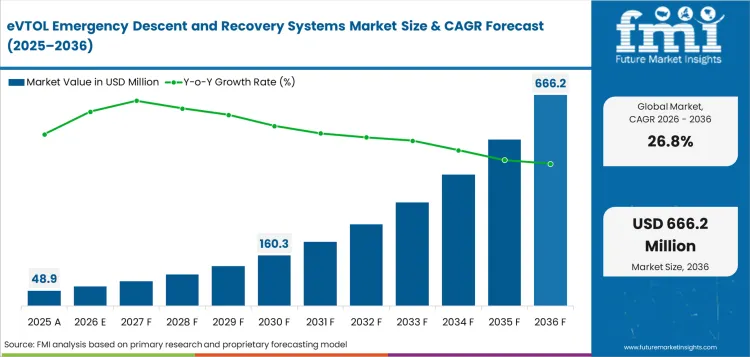
The eVTOL emergency descent and recovery systems market stood at USD 48.9 million in 2025 and is estimated at USD 62.0 million in 2026. From 2026 to 2036, the market is projected to expand at a 26.8% CAGR, taking the overall value to USD 666.2 million by 2036. OEM line-fit is expected to account for a 67.0% installation type share, and passenger air taxis are expected to lead the end use segment with a 52.0% share.
Key Takeaways, Market Size and Forecast
- The eVTOL emergency descent and recovery systems market was valued at USD 48.9 million in 2025.
- By 2036, the eVTOL Emergency Descent and Recovery Systems Market is projected to reach USD 666.2 million.
- From 2026 to 2036, the market is projected to expand at a CAGR of 26.8%.
- The market is projected to create an incremental opportunity of USD 604.2 million between 2026 and 2036.
- In 2026, OEM line-fit is expected to account for 67.0% of installation type demand.
- The USA at 29.4% and China at 28.8% are two faster growing country markets.
- In 2026, passenger air taxis are expected to account for 52.0% of end use demand.
Summary of the eVTOL Emergency Descent and Recovery Systems Market
- Demand and Growth Drivers
- Certification evidence needs raise demand for emergency descent systems as eVTOL makers prepare safety records before passenger operations.
- Low-altitude flight profiles increase recovery system need as urban aircraft have limited time after power or rotor faults.
- Passenger aircraft programs reinforce automatic activation demand as crew response time can be too short during severe descent events.
- Product and Segment View
- OEM line-fit is expected to account for 67.0% of installation type revenue in 2026 as recovery systems need early airframe planning and approved installation space.
- Passenger air taxis are projected to hold 52.0% of end use share in 2026. Safety evidence carries greater weight in aircraft planned for fare-paying passenger service.
- Ballistic parachutes retain high-value system demand as whole-aircraft descent gives certification teams a more direct recovery case after severe flight faults.
- Geography and Competitive Outlook
- The USA is expected to record a CAGR of 29.4% through 2036, as powered-lift certification and pilot programs mature.
- China is projected to expand at 28.8% CAGR by 2036, as pilotless eVTOL certification and low-altitude aviation programs advance.
- Companies combining airframe integration depth with recovery hardware expertise are strengthening their market position during the forecast period.
- Analyst Opinion
- Nikhil Kaitwade, Principal Consultant for Automotive at FMI, says, “Emergency descent systems are becoming certification evidence for eVTOL makers seeking passenger confidence. Aircraft builders need recovery hardware with descent control before the design freeze. Fast deployment and low packed mass reduce redesign pressure while parachute packaging shapes aircraft approval.”
- eVTOL Emergency Descent and Recovery Systems Market Value Analysis
- The eVTOL emergency descent and recovery systems market is moving from prototype safety add-ons into a certification equipment base.
- Adoption is driven by safety evidence needs for passenger air taxis and cargo eVTOL platforms.
- Demand is supported by advanced air mobility programs across early commercial aircraft networks.
- Certification-ready test records guide purchasing decisions as aircraft makers need proof of descent performance and fewer late-stage redesign risks.
Low-altitude eVTOL flights leave very little time to respond after rotor or power failure. The FAA’s November 2024 powered-lift rule created a ten-year SFAR for pilot certification and operations, which means emergency descent evidence needs to be planned early in the aircraft approval process. EASA’s June 2024 SC-VTOL Issue 2 applies to VTOL aircraft with 9 or fewer passenger seats and a maximum certified take-off mass of 5,700 kg.
This makes controlled emergency landing proof important for passenger eVTOL programs. FAA’s March 2026 eVTOL Integration Pilot Program selected 8 projects across 26 states, with operations expected to begin by summer 2026. Field trials will create safety data for regulators and operators. OEMs will prefer line-fit recovery systems with activation electronics and easy inspection access before flight-test programs expand.
eVTOL Emergency Descent and Recovery Systems Market Definition
The eVTOL emergency descent and recovery systems market includes aircraft-installed systems used to stabilize, slow, or lower an eVTOL during severe flight faults. These systems serve passenger air taxis, cargo aircraft, medical eVTOLs, and public safety aircraft. Scope includes ballistic parachutes, controlled descent software, emergency power modules, activation electronics, and crash attenuation devices. Routine flight controls without emergency descent function and ground rescue equipment are outside the scope.
eVTOL Emergency Descent and Recovery Systems Market Inclusions
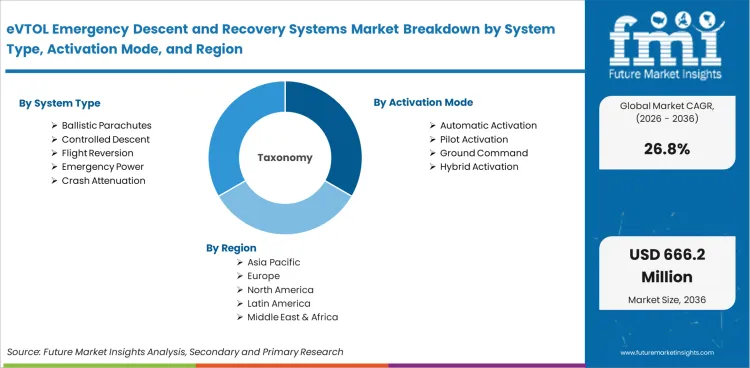
Market scope covers all commercially traded eVTOL emergency descent and recovery systems categorized by system type, including ballistic parachutes, controlled descent systems, flight reversion systems, emergency power modules, and crash attenuation systems; activation mode, including automatic activation, pilot activation, ground command, and hybrid activation; aircraft configuration, including lift-cruise, multicopter, tiltrotor, vectored thrust, and winged VTOL aircraft; installation type, including OEM line-fit, retrofit kits, and test fleet installations; and end use, including passenger air taxi fleets, cargo eVTOLs, medical eVTOLs, public safety aircraft, and training fleets.
Revenue scope covers 2026 to 2036. The key stakeholders include eVTOL manufacturers, recovery system suppliers, parachute module producers, avionics integrators, battery system providers, certification consultants, aircraft operators, more electric aircraft component suppliers, vertiport developers, maintenance service providers, insurance firms, regulators, and safety testing bodies
eVTOL Emergency Descent and Recovery Systems Market Exclusions
Scope does not include normal avionics, pilot training services, vertiport rescue equipment, maintenance software, or aircraft evacuation systems outside onboard emergency descent use.
eVTOL Emergency Descent and Recovery Systems Market Research Methodology
- Primary Research: FMI analysts spoke to eVTOL manufacturers, parachute system specialists, avionics integrators, and certification service specialists in important markets.
- Desk Research: Combined data from FAA powered-lift rules, EASA VTOL guidance, company product portfolios, and aircraft safety requirements.
- Market sizing and forecasting: Added recovery system use across aircraft programs and installation groups from the bottom up.
- Data validation: Cross-checked every three months against certification evidence needs, aircraft program timing, and supplier portfolio coverage.
Why is the eVTOL Emergency Descent and Recovery Systems Market Growing?
- eVTOL makers are using emergency descent systems earlier to reduce redesign risk before certification review begins.
- Recovery system partners are becoming important as aircraft designs combine distributed propulsion and battery-heavy flight architecture.
- Manufacturers are integrating automatic activation electronics to improve response timing during low-altitude mission faults.
Powered-lift certification is creating a formal path for aircraft programs to prove safe operation before passenger service. The FAA’s powered-lift final rule adopted permanent amendments and a ten-year SFAR in November 2024, creating a defined operating path for this aircraft class. This regulatory context increases the need for flight-test evidence across failure response and emergency descent. Recovery system suppliers gain importance as aircraft makers need documented performance across severe fault cases.
EASA safety requirements make continued safe flight and controlled emergency landing important for eVTOL approval. This framework closely matches early air taxi programs, so descent control and occupant protection need strong technical evidence. Suppliers with proven deployment timing and aircraft-level integration records can help reduce uncertainty during certification review.
Market Segmentation Analysis
- Ballistic parachutes are expected to account for 37.0% of the system type segment in 2026 as severe descent cases need direct aircraft recovery.
- Automatic activation is projected at 46.0% share within activation mode for 2026 since low-altitude missions leave limited response time.
- Lift-cruise aircraft are expected to account for 34.0% of configuration revenue in 2026 across passenger programs needing staged recovery planning.
- Certified aircraft builds are expected to keep OEM Line-Fit at 67.0% installation type share in 2026 through early recovery integration.
- Passenger air taxis are expected to represent 52.0% of end use share in 2026 as public service entry needs stronger safety evidence.
The market for eVTOL emergency descent and recovery systems is divided into groups based on system type, activation mode, aircraft configuration, installation type, end use, and region. There are ballistic parachutes, controlled descent systems, flight reversion systems, emergency power modules, and crash attenuation systems under system type. By activation mode, the market includes automatic activation, pilot activation, ground command, and hybrid activation. By aircraft configuration, the market covers lift-cruise aircraft, multicopter aircraft, tiltrotor aircraft, vectored thrust aircraft, and winged VTOL aircraft. Based on installation type, it includes OEM line-fit systems, retrofit kits, and test fleet installations. By end use, the market includes passenger air taxis, cargo eVTOLs, medical eVTOLs, public safety aircraft, and training fleets.
Insights into eVTOL Emergency Descent and Recovery Systems Market by System Type
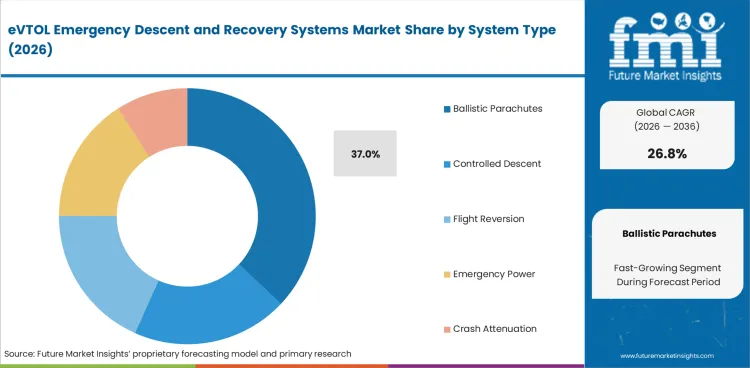
- Ballistic parachutes are expected to account for 37.0% of system type demand in 2026. Whole-aircraft recovery helps eVTOL manufacturers define a direct emergency descent response after severe rotor or power faults.
- Controlled descent and flight reversion systems address aircraft programs needing software-assisted stabilization before emergency landing. Their use improves in platforms with complex flight-control transitions.
Insights into eVTOL Emergency Descent and Recovery Systems Market by Activation Mode
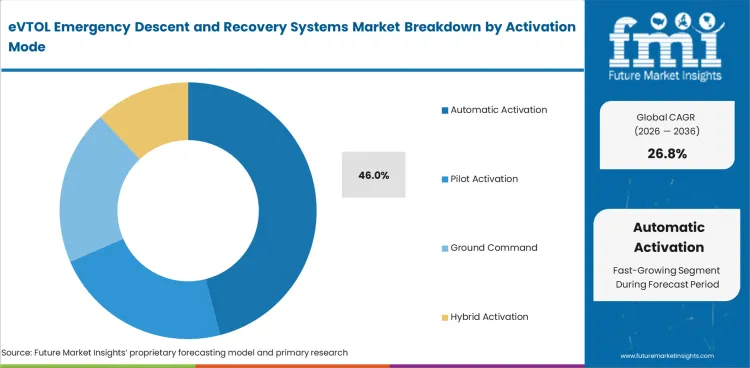
- Automatic activation is projected to hold 46.0% of activation mode demand in 2026. Low-altitude eVTOL missions need fast fault detection as manual response time can be limited during critical flight events.
- Pilot activation and hybrid activation options serve crewed aircraft programs requiring human override. Their role improves in platforms with layered cockpit control needs.
Insights into eVTOL Emergency Descent and Recovery Systems Market by Aircraft Configuration
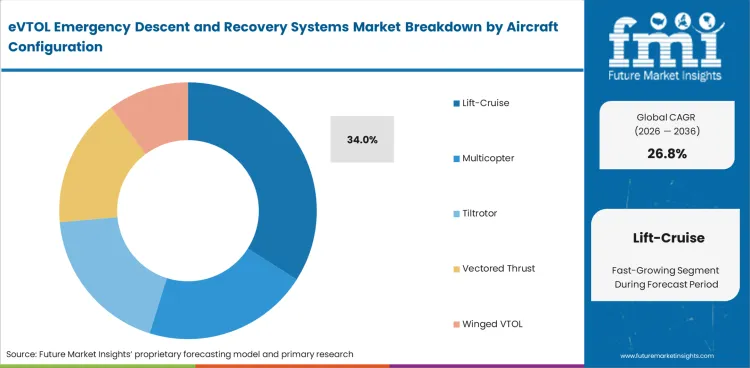
- Lift-cruise aircraft are expected to account for 34.0% of aircraft configuration demand in 2026. This configuration needs recovery planning across vertical lift and wingborne flight phases.
- Multicopter and tiltrotor platforms carry different descent requirements. Recovery system design changes with rotor layout and transition-phase control needs.
Insights into eVTOL Emergency Descent and Recovery Systems Market by Installation Type
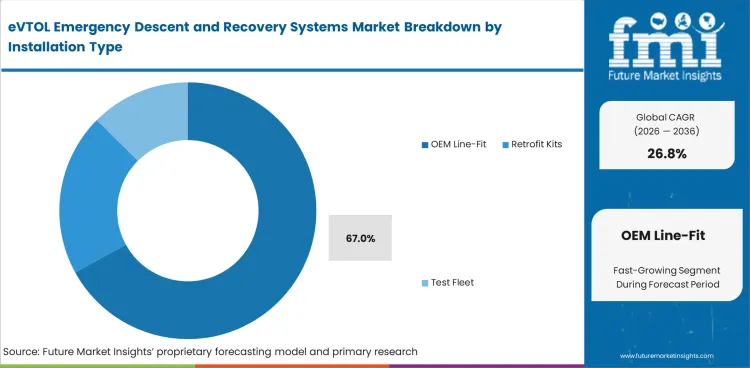
- OEM line-fit installation is expected to account for 67.0% share in 2026. Aircraft manufacturers prefer early integration as recovery systems influence structure and service access.
- Retrofit kits serve test fleets and selected aircraft upgrades. Their value improves in prototype programs requiring safety additions before certification work advances.
Insights into eVTOL Emergency Descent and Recovery Systems Market by End Use
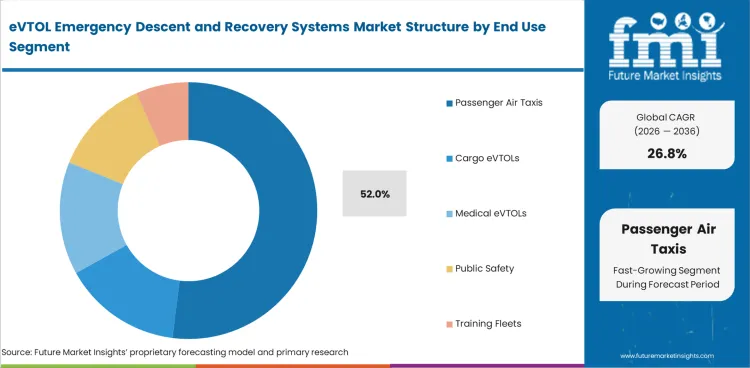
- Passenger air taxis are projected to hold 52.0% share in 2026. Commercial passenger aircraft need stronger emergency descent evidence for certification review and public service readiness.
- Cargo eVTOLs and medical eVTOLs create focused recovery system demand. Their value improves across mission profiles involving dense routes and constrained landing zones.
eVTOL Emergency Descent and Recovery Systems Market Drivers, Restraints, and Opportunities
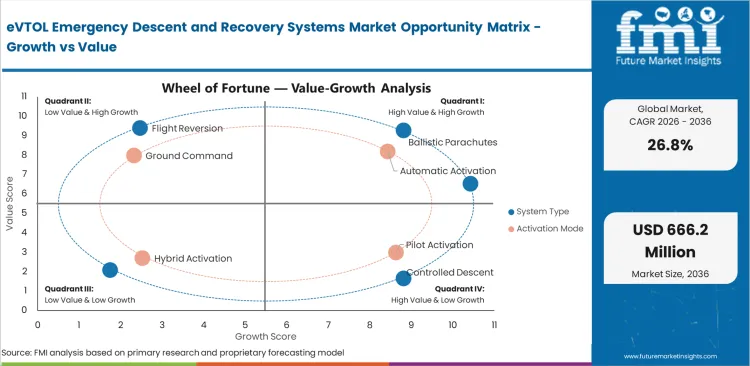
- Certification filing pressure is creating demand for emergency descent evidence across passenger eVTOL programs.
- Packed weight and installation space increase pricing pressure for smaller aircraft platforms.
- Connected aircraft systems improve service opportunity through automatic activation and event data capture.
The market for eVTOL emergency descent and recovery systems expands as aircraft makers need stronger proof before commercial service. FAA selected eight projects for the eVTOL
eVTOL emergency descent and recovery systems keep growing as passenger air taxis and cargo aircraft need reliable descent protection during power or rotor faults. Weight limits and tight airframe space can slow wider integration. Growth is supported by automatic activation systems and OEM line-fit aircraft programs.
Early Certification Volume Is Keeping Prices Firm
Emergency descent and recovery systems for eVTOLs are moving through a price phase where engineering validation is carrying more weight as compared to component scale. FAA-cited AAM demand research conducted in March 2025 estimated NAS-wide AAM departures at 42,405 in Year 1, rising to 2,820,956 by Year 6, with fleet size moving from 4 aircraft to 283 aircraft. For recovery system suppliers this keeps early pricing firm because software assurance and fault tree evidence require significant upfront investment. Parachute or controlled descent integration and flight control redundancy are costly and must be amortized over very small launch fleets. This cost structure limits early pricing flexibility until volume leverage begins to appear. As operators scale, the pricing opportunity shifts toward reusable certification packages and platform-common recovery modules.
Operational Validation Is Lifting Integration Premiums Pricing for eVTOL emergency descent and recovery systems is being pulled upward by route level validation, along with hardware cost considerations. In its February 2026 Orlando International Airport HITL assessment, the FAA modeled three vertiport locations and 12 scenarios. Additive traffic rates reached 26 eVTOL operations per hour with all three vertiports operating at the same time. The study noted over 20 dry-run and shakedown sessions before testing.
This is commercially significant because recovery suppliers must now price for scenario specific descent rationale and alerting functions. They must account for pilot interface behavior and reserve energy management in system pricing. Safe landing area coordination requirements further increase pricing complexity for these recovery solutions. Buyers should expect higher integration and simulation line items until standardized recovery envelopes reduce repeat engineering work.
Analysis of eVTOL Emergency Descent and Recovery Systems Market By Key Countries
.webp "Top Country Growth Comparison Evtol Emergency Descent And Recovery Systems Market Cagr (2026 2036)")
| Country | CAGR |
|---|---|
| USA | 29.4% |
| China | 28.8% |
| UAE | 27.6% |
| Japan | 26.9% |
| Germany | 25.5% |
| UK | 24.9% |
| India | 24.1% |
Source: Future Market Insights, 2026.
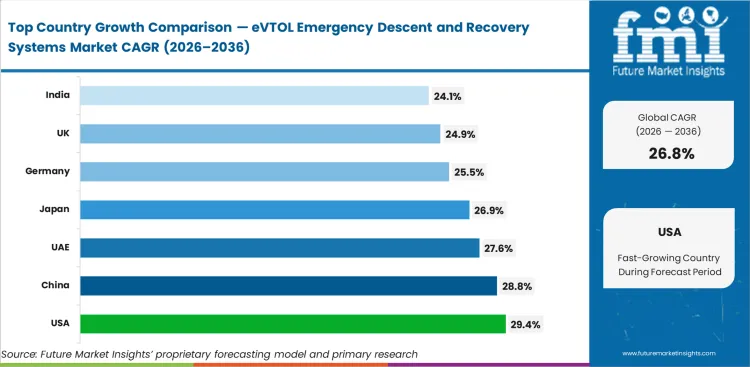
eVTOL Emergency Descent and Recovery Systems Market CAGR Analysis By Country
- USA demand is projected to record the faster pace at 29.4% CAGR, driven by powered-lift certification activity and live pilot programs.
- China is expected to expand at 28.8% CAGR during the assessment period as pilotless eVTOL approvals and low-altitude aviation planning advance together.
- UAE demand is forecast to rise at 27.6% CAGR between 2026 and 2036, helped by early air taxi service planning and vertiport network development.
- Japan is projected to grow at 26.9% CAGR over the forecast years as Expo-linked AAM demonstrations strengthen local certification and public trial activity.
- Germany is projected to advance at 25.5% CAGR by 2036, with European VTOL approval work and supplier depth guiding aircraft safety programs.
- UK demand is expected to post 24.9% CAGR across the forecast window as regulators prepare commercial passenger operations planned from late 2028.
- India is forecast to expand at 24.1% CAGR over 2026 to 2036, driven by AAM working groups and DGCA-backed vertiport guidance.
Demand for eVTOL emergency descent and recovery systems is forecast to rise at 26.8% CAGR from 2026 to 2036. Country-level analysis covers the major markets contributing to this forecast, with the key markets listed below.
Demand Outlook for eVTOL Emergency Descent and Recovery Systems Market in the USA
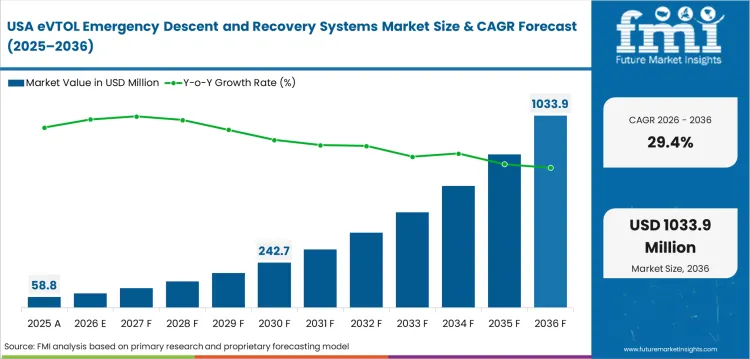
The USA eVTOL emergency descent and recovery systems industry is projected to record a CAGR of 29.4% through 2036. The FAA selected eight eVTOL Integration Pilot Program projects in March 2026, creating flight-use cases for passenger and regional aircraft. This pilot activity strengthens demand for USA eVTOL emergency descent and recovery systems. Local aircraft builders need recovery systems with automatic activation rationale and inspection-ready design.
- Powered-lift certification raises demand for emergency descent systems across FAA-facing aircraft programs.
- Passenger aircraft programs need recovery proof before commercial flight operations can scale.
- Demand for aircraft flight control system integration rises as recovery activation links with fault response.
Sales Analysis of eVTOL Emergency Descent and Recovery Systems Market in China
The eVTOL emergency descent and recovery systems sector in China is expected to expand at a CAGR of 28.8% during the assessment period. EHang stated in September 2024 its EH216-S had obtained type and standard airworthiness certificates from CAAC. This certification base improves demand for China’s eVTOL emergency descent and recovery systems. Suppliers benefit from local aircraft programs seeking repeatable safety records for pilotless and piloted aircraft use.
- Certified pilotless aircraft programs raise demand for automatic activation and descent assurance systems.
- Local low-altitude aviation plans increase safety equipment scrutiny across passenger and sightseeing aircraft.
- Recovery system demand benefits from air traffic management upgrades as flight volume planning improves.
Demand Outlook for eVTOL Emergency Descent and Recovery Systems Market in the UAE
The UAE eVTOL emergency descent and recovery systems industry is forecast to grow at a CAGR of 27.6% by 2036. Joby completed the UAE’s first piloted point-to-point electric air taxi flight in November 2025 and confirmed three new Dubai vertiport sites. This service-readiness work raises demand for UAE eVTOL emergency descent and recovery systems. Operators value recovery systems with heat-tested performance and short inspection cycles for frequent urban flights.
- Early air taxi service planning raises demand for cabin-grade recovery systems.
- Vertiport route planning increases focus on low-altitude descent assurance near dense passenger areas.
- Safety integration connects with Vertiports development as route networks move closer to service.
Opportunity Analysis of eVTOL Emergency Descent and Recovery Systems Market in Japan
The eVTOL emergency descent and recovery systems segment in Japan is projected to advance at 26.9% CAGR over the forecast years. Expo 2025 Osaka included an EXPO Vertiport built for AAM flight demonstrations and public visibility. This operating base improves demand for Japan eVTOL emergency descent and recovery systems. Testing demand is leading for aircraft programs needing quiet descent behavior and safe public demonstration records.
- Public demonstrations boost demand for highly visible safety systems and reliable fault response.
- Domestic eVTOL programs need descent assurance for certification and public acceptance work.
- Flight testing connects with aviation test equipment demand as validation activity expands.
Future Outlook for eVTOL Emergency Descent and Recovery Systems Market in Germany
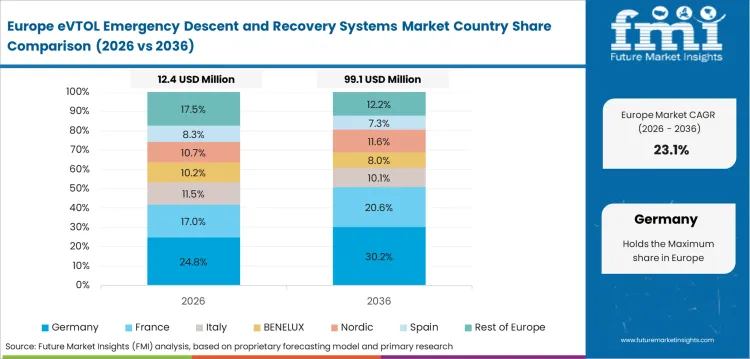
The Germany eVTOL emergency descent and recovery systems industry is expected to post 25.5% CAGR through 2036. Germany’s eVTOL emergency descent and recovery systems market is shaped by Europe’s VTOL certification environment. Aircraft developers need stronger evidence packages before progressing with passenger aircraft programs. This creates demand for partners with disciplined test planning and recovery system knowledge suited to smaller advanced air mobility innovators.
- European certification depth raises demand for documented recovery performance.
- Passenger aircraft programs need strong occupant protection evidence during emergency landing review.
- Testing depth links with aircraft automated inspection and monitoring as service checks become.
Competitive Landscape and Strategic Positioning
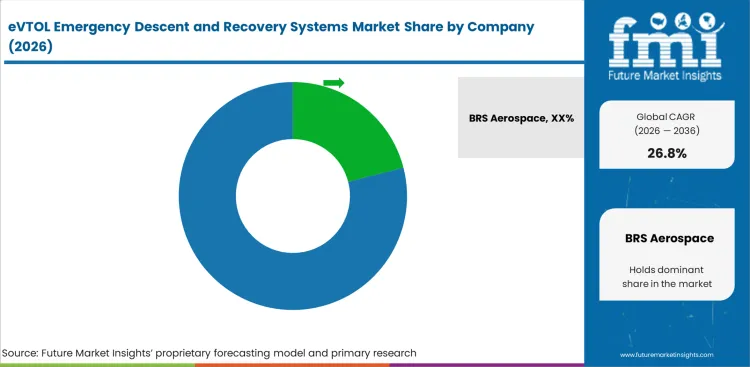
Supplier selection in this market relies on recovery performance and airframe fit across certification-stage aircraft programs. Redesign risk during aircraft approval stays a key decision factor for manufacturers evaluating recovery system partners.
- BRS Aerospace leads through whole-aircraft parachute recovery experience and installation knowledge across light aircraft safety programs.
- Galaxy GRS and SkyEagle Parachute compete on compact parachute assemblies and aircraft-specific recovery designs for smaller platforms.
- Aircraft OEMs connect flight controls with fault sensing, making emergency descent response part of the aircraft approval plan.
BRS Aerospace holds a high position through recovery parachute systems used across light aircraft and emerging electric aircraft programs. Galaxy GRS brings compact recovery hardware suited to smaller aircraft platforms with limited installation space. SkyEagle Parachute focuses on specialist parachute assembly knowledge and platform-specific recovery layouts. Joby Aviation and Archer Aviation add aircraft-level recovery planning through certification-focused design programs. Wisk Aero strengthens the OEM group through autonomous aircraft planning and system redundancy work.
High test cost and strict documentation needs limit entry across safety-critical aircraft equipment. Packed mass reduction and faster deployment timing are becoming key priorities across short descent windows. Manufacturers prefer suppliers offering recovery hardware and activation electronics backed by traceable test records. The top competitors will make recovery equipment easier to install and easier to defend during certification.
Key Companies in the eVTOL Emergency Descent and Recovery Systems Market
Key global companies active in the eVTOL emergency descent and recovery systems market include:
- BRS Aerospace, Galaxy GRS, and SkyEagle Parachute have strong recovery parachute infrastructure for aircraft safety programs.
- Joby Aviation and Archer Aviation serve manufacturers through recovery integration, test programs, and aircraft-level safety architecture.
- Wisk Aero holds a specialist position across autonomous aircraft planning and system redundancy for passenger eVTOL programs.
Competitive Benchmarking: eVTOL Emergency Descent and Recovery Systems Market
| Company | Recovery Integration Depth | Activation Electronics Strength | Certification Evidence Reach | Geographic Footprint |
|---|---|---|---|---|
| BRS Aerospace | High | Medium | High | USA-based with global aircraft recovery parachute coverage and OEM retrofit presence. |
| Galaxy GRS | High | Medium | Medium | Czech Republic-based with European and international recovery system supply reach. |
| SkyEagle Parachute | Medium | High | Medium | China-based with emergency recovery system products for aircraft, eVTOLs, and UAVs. |
| Joby Aviation | High | High | Strong | USA-based with active commercial readiness work in Dubai and international launch planning. |
| Archer Aviation | High | High | Strong | USA-based with FAA certification work and UAE certification activity for Midnight. |
| Wisk Aero | High | High | Strong | USA-based in Mountain View, California, with Boeing-backed autonomous eVTOL development. |
Source: Future Market Insights, 2026.
Key Developments in eVTOL Emergency Descent and Recovery Systems Market
- In January 2024, Pivotal announced the official launch of online sales for the Helix light eVTOL in the United States, with first customer shipments scheduled to begin in June 2024. The company positioned Helix as a safety-focused personal aircraft with fault-tolerant design and triple modular flight control systems. Pivotal’s official Helix page lists a ballistic parachute, radar-guided autoland, and triple redundant flight control system as core safety features.
- In May 2025, Jetson announced the Jetson Airframe Parachute System as a major safety milestone for its Jetson ONE personal eVTOL. The company stated that the system was developed as a last-resort safety mechanism after multiple design iterations and over 20 successful test deployments. Jetson noted that the parachute can be activated by the pilot in a split-second during emergency scenarios.
Key Players in the eVTOL Emergency Descent and Recovery Systems Market
Major Global Players:
- BRS Aerospace
- Galaxy GRS
- SkyEagle Parachute
- Joby Aviation
- Archer Aviation
- Wisk Aero
Specialist Players:
- Galaxy GRS
- SkyEagle Parachute
Report Scope and Coverage
| Parameter | Details |
|---|---|
| Quantitative Units | USD 62.0 million to USD 666.2 million, at a CAGR of 26.8% |
| Market Definition | The eVTOL emergency descent and recovery systems market encompasses aircraft-installed systems used to stabilize or lower aircraft after severe in-flight faults. |
| Regions Covered | North America, Latin America, Europe, East Asia, South Asia and Pacific, Middle East and Africa |
| Countries Covered | USA, China, UAE, Japan, Germany, UK, India, and 30 plus countries |
| Key Companies Profiled | BRS Aerospace, Galaxy GRS, SkyEagle Parachute, Joby Aviation, Archer Aviation, Wisk Aero |
| Forecast Period | 2026 to 2036 |
| Approach | Hybrid bottom-up and top-down methodology starting with recovery system demand and verified certification use patterns. |
eVTOL Emergency Descent and Recovery Systems Market by Segments
eVTOL Emergency Descent and Recovery Systems Market Segmented by System Type:
- Ballistic Parachutes
- Controlled Descent
- Flight Reversion
- Emergency Power
- Crash Attenuation
eVTOL Emergency Descent and Recovery Systems Market Segmented by Activation Mode:
- Automatic Activation
- Pilot Activation
- Ground Command
- Hybrid Activation
eVTOL Emergency Descent and Recovery Systems Market Segmented by Aircraft Configuration:
- Lift-Cruise
- Multicopter
- Tiltrotor
- Vectored Thrust
- Winged VTOL
eVTOL Emergency Descent and Recovery Systems Market Segmented by Installation Type:
- OEM Line-Fit
- Retrofit Kits
- Test Fleet
eVTOL Emergency Descent and Recovery Systems Market Segmented by End Use:
- Passenger Air Taxis
- Cargo eVTOLs
- Medical eVTOLs
- Public Safety
- Training Fleets
eVTOL Emergency Descent and Recovery Systems Market Segmented by Region:
- North America: USA, Canada, Mexico
- Latin America: Brazil, Chile, Rest of Latin America
- Europe: Germany, UK, Italy, Spain, France, Rest of Europe
- East Asia: China, Japan, South Korea
- South Asia and Pacific: India, ASEAN, Australia & New Zealand, Rest of South Asia and Pacific
- Middle East and Africa: UAE, Saudi Arabia, Other GCC Countries, South Africa, Rest of Middle East and Africa
Research Sources and Bibliography
- Federal Aviation Administration. (2024, November 21). Integration of Powered-Lift: Pilot Certification and Operations; Miscellaneous Amendments Related to Rotorcraft and Airplanes. Federal Register.
- European Union Aviation Safety Agency. (2024, June 10). Special Condition for small-category VTOL-capable aircraft. EASA.
- Federal Aviation Administration. (2026, March 9). The future of aviation is here: FAA unveils eight selections for pilot program testing next-gen aircraft. FAA.
- International Civil Aviation Organization. (2025, July 29). Advanced air mobility in India: Current position and developments. ICAO.
- Civil Aviation Authority. (2025, September). Enabling advanced air mobility. UK CAA.
- EHang. (2024, September 16). EHang’s EH216-S pilotless eVTOL obtains experimental flight authorization certificate from Brazilian Civil Aviation Agency. EHang.
- Joby Aviation. (2025, November 17). Dubai Air Taxi Network takes flight: Joby completes landmark flight and announces next vertiport locations. Joby Aviation.
- Expo 2025 Osaka, Kansai, Japan. (2025). Advanced Air Mobility. Japan Association for the 2025 World Exposition.
- Joby Aviation. (2026, March 11). Joby’s first FAA-conforming aircraft takes flight. Joby Aviation.
- Archer Aviation. (2024, January 31). Archer’s Midnight aircraft successfully completes Phase 1 of flight test program. Archer Aviation.
- Federal Aviation Administration. (2024, November 21). Integration of Powered-Lift: Pilot Certification and Operations; Miscellaneous Amendments Related to Rotorcraft and Airplanes. Federal Register.
- European Union Aviation Safety Agency. (2024, June 10). Special Condition for small-category VTOL-capable aircraft: SC-VTOL Issue 2.
- USA Department of Transportation. (2026, March 9). The future of aviation is here: Trump’s Transportation Secretary Sean P. Duffy and FAA unveil eight selections for pilot program testing next-gen aircraft.
- Federal Aviation Administration. (2026, February 20). Advanced Air Mobility Initial Services Assessment of eVTOL Aircraft Operations: Orlando International Airport (MCO). USA Department of Transportation. Advanced Air Mobility Initial Services Assessment of eVTOL Aircraft Operations Orlando International Airport (MCO)
- Federal Aviation Administration. (2025). FAA Aerospace Forecast Fiscal Years 2025–2045: Unmanned Aircraft Systems and Advanced Air Mobility. USA Department of Transportation. FAA Aerospace Forecast Fiscal Years 2025–2045
- Pivotal. (2024, January 8). Pivotal opens sales of Helix light eVTOL aircraft in USA Pivotal | Pivotal Opens Sales of Helix Light eVTOL aircraft in USA
- Jetson. (2025, May 12). Introducing the Jetson Airframe Parachute System: A new era of safety in personal flight. Introducing the Jetson Airframe Parachute System: A New Era of Safety in Personal Flight | Jetson - Personal Electric Aerial Vehicle
This bibliography is provided for reader reference and is not exhaustive. The full report contains the complete reference list and detailed citations.
This Report Answers
- What is the current and future size of the eVTOL emergency descent and recovery systems market?
- How fast is the eVTOL emergency descent and recovery systems market expected to expand between 2026 and 2036?
- Which system type is expected to lead the market by 2026?
- Which installation type segment is expected to account for the leading demand by 2026?
- What factors are driving demand for eVTOL emergency descent and recovery systems globally?
- How are powered-lift certification rules influencing recovery system adoption?
- Why is OEM Line-Fit the main installation base for recovery systems?
- How are passenger air taxi programs creating demand for automatic activation systems?
- Which countries are projected to record faster expansion through 2036?
- What is driving market expansion in the USA and China?
- Who are the key companies active in the eVTOL emergency descent and recovery systems market?
- How does FMI estimate and validate the market forecast?
Frequently Asked Questions
What is the global market demand for eVTOL Emergency Descent and Recovery Systems in 2026?
In 2026, the global market for eVTOL emergency descent and recovery systems is estimated at USD 62.0 million.
How big will the market for eVTOL Emergency Descent and Recovery Systems be in 2036?
By 2036, the market for eVTOL emergency descent and recovery systems is projected to reach USD 666.2 million.
How much is demand for eVTOL Emergency Descent and Recovery Systems expected to expand between 2026 and 2036?
Between 2026 and 2036, demand for eVTOL emergency descent and recovery systems is projected to expand at a CAGR of 26.8%.
Which installation type segment is expected to lead globally by 2026?
OEM Line-Fit will contribute 67.0% of the installation type segment in 2026.
What is causing demand to rise in the USA?
The USA eVTOL emergency descent and recovery systems market is projected to record 29.4% CAGR through 2036, driven by powered-lift certification and pilot programs.
What is causing demand to rise in China?
The China eVTOL emergency descent and recovery systems market is projected to expand at 28.8% CAGR through 2036, driven by pilotless eVTOL certification and low-altitude aircraft planning.
What does this report mean by eVTOL Emergency Descent and Recovery Systems Market definition?
The market includes aircraft-installed systems used to stabilize, slow, or lower eVTOL aircraft after severe in-flight faults.
How does FMI estimate and validate the eVTOL Emergency Descent and Recovery Systems forecast?
Forecast models use a hybrid bottom-up and top-down approach, starting with system demand and validating it against certification use patterns.
Preview the report firsthand - request a free sample
Get SampleGet the brochure for pricing and purchase details.
Get PDFTable of Content
- Executive Summary
- Global Market Outlook
- Demand-side Trends
- Supply-side Trends
- Technology Roadmap Analysis
- Analysis and Recommendations
- Market Overview
- Market Coverage / Taxonomy
- Market Definition / Scope / Limitations
- Research Methodology
- Chapter Orientation
- Analytical Lens and Working Hypotheses
- Market Structure, Signals, and Trend Drivers
- Benchmarking and Cross-market Comparability
- Market Sizing, Forecasting, and Opportunity Mapping
- Research Design and Evidence Framework
- Desk Research Programme (Secondary Evidence)
- Company Annual and Sustainability Reports
- Peer-reviewed Journals and Academic Literature
- Corporate Websites, Product Literature, and Technical Notes
- Earnings Decks and Investor Briefings
- Statutory Filings and Regulatory Disclosures
- Technical White Papers and Standards Notes
- Trade Journals, Industry Magazines, and Analyst Briefs
- Conference Proceedings, Webinars, and Seminar Materials
- Government Statistics Portals and Public Data Releases
- Press Releases and Reputable Media Coverage
- Specialist Newsletters and Curated Briefings
- Sector Databases and Reference Repositories
- FMI Internal Proprietary Databases and Historical Market Datasets
- Subscription Datasets and Paid Sources
- Social Channels, Communities, and Digital Listening Inputs
- Additional Desk Sources
- Expert Input and Fieldwork (Primary Evidence)
- Primary Modes
- Qualitative Interviews and Expert Elicitation
- Quantitative Surveys and Structured Data Capture
- Blended Approach
- Why Primary Evidence is Used
- Field Techniques
- Interviews
- Surveys
- Focus Groups
- Observational and In-context Research
- Social and Community Interactions
- Stakeholder Universe Engaged
- C-suite Leaders
- Board Members
- Presidents and Vice Presidents
- R&D and Innovation Heads
- Technical Specialists
- Domain Subject-matter Experts
- Scientists
- Physicians and Other Healthcare Professionals
- Governance, Ethics, and Data Stewardship
- Research Ethics
- Data Integrity and Handling
- Primary Modes
- Tooling, Models, and Reference Databases
- Desk Research Programme (Secondary Evidence)
- Data Engineering and Model Build
- Data Acquisition and Ingestion
- Cleaning, Normalisation, and Verification
- Synthesis, Triangulation, and Analysis
- Quality Assurance and Audit Trail
- Market Background
- Market Dynamics
- Drivers
- Restraints
- Opportunity
- Trends
- Scenario Forecast
- Demand in Optimistic Scenario
- Demand in Likely Scenario
- Demand in Conservative Scenario
- Opportunity Map Analysis
- Product Life Cycle Analysis
- Supply Chain Analysis
- Investment Feasibility Matrix
- Value Chain Analysis
- PESTLE and Porter’s Analysis
- Regulatory Landscape
- Regional Parent Market Outlook
- Production and Consumption Statistics
- Import and Export Statistics
- Market Dynamics
- Global Market Analysis 2021 to 2025 and Forecast, 2026 to 2036
- Historical Market Size Value (USD Million) Analysis, 2021 to 2025
- Current and Future Market Size Value (USD Million) Projections, 2026 to 2036
- Y-o-Y Growth Trend Analysis
- Absolute $ Opportunity Analysis
- Global Market Pricing Analysis 2021 to 2025 and Forecast 2026 to 2036
- Global Market Analysis 2021 to 2025 and Forecast 2026 to 2036, By System Type
- Introduction / Key Findings
- Historical Market Size Value (USD Million) Analysis By System Type , 2021 to 2025
- Current and Future Market Size Value (USD Million) Analysis and Forecast By System Type , 2026 to 2036
- Ballistic Parachutes
- Controlled Descent
- Flight Reversion
- Emergency Power
- Crash Attenuation
- Ballistic Parachutes
- Y-o-Y Growth Trend Analysis By System Type , 2021 to 2025
- Absolute $ Opportunity Analysis By System Type , 2026 to 2036
- Global Market Analysis 2021 to 2025 and Forecast 2026 to 2036, By Activation Mode
- Introduction / Key Findings
- Historical Market Size Value (USD Million) Analysis By Activation Mode, 2021 to 2025
- Current and Future Market Size Value (USD Million) Analysis and Forecast By Activation Mode, 2026 to 2036
- Automatic Activation
- Pilot Activation
- Ground Command
- Hybrid Activation
- Automatic Activation
- Y-o-Y Growth Trend Analysis By Activation Mode, 2021 to 2025
- Absolute $ Opportunity Analysis By Activation Mode, 2026 to 2036
- Global Market Analysis 2021 to 2025 and Forecast 2026 to 2036, By Aircraft Configuration
- Introduction / Key Findings
- Historical Market Size Value (USD Million) Analysis By Aircraft Configuration, 2021 to 2025
- Current and Future Market Size Value (USD Million) Analysis and Forecast By Aircraft Configuration, 2026 to 2036
- Lift-Cruise
- Multicopter
- Tiltrotor
- Vectored Thrust
- Winged VTOL
- Lift-Cruise
- Y-o-Y Growth Trend Analysis By Aircraft Configuration, 2021 to 2025
- Absolute $ Opportunity Analysis By Aircraft Configuration, 2026 to 2036
- Global Market Analysis 2021 to 2025 and Forecast 2026 to 2036, By Installation Type
- Introduction / Key Findings
- Historical Market Size Value (USD Million) Analysis By Installation Type, 2021 to 2025
- Current and Future Market Size Value (USD Million) Analysis and Forecast By Installation Type, 2026 to 2036
- OEM Line-Fit
- Retrofit Kits
- Test Fleet
- OEM Line-Fit
- Y-o-Y Growth Trend Analysis By Installation Type, 2021 to 2025
- Absolute $ Opportunity Analysis By Installation Type, 2026 to 2036
- Global Market Analysis 2021 to 2025 and Forecast 2026 to 2036, By End Use
- Introduction / Key Findings
- Historical Market Size Value (USD Million) Analysis By End Use, 2021 to 2025
- Current and Future Market Size Value (USD Million) Analysis and Forecast By End Use, 2026 to 2036
- Passenger Air Taxis
- Cargo eVTOLs
- Medical eVTOLs
- Public Safety
- Training Fleets
- Passenger Air Taxis
- Y-o-Y Growth Trend Analysis By End Use, 2021 to 2025
- Absolute $ Opportunity Analysis By End Use, 2026 to 2036
- Global Market Analysis 2021 to 2025 and Forecast 2026 to 2036, By Region
- Introduction
- Historical Market Size Value (USD Million) Analysis By Region, 2021 to 2025
- Current Market Size Value (USD Million) Analysis and Forecast By Region, 2026 to 2036
- North America
- Latin America
- Western Europe
- Eastern Europe
- East Asia
- South Asia and Pacific
- Middle East & Africa
- Market Attractiveness Analysis By Region
- North America Market Analysis 2021 to 2025 and Forecast 2026 to 2036, By Country
- Historical Market Size Value (USD Million) Trend Analysis By Market Taxonomy, 2021 to 2025
- Market Size Value (USD Million) Forecast By Market Taxonomy, 2026 to 2036
- By Country
- USA
- Canada
- Mexico
- By System Type
- By Activation Mode
- By Aircraft Configuration
- By Installation Type
- By End Use
- By Country
- Market Attractiveness Analysis
- By Country
- By System Type
- By Activation Mode
- By Aircraft Configuration
- By Installation Type
- By End Use
- Key Takeaways
- Latin America Market Analysis 2021 to 2025 and Forecast 2026 to 2036, By Country
- Historical Market Size Value (USD Million) Trend Analysis By Market Taxonomy, 2021 to 2025
- Market Size Value (USD Million) Forecast By Market Taxonomy, 2026 to 2036
- By Country
- Brazil
- Chile
- Rest of Latin America
- By System Type
- By Activation Mode
- By Aircraft Configuration
- By Installation Type
- By End Use
- By Country
- Market Attractiveness Analysis
- By Country
- By System Type
- By Activation Mode
- By Aircraft Configuration
- By Installation Type
- By End Use
- Key Takeaways
- Western Europe Market Analysis 2021 to 2025 and Forecast 2026 to 2036, By Country
- Historical Market Size Value (USD Million) Trend Analysis By Market Taxonomy, 2021 to 2025
- Market Size Value (USD Million) Forecast By Market Taxonomy, 2026 to 2036
- By Country
- Germany
- UK
- Italy
- Spain
- France
- Nordic
- BENELUX
- Rest of Western Europe
- By System Type
- By Activation Mode
- By Aircraft Configuration
- By Installation Type
- By End Use
- By Country
- Market Attractiveness Analysis
- By Country
- By System Type
- By Activation Mode
- By Aircraft Configuration
- By Installation Type
- By End Use
- Key Takeaways
- Eastern Europe Market Analysis 2021 to 2025 and Forecast 2026 to 2036, By Country
- Historical Market Size Value (USD Million) Trend Analysis By Market Taxonomy, 2021 to 2025
- Market Size Value (USD Million) Forecast By Market Taxonomy, 2026 to 2036
- By Country
- Russia
- Poland
- Hungary
- Balkan & Baltic
- Rest of Eastern Europe
- By System Type
- By Activation Mode
- By Aircraft Configuration
- By Installation Type
- By End Use
- By Country
- Market Attractiveness Analysis
- By Country
- By System Type
- By Activation Mode
- By Aircraft Configuration
- By Installation Type
- By End Use
- Key Takeaways
- East Asia Market Analysis 2021 to 2025 and Forecast 2026 to 2036, By Country
- Historical Market Size Value (USD Million) Trend Analysis By Market Taxonomy, 2021 to 2025
- Market Size Value (USD Million) Forecast By Market Taxonomy, 2026 to 2036
- By Country
- China
- Japan
- South Korea
- By System Type
- By Activation Mode
- By Aircraft Configuration
- By Installation Type
- By End Use
- By Country
- Market Attractiveness Analysis
- By Country
- By System Type
- By Activation Mode
- By Aircraft Configuration
- By Installation Type
- By End Use
- Key Takeaways
- South Asia and Pacific Market Analysis 2021 to 2025 and Forecast 2026 to 2036, By Country
- Historical Market Size Value (USD Million) Trend Analysis By Market Taxonomy, 2021 to 2025
- Market Size Value (USD Million) Forecast By Market Taxonomy, 2026 to 2036
- By Country
- India
- ASEAN
- Australia & New Zealand
- Rest of South Asia and Pacific
- By System Type
- By Activation Mode
- By Aircraft Configuration
- By Installation Type
- By End Use
- By Country
- Market Attractiveness Analysis
- By Country
- By System Type
- By Activation Mode
- By Aircraft Configuration
- By Installation Type
- By End Use
- Key Takeaways
- Middle East & Africa Market Analysis 2021 to 2025 and Forecast 2026 to 2036, By Country
- Historical Market Size Value (USD Million) Trend Analysis By Market Taxonomy, 2021 to 2025
- Market Size Value (USD Million) Forecast By Market Taxonomy, 2026 to 2036
- By Country
- Kingdom of Saudi Arabia
- Other GCC Countries
- Turkiye
- South Africa
- Other African Union
- Rest of Middle East & Africa
- By System Type
- By Activation Mode
- By Aircraft Configuration
- By Installation Type
- By End Use
- By Country
- Market Attractiveness Analysis
- By Country
- By System Type
- By Activation Mode
- By Aircraft Configuration
- By Installation Type
- By End Use
- Key Takeaways
- Key Countries Market Analysis
- USA
- Pricing Analysis
- Market Share Analysis, 2025
- By System Type
- By Activation Mode
- By Aircraft Configuration
- By Installation Type
- By End Use
- Canada
- Pricing Analysis
- Market Share Analysis, 2025
- By System Type
- By Activation Mode
- By Aircraft Configuration
- By Installation Type
- By End Use
- Mexico
- Pricing Analysis
- Market Share Analysis, 2025
- By System Type
- By Activation Mode
- By Aircraft Configuration
- By Installation Type
- By End Use
- Brazil
- Pricing Analysis
- Market Share Analysis, 2025
- By System Type
- By Activation Mode
- By Aircraft Configuration
- By Installation Type
- By End Use
- Chile
- Pricing Analysis
- Market Share Analysis, 2025
- By System Type
- By Activation Mode
- By Aircraft Configuration
- By Installation Type
- By End Use
- Germany
- Pricing Analysis
- Market Share Analysis, 2025
- By System Type
- By Activation Mode
- By Aircraft Configuration
- By Installation Type
- By End Use
- UK
- Pricing Analysis
- Market Share Analysis, 2025
- By System Type
- By Activation Mode
- By Aircraft Configuration
- By Installation Type
- By End Use
- Italy
- Pricing Analysis
- Market Share Analysis, 2025
- By System Type
- By Activation Mode
- By Aircraft Configuration
- By Installation Type
- By End Use
- Spain
- Pricing Analysis
- Market Share Analysis, 2025
- By System Type
- By Activation Mode
- By Aircraft Configuration
- By Installation Type
- By End Use
- France
- Pricing Analysis
- Market Share Analysis, 2025
- By System Type
- By Activation Mode
- By Aircraft Configuration
- By Installation Type
- By End Use
- India
- Pricing Analysis
- Market Share Analysis, 2025
- By System Type
- By Activation Mode
- By Aircraft Configuration
- By Installation Type
- By End Use
- ASEAN
- Pricing Analysis
- Market Share Analysis, 2025
- By System Type
- By Activation Mode
- By Aircraft Configuration
- By Installation Type
- By End Use
- Australia & New Zealand
- Pricing Analysis
- Market Share Analysis, 2025
- By System Type
- By Activation Mode
- By Aircraft Configuration
- By Installation Type
- By End Use
- China
- Pricing Analysis
- Market Share Analysis, 2025
- By System Type
- By Activation Mode
- By Aircraft Configuration
- By Installation Type
- By End Use
- Japan
- Pricing Analysis
- Market Share Analysis, 2025
- By System Type
- By Activation Mode
- By Aircraft Configuration
- By Installation Type
- By End Use
- South Korea
- Pricing Analysis
- Market Share Analysis, 2025
- By System Type
- By Activation Mode
- By Aircraft Configuration
- By Installation Type
- By End Use
- Russia
- Pricing Analysis
- Market Share Analysis, 2025
- By System Type
- By Activation Mode
- By Aircraft Configuration
- By Installation Type
- By End Use
- Poland
- Pricing Analysis
- Market Share Analysis, 2025
- By System Type
- By Activation Mode
- By Aircraft Configuration
- By Installation Type
- By End Use
- Hungary
- Pricing Analysis
- Market Share Analysis, 2025
- By System Type
- By Activation Mode
- By Aircraft Configuration
- By Installation Type
- By End Use
- Kingdom of Saudi Arabia
- Pricing Analysis
- Market Share Analysis, 2025
- By System Type
- By Activation Mode
- By Aircraft Configuration
- By Installation Type
- By End Use
- Turkiye
- Pricing Analysis
- Market Share Analysis, 2025
- By System Type
- By Activation Mode
- By Aircraft Configuration
- By Installation Type
- By End Use
- South Africa
- Pricing Analysis
- Market Share Analysis, 2025
- By System Type
- By Activation Mode
- By Aircraft Configuration
- By Installation Type
- By End Use
- USA
- Market Structure Analysis
- Competition Dashboard
- Competition Benchmarking
- Market Share Analysis of Top Players
- By Regional
- By System Type
- By Activation Mode
- By Aircraft Configuration
- By Installation Type
- By End Use
- Competition Analysis
- Competition Deep Dive
- BRS Aerospace
- Overview
- Product Portfolio
- Profitability by Market Segments (Product/Age /Sales Channel/Region)
- Sales Footprint
- Strategy Overview
- Marketing Strategy
- Product Strategy
- Channel Strategy
- Galaxy GRS
- SkyEagle Parachute
- Joby Aviation
- Archer Aviation
- Wisk Aero
- BRS Aerospace
- Competition Deep Dive
- Assumptions & Acronyms Used


