

- Market Size (2026)
- USD 188.0 Mn
- Forecast (2036)
- USD 1390 Mn
- CAGR (2026 to 2036)
- 22.1%
eVTOL Redundant Communication and Control Systems Market Size, Market Forecast and Outlook By FMI
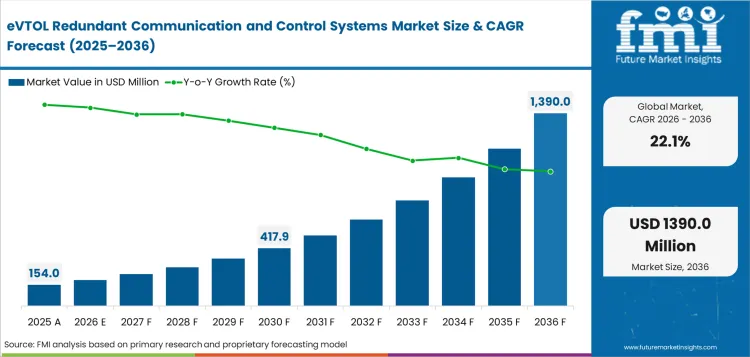
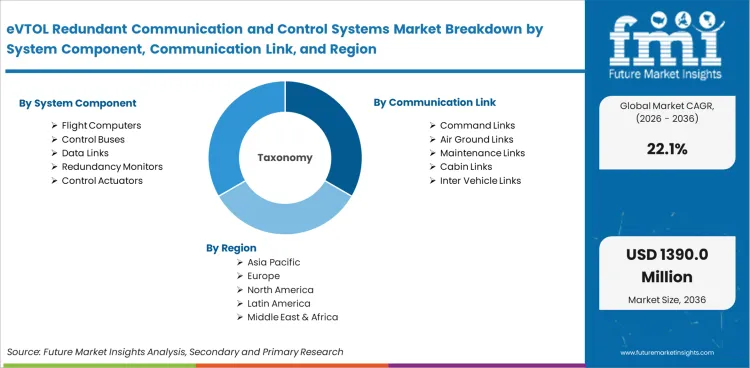
The eVTOL redundant communication and control systems market was valued at USD 154.0 million in 2025. The market is estimated at USD 188.0 million in 2026 and expand at a CAGR of 22.1% between 2026 and 2036 to reach USD 1,390 million by 2036. OEM integration is expected to account for a 74.0% share of the sales channel , and Passenger eVTOL is forecast to lead the aircraft use segment with a 62.5% share.
Summary of the eVTOL Redundant Communication and Control Systems Market
- Demand and Growth Drivers
- Powered-lift certification needs create demand for redundant control paths across passenger eVTOL programs.
- Fly-by-wire aircraft design increases use of flight computers as mechanical backup paths reduce in new platforms.
- Air taxi service planning drives demand for command links across advanced air mobility aircraft programs.
- Certification testing raises spending on urban air mobility flight test systems as signal validation becomes a core step.
- Product and Segment View
- Flight computers are expected to lead the system component segment, driven by certified control processing needs across eVTOL aircraft programs.
- Command links are expected to lead communication link demand, supported by their role in connecting pilot inputs and aircraft management systems.
- OEM integration is expected to retain value importance as aircraft makers prefer line-fit control systems for certification evidence and wiring design.
- Geography and Competitive Outlook
- The USA is projected to record a 24.4% CAGR through 2036, backed by powered-lift rules and federal AAM planning.
- China is projected to expand at 23.7% CAGR by 2036, as certified eVTOL production creates earlier electronics demand.
- Companies combining flight control heritage with certified avionics software are strengthening market position during the forecast period.
- Analyst Opinion
- Nikhil Kaitwade, Principal Consultant for Aviation at FMI, says, “eVTOL communication and control spending is becoming a certification risk decision for aircraft makers. Flight computers and command links drive demand as air taxi programs enter production planning. Software assurance raises cost while documentation strength lowers redesign exposure and interface risk.”
- eVTOL Redundant Communication and Control Systems Market Value Analysis
- The eVTOL redundant communication and control systems market is moving from prototype electronics into a certified aircraft systems base.
- Adoption is driven by powered-lift safety evidence needs across passenger and cargo aircraft programs.
- The market is gaining from deeper use of aerospace avionics across electric and software-defined aircraft.
- Demand is carried by flight computers and command links used to maintain aircraft control during selected fault events.
- Price pressure comes from software review, environmental testing and long qualification cycles before aircraft delivery.
Key Takeaways, Market Size and Forecast
- The eVTOL redundant communication and control systems market was valued at USD 154.0 million in 2025.
- By 2036, the eVTOL redundant communication and control systems market is projected to reach USD 1,390 million.
- From 2026 to 2036, the market is projected to expand at a CAGR of 22.1%.
- The market is projected to create an incremental opportunity of USD 1,202 million between 2026 and 2036.
- In 2026, OEM Integration is expected to account for 74.0% of sales channel demand.
- In 2026, Passenger eVTOL is projected to account for 62.5% of aircraft use demand.
- The USA at a projected 24.4% CAGR and China at 23.7%, are expected to be among the faster-growing country markets through 2036.
Certification is the main buying issue for eVTOL communication and control system suppliers. The FAA introduced a ten-year SFAR in October 2024 for powered-lift pilot certification and operating rules, so aircraft makers need control systems with strong documentation and safety evidence. EASA updated its VTOL compliance guidance in July 2025 for aircraft with over two lift or thrust units, which increases the need for proven electrical and control system records in Europe. Honeywell and Vertical Aerospace agreed in May 2025 to certify two VX4 production systems, including aircraft management and compact fly-by-wire controls. This makes integrated cockpit and control system supply more important for eVTOL OEMs. EHang’s CAAC Production Certificate for the EH216-S in April 2024 reveals why repeatable production quality records are becoming important as eVTOL aircraft move toward commercial output.
eVTOL Redundant Communication and Control Systems Market Definition
The eVTOL redundant communication and control systems market includes aircraft electronics used to keep electric vertical takeoff and landing aircraft controllable after signal or hardware faults. Scope covers flight control computers, control buses, command links, redundancy monitors and control actuators. These systems serve passenger eVTOL, cargo eVTOL and mission-specific aircraft. Scope excludes batteries, propulsion motors, vertiport hardware and passenger entertainment systems.
eVTOL Redundant Communication and Control Systems Market Inclusions
Market scope covers all commercially traded eVTOL redundant communication and control systems categorized by system component, including flight computers, control buses, data links, redundancy monitors, and control actuators; communication link, including command links, air ground links, maintenance links, cabin links, and inter vehicle links; control architecture, including triplex control, duplex control, quadruplex control, distributed control, and federated control; aircraft use, including passenger eVTOL, cargo eVTOL, medical eVTOL, defense eVTOL, and utility eVTOL; and sales channel, including OEM integration, prototype fitment, retrofit upgrades, fleet spares, and certification services. Revenue scope covers 2026 to 2036. The key stakeholders include eVTOL aircraft manufacturers, avionics suppliers, flight control system providers, communication module manufacturers, software assurance specialists, certification consultants, aircraft operators, defense agencies, maintenance service providers, system integrators, distributors, and aviation regulatory bodies.
eVTOL Redundant Communication and Control Systems Market Exclusions
Scope does not include propulsion motors, battery packs, charging systems, vertiport construction, cabin lighting, passenger media systems or non-aircraft telecom equipment.
eVTOL Redundant Communication and Control Systems Market Research Methodology
- Primary Research: FMI analysts spoke to avionics suppliers, eVTOL aircraft makers and certification specialists in important markets.
- Desk Research: Combined inputs from aviation rulemaking, supplier portfolios and aircraft control system references.
- Market sizing and forecasting: Added line-fit electronics value across aircraft programs and checked it against aircraft flight control system demand patterns.
- Data validation: Cross-checked every three months against aircraft certification progress and supplier system coverage.
Why is the eVTOL Redundant Communication and Control Systems Market Growing?
- Aircraft makers are specifying redundant communication paths earlier to reduce redesign risk before certification review.
- Flight control suppliers are becoming important as eVTOL aircraft combine powered lift with software-heavy control.
- Manufacturers are using integrated systems to connect aircraft management and actuator commands.
Passenger eVTOL programs need stronger control evidence as aircraft move toward public service use. FAA’s October 2024 powered-lift final rule adopted a Special Federal Aviation Regulation for ten years to help certify powered-lift pilots and clarify operating rules. This policy signal gives aircraft makers a usable operating frame for early service planning. Redundant control suppliers gain importance as every aircraft needs reliable command paths and fault response records.
European certification work is creating a second demand base for flight control evidence. EASA updated its Special Condition VTOL page on 18 July 2025 with the Fifth Publication of Proposed Means of Compliance. This gives eVTOL developers more direction on design evidence and compliance interpretation. Suppliers with documented control architecture and software assurance work can reduce review friction for airframers.
Market Segmentation Analysis
- Flight computers are forecast to capture 36.5% of 2026 system component revenue, as certified processing defines control authority across eVTOL aircraft.
- Command links are expected to represent 40.0% of the communication link segment in 2026 since aircraft makers need dependable signal paths between pilot inputs and aircraft management systems.
- Triplex control is projected to hold 43.0% share in 2026, with three-channel voting helping manage fault response across safety-critical control paths.
- Passenger eVTOL is expected to account for 62.5% of aircraft use revenue in 2026, reflecting higher documentation and safety review needs for fare-carrying aircraft.
- OEM integration is forecast to account for 74.0% of 2026 sales channel value as aircraft makers select control electronics early to protect wiring design and certification evidence.
The market for eVTOL redundant communication and control systems is divided into groups based on system component, communication link, control architecture, aircraft use, sales channel, and region. Under system component, the market includes flight computers, control buses, data links, redundancy monitors, and control actuators. By communication link, the market covers command links, air ground links, maintenance links, cabin links, and inter vehicle links. Based on control architecture, it includes triplex control, duplex control, quadruplex control, distributed control, and federated control. By aircraft use, the market includes passenger eVTOL, cargo eVTOL, medical eVTOL, defense eVTOL, and utility eVTOL. By sales channel, the market is segmented into OEM integration, prototype fitment, retrofit upgrades, fleet spares, and certification services.
Insights into eVTOL Redundant Communication and Control Systems Market by System Component
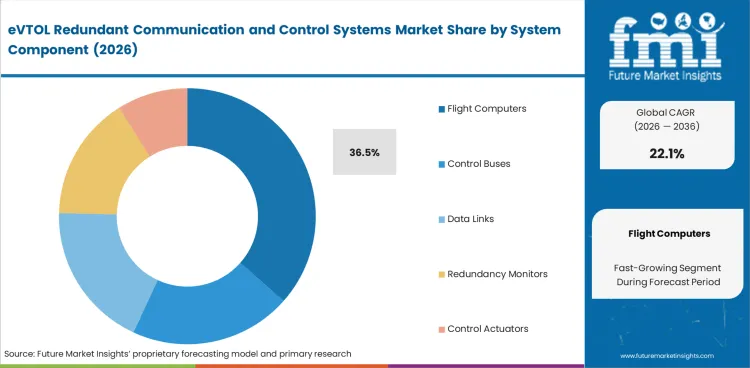
- In 2026, flight computers are expected to account for 36.5% of the system component segment. Certified processing units manage control commands and sensor inputs within one verified stack for fault-voting decisions.
- Control buses and redundancy monitors address selected architecture needs. Their value improves in aircraft programs requiring separated signal paths and faster fault isolation.
Insights into eVTOL Redundant Communication and Control Systems Market by Communication Link
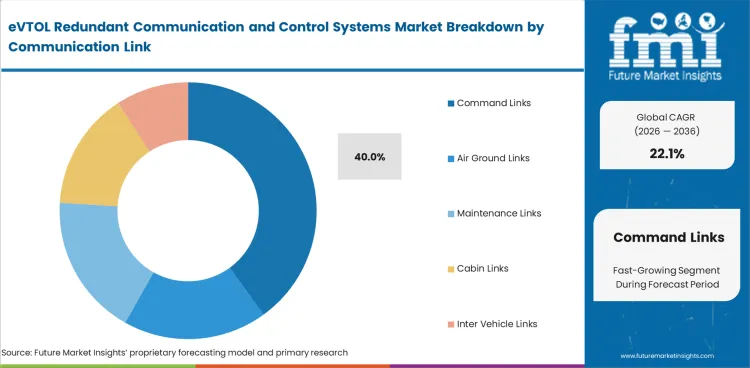
- Command links are projected to account for 40.0% of the communication link segment in 2026. Aircraft makers need dependable signal paths between pilot inputs and aircraft management systems.
- Air ground links serve fleet supervision and operational data needs. Maintenance links gain value as service teams require verified access to aircraft health data.
Insights into eVTOL Redundant Communication and Control Systems Market by Control Architecture
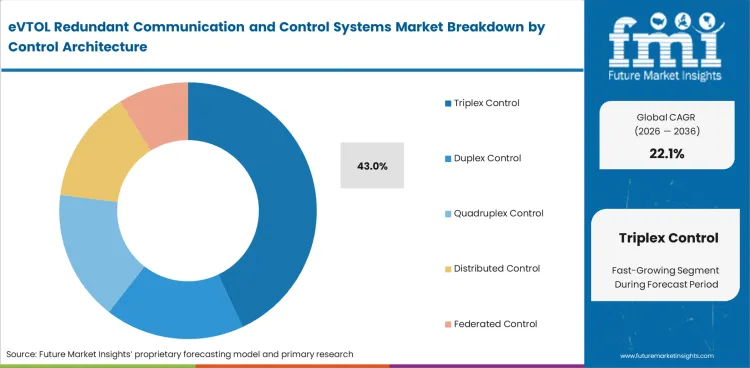
- Triplex control is forecast to account for 43.0% share in 2026. Three-channel voting helps passenger aircraft programs reduce single-path failure exposure during safety review.
- Duplex control supports simpler aircraft programs with lower electronics weight. Quadruplex control serves higher-assurance use cases with added cost and qualification work.
Insights into eVTOL Redundant Communication and Control Systems Market by Aircraft Use
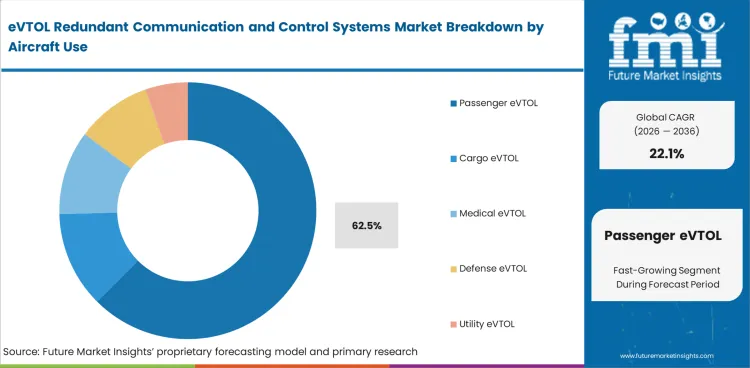
- Passenger eVTOL is expected to account for 62.5% share in 2026. Fare-carrying aircraft require deeper safety files and stronger control evidence before commercial service entry.
- Cargo and utility eVTOL platforms address selected mission needs. Their value improves in logistics programs requiring lower cabin risk and simpler operating approval.
Insights into eVTOL Redundant Communication and Control Systems Market by Sales Channel
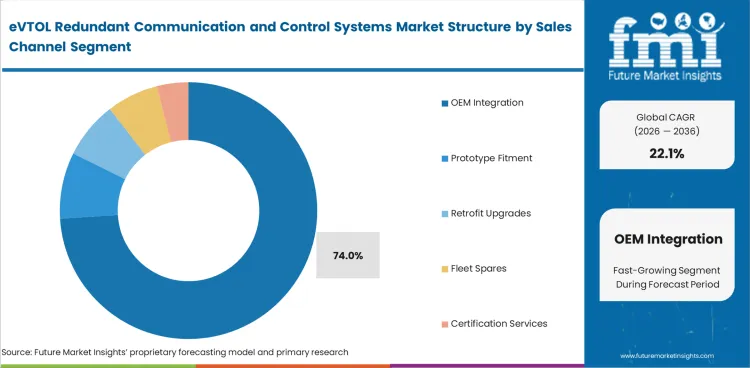
- OEM integration is projected to hold 74.0% share in 2026. Aircraft makers prefer line-fit control systems to protect certification evidence and wiring design.
- Retrofit upgrades support aircraft already entering test or early service cycles. Fleet spares serve replacement needs for certified control units across operating aircraft.
eVTOL Redundant Communication and Control Systems Market Drivers, Restraints, and Opportunities
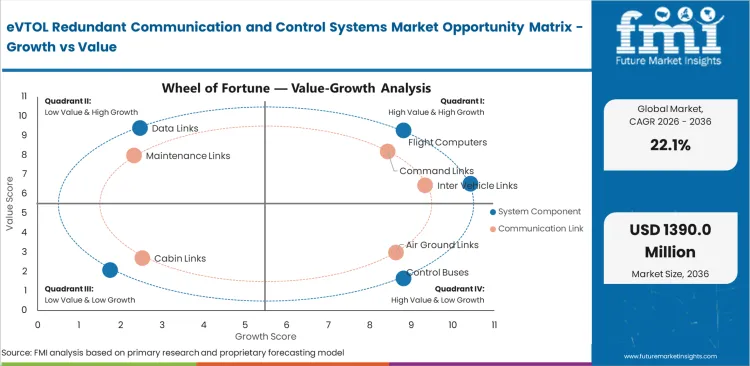
- Powered-lift certification pressure is creating demand for flight control evidence across passenger aircraft programs.
- The requirement for certified software and hardware increases pricing pressure for smaller electronics suppliers.
- Retrofit upgrades improve service opportunity through software refreshes and aircraft avionics cybersecurity protection systems.
eVTOL redundant communication and control systems keep growing as air taxi and cargo aircraft need dependable command links and fault-tolerant control paths for safe flight. High certification cost and complex software validation can slow adoption across early aircraft programs. Growth continues through OEM integration and certified fly-by-wire architectures.
FAA Telecom Modernization Is Lifting Redundancy Pricing
Pricing for eVTOL redundant communication and control systems is moving upward as suppliers shift from prototype avionics packages to systems aligning with FAA modernization of the National Airspace System. In May 2025, the FAA’s FY 2026 budget requested US$13.8 billion for Operations, US$359.2 million or 2.7% above FY 2025, and US$1.0 billion for Project LIFT to modernize telecommunications infrastructure, including voice switches and next-generation radios. It requested US$450 million for radar replacement. For eVTOL OEMs, this enables higher quoting for IP-compatible radios instead of simple hardware supply. It enables pricing for failover control links instead of basic connectivity options. The approach supports cybersecurity hardening and verification documentation requirements.
Pilot Programs Are Repricing Certification Support
Redundant communication and control system pricing is being pulled higher by commercial demonstration requirements. Suppliers must price engineering support and data capture into their contract structures. They must include safety cases and post test modifications within project agreements. In September 2025, the FAA announced the eVTOL and AAM Integration Pilot Program, with proposals due by December 11, 2025, a minimum of five participants to be selected, and a program duration ending 3 years after the first pilot project becomes operational. The notice states that each participant will bear its own costs. This requirement pushes OEMs and system integrators to negotiate bundled pricing upfront. Such pricing must cover redundancy testing and operational data packages. It must include integration support within the agreed commercial structure.
Analysis of eVTOL Redundant Communication and Control Systems Market By Key Countries
.webp "Top Country Growth Comparison Evtol Redundant Communication And Control Systems Market Cagr (2026 2036)")
| Country | CAGR |
|---|---|
| USA | 24.4% |
| China | 23.7% |
| UAE | 23.0% |
| Germany | 21.4% |
| UK | 19.6% |
Source: Future Market Insights, 2026.
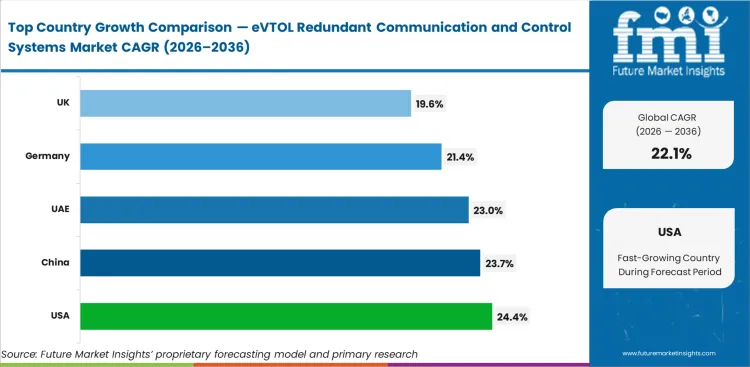
eVTOL Redundant Communication and Control Systems Market CAGR Analysis By Country
- The USA is forecast to record a 24.4% CAGR through 2036 as powered-lift rules improve aircraft approval planning.
- China is expected to expand at 23.7% CAGR during the forecast period with certified eVTOL production gaining policy attention.
- UAE demand is projected to rise at 23.0% CAGR through 2036 as Dubai advances air taxi and vertiport planning.
- Germany’s 21.4% CAGR is linked to aerospace engineering depth and active European certification work.
- The UK is expected to post 19.6% CAGR by 2036 with Future of Flight planning guiding phased flying taxi targets.
Demand for eVTOL redundant communication and control systems is forecast to rise at 22.1% CAGR from 2026 to 2036. Country-level analysis covers the major markets contributing to this forecast, with the key markets listed below.
Demand Outlook for eVTOL Redundant Communication and Control Systems Market in the USA
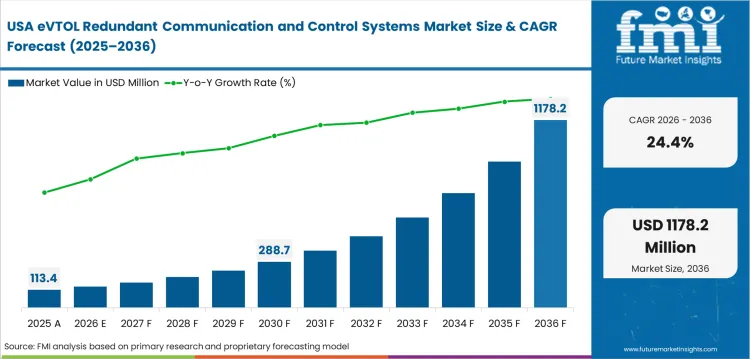
The USA eVTOL redundant communication and control systems industry is projected to record a CAGR of 24.4% through 2036. Federal policy has moved from concept planning into operating work. The USA Department of Transportation said in March 2026 its AAM and eVTOL Integration Pilot Program received over 30 proposals from across the country. This makes a stronger base for suppliers selling certified command links and flight control electronics.
- FAA powered-lift rulemaking gives aircraft makers a clearer operating path for early air taxi programs.
- USA aircraft programs raise demand for flight computers and command links across passenger aircraft.
- Strong avionics depth helps local suppliers integrate flight tracking system interfaces with control data.
Sales Analysis of eVTOL Redundant Communication and Control Systems Market in China
The eVTOL redundant communication and control systems sector in China is expected to expand at a CAGR of 23.7% during the assessment period. China has moved faster on certified aircraft production in comparison to most markets. In April 2024, EHang obtained the CAAC Production Certificate for its EH216-S passenger-carrying pilotless eVTOL aircraft. This certificate strengthens demand for redundant control electronics tied to scalable aircraft output.
- Certified production creates early demand for repeatable electronics and traceable system documentation.
- Low-altitude aviation policy enhances practical use cases beyond demonstration flights.
- Local aircraft makers need qualified control paths for passenger and logistics operations.
Demand Outlook for eVTOL Redundant Communication and Control Systems Market in the UAE
The UAE eVTOL redundant communication and control systems industry is forecast to grow at a CAGR of 23.0% by 2036. Dubai is building an early service base for passenger air taxi operations. Joby stated in February 2024 its Dubai plan included four initial vertiport sites across the city. This improves demand for aircraft systems able to work across high-frequency urban operations and ground network interfaces.
- Dubai air taxi planning boosts demand for aircraft control systems suited to dense city operations.
- Early vertiport planning increases need for command links connecting aircraft and network operations.
- UAE service timing gives suppliers a practical entry point into vertiports integration work.
Opportunity Analysis of eVTOL Redundant Communication and Control Systems Market in Germany
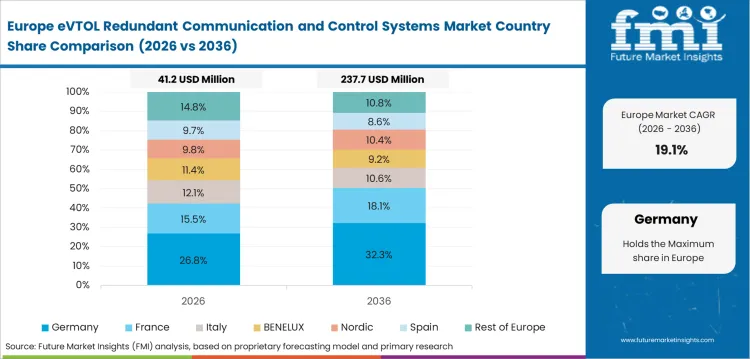
The eVTOL redundant communication and control systems segment in Germany is expected to advance at 21.4% CAGR over the forecast years. Germany has a deep aerospace base suited to safety-critical electronics and flight control software work. BDLI reported in May 2025 German aerospace turnover of EUR 52 billion in 2024. This industrial base helps local suppliers compete in qualified avionics and control electronics.
- Aerospace manufacturing depth creates a strong base for certified electronics work.
- EASA certification activity keeps German suppliers close to European compliance needs.
- Local engineering capability helps address aerospace fiber optics and control bus requirements.
Future Outlook for eVTOL Redundant Communication and Control Systems Market in the United Kingdom
The UK eVTOL redundant communication and control systems industry is expected to post 19.6% CAGR through 2036. The UK Future of Flight Action Plan set a first piloted flying taxi flight by 2026 and regular services by 2028. These targets raise demand for flight control systems with certification evidence and operational readiness. Suppliers with fast integration skills can serve airframers preparing demonstration and service aircraft.
- Future of Flight planning raises near-term demand for flight control validation and command links.
- UK airspace work helps suppliers align aircraft electronics with service entry needs.
- Passenger service planning favors suppliers active in air taxi aircraft programs.
Competitive Landscape and Strategic Positioning
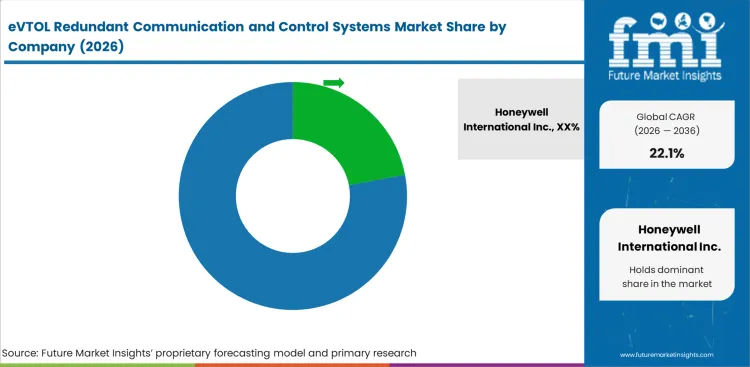
- Honeywell leads through compact fly-by-wire systems and aircraft management integration for certified eVTOL aircraft programs.
- BAE Systems and Thales compete on certified avionics depth and proven flight control experience across safety-critical aircraft.
- Specialist providers focus on redundant autopilot systems and control units for smaller aircraft development programs.
Competitive activity in the eVTOL redundant communication and control systems market is shaped by certified flight control capability and close integration with aircraft manufacturers. Honeywell holds a strong position through aircraft management systems and compact fly-by-wire controls designed for advanced aircraft programs. BAE Systems brings flight control electronics experience from high-assurance aviation applications. Thales and Safran Electronics & Defense focus on avionics computing depth and certified control system capability. Garmin adds cockpit electronics and aircraft interface experience for smaller aircraft classes.
Entry barriers are high as software assurance cost and documentation work increase across certified aircraft control programs. Aircraft manufacturers prefer partners able to combine certified hardware with system integration skill across one program. Competitive strength will favor companies with proven flight control architecture depth and faster evidence preparation across long aircraft development cycles. Broader electronics portfolios can reduce coordination work for aircraft makers and improve supplier selection prospects.
Key Companies in the eVTOL Redundant Communication and Control Systems Market
Key global companies leading the eVTOL redundant communication and control systems market include:
- Honeywell International Inc., BAE Systems plc and Thales Group have strong control electronics infrastructure for aircraft integration.
- Safran Electronics & Defense, RTX Corporation and Garmin Ltd. serve aircraft makers through avionics and control system coverage.
- Embention and Moog Inc. hold specialist positions across redundant autopilot, actuation and embedded computing systems.
Competitive Benchmarking: eVTOL Redundant Communication and Control Systems Market
| Company | Flight Control Depth | Software Evidence Strength | eVTOL Integration Reach | Geographic Footprint |
|---|---|---|---|---|
| Honeywell International Inc. | High | High | Strong | North America; Europe; Asia; India; Middle East; Latin America |
| BAE Systems plc | High | High | Strong | UK; USA; Australia; Saudi Arabia; wider 40 plus country base |
| Thales Group | High | High | Strong | Europe; North America; Asia-Pacific; Middle East; Africa |
| Safran Electronics & Defense | High | High | Strong | Europe; Americas; Asia-Pacific; Middle East; Africa |
| RTX Corporation | High | High | Strong | North America; Europe; Asia-Pacific; India; Australia |
| Garmin Ltd. | Medium | High | Moderate | USA; Europe; Asia; global aviation sales channels |
| Embention | Medium | Medium | Moderate | Spain; Europe; global drone and eVTOL customer base |
| Moog Inc. | High | Medium | Moderate | USA; Europe; Asia-Pacific; South America; 25-country operating base |
Source: Future Market Insights, 2026.
Key Developments in eVTOL Redundant Communication and Control Systems Market
- In November 2024, AVIAGE SYSTEMS delivered the upgraded Flight Control Computer Red Label to Hefei Range Aviation Technology for the LE200 eVTOL program. The company stated the unit includes FCC-level redundancy management, fault detection, and CCDL data exchange for flight-control reliability.
- In May 2025, Honeywell and Vertical Aerospace signed a new long-term agreement covering certification and production work for the VX4 eVTOL. The scope includes the Honeywell Anthem flight deck, aircraft management system, compact fly-by-wire flight control system, and new inceptors for pilot control inputs.
Key Players in the eVTOL Redundant Communication and Control Systems Market
Major Global Players:
- Honeywell International Inc.
- BAE Systems plc
- Thales Group
- Safran Electronics & Defense
- RTX Corporation
- Garmin Ltd.
- Moog Inc.
Specialist Players:
- Embention
Report Scope and Coverage
| Parameter | Details |
|---|---|
| Quantitative Units | USD 188.0 million to USD 1,390 million, at a CAGR of 22.1% |
| Market Definition | The eVTOL redundant communication and control systems market encompasses aircraft electronics used to maintain command and control after signal or hardware faults. |
| Regions Covered | North America, Latin America, Europe, East Asia, South Asia and Pacific, Middle East and Africa |
| Countries Covered | USA, UK, Germany, China, UAE, Japan, South Korea, and 30 plus countries |
| Key Companies Profiled | Honeywell International Inc., BAE Systems plc, Thales Group, Safran Electronics & Defense, RTX Corporation, Garmin Ltd., Embention, Moog Inc. |
| Forecast Period | 2026 to 2036 |
| Approach | Hybrid bottom-up and top-down methodology starting with aircraft program demand and verified control system use patterns. |
eVTOL Redundant Communication and Control Systems Market by Segments
eVTOL Redundant Communication and Control Systems Market Segmented by System Component:
- Flight Computers
- Control Buses
- Data Links
- Redundancy Monitors
- Control Actuators
eVTOL Redundant Communication and Control Systems Market Segmented by Communication Link:
- Command Links
- Air Ground Links
- Maintenance Links
- Cabin Links
- Inter Vehicle Links
eVTOL Redundant Communication and Control Systems Market Segmented by Control Architecture:
- Triplex Control
- Duplex Control
- Quadruplex Control
- Distributed Control
- Federated Control
eVTOL Redundant Communication and Control Systems Market Segmented by Aircraft Use:
- Passenger eVTOL
- Cargo eVTOL
- Medical eVTOL
- Defense eVTOL
- Utility eVTOL
eVTOL Redundant Communication and Control Systems Market Segmented by Sales Channel:
- OEM Integration
- Prototype Fitment
- Retrofit Upgrades
- Fleet Spares
- Certification Services
eVTOL Redundant Communication and Control Systems Market Segmented by Region:
- North America
- USA
- Canada
- Mexico
- Latin America
- Brazil
- Chile
- Rest of Latin America
- Europe
- Germany
- UK
- Italy
- Spain
- France
- Rest of Europe
- East Asia
- China
- Japan
- South Korea
- South Asia and Pacific
- India
- ASEAN
- Australia & New Zealand
- Rest of South Asia and Pacific
- Middle East and Africa
- Saudi Arabia
- Other GCC Countries
- South Africa
- Rest of Middle East and Africa
Research Sources and Bibliography
- Federal Aviation Administration. (2024, October). Integration of Powered-Lift: Pilot Certification and Operations; Miscellaneous Amendments Related to Rotorcraft and Airplanes.
- European Union Aviation Safety Agency. (2025, July). Special Condition for VTOL and Means of Compliance.
- USA Department of Transportation. (2026, March). The Future of Aviation Is Here.
- Joby Aviation. (2024, February). Joby to launch air taxi service in UAE.
- German Aerospace Industries Association. (2025, May). Industry data 2024: German aerospace industry on the rise.
- UK Department for Transport. (2024, March). Future of Flight Action Plan.
- Federal Aviation Administration. (2024, October 22). Integration of powered-lift: Pilot certification and operations; miscellaneous amendments related to rotorcraft and airplanes.
- Honeywell Aerospace. (2025, May 8). Vertical Aerospace, Honeywell expand partnership to bring VX4 eVTOL to market.
- EHang Holdings Limited. (2024, April 7). EHang secures production certificate from CAAC, clearing path for mass production of EH216-S pilotless eVTOL aircraft.
- Federal Aviation Administration. (2025, September 16). Electric Vertical Takeoff and Landing and Advanced Air Mobility Integration Pilot Program-Announcement of Establishment of Program and Request for Proposals. Federal Register, 90, 44751-44753. Federal Register :: Electric Vertical Takeoff and Landing and Advanced Air Mobility Integration Pilot Program-Announcement of Establishment of Program and Request for Proposals
- Federal Aviation Administration. (2025, May). FY 2026 President’s Budget Submission for Federal Aviation Administration. USA Department of Transportation. FY 2026 President's Budget Submission for Federal Aviation Administration
- AVIAGE SYSTEMS. (2024, November 6). AVIAGE SYSTEMS delivers Flight Control Computer Red Label, empowering Range Aviation’s LE200 eVTOL project. News Detail | AVIAGE SYSTEMS - Official Website
- Honeywell Aerospace. (2025, May 8). Vertical Aerospace, Honeywell expand partnership to bring VX4 eVTOL to market. Vertical Aerospace, Honeywell Expand Partnership To Bring VX4 eVTOL To Market
This Report Answers
- What is the current and future size of the eVTOL redundant communication and control systems market?
- How fast is the eVTOL redundant communication and control systems market expected to expand between 2026 and 2036?
- Which system component is expected to lead the market by 2026?
- Which aircraft use segment is expected to account for the leading demand by 2026?
- What factors are driving demand for redundant communication and control systems globally?
- How are powered-lift rules influencing aircraft control system adoption?
- Why is OEM Integration the main sales channel for certified systems?
- How are air taxi programs creating demand for command links and flight computers?
- Which countries are projected to record faster expansion through 2036?
- What is driving market expansion in the USA and China?
- Who are the key companies active in the eVTOL redundant communication and control systems market?
- How does FMI estimate and validate the market forecast?
Frequently Asked Questions
What is the global market demand for eVTOL Redundant Communication and Control Systems in 2026?
In 2026, the global market for eVTOL redundant communication and control systems is estimated at USD 188.0 million.
How big will the market for eVTOL Redundant Communication and Control Systems be in 2036?
By 2036, the market for eVTOL redundant communication and control systems is projected to reach USD 1,390 million.
How much is demand for eVTOL Redundant Communication and Control Systems expected to expand between 2026 and 2036?
Between 2026 and 2036, demand for eVTOL redundant communication and control systems is expected to expand at a CAGR of 22.1%.
Which system component segment is expected to lead globally by 2026?
Flight computers are expected to account for 36.5% of the system component segment in 2026.
What is causing demand to rise in the USA?
The USA eVTOL redundant communication and control systems market is projected to record 24.4% CAGR through 2036, backed by powered-lift rules and pilot program activity.
What is causing demand to rise in China?
The China eVTOL redundant communication and control systems market is projected to expand at 23.7% CAGR through 2036, backed by certified eVTOL production progress.
What does this report mean by eVTOL Redundant Communication and Control Systems Market definition?
The market includes aircraft electronics used to maintain command and control after signal faults or hardware faults inside eVTOL aircraft.
How does FMI make the eVTOL Redundant Communication and Control Systems forecast and check it?
Forecasting models use a hybrid bottom-up and top-down approach, starting with aircraft program demand and checking it against certification activity.
Preview the report firsthand - request a free sample
Get SampleGet the brochure for pricing and purchase details.
Get PDFTable of Content
- Executive Summary
- Global Market Outlook
- Demand-side Trends
- Supply-side Trends
- Technology Roadmap Analysis
- Analysis and Recommendations
- Market Overview
- Market Coverage / Taxonomy
- Market Definition / Scope / Limitations
- Research Methodology
- Chapter Orientation
- Analytical Lens and Working Hypotheses
- Market Structure, Signals, and Trend Drivers
- Benchmarking and Cross-market Comparability
- Market Sizing, Forecasting, and Opportunity Mapping
- Research Design and Evidence Framework
- Desk Research Programme (Secondary Evidence)
- Company Annual and Sustainability Reports
- Peer-reviewed Journals and Academic Literature
- Corporate Websites, Product Literature, and Technical Notes
- Earnings Decks and Investor Briefings
- Statutory Filings and Regulatory Disclosures
- Technical White Papers and Standards Notes
- Trade Journals, Industry Magazines, and Analyst Briefs
- Conference Proceedings, Webinars, and Seminar Materials
- Government Statistics Portals and Public Data Releases
- Press Releases and Reputable Media Coverage
- Specialist Newsletters and Curated Briefings
- Sector Databases and Reference Repositories
- FMI Internal Proprietary Databases and Historical Market Datasets
- Subscription Datasets and Paid Sources
- Social Channels, Communities, and Digital Listening Inputs
- Additional Desk Sources
- Expert Input and Fieldwork (Primary Evidence)
- Primary Modes
- Qualitative Interviews and Expert Elicitation
- Quantitative Surveys and Structured Data Capture
- Blended Approach
- Why Primary Evidence is Used
- Field Techniques
- Interviews
- Surveys
- Focus Groups
- Observational and In-context Research
- Social and Community Interactions
- Stakeholder Universe Engaged
- C-suite Leaders
- Board Members
- Presidents and Vice Presidents
- R&D and Innovation Heads
- Technical Specialists
- Domain Subject-matter Experts
- Scientists
- Physicians and Other Healthcare Professionals
- Governance, Ethics, and Data Stewardship
- Research Ethics
- Data Integrity and Handling
- Primary Modes
- Tooling, Models, and Reference Databases
- Desk Research Programme (Secondary Evidence)
- Data Engineering and Model Build
- Data Acquisition and Ingestion
- Cleaning, Normalisation, and Verification
- Synthesis, Triangulation, and Analysis
- Quality Assurance and Audit Trail
- Market Background
- Market Dynamics
- Drivers
- Restraints
- Opportunity
- Trends
- Scenario Forecast
- Demand in Optimistic Scenario
- Demand in Likely Scenario
- Demand in Conservative Scenario
- Opportunity Map Analysis
- Product Life Cycle Analysis
- Supply Chain Analysis
- Investment Feasibility Matrix
- Value Chain Analysis
- PESTLE and Porter’s Analysis
- Regulatory Landscape
- Regional Parent Market Outlook
- Production and Consumption Statistics
- Import and Export Statistics
- Market Dynamics
- Global Market Analysis 2021 to 2025 and Forecast, 2026 to 2036
- Historical Market Size Value (USD Million) Analysis, 2021 to 2025
- Current and Future Market Size Value (USD Million) Projections, 2026 to 2036
- Y-o-Y Growth Trend Analysis
- Absolute $ Opportunity Analysis
- Global Market Pricing Analysis 2021 to 2025 and Forecast 2026 to 2036
- Global Market Analysis 2021 to 2025 and Forecast 2026 to 2036, By System Component
- Introduction / Key Findings
- Historical Market Size Value (USD Million) Analysis By System Component , 2021 to 2025
- Current and Future Market Size Value (USD Million) Analysis and Forecast By System Component , 2026 to 2036
- Flight Computers
- Control Buses
- Data Links
- Redundancy Monitors
- Control Actuators
- Flight Computers
- Y-o-Y Growth Trend Analysis By System Component , 2021 to 2025
- Absolute $ Opportunity Analysis By System Component , 2026 to 2036
- Global Market Analysis 2021 to 2025 and Forecast 2026 to 2036, By Communication Link
- Introduction / Key Findings
- Historical Market Size Value (USD Million) Analysis By Communication Link, 2021 to 2025
- Current and Future Market Size Value (USD Million) Analysis and Forecast By Communication Link, 2026 to 2036
- Command Links
- Air Ground Links
- Maintenance Links
- Cabin Links
- Inter Vehicle Links
- Command Links
- Y-o-Y Growth Trend Analysis By Communication Link, 2021 to 2025
- Absolute $ Opportunity Analysis By Communication Link, 2026 to 2036
- Global Market Analysis 2021 to 2025 and Forecast 2026 to 2036, By Control Architecture
- Introduction / Key Findings
- Historical Market Size Value (USD Million) Analysis By Control Architecture, 2021 to 2025
- Current and Future Market Size Value (USD Million) Analysis and Forecast By Control Architecture, 2026 to 2036
- Triplex Control
- Duplex Control
- Quadruplex Control
- Distributed Control
- Federated Control
- Triplex Control
- Y-o-Y Growth Trend Analysis By Control Architecture, 2021 to 2025
- Absolute $ Opportunity Analysis By Control Architecture, 2026 to 2036
- Global Market Analysis 2021 to 2025 and Forecast 2026 to 2036, By Aircraft Use
- Introduction / Key Findings
- Historical Market Size Value (USD Million) Analysis By Aircraft Use, 2021 to 2025
- Current and Future Market Size Value (USD Million) Analysis and Forecast By Aircraft Use, 2026 to 2036
- Passenger eVTOL
- Cargo eVTOL
- Medical eVTOL
- Defense eVTOL
- Utility eVTOL
- Passenger eVTOL
- Y-o-Y Growth Trend Analysis By Aircraft Use, 2021 to 2025
- Absolute $ Opportunity Analysis By Aircraft Use, 2026 to 2036
- Global Market Analysis 2021 to 2025 and Forecast 2026 to 2036, By Sales Channel
- Introduction / Key Findings
- Historical Market Size Value (USD Million) Analysis By Sales Channel, 2021 to 2025
- Current and Future Market Size Value (USD Million) Analysis and Forecast By Sales Channel, 2026 to 2036
- OEM Integration
- Prototype Fitment
- Retrofit Upgrades
- Fleet Spares
- Certification Services
- OEM Integration
- Y-o-Y Growth Trend Analysis By Sales Channel, 2021 to 2025
- Absolute $ Opportunity Analysis By Sales Channel, 2026 to 2036
- Global Market Analysis 2021 to 2025 and Forecast 2026 to 2036, By Region
- Introduction
- Historical Market Size Value (USD Million) Analysis By Region, 2021 to 2025
- Current Market Size Value (USD Million) Analysis and Forecast By Region, 2026 to 2036
- North America
- Latin America
- Western Europe
- Eastern Europe
- East Asia
- South Asia and Pacific
- Middle East & Africa
- Market Attractiveness Analysis By Region
- North America Market Analysis 2021 to 2025 and Forecast 2026 to 2036, By Country
- Historical Market Size Value (USD Million) Trend Analysis By Market Taxonomy, 2021 to 2025
- Market Size Value (USD Million) Forecast By Market Taxonomy, 2026 to 2036
- By Country
- USA
- Canada
- Mexico
- By System Component
- By Communication Link
- By Control Architecture
- By Aircraft Use
- By Sales Channel
- By Country
- Market Attractiveness Analysis
- By Country
- By System Component
- By Communication Link
- By Control Architecture
- By Aircraft Use
- By Sales Channel
- Key Takeaways
- Latin America Market Analysis 2021 to 2025 and Forecast 2026 to 2036, By Country
- Historical Market Size Value (USD Million) Trend Analysis By Market Taxonomy, 2021 to 2025
- Market Size Value (USD Million) Forecast By Market Taxonomy, 2026 to 2036
- By Country
- Brazil
- Chile
- Rest of Latin America
- By System Component
- By Communication Link
- By Control Architecture
- By Aircraft Use
- By Sales Channel
- By Country
- Market Attractiveness Analysis
- By Country
- By System Component
- By Communication Link
- By Control Architecture
- By Aircraft Use
- By Sales Channel
- Key Takeaways
- Western Europe Market Analysis 2021 to 2025 and Forecast 2026 to 2036, By Country
- Historical Market Size Value (USD Million) Trend Analysis By Market Taxonomy, 2021 to 2025
- Market Size Value (USD Million) Forecast By Market Taxonomy, 2026 to 2036
- By Country
- Germany
- UK
- Italy
- Spain
- France
- Nordic
- BENELUX
- Rest of Western Europe
- By System Component
- By Communication Link
- By Control Architecture
- By Aircraft Use
- By Sales Channel
- By Country
- Market Attractiveness Analysis
- By Country
- By System Component
- By Communication Link
- By Control Architecture
- By Aircraft Use
- By Sales Channel
- Key Takeaways
- Eastern Europe Market Analysis 2021 to 2025 and Forecast 2026 to 2036, By Country
- Historical Market Size Value (USD Million) Trend Analysis By Market Taxonomy, 2021 to 2025
- Market Size Value (USD Million) Forecast By Market Taxonomy, 2026 to 2036
- By Country
- Russia
- Poland
- Hungary
- Balkan & Baltic
- Rest of Eastern Europe
- By System Component
- By Communication Link
- By Control Architecture
- By Aircraft Use
- By Sales Channel
- By Country
- Market Attractiveness Analysis
- By Country
- By System Component
- By Communication Link
- By Control Architecture
- By Aircraft Use
- By Sales Channel
- Key Takeaways
- East Asia Market Analysis 2021 to 2025 and Forecast 2026 to 2036, By Country
- Historical Market Size Value (USD Million) Trend Analysis By Market Taxonomy, 2021 to 2025
- Market Size Value (USD Million) Forecast By Market Taxonomy, 2026 to 2036
- By Country
- China
- Japan
- South Korea
- By System Component
- By Communication Link
- By Control Architecture
- By Aircraft Use
- By Sales Channel
- By Country
- Market Attractiveness Analysis
- By Country
- By System Component
- By Communication Link
- By Control Architecture
- By Aircraft Use
- By Sales Channel
- Key Takeaways
- South Asia and Pacific Market Analysis 2021 to 2025 and Forecast 2026 to 2036, By Country
- Historical Market Size Value (USD Million) Trend Analysis By Market Taxonomy, 2021 to 2025
- Market Size Value (USD Million) Forecast By Market Taxonomy, 2026 to 2036
- By Country
- India
- ASEAN
- Australia & New Zealand
- Rest of South Asia and Pacific
- By System Component
- By Communication Link
- By Control Architecture
- By Aircraft Use
- By Sales Channel
- By Country
- Market Attractiveness Analysis
- By Country
- By System Component
- By Communication Link
- By Control Architecture
- By Aircraft Use
- By Sales Channel
- Key Takeaways
- Middle East & Africa Market Analysis 2021 to 2025 and Forecast 2026 to 2036, By Country
- Historical Market Size Value (USD Million) Trend Analysis By Market Taxonomy, 2021 to 2025
- Market Size Value (USD Million) Forecast By Market Taxonomy, 2026 to 2036
- By Country
- Kingdom of Saudi Arabia
- Other GCC Countries
- Turkiye
- South Africa
- Other African Union
- Rest of Middle East & Africa
- By System Component
- By Communication Link
- By Control Architecture
- By Aircraft Use
- By Sales Channel
- By Country
- Market Attractiveness Analysis
- By Country
- By System Component
- By Communication Link
- By Control Architecture
- By Aircraft Use
- By Sales Channel
- Key Takeaways
- Key Countries Market Analysis
- USA
- Pricing Analysis
- Market Share Analysis, 2025
- By System Component
- By Communication Link
- By Control Architecture
- By Aircraft Use
- By Sales Channel
- Canada
- Pricing Analysis
- Market Share Analysis, 2025
- By System Component
- By Communication Link
- By Control Architecture
- By Aircraft Use
- By Sales Channel
- Mexico
- Pricing Analysis
- Market Share Analysis, 2025
- By System Component
- By Communication Link
- By Control Architecture
- By Aircraft Use
- By Sales Channel
- Brazil
- Pricing Analysis
- Market Share Analysis, 2025
- By System Component
- By Communication Link
- By Control Architecture
- By Aircraft Use
- By Sales Channel
- Chile
- Pricing Analysis
- Market Share Analysis, 2025
- By System Component
- By Communication Link
- By Control Architecture
- By Aircraft Use
- By Sales Channel
- Germany
- Pricing Analysis
- Market Share Analysis, 2025
- By System Component
- By Communication Link
- By Control Architecture
- By Aircraft Use
- By Sales Channel
- UK
- Pricing Analysis
- Market Share Analysis, 2025
- By System Component
- By Communication Link
- By Control Architecture
- By Aircraft Use
- By Sales Channel
- Italy
- Pricing Analysis
- Market Share Analysis, 2025
- By System Component
- By Communication Link
- By Control Architecture
- By Aircraft Use
- By Sales Channel
- Spain
- Pricing Analysis
- Market Share Analysis, 2025
- By System Component
- By Communication Link
- By Control Architecture
- By Aircraft Use
- By Sales Channel
- France
- Pricing Analysis
- Market Share Analysis, 2025
- By System Component
- By Communication Link
- By Control Architecture
- By Aircraft Use
- By Sales Channel
- India
- Pricing Analysis
- Market Share Analysis, 2025
- By System Component
- By Communication Link
- By Control Architecture
- By Aircraft Use
- By Sales Channel
- ASEAN
- Pricing Analysis
- Market Share Analysis, 2025
- By System Component
- By Communication Link
- By Control Architecture
- By Aircraft Use
- By Sales Channel
- Australia & New Zealand
- Pricing Analysis
- Market Share Analysis, 2025
- By System Component
- By Communication Link
- By Control Architecture
- By Aircraft Use
- By Sales Channel
- China
- Pricing Analysis
- Market Share Analysis, 2025
- By System Component
- By Communication Link
- By Control Architecture
- By Aircraft Use
- By Sales Channel
- Japan
- Pricing Analysis
- Market Share Analysis, 2025
- By System Component
- By Communication Link
- By Control Architecture
- By Aircraft Use
- By Sales Channel
- South Korea
- Pricing Analysis
- Market Share Analysis, 2025
- By System Component
- By Communication Link
- By Control Architecture
- By Aircraft Use
- By Sales Channel
- Russia
- Pricing Analysis
- Market Share Analysis, 2025
- By System Component
- By Communication Link
- By Control Architecture
- By Aircraft Use
- By Sales Channel
- Poland
- Pricing Analysis
- Market Share Analysis, 2025
- By System Component
- By Communication Link
- By Control Architecture
- By Aircraft Use
- By Sales Channel
- Hungary
- Pricing Analysis
- Market Share Analysis, 2025
- By System Component
- By Communication Link
- By Control Architecture
- By Aircraft Use
- By Sales Channel
- Kingdom of Saudi Arabia
- Pricing Analysis
- Market Share Analysis, 2025
- By System Component
- By Communication Link
- By Control Architecture
- By Aircraft Use
- By Sales Channel
- Turkiye
- Pricing Analysis
- Market Share Analysis, 2025
- By System Component
- By Communication Link
- By Control Architecture
- By Aircraft Use
- By Sales Channel
- South Africa
- Pricing Analysis
- Market Share Analysis, 2025
- By System Component
- By Communication Link
- By Control Architecture
- By Aircraft Use
- By Sales Channel
- USA
- Market Structure Analysis
- Competition Dashboard
- Competition Benchmarking
- Market Share Analysis of Top Players
- By Regional
- By System Component
- By Communication Link
- By Control Architecture
- By Aircraft Use
- By Sales Channel
- Competition Analysis
- Competition Deep Dive
- Honeywell International Inc.
- Overview
- Product Portfolio
- Profitability by Market Segments (Product/Age /Sales Channel/Region)
- Sales Footprint
- Strategy Overview
- Marketing Strategy
- Product Strategy
- Channel Strategy
- BAE Systems plc
- Thales Group
- Safran Electronics & Defense
- RTX Corporation
- Garmin Ltd.
- Embention
- Moog Inc.
- Honeywell International Inc.
- Competition Deep Dive
- Assumptions & Acronyms Used


