

- Market Size (2026)
- USD 344.2 Mn
- Forecast (2036)
- USD 652.2 Mn
- CAGR (2026 to 2036)
- 6.6%
EV-Optimized Low-Dust Brake Pad Systems Market Size, Market Forecast and Outlook By FMI
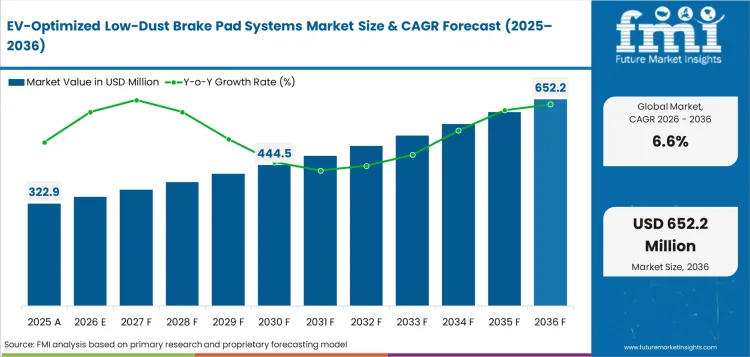
The EV-optimized low-dust brake pad systems market was valued at USD 322.9 million in 2025. Industry revenue is estimated at USD 344.2 million in 2026 and projected to reach USD 652.2 million by 2036 at 6.6% CAGR. Battery electric vehicles are projected to represent 58.0% share of vehicle type in 2026. By end user, repair workshops are expected to account for 46.0% share in 2026.
Key Takeaways, Market Size, and Forecast
- The EV-optimized low-dust brake pad systems market size stood at USD 322.9 million in 2025.
- Industry value is projected to reach USD 652.2 million by 2036 as electric cars need quieter and cleaner friction braking.
- From 2026 to 2036, the sector is projected to expand at 6.6% CAGR.
- Industry revenue is projected to create incremental opportunity of USD 308.0 million from 2026 to 2036.
- Battery electric vehicles are projected to account for 58.0% share of vehicle type in 2026.
- Repair workshops are expected to account for 46.0% share of end user in 2026.
- In the country set, China is projected to record a 9.1% CAGR, followed by India at 8.7% CAGR by 2036.
Summary of EV-Optimized Low-Dust Brake Pad Systems Market
-
Demand and Growth Drivers
- Electric vehicle use and stricter brake dust control needs support higher consumption of low-dust brake pad systems through the forecast period.
- Steady demand for EV-optimized brake pads continues due to their role in reducing particulate emissions and improving cabin comfort during urban driving.
- Regenerative braking supports demand, as brake pad suppliers design quieter and cleaner friction materials for lighter brake-use cycles.
- Product and Segment View
- Battery electric vehicles are projected to account for 58.0% share in 2026, reflecting full EV platforms that need friction pads tuned for light-use cycles.
- Repair workshops are expected to account for 46.0% share in 2026, as pad replacement usually needs wheel inspection and fitment checks.
- Copper-free pads are expected to hold 45.0% share of dust-control design in 2026 as material compliance guides EV platform approval.
- Geography and Competitive Outlook
- China is projected to record 9.1% CAGR by 2036 due to electric car sales and local vehicle production influencing supplier scale.
- India is expected to expand at 8.7% CAGR by 2036 since electric vehicle registrations widen the replacement pool.
- Brembo S.p.A., Valeo SE and TMD Friction Group anchor competition through low-dust friction design and EV fitment coverage.
- Analyst Opinion
- Nikhil Kaitwade, Principal Consultant for Automotive at FMI, opines, “EV brake pads are shifting from a basic wear component to a part focused on comfort and compliance. Drivers hear brake noise more clearly in quiet electric cars. Workshops also need pads resisting corrosion after long regenerative braking cycles. Suppliers with measured dust data and clear fitment support should gain a higher share in this category.”
- EV-Optimized Low-Dust Brake Pad Systems Market Value Analysis
- Market value in EV-optimized low-dust brake pad systems is tied to electric vehicle service exposure and the need for quieter friction parts.
- Supplier pricing reflects ceramic content and shim design before workshops approve a premium replacement pad order.
- Revenue rises above standard automotive brake pad value as low-dust claims need material testing and vehicle-level fitment checks.
- Repair chains and dealer counters promote higher-value orders by bundling pads with clean wheels and low cabin noise claims.
Electric vehicle brake pads now need to do more than stop the car quietly. They must also create less brake dust and meet stricter material rules. In March 2026, the United Nations Economic Commission for Europe set a rule path for measuring PM10 brake particles of 10 micrometers or less. This makes dust testing more important for brake pad suppliers.
Washington State Legislature stated in July 2024, brake friction materials sold from January 1, 2025 must contain no more than 0.5% copper by weight. Suppliers need clear copper-free records to sell into regulated channels. EV braking creates another service issue. Bendix stated in April 2024, EV and hybrid pads need to control rotor corrosion since regenerative braking uses friction brakes less often. Brake pad brands reducing dust and control corrosion can gain stronger workshop acceptance.
EV-Optimized Low-Dust Brake Pad Systems Market Definition
EV-optimized low-dust brake pad systems cover replacement and original equipment pad sets designed for battery electric and hybrid vehicle braking profiles. Scope includes ceramic and non-asbestos organic pads. Copper-free designs and low-abrasion materials are counted. Shims and coated backing plates are included when sold with the pad set. Full calipers and broader automotive brake system assemblies are excluded unless pads form the reported supply unit.
EV-Optimized Low-Dust Brake Pad Systems Market Inclusions
Scope includes pads designed for low dust output, low noise and corrosion control in electrified vehicles. Product value includes front and rear axle pad sets sold through dealer service, independent workshops and online fitment channels. EV-specific friction grades and copper-free formulations are counted. Related automotive brake shims are counted only when supplied as part of the brake pad system.
EV-Optimized Low-Dust Brake Pad Systems Market Exclusions
Scope excludes standard combustion-engine brake pads without EV fitment claims. Full caliper modules and hydraulic controls are excluded. Brake fluid, sensors and actuator parts are outside scope unless bundled into a pad system. Factory brake software and labor charges are excluded. Broader automotive brake friction products revenue is treated as an adjacent category.
EV-Optimized Low-Dust Brake Pad Systems Market Research Methodology
- Primary Research: FMI analysts reviewed replacement needs across EV repair workshops and brake friction suppliers.
- Desk Research: Vehicle production data and brake emission rules supported demand checks.
- Market Sizing and Forecasting: Market sizing used EV parc exposure and replacement rate assumptions.
- Data Validation: Checks compared 2026 value with 2036 value and tested CAGR consistency across seven country rates.
Why is the EV-Optimized Low-Dust Brake Pad Systems Market Growing?
- Electric vehicles are entering wider use, creating a larger service pool for pads designed around light-use friction braking.
- Brake particle rules are pushing suppliers to prove dust control before low-dust claims become useful in vehicle approval.
- Quiet electric cabins are raising workshop interest in pads reducing squeal and support smoother service outcomes.
The growth outlook is tied to rising EV service exposure and upcoming brake-particle compliance. European Environment Agency reported in November 2025, over 1.4 million new battery electric vehicles were registered in the European Union in 2024, accounting for 13.6% of new car registrations. This expands the future replacement pool for EV-specific automotive brake pad systems as these vehicles move into routine service. Council of the European Union adopted Euro 7 in April 2024 and stated, new car and van types will apply the rule after 30 months, with all new cars and vans following after 42 months.
It also includes brake particle emissions and specific limits for electric vehicles, making low-dust evidence more important for supplier approval. Resonac stated in July 2024, its EV-focused non-asbestos organic disc brake pad targets heavy EV braking needs and abrasion resistance. This supports a stronger outlook for suppliers linking dust control with noise comfort in automotive brake system service channels.
Market Segmentation Analysis
- Ceramic pads are expected to account for 41.0% share in 2026, led by low dust behavior and quiet braking fitting premium EV service needs.
- Battery electric vehicles are expected to account for 58.0% share in 2026 through full electric platforms carrying the main service pool.
- Independent aftermarket is projected to represent 42.0% share in 2026 as early EV cohorts shift into local service networks.
- Copper-free pads are expected to hold 45.0% share in 2026 since compliant formulations become a key material specification.
- Repair workshops are projected to account for 46.0% share in 2026 due to pad replacement normally requiring wheel inspection and fitment checks.
Segmentation is divided into five parent groups built around how buyers specify EV brake pad systems. Friction material separates the main formulation routes. Vehicle type shows the platform group carrying replacement demand. Sales channel explains how parts reach the service job. Dust-control design reflects emission and material behavior. End user identifies who approves the pad order and values the low-noise result.
Insights into EV-Optimized Low-Dust Brake Pad Systems Market by Friction Material
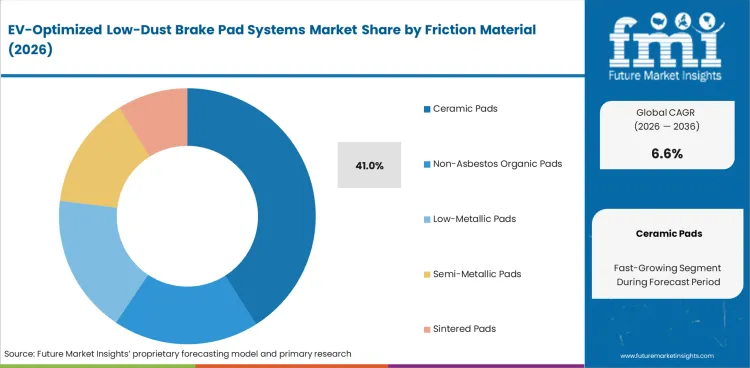
- Ceramic pads are projected to account for 41.0% share in 2026, led by ceramic formulations lowering visible dust without reducing day-to-day braking feel.
- Non-asbestos organic pads gain fitment value in urban EVs as soft friction behavior can reduce noise during light braking events.
Insights into EV-Optimized Low-Dust Brake Pad Systems Market by Vehicle Type
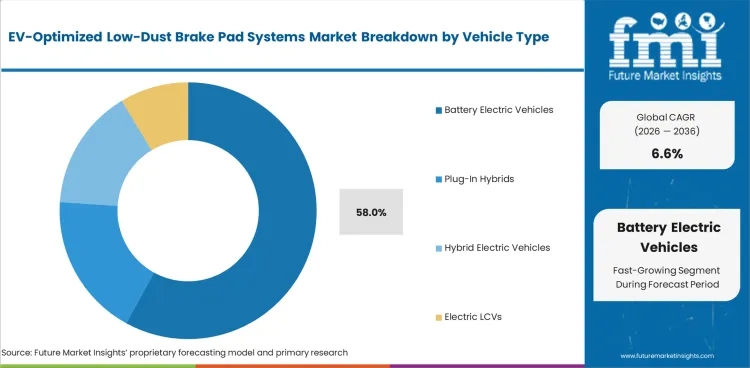
- Battery electric vehicles are forecast to represent 58.0% share in 2026 due to quiet cabins and regenerative braking creating a distinct pad profile.
- Plug-in hybrids add service demand since mixed driving creates uneven friction brake use across commuting and highway trips.
Insights into EV-Optimized Low-Dust Brake Pad Systems Market by Sales Channel
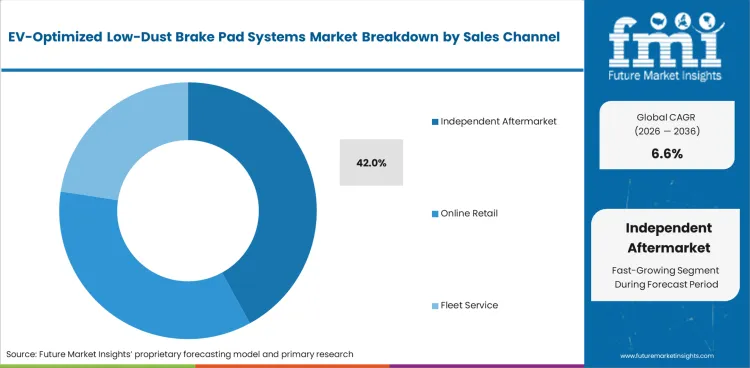
- Independent aftermarket is projected to hold 42.0% share in 2026, driven by older EVs shifting into local service networks.
- OEM service channels retain value for warranty-sensitive vehicles and models needing original pad shape or sensor compatibility.
Insights into EV-Optimized Low-Dust Brake Pad Systems Market by Dust-Control Design
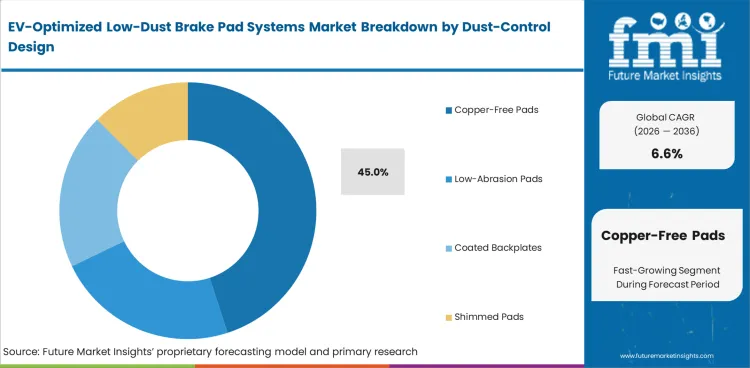
- Copper-free pads are forecast to account for 45.0% share in 2026, reflected by material compliance becoming part of supplier approval.
- Low-abrasion pads gain interest as Euro 7 brings brake particles into the emissions debate for new vehicle platforms.
Insights into EV-Optimized Low-Dust Brake Pad Systems Market by End User
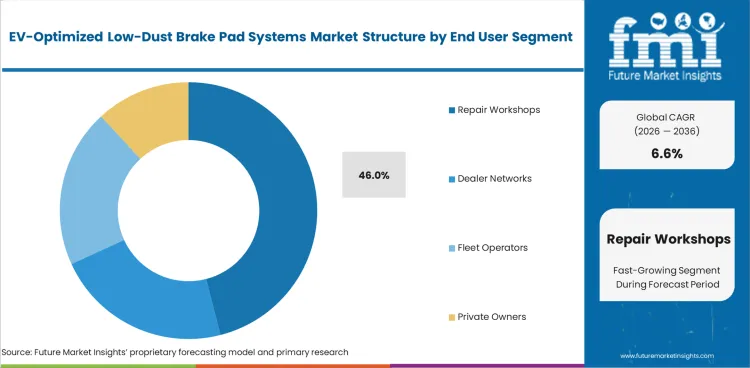
- Repair workshops are expected to account for 46.0% share in 2026 since technicians manage pad selection and noise complaints.
- Dealer networks keep a defined role for new EVs with warranty rules and factory service guidance.
EV-Optimized Low-Dust Brake Pad Systems Market Drivers, Restraints and Opportunities
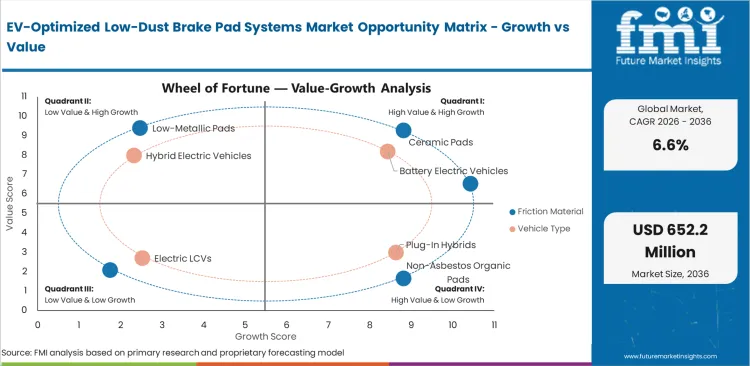
- Brake particle limits are turning low-dust pads into a tested compliance feature for electric vehicle platforms.
- Light friction brake use in electric vehicles can slow acceptance of standard pad designs in repair channels.
- Fitment coverage and noise guidance give suppliers a clearer route to reduce returns and workshop complaints.
Supplier strategy is moving toward measured dust control and fitment support as brake pads become part of EV service planning. In October 2025, a United Nations Economic Commission for Europe working paper proposed a maximum PM10 limit of 2.5 mg/km per front brake and 1.0 mg/km per rear brake for approval. This raises the bar for automotive brake pad systems since low-dust claims now need test-backed evidence.
A 2025 Journal of Hazardous Materials study found two pad emissions at 15.1 mg/km and 16.3 mg/km under the Worldwide Harmonized Light Vehicle Test Procedure brake cycle. Both results exceeded the upcoming 7.0 mg/km limit by more than two times, showing why generic pad designs face a harder approval path. ZF stated in June 2025, TRW brake pads cover 98% of the European vehicle parc and 100% of the top 20 electric vehicle models in Europe. This gives suppliers a practical route to connect low-dust automotive brake system service needs with fitment accuracy.
Buyer Identification and Procurement Structure Analysis
EV-optimized low-dust brake pad buying is shifting toward repair-led and distributor-backed selection. In its 2025 Form 10-K, LKQ Corporation stated that brake pads and sensors are routine maintenance hard parts. Parts and services represented 97.5% of its consolidated revenue in 2025. OEM service counters and large distributors are expected to compare suppliers on vehicle fitment accuracy and instant stock availability for automotive brake pad replacement programs.
After-sales Service and Lifecycle Cost Analysis
EV brake service is moving toward inspection-based maintenance as regenerative braking reduces normal pad use but raises rust and glazing risk. In March 2025, NAPA NexDrive stated that many vehicle makers recommend brake service at least once a year. Service work can include caliper lubrication and replacement of glazed or thinning pads. Brake pad suppliers with corrosion-resistant designs and clear service guidance can reduce repeat visits and support lower ownership cost for regenerative braking system vehicles.
Analysis of EV-Optimized Low-Dust Brake Pad Systems Market by Key Countries
.webp "Top Country Growth Comparison Ev Optimized Low Dust Brake Pad Systems Market Cagr (2026 2036)")
| Country | CAGR |
|---|---|
| China | 9.1% |
| India | 8.7% |
| United States | 6.4% |
| Germany | 6.0% |
| South Korea | 5.8% |
| United Kingdom | 5.4% |
| Japan | 4.9% |
Source: Future Market Insights, 2026.
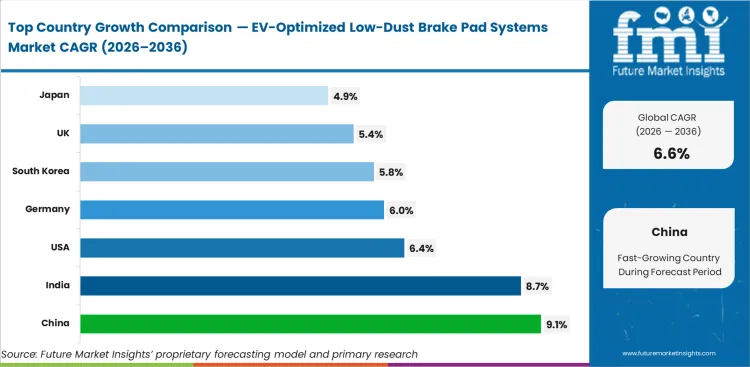
EV-Optimized Low-Dust Brake Pad Systems Market CAGR Analysis by Country
- China is projected to record 9.1% CAGR by 2036 through high electric car sales and domestic brake supplier depth.
- India is expected to expand at 8.7% CAGR by 2036 due to electric vehicle registrations create future service demand.
- United States is projected to grow at 6.4% CAGR by 2036, influenced by aftermarket depth and copper-free material rules.
- Germany is expected to advance at 6.0% CAGR by 2036, led by Euro 7 readiness affecting brake pad qualification.
- South Korea is projected to rise at 5.8% CAGR by 2036 reflecting export-oriented EV production and supplier capability.
- United Kingdom is projected to record 5.4% CAGR by 2036 with zero-emission vehicle registrations widening the service pool.
- Japan is expected to post 4.9% CAGR by 2036 as hybrid strength and careful service discipline support premium pads.
Country performance differs by EV sales depth and regulatory exposure. China and India are projected above the global pace as new electric vehicles expand future pad replacement. United States and Germany track near the global average due to aftermarket scale and material rules. South Korea, United Kingdom and Japan expand at measured rates through established service channels.
Demand Outlook for EV-Optimized Low-Dust Brake Pad Systems in China
Demand in China is set to record 9.1% CAGR by 2036, driven by electric car sales and local vehicle production promoting a leading service pool. International Energy Agency reported in May 2026, electric car sales in China exceeded 13.0 million units in 2025. Electric platforms expose more drivers to quiet cabin expectations and brake dust concerns. Local pad suppliers can use scale to qualify ceramic and low-abrasion formulas faster.
- Domestic EV scale supports many pad shapes across passenger car platforms.
- Repair outlets can package low-dust pads with wheel-cleanliness and noise checks.
- Local supply depth reduces lead time for vehicle-specific EV pad sets.
Demand Analysis of EV-Optimized Low-Dust Brake Pad Systems in India
Sector in India is expected to expand at 8.7% CAGR by 2036, influenced by electric vehicle registrations widening beyond early adopters. India’s policy think tank reported in August 2025, EV sales reached 2.08 million units in 2024. Passenger EVs and electric two-wheelers will build familiarity with low-noise braking expectations. Service networks will need clear product sorting as vehicle models multiply.
- Electric mobility growth raises the future need for EV-aware friction materials.
- Workshops need simple pad selection as model coverage spreads across price bands.
- Distributors can serve local repair demand with clear vehicle year and trim matching.
Growth Outlook for EV-Optimized Low-Dust Brake Pad Systems in the United States
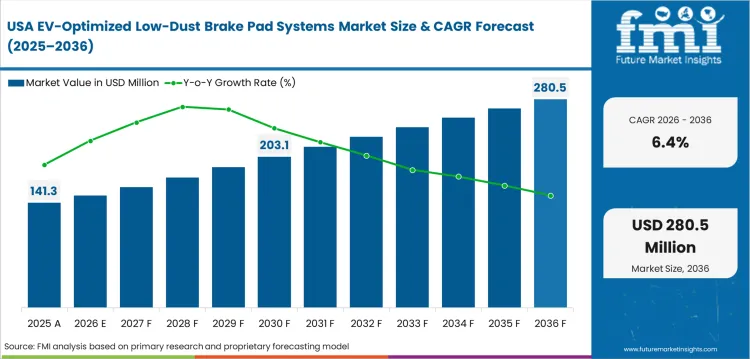
The market in United States is projected to grow at 6.4% CAGR by 2036 through a large repair channel and stricter material rules. United States energy data reported, plug-in vehicles represented 9.1% of annual passenger vehicle sales in 2025. Copper-free pad rules already influence supplier formulations. Aftermarket brands can also profit with low dust claims meeting safety and fitment needs.
- Independent distributors gain from broad vehicle coverage and fast workshop supply.
- Copper-free rules push pad makers toward cleaner friction recipes.
- EV owners value quieter pads since cabin noise is easier to hear.
Sales Analysis of EV-Optimized Low-Dust Brake Pad Systems in Germany
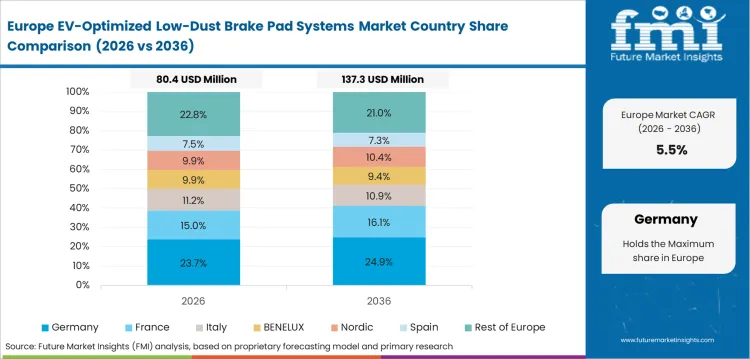
Sales in Germany are expected to advance at 6.0% CAGR by 2036 as European emission rules shift supplier priorities. European Automobile Manufacturers’ Association reported in January 2026, Germany’s battery electric registrations rose 43.2% in 2025. Local engineering standards make dust and noise claims harder to treat as cosmetic features. Pad suppliers must connect formulation data with vehicle approval needs.
- Euro 7 readiness raises interest in brake particle measurement.
- Premium EV service favors ceramic pads with low noise behavior.
- Workshop trust depends on fitment certainty and clear pad bedding guidance.
Industry Outlook for EV-Optimized Low-Dust Brake Pad Systems in South Korea
Sector in South Korea is projected to rise at 5.8% CAGR by 2036, reflecting export programs and domestic supplier capability. Invest KOREA reported in January 2026, South Korea produced 4.1 million vehicles in 2025. Export platforms often need compliance with European and North American material rules. Brake pad suppliers can use OE relationships to support EV-fit aftermarket ranges.
- Export-focused platforms create repeatable pad requirements across regions.
- Supplier capability supports low-noise materials and stable friction control.
- Parts catalogs can serve Korean EV models in domestic and overseas channels.
Sales Outlook for EV-Optimized Low-Dust Brake Pad Systems in the United Kingdom
Sales in the United Kingdom are projected to grow at 5.4% CAGR by 2036 as zero-emission vehicles enter regular service. The Department for Transport reported in April 2026, 528,000 zero-emission vehicles were registered for the first time in 2025. Right-hand-drive model coverage creates specific catalog needs. Low-dust pads gain interest as owners look for cleaner wheels and lower brake noise.
- MOT preparation keeps braking condition visible in routine repair decisions.
- Independent garages need clear pad fitment for right-hand-drive EV trims.
- Direct online sales work best when product pages explain vehicle compatibility.
Demand Outlook for EV-Optimized Low-Dust Brake Pad Systems in Japan
Demand in Japan is expected to post 4.9% CAGR by 2036 since hybrid strength and careful service practice support premium brake parts. Japan Automobile Manufacturers Association reported in September 2025, domestic motor vehicle production totaled 8.23 million units in 2024. Hybrid and electric platforms use friction brakes in lighter duty cycles. Pad makers can gain by controlling corrosion and low-speed noise.
- Hybrid vehicle familiarity supports acceptance of brake pads for low-use cycles.
- Dealer service discipline favors pads with proven noise and wear behavior.
- Export platforms give Japanese suppliers wider coverage for EV-ready pads.
Competitive Landscape and Strategic Positioning
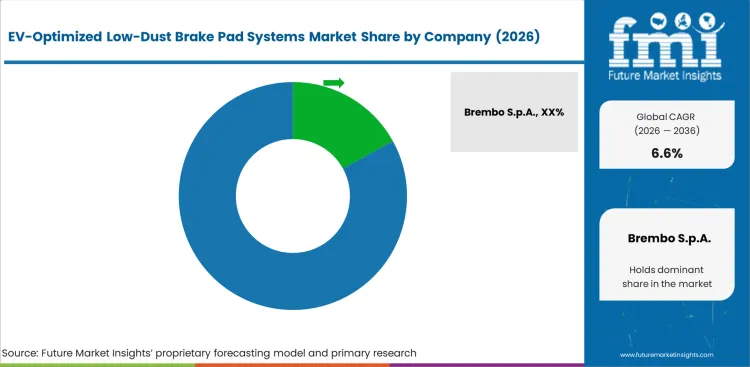
- Friction specialists hold an advantage on proving low dust performance with consistent braking feel.
- OE service suppliers compete by matching EV pad shape and noise control needs.
- Aftermarket brands gain share through deeper catalogs and clear installation guidance.
Competition is divided between OE brake suppliers and aftermarket friction brands. Brembo and Valeo are active in EV-specific pad systems. TMD Friction and ZF compete led by friction material knowledge and broad catalog reach. Bosch and Akebono hold established positions in replacement brake pad channels. NRS Brakes brings a corrosion-control focus for vehicles using regenerative braking.
Supplier selection depends on dust control proof and fitment accuracy. Workshops want pads fitting correctly on the first order and solve complaints without repeat visits. Vehicle owners look for cleaner wheels and quiet braking. Suppliers can improve margin by combining low-dust materials with fitment data and clear service guidance.
Key Companies in the EV-Optimized Low-Dust Brake Pad Systems Market
Competitive structure is differentiated by friction formulators, OE service suppliers and EV aftermarket specialists.
- Friction Formulators: Brembo S.p.A., TMD Friction Group and Akebono Brake Industry Co. Ltd. support ceramic and low-dust pad development.
- OE Service Suppliers: Valeo SE, Robert Bosch GmbH and ZF Friedrichshafen AG support EV and hybrid brake service coverage.
- EV Aftermarket Specialists: NRS Brakes supports corrosion-resistant pad design for electric and hybrid vehicle users.
Competitive Benchmarking: EV-Optimized Low-Dust Brake Pad Systems Market
| Company | Low-Dust Friction Depth | EV Fitment Coverage | Noise Control Support | Geographic Footprint |
|---|---|---|---|---|
| Brembo S.p.A. | High | High | High | Global |
| Valeo SE | High | High | Medium | Europe and global |
| ZF Friedrichshafen AG | Medium | High | High | Global |
| TMD Friction Group | High | Medium | High | Europe and Asia |
| Robert Bosch GmbH | Medium | Medium | High | Global |
| Akebono Brake Industry Co. Ltd. | High | Medium | Medium | Japan and North America |
| NRS Brakes | Medium | Medium | Medium | North America |
Source: Future Market Insights competitive analysis 2026. Ratings reflect relative positioning by low-dust friction depth, EV fitment coverage and noise control support.
Key Developments in EV-Optimized Low-Dust Brake Pad Systems Market
- In June 2024, Valeo launched its E-Performance brake pads range with 222.0 references for hybrid and electric vehicles.
- In April 2025, Brembo unveiled Greentell at Auto Shanghai with a claimed brake dust reduction of up to 90.0% during braking.
- In June 2025, ZF stated that its TRW brake pad range covers 98.0% of the European vehicle parc and 100.0% of the top 20 electric vehicle models in Europe.
Key Players in the EV-Optimized Low-Dust Brake Pad Systems Market
Major Global Players:
- Brembo S.p.A.
- Valeo SE
- ZF Friedrichshafen AG
- Robert Bosch GmbH
- TMD Friction Group
- Akebono Brake Industry Co. Ltd.
Specialist and Regional Players:
- NRS Brakes
Market Report Scope
| Parameter | Details |
|---|---|
| Quantitative units | USD 344.2 million to USD 652.2 million at 6.6% CAGR |
| Market definition | Brake pad systems optimized for electric and hybrid vehicles with low dust, low noise and corrosion control features |
| By friction material | Ceramic pads, non-asbestos organic pads, low-metallic pads, semi-metallic pads, sintered pads |
| By vehicle type | Battery electric vehicles, plug-in hybrids, hybrid electric vehicles, electric LCVs |
| By sales channel | OEM service, independent aftermarket, online retail, fleet service |
| By dust-control design | Copper-free pads, low-abrasion pads, coated backplates, shimmed pads |
| By end user | Repair workshops, dealer networks, fleet operators, private owners |
| Regions covered | North America, Latin America, Europe, East Asia, South Asia and Pacific, Middle East and Africa |
| Countries covered | China, India, United States, Germany, South Korea, United Kingdom, Japan |
| Key companies profiled | Brembo S.p.A., Valeo SE, ZF Friedrichshafen AG, TMD Friction Group, Robert Bosch GmbH, Akebono Brake Industry Co. Ltd., NRS Brakes |
| Forecast period | 2026 to 2036 |
| Approach | Hybrid top-down and bottom-up model using EV parc exposure, pad penetration and replacement rate checks |
Source: Future Market Insights, 2026.
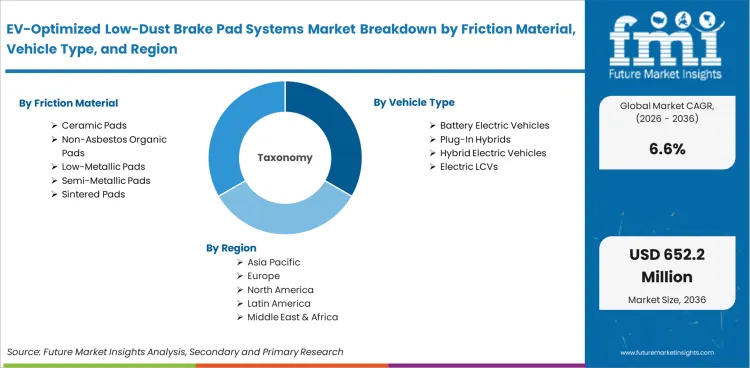
EV-Optimized Low-Dust Brake Pad Systems Market Breakdown by Friction Material, Vehicle Type, Sales Channel, Dust-Control Design, End User, and Region
By Friction Material:
- Ceramic Pads
- Non-Asbestos Organic Pads
- Low-Metallic Pads
- Semi-Metallic Pads
- Sintered Pads
By Vehicle Type:
- Battery Electric Vehicles
- Plug-In Hybrids
- Hybrid Electric Vehicles
- Electric LCVs
By Sales Channel:
- OEM Service
- Independent Aftermarket
- Online Retail
- Fleet Service
By Dust-Control Design:
- Copper-Free Pads
- Low-Abrasion Pads
- Coated Backplates
- Shimmed Pads
By End User:
- Repair Workshops
- Dealer Networks
- Fleet Operators
- Private Owners
By Region:
- North America
- Latin America
- Europe
- East Asia
- South Asia and Pacific
- Middle East and Africa
Research Sources and Bibliography
- United Nations Economic Commission for Europe. (2026, March 11). UN adopts global standard to measure and limit brake particle emissions.
- FMP Group Australia. (2024, April). Bendix product master catalogue PRJ-08473 April 2024.
- Washington State Legislature. (2024, July 12). Chapter 70A.340 RCW: Brake friction material.
- European Environment Agency. (2025, November 6). New registrations of electric cars in Europe.
- Resonac Holdings Corporation. (2024, July 3). Resonac develops high-performance disc brake pad for EV.
- United Nations Economic Commission for Europe. (2025, October 14). Proposal for a new UN Regulation on uniform provisions concerning the approval of replacement brake emission components (GRPE-93-13e).
- Neukirchen, C., Bergmann, M., Klocke, D., Schmidt, M., & Trapp, C. (2025). Comprehensive elemental and physical characterization of vehicle brake wear emissions from two different brake pads following the Global Technical Regulation methodology. Journal of Hazardous Materials, 482, 136609.
- ZF Friedrichshafen AG. (2025, June 5). Leading the way in braking: TRW offers the most comprehensive braking range in the market.
- LKQ Corporation. (2026). Form 10-K for the fiscal year ended December 31, 2025. USA Securities and Exchange Commission.
- NAPA NexDrive. (2025, March 17). Why regenerative braking is bad for your brake pads.
- International Energy Agency. (2026, May 27). Global EV Outlook 2026: Trends in electric cars.
- European Automobile Manufacturers’ Association. (2026, January 27). New car registrations: +1.8% in 2025; battery-electric 17.4% market share.
- European Union. (2024, April 24). Regulation (EU) 2024/1257 on vehicle emissions and battery durability.
- NITI Aayog. (2025, August). Electric vehicles in India.
- United States Energy Information Administration. (2026, February 9). Electric vehicle sales fell as hybrid vehicle sales continued to rise in 2025.
- Japan Automobile Manufacturers Association. (2025, September 26). The motor industry of Japan 2025.
- Invest KOREA. (2026, January 15). S. Korea’s auto exports hit record USD 72 bn in 2025.
- United Kingdom Department for Transport. (2026, April 29). Vehicle licensing statistics, United Kingdom: 2025.
- Brembo S.p.A. (2025, April 23). Brembo unveils Greentell set at Auto Shanghai 2025.
- Valeo Service. (2024, June 23). Valeo’s new E-Performance brake pads range.
- Textar. (2024, October 14). New Textar apad delivers silent and clean braking for Asian vehicles.
- TMD Friction. (2025, April 14). Sound of Silence: How TMD Friction prevents complaints due to brake noise.
- NRS Brakes. (2025, May 13). The EV advantage: Why NRS brake pads are the smartest choice for electric vehicles.
This bibliography is provided for reader reference and is not exhaustive. The full report contains the complete reference list and detailed citations.
This Report Answers
- What is the current and forecast value of the EV-optimized low-dust brake pad systems market?
- Which vehicle type is projected to hold a leading share in 2026?
- How do repair workshops shape demand for EV-optimized low-dust brake pad systems?
- Which countries record faster growth for EV-optimized low-dust brake pad systems?
- How do dust control and noise behavior affect supplier positioning?
- Which companies compete in EV-optimized low-dust brake pad systems?
Frequently Asked Questions
What is the EV-optimized low-dust brake pad systems market value in 2026?
The EV-optimized low-dust brake pad systems market value is estimated at USD 344.2 million in 2026 and projected to reach USD 652.2 million by 2036.
What CAGR is projected for the EV-optimized low-dust brake pad systems market?
The EV-optimized low-dust brake pad systems sector is projected to expand at 6.6% CAGR from 2026 to 2036.
Which vehicle type leads the EV-optimized low-dust brake pad systems market?
Battery electric vehicles are expected to account for 58.0% share in 2026 due to quiet cabin needs and regenerative braking profiles.
Which end user is important for EV-optimized low-dust brake pad systems?
Repair workshops are projected to account for 46.0% share in 2026 as pad selection usually needs fitment checks and noise review.
Which country leads the EV-optimized low-dust brake pad systems market?
China is projected to record 9.1% CAGR by 2036, led by electric car sales building an established service pool.
Who are key players in the EV-optimized low-dust brake pad systems market?
Brembo, Valeo and TMD Friction are active suppliers. ZF, Bosch, Akebono and NRS Brakes also compete here.
Preview the report firsthand - request a free sample
Get SampleGet the brochure for pricing and purchase details.
Get PDFTable of Content
- Key Takeaways
- Market Size and CAGR
- Top Growth Driver
- Fastest Growing Segment
- Leading Region
- Key Companies
- Emerging Opportunities
- Executive Summary
- Global Market Outlook
- Demand-side Trends
- Supply-side Trends
- Technology Roadmap Analysis
- Analysis and Recommendations
- Analyst Perspective (What is happening? Why now? What should investors know?)
- Key Questions Answered
- How large is the market?
- What is the CAGR?
- What are key trends?
- Which region dominates?
- Who are the leaders?
- Market Overview
- Market Coverage / Taxonomy
- Market Definition / Scope / Limitations
- Research Methodology
- Chapter Orientation
- Analytical Lens and Working Hypotheses
- Market Structure, Signals, and Trend Drivers
- Benchmarking and Cross-market Comparability
- Market Sizing, Forecasting, and Opportunity Mapping
- Research Design and Evidence Framework
- Desk Research Programme (Secondary Evidence)
- Expert Input and Fieldwork (Primary Evidence)
- Tooling, Models, and Reference Databases
- Data Engineering and Model Build
- Quality Assurance and Audit Trail
- Market Background
- Market Dynamics (Drivers, Restraints, Opportunity, Trends)
- Scenario Forecast (Optimistic, Likely, Conservative)
- Impact Analysis
- AI Impact
- Sustainability Impact
- Regulatory Impact
- Technology Impact
- Consumer / Buyer Analysis
- Purchase Drivers
- Adoption Barriers
- Buyer Journey
- Opportunity Map Analysis
- Product Life Cycle Analysis
- Supply Chain Analysis
- Investment Feasibility Matrix
- Value Chain Analysis
- PESTLE and Porter's Analysis
- Regulatory Landscape
- Regional Parent Market Outlook
- Production and Consumption Statistics
- Import and Export Statistics
- Global Market Analysis and Forecast, 2021 to 2036
- Historical Market Size Value (USD Million) & Volume (Unit) Analysis, 2021 to 2025
- Current and Future Market Size Value (USD Million) & Volume (Unit) Projections, 2026 to 2036
- Y-o-Y Growth Trend Analysis
- Absolute $ Opportunity Analysis
- Global Market Pricing Analysis, 2021 to 2036
- Global Market Analysis and Forecast, By Friction Material, 2021 to 2036
- Introduction / Key Findings
- Historical Market Size Value (USD Million) & Volume (Unit) Analysis By Friction Material, 2021 to 2025
- Current and Future Market Size Value (USD Million) & Volume (Unit) Analysis and Forecast By Friction Material, 2026 to 2036
- Ceramic Pads
- Non-Asbestos Organic Pads
- Low-Metallic Pads
- Semi-Metallic Pads
- Sintered Pads
- Ceramic Pads
- Y-o-Y Growth Trend Analysis By Friction Material, 2021 to 2025
- Absolute $ Opportunity Analysis By Friction Material, 2026 to 2036
- Global Market Analysis and Forecast, By Vehicle Type, 2021 to 2036
- Introduction / Key Findings
- Historical Market Size Value (USD Million) & Volume (Unit) Analysis By Vehicle Type, 2021 to 2025
- Current and Future Market Size Value (USD Million) & Volume (Unit) Analysis and Forecast By Vehicle Type, 2026 to 2036
- Battery Electric Vehicles
- Plug-In Hybrids
- Hybrid Electric Vehicles
- Electric LCVs
- Battery Electric Vehicles
- Y-o-Y Growth Trend Analysis By Vehicle Type, 2021 to 2025
- Absolute $ Opportunity Analysis By Vehicle Type, 2026 to 2036
- Global Market Analysis and Forecast, By Sales Channel, 2021 to 2036
- Introduction / Key Findings
- Historical Market Size Value (USD Million) & Volume (Unit) Analysis By Sales Channel, 2021 to 2025
- Current and Future Market Size Value (USD Million) & Volume (Unit) Analysis and Forecast By Sales Channel, 2026 to 2036
- Independent Aftermarket
- OEM Service
- Online Retail
- Fleet Service
- Independent Aftermarket
- Y-o-Y Growth Trend Analysis By Sales Channel, 2021 to 2025
- Absolute $ Opportunity Analysis By Sales Channel, 2026 to 2036
- Global Market Analysis and Forecast, By Dust-Control Design, 2021 to 2036
- Introduction / Key Findings
- Historical Market Size Value (USD Million) & Volume (Unit) Analysis By Dust-Control Design, 2021 to 2025
- Current and Future Market Size Value (USD Million) & Volume (Unit) Analysis and Forecast By Dust-Control Design, 2026 to 2036
- Copper-Free Pads
- Low-Abrasion Pads
- Coated Backplates
- Shimmed Pads
- Copper-Free Pads
- Y-o-Y Growth Trend Analysis By Dust-Control Design, 2021 to 2025
- Absolute $ Opportunity Analysis By Dust-Control Design, 2026 to 2036
- Global Market Analysis and Forecast, By End User, 2021 to 2036
- Introduction / Key Findings
- Historical Market Size Value (USD Million) & Volume (Unit) Analysis By End User, 2021 to 2025
- Current and Future Market Size Value (USD Million) & Volume (Unit) Analysis and Forecast By End User, 2026 to 2036
- Repair Workshops
- Dealer Networks
- Fleet Operators
- Private Owners
- Repair Workshops
- Y-o-Y Growth Trend Analysis By End User, 2021 to 2025
- Absolute $ Opportunity Analysis By End User, 2026 to 2036
- Global Market Analysis and Forecast, By Region, 2021 to 2036
- Introduction
- Historical Market Size Value (USD Million) & Volume (Unit) Analysis By Region, 2021 to 2025
- Current Market Size Value (USD Million) & Volume (Unit) Analysis and Forecast By Region, 2026 to 2036
- North America
- Latin America
- Western Europe
- Eastern Europe
- East Asia
- South Asia and Pacific
- Middle East & Africa
- Market Attractiveness Analysis By Region
- North America Market Analysis and Forecast, By Country, 2021 to 2036
- Historical Market Size Value (USD Million) & Volume (Unit) Trend Analysis By Market Taxonomy, 2021 to 2025
- Market Size Value (USD Million) & Volume (Unit) Forecast By Market Taxonomy, 2026 to 2036
- By Country
- USA
- Canada
- Mexico
- By Friction Material
- By Vehicle Type
- By Sales Channel
- By Dust-Control Design
- By End User
- By Country
- Market Attractiveness Analysis
- By Country
- By Friction Material
- By Vehicle Type
- By Sales Channel
- By Dust-Control Design
- By End User
- Key Takeaways
- Latin America Market Analysis and Forecast, By Country
- Historical Market Size Value (USD Million) & Volume (Unit) Trend Analysis By Market Taxonomy, 2021 to 2025
- Market Size Value (USD Million) & Volume (Unit) Forecast By Market Taxonomy, 2026 to 2036
- By Country
- Brazil
- Chile
- Rest of Latin America
- By Friction Material
- By Vehicle Type
- By Sales Channel
- By Dust-Control Design
- By End User
- By Country
- Market Attractiveness Analysis
- By Country
- By Friction Material
- By Vehicle Type
- By Sales Channel
- By Dust-Control Design
- By End User
- Key Takeaways
- Western Europe Market Analysis and Forecast, By Country
- Historical Market Size Value (USD Million) & Volume (Unit) Trend Analysis By Market Taxonomy, 2021 to 2025
- Market Size Value (USD Million) & Volume (Unit) Forecast By Market Taxonomy, 2026 to 2036
- By Country
- Germany
- UK
- Italy
- Spain
- France
- Nordic
- BENELUX
- Rest of Western Europe
- By Friction Material
- By Vehicle Type
- By Sales Channel
- By Dust-Control Design
- By End User
- By Country
- Market Attractiveness Analysis
- By Country
- By Friction Material
- By Vehicle Type
- By Sales Channel
- By Dust-Control Design
- By End User
- Key Takeaways
- Eastern Europe Market Analysis and Forecast, By Country
- Historical Market Size Value (USD Million) & Volume (Unit) Trend Analysis By Market Taxonomy, 2021 to 2025
- Market Size Value (USD Million) & Volume (Unit) Forecast By Market Taxonomy, 2026 to 2036
- By Country
- Russia
- Poland
- Hungary
- Balkan & Baltic
- Rest of Eastern Europe
- By Friction Material
- By Vehicle Type
- By Sales Channel
- By Dust-Control Design
- By End User
- By Country
- Market Attractiveness Analysis
- By Country
- By Friction Material
- By Vehicle Type
- By Sales Channel
- By Dust-Control Design
- By End User
- Key Takeaways
- East Asia Market Analysis and Forecast, By Country
- Historical Market Size Value (USD Million) & Volume (Unit) Trend Analysis By Market Taxonomy, 2021 to 2025
- Market Size Value (USD Million) & Volume (Unit) Forecast By Market Taxonomy, 2026 to 2036
- By Country
- China
- Japan
- South Korea
- By Friction Material
- By Vehicle Type
- By Sales Channel
- By Dust-Control Design
- By End User
- By Country
- Market Attractiveness Analysis
- By Country
- By Friction Material
- By Vehicle Type
- By Sales Channel
- By Dust-Control Design
- By End User
- Key Takeaways
- South Asia and Pacific Market Analysis and Forecast, By Country
- Historical Market Size Value (USD Million) & Volume (Unit) Trend Analysis By Market Taxonomy, 2021 to 2025
- Market Size Value (USD Million) & Volume (Unit) Forecast By Market Taxonomy, 2026 to 2036
- By Country
- India
- ASEAN
- Australia & New Zealand
- Rest of South Asia and Pacific
- By Friction Material
- By Vehicle Type
- By Sales Channel
- By Dust-Control Design
- By End User
- By Country
- Market Attractiveness Analysis
- By Country
- By Friction Material
- By Vehicle Type
- By Sales Channel
- By Dust-Control Design
- By End User
- Key Takeaways
- Middle East & Africa Market Analysis and Forecast, By Country
- Historical Market Size Value (USD Million) & Volume (Unit) Trend Analysis By Market Taxonomy, 2021 to 2025
- Market Size Value (USD Million) & Volume (Unit) Forecast By Market Taxonomy, 2026 to 2036
- By Country
- Kingdom of Saudi Arabia
- Other GCC Countries
- Türkiye
- South Africa
- Other African Union
- Rest of Middle East & Africa
- By Friction Material
- By Vehicle Type
- By Sales Channel
- By Dust-Control Design
- By End User
- By Country
- Market Attractiveness Analysis
- By Country
- By Friction Material
- By Vehicle Type
- By Sales Channel
- By Dust-Control Design
- By End User
- Key Takeaways
- Key Countries Market Analysis
- USA
- Pricing Analysis
- Market Share Analysis, 2025
- By Friction Material
- By Vehicle Type
- By Sales Channel
- By Dust-Control Design
- By End User
- Canada
- Pricing Analysis
- Market Share Analysis, 2025
- By Friction Material
- By Vehicle Type
- By Sales Channel
- By Dust-Control Design
- By End User
- Mexico
- Pricing Analysis
- Market Share Analysis, 2025
- By Friction Material
- By Vehicle Type
- By Sales Channel
- By Dust-Control Design
- By End User
- Brazil
- Pricing Analysis
- Market Share Analysis, 2025
- By Friction Material
- By Vehicle Type
- By Sales Channel
- By Dust-Control Design
- By End User
- Chile
- Pricing Analysis
- Market Share Analysis, 2025
- By Friction Material
- By Vehicle Type
- By Sales Channel
- By Dust-Control Design
- By End User
- Germany
- Pricing Analysis
- Market Share Analysis, 2025
- By Friction Material
- By Vehicle Type
- By Sales Channel
- By Dust-Control Design
- By End User
- UK
- Pricing Analysis
- Market Share Analysis, 2025
- By Friction Material
- By Vehicle Type
- By Sales Channel
- By Dust-Control Design
- By End User
- Italy
- Pricing Analysis
- Market Share Analysis, 2025
- By Friction Material
- By Vehicle Type
- By Sales Channel
- By Dust-Control Design
- By End User
- Spain
- Pricing Analysis
- Market Share Analysis, 2025
- By Friction Material
- By Vehicle Type
- By Sales Channel
- By Dust-Control Design
- By End User
- France
- Pricing Analysis
- Market Share Analysis, 2025
- By Friction Material
- By Vehicle Type
- By Sales Channel
- By Dust-Control Design
- By End User
- India
- Pricing Analysis
- Market Share Analysis, 2025
- By Friction Material
- By Vehicle Type
- By Sales Channel
- By Dust-Control Design
- By End User
- ASEAN
- Pricing Analysis
- Market Share Analysis, 2025
- By Friction Material
- By Vehicle Type
- By Sales Channel
- By Dust-Control Design
- By End User
- Australia & New Zealand
- Pricing Analysis
- Market Share Analysis, 2025
- By Friction Material
- By Vehicle Type
- By Sales Channel
- By Dust-Control Design
- By End User
- China
- Pricing Analysis
- Market Share Analysis, 2025
- By Friction Material
- By Vehicle Type
- By Sales Channel
- By Dust-Control Design
- By End User
- Japan
- Pricing Analysis
- Market Share Analysis, 2025
- By Friction Material
- By Vehicle Type
- By Sales Channel
- By Dust-Control Design
- By End User
- South Korea
- Pricing Analysis
- Market Share Analysis, 2025
- By Friction Material
- By Vehicle Type
- By Sales Channel
- By Dust-Control Design
- By End User
- Russia
- Pricing Analysis
- Market Share Analysis, 2025
- By Friction Material
- By Vehicle Type
- By Sales Channel
- By Dust-Control Design
- By End User
- Poland
- Pricing Analysis
- Market Share Analysis, 2025
- By Friction Material
- By Vehicle Type
- By Sales Channel
- By Dust-Control Design
- By End User
- Hungary
- Pricing Analysis
- Market Share Analysis, 2025
- By Friction Material
- By Vehicle Type
- By Sales Channel
- By Dust-Control Design
- By End User
- Kingdom of Saudi Arabia
- Pricing Analysis
- Market Share Analysis, 2025
- By Friction Material
- By Vehicle Type
- By Sales Channel
- By Dust-Control Design
- By End User
- Türkiye
- Pricing Analysis
- Market Share Analysis, 2025
- By Friction Material
- By Vehicle Type
- By Sales Channel
- By Dust-Control Design
- By End User
- South Africa
- Pricing Analysis
- Market Share Analysis, 2025
- By Friction Material
- By Vehicle Type
- By Sales Channel
- By Dust-Control Design
- By End User
- USA
- Market Structure Analysis
- Competition Dashboard
- Competition Benchmarking
- Market Share Analysis of Top Players
- By Regional
- By Friction Material
- By Vehicle Type
- By Sales Channel
- By Dust-Control Design
- By End User
- Emerging Startups
- Innovation Benchmarking
- Competition Analysis
- Competition Deep Dive
- Brembo S.p.A.
- Overview
- Product Portfolio
- Profitability by Market Segments (Product/Region/Sales Channel)
- Sales Footprint
- Strategy Overview
- Marketing Strategy
- Product Strategy
- Channel Strategy
- Valeo SE
- ZF Friedrichshafen AG
- Robert Bosch GmbH
- TMD Friction Group
- Akebono Brake Industry Co. Ltd.
- NRS Brakes
- Brembo S.p.A.
- Case Studies
- Success Stories
- Recent Developments
- Competition Deep Dive
- Assumptions & Acronyms Used


