

- Market Size (2026)
- USD 3.1 Bn
- Forecast (2036)
- USD 5.1 Bn
- CAGR (2026 to 2036)
- 5.1%
Copper-Free Brake Pad Materials Market Size, Market Forecast and Outlook By FMI
Summary of the Copper-Free Brake Pad Materials Market
- Demand and Growth Drivers
- Copper phaseout rules are changing brake pad formulation as suppliers replace copper with ceramic blends and stabilizer packages.
- Aftermarket replacement demand supports steady material use since worn pads need frequent service across passenger cars and light trucks.
- Fleet and heavy commercial use creates demand for copper-free materials that can manage heat without shortening pad life.
- Product and Segment View
- Ceramic composites are projected to remain the leading material type because low dust and quiet braking suit premium replacement pads.
- Passenger cars are anticipated to create the largest vehicle type demand as daily-use vehicles generate higher replacement volume.
- Friction stabilizers have a defined role in copper-free pads as formulators need heat control without copper-based support.
- Geography and Competitive Outlook
- China is expected to remain the fastest-growing country as local vehicle production and pad manufacturing support material conversion.
- India is likely to gain pace as passenger vehicle sales and two-wheeler service demand widen the replacement base.
- Companies with ceramic formulation depth and wide aftermarket coverage are better placed to serve copper-free pad programs.
- Analyst Opinion
- Nikhil Kaitwade, Principal Consultant at FMI says, “I see copper-free brake pad materials becoming a formulation discipline rather than a simple compliance switch. Brake suppliers must replace copper without losing heat control and pedal feel. Fleet users watch service intervals closely, so material blends that reduce dust and control noise can defend higher prices. Passenger cars give the market its volume base. Heavy commercial pads create a tougher test for copper-free compounds. Clients should watch how suppliers balance ceramic content and stabilizer packages. Companies with deeper friction testing and faster part-number coverage will gain advantage as older copper-bearing pads leave the channel.”
- Copper-Free Brake Pad Materials Market Value Analysis
- Copper-free brake pad materials create value by helping pad makers meet copper limits without losing braking comfort.
- Ceramic composites hold a premium role because low dust and quieter braking improve replacement pad quality.
- Passenger car applications create steady material use as daily driving leads to regular brake pad replacement.
- Aftermarket sales stay important as workshops need compliant pads that can be stocked and fitted quickly.
- Supplier advantage depends on friction testing because copper-free blends must control heat and wear under repeated braking.
Key Takeaways
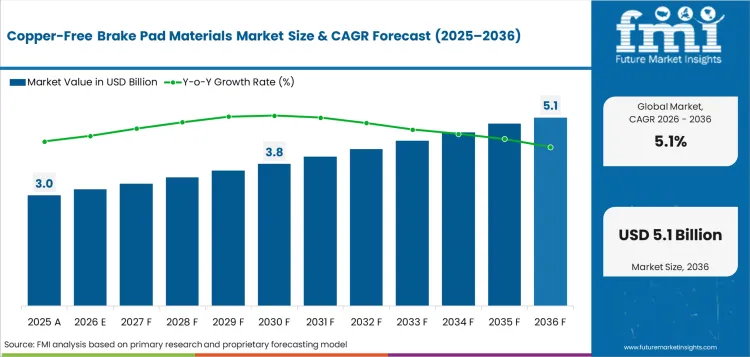
- Copper-free brake pad material market valuation was at USD 3.0 billion in 2025.
- By 2036, copper-free formulation rules are projected to lift market value to USD 5.1 billion.
- Compliant pad replacement is forecast to support demand expansion at 5.1% CAGR across the assessment period.
- USD 2.0 billion in incremental opportunity is estimated over the ten-year forecast as older copper-bearing compounds phase out.
- Ceramic composites are projected to hold 38.0% of material type demand in 2026 since low dust and noise control support premium pads.
- Passenger cars are anticipated to lead vehicle type demand during 2026 as high replacement frequency supports 64.0% share.
- Aftermarket sales are expected to represent 56.0% of channel demand in 2026 as brake wear creates repeat replacement volume.
- Faster-paced countries include China (6.4% CAGR) and India (6.1% CAGR) as vehicle output and service demand expand material use.
Copper-Free Brake Pad Materials Market Definition
The copper-free brake pad materials market includes friction materials used in brake pads and linings that meet low-copper or no-copper requirements. Scope covers ceramic composites, NAO blends, low metallic compounds, fibers, binders, fillers, and friction stabilizers used in compliant pad production. The market serves passenger cars, commercial vehicles, two wheelers, and off-highway vehicles.
Copper-Free Brake Pad Materials Market Inclusions
Market scope includes ceramic composites, NAO composites, low metallic compounds, semi metallic blends, carbon composites, reinforcement fibers, binders, fillers, stabilizers, noise modifiers, OEM supply, aftermarket sales, fleet workshops, authorized service, and regional demand across global vehicle platforms. Market participants include friction material suppliers, brake pad manufacturers, automotive OEMs, aftermarket distributors, fleet maintenance providers, authorized service centers, online parts retailers, and vehicle repair workshops.
Copper-Free Brake Pad Materials Market Exclusions
Market scope excludes brake rotors, calipers, hydraulic brake fluids, electronic braking systems, brake hoses, master cylinders, and copper-based pads above the accepted copper-free threshold.
Copper-Free Brake Pad Materials Market Research Methodology
- Primary Research: FMI analysts reviewed friction material suppliers, brake pad producers, aftermarket distributors, fleet maintenance providers, and OE braking specialists. Interviews focused on copper substitution, pad wear behavior, pricing pressure, and certification readiness.
- Desk Research: Desk research covered regulatory rules, Better Brakes guidance, EPA copper-free initiative materials, company product disclosures, and automotive production data. Product scope was checked against ceramic pad lines and commercial vehicle pad launches.
- Market Sizing and Forecasting: Market sizing combined pad replacement volume, material cost per pad set, vehicle parc aging, and country-level production exposure. Forecasts were tested against regional regulation timing and aftermarket channel demand.
- Data Validation: Forecasts were cross-checked with brake pad portfolio expansion, LeafMark compliance needs, and vehicle output trends. Company positioning was reviewed through official product pages and dated launch statements.
Why is the Copper-Free Brake Pad Materials Market Growing?
- Copper phaseout rules raise demand for compliant ceramic and NAO friction compounds.
- Aftermarket replacement supports repeat material use as pads face regular wear during stop-start driving.
- Heavy commercial pads need stronger heat control as copper-free compounds move into demanding duty cycles.
- EV and hybrid pads add material complexity as suppliers focus on lower noise and reduced dust.
Regulation has moved copper-free friction materials from a specialty option into a standard product requirement. Washington’s Better Brakes Law phases copper out of vehicle brake pads and shoes by 2025. The EPA Copper-Free Brake Initiative calls for copper in motor vehicle brake pads to fall to 0.5% by 2025. The threshold gives pad makers a clear formulation target for ceramic and NAO blends. Material suppliers gain value when they can deliver repeatable compounds that pass compliance checks and maintain braking comfort.
Aftermarket conversion is expanding the addressable demand base for copper-free materials. Service channels need compliant pads that can be stocked nationally without creating separate state-level inventories. Ceramic composites and NAO blends support this shift because they can reduce copper content without weakening noise control. Replacement channels gain a simpler stocking path as older copper-bearing pads leave the system. Material suppliers with stable friction testing and packaging compliance support are better placed to serve national distributors.
Market Segmentation Analysis
- Ceramic composites are projected to account for 38.0% of material type demand in 2026 as premium pads need low dust and quiet braking.
- Passenger cars are anticipated to represent 64.0% of vehicle type demand in 2026 with high service volume across used vehicles.
- Disc pads are expected to hold 72.0% of brake type demand in 2026 as front axle braking load increases friction material use.
- Aftermarket channels are forecast to capture 56.0% of sales in 2026 as pad wear creates repeat replacement cycles.
- Friction stabilizers are projected to represent 31.0% of formulation function demand in 2026 as copper removal raises heat-control needs.
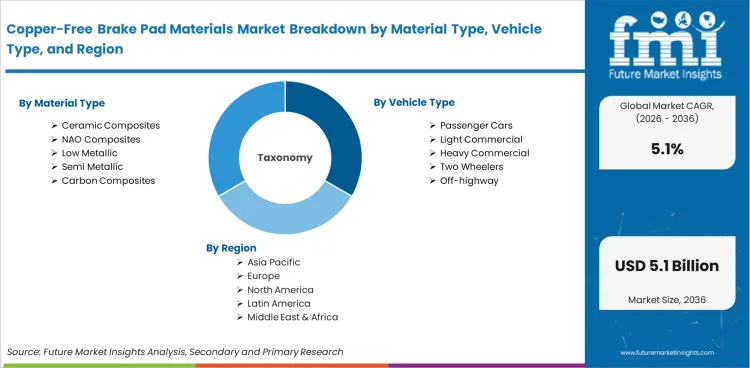
Segmentation covers material type, vehicle type, brake type, sales channel, and formulation function. Material type includes ceramic composites, NAO composites, low metallic, semi metallic, and carbon composites. Vehicle type covers passenger cars, light commercial, heavy commercial, two wheelers, and off-highway. Brake type includes disc pads, drum shoes, brake linings, kit materials, and performance pads. Sales channel includes OEMs, aftermarket, fleet workshops, online retail, and authorized service. Formulation function includes friction stabilizers, reinforcement fibers, binders, fillers, and noise modifiers.
Insights into the Ceramic Composites Material Type Segment
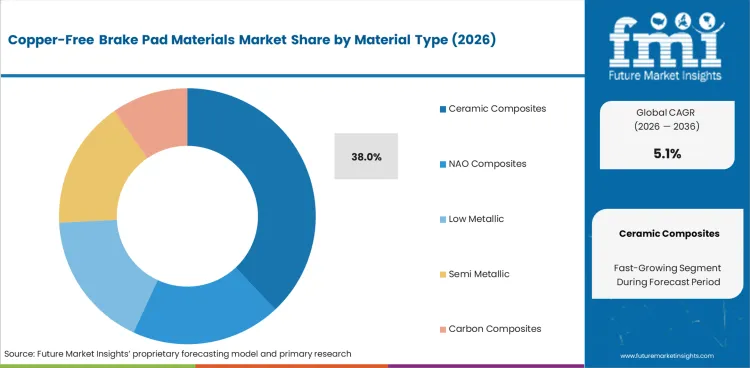
- By 2026, ceramic composites are forecast at 38.0% of material type demand. Ceramic composites lead because low dust and quiet braking help service centers offer premium copper-free pads against older friction compounds.
- NAO Composites stay important in mid-priced replacement pads. Low Metallic and Semi Metallic blends serve heavier duty needs when heat stability carries more weight than low-dust performance.
Insights into the Passenger Cars Vehicle Type Segment
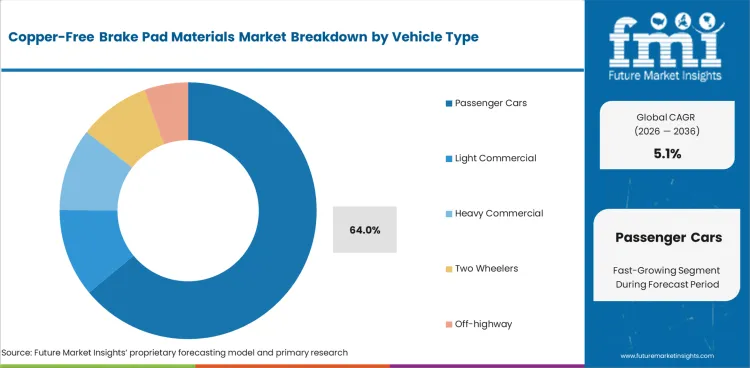
- Passenger cars are expected to be the leading vehicle type with a share of 64.0% in 2026. Daily vehicle use creates frequent pad replacement, which keeps material demand steady across repair workshops.
- Light Commercial vehicles add value through higher load cycles and service intensity. Heavy Commercial demand is more selective since fleets require copper-free materials that can manage heat without faster wear.
Copper-Free Brake Pad Materials Market Analysis by Brake Type
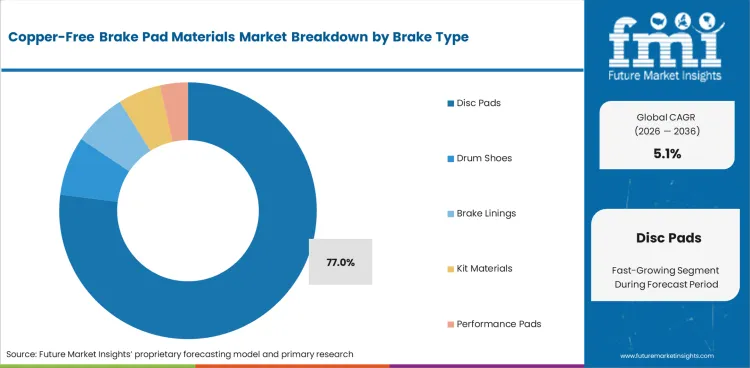
- Disc pads is set to lead brake type in 2026 with a 72.0% share, driven by higher front‑axle braking loads and widespread use in passenger vehicles, which makes disc pad materials the primary base for copper‑free formulations.
- Drum Shoes continue in rear axle and cost-sensitive vehicle platforms. Brake Linings support commercial and off-highway vehicles that need durable friction material under heavier braking cycles.
Copper-Free Brake Pad Materials Market Analysis by Sales Channel
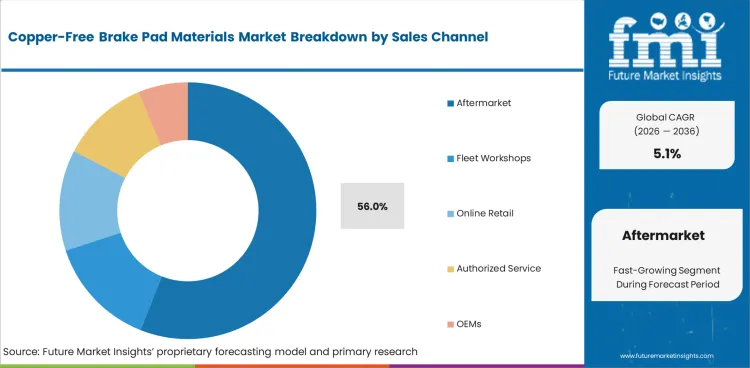
- By sales channel, Aftermarket is projected at 56.0% by 2026. Replacement demand creates repeat material use as worn pads move through service centers and retail parts channels.
- OEMs hold a disciplined approval path because copper-free compounds must pass platform-level testing. Fleet Workshops create repeat orders when pads deliver stable wear across route vehicles.
Copper-Free Brake Pad Materials Market Analysis by Formulation Function
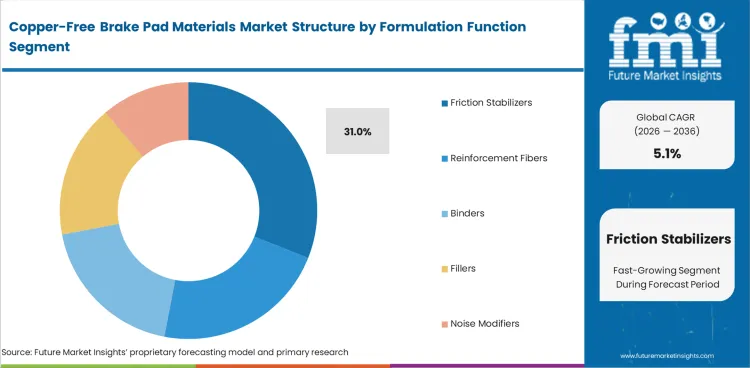
- Friction stabilizers is predicted to record a share of 31.0% of formulation function in 2026, owing to copper-free pads need thermal control during repeated braking.
- Reinforcement Fibers and Binders carry value when pad makers need strength and consistent shape retention. Noise Modifiers gain importance in EV and hybrid pads because quiet braking affects customer acceptance.
Copper-Free Brake Pad Materials Market Drivers, Restraints, and Opportunities
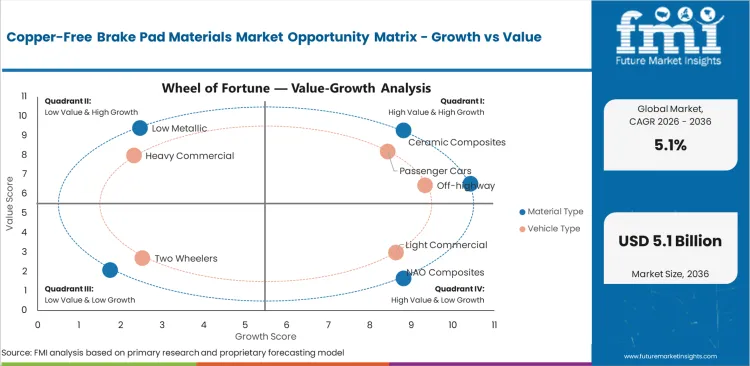
- Copper phaseout rules create direct demand for compliant friction blends across OE and aftermarket pad lines.
- Passenger car replacement supports volume stability as service centers replace pads through normal wear cycles.
- Higher material cost restrains adoption in price-sensitive channels when users compare copper-free pads with older low-cost products.
- Heavy commercial use opens opportunity for coatings and stabilizer packages that protect pad life under high brake energy.
Copper Threshold Compliance
Compliance pressure is the one of the prominent demand driver in copper-free brake pad materials. For instance, Washington’s Better Brakes Law requires brake pads and shoes made after Jan. 1, 2025 to contain less than 0.5% copper by weight. EPA’s Copper-Free Brake Initiative follows the same 2025 copper target for motor vehicle brake pads. Brake material suppliers need compounds that meet chemical limits and still protect pedal feel. Ceramic reinforcement and stabilizer packages gain value because they help replace copper’s heat-control role. Suppliers with clear certification support can serve national aftermarket programs with less channel friction.
Heat Load Substitution
Copper removal creates a technical challenge because brake pads must still manage heat and wear. DRiV’s official Tenneco release in February 2026 introduced an extension of Ferodo Premier copper-free brake pads for commercial vehicles. The release cites OE-quality friction materials and a high-performance pad coating for commercial vehicle fleets. Heavy commercial pads face higher brake energy than daily passenger car pads. Material suppliers compete on thermal stability and coating compatibility. Formulators that control heat without faster wear can defend value in fleet and severe-duty channels.
Analysis of Copper-Free Brake Pad Materials Market by Key Countries
.webp "Top Country Growth Comparison Copper Free Brake Pad Materials Market Cagr (2026 2036)")
| Country | CAGR |
|---|---|
| China | 6.4% |
| India | 6.1% |
| United States | 5.5% |
| Mexico | 5.4% |
| Germany | 4.3% |
| South Korea | 4.1% |
| Japan | 3.8% |
Source: FMI analysis based on primary research and proprietary forecasting model.
Copper-Free Brake Pad Materials Market CAGR Analysis by Country
- China’s 6.4% CAGR during 2026 to 2036 reflects large vehicle output and domestic brake pad production capacity.
- India is assessed at 6.1% CAGR during the forecast period due to passenger vehicle growth and wider workshop-based pad replacement.
- United States demand is forecast to move at 5.5% CAGR by 2036 as copper phaseout rules guide brake pad formulation.
- A 5.4% CAGR outlook places Mexico ahead of mature markets because North American assembly links support local pad production.
- Germany records 4.3% CAGR across 2026 to 2036 through premium vehicle platforms and higher-value ceramic pad demand.
- During 2026 to 2036, South Korea is forecast at 4.1% CAGR as export-ready brake systems need stable compliant materials.
- Japan’s market outlook stands at 3.8% CAGR for 2026 to 2036 due to mature vehicle production and high-quality pad standards.
Demand Outlook for Copper-Free Brake Pad Materials Market in China
China carries a large volume base for copper-free brake pad materials. China’s State Council Information Office reported that 2025 automobile output and sales reached new highs. Local material suppliers can serve a broad pad producer base. China is forecast to rise at 6.4% CAGR during the assessment period as domestic pad makers prepare products for local use and export channels. Export-oriented suppliers need copper-free formulations that can meet North American and European compliance expectations.
- Guangdong supports friction material processing through automotive component clusters serving passenger vehicle and export pad production.
- Shanghai creates OE-linked demand through vehicle assembly networks and higher specification brake system sourcing.
- Jiangsu gives pad material suppliers access to component plants serving both domestic programs and export replacement channels.
Sales Analysis of Copper-Free Brake Pad Materials Market in India
India’s market expansion comes from expanding vehicle ownership and a larger replacement pad base. SIAM reported that passenger vehicle sales reached 4.3 million units in FY 2024-25. Higher passenger vehicle sales widen the future brake pad replacement base. India is assessed at 6.1% CAGR in the forecast timeframe as organized workshops and two-wheeler service demand support local material use. Copper-free suppliers can gain when pad makers offer low-noise products at practical price points.
- Tamil Nadu supports brake pad material demand through Chennai’s automotive manufacturing and component supplier base.
- Maharashtra adds service demand through Mumbai and Pune workshops that handle dense passenger vehicle traffic.
- Delhi NCR creates frequent replacement need because stop-start urban driving raises pad wear in daily-use vehicles.
Demand Analysis of Copper-Free Brake Pad Materials Market in the United States
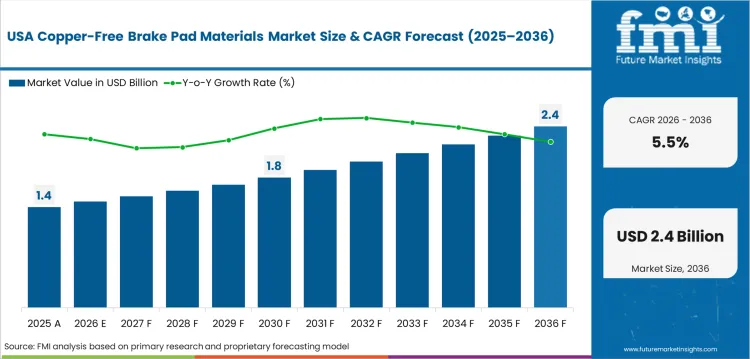
Regulation gives the United States a defined path for copper-free brake pad material use. EPA’s Copper-Free Brake Initiative targets less than 0.5% copper content in motor vehicle brake pads by 2025. The rule direction improves channel clarity for service centers and national parts distributors. United States demand is forecast to move at 5.5% CAGR by 2036 as suppliers align materials with compliance marks and pad performance needs. Friction material firms must prove that copper-free pads still deliver reliable braking comfort.
- California supports early copper-free pad adoption through state rules that affect national aftermarket stocking decisions.
- Washington’s Better Brakes program gives distributors a clear compliance reference for copper content and packaging marks.
- Michigan creates OE-linked validation demand through brake system engineering activity tied to Detroit-area vehicle programs.
Opportunity Analysis of Copper-Free Brake Pad Materials Market in Mexico
Mexico’s demand profile is tied to vehicle assembly and North American parts trade. The International Trade Administration states that Mexico had 37 light vehicle manufacturing plants across 12 states in 2024. Plant density creates a clear base for brake pad and friction material supply. Mexico is assessed at 5.4% CAGR during the forecast period as local suppliers serve OEM programs and replacement channels. Copper-free material demand improves when USA channel requirements flow back into Mexico-based pad production.
- Nuevo León supports auto parts manufacturing through supplier parks serving North American vehicle platforms.
- Guanajuato creates demand for OE-compatible friction materials through vehicle assembly and tier supplier activity.
- Puebla supports brake pad material use through Volkswagen and Audi production links in central Mexico.
Future Outlook for Copper-Free Brake Pad Materials Market in Germany
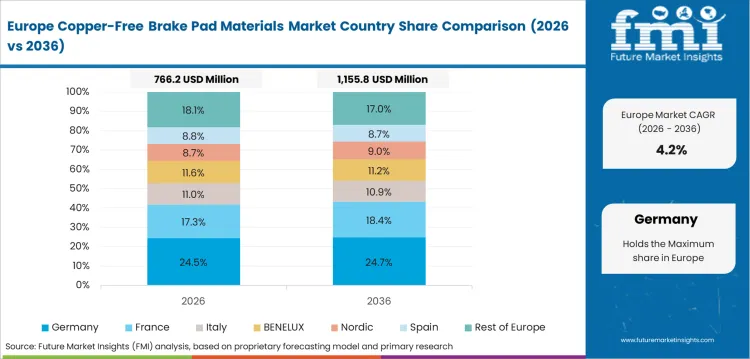
Germany’s market favors higher-value copper-free formulations tied to premium vehicles and EV production. VDA reported 1.67 million electric passenger cars manufactured in Germany during 2025. Electric vehicle output increases attention to quiet braking and low-dust pad behavior. Germany records 4.3% CAGR across 2026 to 2036 as ceramic compounds serve premium replacement and OE service needs. Material suppliers must meet tighter validation demands before wider use in high-speed and heavier vehicles.
- Baden-Württemberg supports premium brake material demand through Mercedes-Benz and Porsche-linked component ecosystems.
- Bavaria creates demand for high-value pad materials through BMW-linked service and replacement networks.
- Lower Saxony supports pad material qualification through Volkswagen-related vehicle platforms and aftermarket replacement demand.
Demand Outlook for Copper-Free Brake Pad Materials Market in South Korea
South Korea links copper-free material use to export-ready pads and compact vehicle platforms. Local brake system suppliers serve Hyundai-Kia programs and overseas replacement channels. South Korea is forecast at 4.1% CAGR across the assessment period as compliant friction systems gain value in export-linked service parts. Material suppliers need pad blends that meet noise targets for passenger cars and hybrid platforms. A faster shift toward EV service parts would raise demand for ceramic formulations with quieter braking behavior.
- Ulsan supports OE brake material demand through large-scale Hyundai vehicle assembly activity.
- Gyeonggi helps friction material suppliers serve domestic automakers and aftermarket parts networks.
- Busan supports export pad movement through port access into North American and Asian replacement channels.
In-depth Analysis of Copper-Free Brake Pad Materials Market in Japan
Japan’s market favors quality proof and stable replacement demand over faster volume expansion. JAMA’s Motor Industry of Japan 2025 covers motor vehicle production, new registrations and global operations across Japanese automakers. JAMA reporting shows the depth of Japan’s vehicle platform base and supplier discipline. Japan’s market outlook stands at 3.8% CAGR for 2026 to 2036 as mature output limits rapid material volume gains. Copper-free suppliers can still gain through ceramic pad coverage and low-noise replacement programs.
- Aichi supports OE brake material demand through Toyota-linked vehicle and component supply networks.
- Saitama creates replacement demand through compact car service activity and established repair networks.
- Gunma supports brake material quality needs through Subaru-linked production and platform service demand.
Competitive Landscape and Strategic Positioning
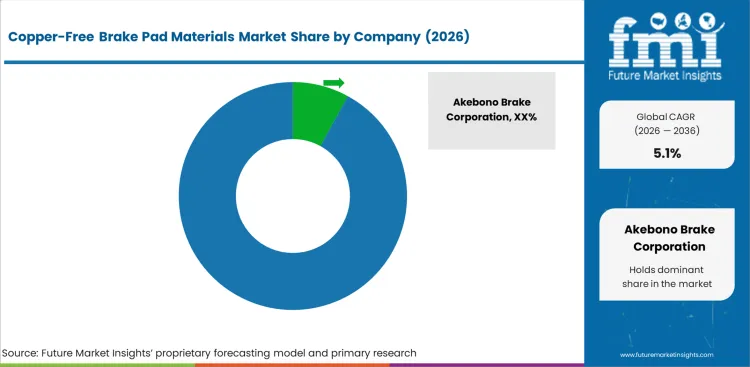
- Market competition centers on friction chemistry, pad coverage, and proof of compliance.
- Established suppliers gain advantage through OE validation and wider aftermarket catalog depth.
- Specialist material firms compete through ceramic blends, stabilizer packages, and noise-control additives.
- Entry barriers include formulation testing, thermal validation, and packaging certification requirements.
Competition depends on replacing copper without weakening the braking feel that drivers and fleets expect. Tenneco’s official DRiV release in February 2026 introduced an extension of Ferodo Premier copper-free brake pads for commercial vehicles. The release names OE-quality friction materials and a high-performance pad coating as part of the product offer. Material suppliers that can match copper-free compounds with coating systems gain a clearer role in fleet pad programs. Fleet service decisions will favor pads that protect bedding-in behavior and service life under repeated braking.
EV and hybrid braking creates a different competitive test for copper-free pad materials. ZF Aftermarket states that TRW Electric Blue brake pads are copper-free replacement pads for electric and hybrid vehicles. The line focuses on lower noise and dust for vehicles using regenerative braking. ZF’s product positioning matters because EV braking is more sensitive to noise during low-speed use. Smaller material suppliers can compete when their blends meet platform-specific noise targets and pass repeatable validation.
Key Companies in the Copper-Free Brake Pad Materials Market
Global companies compete through friction formulation depth, pad coverage, and compliance readiness.
- Global Leaders: Akebono Brake Corporation, Brembo N.V., ZF Aftermarket, and DRiV hold broad pad portfolios with copper-free or low-copper positioning. Akebono brings ceramic formulation depth.
- Regional Players: Nisshinbo Holdings Inc., ADVICS Co., Ltd., and TMD Friction serve OE and aftermarket programs through friction technology and regional platform relationships. Japanese suppliers benefit from long-standing vehicle maker links.
- Emerging and Specialist Suppliers: ICER Brakes, MAT Holdings, and ASK Automotive compete through copper-free pad lines, localized supply, and private-label support.
Competitive Benchmarking: Copper-Free Brake Pad Materials Market
| Company | Copper-Free Formulation Depth | Pad Coverage Breadth | Compliance Marking Readiness | Geographic Footprint |
|---|---|---|---|---|
| Akebono Brake Corporation | High | High | Strong | North America, Asia |
| Brembo N.V. | High | High | Strong | Global |
| ZF Aftermarket | High | High | Strong | Global |
| DRiV | High | High | Strong | Global |
| Nisshinbo Holdings Inc. | High | Medium | Strong | Asia, Global |
| ADVICS Co., Ltd. | Medium | Medium | Strong | Asia, North America |
| TMD Friction | High | High | Strong | Europe, Global |
| ICER Brakes | Medium | Medium | Moderate | Europe, Export Markets |
| MAT Holdings | Medium | High | Moderate | North America, Asia |
| ASK Automotive | Medium | Medium | Moderate | India, Export Markets |
Source: Future Market Insights competitive analysis, 2026.
Key Developments in Copper-Free Brake Pad Materials Market
- In February 2026, DRiV expanded Ferodo Premier copper-free brake pads for commercial vehicles. The line supports fleets that need compliant friction and faster bedding-in.
- In November 2025, Brembo launched XTRA Ceramic Severe Duty Brake Pads at AAPEX. The copper-free ceramic line targets trucks and SUVs.
Key Players in the Copper-Free Brake Pad Materials Market
Global Leaders
- Akebono Brake Corporation
- Brembo N.V.
- ZF Aftermarket
- DRiV
Regional Players
- Nisshinbo Holdings Inc.
- ADVICS Co., Ltd.
- TMD Friction
Emerging and Specialist Suppliers
- ICER Brakes
- MAT Holdings
- ASK Automotive
Report Scope and Coverage
| Parameter | Details |
|---|---|
| Quantitative Units | USD 3.1 billion to USD 5.1 billion, at 5.1% CAGR |
| Market Definition | Copper-free brake pad materials include ceramic composites, NAO blends, stabilizers, binders, fillers, and fibers used in compliant brake pads and linings. |
| Regions Covered | North America, Latin America, Europe, East Asia, South Asia and Pacific, Middle East and Africa |
| Countries Covered | United States, China, India, Mexico, Germany, South Korea, Japan, Brazil, 30+ countries |
| Key Companies Profiled | Akebono Brake Corporation, Brembo N.V., ZF Aftermarket, DRiV, Nisshinbo Holdings Inc., ADVICS Co., Ltd., TMD Friction, ICER Brakes, MAT Holdings, ASK Automotive |
| Forecast Period | 2026 to 2036 |
| Approach | Hybrid bottom-up and top-down methodology starting with pad replacement volume, compliant material cost, vehicle platform exposure, and regional channel checks |
Copper-Free Brake Pad Materials Market by Segments
Copper-Free Brake Pad Materials Market Segmented by Material Type
- • Ceramic Composites
- • NAO Composites
- • Low Metallic
- • Semi Metallic
- • Carbon Composites
Copper-Free Brake Pad Materials Market Segmented by Vehicle Type
- • Passenger Cars
- • Light Commercial
- • Heavy Commercial
- • Two Wheelers
- • Off-highway
Copper-Free Brake Pad Materials Market Segmented by Brake Type
- • Disc Pads
- • Drum Shoes
- • Brake Linings
- • Kit Materials
- • Performance Pads
Copper-Free Brake Pad Materials Market Segmented by Sales Channel
- • OEMs
- • Aftermarket
- • Fleet Workshops
- • Online Retail
- • Authorized Service
Copper-Free Brake Pad Materials Market Segmented by Formulation Function
- • Friction Stabilizers
- • Reinforcement Fibers
- • Binders
- • Fillers
- • Noise Modifiers
Copper-Free Brake Pad Materials Market by Region
- North America
- United States
- Canada
- Mexico
- Latin America
- Brazil
- Chile
- Rest of Latin America
- Western Europe
- Germany
- UK
- Italy
- Spain
- France
- Nordic
- BENELUX
- Rest of Western Europe
- Eastern Europe
- Russia
- Poland
- Hungary
- Balkan & Baltic
- Rest of Eastern Europe
- East Asia
- China
- Japan
- South Korea
- South Asia and Pacific
- India
- ASEAN
- Australia & New Zealand
- Rest of South Asia and Pacific
- Middle East & Africa
- Kingdom of Saudi Arabia
- Other GCC Countries
- Turkiye
- South Africa
- Other African Union
- Rest of Middle East & Africa
Research Sources and Bibliography
- Washington State Department of Ecology. (2025, January). Better Brakes Law. Washington State Department of Ecology.
- USA Environmental Protection Agency. (2015, January 21). Copper-Free Brake Initiative. USA Environmental Protection Agency.
- State Council Information Office of the People’s Republic of China. (2026, January 15). China’s auto output, sales reach new highs in 2025.
- Society of Indian Automobile Manufacturers. (2025, April 15). Performance of auto industry during March 2025 and April 2024 to March 2025. Society of Indian Automobile Manufacturers.
- International Trade Administration. (2026, February 11). Mexico: Automotive industry. USA Department of Commerce.
- Germany Trade & Invest. (2026, February 17). Germany is world’s second-largest EV maker. Germany Trade & Invest.
- Japan Automobile Manufacturers Association. (2025, September 26). The motor industry of Japan 2025. Japan Automobile Manufacturers Association.
- Tenneco. (2026, February 12). DRiV expands Ferodo Premier copper-free brake pads for commercial vehicles. Tenneco.
- AAPEX. (2025, November 5). Brembo launches Severe Duty Brake Pads. Automotive Aftermarket Products Expo.
- ZF Aftermarket. (2022, April). TRW Electric Blue Brake. ZF Friedrichshafen AG.
Bibliography entries use official government, regulatory, company, industry body, or trade event sources.
This Report Answers
- What is the current and future value of the copper-free brake pad materials market through 2036?
- What CAGR is forecast for copper-free brake pad material demand during the assessment period?
- Which material type is projected to lead copper-free brake pad material demand in 2026?
- Which vehicle type is expected to create the largest material demand base in 2026?
- How do Better Brakes rules affect brake pad formulation and material selection?
- Why do ceramic composites gain importance in copper-free brake pad production?
- Which countries are projected to grow faster in copper-free brake pad material demand?
- Which companies are positioned across copper-free ceramic and aftermarket brake pad lines?
- How does FMI define the copper-free brake pad materials market scope?
- What forecasting approach was used to estimate demand from 2026 to 2036?
Frequently Asked Questions
What is the global market demand for copper-free brake pad materials in 2026?
In 2026, global copper-free brake pad material demand is expected to be worth USD 3.1 billion as compliant pads enter wider use.
How big will the copper-free brake pad materials market be by 2036?
By 2036, the copper-free brake pad materials market is projected to reach USD 5.1 billion through replacement and OE conversion.
What CAGR is forecast for copper-free brake pad materials during the assessment period?
Copper-free brake pad material demand is forecast to grow at 5.1% CAGR during the assessment period as copper limits reshape formulations.
Which material type is projected to lead copper-free brake pad material demand in 2026?
Ceramic composites are projected to account for 38.0% of material type demand in 2026 due to low dust and noise control.
Which sales channel is expected to hold the highest demand share in 2026?
Aftermarket channels are expected to represent 56.0% of sales in 2026 as pad wear creates repeat replacement demand.
What is driving demand growth in China?
China is projected to record 6.4% CAGR through 2036 as vehicle production and domestic pad output support compliant material use.
What does FMI include in copper-free brake pad materials market definition?
FMI includes ceramic composites, NAO blends, binders, stabilizers, fillers, and fibers used in compliant brake pads and linings.
How does FMI estimate the copper-free brake pad materials forecast?
FMI estimates demand through pad replacement volume, material cost per set, OE conversion, and country-level compliance checks.
Preview the report firsthand - request a free sample
Get SampleGet the brochure for pricing and purchase details.
Get PDFTable of Content
- Key Takeaways
- Market Size and CAGR
- Top Growth Driver
- Fastest Growing Segment
- Leading Region
- Key Companies
- Emerging Opportunities
- Executive Summary
- Global Market Outlook
- Demand-side Trends
- Supply-side Trends
- Technology Roadmap Analysis
- Analysis and Recommendations
- Analyst Perspective (What is happening? Why now? What should investors know?)
- Key Questions Answered
- How large is the market?
- What is the CAGR?
- What are key trends?
- Which region dominates?
- Who are the leaders?
- Market Overview
- Market Coverage / Taxonomy
- Market Definition / Scope / Limitations
- Research Methodology
- Chapter Orientation
- Analytical Lens and Working Hypotheses
- Market Structure, Signals, and Trend Drivers
- Benchmarking and Cross-market Comparability
- Market Sizing, Forecasting, and Opportunity Mapping
- Research Design and Evidence Framework
- Desk Research Programme (Secondary Evidence)
- Expert Input and Fieldwork (Primary Evidence)
- Tooling, Models, and Reference Databases
- Data Engineering and Model Build
- Quality Assurance and Audit Trail
- Market Background
- Market Dynamics (Drivers, Restraints, Opportunity, Trends)
- Scenario Forecast (Optimistic, Likely, Conservative)
- Impact Analysis
- AI Impact
- Sustainability Impact
- Regulatory Impact
- Technology Impact
- Consumer / Buyer Analysis
- Purchase Drivers
- Adoption Barriers
- Buyer Journey
- Opportunity Map Analysis
- Product Life Cycle Analysis
- Supply Chain Analysis
- Investment Feasibility Matrix
- Value Chain Analysis
- PESTLE and Porter's Analysis
- Regulatory Landscape
- Regional Parent Market Outlook
- Production and Consumption Statistics
- Import and Export Statistics
- Global Market Analysis and Forecast, 2021 to 2036
- Historical Market Size Value (USD Billion) & Volume (Unit) Analysis, 2021 to 2025
- Current and Future Market Size Value (USD Billion) & Volume (Unit) Projections, 2026 to 2036
- Y-o-Y Growth Trend Analysis
- Absolute $ Opportunity Analysis
- Global Market Pricing Analysis, 2021 to 2036
- Global Market Analysis and Forecast, By Material Type, 2021 to 2036
- Introduction / Key Findings
- Historical Market Size Value (USD Billion) & Volume (Unit) Analysis By Material Type, 2021 to 2025
- Current and Future Market Size Value (USD Billion) & Volume (Unit) Analysis and Forecast By Material Type, 2026 to 2036
- Ceramic Composites
- NAO Composites
- Low Metallic
- Semi Metallic
- Carbon Composites
- Ceramic Composites
- Y-o-Y Growth Trend Analysis By Material Type, 2021 to 2025
- Absolute $ Opportunity Analysis By Material Type, 2026 to 2036
- Global Market Analysis and Forecast, By Vehicle Type, 2021 to 2036
- Introduction / Key Findings
- Historical Market Size Value (USD Billion) & Volume (Unit) Analysis By Vehicle Type, 2021 to 2025
- Current and Future Market Size Value (USD Billion) & Volume (Unit) Analysis and Forecast By Vehicle Type, 2026 to 2036
- Passenger Cars
- Light Commercial
- Heavy Commercial
- Two Wheelers
- Off-highway
- Passenger Cars
- Y-o-Y Growth Trend Analysis By Vehicle Type, 2021 to 2025
- Absolute $ Opportunity Analysis By Vehicle Type, 2026 to 2036
- Global Market Analysis and Forecast, By Brake Type, 2021 to 2036
- Introduction / Key Findings
- Historical Market Size Value (USD Billion) & Volume (Unit) Analysis By Brake Type, 2021 to 2025
- Current and Future Market Size Value (USD Billion) & Volume (Unit) Analysis and Forecast By Brake Type, 2026 to 2036
- Disc Pads
- Drum Shoes
- Brake Linings
- Kit Materials
- Performance Pads
- Disc Pads
- Y-o-Y Growth Trend Analysis By Brake Type, 2021 to 2025
- Absolute $ Opportunity Analysis By Brake Type, 2026 to 2036
- Global Market Analysis and Forecast, By Sales Channel, 2021 to 2036
- Introduction / Key Findings
- Historical Market Size Value (USD Billion) & Volume (Unit) Analysis By Sales Channel, 2021 to 2025
- Current and Future Market Size Value (USD Billion) & Volume (Unit) Analysis and Forecast By Sales Channel, 2026 to 2036
- OEMs
- Aftermarket
- Fleet Workshops
- Online Retail
- Authorized Service
- OEMs
- Y-o-Y Growth Trend Analysis By Sales Channel, 2021 to 2025
- Absolute $ Opportunity Analysis By Sales Channel, 2026 to 2036
- Global Market Analysis and Forecast, By Formulation Function, 2021 to 2036
- Introduction / Key Findings
- Historical Market Size Value (USD Billion) & Volume (Unit) Analysis By Formulation Function, 2021 to 2025
- Current and Future Market Size Value (USD Billion) & Volume (Unit) Analysis and Forecast By Formulation Function, 2026 to 2036
- Friction Stabilizers
- Reinforcement Fibers
- Binders
- Fillers
- Noise Modifiers
- Friction Stabilizers
- Y-o-Y Growth Trend Analysis By Formulation Function, 2021 to 2025
- Absolute $ Opportunity Analysis By Formulation Function, 2026 to 2036
- Global Market Analysis and Forecast, By Region, 2021 to 2036
- Introduction
- Historical Market Size Value (USD Billion) & Volume (Unit) Analysis By Region, 2021 to 2025
- Current Market Size Value (USD Billion) & Volume (Unit) Analysis and Forecast By Region, 2026 to 2036
- North America
- Latin America
- Western Europe
- Eastern Europe
- East Asia
- South Asia and Pacific
- Middle East & Africa
- Market Attractiveness Analysis By Region
- North America Market Analysis and Forecast, By Country, 2021 to 2036
- Historical Market Size Value (USD Billion) & Volume (Unit) Trend Analysis By Market Taxonomy, 2021 to 2025
- Market Size Value (USD Billion) & Volume (Unit) Forecast By Market Taxonomy, 2026 to 2036
- By Country
- USA
- Canada
- Mexico
- By Material Type
- By Vehicle Type
- By Brake Type
- By Sales Channel
- By Formulation Function
- By Country
- Market Attractiveness Analysis
- By Country
- By Material Type
- By Vehicle Type
- By Brake Type
- By Sales Channel
- By Formulation Function
- Key Takeaways
- Latin America Market Analysis and Forecast, By Country
- Historical Market Size Value (USD Billion) & Volume (Unit) Trend Analysis By Market Taxonomy, 2021 to 2025
- Market Size Value (USD Billion) & Volume (Unit) Forecast By Market Taxonomy, 2026 to 2036
- By Country
- Brazil
- Chile
- Rest of Latin America
- By Material Type
- By Vehicle Type
- By Brake Type
- By Sales Channel
- By Formulation Function
- By Country
- Market Attractiveness Analysis
- By Country
- By Material Type
- By Vehicle Type
- By Brake Type
- By Sales Channel
- By Formulation Function
- Key Takeaways
- Western Europe Market Analysis and Forecast, By Country
- Historical Market Size Value (USD Billion) & Volume (Unit) Trend Analysis By Market Taxonomy, 2021 to 2025
- Market Size Value (USD Billion) & Volume (Unit) Forecast By Market Taxonomy, 2026 to 2036
- By Country
- Germany
- UK
- Italy
- Spain
- France
- Nordic
- BENELUX
- Rest of Western Europe
- By Material Type
- By Vehicle Type
- By Brake Type
- By Sales Channel
- By Formulation Function
- By Country
- Market Attractiveness Analysis
- By Country
- By Material Type
- By Vehicle Type
- By Brake Type
- By Sales Channel
- By Formulation Function
- Key Takeaways
- Eastern Europe Market Analysis and Forecast, By Country
- Historical Market Size Value (USD Billion) & Volume (Unit) Trend Analysis By Market Taxonomy, 2021 to 2025
- Market Size Value (USD Billion) & Volume (Unit) Forecast By Market Taxonomy, 2026 to 2036
- By Country
- Russia
- Poland
- Hungary
- Balkan & Baltic
- Rest of Eastern Europe
- By Material Type
- By Vehicle Type
- By Brake Type
- By Sales Channel
- By Formulation Function
- By Country
- Market Attractiveness Analysis
- By Country
- By Material Type
- By Vehicle Type
- By Brake Type
- By Sales Channel
- By Formulation Function
- Key Takeaways
- East Asia Market Analysis and Forecast, By Country
- Historical Market Size Value (USD Billion) & Volume (Unit) Trend Analysis By Market Taxonomy, 2021 to 2025
- Market Size Value (USD Billion) & Volume (Unit) Forecast By Market Taxonomy, 2026 to 2036
- By Country
- China
- Japan
- South Korea
- By Material Type
- By Vehicle Type
- By Brake Type
- By Sales Channel
- By Formulation Function
- By Country
- Market Attractiveness Analysis
- By Country
- By Material Type
- By Vehicle Type
- By Brake Type
- By Sales Channel
- By Formulation Function
- Key Takeaways
- South Asia and Pacific Market Analysis and Forecast, By Country
- Historical Market Size Value (USD Billion) & Volume (Unit) Trend Analysis By Market Taxonomy, 2021 to 2025
- Market Size Value (USD Billion) & Volume (Unit) Forecast By Market Taxonomy, 2026 to 2036
- By Country
- India
- ASEAN
- Australia & New Zealand
- Rest of South Asia and Pacific
- By Material Type
- By Vehicle Type
- By Brake Type
- By Sales Channel
- By Formulation Function
- By Country
- Market Attractiveness Analysis
- By Country
- By Material Type
- By Vehicle Type
- By Brake Type
- By Sales Channel
- By Formulation Function
- Key Takeaways
- Middle East & Africa Market Analysis and Forecast, By Country
- Historical Market Size Value (USD Billion) & Volume (Unit) Trend Analysis By Market Taxonomy, 2021 to 2025
- Market Size Value (USD Billion) & Volume (Unit) Forecast By Market Taxonomy, 2026 to 2036
- By Country
- Kingdom of Saudi Arabia
- Other GCC Countries
- Türkiye
- South Africa
- Other African Union
- Rest of Middle East & Africa
- By Material Type
- By Vehicle Type
- By Brake Type
- By Sales Channel
- By Formulation Function
- By Country
- Market Attractiveness Analysis
- By Country
- By Material Type
- By Vehicle Type
- By Brake Type
- By Sales Channel
- By Formulation Function
- Key Takeaways
- Key Countries Market Analysis
- USA
- Pricing Analysis
- Market Share Analysis, 2025
- By Material Type
- By Vehicle Type
- By Brake Type
- By Sales Channel
- By Formulation Function
- Canada
- Pricing Analysis
- Market Share Analysis, 2025
- By Material Type
- By Vehicle Type
- By Brake Type
- By Sales Channel
- By Formulation Function
- Mexico
- Pricing Analysis
- Market Share Analysis, 2025
- By Material Type
- By Vehicle Type
- By Brake Type
- By Sales Channel
- By Formulation Function
- Brazil
- Pricing Analysis
- Market Share Analysis, 2025
- By Material Type
- By Vehicle Type
- By Brake Type
- By Sales Channel
- By Formulation Function
- Chile
- Pricing Analysis
- Market Share Analysis, 2025
- By Material Type
- By Vehicle Type
- By Brake Type
- By Sales Channel
- By Formulation Function
- Germany
- Pricing Analysis
- Market Share Analysis, 2025
- By Material Type
- By Vehicle Type
- By Brake Type
- By Sales Channel
- By Formulation Function
- UK
- Pricing Analysis
- Market Share Analysis, 2025
- By Material Type
- By Vehicle Type
- By Brake Type
- By Sales Channel
- By Formulation Function
- Italy
- Pricing Analysis
- Market Share Analysis, 2025
- By Material Type
- By Vehicle Type
- By Brake Type
- By Sales Channel
- By Formulation Function
- Spain
- Pricing Analysis
- Market Share Analysis, 2025
- By Material Type
- By Vehicle Type
- By Brake Type
- By Sales Channel
- By Formulation Function
- France
- Pricing Analysis
- Market Share Analysis, 2025
- By Material Type
- By Vehicle Type
- By Brake Type
- By Sales Channel
- By Formulation Function
- India
- Pricing Analysis
- Market Share Analysis, 2025
- By Material Type
- By Vehicle Type
- By Brake Type
- By Sales Channel
- By Formulation Function
- ASEAN
- Pricing Analysis
- Market Share Analysis, 2025
- By Material Type
- By Vehicle Type
- By Brake Type
- By Sales Channel
- By Formulation Function
- Australia & New Zealand
- Pricing Analysis
- Market Share Analysis, 2025
- By Material Type
- By Vehicle Type
- By Brake Type
- By Sales Channel
- By Formulation Function
- China
- Pricing Analysis
- Market Share Analysis, 2025
- By Material Type
- By Vehicle Type
- By Brake Type
- By Sales Channel
- By Formulation Function
- Japan
- Pricing Analysis
- Market Share Analysis, 2025
- By Material Type
- By Vehicle Type
- By Brake Type
- By Sales Channel
- By Formulation Function
- South Korea
- Pricing Analysis
- Market Share Analysis, 2025
- By Material Type
- By Vehicle Type
- By Brake Type
- By Sales Channel
- By Formulation Function
- Russia
- Pricing Analysis
- Market Share Analysis, 2025
- By Material Type
- By Vehicle Type
- By Brake Type
- By Sales Channel
- By Formulation Function
- Poland
- Pricing Analysis
- Market Share Analysis, 2025
- By Material Type
- By Vehicle Type
- By Brake Type
- By Sales Channel
- By Formulation Function
- Hungary
- Pricing Analysis
- Market Share Analysis, 2025
- By Material Type
- By Vehicle Type
- By Brake Type
- By Sales Channel
- By Formulation Function
- Kingdom of Saudi Arabia
- Pricing Analysis
- Market Share Analysis, 2025
- By Material Type
- By Vehicle Type
- By Brake Type
- By Sales Channel
- By Formulation Function
- Türkiye
- Pricing Analysis
- Market Share Analysis, 2025
- By Material Type
- By Vehicle Type
- By Brake Type
- By Sales Channel
- By Formulation Function
- South Africa
- Pricing Analysis
- Market Share Analysis, 2025
- By Material Type
- By Vehicle Type
- By Brake Type
- By Sales Channel
- By Formulation Function
- USA
- Market Structure Analysis
- Competition Dashboard
- Competition Benchmarking
- Market Share Analysis of Top Players
- By Regional
- By Material Type
- By Vehicle Type
- By Brake Type
- By Sales Channel
- By Formulation Function
- Emerging Startups
- Innovation Benchmarking
- Competition Analysis
- Competition Deep Dive
- Akebono Brake Corporation
- Overview
- Product Portfolio
- Profitability by Market Segments (Product/Region/Sales Channel)
- Sales Footprint
- Strategy Overview
- Marketing Strategy
- Product Strategy
- Channel Strategy
- Brembo N.V.
- ZF Aftermarket
- DRiV
- Nisshinbo Holdings Inc.
- ADVICS Co., Ltd.
- TMD Friction
- ICER Brakes
- MAT Holdings
- ASK Automotive
- Akebono Brake Corporation
- Case Studies
- Success Stories
- Recent Developments
- Competition Deep Dive
- Assumptions & Acronyms Used


