

- Industry Size (2026)
- USD 4.9 Bn
- Forecast (2036)
- USD 8.6 Bn
- CAGR (2026 to 2036)
- 6.30%
Low-Copper and EV Brake Pads Market Forecast and Outlook 2026 to 2036
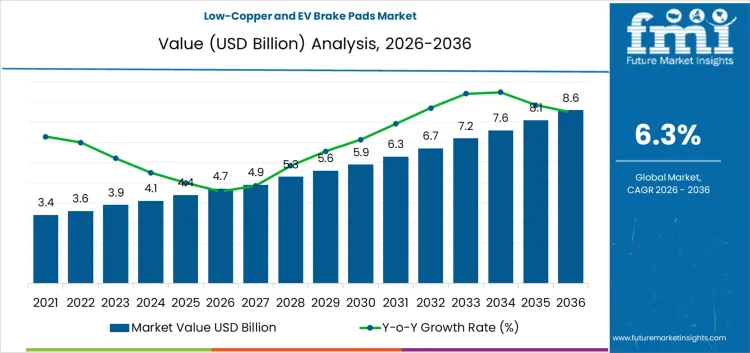
The low-copper and EV brake pads market is likely to be valued at USD 4.9 billion in 2026 and is projected to reach USD 8.6 billion by 2036, expanding at a CAGR of 6.3% over the forecast period. Capital allocation in this market is guided by material reformulation intensity and qualification timelines rather than plant buildouts alone, because compliant friction recipes must pass platform-specific durability, noise, and dust validation. Investment is being concentrated in R&D, pilot-scale compounding, and testing capacity that can shorten OEM approval cycles and reduce the cost of iterative reformulation.
Returns are increasingly tied to securing long-duration OEM awards and high-velocity aftermarket SKUs, where scale improves unit economics and protects margin against volatile input costs. EV adoption shifts spending toward pads engineered for regenerative braking conditions, pushing suppliers to fund corrosion resistance, low-wear performance, and particulate-control additives that can be priced at a premium when validated. Smaller entrants face slower payback due to certification hurdles and limited access to test fleets. Between 2026 and 2036, disciplined capital deployment favors firms that can industrialize compliant formulations quickly and monetize them across multiple vehicle platforms.
Quick Stats for Low-Copper and EV Brake Pads Market
- Low-Copper and EV Brake Pads Market Value (2026): USD 4.9 Billion
- Low-Copper and EV Brake Pads Market Forecast Value (2036): USD 8.6 Billion
- Low-Copper and EV Brake Pads Market Forecast CAGR 2026 to 2036: 6.30%
- Leading Vehicle Type in Low-Copper and EV Brake Pads Market: Battery Electric Vehicles
- Leading Sales Channel in Low-Copper and EV Brake Pads Market: Aftermarket
- Key Growth Regions in Low-Copper and EV Brake Pads Market: Asia Pacific, Latin America, North America, Middle East & Africa
- Top Key Players in Low-Copper and EV Brake Pads Market: Tenneco (DRiV/Ferodo), Akebono, Brembo, Nisshinbo, Bosch, ADVICS, Hitachi Astemo, TRW (ZF Aftermarket), EBC Brakes, Sangsin Brake
Low-Copper and EV Brake Pads Market Key Takeaways
| Metric | Value |
|---|---|
| Industry Value (2026) | USD 4.9 Billion |
| Forecast Value (2036) | USD 8.6 Billion |
| Forecast CAGR 2026 to 2036 | 6.30% |
How Is the Global Low-Copper and EV Brake Pads Market Advancing?
The global low-copper and electric vehicle (EV) brake pads market is advancing steadily, driven by tightening environmental regulations on brake pad materials and the rapid growth of electric vehicle production. Low-copper brake pads are increasingly adopted to reduce particulate emissions from braking systems, while EV-specific brake pads are engineered to meet the distinct braking characteristics of electric drivetrains.
A key driver supporting market growth is the introduction of regulations limiting copper content in brake friction materials to reduce water and soil contamination. Automakers and brake system suppliers are transitioning toward compliant formulations that maintain braking performance while meeting regulatory thresholds. In parallel, EV brake pads are gaining traction as electric vehicles require materials optimized for regenerative braking, lower operating temperatures, and reduced wear.
Advancements in friction material formulations and manufacturing processes are further strengthening market adoption. Innovations in ceramic, organic, and hybrid friction materials are improving durability, noise reduction, and braking consistency. Increasing collaboration between automakers and brake component manufacturers is supporting the development of EV-optimized brake systems. As regulatory pressure and EV adoption continue to expand globally, the low-copper and EV brake pads market is expected to maintain consistent growth over the forecast period.
What Is the Segment-Wise Overview of the Low-Copper and EV Brake Pads Market?
The low-copper and EV brake pads market is shaped by accelerating electrification of vehicles and strong replacement-driven demand. Battery electric vehicles lead with a 48% share, driven by the need for brake pads compatible with regenerative braking systems and compliance with tightening copper-emission regulations. These vehicles require pads that deliver consistent performance under low-wear conditions while minimizing particulate output. On the sales channel side, the aftermarket accounts for 58% of demand, reflecting the recurring replacement nature of brake pads and the growing installed base of EVs and hybrids. Together, these segments highlight a market focused on regulatory compliance, EV-specific performance requirements, and replacement-driven purchasing behavior.
Why Do Battery Electric Vehicles Lead the Low-Copper and EV Brake Pads Market?
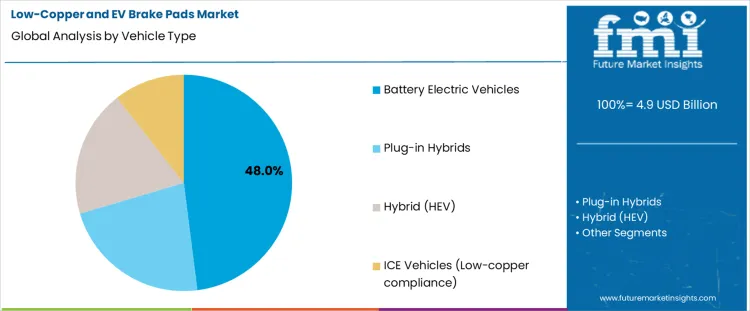
Battery electric vehicles account for 48% of demand in the low-copper and EV brake pads market due to their unique braking requirements and regulatory alignment. EVs rely heavily on regenerative braking, which reduces overall brake usage but increases the need for pads that perform consistently under low-temperature, low-wear conditions. Low-copper formulations are preferred as they comply with tightening environmental regulations on copper emissions while maintaining braking efficiency and noise control. EV manufacturers and consumers also prioritize brake pads that minimize particulate emissions, corrosion, and rotor wear. As global EV adoption accelerates and environmental compliance standards become stricter, demand for specialized low-copper brake pads tailored for battery electric vehicles continues to grow, reinforcing BEVs as the dominant vehicle segment.
Why Does the Aftermarket Dominate Sales Channels in the Low-Copper and EV Brake Pads Market?
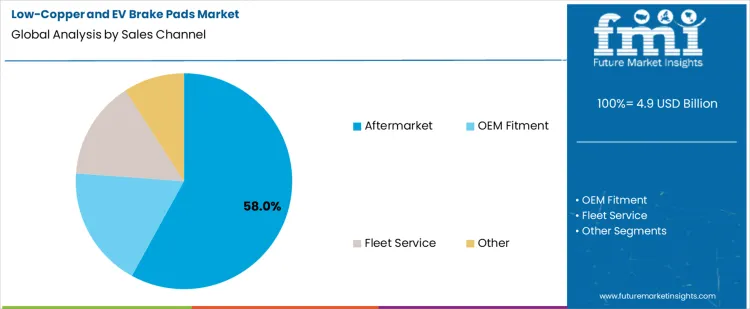
The aftermarket represents 58% of total sales, making it the leading distribution channel in the low-copper and EV brake pads market. Brake pads are wear components that require periodic replacement, driving recurring demand through independent workshops, service centers, and retail outlets. EV owners increasingly turn to the aftermarket for compliant low-copper brake pads that meet environmental regulations without the higher costs often associated with OEM replacements. The growing installed base of EVs and hybrid vehicles further strengthens aftermarket volume, as replacement cycles expand over time. Wide product availability, competitive pricing, and faster service turnaround enhance aftermarket preference. As regulatory-driven brake pad replacement becomes more common, the aftermarket continues to outperform OEM fitment channels.
Low-Copper and EV Brake Pads Market
What Are the Key Dynamics for the Low-Copper and EV Brake Pads Market?
Copper, traditionally used to enhance heat dissipation and friction stability, has been restricted in many regions due to concerns about environmental contamination of waterways. Concurrently, the growth of EVs which place unique demands on braking systems due to regenerative braking and higher vehicle weights has increased demand for pad formulations that balance performance with low copper content. Key market dynamics include OEM commitments to meet emissions and material restrictions, rising EV production volumes, and ongoing material innovation to deliver durable, high-performance brake pads with reduced environmental impact while maintaining safety and comfort standards.
Why Is the Low-Copper and EV Brake Pads Market Growing?
The marke low-copper and EV brake pads market t is growing as regulatory frameworks in North America, Europe, and parts of Asia limit copper content in brake pads, prompting automakers and suppliers to accelerate adoption of compliant friction materials. Electric vehicle adoption is simultaneously rising due to supportive policies, improved charging infrastructure, and consumer interest in electrified transportation, encouraging development of braking solutions tailored to EV requirements. Low-copper formulations and alternative friction modifiers such as organic fibers and ceramics are being optimized for thermal stability, wear resistance, and noise reduction under EV braking dynamics. OEM focus on extending brake component life and reducing warranty costs supports investment in next-generation brake pad materials.
What Are the Challenges Impacting the Low-Copper and EV Brake Pads Market?
Challenges in the low-copper and EV brake pads market include technical complexities in developing low-copper formulations that match or exceed the frictional performance of conventional pads, particularly under high-load conditions such as heavy EV braking. Higher raw material costs associated with alternative friction modifiers and precision manufacturing can increase product prices, potentially limiting adoption in cost-sensitive vehicle segments. Supply chain constraints for novel material inputs may affect production lead times and consistency. Regulatory divergence across regions creates complexity for global suppliers needing to comply with varying copper content limits. In Rigorous testing and certification processes required to demonstrate safety, wear characteristics, and compatibility with diverse vehicle platforms may prolong time-to-market, presenting hurdles for smaller manufacturers and new entrants.
What Is the Growth Outlook for the Low-Copper and EV Brake Pads Market by Country?
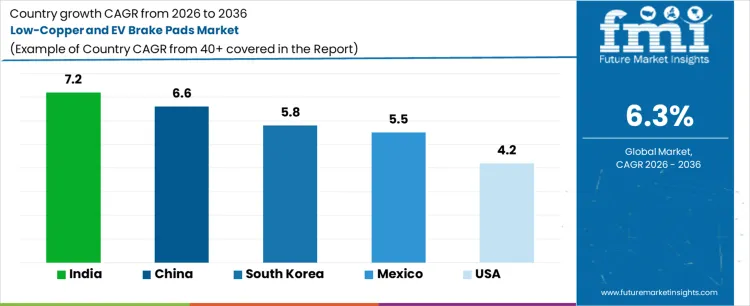
| Country | CAGR (%) |
|---|---|
| India | 7.2% |
| China | 6.6% |
| South Korea | 5.8% |
| Mexico | 5.5% |
| USA | 4.2% |
Source: FMI analysis based on primary research and proprietary forecasting model
The low-copper and EV brake pads market is expanding as automakers transition toward cleaner, EV-optimized braking systems. India leads with a 7.2% CAGR, driven by rapid EV adoption and localization of compliant brake materials. China follows at 6.6%, supported by large-scale EV manufacturing and environmental regulations. South Korea (5.8%) benefits from advanced automotive R&D and export-focused compliance, while Mexico (5.5%) grows through EV-related manufacturing expansion. The USA (4.2%) shows steady growth, reflecting regulatory-driven replacement demand in a mature market. As EV adoption rises globally, low-copper brake pad demand is expected to increase across all regions.
What Is Driving the Growth of the Low-Copper and EV Brake Pads Market in India?
The low-copper and EV brake pads market in India is growing at a CAGR of 7.2%, driven by rapid expansion of electric vehicle adoption and tightening vehicle emission and material standards. Rising sales of electric two-wheelers, passenger EVs, and electric buses are increasing demand for brake pads optimized for regenerative braking systems. Low-copper formulations are gaining traction as automakers and suppliers respond to environmental concerns related to brake dust emissions. India’s growing automotive manufacturing base and increasing localization of EV components are further supporting market growth. Cost-sensitive consumers are encouraging development of durable, low-wear brake pad materials that extend service intervals. In addition, government policies promoting EV adoption and cleaner mobility are influencing OEM material choices. As India’s EV ecosystem matures, demand for compliant, low-copper brake pads is expected to increase steadily.
How Is the Low-Copper and EV Brake Pads Market Expanding in China?
The low-copper and EV brake pads market in China is expanding at a CAGR of 6.6%, supported by the country’s large EV production base and strong regulatory push toward cleaner automotive components. China’s high penetration of electric passenger vehicles and commercial EV fleets is driving demand for brake pads engineered for lower noise, reduced particulate emissions, and compatibility with regenerative braking. Domestic brake pad manufacturers are actively reformulating products to meet low-copper standards while maintaining braking performance. Large-scale automotive production volumes enable faster adoption of new material specifications across platforms. In addition, increasing focus on urban air quality is pushing automakers to reduce non-exhaust emissions, including brake dust. As China continues to dominate global EV manufacturing, demand for low-copper and EV-specific brake pads is expected to grow consistently.
What Is Supporting Growth of the Low-Copper and EV Brake Pads Market in South Korea?
The low-copper and EV brake pads market in South Korea is growing at a CAGR of 5.8%, driven by advanced automotive engineering capabilities and increasing EV model launches. South Korean automakers are integrating low-copper brake pad materials to align with global environmental standards and export market requirements. Growth in electric and hybrid vehicle production is supporting demand for brake pads designed for reduced wear and improved performance under regenerative braking conditions. Strong R&D focus among component suppliers is accelerating development of next-generation friction materials. Emphasis on vehicle noise reduction and ride comfort is influencing brake pad design choices. As South Korea continues to strengthen its position in EV exports and advanced automotive technologies, adoption of low-copper and EV brake pads is expected to increase steadily.
How Is the Low-Copper and EV Brake Pads Market Developing in Mexico?
The low-copper and EV brake pads market in Mexico is expanding at a CAGR of 5.5%, supported by its role as a major automotive manufacturing hub for North America. Increasing production of EVs and hybrid vehicles for export markets is encouraging adoption of low-copper brake pad formulations that meet international standards. Mexico’s strong supplier ecosystem enables efficient scaling of compliant brake components. As automakers align local production with global material regulations, demand for low-copper brake pads is rising. Growth in aftermarket demand for EV-compatible brake components is also contributing to market expansion. In addition, improving awareness of environmental compliance among manufacturers is influencing material transitions. As Mexico continues to attract EV-related investments, demand for low-copper and EV brake pads is expected to grow steadily.
How Is the Low-Copper and EV Brake Pads Market Expanding in the USA?
The low-copper and EV brake pads market in the USA is growing at a CAGR of 4.2%, reflecting a more mature automotive market with gradual transition toward low-copper materials. Regulatory frameworks aimed at reducing copper content in brake pads are a key driver, encouraging replacement of legacy formulations. Growth in EV adoption is increasing demand for brake pads that deliver low noise, minimal dust, and long service life under regenerative braking conditions. OEMs and aftermarket suppliers are increasingly standardizing low-copper formulations across vehicle platforms. However, market maturity and slower vehicle replacement cycles moderate growth rates. As environmental compliance and EV penetration continue to expand, demand for low-copper and EV brake pads in the USA is expected to progress steadily.
How Are Companies Competing in the Low-Copper and EV Brake Pads Market?
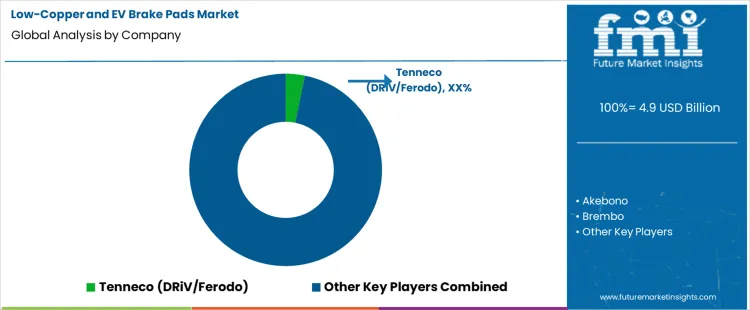
Competition in the low-copper and EV brake pads market is driven by regulatory compliance, braking performance under low-noise conditions, particulate emission reduction, and compatibility with electrified vehicle architectures. As regulations increasingly restrict copper content to limit environmental contamination, brake pad manufacturers are reformulating friction materials without compromising stopping power, durability, or thermal stability. In electric vehicles, competition intensifies around low-dust generation, corrosion resistance, and consistent performance under regenerative braking systems, where mechanical braking is used less frequently but must remain instantly effective when required.
Tenneco (DRiV/Ferodo), Akebono, Brembo, Bosch, TRW (ZF Aftermarket), ADVICS, and Hitachi Astemo lead competition through OEM relationships, advanced material science, and global manufacturing scale. Akebono and ADVICS differentiate strongly in low-copper and copper-free formulations optimized for quiet operation and stable friction, particularly for hybrid and electric vehicles. Brembo and Bosch leverage premium performance positioning, emphasizing braking consistency, low noise, and integration with advanced braking systems. Tenneco and ZF Aftermarket compete through broad product portfolios, regulatory-ready formulations, and strong aftermarket penetration alongside OEM supply.
Nisshinbo, EBC Brakes, Sangsin Brake, and Hitachi Astemo compete through formulation specialization, regional OEM alignment, and targeted performance segments. Nisshinbo focuses on low-copper friction materials with high thermal stability and reduced particulate emissions. EBC Brakes differentiates in performance-oriented and EV-compatible aftermarket pads, while Sangsin Brake competes on cost efficiency and growing EV adoption in Asia. Across the market, competitive advantage is defined by compliance-ready formulations, low-noise and low-dust performance, durability under regenerative braking, and the ability to serve both OEM and aftermarket demand as EV penetration accelerates.
Key Players in Low-Copper and EV Brake Pads Market
- Tenneco (DRiV/Ferodo)
- Akebono
- Brembo
- Nisshinbo
- Bosch
- ADVICS
- Hitachi Astemo
- TRW (ZF Aftermarket)
- EBC Brakes
- Sangsin Brake
Scope of Report
| Attributes | Description |
|---|---|
| Quantitative Unit (2026) | USD Billion |
| Vehicle Type | Battery Electric Vehicles, Plug-in Hybrids, Hybrid (HEV), ICE Vehicles (Low-Copper Compliance) |
| Sales Channel | Aftermarket, OEM Fitment, Fleet Service, Other |
| Regions Covered | Asia Pacific, Europe, North America, Latin America, Middle East & Africa |
| Countries Covered | China, Japan, South Korea, India, Australia & New Zealand, ASEAN, Rest of Asia Pacific, Germany, United Kingdom, France, Italy, Spain, Nordic, BENELUX, Rest of Europe, United States, Canada, Mexico, Brazil, Chile, Rest of Latin America, Kingdom of Saudi Arabia, Other GCC Countries, Turkey, South Africa, Rest of Africa, Rest of Middle East & Africa |
| Key Companies Profiled | Tenneco (DRiV/Ferodo), Akebono, Brembo, Nisshinbo, Bosch, ADVICS, Hitachi Astemo, TRW (ZF Aftermarket), EBC Brakes, Sangsin Brake |
| Additional Attributes | Dollar sales by vehicle type and sales channel; regional market size and forecast analysis; growth outlook across major regions; adoption trends for low-copper compliant and EV-optimized brake pads; assessment of regulatory compliance impact, braking performance requirements, and demand dynamics across OEM, aftermarket, and fleet ser |
Low-Copper and EV Brake Pads Market by Key Segments
Vehicle Type
- Battery Electric Vehicles
- Plug-in Hybrids
- Hybrid (HEV)
- ICE Vehicles (Low-copper compliance)
Sales Channel
- Aftermarket
- OEM Fitment
- Fleet Service
- Other
Region
- Asia Pacific
- China
- Japan
- South Korea
- India
- Australia & New Zealand
- ASEAN
- Rest of Asia Pacific
- Europe
- Germany
- United Kingdom
- France
- Italy
- Spain
- Nordic
- BENELUX
- Rest of Europe
- North America
- United States
- Canada
- Mexico
- Latin America
- Brazil
- Chile
- Rest of Latin America
- Middle East & Africa
- Kingdom of Saudi Arabia
- Other GCC Countries
- Turkey
- South Africa
- Other African Union
- Rest of Middle East & Africa
Bibliography
- Washington State Department of Ecology. (n.d.). Better Brakes Law.
- USA Environmental Protection Agency. (2015). Memorandum of understanding on copper mitigation in watersheds and waterways.
- Bay Area Stormwater Management Agencies Association. (2011). Regional pollutants of concern report: Copper controls (C.13.c vehicle brake pads) FY 2010 to 2011.
- The International Council on Clean Transportation. (2024, May 6). Euro 7: The new emission standard for light-duty vehicles.
- European Parliament and Council of the European Union. (2024, April 24). Regulation (EU) 2024/1257 on type-approval of motor vehicles and engines and of systems, components and separate technical units intended for such vehicles, with respect to their emissions and battery durability (Euro 7).
- Parkin, R., et al. (2025). Copper-enriched automotive brake wear particles perturb metabolism and metal homeostasis. Particle and Fibre Toxicology, 22, 4.
Frequently Asked Questions
How big is the low-copper and ev brake pads market in 2026?
The global low-copper and ev brake pads market is estimated to be valued at USD 4.9 billion in 2026.
What will be the size of low-copper and ev brake pads market in 2036?
The market size for the low-copper and ev brake pads market is projected to reach USD 9.0 billion by 2036.
How much will be the low-copper and ev brake pads market growth between 2026 and 2036?
The low-copper and ev brake pads market is expected to grow at a 6.3% CAGR between 2026 and 2036.
What are the key product types in the low-copper and ev brake pads market?
The key product types in low-copper and ev brake pads market are battery electric vehicles, plug-in hybrids, hybrid (hev) and ice vehicles (low-copper compliance).
Which sales channel segment to contribute significant share in the low-copper and ev brake pads market in 2026?
In terms of sales channel, aftermarket segment to command 58.0% share in the low-copper and ev brake pads market in 2026.
Preview the report firsthand - request a free sample
Get SampleGet the brochure for pricing and purchase details.
Get PDFTable of Content
- Executive Summary
- Global Market Outlook
- Demand-side Trends
- Supply-side Trends
- Technology Roadmap Analysis
- Analysis and Recommendations
- Market Overview
- Market Coverage / Taxonomy
- Market Definition / Scope / Limitations
- Market Background
- Market Dynamics
- Drivers
- Restraints
- Opportunity
- Trends
- Scenario Forecast
- Demand in Optimistic Scenario
- Demand in Likely Scenario
- Demand in Conservative Scenario
- Opportunity Map Analysis
- Product Life Cycle Analysis
- Supply Chain Analysis
- Investment Feasibility Matrix
- Value Chain Analysis
- PESTLE and Porter’s Analysis
- Regulatory Landscape
- Regional Parent Market Outlook
- Production and Consumption Statistics
- Import and Export Statistics
- Market Dynamics
- Global Market Analysis 2021 to 2025 and Forecast, 2026 to 2036
- Historical Market Size Value (USD Million) Analysis, 2021 to 2025
- Current and Future Market Size Value (USD Million) Projections, 2026 to 2036
- Y-o-Y Growth Trend Analysis
- Absolute $ Opportunity Analysis
- Global Market Pricing Analysis 2021 to 2025 and Forecast 2026 to 2036
- Global Market Analysis 2021 to 2025 and Forecast 2026 to 2036, By Vehicle Type
- Introduction / Key Findings
- Historical Market Size Value (USD Million) Analysis By Vehicle Type , 2021 to 2025
- Current and Future Market Size Value (USD Million) Analysis and Forecast By Vehicle Type , 2026 to 2036
- Battery Electric Vehicles
- Plug-in Hybrids
- Hybrid (HEV)
- ICE Vehicles (Low-copper compliance)
- Battery Electric Vehicles
- Y-o-Y Growth Trend Analysis By Vehicle Type , 2021 to 2025
- Absolute $ Opportunity Analysis By Vehicle Type , 2026 to 2036
- Global Market Analysis 2021 to 2025 and Forecast 2026 to 2036, By Sales Channel
- Introduction / Key Findings
- Historical Market Size Value (USD Million) Analysis By Sales Channel, 2021 to 2025
- Current and Future Market Size Value (USD Million) Analysis and Forecast By Sales Channel, 2026 to 2036
- Aftermarket
- OEM Fitment
- Fleet Service
- Other
- Aftermarket
- Y-o-Y Growth Trend Analysis By Sales Channel, 2021 to 2025
- Absolute $ Opportunity Analysis By Sales Channel, 2026 to 2036
- Global Market Analysis 2021 to 2025 and Forecast 2026 to 2036, By Region
- Introduction
- Historical Market Size Value (USD Million) Analysis By Region, 2021 to 2025
- Current Market Size Value (USD Million) Analysis and Forecast By Region, 2026 to 2036
- North America
- Latin America
- Western Europe
- Eastern Europe
- East Asia
- South Asia and Pacific
- Middle East & Africa
- Market Attractiveness Analysis By Region
- North America Market Analysis 2021 to 2025 and Forecast 2026 to 2036, By Country
- Historical Market Size Value (USD Million) Trend Analysis By Market Taxonomy, 2021 to 2025
- Market Size Value (USD Million) Forecast By Market Taxonomy, 2026 to 2036
- By Country
- USA
- Canada
- Mexico
- By Vehicle Type
- By Sales Channel
- By Country
- Market Attractiveness Analysis
- By Country
- By Vehicle Type
- By Sales Channel
- Key Takeaways
- Latin America Market Analysis 2021 to 2025 and Forecast 2026 to 2036, By Country
- Historical Market Size Value (USD Million) Trend Analysis By Market Taxonomy, 2021 to 2025
- Market Size Value (USD Million) Forecast By Market Taxonomy, 2026 to 2036
- By Country
- Brazil
- Chile
- Rest of Latin America
- By Vehicle Type
- By Sales Channel
- By Country
- Market Attractiveness Analysis
- By Country
- By Vehicle Type
- By Sales Channel
- Key Takeaways
- Western Europe Market Analysis 2021 to 2025 and Forecast 2026 to 2036, By Country
- Historical Market Size Value (USD Million) Trend Analysis By Market Taxonomy, 2021 to 2025
- Market Size Value (USD Million) Forecast By Market Taxonomy, 2026 to 2036
- By Country
- Germany
- UK
- Italy
- Spain
- France
- Nordic
- BENELUX
- Rest of Western Europe
- By Vehicle Type
- By Sales Channel
- By Country
- Market Attractiveness Analysis
- By Country
- By Vehicle Type
- By Sales Channel
- Key Takeaways
- Eastern Europe Market Analysis 2021 to 2025 and Forecast 2026 to 2036, By Country
- Historical Market Size Value (USD Million) Trend Analysis By Market Taxonomy, 2021 to 2025
- Market Size Value (USD Million) Forecast By Market Taxonomy, 2026 to 2036
- By Country
- Russia
- Poland
- Hungary
- Balkan & Baltic
- Rest of Eastern Europe
- By Vehicle Type
- By Sales Channel
- By Country
- Market Attractiveness Analysis
- By Country
- By Vehicle Type
- By Sales Channel
- Key Takeaways
- East Asia Market Analysis 2021 to 2025 and Forecast 2026 to 2036, By Country
- Historical Market Size Value (USD Million) Trend Analysis By Market Taxonomy, 2021 to 2025
- Market Size Value (USD Million) Forecast By Market Taxonomy, 2026 to 2036
- By Country
- China
- Japan
- South Korea
- By Vehicle Type
- By Sales Channel
- By Country
- Market Attractiveness Analysis
- By Country
- By Vehicle Type
- By Sales Channel
- Key Takeaways
- South Asia and Pacific Market Analysis 2021 to 2025 and Forecast 2026 to 2036, By Country
- Historical Market Size Value (USD Million) Trend Analysis By Market Taxonomy, 2021 to 2025
- Market Size Value (USD Million) Forecast By Market Taxonomy, 2026 to 2036
- By Country
- India
- ASEAN
- Australia & New Zealand
- Rest of South Asia and Pacific
- By Vehicle Type
- By Sales Channel
- By Country
- Market Attractiveness Analysis
- By Country
- By Vehicle Type
- By Sales Channel
- Key Takeaways
- Middle East & Africa Market Analysis 2021 to 2025 and Forecast 2026 to 2036, By Country
- Historical Market Size Value (USD Million) Trend Analysis By Market Taxonomy, 2021 to 2025
- Market Size Value (USD Million) Forecast By Market Taxonomy, 2026 to 2036
- By Country
- Kingdom of Saudi Arabia
- Other GCC Countries
- Turkiye
- South Africa
- Other African Union
- Rest of Middle East & Africa
- By Vehicle Type
- By Sales Channel
- By Country
- Market Attractiveness Analysis
- By Country
- By Vehicle Type
- By Sales Channel
- Key Takeaways
- Key Countries Market Analysis
- USA
- Pricing Analysis
- Market Share Analysis, 2025
- By Vehicle Type
- By Sales Channel
- Canada
- Pricing Analysis
- Market Share Analysis, 2025
- By Vehicle Type
- By Sales Channel
- Mexico
- Pricing Analysis
- Market Share Analysis, 2025
- By Vehicle Type
- By Sales Channel
- Brazil
- Pricing Analysis
- Market Share Analysis, 2025
- By Vehicle Type
- By Sales Channel
- Chile
- Pricing Analysis
- Market Share Analysis, 2025
- By Vehicle Type
- By Sales Channel
- Germany
- Pricing Analysis
- Market Share Analysis, 2025
- By Vehicle Type
- By Sales Channel
- UK
- Pricing Analysis
- Market Share Analysis, 2025
- By Vehicle Type
- By Sales Channel
- Italy
- Pricing Analysis
- Market Share Analysis, 2025
- By Vehicle Type
- By Sales Channel
- Spain
- Pricing Analysis
- Market Share Analysis, 2025
- By Vehicle Type
- By Sales Channel
- France
- Pricing Analysis
- Market Share Analysis, 2025
- By Vehicle Type
- By Sales Channel
- India
- Pricing Analysis
- Market Share Analysis, 2025
- By Vehicle Type
- By Sales Channel
- ASEAN
- Pricing Analysis
- Market Share Analysis, 2025
- By Vehicle Type
- By Sales Channel
- Australia & New Zealand
- Pricing Analysis
- Market Share Analysis, 2025
- By Vehicle Type
- By Sales Channel
- China
- Pricing Analysis
- Market Share Analysis, 2025
- By Vehicle Type
- By Sales Channel
- Japan
- Pricing Analysis
- Market Share Analysis, 2025
- By Vehicle Type
- By Sales Channel
- South Korea
- Pricing Analysis
- Market Share Analysis, 2025
- By Vehicle Type
- By Sales Channel
- Russia
- Pricing Analysis
- Market Share Analysis, 2025
- By Vehicle Type
- By Sales Channel
- Poland
- Pricing Analysis
- Market Share Analysis, 2025
- By Vehicle Type
- By Sales Channel
- Hungary
- Pricing Analysis
- Market Share Analysis, 2025
- By Vehicle Type
- By Sales Channel
- Kingdom of Saudi Arabia
- Pricing Analysis
- Market Share Analysis, 2025
- By Vehicle Type
- By Sales Channel
- Turkiye
- Pricing Analysis
- Market Share Analysis, 2025
- By Vehicle Type
- By Sales Channel
- South Africa
- Pricing Analysis
- Market Share Analysis, 2025
- By Vehicle Type
- By Sales Channel
- USA
- Market Structure Analysis
- Competition Dashboard
- Competition Benchmarking
- Market Share Analysis of Top Players
- By Regional
- By Vehicle Type
- By Sales Channel
- Competition Analysis
- Competition Deep Dive
- Tenneco (DRiV/Ferodo)
- Overview
- Product Portfolio
- Profitability by Market Segments (Product/Age /Sales Channel/Region)
- Sales Footprint
- Strategy Overview
- Marketing Strategy
- Product Strategy
- Channel Strategy
- Akebono
- Brembo
- Nisshinbo
- Bosch
- ADVICS
- Hitachi Astemo
- TRW (ZF Aftermarket)
- EBC Brakes
- Sangsin Brake
- Tenneco (DRiV/Ferodo)
- Competition Deep Dive
- Assumptions & Acronyms Used
- Research Methodology


