

- Industry Size (2026)
- USD 2.0 Bn
- Forecast (2036)
- USD 3.4 Bn
- CAGR (2026 to 2036)
- 5.6%
Low-Noise Low-Dust EV Brake Components Market Forecast and Outlook 2026 to 2036
The low-noise low-dust EV brake components market is likely to be valued at USD 2.0 billion in 2026 and is projected to reach USD 3.4 billion by 2036 at a 5.6% CAGR. Demand is shaped by cabin comfort targets, particulate emission limits, and brand-level ride quality benchmarks applied to electric vehicles. Vehicle programs specify acceptable noise bands, dusting behavior, and wear profiles during brake system definition. Once a pad and disc family is approved, later material changes require renewed vehicle testing and regulatory checks. Volume growth follows wider adoption of electric vehicles and stricter expectations for refinement in mass and premium segments.
Participation in the low-noise low-dust EV brake components market is governed by inclusion in approved brake system specifications maintained by vehicle manufacturers. Access depends on documented acoustic performance, controlled dust generation, and consistency across production lots. Brake component families remain stable across full model cycles because homologation files and warranty assumptions attach to specific friction systems. Supplier changes occur during platform changes rather than routine sourcing. Revenue development reflects the number of electric vehicle programs specifying low-emission and low-noise braking solutions. Competitive position depends on early involvement in brake system tuning and sustained acceptance within manufacturer validation frameworks.
Low-Noise Low-Dust EV Brake Components Market Quick Stats
- Low-Noise Low-Dust EV Brake Components Market Value (2026): USD 2.0 billion
- Low-Noise Low-Dust EV Brake Components Market Forecast Value (2036): USD 3.4 billion
- Low-Noise Low-Dust EV Brake Components Market Forecast CAGR (2026 to 2036): 5.6%
- Leading Component in Low-Noise Low-Dust EV Brake Components Market: Low-dust pads
- Key Growth Regions in Low-Noise Low-Dust EV Brake Components Market: China, USA, Germany, South Korea, Japan
- Top Players in Low-Noise Low-Dust EV Brake Components Market: Brembo, Tenneco, Akebono Brake Industry, Bosch, Continental, Nisshinbo, ADVICS, ZF Friedrichshafen, EBC Brakes
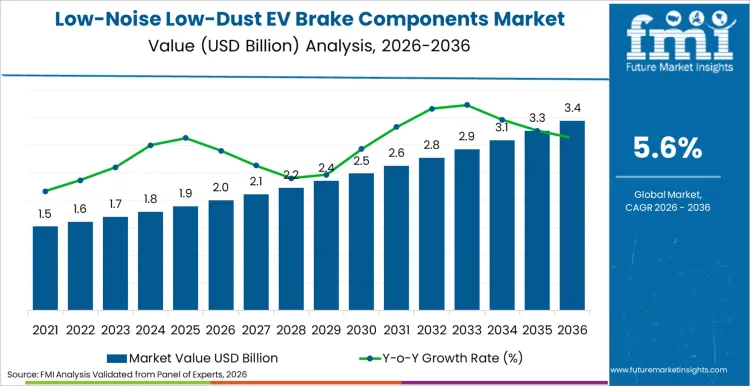
What is the Growth Forecast for the Low Noise Low Dust EV Brake Components Market through 2036?
Urban driving cycles expose brake hardware to frequent light deceleration, which places emphasis on acoustic behavior and particulate control rather than peak stopping force. The low noise low dust EV brake components market in 2026 stands near USD 2.0 billion, supported by passenger EV platforms that prioritize cabin quietness and wheel cleanliness. Product selection centers on pad formulations, rotor surface treatments, shim systems, and tolerance control that limit squeal and visible residue under low energy stops. Validation work measures sound pressure, particle release, and wear pattern stability across mixed duty cycles. Platform teams lock these components into chassis bills of material during vehicle architecture definition. The path to USD 3.4 billion by 2036 follows a 5.6% growth profile linked to wider adoption across volume segments and higher specification levels per axle set.
Fleet deployment patterns shape commercial demand in the low noise low dust EV brake components market. Volumes follow multi year vehicle programs rather than service part cycles. Inventory exposure stays moderate since value concentrates in finished components rather than in raw materials. Cost structure reflects friction material formulation effort, coating processes, machining precision, and test mileage. OEM groups track in cabin noise, wheel appearance after use, and wear consistency across climates. Annual values pass the mid two billion during the early 2030s as more models adopt quiet brake packages as standard equipment. The move to USD 3.4 billion in 2036 comes from broader platform coverage, higher content per vehicle set, and longer program lifetimes that keep these components in place across full model cycles.
Low-Noise Low-Dust EV Brake Components Market Key Takeaways
| Metric | Value |
|---|---|
| Market Value (2026) | USD 2.0 billion |
| Forecast Value (2036) | USD 3.4 billion |
| Forecast CAGR (2026 to 2036) | 5.6% |
Source: Future Market Insights (FMI) analysis, based on proprietary forecasting model and primary research
How Is the Low Noise Low Dust EV Brake Components Market Being Used to Control Acoustic Compliance and Particulate Emissions in Electric Vehicle Platforms?
Vehicle manufacturers treat the low noise low dust EV brake components market as part of homologation and brand risk control rather than as a comfort upgrade. Programs specify low noise brake pad formulations for electric vehicles and low dust brake materials for EV platforms to meet interior noise targets and external particulate limits. Validation teams rely on NVH optimized brake component testing services and brake particle emission control solutions to qualify behavior under urban duty cycles and corrosion exposure. Engineering groups integrate electric vehicle brake noise reduction systems and copper free brake friction materials to avoid late stage rework. The focus stays on wear stability, disc interaction, and contamination control because a quiet stop in early testing does not guarantee stable performance over fleet mileage and seasonal changes.
Program management places EV brake dust regulation compliance components inside release governance rather than inside feature differentiation. Selection criteria for low noise brake suppliers in EV programs include consistency across batches and documented wear behavior. Cost impact analysis of low dust brake systems is tied to avoided warranty claims and field campaigns. Brake wear particulate monitoring methods are used to track drift during endurance testing and production ramps. Service life optimization for EV brake components influences platform maintenance planning more than initial stopping metrics. Brake system acoustic performance validation protocols define acceptance gates and test scope. This makes brake material choice a certification and risk management decision, not a tuning preference driven only by subjective feel.
How Do Regulatory Particle Limits and Cabin Noise Expectations Shape Demand in the Low-Noise Low-Dust EV Brake Components Market by Component and Material in 2026?
In the Low-Noise Low-Dust EV Brake Components Market, program targets start from particulate emission limits, in-cabin acoustic thresholds, and customer acceptance metrics rather than from stopping distance alone. Teams supporting passenger electric vehicle platforms, premium vehicle architectures, and urban fleet electrification programs require components that control wear debris and vibration while preserving consistent pedal response under blended braking. By component, demand spans low-dust pads, coated discs and rotors, noise dampers and shims, and other parts. By material, usage covers copper-reduced friction material, ceramic or NAO, coated or composite rotors, and other systems. Portfolio structure reflects validation scope, warranty exposure, and cross-platform reuse rather than unit cost optimization.
Why Do Low-Dust Pads and Damping Elements Anchor Component Selection?
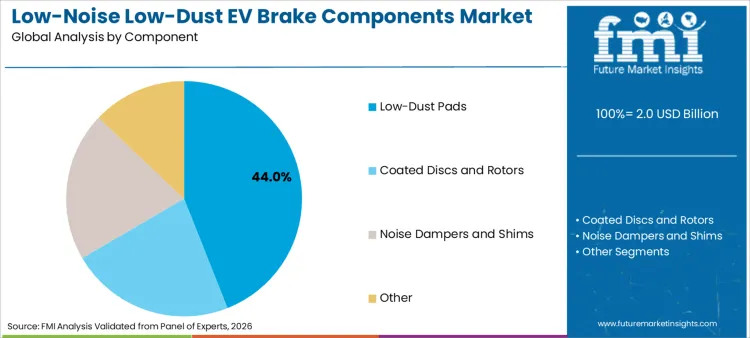
Low-dust pads represent about 44% share, reflecting their role as the primary source of airborne wear particles and visible wheel contamination. In passenger electric vehicle platforms, control of pad wear directly affects both environmental reporting and customer perception of cleanliness. Coated discs and rotors support corrosion resistance and stable friction, though they address dust only indirectly. Noise dampers and shims target vibration transmission paths that cause squeal and low-speed groan. Other components remain secondary. Engineering teams evaluate components through wear rate, particle size distribution, and NVH spectra. Validation teams evaluate through durability cycles and climate exposure. Manufacturing teams evaluate through assembly complexity and supplier maturity.
After a component set is fixed, caliper interfaces, friction pairs, and test procedures are frozen around that combination. Any change introduces new wear studies, acoustic testing, and endurance programs. Program planning then protects long validation windows. Supply chains align to the selected friction and damping stack. Service documentation and warranty models also follow. Volume growth comes from deploying the same component family across multiple models rather than switching solutions. The operating result favors low-dust pad and damping packages that stabilize emissions behavior and acoustic performance across high-volume platforms.
Why Do Copper-Reduced and Ceramic Systems Lead Material Adoption?
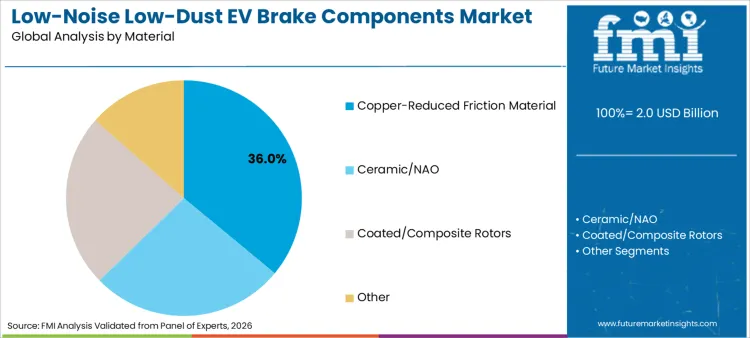
Copper-reduced friction material accounts for about 36% share, reflecting regulatory pressure to limit metal content in wear debris while maintaining stable friction characteristics. This material class supports predictable bedding behavior and controlled dust color. Ceramic or NAO systems follow where low noise and low visible dust take priority, particularly in premium vehicle architectures. Coated or composite rotors extend corrosion resistance and manage surface stability, though they do not replace pad material functions. Other materials remain niche. Materials teams evaluate options through friction stability, compressibility, and thermal fade. Compliance teams evaluate through particulate composition. Manufacturing teams evaluate through process yield and supply continuity.
Material choice then fixes friction pairing rules, bedding procedures, and service specifications. A change requires new compatibility testing and revised wear models. Program schedules and certification files follow the selected stack. Supplier tooling and quality plans also align. Field service and warranty assumptions depend on the same material behavior. Expansion occurs by extending approved materials to additional platforms rather than introducing new chemistries. Demand therefore concentrates in copper-reduced and ceramic-based systems that satisfy environmental constraints while preserving consistent acoustic and wear performance over long service intervals.
Why Is Platform Integration Pressure Driving the Low-Noise Low-Dust EV Brake Components Market?
As vehicle architectures converge around the EV Powertrain Systems and the Blended Brake Systems, brake components are exposed to new duty cycles with lower average friction usage and longer idle periods. This changes pad and disc behavior, making noise events and dust release more visible to customers. At the same time, expectations set by the Vehicle NVH Management Systems and the Brake by Wire Systems require predictable acoustic behavior during both regenerative and friction braking. These overlapping system requirements push OEMs to specify low-noise, low-dust materials rather than relying on traditional friction formulations. The Low-Noise Low-Dust EV Brake Components Market benefits from this shift because component selection now influences cabin experience, wheel cleanliness, and long term perception of vehicle quality.
What Is Limiting Rapid Standardization in the Low-Noise Low-Dust EV Brake Components Market?
Material and system diversity across the EV Platform Engineering and the Brake System Integration prevents easy reuse of friction recipes and hardware designs. Different vehicle weights, motor braking strategies, and thermal profiles create wide variation in friction demand. The Chassis Control Systems also introduces differences in how often and how aggressively friction brakes are blended in. These factors make it difficult to deploy a single low-noise, low-dust solution across multiple platforms. Suppliers must tune compounds for each program, which increases validation cycles and testing cost. Procurement teams face longer qualification timelines and limited opportunities to consolidate specifications across vehicle families.
How Are Materials Engineering and Platform Strategies Changing the Low-Noise Low-Dust EV Brake Components Market?
Product strategy is increasingly shaped by the Automotive Friction Materials and the EV Brake Integration Platforms, which are pushing component development toward system level optimization rather than isolated pad or disc design. Suppliers now co-develop friction materials, shims, and disc surfaces to meet acoustic, wear, and dust targets simultaneously. Simulation workflows tied to the Vehicle Dynamics Simulation Software are being used earlier to predict noise behavior and dust formation under blended braking conditions. The Low-Noise Low-Dust EV Brake Components Market is moving toward platform specific material families supported by shared test data and reuse frameworks. Competitive position depends on validated material systems, not single component performance claims.
What is the Demand for Low Noise Low Dust EV Brake Components by Country?
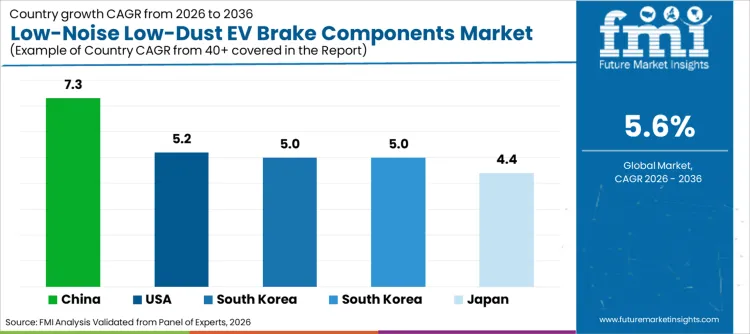
| Country | CAGR (%) |
|---|---|
| USA | 5.2% |
| Japan | 4.4% |
| South Korea | 5.0% |
| Germany | 5.0% |
| China | 7.3% |
Source: Future Market Insights (FMI) analysis, based on proprietary forecasting model and primary research
The demand for low noise low dust EV brake components is increasing across passenger and commercial electric vehicles where NVH performance, safety, and regulatory compliance are critical. China leads at 7.3% CAGR, supported by rapid EV adoption and domestic OEM focus on quieter, cleaner braking systems. The USA grows at 5.2%, driven by expanding EV production and consumer demand for low noise, low maintenance braking solutions. Germany and South Korea both record 5.0%, shaped by integration in premium EV models and regulatory focus on particulate emissions. Japan posts 4.4%, within a mature EV market emphasizing quality, reliability, and consistent braking performance.
How Urban Fleet Performance Drives the Low-Noise Low-Dust EV Brake Components Market in the USA
Increasing urban EV deployment and focus on passenger comfort are supporting a 5.2% CAGR for the low-noise low-dust EV brake components market in the United States. Components are selected based on noise suppression, minimal particulate emission, and integration with regenerative braking systems. Engineering teams evaluate thermal stability, braking response, pad and rotor wear, and compatibility with electronic stability and traction modules. Once validated, components are deployed across multiple vehicle lines and assembly facilities. Volume growth corresponds with fleet expansion, new EV model introductions, and urban mobility programs. Supplier participation relies on audit compliance, technical documentation, and integration support. Commercial success depends on reproducible low-noise performance, durability, and consistent operational reliability across assembly lines.
How High-Frequency Testing and Material Validation Shape the Low-Noise Low-Dust EV Brake Components Market in Japan
In Japan, the low-noise low-dust EV brake components market is growing at a 4.4% CAGR due to rigorous material validation and acoustic performance testing. Components must demonstrate minimal dust emission, noise reduction, and thermal stability under repeated braking cycles. Engineers assess wear resistance, braking consistency, and interaction with regenerative systems and electronic control units. Once validated, the same components are deployed across multiple assembly lines and vehicle platforms. Supplier access depends on audit compliance, documentation accuracy, and technical support capability. Volume growth is tied to EV platform expansions, fleet scaling, and adoption of low-emission urban mobility solutions. Commercial outcomes rely on reproducible performance, durability, and operational reliability.
How Production Load and Platform Integration Influence the Low-Noise Low-Dust EV Brake Components Market in South Korea
Operational load requirements and platform integration are influencing the low-noise low-dust EV brake components market in South Korea at a 5% CAGR. Approval focuses on brake pad composition, rotor design, noise suppression, and dust minimization under high-cycle operations. Engineers evaluate thermal performance, energy recovery compatibility, and integration with traction and regenerative braking systems. Once approved, components are deployed across multiple EV models and production lines. Supplier participation requires technical documentation, compliance audits, and support for multi-line integration. Volume growth follows platform expansion and fleet scaling rather than ad hoc vehicle launches. Commercial success depends on consistent low-noise performance, material durability, and reliable operational support.
How Multi-Site Validation Drives Supplier Deployment in the Low-Noise Low-Dust EV Brake Components Market in Germany
Germany’s low-noise low-dust EV brake components market is advancing at a 5% CAGR, guided by multi-site validation and quality assurance procedures. Individual production facilities cannot independently implement new components. Evaluations focus on braking performance, acoustic output, dust generation, thermal tolerance, and regenerative system compatibility. Once a component passes validation, deployment occurs across multiple assembly lines under uniform standards. Supplier access depends on audit results, documentation integrity, and integration support. Volume growth is linked to fleet expansion, new EV platform launches, and production scale-ups. Commercial success relies on reproducible system behavior, operational reliability, and consistent support for distributed production facilities.
How High-Volume Fleet Programs Accelerate Adoption in the Low-Noise Low-Dust EV Brake Components Market in China
Fleet scaling and high-volume EV assembly are driving the low-noise low-dust EV brake components market in China at a 7.3% CAGR. Components are evaluated for noise suppression, wear resistance, thermal performance, and integration with regenerative braking modules. Technical teams assess braking response, dust generation, torque consistency, and compatibility with vehicle electronic systems. Once validated, components are deployed across multiple assembly lines and vehicle platforms. Supplier participation depends on audit compliance, technical documentation, and integration support. Volume growth is linked to fleet expansion, platform replication, and large-scale EV production programs. Commercial advantage relies on consistent low-noise performance, operational reliability, and technical support across multiple production facilities.
What Strategies Are Leading Suppliers Applying in the Low-Noise Low-Dust EV Brake Components Market?
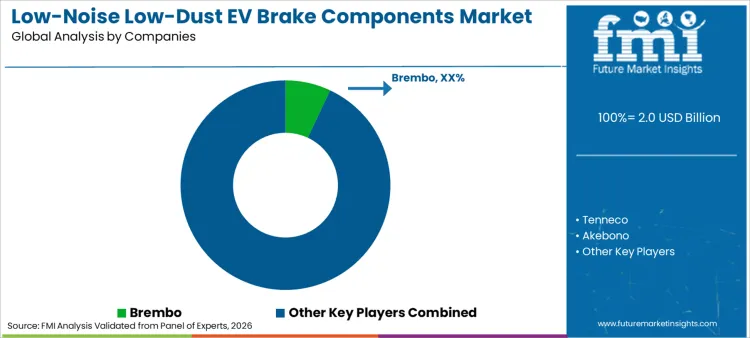
Noise reduction, dust minimization, and component durability drive adoption in the Low-Noise Low-Dust EV Brake Components Market. Brembo, Tenneco, Akebono Brake Industry, Bosch, Continental, Nisshinbo Holdings, ADVICS, ZF Friedrichshafen, and EBC Brakes compete through material testing, component validation, and integration trials in EV braking systems. Once integrated, friction performance, wear resistance, and system compatibility anchor supplier selection. Brembo emphasizes ceramic and composite materials engineered for low noise and minimal particulate generation.
Tenneco delivers brake pads optimized for EV torque profiles. Akebono Brake Industry provides low-dust friction materials for passenger and commercial EVs. Bosch and Continental supply integrated braking components with optimized damping. Nisshinbo Holdings and ADVICS target OEM-specific low-noise solutions. ZF Friedrichshafen focuses on modular brake systems. EBC Brakes delivers performance-oriented friction solutions for niche applications.
Material consistency, thermal stability, and integration support shape competitive positioning in the Low-Noise Low-Dust EV Brake Components Market. Engineers evaluate friction coefficient, wear rate, acoustic performance, and dust emission during validation. Suppliers capable of reproducible production, scalable deployment, and integration guidance gain preference. Brembo maintains adoption through high-performance testing and OEM collaboration. Tenneco secures placements in large-scale EV programs requiring noise reduction.
Akebono Brake Industry competes in specialized low-dust applications. Bosch and Continental hold positions in integrated braking modules. Nisshinbo Holdings and ADVICS provide tailored solutions for OEM requirements. ZF Friedrichshafen targets modular and scalable braking platforms. EBC Brakes focuses on performance and niche industrial applications. Market positions vary by vehicle type, component material, system architecture, and regional automotive standards.
Key Players in Low-Noise Low-Dust EV Brake Components Market
- Brembo S.p.A.
- Tenneco Inc.
- Akebono Brake Industry Co., Ltd.
- Bosch GmbH
- Continental AG
- Nisshinbo Holdings Inc.
- ADVICS Co., Ltd.
- ZF Friedrichshafen AG
- EBC Brakes Group
Scope of the Report
| Items | Values |
|---|---|
| Quantitative Units (2026) | USD billion |
| Component | Low-dust pads, coated discs and rotors, noise dampers and shims, other |
| Material | Copper-reduced friction material, ceramic and NAO, coated and composite rotors, other |
| Vehicle Segment | Passenger EVs, premium and luxury vehicles, LCV EVs, other |
| Sales Channel | OEM line-fit, aftermarket, dealer/OES, other |
| Regions Covered | Asia Pacific, Europe, North America, Latin America, Middle East & Africa |
| Countries Covered | United States, Canada, Mexico, Germany, United Kingdom, France, Italy, Spain, Nordics, BENELUX, China, Japan, South Korea, India, Australia & New Zealand, ASEAN, Brazil, Chile, Saudi Arabia, Turkey, South Africa, and other regional markets |
| Key Companies Profiled | Brembo, Tenneco, Akebono Brake Industry, Bosch, Continental, Nisshinbo Holdings, ADVICS, ZF Friedrichshafen, EBC Brakes |
| Additional Attributes | Dollar sales by component, material, vehicle segment, and sales channel, low-noise and low-dust friction system qualification, pad wear particle control and acoustic behavior management, coated rotor and shim system integration, NVH and particulate emission validation under urban duty cycles, homologation and warranty-linked material approval cycles, brake-by-wire and blended braking compatibility, multi-year platform adoption and model-cycle lock-in, and regional demand patterns across mass-market, premium, and light commercial electric vehicle programs |
Low-Noise Low-Dust EV Brake Components Market Segmentation
Component:
- Low-Dust Pads
- Coated Discs and Rotors
- Noise Dampers and Shims
- Other
Material:
- Copper-Reduced Friction Material
- Ceramic and NAO
- Coated and Composite Rotors
- Other
Vehicle Segment:
- Passenger EVs
- Premium and Luxury
- LCV EVs
- Other
Sales Channel:
- OEM Line-Fit
- Aftermarket
- Dealer/OES
- Other
Region:
- Asia Pacific
- China
- Japan
- South Korea
- India
- Australia & New Zealand
- ASEAN
- Rest of Asia Pacific
- Europe
- Germany
- United Kingdom
- France
- Italy
- Spain
- Nordic
- BENELUX
- Rest of Europe
- North America
- United States
- Canada
- Mexico
- Latin America
- Brazil
- Chile
- Rest of Latin America
- Middle East & Africa
- Kingdom of Saudi Arabia
- Other GCC Countries
- Turkey
- South Africa
- Other African Union
- Rest of Middle East & Africa
References
- European Commission, Joint Research Centre. (2024). Non-exhaust emissions from road transport: Brake and tyre particle emissions. Publications Office of the European Union.
- USA Environmental Protection Agency. (2024). Non-exhaust particulate matter emissions from brake and tire wear. USA EPA.
- United Nations Economic Commission for Europe. (2023). UN Regulation No. 13-H: Uniform provisions concerning the approval of passenger cars with regard to braking. UNECE.
- United Nations Economic Commission for Europe. (2023, June 21). UNECE adopts groundbreaking regulation introducing methodology to measure particle emissions from cars and vans’ braking systems. UNECE Press Release.
- International Organization for Standardization. (2023). ISO 26867: Road vehicles - Brake systems - Brake noise dynamometer test method. ISO.
Frequently Asked Questions
How big is the low-noise low-dust EV brake components market in 2026?
The low-noise low-dust EV brake components market is projected to be valued at USD 2.0 billion in 2026.
What will be the size of the low-noise low-dust EV brake components market in 2036?
The market size for low-noise low-dust EV brake components is projected to reach USD 3.4 billion by 2036.
How much will the demand for low-noise low-dust EV brake components grow between 2026 and 2036?
Demand for low-noise low-dust EV brake components is projected to grow at a 5.6% CAGR between 2026 and 2036.
Which component holds a significant share in the low-noise low-dust EV brake components market in 2026?
In terms of component, low-dust pads are expected to account for a 44% share in 2026.
Which material segment contributes a major share in the low-noise low-dust EV brake components market in 2026?
The copper-reduced friction material segment is expected to command a 36% share in the low-noise low-dust EV brake components market in 2026.
Preview the report firsthand - request a free sample
Get SampleGet the brochure for pricing and purchase details.
Get PDFTable of Content
- Executive Summary
- Global Market Outlook
- Demand-side Trends
- Supply-side Trends
- Technology Roadmap Analysis
- Analysis and Recommendations
- Market Overview
- Market Coverage / Taxonomy
- Market Definition / Scope / Limitations
- Market Background
- Market Dynamics
- Drivers
- Restraints
- Opportunity
- Trends
- Scenario Forecast
- Demand in Optimistic Scenario
- Demand in Likely Scenario
- Demand in Conservative Scenario
- Opportunity Map Analysis
- Product Life Cycle Analysis
- Supply Chain Analysis
- Investment Feasibility Matrix
- Value Chain Analysis
- PESTLE and Porter’s Analysis
- Regulatory Landscape
- Regional Parent Market Outlook
- Production and Consumption Statistics
- Import and Export Statistics
- Market Dynamics
- Global Market Analysis 2021 to 2025 and Forecast, 2026 to 2036
- Historical Market Size Value (USD Million) Analysis, 2021 to 2025
- Current and Future Market Size Value (USD Million) Projections, 2026 to 2036
- Y-o-Y Growth Trend Analysis
- Absolute $ Opportunity Analysis
- Global Market Pricing Analysis 2021 to 2025 and Forecast 2026 to 2036
- Global Market Analysis 2021 to 2025 and Forecast 2026 to 2036, By Component
- Introduction / Key Findings
- Historical Market Size Value (USD Million) Analysis By Component , 2021 to 2025
- Current and Future Market Size Value (USD Million) Analysis and Forecast By Component , 2026 to 2036
- Low-Dust Pads
- Coated Discs and Rotors
- Noise Dampers and Shims
- Other
- Low-Dust Pads
- Y-o-Y Growth Trend Analysis By Component , 2021 to 2025
- Absolute $ Opportunity Analysis By Component , 2026 to 2036
- Global Market Analysis 2021 to 2025 and Forecast 2026 to 2036, By Material
- Introduction / Key Findings
- Historical Market Size Value (USD Million) Analysis By Material, 2021 to 2025
- Current and Future Market Size Value (USD Million) Analysis and Forecast By Material, 2026 to 2036
- Copper-Reduced Friction Material
- Ceramic/NAO
- Coated/Composite Rotors
- Other
- Copper-Reduced Friction Material
- Y-o-Y Growth Trend Analysis By Material, 2021 to 2025
- Absolute $ Opportunity Analysis By Material, 2026 to 2036
- Global Market Analysis 2021 to 2025 and Forecast 2026 to 2036, By Vehicle Segment
- Introduction / Key Findings
- Historical Market Size Value (USD Million) Analysis By Vehicle Segment, 2021 to 2025
- Current and Future Market Size Value (USD Million) Analysis and Forecast By Vehicle Segment, 2026 to 2036
- Passenger EVs
- Premium/Luxury
- LCV EVs
- Other
- Passenger EVs
- Y-o-Y Growth Trend Analysis By Vehicle Segment, 2021 to 2025
- Absolute $ Opportunity Analysis By Vehicle Segment, 2026 to 2036
- Global Market Analysis 2021 to 2025 and Forecast 2026 to 2036, By Sales Channel
- Introduction / Key Findings
- Historical Market Size Value (USD Million) Analysis By Sales Channel, 2021 to 2025
- Current and Future Market Size Value (USD Million) Analysis and Forecast By Sales Channel, 2026 to 2036
- OEM Line-Fit
- Aftermarket
- Dealer/OES
- Other
- OEM Line-Fit
- Y-o-Y Growth Trend Analysis By Sales Channel, 2021 to 2025
- Absolute $ Opportunity Analysis By Sales Channel, 2026 to 2036
- Global Market Analysis 2021 to 2025 and Forecast 2026 to 2036, By Region
- Introduction
- Historical Market Size Value (USD Million) Analysis By Region, 2021 to 2025
- Current Market Size Value (USD Million) Analysis and Forecast By Region, 2026 to 2036
- North America
- Latin America
- Western Europe
- Eastern Europe
- East Asia
- South Asia and Pacific
- Middle East & Africa
- Market Attractiveness Analysis By Region
- North America Market Analysis 2021 to 2025 and Forecast 2026 to 2036, By Country
- Historical Market Size Value (USD Million) Trend Analysis By Market Taxonomy, 2021 to 2025
- Market Size Value (USD Million) Forecast By Market Taxonomy, 2026 to 2036
- By Country
- USA
- Canada
- Mexico
- By Component
- By Material
- By Vehicle Segment
- By Sales Channel
- By Country
- Market Attractiveness Analysis
- By Country
- By Component
- By Material
- By Vehicle Segment
- By Sales Channel
- Key Takeaways
- Latin America Market Analysis 2021 to 2025 and Forecast 2026 to 2036, By Country
- Historical Market Size Value (USD Million) Trend Analysis By Market Taxonomy, 2021 to 2025
- Market Size Value (USD Million) Forecast By Market Taxonomy, 2026 to 2036
- By Country
- Brazil
- Chile
- Rest of Latin America
- By Component
- By Material
- By Vehicle Segment
- By Sales Channel
- By Country
- Market Attractiveness Analysis
- By Country
- By Component
- By Material
- By Vehicle Segment
- By Sales Channel
- Key Takeaways
- Western Europe Market Analysis 2021 to 2025 and Forecast 2026 to 2036, By Country
- Historical Market Size Value (USD Million) Trend Analysis By Market Taxonomy, 2021 to 2025
- Market Size Value (USD Million) Forecast By Market Taxonomy, 2026 to 2036
- By Country
- Germany
- UK
- Italy
- Spain
- France
- Nordic
- BENELUX
- Rest of Western Europe
- By Component
- By Material
- By Vehicle Segment
- By Sales Channel
- By Country
- Market Attractiveness Analysis
- By Country
- By Component
- By Material
- By Vehicle Segment
- By Sales Channel
- Key Takeaways
- Eastern Europe Market Analysis 2021 to 2025 and Forecast 2026 to 2036, By Country
- Historical Market Size Value (USD Million) Trend Analysis By Market Taxonomy, 2021 to 2025
- Market Size Value (USD Million) Forecast By Market Taxonomy, 2026 to 2036
- By Country
- Russia
- Poland
- Hungary
- Balkan & Baltic
- Rest of Eastern Europe
- By Component
- By Material
- By Vehicle Segment
- By Sales Channel
- By Country
- Market Attractiveness Analysis
- By Country
- By Component
- By Material
- By Vehicle Segment
- By Sales Channel
- Key Takeaways
- East Asia Market Analysis 2021 to 2025 and Forecast 2026 to 2036, By Country
- Historical Market Size Value (USD Million) Trend Analysis By Market Taxonomy, 2021 to 2025
- Market Size Value (USD Million) Forecast By Market Taxonomy, 2026 to 2036
- By Country
- China
- Japan
- South Korea
- By Component
- By Material
- By Vehicle Segment
- By Sales Channel
- By Country
- Market Attractiveness Analysis
- By Country
- By Component
- By Material
- By Vehicle Segment
- By Sales Channel
- Key Takeaways
- South Asia and Pacific Market Analysis 2021 to 2025 and Forecast 2026 to 2036, By Country
- Historical Market Size Value (USD Million) Trend Analysis By Market Taxonomy, 2021 to 2025
- Market Size Value (USD Million) Forecast By Market Taxonomy, 2026 to 2036
- By Country
- India
- ASEAN
- Australia & New Zealand
- Rest of South Asia and Pacific
- By Component
- By Material
- By Vehicle Segment
- By Sales Channel
- By Country
- Market Attractiveness Analysis
- By Country
- By Component
- By Material
- By Vehicle Segment
- By Sales Channel
- Key Takeaways
- Middle East & Africa Market Analysis 2021 to 2025 and Forecast 2026 to 2036, By Country
- Historical Market Size Value (USD Million) Trend Analysis By Market Taxonomy, 2021 to 2025
- Market Size Value (USD Million) Forecast By Market Taxonomy, 2026 to 2036
- By Country
- Kingdom of Saudi Arabia
- Other GCC Countries
- Turkiye
- South Africa
- Other African Union
- Rest of Middle East & Africa
- By Component
- By Material
- By Vehicle Segment
- By Sales Channel
- By Country
- Market Attractiveness Analysis
- By Country
- By Component
- By Material
- By Vehicle Segment
- By Sales Channel
- Key Takeaways
- Key Countries Market Analysis
- USA
- Pricing Analysis
- Market Share Analysis, 2025
- By Component
- By Material
- By Vehicle Segment
- By Sales Channel
- Canada
- Pricing Analysis
- Market Share Analysis, 2025
- By Component
- By Material
- By Vehicle Segment
- By Sales Channel
- Mexico
- Pricing Analysis
- Market Share Analysis, 2025
- By Component
- By Material
- By Vehicle Segment
- By Sales Channel
- Brazil
- Pricing Analysis
- Market Share Analysis, 2025
- By Component
- By Material
- By Vehicle Segment
- By Sales Channel
- Chile
- Pricing Analysis
- Market Share Analysis, 2025
- By Component
- By Material
- By Vehicle Segment
- By Sales Channel
- Germany
- Pricing Analysis
- Market Share Analysis, 2025
- By Component
- By Material
- By Vehicle Segment
- By Sales Channel
- UK
- Pricing Analysis
- Market Share Analysis, 2025
- By Component
- By Material
- By Vehicle Segment
- By Sales Channel
- Italy
- Pricing Analysis
- Market Share Analysis, 2025
- By Component
- By Material
- By Vehicle Segment
- By Sales Channel
- Spain
- Pricing Analysis
- Market Share Analysis, 2025
- By Component
- By Material
- By Vehicle Segment
- By Sales Channel
- France
- Pricing Analysis
- Market Share Analysis, 2025
- By Component
- By Material
- By Vehicle Segment
- By Sales Channel
- India
- Pricing Analysis
- Market Share Analysis, 2025
- By Component
- By Material
- By Vehicle Segment
- By Sales Channel
- ASEAN
- Pricing Analysis
- Market Share Analysis, 2025
- By Component
- By Material
- By Vehicle Segment
- By Sales Channel
- Australia & New Zealand
- Pricing Analysis
- Market Share Analysis, 2025
- By Component
- By Material
- By Vehicle Segment
- By Sales Channel
- China
- Pricing Analysis
- Market Share Analysis, 2025
- By Component
- By Material
- By Vehicle Segment
- By Sales Channel
- Japan
- Pricing Analysis
- Market Share Analysis, 2025
- By Component
- By Material
- By Vehicle Segment
- By Sales Channel
- South Korea
- Pricing Analysis
- Market Share Analysis, 2025
- By Component
- By Material
- By Vehicle Segment
- By Sales Channel
- Russia
- Pricing Analysis
- Market Share Analysis, 2025
- By Component
- By Material
- By Vehicle Segment
- By Sales Channel
- Poland
- Pricing Analysis
- Market Share Analysis, 2025
- By Component
- By Material
- By Vehicle Segment
- By Sales Channel
- Hungary
- Pricing Analysis
- Market Share Analysis, 2025
- By Component
- By Material
- By Vehicle Segment
- By Sales Channel
- Kingdom of Saudi Arabia
- Pricing Analysis
- Market Share Analysis, 2025
- By Component
- By Material
- By Vehicle Segment
- By Sales Channel
- Turkiye
- Pricing Analysis
- Market Share Analysis, 2025
- By Component
- By Material
- By Vehicle Segment
- By Sales Channel
- South Africa
- Pricing Analysis
- Market Share Analysis, 2025
- By Component
- By Material
- By Vehicle Segment
- By Sales Channel
- USA
- Market Structure Analysis
- Competition Dashboard
- Competition Benchmarking
- Market Share Analysis of Top Players
- By Regional
- By Component
- By Material
- By Vehicle Segment
- By Sales Channel
- Competition Analysis
- Competition Deep Dive
- Brembo
- Overview
- Product Portfolio
- Profitability by Market Segments (Product/Age /Sales Channel/Region)
- Sales Footprint
- Strategy Overview
- Marketing Strategy
- Product Strategy
- Channel Strategy
- Tenneco
- Akebono
- Bosch
- Continental
- Nisshinbo
- ADVICS
- ZF
- TRW (ZF)
- EBC Brakes
- Brembo
- Competition Deep Dive
- Assumptions & Acronyms Used
- Research Methodology


