

- Market Size (2026)
- USD 169.4 Mn
- Forecast (2036)
- USD 637.8 Mn
- CAGR (2026 to 2036)
- 14.2%
EV Regenerative Braking Feel Customization Services Market Size, Market Forecast and Outlook By FMI
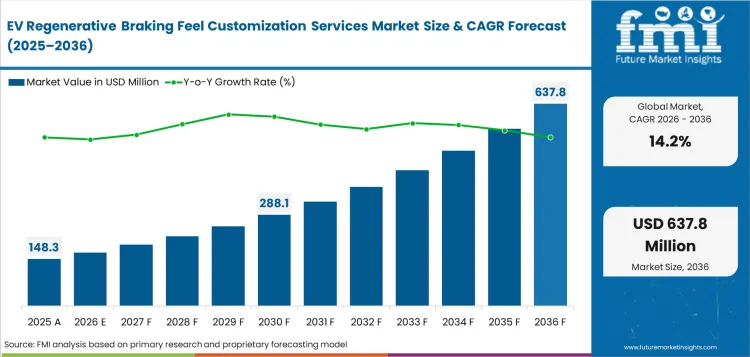
The EV regenerative braking feel customization services market was valued at USD 148.3 million in 2025. Industry revenue is projected to reach USD 169.4 million in 2026 and scale to USD 637.8 million by 2036 at 14.2% CAGR. Battery electric cars are expected to represent 58.6% share of EV type in 2026. Automakers are expected to account for 52.9% share of end user in 2026.
Key Takeaways, Market Size, and Forecast
- The EV regenerative braking feel customization services market size stood at USD 148.3 million in 2025.
- Industry value is projected to reach USD 637.8 million by 2036 as EV brake feel moves into software release work.
- From 2026 to 2036, the sector is projected to expand at 14.2% CAGR.
- Industry revenue is forecast to create incremental opportunity of USD 468.4 million from 2026 to 2036.
- Battery electric cars are expected to account for 58.6% share of EV type in 2026.
- Automakers are likely to secure 52.9% share of end user in 2026.
- China is projected to record the fastest country CAGR at 16.8%, followed by India at 15.9% CAGR by 2036.
Summary of EV Regenerative Braking Feel Customization Services Market
- Demand and Growth Drivers
- EV drivers expect a stable pedal feel across traffic speeds and battery states of charge.
- Brake blending work expands as regenerative braking systems share braking work with friction brakes.
- Over-the-air software updates make feel calibration easier to revise during a vehicle life cycle.
- Product and Segment View
- Battery electric cars are expected to capture 58.6% share in 2026 since most driver-facing regen choices appear first in BEVs.
- Automakers are expected to secure 52.9% share in 2026, led by brake feel remaining tied to brand character and safety validation.
- OEM calibration is projected to represent 44.2% share in 2026 due to automakers keeping brake energy recovery settings aligned to vehicle safety validation.
- Geography and Company Outlook
- China is projected to record 16.8% CAGR by 2036, driven by electric car scale creating broad calibration work.
- India is expected to expand at 15.9% CAGR by 2036 with new EV models adding software-controlled brake features.
- Robert Bosch GmbH and ZF Friedrichshafen AG anchor competition through brake control electronics and by-wire system work.
- Analyst Opinion
- Nikhil Kaitwade, Principal Consultant for Automotive at FMI, observes, "I see EV regenerative braking feel becoming a customer-facing service line since one-pedal driving changes how owners judge comfort and control. Tier suppliers want calibration files protecting their brake hardware from poor integration. Service demand grows when software updates change pedal response after the vehicle has already been sold. Suppliers combining brake physics and software testing are expected to gain share over firms selling one tool or one test service."
- EV Regenerative Braking Feel Customization Services Market Value Analysis
- Market value is tied to engineering time and validated software files rather than replacement hardware alone.
- Pricing rises when a service package includes simulator work and road testing for multiple battery states.
- Program value expands as regenerative braking optimization software reduces repeat calibration work across trims and model years.
- Brake feel work carries higher margin when it is bundled with safety test support and customer clinic feedback.
Software changes in brake feel now carry direct safety and service risk. Volvo recall 25V-392 covered 11,469 vehicles and warned owners to turn off one-pedal driving until repair. Such warning makes regression testing a buying requirement for any update changing deceleration feel or driver controls. Driver preference is creating a second workstream for calibration teams. Toyota added 2026 bZ steering wheel paddles to switch regenerative braking on and adjust force up or down by preference.
Such feature shifts brake feel work closer to cabin controls and brand experience. Fleet use adds another pressure point since regen behavior changes with battery state and temperature. International stated, faults occur most often at 95% to 100% battery charge during cold conditions. Operators need settings protecting uptime and avoiding warning lamp events. Service providers with software validation and driver interface tuning will acquire projects that simple road-testing firms cannot support.
EV Regenerative Braking Feel Customization Services Market Definition
EV regenerative braking feel customization services cover software and engineering services used to tune how an electric vehicle slows during energy recovery. Scope includes pedal mapping, regen level tuning and brake blending calibration. Validation tuning, drive mode profiles and software packages are counted. Full brake hardware, actuator manufacturing and generic battery management software are excluded unless sold with brake feel calibration work.
EV Regenerative Braking Feel Customization Services Market Inclusions
Scope includes OEM calibration work, Tier 1 integration services and third-party validation used to tune driver-facing braking response. Services linked with control systems are included when they change regen feel or brake blending. Cloud diagnostics, simulation tools and road test services are counted if sold for brake feel customization. Fleet profiles are included when operators request consistent deceleration across multiple vehicles.
EV Regenerative Braking Feel Customization Services Market Exclusions
Scope excludes basic brake pad replacement, brake fluid service and mechanical parking brake repair. Battery cell production and motor manufacturing are excluded. Generic chassis software is excluded unless the project changes regenerative braking feel. Full autonomous driving validation is excluded except for the braking portion used to tune driver comfort and brake response.
EV Regenerative Braking Feel Customization Services Market Research Methodology
- Primary Research: FMI analysts reviewed EV calibration needs with brake software engineers and fleet service planners.
- Desk Research: Public EV sales data and company brake technology releases were used to map the serviceable opportunity.
- Market Sizing and Forecasting: Forecast values used electric vehicle volume and engineering service intensity assumptions.
- Data Validation: Checks compared 2026 value with 2036 value and tested country CAGRs against EV sales scale and supplier presence.
Why is the EV Regenerative Braking Feel Customization Services Market Growing?
- Driver-facing regen controls are moving brake feel into vehicle launch checks and software release planning.
- Brake blending is drawing closer validation as energy recovery and hydraulic braking must feel consistent to drivers.
- Post-launch updates are creating repeat calibration work led by automakers refining braking response across trims and model years.
EV braking work is shifting from hardware fit to software behavior that drivers feel during daily use. General Motors stated in May 2024, the 2024 Chevrolet Equinox EV comes standard with one-pedal driving and Regen on Demand. It also says its custom My Mode lets the driver choose braking responsiveness as part of the vehicle mode package. This makes regenerative braking optimization software more important to launch teams required to tune pedal response before release. Hyundai stated in March 2026, IONIQ 6 N uses N Brake Regen with up to 0.6 G regenerative braking.
It also supports 0.35 G regenerative braking under anti-lock braking system operation. Such figures show why EV regenerative braking control systems need careful brake blending validation. Ford’s April 2025 Mustang Mach-E order guide lists three selectable drive modes with one-pedal drive and Brake Coach. This reflects the rising service need for driver-facing brake behavior checks across mainstream EV programs.
Market Segmentation Analysis
- Pedal mapping is likely to account for 34.8% share in 2026 due to accelerator release response shaping daily EV comfort.
- Battery electric cars are forecast to capture 58.6% share in 2026 through broad one-pedal driving use.
- OEM calibration is projected to represent 44.2% share in 2026, led by approved releases controlling brand-level driving feel.
- Software packages are forecast to hold 41.7% share in 2026 since reusable toolkits cut launch-program work.
- Automakers are projected to account for 52.9% share in 2026 as vehicle makers own the final brake-feel signoff.
Segmentation is divided into five parent groups based on how brake-feel work is bought and delivered. Service type separates the tuning task. EV type identifies the platform pool requiring calibration. Customization mode explains who controls the approved software path. Delivery model shows whether the project is sold as a package or engineering service. End user identifies the organization signing off on brake feel and safety behavior.
Insights into EV Regenerative Braking Feel Customization Services Market by Service Type
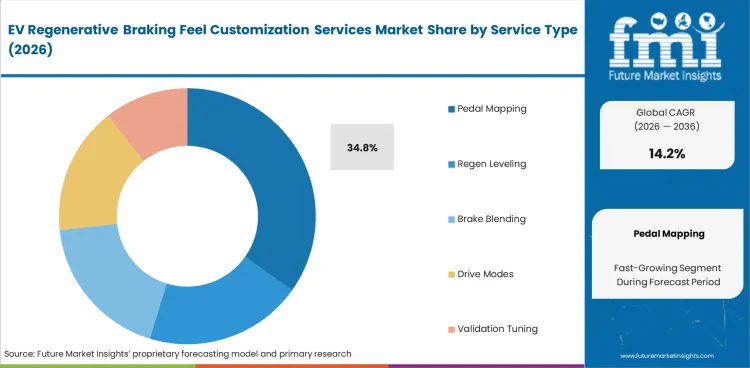
- Pedal mapping is projected to account for 34.8% share in 2026 since accelerator release response gives drivers the first feel of energy recovery.
- Brake blending gains attention as blended hydraulic regenerative brake systems need smooth handover between motor braking and friction braking.
Insights into EV Regenerative Braking Feel Customization Services Market by EV Type
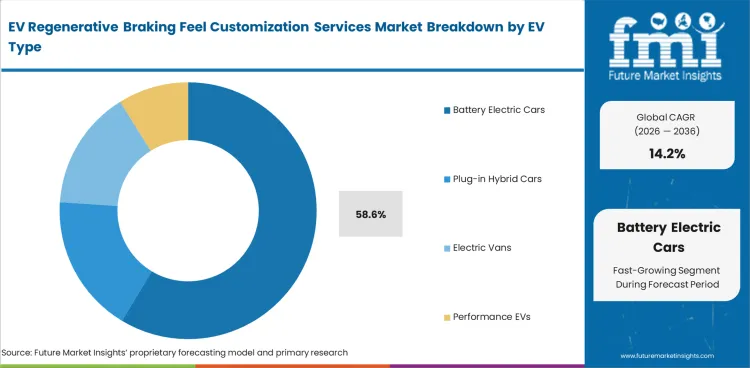
- Battery electric cars are forecast to represent 58.6% share in 2026 given their wide use of one-pedal driving and driver-selectable regen levels.
- Electric fleets need different tuning as frequent urban stops place more weight on predictability than a sporty pedal response.
Insights into EV Regenerative Braking Feel Customization Services Market by Customization Mode
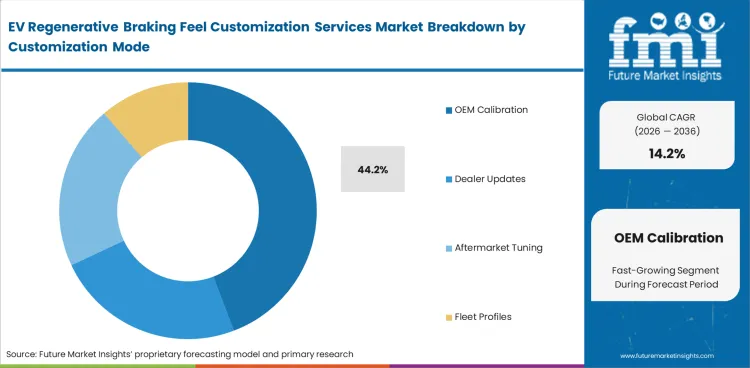
- OEM calibration is projected to hold 44.2% share in 2026 due to automakers controlling approved software and vehicle warranty boundaries.
- Aftermarket tuning stays smaller but useful for performance EVs and fleet needs.
Insights into EV Regenerative Braking Feel Customization Services Market by Delivery Model
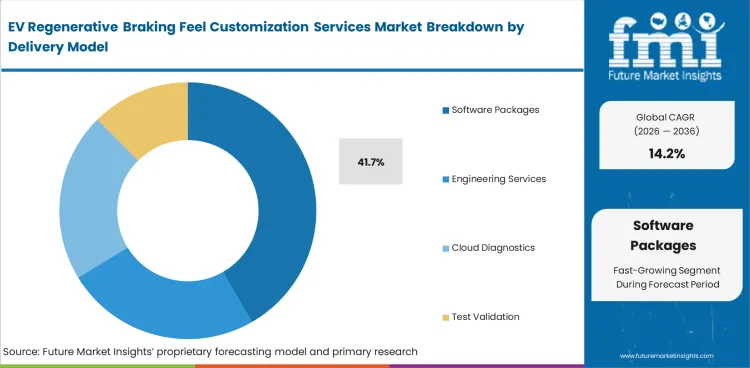
- Software packages are forecast to account for 41.7% share in 2026, led by reusable tuning modules lowering repeated work across platforms.
- Engineering services remain important for automotive brake-by-wire pedal simulator work requiring human driver scoring.
Insights into EV Regenerative Braking Feel Customization Services Market by End User
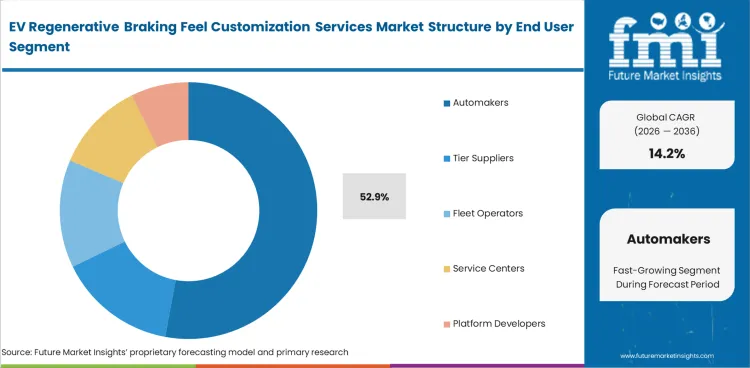
- Automakers are projected to account for 52.9% share in 2026 as brake feel belongs to the vehicle brand and software release process.
- Tier suppliers use customization services to protect hardware value inside brake system control ECU platforms.
EV Regenerative Braking Feel Customization Services Market Drivers, Restraints and Opportunities
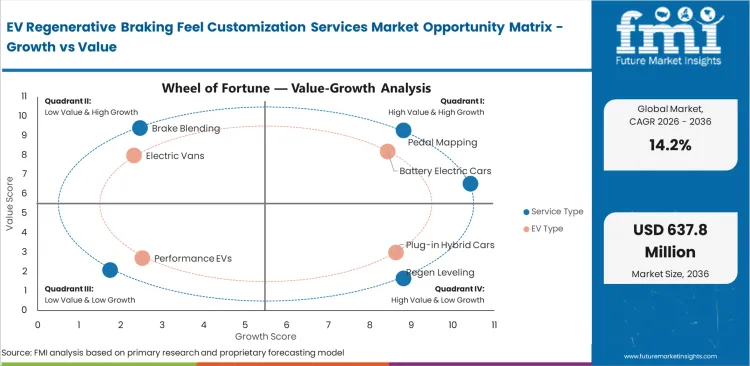
- Driver-selectable deceleration is making brake feel a visible part of EV comfort and daily control.
- Road condition limits and safety checks make regen tuning harder to approve across vehicle programs.
- Packaged validation services can support repeat tuning work across software releases and EV variants.
Automakers are moving regenerative braking optimization software closer to launch calibration as EVs give drivers more control over slowing behavior. Kia’s 2026 EV9 feature guide says one-pedal driving raises regenerative braking above Level 3 and can stop the vehicle below 2 mph. This gives service providers a clear need to tune low-speed deceleration and pedal release behavior. Polestar’s 2025 manual states One Pedal Drive has three levels and is not recommended in slippery conditions, creating a restraint since EV regenerative braking control systems are required to be checked across road states before release.
After-sales Service and Lifecycle Cost Analysis
EV service economics are shifting from brake pad replacement toward scheduled inspections and software checks across the vehicle life cycle. Ayvens stated in April 2025, EV tire rotation is needed every 5,000 to 7,500 miles. It also says regenerative braking lowers brake pad use but brake inspection and fluid service remain necessary for safety. It supports AMC structures built around regenerative braking optimization software and uptime protection. Service providers bundling brake feel diagnostics with routine EV care can protect margins while reducing repeat workshop visits.
Company Benchmarking and Technology Positioning Analysis
Technology positioning is moving toward suppliers combining brake hardware and motion software in one validated package. ZF stated in January 2025, its global OEM deal will equip nearly 5 million vehicles with Electro-Mechanical Braking over the contract life. It also says the program combines rear brake-by-wire technology with Integrated Brake Control and front hydraulic calipers. Reflecting why benchmarking in EV regenerative braking control systems should compare software depth, brake-by-wire integration and validation evidence. Suppliers with proven chassis software and series production scale are better placed than firms limited to test support.
Analysis of EV Regenerative Braking Feel Customization Services Market by Key Countries
.webp "Top Country Growth Comparison Ev Regenerative Braking Feel Customization Services Market Cagr (2026 2036)")
| Country | CAGR |
|---|---|
| China | 16.8% |
| India | 15.9% |
| South Korea | 14.8% |
| United States | 14.3% |
| Germany | 13.7% |
| Japan | 12.9% |
| United Kingdom | 12.4% |
Source: Future Market Insights, 2026.
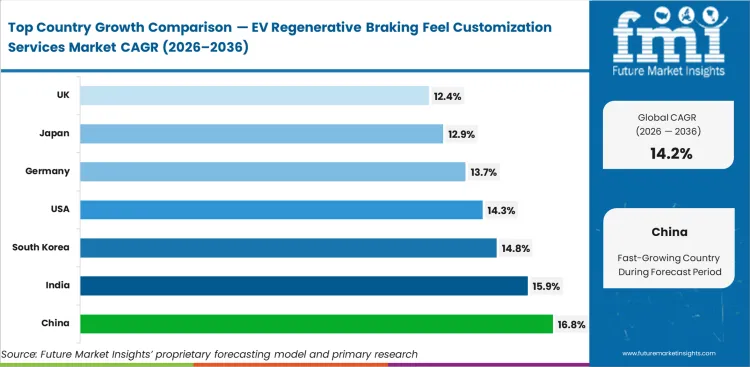
EV Regenerative Braking Feel Customization Services Market CAGR Analysis by Country
- China is poised to record 16.8% CAGR by 2036, driven by electric car volume expanding the largest calibration pool.
- India is expected to expand at 15.9% CAGR by 2036, reflected by new EV models moving from early users to wider cities.
- South Korea is forecast to grow at 14.8% CAGR by 2036 with export programs supporting brake software depth.
- United States is expected to advance at 14.3% CAGR by 2036, led by software-defined EV models raising tuning needs.
- Germany is projected to rise at 13.7% CAGR by 2036 due to premium EV programs needing a stable brake character.
- Japan is forecast at 12.9% CAGR by 2036 through disciplined validation favoring careful calibration cycles.
- United Kingdom is expected to post 12.4% CAGR by 2036 as zero-emission registrations add serviceable EV stock.
Country performance differs by EV volume and local validation culture. China and India track above the global rate as new electric car fleets influence fresh tuning demand. South Korea and the United States stay near the global range through strong electronics suppliers and active EV programs. Germany, Japan and the United Kingdom expand at measured rates as established approval paths generate longer service cycles.
Demand Outlook for EV Regenerative Braking Feel Customization Services in China
Demand in China is set to garner 16.8% CAGR by 2036, influenced by electric car volume creating a broad calibration pipeline. International Energy Agency analysis in May 2026 stated China sold more than 13 million electric cars in 2025. Large model volume gives suppliers repeat work across trims and battery packs. Brake-feel teams will focus on smooth low-speed stops and high regen levels for city traffic.
- Dense urban EV use raises interest in smoother one-pedal response during stop-and-go travel.
- Battery electric car programs support reusable calibration files across several trims and software releases.
- Local EV export growth makes brake feel tuning important for overseas buyers who expect familiar pedal behavior.
Demand Analysis of EV Regenerative Braking Feel Customization Services in India
Industry in India is anticipated to expand at 15.9% CAGR by 2036 due to domestic EV launches shifting from early users to broader city fleets. India's heavy industry ministry stated in January 2026, more than 2.1 million electric vehicles received support under its 2025 electric mobility scheme. Such scale builds a wider software service pool for local and global suppliers. Calibration work will be most visible in compact EVs facing mixed traffic and frequent braking.
- City delivery and ride-hailing use increases the need for predictable deceleration across many drivers.
- Locally built EVs give service providers a path to work with early platform files and test data.
- Software packages can reduce calibration cost for lower-priced EVs that cannot absorb long engineering cycles.
Industry Outlook for EV Regenerative Braking Feel Customization Services in South Korea
Supplier depth gives South Korea a strong position in brake-feel software work. Sales in South Korea are forecast to grow at 14.8% CAGR by 2036 with export programs supporting brake software depth. Government trade reporting in March 2026 showed eco-friendly vehicle sales reached 76,000 in February 2026. Export-focused platforms require braking behavior suiting domestic and overseas drivers.
- Electronics suppliers can connect brake feel tuning with motion control and software-defined vehicle programs.
- Export model programs increase the need for region-specific brake response and validation work.
- Domestic EV subsidies keep local demand active enough to test new pedal feel settings before export use.
Growth Outlook for EV Regenerative Braking Feel Customization Services in the United States
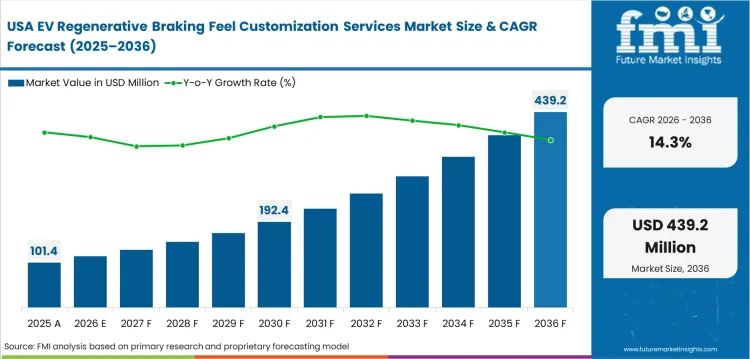
Software-defined vehicle programs shape the United States opportunity. Argonne National Laboratory data updated in 2026 showed plug-in electric vehicles reached 9.1% of annual passenger vehicle sales in 2025. The market in United States is expected to rise at 14.3% CAGR by 2036 as EV model coverage widens. Service demand will center on brake response remaining stable after software updates.
- Safety rules make evidence-backed brake tuning important before new software reaches customers.
- Large pickup and sport utility programs need different regen feel than compact EVs or sedans.
- Engineering firms gain share when testing links driver comfort with measured stop distance.
Sales Analysis of EV Regenerative Braking Feel Customization Services in Germany
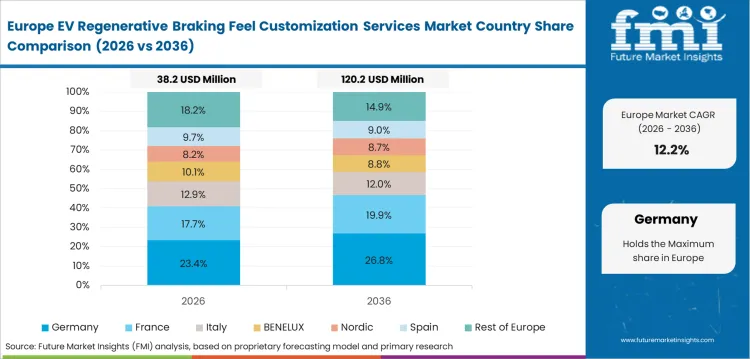
Sales in Germany are projected to scale at 13.7% CAGR by 2036, led by premium EV programs demanding a refined brake character. International Energy Agency analysis in May 2026 stated Germany sold about 850,000 electric cars in 2025. High-end vehicles place heavier weight on seamless handover between regen and friction brakes. Suppliers serving German programs must document pedal feel and safety performance across driving modes.
- Premium EV buyers notice small changes in pedal response during low-speed parking and highway slowing.
- Brake-by-wire programs raise demand for electro-hydraulic brake actuation units matching software tuning work.
- European validation culture favors suppliers with repeatable data and structured driver evaluation results.
Demand Outlook for EV Regenerative Braking Feel Customization Services in Japan
Demand in Japan is forecast at 12.9% CAGR by 2036 through disciplined validation favoring careful calibration cycles. Japan Automobile Manufacturers Association data released in September 2025 recorded 8.23 million motor vehicles produced in Japan during 2024. Domestic automakers use long validation programs before changing driver controls. Brake-feel service providers will gain when they combine cautious road tests with software traceability.
- Compact EV cabins favor fine pedal tuning as drivers use regen response in dense urban travel.
- Hybrid experience gives Japanese engineers a strong foundation for blended braking calibration.
- Export platforms extend demand for brake feel profiles matching driving habits across regions.
Sales Outlook for EV Regenerative Braking Feel Customization Services in the United Kingdom
Roadworthiness checks and zero-emission registrations keep the United Kingdom service outlook active. United Kingdom transport statistics published in April 2026 recorded 473,000 zero-emission cars registered for the first time in 2025. Sector in the United Kingdom is expected to post 12.4% CAGR by 2036 as EV stock increases. Independent test and validation providers will gain work as new models enter daily service.
- Right-hand-drive EV programs need dedicated cabin checks and driver feel validation.
- Fleet electrification propels demand for similar braking response across mixed vehicle makes.
- Service providers can pair digital brake control and antiskid systems knowledge with local road testing.
Company Landscape and Strategic Positioning
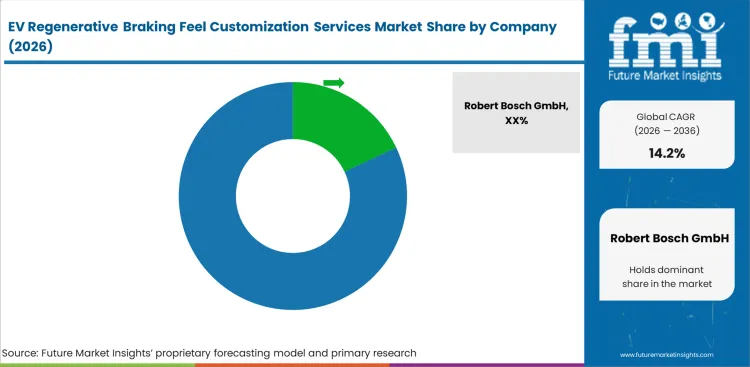
- Competition is moderately concentrated around brake electronics firms and vehicle validation specialists.
- Leading suppliers stand out with by-wire braking hardware and software release support.
- Smaller firms profit by offering proving-ground testing and driver clinic support for single vehicle programs.
Competition is shifting toward suppliers connecting brake hardware with software signoff. Bosch stated in September 2025, by-wire braking and steering systems are key parts of software-defined vehicles. ZF stated in July 2025, its hybrid electro-hydraulic brake approach removes the vacuum booster and gives more chassis design freedom. Such moves show why brake feel services often sit beside automotive brake actuation systems and control software work.
Established companies hold an advantage through safety evidence and OEM access. Brembo said in May 2026, Sensify entered production with a global vehicle manufacturer and is fitted as standard on every vehicle in that program. AUMOVIO presented EV brake technologies in July 2025 before its independent company launch. Buyers view such proof as useful since customized feel are required to survive factory release and warranty review.
Specialist engineering firms compete on test depth. AVL List and Applus+ IDIADA can support simulator work and driver scoring. Their role grows when automakers need independent checks for steer-by-wire and brake-by-wire HMI controller systems. New entrants face a high bar since customers ask for brake domain skills and protected software handling.
Key Companies in the EV Regenerative Braking Feel Customization Services Market
Competitive structure is grouped by brake electronics suppliers, software validation specialists and vehicle engineering partners.
- Brake Electronics Suppliers: Robert Bosch GmbH, ZF Friedrichshafen AG, Brembo N.V., AUMOVIO SE, Hyundai Mobis Co. Ltd. support braking platforms connecting driver feel and safety functions. Their advantage comes from direct work on brake-by-wire systems and motion-control software entering OEM vehicle programs.
- Software Validation Specialists: AVL List GmbH and Applus+ IDIADA support calibration work through vehicle testing and validation services. Their role is strongest when automakers need independent evidence that regen settings feel natural and still support compliant braking behavior across road conditions.
- Platform Tool Providers: ETAS GmbH, dSPACE GmbH and FEV Group support adjacent software workflows and vehicle development programs. Their position is important when brake-feel tuning needs x-by-wire platforms and software release checks for multi-model EV programs.
Company Benchmarking: EV Regenerative Braking Feel Customization Services Market
| Company | Brake Feel Calibration Depth | By-Wire Integration Evidence | Validation Tool Coverage | Geographic Footprint |
|---|---|---|---|---|
| Robert Bosch GmbH | High | High | Strong | Global |
| ZF Friedrichshafen AG | High | High | Strong | Global |
| Brembo N.V. | High | Strong | Moderate | Global |
| AUMOVIO SE | Strong | High | Moderate | Global |
| Hyundai Mobis Co., Ltd. | Strong | Strong | Moderate | Global |
| AVL List GmbH | Moderate | Medium | High | Global |
| Applus+ IDIADA | Moderate | Medium | High | Europe and global |
| FEV Group | Moderate | Medium | Strong | Europe and global |
| ETAS GmbH | Medium | Medium | Strong | Global |
| dSPACE GmbH | Medium | Medium | Strong | Global |
Source: Future Market Insights competitive analysis, 2026. Ratings reflect relative positioning based on brake feel calibration depth, by-wire integration evidence and validation tool coverage.
Key Developments in EV Regenerative Braking Feel Customization Services Market
- In September 2025, Bosch stated that with brake-by-wire and steer-by-wire solutions, Bosch expects to achieve cumulative sales revenue of more than 7 billion euros by 2032.
- In July 2025, ZF presented a hybrid brake-by-wire system combining electro-hydraulic brake control with an electromechanical brake.
- In May 2026, Brembo said Sensify entered production for a leading global vehicle manufacturer and is fitted as standard on 100% of vehicles in the program.
Key Players in the EV Regenerative Braking Feel Customization Services Market
Brake Electronics Suppliers
- Robert Bosch GmbH
- ZF Friedrichshafen AG
- Brembo N.V.
- AUMOVIO SE
- Hyundai Mobis Co., Ltd.
Software Validation Specialists
- AVL List GmbH
- Applus+ IDIADA
- FEV Group
Platform Tool Providers
- ETAS GmbH
- dSPACE GmbH
Market Report Scope
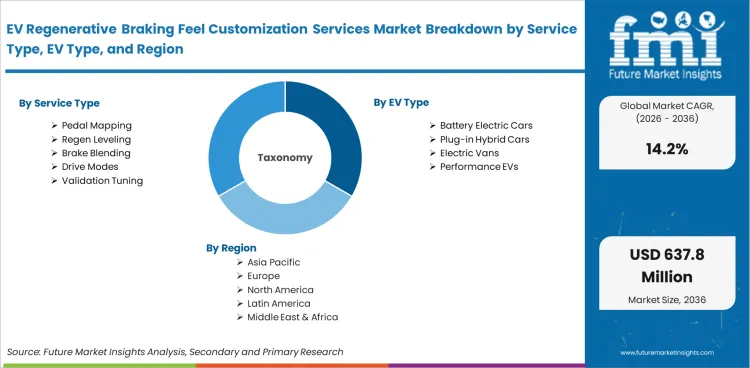
| Parameter | Details |
|---|---|
| Quantitative units | USD 169.4 million to USD 637.8 million at 14.2% CAGR |
| Market definition | Software and engineering services used to tune EV regenerative braking feel, pedal response and brake blending behavior. |
| By service type | Pedal Mapping, Regen Leveling, Brake Blending, Drive Modes, Validation Tuning |
| By EV type | Battery Electric Cars, Plug-in Hybrid Cars, Electric Vans, Performance EVs |
| By customization mode | OEM Calibration, Dealer Updates, Aftermarket Tuning, Fleet Profiles |
| By delivery model | Software Packages, Engineering Services, Cloud Diagnostics, Test Validation |
| By end user | Automakers, Tier Suppliers, Fleet Operators, Service Centers, Platform Developers |
| Regions covered | North America, Latin America, Europe, East Asia, South Asia and Pacific, Middle East and Africa |
| Countries covered | China, India, South Korea, United States, Germany, Japan, United Kingdom |
| Key companies profiled | Robert Bosch GmbH, ZF Friedrichshafen AG, Brembo N.V., AUMOVIO SE, Hyundai Mobis Co., Ltd., AVL List GmbH, Applus+ IDIADA, FEV Group, ETAS GmbH, dSPACE GmbH |
| Forecast period | 2026 to 2036 |
| Approach | Hybrid bottom-up and top-down methodology starting with verified EV volume, software content and brake validation workload. |
Source: Future Market Insights, 2026.
EV Regenerative Braking Feel Customization Services Market Breakdown by Service Type, EV Type, Customization Mode, Delivery Model, End User, and Region
By Service Type:
- Pedal Mapping
- Regen Leveling
- Brake Blending
- Drive Modes
- Validation Tuning
By EV Type:
- Battery Electric Cars
- Plug-in Hybrid Cars
- Electric Vans
- Performance EVs
By Customization Mode:
- OEM Calibration
- Dealer Updates
- Aftermarket Tuning
- Fleet Profiles
By Delivery Model:
- Software Packages
- Engineering Services
- Cloud Diagnostics
- Test Validation
By End User:
- Automakers
- Tier Suppliers
- Fleet Operators
- Service Centers
- Platform Developers
By Region:
- North America
- Latin America
- Europe
- East Asia
- South Asia and Pacific
- Middle East and Africa
Research Sources and Bibliography
- Argonne National Laboratory. (2026, April). Light duty electric drive vehicles monthly sales updates.
- Bosch. (2025, September 8). IAA Mobility 2025: Bosch is shaping the new vehicle world with intelligent hardware and software solutions.
- Brembo N.V. (2026, May 4). The new standard begins: Sensify by Brembo enters production.
- Continental AG. (2025, July 31). AUMOVIO to showcase automotive technologies at IAA Mobility.
- Federal Register. (2024, May 9). Federal motor vehicle safety standards: Automatic emergency braking systems for light vehicles.
- Ford Motor Company. (2025). 2026 Mustang Mach-E owner’s manual.
- General Motors. (2024, May). Service bulletin 24-NA-093: 2024 Chevrolet Equinox EV new model features. National Highway Traffic Safety Administration.
- Hyundai Mobis Co., Ltd. (2025, September 10). Hyundai Mobis targets global top 3 with electrification, integration, and UX innovation.
- Hyundai Motor Company. (2026, March). Hyundai IONIQ 6 N press information. Hyundai Newsroom Europe.
- International Energy Agency. (2026, May). Global EV Outlook 2026: Trends in electric cars.
- International Truck. (2024, December 19). IK1800043: EV regenerative braking operation during cold weather causing faults. National Highway Traffic Safety Administration.
- Japan Automobile Manufacturers Association. (2025, September 26). The motor industry of Japan 2025.
- Kia America. (2026). 2026 Kia EV9 vehicle feature tips.
- Ministry of Trade, Industry and Energy. (2026, March 19). February 2026 automobile exports reach $4.8 billion.
- National Highway Traffic Safety Administration. (2025, July 17). NHTSA issues urgent brake failure warning for select Volvo vehicles.
- Polestar. (2025). One Pedal Drive: Polestar 2 manual.
- Press Information Bureau, Ministry of Heavy Industries. (2026, January 13). Year end review 2025: Ministry of Heavy Industries.
- Tesla. (2025, April 1). Tesla maintenance costs: A comprehensive breakdown.
- Toyota Motor North America. (2025, May 13). Toyota bZ all electric SUV adds range, charging, and exterior updates for 2026. Toyota USA Newsroom.
- United Kingdom Department for Transport. (2026, April 29). Vehicle licensing statistics: United Kingdom 2025. GOV.UK.
- United Nations Economic Commission for Europe. (2024, November 11). Proposal for amendments to UN Regulation No. 13 (Heavy vehicle braking) (ECE/TRANS/WP.29/GRVA/2025/15).
- United States Department of Energy. (2026, May). Electric vehicle technology overview for federal fleet training.
- ZF Friedrichshafen AG. (2025, January 6). ZF secures substantial brake-by-wire technology business for light vehicles.
- ZF Friedrichshafen AG. (2025, July 10). Braking evolution: ZF brings to market a comprehensive brake-by-wire portfolio.
This bibliography is provided for reader reference and is not exhaustive. The full report contains the complete reference list and detailed citations.
This Report Answers
- How large is the EV regenerative braking feel customization services industry in 2026?
- Which service type is projected to hold the leading share in 2026?
- Which EV type is expected to generate the widest service pool?
- Which country is forecast to record the strongest CAGR by 2036?
- How do software updates affect post-launch brake feel service revenue?
- What role do safety rules play in regenerative braking feel customization?
Frequently Asked Questions
How big is the EV regenerative braking feel customization services market in 2026?
The EV regenerative braking feel customization services market is expected to cross USD 169.4 million in 2026 and reach USD 637.8 million by 2036.
What CAGR is projected for the EV regenerative braking feel customization services market?
The EV regenerative braking feel customization services industry is anticipated to expand at 14.2% CAGR from 2026 to 2036.
Which service type leads the EV regenerative braking feel customization services market?
Pedal mapping is projected to lead service type with 34.8% share in 2026 as driver response curves define daily brake comfort.
Which EV type leads the EV regenerative braking feel customization services market?
Battery electric cars are forecast to hold 58.6% share in 2026 since one-pedal driving is most visible in BEV ownership.
Which country grows fastest in the EV regenerative braking feel customization services market?
China is projected to record 16.8% CAGR by 2036 due to large EV model volume and faster software calibration cycles.
How does EV regenerative braking feel customization work?
Engineers adjust pedal response, regen strength and brake blending so the vehicle slows smoothly while keeping energy recovery and safety behavior stable.
Why do automakers buy EV regenerative braking feel customization services?
Automakers buy these services to protect brand driving feel and prove braking software behaves safely across use cases.
What limits the EV regenerative braking feel customization services market?
Main limits include safety approval time and the need to validate changes across battery state and road conditions.
Preview the report firsthand - request a free sample
Get SampleGet the brochure for pricing and purchase details.
Get PDFTable of Content
- Executive Summary
- Global Market Outlook
- Demand-side Trends
- Supply-side Trends
- Technology Roadmap Analysis
- Analysis and Recommendations
- Market Overview
- Market Coverage / Taxonomy
- Market Definition / Scope / Limitations
- Research Methodology
- Chapter Orientation
- Analytical Lens and Working Hypotheses
- Market Structure, Signals, and Trend Drivers
- Benchmarking and Cross-market Comparability
- Market Sizing, Forecasting, and Opportunity Mapping
- Research Design and Evidence Framework
- Desk Research Programme (Secondary Evidence)
- Company Annual and Sustainability Reports
- Peer-reviewed Journals and Academic Literature
- Corporate Websites, Product Literature, and Technical Notes
- Earnings Decks and Investor Briefings
- Statutory Filings and Regulatory Disclosures
- Technical White Papers and Standards Notes
- Trade Journals, Industry Magazines, and Analyst Briefs
- Conference Proceedings, Webinars, and Seminar Materials
- Government Statistics Portals and Public Data Releases
- Press Releases and Reputable Media Coverage
- Specialist Newsletters and Curated Briefings
- Sector Databases and Reference Repositories
- FMI Internal Proprietary Databases and Historical Market Datasets
- Subscription Datasets and Paid Sources
- Social Channels, Communities, and Digital Listening Inputs
- Additional Desk Sources
- Expert Input and Fieldwork (Primary Evidence)
- Primary Modes
- Qualitative Interviews and Expert Elicitation
- Quantitative Surveys and Structured Data Capture
- Blended Approach
- Why Primary Evidence is Used
- Field Techniques
- Interviews
- Surveys
- Focus Groups
- Observational and In-context Research
- Social and Community Interactions
- Stakeholder Universe Engaged
- C-suite Leaders
- Board Members
- Presidents and Vice Presidents
- R&D and Innovation Heads
- Technical Specialists
- Domain Subject-matter Experts
- Scientists
- Physicians and Other Healthcare Professionals
- Governance, Ethics, and Data Stewardship
- Research Ethics
- Data Integrity and Handling
- Primary Modes
- Tooling, Models, and Reference Databases
- Desk Research Programme (Secondary Evidence)
- Data Engineering and Model Build
- Data Acquisition and Ingestion
- Cleaning, Normalisation, and Verification
- Synthesis, Triangulation, and Analysis
- Quality Assurance and Audit Trail
- Market Background
- Market Dynamics
- Drivers
- Restraints
- Opportunity
- Trends
- Scenario Forecast
- Demand in Optimistic Scenario
- Demand in Likely Scenario
- Demand in Conservative Scenario
- Opportunity Map Analysis
- Product Life Cycle Analysis
- Supply Chain Analysis
- Investment Feasibility Matrix
- Value Chain Analysis
- PESTLE and Porter’s Analysis
- Regulatory Landscape
- Regional Parent Market Outlook
- Production and Consumption Statistics
- Import and Export Statistics
- Market Dynamics
- Global Market Analysis 2021 to 2025 and Forecast, 2026 to 2036
- Historical Market Size Value (USD Million) Analysis, 2021 to 2025
- Current and Future Market Size Value (USD Million) Projections, 2026 to 2036
- Y-o-Y Growth Trend Analysis
- Absolute $ Opportunity Analysis
- Global Market Pricing Analysis 2021 to 2025 and Forecast 2026 to 2036
- Global Market Analysis 2021 to 2025 and Forecast 2026 to 2036, By Friction Material
- Introduction / Key Findings
- Historical Market Size Value (USD Million) Analysis By Friction Material , 2021 to 2025
- Current and Future Market Size Value (USD Million) Analysis and Forecast By Friction Material , 2026 to 2036
- Ceramic Pads
- Non-Asbestos Organic Pads
- Low-Metallic Pads
- Semi-Metallic Pads
- Sintered Pads
- Ceramic Pads
- Y-o-Y Growth Trend Analysis By Friction Material , 2021 to 2025
- Absolute $ Opportunity Analysis By Friction Material , 2026 to 2036
- Global Market Analysis 2021 to 2025 and Forecast 2026 to 2036, By Vehicle Type
- Introduction / Key Findings
- Historical Market Size Value (USD Million) Analysis By Vehicle Type, 2021 to 2025
- Current and Future Market Size Value (USD Million) Analysis and Forecast By Vehicle Type, 2026 to 2036
- Battery Electric Vehicles
- Plug-In Hybrids
- Hybrid Electric Vehicles
- Electric LCVs
- Battery Electric Vehicles
- Y-o-Y Growth Trend Analysis By Vehicle Type, 2021 to 2025
- Absolute $ Opportunity Analysis By Vehicle Type, 2026 to 2036
- Global Market Analysis 2021 to 2025 and Forecast 2026 to 2036, By Sales Channel
- Introduction / Key Findings
- Historical Market Size Value (USD Million) Analysis By Sales Channel, 2021 to 2025
- Current and Future Market Size Value (USD Million) Analysis and Forecast By Sales Channel, 2026 to 2036
- Independent Aftermarket
- Online Retail
- Fleet Service
- Independent Aftermarket
- Y-o-Y Growth Trend Analysis By Sales Channel, 2021 to 2025
- Absolute $ Opportunity Analysis By Sales Channel, 2026 to 2036
- Global Market Analysis 2021 to 2025 and Forecast 2026 to 2036, By Dust-Control Design
- Introduction / Key Findings
- Historical Market Size Value (USD Million) Analysis By Dust-Control Design, 2021 to 2025
- Current and Future Market Size Value (USD Million) Analysis and Forecast By Dust-Control Design, 2026 to 2036
- Copper-Free Pads
- Low-Abrasion Pads
- Coated Backplates
- Shimmed Pads
- Copper-Free Pads
- Y-o-Y Growth Trend Analysis By Dust-Control Design, 2021 to 2025
- Absolute $ Opportunity Analysis By Dust-Control Design, 2026 to 2036
- Global Market Analysis 2021 to 2025 and Forecast 2026 to 2036, By End User
- Introduction / Key Findings
- Historical Market Size Value (USD Million) Analysis By End User, 2021 to 2025
- Current and Future Market Size Value (USD Million) Analysis and Forecast By End User, 2026 to 2036
- Repair Workshops
- Dealer Networks
- Fleet Operators
- Private Owners
- Repair Workshops
- Y-o-Y Growth Trend Analysis By End User, 2021 to 2025
- Absolute $ Opportunity Analysis By End User, 2026 to 2036
- Global Market Analysis 2021 to 2025 and Forecast 2026 to 2036, By Region
- Introduction
- Historical Market Size Value (USD Million) Analysis By Region, 2021 to 2025
- Current Market Size Value (USD Million) Analysis and Forecast By Region, 2026 to 2036
- North America
- Latin America
- Western Europe
- Eastern Europe
- East Asia
- South Asia and Pacific
- Middle East & Africa
- Market Attractiveness Analysis By Region
- North America Market Analysis 2021 to 2025 and Forecast 2026 to 2036, By Country
- Historical Market Size Value (USD Million) Trend Analysis By Market Taxonomy, 2021 to 2025
- Market Size Value (USD Million) Forecast By Market Taxonomy, 2026 to 2036
- By Country
- USA
- Canada
- Mexico
- By Friction Material
- By Vehicle Type
- By Sales Channel
- By Dust-Control Design
- By End User
- By Country
- Market Attractiveness Analysis
- By Country
- By Friction Material
- By Vehicle Type
- By Sales Channel
- By Dust-Control Design
- By End User
- Key Takeaways
- Latin America Market Analysis 2021 to 2025 and Forecast 2026 to 2036, By Country
- Historical Market Size Value (USD Million) Trend Analysis By Market Taxonomy, 2021 to 2025
- Market Size Value (USD Million) Forecast By Market Taxonomy, 2026 to 2036
- By Country
- Brazil
- Chile
- Rest of Latin America
- By Friction Material
- By Vehicle Type
- By Sales Channel
- By Dust-Control Design
- By End User
- By Country
- Market Attractiveness Analysis
- By Country
- By Friction Material
- By Vehicle Type
- By Sales Channel
- By Dust-Control Design
- By End User
- Key Takeaways
- Western Europe Market Analysis 2021 to 2025 and Forecast 2026 to 2036, By Country
- Historical Market Size Value (USD Million) Trend Analysis By Market Taxonomy, 2021 to 2025
- Market Size Value (USD Million) Forecast By Market Taxonomy, 2026 to 2036
- By Country
- Germany
- UK
- Italy
- Spain
- France
- Nordic
- BENELUX
- Rest of Western Europe
- By Friction Material
- By Vehicle Type
- By Sales Channel
- By Dust-Control Design
- By End User
- By Country
- Market Attractiveness Analysis
- By Country
- By Friction Material
- By Vehicle Type
- By Sales Channel
- By Dust-Control Design
- By End User
- Key Takeaways
- Eastern Europe Market Analysis 2021 to 2025 and Forecast 2026 to 2036, By Country
- Historical Market Size Value (USD Million) Trend Analysis By Market Taxonomy, 2021 to 2025
- Market Size Value (USD Million) Forecast By Market Taxonomy, 2026 to 2036
- By Country
- Russia
- Poland
- Hungary
- Balkan & Baltic
- Rest of Eastern Europe
- By Friction Material
- By Vehicle Type
- By Sales Channel
- By Dust-Control Design
- By End User
- By Country
- Market Attractiveness Analysis
- By Country
- By Friction Material
- By Vehicle Type
- By Sales Channel
- By Dust-Control Design
- By End User
- Key Takeaways
- East Asia Market Analysis 2021 to 2025 and Forecast 2026 to 2036, By Country
- Historical Market Size Value (USD Million) Trend Analysis By Market Taxonomy, 2021 to 2025
- Market Size Value (USD Million) Forecast By Market Taxonomy, 2026 to 2036
- By Country
- China
- Japan
- South Korea
- By Friction Material
- By Vehicle Type
- By Sales Channel
- By Dust-Control Design
- By End User
- By Country
- Market Attractiveness Analysis
- By Country
- By Friction Material
- By Vehicle Type
- By Sales Channel
- By Dust-Control Design
- By End User
- Key Takeaways
- South Asia and Pacific Market Analysis 2021 to 2025 and Forecast 2026 to 2036, By Country
- Historical Market Size Value (USD Million) Trend Analysis By Market Taxonomy, 2021 to 2025
- Market Size Value (USD Million) Forecast By Market Taxonomy, 2026 to 2036
- By Country
- India
- ASEAN
- Australia & New Zealand
- Rest of South Asia and Pacific
- By Friction Material
- By Vehicle Type
- By Sales Channel
- By Dust-Control Design
- By End User
- By Country
- Market Attractiveness Analysis
- By Country
- By Friction Material
- By Vehicle Type
- By Sales Channel
- By Dust-Control Design
- By End User
- Key Takeaways
- Middle East & Africa Market Analysis 2021 to 2025 and Forecast 2026 to 2036, By Country
- Historical Market Size Value (USD Million) Trend Analysis By Market Taxonomy, 2021 to 2025
- Market Size Value (USD Million) Forecast By Market Taxonomy, 2026 to 2036
- By Country
- Kingdom of Saudi Arabia
- Other GCC Countries
- Turkiye
- South Africa
- Other African Union
- Rest of Middle East & Africa
- By Friction Material
- By Vehicle Type
- By Sales Channel
- By Dust-Control Design
- By End User
- By Country
- Market Attractiveness Analysis
- By Country
- By Friction Material
- By Vehicle Type
- By Sales Channel
- By Dust-Control Design
- By End User
- Key Takeaways
- Key Countries Market Analysis
- USA
- Pricing Analysis
- Market Share Analysis, 2025
- By Friction Material
- By Vehicle Type
- By Sales Channel
- By Dust-Control Design
- By End User
- Canada
- Pricing Analysis
- Market Share Analysis, 2025
- By Friction Material
- By Vehicle Type
- By Sales Channel
- By Dust-Control Design
- By End User
- Mexico
- Pricing Analysis
- Market Share Analysis, 2025
- By Friction Material
- By Vehicle Type
- By Sales Channel
- By Dust-Control Design
- By End User
- Brazil
- Pricing Analysis
- Market Share Analysis, 2025
- By Friction Material
- By Vehicle Type
- By Sales Channel
- By Dust-Control Design
- By End User
- Chile
- Pricing Analysis
- Market Share Analysis, 2025
- By Friction Material
- By Vehicle Type
- By Sales Channel
- By Dust-Control Design
- By End User
- Germany
- Pricing Analysis
- Market Share Analysis, 2025
- By Friction Material
- By Vehicle Type
- By Sales Channel
- By Dust-Control Design
- By End User
- UK
- Pricing Analysis
- Market Share Analysis, 2025
- By Friction Material
- By Vehicle Type
- By Sales Channel
- By Dust-Control Design
- By End User
- Italy
- Pricing Analysis
- Market Share Analysis, 2025
- By Friction Material
- By Vehicle Type
- By Sales Channel
- By Dust-Control Design
- By End User
- Spain
- Pricing Analysis
- Market Share Analysis, 2025
- By Friction Material
- By Vehicle Type
- By Sales Channel
- By Dust-Control Design
- By End User
- France
- Pricing Analysis
- Market Share Analysis, 2025
- By Friction Material
- By Vehicle Type
- By Sales Channel
- By Dust-Control Design
- By End User
- India
- Pricing Analysis
- Market Share Analysis, 2025
- By Friction Material
- By Vehicle Type
- By Sales Channel
- By Dust-Control Design
- By End User
- ASEAN
- Pricing Analysis
- Market Share Analysis, 2025
- By Friction Material
- By Vehicle Type
- By Sales Channel
- By Dust-Control Design
- By End User
- Australia & New Zealand
- Pricing Analysis
- Market Share Analysis, 2025
- By Friction Material
- By Vehicle Type
- By Sales Channel
- By Dust-Control Design
- By End User
- China
- Pricing Analysis
- Market Share Analysis, 2025
- By Friction Material
- By Vehicle Type
- By Sales Channel
- By Dust-Control Design
- By End User
- Japan
- Pricing Analysis
- Market Share Analysis, 2025
- By Friction Material
- By Vehicle Type
- By Sales Channel
- By Dust-Control Design
- By End User
- South Korea
- Pricing Analysis
- Market Share Analysis, 2025
- By Friction Material
- By Vehicle Type
- By Sales Channel
- By Dust-Control Design
- By End User
- Russia
- Pricing Analysis
- Market Share Analysis, 2025
- By Friction Material
- By Vehicle Type
- By Sales Channel
- By Dust-Control Design
- By End User
- Poland
- Pricing Analysis
- Market Share Analysis, 2025
- By Friction Material
- By Vehicle Type
- By Sales Channel
- By Dust-Control Design
- By End User
- Hungary
- Pricing Analysis
- Market Share Analysis, 2025
- By Friction Material
- By Vehicle Type
- By Sales Channel
- By Dust-Control Design
- By End User
- Kingdom of Saudi Arabia
- Pricing Analysis
- Market Share Analysis, 2025
- By Friction Material
- By Vehicle Type
- By Sales Channel
- By Dust-Control Design
- By End User
- Turkiye
- Pricing Analysis
- Market Share Analysis, 2025
- By Friction Material
- By Vehicle Type
- By Sales Channel
- By Dust-Control Design
- By End User
- South Africa
- Pricing Analysis
- Market Share Analysis, 2025
- By Friction Material
- By Vehicle Type
- By Sales Channel
- By Dust-Control Design
- By End User
- USA
- Market Structure Analysis
- Competition Dashboard
- Competition Benchmarking
- Market Share Analysis of Top Players
- By Regional
- By Friction Material
- By Vehicle Type
- By Sales Channel
- By Dust-Control Design
- By End User
- Competition Analysis
- Competition Deep Dive
- Brembo S.p.A.
- Overview
- Product Portfolio
- Profitability by Market Segments (Product/Age /Sales Channel/Region)
- Sales Footprint
- Strategy Overview
- Marketing Strategy
- Product Strategy
- Channel Strategy
- Valeo SE
- ZF Friedrichshafen AG
- TMD Friction Group
- Robert Bosch GmbH
- Akebono Brake Industry Co. Ltd.
- NRS Brakes
- Brembo S.p.A.
- Competition Deep Dive
- Assumptions & Acronyms Used


