

- Industry Size (2026)
- USD 562.89 Mn
- Forecast (2036)
- USD 849.38 Mn
- CAGR (2026 to 2036)
- 4.2%
Marine-grade Polyurethane Market Size, Market Forecast and Outlook By FMI
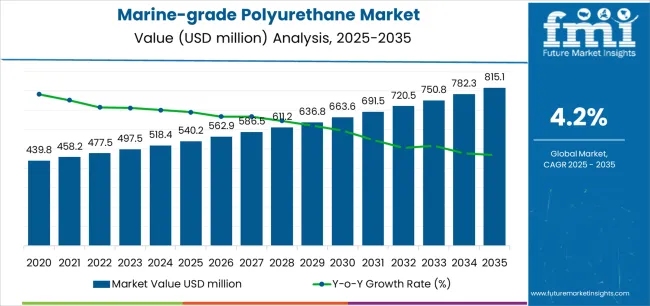
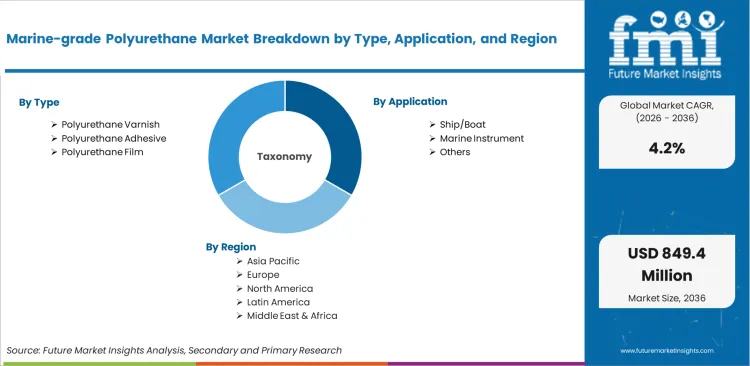
The marine-grade polyurethane market was valued at USD 540.00 million in 2025, projected to reach USD 562.89 million in 2026, and is forecast to expand to USD 849.38 million by 2036 at a 4.2% CAGR. Vessel maintenance cycles and newbuild coating specifications are sustaining demand for polyurethane-based protective coatings, adhesives, and films in marine environments. Stringent anti-corrosion performance requirements for hulls, decks, and onboard instruments, combined with regulatory pressure to reduce VOC emissions from marine coatings, are directing formulation investment toward high-solids and waterborne polyurethane systems.
Summary of Marine-grade Polyurethane Market
- Market Snapshot
- The marine-grade polyurethane market is valued at USD 540.00 million in 2025 and is projected to reach USD 849.38 million by 2036.
- The industry is expected to grow at a 4.2% CAGR from 2026 to 2036, creating an incremental opportunity of USD 286.49 million.
- The market is a specialty marine coatings and adhesives category where demand tracks vessel newbuild activity, fleet maintenance drydocking cycles, and recreational boating market size.
- Demand and Growth Drivers
- Anti-corrosion coating specifications for vessel hulls and deck surfaces mandate polyurethane-based protective systems that withstand sustained saltwater and UV exposure.
- Regulatory pressure to reduce VOC emissions from marine coatings is directing formulation investment toward high-solids and waterborne polyurethane systems.
- Recreational boat maintenance and refurbishment cycles sustain a steady aftermarket demand channel for marine-grade varnishes and adhesives.
- Among key countries, China leads at 5.7% CAGR, followed by India at 5.3%, Germany at 4.8%, the United States at 4%, and United Kingdom at 3.6%.
- Product and Segment View
- The market covers polyurethane-based varnishes, adhesives, and films formulated for marine environments, offering anti-corrosion, UV resistance, and saltwater durability properties.
- Applications span hull coating, deck finishing, structural bonding, marine instrument protection, and onboard interior finishing for commercial, recreational, and military vessels.
- Polyurethane Varnish leads by Type with 45.3% share in 2026, providing clear protective finishes for deck woodwork and interior surfaces across vessel classes.
- Ship/Boat accounts for 62.8% of the Application segment in 2026, reflecting the highest consumption volume for hull, deck, and structural coating and bonding.
- The scope includes marine-grade polyurethane varnishes, adhesives, and films; it excludes epoxy-based marine coatings, antifouling paints, industrial polyurethane products, and general-purpose adhesives.
- Geography and Competitive Outlook
- China and India lead at 5.7% and 5.3% CAGR, driven by shipbuilding production volume and expanding coastal fleet maintenance requirements.
- North America and Europe maintain steady demand driven by recreational boating maintenance cycles and specialized yacht and cruise ship coating specifications.
- Competition is shaped by coating performance certification, marine environment test data, and distribution channel reach, with key players including 3M, BASF, Benjamin Moore, Interlux (AkzoNobel), Sika.
Marine-grade Polyurethane Market Key Takeaways
| Metric | Details |
|---|---|
| Industry Size (2026) | USD 562.89 Million |
| Industry Value (2036) | USD 849.38 Million |
| CAGR (2026-2036) | 4.2% |
Source: Future Market Insights, 2026
FMI analysts observe that the marine-grade polyurethane market is a specialty coatings and adhesives category where performance specifications are dictated by saltwater exposure, UV degradation resistance, and anti-corrosion durability requirements. Polyurethane varnish leads the type segment because it provides a clear protective finish for deck woodwork and interior surfaces on commercial and recreational vessels. FMI is of the opinion that the ship and boat application segment retains the dominant share as hull coating, deck finishing, and structural bonding represent the highest volume consumption points for marine-grade polyurethane products. Spray application remains the leading coating method for large vessel surfaces, while brush and roll-on methods serve maintenance and touch-up applications on smaller craft and marine instruments.
Regional demand mirrors shipbuilding output, vessel maintenance fleet size, and recreational marine activity. China leads at 5.7% CAGR, reflecting the global shipbuilding production volume and associated coating consumption. India follows at 5.3%, supported by expanding domestic shipbuilding and coastal fleet maintenance requirements. Germany registers 4.8%, driven by specialized yacht and cruise ship coating specifications. Brazil advances at 4.4% from naval vessel maintenance and offshore platform coating programs. United States maintains 4% growth, and United Kingdom tracks 3.6%. Japan registers 3.2% CAGR through 2036.
Marine-grade Polyurethane Market Definition
Marine-grade polyurethane encompasses polyurethane-based varnishes, adhesives, and films formulated to withstand saltwater exposure, UV degradation, and mechanical abrasion in marine environments. These products are specified for protective coating, structural bonding, and surface finishing on commercial vessels, recreational boats, military ships, and marine instruments. The primary function is to provide durable anti-corrosion and weathering protection for surfaces and joints exposed to continuous marine operating conditions.
Marine-grade Polyurethane Market Inclusions
Market scope includes polyurethane varnishes, adhesives, and films formulated for marine environments across all vessel types, application methods, end users, and price segments. Global and regional market sizing covers the forecast period from 2026 to 2036 with segment breakdowns by Type, Application, Vessel Type, End User, Coating Method, and Price Segment.
Marine-grade Polyurethane Market Exclusions
The scope excludes epoxy-based marine coatings, antifouling bottom paints, industrial-grade polyurethane products not certified for marine use, and general-purpose adhesives. Marine paint thinners, surface preparation chemicals, and application equipment are also excluded.
Marine-grade Polyurethane Market Research Methodology
- Primary Research: Analysts engaged with marine coating specification engineers, shipyard procurement managers, and boat maintenance service operators to map procurement decision gates and technical qualification criteria shaping marine-grade polyurethane purchasing cycles.
- Desk Research: Data collection aggregated marine coating performance test databases, vessel drydocking schedule registries, and VOC regulation compliance records from public and institutional sources covering the 2021 to 2025 historical period.
- Market-Sizing and Forecasting: Baseline values derive from a bottom-up aggregation of coating consumption volumes per vessel type and weighted average product pricing across formulation categories, applying region-specific adoption curves to project demand through 2036.
- Data Validation and Update Cycle: Projections are tested against publicly reported expenditure guidance from specialty chemical manufacturers and marine coating distributor revenue filings and reconciled quarterly.
Why is the Marine-grade Polyurethane Market Growing?
Market expansion is being supported by the increasing global demand for advanced marine protection systems and the corresponding need for polyurethane coating technologies that can provide superior corrosion resistance benefits and durability advantages while enabling enhanced operational efficiency and extended compatibility across various commercial vessel and recreational marine applications. Modern shipbuilders and marine industry specialists are increasingly focused on implementing proven coating technologies that can deliver effective corrosion protection, minimize traditional maintenance dependency, and provide consistent performance throughout complex marine configurations and diverse environmental conditions. Marine-grade polyurethane proven ability to deliver exceptional protection efficacy against traditional alternatives, enable advanced marine integration, and support modern vessel protection protocols makes it an essential component for contemporary shipbuilding and marine maintenance operations.
The growing emphasis on vessel longevity and marine efficiency optimization is driving demand for marine-grade polyurethane that can support large-scale shipyard requirements, improve protection outcomes, and enable advanced coating systems. Consumer preference for products that combine effective corrosion protection with proven durability and operational benefits is creating opportunities for innovative polyurethane implementations. The rising influence of environmental compliance trends and marine performance awareness is also contributing to increased demand for marine-grade polyurethane that can provide advanced features, seamless vessel integration, and reliable performance across extended service periods.
Opportunity Pathways - Marine-grade Polyurethane Market
The marine-grade polyurethane market is poised for steady growth and technological advancement. As marine manufacturers across North America, Europe, Asia-Pacific, and emerging markets seek systems that deliver exceptional protection quality, advanced coating capabilities, and reliable durability options, marine-grade polyurethane solutions are gaining prominence not just as protective coatings but as strategic enablers of vessel technologies and advanced marine functionality.
Rising polyurethane film adoption in Asia-Pacific and expanding vessel protection initiatives globally amplify demand, while manufacturers are leveraging innovations in coating engineering, advanced formulation integration, and protection management technologies.
Pathways like adhesive-based implementations, film coating platforms, and specialized marine solutions promise strong margin uplift, especially in premium vessel segments. Geographic expansion and product diversification will capture volume, particularly where local marine preferences and advanced technology adoption are critical. Regulatory support around marine protection standards, coating efficacy protocols, and environmental requirements give structural support.
- Pathway A - Polyurethane Film Implementations. Premium vessel manufacturers and luxury marine producers increasingly require marine-grade polyurethane solutions with film technology and advanced protection profiles for enhanced durability appeal and premium positioning capabilities. Technology developers who develop film platforms with superior protection standards can command premium pricing. Expected revenue pool: USD 98.4 million - USD 135.2 million.
- Pathway B - Polyurethane Adhesive Platforms. Growing demand for bonding and structural implementations, high-strength adhesion capabilities, and unique application features drives need for advanced adhesive capabilities with specialized marine integration. Opportunity: USD 87.6 million - USD 120.4 million.
- Pathway C - Specialized Varnish Solutions. Advanced varnish formulations capable of meeting specific marine requirements, vessel compatibility, and specialized protection profiles enable market expansion and enhanced aesthetic appeal for marine-focused manufacturers. Revenue lift: USD 76.8 million - USD 105.6 million.
- Pathway D - Ship Integration Applications. Expanding reach into vessel-specific platforms with optimized protection delivery, advanced integration capabilities, and extended functionality features. Manufacturers will seek partners who supply integrated coating solutions with complete marine functionality. Pool: USD 84.9 million - USD 116.7 million.
- Pathway E - Geographic Expansion & Local Manufacturing. Strong growth in APAC, particularly China, India, and Southeast Asia. Local manufacturing lowers costs, reduces supply complexity, and enables faster response to regional marine preferences. Expected upside: USD 98.7 million - USD 135.6 million.
- Pathway F - OEM Partnership Development. Increasing demand for custom formulations, brand-specific functionality, and specialized marine profiles with validated protection characteristics for shipbuilding companies. USD 68.5 million - USD 94.2 million.
- Pathway G - Aftermarket Expansion. Developing comprehensive retrofit solutions, maintenance compatibility services, and enhancement programs creates differentiation and addresses specialized requirements for marine service providers and vessel owners. Growing demand from independent marine services. Pool: USD 63.1 million - USD 86.7 million.
Which Key Segments Are Driving Growth in the Marine-grade Polyurethane Market?
The marine-grade polyurethane market is segmented by type, application, vessel type, end user, coating method, price range, and region. By type, the marine-grade polyurethane market is divided into polyurethane varnish, polyurethane adhesive, and polyurethane film categories. By application, it covers ship/boat, marine instrument, and other segments. By vessel type, the marine-grade polyurethane market includes commercial vessels, recreational boats, and military ships. By end user, it encompasses shipbuilders, marine maintenance, and vessel owners. By coating method, the marine-grade polyurethane market is categorized into spray, brush, and roll-on applications. By price range, the marine-grade polyurethane market is divided into premium, mid-range, and economy. Regionally, the marine-grade polyurethane market is divided into North America, Europe, East Asia, South Asia & Pacific, Latin America, and the Middle East & Africa.
By Type, the Polyurethane Varnish Segment Accounts for 45.3% Market Share
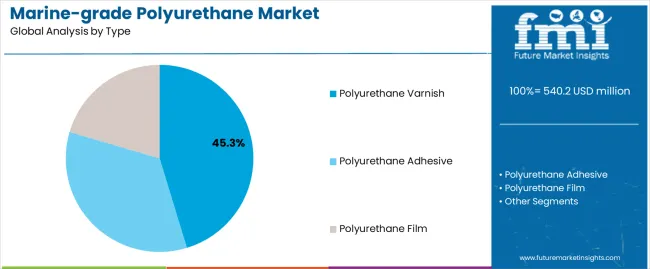
The polyurethane varnish segment is projected to account for 45.3% of the marine-grade polyurethane market in 2026, reaffirming its position as the leading type category. Marine manufacturers and coating system integrators increasingly utilize polyurethane varnish implementations for their superior weather protection when operating across diverse vessel platforms, excellent application properties, and widespread acceptance in applications ranging from basic wood protection to premium marine operations. Polyurethane varnish technology's established protection methods and proven durability capabilities directly address the manufacturer requirements for dependable coating solutions in complex marine environments.
This type segment forms the foundation of modern marine coating adoption patterns, as it represents the implementation with the greatest market penetration and established consumer acceptance across multiple vessel categories and price segments. Manufacturer investments in varnish standardization and system consistency continue to strengthen adoption among marine producers and coating companies. With consumers prioritizing durability and aesthetic appeal, polyurethane varnish implementations align with both functionality preferences and budget expectations, making them the central component of comprehensive vessel protection strategies.
By Application, the Ship/Boat Segment Accounts for 62.8% Market Share
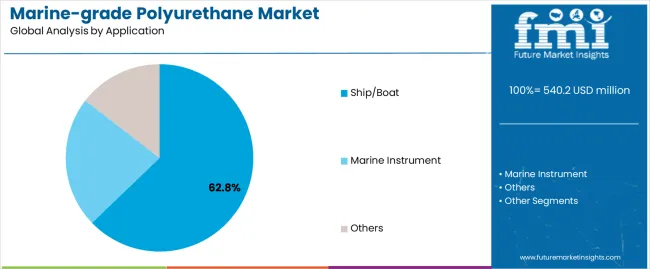
Ship/boat applications are projected to represent 62.8% of marine-grade polyurethane demand in 2026, underscoring their critical role as the primary application channel for vessel protection across marine manufacturing, shipbuilding operations, and commercial vessel applications. Marine manufacturers prefer marine-grade polyurethane for ship/boat use for their exceptional protection characteristics, scalable application options, and ability to enhance vessel performance while ensuring consistent coating quality throughout diverse marine platforms and construction processes. Positioned as essential protection components for modern marine production, marine-grade polyurethane solutions offer both technological advantages and manufacturing efficiency benefits.
The segment is supported by continuous innovation in vessel protection technologies and the growing availability of specialized implementations that enable diverse marine requirements with enhanced coating uniformity and extended durability capabilities. Additionally, marine manufacturers are investing in advanced technologies to support large-scale shipyard integration and product development. As vessel protection trends become more prevalent and marine performance awareness increases, ship/boat applications will continue to represent a major implementation market while supporting advanced marine utilization and technology integration strategies.
What are the Drivers, Restraints, and Key Trends of the Marine-grade Polyurethane Market?
The marine-grade polyurethane market is advancing steadily due to increasing demand for advanced marine protection systems and growing adoption of polyurethane coating technologies that provide superior corrosion resistance characteristics and durability benefits while enabling enhanced operational efficiency across diverse commercial vessel and recreational marine applications. The marine-grade polyurethane market faces challenges, including complex formulation requirements, evolving marine regulations, and the need for specialized coating expertise and performance programs. Innovation in polyurethane chemistry and advanced application systems continues to influence product development and market expansion patterns.
Expansion of Vessel Protection Technologies and Marine Integration
The growing adoption of advanced vessel protection, sophisticated coating management capabilities, and marine durability awareness is enabling system developers to produce advanced marine-grade polyurethane solutions with superior protection positioning, enhanced coating profiles, and seamless integration functionalities. Advanced marine protection systems provide improved durability outcomes while allowing more efficient manufacturing workflows and reliable performance across various vessel applications and environmental conditions. Developers are increasingly recognizing the competitive advantages of marine integration capabilities for market differentiation and protection positioning.
Integration of Advanced Coating Methods and Protection Engineering
Modern marine-grade polyurethane providers are incorporating advanced formulation technology, protection protocol integration, and sophisticated coating solutions to enhance product appeal, enable intelligent protection features, and deliver value-added solutions to marine customers. These technologies improve coating performance while enabling new market opportunities, including multi-layer systems, optimized surface preparation, and enhanced corrosion resistance characteristics. Advanced protection integration also allows developers to support comprehensive marine coating technologies and market expansion beyond traditional coating approaches.
How Are Global Trends Shaping the Marine-grade Polyurethane Market Across Key Countries?
.webp "Top Country Growth Comparison Marine Grade Polyurethane Market Cagr (2026 2036)")
| Country | CAGR (2026-2036) |
|---|---|
| China | 5.7% |
| India | 5.3% |
| Germany | 4.8% |
| Brazil | 4.4% |
| United States (USA) | 4% |
| United Kingdom (UK) | 3.6% |
| Japan | 3.2% |
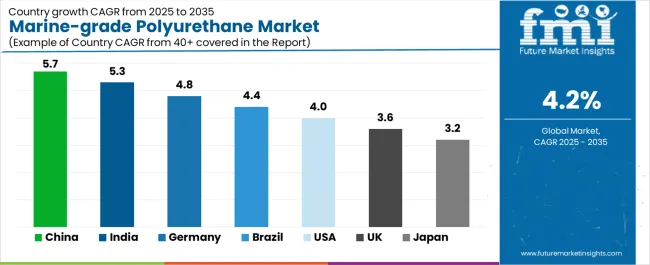
The marine-grade polyurethane market is experiencing steady growth globally, with China leading at a 5.7% CAGR through 2036, driven by expanding shipbuilding capacity, growing vessel protection modernization programs, and significant investment in marine coating development. India follows at 5.3%, supported by increasing commercial vessel production expansion, growing marine technology integration patterns, and expanding maritime infrastructure. Brazil shows growth at 4.4%, emphasizing marine manufacturing leadership and coating technology development. Germany records 4.8%, focusing on expanding premium vessel capabilities and marine integration modernization. The UK demonstrates 3.6% growth, prioritizing advanced marine technology development and vessel protection adoption trends. The USA exhibits 4% growth, emphasizing marine innovation excellence and premium coating development. Japan shows 3.2% growth, supported by marine technology initiatives and quality-focused production patterns.
The report covers an in-depth analysis of 40+ countries, the top-performing countries are highlighted below.
What Factors Are Boosting China’s Demand for Marine-grade Polyurethane in Shipbuilding?
Revenue from marine-grade polyurethane in China is projected to exhibit robust growth with a CAGR of 5.7% through 2036, driven by expanding shipbuilding capacity and rapidly growing vessel protection integration supported by government initiatives promoting marine technology development. The country's strong position in vessel production and increasing investment in marine coating infrastructure are creating substantial demand for advanced polyurethane implementations. Major shipbuilding manufacturers and technology companies are establishing comprehensive integration capabilities to serve both domestic marine demand and expanding export markets.
- Government support for marine modernization initiatives and vessel protection development is driving demand for advanced coating systems throughout major shipbuilding regions and production centers across the country.
- Strong shipbuilding growth and an expanding network of technology-focused producers are supporting the rapid adoption of marine-grade polyurethane among manufacturers seeking advanced protection capabilities and integrated marine technologies.
How Is India’s Growing Maritime Industry Increasing Demand for Marine-grade Polyurethane?
Revenue from marine-grade polyurethane in India is expanding at a CAGR of 5.3%, supported by the country's growing commercial vessel manufacturing sector, expanding marine technology capacity, and increasing adoption of vessel protection technologies. The country's initiatives promoting marine modernization and growing coastal development awareness are driving requirements for technology-integrated coating systems. International marine providers and domestic shipbuilding companies are establishing extensive manufacturing and integration capabilities to address the growing demand for advanced protection solutions.
- Rising commercial vessel production requirements and expanding marine programs are creating opportunities for marine-grade polyurethane adoption across coastal manufacturing centers, progressive producers, and modern shipbuilding facilities in major maritime regions.
- Growing focus on vessel protection integration and durability features is driving adoption of polyurethane platforms among marine manufacturers seeking enhanced product capabilities and advanced protection experiences.
Why Does Germany Lead the Marine-grade Polyurethane Market in Europe’s Shipbuilding Sector?
Revenue from marine-grade polyurethane in Germany is expanding at a CAGR of 4.8%, supported by the country's marine manufacturing heritage, strong emphasis on vessel protection technology, and robust demand for advanced coating systems in commercial and recreational applications. The nation's mature marine sector and technology-focused operations are driving sophisticated polyurethane implementations throughout the shipbuilding industry. Leading manufacturers and marine specialists are investing extensively in coating development and advanced integration technologies to serve both domestic and international markets.
- Rising demand for commercial vessel protection technologies and advanced marine systems is creating requirements for sophisticated marine-grade polyurethane solutions with exceptional protection capabilities among quality-conscious manufacturers seeking enhanced vessel experiences and advanced integration methods.
- Strong marine tradition and growing investment in vessel protection technologies are supporting adoption of quality polyurethane platforms with advanced development methods and enhanced protection profiles across marine operations in major shipbuilding regions.
What Is Fueling Brazil’s Use of Marine-grade Polyurethane in Naval and Coastal Applications?
Revenue from marine-grade polyurethane in Brazil is growing at a CAGR of 4.4%, driven by the country's expanding marine manufacturing sector, growing coastal protection programs, and increasing investment in vessel technology development. Brazil's large marine market and commitment to maritime advancement are supporting demand for diverse polyurethane solutions across multiple vessel segments. Manufacturers are establishing comprehensive integration capabilities to serve the growing domestic market and expanding marine opportunities.
- Strong manufacturing expansion and expanding modern marine operations are driving adoption of integrated coating systems with superior protection capabilities and advanced integration among large vessel manufacturers and progressive marine producers.
- Growing technology diversity and increasing vessel protection adoption are supporting market expansion for advanced polyurethane implementations with seamless integration profiles and modern protection delivery throughout the country's marine regions.
How Are USA Innovations Enhancing Marine-grade Polyurethane Performance?
Revenue from marine-grade polyurethane in the USA is expanding at a CAGR of 4%, supported by the country's advanced marine technology sector, strategic focus on vessel protection solutions, and established shipbuilding capabilities. The USA's marine innovation leadership and technology integration are driving demand for specialized polyurethane implementations in premium vessels, commercial applications, and advanced marine products. Manufacturers are investing in comprehensive technology development to serve both domestic specialty markets and international quality applications.
- Vessel protection optimization and technology advancement are creating opportunities for specialized polyurethane adoption in marine coating systems, protection services, and technology-focused marine operations among leading maritime enterprises.
- Growing emphasis on advanced protection delivery and durability features is driving adoption of quality polyurethane implementations with enhanced technology profiles and integrated protection management throughout the country's marine technology sector.
What Is Driving the UK’s Adoption of Marine-grade Polyurethane in Maritime Coatings?
Revenue from marine-grade polyurethane in the UK is growing at a CAGR of 3.6%, driven by the country's focus on marine technology advancement, emphasis on premium vessel innovation, and strong position in vessel protection development. The UK's established marine innovation capabilities and commitment to technology diversification are supporting investment in specialized polyurethane technologies throughout major marine regions. Industry leaders are establishing comprehensive technology integration systems to serve domestic premium vessel production and marine protection applications.
- Innovations in vessel protection platforms and coating integration capabilities are creating demand for advanced marine-grade polyurethane implementations with exceptional protection properties among progressive marine manufacturers seeking enhanced technology differentiation and consumer appeal.
- Growing premium vessel adoption and increasing focus on marine innovation are driving adoption of advanced polyurethane platforms with integrated protection delivery and coating optimization across marine enterprises throughout the country.
How Is Japan Shaping the Future of Marine-grade Polyurethane with Its Marine Engineering?
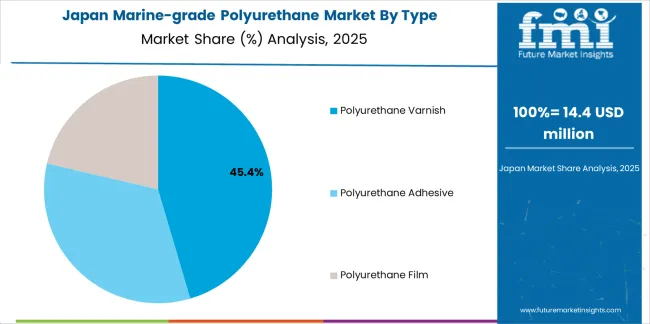
Revenue from marine-grade polyurethane in Japan is expanding at a CAGR of 3.2%, supported by the country's marine excellence initiatives, growing quality technology sector, and strategic emphasis on advanced vessel development. Japan's advanced quality control capabilities and integrated marine systems are driving demand for high-quality polyurethane platforms in premium vessels, marine technology, and advanced protection applications. Leading manufacturers are investing in specialized capabilities to serve the stringent requirements of technology-focused marine and premium vessel industries.
- Quality marine advancement and technology-focused development are creating requirements for specialized marine-grade polyurethane solutions with superior quality integration, exceptional protection capabilities, and advanced coating features among quality-conscious marine operations and premium vessel manufacturers.
- Strong position in marine technology innovation is supporting adoption of advanced polyurethane systems with validated protection characteristics and quality integration capabilities throughout the country's marine technology sector.
What Regional Factors Are Shaping the Marine-grade Polyurethane Market in Europe?
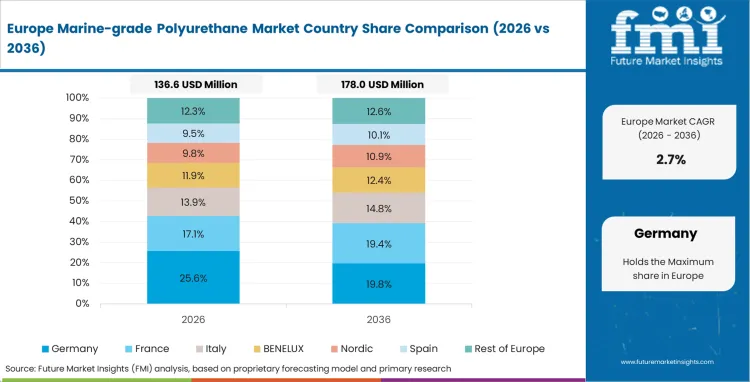
The marine-grade polyurethane market in Europe is projected to grow from USD 158.7 million in 2026 to USD 195.4 million by 2036, registering a CAGR of 2.1% over the forecast period. Germany is expected to maintain its leadership position with a 38.2% market share in 2026, declining slightly to 37.8% by 2036, supported by its strong marine engineering culture, sophisticated vessel manufacturing capabilities, and comprehensive shipbuilding industry serving diverse marine-grade polyurethane applications across Europe.
Norway follows with a 16.8% share in 2026, projected to reach 17.2% by 2036, driven by robust demand for marine coating technologies in offshore applications, advanced vessel programs, and commercial shipping markets, combined with established maritime infrastructure and technology integration expertise. The United Kingdom holds a 14.3% share in 2026, expected to reach 14.7% by 2036, supported by strong marine technology sector and growing premium vessel activities. Italy commands a 12.1% share in 2026, projected to reach 12.5% by 2036, while Netherlands accounts for 8.9% in 2026, expected to reach 9.2% by 2036. France maintains a 6.4% share in 2026, growing to 6.7% by 2036. The Rest of Europe region, including Nordic countries, Eastern Europe, Belgium, Poland, and other nations, is anticipated to maintain momentum, with its collective share moving from 3.3% to 1.9% by 2036, attributed to increasing marine modernization in Eastern Europe and growing technology penetration in Nordic countries implementing advanced vessel protection programs.
How Are Leading Players Strengthening Their Position in the Marine-grade Polyurethane Market?
The marine-grade polyurethane market is characterized by competition among established marine coating companies, specialized polyurethane technology developers, and integrated protection solution providers. Companies are investing in formulation chemistry research, application optimization, advanced coating system development, and comprehensive marine portfolios to deliver consistent, high-quality, and application-specific marine-grade polyurethane solutions. Innovation in advanced protection integration, durability enhancement, and marine compatibility improvement is central to strengthening market position and competitive advantage.
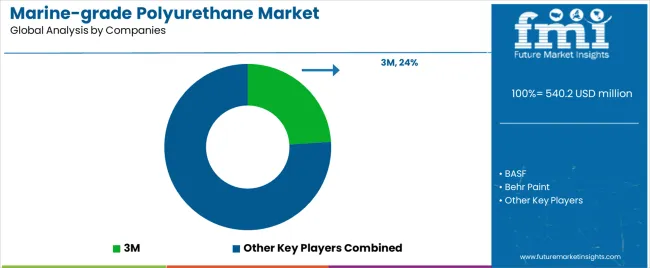
3M leads the marine-grade polyurethane market with a 24% market share, offering comprehensive marine technology solutions, including quality coating platforms and advanced integration systems, with a focus on premium and OEM marine applications. BASF provides specialized chemical capabilities with an emphasis on advanced polyurethane implementations and innovative marine solutions. Behr Paint delivers comprehensive coating services with a focus on integrated platforms and large-scale marine applications. Benjamin Moore specializes in advanced coating technologies and specialized polyurethane implementations for premium applications. Dutch Boy focuses on consumer-oriented coating integration and innovative technology solutions. Lanco Paints offers advanced marine coating platforms with emphasis on quality-critical and high-performance applications.
Who Are the Key Innovators Driving Growth in the Marine-grade Polyurethane Market?
- 3M
- BASF
- Behr Paint
- Benjamin Moore
- Dutch Boy
- Lanco Paints
- Cabots
- Bondall
- Rust-Ole
- Cloverdale Paint
- Interlux (AkzoNobel)
- Sika
- Covestro
- Rustins
- Stanley
- Minwax (PPG Industries)
- Sherwin-Williams
Scope of the Report
| Metric | Value |
|---|---|
| Quantitative Units | USD 562.89 Million to USD 849.38 Million, at a CAGR of 4.2% |
| Market Definition | Marine-grade polyurethane encompasses polyurethane-based varnishes, adhesives, and films formulated to withstand saltwater exposure, UV degradation, and mechanical abrasion in marine environments. These products are specified for protective coating, structural bonding, and surface finishing on commercial vessels, recreational boats, military ships, and marine instruments. |
| Segmentation | Type: Polyurethane Varnish, Polyurethane Adhesive, Polyurethane Film; Application: Ship/Boat, Marine Instrument, Others; Vessel Type: Commercial Vessels, Recreational Boats, Military Ships; End User: Shipbuilders, Marine Maintenance, Vessel Owners; Coating Method: Spray Application, Brush Application, Roll-on Application; Price Segment: Premium, Mid-range, Economy |
| Regions Covered | North America, Latin America, Europe, East Asia, South Asia, Oceania, Middle East & Africa |
| Countries Covered | China, India, Germany, Brazil, United States, United Kingdom, Japan, and 40 plus countries |
| Key Companies Profiled | 3M, BASF, Benjamin Moore, Interlux (AkzoNobel), Sika, Covestro, Sherwin-Williams, PPG Industries |
| Forecast Period | 2026 to 2036 |
| Approach | Forecasting models apply a bottom-up methodology starting with installed base metrics and cross-validate projections against reported industry expenditure volumes. |
Marine-grade Polyurethane Market by Segments
Type:
- Polyurethane Varnish
- Polyurethane Adhesive
- Polyurethane Film
Application:
- Ship/Boat
- Marine Instrument
- Others
Vessel Type:
- Commercial Vessels
- Recreational Boats
- Military Ships
End User:
- Shipbuilders
- Marine Maintenance
- Vessel Owners
Coating Method:
- Spray Application
- Brush Application
- Roll-on Application
Price Segment:
- Premium
- Mid-range
- Economy
Region:
North America
- United States
- Canada
- Mexico
Europe
- Germany
- United Kingdom
- France
- Italy
- Spain
- Nordic
- BENELUX
- Rest of Europe
East Asia
- China
- Japan
- South Korea
South Asia & Pacific
- India
- ASEAN
- Australia & New Zealand
- Rest of South Asia & Pacific
Latin America
- Brazil
- Chile
- Argentina
- Rest of Latin America
Middle East & Africa
- Kingdom of Saudi Arabia
- Other GCC Countries
- Turkiye
- South Africa
- Other African Union
- Rest of Middle East & Africa
Bibliography
- 1. International Maritime Organization. (2025). AFS Convention: Anti-Fouling Systems on Ships Implementation Report. IMO.
- 2. International Organization for Standardization. (2025). ISO 12944: Corrosion Protection of Steel Structures by Protective Paint Systems. ISO.
- 3. European Chemicals Agency. (2025). REACH Regulation: Marine Coatings Substances of Very High Concern Update. ECHA.
- 4. BASF SE. (2025). BASF Coatings Division Annual Report 2025. BASF.
- 5. American Boat and Yacht Council. (2025). ABYC Standards for Small Craft: Coating and Finish Specifications. ABYC.
- 6. Lloyd's Register. (2025). Rules for Classification: Coatings and Surface Protection. Lloyd's Register.
This bibliography is provided for reader reference. The full Future Market Insights report contains the complete reference list with primary research documentation.
Frequently Asked Questions
How large is the demand for Marine-grade Polyurethane in the global market in 2026?
Demand for Marine-grade Polyurethane in the global market is estimated to be valued at USD 562.89 Million in 2026.
What will be the market size of Marine-grade Polyurethane in the global market by 2036?
Market size for Marine-grade Polyurethane is projected to reach USD 849.38 Million by 2036.
What is the expected demand growth for Marine-grade Polyurethane in the global market between 2026 and 2036?
Demand for Marine-grade Polyurethane is expected to grow at a CAGR of 4.2% between 2026 and 2036.
Which Type is poised to lead global sales by 2026?
Polyurethane Varnish accounts for 45.3% share in 2026.
How is the Application segment structured in this market?
Ship/Boat leads the Application segment with 62.8% share in 2026.
What is driving demand in China?
China leads growth at 5.7% CAGR through 2036, driven by global shipbuilding production volume and associated protective coating consumption.
What is India's growth outlook in this report?
India is projected to grow at a CAGR of 5.3% during 2026 to 2036.
What is Marine-grade Polyurethane and what is it mainly used for?
Marine-grade polyurethane covers varnishes, adhesives, and films formulated for marine environments. These products are used on vessel hulls, decks, and instruments for anti-corrosion protection, structural bonding, and surface finishing in saltwater conditions.
Preview the report firsthand - request a free sample
Get SampleGet the brochure for pricing and purchase details.
Get PDFTable of Content
- Executive Summary
- Global Market Outlook
- Demand-side Trends
- Supply-side Trends
- Technology Roadmap Analysis
- Analysis and Recommendations
- Market Overview
- Market Coverage / Taxonomy
- Market Definition / Scope / Limitations
- Research Methodology
- Chapter Orientation
- Analytical Lens and Working Hypotheses
- Market Structure, Signals, and Trend Drivers
- Benchmarking and Cross-market Comparability
- Market Sizing, Forecasting, and Opportunity Mapping
- Research Design and Evidence Framework
- Desk Research Programme (Secondary Evidence)
- Company Annual and Sustainability Reports
- Peer-reviewed Journals and Academic Literature
- Corporate Websites, Product Literature, and Technical Notes
- Earnings Decks and Investor Briefings
- Statutory Filings and Regulatory Disclosures
- Technical White Papers and Standards Notes
- Trade Journals, Industry Magazines, and Analyst Briefs
- Conference Proceedings, Webinars, and Seminar Materials
- Government Statistics Portals and Public Data Releases
- Press Releases and Reputable Media Coverage
- Specialist Newsletters and Curated Briefings
- Sector Databases and Reference Repositories
- FMI Internal Proprietary Databases and Historical Market Datasets
- Subscription Datasets and Paid Sources
- Social Channels, Communities, and Digital Listening Inputs
- Additional Desk Sources
- Expert Input and Fieldwork (Primary Evidence)
- Primary Modes
- Qualitative Interviews and Expert Elicitation
- Quantitative Surveys and Structured Data Capture
- Blended Approach
- Why Primary Evidence is Used
- Field Techniques
- Interviews
- Surveys
- Focus Groups
- Observational and In-context Research
- Social and Community Interactions
- Stakeholder Universe Engaged
- C-suite Leaders
- Board Members
- Presidents and Vice Presidents
- R&D and Innovation Heads
- Technical Specialists
- Domain Subject-matter Experts
- Scientists
- Physicians and Other Healthcare Professionals
- Governance, Ethics, and Data Stewardship
- Research Ethics
- Data Integrity and Handling
- Primary Modes
- Tooling, Models, and Reference Databases
- Desk Research Programme (Secondary Evidence)
- Data Engineering and Model Build
- Data Acquisition and Ingestion
- Cleaning, Normalisation, and Verification
- Synthesis, Triangulation, and Analysis
- Quality Assurance and Audit Trail
- Market Background
- Market Dynamics
- Drivers
- Restraints
- Opportunity
- Trends
- Scenario Forecast
- Demand in Optimistic Scenario
- Demand in Likely Scenario
- Demand in Conservative Scenario
- Opportunity Map Analysis
- Product Life Cycle Analysis
- Supply Chain Analysis
- Investment Feasibility Matrix
- Value Chain Analysis
- PESTLE and Porter’s Analysis
- Regulatory Landscape
- Regional Parent Market Outlook
- Production and Consumption Statistics
- Import and Export Statistics
- Market Dynamics
- Global Market Analysis 2021 to 2025 and Forecast, 2026 to 2036
- Historical Market Size Value (USD Million) Analysis, 2021 to 2025
- Current and Future Market Size Value (USD Million) Projections, 2026 to 2036
- Y-o-Y Growth Trend Analysis
- Absolute $ Opportunity Analysis
- Global Market Pricing Analysis 2021 to 2025 and Forecast 2026 to 2036
- Global Market Analysis 2021 to 2025 and Forecast 2026 to 2036, By Type
- Introduction / Key Findings
- Historical Market Size Value (USD Million) Analysis By Type , 2021 to 2025
- Current and Future Market Size Value (USD Million) Analysis and Forecast By Type , 2026 to 2036
- Polyurethane Varnish
- Polyurethane Adhesive
- Polyurethane Film
- Polyurethane Varnish
- Y-o-Y Growth Trend Analysis By Type , 2021 to 2025
- Absolute $ Opportunity Analysis By Type , 2026 to 2036
- Global Market Analysis 2021 to 2025 and Forecast 2026 to 2036, By Application
- Introduction / Key Findings
- Historical Market Size Value (USD Million) Analysis By Application, 2021 to 2025
- Current and Future Market Size Value (USD Million) Analysis and Forecast By Application, 2026 to 2036
- Ship/Boat
- Marine Instrument
- Others
- Ship/Boat
- Y-o-Y Growth Trend Analysis By Application, 2021 to 2025
- Absolute $ Opportunity Analysis By Application, 2026 to 2036
- Global Market Analysis 2021 to 2025 and Forecast 2026 to 2036, By Vessel Type
- Introduction / Key Findings
- Historical Market Size Value (USD Million) Analysis By Vessel Type, 2021 to 2025
- Current and Future Market Size Value (USD Million) Analysis and Forecast By Vessel Type, 2026 to 2036
- Commercial Vessels
- Recreational Boats
- Military Ships
- Commercial Vessels
- Y-o-Y Growth Trend Analysis By Vessel Type, 2021 to 2025
- Absolute $ Opportunity Analysis By Vessel Type, 2026 to 2036
- Global Market Analysis 2021 to 2025 and Forecast 2026 to 2036, By End User
- Introduction / Key Findings
- Historical Market Size Value (USD Million) Analysis By End User, 2021 to 2025
- Current and Future Market Size Value (USD Million) Analysis and Forecast By End User, 2026 to 2036
- Shipbuilders
- Marine Maintenance
- Vessel Owners
- Shipbuilders
- Y-o-Y Growth Trend Analysis By End User, 2021 to 2025
- Absolute $ Opportunity Analysis By End User, 2026 to 2036
- Global Market Analysis 2021 to 2025 and Forecast 2026 to 2036, By Coating Method
- Introduction / Key Findings
- Historical Market Size Value (USD Million) Analysis By Coating Method, 2021 to 2025
- Current and Future Market Size Value (USD Million) Analysis and Forecast By Coating Method, 2026 to 2036
- Spray Application
- Brush Application
- Roll-on Application
- Spray Application
- Y-o-Y Growth Trend Analysis By Coating Method, 2021 to 2025
- Absolute $ Opportunity Analysis By Coating Method, 2026 to 2036
- Global Market Analysis 2021 to 2025 and Forecast 2026 to 2036, By Price Segment
- Introduction / Key Findings
- Historical Market Size Value (USD Million) Analysis By Price Segment, 2021 to 2025
- Current and Future Market Size Value (USD Million) Analysis and Forecast By Price Segment, 2026 to 2036
- Premium
- Mid-range
- Economy
- Premium
- Y-o-Y Growth Trend Analysis By Price Segment, 2021 to 2025
- Absolute $ Opportunity Analysis By Price Segment, 2026 to 2036
- Global Market Analysis 2021 to 2025 and Forecast 2026 to 2036, By Region
- Introduction
- Historical Market Size Value (USD Million) Analysis By Region, 2021 to 2025
- Current Market Size Value (USD Million) Analysis and Forecast By Region, 2026 to 2036
- North America
- Latin America
- Western Europe
- Eastern Europe
- East Asia
- South Asia and Pacific
- Middle East & Africa
- Market Attractiveness Analysis By Region
- North America Market Analysis 2021 to 2025 and Forecast 2026 to 2036, By Country
- Historical Market Size Value (USD Million) Trend Analysis By Market Taxonomy, 2021 to 2025
- Market Size Value (USD Million) Forecast By Market Taxonomy, 2026 to 2036
- By Country
- USA
- Canada
- Mexico
- By Type
- By Application
- By Vessel Type
- By End User
- By Coating Method
- By Price Segment
- By Country
- Market Attractiveness Analysis
- By Country
- By Type
- By Application
- By Vessel Type
- By End User
- By Coating Method
- By Price Segment
- Key Takeaways
- Latin America Market Analysis 2021 to 2025 and Forecast 2026 to 2036, By Country
- Historical Market Size Value (USD Million) Trend Analysis By Market Taxonomy, 2021 to 2025
- Market Size Value (USD Million) Forecast By Market Taxonomy, 2026 to 2036
- By Country
- Brazil
- Chile
- Rest of Latin America
- By Type
- By Application
- By Vessel Type
- By End User
- By Coating Method
- By Price Segment
- By Country
- Market Attractiveness Analysis
- By Country
- By Type
- By Application
- By Vessel Type
- By End User
- By Coating Method
- By Price Segment
- Key Takeaways
- Western Europe Market Analysis 2021 to 2025 and Forecast 2026 to 2036, By Country
- Historical Market Size Value (USD Million) Trend Analysis By Market Taxonomy, 2021 to 2025
- Market Size Value (USD Million) Forecast By Market Taxonomy, 2026 to 2036
- By Country
- Germany
- UK
- Italy
- Spain
- France
- Nordic
- BENELUX
- Rest of Western Europe
- By Type
- By Application
- By Vessel Type
- By End User
- By Coating Method
- By Price Segment
- By Country
- Market Attractiveness Analysis
- By Country
- By Type
- By Application
- By Vessel Type
- By End User
- By Coating Method
- By Price Segment
- Key Takeaways
- Eastern Europe Market Analysis 2021 to 2025 and Forecast 2026 to 2036, By Country
- Historical Market Size Value (USD Million) Trend Analysis By Market Taxonomy, 2021 to 2025
- Market Size Value (USD Million) Forecast By Market Taxonomy, 2026 to 2036
- By Country
- Russia
- Poland
- Hungary
- Balkan & Baltic
- Rest of Eastern Europe
- By Type
- By Application
- By Vessel Type
- By End User
- By Coating Method
- By Price Segment
- By Country
- Market Attractiveness Analysis
- By Country
- By Type
- By Application
- By Vessel Type
- By End User
- By Coating Method
- By Price Segment
- Key Takeaways
- East Asia Market Analysis 2021 to 2025 and Forecast 2026 to 2036, By Country
- Historical Market Size Value (USD Million) Trend Analysis By Market Taxonomy, 2021 to 2025
- Market Size Value (USD Million) Forecast By Market Taxonomy, 2026 to 2036
- By Country
- China
- Japan
- South Korea
- By Type
- By Application
- By Vessel Type
- By End User
- By Coating Method
- By Price Segment
- By Country
- Market Attractiveness Analysis
- By Country
- By Type
- By Application
- By Vessel Type
- By End User
- By Coating Method
- By Price Segment
- Key Takeaways
- South Asia and Pacific Market Analysis 2021 to 2025 and Forecast 2026 to 2036, By Country
- Historical Market Size Value (USD Million) Trend Analysis By Market Taxonomy, 2021 to 2025
- Market Size Value (USD Million) Forecast By Market Taxonomy, 2026 to 2036
- By Country
- India
- ASEAN
- Australia & New Zealand
- Rest of South Asia and Pacific
- By Type
- By Application
- By Vessel Type
- By End User
- By Coating Method
- By Price Segment
- By Country
- Market Attractiveness Analysis
- By Country
- By Type
- By Application
- By Vessel Type
- By End User
- By Coating Method
- By Price Segment
- Key Takeaways
- Middle East & Africa Market Analysis 2021 to 2025 and Forecast 2026 to 2036, By Country
- Historical Market Size Value (USD Million) Trend Analysis By Market Taxonomy, 2021 to 2025
- Market Size Value (USD Million) Forecast By Market Taxonomy, 2026 to 2036
- By Country
- Kingdom of Saudi Arabia
- Other GCC Countries
- Turkiye
- South Africa
- Other African Union
- Rest of Middle East & Africa
- By Type
- By Application
- By Vessel Type
- By End User
- By Coating Method
- By Price Segment
- By Country
- Market Attractiveness Analysis
- By Country
- By Type
- By Application
- By Vessel Type
- By End User
- By Coating Method
- By Price Segment
- Key Takeaways
- Key Countries Market Analysis
- USA
- Pricing Analysis
- Market Share Analysis, 2025
- By Type
- By Application
- By Vessel Type
- By End User
- By Coating Method
- By Price Segment
- Canada
- Pricing Analysis
- Market Share Analysis, 2025
- By Type
- By Application
- By Vessel Type
- By End User
- By Coating Method
- By Price Segment
- Mexico
- Pricing Analysis
- Market Share Analysis, 2025
- By Type
- By Application
- By Vessel Type
- By End User
- By Coating Method
- By Price Segment
- Brazil
- Pricing Analysis
- Market Share Analysis, 2025
- By Type
- By Application
- By Vessel Type
- By End User
- By Coating Method
- By Price Segment
- Chile
- Pricing Analysis
- Market Share Analysis, 2025
- By Type
- By Application
- By Vessel Type
- By End User
- By Coating Method
- By Price Segment
- Germany
- Pricing Analysis
- Market Share Analysis, 2025
- By Type
- By Application
- By Vessel Type
- By End User
- By Coating Method
- By Price Segment
- UK
- Pricing Analysis
- Market Share Analysis, 2025
- By Type
- By Application
- By Vessel Type
- By End User
- By Coating Method
- By Price Segment
- Italy
- Pricing Analysis
- Market Share Analysis, 2025
- By Type
- By Application
- By Vessel Type
- By End User
- By Coating Method
- By Price Segment
- Spain
- Pricing Analysis
- Market Share Analysis, 2025
- By Type
- By Application
- By Vessel Type
- By End User
- By Coating Method
- By Price Segment
- France
- Pricing Analysis
- Market Share Analysis, 2025
- By Type
- By Application
- By Vessel Type
- By End User
- By Coating Method
- By Price Segment
- India
- Pricing Analysis
- Market Share Analysis, 2025
- By Type
- By Application
- By Vessel Type
- By End User
- By Coating Method
- By Price Segment
- ASEAN
- Pricing Analysis
- Market Share Analysis, 2025
- By Type
- By Application
- By Vessel Type
- By End User
- By Coating Method
- By Price Segment
- Australia & New Zealand
- Pricing Analysis
- Market Share Analysis, 2025
- By Type
- By Application
- By Vessel Type
- By End User
- By Coating Method
- By Price Segment
- China
- Pricing Analysis
- Market Share Analysis, 2025
- By Type
- By Application
- By Vessel Type
- By End User
- By Coating Method
- By Price Segment
- Japan
- Pricing Analysis
- Market Share Analysis, 2025
- By Type
- By Application
- By Vessel Type
- By End User
- By Coating Method
- By Price Segment
- South Korea
- Pricing Analysis
- Market Share Analysis, 2025
- By Type
- By Application
- By Vessel Type
- By End User
- By Coating Method
- By Price Segment
- Russia
- Pricing Analysis
- Market Share Analysis, 2025
- By Type
- By Application
- By Vessel Type
- By End User
- By Coating Method
- By Price Segment
- Poland
- Pricing Analysis
- Market Share Analysis, 2025
- By Type
- By Application
- By Vessel Type
- By End User
- By Coating Method
- By Price Segment
- Hungary
- Pricing Analysis
- Market Share Analysis, 2025
- By Type
- By Application
- By Vessel Type
- By End User
- By Coating Method
- By Price Segment
- Kingdom of Saudi Arabia
- Pricing Analysis
- Market Share Analysis, 2025
- By Type
- By Application
- By Vessel Type
- By End User
- By Coating Method
- By Price Segment
- Turkiye
- Pricing Analysis
- Market Share Analysis, 2025
- By Type
- By Application
- By Vessel Type
- By End User
- By Coating Method
- By Price Segment
- South Africa
- Pricing Analysis
- Market Share Analysis, 2025
- By Type
- By Application
- By Vessel Type
- By End User
- By Coating Method
- By Price Segment
- USA
- Market Structure Analysis
- Competition Dashboard
- Competition Benchmarking
- Market Share Analysis of Top Players
- By Regional
- By Type
- By Application
- By Vessel Type
- By End User
- By Coating Method
- By Price Segment
- Competition Analysis
- Competition Deep Dive
- 3M
- Overview
- Product Portfolio
- Profitability by Market Segments (Product/Age /Sales Channel/Region)
- Sales Footprint
- Strategy Overview
- Marketing Strategy
- Product Strategy
- Channel Strategy
- BASF
- Behr Paint
- Benjamin Moore
- Dutch Boy
- Lanco Paints
- Cabots
- Bondall
- Rust-Ole
- Cloverdale Paint
- Interlux (AkzoNobel)
- Sika
- Covestro
- Rustins
- Stanley
- Minwax (PPG Industries)
- Sherwin-Williams
- 3M
- Competition Deep Dive
- Assumptions & Acronyms Used


