

- Industry Size (2026)
- USD 8.76 Bn
- Forecast (2036)
- USD 16.91 Bn
- CAGR (2026 to 2036)
- 6.80%
Core Plate Varnishes Market Size, Market Forecast and Outlook By FMI
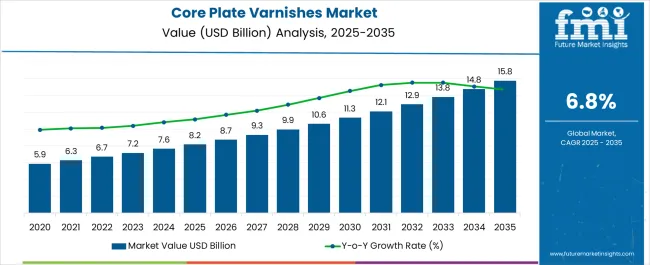
The core plate varnishes market was valued at USD 8.20 billion in 2025, projected to reach USD 8.76 billion in 2026, and is forecast to expand to USD 16.91 billion by 2036 at a 6.80% CAGR. As per FMI, the incremental opportunity across the forecast period amounts to USD 8.15 billion, reflecting a steady expansion trajectory shaped by evolving end-use requirements and shifting procurement patterns across global supply chains.
Summary of Core Plate Varnishes Market
- Market Snapshot
- The core plate varnishes market is valued at USD 8.20 billion in 2025 and is projected to reach USD 16.91 billion by 2036.
- The industry is expected to grow at a 6.80% CAGR from 2026 to 2036, creating an incremental opportunity of USD 8.15 billion.
- The market is a specification-driven electrical insulation material category, where dielectric performance, thermal class rating, and environmental compliance define formulation development priorities and procurement specifications.
- Demand and Growth Drivers
- Demand is driven by global power grid expansion and transformer manufacturing capacity additions requiring high-performance core plate insulation coatings that meet tightening dielectric and thermal standards.
- Electric motor production scale-up for industrial automation, HVAC systems, and electric vehicle powertrain components is sustaining high-volume varnish procurement across multiple thermal class specifications.
- Environmental compliance mandates are accelerating the transition from solvent-based alkyd phenolic formulations toward waterborne and high-solids polyurethane systems with lower VOC emission profiles.
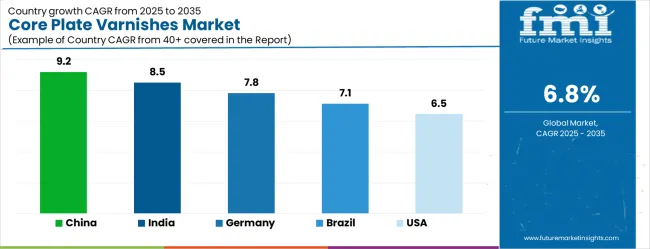
- Among key countries, China at 9.2%, India at 8.5%, Germany at 7.8%, Brazil at 7.1%, USA at 6.5%, UK at 5.8%, Japan at 5.1%.
- Product and Segment View
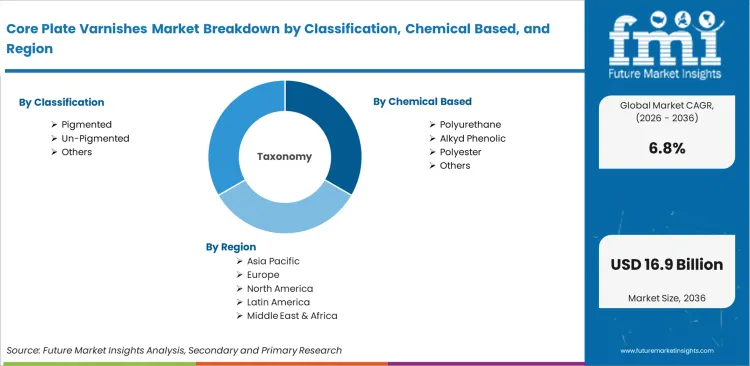
- The market includes core plate varnishes across classification types (pigmented, un-pigmented) and chemical bases (polyurethane, alkyd phenolic, polyester, others) for transformer, motor, generator, and electromagnetic pole applications.
- Formulation development is focused on improving thermal class ratings, dielectric breakdown resistance, and adhesion performance while reducing volatile organic compound emissions.
- The scope includes liquid core plate varnishes applied during electrical lamination manufacturing, while excluding wire enamel coatings, potting compounds, and structural adhesives used in electrical equipment assembly.
- Pigmented leads by Classification with 41.3% share in 2026.
- Polyurethane leads by Chemical Based with 37.6% share in 2026.
- Geography and Competitive Outlook
- China and India are the fastest-growing markets driven by power grid expansion and transformer/motor manufacturing scale-up, while Germany and the United States sustain value through precision electrical equipment manufacturing and grid modernization procurement.
- Competition is shaped by product specification depth, material performance certification, and supply chain reliability, with key players including Helios Group, Rembrandtin, ALTANA, Toyo Ink, Bakelite Hylam Limited, Axalta, Mader, Super Urecoat Industries, Sichuan Dongfang Insulating Material, AEV Ltd, Hitachi Chemical Co. Ltd.
- Analyst Opinion at FMI
- Nikhil Kaitwade, Principal Consultant, opines: 'In my analysis, I have observed that the core plate varnishes market is experiencing a formulation transition where legacy solvent-based alkyd phenolic systems are losing specification approval in new transformer and motor designs as OEMs mandate higher thermal class ratings and lower VOC emission profiles. Varnish suppliers who delay formulation migration toward polyurethane and polyester systems face growing disqualification from tier-1 electrical equipment manufacturer approved supplier lists.'
- Strategic Implications / Executive Takeaways
- Varnish formulators must accelerate development of high-solids polyurethane and waterborne polyester systems to meet OEM thermal class upgrade mandates and environmental compliance thresholds.
- Transformer and motor manufacturers should establish dual-source procurement agreements for core plate varnishes to mitigate supply concentration risk in specialty chemical supply chains.
- Electrical equipment procurement teams must specify core plate varnish thermal class ratings aligned with the operating temperature requirements of next-generation high-efficiency motor and transformer designs.
Core Plate Varnishes Market Key Takeaways
| Metric | Details |
|---|---|
| Industry Size (2026) | USD 8.76 Billion |
| Industry Value (2036) | USD 16.91 Billion |
| CAGR (2026-2036) | 6.80% |
Source: Future Market Insights, 2026
Based on FMI's report, the core plate varnishes market is expected to create an incremental opportunity of USD 8.15 billion between 2026 and 2036. FMI analysts project that end-use procurement patterns and regional supply chain dynamics will shape the distribution of this opportunity across segments and geographies.
Expanding global electrical infrastructure investment, transformer manufacturing capacity additions, and motor production scale-up programs are sustaining procurement volumes for core plate varnishes across power generation, transmission, and industrial equipment segments. Tightening dielectric performance standards and thermal class upgrade mandates are compelling varnish formulators to develop polyurethane and polyester systems capable of withstanding higher operating temperatures and extended service intervals. As per FMI, the transition from solvent-based alkyd phenolic formulations toward waterborne and high-solids polyurethane systems is reshaping the competitive positioning of core plate varnish suppliers across all major producing regions.
Regional demand for core plate varnishes reflects the geographic distribution of transformer manufacturing, electric motor production, and generator assembly operations. China at 9.2% CAGR, India at 8.5% CAGR, Germany at 7.8% CAGR, Brazil at 7.1% CAGR, USA at 6.5% CAGR, UK at 5.8% CAGR, Japan at 5.1% CAGR. China leads growth through massive power grid expansion programs and domestic transformer and motor manufacturing capacity that supplies both internal infrastructure and export markets. India follows on the strength of national grid modernization, renewable energy integration, and expanding industrial motor production. Germany sustains growth through precision electrical equipment manufacturing and thermal class upgrade requirements. France and the United Kingdom maintain growth through grid infrastructure renovation and offshore wind power transformer procurement. The United States advances through grid hardening investment and industrial motor replacement cycles. Brazil registers steady growth tied to hydroelectric infrastructure expansion and industrial electrification programs.
Core Plate Varnishes Market Definition
Core plate varnishes are specialized insulating coatings applied to electrical steel laminations used in transformers, electric motors, generators, and electromagnetic poles. They provide inter-laminar insulation, reduce eddy current losses, and protect core plates from corrosion and mechanical damage during assembly and operation. Formulations span polyurethane, alkyd phenolic, polyester, and hybrid chemical bases across pigmented and un-pigmented classification types.
Future Market Insights analysis captures the complete addressable consumption base across all major producing and consuming regions, covering the forecast period from 2026 to 2036.
Core Plate Varnishes Market Inclusions
Market scope includes core plate varnishes across classification types (pigmented, un-pigmented), chemical bases (polyurethane, alkyd phenolic, polyester, others), and application segments (transformer, motor, generator, electromagnetic poles, others). The assessment covers global and regional market sizes, forecast period 2026 to 2036, and full segment breakdowns by classification, chemical base, application, and region.
Core Plate Varnishes Market Exclusions
The scope excludes wire enamel coatings, vacuum pressure impregnation resins, potting and encapsulation compounds, and structural adhesives used in electrical equipment assembly. Core plate steel laminations sold as raw material are not included.
Core Plate Varnishes Market Research Methodology
- Primary Research: Analysts engaged with procurement managers, production engineers, and distribution channel executives to map the decision gates and compliance thresholds shaping product adoption.
- Desk Research: Data collection aggregated regulatory filings, trade body publications, standards body documentation, and company financial disclosures across all major producing and consuming regions.
- Market-Sizing and Forecasting: Baseline values derive from a bottom-up aggregation of producer shipment volumes and trade flow data, applying region-specific demand growth curves to project adoption velocity through 2036.
- Data Validation and Update Cycle: Projections are tested against publicly reported industry statistics, trade data, and company guidance. The model is updated quarterly to reflect market structure changes.
Why is the Core Plate Varnishes Market Growing?
The Core Plate Varnishes market is experiencing notable expansion as demand grows for efficient insulation materials in electrical equipment manufacturing. Core plate varnishes are being widely adopted to enhance dielectric strength, protect against corrosion, and ensure long-term durability of electrical steel laminations used in transformers, motors, and generators. The rising focus on energy efficiency and performance reliability in power distribution systems is reinforcing the need for high-quality varnishes.
Increasing investment in renewable energy infrastructure, smart grids, and industrial automation is further boosting market demand. Chemical advancements that provide superior adhesion, heat resistance, and environmental compliance are shaping product development trends. Additionally, regulatory pressures around volatile organic compounds are encouraging innovation in environmentally friendly formulations.
As electricity consumption continues to grow globally and the replacement rate of aging power infrastructure increases, the market is set to benefit from higher adoption across utilities and industrial applications Continuous research and development efforts aimed at enhancing product performance and sustainability are expected to drive further growth in the coming decade.
Segmental Analysis
The core plate varnishes market is segmented by classification, chemical based, application, and geographic regions. By classification, core plate varnishes market is divided into Pigmented, Un-Pigmented, and Others. In terms of chemical based, core plate varnishes market is classified into Polyurethane, Alkyd Phenolic, Polyester, and Others. Based on application, core plate varnishes market is segmented into Transformer, Motor, Generator, Electromagnetic Poles, and Others. Regionally, the core plate varnishes industry is classified into North America, Latin America, Western Europe, Eastern Europe, Balkan & Baltic Countries, Russia & Belarus, Central Asia, East Asia, South Asia & Pacific, and the Middle East & Africa.
Insights into the Pigmented Classification Segment
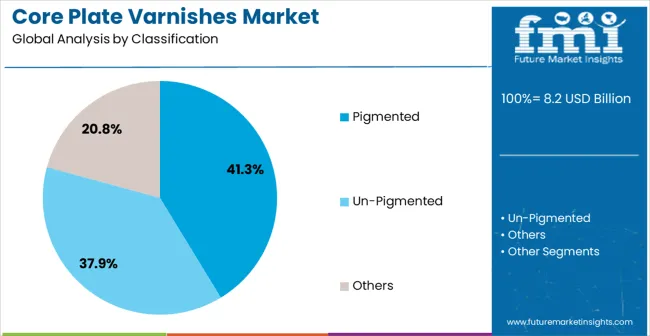
The pigmented classification segment is projected to hold 41.3% of the market revenue in 2025, making it the leading classification type. This dominance is being reinforced by the segment’s ability to provide superior coverage, visual identification, and improved corrosion resistance compared to clear varnishes. Pigmented varnishes enhance the protective layer on electrical steel laminations, ensuring reliable insulation and reducing the risk of short circuits or performance degradation.
Their widespread adoption in transformer and motor manufacturing reflects the segment’s ability to deliver both functional and aesthetic advantages. Advances in formulation technologies have further improved the adhesion, heat stability, and chemical resistance of pigmented varnishes, aligning with evolving performance requirements in the electrical industry.
As manufacturers seek reliable and cost-effective solutions that comply with international safety and environmental standards, pigmented varnishes are expected to maintain their leadership Their proven ability to extend equipment lifespan while supporting operational efficiency positions them as a critical driver of growth in the Core Plate Varnishes market.
Insights into the Polyurethane Chemical Based Segment
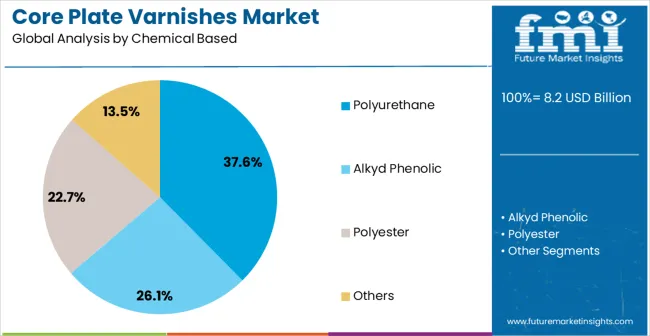
The polyurethane chemical based segment is anticipated to account for 37.6% of the market revenue in 2025, establishing it as the leading chemical type. Polyurethane varnishes are being widely chosen due to their excellent flexibility, abrasion resistance, and chemical stability, which are essential for insulating electrical steel laminations under high thermal and mechanical stress. Their ability to provide strong adhesion and superior dielectric properties ensures reliable performance in demanding applications such as high-voltage transformers and industrial motors.
Polyurethane-based varnishes also exhibit resistance to moisture and environmental factors, making them suitable for varied operating conditions. Advances in formulation have enabled the development of low-VOC and eco-friendly polyurethane products, aligning with global sustainability goals and regulatory compliance requirements.
The versatility of polyurethane, combined with its proven performance advantages, has reinforced its widespread use across electrical equipment manufacturing As industries increasingly demand long-lasting and efficient insulation materials, polyurethane varnishes are expected to sustain their leadership in the market.
Insights into the Transformer Application Segment
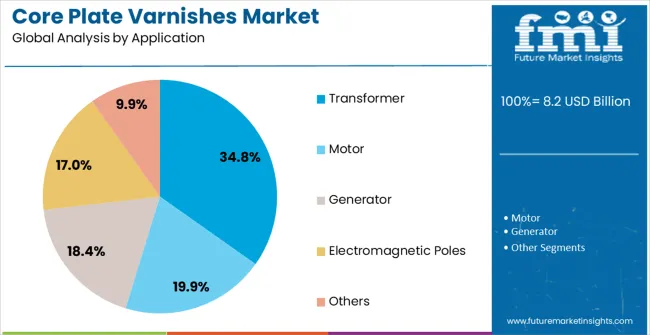
The transformer application segment is projected to hold 34.8% of the market revenue in 2025, positioning it as the largest application area. Growth in this segment is being driven by the rising global demand for reliable power transmission and distribution infrastructure. Core plate varnishes are critical in transformer manufacturing, where they prevent inter-laminar short circuits, minimize eddy current losses, and extend operational lifespans.
The increasing deployment of transformers in renewable energy grids, urban power networks, and industrial facilities is reinforcing varnish demand. Furthermore, the ongoing replacement of aging power infrastructure in developed economies and rapid electrification in emerging markets are creating new growth opportunities. Transformer manufacturers are prioritizing varnishes that provide superior thermal endurance and mechanical stability to ensure uninterrupted operation in diverse environments.
Regulatory emphasis on energy efficiency standards is also propelling the adoption of advanced varnishes that reduce energy losses As power consumption continues to rise worldwide, transformers will remain a primary end-use driver, sustaining the segment’s leading role in the Core Plate Varnishes market.
Market Overview
Core Plate Varnishes Market Overview
Over the decade, consumption of energy has significantly increased over the globe, owing to various factors such as, increasing rate of habitation in urban and rural sector, commercial workspace, growing industrial establishments, per capita consumption, and many more. Most of the energy is lost during transmission from the generation site to distribution centres. In order to recover this energy and minimization of losses, insulation plays an important role in optimizing the power transmission process.
Core plate varnishes is one of the insulation components to the electrical devices and machines. Manufacturers have developed water borne and heat absorbing varnishes to insulate the electrical steel. Properties present in the core plate varnishes reduce the eddy current losses of the electrical components which enhance the efficiency and life of the components.
These core plate varnishes used to insulate the electrical components such as, motor, generators, transformers, and other electromagnetic poles. The application of core plate varnish in saving the energy is a special technology in which coated laminations of the electrical core are not held together by mechanical or welding connection.
Core plate varnishes applies in two steps, in the first step the electrical components coated with varnishes and keep it for drying in an oven in the second step the insulated components undergoes high temperature and pressure test.
Analysis of Core Plate Varnishes Market By Key Countries
.webp "Top Country Growth Comparison Core Plate Varnishes Market Cagr (2026 2036)")
| Country | CAGR |
|---|---|
| China | 9.2% |
| India | 8.5% |
| Germany | 7.8% |
| Brazil | 7.1% |
| USA | 6.5% |
| UK | 5.8% |
| Japan | 5.1% |
Country-wise Analysis
The Core Plate Varnishes Market is expected to register a CAGR of 6.8% during the forecast period, exhibiting varied country level momentum. China leads with the highest CAGR of 9.2%, followed by India at 8.5%. Developed markets such as Germany, France, and the UK continue to expand steadily, while the USA is likely to grow at consistent rates. Japan posts the lowest CAGR at 5.1%, yet still underscores a broadly positive trajectory for the global Core Plate Varnishes Market. In 2025, Germany held a dominant revenue in the Western Europe market and is expected to grow with a CAGR of 7.8%. The USA Core Plate Varnishes Market is estimated to be valued at USD 3.1 billion in 2025 and is anticipated to reach a valuation of USD 3.1 billion by 2035. Sales are projected to rise at a CAGR of 0.0% over the forecast period between 2025 and 2035. While Japan and South Korea markets are estimated to be valued at USD 401.1 million and USD 224.7 million respectively in 2025.
Key Players in the Core Plate Varnishes Market
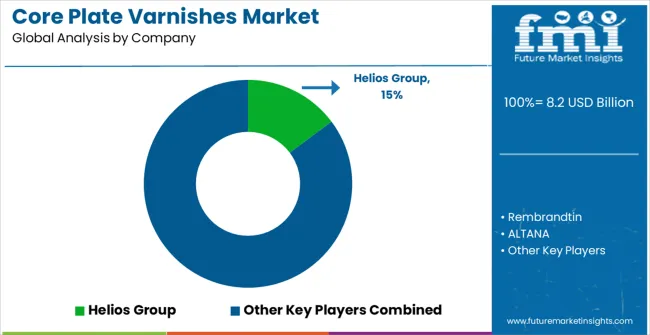
- Helios Group
- Rembrandtin
- ALTANA
- Toyo Ink
- Bakelite Hylam Limited
- Axalta
- Mader
- Super Urecoat Industries
- Sichuan Dongfang Insulating Material
- AEV Ltd
- Hitachi Chemical Co. Ltd
Scope of the Report
| Metric | Value |
|---|---|
| Quantitative Units | USD 8.76 Billion to USD 16.91 Billion, at a CAGR of 6.80% |
| Market Definition | Core plate varnishes are specialized insulating coatings applied to electrical steel laminations used in transformers, electric motors, generators, and electromagnetic poles. They provide inter-laminar insulation, reduce eddy current losses, and protect core plates from corrosion and mechanical damage during assembly and operation. |
| Segmentation | Classification: Pigmented, Un-Pigmented, Others; Chemical Based: Polyurethane, Alkyd Phenolic, Polyester, Others; Application: Transformer, Motor, Generator, Electromagnetic Poles, Others |
| Regions Covered | North America, Latin America, Europe, East Asia, South Asia, Oceania, Middle East & Africa |
| Countries Covered | China, India, Germany, Brazil, USA, UK, Japan, and 40 plus countries |
| Key Companies Profiled | Helios Group, Rembrandtin, ALTANA, Toyo Ink, Bakelite Hylam Limited, Axalta, Mader, Super Urecoat Industries, Sichuan Dongfang Insulating Material, AEV Ltd, Hitachi Chemical Co. Ltd |
| Forecast Period | 2026 to 2036 |
| Approach | Forecasting models apply a bottom-up methodology starting with regional production and trade metrics and projecting adoption rates against demand drivers and regulatory compliance timelines. |
Core Plate Varnishes Market by Segments
Classification:
- Pigmented
- Un-Pigmented
- Others
Chemical Based:
- Polyurethane
- Alkyd Phenolic
- Polyester
- Others
Application:
- Transformer
- Motor
- Generator
- Electromagnetic Poles
- Others
Region:
- North America
- USA
- Canada
- Mexico
- Latin America
- Brazil
- Chile
- Rest of Latin America
- Western Europe
- Germany
- UK
- Italy
- Spain
- France
- Nordic
- BENELUX
- Rest of Western Europe
- Eastern Europe
- Russia
- Poland
- Hungary
- Balkan & Baltic
- Rest of Eastern Europe
- East Asia
- China
- Japan
- South Korea
- South Asia and Pacific
- India
- ASEAN
- Australia & New Zealand
- Rest of South Asia and Pacific
- Middle East & Africa
- Kingdom of Saudi Arabia
- Other GCC Countries
- Turkiye
- South Africa
- Other African Union
- Rest of Middle East & Africa
Bibliography
- International Electrotechnical Commission. (2025). IEC 60317: Specifications for Particular Types of Winding Wires. IEC.
- European Commission. (2025). Regulation (EU) 2019/1781: Ecodesign Requirements for Electric Motors. European Commission.
- International Energy Agency. (2025). World Energy Investment 2025: Grid Infrastructure. IEA.
- Organisation for Economic Co-operation and Development. (2025). Industrial Production Indicators: Electrical Equipment. OECD.
- Axalta Coating Systems. (2025). Annual Report 2025: Industrial Coatings Division. Axalta.
This bibliography is provided for reader reference. The full Future Market Insights report contains the complete reference list with primary research documentation.
Frequently Asked Questions
How large is the demand for Core Plate Varnishes in the global market in 2026?
Demand for Core Plate Varnishes in the global market is estimated to be valued at USD 8.76 billion in 2026.
What will be the market size of Core Plate Varnishes in the global market by 2036?
Market size for Core Plate Varnishes is projected to reach USD 16.91 billion by 2036.
What is the expected demand growth for Core Plate Varnishes in the global market between 2026 and 2036?
Demand for Core Plate Varnishes is expected to grow at a CAGR of 6.80% between 2026 and 2036.
Which Classification is poised to lead global sales by 2026?
Pigmented accounts for 41.3% share in 2026 based on structural demand factors and procurement concentration patterns.
What is driving demand in China?
China leads growth at 9.2% CAGR through 2036, driven by expanding domestic production capacity and end-use procurement volumes.
What is India's growth outlook in this report?
India is projected to grow at a CAGR of 8.5% during 2026 to 2036.
What is Core Plate Varnishes and what is it mainly used for?
Core plate varnishes are specialized insulating coatings applied to electrical steel laminations used in transformers, electric motors, generators, and electromagnetic poles. They provide inter-laminar insulation, reduce eddy current losses, and protect core plates from corrosion and mechanical damage during assembly and operation.
How does FMI build and validate the Core Plate Varnishes forecast?
Forecasting models apply a bottom-up methodology starting with regional production and trade metrics and cross-validate projections against industry statistics and company guidance.
Preview the report firsthand - request a free sample
Get SampleGet the brochure for pricing and purchase details.
Get PDFTable of Content
- Executive Summary
- Global Market Outlook
- Demand-side Trends
- Supply-side Trends
- Technology Roadmap Analysis
- Analysis and Recommendations
- Market Overview
- Market Coverage / Taxonomy
- Market Definition / Scope / Limitations
- Research Methodology
- Chapter Orientation
- Analytical Lens and Working Hypotheses
- Market Structure, Signals, and Trend Drivers
- Benchmarking and Cross-market Comparability
- Market Sizing, Forecasting, and Opportunity Mapping
- Research Design and Evidence Framework
- Desk Research Programme (Secondary Evidence)
- Company Annual and Sustainability Reports
- Peer-reviewed Journals and Academic Literature
- Corporate Websites, Product Literature, and Technical Notes
- Earnings Decks and Investor Briefings
- Statutory Filings and Regulatory Disclosures
- Technical White Papers and Standards Notes
- Trade Journals, Industry Magazines, and Analyst Briefs
- Conference Proceedings, Webinars, and Seminar Materials
- Government Statistics Portals and Public Data Releases
- Press Releases and Reputable Media Coverage
- Specialist Newsletters and Curated Briefings
- Sector Databases and Reference Repositories
- FMI Internal Proprietary Databases and Historical Market Datasets
- Subscription Datasets and Paid Sources
- Social Channels, Communities, and Digital Listening Inputs
- Additional Desk Sources
- Expert Input and Fieldwork (Primary Evidence)
- Primary Modes
- Qualitative Interviews and Expert Elicitation
- Quantitative Surveys and Structured Data Capture
- Blended Approach
- Why Primary Evidence is Used
- Field Techniques
- Interviews
- Surveys
- Focus Groups
- Observational and In-context Research
- Social and Community Interactions
- Stakeholder Universe Engaged
- C-suite Leaders
- Board Members
- Presidents and Vice Presidents
- R&D and Innovation Heads
- Technical Specialists
- Domain Subject-matter Experts
- Scientists
- Physicians and Other Healthcare Professionals
- Governance, Ethics, and Data Stewardship
- Research Ethics
- Data Integrity and Handling
- Primary Modes
- Tooling, Models, and Reference Databases
- Desk Research Programme (Secondary Evidence)
- Data Engineering and Model Build
- Data Acquisition and Ingestion
- Cleaning, Normalisation, and Verification
- Synthesis, Triangulation, and Analysis
- Quality Assurance and Audit Trail
- Market Background
- Market Dynamics
- Drivers
- Restraints
- Opportunity
- Trends
- Scenario Forecast
- Demand in Optimistic Scenario
- Demand in Likely Scenario
- Demand in Conservative Scenario
- Opportunity Map Analysis
- Product Life Cycle Analysis
- Supply Chain Analysis
- Investment Feasibility Matrix
- Value Chain Analysis
- PESTLE and Porter’s Analysis
- Regulatory Landscape
- Regional Parent Market Outlook
- Production and Consumption Statistics
- Import and Export Statistics
- Market Dynamics
- Global Market Analysis 2021 to 2025 and Forecast, 2026 to 2036
- Historical Market Size Value (USD Million) Analysis, 2021 to 2025
- Current and Future Market Size Value (USD Million) Projections, 2026 to 2036
- Y-o-Y Growth Trend Analysis
- Absolute $ Opportunity Analysis
- Global Market Pricing Analysis 2021 to 2025 and Forecast 2026 to 2036
- Global Market Analysis 2021 to 2025 and Forecast 2026 to 2036, By Classification
- Introduction / Key Findings
- Historical Market Size Value (USD Million) Analysis By Classification , 2021 to 2025
- Current and Future Market Size Value (USD Million) Analysis and Forecast By Classification , 2026 to 2036
- Pigmented
- Un-Pigmented
- Others
- Pigmented
- Y-o-Y Growth Trend Analysis By Classification , 2021 to 2025
- Absolute $ Opportunity Analysis By Classification , 2026 to 2036
- Global Market Analysis 2021 to 2025 and Forecast 2026 to 2036, By Chemical Based
- Introduction / Key Findings
- Historical Market Size Value (USD Million) Analysis By Chemical Based, 2021 to 2025
- Current and Future Market Size Value (USD Million) Analysis and Forecast By Chemical Based, 2026 to 2036
- Polyurethane
- Alkyd Phenolic
- Polyester
- Others
- Polyurethane
- Y-o-Y Growth Trend Analysis By Chemical Based, 2021 to 2025
- Absolute $ Opportunity Analysis By Chemical Based, 2026 to 2036
- Global Market Analysis 2021 to 2025 and Forecast 2026 to 2036, By Application
- Introduction / Key Findings
- Historical Market Size Value (USD Million) Analysis By Application, 2021 to 2025
- Current and Future Market Size Value (USD Million) Analysis and Forecast By Application, 2026 to 2036
- Transformer
- Motor
- Generator
- Electromagnetic Poles
- Others
- Transformer
- Y-o-Y Growth Trend Analysis By Application, 2021 to 2025
- Absolute $ Opportunity Analysis By Application, 2026 to 2036
- Global Market Analysis 2021 to 2025 and Forecast 2026 to 2036, By Region
- Introduction
- Historical Market Size Value (USD Million) Analysis By Region, 2021 to 2025
- Current Market Size Value (USD Million) Analysis and Forecast By Region, 2026 to 2036
- North America
- Latin America
- Western Europe
- Eastern Europe
- East Asia
- South Asia and Pacific
- Middle East & Africa
- Market Attractiveness Analysis By Region
- North America Market Analysis 2021 to 2025 and Forecast 2026 to 2036, By Country
- Historical Market Size Value (USD Million) Trend Analysis By Market Taxonomy, 2021 to 2025
- Market Size Value (USD Million) Forecast By Market Taxonomy, 2026 to 2036
- By Country
- USA
- Canada
- Mexico
- By Classification
- By Chemical Based
- By Application
- By Country
- Market Attractiveness Analysis
- By Country
- By Classification
- By Chemical Based
- By Application
- Key Takeaways
- Latin America Market Analysis 2021 to 2025 and Forecast 2026 to 2036, By Country
- Historical Market Size Value (USD Million) Trend Analysis By Market Taxonomy, 2021 to 2025
- Market Size Value (USD Million) Forecast By Market Taxonomy, 2026 to 2036
- By Country
- Brazil
- Chile
- Rest of Latin America
- By Classification
- By Chemical Based
- By Application
- By Country
- Market Attractiveness Analysis
- By Country
- By Classification
- By Chemical Based
- By Application
- Key Takeaways
- Western Europe Market Analysis 2021 to 2025 and Forecast 2026 to 2036, By Country
- Historical Market Size Value (USD Million) Trend Analysis By Market Taxonomy, 2021 to 2025
- Market Size Value (USD Million) Forecast By Market Taxonomy, 2026 to 2036
- By Country
- Germany
- UK
- Italy
- Spain
- France
- Nordic
- BENELUX
- Rest of Western Europe
- By Classification
- By Chemical Based
- By Application
- By Country
- Market Attractiveness Analysis
- By Country
- By Classification
- By Chemical Based
- By Application
- Key Takeaways
- Eastern Europe Market Analysis 2021 to 2025 and Forecast 2026 to 2036, By Country
- Historical Market Size Value (USD Million) Trend Analysis By Market Taxonomy, 2021 to 2025
- Market Size Value (USD Million) Forecast By Market Taxonomy, 2026 to 2036
- By Country
- Russia
- Poland
- Hungary
- Balkan & Baltic
- Rest of Eastern Europe
- By Classification
- By Chemical Based
- By Application
- By Country
- Market Attractiveness Analysis
- By Country
- By Classification
- By Chemical Based
- By Application
- Key Takeaways
- East Asia Market Analysis 2021 to 2025 and Forecast 2026 to 2036, By Country
- Historical Market Size Value (USD Million) Trend Analysis By Market Taxonomy, 2021 to 2025
- Market Size Value (USD Million) Forecast By Market Taxonomy, 2026 to 2036
- By Country
- China
- Japan
- South Korea
- By Classification
- By Chemical Based
- By Application
- By Country
- Market Attractiveness Analysis
- By Country
- By Classification
- By Chemical Based
- By Application
- Key Takeaways
- South Asia and Pacific Market Analysis 2021 to 2025 and Forecast 2026 to 2036, By Country
- Historical Market Size Value (USD Million) Trend Analysis By Market Taxonomy, 2021 to 2025
- Market Size Value (USD Million) Forecast By Market Taxonomy, 2026 to 2036
- By Country
- India
- ASEAN
- Australia & New Zealand
- Rest of South Asia and Pacific
- By Classification
- By Chemical Based
- By Application
- By Country
- Market Attractiveness Analysis
- By Country
- By Classification
- By Chemical Based
- By Application
- Key Takeaways
- Middle East & Africa Market Analysis 2021 to 2025 and Forecast 2026 to 2036, By Country
- Historical Market Size Value (USD Million) Trend Analysis By Market Taxonomy, 2021 to 2025
- Market Size Value (USD Million) Forecast By Market Taxonomy, 2026 to 2036
- By Country
- Kingdom of Saudi Arabia
- Other GCC Countries
- Turkiye
- South Africa
- Other African Union
- Rest of Middle East & Africa
- By Classification
- By Chemical Based
- By Application
- By Country
- Market Attractiveness Analysis
- By Country
- By Classification
- By Chemical Based
- By Application
- Key Takeaways
- Key Countries Market Analysis
- USA
- Pricing Analysis
- Market Share Analysis, 2025
- By Classification
- By Chemical Based
- By Application
- Canada
- Pricing Analysis
- Market Share Analysis, 2025
- By Classification
- By Chemical Based
- By Application
- Mexico
- Pricing Analysis
- Market Share Analysis, 2025
- By Classification
- By Chemical Based
- By Application
- Brazil
- Pricing Analysis
- Market Share Analysis, 2025
- By Classification
- By Chemical Based
- By Application
- Chile
- Pricing Analysis
- Market Share Analysis, 2025
- By Classification
- By Chemical Based
- By Application
- Germany
- Pricing Analysis
- Market Share Analysis, 2025
- By Classification
- By Chemical Based
- By Application
- UK
- Pricing Analysis
- Market Share Analysis, 2025
- By Classification
- By Chemical Based
- By Application
- Italy
- Pricing Analysis
- Market Share Analysis, 2025
- By Classification
- By Chemical Based
- By Application
- Spain
- Pricing Analysis
- Market Share Analysis, 2025
- By Classification
- By Chemical Based
- By Application
- France
- Pricing Analysis
- Market Share Analysis, 2025
- By Classification
- By Chemical Based
- By Application
- India
- Pricing Analysis
- Market Share Analysis, 2025
- By Classification
- By Chemical Based
- By Application
- ASEAN
- Pricing Analysis
- Market Share Analysis, 2025
- By Classification
- By Chemical Based
- By Application
- Australia & New Zealand
- Pricing Analysis
- Market Share Analysis, 2025
- By Classification
- By Chemical Based
- By Application
- China
- Pricing Analysis
- Market Share Analysis, 2025
- By Classification
- By Chemical Based
- By Application
- Japan
- Pricing Analysis
- Market Share Analysis, 2025
- By Classification
- By Chemical Based
- By Application
- South Korea
- Pricing Analysis
- Market Share Analysis, 2025
- By Classification
- By Chemical Based
- By Application
- Russia
- Pricing Analysis
- Market Share Analysis, 2025
- By Classification
- By Chemical Based
- By Application
- Poland
- Pricing Analysis
- Market Share Analysis, 2025
- By Classification
- By Chemical Based
- By Application
- Hungary
- Pricing Analysis
- Market Share Analysis, 2025
- By Classification
- By Chemical Based
- By Application
- Kingdom of Saudi Arabia
- Pricing Analysis
- Market Share Analysis, 2025
- By Classification
- By Chemical Based
- By Application
- Turkiye
- Pricing Analysis
- Market Share Analysis, 2025
- By Classification
- By Chemical Based
- By Application
- South Africa
- Pricing Analysis
- Market Share Analysis, 2025
- By Classification
- By Chemical Based
- By Application
- USA
- Market Structure Analysis
- Competition Dashboard
- Competition Benchmarking
- Market Share Analysis of Top Players
- By Regional
- By Classification
- By Chemical Based
- By Application
- Competition Analysis
- Competition Deep Dive
- Helios Group
- Overview
- Product Portfolio
- Profitability by Market Segments (Product/Age /Sales Channel/Region)
- Sales Footprint
- Strategy Overview
- Marketing Strategy
- Product Strategy
- Channel Strategy
- Rembrandtin
- ALTANA
- Toyo Ink
- Bakelite Hylam Limited
- Axalta
- Mader
- Super Urecoat Industries
- Sichuan Dongfang Insulating Material
- AEV Ltd
- Hitachi Chemical Co. Ltd
- Helios Group
- Competition Deep Dive
- Assumptions & Acronyms Used


