

- Market Size (2026)
- USD 586.9 Mn
- Forecast (2036)
- USD 858.4 Mn
- CAGR (2026 to 2036)
- 12.2%
Berry Greenhouse Premium Micronutrient Package Market Size, Market Forecast and Outlook By FMI
Summary of the Berry Greenhouse Premium Micronutrient Package Market
- Demand and Growth Drivers
- Greenhouse berry acreage is moving toward tighter fertigation control because fruit set and shelf life weaken quickly when iron or boron drift off target.
- Retail standards for color and uniform pack-out are lifting demand for premium trace element programs that reduce lot variation in closed production systems.
- Protected cultivation projects in India and Europe support faster adoption because new sites often specify calibrated nutrient programs from the first commercial cycle.
- Product and Segment View
- Standard programs remain the largest application block because most berry houses need reliable multi-stage feeding plans before they adopt highly customized premium recipes.
- Liquid formulations lead because drip systems and hydroponic layouts favor fast mixing and low labor handling during peak fruiting windows.
- Strawberry houses stay at the center of demand because their high crop turnover gives suppliers more repeat purchase points for chelated iron and boron packages.
- Geography and Competitive Outlook
- India and the Netherlands set the pace because one combines new protected horticulture investment while the other runs dense greenhouse systems with mature precision feeding practice.
- ICL Group, Haifa Group, Yara International, Nutrien, UPL, EuroChem, and Tradecorp compete through technical advisory depth and not only through list price.
- Suppliers with cultivar-stage data and strong greenhouse support teams are gaining preference because switching a micronutrient recipe can disrupt harvest timing within a single cycle.
- Analyst Opinion
- Nikhil Kaitwade, Principal Consultant at FMI says, "Demand is moving toward crop-specific micronutrient packages that protect fruit consistency inside expensive greenhouse systems. Growers now treat iron, boron, zinc, and manganese control as revenue insurance because shelf-life losses quickly erase gains from higher yields. Suppliers that combine chelation depth with fertigation support should remain best placed because berry houses want performance records before they change a validated program."
- Berry Greenhouse Premium Micronutrient Package Market Market Value Analysis
- The industry is moving from broad horticulture feeding into a defined greenhouse berry input class with clear value linked to fruit finish and pack-out stability.
- Adoption is being led by protected strawberry and blueberry sites where yield quality decides contract renewal and daily nutrient drift carries an immediate commercial penalty.
- Demand is supported by rising use of drip fertigation and closed substrate systems because those formats reward fully soluble trace packages with stable uptake behavior.
- Premium pricing holds when suppliers can show better fruit set and fewer grading losses during high temperature or high humidity stress inside the house.

Berry Greenhouse Premium Micronutrient Package Market Definition
The berry greenhouse premium micronutrient package market includes formulated trace element blends sold for protected berry cultivation. Products in scope support strawberries, blueberries, raspberries, and blackberries grown in greenhouses, tunnels, or advanced substrate systems. Suppliers sell liquid, solid, gel, or gas-assisted formulations for routine fertigation, crop-stage correction, and quality management across flowering and fruiting cycles.
Berry Greenhouse Premium Micronutrient Package Market Inclusions
Market scope covers chelated and complexed micronutrient packages for berry greenhouses, stage-specific fertigation blends, soluble correction products, direct supplier programs, distributor supply, retail packs, online repeat orders, strawberry programs, blueberry programs, raspberry programs, blackberry programs, and nutrient packages designed for substrate culture, hydroponic systems, and drip-fed protected cultivation.
Berry Greenhouse Premium Micronutrient Package Market Exclusions
The scope does not include bulk NPK blends, generic open-field micronutrient fertilizers, nursery propagation media without trace packages, crop protection sprays without nutritional function, irrigation hardware sales, greenhouse films, substrate blocks, or berry plant genetics that influence nutrient demand but are not sold as micronutrient packages.
Berry Greenhouse Premium Micronutrient Package Market Research Methodology
- Primary Research: FMI reviewed greenhouse berry nutrition practices with protected cultivation advisors, specialty fertilizer sellers, fertigation managers, and commercial berry operators across Europe, Asia, and North America to understand buying criteria and replacement behavior.
- Desk Research: The study used government horticulture updates, extension literature on strawberry nutrient management, controlled environment agriculture material, company annual reports, and official crop nutrition references tied to greenhouse and berry production.
- Market Sizing and Forecasting: The model built value from application programs, form mix, and chelation type before testing country demand through greenhouse expansion and premium fruit quality requirements.
- Data Validation: FMI cross-checked segment splits against the published 2026 to 2036 outlook for berry greenhouse micronutrient packages and then reviewed consistency with related controlled cultivation categories.
Why is the Berry Greenhouse Premium Micronutrient Package Market Growing?
- Berry crops react quickly to trace imbalance and this keeps demand firm for calibrated packages that protect flowering and shelf life in covered systems.
- Liquid and chelated programs fit drip-fed houses because growers need clean solubility and stable uptake when they correct iron, boron, or zinc during active fruiting.
- Protected cultivation investment in India and Europe expands the addressable base because new berry houses usually adopt formal nutrient protocols from the start.
- Retail quality standards push repeat buying because downgraded fruit can lose value even when greenhouse volume remains high.
Demand growth is tied to how berry houses protect yield quality inside commercial greenhouses rather than how much broad fertilizer volume they buy. Berry growers pay for precision because strawberries and blueberries show visible defects when iron or boron delivery slips during flowering or early fruit fill. The FMI outlook places the market at USD 271.5 million in 2026 and USD 858.4 million in 2036 with a 12.2% CAGR. University guidance on strawberry nutrient management and recent work on sensor-guided fertigation both point the same way. Greenhouse teams want recipes that stay soluble and hold performance through fast harvest cycles.
Supply conditions favor premium programs because soilless substrate fertility solutions and fertigation control systems work best when trace delivery stays predictable. ICL said in July 2024 that it expanded its North American specialty plant nutrition footprint through another acquisition. That step matters because berry greenhouse buyers often prefer vendors that can provide both product and local technical follow-up. Nutrient packages now compete on chelation stability and advice quality. Houses using closed substrate lines or recirculating systems need fewer surprises than open field growers can absorb.
Market Segmentation Analysis
- Standard programs lead the application mix with 50.0% share in 2026 as they cover the routine needs of most berry greenhouses without the cost of full custom blending.
- Liquid formulations hold 45.0% of the form segment because greenhouse drip systems favor rapid mixing and even nutrient delivery through the root zone.
- Direct supply commands 60.0% of channel demand as cultivar-specific support and troubleshooting remain central to greenhouse berry operations.
- Chelated blends are estimated to hold 58.0% of the chelation type segment since berry houses need stable availability under variable substrate and water conditions.
- Strawberry programs are estimated to represent 46.0% of the berry crop segment because the crop runs at large protected scale and uses frequent nutrient correction cycles.
The segment split matters because micronutrient demand is not shaped by crop area alone. Application format decides how much advisory support a grower wants. Form selection affects mixing behavior and dosing precision inside drip-fed houses. Channel choice shows whether the buyer values local stock or direct technical supervision. Chelation type determines how well iron, zinc, manganese, and boron stay available in recirculating or substrate systems. Berry crop mix matters because strawberries buy more routine correction while blueberries need tighter pH and iron management. Together these layers explain why premium greenhouse nutrition behaves differently from broad horticulture fertilizer demand.
Insights into the Standard Program Segment
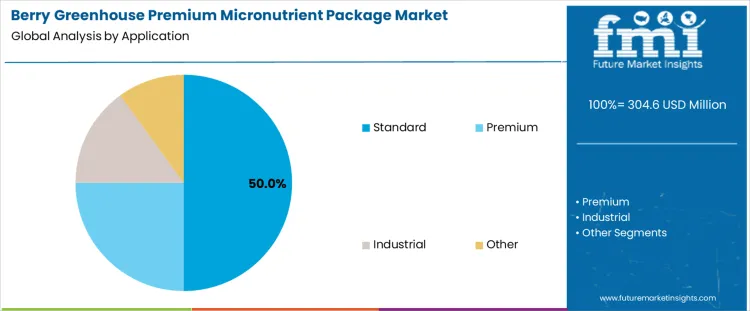
In 2026, standard programs are expected to contribute 50.0% of total market share. Most berry houses choose this format because it gives stable stage-wise feeding without full recipe redesign.
- Multi-stage standard packs lead as they match the daily needs of routine greenhouse berry cycles.
- Strawberry-led houses stay in this tier when they want reliable fruit set support with lower advisory burden.
- Repeat buying remains strong because growers re-order the same validated package once performance is proven.
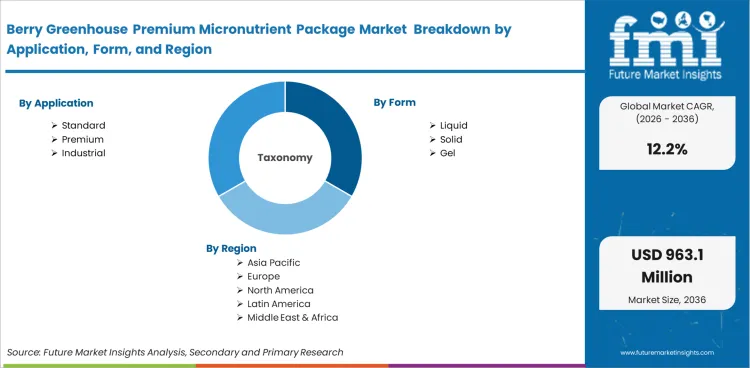
The market for berry greenhouse premium micronutrient packages is divided into application, form, channel, chelation type, micronutrient focus, berry crop, and region. Application includes Standard, Premium, Industrial, and Other programs. Form includes Liquid, Solid, Gel, and Gas. Channel includes Direct, Distributor, Retail, and Online. Chelation type includes Chelated, Complexed, Inorganic, and Hybrid. Micronutrient focus includes Iron-led, Boron-led, Zinc-led, and Multi-trace. Berry crop includes Strawberry, Blueberry, Raspberry, and Blackberry.
Insights into the Liquid Segment

In 2026, liquid formulations are projected to hold 45.0% of the form segment. Greenhouse teams prefer liquid packs because they dissolve fast and move cleanly through injection systems.
- Liquid iron and boron blends lead this segment because correction speed matters during active flowering.
- Hydroponic and substrate houses favor liquids when they need uniform dosing across many irrigation events.
- Premium sites use liquids to reduce labor handling and to keep tank preparation simple under tight harvest schedules.
The form outlook stays closely linked to how berries are fed inside the house. Liquids support direct injection and quick adjustment. Solids remain useful where storage life matters and batch tanks are standard. Gel products fit narrow use cases where controlled release near the root zone is preferred. Gas-assisted products remain small because they suit only specialized physiological programs.
Insights into the Direct Channel Segment

In 2026, direct supply is expected to account for 60.0% of the channel segment. Berry growers rely on supplier agronomy teams because cultivar response and substrate chemistry vary by site.
- Direct contracts lead where growers want crop-stage advice and rapid troubleshooting during fruiting peaks.
- Large houses use direct supply to align nutrient schedules with labor plans and retailer quality targets.
- Distributor and retail routes remain relevant for small sites, though they offer less customization depth.
Channel structure reflects the risk profile of greenhouse berry production. Direct supply dominates when growers need technical continuity. Distributor networks matter in secondary regions that need faster local stock access. Retail and online orders suit repeat purchase of stable recipes, yet those routes rarely replace direct advisory support on premium programs.
Berry Greenhouse Premium Micronutrient Package Market Drivers, Restraints, and Opportunities
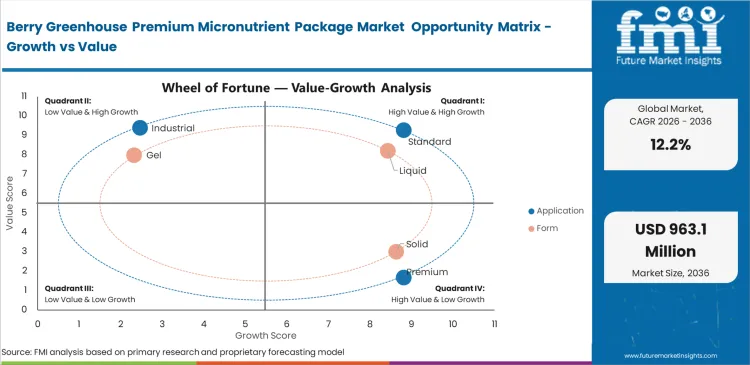
- Berry quality premiums support spending on trace packages because color defects and soft fruit can reduce realized value within a single shipment cycle.
- High unit cost can slow adoption where growers still rely on generic horticulture blends and accept broader variation in pack-out rates.
- New protected berry projects create room for premium suppliers because fresh houses need validated feeding plans before scale-up begins.
Cultivar-Specific Nutrition Demand
Berry houses do not treat micronutrients as a generic add-on anymore. Each cultivar responds differently during bloom and fruit fill. That makes crop-stage calibration more valuable than simple product concentration. Growers want packages that fit substrate type, irrigation frequency, and target fruit finish. This demand pattern benefits suppliers with greenhouse berry trial data and strong technical service records. It weakens vendors that sell only a broad horticulture mix without cultivar guidance.
Cost Pressure in Mid-Tier Greenhouses
Premium micronutrient packages raise input cost and that remains the main restraint in mid-tier houses. Some growers still prefer a cheaper blend when fruit is sold into less demanding channels. Price pressure rises when energy or labor costs already strain greenhouse margins. Premium suppliers must show fewer grading losses or more stable harvest timing to defend price. Without that proof, direct procurement teams may keep premium packs for only the most sensitive blocks.
Traceability and Retail Compliance
Opportunities are expanding because berry programs are being audited more tightly around input discipline and crop consistency. Pack houses and retail buyers want stable fruit color and residue management. Nutrient suppliers that provide traceable batch records and mixing guidance can fit this need well. Premium packs win more often when suppliers show how iron and zinc support measurable pack-out quality. That connection turns micronutrients into a commercial quality tool and not only an agronomy input.
Protected Berry Expansion
Protected berry acreage is rising across several regions and new houses usually formalize nutrition programs early. The growth of controlled environment agriculture and indoor farming supports this shift because operators invest heavily in systems where nutrient precision affects every harvest. Premium suppliers can build share at project start when they help define fertigation schedules and correction plans. That entry point is valuable because validated nutrient programs often stay in place for many seasons.
Country Analysis Overview
.webp "Top Country Growth Comparison Berry Greenhouse Premium Micronutrient Package Market Cagr (2026 2036)")
- India and the Netherlands are witnessing stable expansion owing to new greenhouse investment and advanced precision feeding which pull micronutrient demand higher.
- The United States and China remain major demand centers because protected berry output is rising near premium fresh fruit channels.
- Spain, Mexico, and Morocco add momentum because export-focused berry systems need stronger color, firmness, and shelf-life control under protected cultivation.
| Country | CAGR |
|---|---|
| India | 12.9% |
| Netherlands | 12.8% |
| United States | 12.1% |
| China | 11.6% |
| Spain | 11.2% |
| Mexico | 10.8% |
| Morocco | 10.4% |
The global market is expected to grow at 12.2% per year from 2026 to 2036. India and the Netherlands edge above that line because berry greenhouses are either being built quickly or already run with high nutrition precision. China and the United States stay close to the core demand base because protected berry production keeps expanding near premium fresh channels. Spain, Mexico, and Morocco remain slightly lower because adoption is strong yet a larger share of sites still balance premium input use against export margin pressure.

Demand Outlook for Berry Greenhouse Premium Micronutrient Package Market in India

India is likely to grow at a CAGR of 12.9% through 2036. Protected cultivation support and new horticulture investment are widening the installed base for berries that need stage-wise nutrition control. Import-led premium blueberry and raspberry projects are pushing growers toward fully soluble trace packages from the first commercial cycles. MIDH guidelines issued at the end of 2024 and the clean plant push improve the setting for structured high-value horticulture. That backdrop supports premium micronutrient adoption where growers target stable fruit appearance and lower rejection.
- Protected berry sites need ready-to-dose trace blends from the first crop cycle.
- Project developers prefer direct supplier support while cultivar performance is still being stabilized.
- Premium fruit channels reward better color and shelf stability which supports package upgrades.
Future Outlook for Berry Greenhouse Premium Micronutrient Package Market in the Netherlands
Netherlands berry greenhouse premium micronutrient package market is projected to grow at a CAGR of 12.8% through 2036. Dutch strawberry production under glass and tunnels accounted for three quarters of total harvest in 2024. High greenhouse skill and dense fertigation use push buyers toward stable chelation and clean tank compatibility. Growers in this market tend to test products carefully and then stay with validated programs. That makes performance proof more important than discounting.
- Protected strawberry output gives micronutrient suppliers a dense and technically mature demand base.
- Liquid and chelated products fit well because irrigation precision is already part of normal practice.
- Validated recipes can hold for long periods which raises the value of early trial wins.
Demand Analysis of Berry Greenhouse Premium Micronutrient Package Market in the United States
Demand in United States is anticipated to grow at a CAGR of 12.1% through 2036. Controlled environment strawberry work and year-round berry supply programs are raising interest in more precise nutrient schedules. Commercial greenhouse operators want stable fruit quality across longer shipping distances and that raises the penalty for micronutrient drift. Extension guidance on strawberry nutrient management has kept the agronomy case visible to growers. Demand therefore leans toward direct programs that combine product with crop support.
- Controlled environment berry expansion supports repeat demand for stage-wise trace programs.
- Retail and foodservice channels value firmness and shelf life which favor premium inputs.
- Direct supplier advice remains important because substrate and water quality vary by site.
Sales Analysis of Berry Greenhouse Premium Micronutrient Package Market in China
China berry greenhouse premium micronutrient package industry is set to grow at a CAGR of 11.6% through 2036. China already operates large strawberry production capacity and is pushing more output into controlled systems near urban demand centers. Scale alone does not guarantee premium micronutrient use, yet modern greenhouse projects need cleaner fertigation control and stronger quality consistency. That raises demand for iron and manganese packages that can perform under intensive production. Suppliers that can support large commercial projects should gain most from this shift.
- Large strawberry volume gives China the widest long-term demand pool in the study.
- Modern protected houses lift interest in chelated and liquid programs with clean solubility.
- Urban fresh channels reward color and firmness which supports premium recipe adoption.
Opportunity Analysis of Berry Greenhouse Premium Micronutrient Package Market in Spain
Spain berry greenhouse premium micronutrient package sector is estimated to grow at a CAGR of 11.2% through 2036. Export-driven berry systems need strong fruit finish and reliable shelf life, especially during long logistics windows into Europe. That operating profile supports micronutrient programs that reduce fruit softness and uneven coloration. Buyers remain cost aware because export margins can change with labor and energy pressure. Even so, premium packages hold appeal where the crop is sold into quality-sensitive retail contracts.
- Export berry chains support demand for fruit finish and post-harvest stability.
- Growers watch input cost closely which keeps proof of value central in each sale.
- Direct and distributor channels both matter because production clusters buy at scale.
In-depth Analysis of Berry Greenhouse Premium Micronutrient Package Market in Mexico
Mexico is projected to witness expansion at a CAGR of 10.8% through 2036. Berry exports and protected cultivation continue to support more technical nutrition practice in commercial sites. Houses that serve North American channels need firmer fruit and lower field-to-pack variation. Premium micronutrient programs help manage those outcomes when fertigation is tightly scheduled. Adoption should rise first in export-focused sites where payback is easier to measure against pack-out performance.
- Export houses adopt premium trace products faster than commodity-oriented sites.
- Programs with technical follow-up gain preference because water and substrate conditions vary.
- Stable fruit set and lower rejection give suppliers a clear value case in this market.
Prospects for Berry Greenhouse Premium Micronutrient Package Market in Morocco
The Morocco berry greenhouse premium micronutrient package market is projected to grow at a CAGR of 10.4% through 2036. Berry export activity and protected cultivation support demand for cleaner input management. Growers selling into European channels need dependable color and shelf life, which increases interest in trace element precision during flowering and fruit fill. Adoption will remain selective where budgets are tight, yet premium programs can win in houses that target more stable export quality. That keeps the market smaller than Spain but still attractive for focused suppliers.
- Export quality targets support the use of trace packages with reliable uptake.
- Growth should concentrate in professionally managed protected sites and not in all berry acreage.
- Suppliers with local agronomy support can improve conversion in early adoption clusters.
Competitive Landscape and Strategic Positioning

- ICL Group and Haifa Group stay close to the greenhouse nutrition core because both carry strong soluble and specialty crop positions.
- Yara International and Nutrien use broader crop nutrition reach to serve berry greenhouse buyers that want one supplier with technical depth.
- EuroChem, UPL, and Tradecorp compete where water soluble nutrition and local advisory channels can win specialty berry accounts.
Competition is shaped by formulation fit and service quality across water soluble fertilizers and specialty fertilizers rather than by commodity fertilizer scale alone. Berry greenhouse buyers usually test products in one block before they expand usage across a site. That process rewards suppliers that can document uptake behavior, tank compatibility, and cultivar response. ICL strengthened this position in North America with its July 2024 specialty plant nutrition expansion. Firms that lack greenhouse-facing agronomy depth may still sell product, yet they often struggle to displace a validated incumbent program.
The second layer of competition centers on how suppliers support complex feeding systems. Houses using closed substrate lines and automated dosing want clean integration with sensors, stock tanks, and recirculation protocols. Yara, Nutrien, and EuroChem bring broad nutrient portfolios that can support cross-selling into these sites. Haifa and Tradecorp compete well where greenhouse managers value specialist crop feeding guidance. UPL can build share where sustainability-led product positioning and channel breadth support technical nutrition sales. Price still matters, yet berry houses tend to accept a premium when the supplier reduces variability in fruit finish.
Adjacent categories such as agricultural chelates and biostimulants can influence bundle strategy. Some suppliers use those products to deepen account access before they pitch a full berry micronutrient program. That raises competitive pressure on single-line vendors. Still, berry greenhouse managers remain conservative once a recipe works well. Incumbency therefore stays powerful when a supplier has reliable stock and a strong troubleshooting team.
Key Companies in the Berry Greenhouse Premium Micronutrient Package Market
- ICL Group Ltd., Haifa Group, and Yara International hold strong positions in protected crop nutrition because they combine soluble products with greenhouse-facing agronomy support.
- Nutrien, UPL, and EuroChem add depth through broad crop nutrition portfolios, regional distribution, and ability to support premium berry sites through technical channels.
- Tradecorp remains relevant in specialty horticulture because its trace element and biostimulant presence fits export-oriented berry programs that value precise fruit quality management.
Competitive Benchmarking: Berry Greenhouse Premium Micronutrient Package Market
| Company | Berry Nutrition Breadth | Chelation Expertise | Fertigation Fit | Greenhouse Reach |
|---|---|---|---|---|
| ICL Group Ltd. | High | High | Strong | Global |
| Haifa Group | High | High | Strong | Global |
| Yara International | High | Medium | Strong | Global |
| Nutrien | Medium | Medium | Moderate | North America |
| UPL | Medium | Medium | Moderate | Asia, LatAm |
| EuroChem | Medium | Medium | Moderate | Europe, Global |
| Tradecorp | Medium | High | Moderate | Europe, LatAm |
Source: Future Market Insights competitive analysis, 2026.
Key Developments in Berry Greenhouse Premium Micronutrient Package Market
- In March 2025, Yara reported all-time highs in 2024 production performance in its integrated report while sustaining focus on specialty crop nutrition.
- In April 2025, UPL published its 2024-25 sustainability report and highlighted technologies designed to improve nutrient use efficiency in farming systems.
Key Players in the Berry Greenhouse Premium Micronutrient Package Market:
Major Global Players:
- ICL Group Ltd.
- Haifa Group
- Yara International
- Nutrien
- UPL
- EuroChem
- Tradecorp
Emerging and Regional Specialists
- SQM
- Valagro
- OCP Nutricrops
- Nouryon
- Compo Expert
Report Scope and Coverage
Berry Greenhouse Premium Micronutrient Package Market Breakdown by Application, Form, Channel, Chelation Type, Micronutrient Focus, and Berry Crop
| Parameter | Details |
|---|---|
| Quantitative Units | USD 271.5 million to USD 858.4 million, at a CAGR of 12.2% |
| Market Definition | Premium trace element packages sold for protected berry cultivation across greenhouse and intensive substrate systems. |
| Regions Covered | North America, Latin America, Europe, Asia Pacific, Middle East and Africa |
| Countries Covered | India, Netherlands, United States, China, Spain, Mexico, Morocco, and 40 plus countries |
| Key Companies Profiled | ICL Group Ltd., Haifa Group, Yara International, Nutrien, UPL, EuroChem, Tradecorp |
| Forecast Period | 2026 to 2036 |
| Historical Reference | 2025 |
| Approach | Hybrid bottom-up and top-down methodology built from application mix, channel structure, and country adoption patterns. |
Berry Greenhouse Premium Micronutrient Package Market by Segment
Berry Greenhouse Premium Micronutrient Package Market Segmented by Application
- Standard
- Premium
- Industrial
- Other
Berry Greenhouse Premium Micronutrient Package Market Segmented by Form
- Liquid
- Solid
- Gel
- Gas
Berry Greenhouse Premium Micronutrient Package Market Segmented by Channel
- Direct
- Distributor
- Retail
- Online
Berry Greenhouse Premium Micronutrient Package Market Segmented by Chelation Type
- Chelated
- Complexed
- Inorganic
- Hybrid
Berry Greenhouse Premium Micronutrient Package Market Segmented by Micronutrient Focus
- Iron-led
- Boron-led
- Zinc-led
- Multi-trace
Berry Greenhouse Premium Micronutrient Package Market Segmented by Berry Crop
- Strawberry
- Blueberry
- Raspberry
- Blackberry
Berry Greenhouse Premium Micronutrient Package Market by Region
- North America
- Latin America
- Europe
- Asia Pacific
- Middle East & Africa
Frequently Asked Questions
What is the global market demand for Berry Greenhouse Premium Micronutrient Package in 2026?
In 2026, the global market for berry greenhouse premium micronutrient packages is expected to be worth USD 271.5 million.
How big will the market for Berry Greenhouse Premium Micronutrient Package be in 2036?
By 2036, the market for berry greenhouse premium micronutrient packages is expected to be worth USD 858.4 million.
How much will demand for Berry Greenhouse Premium Micronutrient Package grow between 2026 and 2036?
Between 2026 and 2036, demand for berry greenhouse premium micronutrient packages is expected to grow at a CAGR of 12.2%.
Which application segment is likely to be the best seller in the world by 2026?
Standard programs are expected to hold 50.0% of the application segment in 2026 because most berry greenhouses still buy validated routine feeding packages.
Which form segment is likely to lead Berry Greenhouse Premium Micronutrient Package demand by 2026?
Liquid formulations are expected to lead with 45.0% share in 2026 because drip-fed berry houses need quick mixing and clean injection performance.
What is causing demand to rise in India?
The India berry greenhouse premium micronutrient package market is projected to grow at 12.9% because protected horticulture investment is creating new berry sites.
What is causing demand to rise in the Netherlands?
The Netherlands berry greenhouse premium micronutrient package market is projected to grow at 12.8% because protected strawberry output keeps precision feeding demand high.
What does this report mean by Berry Greenhouse Premium Micronutrient Package definition?
The market includes premium trace element blends sold for protected berry cultivation across greenhouse, tunnel, hydroponic, and intensive substrate production systems.
Preview the report firsthand - request a free sample
Get SampleGet the brochure for pricing and purchase details.
Get PDFTable of Content
- Executive Summary
- Global Market Outlook
- Demand-side Trends
- Supply-side Trends
- Technology Roadmap Analysis
- Analysis and Recommendations
- Market Overview
- Market Coverage / Taxonomy
- Market Definition / Scope / Limitations
- Research Methodology
- Chapter Orientation
- Analytical Lens and Working Hypotheses
- Market Structure, Signals, and Trend Drivers
- Benchmarking and Cross-market Comparability
- Market Sizing, Forecasting, and Opportunity Mapping
- Research Design and Evidence Framework
- Desk Research Programme (Secondary Evidence)
- Company Annual and Sustainability Reports
- Peer-reviewed Journals and Academic Literature
- Corporate Websites, Product Literature, and Technical Notes
- Earnings Decks and Investor Briefings
- Statutory Filings and Regulatory Disclosures
- Technical White Papers and Standards Notes
- Trade Journals, Industry Magazines, and Analyst Briefs
- Conference Proceedings, Webinars, and Seminar Materials
- Government Statistics Portals and Public Data Releases
- Press Releases and Reputable Media Coverage
- Specialist Newsletters and Curated Briefings
- Additional Desk Sources
- Expert Input and Fieldwork (Primary Evidence)
- Primary Modes
- Qualitative Interviews and Expert Elicitation
- Quantitative Surveys and Structured Data Capture
- Blended Approach
- Why Primary Evidence is Used
- Field Techniques
- Interviews
- Surveys
- Focus Groups
- Observational and In-context Research
- Social and Community Interactions
- Stakeholder Universe Engaged
- C-suite Leaders
- Board Members
- Presidents and Vice Presidents
- R&D and Innovation Heads
- Technical Specialists
- Domain Subject-matter Experts
- Scientists
- Physicians and Other Healthcare Professionals
- Governance, Ethics, and Data Stewardship
- Research Ethics
- Data Integrity and Handling
- Primary Modes
- Tooling, Models, and Reference Databases
- Desk Research Programme (Secondary Evidence)
- Data Engineering and Model Build
- Data Acquisition and Ingestion
- Cleaning, Normalisation, and Verification
- Synthesis, Triangulation, and Analysis
- Quality Assurance and Audit Trail
- Market Background
- Market Dynamics
- Drivers
- Restraints
- Opportunity
- Trends
- Scenario Forecast
- Demand in Optimistic Scenario
- Demand in Likely Scenario
- Demand in Conservative Scenario
- Opportunity Map Analysis
- Product Life Cycle Analysis
- Supply Chain Analysis
- Investment Feasibility Matrix
- Value Chain Analysis
- PESTLE and Porter’s Analysis
- Regulatory Landscape
- Regional Parent Market Outlook
- Production and Consumption Statistics
- Import and Export Statistics
- Market Dynamics
- Global Market Analysis 2021 to 2025 and Forecast, 2026 to 2036
- Historical Market Size Value (USD Million) Analysis, 2021 to 2025
- Current and Future Market Size Value (USD Million) Projections, 2026 to 2036
- Y-o-Y Growth Trend Analysis
- Absolute $ Opportunity Analysis
- Global Market Pricing Analysis 2021 to 2025 and Forecast 2026 to 2036
- Global Market Analysis 2021 to 2025 and Forecast 2026 to 2036, By Application
- Introduction / Key Findings
- Historical Market Size Value (USD Million) Analysis By Application , 2021 to 2025
- Current and Future Market Size Value (USD Million) Analysis and Forecast By Application , 2026 to 2036
- Standard
- Premium
- Industrial
- Standard
- Y-o-Y Growth Trend Analysis By Application , 2021 to 2025
- Absolute $ Opportunity Analysis By Application , 2026 to 2036
- Global Market Analysis 2021 to 2025 and Forecast 2026 to 2036, By Form
- Introduction / Key Findings
- Historical Market Size Value (USD Million) Analysis By Form, 2021 to 2025
- Current and Future Market Size Value (USD Million) Analysis and Forecast By Form, 2026 to 2036
- Liquid
- Solid
- Gel
- Liquid
- Y-o-Y Growth Trend Analysis By Form, 2021 to 2025
- Absolute $ Opportunity Analysis By Form, 2026 to 2036
- Global Market Analysis 2021 to 2025 and Forecast 2026 to 2036, By Channel
- Introduction / Key Findings
- Historical Market Size Value (USD Million) Analysis By Channel, 2021 to 2025
- Current and Future Market Size Value (USD Million) Analysis and Forecast By Channel, 2026 to 2036
- Direct
- Distributor
- Retail
- Direct
- Y-o-Y Growth Trend Analysis By Channel, 2021 to 2025
- Absolute $ Opportunity Analysis By Channel, 2026 to 2036
- Global Market Analysis 2021 to 2025 and Forecast 2026 to 2036, By Region
- Introduction
- Historical Market Size Value (USD Million) Analysis By Region, 2021 to 2025
- Current Market Size Value (USD Million) Analysis and Forecast By Region, 2026 to 2036
- North America
- Latin America
- Western Europe
- Eastern Europe
- East Asia
- South Asia and Pacific
- Middle East & Africa
- Market Attractiveness Analysis By Region
- North America Market Analysis 2021 to 2025 and Forecast 2026 to 2036, By Country
- Historical Market Size Value (USD Million) Trend Analysis By Market Taxonomy, 2021 to 2025
- Market Size Value (USD Million) Forecast By Market Taxonomy, 2026 to 2036
- By Country
- USA
- Canada
- Mexico
- By Application
- By Form
- By Channel
- By Country
- Market Attractiveness Analysis
- By Country
- By Application
- By Form
- By Channel
- Key Takeaways
- Latin America Market Analysis 2021 to 2025 and Forecast 2026 to 2036, By Country
- Historical Market Size Value (USD Million) Trend Analysis By Market Taxonomy, 2021 to 2025
- Market Size Value (USD Million) Forecast By Market Taxonomy, 2026 to 2036
- By Country
- Brazil
- Chile
- Rest of Latin America
- By Application
- By Form
- By Channel
- By Country
- Market Attractiveness Analysis
- By Country
- By Application
- By Form
- By Channel
- Key Takeaways
- Western Europe Market Analysis 2021 to 2025 and Forecast 2026 to 2036, By Country
- Historical Market Size Value (USD Million) Trend Analysis By Market Taxonomy, 2021 to 2025
- Market Size Value (USD Million) Forecast By Market Taxonomy, 2026 to 2036
- By Country
- Germany
- UK
- Italy
- Spain
- France
- Nordic
- BENELUX
- Rest of Western Europe
- By Application
- By Form
- By Channel
- By Country
- Market Attractiveness Analysis
- By Country
- By Application
- By Form
- By Channel
- Key Takeaways
- Eastern Europe Market Analysis 2021 to 2025 and Forecast 2026 to 2036, By Country
- Historical Market Size Value (USD Million) Trend Analysis By Market Taxonomy, 2021 to 2025
- Market Size Value (USD Million) Forecast By Market Taxonomy, 2026 to 2036
- By Country
- Russia
- Poland
- Hungary
- Balkan & Baltic
- Rest of Eastern Europe
- By Application
- By Form
- By Channel
- By Country
- Market Attractiveness Analysis
- By Country
- By Application
- By Form
- By Channel
- Key Takeaways
- East Asia Market Analysis 2021 to 2025 and Forecast 2026 to 2036, By Country
- Historical Market Size Value (USD Million) Trend Analysis By Market Taxonomy, 2021 to 2025
- Market Size Value (USD Million) Forecast By Market Taxonomy, 2026 to 2036
- By Country
- China
- Japan
- South Korea
- By Application
- By Form
- By Channel
- By Country
- Market Attractiveness Analysis
- By Country
- By Application
- By Form
- By Channel
- Key Takeaways
- South Asia and Pacific Market Analysis 2021 to 2025 and Forecast 2026 to 2036, By Country
- Historical Market Size Value (USD Million) Trend Analysis By Market Taxonomy, 2021 to 2025
- Market Size Value (USD Million) Forecast By Market Taxonomy, 2026 to 2036
- By Country
- India
- ASEAN
- Australia & New Zealand
- Rest of South Asia and Pacific
- By Application
- By Form
- By Channel
- By Country
- Market Attractiveness Analysis
- By Country
- By Application
- By Form
- By Channel
- Key Takeaways
- Middle East & Africa Market Analysis 2021 to 2025 and Forecast 2026 to 2036, By Country
- Historical Market Size Value (USD Million) Trend Analysis By Market Taxonomy, 2021 to 2025
- Market Size Value (USD Million) Forecast By Market Taxonomy, 2026 to 2036
- By Country
- Kingdom of Saudi Arabia
- Other GCC Countries
- Turkiye
- South Africa
- Other African Union
- Rest of Middle East & Africa
- By Application
- By Form
- By Channel
- By Country
- Market Attractiveness Analysis
- By Country
- By Application
- By Form
- By Channel
- Key Takeaways
- Key Countries Market Analysis
- USA
- Pricing Analysis
- Market Share Analysis, 2025
- By Application
- By Form
- By Channel
- Canada
- Pricing Analysis
- Market Share Analysis, 2025
- By Application
- By Form
- By Channel
- Mexico
- Pricing Analysis
- Market Share Analysis, 2025
- By Application
- By Form
- By Channel
- Brazil
- Pricing Analysis
- Market Share Analysis, 2025
- By Application
- By Form
- By Channel
- Chile
- Pricing Analysis
- Market Share Analysis, 2025
- By Application
- By Form
- By Channel
- Germany
- Pricing Analysis
- Market Share Analysis, 2025
- By Application
- By Form
- By Channel
- UK
- Pricing Analysis
- Market Share Analysis, 2025
- By Application
- By Form
- By Channel
- Italy
- Pricing Analysis
- Market Share Analysis, 2025
- By Application
- By Form
- By Channel
- Spain
- Pricing Analysis
- Market Share Analysis, 2025
- By Application
- By Form
- By Channel
- France
- Pricing Analysis
- Market Share Analysis, 2025
- By Application
- By Form
- By Channel
- India
- Pricing Analysis
- Market Share Analysis, 2025
- By Application
- By Form
- By Channel
- ASEAN
- Pricing Analysis
- Market Share Analysis, 2025
- By Application
- By Form
- By Channel
- Australia & New Zealand
- Pricing Analysis
- Market Share Analysis, 2025
- By Application
- By Form
- By Channel
- China
- Pricing Analysis
- Market Share Analysis, 2025
- By Application
- By Form
- By Channel
- Japan
- Pricing Analysis
- Market Share Analysis, 2025
- By Application
- By Form
- By Channel
- South Korea
- Pricing Analysis
- Market Share Analysis, 2025
- By Application
- By Form
- By Channel
- Russia
- Pricing Analysis
- Market Share Analysis, 2025
- By Application
- By Form
- By Channel
- Poland
- Pricing Analysis
- Market Share Analysis, 2025
- By Application
- By Form
- By Channel
- Hungary
- Pricing Analysis
- Market Share Analysis, 2025
- By Application
- By Form
- By Channel
- Kingdom of Saudi Arabia
- Pricing Analysis
- Market Share Analysis, 2025
- By Application
- By Form
- By Channel
- Turkiye
- Pricing Analysis
- Market Share Analysis, 2025
- By Application
- By Form
- By Channel
- South Africa
- Pricing Analysis
- Market Share Analysis, 2025
- By Application
- By Form
- By Channel
- USA
- Market Structure Analysis
- Competition Dashboard
- Competition Benchmarking
- Market Share Analysis of Top Players
- By Regional
- By Application
- By Form
- By Channel
- Competition Analysis
- Competition Deep Dive
- ICL Group Ltd.
- Overview
- Product Portfolio
- Profitability by Market Segments (Product/Age /Sales Channel/Region)
- Sales Footprint
- Strategy Overview
- Marketing Strategy
- Product Strategy
- Channel Strategy
- Haifa Group
- Yara International
- Nutrien
- UPL
- EuroChem
- Tradecorp
- ICL Group Ltd.
- Competition Deep Dive
- Assumptions & Acronyms Used


