

- Market Size (2026)
- USD 328.00 Mn
- Forecast (2036)
- USD 769.40 Mn
- CAGR (2026 to 2036)
- 8.9%
Low-Odor, Enclosed-Greenhouse Foliar Protection Market Size, Market Forecast and Outlook By FMI
Low-odor, enclosed-greenhouse foliar protection market was valued at USD 301.20 million in 2025. The market is projected to reach USD 328.00 million by the end of 2026 and USD 769.40 million by 2036. The market is projected to expand at a CAGR of 8.9% from 2026 to 2036. Biofungicides are projected to lead product type with 29.0% in 2026. Vegetables are projected to lead crop type with 41.0% in 2026.
Summary of the Low-Odor, Enclosed-Greenhouse Foliar Protection Market
- Demand and Growth Drivers
- Enclosed crop rooms create repeated mildew pressure and thrips pressure. Foliar protection remains part of routine crop management.
- Low-odor positioning gains value in protected structures because ventilation limits and worker entry schedules influence product selection.
- Residue-light programs support added demand in high-value vegetables and ornamentals. Commercial greenhouse systems and indoor farming systems reinforce that demand.
- Product and Segment View
- Biofungicides lead product demand because enclosed structures face recurring foliar disease pressure and greenhouse programs often favor softer rotation tools.
- Microbial actives hold a larger role in portfolio mix due to compatibility with greenhouse IPM routines and residue-sensitive crops.
- Hydraulic spray stays the main delivery route. Fogging and misting retain value in crop rooms seeking canopy reach with lower water loading.
- Geography and Competitive Outlook
- India and China post faster expansion because protected cultivation is expanding. Spain and Mexico also show faster expansion because specialty-crop intensity remains high.
- The United States and Canada offer a larger installed base. The Netherlands adds mature greenhouse input access and stronger distributor support.
- Competitive strength depends on greenhouse crop labels and biological portfolio depth. Horticulture channel reach adds a further advantage.
- Analyst Opinion
- According to Nikhil Kaitwade, Analyst, Chemical & Materials at FMI, “Adoption of low‑odor foliar protection solutions is accelerating fastest in enclosed greenhouse programs where disease control is carefully balanced with worker‑entry practicality. Products offering a softer residue profile and dependable distributor based technical support are increasingly shaping supplier preference and long‑term program adoption.”
- Low-Odor, Enclosed-Greenhouse Foliar Protection Market Value Analysis
- Commercial value comes from enclosed-space crop protection programs where odor profile and residue sensitivity shape product choice. Repeat spray practicality affects product selection in the same programs.
- Biofungicides anchor revenue formation because mildew and botrytis create repeat foliar demand across enclosed vegetables and ornamentals.
- Vegetables contribute the largest crop share because greenhouse acreage is dense. Frequent foliar disease cycles and higher spending per protected acre support that lead position.
- Revenue gains depend less on acreage alone and more on crop value and product rotation need. Access to softer formulations such as biorational pesticides and biorational fungicides support that demand.
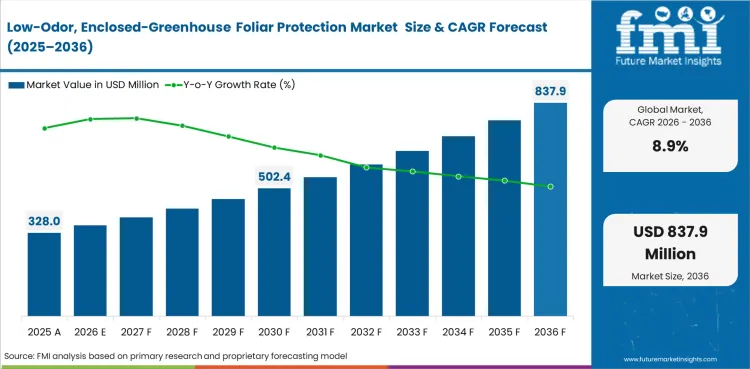
Key Takeaways
- Industry was valued at USD 301.20 million in 2025.
- Market is projected at USD 769.40 million by 2036.
- Global industry expansion is estimated at 8.9% CAGR across 2026 to 2036.
- Incremental opportunity during the forecast period garnering around USD 441.40 million.
- Biofungicides are projected to represent 29.0% of total demand in 2026.
- India records the fastest demand expansion, at a CAGR of 10.8% across the study period.
- China is expected to expand at a CAGR of 10.2% during the forecast period.
Low-Odor, Enclosed-Greenhouse Foliar Protection Market Definition
Low-odor foliar products serve enclosed greenhouse crop programs. Coverage includes disease control sprays and pest control sprays. Product choice reflects odor profile and worker handling needs. Use remains limited to enclosed greenhouse crop production.
Low-Odor, Enclosed-Greenhouse Foliar Protection Market Inclusions
Coverage includes biofungicides, bioinsecticides, bactericides, soaps, oils, botanicals, and spray adjuvants. Crops include vegetables, ornamentals, herbs, berries, and leafy greens. Use also covers transplants and young plants. Related context connects with Bacillus-based biofungicides, and agricultural adjuvants.
Low-Odor, Enclosed-Greenhouse Foliar Protection Market Exclusions
Coverage excludes soil fumigants and beneficial insects sold without foliar formulation. Hard-surface sanitation chemicals are outside scope. Nutrition salts and irrigation hardware are excluded. Greenhouse frames, films, and climate systems are excluded. Finished produce revenue also stays outside scope, along with horticulture film and microbial seed treatment.
Low-Odor, Enclosed-Greenhouse Foliar Protection Market Research Methodology
- Primary Research: Interviews with greenhouse input distributors and specialty-crop advisors. Interviews also covered biological crop-protection participants.
- Desk Research: Review of government greenhouse statistics and extension material. Regulatory pages, product labels, and peer-reviewed crop-protection studies were also reviewed.
- Market sizing and forecasting: Top-down greenhouse crop-protection model refined by product-fit screening for odor profile and enclosed-space suitability. Crop mix and foliar spray frequency were also assessed.
- Data validation: Cross-check against company portfolio relevance and protected-cultivation intensity. Country-level greenhouse adoption patterns were also reviewed.
Why is the Low-Odor, Enclosed-Greenhouse Foliar Protection Market Growing?
- Enclosed crop rooms need regular foliar intervention against mildew and botrytis. Sucking pests add another layer of routine treatment demand.
- Worker-entry practicality favors products with softer odor profile and shorter handling burden.
- Residue-light programs gain preference in vegetables and herbs. Ornamentals sold into quality-sensitive channels support the same preference.
Humidity, dense canopy growth, and repeated crop cycles keep foliar disease pressure consistently high in enclosed greenhouse structures. Because production runs are long and continuous, growers cannot rely on a single high‑intensity chemistry block. Softer rotation tools therefore retain strong commercial value.
Residue management is also promoting the demand for low-odor, enclosed-greenhouse foliar protection. Premium greenhouse vegetables and ornamentals often move through channels with strict quality expectations. Program design therefore prioritizes products with practical foliar fit and strong crop‑room compatibility rather than relying on raw knockdown performance alone.
Market Segmentation Analysis
- Biofungicides lead product demand with 29.0% share in 2026 because mildew and botrytis pressure keep preventive foliar programs active.
- Microbials are expected to account for 31.0% in 2026 because greenhouse programs favor softer residue profile and IPM compatibility.
- Hydraulic spray is projected to contribute 46.0% in 2026 because installed equipment and application familiarity support broader use. Canopy reach also supports wider use.
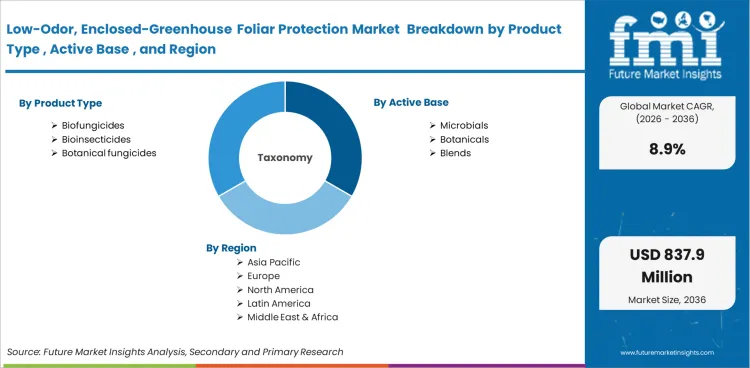
The market for low-odor, enclosed-greenhouse foliar protection is divided into groups based on product type, active base, target problem, crop type, formulation type, application method, sales channel, and region. By product type, the market includes biofungicides, bioinsecticides, botanical fungicides, insecticidal soaps, horticultural oils, bactericides, and spray adjuvants. By active base, the market covers microbials, botanicals, copper salts, fatty acids, mineral oils, reduced-VOC synthetics, and blends. Based on target problem, it is segmented into powdery mildew, botrytis, downy mildew, leaf spots, whiteflies, thrips, and aphids. By crop type, the market includes vegetables, ornamentals, herbs, berries, leafy greens, nursery transplants, and young plants. By formulation type, the market covers liquid concentrates, water dispersible granules, wettable powders, soluble liquids, emulsions, ready-to-use, and tank-mix packs. By application method, the market includes hydraulic spray, backpack spray, boom spray, fogging, misting, electrostatic spray, and hand lance. By sales channel, the market is divided into distributor sales, direct sales, dealer networks, cooperative supply, e-commerce, contract supply, and private label.[1]
Insights into the Product Type Segment
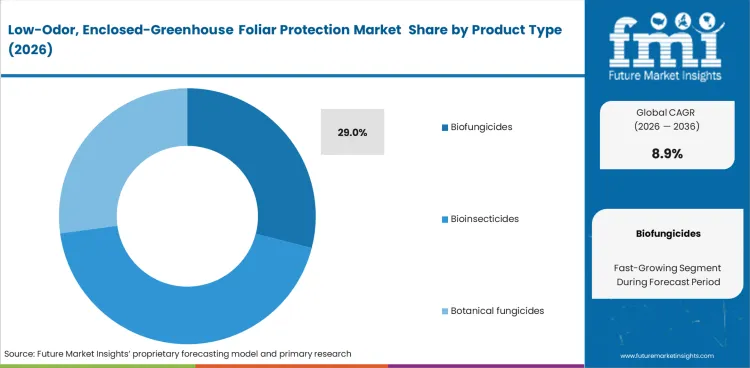
- Biofungicides are expected to account for 29.0% share in 2026 because powdery mildew and botrytis pressure keep disease-control programs active. Leaf-spot pressure adds further demand across enclosed vegetables and ornamentals.
- Bioinsecticides retain a strong secondary role in programs addressing thrips and aphids. Whitefly control also supports use in crop rooms that rely on softer rotations and natural-enemy compatibility.
Insights into the Active Base Segment
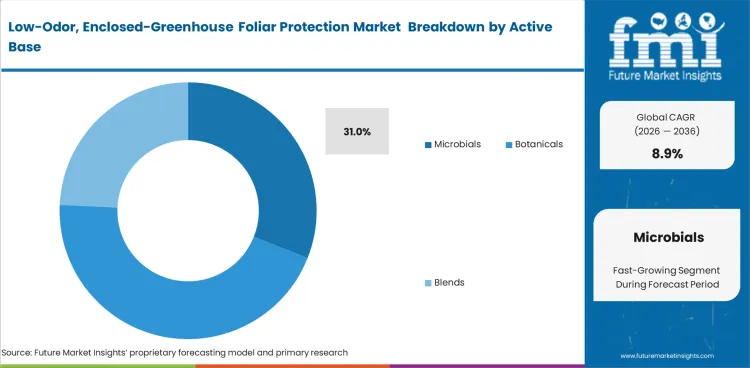
- Microbials are projected to reach 31.0% market share in 2026 because greenhouse operators value softer residue profile and preventive fit. Integration with IPM routines also supports demand.
- Botanical and fatty-acid-based products add practical value in enclosed structures seeking lower odor profile and fast turnaround across targeted pest windows.
Insights into the Crop Type Segment
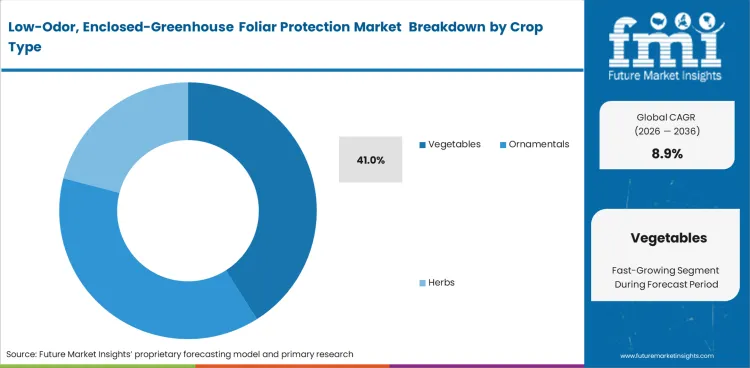
- Vegetables are anticipated to represent 41.0% of the market in 2026 because tomato and cucumber systems create steady foliar demand. Pepper and leafy systems add further demand across protected acreage linked with the broader fresh vegetables market.
- Ornamentals remain a strong secondary crop block because cosmetic loss from leaf spots and mildew can reduce salable quality quickly.
Insights into the Application Method Segment
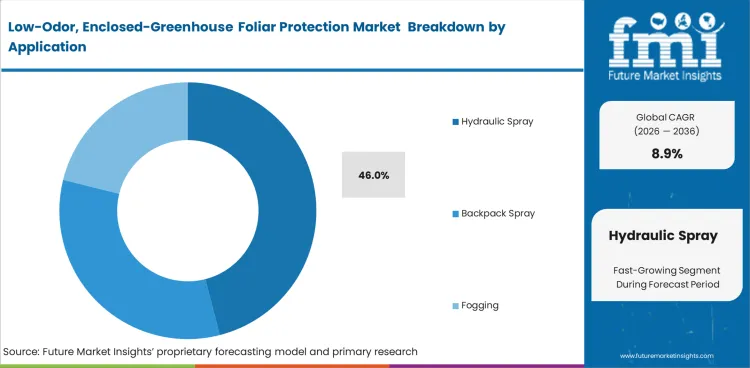
- Hydraulic spray is likely to secure 46.0% share in 2026 because growers already use handheld and trolley-based liquid spray routines. Many enclosed crop rooms already rely on that installed practice.
Fogging and misting are used in specific greenhouse programs where canopy coverage and efficient use of water matter in enclosed spaces.
Low-Odor, Enclosed-Greenhouse Foliar Protection Market Drivers, Restraints, and Opportunities
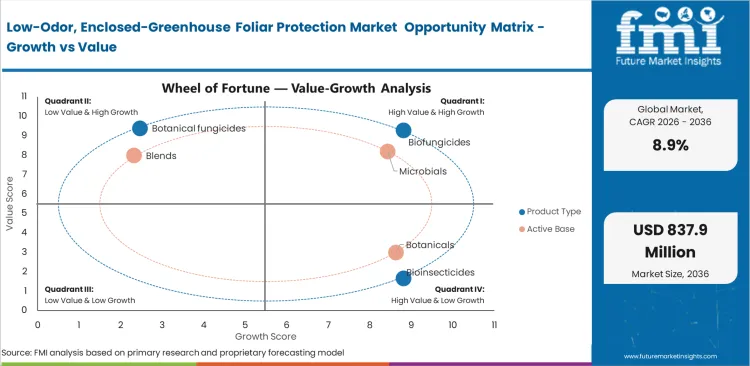
- Repeated enclosed-space disease pressure supports routine foliar demand.
- Biological performance can vary under poor timing and heavier pressure. Weak spray coverage can also reduce field performance.
- Residue-light greenhouse programs create room for differentiated bio-based foliar products.
Commercial uptake improves in crop programs balancing disease suppression with worker-entry practicality and crop tolerance. Adoption remains limited in situations that need broad-spectrum knockdown under heavy pressure. Suppliers with strong greenhouse labels and technical guidance can gain share in this selective market.
Enclosed-Space Worker Compatibility
USA EPA states that the Worker Protection Standard offers protections to more than 2 million agricultural workers and pesticide handlers across more than 600,000 agricultural establishments. BioWorks states that CEASE® carries the shortest REI among fungicides at 4 hours versus up to 48 hours. Shorter worker re-entry windows improve greenhouse labor planning and reduce disruption in enclosed crop rooms.
Residue-Light Programs in High-Value Crops
A 2024 Agronomy study investigated 65 pesticides in 469 leafy vegetable samples from greenhouses in Liaoning province. Overall pesticide levels in 96.4% of samples remained below Codex MRLs. The findings indicate that residue management remains a visible issue in greenhouse vegetables.
Analysis of Low-Odor, Enclosed-Greenhouse Foliar Protection Market By Key Countries
.webp "Top Country Growth Comparison Low Odor, Enclosed Greenhouse Foliar Protection Market Cagr (2026 2036)")
| Country | CAGR |
|---|---|
| India | 10.8% |
| China | 10.2% |
| Spain | 9.6% |
| Mexico | 9.1% |
| Canada | 8.1% |
| United States | 7.8% |
| Netherlands | 7.4% |
Source: FMI analysis based on primary research and proprietary forecasting model
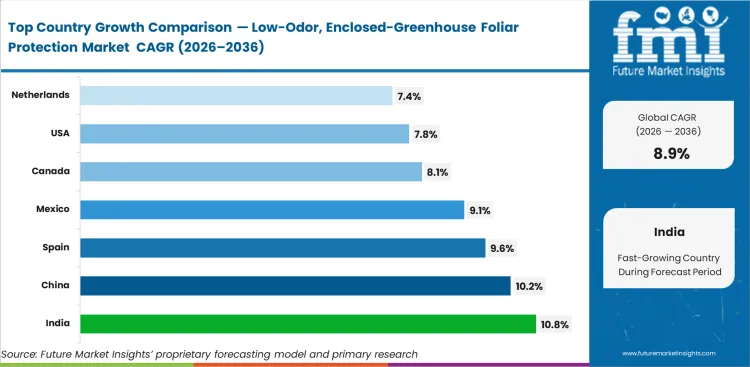
Low-Odor, Enclosed-Greenhouse Foliar Protection Market Cagr Analysis By Country
- Demand for low-odor, enclosed-greenhouse foliar protection in India is projected to rise at a CAGR of 10.8% through 2036. Protected-cultivation build-out and stronger access to biological crop protection access.
- Sales of low-odor, enclosed-greenhouse foliar protection in China are projected to rise at a CAGR of 10.2% through the forecast period. Greenhouse vegetable scale and input modernization.
- Demand for low-odor, enclosed-greenhouse foliar protection in Spain is projected to expand at a CAGR of 9.6% through 2036. Export-oriented greenhouse vegetables and recurring foliar disease pressure support that outlook.
- Mexico is projected to record a CAGR of 9.1% in low-odor, enclosed-greenhouse foliar protection during the assessment period. Protected vegetable output and quality-sensitive crop programs support that outlook.
- Low-odor, enclosed-greenhouse foliar protection in Canada is projected to advance at a CAGR of 8.1% through 2036. Greenhouse vegetables and ornamental production support steady foliar demand from an established operating base.
- The United States is projected to expand at a CAGR of 7.8% in low-odor, enclosed-greenhouse foliar protection through 2036. Mature greenhouse input channels and wider biological product availability support that outlook.
- Low-odor, enclosed-greenhouse foliar protection industry in the Netherlands is projected to grow at a CAGR of 7.4% through the study period. Greenhouse maturity and stable specialist input access support that outlook.
The country spread indicates demand across mature greenhouse hubs and faster-scaling protected-cultivation markets.
Demand Outlook for Low-Odor, Enclosed-Greenhouse Foliar Protection in India
Protected cultivation is expanding across vegetables and nursery crops in India. That expansion is creating first-use demand for enclosed-space foliar programs. Low-odor, enclosed-greenhouse foliar protection industry in India is projected to rise at a CAGR of 10.8% through 2036. Protected-crop expansion and wider access to biological inputs support that outlook. Supplier relevance rises in states and crop clusters using greenhouse vegetables and floriculture for higher-value output.[2]
- Protected acreage is creating a wider first-use customer base.
- Vegetable and floriculture programs support repeat foliar need.
- Distributor education can accelerate adoption across newer greenhouse users.
Future Outlook for Low-Odor, Enclosed-Greenhouse Foliar Protection in China
Large-scale greenhouse vegetable production gives China a broad demand base for disease and pest management. Sales of low-odor, enclosed-greenhouse foliar protection in China are projected to rise at a CAGR of 10.2% through the forecast period. Broad crop intensity supports supplier relevance, while price‑performance continues to guide buying decisions.
- Greenhouse vegetables create dense foliar disease exposure.
- Local crop-protection supply improves market access.
- Performance consistency matters in larger commercial operations.
Opportunity Analysis of Low-Odor, Enclosed-Greenhouse Foliar Protection in Spain
Spanish greenhouse vegetables create constant pressure for foliar disease control and crop finish management. Demand for low-odor, enclosed-greenhouse foliar protection in Spain is projected to expand at a CAGR of 9.6% through 2036. Export-oriented greenhouse vegetables and frequent mildew pressure support outlook. Suppliers with crop-specific greenhouse labels gain a better route into intensive production systems.
- Export channels value crop finish and residue profile.
- Mildew and botrytis keep preventive programs active.
- Technical advisory support can improve supplier stickiness.
In-depth Analysis of Low-Odor, Enclosed-Greenhouse Foliar Protection in Mexico
Protected vegetables in Mexico support regular fungicide and insecticide rotation under enclosed conditions. Mexico is projected to record a CAGR of 9.1% in low-odor, enclosed-greenhouse foliar protection during the assessment period. Greenhouse vegetables and quality-sensitive crop programs keep foliar demand active. Supplier advantage improves with crop guidance and residue-aware program design for export-linked production.
- Tomato and pepper systems support repeat spray use.
- Export quality screens lift interest in softer programs.
- Distribution depth shapes commercial reach.
Sales Analysis of Low-Odor, Enclosed-Greenhouse Foliar Protection in Canada
Greenhouse vegetables and ornamentals keep Canada relevant in this category, especially across large protected operators. Low-odor, enclosed-greenhouse foliar protection in Canada is projected to advance at a CAGR of 8.1% through 2036. Greenhouse vegetables and ornamental production support steady foliar demand. Commercial uptake depends on crop-specific efficacy and fit with integrated biological programs instead of odor profile alone.
- Large greenhouse vegetable operators support volume stability.
- Ornamentals add secondary demand for cosmetic crop protection.
- Technical support remains valuable in rotation planning.
Demand Outlook for Low-Odor, Enclosed-Greenhouse Foliar Protection in the United States
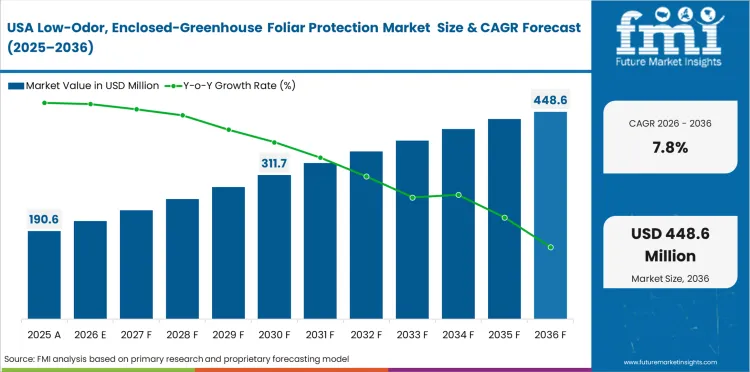
United States greenhouse demand comes from vegetables and nursery crops. Controlled-environment specialty production adds a further demand base. The United States is projected to expand at a CAGR of 7.8% in the low-odor, enclosed-greenhouse foliar protection market through 2036. Mature greenhouse input channels and stronger biological product availability is also promoting the industry outlook. Supplier preference reflects label breadth and distributor reach. Field support across greenhouse and nursery users also matters.
- Mature horticulture distributors support product access.
- Biological portfolio depth improves competitive position.
- High-value crop programs justify premium foliar options.
Competitive Landscape and Strategic Positioning
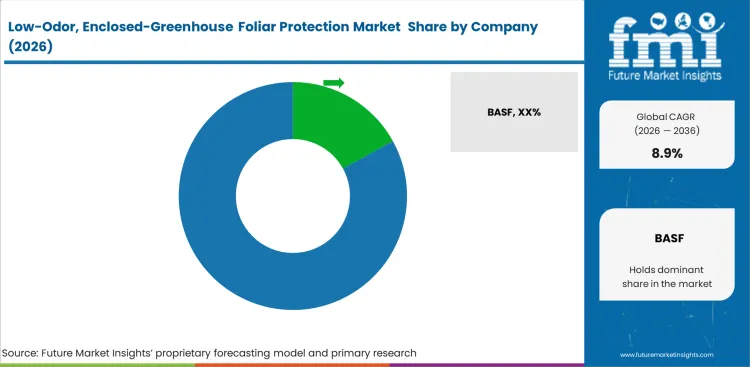
- Biological greenhouse specialists compete on crop fit and softer residue profile. Technical support also shapes competition.
- Broad crop-protection groups compete on portfolio depth and channel access. Integrated disease-management options add a further advantage.
- Entry barriers come from greenhouse labels and grower trust. Distributor relationships and performance consistency across enclosed crop conditions also matter.
Competition divides into two visible clusters. Certis Biologicals and BioWorks bring stronger biological identity and greenhouse program relevance. BASF, Syngenta, Gowan, OHP, and UPL bring broader crop-protection scale with selected greenhouse-compatible products.
New entrants face a tougher route into this category than headline growth may imply. Greenhouse users tend to stay selective because one poor foliar outcome can damage crop finish and disrupt labor schedules. A weak result can also erode trust in softer programs. Suppliers gain ground faster with proven labels and enclosed-crop references. Distributor-backed technical presence linked with pest control products and specialty adjuvant portfolios also supports entry.
Key Companies in the Low-Odor, Enclosed-Greenhouse Foliar Protection Market
The leading companies in the low-odor, enclosed-greenhouse foliar protection market include:
- Biological greenhouse specialists such as Certis Biologicals and BioWorks.
- Broad agricultural suppliers such as BASF and Syngenta. UPL is also part of this group.
- Greenhouse and nursery-focused crop-protection suppliers such as OHP and Gowan Company.
Competitive Benchmarking: Low-Odor, Enclosed-Greenhouse Foliar Protection
| Company | Greenhouse Crop Fit | Biological Portfolio | Channel Reach | Geographic Footprint |
|---|---|---|---|---|
| Certis Biologicals | High | High | Strong | North America + International |
| BioWorks | High | High | Medium | North America |
| BASF | Medium | High | Strong | Global |
| Syngenta | Medium | Medium | Strong | Global |
| OHP | High | Medium | Medium | North America |
Source: Future Market Insights competitive analysis, 2026. Ratings reflect relative positioning based on greenhouse crop fit and biological portfolio depth. Channel reach is the third rating factor.
Key Developments in Low-Odor, Enclosed-Greenhouse Foliar Protection
- In September 2024, Syngenta reported that Postiva™ fungicide was registered for use in California. The registration expanded ornamental disease-control access for greenhouse and nursery growers. Link:
- In April 2025, BioWorks reported EPA approval for PRINCIPLE™ WP, a biological insecticide for thrips, aphid, and whitefly control. The approval added a biological insect-control tool relevant to enclosed greenhouse pest programs.
- On April 1, 2026, BASF Agricultural Solutions completed the acquisition of AgBiTech. The acquisition expanded its biological insect control portfolio and strengthened BASF's position in controlled-environment crop programs.
Key Players in the Low-Odor, Enclosed-Greenhouse Foliar Protection:
Major Global Players:
- BASF
- Syngenta
Emerging Players/Startups
- Certis Biologicals
- BioWorks
Report Scope and Coverage
| Parameter | Details |
|---|---|
| Quantitative Units | USD Million, value growth, and CAGR from 2026 to 2036 |
| Market Definition | Foliar crop-protection products for enclosed greenhouse use selected for lower odor profile, greenhouse compatibility, and residue-light or worker-friendly handling fit |
| Regions Covered | North America, Latin America, Europe, Asia Pacific, Middle East & Africa |
| Countries Covered | India, China, Spain, Mexico, Canada, United States, Netherlands |
| Key Companies Profiled | Certis Biologicals, BioWorks, BASF, Syngenta, OHP, Gowan Company, UPL |
| Forecast Period | 2026 to 2036 |
| Approach | Primary research, desk research, greenhouse crop-protection modelling, and FMI forecasting framework |
Low-Odor, Enclosed-Greenhouse Foliar Protection Market by Segments
Low-Odor, Enclosed-Greenhouse Foliar Protection Market Segmented by Product Type:
- Biofungicides
- Bioinsecticides
- Botanical fungicides
- Insecticidal soaps
- Horticultural oils
- Bactericides
- Spray adjuvants
Low-Odor, Enclosed-Greenhouse Foliar Protection Market Segmented by Active Base:
- Microbials
- Botanicals
- Copper salts
- Fatty acids
- Mineral oils
- Reduced-VOC synthetics
- Blends
Low-Odor, Enclosed-Greenhouse Foliar Protection Market Segmented by Target Problem:
- Powdery mildew
- Botrytis
- Downy mildew
- Leaf spots
- Whiteflies
- Thrips
- Aphids
Low-Odor, Enclosed-Greenhouse Foliar Protection Market Segmented by Crop Type:
- Vegetables
- Ornamentals
- Herbs
- Berries
- Leafy greens
- Nursery transplants
- Young plants
Low-Odor, Enclosed-Greenhouse Foliar Protection Market Segmented by Formulation Type:
- Liquid concentrates
- Water dispersible granules
- Wettable powders
- Soluble liquids
- Emulsions
- Ready-to-use
- Tank-mix packs
Low-Odor, Enclosed-Greenhouse Foliar Protection Market Segmented by Application Method:
- Hydraulic spray
- Backpack spray
- Boom spray
- Fogging
- Misting
- Electrostatic spray
- Hand lance
Low-Odor, Enclosed-Greenhouse Foliar Protection Market Segmented by Sales Channel:
- Distributor sales
- Direct sales
- Dealer networks
- Cooperative supply
- E-commerce
- Contract supply
- Private label
Low-Odor, Enclosed-Greenhouse Foliar Protection Market Segmented by Region:
- North America
- USA
- Canada
- Mexico
- Latin America
- Brazil
- Chile
- Rest of Latin America
- Western Europe
- Germany
- UK
- Italy
- Spain
- France
- Nordic
- BENELUX
- Rest of Western Europe
- Eastern Europe
- Russia
- Poland
- Hungary
- Balkan & Baltic
- Rest of Eastern Europe
- East Asia
- China
- Japan
- South Korea
- South Asia and Pacific
- India
- ASEAN
- Australia & New Zealand
- Rest of South Asia and Pacific
- Middle East & Africa
- Kingdom of Saudi Arabia
- Other GCC Countries
- Turkiye
- South Africa
- Other African Union
- Rest of Middle East & Africa
Research Sources and Bibliography
- Wang, Y., Li, L., Zhang, X., & Ji, M. (2024). Pesticide residues in greenhouse leafy vegetables in cold seasons and dietary exposure assessment for consumers in Liaoning Province, Northeast China. Agronomy, 14(2), 322.
- Syngenta. (2024, September 19). Postiva™ fungicide from Syngenta now registered for use in California.
- BASF. (2026, April 1). BASF Agricultural Solutions completes acquisition of AgBiTech, expanding its biological insect control portfolio.UConn Extension. (2024, May) Greenhouse Integrated Pest Management.
- OECD. (2024, November 11). Report of the 12th Expert Group on Biopesticides Seminar on Problem Formulation for the risk assessment of biopesticides
- USA Environmental Protection Agency. (2026, April 17). Agricultural Worker Protection Standard (WPS).
- USA Department of Agriculture, National Agricultural Statistics Service. (2025, February 24). USDA extends response deadline for 2024 Census of Horticultural Specialties.
- Emmanuel O. Fenibo and Tonderayi Matambo. (2025, October 31). Biopesticides for sustainable agriculture: feasible options for adopting cost-effective strategies.
This Report Answers
- What is covered in low-odor, enclosed-greenhouse foliar protection?
- How large is the market in 2025, 2026, and 2036?
- What CAGR is projected across 2026 to 2036?
- What product type leads market demand?
- What active base holds the largest share?
- Which crop group creates the strongest revenue base?
- Which application method leads commercial use?
- Which countries post faster expansion?
- Which companies shape competitive positioning?
- What factors support adoption in enclosed greenhouse programs?
- What issues limit wider use of softer foliar programs?
- What channel structure shapes supplier access?
Frequently Asked Questions
What is low-odor, enclosed-greenhouse foliar protection?
It covers foliar fungicides, insecticides, bactericides, soaps, oils, biologicals, and spray aids used in enclosed greenhouse crop production, with product choice influenced by odor profile, crop-room handling, and residue fit.
Which product type leads market demand?
Biofungicides lead because enclosed greenhouse crops face repeated mildew and botrytis pressure across long production cycles.
Which crop segment contributes the largest share?
Vegetables lead because greenhouse tomato, cucumber, pepper, and leafy systems require regular foliar protection.
Why do growers use low-odor foliar programs in enclosed structures?
Growers look for workable crop-room handling, softer residue profile, and foliar tools fitting labor-entry schedules.
Which countries show faster expansion?
India, China, Spain, and Mexico show faster growth due to greenhouse build-out and specialty-crop intensity.
What limits wider adoption?
Performance variability under poor timing, heavier pressure, or weak spray coverage can limit broader use.
Which application method leads?
Hydraulic spray leads because greenhouse operators already use liquid spray routines across many crop rooms.
How do suppliers compete in this category?
Competition depends on greenhouse crop labels, biological portfolio depth, technical support, and specialist horticulture distribution.
Does this market include greenhouse sanitation chemicals?
No. Scope excludes hard-surface sanitation chemistry, greenhouse hardware, and finished produce revenue.
Why do distributors matter in this market?
Growers often buy a crop program with technical guidance, so distributor support can influence product selection and repeat use.
Preview the report firsthand - request a free sample
Get SampleGet the brochure for pricing and purchase details.
Get PDFTable of Content
- Key Takeaways
- Market Size and CAGR
- Top Growth Driver
- Fastest Growing Segment
- Leading Region
- Key Companies
- Emerging Opportunities
- Executive Summary
- Global Market Outlook
- Demand-side Trends
- Supply-side Trends
- Technology Roadmap Analysis
- Analysis and Recommendations
- Analyst Perspective (What is happening? Why now? What should investors know?)
- Key Questions Answered
- How large is the market?
- What is the CAGR?
- What are key trends?
- Which region dominates?
- Who are the leaders?
- Market Overview
- Market Coverage / Taxonomy
- Market Definition / Scope / Limitations
- Research Methodology
- Chapter Orientation
- Analytical Lens and Working Hypotheses
- Market Structure, Signals, and Trend Drivers
- Benchmarking and Cross-market Comparability
- Market Sizing, Forecasting, and Opportunity Mapping
- Research Design and Evidence Framework
- Desk Research Programme (Secondary Evidence)
- Expert Input and Fieldwork (Primary Evidence)
- Tooling, Models, and Reference Databases
- Data Engineering and Model Build
- Quality Assurance and Audit Trail
- Market Background
- Market Dynamics (Drivers, Restraints, Opportunity, Trends)
- Scenario Forecast (Optimistic, Likely, Conservative)
- Impact Analysis
- AI Impact
- Sustainability Impact
- Regulatory Impact
- Technology Impact
- Consumer / Buyer Analysis
- Purchase Drivers
- Adoption Barriers
- Buyer Journey
- Opportunity Map Analysis
- Product Life Cycle Analysis
- Supply Chain Analysis
- Investment Feasibility Matrix
- Value Chain Analysis
- PESTLE and Porter's Analysis
- Regulatory Landscape
- Regional Parent Market Outlook
- Production and Consumption Statistics
- Import and Export Statistics
- Global Market Analysis and Forecast, 2021 to 2036
- Historical Market Size Value (USD Million) & Volume (Unit) Analysis, 2021 to 2025
- Current and Future Market Size Value (USD Million) & Volume (Unit) Projections, 2026 to 2036
- Y-o-Y Growth Trend Analysis
- Absolute $ Opportunity Analysis
- Global Market Pricing Analysis, 2021 to 2036
- Global Market Analysis and Forecast, By Product Type, 2021 to 2036
- Introduction / Key Findings
- Historical Market Size Value (USD Million) & Volume (Unit) Analysis By Product Type, 2021 to 2025
- Current and Future Market Size Value (USD Million) & Volume (Unit) Analysis and Forecast By Product Type, 2026 to 2036
- Biofungicides
- Bioinsecticides
- Botanical fungicides
- Insecticidal soaps
- Horticultural oils
- Bactericides
- Spray adjuvants
- Biofungicides
- Y-o-Y Growth Trend Analysis By Product Type, 2021 to 2025
- Absolute $ Opportunity Analysis By Product Type, 2026 to 2036
- Global Market Analysis and Forecast, By Active Base, 2021 to 2036
- Introduction / Key Findings
- Historical Market Size Value (USD Million) & Volume (Unit) Analysis By Active Base, 2021 to 2025
- Current and Future Market Size Value (USD Million) & Volume (Unit) Analysis and Forecast By Active Base, 2026 to 2036
- Microbials
- Botanicals
- Copper salts
- Fatty acids
- Mineral oils
- Reduced-VOC synthetics
- Blends
- Microbials
- Y-o-Y Growth Trend Analysis By Active Base, 2021 to 2025
- Absolute $ Opportunity Analysis By Active Base, 2026 to 2036
- Global Market Analysis and Forecast, By Target Problem, 2021 to 2036
- Introduction / Key Findings
- Historical Market Size Value (USD Million) & Volume (Unit) Analysis By Target Problem, 2021 to 2025
- Current and Future Market Size Value (USD Million) & Volume (Unit) Analysis and Forecast By Target Problem, 2026 to 2036
- Powdery mildew
- Botrytis
- Downy mildew
- Leaf spots
- Whiteflies
- Thrips
- Aphids
- Powdery mildew
- Y-o-Y Growth Trend Analysis By Target Problem, 2021 to 2025
- Absolute $ Opportunity Analysis By Target Problem, 2026 to 2036
- Global Market Analysis and Forecast, By Crop Type, 2021 to 2036
- Introduction / Key Findings
- Historical Market Size Value (USD Million) & Volume (Unit) Analysis By Crop Type, 2021 to 2025
- Current and Future Market Size Value (USD Million) & Volume (Unit) Analysis and Forecast By Crop Type, 2026 to 2036
- Vegetables
- Ornamentals
- Herbs
- Berries
- Leafy greens
- Nursery transplants
- Young plants
- Vegetables
- Y-o-Y Growth Trend Analysis By Crop Type, 2021 to 2025
- Absolute $ Opportunity Analysis By Crop Type, 2026 to 2036
- Global Market Analysis and Forecast, By Formulation Type, 2021 to 2036
- Introduction / Key Findings
- Historical Market Size Value (USD Million) & Volume (Unit) Analysis By Formulation Type, 2021 to 2025
- Current and Future Market Size Value (USD Million) & Volume (Unit) Analysis and Forecast By Formulation Type, 2026 to 2036
- Liquid concentrates
- Water dispersible granules
- Wettable powders
- Soluble liquids
- Emulsions
- Ready-to-use
- Tank-mix packs
- Liquid concentrates
- Y-o-Y Growth Trend Analysis By Formulation Type, 2021 to 2025
- Absolute $ Opportunity Analysis By Formulation Type, 2026 to 2036
- Global Market Analysis and Forecast, By Application Method
- Introduction / Key Findings
- Historical Market Size Value (USD Million) & Volume (Unit) Analysis By Application Method, 2021 to 2025
- Current and Future Market Size Value (USD Million) & Volume (Unit) Analysis and Forecast By Application Method, 2026 to 2036
- Hydraulic spray
- Backpack spray
- Boom spray
- Fogging
- Misting
- Electrostatic spray
- Hand lance
- Hydraulic spray
- Y-o-Y Growth Trend Analysis By Application Method, 2021 to 2025
- Absolute $ Opportunity Analysis By Application Method, 2026 to 2036
- Global Market Analysis and Forecast, By Region, 2021 to 2036
- Introduction
- Historical Market Size Value (USD Million) & Volume (Unit) Analysis By Region, 2021 to 2025
- Current Market Size Value (USD Million) & Volume (Unit) Analysis and Forecast By Region, 2026 to 2036
- North America
- Latin America
- Western Europe
- Eastern Europe
- East Asia
- South Asia and Pacific
- Middle East & Africa
- Market Attractiveness Analysis By Region
- North America Market Analysis and Forecast, By Country, 2021 to 2036
- Historical Market Size Value (USD Million) & Volume (Unit) Trend Analysis By Market Taxonomy, 2021 to 2025
- Market Size Value (USD Million) & Volume (Unit) Forecast By Market Taxonomy, 2026 to 2036
- By Country
- USA
- Canada
- Mexico
- By Product Type
- By Active Base
- By Target Problem
- By Crop Type
- By Formulation Type
- By Application Method
- By Country
- Market Attractiveness Analysis
- By Country
- By Product Type
- By Active Base
- By Target Problem
- By Crop Type
- By Formulation Type
- By Application Method
- Key Takeaways
- Latin America Market Analysis and Forecast, By Country
- Historical Market Size Value (USD Million) & Volume (Unit) Trend Analysis By Market Taxonomy, 2021 to 2025
- Market Size Value (USD Million) & Volume (Unit) Forecast By Market Taxonomy, 2026 to 2036
- By Country
- Brazil
- Chile
- Rest of Latin America
- By Product Type
- By Active Base
- By Target Problem
- By Crop Type
- By Formulation Type
- By Application Method
- By Country
- Market Attractiveness Analysis
- By Country
- By Product Type
- By Active Base
- By Target Problem
- By Crop Type
- By Formulation Type
- By Application Method
- Key Takeaways
- Western Europe Market Analysis and Forecast, By Country
- Historical Market Size Value (USD Million) & Volume (Unit) Trend Analysis By Market Taxonomy, 2021 to 2025
- Market Size Value (USD Million) & Volume (Unit) Forecast By Market Taxonomy, 2026 to 2036
- By Country
- Germany
- UK
- Italy
- Spain
- France
- Nordic
- BENELUX
- Rest of Western Europe
- By Product Type
- By Active Base
- By Target Problem
- By Crop Type
- By Formulation Type
- By Application Method
- By Country
- Market Attractiveness Analysis
- By Country
- By Product Type
- By Active Base
- By Target Problem
- By Crop Type
- By Formulation Type
- By Application Method
- Key Takeaways
- Eastern Europe Market Analysis and Forecast, By Country
- Historical Market Size Value (USD Million) & Volume (Unit) Trend Analysis By Market Taxonomy, 2021 to 2025
- Market Size Value (USD Million) & Volume (Unit) Forecast By Market Taxonomy, 2026 to 2036
- By Country
- Russia
- Poland
- Hungary
- Balkan & Baltic
- Rest of Eastern Europe
- By Product Type
- By Active Base
- By Target Problem
- By Crop Type
- By Formulation Type
- By Application Method
- By Country
- Market Attractiveness Analysis
- By Country
- By Product Type
- By Active Base
- By Target Problem
- By Crop Type
- By Formulation Type
- By Application Method
- Key Takeaways
- East Asia Market Analysis and Forecast, By Country
- Historical Market Size Value (USD Million) & Volume (Unit) Trend Analysis By Market Taxonomy, 2021 to 2025
- Market Size Value (USD Million) & Volume (Unit) Forecast By Market Taxonomy, 2026 to 2036
- By Country
- China
- Japan
- South Korea
- By Product Type
- By Active Base
- By Target Problem
- By Crop Type
- By Formulation Type
- By Application Method
- By Country
- Market Attractiveness Analysis
- By Country
- By Product Type
- By Active Base
- By Target Problem
- By Crop Type
- By Formulation Type
- By Application Method
- Key Takeaways
- South Asia and Pacific Market Analysis and Forecast, By Country
- Historical Market Size Value (USD Million) & Volume (Unit) Trend Analysis By Market Taxonomy, 2021 to 2025
- Market Size Value (USD Million) & Volume (Unit) Forecast By Market Taxonomy, 2026 to 2036
- By Country
- India
- ASEAN
- Australia & New Zealand
- Rest of South Asia and Pacific
- By Product Type
- By Active Base
- By Target Problem
- By Crop Type
- By Formulation Type
- By Application Method
- By Country
- Market Attractiveness Analysis
- By Country
- By Product Type
- By Active Base
- By Target Problem
- By Crop Type
- By Formulation Type
- By Application Method
- Key Takeaways
- Middle East & Africa Market Analysis and Forecast, By Country
- Historical Market Size Value (USD Million) & Volume (Unit) Trend Analysis By Market Taxonomy, 2021 to 2025
- Market Size Value (USD Million) & Volume (Unit) Forecast By Market Taxonomy, 2026 to 2036
- By Country
- Kingdom of Saudi Arabia
- Other GCC Countries
- Türkiye
- South Africa
- Other African Union
- Rest of Middle East & Africa
- By Product Type
- By Active Base
- By Target Problem
- By Crop Type
- By Formulation Type
- By Application Method
- By Country
- Market Attractiveness Analysis
- By Country
- By Product Type
- By Active Base
- By Target Problem
- By Crop Type
- By Formulation Type
- By Application Method
- Key Takeaways
- Key Countries Market Analysis
- USA
- Pricing Analysis
- Market Share Analysis, 2025
- By Product Type
- By Active Base
- By Target Problem
- By Crop Type
- By Formulation Type
- By Application Method
- Canada
- Pricing Analysis
- Market Share Analysis, 2025
- By Product Type
- By Active Base
- By Target Problem
- By Crop Type
- By Formulation Type
- By Application Method
- Mexico
- Pricing Analysis
- Market Share Analysis, 2025
- By Product Type
- By Active Base
- By Target Problem
- By Crop Type
- By Formulation Type
- By Application Method
- Brazil
- Pricing Analysis
- Market Share Analysis, 2025
- By Product Type
- By Active Base
- By Target Problem
- By Crop Type
- By Formulation Type
- By Application Method
- Chile
- Pricing Analysis
- Market Share Analysis, 2025
- By Product Type
- By Active Base
- By Target Problem
- By Crop Type
- By Formulation Type
- By Application Method
- Germany
- Pricing Analysis
- Market Share Analysis, 2025
- By Product Type
- By Active Base
- By Target Problem
- By Crop Type
- By Formulation Type
- By Application Method
- UK
- Pricing Analysis
- Market Share Analysis, 2025
- By Product Type
- By Active Base
- By Target Problem
- By Crop Type
- By Formulation Type
- By Application Method
- Italy
- Pricing Analysis
- Market Share Analysis, 2025
- By Product Type
- By Active Base
- By Target Problem
- By Crop Type
- By Formulation Type
- By Application Method
- Spain
- Pricing Analysis
- Market Share Analysis, 2025
- By Product Type
- By Active Base
- By Target Problem
- By Crop Type
- By Formulation Type
- By Application Method
- France
- Pricing Analysis
- Market Share Analysis, 2025
- By Product Type
- By Active Base
- By Target Problem
- By Crop Type
- By Formulation Type
- By Application Method
- India
- Pricing Analysis
- Market Share Analysis, 2025
- By Product Type
- By Active Base
- By Target Problem
- By Crop Type
- By Formulation Type
- By Application Method
- ASEAN
- Pricing Analysis
- Market Share Analysis, 2025
- By Product Type
- By Active Base
- By Target Problem
- By Crop Type
- By Formulation Type
- By Application Method
- Australia & New Zealand
- Pricing Analysis
- Market Share Analysis, 2025
- By Product Type
- By Active Base
- By Target Problem
- By Crop Type
- By Formulation Type
- By Application Method
- China
- Pricing Analysis
- Market Share Analysis, 2025
- By Product Type
- By Active Base
- By Target Problem
- By Crop Type
- By Formulation Type
- By Application Method
- Japan
- Pricing Analysis
- Market Share Analysis, 2025
- By Product Type
- By Active Base
- By Target Problem
- By Crop Type
- By Formulation Type
- By Application Method
- South Korea
- Pricing Analysis
- Market Share Analysis, 2025
- By Product Type
- By Active Base
- By Target Problem
- By Crop Type
- By Formulation Type
- By Application Method
- Russia
- Pricing Analysis
- Market Share Analysis, 2025
- By Product Type
- By Active Base
- By Target Problem
- By Crop Type
- By Formulation Type
- By Application Method
- Poland
- Pricing Analysis
- Market Share Analysis, 2025
- By Product Type
- By Active Base
- By Target Problem
- By Crop Type
- By Formulation Type
- By Application Method
- Hungary
- Pricing Analysis
- Market Share Analysis, 2025
- By Product Type
- By Active Base
- By Target Problem
- By Crop Type
- By Formulation Type
- By Application Method
- Kingdom of Saudi Arabia
- Pricing Analysis
- Market Share Analysis, 2025
- By Product Type
- By Active Base
- By Target Problem
- By Crop Type
- By Formulation Type
- By Application Method
- Türkiye
- Pricing Analysis
- Market Share Analysis, 2025
- By Product Type
- By Active Base
- By Target Problem
- By Crop Type
- By Formulation Type
- By Application Method
- South Africa
- Pricing Analysis
- Market Share Analysis, 2025
- By Product Type
- By Active Base
- By Target Problem
- By Crop Type
- By Formulation Type
- By Application Method
- USA
- Market Structure Analysis
- Competition Dashboard
- Competition Benchmarking
- Market Share Analysis of Top Players
- By Regional
- By Product Type
- By Active Base
- By Target Problem
- By Crop Type
- By Formulation Type
- By Application Method
- Emerging Startups
- Innovation Benchmarking
- Competition Analysis
- Competition Deep Dive
- Certis Biologicals
- Overview
- Product Portfolio
- Profitability by Market Segments (Product/Region/Sales Channel)
- Sales Footprint
- Strategy Overview
- Marketing Strategy
- Product Strategy
- Channel Strategy
- BioWorks
- BASF
- Syngenta
- OHP
- Certis Biologicals
- Case Studies
- Success Stories
- Recent Developments
- Competition Deep Dive
- Assumptions & Acronyms Used


