

- Industry Size (2026)
- USD 1053.5 Mn
- Forecast (2036)
- USD 2171.3 Mn
- CAGR (2026 to 2036)
- 7.50%
CMP Slurry Additives Market Forecast and Outlook 2026 to 2036
The CMP slurry additives market is forecast to expand from USD 1,053.5 million in 2026 to USD 2,171.3 million by 2036, progressing at a CAGR of 7.5%. Competitive power in this market is closely tied to process qualification depth rather than additive volume alone. Leading suppliers defend pricing power by embedding their chemistries into CMP processes that are finely tuned for specific materials such as copper, tungsten, and advanced dielectrics, making substitution risky once yield targets are met. Entry barriers remain high due to stringent purity requirements, long qualification cycles, and the need to demonstrate defect reduction across high-volume production environments.
While the market includes multiple global and regional players, fragmentation narrows at advanced nodes, where only a limited group can consistently deliver stable removal rates and low defectivity. Smaller suppliers tend to remain concentrated in mature nodes or niche applications. Over time, value increasingly concentrates with suppliers that combine chemistry expertise, application engineering, and long-term fab relationships, reinforcing disciplined competition and margin resilience.
Quick Stats for CMP Slurry Additives Market
- CMP Slurry Additives Market Value (2026): USD 1,053.5 Million
- CMP Slurry Additives Market Forecast Value (2036): USD 2,171.3 Million
- CMP Slurry Additives Market Forecast CAGR 2026 to 2036: 7.50%
- Leading Device Type in CMP Slurry Additives Market: Logic & Foundry Devices (40% share)
- Key Growth Regions in CMP Slurry Additives Market: Asia Pacific, Europe, North America, Latin America, Middle East & Africa
- Top Key Players in CMP Slurry Additives Market: Cabot Microelectronics (CMC Materials), Fujimi Corporation, Versum Materials (Merck), Dow, BASF SE, JSR Corporation, Hitachi Chemical (Showa Denko Materials), DuPont (Electronics), Saint-Gobain Surface Conditioning, 3M
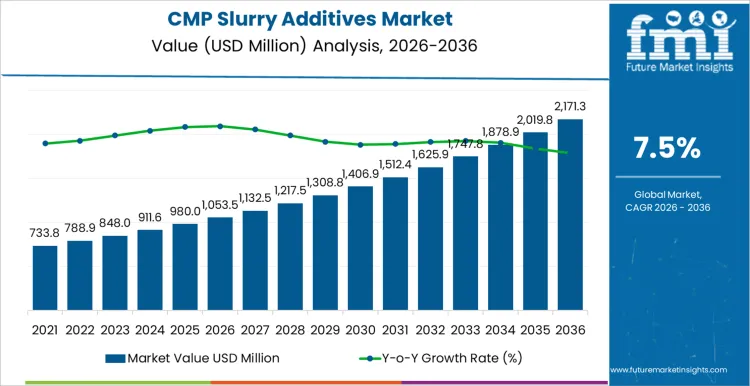
CMP Slurry Additives Market Key Takeaways
| Metric | Value |
|---|---|
| CMP Slurry Additives Market Value (2026) | USD 1,053.50 Million |
| CMP Slurry Additives Market Forecast Value (2036) | USD 2,171.3 Million |
| CMP Slurry Additives Market Forecast CAGR 2026 to 2036 | 7.50% |
How Are Planarity Requirements and Defect Sensitivity Driving the CMP Slurry Additives Market?
The CMP slurry additives market is expanding as semiconductor manufacturing faces tighter planarity tolerances and heightened sensitivity to surface defects at advanced nodes. Additives including oxidizers, corrosion inhibitors, dispersants, and pH stabilizers-play a critical role in controlling material removal rates, selectivity, and surface finish during chemical mechanical planarization. For fabs, these additives are yield-critical components that directly influence uniformity across wafers and layers.
Supplier selection is increasingly driven by performance consistency and integration with process-of-record slurries. As device architectures become more complex, fabs require additive systems that deliver stable removal rates while minimizing defects such as scratches, dishing, and erosion. Tailored additive packages optimized for specific materials copper, tungsten, dielectrics, and barrier layers are gaining preference. Suppliers that can co-develop additives with slurry formulators and CMP tool OEMs are securing deeper integration into advanced process nodes.
Cost-of-ownership and supply assurance are further shaping market dynamics. CMP consumables represent a recurring operational expense, pushing fabs to prioritize additives that extend pad life, reduce slurry consumption, and improve process repeatability. With new fab capacity coming online globally, buyers are also emphasizing multi-region production, batch traceability, and responsive technical support. For additive producers, competitive advantage increasingly depends on chemistry precision, application engineering depth, and reliable supply positioning CMP slurry additives as a foundational enabler of advanced semiconductor planarization.
How is The CMP Slurry Additives Market Structured by Additive Function and Device Type?
The CMP slurry additives market is segmented by additive function and device type, reflecting how surface control requirements and device architecture influence slurry formulation. By additive function, dispersants and stabilizers represent the leading segment, as they maintain particle suspension and slurry stability during polishing. Other additive functions include oxidizers and accelerators, inhibitors and corrosion control agents, and other functional additives that fine-tune removal rates and selectivity. By device type, logic and foundry applications dominate demand, followed by memory devices and other semiconductor categories, where advanced planarization precision is required to support complex interconnect structures.
Why Do Dispersants And Stabilizers Lead Additive Function Adoption In The CMP Slurry Additives Market?
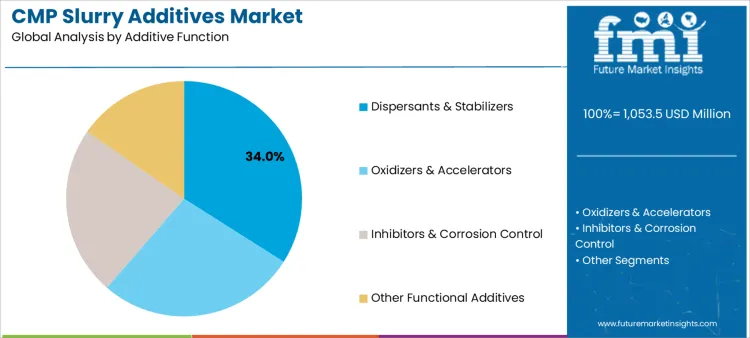
Dispersants and stabilizers account for 34% share of the cmp slurry additives market because uniform particle distribution is essential for consistent material removal and defect control. These additives prevent agglomeration of abrasive particles, ensuring stable slurry behavior during extended polishing cycles. Semiconductor manufacturers rely on dispersants to achieve predictable removal rates and minimize scratches or dishing on wafer surfaces. Stable slurries also reduce downtime caused by filtration issues or line blockages. As device geometries shrink, sensitivity to surface defects increases, strengthening demand for high-performance dispersants. These process-stability and yield-protection factors explain why dispersants and stabilizers remain the most widely used additive function.
Why Do Logic And Foundry Devices Dominate Device Type Demand In The CMP Slurry Additives Market?

Logic and foundry devices hold 40% share of the cmp slurry additives market because advanced logic chips require multiple CMP steps across front-end and back-end processes. High layer counts, tight critical dimensions, and complex interconnect stacks increase reliance on precisely engineered slurry formulations. Foundry fabs process large wafer volumes for diverse customers, amplifying additive consumption across production lines. Continuous node scaling intensifies planarization challenges, driving higher usage of specialized additives to control selectivity and surface quality. These volume-driven and precision-intensive manufacturing requirements explain why logic and foundry applications represent the dominant device type segment.
What are the Key Dynamics of the CMP Slurry Additives Market?
The CMP slurry additives market is driven by demand for performance-enhancing chemistries used in chemical mechanical planarization (CMP) processes integral to semiconductor wafer fabrication and advanced packaging. Additives such as dispersants, complexing agents, pH modifiers, corrosion inhibitors, surfactants, and polishing catalysts help tailor slurry characteristics to achieve target removal rates, selectivity between materials, minimal defects, and improved surface quality. For additive manufacturers and slurry formulators, chemical purity, process repeatability, compatibility with abrasive particles and pad materials, and consistent performance in high-volume manufacturing are decisive factors that influence adoption by semiconductor fabs and CMP tool OEMs.
How do Semiconductor Technology Trends Shape This Market?
Semiconductor technology trends profoundly shape the CMP slurry additives market because device scaling, 3D architectures, and heterogeneous integration raise performance requirements for planarization and material removal. As logic and memory nodes advance and multi-patterning increases complexity, slurry formulations must deliver precise control over removal rates for dielectrics, copper, barrier metals, tungsten, and other CMP target materials without inducing dishing or erosion. Growth in 3D NAND, finFET/NS-FinFET, and interconnect density amplifies demand for optimized additive packages that improve selectivity and defect control. Suppliers that co-develop with fabs to customize additive blends for specific process modules gain early qualification advantages and stronger integration into process flows.
Why do Contamination Control and Qualification Challenges Restrain Market Growth?
Contamination control and qualification challenges restrain growth in the CMP slurry additives market because semiconductor fabs operate under extremely tight defectivity and reliability margins. Additives must be formulated to minimize ionic and particulate contamination, control pH and oxidant stability, and maintain compatibility with abrasive carriers and pad materials. Introducing a new additive often requires exhaustive qualification covering defectivity impact, film integrity, corrosion behavior, and long-term reliability testing which extends time to production readiness and increases cost. Traceability of chemical inputs and strict lot-to-lot consistency demands limit market entry for new suppliers and favor established providers with proven datasets and validation history.
How is the CMP Slurry Additives Market Expanding across Key Countries?
The CMP slurry additives market is expanding steadily as semiconductor manufacturers increase wafer production and adopt more complex device architectures. CMP slurry additives such as oxidizers, corrosion inhibitors, dispersants, and pH modifiers play a critical role in controlling material removal rates, surface planarity, and defect reduction during chemical mechanical planarization. Country-wise growth varies based on semiconductor fabrication capacity, node migration intensity, and investment in advanced logic, memory, and power devices. High-growth markets benefit from rising wafer starts and localization of electronic materials, while mature regions focus on process precision, yield optimization, and consistency across multilayer device stacks.
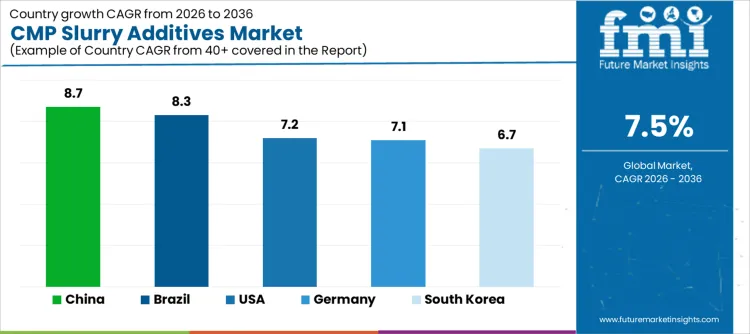
| Country | CAGR (%) |
|---|---|
| China | 8.7 |
| Brazil | 8.3 |
| United States | 7.2 |
| Germany | 7.1 |
| South Korea | 6.7 |
Why Is China Leading the CMP Slurry Additives Market?
China’s CMP slurry additives market is expanding at a CAGR of 8.7% during 2026 to 2036, driven by rapid expansion of domestic semiconductor fabrication and increasing localization of critical electronic chemicals. As memory, logic, and power semiconductor fabs scale wafer output, demand is rising for high-performance slurry additives that enable precise planarization and low defect density. CMP steps are increasing per wafer as device structures become more complex, directly raising additive consumption. Chinese fabs prioritize slurry additives that deliver stable removal rates, controlled selectivity between materials, and effective corrosion protection for copper and barrier layers. Domestic chemical suppliers are scaling electronic-grade additive production to meet stringent purity and consistency requirements. Integration with locally produced base slurries further strengthens adoption. Procurement decisions emphasize impurity control, batch-to-batch consistency, and the ability to support high-volume, continuous operations.
Why Is Brazil Emerging as a High-Growth Market for CMP Slurry Additives?
Brazil’s CMP slurry additives market is growing at a CAGR of 8.3% during 2026 to 2036, supported by gradual expansion of semiconductor-related manufacturing, compound semiconductors, and advanced electronics production. While Brazil does not host large-scale advanced logic fabs, demand is increasing from specialty semiconductor lines, sensors, and electronics packaging facilities that use CMP processes for planarization. Manufacturers value slurry additives for improving surface finish, controlling removal rates, and minimizing defects during polishing. Buyers prioritize formulation stability, ease of handling, and compatibility with small- to mid-scale CMP equipment. Adoption is supported by incremental upgrades in fabrication capability and increasing localization of electronics manufacturing. Procurement decisions often favor suppliers with regional availability, technical support, and compliance with international electronic chemical standards. As Brazil expands its role in automotive electronics, industrial electronics, and specialty semiconductor processing, demand for CMP slurry additives is expected to grow steadily over the forecast period.
What Is Driving Demand for CMP Slurry Additives in the United States?
The United States CMP slurry additives market is expanding at a CAGR of 7.2% during 2026 to 2036, driven by renewed investment in semiconductor manufacturing and expansion of domestic fab capacity. Advanced logic, memory, and specialty semiconductor facilities require precise planarization to maintain yield and device performance, supporting consistent demand for high-quality slurry additives. USA fabs emphasize additive performance consistency, low metallic contamination, and predictable interaction with copper, dielectric, and barrier materials. CMP slurry additives are critical for achieving uniform material removal and minimizing surface defects at advanced nodes. Buyers prioritize suppliers with proven performance data and strong technical collaboration capabilities. Procurement decisions focus on long-term supply agreements, detailed quality documentation, and support for advanced process integration. Market growth is reinforced by fab construction programs, increasing CMP steps per wafer, and continued adoption of advanced device architectures.
How Is Germany Supporting Growth in the CMP Slurry Additives Market?
Germany’s CMP slurry additives market is growing at a CAGR of 7.1% during 2026 to 2036, supported by demand from power semiconductors, automotive electronics, sensors, and industrial chip manufacturing. German fabs focus on precision processing, surface quality, and long-term reliability, making CMP additives essential for controlled planarization. Additives are widely used to fine-tune polishing behavior, reduce corrosion, and ensure uniformity across wafers. Buyers prioritize reproducibility, traceability, and strict compliance with manufacturing standards. Adoption is driven by performance and quality requirements rather than sheer volume growth. Procurement decisions favor suppliers with certified quality systems, strong technical documentation, and the ability to support long qualification cycles. Market growth is reinforced by Germany’s leadership in automotive semiconductors and continued investment in advanced manufacturing infrastructure.
How Is South Korea Expanding Use of CMP Slurry Additives?
South Korea’s CMP slurry additives market is expanding at a CAGR of 6.7% during 2026 to 2036, driven by strong demand from memory semiconductor manufacturing and advanced logic production. High wafer throughput and multilayer device structures significantly increase CMP intensity, driving additive consumption. South Korean fabs emphasize ultra-low defect density, stable removal rates, and compatibility with high-speed CMP tools. Slurry additives play a critical role in maintaining yield at advanced memory nodes. Buyers prioritize suppliers capable of delivering consistent quality at scale. Procurement decisions are influenced by supplier reliability, rapid technical support, and alignment with global semiconductor manufacturing standards. Market growth is supported by continued investment in memory fabs, node transitions, and increasing CMP process complexity.
How Are Suppliers Competing in the CMP Slurry Additives Market?
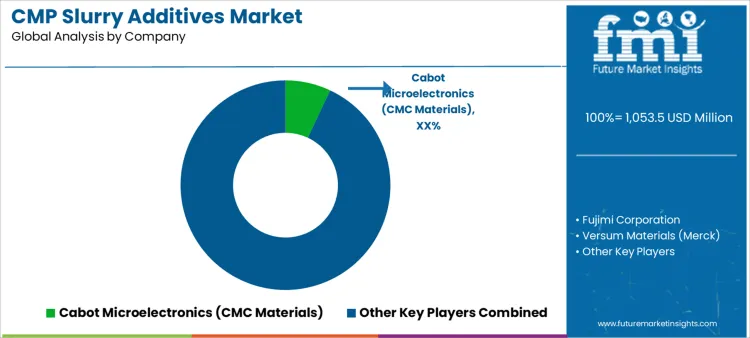
Competition in the CMP (chemical mechanical planarization) slurry additives market is defined by defectivity control, removal-rate selectivity, and consistency across increasingly complex semiconductor material stacks. As device nodes shrink and interconnect architectures become more intricate, slurry additives such as abrasives, dispersants, corrosion inhibitors, and pH modifiers must deliver precise surface interactions without inducing scratches, dishing, or erosion. Cabot Microelectronics (CMC Materials) anchors the market with tightly engineered additive systems designed to balance polish rate and defect suppression, particularly in copper, tungsten, and dielectric CMP processes. Its competitive strength lies in deep process co-development with leading fabs and strong lot-to-lot consistency.
Japanese materials specialists compete through chemistry precision and node-specific tuning. Fujimi Corporation differentiates with high-purity abrasives and dispersant technologies optimized for uniform particle distribution and stable slurry behavior. JSR Corporation and Showa Denko Materials focus on polymer additives and surface-conditioning chemistries that improve selectivity between metals and dielectrics while maintaining low defect density.
Global chemical majors strengthen competition through scale and portfolio breadth. Merck Group (Versum Materials legacy) positions CMP slurry additives as part of integrated planarization solutions, emphasizing reproducibility across multi-fab deployments. Dow and BASF SE leverage formulation expertise and global manufacturing to support advanced-node CMP with reliable supply and technical service. Surface engineering specialists add further differentiation. DuPont, Saint-Gobain, and 3M compete through niche additives and conditioning agents that enhance pad-slurry-wafer interaction. Across the market, competitive advantage is driven by defect reduction capability, process stability, and fab-level qualification depth rather than additive pricing alone.
Key Players in CMP Slurry Additives Market
- Cabot Microelectronics (CMC Materials)
- Fujimi Corporation
- Versum Materials (Merck)
- Dow
- BASF SE
- JSR Corporation
- Hitachi Chemical (Showa Denko Materials)
- Dupont (electronics)
- Saint-Gobain Surface Conditioning
- 3M
Scope of Report
| Attribute | Details |
|---|---|
| Market Size Unit | USD Million |
| Additive Function Covered | Dispersants & Stabilizers, Oxidizers & Accelerators, Inhibitors & Corrosion Control, Other Functional Additives |
| Device Type Covered | Logic & Foundry Devices, Memory Devices, Other Semiconductor Devices |
| Countries Covered | China, Japan, South Korea, India, Australia & New Zealand, ASEAN, Rest of Asia Pacific, Germany, United Kingdom, France, Italy, Spain, Nordic, BENELUX, Rest of Europe, United States, Canada, Mexico, Brazil, Chile, Rest of Latin America, Kingdom of Saudi Arabia, Other GCC Countries, Turkey, South Africa, Other African Union, Rest of Middle East & Africa |
| Regions Covered | Asia Pacific, Europe, North America, Latin America, Middle East & Africa |
| Key Companies Profiled | Cabot Microelectronics (CMC Materials), Fujimi Corporation, Versum Materials (Merck), Dow, BASF SE, JSR Corporation, Hitachi Chemical (Showa Denko Materials), DuPont (Electronics), Saint-Gobain Surface Conditioning, 3M |
| Additional Attributes | Dollar sales by additive function and device type are evaluated across advanced and mature semiconductor nodes. The scope examines removal rate control, defect reduction, selectivity enhancement, and slurry stability. Country-level analysis reflects fab capacity expansion, CMP step intensity, and technology transitions in logic and memory manufacturing. |
CMP Slurry Additives Market by Key Segments
Additive Function
- Dispersants & Stabilizers
- Oxidizers & Accelerators
- Inhibitors & Corrosion Control
- Other Functional Additives
Device Type
- Logic & Foundry
- Memory
- Other Devices
Region
- Asia Pacific
- China
- Japan
- South Korea
- India
- Australia & New Zealand
- ASEAN
- Rest of Asia Pacific
- Europe
- Germany
- United Kingdom
- France
- Italy
- Spain
- Nordic
- BENELUX
- Rest of Europe
- North America
- United States
- Canada
- Mexico
- Latin America
- Brazil
- Chile
- Rest of Latin America
- Middle East & Africa
- Kingdom of Saudi Arabia
- Other GCC Countries
- Turkey
- South Africa
- Other African Union
- Rest of Middle East & Africa
Bibliography
- Chen, Z., Liu, Y., & Wang, J. (2024). Role of slurry additives in defect control during copper and dielectric CMP. Journal of Vacuum Science & Technology B, 42(3), 031204.
- Grill, A. (2024). Planarization materials and processes for advanced semiconductor manufacturing. Journal of Applied Physics, 135(12), 120902.
- European Commission Joint Research Centre. (2024). Advanced materials and surface finishing in semiconductor fabrication.
- SEMI. (2024). CMP process materials and contamination control guidelines. SEMI International Standards Program
- International Roadmap for Devices and Systems. (2023). Interconnect and planarization process requirements.
Frequently Asked Questions
How big is the cmp slurry additives market in 2026?
The global cmp slurry additives market is estimated to be valued at USD 1,053.5 million in 2026.
What will be the size of cmp slurry additives market in 2036?
The market size for the cmp slurry additives market is projected to reach USD 2,171.3 million by 2036.
How much will be the cmp slurry additives market growth between 2026 and 2036?
The cmp slurry additives market is expected to grow at a 7.5% CAGR between 2026 and 2036.
What are the key product types in the cmp slurry additives market?
The key product types in cmp slurry additives market are dispersants & stabilizers, oxidizers & accelerators, inhibitors & corrosion control and other functional additives.
Which device type segment to contribute significant share in the cmp slurry additives market in 2026?
In terms of device type, logic & foundry segment to command 40.0% share in the cmp slurry additives market in 2026.
Preview the report firsthand - request a free sample
Get SampleGet the brochure for pricing and purchase details.
Get PDFTable of Content
- Executive Summary
- Global Market Outlook
- Demand-side Trends
- Supply-side Trends
- Technology Roadmap Analysis
- Analysis and Recommendations
- Market Overview
- Market Coverage / Taxonomy
- Market Definition / Scope / Limitations
- Market Background
- Market Dynamics
- Drivers
- Restraints
- Opportunity
- Trends
- Scenario Forecast
- Demand in Optimistic Scenario
- Demand in Likely Scenario
- Demand in Conservative Scenario
- Opportunity Map Analysis
- Product Life Cycle Analysis
- Supply Chain Analysis
- Investment Feasibility Matrix
- Value Chain Analysis
- PESTLE and Porter’s Analysis
- Regulatory Landscape
- Regional Parent Market Outlook
- Production and Consumption Statistics
- Import and Export Statistics
- Market Dynamics
- Global Market Analysis 2021 to 2025 and Forecast, 2026 to 2036
- Historical Market Size Value (USD Million) Analysis, 2021 to 2025
- Current and Future Market Size Value (USD Million) Projections, 2026 to 2036
- Y-o-Y Growth Trend Analysis
- Absolute $ Opportunity Analysis
- Global Market Pricing Analysis 2021 to 2025 and Forecast 2026 to 2036
- Global Market Analysis 2021 to 2025 and Forecast 2026 to 2036, By Additive Function
- Introduction / Key Findings
- Historical Market Size Value (USD Million) Analysis By Additive Function , 2021 to 2025
- Current and Future Market Size Value (USD Million) Analysis and Forecast By Additive Function , 2026 to 2036
- Dispersants & Stabilizers
- Oxidizers & Accelerators
- Inhibitors & Corrosion Control
- Other Functional Additives
- Dispersants & Stabilizers
- Y-o-Y Growth Trend Analysis By Additive Function , 2021 to 2025
- Absolute $ Opportunity Analysis By Additive Function , 2026 to 2036
- Global Market Analysis 2021 to 2025 and Forecast 2026 to 2036, By Device Type
- Introduction / Key Findings
- Historical Market Size Value (USD Million) Analysis By Device Type, 2021 to 2025
- Current and Future Market Size Value (USD Million) Analysis and Forecast By Device Type, 2026 to 2036
- Logic & Foundry
- Memory
- Other Devices
- Logic & Foundry
- Y-o-Y Growth Trend Analysis By Device Type, 2021 to 2025
- Absolute $ Opportunity Analysis By Device Type, 2026 to 2036
- Global Market Analysis 2021 to 2025 and Forecast 2026 to 2036, By Region
- Introduction
- Historical Market Size Value (USD Million) Analysis By Region, 2021 to 2025
- Current Market Size Value (USD Million) Analysis and Forecast By Region, 2026 to 2036
- North America
- Latin America
- Western Europe
- Eastern Europe
- East Asia
- South Asia and Pacific
- Middle East & Africa
- Market Attractiveness Analysis By Region
- North America Market Analysis 2021 to 2025 and Forecast 2026 to 2036, By Country
- Historical Market Size Value (USD Million) Trend Analysis By Market Taxonomy, 2021 to 2025
- Market Size Value (USD Million) Forecast By Market Taxonomy, 2026 to 2036
- By Country
- USA
- Canada
- Mexico
- By Additive Function
- By Device Type
- By Country
- Market Attractiveness Analysis
- By Country
- By Additive Function
- By Device Type
- Key Takeaways
- Latin America Market Analysis 2021 to 2025 and Forecast 2026 to 2036, By Country
- Historical Market Size Value (USD Million) Trend Analysis By Market Taxonomy, 2021 to 2025
- Market Size Value (USD Million) Forecast By Market Taxonomy, 2026 to 2036
- By Country
- Brazil
- Chile
- Rest of Latin America
- By Additive Function
- By Device Type
- By Country
- Market Attractiveness Analysis
- By Country
- By Additive Function
- By Device Type
- Key Takeaways
- Western Europe Market Analysis 2021 to 2025 and Forecast 2026 to 2036, By Country
- Historical Market Size Value (USD Million) Trend Analysis By Market Taxonomy, 2021 to 2025
- Market Size Value (USD Million) Forecast By Market Taxonomy, 2026 to 2036
- By Country
- Germany
- UK
- Italy
- Spain
- France
- Nordic
- BENELUX
- Rest of Western Europe
- By Additive Function
- By Device Type
- By Country
- Market Attractiveness Analysis
- By Country
- By Additive Function
- By Device Type
- Key Takeaways
- Eastern Europe Market Analysis 2021 to 2025 and Forecast 2026 to 2036, By Country
- Historical Market Size Value (USD Million) Trend Analysis By Market Taxonomy, 2021 to 2025
- Market Size Value (USD Million) Forecast By Market Taxonomy, 2026 to 2036
- By Country
- Russia
- Poland
- Hungary
- Balkan & Baltic
- Rest of Eastern Europe
- By Additive Function
- By Device Type
- By Country
- Market Attractiveness Analysis
- By Country
- By Additive Function
- By Device Type
- Key Takeaways
- East Asia Market Analysis 2021 to 2025 and Forecast 2026 to 2036, By Country
- Historical Market Size Value (USD Million) Trend Analysis By Market Taxonomy, 2021 to 2025
- Market Size Value (USD Million) Forecast By Market Taxonomy, 2026 to 2036
- By Country
- China
- Japan
- South Korea
- By Additive Function
- By Device Type
- By Country
- Market Attractiveness Analysis
- By Country
- By Additive Function
- By Device Type
- Key Takeaways
- South Asia and Pacific Market Analysis 2021 to 2025 and Forecast 2026 to 2036, By Country
- Historical Market Size Value (USD Million) Trend Analysis By Market Taxonomy, 2021 to 2025
- Market Size Value (USD Million) Forecast By Market Taxonomy, 2026 to 2036
- By Country
- India
- ASEAN
- Australia & New Zealand
- Rest of South Asia and Pacific
- By Additive Function
- By Device Type
- By Country
- Market Attractiveness Analysis
- By Country
- By Additive Function
- By Device Type
- Key Takeaways
- Middle East & Africa Market Analysis 2021 to 2025 and Forecast 2026 to 2036, By Country
- Historical Market Size Value (USD Million) Trend Analysis By Market Taxonomy, 2021 to 2025
- Market Size Value (USD Million) Forecast By Market Taxonomy, 2026 to 2036
- By Country
- Kingdom of Saudi Arabia
- Other GCC Countries
- Turkiye
- South Africa
- Other African Union
- Rest of Middle East & Africa
- By Additive Function
- By Device Type
- By Country
- Market Attractiveness Analysis
- By Country
- By Additive Function
- By Device Type
- Key Takeaways
- Key Countries Market Analysis
- USA
- Pricing Analysis
- Market Share Analysis, 2025
- By Additive Function
- By Device Type
- Canada
- Pricing Analysis
- Market Share Analysis, 2025
- By Additive Function
- By Device Type
- Mexico
- Pricing Analysis
- Market Share Analysis, 2025
- By Additive Function
- By Device Type
- Brazil
- Pricing Analysis
- Market Share Analysis, 2025
- By Additive Function
- By Device Type
- Chile
- Pricing Analysis
- Market Share Analysis, 2025
- By Additive Function
- By Device Type
- Germany
- Pricing Analysis
- Market Share Analysis, 2025
- By Additive Function
- By Device Type
- UK
- Pricing Analysis
- Market Share Analysis, 2025
- By Additive Function
- By Device Type
- Italy
- Pricing Analysis
- Market Share Analysis, 2025
- By Additive Function
- By Device Type
- Spain
- Pricing Analysis
- Market Share Analysis, 2025
- By Additive Function
- By Device Type
- France
- Pricing Analysis
- Market Share Analysis, 2025
- By Additive Function
- By Device Type
- India
- Pricing Analysis
- Market Share Analysis, 2025
- By Additive Function
- By Device Type
- ASEAN
- Pricing Analysis
- Market Share Analysis, 2025
- By Additive Function
- By Device Type
- Australia & New Zealand
- Pricing Analysis
- Market Share Analysis, 2025
- By Additive Function
- By Device Type
- China
- Pricing Analysis
- Market Share Analysis, 2025
- By Additive Function
- By Device Type
- Japan
- Pricing Analysis
- Market Share Analysis, 2025
- By Additive Function
- By Device Type
- South Korea
- Pricing Analysis
- Market Share Analysis, 2025
- By Additive Function
- By Device Type
- Russia
- Pricing Analysis
- Market Share Analysis, 2025
- By Additive Function
- By Device Type
- Poland
- Pricing Analysis
- Market Share Analysis, 2025
- By Additive Function
- By Device Type
- Hungary
- Pricing Analysis
- Market Share Analysis, 2025
- By Additive Function
- By Device Type
- Kingdom of Saudi Arabia
- Pricing Analysis
- Market Share Analysis, 2025
- By Additive Function
- By Device Type
- Turkiye
- Pricing Analysis
- Market Share Analysis, 2025
- By Additive Function
- By Device Type
- South Africa
- Pricing Analysis
- Market Share Analysis, 2025
- By Additive Function
- By Device Type
- USA
- Market Structure Analysis
- Competition Dashboard
- Competition Benchmarking
- Market Share Analysis of Top Players
- By Regional
- By Additive Function
- By Device Type
- Competition Analysis
- Competition Deep Dive
- Cabot Microelectronics (CMC Materials)
- Overview
- Product Portfolio
- Profitability by Market Segments (Product/Age /Sales Channel/Region)
- Sales Footprint
- Strategy Overview
- Marketing Strategy
- Product Strategy
- Channel Strategy
- Fujimi Corporation
- Versum Materials (Merck)
- Dow
- BASF SE
- JSR Corporation
- Hitachi Chemical (Showa Denko Materials)
- Dupont (electronics)
- Saint-Gobain Surface Conditioning
- 3M
- Cabot Microelectronics (CMC Materials)
- Competition Deep Dive
- Assumptions & Acronyms Used
- Research Methodology


