

- Market Size (2026)
- USD 214.6 Mn
- Forecast (2036)
- USD 446.4 Mn
- CAGR (2026 to 2036)
- 7.6%
Phase-Change Material Additives for Thermal Mass Concrete Systems Market Size, Forecast, and Outlook By FMI
Summary of the Phase-Change Material Additives for Thermal Mass Concrete Systems Market
- Demand and Growth Drivers
- Building owners are expected to use PCM concrete additives to shift indoor heat loads away from peak cooling hours.
- Green building rules are pushing designers to combine thermal mass with lower mechanical cooling intensity.
- Concrete producers need additive formats that survive mixing without leakage or visible surface defects.
- Product and Segment View
- Microcapsules are projected to hold 47.0% share in 2026 with capsule walls protecting PCM during mixing.
- Ready-mix admixture is anticipated to account for 43.0% share in 2026 due to simpler integration at concrete plants.
- Direct supply is projected to represent 51.0% share in 2026, led by project teams asking for formulation support.
- Geography and Competitive Outlook
- India is projected to record 9.1% CAGR by 2036 as hot-climate construction raises the value of passive cooling layers.
- China is expected to expand at 8.8% CAGR by 2036, reflected by green building floor area creating wider concrete specification opportunities.
- Rubitherm and Microtek compete on PCM formulation depth. Sika and Mapei connect concrete system support to field trials.
- Analyst Opinion
- Nikhil Kaitwade, Principal Analyst for Chemicals and Materials at FMI, assesses, “PCM additives are becoming a design-risk input for concrete thermal mass. Buyers are not paying only for latent heat capacity. Project teams require proof that capsules survive mixing and do not weaken compressive strength. Suppliers with concrete mix support and phase-change testing should gain better access to low-energy commercial buildings by 2036.”
- Phase-Change Material Additives for Thermal Mass Concrete Systems Market Value Analysis
- PCM concrete additives are moving from material trials into a defined passive cooling input for selected building envelopes.
- Concrete producers are expected to increase additive use in projects that can link cooling load reduction with building energy ratings.
- Microcapsule formats are gaining preference due to leakage control across ready-mix batching and precast curing.
- Demand is supported by thermal mass concrete designs that store daytime heat and release it after indoor load peaks.
Key Takeaways, Market Size, and Forecast
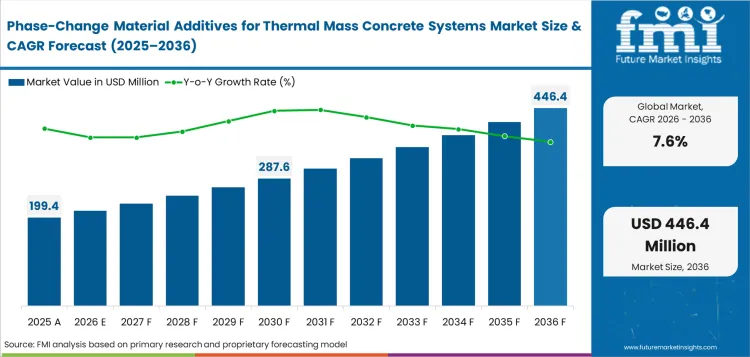
- The phase-change material additives for thermal mass concrete systems market size was valued at USD 199.4 million in 2025.
- Industry revenue is projected to reach USD 446.4 million by 2036 due to building teams specifying passive thermal buffering in concrete shells.
- The sector is expected to expand at 7.6% CAGR from 2026 to 2036 across low-cooling and energy-code projects.
- Incremental opportunity is projected at USD 231.8 million between 2026 and 2036 across additive suppliers and concrete formulators.
- Direct supply is projected to account for 51.0% share in 2026 as projects need mix-design checks and capsule survivability data.
- Microcapsules are expected to hold 47.0% share in 2026 since concrete plants require leakage control during mixing and curing.
- India at 9.1% CAGR and China at 8.8% CAGR are expected to record the fastest pace by 2036.
Thermal management additives need the right melting point before they create commercial value. Rubitherm’s April 2024 RT15 data sheet describes a pure PCM that stores and releases energy at nearly constant temperature. That supports targeted use in storage and building materials. Microtek’s fibratek 24D data sheet lists 24°C ± 2°C melting point and 105 J/g heat of fusion. Dry powder handling makes PCM easier to use in textiles and coatings. PureTemp states that PureTemp 18 remained stable through 10,000 thermal cycles and kept a 19.1 ± 0.3°C peak melting point. Long-cycle evidence helps buyers compare PCM additives on durability. Rubitherm’s March 2024 SP40 data sheet also describes a low-flammability inorganic PCM class for construction use. Building materials are likely to favor additives that combine thermal storage with safer flammability behavior.
Phase-Change Material Additives for Thermal Mass Concrete Systems Market Definition
Sector scope covers additives that place phase-change materials inside concrete or cementitious systems to raise heat storage capacity. Included products cover microencapsulated paraffin and salt hydrate blends. Fatty acid and biogenic PCM grades complete the material scope. Materials are sold to admixture producers and concrete system suppliers serving thermal mass walls and slabs. Separate wallboards and mechanical thermal storage tanks remain outside this study.
Phase-Change Material Additives for Thermal Mass Concrete Systems Market Inclusions
Market scope covers all commercially traded phase-change material additives used inside concrete and cementitious systems. Scope covers additive type such as encapsulated paraffin and salt hydrates. Scope covers form such as microcapsules and composite powders. Application scope includes ready-mix concrete and precast panels. Revenue scope covers 2026 to 2036. Stakeholders include PCM suppliers and concrete admixture producers. Construction chemical companies and green building designers form the wider buyer group.
Phase-Change Material Additives for Thermal Mass Concrete Systems Market Exclusions
Study scope excludes finished gypsum boards and insulation panels sold without concrete placement. Mechanical phase-change storage tanks are treated as adjacent thermal storage products. Standard mineral admixtures and fibers are excluded unless supplied with a thermal storage function. Conventional insulation products remain outside the revenue scope when they do not store latent heat.
Phase-Change Material Additives for Thermal Mass Concrete Systems Market Research Methodology
- Primary Research: FMI analysts reviewed PCM material suppliers and concrete formulators using microcapsule and composite powder systems.
- Desk Research: Desk review used building energy policy data and official green construction programs after January 2024.
- Market Sizing and Forecasting: Forecast work combined concrete admixture value with thermal mass additive loading rates and project conversion levels.
- Data Validation: Segment shares were checked against capsule survivability needs and building envelope specification practice before country review.
Why is the Phase-Change Material Additives for Thermal Mass Concrete Systems Market Growing?
- Global buildings accounted for 32.0% of energy demand in 2024, supporting passive heat-storage materials in concrete systems.
- USA building operations consume about 40% of energy and 74% of electricity, creating interest in materials that lower cooling loads.
- European rules require zero-emission new public buildings from January 2028, pushing low-energy envelopes and thermal mass design.
- India’s Energy Conservation and Sustainable Building Code 2024 created three energy-performance tiers, which supports advanced building material choices.
Concrete producers are adding phase-change materials when building teams need heat storage without thicker walls or larger mechanical systems. Microencapsulated PCM additives absorb heat during warmer hours and release it as indoor temperature drops. Practical use is strongest in precast panels and floor screeds where dosage control can be managed during batching. Suppliers able to prove capsule stability and mixing compatibility should gain wider acceptance among concrete product makers.
Specification pressure is another route for sector expansion. Architects and engineers are linking thermal mass concrete with lower cooling peaks and better indoor comfort. Additive makers must show thermal cycling data before designers approve use in occupied buildings. Smaller suppliers can compete when they provide reliable capsules and clear dosage guidance for concrete mix producers.
Market Segmentation Analysis
- Encapsulated paraffin is anticipated to lead with 41.0% share in 2026 since melt ranges can be tuned for comfort-band heat storage.
- With a projected 47.0% share in 2026, microcapsules are expected to lead as capsule walls lower leakage risk during mixing.
- Ready-mix admixture is estimated to reach 43.0% share in 2026 with concrete plants favoring controlled dosing routes.
- Commercial buildings are expected to hold 39.0% share in 2026 since office and retail projects can justify energy-performance trials.
- Direct supply is projected to secure 51.0% share in 2026 led by project accounts requiring thermal and mechanical test support.
Additive type segmentation includes paraffin PCM, bio-based PCM, salt hydrate PCM, fatty acid PCM, and eutectic PCM. Paraffin PCM leads due to stable phase transition behavior and wider concrete compatibility. Form segmentation covers microcapsules, macro capsules, powder blends, and slurry dispersions. Microcapsules are projected to lead as concrete batching needs protected PCM particles and lower leakage risk. Integration route and end use segmentation covers precast panels, floor screeds, wall systems, roof slabs, and commercial buildings. Designers use thermal mass to reduce indoor temperature swings. Sales channel segmentation covers direct supply, distributors, and specialty formulators. Direct supply leads as concrete producers need dosage support and mix-performance testing before project use.
Insights into the Encapsulated Paraffin Additive Type Segment
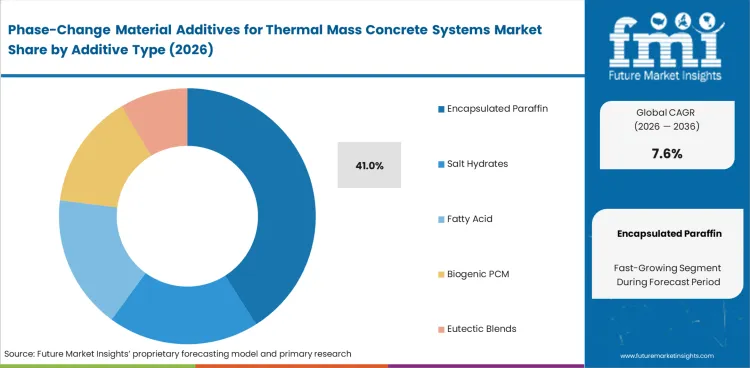
- Encapsulated paraffin is expected to account for 41.0% share in 2026 as suppliers match phase-change temperature to indoor comfort ranges.
- Salt hydrate grades serve projects needing higher heat capacity but formulation teams must manage corrosion and supercooling risks.
Insights into the Microcapsules Form Segment
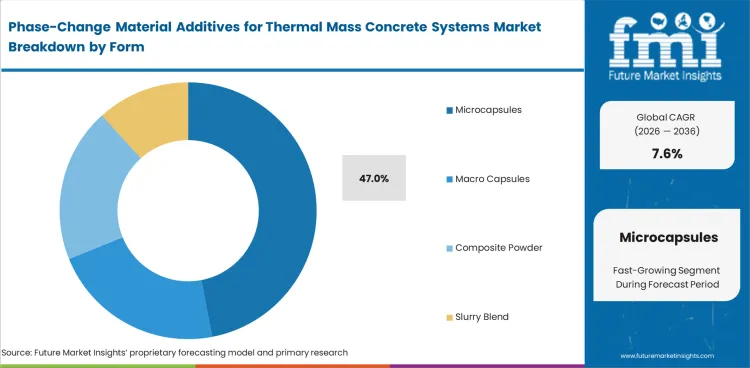
- Microcapsules are projected to represent 47.0% share in 2026 with polymer shells protecting PCM during mixing and curing.
- Composite powders contribute in dry-mix mortars along with silica, limiting leakage during transport and storage.
Insights into the Ready-Mix Admixture Integration Route Segment
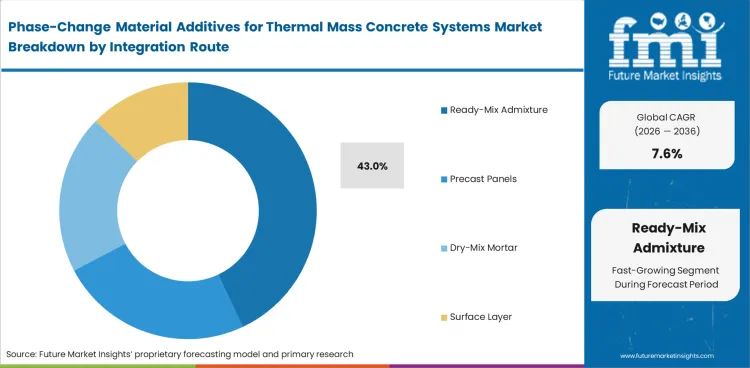
- Ready-mix admixture is anticipated to account for 43.0% share in 2026 led by batching plants controlling dosage and mixing time.
- Precast panels gain adoption when factory curing gives better control over capsule distribution and surface finish.
Insights into the Commercial Buildings End Use Segment
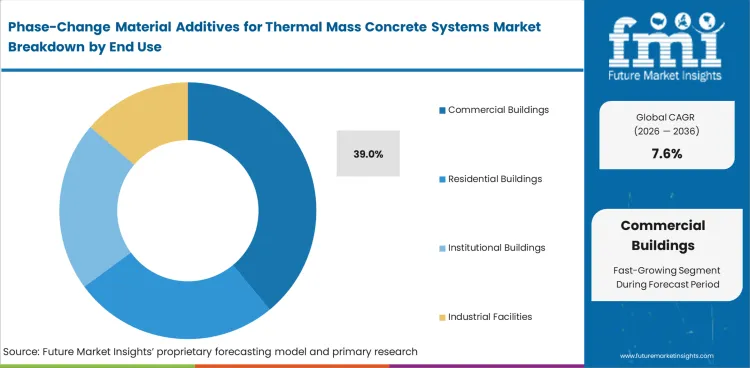
- Commercial buildings are expected to hold 39.0% share in 2026 due to owners tracking cooling peaks and green building scores.
- Institutional buildings use PCM concrete influenced by schools and hospitals requiring comfort control without larger mechanical equipment.
Insights into the Direct Supply Sales Channel Segment
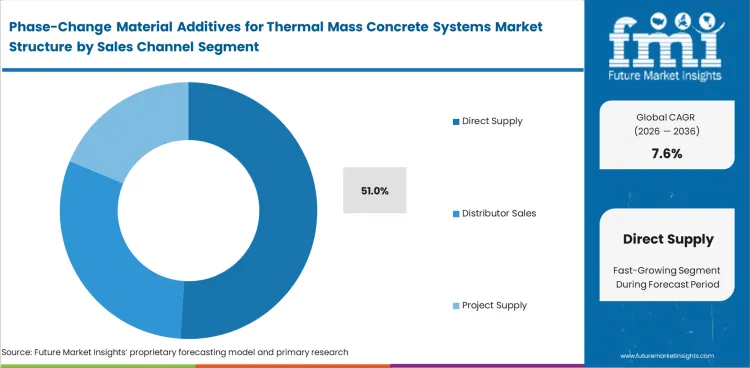
- Direct supply is projected to represent 51.0% share in 2026 reflecting large projects depending on thermal simulation and mix trials.
- Distributor sales serve smaller contractors purchasing limited additive volumes for pilot slabs and retrofit works.
Phase-Change Material Additives for Thermal Mass Concrete Systems Market Drivers, Restraints, and Opportunities
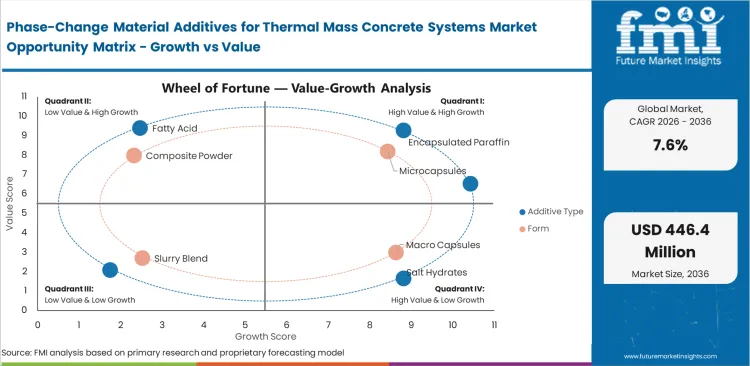
- Cooling peak control is expected to lift PCM additive trials as concrete floors and walls can store heat during warmer hours.
- Capsule survivability testing is anticipated to slow supplier switching since weak shells can fail under concrete mixing shear.
- Energy-code concrete design is expected to create prospects as passive heat storage gains value in low-energy building envelopes.
Passive cooling needs are expected to support PCM additives in concrete systems used for commercial buildings and public projects. Buildings account for 32.0% of global energy demand, maintaining pressure on designers to reduce cooling intensity without adding more equipment. PCM additives align by storing heat during peak hours and releasing it when indoor temperatures fall. Adoption is likely to advance fastest in precast panels and floor screeds where dosing can be controlled before site installation.
Technical qualification is likely to remain the main restraint during the forecast period. PCM concrete can reduce indoor temperature swings. Research shows that PCM integration can affect mechanical properties in cementitious materials. Concrete producers need capsule-strength evidence and thermal cycling data. Compressive strength results are needed before approving full-scale use. Opportunity should favor suppliers able to prove heat-storage performance without weakening the concrete matrix.
Production Capacity and Utilization Analysis
Production capacity is anticipated to expand around microencapsulation lines and supported powder formats. Rubitherm offers PCM products based on paraffins and waxes for latent heat storage. Its bound PCM formats address handling issues tied to liquid phase change materials. Microtek and PureTemp strengthen the supplier pool through defined transition temperatures and bio-based PCM options for thermal control applications. Capacity use is likely to improve as building projects move from pilot mixes toward specified concrete systems.
Channel and Distribution Structure Analysis
Channel structure is expected to favor direct technical selling for large concrete and building envelope accounts. Concrete producers need trial-batch support before approving PCM additives, especially when capsule loading can affect workability and strength. Distributors should continue serving small retrofit pilots and specialty contractors buying limited volumes. Direct supply is expected to gain share because thermal performance depends on dosage control and mix design. Curing behavior adds a separate approval variable.
Regional Analysis
.webp "Top Country Growth Comparison Phase Change Material Additives For Thermal Mass Concrete Systems Market Cagr (2026 2036)")
| Country | CAGR 2026 to 2036 |
|---|---|
| India | 9.1% |
| China | 8.8% |
| United Arab Emirates | 8.6% |
| United States | 7.3% |
| Germany | 6.8% |
| Australia | 6.6% |
| Japan | 6.3% |
Source: Future Market Insights analysis using PCM additive adoption review in 2026.
Analysis of Phase-Change Material Additives for Thermal Mass Concrete Systems Market by Key Countries
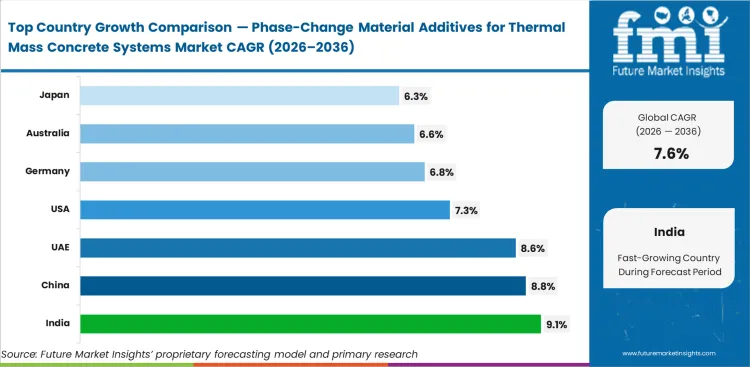
- India is projected to record 9.1% CAGR by 2036 due to hot-climate building growth increasing passive cooling trials.
- China is expected to expand at 8.8% CAGR by 2036 with green construction scale supporting thermal mass specifications.
- United Arab Emirates is forecast to grow at 8.6% CAGR by 2036 reflecting low-energy building codes promoting PCM concrete pilots.
- United States is expected to advance at 7.3% CAGR by 2036 as building thermal storage research supports early projects.
- Germany at 6.8% CAGR and Australia at 6.6% CAGR expand through energy-efficiency rules. Japan at 6.3% CAGR follows through ZEB and ZEH building targets.
Country performance changes with climate load and building code pressure. India leads through hot urban construction and energy-efficient building rules. China follows through large green building floor area and local concrete production. Demand for thermal insulation materials in EU reflects how European building policy is widening the buyer view beyond conventional envelope products. United Arab Emirates advances through low-energy building standards in hot climates. United States demand moves through research-backed pilots and commercial retrofits. Germany and Australia progress through strict building efficiency expectations. Japan maintains a steady pace through zero-energy building policy goals.
Demand Outlook for Phase-Change Material Additives for Thermal Mass Concrete Systems in India
The sector in India is projected to record 9.1% CAGR by 2036 as hot-climate cities need passive cooling in concrete structures. India’s building sector accounts for 38.0% of annual primary energy use and 31.0% of electricity use. Energy-code work gives PCM concrete a clearer role in offices and public buildings. Suppliers with local trial support should gain faster conversion across metro projects.
- Commercial developers in Bengaluru and Hyderabad require concrete systems able to lower indoor heat gain during peak afternoon hours.
- Ready-mix producers value microcapsules that can enter batching routines without changing normal workability targets.
- Public building projects may test PCM slabs during reviews of cooling budgets and comfort goals.
Sales Analysis for Phase-Change Material Additives for Thermal Mass Concrete Systems in China
Industry sales in China are expected to expand at 8.8% CAGR by 2036 as urban green construction gives PCM concrete a wider trial field. Green buildings accounted for 97.9% of gross floor area in newly built urban buildings during 2024. Large concrete volumes make additive qualification valuable for suppliers. Local capsule producers should benefit as developers align thermal comfort with building energy scores.
- Prefabricated building producers require PCM formats able to disperse evenly during factory casting and controlled curing.
- Urban retrofit programs create scope for surface layers in buildings not able to support full structural replacement.
- Domestic admixture suppliers package PCM with concrete performance testing for municipal and commercial buyers.
Opportunity Analysis of Phase-Change Material Additives for Thermal Mass Concrete Systems in United Arab Emirates
The market in United Arab Emirates is forecast to grow at 8.6% CAGR by 2036, reflecting hot-climate efficiency rules favoring passive heat storage. Barjeel buildings in Ras Al Khaimah are expected to consume 30.0% less energy and water than typical buildings. PCM concrete fits projects requiring reduced cooling load without sacrificing usable space. Suppliers should focus on melting ranges suited to Gulf indoor comfort targets.
- Dubai and Abu Dhabi developers require thermal mass products able to support building ratings in high-cooling environments.
- Precast facade producers test PCM layers in projects with solar gain and daily indoor comfort fluctuations.
- Specification teams value supplier data that covers fire behavior and repeated phase-change cycling under hot storage.
In-Depth Analysis of Phase-Change Material Additives for Thermal Mass Concrete Systems in United States
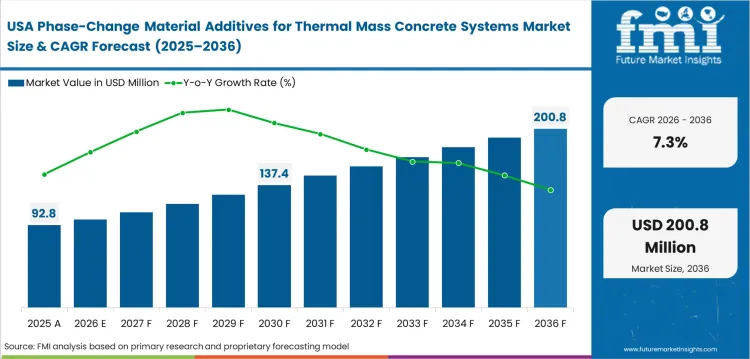
Industry in the United States is expected to advance at 7.3% CAGR by 2036 as research programs turn thermal storage into a building design option. American electricity use was about 4.0 trillion kWh in 2024 across all sectors. Residential and commercial buildings consume large shares of that power. PCM concrete suppliers should target projects in which peak cooling reduction affects operating costs.
- Federal laboratory work on building thermal storage supports pilot confidence for PCM walls and floors.
- Commercial retrofit buyers ask for payback evidence before accepting additive cost inside concrete packages.
- State energy codes create better entry points for designers already quantifying envelope performance.
Demand Outlook for Phase-Change Material Additives for Thermal Mass Concrete Systems in Germany
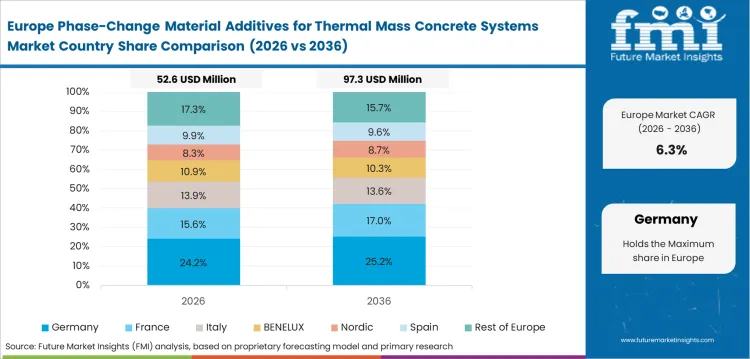
Demand for the sector in Germany is projected to rise at 6.8% CAGR by 2036 as building heat reduction remains central to energy policy. Building heat and hot water accounted for 32.5% of final energy use in 2024. PCM concrete can support low-energy renovations when designers need thermal buffering without thicker walls. Adoption will likely be measured since German buyers require strong documentation before changing material specifications.
- Office refurbishment projects need additives promoting thermal comfort while keeping floor area loss low.
- Concrete formulators value capsule stability data when EN product checks and warranty terms affect acceptance.
- Public building upgrades give suppliers a route to prove PCM concrete under monitored energy conditions.
Sales Analysis for Phase-Change Material Additives for Thermal Mass Concrete Systems in Australia
The market in Australia is forecast to expand at 6.6% CAGR by 2036 as thermal mass design aligns with housing comfort and energy bills. Buildings account for around 19.0% of total energy use and 18.0% of direct carbon emissions. Hot summers make passive heat storage useful in both residential and public buildings. Suppliers should focus on simple dosing routes for ready-mix and precast users.
- Architects use thermal mass in climate-responsive housing built by concrete slabs moderating indoor temperature fluctuations.
- Residential approvals create local testing scope for additives that do not weaken slab finish or curing quality.
- Public housing energy upgrades are likely to create pilot cases for passive cooling and household comfort goals.
Opportunity Analysis of Phase-Change Material Additives for Thermal Mass Concrete Systems in Japan
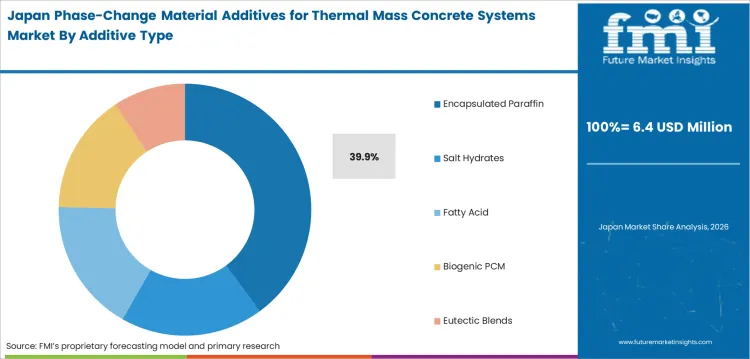
The market in Japan is expected to post 6.3% CAGR by 2036 as zero-energy building policy pushes material-level efficiency. New energy efficiency standards become mandatory for residential and small buildings in fiscal year 2025. PCM concrete will likely help buildings store daily heat and preserve compact design. Mature contractor practice keeps adoption selective but technically demanding.
- Tokyo and Osaka projects depend on compact thermal storage as high land costs limit thicker wall assemblies.
- Precast suppliers can use factory quality control to reduce capsule breakage before jobsite placement.
- Building owners ask for long-cycle reliability evidence before accepting PCM grades in durable concrete elements.
Competitive Positioning and Strategic Supplier Strength
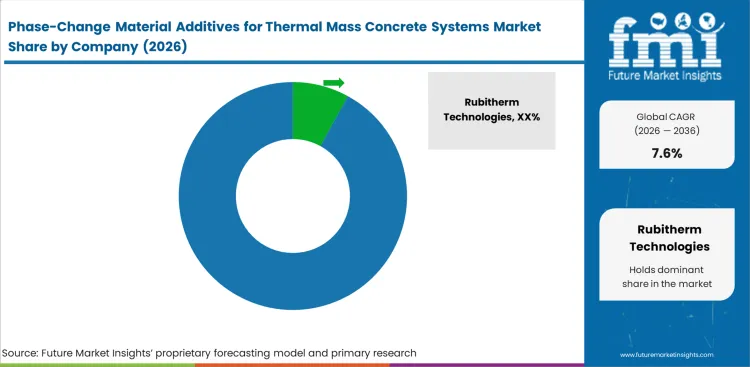
- Rubitherm can gain specification trials by offering PCM powders and gels with defined melt-point choices for building envelopes.
- Microtek is expected to defend microcapsule work by showing shell stability and leakage control under construction mixing stress.
- PureTemp holds attention when biogenic PCM grades support lower-toxicity building material specifications.
- Sika and Mapei can support concrete trial work through admixture labs and contractor-facing technical teams.
Competition is expected to move beyond latent heat claims and into proof inside concrete systems. Sika opened a Kazakhstan facility in April 2025 with mortar and concrete admixture production lines. Saint-Gobain completed the Fosroc acquisition in February 2025 and expanded its construction chemicals reach across Asia and other growth regions. Concrete buyers should see faster local support as system suppliers bring materials and testing closer to project sites. Phase-change thermoregulating fiber points to the same material concept being used in textiles and temperature-sensitive fibers. Advanced energy storage systems frame PCM concrete as part of a wider shift toward storing energy across buildings and materials.
Large suppliers use formulation support to protect accounts after engineers approve a PCM additive package. Specialist PCM firms hold an edge in melt-point selection and encapsulation knowledge. Construction chemical groups hold an edge in concrete trials and contractor access. Suppliers best positioned to win are those that can prove capsule survivability. These suppliers must support mix design and help buyers move from pilot work to approved project use.
Key Companies in Phase-Change Material Additives for Thermal Mass Concrete Systems Market
Competition spans PCM material suppliers and construction chemical system companies serving concrete producers. Specialist suppliers hold a stronger role when melting temperature and capsule wall behavior decide project approval.
- PCM material specialists: Rubitherm Technologies and Microtek Laboratories compete through formulation breadth. PureTemp and PCM Products compete through specialty temperature ranges.
- Encapsulation and biogenic suppliers: Phase Change Solutions and Croda compete through thermal storage material know-how. Pluss Advanced Technologies serves warm-climate building and cold-chain adjacent use cases.
- Concrete system suppliers: Sika and Mapei connect admixture labs with contractor support. Saint-Gobain Chryso and Master Builders Solutions compete through construction chemical access.
Competitive Benchmarking: Phase-Change Material Additives for Thermal Mass Concrete Systems Market
| Company | PCM Grade Breadth | Concrete Mix Support | Encapsulation Proof | Footprint |
|---|---|---|---|---|
| Rubitherm Technologies | High | Moderate | Large | Europe |
| Microtek Laboratories | High | Moderate | High | North America |
| PureTemp | Large | Moderate | Large | North America |
| Phase Change Solutions | Large | Moderate | Large | North America |
| PCM Products | Large | Moderate | Moderate | Europe |
| Pluss Advanced Technologies | Moderate | Moderate | Moderate | India |
| Croda International | Moderate | Large | Large | Global |
| Sika | Selective | High | Moderate | Global |
| Mapei | Selective | High | Moderate | Global |
| Saint-Gobain Chryso | Selective | High | Moderate | Global |
Source: Future Market Insights competitive analysis using public product portfolios and company activity in 2026.
Key Developments in the Phase-Change Material Additives for Thermal Mass Concrete Systems Market
- In April 2025, Sika opened a Kazakhstan facility with production lines for mortar and concrete admixtures, supported by a modern laboratory.
- In December 2025, Alexium International acquired Microtek Laboratories from CAVU Group, expanding its PCM and microencapsulation technology platform.
- In January 2026, MAPEI introduced Mapecube GEO as a strength-enhancing liquid admixture for low-CO₂ concrete and mortar applications.
Key Players in the Phase-Change Material Additives for Thermal Mass Concrete Systems Market
PCM material specialists
- Rubitherm Technologies
- Microtek Laboratories
- PureTemp
- PCM Products
- Phase Change Solutions
Biogenic thermal storage suppliers
- Croda International
- Pluss Advanced Technologies
- Climator Sweden
- Sasol Performance Chemicals
Concrete system integrators
- Sika
- Mapei
- Saint-Gobain Chryso
- Master Builders Solutions
- Wacker Chemie
- Evonik
Report Scope and Coverage
| Item | Value |
|---|---|
| Market value in 2025 | USD 199.4 million |
| Market value in 2026 | USD 214.6 million |
| Market value in 2036 | USD 446.4 million |
| CAGR from 2026 to 2036 | 7.6% CAGR |
| Quantitative units | USD million |
| Market definition | PCM additives used to increase latent heat storage inside concrete systems |
| By additive type | Encapsulated paraffin, salt hydrates, fatty acid, biogenic PCM, eutectic blends |
| By form | Microcapsules, macro capsules, composite powder, slurry blend |
| By integration route | Ready-mix admixture, precast panels, dry-mix mortar, surface layer |
| By end use | Commercial buildings, residential buildings, institutional buildings, industrial facilities |
| By sales channel | Direct supply, distributor sales, project supply |
| Countries covered | India, China, United Arab Emirates, United States, Germany, Australia, Japan |
| Key companies profiled | Rubitherm, Microtek, PureTemp, Phase Change Solutions, Sika, Mapei, Saint-Gobain Chryso |
| Forecast period | 2026 to 2036 |
| Approach | Bottom-up PCM additive modeling with building energy and concrete system cross-checks |
Source: Future Market Insights analysis, 2026.
Phase-Change Material Additives for Thermal Mass Concrete Systems Market Breakdown by Additive Type, Form, Integration Route, End Use, Sales Channel and Region
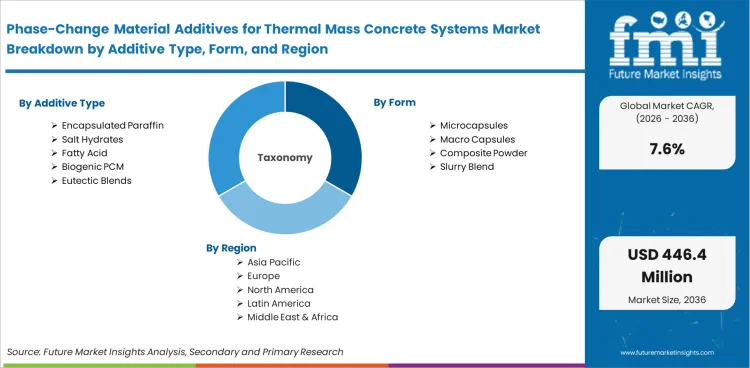
Phase-Change Material Additives for Thermal Mass Concrete Systems Market Segmented by Additive Type
- Encapsulated Paraffin
- Salt Hydrates
- Fatty Acid
- Biogenic PCM
- Eutectic Blends
Phase-Change Material Additives for Thermal Mass Concrete Systems Market Segmented by Form
- Microcapsules
- Macro Capsules
- Composite Powder
- Slurry Blend
Phase-Change Material Additives for Thermal Mass Concrete Systems Market Segmented by Integration Route
- Ready-Mix Admixture
- Precast Panels
- Dry-Mix Mortar
- Surface Layer
Phase-Change Material Additives for Thermal Mass Concrete Systems Market Segmented by End Use
- Commercial Buildings
- Residential Buildings
- Institutional Buildings
- Industrial Facilities
Phase-Change Material Additives for Thermal Mass Concrete Systems Market Segmented by Sales Channel
- Direct Supply
- Distributor Sales
- Project Supply
Phase-Change Material Additives for Thermal Mass Concrete Systems Market by Region
- North America
- United States
- Canada
- Mexico
- Latin America
- Brazil
- Chile
- Rest of Latin America
- Western Europe
- Germany
- United Kingdom
- France
- Italy
- Spain
- Nordic
- BENELUX
- Rest of Western Europe
- Eastern Europe
- Poland
- Hungary
- Rest of Eastern Europe
- East Asia
- China
- Japan
- South Korea
- South Asia and Pacific
- India
- ASEAN
- Australia and New Zealand
- Rest of South Asia and Pacific
- Middle East and Africa
- United Arab Emirates
- Kingdom of Saudi Arabia
- Other GCC Countries
- South Africa
- Rest of Middle East and Africa
Research Sources and Bibliography
- Global Alliance for Buildings and Construction, & United Nations Environment Programme. (2025, March 17). Global status report for buildings and construction 2024/2025: Not just another brick in the wall. United Nations Environment Programme.
- REN21. (2025, June 24). Renewables 2025 global status report: Global overview. REN21 Secretariat.
- International Energy Agency. (2025, June 11). Energy efficiency policy toolkit 2025. International Energy Agency.
- The State Council of the People’s Republic of China. (2024, March 15). China to advance energy conservation, carbon reduction in construction sector. Government of China.
- Bureau of Energy Efficiency. (2026, April 14). Energy efficiency in buildings. Government of India.
- USA Energy Information Administration. (2025, April 9). Electricity explained: Use of electricity. USA Department of Energy.
- USA Census Bureau. (2026, March 23). Monthly construction spending, January 2026. USA Department of Commerce.
- German Environment Agency. (2026, January 8). Indicator: Energy consumption for buildings. Umweltbundesamt.
- Department of Climate Change, Energy, the Environment and Water. (2026, February 12). Buildings. Australian Government.
- Australian Bureau of Statistics. (2026, May 4). Building approvals, Australia, March 2026. Australian Bureau of Statistics.
- United Arab Emirates Government. (2025, October 31). Energy efficiency. The Official Portal of the UAE Government.
- Agency for Natural Resources and Energy. (2026, March 26). Japan’s ENERGY 2025 edition: 10 questions for understanding the current energy situation. Ministry of Economy, Trade and Industry.
- Sika AG. (2025, April 8). Sika opens a new plant for concrete admixtures and mortars in Kazakhstan. Sika AG.
- Saint-Gobain. (2025, February 10). Saint-Gobain completes the acquisition of FOSROC, a leading player in construction chemicals in Asia and emerging markets. Compagnie de Saint-Gobain.
- Alexium International Group Limited. (2025, December 15). Alexium International announces acquisition of Microtek Laboratories from CAVU Group. Alexium International Group Limited.
- MAPEI Corporation. (2026, January 29). MAPEI introduces Mapecube GEO strength-enhancing admixture for low-CO₂-emission concrete technologies. MAPEI Corporation.
- Rubitherm Technologies GmbH. (2025, November 3). PX42HC data sheet. Rubitherm Technologies GmbH.
Bibliography uses public building-energy sources and official company publications.
This Report Answers
- What is the current and future value of the phase-change material additives for thermal mass concrete systems market from 2026 to 2036?
- What CAGR is expected for the phase-change material additives for thermal mass concrete systems market during the forecast period?
- Which additive type segment is projected to lead phase-change material additive demand in 2026?
- Which form segment is expected to hold the highest share in phase-change material additives for concrete systems?
- What factors are driving PCM additive use in thermal mass concrete systems?
- How do capsule survivability tests affect supplier selection for PCM additives?
- Which countries are expected to grow fastest in phase-change material additives for thermal mass concrete systems?
- Which companies are positioned across PCM materials and concrete additive support?
- How does FMI define the PCM additive revenue scope for thermal mass concrete systems?
- What forecasting approach was used to estimate additive demand from 2026 to 2036?
Frequently Asked Questions
What is the global market demand for phase-change material additives for thermal mass concrete systems market in 2026?
The phase-change material additives for thermal mass concrete systems market is expected to cross USD 214.6 million in 2026.
What will the phase-change material additives for thermal mass concrete systems market be worth by 2036?
The phase-change material additives for thermal mass concrete systems industry is projected to reach USD 446.4 million by 2036.
What is the expected CAGR for the phase-change material additives for thermal mass concrete systems market?
The sector is expected to expand at 7.6% CAGR from 2026 to 2036 across concrete and building envelope channels.
Which additive type leads the phase-change material additives for thermal mass concrete systems market?
Paraffin PCM is projected to account for 41.0% share in 2026 due to stable phase transition behavior.
Which form leads the phase-change material additives for thermal mass concrete systems market?
Microcapsules are expected to hold 47.0% share in 2026 as concrete batching needs lower leakage risk.
Which country grows fastest in the phase-change material additives for thermal mass concrete systems market?
India is projected to record 9.1% CAGR by 2036 as low-energy building work supports PCM concrete trials.
What does the phase-change material additives for thermal mass concrete systems market include?
Scope includes PCM additives used in concrete floors and walls. Finished concrete panels are outside additive revenue.
How was the phase-change material additives for thermal mass concrete systems market forecast prepared?
Forecast work used building energy demand and additive loading assumptions. Country and segment checks were used for validation.
How do phase-change material additives work in thermal mass concrete systems?
PCM additives store heat during warmer hours. Controlled release reduces indoor temperature swings after concrete cures.
Preview the report firsthand - request a free sample
Get SampleGet the brochure for pricing and purchase details.
Get PDFTable of Content
- Key Takeaways
- Market Size and CAGR
- Top Growth Driver
- Fastest Growing Segment
- Leading Region
- Key Companies
- Emerging Opportunities
- Executive Summary
- Global Market Outlook
- Demand-side Trends
- Supply-side Trends
- Technology Roadmap Analysis
- Analysis and Recommendations
- Analyst Perspective (What is happening? Why now? What should investors know?)
- Key Questions Answered
- How large is the market?
- What is the CAGR?
- What are key trends?
- Which region dominates?
- Who are the leaders?
- Market Overview
- Market Coverage / Taxonomy
- Market Definition / Scope / Limitations
- Research Methodology
- Chapter Orientation
- Analytical Lens and Working Hypotheses
- Market Structure, Signals, and Trend Drivers
- Benchmarking and Cross-market Comparability
- Market Sizing, Forecasting, and Opportunity Mapping
- Research Design and Evidence Framework
- Desk Research Programme (Secondary Evidence)
- Expert Input and Fieldwork (Primary Evidence)
- Tooling, Models, and Reference Databases
- Data Engineering and Model Build
- Quality Assurance and Audit Trail
- Market Background
- Market Dynamics (Drivers, Restraints, Opportunity, Trends)
- Scenario Forecast (Optimistic, Likely, Conservative)
- Impact Analysis
- AI Impact
- Sustainability Impact
- Regulatory Impact
- Technology Impact
- Consumer / Buyer Analysis
- Purchase Drivers
- Adoption Barriers
- Buyer Journey
- Opportunity Map Analysis
- Product Life Cycle Analysis
- Supply Chain Analysis
- Investment Feasibility Matrix
- Value Chain Analysis
- PESTLE and Porter's Analysis
- Regulatory Landscape
- Regional Parent Market Outlook
- Production and Consumption Statistics
- Import and Export Statistics
- Global Market Analysis and Forecast, 2021 to 2036
- Historical Market Size Value (USD Million) & Volume (Unit) Analysis, 2021 to 2025
- Current and Future Market Size Value (USD Million) & Volume (Unit) Projections, 2026 to 2036
- Y-o-Y Growth Trend Analysis
- Absolute $ Opportunity Analysis
- Global Market Pricing Analysis, 2021 to 2036
- Global Market Analysis and Forecast, By Form, 2021 to 2036
- Introduction / Key Findings
- Historical Market Size Value (USD Million) & Volume (Unit) Analysis By Form, 2021 to 2025
- Current and Future Market Size Value (USD Million) & Volume (Unit) Analysis and Forecast By Form, 2026 to 2036
- Microcapsules
- Macro Capsules
- Composite Powder
- Slurry Blend
- Microcapsules
- Y-o-Y Growth Trend Analysis By Form, 2021 to 2025
- Absolute $ Opportunity Analysis By Form, 2026 to 2036
- Global Market Analysis and Forecast, By Integration Route, 2021 to 2036
- Introduction / Key Findings
- Historical Market Size Value (USD Million) & Volume (Unit) Analysis By Integration Route, 2021 to 2025
- Current and Future Market Size Value (USD Million) & Volume (Unit) Analysis and Forecast By Integration Route, 2026 to 2036
- Ready-Mix Admixture
- Precast Panels
- Dry-Mix Mortar
- Surface Layer
- Ready-Mix Admixture
- Y-o-Y Growth Trend Analysis By Integration Route, 2021 to 2025
- Absolute $ Opportunity Analysis By Integration Route, 2026 to 2036
- Global Market Analysis and Forecast, By End Use, 2021 to 2036
- Introduction / Key Findings
- Historical Market Size Value (USD Million) & Volume (Unit) Analysis By End Use, 2021 to 2025
- Current and Future Market Size Value (USD Million) & Volume (Unit) Analysis and Forecast By End Use, 2026 to 2036
- Commercial Buildings
- Residential Buildings
- Institutional Buildings
- Industrial Facilities
- Commercial Buildings
- Y-o-Y Growth Trend Analysis By End Use, 2021 to 2025
- Absolute $ Opportunity Analysis By End Use, 2026 to 2036
- Global Market Analysis and Forecast, By Sales Channel, 2021 to 2036
- Introduction / Key Findings
- Historical Market Size Value (USD Million) & Volume (Unit) Analysis By Sales Channel, 2021 to 2025
- Current and Future Market Size Value (USD Million) & Volume (Unit) Analysis and Forecast By Sales Channel, 2026 to 2036
- Direct Supply
- Distributor Sales
- Project Supply
- Direct Supply
- Y-o-Y Growth Trend Analysis By Sales Channel, 2021 to 2025
- Absolute $ Opportunity Analysis By Sales Channel, 2026 to 2036
- Global Market Analysis and Forecast, By Additive Type, 2021 to 2036
- Introduction / Key Findings
- Historical Market Size Value (USD Million) & Volume (Unit) Analysis By Additive Type, 2021 to 2025
- Current and Future Market Size Value (USD Million) & Volume (Unit) Analysis and Forecast By Additive Type, 2026 to 2036
- Encapsulated Paraffin
- Salt Hydrates
- Fatty Acid
- Biogenic PCM
- Eutectic Blends
- Encapsulated Paraffin
- Y-o-Y Growth Trend Analysis By Additive Type, 2021 to 2025
- Absolute $ Opportunity Analysis By Additive Type, 2026 to 2036
- Global Market Analysis and Forecast, By Region, 2021 to 2036
- Introduction
- Historical Market Size Value (USD Million) & Volume (Unit) Analysis By Region, 2021 to 2025
- Current Market Size Value (USD Million) & Volume (Unit) Analysis and Forecast By Region, 2026 to 2036
- North America
- Latin America
- Western Europe
- Eastern Europe
- East Asia
- South Asia and Pacific
- Middle East & Africa
- Market Attractiveness Analysis By Region
- North America Market Analysis and Forecast, By Country, 2021 to 2036
- Historical Market Size Value (USD Million) & Volume (Unit) Trend Analysis By Market Taxonomy, 2021 to 2025
- Market Size Value (USD Million) & Volume (Unit) Forecast By Market Taxonomy, 2026 to 2036
- By Country
- USA
- Canada
- Mexico
- By Form
- By Integration Route
- By End Use
- By Sales Channel
- By Additive Type
- By Country
- Market Attractiveness Analysis
- By Country
- By Form
- By Integration Route
- By End Use
- By Sales Channel
- By Additive Type
- Key Takeaways
- Latin America Market Analysis and Forecast, By Country
- Historical Market Size Value (USD Million) & Volume (Unit) Trend Analysis By Market Taxonomy, 2021 to 2025
- Market Size Value (USD Million) & Volume (Unit) Forecast By Market Taxonomy, 2026 to 2036
- By Country
- Brazil
- Chile
- Rest of Latin America
- By Form
- By Integration Route
- By End Use
- By Sales Channel
- By Additive Type
- By Country
- Market Attractiveness Analysis
- By Country
- By Form
- By Integration Route
- By End Use
- By Sales Channel
- By Additive Type
- Key Takeaways
- Western Europe Market Analysis and Forecast, By Country
- Historical Market Size Value (USD Million) & Volume (Unit) Trend Analysis By Market Taxonomy, 2021 to 2025
- Market Size Value (USD Million) & Volume (Unit) Forecast By Market Taxonomy, 2026 to 2036
- By Country
- Germany
- UK
- Italy
- Spain
- France
- Nordic
- BENELUX
- Rest of Western Europe
- By Form
- By Integration Route
- By End Use
- By Sales Channel
- By Additive Type
- By Country
- Market Attractiveness Analysis
- By Country
- By Form
- By Integration Route
- By End Use
- By Sales Channel
- By Additive Type
- Key Takeaways
- Eastern Europe Market Analysis and Forecast, By Country
- Historical Market Size Value (USD Million) & Volume (Unit) Trend Analysis By Market Taxonomy, 2021 to 2025
- Market Size Value (USD Million) & Volume (Unit) Forecast By Market Taxonomy, 2026 to 2036
- By Country
- Russia
- Poland
- Hungary
- Balkan & Baltic
- Rest of Eastern Europe
- By Form
- By Integration Route
- By End Use
- By Sales Channel
- By Additive Type
- By Country
- Market Attractiveness Analysis
- By Country
- By Form
- By Integration Route
- By End Use
- By Sales Channel
- By Additive Type
- Key Takeaways
- East Asia Market Analysis and Forecast, By Country
- Historical Market Size Value (USD Million) & Volume (Unit) Trend Analysis By Market Taxonomy, 2021 to 2025
- Market Size Value (USD Million) & Volume (Unit) Forecast By Market Taxonomy, 2026 to 2036
- By Country
- China
- Japan
- South Korea
- By Form
- By Integration Route
- By End Use
- By Sales Channel
- By Additive Type
- By Country
- Market Attractiveness Analysis
- By Country
- By Form
- By Integration Route
- By End Use
- By Sales Channel
- By Additive Type
- Key Takeaways
- South Asia and Pacific Market Analysis and Forecast, By Country
- Historical Market Size Value (USD Million) & Volume (Unit) Trend Analysis By Market Taxonomy, 2021 to 2025
- Market Size Value (USD Million) & Volume (Unit) Forecast By Market Taxonomy, 2026 to 2036
- By Country
- India
- ASEAN
- Australia & New Zealand
- Rest of South Asia and Pacific
- By Form
- By Integration Route
- By End Use
- By Sales Channel
- By Additive Type
- By Country
- Market Attractiveness Analysis
- By Country
- By Form
- By Integration Route
- By End Use
- By Sales Channel
- By Additive Type
- Key Takeaways
- Middle East & Africa Market Analysis and Forecast, By Country
- Historical Market Size Value (USD Million) & Volume (Unit) Trend Analysis By Market Taxonomy, 2021 to 2025
- Market Size Value (USD Million) & Volume (Unit) Forecast By Market Taxonomy, 2026 to 2036
- By Country
- Kingdom of Saudi Arabia
- Other GCC Countries
- Türkiye
- South Africa
- Other African Union
- Rest of Middle East & Africa
- By Form
- By Integration Route
- By End Use
- By Sales Channel
- By Additive Type
- By Country
- Market Attractiveness Analysis
- By Country
- By Form
- By Integration Route
- By End Use
- By Sales Channel
- By Additive Type
- Key Takeaways
- Key Countries Market Analysis
- USA
- Pricing Analysis
- Market Share Analysis, 2025
- By Form
- By Integration Route
- By End Use
- By Sales Channel
- By Additive Type
- Canada
- Pricing Analysis
- Market Share Analysis, 2025
- By Form
- By Integration Route
- By End Use
- By Sales Channel
- By Additive Type
- Mexico
- Pricing Analysis
- Market Share Analysis, 2025
- By Form
- By Integration Route
- By End Use
- By Sales Channel
- By Additive Type
- Brazil
- Pricing Analysis
- Market Share Analysis, 2025
- By Form
- By Integration Route
- By End Use
- By Sales Channel
- By Additive Type
- Chile
- Pricing Analysis
- Market Share Analysis, 2025
- By Form
- By Integration Route
- By End Use
- By Sales Channel
- By Additive Type
- Germany
- Pricing Analysis
- Market Share Analysis, 2025
- By Form
- By Integration Route
- By End Use
- By Sales Channel
- By Additive Type
- UK
- Pricing Analysis
- Market Share Analysis, 2025
- By Form
- By Integration Route
- By End Use
- By Sales Channel
- By Additive Type
- Italy
- Pricing Analysis
- Market Share Analysis, 2025
- By Form
- By Integration Route
- By End Use
- By Sales Channel
- By Additive Type
- Spain
- Pricing Analysis
- Market Share Analysis, 2025
- By Form
- By Integration Route
- By End Use
- By Sales Channel
- By Additive Type
- France
- Pricing Analysis
- Market Share Analysis, 2025
- By Form
- By Integration Route
- By End Use
- By Sales Channel
- By Additive Type
- India
- Pricing Analysis
- Market Share Analysis, 2025
- By Form
- By Integration Route
- By End Use
- By Sales Channel
- By Additive Type
- ASEAN
- Pricing Analysis
- Market Share Analysis, 2025
- By Form
- By Integration Route
- By End Use
- By Sales Channel
- By Additive Type
- Australia & New Zealand
- Pricing Analysis
- Market Share Analysis, 2025
- By Form
- By Integration Route
- By End Use
- By Sales Channel
- By Additive Type
- China
- Pricing Analysis
- Market Share Analysis, 2025
- By Form
- By Integration Route
- By End Use
- By Sales Channel
- By Additive Type
- Japan
- Pricing Analysis
- Market Share Analysis, 2025
- By Form
- By Integration Route
- By End Use
- By Sales Channel
- By Additive Type
- South Korea
- Pricing Analysis
- Market Share Analysis, 2025
- By Form
- By Integration Route
- By End Use
- By Sales Channel
- By Additive Type
- Russia
- Pricing Analysis
- Market Share Analysis, 2025
- By Form
- By Integration Route
- By End Use
- By Sales Channel
- By Additive Type
- Poland
- Pricing Analysis
- Market Share Analysis, 2025
- By Form
- By Integration Route
- By End Use
- By Sales Channel
- By Additive Type
- Hungary
- Pricing Analysis
- Market Share Analysis, 2025
- By Form
- By Integration Route
- By End Use
- By Sales Channel
- By Additive Type
- Kingdom of Saudi Arabia
- Pricing Analysis
- Market Share Analysis, 2025
- By Form
- By Integration Route
- By End Use
- By Sales Channel
- By Additive Type
- Türkiye
- Pricing Analysis
- Market Share Analysis, 2025
- By Form
- By Integration Route
- By End Use
- By Sales Channel
- By Additive Type
- South Africa
- Pricing Analysis
- Market Share Analysis, 2025
- By Form
- By Integration Route
- By End Use
- By Sales Channel
- By Additive Type
- USA
- Market Structure Analysis
- Competition Dashboard
- Competition Benchmarking
- Market Share Analysis of Top Players
- By Regional
- By Form
- By Integration Route
- By End Use
- By Sales Channel
- By Additive Type
- Emerging Startups
- Innovation Benchmarking
- Competition Analysis
- Competition Deep Dive
- Rubitherm Technologies
- Overview
- Product Portfolio
- Profitability by Market Segments (Product/Region/Sales Channel)
- Sales Footprint
- Strategy Overview
- Marketing Strategy
- Product Strategy
- Channel Strategy
- Microtek Laboratories
- PureTemp
- Phase Change Solutions
- PCM Products
- Pluss Advanced Technologies
- Croda International
- Sika
- Mapei
- Saint-Gobain Chryso
- Rubitherm Technologies
- Case Studies
- Success Stories
- Recent Developments
- Competition Deep Dive
- Assumptions & Acronyms Used


