

- Industry Size (2026)
- USD 930.5 Mn
- Forecast (2036)
- USD 2046.4 Mn
- CAGR (2026 to 2036)
- 8.20%
UV-Blocking Nanoparticle Additives Market Forecast and Outlook 2026 to 2036
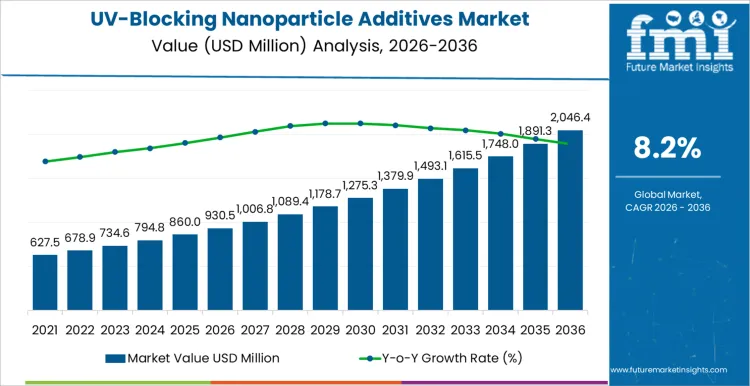
The UV-blocking nanoparticle additives market is expected to expand from USD 930.5 million in 2026, to USD 2,046.4 million by 2036, at a CAGR of 8.20%. Market performance is closely tied to a narrow set of application clusters where UV exposure directly determines material failure rates and replacement costs. Demand concentration in plastics, packaging, and coatings creates volume stability, but also links growth quality to downstream production cycles and specification discipline. End users adopt nanoparticle UV blockers primarily where transparency, surface appearance, and long service life are non-negotiable, rather than as discretionary enhancements. Packaging films and outdoor plastics generate repeat demand due to high throughput and continuous exposure, while coatings and specialty applications contribute margin but fluctuate with capital spending. This dependency structure favors suppliers aligned with high-volume processors and standardized formulations. Growth therefore reflects application durability requirements and substitution resistance, not broad-based expansion, making end-use reliability a stronger driver than headline demand growth.
Quick Stats for UV-Blocking Nanoparticle Additives Market
- UV-Blocking Nanoparticle Additives Market Value (2026): USD 930.5 Million
- UV-Blocking Nanoparticle Additives Market Forecast Value (2036): USD 2,046.4 Million
- UV-Blocking Nanoparticle Additives Market Forecast CAGR 2026 to 2036: 8.20%
- Leading Nanoparticle Type in UV-Blocking Nanoparticle Additives Market: Titanium Dioxide Nanoparticles (40% share)
- Key Growth Regions in UV-Blocking Nanoparticle Additives Market: Asia Pacific, Europe, North America, Latin America, Middle East & Africa
- Top Key Players in UV-Blocking Nanoparticle Additives Market: Evonik Industries, BASF, Kronos Worldwide, Tronox, Altana, Croda International, Sachtleben Chemie, Ishihara Sangyo Kaisha, Huntsman Corporation, BYK-Chemie
UV-Blocking Nanoparticle Additives Market Key Takeaways
| Metric | Value |
|---|---|
| UV-Blocking Nanoparticle Additives Market Value (2026) | USD 930.5 Million |
| UV-Blocking Nanoparticle Additives Market Forecast Value (2036) | USD 2,046.4 Million |
| UV-Blocking Nanoparticle Additives Market Forecast CAGR 2026 to 2036 | 8.20% |
How Are Durability Expectations and Optical Performance Requirements Driving the UV-Blocking Nanoparticle Additives Market?
The UV-blocking nanoparticle additives market is expanding as manufacturers across packaging, coatings, plastics, and consumer products seek to protect materials from ultraviolet-induced degradation. Prolonged UV exposure can cause discoloration, embrittlement, and loss of mechanical properties in polymers and coatings, reducing product lifespan and visual appeal. Nanoparticle-based UV blockers such as zinc oxide, titanium dioxide, and silica-based systems provide effective UV absorption and scattering while preserving transparency, making them well suited for applications where both protection and optical clarity are required.
Additive performance and dispersion quality are central to adoption decisions. End users evaluate UV-blocking n nanoparticles based on particle size control, surface treatment, and compatibility with different polymer matrices and coating formulations. Proper dispersion ensures uniform UV protection without haze formation or processing defects. In packaging films, automotive coatings, and outdoor construction materials, nanoparticle additives enable long-term UV resistance at low loadings, supporting lightweight designs and material efficiency without compromising appearance or processability.
Growth in outdoor applications and regulatory emphasis on product longevity are further reinforcing market demand. Increasing use of plastics and coatings in exterior environments, along with rising expectations for warranty life and durability, is driving adoption of advanced UV protection solutions. At the same time, regulatory scrutiny related to additive safety and environmental impact is encouraging the use of engineered nanoparticles with controlled migration and stability profiles. For suppliers, competitive advantage increasingly depends on nanoparticle engineering, formulation support, and application-specific customization positioning UV-blocking nanoparticle additives as a critical component in high-performance, long-lasting material systems.
How Is the UV-Blocking Nanoparticle Additives Market Structured by Nanoparticle Type and Application?
The UV-blocking nanoparticle additives market is structured by nanoparticle type and application, reflecting how UV absorption efficiency, dispersion behavior, and end-use durability requirements influence material selection. By nanoparticle type, titanium dioxide nanoparticles represent the leading segment, driven by their strong UV-blocking performance and broad compatibility with polymers and coatings. Other nanoparticle types include zinc oxide nanoparticles and other nano-UV absorbers designed for specialized optical, cosmetic, and textile applications. By application, plastics and packaging account for the largest share, followed by coatings and paints, personal care and textiles, and other uses where long-term UV protection and material stability are required.
Why Do Titanium Dioxide Nanoparticles Lead Nanoparticle Type Adoption in the UV-Blocking Nanoparticle Additives Market?

Titanium dioxide nanoparticles account for 40% share of the UV-blocking nanoparticle additives market due to their high refractive index, strong UV absorption, and proven performance across a wide range of formulations. TiO₂ nanoparticles are widely used in plastics, packaging films, coatings, and industrial materials to prevent UV-induced degradation, discoloration, and loss of mechanical properties. Formulators prefer titanium dioxide nanoparticles because they offer consistent dispersion, thermal stability, and long service life under outdoor and high-exposure conditions. Their compatibility with both polymer and coating systems, combined with established regulatory acceptance in many applications, supports continued dominance of titanium dioxide nanoparticles within the market.
Why Do Plastics and Packaging Dominate Application Demand in the UV-Blocking Nanoparticle Additives Market?
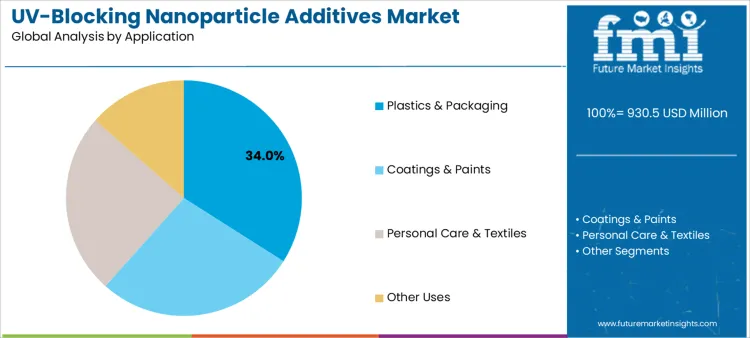
Plastics and packaging hold 34% share of the UV-blocking nanoparticle additives market because polymer materials are highly susceptible to UV-induced aging, yellowing, and loss of structural integrity. Packaging applications require UV protection to preserve product appearance, extend shelf life, and maintain material performance during storage, transport, and outdoor exposure. UV-blocking nanoparticles help stabilize packaging films, containers, and molded plastics without significantly affecting transparency or mechanical strength. High production volumes in food, beverage, consumer goods, and industrial packaging drive consistent demand. These performance requirements and scale of use explain why plastics and packaging remain the leading application segment.
What Are the Key Dynamics of the UV-Blocking Nanoparticle Additives Market?
The UV-blocking nanoparticle additives market is propelled by rising demand for advanced materials that protect products and surfaces from ultraviolet radiation degradation. UV-blocking nanoparticles such as nano-TiO₂, ZnO, and other engineered nanoscale UV absorbers enhance UV resistance while maintaining transparency and mechanical integrity in coatings, plastics, films, and textiles. Growth in end-use industries including automotive, construction, electronics, and packaging amplifies demand for durable, weather-resistant materials. Sustainability trends emphasizing longer product lifetimes and reduced maintenance costs further support adoption. For suppliers and formulators, nanoparticle size distribution, surface treatment, and dispersion quality are key determinants of performance and long-term market uptake.
How Do Application Trends and Industry Requirements Shape This Market?
Application trends and industry requirements are shaping the UV-blocking nanoparticle additives market as manufacturers seek solutions that combine high UV protection with minimal impact on optical clarity and processability. In packaging films and plastics, UV-blocking nanoparticles protect sensitive contents (e.g., food, pharmaceuticals) from photodegradation while preserving visual appeal. In coatings and paints, they extend substrate life by mitigating UV-induced discoloration and mechanical breakdown. Textile and apparel applications leverage UV-blocking nanoparticles to enhance wearer protection in outdoor environments. Consistent quality, compatibility with diverse polymer matrices, and regulatory approvals for safety and environmental compliance are essential to meet stringent application standards.
Why Do Cost, Dispersion, and Regulatory Challenges Restrain Market Growth?
Cost, dispersion, and regulatory challenges restrain growth in the UV-blocking nanoparticle additives market, particularly in cost-sensitive or highly regulated segments. Producing uniformly sized, surface-treated nanoparticles with controlled UV absorption characteristics involves complex, energy-intensive processes that elevate material costs. Achieving stable dispersion in polymers and coatings remains technically demanding, and poor dispersion can compromise optical clarity, mechanical performance, and UV efficacy. Regulatory scrutiny around nanoparticle safety and environmental impact also adds compliance complexity and time to market qualification. In price-competitive segments, conventional UV stabilizers or macro-scale additives often remain preferred due to lower cost and simpler processing.
How Is the UV-Blocking Nanoparticle Additives Market Growing Across Key Countries?
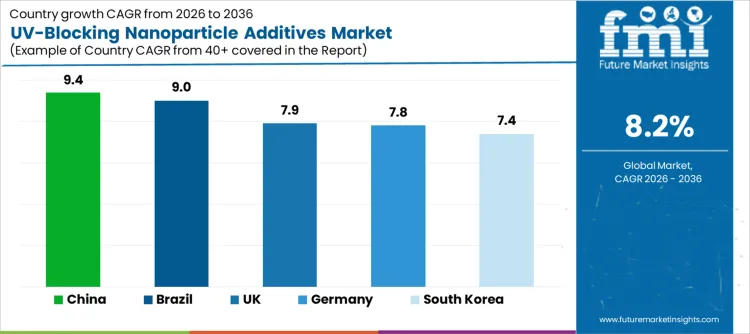
The UV-blocking nanoparticle additives market is expanding steadily as packaging, coatings, plastics, and personal care manufacturers seek effective protection against ultraviolet radiation without compromising transparency or mechanical performance. Nanoparticles such as titanium dioxide, zinc oxide, and silica-based UV absorbers are widely used to prevent discoloration, material degradation, and loss of functional properties under prolonged UV exposure. Country-wise growth varies based on packaging volumes, outdoor application demand, and adoption of advanced material technologies. High-growth markets are driven by large consumer goods and construction sectors, while mature regions focus on controlled particle size, dispersion stability, and long-term UV protection efficiency.
| Country | CAGR (%) |
|---|---|
| China | 9.4 |
| Brazil | 9.0 |
| United Kingdom | 7.9 |
| Germany | 7.8 |
| South Korea | 7.4 |
Why Is China Leading the UV-Blocking Nanoparticle Additives Market?
China’s UV-blocking nanoparticle additives market is expanding at a CAGR of 9.4% during 2026-2036, driven by strong demand from packaging films, construction materials, automotive plastics, and industrial coatings. UV-blocking additives are widely incorporated into plastic films, molded components, and coatings to prevent discoloration and material degradation caused by prolonged sun exposure. Rapid expansion of consumer goods packaging and outdoor infrastructure supports sustained demand. Chinese manufacturers prioritize nanoparticle additives that offer high UV absorption efficiency, fine particle dispersion, and compatibility with polyethylene, polypropylene, and engineering plastics. Domestic suppliers benefit from large-scale nanoparticle production capacity and cost-competitive formulations, enabling broad adoption across high-volume applications. Procurement decisions emphasize additive consistency, dispersion quality, and performance under high-temperature processing.
Why Is Brazil Emerging as a High-Growth Market for UV-Blocking Nanoparticle Additives?
Brazil’s UV-blocking nanoparticle additives market is growing at a CAGR of 9.0% during 2026-2036, supported by demand from packaging, construction materials, agricultural films, and automotive components. High UV exposure levels increase the need for additives that protect plastics and coatings from degradation and color fading. Brazilian buyers value nanoparticle additives that provide durable UV protection while maintaining material clarity and mechanical strength. Adoption is strong in agricultural films, food packaging, and outdoor building materials. Cost-performance balance remains an important purchasing factor. Procurement decisions often favor suppliers offering technical formulation support, reliable regional supply, and compatibility with locally processed polymers. Market growth is supported by construction activity, expanding packaged food consumption, and increasing use of UV-protected materials in outdoor applications.
What Is Driving Demand for UV-Blocking Nanoparticle Additives in the United Kingdom?
The United Kingdom UV-blocking nanoparticle additives market is expanding at a CAGR of 7.9% during 2026-2036, driven by demand from packaging films, architectural coatings, and specialty plastics. UV protection is critical for maintaining appearance and performance of materials used in retail packaging and outdoor applications. UK manufacturers emphasize controlled particle size, uniform dispersion, and predictable UV absorption behavior. Demand is strongest in premium packaging and specialty coating formulations rather than commodity plastics. Procurement decisions prioritize supplier reliability, technical documentation, and repeatable performance. Market growth is reinforced by steady demand for high-quality packaging and durable construction materials.
How Is Germany Supporting Growth in the UV-Blocking Nanoparticle Additives Market?
Germany’s UV-blocking nanoparticle additives market is growing at a CAGR of 7.8% during 2026-2036, supported by demand from automotive plastics, industrial coatings, and high-performance polymer applications. German manufacturers focus on long-term material stability and precision performance. Buyers prioritize additives with narrow particle size distribution, high dispersion stability, and compatibility with advanced polymer systems. Adoption is driven by performance optimization rather than volume growth. Procurement decisions favor suppliers with strong quality systems, certified material performance, and technical customization capabilities. Market growth is reinforced by Germany’s focus on advanced materials and precision manufacturing.
How Is South Korea Expanding Use of UV-Blocking Nanoparticle Additives?
South Korea’s UV-blocking nanoparticle additives market is expanding at a CAGR of 7.4% during 2026-2036, driven by demand from electronics housings, packaging films, and industrial plastics. UV protection is increasingly required to maintain surface appearance and functional integrity of high-value products. South Korean manufacturers emphasize nanoparticle purity, dispersion consistency, and compatibility with automated processing. Adoption is strongest in export-oriented packaging and electronics-related applications. Procurement decisions are influenced by supplier technical capability, product consistency, and alignment with advanced manufacturing standards. Market growth is supported by steady industrial output and continued adoption of functional nanoparticle additives.
How are Companies Competing in the UV-Blocking Nanoparticle Additives Market?
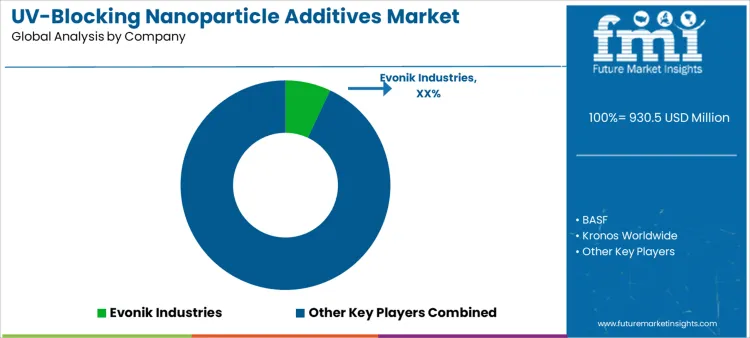
Competition in the UV-blocking nanoparticle additives market centers on photoprotection performance, nanoparticle dispersion quality, and compatibility with diverse end uses such as coatings, plastics, films, and personal care products. UV-blocking additives improve material durability, color stability, and product longevity by absorbing or scattering harmful ultraviolet radiation. Suppliers differentiate through engineered particle chemistries, surface modifications that enhance dispersion, and documented performance in target applications.
Evonik Industries positions its nanoparticle additives with products engineered for strong UV absorption and stable dispersion in polymers and coatings. Its materials emphasize minimized agglomeration and controlled particle surface treatments that support consistent performance and optical clarity. BASF competes with a broad portfolio of UV-blocking solutions that span inorganic nanoparticles and hybrid additive systems, targeting high-performance industrial and consumer coatings. It’s positioning highlights compatibility with demanding coating chemistries and robust UV protection across exposure conditions.
Titanium dioxide specialists and pigment leaders add depth to competitive dynamics. Kronos Worldwide and Tronox differentiate through high-grade TiO₂ nanoparticles with tailored surface treatments that enhance UV scattering and protective performance in plastics and coatings. Altana contributes through engineered UV-blocking additives integrated with overall coating performance solutions.
Specialty and regional players further diversify the field. Croda International focuses on nanoparticle additives designed for personal care and polymer protection, while Sachtleben Chemie offers finely tuned UV-blocking fillers for coatings. Ishihara Sangyo Kaisha frames its UV additives around dispersion quality and minimal impact on optical properties. Huntsman Corporation (TiO₂ legacy business) competes on high-performance titanium dioxide grades, and BYK Chemie rounds out the market with functional additives that enhance both UV protection and coating rheology. Across players, competitive advantage is defined by verified UV-blocking efficacy, product formulation support, and scalability rather than additive cost alone.
Key Players in UV-Blocking Nanoparticle Additives Market
- Evonik Industries
- BASF
- Kronos Worldwide
- Tronox
- Altana
- Croda International
- Sachtleben Chemie
- Ishihara Sangyo Kaisha
- Huntsman Corporation (TiO₂ legacy business)
- BYK-Chemie
Scope of Report
| Attribute | Details |
|---|---|
| Market Size Unit | USD Million |
| Nanoparticle Type Covered | Titanium Dioxide Nanoparticles, Zinc Oxide Nanoparticles, Other Nano-UV Absorbers |
| Application Covered | Plastics & Packaging, Coatings & Paints, Personal Care & Textiles, Other Uses |
| Countries Covered | China, Japan, South Korea, India, Australia & New Zealand, ASEAN, Rest of Asia Pacific, Germany, United Kingdom, France, Italy, Spain, Nordic, BENELUX, Rest of Europe, United States, Canada, Mexico, Brazil, Chile, Rest of Latin America, Kingdom of Saudi Arabia, Other GCC Countries, Turkey, South Africa, Other African Union, Rest of Middle East & Africa |
| Regions Covered | Asia Pacific, Europe, North America, Latin America, Middle East & Africa |
| Key Companies Profiled | Evonik Industries, BASF, Kronos Worldwide, Tronox, Altana, Croda International, Sachtleben Chemie, Ishihara Sangyo Kaisha, Huntsman Corporation, BYK-Chemie |
| Additional Attributes | Dollar sales of UV-blocking nanoparticle additives are analyzed by nanoparticle type and end-use application across polymer, coating, and personal care formulations. The scope evaluates UV absorption efficiency, particle size control, dispersion stability, transparency retention, and compatibility with organic matrices. Country-level analysis reflects regulatory standards on UV protection, growth in packaging and coatings demand, rising use of functional nanoparticles in personal care and textile applications, and increasing emphasis on durability and weather resistance in end-use products. |
UV-Blocking Nanoparticle Additives Market by Key Segments
Nanoparticle Type:
- Titanium Dioxide Nanoparticles
- Zinc Oxide Nanoparticles
- Other Nano-UV Absorbers
Application:
- Plastics & Packaging
- Coatings & Paints
- Personal Care & Textiles
- Other Uses
Region:
- Asia Pacific
- China
- Japan
- South Korea
- India
- Australia & New Zealand
- ASEAN
- Rest of Asia Pacific
- Europe
- Germany
- United Kingdom
- France
- Italy
- Spain
- Nordic
- BENELUX
- Rest of Europe
- North America
- United States
- Canada
- Mexico
- Latin America
- Brazil
- Chile
- Rest of Latin America
- Middle East & Africa
- Kingdom of Saudi Arabia
- Other GCC Countries
- Turkey
- South Africa
- Other African Union
- Rest of Middle East & Africa
Bibliography
- International Organization for Standardization. (2023). ISO/TR 13014: Nanotechnologies—Guidance on physicochemical characterization of engineered nanoscale materials for industrial applications. ISO.
- Organisation for Economic Co-operation and Development. (2024). Assessment of manufactured nanomaterials: Environmental, health, and safety considerations for polymer and coating applications. OECD Publishing.
- Food and Agriculture Organization of the United Nations. (2023). Food‑contact materials and functional additives: Safety considerations for ultraviolet‑protective packaging systems. FAO.
Frequently Asked Questions
How big is the uv-blocking nanoparticle additives market in 2026?
The global uv-blocking nanoparticle additives market is estimated to be valued at USD 930.5 million in 2026.
What will be the size of uv-blocking nanoparticle additives market in 2036?
The market size for the uv-blocking nanoparticle additives market is projected to reach USD 2,046.4 million by 2036.
How much will be the uv-blocking nanoparticle additives market growth between 2026 and 2036?
The uv-blocking nanoparticle additives market is expected to grow at a 8.2% CAGR between 2026 and 2036.
What are the key product types in the uv-blocking nanoparticle additives market?
The key product types in uv-blocking nanoparticle additives market are titanium dioxide nanoparticles, zinc oxide nanoparticles and other nano-uv absorbers.
Which application segment to contribute significant share in the uv-blocking nanoparticle additives market in 2026?
In terms of application, plastics & packaging segment to command 34.0% share in the uv-blocking nanoparticle additives market in 2026.
Preview the report firsthand - request a free sample
Get SampleGet the brochure for pricing and purchase details.
Get PDFTable of Content
- Executive Summary
- Global Market Outlook
- Demand-side Trends
- Supply-side Trends
- Technology Roadmap Analysis
- Analysis and Recommendations
- Market Overview
- Market Coverage / Taxonomy
- Market Definition / Scope / Limitations
- Market Background
- Market Dynamics
- Drivers
- Restraints
- Opportunity
- Trends
- Scenario Forecast
- Demand in Optimistic Scenario
- Demand in Likely Scenario
- Demand in Conservative Scenario
- Opportunity Map Analysis
- Product Life Cycle Analysis
- Supply Chain Analysis
- Investment Feasibility Matrix
- Value Chain Analysis
- PESTLE and Porter’s Analysis
- Regulatory Landscape
- Regional Parent Market Outlook
- Production and Consumption Statistics
- Import and Export Statistics
- Market Dynamics
- Global Market Analysis 2021 to 2025 and Forecast, 2026 to 2036
- Historical Market Size Value (USD Million) Analysis, 2021 to 2025
- Current and Future Market Size Value (USD Million) Projections, 2026 to 2036
- Y-o-Y Growth Trend Analysis
- Absolute $ Opportunity Analysis
- Global Market Pricing Analysis 2021 to 2025 and Forecast 2026 to 2036
- Global Market Analysis 2021 to 2025 and Forecast 2026 to 2036, By Nanoparticle Type
- Introduction / Key Findings
- Historical Market Size Value (USD Million) Analysis By Nanoparticle Type , 2021 to 2025
- Current and Future Market Size Value (USD Million) Analysis and Forecast By Nanoparticle Type , 2026 to 2036
- Titanium Dioxide Nanoparticles
- Zinc Oxide Nanoparticles
- Other Nano-UV Absorbers
- Titanium Dioxide Nanoparticles
- Y-o-Y Growth Trend Analysis By Nanoparticle Type , 2021 to 2025
- Absolute $ Opportunity Analysis By Nanoparticle Type , 2026 to 2036
- Global Market Analysis 2021 to 2025 and Forecast 2026 to 2036, By Application
- Introduction / Key Findings
- Historical Market Size Value (USD Million) Analysis By Application, 2021 to 2025
- Current and Future Market Size Value (USD Million) Analysis and Forecast By Application, 2026 to 2036
- Plastics & Packaging
- Coatings & Paints
- Personal Care & Textiles
- Other Uses
- Plastics & Packaging
- Y-o-Y Growth Trend Analysis By Application, 2021 to 2025
- Absolute $ Opportunity Analysis By Application, 2026 to 2036
- Global Market Analysis 2021 to 2025 and Forecast 2026 to 2036, By Region
- Introduction
- Historical Market Size Value (USD Million) Analysis By Region, 2021 to 2025
- Current Market Size Value (USD Million) Analysis and Forecast By Region, 2026 to 2036
- North America
- Latin America
- Western Europe
- Eastern Europe
- East Asia
- South Asia and Pacific
- Middle East & Africa
- Market Attractiveness Analysis By Region
- North America Market Analysis 2021 to 2025 and Forecast 2026 to 2036, By Country
- Historical Market Size Value (USD Million) Trend Analysis By Market Taxonomy, 2021 to 2025
- Market Size Value (USD Million) Forecast By Market Taxonomy, 2026 to 2036
- By Country
- USA
- Canada
- Mexico
- By Nanoparticle Type
- By Application
- By Country
- Market Attractiveness Analysis
- By Country
- By Nanoparticle Type
- By Application
- Key Takeaways
- Latin America Market Analysis 2021 to 2025 and Forecast 2026 to 2036, By Country
- Historical Market Size Value (USD Million) Trend Analysis By Market Taxonomy, 2021 to 2025
- Market Size Value (USD Million) Forecast By Market Taxonomy, 2026 to 2036
- By Country
- Brazil
- Chile
- Rest of Latin America
- By Nanoparticle Type
- By Application
- By Country
- Market Attractiveness Analysis
- By Country
- By Nanoparticle Type
- By Application
- Key Takeaways
- Western Europe Market Analysis 2021 to 2025 and Forecast 2026 to 2036, By Country
- Historical Market Size Value (USD Million) Trend Analysis By Market Taxonomy, 2021 to 2025
- Market Size Value (USD Million) Forecast By Market Taxonomy, 2026 to 2036
- By Country
- Germany
- UK
- Italy
- Spain
- France
- Nordic
- BENELUX
- Rest of Western Europe
- By Nanoparticle Type
- By Application
- By Country
- Market Attractiveness Analysis
- By Country
- By Nanoparticle Type
- By Application
- Key Takeaways
- Eastern Europe Market Analysis 2021 to 2025 and Forecast 2026 to 2036, By Country
- Historical Market Size Value (USD Million) Trend Analysis By Market Taxonomy, 2021 to 2025
- Market Size Value (USD Million) Forecast By Market Taxonomy, 2026 to 2036
- By Country
- Russia
- Poland
- Hungary
- Balkan & Baltic
- Rest of Eastern Europe
- By Nanoparticle Type
- By Application
- By Country
- Market Attractiveness Analysis
- By Country
- By Nanoparticle Type
- By Application
- Key Takeaways
- East Asia Market Analysis 2021 to 2025 and Forecast 2026 to 2036, By Country
- Historical Market Size Value (USD Million) Trend Analysis By Market Taxonomy, 2021 to 2025
- Market Size Value (USD Million) Forecast By Market Taxonomy, 2026 to 2036
- By Country
- China
- Japan
- South Korea
- By Nanoparticle Type
- By Application
- By Country
- Market Attractiveness Analysis
- By Country
- By Nanoparticle Type
- By Application
- Key Takeaways
- South Asia and Pacific Market Analysis 2021 to 2025 and Forecast 2026 to 2036, By Country
- Historical Market Size Value (USD Million) Trend Analysis By Market Taxonomy, 2021 to 2025
- Market Size Value (USD Million) Forecast By Market Taxonomy, 2026 to 2036
- By Country
- India
- ASEAN
- Australia & New Zealand
- Rest of South Asia and Pacific
- By Nanoparticle Type
- By Application
- By Country
- Market Attractiveness Analysis
- By Country
- By Nanoparticle Type
- By Application
- Key Takeaways
- Middle East & Africa Market Analysis 2021 to 2025 and Forecast 2026 to 2036, By Country
- Historical Market Size Value (USD Million) Trend Analysis By Market Taxonomy, 2021 to 2025
- Market Size Value (USD Million) Forecast By Market Taxonomy, 2026 to 2036
- By Country
- Kingdom of Saudi Arabia
- Other GCC Countries
- Turkiye
- South Africa
- Other African Union
- Rest of Middle East & Africa
- By Nanoparticle Type
- By Application
- By Country
- Market Attractiveness Analysis
- By Country
- By Nanoparticle Type
- By Application
- Key Takeaways
- Key Countries Market Analysis
- USA
- Pricing Analysis
- Market Share Analysis, 2025
- By Nanoparticle Type
- By Application
- Canada
- Pricing Analysis
- Market Share Analysis, 2025
- By Nanoparticle Type
- By Application
- Mexico
- Pricing Analysis
- Market Share Analysis, 2025
- By Nanoparticle Type
- By Application
- Brazil
- Pricing Analysis
- Market Share Analysis, 2025
- By Nanoparticle Type
- By Application
- Chile
- Pricing Analysis
- Market Share Analysis, 2025
- By Nanoparticle Type
- By Application
- Germany
- Pricing Analysis
- Market Share Analysis, 2025
- By Nanoparticle Type
- By Application
- UK
- Pricing Analysis
- Market Share Analysis, 2025
- By Nanoparticle Type
- By Application
- Italy
- Pricing Analysis
- Market Share Analysis, 2025
- By Nanoparticle Type
- By Application
- Spain
- Pricing Analysis
- Market Share Analysis, 2025
- By Nanoparticle Type
- By Application
- France
- Pricing Analysis
- Market Share Analysis, 2025
- By Nanoparticle Type
- By Application
- India
- Pricing Analysis
- Market Share Analysis, 2025
- By Nanoparticle Type
- By Application
- ASEAN
- Pricing Analysis
- Market Share Analysis, 2025
- By Nanoparticle Type
- By Application
- Australia & New Zealand
- Pricing Analysis
- Market Share Analysis, 2025
- By Nanoparticle Type
- By Application
- China
- Pricing Analysis
- Market Share Analysis, 2025
- By Nanoparticle Type
- By Application
- Japan
- Pricing Analysis
- Market Share Analysis, 2025
- By Nanoparticle Type
- By Application
- South Korea
- Pricing Analysis
- Market Share Analysis, 2025
- By Nanoparticle Type
- By Application
- Russia
- Pricing Analysis
- Market Share Analysis, 2025
- By Nanoparticle Type
- By Application
- Poland
- Pricing Analysis
- Market Share Analysis, 2025
- By Nanoparticle Type
- By Application
- Hungary
- Pricing Analysis
- Market Share Analysis, 2025
- By Nanoparticle Type
- By Application
- Kingdom of Saudi Arabia
- Pricing Analysis
- Market Share Analysis, 2025
- By Nanoparticle Type
- By Application
- Turkiye
- Pricing Analysis
- Market Share Analysis, 2025
- By Nanoparticle Type
- By Application
- South Africa
- Pricing Analysis
- Market Share Analysis, 2025
- By Nanoparticle Type
- By Application
- USA
- Market Structure Analysis
- Competition Dashboard
- Competition Benchmarking
- Market Share Analysis of Top Players
- By Regional
- By Nanoparticle Type
- By Application
- Competition Analysis
- Competition Deep Dive
- Evonik Industries
- Overview
- Product Portfolio
- Profitability by Market Segments (Product/Age /Sales Channel/Region)
- Sales Footprint
- Strategy Overview
- Marketing Strategy
- Product Strategy
- Channel Strategy
- BASF
- Kronos Worldwide
- Tronox
- Altana
- Croda International
- Sachtleben Chemie
- Ishihara Sangyo Kaisha
- Huntsman Corporation (TiO₂ legacy business)
- BYK-Chemie
- Evonik Industries
- Competition Deep Dive
- Assumptions & Acronyms Used
- Research Methodology


