

- Industry Size (2026)
- USD 799.4 Mn
- Forecast (2036)
- USD 1981.1 Mn
- CAGR (2026 to 2036)
- 9.5%
Compostable Spunbond Nonwoven Filament Fiber Market Forecast and Outlook 2026 to 2036
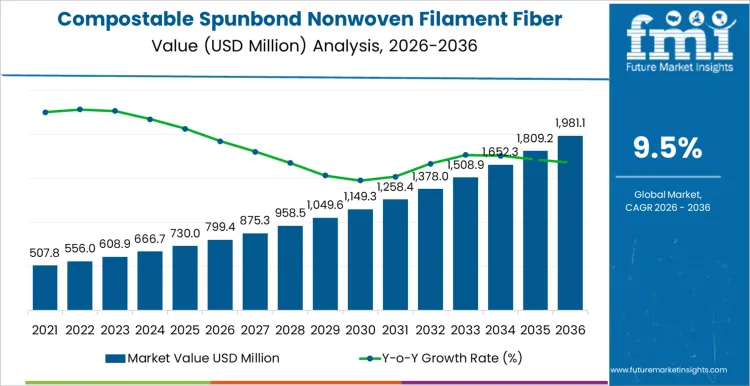
Spending on compostable spunbond nonwoven filament fiber is projected to grow from USD 799.4 million in 2026 to USD 1,981.1 million by 2036, registering a CAGR of 9.5% over the period. Demand formation follows disposal route definitions, compostability labeling rules, and municipal acceptance standards rather than procurement price targets. Product owners lock fiber systems during packaging and hygiene product architecture work based on certification scope, mechanical performance limits, and line compatibility. Once a product format enters certified status, later material replacement requires renewed testing and labeling authorization. Volume growth follows wider use in food service, single-use packaging, and hygiene products governed by regulated end-of-life pathways.
Access to the compostable spunbond nonwoven filament fiber market is controlled through certification schemes, audit regimes, and approved construction lists. Brand owners and retailers determine qualification timing through compliance calendars and portfolio renewal plans. Product families remain stable across extended lifecycles due to labeling commitments and waste handling claims. Supplier participation depends on inclusion in approved material architectures rather than on short-term converter preference. Revenue progression reflects the number of product lines converted to certified compostable structures. Competitive position depends on early involvement in product definition programs and sustained acceptance within material systems recognized by certification bodies and retail groups.
Compostable Spunbond Nonwoven Filament Fiber Market Quick Stats
- Compostable Spunbond Nonwoven Filament Fiber Market Value (2026): USD 799.4 million
- Compostable Spunbond Nonwoven Filament Fiber Market Forecast Value (2036): USD 1,981.1 million
- Compostable Spunbond Nonwoven Filament Fiber Market Forecast CAGR (2026-2036): 9.5%
- Leading Type in Compostable Spunbond Nonwoven Filament Fiber Market: PLA & PLA blends
- Key Growth Regions in Compostable Spunbond Nonwoven Filament Fiber Market: China, USA, Germany, South Korea, Japan
- Top Players in Compostable Spunbond Nonwoven Filament Fiber Market: Berry Global, Ahlstrom, Mondi, Toray Advanced Materials, Fitesa, Avgol, PEGAS Nonwovens, Kimberly-Clark (internal), Freudenberg Performance Materials, TWE Group
What is the Growth Forecast for the Compostable Spunbond Nonwoven Filament Fiber Market through 2036?
The compostable spunbond nonwoven filament fiber market in 2026 stands near USD 799.4 million, shaped by procurement rules that tie material choice to end of life treatment routes. Buyers treat this fiber as a system input that affects certification, waste handling contracts, and product labeling. Line managers focus on draw stability, basis weight control, and bonding response under existing spunbond equipment. Grade approval depends on web uniformity, tensile retention, and run speed consistency. Volume expands inside hygiene, wipes, and single use technical products that carry disposal obligations. The path to USD 1,981.1 million in 2036 follows a 9.50% growth profile built on wider platform adoption and higher filament content per square meter of finished web.
Operating discipline sets the commercial rhythm of the compostable spunbond nonwoven filament fiber market. Orders align with long production campaigns and brand program lifetimes. Inventory policy favors continuity of certified grades and predictable lot behavior. Cost structure reflects polymer supply contracts, spinning yield, filtration load, and waste rates during startups. Technical teams at converter sites value stable web formation and low break frequency over marginal price differences. Annual values move into the mid and upper one billions during the early 2030s as more product families convert base materials. The rise to USD 1,981.1 million in 2036 comes from thicker webs, broader use across disposables, and longer supply agreements that place this fiber into fixed material specifications across multiple product lines.
Compostable Spunbond Nonwoven Filament Fiber Market Key Takeaways
| Metric | Value |
|---|---|
| Market Value (2026) | USD 799.4 million |
| Forecast Value (2036) | USD 1,981.1 million |
| Forecast CAGR (2026-2036) | 9.5% |
How Is the Compostable Spunbond Nonwoven Filament Fiber Market Being Qualified for Process Stability and End Use Approval?
The compostable spunbond nonwoven filament fiber market operates inside production systems that already depend on industrial compostable plastics standards, nonwoven hygiene substrates, biodegradable packaging films, agricultural mulch fabrics, polymer melt spinning lines, compostability certification services, and waste stream sorting systems. Producers separate structural performance from end of life behavior through polymer selection and filament geometry. Qualification focuses on melt stability, filament laydown uniformity, and bonding response because small shifts change basis weight control and tensile spread. Spunbond operators track pressure balance and quench conditions since both affect web cohesion. Converters review linting and tear behavior for target uses. Purchasing teams examine certificate scope, batch traceability, and resin origin because nonconforming material blocks shipment approval and downstream claims validation across regulated channels.
The compostable spunbond nonwoven filament fiber market is governed through manufacturing control frameworks and compliance verification mechanisms rather than sustainability storytelling. Validation pathways aligned with industrial compostability benchmarks condition approval on recorded extrusion consistency and forecastable breakdown performance. Operations supplying hygienic nonwoven applications assess output value using roll integrity metrics and defect screening results. Material streams directed toward compostable flexible packaging correlate filament selection with heat-seal efficiency and resistance to transport-related damage. Deployment within crop protection textiles prioritizes functional lifespan under predetermined soil and climate exposure limits. Governance of continuous melt-spinning equipment directly influences productivity ratios and changeover waste volumes. Supervision conducted by independent certification bodies establishes boundaries for formulation variance. Interaction with post-use sorting infrastructure determines marking protocols and material separation compliance. Commercial agreements codify tolerance thresholds for rheology, filament robustness, and fragmentation response, as shipment authorization relies on verifiable adherence records.
How do certification scope and process windows shape demand in the Compostable Spunbond Nonwoven Filament Fiber Market by polymer and application in 2026?
In the Compostable Spunbond Nonwoven Filament Fiber Market, specifications start from compostability claims, residue limits, and chain of custody rather than from resin price lists. Programs supplying hygiene and wipes converting, single use packaging films, and agricultural ground cover fabrics require fibers that pass disintegration and ecotoxicity screens without narrowing draw and quench windows. By polymer, usage spans pla and pla blends, pbs and pbat blends, pha and co polyesters, and other compostable systems, each with different melt stability and crystallization behavior. By application, consumption covers hygiene and wipes, packaging and single use products, agriculture and landscaping, and other nonwoven uses. Once a construction is written into technical files and labeling, substitution triggers requalification and customer approvals, which stabilizes portfolios and favors incremental scale within approved windows.
Why do pla families set the reference point for polymer selection?
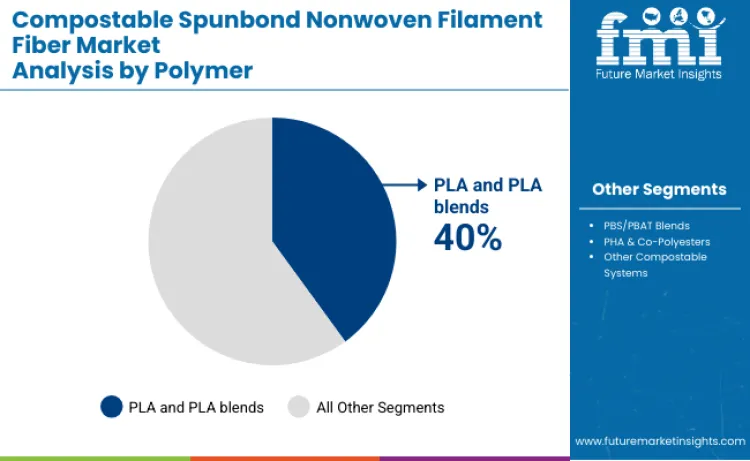
PLA and PLA blends hold about 40% share because they offer a workable balance between melt strength, draw stability, and claim documentation across many lines. In the Compostable Spunbond Nonwoven Filament Fiber Market, producers serving hygiene and wipes converting and medical disposable nonwovens need fibers that tolerate long runs and keep filament laydown uniform. PLA systems fit existing spinnerets and calenders without forcing new temperature maps. PBS and PBAT blends address designs that need higher ductility and tear resistance in single use packaging films and food contact packaging formats, yet these blends narrow the safe processing window and raise moisture control requirements. PHA and co polyesters support niche programs tied to agricultural mulch films and controlled biodegradation materials where end of life behavior drives the brief. Other compostable systems remain tied to limited recipes. Polymer choice is reviewed through quench stability, filament break rate, and bond response. Quality teams review claim scope and batch identity. Operations teams review uptime and scrap. A family that satisfies all three becomes the standard. Substitution forces new trials, new audits, and new labels. That sequence keeps pla at the center while growth arrives through denier sets and web weights inside the same chemistry rather than frequent switches.
How do use conditions and audit rules lock in application demand?
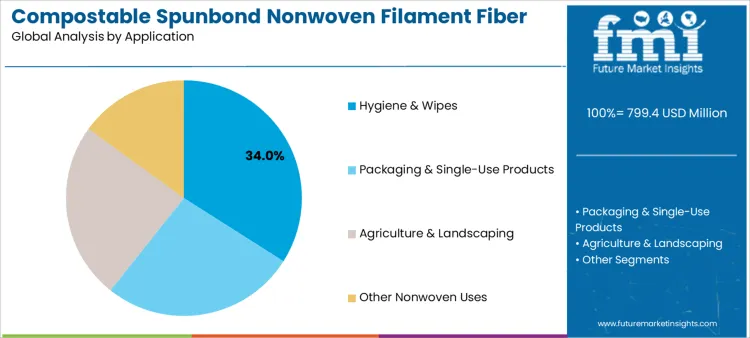
Hygiene and wipes account for about 34% of demand because these products combine high volumes with strict claim review and disposal expectations. In the Compostable Spunbond Nonwoven Filament Fiber Market, converters supplying infant care absorbent products and household cleaning wipes write control plans that link basis weight, tensile, and disintegration results to lot identity. Packaging and single use products follow where shelf life and printability are reviewed alongside compostability in retail ready packaging formats. Agriculture and landscaping use fibers in crop protection textiles and erosion control fabrics where soil contact and seasonal exposure define acceptance. Other nonwoven uses remain equipment specific. Application choice is evaluated through forming speed, bonding profile, and downstream converting yield. Compliance teams define sampling and record retention. Once a route clears these gates, the application becomes fixed to a narrow window. Changing the fiber resets trials and customer files. Schedules protect the approved window. Orders grow by adding width and shifts rather than changing recipes. Demand stays anchored in uses where audit scope and disposal pathway are written into specifications.
Why Are End-Use Material Criteria Supporting Growth in the Compostable Spunbond Nonwoven Filament Fiber Market?
Compostable Spunbond Nonwoven Filament Fiber Market demand is driven by product performance requirements where biodegradation after service life reduces waste handling burdens for brands and converters. Categories such as single-use hygiene products, agricultural covers, and disposable wipes need fibers that can produce strong, uniform nonwoven webs yet transition to fragmentation in controlled compost environments. Film and web producers assess compostable filament fibers for consistent tensile strength, bonding behavior, and basis weight control to preserve productivity and product quality. Procurement teams prioritize reliable supply of polymer feedstocks and filament production runs that deliver minimal breakage, stable throughput, and predictable bonding windows across line speeds.
What Factors Are Restricting Adoption and Scale in the Compostable Spunbond Nonwoven Filament Fiber Market?
Compostable Spunbond Nonwoven Filament Fiber Market growth is limited by feedstock cost dispersion, process sensitivity, and qualification cycles required by converters and brand owners. Compostable polymers exhibit distinct melt and flow behavior compared with conventional polyolefins, which requires adjustments in spinning, quenching, draw, and bonding conditions. Achieving uniform filament diameter and molecular orientation at production speeds affects web integrity and conversion efficiency. Buyers in price-competitive categories evaluate cost differences between compostable filament fibers and established alternatives, often postponing adoption until performance risk is fully mitigated. Quality control across polymer lots and filament production batches remains critical to avoid web defects and line stoppages.
How Are Product Strategies and Supply Practices Shaping the Compostable Spunbond Nonwoven Filament Fiber Market?
Compostable Spunbond Nonwoven Filament Fiber Market offerings are being categorized by defined melt point windows and compatibility attributes that simplify selection for specific nonwoven applications. Producers are aligning fiber grades with known bonding technologies such as calendering and air-through bonding, helping converters match process settings without extensive trial runs. Vendors provide detailed processing guides that map filament behavior to line settings, reducing setup time and scrap. Commercial agreements increasingly secure polymer feedstock volumes and filament output commitments, improving planning for high volume converters. Support services focus on process parameter mapping and defect reduction to help customers achieve consistent quality and throughput.
What is the Demand for Compostable Spunbond Nonwoven Filament Fiber by Country?
| Country | CAGR (%) |
|---|---|
| USA | 9.2% |
| Japan | 8.0% |
| South Korea | 8.7% |
| Germany | 9.1% |
| China | 10.7% |
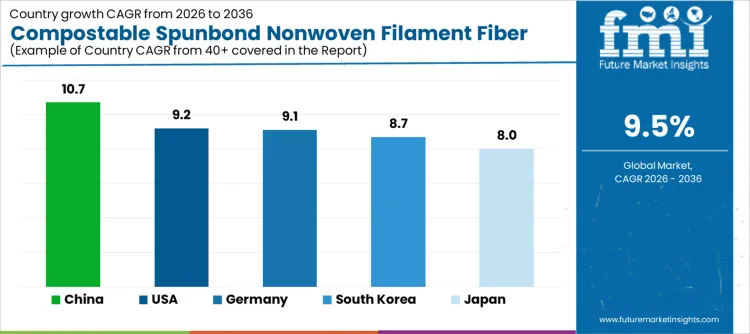
The demand for compostable spunbond nonwoven filament fiber is rising across hygiene, medical, and single use packaging applications where material disposal standards and regulatory expectations are tightening. China leads at 10.7% CAGR, supported by large scale nonwoven capacity, export oriented production, and growing use of compostable formats in consumer goods packaging. The USA grows at 9.2%, driven by adoption in wipes, medical disposables, and food service products that require certified compostable substrates. Germany records 9.1%, reflecting strong demand from packaging and hygiene segments with strict material specifications. South Korea advances at 8.7%, supported by industrial nonwovens and hygiene products. Japan posts 8.0%, within a mature but quality focused nonwoven manufacturing base.
How do process certification systems shape buy in the compostable spunbond nonwoven filament fiber market in the USA?
In the United States, the compostable spunbond nonwoven filament fiber market is advancing in line with a 9.2% CAGR. Adoption is controlled through production line approval files that define acceptable extrusion stability, bonding response, and web formation limits. Process owners evaluate filament uniformity, basis weight control, tear resistance, and thermal bonding behavior on full scale equipment. Once a fiber grade clears these trials, the same qualification package anchors downstream audits and material substitution becomes rare. Volume increases only when approved hygiene, packaging, or agricultural programs secure new supply contracts. Technical committees retain authority over any change request. Supplier access depends on documentation depth and audit performance. Inventory planning follows line loading schedules rather than spot demand. Commercial success depends on specification entry and repeatable batch behavior across several plants.
How do factory governance rules determine adoption in the compostable spunbond nonwoven filament fiber market in Japan?
Inside Japanese operations, material discipline is guiding the compostable spunbond nonwoven filament fiber market along a path consistent with an 8% CAGR. Fiber choice is treated as a manufacturing control variable rather than a sourcing decision. Any proposed change enters a formal review cycle that includes long run extrusion stability checks and web uniformity assessments. Engineers focus on filament consistency, bonding strength, lint generation, and tolerance to line speed variation. Once approved, the same fiber remains embedded in identical constructions for extended production cycles. Change requests trigger full revalidation procedures. Supplier access depends on documentation completeness and inspection outcomes. Local sources benefit from proximity to audit teams. Volume growth follows gradual portfolio renewal rather than replacement campaigns. Commercial positioning relies on consistency and disciplined process support over long operating periods.
How do platform material definitions drive scale in the compostable spunbond nonwoven filament fiber market in South Korea?
Product platform governance explains why the compostable spunbond nonwoven filament fiber market in South Korea is tracking growth consistent with an 8.7% CAGR. Development groups define standard material sets that apply across several product families. A single filament decision can affect multiple lines without separate plant approvals. Evaluation centers on melt stability, drawability, web cohesion, and run speed tolerance. When a fiber enters the platform baseline, scale follows through synchronized launches. Plant level changes remain limited because the platform file governs material use. Suppliers secure positions through joint trials and documentation alignment. Volume growth mirrors platform rollout schedules. Inventory planning aligns with coordinated startups. Commercial success depends on early inclusion in platform definitions and stable execution during multi line introductions across several manufacturing sites.
How do central approval structures control material choice in the compostable spunbond nonwoven filament fiber market in Germany?
In Germany, corporate technical governance is steering the compostable spunbond nonwoven filament fiber market in line with a 9.1% CAGR. Material access is controlled through central approval registers that apply across multiple sites. Individual plants cannot introduce new fibers independently. Reviews focus on reproducibility, process stability, and audit completeness across operations. After approval, the same fiber grade is released for use in several factories under identical process rules. Volume expansion follows program growth rather than local purchasing initiatives. Supplier positioning depends on audit performance and documentation discipline. Change control remains formal and tightly supervised. Inventory policies reflect coordinated production planning. Commercial success depends on passing central reviews and maintaining identical behavior across distributed manufacturing environments over extended production cycles.
How do replication programs and capacity expansion create volume in the compostable spunbond nonwoven filament fiber market in China?
Replication speed across manufacturing networks explains why the compostable spunbond nonwoven filament fiber market in China is advancing in line with a 10.7% CAGR. Once a fiber performs within defined extrusion and bonding limits in one plant, it moves into parallel lines with limited redesign. Approval focuses on consistency and tolerance to high speed operation rather than incremental optimization. Expansion teams rely on standardized process transfer files and commissioning checklists. Domestic suppliers dominate because they can follow capacity additions and line moves. Imports remain concentrated in higher specification uses. Volume growth comes from repeating approved constructions across sites. Commercial advantage depends on being present when a construction becomes a template rather than competing for each individual production line.
How Do Suppliers Compete in the Compostable Spunbond Nonwoven Filament Fiber Market?
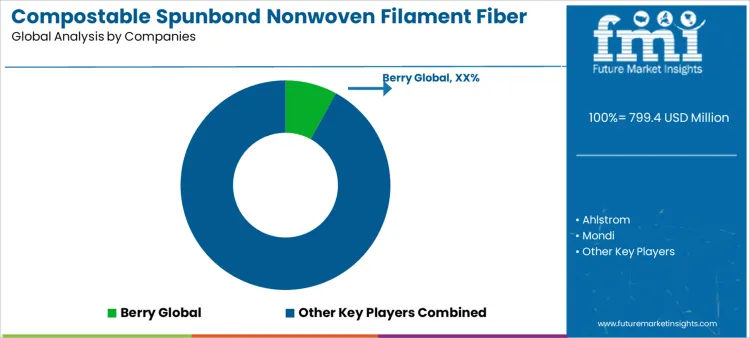
Biodegradability, filament integrity, and extrusion consistency determine adoption in the Compostable Spunbond Nonwoven Filament Fiber Market rather than catalog range. Berry Global, Ahlstrom, Mondi, Toray Advanced Materials, Fitesa, Avgol, PEGAS Nonwovens, Kimberly-Clark (internal), Freudenberg Performance Materials, and TWE Group compete during pilot extrusion, nonwoven line trials, and product qualification. Once a fiber is integrated, filament diameter uniformity, bonding efficiency, and thermal stability anchor supplier acceptance. Berry Global focuses on high-speed spunbond lines for disposable hygiene. Ahlstrom targets filtration and sustainable packaging. Mondi emphasizes industrial-scale biodegradable fibers with consistent mechanical properties. Toray Advanced Materials supplies specialty polymers for compostable nonwovens. Fitesa and Avgol provide fibers tailored for hygiene and medical applications. PEGAS Nonwovens supports flexible production across multiple line types. Kimberly-Clark integrates fibers into internal branded hygiene products. Freudenberg Performance Materials serves technical nonwoven applications. TWE Group delivers fibers optimized for large-volume biodegradable programs.
Thermal behavior, process adaptability, and sustainability verification shape competitive outcomes in the Compostable Spunbond Nonwoven Filament Fiber Market rather than price alone. R&D teams examine melt flow, filament uniformity, tensile strength, bonding characteristics, and compostability performance during validation. Manufacturing teams favor suppliers with reproducible lot quality, scalable supply, and support for nonwoven process integration. Berry Global secures adoption through large-scale line validation and technical support. Ahlstrom competes where compostable fibers must meet regulatory standards for filtration and packaging. Mondi holds positions in industrial and consumer product lines requiring mechanical consistency. Toray Advanced Materials supports specialty biodegradable polymers with predictable extrusion. Fitesa and Avgol gain placements in hygiene and medical nonwovens. PEGAS Nonwovens serves multi-line flexible production facilities. Kimberly-Clark maintains internal adoption for proprietary hygiene solutions. Freudenberg Performance Materials targets specialty technical textiles. TWE Group focuses on high-volume industrial compostable fiber applications. Market positions vary by fiber composition, end-use application, production scale, and regional sustainability regulations.
Key Players in Compostable Spunbond Nonwoven Filament Fiber Market
- Berry Global
- Ahlstrom
- Mondi
- Toray Advanced Materials
- Fitesa
- Avgol
- PEGAS Nonwovens
- Kimberly-Clark (internal)
- Freudenberg Performance Materials
- TWE Group
Scope of the Report
| Items | Values |
|---|---|
| Quantitative Units (2026) | USD million |
| Polymer | PLA and PLA blends, PBS and PBAT blends, PHA and co-polyesters, other compostable systems |
| Application | Hygiene and wipes, packaging and single-use products, agriculture and landscaping, other nonwoven uses |
| Compostability Type | Industrial compostable, home compostable, compostable-in-development |
| End Customer | Brand owners and converters, nonwoven producers, other users |
| Regions Covered | Asia Pacific, Europe, North America, Latin America, Middle East & Africa |
| Countries Covered | United States, Canada, Mexico, Germany, United Kingdom, France, Italy, Spain, Nordics, BENELUX, China, Japan, South Korea, India, Australia & New Zealand, ASEAN, Brazil, Chile, Saudi Arabia, Turkey, South Africa, and other regional markets |
| Key Companies Profiled | Berry Global, Ahlstrom, Mondi, Toray Advanced Materials, Fitesa, Avgol, PEGAS Nonwovens, Kimberly-Clark (internal), Freudenberg Performance Materials, TWE Group |
| Additional Attributes | Dollar sales by polymer, application, compostability type, and end customer, certification-driven procurement and audit-controlled adoption, integration into spunbond hygiene, packaging, and agricultural nonwoven production lines, processing constraints linked to melt stability, drawability, and bonding response, lot traceability and chain-of-custody requirements, interaction with compostability labeling rules and waste stream acceptance standards, long qualification cycles tied to product architecture, and regional demand patterns linked to replication of certified constructions across nonwoven manufacturing networks |
Compostable Spunbond Nonwoven Filament Fiber Market Segmentation
Polymer:
- PLA & PLA Blends
- PBS/PBAT Blends
- PHA & Co-Polyesters
- Other Compostable Systems
Application:
- Hygiene & Wipes
- Packaging & Single-Use Products
- Agriculture & Landscaping
- Other Nonwoven Uses
Compostability Type:
- Industrial Compostable
- Home Compostable
- Compostable-in-Development
End Customer:
- Brand Owners & Converters
- Nonwoven Producers
- Other Users
Region
- Asia Pacific
- China
- Japan
- South Korea
- India
- Australia & New Zealand
- ASEAN
- Rest of Asia Pacific
- Europe
- Germany
- United Kingdom
- France
- Italy
- Spain
- Nordic
- BENELUX
- Rest of Europe
- North America
- United States
- Canada
- Mexico
- Latin America
- Brazil
- Chile
- Rest of Latin America
- Middle East & Africa
- Kingdom of Saudi Arabia
- Other GCC Countries
- Turkey
- South Africa
- Other African Union
- Rest of Middle East & Africa
Bibliography
- International Organization for Standardization. (2023). ISO 20200:2023—Plastics—Determination of the degree of disintegration of plastic materials under composting conditions in a laboratory‑scale test. International Organization for Standardization.
- Government of India, Ministry of Environment, Forest and Climate Change. (2024). Plastic Waste Management (Amendment) Rules, 2024. Government of India.
- United Nations Environment Programme. (2024). Global waste management outlook 2024. United Nations Environment Programme.
- ASTM International. (2024). ASTM D6954‑24: Standard guide for exposing and testing plastics that degrade in the environment by a combination of oxidation and biodegradation. ASTM International.
Frequently Asked Questions
How big is the compostable spunbond nonwoven filament fiber market in 2026?
The global compostable spunbond nonwoven filament fiber market is estimated to be valued at USD 799.4 million in 2026.
What will be the size of compostable spunbond nonwoven filament fiber market in 2036?
The market size for the compostable spunbond nonwoven filament fiber market is projected to reach USD 1,981.1 million by 2036.
How much will be the compostable spunbond nonwoven filament fiber market growth between 2026 and 2036?
The compostable spunbond nonwoven filament fiber market is expected to grow at a 9.5% CAGR between 2026 and 2036.
What are the key product types in the compostable spunbond nonwoven filament fiber market?
The key product types in compostable spunbond nonwoven filament fiber market are pla & pla blends, pbs/pbat blends, pha & co-polyesters and other compostable systems.
Which application segment to contribute significant share in the compostable spunbond nonwoven filament fiber market in 2026?
In terms of application, hygiene & wipes segment to command 34.0% share in the compostable spunbond nonwoven filament fiber market in 2026.
Preview the report firsthand - request a free sample
Get SampleGet the brochure for pricing and purchase details.
Get PDFTable of Content
- Executive Summary
- Global Market Outlook
- Demand-side Trends
- Supply-side Trends
- Technology Roadmap Analysis
- Analysis and Recommendations
- Market Overview
- Market Coverage / Taxonomy
- Market Definition / Scope / Limitations
- Market Background
- Market Dynamics
- Drivers
- Restraints
- Opportunity
- Trends
- Scenario Forecast
- Demand in Optimistic Scenario
- Demand in Likely Scenario
- Demand in Conservative Scenario
- Opportunity Map Analysis
- Product Life Cycle Analysis
- Supply Chain Analysis
- Investment Feasibility Matrix
- Value Chain Analysis
- PESTLE and Porter’s Analysis
- Regulatory Landscape
- Regional Parent Market Outlook
- Production and Consumption Statistics
- Import and Export Statistics
- Market Dynamics
- Global Market Analysis 2021 to 2025 and Forecast, 2026 to 2036
- Historical Market Size Value (USD Million) Analysis, 2021 to 2025
- Current and Future Market Size Value (USD Million) Projections, 2026 to 2036
- Y-o-Y Growth Trend Analysis
- Absolute $ Opportunity Analysis
- Global Market Pricing Analysis 2021 to 2025 and Forecast 2026 to 2036
- Global Market Analysis 2021 to 2025 and Forecast 2026 to 2036, By Polymer
- Introduction / Key Findings
- Historical Market Size Value (USD Million) Analysis By Polymer , 2021 to 2025
- Current and Future Market Size Value (USD Million) Analysis and Forecast By Polymer , 2026 to 2036
- PLA & PLA Blends
- PBS/PBAT Blends
- PHA & Co-Polyesters
- Other Compostable Systems
- PLA & PLA Blends
- Y-o-Y Growth Trend Analysis By Polymer , 2021 to 2025
- Absolute $ Opportunity Analysis By Polymer , 2026 to 2036
- Global Market Analysis 2021 to 2025 and Forecast 2026 to 2036, By Application
- Introduction / Key Findings
- Historical Market Size Value (USD Million) Analysis By Application, 2021 to 2025
- Current and Future Market Size Value (USD Million) Analysis and Forecast By Application, 2026 to 2036
- Hygiene & Wipes
- Packaging & Single-Use Products
- Agriculture & Landscaping
- Other Nonwoven Uses
- Hygiene & Wipes
- Y-o-Y Growth Trend Analysis By Application, 2021 to 2025
- Absolute $ Opportunity Analysis By Application, 2026 to 2036
- Global Market Analysis 2021 to 2025 and Forecast 2026 to 2036, By Compostability Type
- Introduction / Key Findings
- Historical Market Size Value (USD Million) Analysis By Compostability Type, 2021 to 2025
- Current and Future Market Size Value (USD Million) Analysis and Forecast By Compostability Type, 2026 to 2036
- Industrial Compostable
- Home Compostable
- Compostable-in-Development
- Industrial Compostable
- Y-o-Y Growth Trend Analysis By Compostability Type, 2021 to 2025
- Absolute $ Opportunity Analysis By Compostability Type, 2026 to 2036
- Global Market Analysis 2021 to 2025 and Forecast 2026 to 2036, By End Customer
- Introduction / Key Findings
- Historical Market Size Value (USD Million) Analysis By End Customer, 2021 to 2025
- Current and Future Market Size Value (USD Million) Analysis and Forecast By End Customer, 2026 to 2036
- Brand Owners & Converters
- Nonwoven Producers
- Other Users
- Brand Owners & Converters
- Y-o-Y Growth Trend Analysis By End Customer, 2021 to 2025
- Absolute $ Opportunity Analysis By End Customer, 2026 to 2036
- Global Market Analysis 2021 to 2025 and Forecast 2026 to 2036, By Region
- Introduction
- Historical Market Size Value (USD Million) Analysis By Region, 2021 to 2025
- Current Market Size Value (USD Million) Analysis and Forecast By Region, 2026 to 2036
- North America
- Latin America
- Western Europe
- Eastern Europe
- East Asia
- South Asia and Pacific
- Middle East & Africa
- Market Attractiveness Analysis By Region
- North America Market Analysis 2021 to 2025 and Forecast 2026 to 2036, By Country
- Historical Market Size Value (USD Million) Trend Analysis By Market Taxonomy, 2021 to 2025
- Market Size Value (USD Million) Forecast By Market Taxonomy, 2026 to 2036
- By Country
- USA
- Canada
- Mexico
- By Polymer
- By Application
- By Compostability Type
- By End Customer
- By Country
- Market Attractiveness Analysis
- By Country
- By Polymer
- By Application
- By Compostability Type
- By End Customer
- Key Takeaways
- Latin America Market Analysis 2021 to 2025 and Forecast 2026 to 2036, By Country
- Historical Market Size Value (USD Million) Trend Analysis By Market Taxonomy, 2021 to 2025
- Market Size Value (USD Million) Forecast By Market Taxonomy, 2026 to 2036
- By Country
- Brazil
- Chile
- Rest of Latin America
- By Polymer
- By Application
- By Compostability Type
- By End Customer
- By Country
- Market Attractiveness Analysis
- By Country
- By Polymer
- By Application
- By Compostability Type
- By End Customer
- Key Takeaways
- Western Europe Market Analysis 2021 to 2025 and Forecast 2026 to 2036, By Country
- Historical Market Size Value (USD Million) Trend Analysis By Market Taxonomy, 2021 to 2025
- Market Size Value (USD Million) Forecast By Market Taxonomy, 2026 to 2036
- By Country
- Germany
- UK
- Italy
- Spain
- France
- Nordic
- BENELUX
- Rest of Western Europe
- By Polymer
- By Application
- By Compostability Type
- By End Customer
- By Country
- Market Attractiveness Analysis
- By Country
- By Polymer
- By Application
- By Compostability Type
- By End Customer
- Key Takeaways
- Eastern Europe Market Analysis 2021 to 2025 and Forecast 2026 to 2036, By Country
- Historical Market Size Value (USD Million) Trend Analysis By Market Taxonomy, 2021 to 2025
- Market Size Value (USD Million) Forecast By Market Taxonomy, 2026 to 2036
- By Country
- Russia
- Poland
- Hungary
- Balkan & Baltic
- Rest of Eastern Europe
- By Polymer
- By Application
- By Compostability Type
- By End Customer
- By Country
- Market Attractiveness Analysis
- By Country
- By Polymer
- By Application
- By Compostability Type
- By End Customer
- Key Takeaways
- East Asia Market Analysis 2021 to 2025 and Forecast 2026 to 2036, By Country
- Historical Market Size Value (USD Million) Trend Analysis By Market Taxonomy, 2021 to 2025
- Market Size Value (USD Million) Forecast By Market Taxonomy, 2026 to 2036
- By Country
- China
- Japan
- South Korea
- By Polymer
- By Application
- By Compostability Type
- By End Customer
- By Country
- Market Attractiveness Analysis
- By Country
- By Polymer
- By Application
- By Compostability Type
- By End Customer
- Key Takeaways
- South Asia and Pacific Market Analysis 2021 to 2025 and Forecast 2026 to 2036, By Country
- Historical Market Size Value (USD Million) Trend Analysis By Market Taxonomy, 2021 to 2025
- Market Size Value (USD Million) Forecast By Market Taxonomy, 2026 to 2036
- By Country
- India
- ASEAN
- Australia & New Zealand
- Rest of South Asia and Pacific
- By Polymer
- By Application
- By Compostability Type
- By End Customer
- By Country
- Market Attractiveness Analysis
- By Country
- By Polymer
- By Application
- By Compostability Type
- By End Customer
- Key Takeaways
- Middle East & Africa Market Analysis 2021 to 2025 and Forecast 2026 to 2036, By Country
- Historical Market Size Value (USD Million) Trend Analysis By Market Taxonomy, 2021 to 2025
- Market Size Value (USD Million) Forecast By Market Taxonomy, 2026 to 2036
- By Country
- Kingdom of Saudi Arabia
- Other GCC Countries
- Turkiye
- South Africa
- Other African Union
- Rest of Middle East & Africa
- By Polymer
- By Application
- By Compostability Type
- By End Customer
- By Country
- Market Attractiveness Analysis
- By Country
- By Polymer
- By Application
- By Compostability Type
- By End Customer
- Key Takeaways
- Key Countries Market Analysis
- USA
- Pricing Analysis
- Market Share Analysis, 2025
- By Polymer
- By Application
- By Compostability Type
- By End Customer
- Canada
- Pricing Analysis
- Market Share Analysis, 2025
- By Polymer
- By Application
- By Compostability Type
- By End Customer
- Mexico
- Pricing Analysis
- Market Share Analysis, 2025
- By Polymer
- By Application
- By Compostability Type
- By End Customer
- Brazil
- Pricing Analysis
- Market Share Analysis, 2025
- By Polymer
- By Application
- By Compostability Type
- By End Customer
- Chile
- Pricing Analysis
- Market Share Analysis, 2025
- By Polymer
- By Application
- By Compostability Type
- By End Customer
- Germany
- Pricing Analysis
- Market Share Analysis, 2025
- By Polymer
- By Application
- By Compostability Type
- By End Customer
- UK
- Pricing Analysis
- Market Share Analysis, 2025
- By Polymer
- By Application
- By Compostability Type
- By End Customer
- Italy
- Pricing Analysis
- Market Share Analysis, 2025
- By Polymer
- By Application
- By Compostability Type
- By End Customer
- Spain
- Pricing Analysis
- Market Share Analysis, 2025
- By Polymer
- By Application
- By Compostability Type
- By End Customer
- France
- Pricing Analysis
- Market Share Analysis, 2025
- By Polymer
- By Application
- By Compostability Type
- By End Customer
- India
- Pricing Analysis
- Market Share Analysis, 2025
- By Polymer
- By Application
- By Compostability Type
- By End Customer
- ASEAN
- Pricing Analysis
- Market Share Analysis, 2025
- By Polymer
- By Application
- By Compostability Type
- By End Customer
- Australia & New Zealand
- Pricing Analysis
- Market Share Analysis, 2025
- By Polymer
- By Application
- By Compostability Type
- By End Customer
- China
- Pricing Analysis
- Market Share Analysis, 2025
- By Polymer
- By Application
- By Compostability Type
- By End Customer
- Japan
- Pricing Analysis
- Market Share Analysis, 2025
- By Polymer
- By Application
- By Compostability Type
- By End Customer
- South Korea
- Pricing Analysis
- Market Share Analysis, 2025
- By Polymer
- By Application
- By Compostability Type
- By End Customer
- Russia
- Pricing Analysis
- Market Share Analysis, 2025
- By Polymer
- By Application
- By Compostability Type
- By End Customer
- Poland
- Pricing Analysis
- Market Share Analysis, 2025
- By Polymer
- By Application
- By Compostability Type
- By End Customer
- Hungary
- Pricing Analysis
- Market Share Analysis, 2025
- By Polymer
- By Application
- By Compostability Type
- By End Customer
- Kingdom of Saudi Arabia
- Pricing Analysis
- Market Share Analysis, 2025
- By Polymer
- By Application
- By Compostability Type
- By End Customer
- Turkiye
- Pricing Analysis
- Market Share Analysis, 2025
- By Polymer
- By Application
- By Compostability Type
- By End Customer
- South Africa
- Pricing Analysis
- Market Share Analysis, 2025
- By Polymer
- By Application
- By Compostability Type
- By End Customer
- USA
- Market Structure Analysis
- Competition Dashboard
- Competition Benchmarking
- Market Share Analysis of Top Players
- By Regional
- By Polymer
- By Application
- By Compostability Type
- By End Customer
- Competition Analysis
- Competition Deep Dive
- Berry Global
- Overview
- Product Portfolio
- Profitability by Market Segments (Product/Age /Sales Channel/Region)
- Sales Footprint
- Strategy Overview
- Marketing Strategy
- Product Strategy
- Channel Strategy
- Ahlstrom
- Mondi
- Toray Advanced Materials
- Fitesa
- Avgol
- PEGAS Nonwovens
- Kimberly-Clark (internal)
- Freudenberg Performance Materials
- TWE Group
- Berry Global
- Competition Deep Dive
- Assumptions & Acronyms Used
- Research Methodology


