

- Industry Size (2025)
- USD 0.5 Bn
- Forecast (2035)
- USD 0.9 Bn
- CAGR (2025 to 2035)
- 5.0%
Demand for Vacuum Shrink Bags in USA 2025 to 2035
The demand for vacuum shrink bags in the USA is valued at USD 0.5 billion in 2025 and is projected to reach USD 0.9 billion by 2035, reflecting a CAGR of 5.0%. Demand is driven by the continued focus on extending product shelf life, reducing contamination risks, and supporting cold-chain logistics for perishable goods. Food processors, meat and poultry suppliers, and dairy packaging facilities widely adopt shrink-grade barrier films to maintain freshness and preserve structural integrity during distribution.
Polyethylene (PE)-based vacuum shrink bags represent the leading category due to their durability, adaptability to automated packaging lines, and reliable heat-shrink performance. Enhanced multi-layer films with improved oxygen and moisture barriers support compliance with food-safety requirements and minimize product loss during long-distance transport. Ongoing improvements in seal strength, puncture resistance, and compatibility with recyclable material formats contribute to adoption in sustainability-oriented packaging operations.
Demand remains concentrated in the West, South, and Northeast, where large food-processing hubs, strong retail distribution networks, and expanding consumption of packaged proteins influence procurement priorities. Key suppliers include Sealed Air (Cryovac), Berry Global Inc., Winpak Ltd., Coveris, and Plastopin. Their portfolios support high-volume shrink applications in meat, seafood, and cheese packaging through materials engineered for high-clarity presentation, thermal stability, and efficient vacuum sealing performance.
Quick Stats for USA Vacuum Shrink Bags Demand
- USA Vacuum Shrink Bags Sales Value (2025): USD 0.5 billion
- USA Vacuum Shrink Bags Forecast Value (2035): USD 0.9 billion
- USA Vacuum Shrink Bags Forecast CAGR (2025-2035): 5.0%
- Leading Category in USA Vacuum Shrink Bags Demand: Polyethylene (PE)
- Key Growth Regions in USA Vacuum Shrink Bags Demand: West USA, South USA, Northeast USA
- Top Players in USA Vacuum Shrink Bags Demand: Sealed Air (Cryovac), Berry Global Inc., Winpak Ltd., Coveris, Plastopin
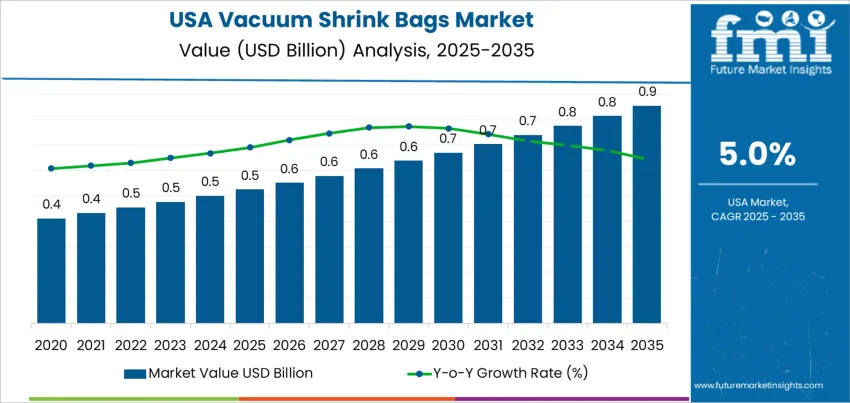
What is the Growth Forecast for Vacuum Shrink Bags Industry in USA through 2035?
Saturation dynamics for demand for vacuum shrink bags in the United States reflect wide penetration across major food processing categories. Meat, poultry, and dairy producers rely on vacuum shrink packaging to maintain shelf life and product safety, creating a mature installed base. Most large-scale processors already operate shrink packaging lines, which limits rapid acceleration in later forecast years. Growth primarily comes from replacement cycles and material upgrades rather than new system adoption.
Residual expansion potential exists in specialty foods, private-label products, and export-driven packaging where enhanced presentation and extended distribution life are required. Smaller processors continue transitioning from basic vacuum pouches to shrink bags to improve product appearance and reduce purge losses. Sustainability preferences influence incremental enhancements such as downgauged films and recyclable structures rather than major shifts in demand volume.
The saturation profile indicates that the market is approaching a high level of adoption among core food producers, leading to moderated growth. Ongoing use is tied to essential preservation functions, preventing demand from plateauing completely. Continuous operational reliance and gradual performance improvements sustain a positive though steady trajectory.
USA Vacuum Shrink Bags Key Takeaways
| Metric | Value |
|---|---|
| USA Vacuum Shrink Bags Sales Value (2025) | USD 0.5 billion |
| USA Vacuum Shrink Bags Forecast Value (2035) | USD 0.9 billion |
| USA Vacuum Shrink Bags Forecast CAGR (2025-2035) | 5.0% |
Why is the Demand for Vacuum Shrink Bags in the USA Growing?
Demand for vacuum shrink bags in the USA is increasing because food processors and meat packers require packaging that maintains freshness, prevents freezer burn and supports extended shelf life. Shrink bags form tight seals around products such as beef, poultry, cheese and seafood, which reduces oxygen exposure and helps preserve appearance during refrigerated storage. Convenience stores and supermarkets rely on this packaging to reduce product waste in deli counters and prepared food sections.
Growth in bulk purchasing and home freezing also strengthens retail sales of vacuum packaged items. E commerce delivery of perishable foods uses shrink bags to protect products during transport and maintain food safety standards. The packaging supports tamper evidence and clear visibility, which helps buyers evaluate product quality at the point of sale. Manufacturers develop high barrier materials to meet regulatory and hygiene requirements across fresh and processed food categories. Compatibility with automated sealing equipment improves production efficiency for large facilities. Constraints include pressure to reduce plastic waste and evaluate recyclable materials. Price fluctuations in resin supply can affect procurement decisions. Some brands use alternative packaging formats when prioritizing portion control or premium visual presentation.
Which Materials and Applications Lead Demand for Vacuum Shrink Bags in the USA?
Demand for vacuum shrink bags in the United States is supported by food safety compliance, extended shelf-life needs, and widespread cold-chain distribution. Consumers and processors prioritize puncture resistance, oxygen barrier performance, and freshness retention for proteins, dairy, and frozen products. Adoption remains high across industrial packaging lines due to compatibility with automated vacuum sealers, ease of printing for branding, and strong distribution efficiency across supermarkets and bulk retail formats.
By Material, Polyethylene (PE) Holds the Largest Share
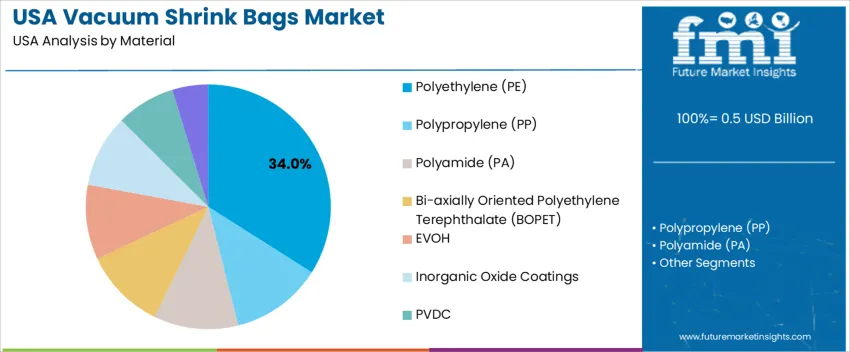
Polyethylene (PE) represents 34.0%, driven by its sealing strength, flexibility, and compatibility with fresh and frozen foods requiring tight vacuum packaging. PE supports strong shrink characteristics and durability against handling stress during transportation and retail stocking. It is widely used for fresh meats, cheese, and processed food protection in the U.S. Expanded demand reflects regulatory emphasis on food-grade safety and moisture resistance that minimizes spoilage and contamination exposure. Other material options such as PP, PA, BOPET, EVOH, PVDC, and oxide-coating films serve niche performance requirements like enhanced barrier durability or clarity, though they are referenced without specific shares and therefore remain comparatively smaller. Material selection aligns with cost optimization, freezer performance, and automated machinability in large-volume food packaging operations.
Key Points:
- PE leads due to strong seal integrity and food-safe performance
- Barrier and specialty films support selective industrial packaging needs
- Material choices align with freshness retention and transportation resilience
By Application, Food Industry Dominates the Segment
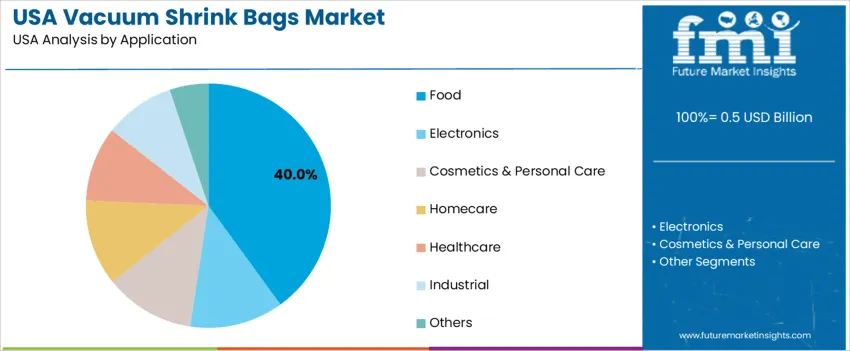
Food applications account for 40.0%, reflecting widespread use in meat, poultry, seafood, cheese, bakery, and ready meal preservation. U.S. food processors rely on vacuum shrink bag packaging to maintain color, flavor, and moisture while supporting extended storage across refrigerated and frozen channels. Adoption increases with the rise of high-protein packaged diets and home-meal convenience categories. Other sectors such as electronics, personal care, homecare, healthcare, and industrial uses exist without specified shares. These non-food applications typically require protection from dust, corrosion, and environmental exposure, supporting specialty shrink solutions. The U.S. retail landscape further accelerates replenishment cycles, strengthening consistent volume consumption across national distribution networks.
Key Points:
- Food packaging drives primary consumption in the United States
- Cold-chain growth reinforces vacuum shrink USAge
- Industrial applications remain smaller but support protective barrier needs
What are the Drivers, Restraints, and Key Trends of the Demand for Vacuum Shrink Bags in the USA?
Growth of protein packaging demand, increased focus on shelf life extension and expansion of home meal preparation support are driving demand.
In the United States, vacuum shrink bags are widely used by meat and poultry processors to preserve product freshness and maintain package integrity during chilled distribution. Retailers prioritize extended shelf life for beef, pork and seafood to reduce food waste and sustain inventory rotations in supermarkets and club stores. Home meal preparation trends encourage consumers to purchase bulk proteins that rely on vacuum packaging for portion control and freezer storage performance. Specialty cheese and deli product suppliers also rely on shrink bags for product appearance and protection against moisture loss. These factors support continuous demand across commercial food supply chains, from slaughter facilities to retail service counters.
Material sustainability concerns, resin price volatility and competition from thermoforming and skin packaging restrain demand.
Multilayer films that deliver high barrier performance can be difficult to recycle, prompting retailers to evaluate packaging alternatives with easier disposal pathways. Cost fluctuations in polyethylene and nylon influence pricing pressure in high-volume protein categories. Skin packaging formats expand in premium meat and seafood segments where visual presentation and leak prevention drive consumer preference. Smaller processors may delay upgrades to advanced shrink systems when equipment investment is significant. These sustainability and cost-based considerations slow category growth in certain market segments.
Shift toward recyclable monomaterial structures, increased barcode and label compatibility and rising adoption in meal-kit distribution define key trends.
Manufacturers introduce mono-polymer shrink bags designed to align with store take-back and regional recycling programs. High-clarity films improve product appearance and allow crisp barcode scanning through packaging to enhance point-of-sale accuracy. Meal-kit providers adopt vacuum shrink bags for portioned proteins to maintain quality in home delivery networks. Oxygen-scavenging materials and seal-strength improvements support transport distances required in national distribution. These developments indicate stable, functionality-driven demand for vacuum shrink bags across the United States food retail and protein processing industry.
Analysis of the Demand for Vacuum Shrink Bags in the USA by Region
Demand for vacuum shrink bags in the United States is increasing as food processors, meat packers, and consumer-goods suppliers prioritize product safety, extended shelf life, and visually enhanced packaging for retail presentation. Compliance with food protection standards, high-barrier performance, puncture resistance, and seal integrity influence procurement decisions. Distribution growth in chilled and frozen products strengthens supply chain reliance on shrink formats. West USA leads at 5.7% CAGR, followed by South USA at 5.1%, Northeast USA at 4.6%, and Midwest USA at 4.0%. Adoption aligns with protein-processing capacity, export preparation activity, retail packaging automation, and sustainability shifts involving thinner-gauge materials.
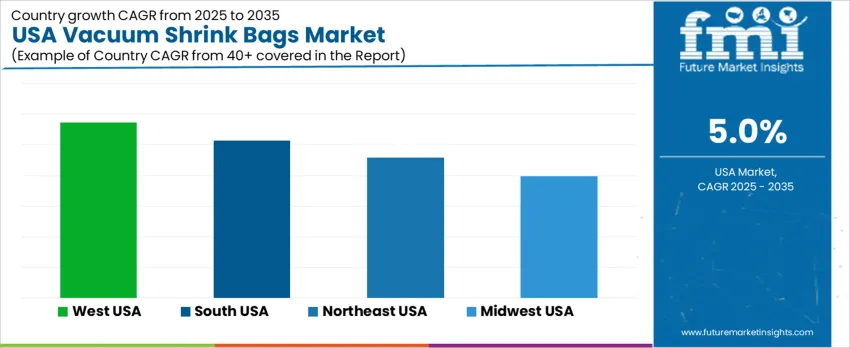
| Region | CAGR (2025-2035) |
|---|---|
| West USA | 5.7% |
| South USA | 5.1% |
| Northeast USA | 4.6% |
| Midwest USA | 4.0% |
How is the West USA driving demand for vacuum shrink bags?
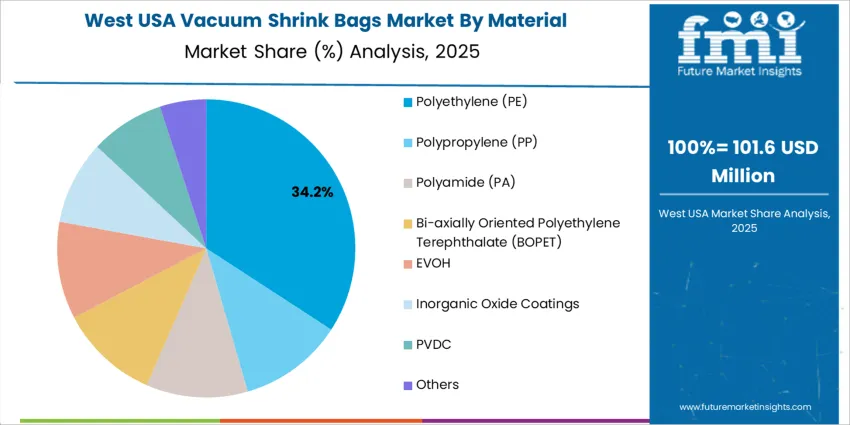
West USA expands at 5.7% CAGR, propelled by strong beef and poultry packaging operations in California and Washington, where producers maintain high-quality retail displays for supermarket chains. Processors rely on vacuum shrink bags for leak prevention, oxidation reduction, and preservation of color stability in fresh meat products. Export-focused facilities serving Pacific trade routes emphasize durable multi-layer films resistant to freezer burn and puncture from bone-in cuts. Automation upgrades in large-scale meat plants support continuous packaging-line efficiency with consistent shrink performance. Sustainability objectives promote downgauged barrier structures while retaining sealing reliability. Procurement teams evaluate compatibility with advanced shrink tunnels and operational flexibility during seasonal throughput shifts.
- Retail meat packaging sustaining barrier-film demand
- Export readiness requiring puncture-resistant structures
- Automation upgrades prioritizing dependable sealing
- Thinner-gauge adoption supporting sustainability targets
How is the South USA shaping demand growth?
South USA records 5.1% CAGR supported by poultry and pork processing hubs across Texas, Georgia, and Arkansas. Shrink bags are prioritized to maintain food-safety compliance and maximize shelf life for chilled and frozen shipments distributed nationwide. Processors source high-barrier formats optimized for high-moisture environments. Consumer preference for family-size meat packs drives volume procurement. Logistics operations through Gulf Coast distribution corridors reinforce supply chain continuity for protein exports. Buyers monitor film strength during rigorous chilling cycles and require traceability certifications to meet regulatory expectations.
- Poultry and pork processing driving continuous packaging use
- Family-size portions strengthening demand for durable bags
- Gulf logistics supporting outbound flow
- Compliance and traceability shaping purchasing standards
How is the Northeast USA influencing procurement?
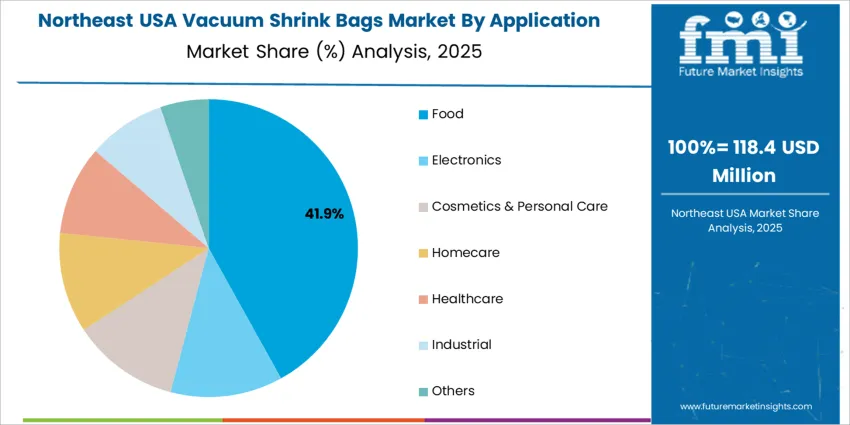
Northeast USA grows at 4.6% CAGR, driven by diverse food manufacturing segments including seafood processing, deli meats, and dairy. Shrink packaging helps preserve freshness in short-shelf-life categories aligned with densely populated metro consumption patterns. Cold-chain infrastructure supporting convenience retail formats increases reliance on bag-to-tray sealing and oxygen-barrier technologies. Sustainability considerations influence procurement decisions in urban markets receptive to lower plastic content. High regulatory oversight requires vendors to demonstrate food-contact compliance and robust quality documentation.
- Cold-chain retail expansion supporting frequent USAge
- Seafood and deli categories requiring enhanced oxygen barriers
- Urban sustainability policies influencing material specs
- Compliance documentation required for supplier qualification
How is the Midwest USA contributing to steady utilization?
Midwest USA posts 4.0% CAGR, supported by major beef and dairy industries in states such as Wisconsin, Illinois, and Nebraska. Shrink bags preserve product quality during extended road transportation to nationwide retail hubs. Processors prioritize abrasion resistance and seal consistency during bulk handling operations. Long-established facilities adopt format-standardized bags to ensure smooth operations within high-speed packaging equipment. Cost-management priorities influence procurement, with buyers balancing performance features against material-efficiency initiatives. Market activity remains stable due to ongoing demand in processed meat, cheese blocks, and frozen products.
- Strong livestock industries securing baseline demand
- Long-haul transport requiring robust packaging durability
- Standardized formats maintaining operational efficiency
- Value-focused purchasing supporting gradual adoption growth
What does the competitive landscape for vacuum-shrink bag demand in the United States look like?
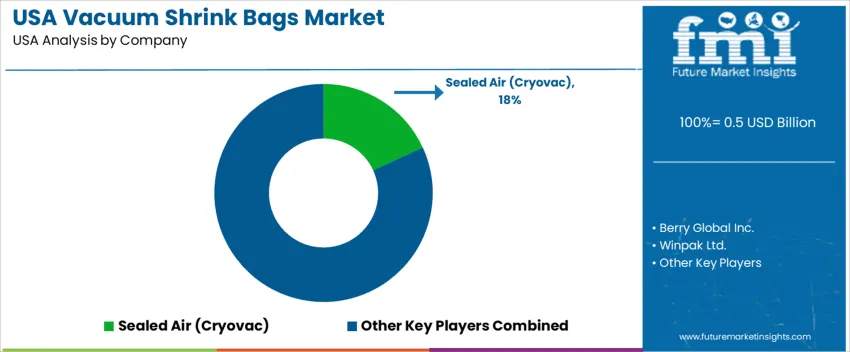
Vacuum-shrink bags in the United States are used across meat and poultry processing, dairy packaging, seafood handling, and ready-meal distribution. Demand reflects the need for extended shelf life, strong puncture resistance, and high-clarity packaging that maintains product integrity throughout cold-chain transport. Food-safety compliance and operational compatibility with high-throughput sealing systems shape procurement priorities for domestic processors and large grocery suppliers. Sealed Air (Cryovac) holds an estimated 18.2% share. Its multilayer shrink structures support large meat processors and national retail-focused packaging operations. Cryovac solutions sustain durability during chilling, distribution, and retail handling, while providing consistent shrink performance.
Berry Global Inc. engages through custom shrink-flexible films adapted to automated packaging lines. Winpak Ltd. participates in food-service and protein-packaging segments that require strong barrier protection for refrigerated and frozen storage. Coveris serves regional processors requiring tailored shrink performance and variable sizing to match product form factors. Plastopin supports small and mid-size processors seeking dependable shrink quality at competitive cost levels. Competitive positioning in the United States depends on regulatory assurance, material strength during transport, sealing reliability, and continuity of supply as producers work to reduce food waste while maintaining visual product appeal in retail environments.
Key Players in USA Vacuum Shrink Bags Demand
- Sealed Air (Cryovac)
- Berry Global Inc.
- Winpak Ltd.
- Coveris
- Plastopin
Scope of the Report
| Items | Values |
|---|---|
| Quantitative Units | USD billion |
| Material | Polyethylene (PE), Polypropylene (PP), Polyamide (PA), Bi-axially Oriented Polyethylene Terephthalate (BOPET), EVOH, Inorganic Oxide Coatings, PVDC, Others |
| Application | Food, Electronics, Cosmetics & Personal Care, Homecare, Healthcare, Industrial, Others |
| Regions Covered | West USA, South USA, Northeast USA, Midwest USA |
| Key Companies Profiled | Sealed Air (Cryovac), Berry Global Inc., Winpak Ltd., Coveris, Plastopin |
| Additional Attributes | Dollar sales by material and end-use applications; adoption trends driven by food preservation, extended shelf-life, and contamination prevention; demand growth from meat, poultry, cheese, and processed food producers; regional variation linked to retail packaging and cold-chain logistics; performance characteristics including oxygen barrier, tear resistance, and sealing compatibility; sustainability shift toward recyclable and lower-barrier shrink materials with reduced PVDC and EVOH content. |
USA Vacuum Shrink Bags Demand by Segments
Material:
- Polyethylene (PE)
- Polypropylene (PP)
- Polyamide (PA)
- Bi-axially Oriented Polyethylene Terephthalate (BOPET)
- EVOH
- Inorganic Oxide Coatings
- PVDC
- Others
Application:
- Food
- Electronics
- Cosmetics & Personal Care
- Homecare
- Healthcare
- Industrial
- Others
Region:
- West USA
- South USA
- Northeast USA
- Midwest USA
Frequently Asked Questions
How big is the demand for vacuum shrink bags in USA in 2025?
The demand for vacuum shrink bags in USA is estimated to be valued at USD 0.5 billion in 2025.
What will be the size of vacuum shrink bags in USA in 2035?
The market size for the vacuum shrink bags in USA is projected to reach USD 0.9 billion by 2035.
How much will be the demand for vacuum shrink bags in USA growth between 2025 and 2035?
The demand for vacuum shrink bags in USA is expected to grow at a 5.0% CAGR between 2025 and 2035.
What are the key product types in the vacuum shrink bags in USA?
The key product types in vacuum shrink bags in USA are polyethylene (pe), polypropylene (pp), polyamide (pa), bi-axially oriented polyethylene terephthalate (bopet), evoh, inorganic oxide coatings, pvdc and others.
Which application segment is expected to contribute significant share in the vacuum shrink bags in USA in 2025?
In terms of application, food segment is expected to command 40.0% share in the vacuum shrink bags in USA in 2025.
Preview the report firsthand - request a free sample
Get SampleGet the brochure for pricing and purchase details.
Get PDFTable of Content
- Executive Summary
- USA Market Outlook
- Demand-side Trends
- Supply-side Trends
- Technology Roadmap Analysis
- Analysis and Recommendations
- Market Overview
- Market Coverage / Taxonomy
- Market Definition / Scope / Limitations
- Market Background
- Market Dynamics
- Drivers
- Restraints
- Opportunity
- Trends
- Scenario Forecast
- Demand in Optimistic Scenario
- Demand in Likely Scenario
- Demand in Conservative Scenario
- Opportunity Map Analysis
- Product Life Cycle Analysis
- Supply Chain Analysis
- Investment Feasibility Matrix
- Value Chain Analysis
- PESTLE and Porter’s Analysis
- Regulatory Landscape
- Regional Parent Market Outlook
- Production and Consumption Statistics
- Import and Export Statistics
- Market Dynamics
- USA Market Analysis 2020 to 2024 and Forecast, 2025 to 2035
- Historical Market Size Value (USD Million) Analysis, 2020 to 2024
- Current and Future Market Size Value (USD Million) Projections, 2025 to 2035
- Y-o-Y Growth Trend Analysis
- Absolute $ Opportunity Analysis
- USA Market Pricing Analysis 2020 to 2024 and Forecast 2025 to 2035
- USA Market Analysis 2020 to 2024 and Forecast 2025 to 2035, By Material
- Introduction / Key Findings
- Historical Market Size Value (USD Million) Analysis By Material , 2020 to 2024
- Current and Future Market Size Value (USD Million) Analysis and Forecast By Material , 2025 to 2035
- Polyethylene (PE)
- Polypropylene (PP)
- Polyamide (PA)
- Bi-axially Oriented Polyethylene Terephthalate (BOPET)
- EVOH
- Inorganic Oxide Coatings
- PVDC
- Others
- Y-o-Y Growth Trend Analysis By Material , 2020 to 2024
- Absolute $ Opportunity Analysis By Material , 2025 to 2035
- USA Market Analysis 2020 to 2024 and Forecast 2025 to 2035, By Application
- Introduction / Key Findings
- Historical Market Size Value (USD Million) Analysis By Application, 2020 to 2024
- Current and Future Market Size Value (USD Million) Analysis and Forecast By Application, 2025 to 2035
- Food
- Electronics
- Cosmetics & Personal Care
- Homecare
- Healthcare
- Industrial
- Others
- Y-o-Y Growth Trend Analysis By Application, 2020 to 2024
- Absolute $ Opportunity Analysis By Application, 2025 to 2035
- Market Structure Analysis
- Competition Dashboard
- Competition Benchmarking
- Market Share Analysis of Top Players
- By Regional
- By Material
- By Application
- Competition Analysis
- Competition Deep Dive
- Sealed Air (Cryovac)
- Overview
- Product Portfolio
- Profitability by Market Segments (Product/Age /Sales Channel/Region)
- Sales Footprint
- Strategy Overview
- Marketing Strategy
- Product Strategy
- Channel Strategy
- Berry Global Inc.
- Winpak Ltd.
- Coveris
- Plastopin
- Sealed Air (Cryovac)
- Competition Deep Dive
- Assumptions & Acronyms Used
- Research Methodology


