

- Industry Size (2026)
- USD 1.2 Bn
- Forecast (2036)
- USD 2.5 Bn
- CAGR (2026 to 2036)
- 7.3%
Vacuum Pump Stations Market Size, Market Forecast and Outlook By FMI
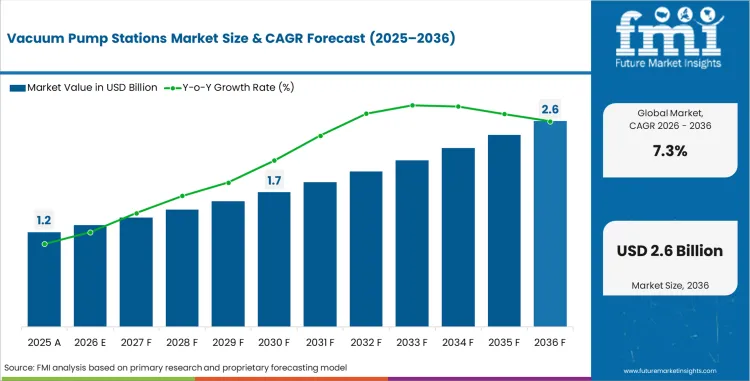
The vacuum pump stations market was valued at USD 1.1 billion in 2025. Industry is estimated to reach USD 1.2 billion in 2026, reflecting steady demand for centralized vacuum systems. The market is projected to grow at a CAGR of 7.3% from 2026 to 2036, with total revenue expected to reach USD 2.5 billion by 2036. Growth is linked to the shift from decentralized vacuum units toward centralized station-based systems in industrial facilities.
Summary of Vacuum Pump Stations Market
- The market is forecast to reach USD 2.5 billion by 2036.
- The market is expected to grow at a CAGR of 7.3% from 2026 to 2036.
- The market was estimated at USD 1.2 billion in 2025.
- The forecast period represents an incremental opportunity of USD 1.3 billion.
- Vacuum pump stations are integrated systems combining pumps, controls, and piping to provide continuous vacuum supply across industrial operations.
- Demand is driven by the shift from standalone vacuum units to centralized systems that improve efficiency and reduce maintenance.
- Dry vacuum systems are gaining adoption due to oil-free operation and suitability for contamination-sensitive applications.
- Multi-pump configurations dominate with a 61.0% share in 2026, offering redundancy and staged capacity.
- Dry vacuum technology is expected to hold 34.0% share of the pump segment in 2026.
- Process vacuum applications are projected to account for 31.0% share of end use in 2026.
- The general industry segment is expected to capture 41.0% share, reflecting broad cross-industry adoption.
- OEM channels are anticipated to lead with a 54.0% share in 2026 due to integration into new production lines.
- India, China, and the United States are the fastest-growing markets, with India leading at a 7.9% CAGR.
- Market growth is constrained by long equipment lifespans and cautious capital investment cycles in mature regions.
- Key companies include Busch Vacuum Solutions, Atlas Copco, Edwards Vacuum, Pfeiffer Vacuum+Fab Solutions, Leybold, ULVAC, and Elmo Rietschle.
Key Takeaways, Market Size, and Forecast
- Vacuum Pump Stations Market is projected to grow from USD 1.2 billion in 2026 to USD 2.5 billion by 2036, at a CAGR of 7.3%.
- The vacuum pump stations market was valued at USD 1.1 billion in 2025.
- The market is projected to create an incremental opportunity of USD 1.3 billion between 2026 and 2036.
- In 2026, multi-pump configurations are expected to account for 61.0% of the configuration segment.
- India (7.9%), China (7.0%), and the United States (6.3%) are among the fastest-growing markets.
Manufacturing plants are reducing noise and heat levels on production floors by replacing point-of-use vacuum units with centralized systems. Distributed setups require multiple motors running under partial load, which increases energy consumption and operational inefficiency. Centralized stations allow better load balancing and improved system control across production lines.
System design decisions focus on multi-pump configurations with variable frequency drives to adjust output based on demand. Facilities that delay this transition face higher energy costs and lower efficiency during off-peak operations. Equipment suppliers benefit from ongoing service contracts as centralized systems require specialized maintenance and monitoring.
Large facilities must assess total vacuum demand across multiple production lines before installation. System capacity planning ensures that centralized stations can handle simultaneous operation without performance loss. Centralized designs reduce maintenance complexity by replacing multiple standalone units with a single managed system. This approach also allows consolidation of service agreements and reduces overall operating cost.
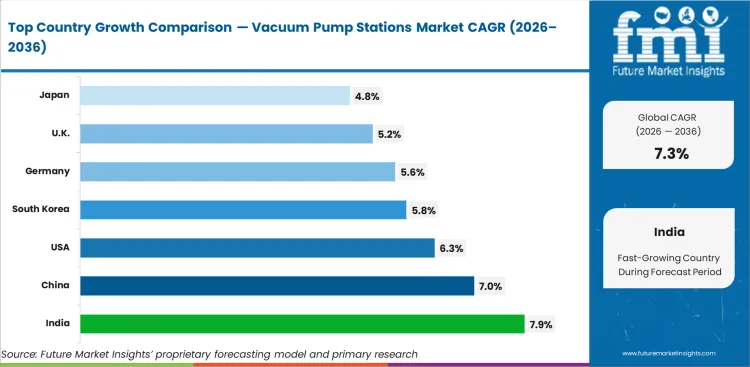
India is projected to grow at a CAGR of 7.9% in the vacuum pump stations market from 2026 to 2036, supported by industrial park development and centralized utility requirements. China is expected to expand at a CAGR of 7.0% over the same period, driven by demand from electronics manufacturing and controlled production environments. The United States is anticipated to grow at a CAGR of 6.3% from 2026 to 2036, supported by upgrades in food processing and packaging facilities. South Korea is forecast to record a CAGR of 5.8% during the forecast period, driven by vacuum requirements in battery material processing. Germany is set to grow at a CAGR of 5.6% through 2036, with demand focused on replacing decentralized systems with centralized units. The United Kingdom is expected to expand at a CAGR of 5.2% over the forecast period, supported by upgrades in plastics and manufacturing lines. Japan is projected to grow at a CAGR of 4.8% from 2026 to 2036, with demand linked to space-efficient system design in industrial facilities.
Segmental Analysis
Vacuum Pump Stations Market Analysis by Pump Technology
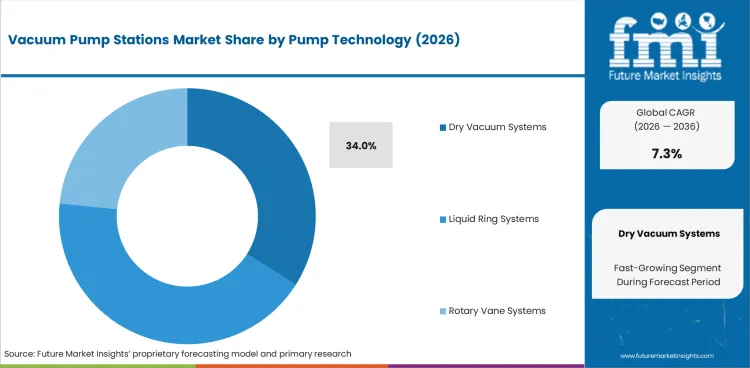
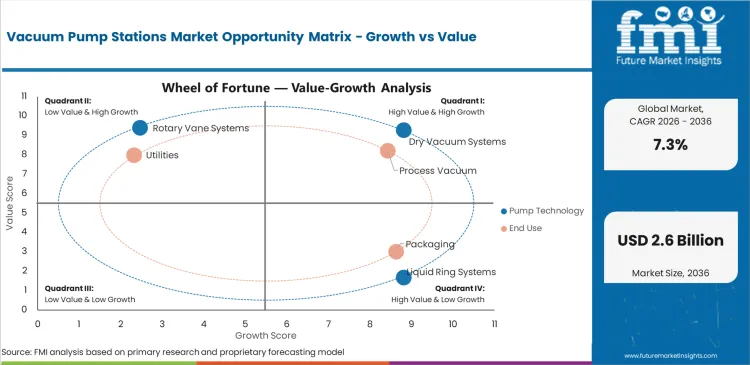
Contamination-sensitive applications require vacuum systems that eliminate fluid contact and maintain process purity. Dry vacuum technologies are expected to account for nearly 34.0% share of the vacuum pump stations market in 2026, driven by their oil-free operation and suitability for high-purity environments. Absence of liquid sealing reduces downstream treatment requirements, improving overall process efficiency. Traditional liquid ring systems introduce additional water handling complexity, increasing operational overhead. Technology selection depends on balancing purity requirements with cost and energy considerations across continuous processing environments.
- Selection between dry and liquid ring systems depends primarily on contamination sensitivity, vapor composition, water handling requirements, and maintenance priorities.
- Dry systems are typically preferred in applications where oil-free operation, cleaner processing conditions, and lower downstream treatment burden matter most.
- Liquid ring systems remain relevant in wet or aggressive vapor environments where process tolerance can outweigh water and utility overhead.
Vacuum Pump Stations Market Analysis by End Use
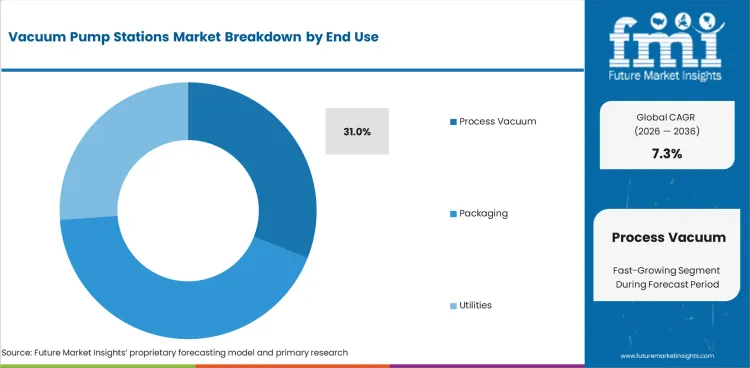
Process vacuum is expected to hold 31.0% share in 2026 because many industrial operations require stable suction conditions across multiple production stages rather than isolated point applications. Demand is strongest where centralized vacuum can improve process consistency, simplify maintenance, and support continuous plant operation. A key buyer consideration is that installation cost is not limited to the pump skid itself; piping, controls integration, and commissioning can materially increase total project cost, especially in retrofit environments. Purchasing departments at processing agencies optimize their capital expenditure by avoiding massive custom-built industrial vacuum evaporation systems when possible.
- Chemical alignment precision: Rigs operating in aggressive environments mirror exact specifications of standard safety containers. Engineering teams validate real-world exposure profiles efficiently.
- Infrastructure cost optimization: Facilities avoid installing massive dedicated scrubbers required for extreme central solvent extraction. Capital expenditure directors maintain sustainable operating margins.
- Toxicity synchronization testing: Engineers deploy multiple sealed rigs simultaneously to manage complex explosive vapors across networked lines. Developers verify grounding stability before full production.
Vacuum Pump Stations Market Analysis by Configuration
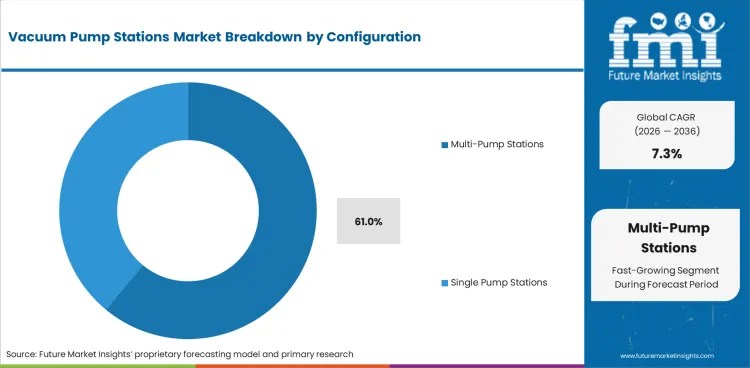
Multi-pump stations are expected to hold 61.0% share in 2026 because they are better suited to plants with variable load conditions, multiple process points, and uptime requirements that do not allow single-point failure. Their main advantage is staged capacity control, which helps facilities match output to real demand while preserving redundancy during maintenance or unexpected line fluctuations. Single-pump systems remain relevant in simpler or lower-load environments, but multi-pump configurations are generally favored in larger installations where energy management and operational continuity are critical.
- Process vacuum demand is strongest in applications where stable pressure conditions affect throughput, product quality, or line consistency.
- Pneumatic conveying applications favor centralized systems when multiple transfer points need coordinated vacuum supply.
- Packaging applications adopt station-based systems when uptime, hygiene, and maintenance access become more important than simple point-of-use installation.
Vacuum Pump Stations Market Analysis by Industry
Dry vacuum technologies are expected to account for nearly 34.0% share of the vacuum pump stations market in 2026, driven by their oil-free operation and suitability for high-purity environments. Industry demand varies by process sensitivity, duty cycle, and plant layout. Food and beverage facilities prioritize hygiene, clean operation, and easy maintenance access. Chemical processors focus more heavily on vapor compatibility, system reliability, and safe handling of demanding process conditions. General industry remains the largest segment because vacuum stations are used across a broad range of manufacturing environments where centralized utility design can improve maintenance efficiency and line coordination
- Iterative batch discovery: Operators deploy manual test rigs to deliberately tweak experimental layouts under precise pressure conditions. Research directors identify structural weaknesses efficiently.
- Proprietary formulation security: Keeping pneumatic additions unnetworked prevents sensitive cycle ratios from leaking via cloud analytics. Chief technology officers maintain absolute control over performance models.
- Pre-blending readiness: Centralized intake ensures minor applications pass compliance checks seamlessly. Facility planners avoid expensive external rework fees.
Vacuum Pump Stations Market Analysis by Channel
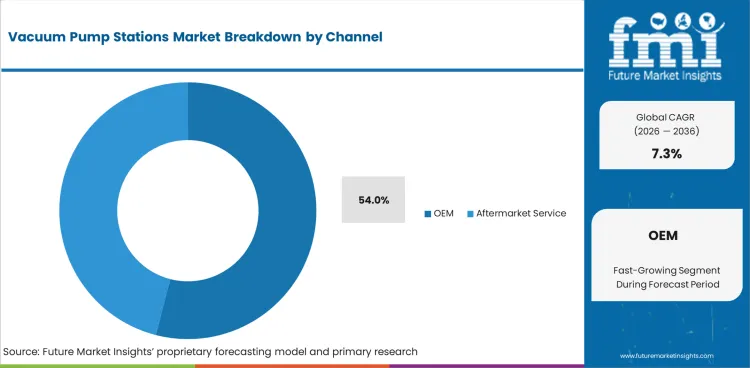
OEM vacuum station suppliers are likely to reach 54.0% share in 2026 as direct engineering support remains critical when designing custom multi-megawatt configurations. Facility planners reviewing vacuum packaging market share analysis cannot gamble on third-party integrators lacking deep proprietary knowledge of internal pump tolerances. Procurement teams lock in direct factory supply lines to secure guaranteed response times for critical spares. Utilizing alternative aftermarket channels for massive centralized utility blocks frequently results in incompatible communication protocols between disparate pump brands.
- Direct factory programming: Code optimization ensures that primary and secondary pumps alternate wear cycles evenly. Facility directors drastically lower their monthly utility overhead.
- Warranty preservation protocols: Utilizing certified technicians prevents voided service agreements during catastrophic facility power surges. Site planners save critical maintenance budgets.
- Integrated diagnostic access: OEM platforms provide direct remote monitoring connections linked strictly to factory reliability centers. Developers validate advanced sequencing logic simultaneously.
Vacuum Pump Stations Market Drivers, Restraints, and Opportunities
Workplace noise limits require facilities to demonstrate controlled acoustic levels before operations begin. This requirement is driving upgrades from distributed vacuum units to centralized systems placed outside production areas. Compliance cannot be achieved through personal protective equipment alone, as source-level noise reduction is required. Facilities that delay upgrades face penalties and risk losing contracts where lower noise levels are specified.
Centralized vacuum systems introduce operational challenges in multi-product environments. Different process lines operate at varying suction levels and pressure requirements. A single system must adjust output across multiple demand points without affecting stability. This creates complexity in system balancing and control. Switching between production lines requires valve adjustments, line clearing, and controller reconfiguration. These steps increase downtime and reduce system flexibility. Operators must manage pressure distribution carefully to avoid performance loss across connected lines.
Modular vacuum system designs are being developed to improve flexibility across varying demand conditions. These systems aim to simplify control across multiple lines. Current designs face pressure drop issues at manifold junctions during high-load operation, which can limit overall system efficiency.
Opportunities in the Vacuum Pump Stations Market
- Predictive maintenance software integration: Equipment manufacturers can bundle AI-driven vibration models directly into station control software. Plant directors capture premium uptime by offering predictive analytics alongside raw displacement data.
- Automated load balancing capabilities: Integrating intelligent logic systems allows real-time sequencing without exposing the operator to manual valve adjustments. Facility engineers achieve higher energy ratings without interrupting the vacuum thermoformed packaging timeline.
- Mobile modular transfer rigs: Building self-contained, caster-mounted environments enables flexible routing across multiple localized operations within a plant. Production planners validate diverse recipe changes safely.
Regional Analysis
Based on regional analysis, Vacuum Pump Stations is segmented into North America, Europe, East Asia, and South Asia & Pacific across 40 plus countries.
.webp "Top Country Growth Comparison Vacuum Pump Stations Market Cagr (2026 2036)")
| Country | CAGR (2026 to 2036) |
|---|---|
| India | 7.9% |
| China | 7.0% |
| USA | 6.3% |
| South Korea | 5.8% |
| Germany | 5.6% |
| UK | 5.2% |
| Japan | 4.8% |
Source: Future Market Insights (FMI) analysis, based on proprietary forecasting model and primary research
North America Vacuum Pump Stations Market Analysis
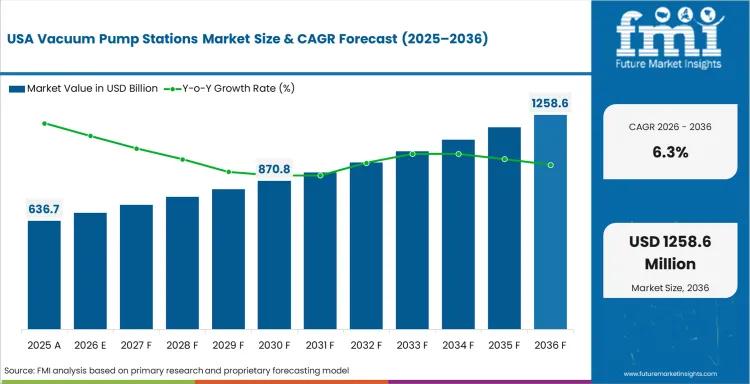
North American demand is increasingly tied to retrofit projects in processing and packaging facilities where point-of-use vacuum units create excess noise, heat, and maintenance burden. Buyers are evaluating centralized vacuum stations when plant operators need better energy control, easier maintenance access, and more stable vacuum performance across multiple lines. Replacement demand is strongest in facilities where legacy oil-sealed units are costly to service or difficult to integrate with newer control systems. Procurement decisions typically balance skid footprint, piping complexity, controls compatibility, and expected uptime improvement. Operations managers reviewing vacuum sealing machine market share analysis metrics specify exact footprint requirements for skid integration.
- USA: The United States is projected to witness 6.3% CAGR in vacuum pump stations during 2026 to 2036. OSHA noise and safety compliance requirements continue to push facilities toward centralized vacuum infrastructure. Processing plants replace oil-sealed standalone units with integrated systems capable of handling reactive vapor streams. Retrofitting remains a dominant factor as existing layouts restrict major redesign. Equipment must align with footprint constraints while delivering consistent performance. Procurement decisions are shaped by compliance deadlines and operational efficiency targets. These conditions support continued upgrades across industrial processing sectors.
Europe Vacuum Pump Stations Market Analysis
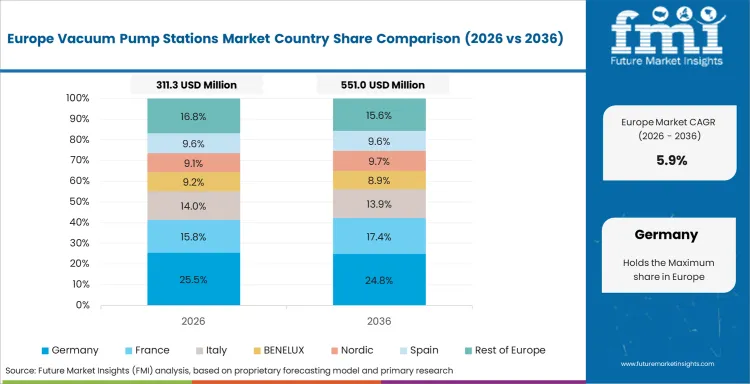
In Europe, supplier selection is shaped by energy efficiency, operating reliability, and compatibility with plant-wide automation systems. Buyers increasingly prioritize vacuum stations that can maintain stable performance over long operating cycles while reducing unnecessary power draw during partial-load conditions. Operating high-precision static diagnostic alarms alongside modified atmosphere packaging equipment intake becomes a baseline requirement. Sequencing controls, monitoring capability, and service access often matter as much as installed capacity because plants are focused on lifecycle efficiency rather than peak output alone.
- Germany: Germany’s vacuum pump stations market reflects growth at 5.6% through 2026 to 2036, supported by industrial demand for precision-controlled vacuum systems. Manufacturing facilities require stable vacuum conditions for continuous processing applications. Equipment selection focuses on systems with advanced monitoring and automated fault detection. Operators prioritize integration with plant-wide control architecture. Reliability under long operating cycles remains critical. These factors support demand for technically advanced centralized vacuum systems across industrial environments.
- UK: Aerospace and advanced manufacturing activities influence vacuum system demand in the United Kingdom. Facilities require systems capable of maintaining controlled pressure conditions during specialized production processes. Demand remains steady, with growth reaching 5.2% over the forecast period, supported by increasing precision requirements in manufacturing. Operators prioritize systems that maintain consistent performance under variable operating conditions. Equipment must support process stability without frequent recalibration. These conditions sustain adoption across high-specification production environments.
East Asia Vacuum Pump Stations Market Analysis
East Asia remains a strong demand center because electronics, battery, and precision manufacturing facilities require vacuum systems that support continuous operation, contamination control, and process stability. In this region, centralized stations are often preferred where multiple production stages must be served from one managed system without compromising uptime. Demand is especially favorable in facilities upgrading legacy systems that cannot support higher throughput or tighter process-control requirements.
- China: China is predicted to record 7.0% CAGR in the vacuum pump stations market from 2026 to 2036. Semiconductor and electronics manufacturing expansion increases demand for high-capacity centralized vacuum systems. Facilities require consistent suction performance to maintain contamination-free production environments. Operators upgrade legacy systems that fail to support continuous operation under high load conditions. Equipment must integrate with automated production lines without affecting throughput. These factors support ongoing investment in large-scale vacuum infrastructure across industrial zones.
- Japan: Manufacturing facilities in Japan require vacuum systems that support clean and controlled processing environments. Food, electronics, and specialty material sectors depend on stable vacuum performance to maintain product integrity. Industry growth is estimated at 4.8% over 2026 to 2036, supported by demand for hygienic and precision-controlled systems. Operators prioritize equipment with automated cleaning and minimal maintenance requirements. Compact system design remains essential due to space constraints. These requirements sustain demand across high-specification production facilities.
- South Korea: Battery manufacturing expansion drives vacuum system demand across South Korea. Production facilities require strict humidity and contamination control during electrolyte handling and cell assembly. The country is expected to reach at a CAGR of 5.8% through 2036. Operators deploy large-scale dry vacuum systems to maintain controlled environments across production lines. Equipment must support continuous operation under high throughput conditions. Reliability and system scalability remain key selection factors. These conditions support steady demand across battery and electronics manufacturing sectors.
South Asia & Pacific Vacuum Pump Stations Market Analysis
South Asia and Pacific growth is closely linked to new industrial park development and greenfield manufacturing expansion. In these environments, centralized vacuum stations are attractive because they simplify utility planning across multiple lines and support future capacity additions. Buyers in the region are particularly focused on systems that can scale with plant utilization, manage variable load conditions, and reduce long-term operating complexity.
- India: India is likely to post a CAGR of 7.9% in vacuum pump stations during 2026 to 2036, driven by rapid expansion of industrial parks and multi-tenant manufacturing zones. Facility operators invest in centralized vacuum systems that serve multiple production units simultaneously. Equipment must handle peak load variation across diverse industries such as textiles and pharmaceuticals. Installation speed remains critical as new facilities are commissioned. Procurement decisions are influenced by scalability and long-term operational efficiency. These factors support strong demand across emerging industrial clusters.
Competitive Aligners for Market Players
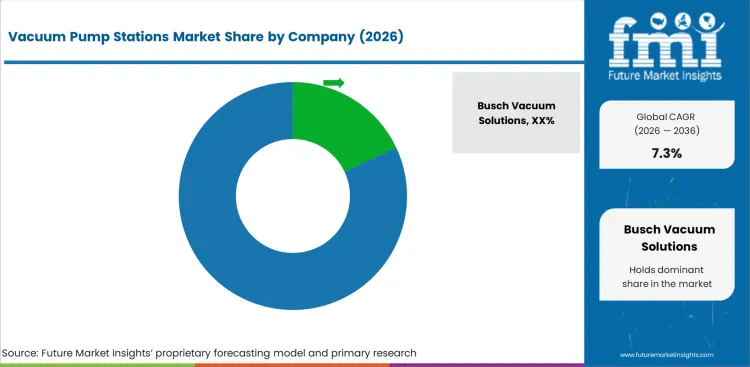
Control system design and variable speed capability strongly influence supplier selection, often taking priority over basic mechanical capacity. Buyers focus on how sequencing software handles changing vacuum demand across multiple process points. Stable coordination between pumps, control systems, and plant networks determines overall system performance.
Processing facilities assess systems based on how easily individual pumps can be isolated without disrupting pressure levels. Maintenance must allow one unit to be serviced while the rest of the system continues operating. Modular base frame designs support faster replacement and reduce downtime compared to fixed layouts.
Established suppliers benefit from global service coverage and experience in handling complex and hazardous applications. Equipment reliability remains critical in sectors such as semiconductor and chemical processing, where system failure can cause safety risks or product loss. Procurement teams require proven performance data before approving new suppliers, even when pricing is lower.
Large facilities standardize control architectures to maintain flexibility across multiple suppliers. System selection favors open communication protocols that integrate with existing plant systems. Proprietary formats that limit data access or interoperability are often rejected during evaluation. Supplier differentiation is shifting toward software capability and system efficiency. Focus is moving toward tools that improve energy use and support predictive maintenance, along with continued refinement of pump design and system integration.
Key Players in Vacuum Pump Stations Market
- Busch Vacuum Solutions
- Atlas Copco
- Edwards Vacuum
- Pfeiffer Vacuum+Fab Solutions
- Leybold
- ULVAC
- Elmo Rietschle
Scope of the Report
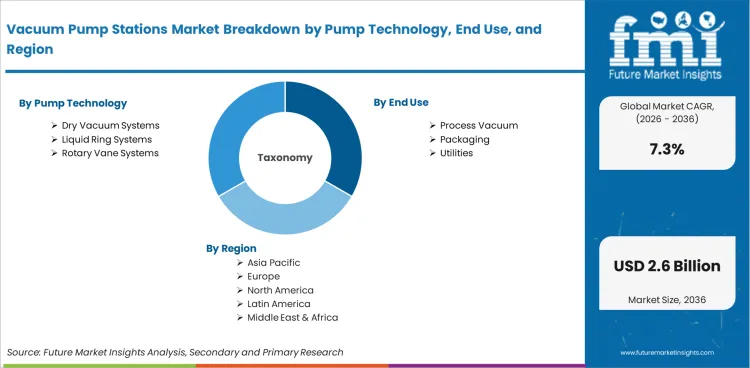
| Metric | Value |
|---|---|
| Quantitative Units | USD 1.2 billion to USD 2.5 billion, at a CAGR of 7.3% |
| Market Definition | Specialized centralized extraction platforms engineered specifically to facilitate stable, continuous negative pressure across multi-point industrial networks while incorporating integrated variable speed controls. |
| Segmentation | Pump Technology, End Use, Configuration, Industry, Channel, and Region |
| Regions Covered | North America, Latin America, Europe, East Asia, South Asia & Pacific, Middle East & Africa |
| Countries Covered | USA, Germany, UK, China, India, Japan, South Korea |
| Key Companies Profiled | Busch Vacuum Solutions, Atlas Copco, Edwards Vacuum, Pfeiffer Vacuum+Fab Solutions, Leybold, ULVAC, Elmo Rietschle |
| Forecast Period | 2026 to 2036 |
| Approach | Independent industrial facility capital expenditure data cross-validated with federal occupational safety program equipment registries. |
Source: Future Market Insights (FMI) analysis, based on proprietary forecasting model and primary research
Vacuum Pump Stations Market Analysis by Segments
Pump Technology
- Dry Vacuum Systems
- Liquid Ring Systems
- Rotary Vane Systems
- Other
End Use
- Pneumatic Conveying
- Process Vacuum
- Packaging
- Utilities
Configuration
- Single Pump Stations
- Multi-pump Stations
Industry
- Food & Beverage
- Plastics
- Chemicals
- General Industry
Channel
- OEM
- Aftermarket Service
Region:
- North America
- United States
- Canada
- Europe
- Germany
- United Kingdom
- France
- Italy
- Spain
- Asia Pacific
- China
- Japan
- South Korea
- Taiwan
- Singapore
- Latin America
- Brazil
- Mexico
- Argentina
- Middle East & Africa
- GCC Countries
- South Africa
- Israel
Bibliography
- Ingersoll Rand Inc. (2026). Annual report 2025.
- Observatory of Economic Complexity. (2026, March 24). Vacuum pumps (HS: 841410) product trade, exporters and importers.
- Pfeiffer Vacuum+Fab Solutions. (2025). Annual report 2024.
- United Nations Statistics Division. (2026). 841410 - Pumps; vacuum.
- USA Census Bureau. (2026). North American Industry Classification System (NAICS).
This bibliography is provided for reader reference. The full FMI report contains the complete reference list with primary source documentation.
This Report Addresses
- Component specification criteria procurement managers utilize to evaluate centralized utility networks.
- Capital expenditure impacts plant directors navigate when building continuous multi-line packaging floors.
- Fluid incompatibility constraints engineering teams must solve to maximize individual pump platform utilization.
- Certification barriers independent processors bypass by integrating advanced predictive load-matching algorithms.
- Electrical connectivity complications facility planners resolve to operate fully cascaded extraction frameworks safely.
- Wetted material requirements R&D directors implement for extreme reactive chemical testing environments.
- Workplace validation mandates compelling massive near-term noise reduction expansions across global manufacturing agencies.
- Maintenance vulnerabilities processing operators face when lacking adequate automated sequencer channels.
Frequently Asked Questions
What is a vacuum pump station?
These systems represent specialized centralized diagnostic and extraction networks engineered to simulate continuous suction protocols for multi-point industrial sites, moving away from localized point-of-use units.
How does a vacuum pump station work in a factory?
Packaged modules maintain precise volumetric control over massive air displacement requirements by utilizing integrated variable frequency drives that sequence multiple pumps based on real-time pneumatic demand across the plant floor.
Why are multi-pump stations preferred over single pump systems?
Multi-pump cascaded staging prevents severe pressure drops during fluctuating demand periods, allowing redundant testing protocols and delivering substantial energy savings during off-peak processing shifts.
Which industries use centralized vacuum stations most?
Food and beverage processing lines, advanced chemical reaction plants, pneumatic conveying integrators, and semiconductor fabrication clean-rooms represent the dominant deployment zones.
What is the difference between dry and liquid ring vacuum systems?
Dry vacuum platforms operate oil-free and water-free to eliminate hydrocarbon back-streaming and wastewater treatment costs, whereas liquid ring variants rely on fluid seals suited for handling wet, aggressive vapor streams.
How large is the vacuum pump stations market in 2026?
Capital expenditure data indicates industry revenue hits USD 1.24 billion in 2026, advancing to USD 2.51 billion by 2036. This establishes clear structural intent from independent processing agencies moving toward centralized utility generation.
Which countries are growing fastest in vacuum pump stations?
India tracks at a 7.9% CAGR due to massive industrial park construction, closely followed by China scaling high-capacity clean-room utility arrays for domestic electronics manufacturing.
Who are the leading vacuum pump station suppliers?
Dominant global equipment suppliers include Busch Vacuum Solutions, Atlas Copco, Edwards Vacuum, Pfeiffer Vacuum+Fab Solutions, Leybold, ULVAC, and Elmo Rietschle.
What drives OEM demand for vacuum pump stations?
Direct factory programming ensures optimal code efficiency where primary and secondary pumps alternate wear cycles evenly, allowing facilities to preserve warranties and avoid incompatible third-party communication protocols.
What does aftermarket service include for a vacuum pump station?
Service contracts cover essential predictive bearing-failure monitoring, variable speed drive recalibrations, routine seal replacements, and extensive piping leak-detection audits across the integrated plant network.
Preview the report firsthand - request a free sample
Get SampleGet the brochure for pricing and purchase details.
Get PDFTable of Content
- Executive Summary
- Global Market Outlook
- Demand-side Trends
- Supply-side Trends
- Technology Roadmap Analysis
- Analysis and Recommendations
- Market Overview
- Market Coverage / Taxonomy
- Market Definition / Scope / Limitations
- Research Methodology
- Chapter Orientation
- Analytical Lens and Working Hypotheses
- Market Structure, Signals, and Trend Drivers
- Benchmarking and Cross-market Comparability
- Market Sizing, Forecasting, and Opportunity Mapping
- Research Design and Evidence Framework
- Desk Research Programme (Secondary Evidence)
- Company Annual and Sustainability Reports
- Peer-reviewed Journals and Academic Literature
- Corporate Websites, Product Literature, and Technical Notes
- Earnings Decks and Investor Briefings
- Statutory Filings and Regulatory Disclosures
- Technical White Papers and Standards Notes
- Trade Journals, Industry Magazines, and Analyst Briefs
- Conference Proceedings, Webinars, and Seminar Materials
- Government Statistics Portals and Public Data Releases
- Press Releases and Reputable Media Coverage
- Specialist Newsletters and Curated Briefings
- Sector Databases and Reference Repositories
- FMI Internal Proprietary Databases and Historical Market Datasets
- Subscription Datasets and Paid Sources
- Social Channels, Communities, and Digital Listening Inputs
- Additional Desk Sources
- Expert Input and Fieldwork (Primary Evidence)
- Primary Modes
- Qualitative Interviews and Expert Elicitation
- Quantitative Surveys and Structured Data Capture
- Blended Approach
- Why Primary Evidence is Used
- Field Techniques
- Interviews
- Surveys
- Focus Groups
- Observational and In-context Research
- Social and Community Interactions
- Stakeholder Universe Engaged
- C-suite Leaders
- Board Members
- Presidents and Vice Presidents
- R&D and Innovation Heads
- Technical Specialists
- Domain Subject-matter Experts
- Scientists
- Physicians and Other Healthcare Professionals
- Governance, Ethics, and Data Stewardship
- Research Ethics
- Data Integrity and Handling
- Primary Modes
- Tooling, Models, and Reference Databases
- Desk Research Programme (Secondary Evidence)
- Data Engineering and Model Build
- Data Acquisition and Ingestion
- Cleaning, Normalisation, and Verification
- Synthesis, Triangulation, and Analysis
- Quality Assurance and Audit Trail
- Market Background
- Market Dynamics
- Drivers
- Restraints
- Opportunity
- Trends
- Scenario Forecast
- Demand in Optimistic Scenario
- Demand in Likely Scenario
- Demand in Conservative Scenario
- Opportunity Map Analysis
- Product Life Cycle Analysis
- Supply Chain Analysis
- Investment Feasibility Matrix
- Value Chain Analysis
- PESTLE and Porter’s Analysis
- Regulatory Landscape
- Regional Parent Market Outlook
- Production and Consumption Statistics
- Import and Export Statistics
- Market Dynamics
- Global Market Analysis 2021 to 2025 and Forecast, 2026 to 2036
- Historical Market Size Value (USD Million) Analysis, 2021 to 2025
- Current and Future Market Size Value (USD Million) Projections, 2026 to 2036
- Y-o-Y Growth Trend Analysis
- Absolute $ Opportunity Analysis
- Global Market Pricing Analysis 2021 to 2025 and Forecast 2026 to 2036
- Global Market Analysis 2021 to 2025 and Forecast 2026 to 2036, By Pump Technology
- Introduction / Key Findings
- Historical Market Size Value (USD Million) Analysis By Pump Technology , 2021 to 2025
- Current and Future Market Size Value (USD Million) Analysis and Forecast By Pump Technology , 2026 to 2036
- Dry Vacuum Systems
- Liquid Ring Systems
- Rotary Vane Systems
- Dry Vacuum Systems
- Y-o-Y Growth Trend Analysis By Pump Technology , 2021 to 2025
- Absolute $ Opportunity Analysis By Pump Technology , 2026 to 2036
- Global Market Analysis 2021 to 2025 and Forecast 2026 to 2036, By End Use
- Introduction / Key Findings
- Historical Market Size Value (USD Million) Analysis By End Use, 2021 to 2025
- Current and Future Market Size Value (USD Million) Analysis and Forecast By End Use, 2026 to 2036
- Process Vacuum
- Packaging
- Utilities
- Process Vacuum
- Y-o-Y Growth Trend Analysis By End Use, 2021 to 2025
- Absolute $ Opportunity Analysis By End Use, 2026 to 2036
- Global Market Analysis 2021 to 2025 and Forecast 2026 to 2036, By Configuration
- Introduction / Key Findings
- Historical Market Size Value (USD Million) Analysis By Configuration, 2021 to 2025
- Current and Future Market Size Value (USD Million) Analysis and Forecast By Configuration, 2026 to 2036
- Multi-Pump Stations
- Single Pump Stations
- Multi-Pump Stations
- Y-o-Y Growth Trend Analysis By Configuration, 2021 to 2025
- Absolute $ Opportunity Analysis By Configuration, 2026 to 2036
- Global Market Analysis 2021 to 2025 and Forecast 2026 to 2036, By Channel
- Introduction / Key Findings
- Historical Market Size Value (USD Million) Analysis By Channel, 2021 to 2025
- Current and Future Market Size Value (USD Million) Analysis and Forecast By Channel, 2026 to 2036
- OEM
- Aftermarket Service
- OEM
- Y-o-Y Growth Trend Analysis By Channel, 2021 to 2025
- Absolute $ Opportunity Analysis By Channel, 2026 to 2036
- Global Market Analysis 2021 to 2025 and Forecast 2026 to 2036, By Region
- Introduction
- Historical Market Size Value (USD Million) Analysis By Region, 2021 to 2025
- Current Market Size Value (USD Million) Analysis and Forecast By Region, 2026 to 2036
- North America
- Latin America
- Western Europe
- Eastern Europe
- East Asia
- South Asia and Pacific
- Middle East & Africa
- Market Attractiveness Analysis By Region
- North America Market Analysis 2021 to 2025 and Forecast 2026 to 2036, By Country
- Historical Market Size Value (USD Million) Trend Analysis By Market Taxonomy, 2021 to 2025
- Market Size Value (USD Million) Forecast By Market Taxonomy, 2026 to 2036
- By Country
- USA
- Canada
- Mexico
- By Pump Technology
- By End Use
- By Configuration
- By Channel
- By Country
- Market Attractiveness Analysis
- By Country
- By Pump Technology
- By End Use
- By Configuration
- By Channel
- Key Takeaways
- Latin America Market Analysis 2021 to 2025 and Forecast 2026 to 2036, By Country
- Historical Market Size Value (USD Million) Trend Analysis By Market Taxonomy, 2021 to 2025
- Market Size Value (USD Million) Forecast By Market Taxonomy, 2026 to 2036
- By Country
- Brazil
- Chile
- Rest of Latin America
- By Pump Technology
- By End Use
- By Configuration
- By Channel
- By Country
- Market Attractiveness Analysis
- By Country
- By Pump Technology
- By End Use
- By Configuration
- By Channel
- Key Takeaways
- Western Europe Market Analysis 2021 to 2025 and Forecast 2026 to 2036, By Country
- Historical Market Size Value (USD Million) Trend Analysis By Market Taxonomy, 2021 to 2025
- Market Size Value (USD Million) Forecast By Market Taxonomy, 2026 to 2036
- By Country
- Germany
- UK
- Italy
- Spain
- France
- Nordic
- BENELUX
- Rest of Western Europe
- By Pump Technology
- By End Use
- By Configuration
- By Channel
- By Country
- Market Attractiveness Analysis
- By Country
- By Pump Technology
- By End Use
- By Configuration
- By Channel
- Key Takeaways
- Eastern Europe Market Analysis 2021 to 2025 and Forecast 2026 to 2036, By Country
- Historical Market Size Value (USD Million) Trend Analysis By Market Taxonomy, 2021 to 2025
- Market Size Value (USD Million) Forecast By Market Taxonomy, 2026 to 2036
- By Country
- Russia
- Poland
- Hungary
- Balkan & Baltic
- Rest of Eastern Europe
- By Pump Technology
- By End Use
- By Configuration
- By Channel
- By Country
- Market Attractiveness Analysis
- By Country
- By Pump Technology
- By End Use
- By Configuration
- By Channel
- Key Takeaways
- East Asia Market Analysis 2021 to 2025 and Forecast 2026 to 2036, By Country
- Historical Market Size Value (USD Million) Trend Analysis By Market Taxonomy, 2021 to 2025
- Market Size Value (USD Million) Forecast By Market Taxonomy, 2026 to 2036
- By Country
- China
- Japan
- South Korea
- By Pump Technology
- By End Use
- By Configuration
- By Channel
- By Country
- Market Attractiveness Analysis
- By Country
- By Pump Technology
- By End Use
- By Configuration
- By Channel
- Key Takeaways
- South Asia and Pacific Market Analysis 2021 to 2025 and Forecast 2026 to 2036, By Country
- Historical Market Size Value (USD Million) Trend Analysis By Market Taxonomy, 2021 to 2025
- Market Size Value (USD Million) Forecast By Market Taxonomy, 2026 to 2036
- By Country
- India
- ASEAN
- Australia & New Zealand
- Rest of South Asia and Pacific
- By Pump Technology
- By End Use
- By Configuration
- By Channel
- By Country
- Market Attractiveness Analysis
- By Country
- By Pump Technology
- By End Use
- By Configuration
- By Channel
- Key Takeaways
- Middle East & Africa Market Analysis 2021 to 2025 and Forecast 2026 to 2036, By Country
- Historical Market Size Value (USD Million) Trend Analysis By Market Taxonomy, 2021 to 2025
- Market Size Value (USD Million) Forecast By Market Taxonomy, 2026 to 2036
- By Country
- Kingdom of Saudi Arabia
- Other GCC Countries
- Turkiye
- South Africa
- Other African Union
- Rest of Middle East & Africa
- By Pump Technology
- By End Use
- By Configuration
- By Channel
- By Country
- Market Attractiveness Analysis
- By Country
- By Pump Technology
- By End Use
- By Configuration
- By Channel
- Key Takeaways
- Key Countries Market Analysis
- USA
- Pricing Analysis
- Market Share Analysis, 2025
- By Pump Technology
- By End Use
- By Configuration
- By Channel
- Canada
- Pricing Analysis
- Market Share Analysis, 2025
- By Pump Technology
- By End Use
- By Configuration
- By Channel
- Mexico
- Pricing Analysis
- Market Share Analysis, 2025
- By Pump Technology
- By End Use
- By Configuration
- By Channel
- Brazil
- Pricing Analysis
- Market Share Analysis, 2025
- By Pump Technology
- By End Use
- By Configuration
- By Channel
- Chile
- Pricing Analysis
- Market Share Analysis, 2025
- By Pump Technology
- By End Use
- By Configuration
- By Channel
- Germany
- Pricing Analysis
- Market Share Analysis, 2025
- By Pump Technology
- By End Use
- By Configuration
- By Channel
- UK
- Pricing Analysis
- Market Share Analysis, 2025
- By Pump Technology
- By End Use
- By Configuration
- By Channel
- Italy
- Pricing Analysis
- Market Share Analysis, 2025
- By Pump Technology
- By End Use
- By Configuration
- By Channel
- Spain
- Pricing Analysis
- Market Share Analysis, 2025
- By Pump Technology
- By End Use
- By Configuration
- By Channel
- France
- Pricing Analysis
- Market Share Analysis, 2025
- By Pump Technology
- By End Use
- By Configuration
- By Channel
- India
- Pricing Analysis
- Market Share Analysis, 2025
- By Pump Technology
- By End Use
- By Configuration
- By Channel
- ASEAN
- Pricing Analysis
- Market Share Analysis, 2025
- By Pump Technology
- By End Use
- By Configuration
- By Channel
- Australia & New Zealand
- Pricing Analysis
- Market Share Analysis, 2025
- By Pump Technology
- By End Use
- By Configuration
- By Channel
- China
- Pricing Analysis
- Market Share Analysis, 2025
- By Pump Technology
- By End Use
- By Configuration
- By Channel
- Japan
- Pricing Analysis
- Market Share Analysis, 2025
- By Pump Technology
- By End Use
- By Configuration
- By Channel
- South Korea
- Pricing Analysis
- Market Share Analysis, 2025
- By Pump Technology
- By End Use
- By Configuration
- By Channel
- Russia
- Pricing Analysis
- Market Share Analysis, 2025
- By Pump Technology
- By End Use
- By Configuration
- By Channel
- Poland
- Pricing Analysis
- Market Share Analysis, 2025
- By Pump Technology
- By End Use
- By Configuration
- By Channel
- Hungary
- Pricing Analysis
- Market Share Analysis, 2025
- By Pump Technology
- By End Use
- By Configuration
- By Channel
- Kingdom of Saudi Arabia
- Pricing Analysis
- Market Share Analysis, 2025
- By Pump Technology
- By End Use
- By Configuration
- By Channel
- Turkiye
- Pricing Analysis
- Market Share Analysis, 2025
- By Pump Technology
- By End Use
- By Configuration
- By Channel
- South Africa
- Pricing Analysis
- Market Share Analysis, 2025
- By Pump Technology
- By End Use
- By Configuration
- By Channel
- USA
- Market Structure Analysis
- Competition Dashboard
- Competition Benchmarking
- Market Share Analysis of Top Players
- By Regional
- By Pump Technology
- By End Use
- By Configuration
- By Channel
- Competition Analysis
- Competition Deep Dive
- Busch Vacuum Solutions
- Overview
- Product Portfolio
- Profitability by Market Segments (Product/Age /Sales Channel/Region)
- Sales Footprint
- Strategy Overview
- Marketing Strategy
- Product Strategy
- Channel Strategy
- Atlas Copco
- Edwards Vacuum
- Pfeiffer Vacuum+Fab Solutions
- Leybold
- ULVAC
- Elmo Rietschle
- Busch Vacuum Solutions
- Competition Deep Dive
- Assumptions & Acronyms Used


