

- Industry Size (2026)
- USD 1.6 Bn
- Forecast (2036)
- USD 3.8 Bn
- CAGR (2026 to 2036)
- 8.9%
Vacuum Mixer Homogenizer Market Forecast and Outlook 2026 to 2036
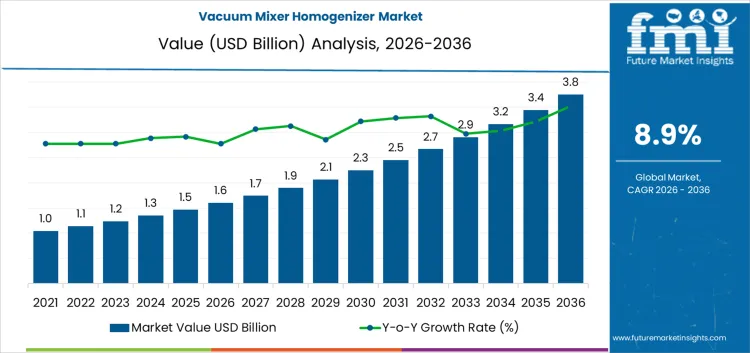
The vacuum mixer homogenizer market is projected to grow from USD 1.6 billion in 2026 to USD 3.8 billion by 2036, resulting in an 8.9% CAGR. These systems are central to formulations where air inclusion, shear profile, and temperature control directly affect product quality, including pharmaceuticals, cosmetics, specialty chemicals, and food pastes. Production planning in these industries links mixer sizing and configuration to batch integrity and downstream filling efficiency rather than to simple throughput targets. Facilities with high value or sensitive formulations invest earlier because scrap and rework costs are material. Regional concentration follows clusters of regulated manufacturing and branded product production.
Process validation and recipe protection shape procurement behavior more than capital budgeting cycles. Once a mixing platform is qualified for a specific formulation family, it becomes part of a locked process set to avoid revalidation risk and consistency drift. Cleaning protocols, changeover time, and seal reliability influence equipment selection as much as mixing performance. Smaller producers often rely on contract manufacturers with standardized platforms. Vacuum mixer homogenizer market grows through expansion of high specification product lines and tighter quality control regimes, not through uniform modernization of all mixing operations.
Quick Stats for Vacuum Mixer Homogenizer Market
- Vacuum Mixer Homogenizer Market Value (2026): USD 1.6 billion
- Vacuum Mixer Homogenizer Market Forecast Value (2036): USD 3.8 billion
- Vacuum Mixer Homogenizer Market Forecast CAGR 2026 to 2036: 8.9%
- Leading Type in Vacuum Mixer Homogenizer Market: Laboratory vacuum mixer homogenizers
- Leading Application in Vacuum Mixer Homogenizer Market: Pharmaceutical processing
- Key Growth Regions in Vacuum Mixer Homogenizer Market: Asia Pacific, North America, Europe
- Top Players in Vacuum Mixer Homogenizer Market: IKA Works, Ystral GmbH, Silverson Machines, Admix Inc.,VELP Scientifica
What is the Growth Forecast for Vacuum Mixer Homogenizer Market through 2036?
Vacuum mixer homogenizers are being pulled into more production lines because formulation risk and batch failure costs are rising faster than throughput targets. In 2021, when the market is still close to USD 0.9 billion, demand is largely tied to established pharmaceutical, cosmetics, and specialty food plants upgrading older open or atmospheric systems. By 2023-2024, spending moves to roughly USD 1.1 to 1.2 billion as vacuum mixing becomes more common for controlling aeration and texture in higher-value products. The step to about USD 1.5 billion by 2025 and around USD 1.6 billion in 2026 marks the point where these machines are no longer reserved for premium lines but are increasingly specified as default equipment in new or refurbished plants where yield stability and visual quality directly affect approvals and brand acceptance.
As product portfolios become more complex and batch sizes more variable, the market reaches about USD 1.9 billion by 2028 and roughly USD 2.3 billion by 2030, driven by scale-up projects, automation upgrades, and multi-product facility designs. By 2032, spending advances to around USD 2.9 billion as larger vessels and higher-spec systems replace earlier generations. The move into the USD 3.2 to 3.5 billion range around 2033-2034 reflects continued upscaling and tighter integration with dosing, heating, and cleaning systems. Approaching about USD 3.7 to 3.8 billion by 2035-2036, growth is carried mainly by higher system specification and larger working volumes rather than by an increase in the number of manufacturers. Purchasing decisions remain focused on validation support, cleanability, process control accuracy, and long-term reliability rather than on basic mechanical capacity or lowest upfront price.
Vacuum Mixer Homogenizer Market Key Takeaways
| Metric | Value |
|---|---|
| Market Value (2026) | USD 1.6 billion |
| Forecast Value (2036) | USD 3.8 billion |
| Forecast CAGR 2026 to 2036 | 8.9% |
How Is the Vacuum Mixer Homogenizer Market Supporting Efficient Mixing and Product Consistency?
Vacuum mixer homogenizers are increasingly adopted to achieve uniform mixing, de-aeration, and consistent texture in pharmaceutical, cosmetic, and food processing applications. Historically, conventional mixers struggled with air entrapment, uneven blending, and extended processing times, affecting product quality and stability. Modern vacuum mixer homogenizers combine high-shear mixing, vacuum degassing, and precise temperature control to ensure homogenous mixtures, reduced bubble formation, and reproducible product characteristics. Manufacturers, formulation labs, and production facilities prioritize mixing efficiency, material compatibility, and process control. Early adoption focused on pharmaceutical and cosmetic production, while current demand spans food processing, personal care products, and specialty chemical formulations, driven by quality standards, operational efficiency, and regulatory compliance. Shear rate, vacuum capability, and mixing uniformity influence supplier selection.
Maintaining consistent product quality and reducing processing variability are shaping market growth. Compared with conventional mixers, vacuum homogenizers emphasize uniform particle dispersion, controlled aeration, and precise process reproducibility. Cost structures depend on motor performance, vessel material, and automation features, concentrating margins among suppliers capable of delivering reliable, high-performance systems. Manufacturers adopt these mixers to enhance product stability, improve texture and consistency, and optimize production efficiency. By 2036, vacuum mixer homogenizers are expected to become standard equipment in pharmaceutical, cosmetic, and food processing facilities, supporting uniform product quality, reduced production variability, and reliable formulation performance.
What Factors Are Shaping the Demand for Vacuum Mixer Homogenizer Market, Segment wise by Type and Application, in 2026?
The Vacuum Mixer Homogenizer Market in 2026 is segmented by type and by application. By equipment class, demand in the Vacuum Mixer Homogenizer Market is divided into laboratory vacuum mixer homogenizers, industrial vacuum mixer homogenizers, portable or benchtop models, and automated or robotic vacuum homogenizers, each suited to different batch sizes, viscosity ranges, and control requirements. By application, demand in the vacuum mixer homogenizer market is organized around pharmaceutical processing, food and beverage production, cosmetics and personal care, and chemical and materials research, which differ in hygiene standards, formulation complexity, and validation requirements. These segments show how buyers select systems based on scale, compliance burden, and process repeatability.
Why Do Laboratory Vacuum Mixer Homogenizers Lead Product Demand in the Vacuum Mixer Homogenizer Market?

Laboratory vacuum mixer homogenizers account for about 44% of demand in the Vacuum Mixer Homogenizer Market in 2026 because formulation development and small batch validation work occur continuously across multiple industries. Pharmaceutical, cosmetic, and specialty chemical producers rely on lab scale equipment to develop and refine recipes before scaling to production. In the Vacuum Mixer Homogenizer Market, each R and D center typically requires several units for different projects, which multiplies installation counts. These systems are also used for quality control and reformulation work. Their lower cost and frequent procurement cycles compared with large industrial systems keep laboratory units as the most widely purchased equipment category.
Industrial, portable, and automated systems in the Vacuum Mixer Homogenizer Market serve different roles. Industrial systems handle large volumes but are bought in smaller numbers and on longer investment cycles. Portable or benchtop models are used for demonstrations or limited tasks. Automated or robotic systems target high throughput or highly controlled environments, yet their cost and complexity limit adoption to selected sites. These categories are important for value and capacity, but their unit volumes do not match the widespread use of laboratory equipment.
Why Does Pharmaceutical Processing Dominate Application Demand in the Vacuum Mixer Homogenizer Market?
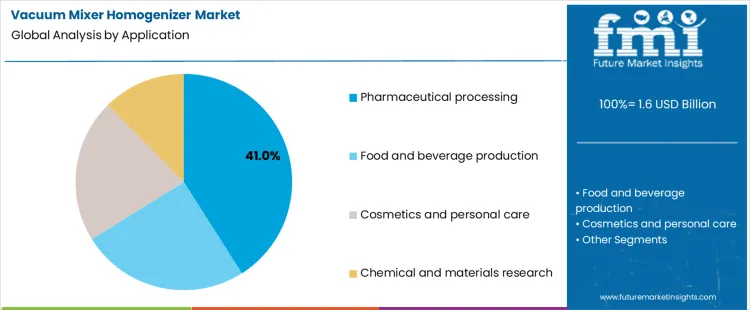
Pharmaceutical processing represents about 41% of demand in the Vacuum Mixer Homogenizer Market in 2026 because many drug formulations require air free mixing to ensure stability, dose uniformity, and consistent texture. Creams, gels, suspensions, and injectable preparations often depend on vacuum mixing to remove entrapped air and achieve uniform dispersion. In the Vacuum Mixer Homogenizer Market, pharmaceutical manufacturers also operate under strict validation and documentation regimes, which supports repeated investment in dedicated equipment for different products or lines. Development, pilot, and commercial production stages all require compatible mixing systems. This broad and continuous need explains why pharmaceuticals remain the largest application segment.
Food, cosmetics, and materials research in the Vacuum Mixer Homogenizer Market follow different patterns. Food producers use vacuum mixing for selected products rather than across all lines. Cosmetics companies use such equipment heavily, but total plant counts are smaller. Research applications involve high equipment density per site but few sites overall. These segments contribute to growth and diversification, but none matches the scale and regulatory driven intensity of use found in pharmaceutical processing.
How Are the Key Dynamics Reshaping the Vacuum Mixer Homogenizer Market?
The category is being shaped by product consistency requirements, conservative qualification cycles, and the move toward standardized processing lines. In pharmaceuticals, cosmetics, food, and specialty chemicals, uniform texture and air free mixing are quality critical. Vacuum mixer homogenizers address this, but adoption is gated by validation effort, cleaning protocols, and line integration risk. Manufacturers are reducing process variation by standardizing equipment platforms across plants. This creates a market where growth depends on inclusion in approved line designs and capital programs rather than on frequent equipment replacement, and where platform acceptance and service capability matter as much as mixing performance.
Why Are Product Quality and Consistency Driving Demand?
Demand is anchored in repeatability and defect avoidance. Many formulations are sensitive to entrapped air, particle agglomeration, or uneven dispersion, which affects appearance, stability, and shelf life. Vacuum mixing improves homogeneity and removes bubbles, reducing rework and rejects. In regulated or brand sensitive products, consistent texture and fill behavior are part of release criteria. Once a recipe and line are qualified with a specific mixer, that configuration is reused for years. Volume then follows new line installations, capacity expansions, and new product introductions rather than routine replacement of existing equipment.
What Is Slowing Wider Adoption of These Systems?
The main barrier is capital and integration risk. Vacuum mixer homogenizers are large, custom configured machines that must fit into upstream feeding and downstream filling lines. Commissioning affects cleaning validation, operator training, and sometimes building layout. For simpler products, conventional mixers are adequate and cheaper. Changeovers and cleaning complexity also raise concerns in multiproduct plants. Because of these factors, buyers move cautiously and often wait to bundle purchases into larger line upgrades. This keeps sales concentrated in new projects and major expansions rather than in incremental, stand alone upgrades.
How Are Standard Processing Platforms Changing Buying Behavior?
The trend is toward line level standardization. Large manufacturers increasingly define reference processing lines and replicate them across plants to reduce variability and speed validation. Vacuum mixer homogenizers selected for these lines become part of the standard package and are reordered with each new line or site. Procurement shifts to long term supplier relationships and framework contracts. Service support, documentation, and cleanability become as important as mixing performance. Over time, success depends on being embedded in these standard line architectures rather than on winning individual, one off equipment orders.
What is the Demand for Vacuum Mixer Homogenizers by Country?
| Country | CAGR (%) |
|---|---|
| US | 8.3% |
| UK | 7.8% |
| China | 9.8% |
| India | 10.5% |
| Brazil | 8.5% |
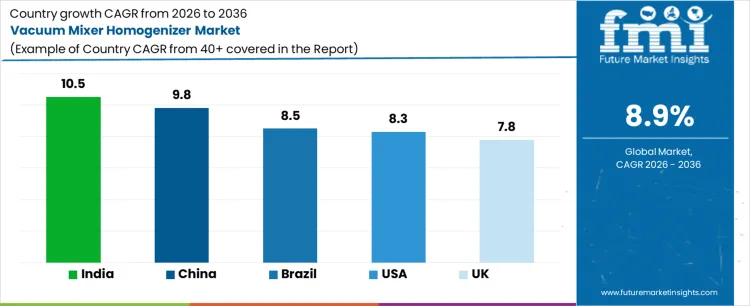
Demand for vacuum mixer homogenizers is rising as pharmaceutical, food, and chemical manufacturers adopt equipment for consistent mixing, improved product quality, and reduced air entrapment. India leads with a 10.5% CAGR, driven by growing pharmaceutical production, increased adoption of automated mixing technologies, and rising demand for high-quality formulations. China follows at 9.8%, supported by expansion in food and chemical manufacturing sectors. Brazil records 8.5% growth, shaped by industrial processing requirements and adoption of advanced homogenization equipment. The US grows at 8.3%, influenced by replacement demand and process optimization. The UK shows 7.8% CAGR, reflecting steady adoption across pharmaceutical, food, and chemical industries.
How is the United States experiencing growth in the vacuum mixer homogenizer market?
United States is experiencing growth at a CAGR of 8.3%, driven by pharmaceutical manufacturing, food processing, and cosmetics production in California, New Jersey, and Texas. Installed base size and predictable replacement cycles support consistent demand for high-efficiency vacuum mixer homogenizers. Industry concentration among pharmaceutical companies, large food processors, and cosmetic manufacturers anchors adoption. Investments focus on precision mixing, temperature control, and system integration. Growth reflects rising requirements for consistent product quality, scalable production, and compliance with FDA standards.
- Pharmaceutical, food, and cosmetics industries drive adoption.
- Urban industrial hubs concentrate demand.
- Precision and temperature control guide investment.
- Replacement cycles support recurring adoption.
How is the United Kingdom witnessing growth in the vacuum mixer homogenizer market?
United Kingdom is witnessing growth at a CAGR of 7.8%, supported by labor cost structure and productivity pressures in pharmaceutical and food manufacturing facilities in London, Manchester, and Birmingham. Adoption favors mixers that reduce manual handling, improve batch consistency, and optimize workflow efficiency. Market concentration is moderate, with demand spread across small and medium-sized manufacturers. Investments focus on energy efficiency, ease of operation, and compliance with UK GMP standards. Growth reflects efforts to improve production efficiency while maintaining consistent product quality.
- Pharmaceutical and food manufacturers drive adoption.
- Urban industrial hubs concentrate demand.
- Energy efficiency and operational ease guide investment.
- Productivity pressures influence adoption.
How is China experiencing growth in the vacuum mixer homogenizer market?
China is experiencing growth at a CAGR of 9.8%, fueled by industrial clusters in Shanghai, Guangzhou, and Shenzhen where pharmaceutical, chemical, and food processing facilities require high-throughput mixing solutions. Market concentration is high in industrial zones, and short replacement cycles support rapid adoption. Investments focus on automation, energy-efficient designs, and integration with large-scale production lines. Growth reflects increasing industrial output, rising demand for consistent product quality, and adoption of modern mixing technologies in dense manufacturing hubs.
- Pharmaceutical, chemical, and food clusters drive adoption.
- Industrial zones concentrate demand.
- Automation and energy efficiency guide investment.
- Short replacement cycles accelerate adoption.
How is India witnessing growth in the vacuum mixer homogenizer market?
India is experiencing growth at a CAGR of 10.5%, supported by capital intensity and payback expectations in pharmaceutical, food, and cosmetic production in Mumbai, Bengaluru, and Pune. Urban industrial hubs concentrate demand, and manufacturers invest in durable, high-performance vacuum mixer homogenizers with predictable payback periods. Growth reflects increasing industrialization, modernization of production facilities, and rising adoption of efficient equipment to maintain consistent quality and reduce operational downtime.
- Pharmaceutical, food, and cosmetic industries drive adoption.
- Urban industrial hubs concentrate demand.
- Durable and high-performance systems guide investment.
- Payback expectations influence procurement.
How is Brazil experiencing growth in the vacuum mixer homogenizer market?
Brazil is experiencing growth at a CAGR of 8.5%, driven by pharmaceutical, food processing, and cosmetic industries in São Paulo, Rio de Janeiro, and Paraná. Sensitivity to downtime and operational risk encourages adoption of reliable, low-maintenance vacuum mixer homogenizers. Market concentration exists in major urban industrial hubs, with regional dispersion across secondary cities. Investments focus on system durability, energy efficiency, and ease of maintenance. Growth reflects the need for dependable mixing equipment to ensure consistent product quality and uninterrupted production.
- Pharmaceutical, food, and cosmetic sectors drive adoption.
- Urban industrial hubs concentrate demand.
- Durability and energy efficiency guide investment.
- Operational risk sensitivity supports adoption.
How Are Suppliers Advancing Precision and Versatility for Industrial and Laboratory Use in Vacuum Mixer Homogenizer Market?
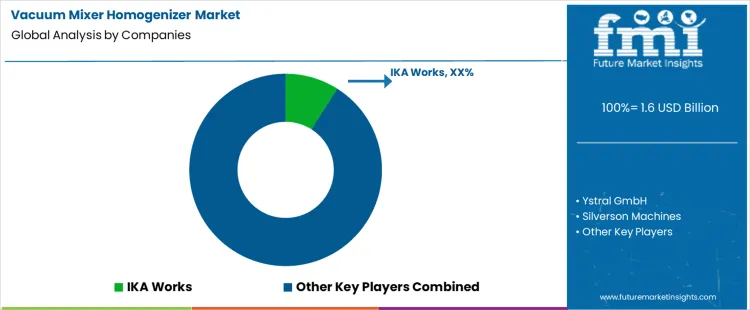
In the vacuum mixer homogenizer market, suppliers distinguish their offerings through mixing performance, pressure control, and adaptability to varied materials and batch sizes. IKA Works supplies homogenizers that integrate vacuum capability with high-shear mixing, supporting dispersion and degassing for pharmaceuticals, cosmetics, and chemical formulations.
Ystral GmbH provides homogenizers engineered for robust processing of viscous media, with emphasis on adjustable shear profiles and continuous operation modes. Silverson Machines delivers high-speed mixers that combine vacuum deaeration with efficient particle size reduction, suited for emulsions, suspensions, and fine dispersions.
Admix Inc. supplies vacuum capable mixers that emphasize sanitary design and ease of cleaning, meeting standards for food, beverage, and biotech processing. VELP Scientifica develops units combining precise vacuum control with intuitive operation for research-intensive environments. Other regional and niche manufacturers provide mixers optimized for specific industry niches, such as paint and coatings or high-viscosity polymer blends. Competitive differentiation arises from vacuum range stability, shear intensity control, ease of maintenance, and material-contact surface design. Suppliers that combine validated performance, technical support, and documented process reproducibility position themselves well where consistent homogenization under reduced pressure is critical for product quality and formulation reliability.
Key Players in the Vacuum Mixer Homogenizer Market
- IKA Works
- Ystral GmbH
- Silverson Machines
- Admix Inc.
- VELP Scientifica
Scope of the Report
| Items | Values |
|---|---|
| Quantitative Units (2026) | USD billion |
| Type | Laboratory vacuum mixer homogenizers, Industrial vacuum mixer homogenizers, Portable or benchtop models, Automated or robotic vacuum homogenizers |
| Application | Pharmaceutical processing, Food and beverage production, Cosmetics and personal care, Chemical and materials research |
| Regions Covered | Asia Pacific, Europe, North America, Latin America, Middle East & Africa |
| Countries Covered | China, Japan, South Korea, India, Australia & New Zealand, ASEAN, Germany, United Kingdom, France, Italy, Spain, Nordic, BENELUX, United States, Canada, Mexico, Brazil, Chile, Saudi Arabia, Turkey, South Africa, and other regional markets |
| Key Companies Profiled | IKA Works, Ystral GmbH, Silverson Machines, Admix Inc., VELP Scientifica |
| Additional Attributes | Dollar by sales by type and application; laboratory systems and pharmaceutical processing as leading segments; demand driven by air-free mixing, batch reproducibility, and validation needs; growth shaped by line upgrades and automation; procurement influenced by cleanability, documentation support, service coverage, and integration with standardized processing lines. |
Vacuum Mixer Homogenizer Market Segmentation
Type:
- Laboratory vacuum mixer homogenizers
- Industrial vacuum mixer homogenizers
- Portable or benchtop models
- Automated or robotic vacuum homogenizers
Application:
- Pharmaceutical processing
- Food and beverage production
- Cosmetics and personal care
- Chemical and materials research
Region
- Asia Pacific
- China
- Japan
- South Korea
- India
- Australia & New Zealand
- ASEAN
- Rest of Asia Pacific
- Europe
- Germany
- United Kingdom
- France
- Italy
- Spain
- Nordic
- BENELUX
- Rest of Europe
- North America
- United States
- Canada
- Mexico
- Latin America
- Brazil
- Chile
- Rest of Latin America
- Middle East & Africa
- Kingdom of Saudi Arabia
- Other GCC Countries
- Turkey
- South Africa
- Other African Union
- Rest of Middle East & Africa
Bibliography
- USA Food and Drug Administration. (2025). Current Good Manufacturing Practice (CGMP) regulations for drugs and biologics (as of November 21, 2025). USA Department of Health and Human Services.
- World Health Organization. (2024). Quality assurance of pharmaceuticals: A compendium of guidelines and related materials, Volume 2 - Good manufacturing practices and inspection (10th edition). World Health Organization.
- International Council for Harmonisation. (2023). ICH Q9(R1): Quality risk management (Revision 1). International Council for Harmonisation.
- International Organization for Standardization. (2024). ISO 9001:2015/Amd 1:2024 Quality management systems - Requirements - Amendment 1. ISO.
Frequently Asked Questions
How big is the vacuum mixer homogenizer market in 2026?
The global vacuum mixer homogenizer market is estimated to be valued at USD 1.6 billion in 2026.
What will be the size of vacuum mixer homogenizer market in 2036?
The market size for the vacuum mixer homogenizer market is projected to reach USD 3.8 billion by 2036.
How much will be the vacuum mixer homogenizer market growth between 2026 and 2036?
The vacuum mixer homogenizer market is expected to grow at a 8.9% CAGR between 2026 and 2036.
What are the key product types in the vacuum mixer homogenizer market?
The key product types in vacuum mixer homogenizer market are laboratory vacuum mixer homogenizers , industrial vacuum mixer homogenizers, portable or benchtop models and automated or robotic vacuum homogenizers.
Which application segment to contribute significant share in the vacuum mixer homogenizer market in 2026?
In terms of application, pharmaceutical processing segment to command 41.0% share in the vacuum mixer homogenizer market in 2026.
Preview the report firsthand - request a free sample
Get SampleGet the brochure for pricing and purchase details.
Get PDFTable of Content
- Executive Summary
- Global Market Outlook
- Demand-side Trends
- Supply-side Trends
- Technology Roadmap Analysis
- Analysis and Recommendations
- Market Overview
- Market Coverage / Taxonomy
- Market Definition / Scope / Limitations
- Market Background
- Market Dynamics
- Drivers
- Restraints
- Opportunity
- Trends
- Scenario Forecast
- Demand in Optimistic Scenario
- Demand in Likely Scenario
- Demand in Conservative Scenario
- Opportunity Map Analysis
- Product Life Cycle Analysis
- Supply Chain Analysis
- Investment Feasibility Matrix
- Value Chain Analysis
- PESTLE and Porter’s Analysis
- Regulatory Landscape
- Regional Parent Market Outlook
- Production and Consumption Statistics
- Import and Export Statistics
- Market Dynamics
- Global Market Analysis 2021 to 2025 and Forecast, 2026 to 2036
- Historical Market Size Value (USD Million) Analysis, 2021 to 2025
- Current and Future Market Size Value (USD Million) Projections, 2026 to 2036
- Y-o-Y Growth Trend Analysis
- Absolute $ Opportunity Analysis
- Global Market Pricing Analysis 2021 to 2025 and Forecast 2026 to 2036
- Global Market Analysis 2021 to 2025 and Forecast 2026 to 2036, By Type
- Introduction / Key Findings
- Historical Market Size Value (USD Million) Analysis By Type, 2021 to 2025
- Current and Future Market Size Value (USD Million) Analysis and Forecast By Type, 2026 to 2036
- Laboratory vacuum mixer homogenizers
- Industrial vacuum mixer homogenizers
- Portable or benchtop models
- Automated or robotic vacuum homogenizers
- Laboratory vacuum mixer homogenizers
- Y-o-Y Growth Trend Analysis By Type, 2021 to 2025
- Absolute $ Opportunity Analysis By Type, 2026 to 2036
- Global Market Analysis 2021 to 2025 and Forecast 2026 to 2036, By Application
- Introduction / Key Findings
- Historical Market Size Value (USD Million) Analysis By Application, 2021 to 2025
- Current and Future Market Size Value (USD Million) Analysis and Forecast By Application, 2026 to 2036
- Pharmaceutical processing
- Food and beverage production
- Cosmetics and personal care
- Chemical and materials research
- Pharmaceutical processing
- Y-o-Y Growth Trend Analysis By Application, 2021 to 2025
- Absolute $ Opportunity Analysis By Application, 2026 to 2036
- Global Market Analysis 2021 to 2025 and Forecast 2026 to 2036, By Region
- Introduction
- Historical Market Size Value (USD Million) Analysis By Region, 2021 to 2025
- Current Market Size Value (USD Million) Analysis and Forecast By Region, 2026 to 2036
- North America
- Latin America
- Western Europe
- Eastern Europe
- East Asia
- South Asia and Pacific
- Middle East & Africa
- Market Attractiveness Analysis By Region
- North America Market Analysis 2021 to 2025 and Forecast 2026 to 2036, By Country
- Historical Market Size Value (USD Million) Trend Analysis By Market Taxonomy, 2021 to 2025
- Market Size Value (USD Million) Forecast By Market Taxonomy, 2026 to 2036
- By Country
- USA
- Canada
- Mexico
- By Type
- By Application
- By Country
- Market Attractiveness Analysis
- By Country
- By Type
- By Application
- Key Takeaways
- Latin America Market Analysis 2021 to 2025 and Forecast 2026 to 2036, By Country
- Historical Market Size Value (USD Million) Trend Analysis By Market Taxonomy, 2021 to 2025
- Market Size Value (USD Million) Forecast By Market Taxonomy, 2026 to 2036
- By Country
- Brazil
- Chile
- Rest of Latin America
- By Type
- By Application
- By Country
- Market Attractiveness Analysis
- By Country
- By Type
- By Application
- Key Takeaways
- Western Europe Market Analysis 2021 to 2025 and Forecast 2026 to 2036, By Country
- Historical Market Size Value (USD Million) Trend Analysis By Market Taxonomy, 2021 to 2025
- Market Size Value (USD Million) Forecast By Market Taxonomy, 2026 to 2036
- By Country
- Germany
- UK
- Italy
- Spain
- France
- Nordic
- BENELUX
- Rest of Western Europe
- By Type
- By Application
- By Country
- Market Attractiveness Analysis
- By Country
- By Type
- By Application
- Key Takeaways
- Eastern Europe Market Analysis 2021 to 2025 and Forecast 2026 to 2036, By Country
- Historical Market Size Value (USD Million) Trend Analysis By Market Taxonomy, 2021 to 2025
- Market Size Value (USD Million) Forecast By Market Taxonomy, 2026 to 2036
- By Country
- Russia
- Poland
- Hungary
- Balkan & Baltic
- Rest of Eastern Europe
- By Type
- By Application
- By Country
- Market Attractiveness Analysis
- By Country
- By Type
- By Application
- Key Takeaways
- East Asia Market Analysis 2021 to 2025 and Forecast 2026 to 2036, By Country
- Historical Market Size Value (USD Million) Trend Analysis By Market Taxonomy, 2021 to 2025
- Market Size Value (USD Million) Forecast By Market Taxonomy, 2026 to 2036
- By Country
- China
- Japan
- South Korea
- By Type
- By Application
- By Country
- Market Attractiveness Analysis
- By Country
- By Type
- By Application
- Key Takeaways
- South Asia and Pacific Market Analysis 2021 to 2025 and Forecast 2026 to 2036, By Country
- Historical Market Size Value (USD Million) Trend Analysis By Market Taxonomy, 2021 to 2025
- Market Size Value (USD Million) Forecast By Market Taxonomy, 2026 to 2036
- By Country
- India
- ASEAN
- Australia & New Zealand
- Rest of South Asia and Pacific
- By Type
- By Application
- By Country
- Market Attractiveness Analysis
- By Country
- By Type
- By Application
- Key Takeaways
- Middle East & Africa Market Analysis 2021 to 2025 and Forecast 2026 to 2036, By Country
- Historical Market Size Value (USD Million) Trend Analysis By Market Taxonomy, 2021 to 2025
- Market Size Value (USD Million) Forecast By Market Taxonomy, 2026 to 2036
- By Country
- Kingdom of Saudi Arabia
- Other GCC Countries
- Turkiye
- South Africa
- Other African Union
- Rest of Middle East & Africa
- By Type
- By Application
- By Country
- Market Attractiveness Analysis
- By Country
- By Type
- By Application
- Key Takeaways
- Key Countries Market Analysis
- USA
- Pricing Analysis
- Market Share Analysis, 2025
- By Type
- By Application
- Canada
- Pricing Analysis
- Market Share Analysis, 2025
- By Type
- By Application
- Mexico
- Pricing Analysis
- Market Share Analysis, 2025
- By Type
- By Application
- Brazil
- Pricing Analysis
- Market Share Analysis, 2025
- By Type
- By Application
- Chile
- Pricing Analysis
- Market Share Analysis, 2025
- By Type
- By Application
- Germany
- Pricing Analysis
- Market Share Analysis, 2025
- By Type
- By Application
- UK
- Pricing Analysis
- Market Share Analysis, 2025
- By Type
- By Application
- Italy
- Pricing Analysis
- Market Share Analysis, 2025
- By Type
- By Application
- Spain
- Pricing Analysis
- Market Share Analysis, 2025
- By Type
- By Application
- France
- Pricing Analysis
- Market Share Analysis, 2025
- By Type
- By Application
- India
- Pricing Analysis
- Market Share Analysis, 2025
- By Type
- By Application
- ASEAN
- Pricing Analysis
- Market Share Analysis, 2025
- By Type
- By Application
- Australia & New Zealand
- Pricing Analysis
- Market Share Analysis, 2025
- By Type
- By Application
- China
- Pricing Analysis
- Market Share Analysis, 2025
- By Type
- By Application
- Japan
- Pricing Analysis
- Market Share Analysis, 2025
- By Type
- By Application
- South Korea
- Pricing Analysis
- Market Share Analysis, 2025
- By Type
- By Application
- Russia
- Pricing Analysis
- Market Share Analysis, 2025
- By Type
- By Application
- Poland
- Pricing Analysis
- Market Share Analysis, 2025
- By Type
- By Application
- Hungary
- Pricing Analysis
- Market Share Analysis, 2025
- By Type
- By Application
- Kingdom of Saudi Arabia
- Pricing Analysis
- Market Share Analysis, 2025
- By Type
- By Application
- Turkiye
- Pricing Analysis
- Market Share Analysis, 2025
- By Type
- By Application
- South Africa
- Pricing Analysis
- Market Share Analysis, 2025
- By Type
- By Application
- USA
- Market Structure Analysis
- Competition Dashboard
- Competition Benchmarking
- Market Share Analysis of Top Players
- By Regional
- By Type
- By Application
- Competition Analysis
- Competition Deep Dive
- IKA Works
- Overview
- Product Portfolio
- Profitability by Market Segments (Product/Age /Sales Channel/Region)
- Sales Footprint
- Strategy Overview
- Marketing Strategy
- Product Strategy
- Channel Strategy
- Ystral GmbH
- Silverson Machines
- Admix Inc.
- VELP Scientifica
- IKA Works
- Competition Deep Dive
- Assumptions & Acronyms Used
- Research Methodology


