

- Industry Size (2026)
- USD 557.0 Mn
- Forecast (2036)
- USD 1560.0 Mn
- CAGR (2026 to 2036)
- 10.2%
Pumpkin Seed Protein & Fiber Market Size, Market Forecast and Outlook By FMI
In 2025, the pumpkin seed protein & fiber market crossed a valuation of USD 510.0 million. Projections of USD 557.0 million for 2026 and USD 1,560.0 million by 2036 imply a 10.2% CAGR as procurement specifications shift toward dual-action functional ingredients. Buyers specify seed extracts over conventional dairy proteins to clear clean-label qualification hurdles.
Plant-based scale dictates capacity investments. Formulation teams substitute highly processed soy derivatives with hypoallergenic seed fractions during regular recipe updates. Global retail plant-based foods sales reached USD 28.6 billion in 2024. [1] As per FMI's projection, commercial adoption accelerates across mainstream beverage channels. Procurement managers lock in long-term acreage contracts to insulate margins against raw material volatility.
Summary of Pumpkin Seed Protein & Fiber
- Pumpkin Seed Protein & Fiber Market Definition
- Functional food ingredients extracted from seeds serve as primary inputs for nutritional fortification and clean-label product formulation.
- Demand Drivers in the Market
- Rising consumer awareness regarding digestive health prompts food manufacturers to fortify product lines with natural plant extracts.
- Stringent clean-label requirements compel brands to substitute artificial texturizers with naturally derived seed components.
- Expanding vegan demographic profiles increase baseline consumption of non-dairy protein powders across retail channels.
- Key Segments Analyzed in the FMI Report
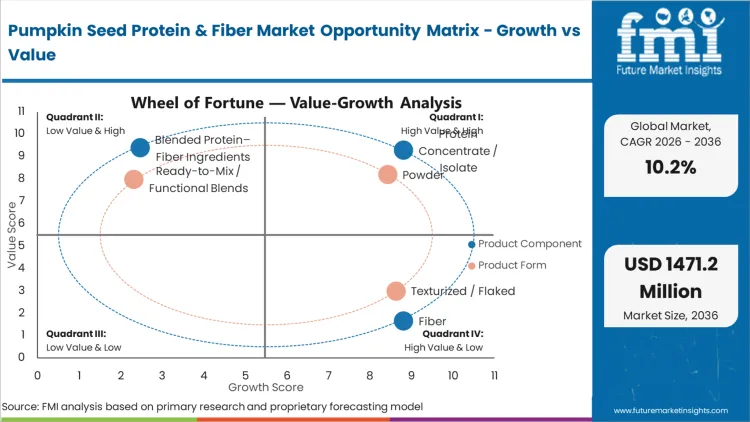
- Product Component: Dominant protein concentrate / isolate (53%) versus other seed derivatives.
- Product Form: Powder (61% of total volume) versus other formats.
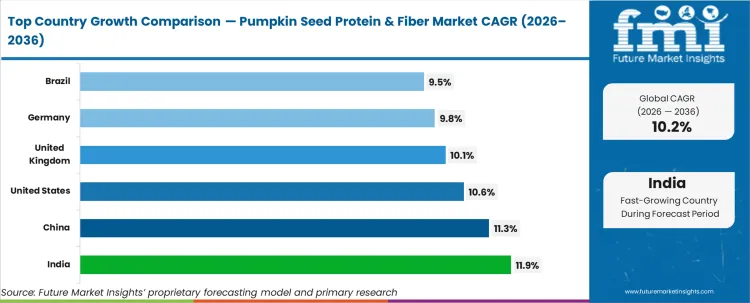
- Geography: High-growth Asia-Pacific (India 11.9%, China 11.3%) versus mature North America (United States 10.6%) and regulatory-driven Europe (United Kingdom 10.1%, Germany 9.8%).
- Analyst Opinion at FMI
- Nandini Roy Choudhury, Principal Consultant for Food & Beverage at Future Market Insights, opines, “In our latest Pumpkin Seed Protein & Fiber Market assessment, my team and I have identified mineral fortification and formulation versatility as underleveraged growth drivers. Pumpkin seed derivatives naturally carry zinc, magnesium, and iron, enabling dual-positioning as both protein enrichment and micronutrient enhancement solutions. However, particle size control and flavor balancing remain essential for seamless integration into beverage and high-protein bakery systems. Suppliers that optimize solubility and standardize nutritional claims will strengthen adoption across performance and functional nutrition platforms.”
- Strategic Implications/Executive Takeaways
- Procurement managers must secure multi-year supply agreements to mitigate localized crop yield fluctuations.
- Ingredient suppliers should expand extraction capabilities to offer higher-purity isolates for premium beverage applications.
- Brands must formulate products combining dual-action macro-nutrients to capture health-conscious consumer spending.
- Methodology
- Validated through first-hand corporate production and capacity data.
- Zero reliance on speculative third-party market research reports.
- Based on verifiable industrial benchmarks and verified sources.
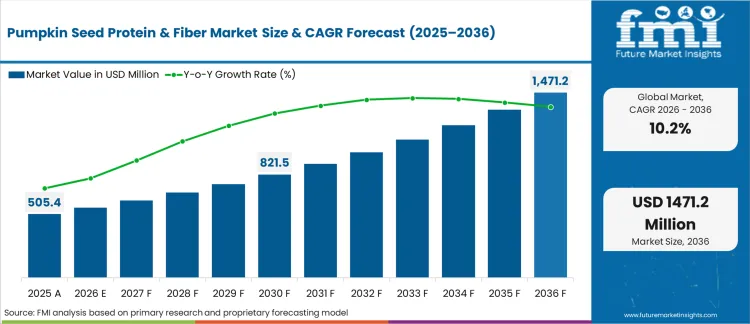
India, China, United States, United Kingdom, Germany, and Brazil exhibit CAGRs ranging from 9.5% to 11.9%. Country dispersion mirrors regulatory compliance corridors where government health guidelines force manufacturers to elevate nutritional profiles. Processing clusters concentrate near agricultural hubs, reducing freight overhead for international ingredient exporters.
Pumpkin Seed Protein & Fiber Market Key Takeaways
| Metric | Value |
|---|---|
| Industry Size (2026) | USD 557 Million |
| Industry Value (2036) | USD 1,560 Million |
| CAGR (2026-2036) | 10.2% |
Pumpkin Seed Protein & Fiber Market Definition
Pumpkin seed protein and fiber designates functional food ingredients extracted from raw seeds through cold-pressing and milling processes. Formulators utilize these derivatives to replace animal-based proteins in packaged goods. Commercial processors quantify market revenue based on business-to-business sales of concentrated powders and dietary extracts originating entirely from pumpkin feedstocks. Production lines standardize raw materials to meet commercial safety thresholds.
Pumpkin Seed Protein & Fiber Market Inclusions
The pumpkin seed protein & fiber category includes concentrated protein powders derived from cold-pressed pumpkin seeds and isolated protein fractions supplied for commercial beverage manufacturing. It also covers dietary fiber extracts separated during industrial milling and standardized for formulation use. Combined macro-nutrient blends containing pumpkin-derived protein and fiber sold directly to food processors are included at the bulk ingredient level.
Pumpkin Seed Protein & Fiber Market Exclusions
The scope excludes whole raw pumpkin seeds marketed for direct consumer snacking and seed oil pressed solely for culinary purposes. Finished retail products where pumpkin derivatives appear only as minor ingredients are not considered. Animal feed formulations utilizing low-grade agricultural byproducts are also excluded.
Pumpkin Seed Protein & Fiber Market Research Methodology
- Primary Research: Analysts conducted interviews with ingredient processors, extraction facility managers, and food formulation scientists to verify production yields.
- Desk Research: Analysts evaluated agricultural output data from national regulatory bodies and trade customs databases to model raw material availability.
- Market-Sizing and Forecasting: Analysts applied top-down and bottom-up modeling techniques, validating baseline consumption against known capacities.
- Data Validation and Update Cycle: Analysts subjected all statistical outputs to multi-point variance screening and cross-referenced estimates against published corporate financial filings before final publication.
Segmental Analysis
Pumpkin Seed Protein & Fiber Market Analysis by Product Component
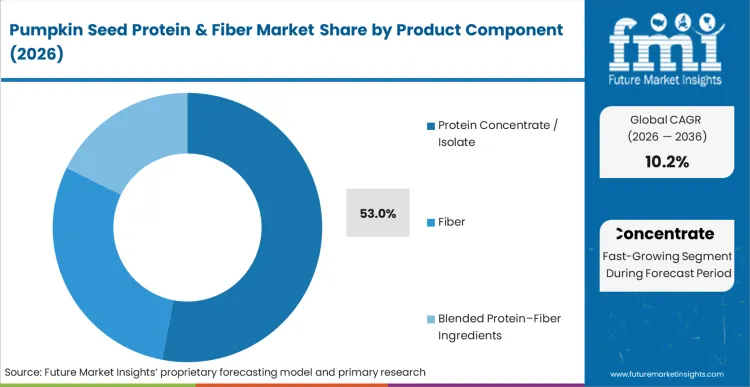
Formulators are increasingly prioritizing high-purity protein inputs, particularly for liquid applications where texture and solubility are critical. Refined concentrates and isolates help avoid the gritty mouthfeel often associated with less processed flours. In August 2024, NNB Nutrition introduced TruSeed P, expanding commercial availability of soluble botanical protein options [3]. FMI estimates that buyers are specifying isolate grades to meet precise nutritional claims while minimizing off-flavors. Ongoing improvements in extraction technology are also increasing yields, enabling suppliers to concentrate more competitively against traditional soy ingredients. At the same time, procurement teams are tightening supplier audits to ensure consistent amino acid profiles across production runs. As these preferences solidify, protein concentrates and isolates account for 53% of total category volume in 2026.
- Procurement trigger: Tightening allergen regulations compel food brands to source hypoallergenic ingredients. Buyers replace soy and wheat inputs with seed-derived isolates to secure broad demographic access.
- Technology shift: Advancements in cold-pressing techniques yield higher protein concentrations without denaturing delicate structures. Processors deliver superior functional properties, allowing formulators to achieve smoother textures in liquid formats.
- Buyer priority: Clean-tasting profiles dictate vendor selection for premium sports nutrition lines. Brands select suppliers offering neutral-flavor isolates to reduce masking agent reliance.
Pumpkin Seed Protein & Fiber Market Analysis by Product Form
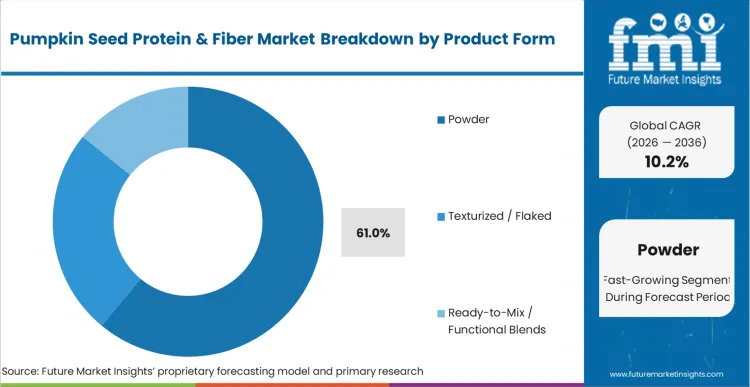
Powder captures 61% of total consumption in 2026. Transport economics strongly favor dehydrated formats, reducing freight costs and extending operational shelf life. Laird Superfood introduced a Protein Creamer in May 2024, utilizing powdered blends to target mainstream beverage consumers. [15] FMI analysts opine that manufacturers deploy powdered forms across diverse applications, ranging from baked goods to nutritional supplements. Consistent particle sizing ensures uniform blending within industrial mixing equipment, minimizing batch rejection rates. Suppliers invest in advanced milling equipment to customize powder specifications for specific end-user viscosity requirements.
- Supply-side move: Processors install specialized milling infrastructure to produce ultra-fine powder grades. Fine particulates improve mouthfeel in liquid applications, expanding addressable sales categories for ingredient manufacturers.
- Regulatory signal: Health authorities update nutritional labeling mandates, prompting brands to reformulate existing product lines. Companies incorporate powdered to meet elevated daily recommended intake targets.
- Procurement shift: Buyers consolidate ingredient sourcing by purchasing multi-functional powder blends. Formulators achieve protein and fiber fortification simultaneously, reducing raw material inventory complexity.
Pumpkin Seed Protein & Fiber Market Drivers, Restraints, and Opportunities
Mandated fiber intake targets compel widespread product reformulation across baked goods and snacks. Global health authorities advise adults to consume at least 25 grams of dietary fiber daily. [4] According to FMI's estimates, food producers incorporate pumpkin seed derivatives to bridge nutritional gaps without compromising sensory appeal. Mass-market brands redesign core portfolios to feature front-of-pack health claims. Public health initiatives highlighting digestive wellness translate directly into increased procurement orders for functional ingredients. Suppliers capitalizing on health directives experience sustained volume growth.
Cost premiums and extraction inefficiencies limit immediate mass adoption within price-sensitive emerging economies. United Kingdom government tracking highlights persistent adult dietary deficiencies, reflecting structural supply barriers. [14] FMI analysts opine that yield optimization remains an ongoing challenge for independent processors. Procurement teams frequently encounter pricing barriers when substituting cheaper soy ingredients with premium seed extracts. Facility upgrades demand substantial upfront capital, delaying capacity expansions.
- Formulation Upgrade: Brands replacing synthetic texturizers with natural seed fibers appeal directly to clean-label consumers. Food manufacturers achieve superior product positioning and justify higher retail price points by utilizing premium extracts.
- Capacity Expansion: Ingredient processors building dedicated extraction facilities capture growing demand from regional wellness brands. Burcon formed an alliance to acquire a commercial protein production facility during November 2024. [5]
- Agricultural Sourcing: Upstream supply stability dictates commercial viability for specialized botanical extracts. United States agricultural yields reached 1.44 billion pounds in 2024, indicating sufficient raw material availability. [16]
Regional Analysis
Based on the regional analysis, the Pumpkin Seed Protein & Fiber market is segmented into North America, Latin America, Europe, East Asia, South Asia, Oceania and Middle East & Africa across 40+ countries. The full report also offers market attractiveness analysis based on regional trends.
.webp "Top Country Growth Comparison Pumpkin Seed Protein & Fiber Market Cagr (2026 2036)")
| Country | Estimated CAGR |
|---|---|
| India | 11.9% |
| China | 11.3% |
| United States | 10.6% |
| United Kingdom | 10.1% |
| Germany | 9.8% |
| Brazil | 9.5% |
Source: Future Market Insights (FMI) analysis, based on proprietary forecasting model and primary research
Asia Pacific Pumpkin Seed Protein & Fiber Analysis
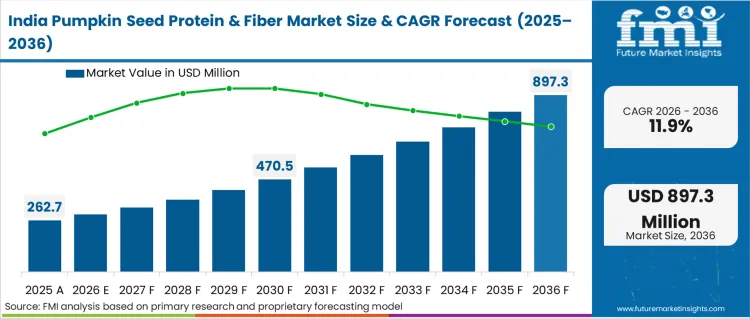
Asia Pacific agricultural sectors expand extraction capabilities to substitute imported nutritional ingredients. Regional governments incentivize local processing to capture higher value from raw seed harvests. Domestic food brands actively seek regional suppliers to reduce currency exchange risks. Increased processing capacity lowers ingredient costs, allowing functional foods to penetrate mass-market retail channels. Local ingredient manufacturing improves supply chain resilience against international shipping bottlenecks.
- India: In India, growing import substitution initiatives are strengthening the outlook for domestically produced pumpkin seed protein, as policymakers aim to reduce reliance on foreign plant protein isolates [6]. With nearly 90 percent of isolates currently sourced from imports, the scope for localization remains substantial. As procurement frameworks gradually shift toward domestic sourcing and industrial deployment scales accordingly, demand for pumpkin seed protein in India is projected to grow at an 11.9% CAGR through 2036.
- China: Pumpkin seed protein sales in China are projected to rise at 11.3% CAGR from 2026 to 2036 as ingredient innovation drives functional nutrition formats, creating a clearer pathway from policy intent to purchase orders. Summa Equity acquired a majority stake in Nutris during September 2024 to scale plant-based protein factory output. [7]
FMI's report includes detailed analysis covering Japan, South Korea, and Indonesia. Manufacturers observing import policies in Indonesia should prepare for stricter localization mandates. Evaluating supplier capacities remains critical for brands entering developing territories requiring alternatives. As per FMI's projection, strengthening regional supply chains mitigates exposure to commodity price fluctuations.
North America Pumpkin Seed Protein & Fiber Analysis
North American consumer packaged goods companies aggressively reformulate product lines to align with clean-label preferences. Plant-based retail sales establish a strong foundation for continued ingredient procurement. Ingredient suppliers expand distribution networks to service rapidly growing wellness brands. Formulators utilize alternatives to capture allergen-conscious consumer segments. Established logistics infrastructure supports rapid deployment of specialized botanical extracts.
- United States: United States pumpkin seed protein sector is poised to expand at 10.6% CAGR during 2026 to 2036 because plant-based retail scale pulls ingredient volume, which lifts utilization rates and justifies capacity investments. Retail sales of plant-based foods reached USD 8.1 billion in 2024, proving concrete consumer uptake. [8]
FMI's report includes detailed analysis covering Canada and Mexico. Companies monitoring agricultural yields in Canada should anticipate steady raw material availability. Assessing cross-border trade agreements helps secure reliable ingredient sourcing across these distinct geographic boundaries.
Europe Pumpkin Seed Protein & Fiber Analysis
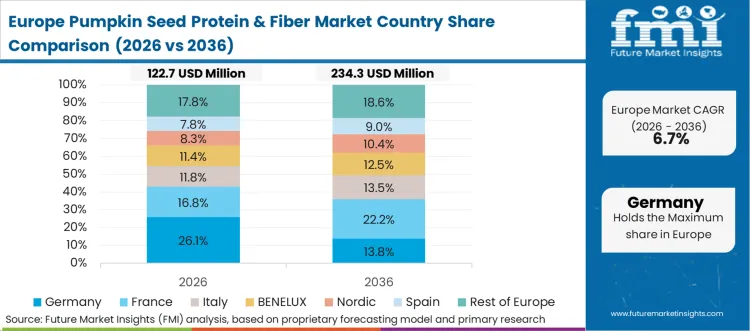
European food manufacturers prioritize sustainable sourcing and clean-label declarations across core product portfolios. Public health guidelines addressing dietary deficiencies prompt widespread nutritional fortification. Ingredient processors refine extraction techniques to meet stringent European Union food safety standards. Brands leverage premium positioning to offset higher specialized ingredient costs. Consumer preference for transparent supply chains forces companies to audit upstream agricultural partners.
- United Kingdom: In the United Kingdom, widening public-health fiber gaps are prompting food manufacturers to reformulate products in line with evolving nutritional targets. Government research highlighting a clear fiber-income gradient among adult male populations has reinforced the urgency of dietary improvement initiatives [9]. As brands align procurement strategies with these health-driven objectives and incorporate higher-fiber plant proteins into mainstream formulations, pumpkin seed protein demand in the country is projected to grow at a 10.1% CAGR between 2026 and 2036.
- Germany: In Germany, pumpkin seed protein market is forecast to advance at 9.8% CAGR through 2036, with growth anchored in high-quality sensorial performance that converts into measurable budget allocation. Official health statistics revealed adults consumed 53.0 percent of calories from ultra-processed foods, amplifying clean-label messaging. [10]
FMI's report includes detailed analysis covering France, Italy, and Spain. Processors analyzing consumer preferences in France should expect high demand for organic-certified ingredients. Monitoring local health guidelines provides actionable insights for regional product development initiatives involving formulation updates.
Latin America Pumpkin Seed Protein & Fiber Analysis
Latin American agricultural processors invest in value-added extraction facilities to maximize revenue from seed harvests. Regional food brands gradually incorporate functional ingredients to target emerging middle-class health awareness. Suppliers navigate volatile economic conditions by establishing long-term supply agreements with multinational consumer goods companies. Local production capabilities reduce reliance on expensive imported protein isolates. Regulatory frameworks increasingly support botanical ingredient integration.
- Brazil: Pumpkin seed protein uptake in Brazil is anticipated to climb at 9.5% CAGR over the forecast period as co-processing oilseed meals yields functional ingredients, helping suppliers align positioning with local buying triggers. Global plant-based dairy sales reached USD 22.4 billion in 2024, signaling broad acceptance applicable to regional adaptation. [11]
FMI's report includes detailed analysis covering Argentina, Chile, and Peru. Buyers observing agricultural investments in Argentina should identify emerging extraction partners. Strengthening regional supply chains mitigates exposure to international shipping disruptions and commodity pricing changes.
Competitive Aligners for Market Players
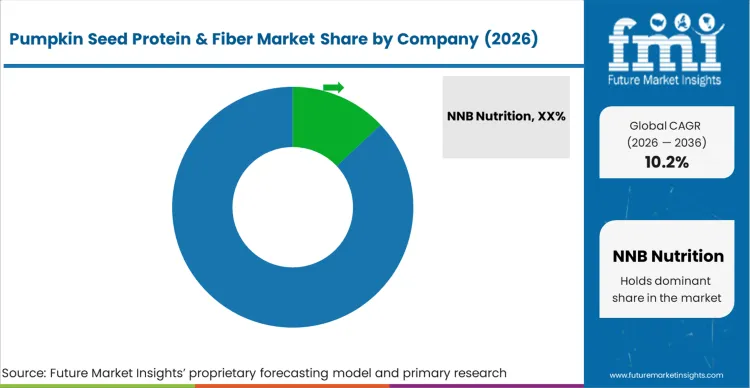
Market participants compete heavily on extraction efficiency and sensory profile optimization. Processing raw seeds into neutral-tasting isolates requires sophisticated milling and separation technologies. According to Jacob Frandsen, Partner at Summa Equity, "Providing sustainable protein sources for the growing global population is crucial." [13] Operational capability allows integrated suppliers to guarantee consistent volume and quality to large-scale food manufacturers, establishing high barriers to entry for smaller processors.
Consolidation within ingredient supply chains reshapes procurement strategies for consumer brands. Strategic acquisitions allow established players to rapidly scale production capacities and broaden product portfolios. Financial maneuvers provide necessary capital to fund expensive facility upgrades, enabling companies to meet rising global demand for specialized plant proteins. Diversified ingredient catalogs protect manufacturer margins during seasonal agricultural downturns.
Regulatory compliance regarding allergen declarations dictates formulation decisions across international markets. Companies producing highly purified free from cross-contamination command premium pricing structures. Ingredient suppliers investing in dedicated, allergen-free processing facilities capture lucrative contracts from brands targeting health-conscious consumer segments. Rigorous quality control protocols prevent costly product recalls.
Recent Developments
The report includes full coverage of key trends from competitive benchmarking. Some of the recent developments covered in the reports:
- In February 2026, Marico entered definitive agreements to invest in Cosmix, accelerating expansion within functional wellness categories. [12]
Key Players in Pumpkin Seed Protein & Fiber Market
- NNB Nutrition
- Nutris
- Simply Good Foods
- Go Raw
- ALOHA
- Burcon NutraScience
Scope of the Report
| Metric | Value |
|---|---|
| Quantitative Units | USD 557.0 million (2026) to USD 1,560.0 million (2036), at a CAGR of 10.2% |
| Market Definition | The pumpkin seed protein & fiber market comprises global business-to-business sales of concentrated protein powders, isolated protein fractions, and dietary fiber extracts derived from pumpkin seed feedstocks, utilized primarily for plant-based fortification, clean-label reformulation, and nutritional enhancement across food and beverage applications. |
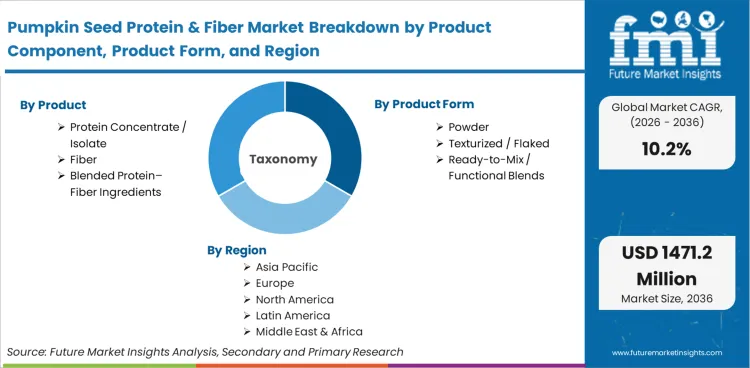
| Product Component Segmentation | Protein Concentrate / Isolate, Fiber, Blended Protein–Fiber Ingredients |
| Product Form Segmentation | Powder, Texturized / Flaked, Ready-to-Mix / Functional Blends |
| Application Coverage | Food & Beverages, Dietary Supplements, Animal & Pet Nutrition, Sports & Performance Nutrition, Cosmetics & Functional Ingredients |
| Distribution Channel Segmentation | Grocery / Supermarkets, Online Retail, Specialty Stores & Pharmacies, Institutional / B2B Sales |
| Regions Covered | North America, Latin America, Europe, East Asia, South Asia, Oceania, Middle East & Africa |
| Countries Covered | United States, Canada, Mexico, Brazil, Argentina, Germany, France, United Kingdom, Italy, Spain, China, India, Japan, South Korea, Indonesia, Australia & New Zealand, ASEAN, Kingdom of Saudi Arabia, United Arab Emirates, South Africa, Turkey and 40+ countries |
| Key Companies Profiled | NNB Nutrition, Nutris, Simply Good Foods, Go Raw, ALOHA, Burcon NutraScience |
| Forecast Period | 2026 to 2036 |
| Approach | Hybrid top-down and bottom-up market modeling validated through primary interviews with ingredient processors and formulation specialists, supported by agricultural output benchmarking, trade data validation, and corporate capacity verification |
Pumpkin Seed Protein & Fiber Market Analysis by Segments
Product Component:
- Protein Concentrate / Isolate
- Fiber
- Blended Protein-Fiber Ingredients
Product Form:
- Powder
- Texturized / Flaked
- Ready-to-Mix / Functional Blends
Application:
- Food & Beverages
- Dietary Supplements
- Animal & Pet Nutrition
- Sports & Performance Nutrition
- Cosmetics & Functional Ingredients
Distribution Channel:
- Grocery / Supermarkets
- Online Retail
- Specialty Stores & Pharmacies
- Institutional / B2B Sales
Region:
- Asia Pacific
- India
- China
- Japan
- South Korea
- Indonesia
- Australia & New Zealand
- ASEAN
- Rest of Asia Pacific
- Europe
- Germany
- Italy
- France
- United Kingdom
- Spain
- Benelux
- Nordics
- Central & Eastern Europe
- Rest of Europe
- North America
- United States
- Canada
- Mexico
- Latin America
- Brazil
- Argentina
- Chile
- Rest of Latin America
- Middle East & Africa
- Kingdom of Saudi Arabia
- United Arab Emirates
- South Africa
- Turkey
- Rest of Middle East & Africa
Bibliography
- [1] Good Food Institute (GFI). (2025). Global retail plant-based foods sales reach USD 28.6 billion.
- [3] NNB Nutrition. (2024, August). TruSeed P launch announcement.
- [4] World Health Organization (WHO). (2026, January). Dietary fibre intake guidance (25 g/day).
- [5] Burcon NutraScience Corporation. (2024, November). Capacity expansion announcement.
- [6] Ministry of Food Processing Industries, Government of India. (2024). India imports 90% of protein isolates.
- [7] Summa Equity. (2024, September). Acquisition of Nutris.
- [8] Good Food Institute (GFI). (2025). USA plant-based food retail sales reach $8.1 billion.
- [9] UK Government. (2025, June). National Diet and Nutrition Survey (NDNS): Fibre-income gradient findings.
- [10] Centers for Disease Control and Prevention (CDC). (2025, August). Adults derive 53% of calories from ultra-processed foods.
- [11] Good Food Institute (GFI). (2025). Global plant-based dairy market reaches USD 22.4 billion.
- [12] Marico. (2026, February). Investment in Cosmix.
- [13] Frandsen, J. (2024). Statement from Summa Equity.
- [14] UK Government. (2024, December). UK Food Security Report 2024.
- [15] Laird Superfood. (2024, May). Protein Creamer launch.
- [16] USA Department of Agriculture, Economic Research Service (USDA ERS). (2025, November). USA pumpkin production reaches 1.44 billion pounds.
This bibliography is provided for reader reference and is not exhaustive. The full report contains the complete reference list and detailed citations.
This Report Addresses
- Market intelligence to enable structured strategic decision making across mature and emerging ingredient economies
- Market size estimation and 10 year revenue forecasts from 2026 to 2036, supported by validated capacity and trade benchmarks
- Growth opportunity mapping across powder and concentrate forms with emphasis on clean-label grade transitions
- Segment and regional revenue forecasts covering food and beverage applications
- Competition strategy assessment including integration models, cost survivability positioning, and compliance capability benchmarking
- Product reformulation and nutritional compliance tracking aligned with global dietary fiber standards
- Regulatory impact analysis covering allergen mandates, clean-label thresholds, and export driven specification upgrades
Frequently Asked Questions
How large is demand for Pumpkin Seed Protein & Fiber in global market in 2026?
Demand for Pumpkin Seed Protein & Fiber in global market is estimated to be valued at USD 557.0 million in 2026.
What will be market size of Pumpkin Seed Protein & Fiber in global market by 2036?
Market size for Pumpkin Seed Protein & Fiber is projected to reach USD 1,560.0 million by 2036.
What is expected demand growth for Pumpkin Seed Protein & Fiber in global market between 2026 and 2036?
Demand for Pumpkin Seed Protein & Fiber in global market is expected to grow at a CAGR of 10.2% between 2026 and 2036.
Which Product Component is poised to lead global sales by 2026?
Protein Concentrate / Isolate is expected to be leading component, capturing approximately 53% of global share in 2026 due to superior beverage solubility.
How significant is role of Food & Beverages in driving Pumpkin Seed Protein & Fiber adoption in 2026?
Food & Beverages represents critical segment, projected to hold substantial 44% share of total volume in 2026 as snack manufacturers prioritize dual-action ingredients.
What is driving demand in India?
Import substitution policies and domestic processing capacity expansion drive demand as food brands seek local extraction partners.
What compliance standards or regulations are referenced for India?
Ministry of Food Processing Industries guidelines concerning agricultural output and localization mandates are referenced.
What is India growth outlook in report?
India is projected to grow at a CAGR of 11.9% during 2026 to 2036.
Why is North America described as priority region in report?
Growth is structured around high plant-based retail penetration and aggressive clean-label reformulation mandates across consumer packaged goods companies.
What type of demand dominates in North America?
Demand driven by mainstream wellness product launches and allergen-free reformulation dominates regional consumption.
What is United States growth outlook in report?
United States is projected to expand at a CAGR of 10.6% during 2026 to 2036.
Does report cover China in its regional analysis?
China is included within East Asia under regional scope of analysis.
What are sources referred to for analyzing China?
Official agricultural benchmarks, corporate launch announcements, and plant-based capacity datasets are cited as primary reference sources.
What is main demand theme linked to China in its region coverage?
Demand is associated with functional nutrition formats and domestic suppliers pushing new seed-protein formulations into retail channels.
Does report cover United Kingdom in its regional analysis?
United Kingdom is included within Europe under regional coverage framework.
What is main United Kingdom related demand theme in its region coverage?
Public health policy gaps forcing food brands to fortify products with clean-label dietary fibers is emphasized.
Which product formats or configurations are strategically important for Asia Pacific supply chains?
Powder formats are prioritized due to lower storage risk and reduced freight economics across expanding extraction facility networks.
What is Pumpkin Seed Protein & Fiber and what is it mainly used for?
It designates functional food ingredients extracted from seeds, utilized primarily by buyers to replace animal-based proteins in processed foods.
What does Pumpkin Seed Protein & Fiber mean in report?
It refers to global business-to-business sales of concentrated powders, isolates, and dietary fibers originating from pumpkin seed feedstocks.
What is included in scope of Pumpkin Seed Protein & Fiber report?
Scope covers concentrated protein powders, isolated protein fractions, and dietary fiber extracts used in commercial manufacturing.
What is excluded from scope of report?
Whole raw seeds sold directly for snacking and finished consumer products containing fibers as minor ingredients are excluded.
What does market forecast mean on page?
Market forecast represents model-based projection built on agricultural output data and plant capacity assumptions for strategic planning purposes.
How does FMI build and validate Pumpkin Seed Protein & Fiber forecast?
Forecast is developed using hybrid top down and bottom up modeling validated through trade data, capacity checks, and corporate financial filings.
What does zero reliance on speculative third party market research mean here?
Primary interviews with ingredient processors and verifiable public agricultural datasets are used instead of unverified syndicated estimates.
Preview the report firsthand - request a free sample
Get SampleGet the brochure for pricing and purchase details.
Get PDFTable of Content
- Executive Summary
- Global Market Outlook
- Demand-side Trends
- Supply-side Trends
- Technology Roadmap Analysis
- Analysis and Recommendations
- Market Overview
- Market Coverage / Taxonomy
- Market Definition / Scope / Limitations
- Research Methodology
- Chapter Orientation
- Analytical Lens and Working Hypotheses
- Market Structure, Signals, and Trend Drivers
- Benchmarking and Cross-market Comparability
- Market Sizing, Forecasting, and Opportunity Mapping
- Research Design and Evidence Framework
- Desk Research Programme (Secondary Evidence)
- Company Annual and Sustainability Reports
- Peer-reviewed Journals and Academic Literature
- Corporate Websites, Product Literature, and Technical Notes
- Earnings Decks and Investor Briefings
- Statutory Filings and Regulatory Disclosures
- Technical White Papers and Standards Notes
- Trade Journals, Industry Magazines, and Analyst Briefs
- Conference Proceedings, Webinars, and Seminar Materials
- Government Statistics Portals and Public Data Releases
- Press Releases and Reputable Media Coverage
- Specialist Newsletters and Curated Briefings
- Sector Databases and Reference Repositories
- FMI Internal Proprietary Databases and Historical Market Datasets
- Subscription Datasets and Paid Sources
- Social Channels, Communities, and Digital Listening Inputs
- Additional Desk Sources
- Expert Input and Fieldwork (Primary Evidence)
- Primary Modes
- Qualitative Interviews and Expert Elicitation
- Quantitative Surveys and Structured Data Capture
- Blended Approach
- Why Primary Evidence is Used
- Field Techniques
- Interviews
- Surveys
- Focus Groups
- Observational and In-context Research
- Social and Community Interactions
- Stakeholder Universe Engaged
- C-suite Leaders
- Board Members
- Presidents and Vice Presidents
- R&D and Innovation Heads
- Technical Specialists
- Domain Subject-matter Experts
- Scientists
- Physicians and Other Healthcare Professionals
- Governance, Ethics, and Data Stewardship
- Research Ethics
- Data Integrity and Handling
- Primary Modes
- Tooling, Models, and Reference Databases
- Desk Research Programme (Secondary Evidence)
- Data Engineering and Model Build
- Data Acquisition and Ingestion
- Cleaning, Normalisation, and Verification
- Synthesis, Triangulation, and Analysis
- Quality Assurance and Audit Trail
- Market Background
- Market Dynamics
- Drivers
- Restraints
- Opportunity
- Trends
- Scenario Forecast
- Demand in Optimistic Scenario
- Demand in Likely Scenario
- Demand in Conservative Scenario
- Opportunity Map Analysis
- Product Life Cycle Analysis
- Supply Chain Analysis
- Investment Feasibility Matrix
- Value Chain Analysis
- PESTLE and Porter’s Analysis
- Regulatory Landscape
- Regional Parent Market Outlook
- Production and Consumption Statistics
- Import and Export Statistics
- Market Dynamics
- Global Market Analysis 2021 to 2025 and Forecast, 2026 to 2036
- Historical Market Size Value (USD Million) Analysis, 2021 to 2025
- Current and Future Market Size Value (USD Million) Projections, 2026 to 2036
- Y-o-Y Growth Trend Analysis
- Absolute $ Opportunity Analysis
- Global Market Pricing Analysis 2021 to 2025 and Forecast 2026 to 2036
- Global Market Analysis 2021 to 2025 and Forecast 2026 to 2036, By Product Component
- Introduction / Key Findings
- Historical Market Size Value (USD Million) Analysis By Product Component , 2021 to 2025
- Current and Future Market Size Value (USD Million) Analysis and Forecast By Product Component , 2026 to 2036
- Protein Concentrate / Isolate
- Fiber
- Blended Protein–Fiber Ingredients
- Protein Concentrate / Isolate
- Y-o-Y Growth Trend Analysis By Product Component , 2021 to 2025
- Absolute $ Opportunity Analysis By Product Component , 2026 to 2036
- Global Market Analysis 2021 to 2025 and Forecast 2026 to 2036, By Product Form
- Introduction / Key Findings
- Historical Market Size Value (USD Million) Analysis By Product Form, 2021 to 2025
- Current and Future Market Size Value (USD Million) Analysis and Forecast By Product Form, 2026 to 2036
- Powder
- Texturized / Flaked
- Ready-to-Mix / Functional Blends
- Powder
- Y-o-Y Growth Trend Analysis By Product Form, 2021 to 2025
- Absolute $ Opportunity Analysis By Product Form, 2026 to 2036
- Global Market Analysis 2021 to 2025 and Forecast 2026 to 2036, By Region
- Introduction
- Historical Market Size Value (USD Million) Analysis By Region, 2021 to 2025
- Current Market Size Value (USD Million) Analysis and Forecast By Region, 2026 to 2036
- North America
- Latin America
- Western Europe
- Eastern Europe
- East Asia
- South Asia and Pacific
- Middle East & Africa
- Market Attractiveness Analysis By Region
- North America Market Analysis 2021 to 2025 and Forecast 2026 to 2036, By Country
- Historical Market Size Value (USD Million) Trend Analysis By Market Taxonomy, 2021 to 2025
- Market Size Value (USD Million) Forecast By Market Taxonomy, 2026 to 2036
- By Country
- USA
- Canada
- Mexico
- By Product Component
- By Product Form
- By Country
- Market Attractiveness Analysis
- By Country
- By Product Component
- By Product Form
- Key Takeaways
- Latin America Market Analysis 2021 to 2025 and Forecast 2026 to 2036, By Country
- Historical Market Size Value (USD Million) Trend Analysis By Market Taxonomy, 2021 to 2025
- Market Size Value (USD Million) Forecast By Market Taxonomy, 2026 to 2036
- By Country
- Brazil
- Chile
- Rest of Latin America
- By Product Component
- By Product Form
- By Country
- Market Attractiveness Analysis
- By Country
- By Product Component
- By Product Form
- Key Takeaways
- Western Europe Market Analysis 2021 to 2025 and Forecast 2026 to 2036, By Country
- Historical Market Size Value (USD Million) Trend Analysis By Market Taxonomy, 2021 to 2025
- Market Size Value (USD Million) Forecast By Market Taxonomy, 2026 to 2036
- By Country
- Germany
- UK
- Italy
- Spain
- France
- Nordic
- BENELUX
- Rest of Western Europe
- By Product Component
- By Product Form
- By Country
- Market Attractiveness Analysis
- By Country
- By Product Component
- By Product Form
- Key Takeaways
- Eastern Europe Market Analysis 2021 to 2025 and Forecast 2026 to 2036, By Country
- Historical Market Size Value (USD Million) Trend Analysis By Market Taxonomy, 2021 to 2025
- Market Size Value (USD Million) Forecast By Market Taxonomy, 2026 to 2036
- By Country
- Russia
- Poland
- Hungary
- Balkan & Baltic
- Rest of Eastern Europe
- By Product Component
- By Product Form
- By Country
- Market Attractiveness Analysis
- By Country
- By Product Component
- By Product Form
- Key Takeaways
- East Asia Market Analysis 2021 to 2025 and Forecast 2026 to 2036, By Country
- Historical Market Size Value (USD Million) Trend Analysis By Market Taxonomy, 2021 to 2025
- Market Size Value (USD Million) Forecast By Market Taxonomy, 2026 to 2036
- By Country
- China
- Japan
- South Korea
- By Product Component
- By Product Form
- By Country
- Market Attractiveness Analysis
- By Country
- By Product Component
- By Product Form
- Key Takeaways
- South Asia and Pacific Market Analysis 2021 to 2025 and Forecast 2026 to 2036, By Country
- Historical Market Size Value (USD Million) Trend Analysis By Market Taxonomy, 2021 to 2025
- Market Size Value (USD Million) Forecast By Market Taxonomy, 2026 to 2036
- By Country
- India
- ASEAN
- Australia & New Zealand
- Rest of South Asia and Pacific
- By Product Component
- By Product Form
- By Country
- Market Attractiveness Analysis
- By Country
- By Product Component
- By Product Form
- Key Takeaways
- Middle East & Africa Market Analysis 2021 to 2025 and Forecast 2026 to 2036, By Country
- Historical Market Size Value (USD Million) Trend Analysis By Market Taxonomy, 2021 to 2025
- Market Size Value (USD Million) Forecast By Market Taxonomy, 2026 to 2036
- By Country
- Kingdom of Saudi Arabia
- Other GCC Countries
- Turkiye
- South Africa
- Other African Union
- Rest of Middle East & Africa
- By Product Component
- By Product Form
- By Country
- Market Attractiveness Analysis
- By Country
- By Product Component
- By Product Form
- Key Takeaways
- Key Countries Market Analysis
- USA
- Pricing Analysis
- Market Share Analysis, 2025
- By Product Component
- By Product Form
- Canada
- Pricing Analysis
- Market Share Analysis, 2025
- By Product Component
- By Product Form
- Mexico
- Pricing Analysis
- Market Share Analysis, 2025
- By Product Component
- By Product Form
- Brazil
- Pricing Analysis
- Market Share Analysis, 2025
- By Product Component
- By Product Form
- Chile
- Pricing Analysis
- Market Share Analysis, 2025
- By Product Component
- By Product Form
- Germany
- Pricing Analysis
- Market Share Analysis, 2025
- By Product Component
- By Product Form
- UK
- Pricing Analysis
- Market Share Analysis, 2025
- By Product Component
- By Product Form
- Italy
- Pricing Analysis
- Market Share Analysis, 2025
- By Product Component
- By Product Form
- Spain
- Pricing Analysis
- Market Share Analysis, 2025
- By Product Component
- By Product Form
- France
- Pricing Analysis
- Market Share Analysis, 2025
- By Product Component
- By Product Form
- India
- Pricing Analysis
- Market Share Analysis, 2025
- By Product Component
- By Product Form
- ASEAN
- Pricing Analysis
- Market Share Analysis, 2025
- By Product Component
- By Product Form
- Australia & New Zealand
- Pricing Analysis
- Market Share Analysis, 2025
- By Product Component
- By Product Form
- China
- Pricing Analysis
- Market Share Analysis, 2025
- By Product Component
- By Product Form
- Japan
- Pricing Analysis
- Market Share Analysis, 2025
- By Product Component
- By Product Form
- South Korea
- Pricing Analysis
- Market Share Analysis, 2025
- By Product Component
- By Product Form
- Russia
- Pricing Analysis
- Market Share Analysis, 2025
- By Product Component
- By Product Form
- Poland
- Pricing Analysis
- Market Share Analysis, 2025
- By Product Component
- By Product Form
- Hungary
- Pricing Analysis
- Market Share Analysis, 2025
- By Product Component
- By Product Form
- Kingdom of Saudi Arabia
- Pricing Analysis
- Market Share Analysis, 2025
- By Product Component
- By Product Form
- Turkiye
- Pricing Analysis
- Market Share Analysis, 2025
- By Product Component
- By Product Form
- South Africa
- Pricing Analysis
- Market Share Analysis, 2025
- By Product Component
- By Product Form
- USA
- Market Structure Analysis
- Competition Dashboard
- Competition Benchmarking
- Market Share Analysis of Top Players
- By Regional
- By Product Component
- By Product Form
- Competition Analysis
- Competition Deep Dive
- NNB Nutrition
- Overview
- Product Portfolio
- Profitability by Market Segments (Product/Age /Sales Channel/Region)
- Sales Footprint
- Strategy Overview
- Marketing Strategy
- Product Strategy
- Channel Strategy
- Nutris
- Simply Good Foods
- Go Raw
- ALOHA
- Burcon NutraScience
- NNB Nutrition
- Competition Deep Dive
- Assumptions & Acronyms Used


