

- Market Size (2026)
- USD 0.99 Bn
- Forecast (2036)
- USD 1.65 Bn
- CAGR (2026 to 2036)
- 5.2%
Protein-Content Optimizing Cereal Fertility Program Market Size, Forecast, and Outlook By FMI
Summary of the Protein-Content Optimizing Cereal Fertility Program Market
- Demand and Growth Drivers
- Grain contracts that pay for protein bands are pushing farms to buy nutrient programs that target both yield and protein outcomes.
- Split nitrogen plans are gaining use in wheat and barley because late-season timing can lift grain protein more directly than early blanket application.
- Sulfur is gaining place in cereal quality programs because nitrogen response weakens when sulfur supply falls below crop need.
- Remote sensing and in-field tests are widening advisory revenue because farms want field-specific topdress decisions before protein risk becomes visible.
- Product and Segment View
- Nitrogen-led blends remain the largest nutrient focus because nitrogen is still the main controllable lever for cereal protein formation.
- Wheat leads cereal type demand because milling wheat premiums and export specifications keep protein management commercially relevant across large acreage.
- Split soil application leads delivery mode because growers still trust familiar equipment and staged field passes in broadacre cereal systems.
- Late protein push programs are gaining value in premium wheat and malting barley where quality penalties can outweigh modest yield gains.
- Geography and Competitive Outlook
- India and China record faster expansion because cereal intensity is high and domestic advisory networks are widening fertilizer program adoption.
- Australia and Canada retain strong program depth because protein premiums in export wheat keep nutrient timing tied to price realization.
- Yara International, Nutrien, ICL Group, EuroChem, Coromandel International, CF Industries, and Koch Agronomic Services shape supply through products, retail access, and agronomy support.
- Competitive position depends on protein response evidence and field service reach because growers need proof that late nitrogen spend can still pay.
- Analyst Opinion
- Nikhil Kaitwade, Principal Consultant at FMI says, "Demand is moving toward programs that treat grain protein as a revenue target rather than a secondary crop outcome. Pressure comes from tighter buyer specifications and from fertilizer costs that punish poorly timed nitrogen use. Suppliers with strong agronomy teams and retail reach are in a better place because cereal growers need advice that fits weather risk and field history. The strongest commercial shift is the move from single product selling to program selling where nitrogen source, sulfur balance, and late-season timing are offered as one managed package."
- Protein-Content Optimizing Cereal Fertility Program Market Market Value Analysis
- This market sits between specialty fertilizers and agronomy services because the program is sold as nutrient product plus decision support.
- Revenue growth is supported by protein-linked grain premiums that justify extra spending when weather still allows quality correction.
- Program value is higher in wheat and barley belts where grain quality is priced by protein bands and end-use class.
- Demand support comes from better sensing tools and from retailer programs that can schedule topdress windows more precisely.
- The category gains value where farms want yield stability first and protein lift second because blended programs reduce single-pass risk.
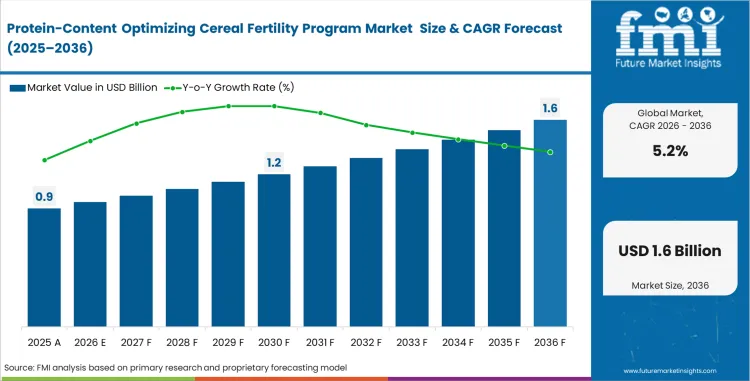
Key Takeaways, Market Size, and Forecast
- The protein-content optimizing cereal fertility program market reached USD 0.94 billion in 2025 as cereal quality programs moved beyond yield-only nutrition planning.
- Market value is projected to reach USD 1.65 billion by 2036 as grain buyers keep linking protein bands to realized farmgate premiums.
- The market is expected to expand at a CAGR of 5.2% from 2026 to 2036 under wider use of staged nitrogen and sulfur programs.
- Incremental opportunity between 2026 and 2036 is estimated at USD 0.66 billion as late-season quality management becomes a paid service layer.
- Nitrogen-led blends are expected to account for 41.0% share in 2026 because protein response still tracks nitrogen availability in most cereal systems.
- India at 6.7% CAGR and China at 6.4% CAGR are expected to post the fastest growth among the major countries covered in this study.
- Commercial farms are projected to hold 44.0% share in 2026 because premium wheat and malting barley contracts need tighter nutrient execution.
Protein-Content Optimizing Cereal Fertility Program Market Definition
The protein-content optimizing cereal fertility program market covers crop nutrition programs used to improve grain protein in cereal crops. The market includes nutrient plans, staged fertilizer schedules, foliar finish options, and advisory support used in wheat, barley, durum, maize, and oats. Users include commercial farms, cooperatives, ag retailers, and contract grain programs that pay for defined protein outcomes.
Protein-Content Optimizing Cereal Fertility Program Market Inclusions
Market scope includes nitrogen programs, nitrogen sulfur blends, inhibitor-treated nitrogen, foliar protein finish products, variable rate prescriptions, and advisory packages tied to cereal protein targets. Scope includes pre-season planning, base application, in-season topdress, and late protein push actions. Sales through farm retail, direct farm channels, and grain-linked program channels are included.
Protein-Content Optimizing Cereal Fertility Program Market Exclusions
Scope does not include general cereal fertilizers sold only for yield support with no protein objective. Scope excludes broad soil amendments, crop protection products, seed treatments, irrigation hardware, and post-harvest grain blending services. Commodity urea volume with no program layer or advisory layer is outside the market boundary.
Protein-Content Optimizing Cereal Fertility Program Market Research Methodology
- Primary Research: FMI reviewed discussions across crop nutrition advisers, cereal growers, ag retailers, and grain quality managers in wheat and barley producing regions.
- Desk Research: Research used government crop statistics, nutrient management guidance, cereal quality studies, and official supplier disclosures on specialty nutrition programs.
- Market Sizing and Forecasting: Market sizing used a bottom-up build from protein-focused cereal acreage, program adoption, and realized spend per managed hectare.
- Data Validation: Shares and growth rates were checked against country cereal area data, fertilizer use patterns, company channel presence, and grain quality payment structures.
Why is the Protein-Content Optimizing Cereal Fertility Program Market Growing?
- Protein premiums in milling wheat and malting barley are creating a direct reason to buy fertility programs rather than generic nitrogen volume.
- Late-season nitrogen decisions now use better field data because handheld tests and crop sensing improve timing confidence before grain fill.
- Sulfur balancing is widening program spend because quality response weakens when cereal crops cannot convert nitrogen into grain protein efficiently.
- Retail agronomy networks are packaging products with advice because growers want one accountable program during narrow application windows.
Cereal growers have long used fertilizer to support yield, yet protein programs change the buying decision because grain quality can alter the selling price after harvest. That shift matters most in wheat and barley where buyers often separate lots by protein or end-use class. Program demand rises when growers feel a clear gap between field potential and delivered grain quality. Advisers now sell staged nitrogen and sulfur plans as a risk-managed path that keeps more options open during the season. Such plans work best where farms can still act in time and where grain marketing rewards better quality.
Weather risk keeps the category from becoming a simple volume story. A late topdress only pays when moisture remains available and when crop condition can still support grain fill. That is why program design matters more than raw nutrient tonnage in this market. Suppliers that pair products with field checks and local timing guidance can charge more than straight commodity fertilizer sellers. The category therefore grows through better execution rather than through broad fertilizer inflation alone. Quality programs gain the most ground in regions where cereal margins justify closer nutrient management.
Market Segmentation Analysis
- Nitrogen-led blends are estimated to account for 41.0% share in 2026 because nitrogen remains the main input used to influence cereal protein content.
- Split soil application is expected to hold 36.0% share in 2026 because broadacre growers still prefer staged field applications through familiar equipment.
- Wheat is projected to account for 38.0% share in 2026 because milling classes often reward protein levels more directly than other cereal crops.
- Commercial farms are likely to secure 44.0% share in 2026 because larger acreages support program economics and quality-linked grain marketing.
- Mid-season topdress is expected to hold 34.0% share in 2026 because that timing still offers a workable balance between yield support and protein lift.
The market is divided into program type, nutrient focus, delivery mode, cereal type, buyer type, application stage, and region. Program design follows how cereal growers manage grain quality in the field rather than how fertilizer plants classify products. Nitrogen remains the center of most protein programs, though sulfur and inhibitor use shape response quality and efficiency. Delivery choice depends on field size, weather windows, crop stage, and retailer support. Buyer structure matters because large farms and organized grain programs can turn protein gains into a clearer economic return.
Insights into the Nitrogen-Led Blends Segment
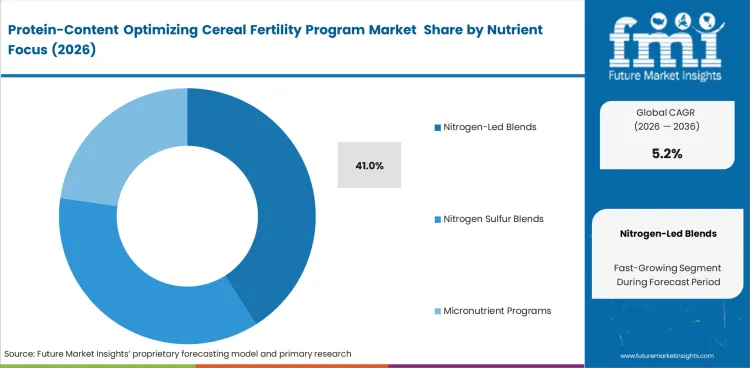
- In 2026, nitrogen-led blends are expected to contribute 41.0% of total market share because cereal protein still responds most directly to nitrogen availability.
- Urea and UAN remain common foundations in this segment. Stabilized nitrogen products gain place where loss risk can erode late-season response.
- Program value improves when sulfur is added only where deficiency risk is visible rather than applied as a routine extra cost.
Insights into the Split Soil Application Segment
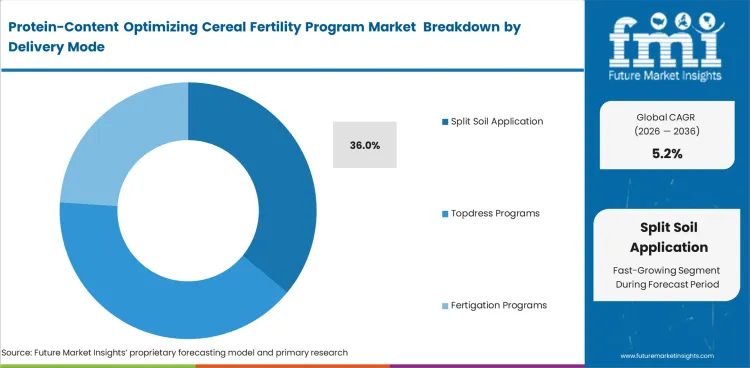
- Split soil application is likely to hold 36.0% share in 2026 because growers trust staged passes that fit standard cereal machinery and field operations.
- Base plus topdress remains the most common structure in broadacre wheat systems. The second pass is used to protect yield first and lift protein when conditions permit.
- Variable rate plans are expanding in larger fields, though adoption remains slower where service access and data confidence are still limited.
Insights into the Wheat Segment
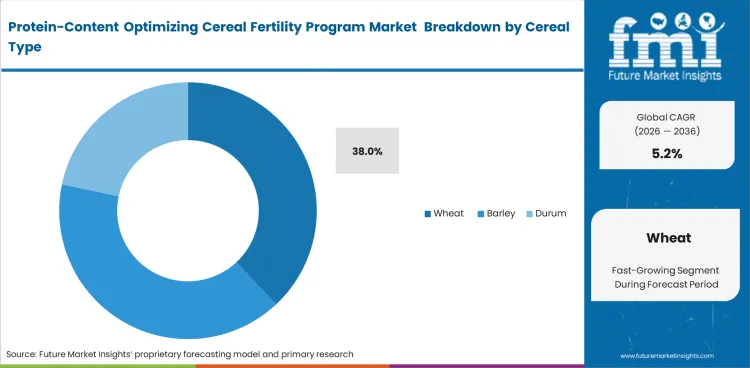
- Wheat is anticipated to represent 38.0% of market share in 2026 because milling and export grades often price protein more tightly than feed grain channels.
- Hard wheat and durum programs carry more program intensity than feed wheat. Protein shortfalls can cut realized value even when yield looks acceptable at harvest.
- Barley follows as an important quality program crop because malting contracts punish excess or weak protein bands on delivered grain.
Insights into the Commercial Farms Segment
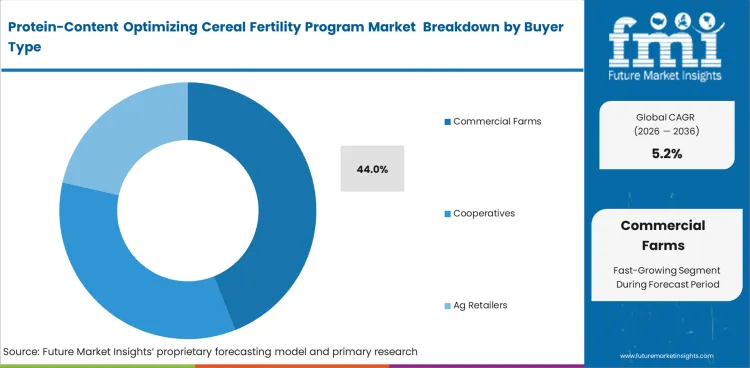
- Commercial farms are set to represent 44.0% of market share in 2026 because larger cereal area makes program design worth the extra field management effort.
- These farms tend to keep better field records and grain marketing plans. That advantage improves the case for staged fertility decisions with measurable quality goals.
- Cooperatives and ag retailers remain important channels because many growers still rely on local advisers for timing and product mix.
Insights into the Mid-Season Topdress Segment
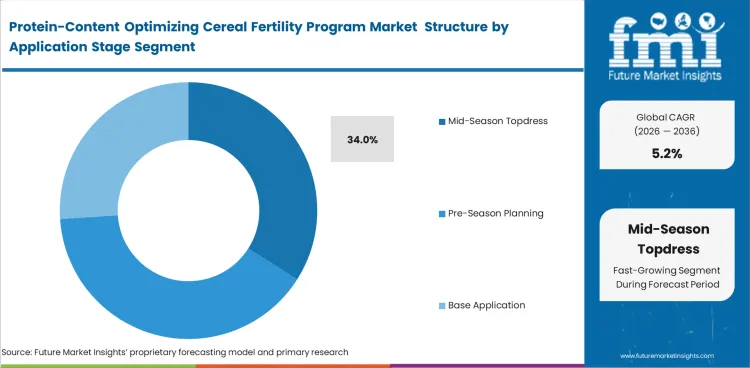
- Mid-season topdress is expected to account for 34.0% share in 2026 because it remains the main checkpoint for adjusting cereal nutrition after crop establishment.
- Growers use this stage to judge stand condition and moisture outlook. A good crop can justify extra spend where protein premiums remain open.
- Late protein push programs matter in premium wheat belts, yet they stay more selective because timing risk rises near grain fill.
Protein-Content Optimizing Cereal Fertility Program Market Drivers, Restraints, and Opportunities
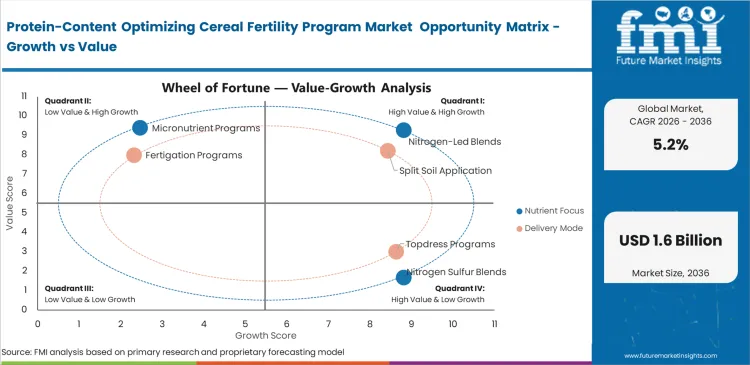
- Protein-linked grain contracts are supporting a structured need for cereal fertility programs that target quality as well as yield.
- Adoption is limited by weather risk and by uncertainty on whether late nutrient spend will still return enough value.
- Opportunity is building in field-specific prescriptions and in sulfur balancing programs that improve nitrogen use in quality wheat systems.
Quality-Premium Grain Contracts
Milling wheat and malting barley contracts are the clearest commercial driver for this market because they connect nutrient timing to a visible price outcome. Where buyers pay more for higher protein bands, growers can justify an extra topdress or a more refined nitrogen source. The decision is stronger on farms that keep crop records and know their usual protein gap. Retailers benefit because they can sell a broader program instead of one fertilizer line. That commercial structure keeps adoption centered in crops and regions where quality grades are enforced at delivery.
Weather-Limited Response Risk
Not every cereal field can convert late fertilizer into better protein. Dry weather after application can weaken uptake and leave growers with extra cost but little quality gain. That risk slows wider adoption in lower rainfall areas and in farms with weak in-season scouting. Program sellers therefore face a higher proof burden than sellers of straight commodity fertilizer. Growers need local evidence that timing, source, and crop stage can still shift grain quality in their area. Markets with variable spring weather tend to adopt more slowly because response confidence stays uneven.
Sulfur Balance and Efficiency Services
Sulfur creates a strong opening for program expansion because nitrogen efficiency weakens when sulfur supply is short. Cereal quality programs now use sulfur as a supporting tool rather than a side add-on. That shift helps suppliers build higher value packages in regions with lighter soils or repeated cereal rotations. Service income can rise when advisers use tissue tests or field history to target sulfur need more precisely. The commercial gain comes from better conversion of nitrogen spend into saleable grain quality.
Digital Prescription Support
Digital prescription tools can widen program revenue where farms already use yield maps or remote crop imagery. Such tools matter because protein management depends on field variability and on short application windows. A field-by-field plan can cut overspend on weaker zones and redirect nutrient to better performing areas. Ag retailers can use this service layer to differentiate from bulk fertilizer sellers. Growth will stay strongest where digital support is paired with local agronomy and spreader access.
Analysis of Protein-Content Optimizing Cereal Fertility Program Market By Key Countries
.webp "Top Country Growth Comparison Protein Content Optimizing Cereal Fertility Program Market Cagr (2026 2036)")
| Country | CAGR |
|---|---|
| India | 6.7% |
| China | 6.4% |
| Australia | 5.8% |
| United States | 5.3% |
| Canada | 5.1% |
| France | 4.9% |
| Germany | 4.7% |
Source: FMI analysis based on primary research and proprietary forecasting model
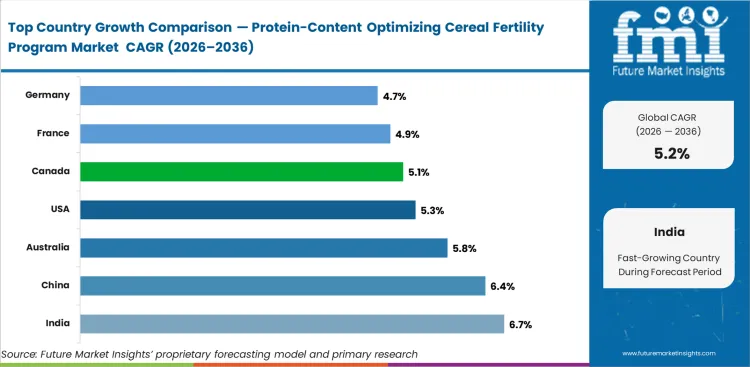
Protein-Content Optimizing Cereal Fertility Program Market CAGR Analysis By Country
- India leads with 6.7% CAGR because organized advisory channels and wheat intensification are widening the base for managed protein programs.
- China follows at 6.4% CAGR because quality wheat production and nitrogen optimization needs are moving closer together in larger cereal belts.
- Australia remains an important premium wheat market and is projected to expand at 5.8% CAGR through 2036.
- The United States and Canada post mid-range growth because protein programs are mature in several cereal regions but quality premiums still support upgrades.
- France and Germany expand below the global average because cereal nutrition is established already and adoption gains come more from refinement than first use.
Country growth spans from 4.7% to 6.7% across the study. Faster markets combine expanding cereal intensity with advisory channel growth and a wider need to manage fertilizer efficiency. More mature markets still offer value because growers refine sulfur use, timing, and variable rate application rather than start from zero. Export wheat regions retain a stronger case for protein programs because grain quality affects realized price more clearly. Low-growth markets remain commercially relevant because existing spending per hectare is already high.
Demand Outlook for Protein-Content Optimizing Cereal Fertility Program Market in India
India records the fastest growth in this study because wheat quality programs and organized nutrient advisory channels are widening together. The protein-content optimizing cereal fertility program market in India is projected to grow at a CAGR of 6.7% through 2036. Retail agronomy networks play a large role because many growers buy crop nutrition as a package rather than as a single input. Sulfur-linked cereal programs are gaining use where repeated nitrogen use has exposed weaker nutrient balance. Program suppliers that can pair affordable products with field guidance are likely to gain the most ground.
- Organized advisory networks support faster field adoption.
- Wheat intensity keeps protein management commercially relevant.
- Balanced nutrition programs are widening beyond large farms.
Future Outlook for Protein-Content Optimizing Cereal Fertility Program Market in China
China shows strong expansion because cereal quality targets and nitrogen efficiency pressure now move in the same direction. The market in China is expected to grow at a CAGR of 6.4% through 2036. Large cereal areas create room for staged programs that can shift fertilizer timing based on crop condition. Program demand is strongest where wheat quality and fertilizer efficiency both matter to farm returns. Suppliers with stable regional channels and practical field evidence should hold an advantage.
- Quality wheat programs support demand depth.
- Nitrogen efficiency pressure supports staged programs.
- Regional channels matter more than national brand reach alone.
Sales Analysis of Protein-Content Optimizing Cereal Fertility Program Market in Australia
Australia stays important because export wheat premiums keep grain protein central to crop nutrition decisions. The protein-content optimizing cereal fertility program market in Australia is projected to grow at a CAGR of 5.8% through 2036. Growers often make quality decisions under tight moisture limits, which raises the value of timing discipline. Late nitrogen remains selective because rainfall risk can change the payback quickly. Programs that protect margin under variable seasons can keep steady demand in this market.
- Export wheat premiums keep protein relevant.
- Moisture risk makes timing discipline essential.
- Selective late nitrogen supports value over volume.
Demand Outlook for Protein-Content Optimizing Cereal Fertility Program Market in the United States
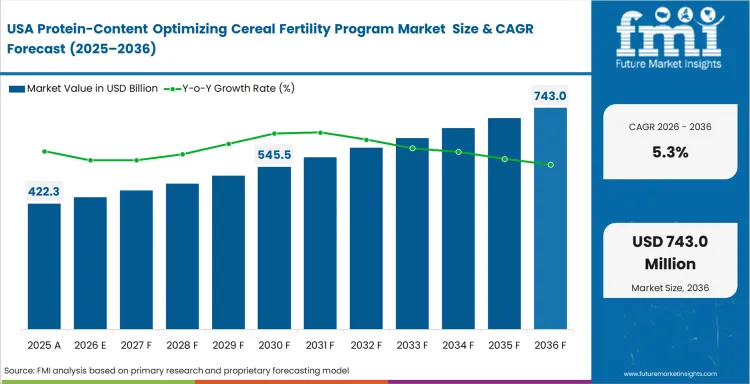
The United States holds a stable middle position because wheat classes and regional cereal systems create varied but persistent quality demand. The market in the United States is projected to grow at a CAGR of 5.3% through 2036. Protein programs have clearer value in hard wheat belts where buyers measure quality tightly at delivery. Retail crop advisers remain important because field variability changes the best timing decision by zone and season. Supplier strength depends on agronomy support as much as on product assortment.
- Hard wheat regions support stronger program intensity.
- Retail advisers influence application timing choices.
- Agronomy support remains a major selling point.
Future Outlook for Protein-Content Optimizing Cereal Fertility Program Market in Canada
Canada remains a disciplined cereal quality market because wheat class and protein expectations are embedded in export-oriented grain systems. The market in Canada is expected to grow at a CAGR of 5.1% through 2036. Growers often look for programs that raise quality without creating excessive lodging or late cost risk. That balance favors staged programs instead of one heavy nitrogen pass. Commercial value stays tied to quality assurance in premium wheat channels.
- Export grading supports quality-focused nutrition.
- Staged plans help manage protein and lodging risk.
- Program value remains strong in premium wheat systems.
Opportunity Analysis of Protein-Content Optimizing Cereal Fertility Program Market in France
France grows at a measured pace because cereal management is advanced already and future gains come from better precision rather than wider first adoption. The market in France is projected to grow at a CAGR of 4.9% through 2036. Program demand remains healthy in milling wheat where protein shortfalls can reduce realized grain value. Suppliers therefore compete on execution and field support more than on basic nutrient availability. Digital guidance can improve margins where field variability is high.
- Milling wheat programs hold commercial value.
- Execution quality matters more than basic nutrient access.
- Digital guidance can lift field-level precision.
In-depth Analysis of Protein-Content Optimizing Cereal Fertility Program Market in Germany
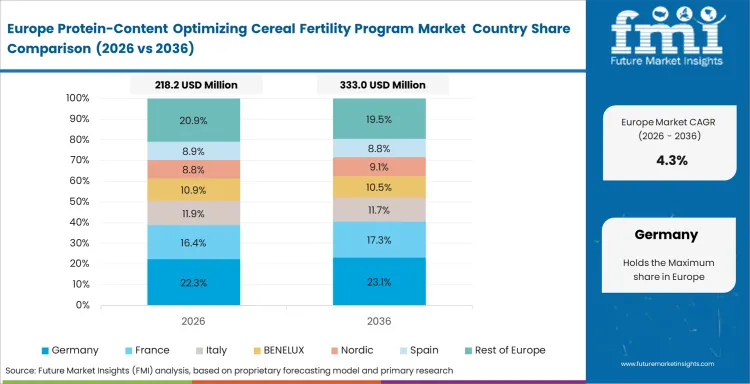
Germany records the slowest growth in this group because cereal nutrition systems are mature and growers already apply structured quality management in many regions. The market in Germany is projected to grow at a CAGR of 4.7% through 2036. Future demand will come from refinement in inhibitor use, sulfur balance, and field-specific rate setting. Program suppliers can still protect value where growers want stronger efficiency under tighter environmental expectations. The market stays attractive because spending quality per hectare remains relatively solid.
- Mature systems limit first-time adoption gains.
- Efficiency refinement supports continued spending.
- Per-hectare value stays solid in managed cereal systems.
Competitive Landscape and Strategic Positioning
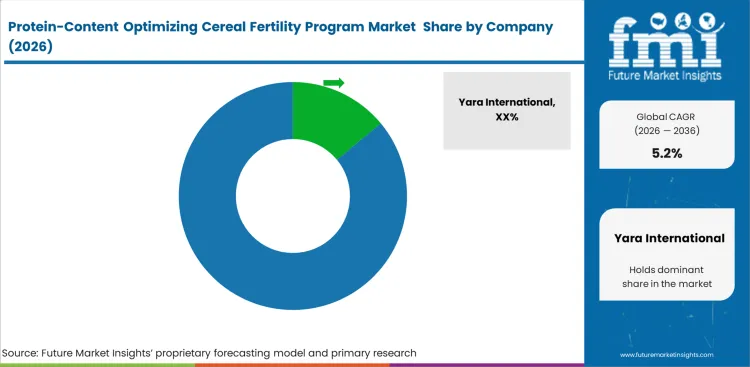
- Competition is shaped by cereal agronomy depth, retailer access, and the ability to prove protein response under local field conditions.
- Large suppliers hold an advantage where they can bundle nitrogen products, sulfur lines, digital tools, and field advisers in one package.
- Regional specialists still matter because growers often trust local evidence more than broad brand claims in weather-sensitive protein programs.
Yara International, Nutrien, ICL Group, EuroChem, Coromandel International, CF Industries, and Koch Agronomic Services form the main capability group in this market. These companies do not compete only on product chemistry. They compete on agronomy support, distributor reach, and the ability to fit programs into farm timing constraints. Cereal protein programs need a sharper value story than general crop nutrition because the grower must believe the extra pass can still alter saleable quality. That proof requirement favors suppliers with field trial depth and strong local teams. The market therefore rewards execution strength more than simple portfolio breadth.
Program design is becoming more important than commodity tonnage. A supplier that offers one nitrogen line without timing support is easier to replace than a supplier that can interpret crop status and advise on late corrections. That difference raises the role of ag retail and independent agronomy in competitive outcomes. Private channel partnerships can therefore shift share even when plant capacity does not change. Companies with stronger sulfur and inhibitor offerings gain an extra edge in cereal systems where nitrogen efficiency is under pressure. Premium grain channels raise the value of such complete offerings.
Smaller firms and regional blenders still hold room in this category because many protein programs are built around local weather patterns and crop classes. Those firms can respond quickly with custom blends or seasonal campaigns tied to narrow topdress windows. Yet long-term share still tends to favor suppliers that can finance field support and maintain product availability during peak demand periods. Retail loyalty matters because protein programs often need one more conversation after emergence and before grain fill. Commercial discipline in that short decision window can decide repeat business.
Key Companies in the Protein-Content Optimizing Cereal Fertility Program Market
Key global companies leading the protein-content optimizing cereal fertility program market include:
- Global crop nutrition leaders include Yara International, Nutrien Ltd., ICL Group, and EuroChem because these firms combine broad nutrient portfolios with agronomy reach across cereal regions.
- Nitrogen platform and efficiency specialists include CF Industries and Koch Agronomic Services because nitrogen source performance and stabilization matter in protein-focused cereal programs.
- Regional cereal nutrition strength is visible at Coromandel International because advisory reach and crop-specific nutrient programs support quality farming decisions in India.
Competitive Benchmarking: Protein-Content Optimizing Cereal Fertility Program Market
| Company | Cereal Agronomy Depth | Protein Program Fit | Retail or Farm Reach | Geographic Footprint |
|---|---|---|---|---|
| Yara International | High | High | Strong | Global |
| Nutrien Ltd. | High | Medium | Strong | North America, Global |
| ICL Group | Medium | Medium | Moderate | Global |
| EuroChem | Medium | Medium | Moderate | Europe, Global |
| CF Industries | High | Medium | Strong | North America |
| Koch Agronomic Services | Medium | High | Strong | North America |
| Coromandel International | Medium | Medium | Strong | India |
Source: Future Market Insights competitive analysis, 2026. Ratings reflect relative positioning based on cereal agronomy depth, protein program fit, retail or farm reach, and stated geographic presence.
Key Developments in Protein-Content Optimizing Cereal Fertility Program Market
- In May 2025, ICL launched Bioz Tonus in Brazil as a crop nutrition product positioned to maximize nitrogen use in crops.
- In January 2026, CF Industries joined a low-carbon ammonia fertilizer trial with POET and agricultural cooperatives across the USA Midwest.
- In March 2025, Coromandel International signed a definitive agreement to acquire a controlling stake in NACL Industries.
- In 2024, EuroChem reported official confirmation for ENTEC fertilizers as an enhanced performance product under Europe-focused nutrient efficiency positioning.
Key Players in the Protein-Content Optimizing Cereal Fertility Program Market
Major Global Players:
- Yara International
- Nutrien Ltd.
- ICL Group
- EuroChem
Regional and Program Specialists:
- CF Industries
- Koch Agronomic Services
- Coromandel International
Report Scope and Coverage
| Parameter | Details |
|---|---|
| Quantitative Units | USD 0.99 billion to USD 1.65 billion at a CAGR of 5.2% |
| Market Definition | Crop nutrition programs used to improve cereal grain protein through managed nutrient timing and program design |
| Regions Covered | North America, Latin America, Europe, East Asia, South Asia and Pacific, Middle East and Africa |
| Countries Covered | India, China, Australia, United States, Canada, France, Germany and more than 25 additional countries |
| Key Companies Profiled | Yara International, Nutrien Ltd., ICL Group, EuroChem, CF Industries, Koch Agronomic Services, Coromandel International |
| Forecast Period | 2026 to 2036 |
| Approach | Hybrid bottom-up and top-down methodology using cereal acreage, program adoption, and managed spend per hectare |
| Historical Reference | 2025 |
Protein-Content Optimizing Cereal Fertility Program Market by Segments
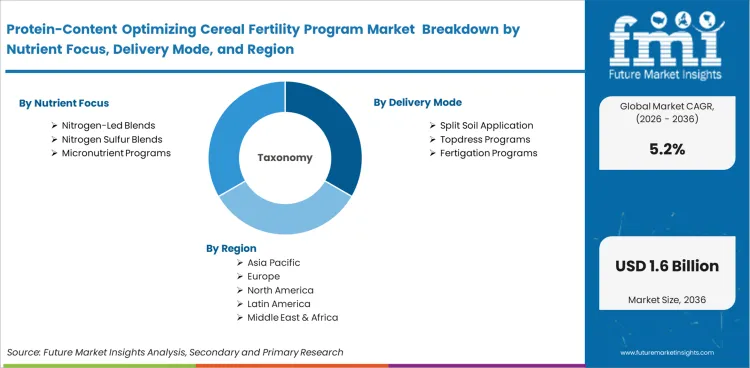
Protein-Content Optimizing Cereal Fertility Program Market Segmented by Program Type:
- Season-Long Nitrogen Programs
- Quality Premium Programs
- Sulfur-Linked Programs
- Variable Rate Programs
- Foliar Finish Programs
Protein-Content Optimizing Cereal Fertility Program Market Segmented by Nutrient Focus:
- Nitrogen-Led Blends
- Nitrogen Sulfur Blends
- Micronutrient Programs
- Inhibitor-Treated Programs
- Biostimulant-Linked Programs
Protein-Content Optimizing Cereal Fertility Program Market Segmented by Delivery Mode:
- Split Soil Application
- Topdress Programs
- Fertigation Programs
- Foliar Protein Finish
- Digital Prescription Programs
Protein-Content Optimizing Cereal Fertility Program Market Segmented by Cereal Type:
- Wheat
- Barley
- Durum
- Maize
- Oats
Protein-Content Optimizing Cereal Fertility Program Market Segmented by Buyer Type:
- Commercial Farms
- Cooperatives
- Ag Retailers
- Grain-Linked Contract Programs
- Advisory Networks
Protein-Content Optimizing Cereal Fertility Program Market Segmented by Application Stage:
- Pre-Season Planning
- Base Application
- Mid-Season Topdress
- Late Protein Push
- Post-Harvest Review
Protein-Content Optimizing Cereal Fertility Program Market Segmented by Region:
- North America
- Latin America
- Western Europe
- Eastern Europe
- East Asia
- South Asia and Pacific
- Middle East and Africa
Research Sources and Bibliography
- Food and Agriculture Organization of the United Nations. (n.d.). FAOSTAT.
- World Agricultural Outlook Board. (2026, April 9). World agricultural supply and demand estimates (WASDE-670). USA Department of Agriculture.
- Organisation for Economic Co-operation and Development, & Food and Agriculture Organization of the United Nations. (2025). OECD-FAO agricultural outlook 2025-2034. OECD Publishing.
- Government of India, Ministry of Agriculture & Farmers Welfare, Department of Agriculture & Farmers Welfare, Economics, Statistics & Evaluation Division. (2024). Agricultural statistics at a glance 2024.
- Australian Bureau of Agricultural and Resource Economics and Sciences. (2025, December 2). Australian crop report: December 2025. Department of Agriculture, Fisheries and Forestry.
- Eurostat. (n.d.). Agri-environmental indicator - mineral fertiliser consumption.
- Statistics Canada. (2025, June 27). Agriculture and food statistics.
- Roa, G. A., Quintana-Obregón, E. A., González-Renteria, M., & Ruiz Diaz, D. A. (2024). Increasing wheat protein and yield through sulfur fertilization and its relationship with nitrogen. Nitrogen, 5(3), 553-571
- Pinto, J. C., Arnall, B., Mueller, N., Balboa, G. R., & Puntel, L. A. (2025). Evaluation of static and sensor-based nitrogen recommendation models for winter wheat. Agronomy Journal, 117(3), e70063.
- Zhang, X., Zeng, B., Ding, D., Zhou, W., Dai, X., & He, M. (2025). Effects of sulfur fertilizer on the bread-making quality of wheat depend on the nitrogen input level. Journal of Integrative Agriculture. Advance online publication.
This Report Answers
- How large is the protein-content optimizing cereal fertility program market in 2025 and how much can it reach by 2036?
- Which nutrient focus segment is expected to lead the protein-content optimizing cereal fertility program market by 2026?
- Why does wheat create the largest demand pool in the protein-content optimizing cereal fertility program market?
- How do quality premiums affect grower spending in the protein-content optimizing cereal fertility program market?
- Which countries are expected to post faster growth through 2036 in the protein-content optimizing cereal fertility program market?
- What limits wider use of late protein push programs in cereal nutrition planning?
- Which companies hold the strongest position in protein-focused cereal fertility programs?
- How does FMI size and validate the protein-content optimizing cereal fertility program market forecast?
Frequently Asked Questions
What is the global market demand for Protein-Content Optimizing Cereal Fertility Program in 2026?
In 2026 the global protein-content optimizing cereal fertility program market is expected to be worth USD 0.99 billion based on managed cereal nutrition spending.
How large can the Protein-Content Optimizing Cereal Fertility Program market become by 2036?
• By 2036 the protein-content optimizing cereal fertility program market is expected to reach USD 1.65 billion as protein-linked cereal programs widen across key grain regions.
How fast will demand for Protein-Content Optimizing Cereal Fertility Program grow between 2026 and 2036?
Demand for the protein-content optimizing cereal fertility program market is expected to expand at a CAGR of 5.2% between 2026 and 2036.
Which segment leads the Protein-Content Optimizing Cereal Fertility Program market by nutrient focus?
Nitrogen-led blends lead the market with an estimated 41.0% share in 2026 because nitrogen still carries the strongest direct effect on cereal protein.
Why do commercial farms lead the Protein-Content Optimizing Cereal Fertility Program market?
Commercial farms lead because larger cereal acreage and clearer grain marketing plans make staged fertility programs easier to justify and measure.
What is the main restraint in the Protein-Content Optimizing Cereal Fertility Program market?
Weather risk is the main restraint because late nutrient spending cannot always shift grain protein enough to recover extra field cost.
Which country is expected to grow fastest in the Protein-Content Optimizing Cereal Fertility Program market?
India is projected to post the fastest growth through 2036 because organized advisory channels and wheat nutrition programs are widening together.
How does FMI validate the Protein-Content Optimizing Cereal Fertility Program market forecast?
FMI uses cereal acreage, program adoption, field management patterns, and country crop data to validate revenue build-up and forecast direction.
Preview the report firsthand - request a free sample
Get SampleGet the brochure for pricing and purchase details.
Get PDFTable of Content
- Executive Summary
- Global Market Outlook
- Demand-side Trends
- Supply-side Trends
- Technology Roadmap Analysis
- Analysis and Recommendations
- Market Overview
- Market Coverage / Taxonomy
- Market Definition / Scope / Limitations
- Research Methodology
- Chapter Orientation
- Analytical Lens and Working Hypotheses
- Market Structure, Signals, and Trend Drivers
- Benchmarking and Cross-market Comparability
- Market Sizing, Forecasting, and Opportunity Mapping
- Research Design and Evidence Framework
- Desk Research Programme (Secondary Evidence)
- Company Annual and Sustainability Reports
- Peer-reviewed Journals and Academic Literature
- Corporate Websites, Product Literature, and Technical Notes
- Earnings Decks and Investor Briefings
- Statutory Filings and Regulatory Disclosures
- Technical White Papers and Standards Notes
- Trade Journals, Industry Magazines, and Analyst Briefs
- Conference Proceedings, Webinars, and Seminar Materials
- Government Statistics Portals and Public Data Releases
- Press Releases and Reputable Media Coverage
- Specialist Newsletters and Curated Briefings
- Sector Databases and Reference Repositories
- FMI Internal Proprietary Databases and Historical Market Datasets
- Subscription Datasets and Paid Sources
- Social Channels, Communities, and Digital Listening Inputs
- Additional Desk Sources
- Expert Input and Fieldwork (Primary Evidence)
- Primary Modes
- Qualitative Interviews and Expert Elicitation
- Quantitative Surveys and Structured Data Capture
- Blended Approach
- Why Primary Evidence is Used
- Field Techniques
- Interviews
- Surveys
- Focus Groups
- Observational and In-context Research
- Social and Community Interactions
- Stakeholder Universe Engaged
- C-suite Leaders
- Board Members
- Presidents and Vice Presidents
- R&D and Innovation Heads
- Technical Specialists
- Domain Subject-matter Experts
- Scientists
- Physicians and Other Healthcare Professionals
- Governance, Ethics, and Data Stewardship
- Research Ethics
- Data Integrity and Handling
- Primary Modes
- Tooling, Models, and Reference Databases
- Desk Research Programme (Secondary Evidence)
- Data Engineering and Model Build
- Data Acquisition and Ingestion
- Cleaning, Normalisation, and Verification
- Synthesis, Triangulation, and Analysis
- Quality Assurance and Audit Trail
- Market Background
- Market Dynamics
- Drivers
- Restraints
- Opportunity
- Trends
- Scenario Forecast
- Demand in Optimistic Scenario
- Demand in Likely Scenario
- Demand in Conservative Scenario
- Opportunity Map Analysis
- Product Life Cycle Analysis
- Supply Chain Analysis
- Investment Feasibility Matrix
- Value Chain Analysis
- PESTLE and Porter’s Analysis
- Regulatory Landscape
- Regional Parent Market Outlook
- Production and Consumption Statistics
- Import and Export Statistics
- Market Dynamics
- Global Market Analysis 2021 to 2025 and Forecast, 2026 to 2036
- Historical Market Size Value (USD Million) Analysis, 2021 to 2025
- Current and Future Market Size Value (USD Million) Projections, 2026 to 2036
- Y-o-Y Growth Trend Analysis
- Absolute $ Opportunity Analysis
- Global Market Pricing Analysis 2021 to 2025 and Forecast 2026 to 2036
- Global Market Analysis 2021 to 2025 and Forecast 2026 to 2036, By Nutrient Focus
- Introduction / Key Findings
- Historical Market Size Value (USD Million) Analysis By Nutrient Focus , 2021 to 2025
- Current and Future Market Size Value (USD Million) Analysis and Forecast By Nutrient Focus , 2026 to 2036
- Nitrogen-Led Blends
- Nitrogen Sulfur Blends
- Micronutrient Programs
- Nitrogen-Led Blends
- Y-o-Y Growth Trend Analysis By Nutrient Focus , 2021 to 2025
- Absolute $ Opportunity Analysis By Nutrient Focus , 2026 to 2036
- Global Market Analysis 2021 to 2025 and Forecast 2026 to 2036, By Delivery Mode
- Introduction / Key Findings
- Historical Market Size Value (USD Million) Analysis By Delivery Mode, 2021 to 2025
- Current and Future Market Size Value (USD Million) Analysis and Forecast By Delivery Mode, 2026 to 2036
- Split Soil Application
- Topdress Programs
- Fertigation Programs
- Split Soil Application
- Y-o-Y Growth Trend Analysis By Delivery Mode, 2021 to 2025
- Absolute $ Opportunity Analysis By Delivery Mode, 2026 to 2036
- Global Market Analysis 2021 to 2025 and Forecast 2026 to 2036, By Cereal Type
- Introduction / Key Findings
- Historical Market Size Value (USD Million) Analysis By Cereal Type, 2021 to 2025
- Current and Future Market Size Value (USD Million) Analysis and Forecast By Cereal Type, 2026 to 2036
- Wheat
- Barley
- Durum
- Wheat
- Y-o-Y Growth Trend Analysis By Cereal Type, 2021 to 2025
- Absolute $ Opportunity Analysis By Cereal Type, 2026 to 2036
- Global Market Analysis 2021 to 2025 and Forecast 2026 to 2036, By Buyer Type
- Introduction / Key Findings
- Historical Market Size Value (USD Million) Analysis By Buyer Type, 2021 to 2025
- Current and Future Market Size Value (USD Million) Analysis and Forecast By Buyer Type, 2026 to 2036
- Commercial Farms
- Cooperatives
- Ag Retailers
- Commercial Farms
- Y-o-Y Growth Trend Analysis By Buyer Type, 2021 to 2025
- Absolute $ Opportunity Analysis By Buyer Type, 2026 to 2036
- Global Market Analysis 2021 to 2025 and Forecast 2026 to 2036, By Application Stage
- Introduction / Key Findings
- Historical Market Size Value (USD Million) Analysis By Application Stage, 2021 to 2025
- Current and Future Market Size Value (USD Million) Analysis and Forecast By Application Stage, 2026 to 2036
- Mid-Season Topdress
- Pre-Season Planning
- Base Application
- Mid-Season Topdress
- Y-o-Y Growth Trend Analysis By Application Stage, 2021 to 2025
- Absolute $ Opportunity Analysis By Application Stage, 2026 to 2036
- Global Market Analysis 2021 to 2025 and Forecast 2026 to 2036, By Region
- Introduction
- Historical Market Size Value (USD Million) Analysis By Region, 2021 to 2025
- Current Market Size Value (USD Million) Analysis and Forecast By Region, 2026 to 2036
- North America
- Latin America
- Western Europe
- Eastern Europe
- East Asia
- South Asia and Pacific
- Middle East & Africa
- Market Attractiveness Analysis By Region
- North America Market Analysis 2021 to 2025 and Forecast 2026 to 2036, By Country
- Historical Market Size Value (USD Million) Trend Analysis By Market Taxonomy, 2021 to 2025
- Market Size Value (USD Million) Forecast By Market Taxonomy, 2026 to 2036
- By Country
- USA
- Canada
- Mexico
- By Nutrient Focus
- By Delivery Mode
- By Cereal Type
- By Buyer Type
- By Application Stage
- By Country
- Market Attractiveness Analysis
- By Country
- By Nutrient Focus
- By Delivery Mode
- By Cereal Type
- By Buyer Type
- By Application Stage
- Key Takeaways
- Latin America Market Analysis 2021 to 2025 and Forecast 2026 to 2036, By Country
- Historical Market Size Value (USD Million) Trend Analysis By Market Taxonomy, 2021 to 2025
- Market Size Value (USD Million) Forecast By Market Taxonomy, 2026 to 2036
- By Country
- Brazil
- Chile
- Rest of Latin America
- By Nutrient Focus
- By Delivery Mode
- By Cereal Type
- By Buyer Type
- By Application Stage
- By Country
- Market Attractiveness Analysis
- By Country
- By Nutrient Focus
- By Delivery Mode
- By Cereal Type
- By Buyer Type
- By Application Stage
- Key Takeaways
- Western Europe Market Analysis 2021 to 2025 and Forecast 2026 to 2036, By Country
- Historical Market Size Value (USD Million) Trend Analysis By Market Taxonomy, 2021 to 2025
- Market Size Value (USD Million) Forecast By Market Taxonomy, 2026 to 2036
- By Country
- Germany
- UK
- Italy
- Spain
- France
- Nordic
- BENELUX
- Rest of Western Europe
- By Nutrient Focus
- By Delivery Mode
- By Cereal Type
- By Buyer Type
- By Application Stage
- By Country
- Market Attractiveness Analysis
- By Country
- By Nutrient Focus
- By Delivery Mode
- By Cereal Type
- By Buyer Type
- By Application Stage
- Key Takeaways
- Eastern Europe Market Analysis 2021 to 2025 and Forecast 2026 to 2036, By Country
- Historical Market Size Value (USD Million) Trend Analysis By Market Taxonomy, 2021 to 2025
- Market Size Value (USD Million) Forecast By Market Taxonomy, 2026 to 2036
- By Country
- Russia
- Poland
- Hungary
- Balkan & Baltic
- Rest of Eastern Europe
- By Nutrient Focus
- By Delivery Mode
- By Cereal Type
- By Buyer Type
- By Application Stage
- By Country
- Market Attractiveness Analysis
- By Country
- By Nutrient Focus
- By Delivery Mode
- By Cereal Type
- By Buyer Type
- By Application Stage
- Key Takeaways
- East Asia Market Analysis 2021 to 2025 and Forecast 2026 to 2036, By Country
- Historical Market Size Value (USD Million) Trend Analysis By Market Taxonomy, 2021 to 2025
- Market Size Value (USD Million) Forecast By Market Taxonomy, 2026 to 2036
- By Country
- China
- Japan
- South Korea
- By Nutrient Focus
- By Delivery Mode
- By Cereal Type
- By Buyer Type
- By Application Stage
- By Country
- Market Attractiveness Analysis
- By Country
- By Nutrient Focus
- By Delivery Mode
- By Cereal Type
- By Buyer Type
- By Application Stage
- Key Takeaways
- South Asia and Pacific Market Analysis 2021 to 2025 and Forecast 2026 to 2036, By Country
- Historical Market Size Value (USD Million) Trend Analysis By Market Taxonomy, 2021 to 2025
- Market Size Value (USD Million) Forecast By Market Taxonomy, 2026 to 2036
- By Country
- India
- ASEAN
- Australia & New Zealand
- Rest of South Asia and Pacific
- By Nutrient Focus
- By Delivery Mode
- By Cereal Type
- By Buyer Type
- By Application Stage
- By Country
- Market Attractiveness Analysis
- By Country
- By Nutrient Focus
- By Delivery Mode
- By Cereal Type
- By Buyer Type
- By Application Stage
- Key Takeaways
- Middle East & Africa Market Analysis 2021 to 2025 and Forecast 2026 to 2036, By Country
- Historical Market Size Value (USD Million) Trend Analysis By Market Taxonomy, 2021 to 2025
- Market Size Value (USD Million) Forecast By Market Taxonomy, 2026 to 2036
- By Country
- Kingdom of Saudi Arabia
- Other GCC Countries
- Turkiye
- South Africa
- Other African Union
- Rest of Middle East & Africa
- By Nutrient Focus
- By Delivery Mode
- By Cereal Type
- By Buyer Type
- By Application Stage
- By Country
- Market Attractiveness Analysis
- By Country
- By Nutrient Focus
- By Delivery Mode
- By Cereal Type
- By Buyer Type
- By Application Stage
- Key Takeaways
- Key Countries Market Analysis
- USA
- Pricing Analysis
- Market Share Analysis, 2025
- By Nutrient Focus
- By Delivery Mode
- By Cereal Type
- By Buyer Type
- By Application Stage
- Canada
- Pricing Analysis
- Market Share Analysis, 2025
- By Nutrient Focus
- By Delivery Mode
- By Cereal Type
- By Buyer Type
- By Application Stage
- Mexico
- Pricing Analysis
- Market Share Analysis, 2025
- By Nutrient Focus
- By Delivery Mode
- By Cereal Type
- By Buyer Type
- By Application Stage
- Brazil
- Pricing Analysis
- Market Share Analysis, 2025
- By Nutrient Focus
- By Delivery Mode
- By Cereal Type
- By Buyer Type
- By Application Stage
- Chile
- Pricing Analysis
- Market Share Analysis, 2025
- By Nutrient Focus
- By Delivery Mode
- By Cereal Type
- By Buyer Type
- By Application Stage
- Germany
- Pricing Analysis
- Market Share Analysis, 2025
- By Nutrient Focus
- By Delivery Mode
- By Cereal Type
- By Buyer Type
- By Application Stage
- UK
- Pricing Analysis
- Market Share Analysis, 2025
- By Nutrient Focus
- By Delivery Mode
- By Cereal Type
- By Buyer Type
- By Application Stage
- Italy
- Pricing Analysis
- Market Share Analysis, 2025
- By Nutrient Focus
- By Delivery Mode
- By Cereal Type
- By Buyer Type
- By Application Stage
- Spain
- Pricing Analysis
- Market Share Analysis, 2025
- By Nutrient Focus
- By Delivery Mode
- By Cereal Type
- By Buyer Type
- By Application Stage
- France
- Pricing Analysis
- Market Share Analysis, 2025
- By Nutrient Focus
- By Delivery Mode
- By Cereal Type
- By Buyer Type
- By Application Stage
- India
- Pricing Analysis
- Market Share Analysis, 2025
- By Nutrient Focus
- By Delivery Mode
- By Cereal Type
- By Buyer Type
- By Application Stage
- ASEAN
- Pricing Analysis
- Market Share Analysis, 2025
- By Nutrient Focus
- By Delivery Mode
- By Cereal Type
- By Buyer Type
- By Application Stage
- Australia & New Zealand
- Pricing Analysis
- Market Share Analysis, 2025
- By Nutrient Focus
- By Delivery Mode
- By Cereal Type
- By Buyer Type
- By Application Stage
- China
- Pricing Analysis
- Market Share Analysis, 2025
- By Nutrient Focus
- By Delivery Mode
- By Cereal Type
- By Buyer Type
- By Application Stage
- Japan
- Pricing Analysis
- Market Share Analysis, 2025
- By Nutrient Focus
- By Delivery Mode
- By Cereal Type
- By Buyer Type
- By Application Stage
- South Korea
- Pricing Analysis
- Market Share Analysis, 2025
- By Nutrient Focus
- By Delivery Mode
- By Cereal Type
- By Buyer Type
- By Application Stage
- Russia
- Pricing Analysis
- Market Share Analysis, 2025
- By Nutrient Focus
- By Delivery Mode
- By Cereal Type
- By Buyer Type
- By Application Stage
- Poland
- Pricing Analysis
- Market Share Analysis, 2025
- By Nutrient Focus
- By Delivery Mode
- By Cereal Type
- By Buyer Type
- By Application Stage
- Hungary
- Pricing Analysis
- Market Share Analysis, 2025
- By Nutrient Focus
- By Delivery Mode
- By Cereal Type
- By Buyer Type
- By Application Stage
- Kingdom of Saudi Arabia
- Pricing Analysis
- Market Share Analysis, 2025
- By Nutrient Focus
- By Delivery Mode
- By Cereal Type
- By Buyer Type
- By Application Stage
- Turkiye
- Pricing Analysis
- Market Share Analysis, 2025
- By Nutrient Focus
- By Delivery Mode
- By Cereal Type
- By Buyer Type
- By Application Stage
- South Africa
- Pricing Analysis
- Market Share Analysis, 2025
- By Nutrient Focus
- By Delivery Mode
- By Cereal Type
- By Buyer Type
- By Application Stage
- USA
- Market Structure Analysis
- Competition Dashboard
- Competition Benchmarking
- Market Share Analysis of Top Players
- By Regional
- By Nutrient Focus
- By Delivery Mode
- By Cereal Type
- By Buyer Type
- By Application Stage
- Competition Analysis
- Competition Deep Dive
- Yara International
- Overview
- Product Portfolio
- Profitability by Market Segments (Product/Age /Sales Channel/Region)
- Sales Footprint
- Strategy Overview
- Marketing Strategy
- Product Strategy
- Channel Strategy
- Nutrien Ltd.
- ICL Group
- EuroChem
- Regional and Program Specialists:
- CF Industries
- Koch Agronomic Services
- Yara International
- Competition Deep Dive
- Assumptions & Acronyms Used


