

- Industry Size (2026):
- USD 69.4 Mn
- Forecast (2036):
- USD 415.6 Mn
- CAGR (2026 to 2036)
- 19.6%
Geo-Specific Climate-Risk Indexed Fertility Program Market Forecast and Outlook 2026 to 2036
The geo-specific climate-risk indexed fertility program market is valued at USD 69.4 million in 2026 and is forecasted to reach USD 415.6 million by 2036, registering a CAGR of 19.6%. Expansion reflects structural change in nutrient management rather than incremental fertilizer demand. Climate volatility has shifted fertility planning from uniform seasonal schedules toward risk-calibrated inputs tied to location-specific weather exposure. Value concentrates in programs that link nutrient timing, formulation choice, and release behavior to probabilistic climate stress rather than historical averages.
Demand is driven by risk management discipline across production systems exposed to rainfall variability, heat stress, and soil moisture instability. Fertility programs increasingly function as operational hedging tools, reducing downside yield volatility instead of maximizing peak output. Adoption remains strongest where nutrient decisions intersect with crop insurance frameworks, sustainability reporting, or contract farming requirements. Switching costs remain elevated because geo-specific indexing embeds local climate models, soil baselines, and historical response data into program design. Long-term expansion depends on lower-cost analytics, clearer alignment between climate policy incentives and nutrient stewardship, and wider acceptance of climate-indexed inputs as core agronomic infrastructure rather than optional optimization tools.
Quick Stats for Geo-Specific Climate-Risk Indexed Fertility Program Market
- Geo-Specific Climate-Risk Indexed Fertility Program Market Value (2026): USD 69.4 million
- Geo-Specific Climate-Risk Indexed Fertility Program Market Forecast Value (2036): USD 415.6 million
- Forecast CAGR (2026–2036): 19.6%
- Leading Application Segment in Global Demand: Standard Applications
- Fastest-Growing Countries: India, China, Netherlands, USA
- Key Players in Global Demand: Bayer, Corteva, Nutrien, Syngenta, Yara International, Trimble
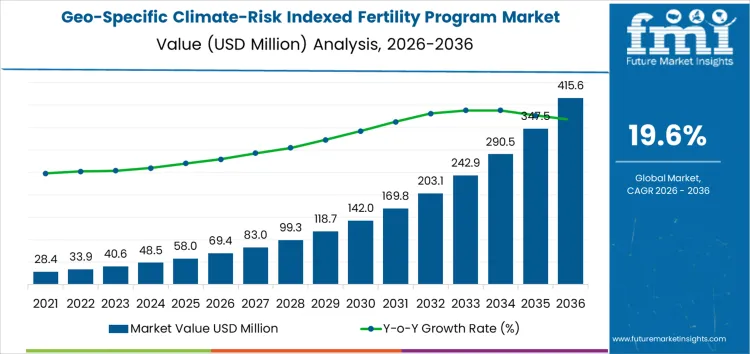
Geo-Specific Climate-Risk Indexed Fertility Program Market Key Takeaways
| Metric | Value |
|---|---|
| Market Value (2026) | USD 69.4 million |
| Market Forecast Value (2036) | USD 415.6 million |
| Forecast CAGR (2026-2036) | 19.6% |
Why is the Demand for Geo-Specific Climate-Risk Indexed Fertility Program Market Growing?
Demand for geo-specific climate-risk indexed fertility programs is growing globally due to escalating climate variability and its impact on crop nutrient dynamics, soil health, and overall agricultural productivity. Farmers and agronomy service providers adopt fertility solutions tailored to regional climate risk profiles that account for temperature fluctuation, drought stress, erratic rainfall, and extreme weather events that influence nutrient availability and plant uptake efficiency. Standard fertility programs that ignore localized climate stressors can lead to nutrient imbalances, reduced yields, and increased environmental risk from runoff or leaching.
Geo-specific programs integrate soil data, climatic patterns, crop requirements, and predictive modeling to optimize nutrient timing and composition for site-specific conditions, which improves resource use efficiency and yield reliability. Regulatory frameworks in multiple regions emphasize environmental safeguards, reduced nutrient loss, and sustainable input use, which reinforces adoption of fertility strategies aligned with localized climate risk criteria. Precision agriculture technologies, including remote sensing, variable rate application, and decision support tools, support implementation and monitoring of indexed programs. Expansion of global crop markets and food security priorities encourages nutrient planning that mitigates climate related production risk. Growers and supply chain partners invest in integrated fertility solutions that enhance resilience, compliance, and consistent performance in diverse agroecological environments worldwide.
How Is the Geo-Specific Climate-Risk Indexed Fertility Program Market Structured Globally?
The global geo-specific climate-risk indexed fertility program market is defined by increasing exposure of agriculture to weather volatility, regional climate stress, and yield instability. These programs integrate localized climate data such as rainfall variability, heat stress frequency, drought probability, and soil moisture risk into fertilizer design, timing, and nutrient release profiles. Adoption is strongest in regions facing unpredictable growing seasons, climate-driven yield insurance frameworks, and performance-linked input procurement. Fertility programs are increasingly aligned with climate-indexed advisory tools, digital agronomy platforms, and outcome-based crop management models that emphasize resilience rather than maximum yield alone.
Which Application Segment Accounts for the Largest Share of Global Adoption?
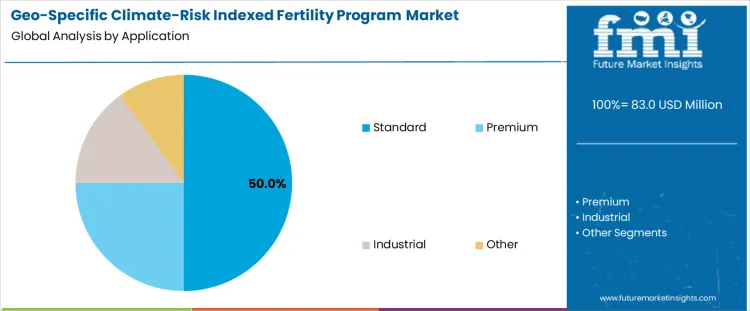
Standard applications account for the largest share at 50.0%, reflecting widespread use of climate-risk indexed fertility programs across mainstream crop production systems. These programs focus on stabilizing yields under moderate climate variability, using adaptive nutrient timing and stress-mitigation formulations without significantly increasing input complexity. Premium applications represent 25.0% of global demand, driven by high-value crops, export-oriented producers, and regions with extreme climate exposure where tailored nutrient strategies are essential for economic viability. Industrial applications hold a 15.0% share, primarily linked to large-scale plantations, contract farming operations, and climate-indexed input agreements tied to performance guarantees. The remaining 10.0% falls under other applications, including pilot programs, government-supported resilience initiatives, and experimental climate-smart agriculture deployments.
Key Takeaways:
- Standard programs dominate due to broad applicability and scalability
- Premium solutions address high-risk and high-value production systems
- Industrial use reflects structured, contract-driven agriculture models
Which Form Is Most Widely Used in Climate-Risk Indexed Fertility Programs?
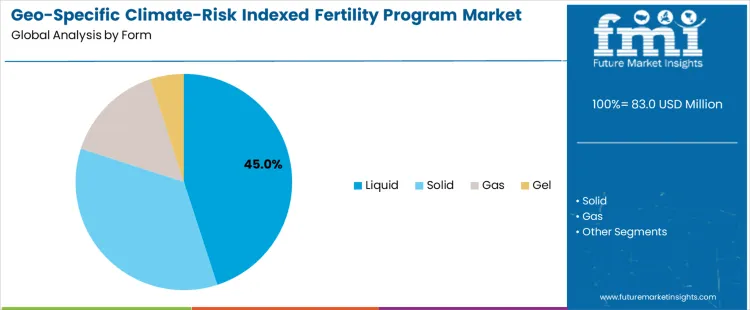
Liquid formulations lead the market with a 45.0% share, driven by their flexibility, rapid plant uptake, and compatibility with precision application systems that respond to real-time climate signals. Liquids allow growers to adjust nutrient delivery quickly in response to drought stress, heat events, or unexpected rainfall patterns. Solid forms account for 35.0%, favored for baseline nutrient provisioning and slow-release strategies that buffer crops against seasonal uncertainty. Gas-based applications represent 15.0%, mainly associated with nitrogen management in regions where volatilization risk and emission control are integrated into climate indexing models. Gel formulations hold a smaller 5.0% share, reflecting niche use in water-stressed environments where moisture retention and localized nutrient availability are critical.
Key Takeaways:
- Liquids dominate due to adaptability and rapid response capability
- Solids provide foundational resilience through controlled release
- Gas and gel forms serve specialized climate-risk mitigation roles
Which Distribution Channel Leads the Global Market?
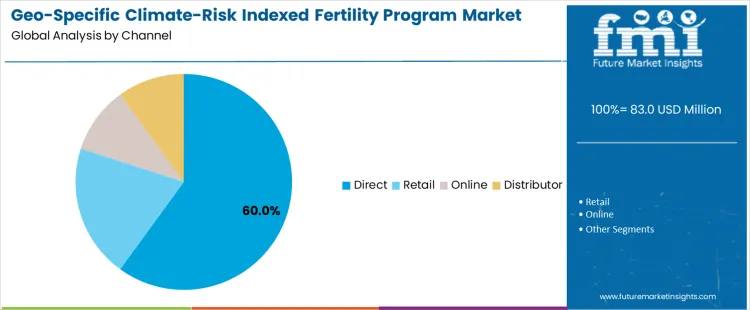
Direct sales channels represent the largest share at 60.0%, highlighting the importance of customized program design, data integration, and direct agronomic support in climate-risk indexed fertility solutions. Producers increasingly prefer direct engagement with solution providers to align nutrient strategies with localized climate models and insurance-linked performance metrics. Retail channels account for 20.0%, supplying standardized climate-smart fertility products to regional growers through established input networks. Online channels contribute 10.0%, primarily supporting digital agriculture platforms and subscription-based fertility programs. Distributors also represent 10.0%, facilitating access in regions where direct supplier presence is limited but climate-risk exposure remains high.
Key Takeaways
- Direct channels dominate due to customization and data integration needs
- Retail supports standardized climate-smart offerings
- Online and distributor channels expand reach into emerging regions
What are the Key Dynamics in the Geo-Specific Climate-Risk Indexed Fertility Program Market?
Global demand rises as agricultural producers and input suppliers adopt fertility programs indexed to geo-specific climate risk profiles that align nutrient strategies with local weather patterns, soil conditions, and climate variability. Geo-specific climate-risk indexed programs integrate climate data, historical weather trends, and crop response models to optimize timing and composition of nutrient applications. Adoption reflects increasing focus on climate resilience, yield stability, and resource efficiency across major cropping regions in North America, Europe, Asia-Pacific, and Latin America. Usage spans row crops, specialty horticulture, and controlled environment agriculture where climate variability influences nutrient demand and crop performance.
How do climate variability and precision agriculture expectations shape adoption?
Farmers face increasing incidence of irregular rainfall, temperature extremes, and drought events that affect nutrient availability and crop nutrient uptake. Geo-specific climate-risk indexed fertility programs support adaptive nutrient planning by leveraging localized climate metrics to time applications, adjust nutrient ratios, and mitigate risk of leaching or deficiency under variable conditions. Agronomy advisors and digital platforms integrate soil moisture, crop stage, and climate forecasts to refine nutrient delivery and improve resilience. Growers emphasize strategies that minimize yield variability and support consistent crop performance in the face of unpredictable weather events. Climate-indexed nutrient planning also supports sustainable input use and water conservation goals.
How do cost barriers, data complexity, and regional policy variation influence market scalability?
Geo-specific climate-risk indexed fertility programs require investment in data infrastructure, climate modeling tools, and field-level sensor networks that increase operational complexity relative to conventional nutrient plans. Smaller growers may face barriers due to technology cost and limited access to localized climate data or analytical expertise. Interpreting multi-factor datasets and integrating them into real-time fertility decisions demands technical literacy and extension support. Variability in regional policy frameworks for climate risk management and agricultural incentives affects program adoption priorities. Differences in weather patterns, soil health standards, and nutrient regulations across countries shape program customization requirements. Long-term market growth depends on cost-effective analytics platforms, accessible agronomy support, and alignment between climate adaptation policies and nutrient management frameworks that support consistent adoption across diverse agricultural landscapes worldwide.
How Is Demand for Geo-Specific Climate-Risk Indexed Fertility Programs Evolving Globally?
Demand for geo-specific climate-risk indexed fertility programs is increasing globally due to rising weather volatility, yield instability, and need for location-calibrated nutrient strategies. India leads with an 18.9% CAGR, supported by climate exposure across cropping zones and rapid uptake of risk-indexed agronomy tools. China follows at 18.4%, driven by regional climate divergence and policy-backed resilience programs. Netherlands records 17.8%, reflecting precision agriculture leadership and data-integrated nutrient planning. USA posts a 17.2% CAGR, shaped by climate variability, insurance-linked agronomy, and adoption of decision-support platforms. Growth reflects transition from uniform fertilization toward climate-responsive programs indexed to heat stress, rainfall variability, and soil moisture risk.
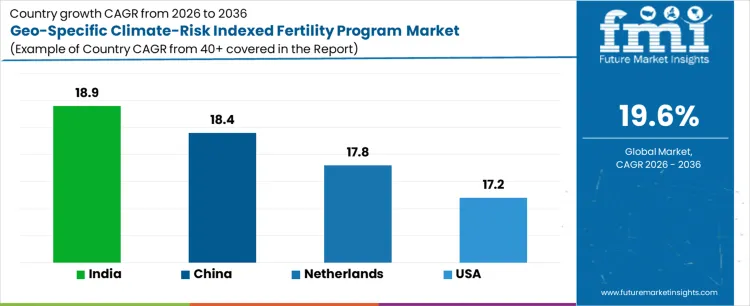
| Country | CAGR (%) |
|---|---|
| India | 18.9% |
| China | 18.4% |
| Netherlands | 17.8% |
| USA | 17.2% |
What is driving accelerated adoption of climate-risk indexed fertility programs in India?
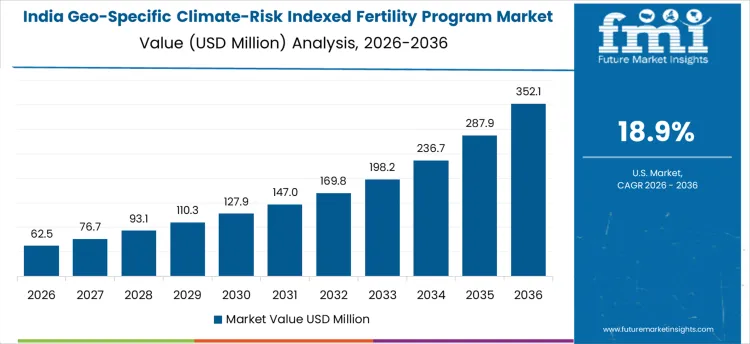
India demand is driven by high climate variability across agro-climatic zones and increasing frequency of heat waves, droughts, and erratic monsoons. CAGR of 18.9% reflects adoption of fertility programs calibrated to regional climate risk indices, crop stage vulnerability, and soil water dynamics. Farmers require nutrient strategies that adjust nitrogen, potassium, and micronutrient timing under stress conditions. Government and private advisory platforms integrate weather data with fertility recommendations. Insurance-linked risk mitigation increases demand for documented, climate-aligned practices. Domestic agronomy providers expand geo-tagged nutrient programs. Growth remains resilience-led and data-supported, aligned with yield stabilization, risk reduction, and income protection priorities.
- High exposure to climate variability across regions
- Integration of weather data into nutrient planning
- Focus on stress-stage-specific nutrient timing
- Linkage with risk mitigation and advisory platforms
How is China sustaining strong growth in climate-risk indexed fertility demand?
China demand reflects pronounced regional climate divergence and policy focus on climate-resilient agriculture. CAGR of 18.4% is supported by adoption of fertility programs indexed to drought, flooding, and temperature stress across major cropping belts. Large farming operations deploy zone-specific nutrient schedules guided by climate modeling. Government-backed digital agriculture initiatives support integration of meteorological data with nutrient management. Food security objectives reinforce investment in resilience-focused inputs. Domestic suppliers develop region-tagged fertility solutions. Growth remains scale-driven and policy-aligned, supported by centralized planning and rapid digitization of agronomy services.
- Regional climate divergence driving zone-specific programs
- Government support for climate-resilient agriculture
- Use of climate modeling in nutrient scheduling
- Standardized adoption across large-scale farms
What supports Netherlands’ leadership in climate-risk indexed fertility programs?
Netherlands demand reflects advanced precision agriculture, dense climate data infrastructure, and emphasis on risk-managed production. CAGR of 17.8% is supported by fertility programs indexed to microclimate variation, soil moisture sensors, and controlled environment conditions. Growers integrate real-time data into fertigation adjustments to mitigate heat and water stress. Research institutions collaborate with agritech firms to refine climate-responsive nutrient algorithms. Export-oriented production requires predictable outcomes under variable conditions. Growth remains innovation-led and technology-focused, aligned with Netherlands’ role as a global reference for data-driven, climate-adaptive agronomy.
- Advanced climate and soil sensor integration
- Real-time adjustment of fertigation programs
- Strong research and agritech collaboration
- Focus on predictability under climate variability
What factors are shaping demand growth in the USA for climate-risk indexed fertility programs?
USA demand is shaped by increasing weather extremes, regional yield volatility, and integration of agronomy with risk management tools. CAGR of 17.2% reflects adoption of fertility programs indexed to drought risk, heat stress, and rainfall patterns. Growers use predictive analytics to optimize nutrient timing and reduce loss exposure. Crop insurance and sustainability reporting influence adoption of documented, climate-aligned practices. Precision agriculture platforms enable geo-specific nutrient deployment. Domestic suppliers expand climate-risk indexed offerings. Growth remains technology-led and risk-focused, aligned with yield protection, compliance, and operational resilience.
- Rising frequency of extreme weather events
- Use of predictive analytics for nutrient timing
- Integration with insurance and sustainability frameworks
- Expansion of geo-specific fertility platforms
What is the competitive landscape of demand for geo-specific climate-risk indexed fertility programs globally?
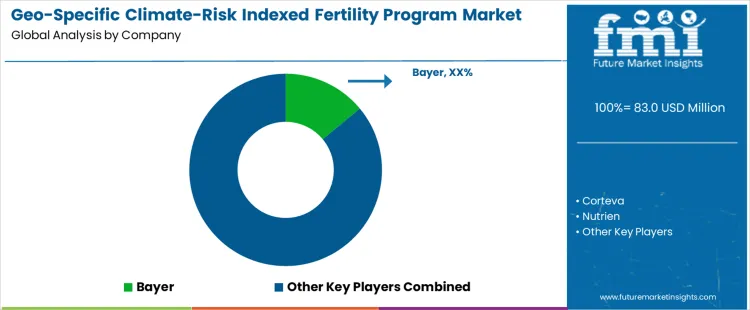
Demand for geo-specific climate-risk indexed fertility programs is driven by rising weather volatility, yield risk management needs, and adoption of precision agriculture practices. These programs link nutrient application strategies with localized climate data, soil profiles, and seasonal risk indicators to optimize nutrient timing and reduce exposure to drought, excess rainfall, and temperature stress. Buyers evaluate accuracy of geo-spatial modeling, integration of weather forecasts, nutrient efficiency under stress conditions, and compatibility with variable-rate application systems. Procurement teams prioritize suppliers offering robust data platforms, agronomic decision support, and proven field performance across diverse climatic zones. Trend in the global market reflects convergence of digital agriculture, risk mitigation strategies, and nutrient optimization aligned with climate resilience objectives.
Bayer holds leading positioning through digital agronomy platforms and climate-linked crop nutrition programs integrated with seed and crop protection portfolios. Corteva supports demand with data-driven fertility recommendations and climate-responsive agronomic models embedded within precision farming systems. Nutrien contributes integrated nutrient solutions and digital advisory services tailored to localized climate and soil variability. Syngenta advances climate-adaptive nutrition strategies through digital tools and crop-specific fertility programs. Yara International supports demand with sensor-based nutrient management systems and geo-referenced decision platforms linking climate data with fertilizer application. Competitive differentiation depends on quality of climate modeling, agronomic insight depth, digital integration capability, and ability to deliver measurable risk-adjusted yield outcomes.
Key Players in the Geo-Specific Climate-Risk Indexed Fertility Program Market
- Bayer
- Corteva
- Nutrien
- Syngenta
- Yara International
- Trimble
Scope of the Report
| Items | Values |
|---|---|
| Quantitative Units | USD million |
| Application | Standard; Premium; Industrial; Other |
| Form | Liquid; Solid; Gas; Gel |
| Channel | Direct; Retail; Online; Distributor |
| Regions Covered | Asia Pacific, Europe, North America, Latin America, Middle East & Africa |
| Countries Covered | India, China, Netherlands, USA, and 40+ countries |
| Key Companies Profiled | Bayer; Corteva; Nutrien; Syngenta; Yara International; Trimble |
| Additional Attributes | Dollar sales by application and form; adoption trends for climate-risk indexed fertility programs linked to geo-specific weather variability; performance metrics for yield stability, nutrient use efficiency, and stress resilience; integration with climate data, soil analytics, and decision-support platforms; formulation adaptability across liquid, solid, gas, and gel delivery modes; regulatory compliance, data governance, and nutrient stewardship standards influencing climate-indexed fertility program deployment. |
Geo-Specific Climate-Risk Indexed Fertility Program Market by Segment
Application:
- Standard
- Premium
- Industrial
- Other
Form:
- Liquid
- Solid
- Gas
- Gel
Channel:
- Direct
- Retail
- Online
- Distributor
Region:
- Asia Pacific
- China
- Japan
- South Korea
- India
- Australia & New Zealand
- ASEAN
- Rest of Asia Pacific
- Europe
- Germany
- United Kingdom
- France
- Italy
- Spain
- Nordic
- BENELUX
- Rest of Europe
- North America
- United States
- Canada
- Mexico
- Latin America
- Brazil
- Chile
- Rest of Latin America
- Middle East & Africa
- Kingdom of Saudi Arabia
- Other GCC Countries
- Turkey
- South Africa
- Other African Union
- Rest of Middle East & Africa
Frequently Asked Questions
How big is the geo-specific climate-risk indexed fertility program market in 2026?
The global geo-specific climate-risk indexed fertility program market is estimated to be valued at USD 83.0 million in 2026.
What will be the size of geo-specific climate-risk indexed fertility program market in 2036?
The market size for the geo-specific climate-risk indexed fertility program market is projected to reach USD 415.6 million by 2036.
How much will be the geo-specific climate-risk indexed fertility program market growth between 2026 and 2036?
The geo-specific climate-risk indexed fertility program market is expected to grow at a 19.6% CAGR between 2026 and 2036.
What are the key product types in the geo-specific climate-risk indexed fertility program market?
The key product types in geo-specific climate-risk indexed fertility program market are standard, premium, industrial and other.
Which form segment to contribute significant share in the geo-specific climate-risk indexed fertility program market in 2026?
In terms of form, liquid segment to command 45.0% share in the geo-specific climate-risk indexed fertility program market in 2026.
Preview the report firsthand - request a free sample
Get SampleGet the brochure for pricing and purchase details.
Get PDFTable of Content
- Executive Summary
- Global Market Outlook
- Demand-side Trends
- Supply-side Trends
- Technology Roadmap Analysis
- Analysis and Recommendations
- Market Overview
- Market Coverage / Taxonomy
- Market Definition / Scope / Limitations
- Market Background
- Market Dynamics
- Drivers
- Restraints
- Opportunity
- Trends
- Scenario Forecast
- Demand in Optimistic Scenario
- Demand in Likely Scenario
- Demand in Conservative Scenario
- Opportunity Map Analysis
- Product Life Cycle Analysis
- Supply Chain Analysis
- Investment Feasibility Matrix
- Value Chain Analysis
- PESTLE and Porter’s Analysis
- Regulatory Landscape
- Regional Parent Market Outlook
- Production and Consumption Statistics
- Import and Export Statistics
- Market Dynamics
- Global Market Analysis 2021 to 2025 and Forecast, 2026 to 2036
- Historical Market Size Value (USD Million) Analysis, 2021 to 2025
- Current and Future Market Size Value (USD Million) Projections, 2026 to 2036
- Y-o-Y Growth Trend Analysis
- Absolute $ Opportunity Analysis
- Global Market Pricing Analysis 2021 to 2025 and Forecast 2026 to 2036
- Global Market Analysis 2021 to 2025 and Forecast 2026 to 2036, By Application
- Introduction / Key Findings
- Historical Market Size Value (USD Million) Analysis By Application , 2021 to 2025
- Current and Future Market Size Value (USD Million) Analysis and Forecast By Application , 2026 to 2036
- Standard
- Premium
- Industrial
- Other
- Standard
- Y-o-Y Growth Trend Analysis By Application , 2021 to 2025
- Absolute $ Opportunity Analysis By Application , 2026 to 2036
- Global Market Analysis 2021 to 2025 and Forecast 2026 to 2036, By Form
- Introduction / Key Findings
- Historical Market Size Value (USD Million) Analysis By Form, 2021 to 2025
- Current and Future Market Size Value (USD Million) Analysis and Forecast By Form, 2026 to 2036
- Liquid
- Solid
- Gas
- Gel
- Liquid
- Y-o-Y Growth Trend Analysis By Form, 2021 to 2025
- Absolute $ Opportunity Analysis By Form, 2026 to 2036
- Global Market Analysis 2021 to 2025 and Forecast 2026 to 2036, By Channel
- Introduction / Key Findings
- Historical Market Size Value (USD Million) Analysis By Channel, 2021 to 2025
- Current and Future Market Size Value (USD Million) Analysis and Forecast By Channel, 2026 to 2036
- Direct
- Retail
- Online
- Distributor
- Direct
- Y-o-Y Growth Trend Analysis By Channel, 2021 to 2025
- Absolute $ Opportunity Analysis By Channel, 2026 to 2036
- Global Market Analysis 2021 to 2025 and Forecast 2026 to 2036, By Region
- Introduction
- Historical Market Size Value (USD Million) Analysis By Region, 2021 to 2025
- Current Market Size Value (USD Million) Analysis and Forecast By Region, 2026 to 2036
- North America
- Latin America
- Western Europe
- Eastern Europe
- East Asia
- South Asia and Pacific
- Middle East & Africa
- Market Attractiveness Analysis By Region
- North America Market Analysis 2021 to 2025 and Forecast 2026 to 2036, By Country
- Historical Market Size Value (USD Million) Trend Analysis By Market Taxonomy, 2021 to 2025
- Market Size Value (USD Million) Forecast By Market Taxonomy, 2026 to 2036
- By Country
- USA
- Canada
- Mexico
- By Application
- By Form
- By Channel
- By Country
- Market Attractiveness Analysis
- By Country
- By Application
- By Form
- By Channel
- Key Takeaways
- Latin America Market Analysis 2021 to 2025 and Forecast 2026 to 2036, By Country
- Historical Market Size Value (USD Million) Trend Analysis By Market Taxonomy, 2021 to 2025
- Market Size Value (USD Million) Forecast By Market Taxonomy, 2026 to 2036
- By Country
- Brazil
- Chile
- Rest of Latin America
- By Application
- By Form
- By Channel
- By Country
- Market Attractiveness Analysis
- By Country
- By Application
- By Form
- By Channel
- Key Takeaways
- Western Europe Market Analysis 2021 to 2025 and Forecast 2026 to 2036, By Country
- Historical Market Size Value (USD Million) Trend Analysis By Market Taxonomy, 2021 to 2025
- Market Size Value (USD Million) Forecast By Market Taxonomy, 2026 to 2036
- By Country
- Germany
- UK
- Italy
- Spain
- France
- Nordic
- BENELUX
- Rest of Western Europe
- By Application
- By Form
- By Channel
- By Country
- Market Attractiveness Analysis
- By Country
- By Application
- By Form
- By Channel
- Key Takeaways
- Eastern Europe Market Analysis 2021 to 2025 and Forecast 2026 to 2036, By Country
- Historical Market Size Value (USD Million) Trend Analysis By Market Taxonomy, 2021 to 2025
- Market Size Value (USD Million) Forecast By Market Taxonomy, 2026 to 2036
- By Country
- Russia
- Poland
- Hungary
- Balkan & Baltic
- Rest of Eastern Europe
- By Application
- By Form
- By Channel
- By Country
- Market Attractiveness Analysis
- By Country
- By Application
- By Form
- By Channel
- Key Takeaways
- East Asia Market Analysis 2021 to 2025 and Forecast 2026 to 2036, By Country
- Historical Market Size Value (USD Million) Trend Analysis By Market Taxonomy, 2021 to 2025
- Market Size Value (USD Million) Forecast By Market Taxonomy, 2026 to 2036
- By Country
- China
- Japan
- South Korea
- By Application
- By Form
- By Channel
- By Country
- Market Attractiveness Analysis
- By Country
- By Application
- By Form
- By Channel
- Key Takeaways
- South Asia and Pacific Market Analysis 2021 to 2025 and Forecast 2026 to 2036, By Country
- Historical Market Size Value (USD Million) Trend Analysis By Market Taxonomy, 2021 to 2025
- Market Size Value (USD Million) Forecast By Market Taxonomy, 2026 to 2036
- By Country
- India
- ASEAN
- Australia & New Zealand
- Rest of South Asia and Pacific
- By Application
- By Form
- By Channel
- By Country
- Market Attractiveness Analysis
- By Country
- By Application
- By Form
- By Channel
- Key Takeaways
- Middle East & Africa Market Analysis 2021 to 2025 and Forecast 2026 to 2036, By Country
- Historical Market Size Value (USD Million) Trend Analysis By Market Taxonomy, 2021 to 2025
- Market Size Value (USD Million) Forecast By Market Taxonomy, 2026 to 2036
- By Country
- Kingdom of Saudi Arabia
- Other GCC Countries
- Turkiye
- South Africa
- Other African Union
- Rest of Middle East & Africa
- By Application
- By Form
- By Channel
- By Country
- Market Attractiveness Analysis
- By Country
- By Application
- By Form
- By Channel
- Key Takeaways
- Key Countries Market Analysis
- USA
- Pricing Analysis
- Market Share Analysis, 2025
- By Application
- By Form
- By Channel
- Canada
- Pricing Analysis
- Market Share Analysis, 2025
- By Application
- By Form
- By Channel
- Mexico
- Pricing Analysis
- Market Share Analysis, 2025
- By Application
- By Form
- By Channel
- Brazil
- Pricing Analysis
- Market Share Analysis, 2025
- By Application
- By Form
- By Channel
- Chile
- Pricing Analysis
- Market Share Analysis, 2025
- By Application
- By Form
- By Channel
- Germany
- Pricing Analysis
- Market Share Analysis, 2025
- By Application
- By Form
- By Channel
- UK
- Pricing Analysis
- Market Share Analysis, 2025
- By Application
- By Form
- By Channel
- Italy
- Pricing Analysis
- Market Share Analysis, 2025
- By Application
- By Form
- By Channel
- Spain
- Pricing Analysis
- Market Share Analysis, 2025
- By Application
- By Form
- By Channel
- France
- Pricing Analysis
- Market Share Analysis, 2025
- By Application
- By Form
- By Channel
- India
- Pricing Analysis
- Market Share Analysis, 2025
- By Application
- By Form
- By Channel
- ASEAN
- Pricing Analysis
- Market Share Analysis, 2025
- By Application
- By Form
- By Channel
- Australia & New Zealand
- Pricing Analysis
- Market Share Analysis, 2025
- By Application
- By Form
- By Channel
- China
- Pricing Analysis
- Market Share Analysis, 2025
- By Application
- By Form
- By Channel
- Japan
- Pricing Analysis
- Market Share Analysis, 2025
- By Application
- By Form
- By Channel
- South Korea
- Pricing Analysis
- Market Share Analysis, 2025
- By Application
- By Form
- By Channel
- Russia
- Pricing Analysis
- Market Share Analysis, 2025
- By Application
- By Form
- By Channel
- Poland
- Pricing Analysis
- Market Share Analysis, 2025
- By Application
- By Form
- By Channel
- Hungary
- Pricing Analysis
- Market Share Analysis, 2025
- By Application
- By Form
- By Channel
- Kingdom of Saudi Arabia
- Pricing Analysis
- Market Share Analysis, 2025
- By Application
- By Form
- By Channel
- Turkiye
- Pricing Analysis
- Market Share Analysis, 2025
- By Application
- By Form
- By Channel
- South Africa
- Pricing Analysis
- Market Share Analysis, 2025
- By Application
- By Form
- By Channel
- USA
- Market Structure Analysis
- Competition Dashboard
- Competition Benchmarking
- Market Share Analysis of Top Players
- By Regional
- By Application
- By Form
- By Channel
- Competition Analysis
- Competition Deep Dive
- Bayer
- Overview
- Product Portfolio
- Profitability by Market Segments (Product/Age /Sales Channel/Region)
- Sales Footprint
- Strategy Overview
- Marketing Strategy
- Product Strategy
- Channel Strategy
- Corteva
- Nutrien
- Syngenta
- Yara International
- Trimble
- Bayer
- Competition Deep Dive
- Assumptions & Acronyms Used
- Research Methodology


