

- Industry Size (2026)
- USD 106.4 Bn
- Forecast (2036)
- USD 959.7 Bn
- CAGR (2026 to 2036)
- 24.6%
Programmatic Display Market Forecast and Outlook 2026 to 2036
The global programmatic display sector is on track to achieve a valuation of USD 959.7 Billion by 2036, accelerating from USD 106.4 Billion in 2026 at a CAGR of 24.6%. As per Future Market Insights, expansion is structurally underpinned by the wholesale migration of linear television budgets into connected TV (CTV) and digital out-of-home (DOOH) programmatic channels. The Interactive Advertising Bureau (IAB) confirmed in its 2025 Digital Advertising Revenue Report that programmatic transactions accounted for over 90% of all digital display ad spending in the United States, validating the channel as the default buying mechanism for brand and performance advertising. This dominance compels technology platforms to invest in supply path optimization and curation tools that reduce intermediary waste. Simultaneously the regulatory environment is shifting from self-regulation to binding data governance frameworks which forces a structural overhaul in audience targeting methodologies across the supply chain.
Samantha Jacobson, Chief Strategy Officer of The Trade Desk, stated: 'Audience Unlimited is going to transform the way marketers think about the value and cost of third-party data.' This signals a pricing reset in the data market place where bulk access models replace per-impression data fees, directly lowering the cost of audience activation for mid-market advertisers. FMI analysts are of the view that this pricing innovation will accelerate the shift of budgets from walled gardens to the open internet.
In the first quarter of 2025, a wave of strategic acquisitions reshaped the competitive field. Publicis Groupe acquired Lotame, adding 1.6 billion identity profiles to its Epsilon platform. The Trade Desk acquired Sincera, its first purchase since 2017, to strengthen metadata transparency in programmatic supply chains. DoubleVerify acquired Rockerblox to expand its measurement and verification capabilities. FMI opines that this acquisition velocity reflects the industry's urgency to build vertically integrated data and measurement stacks before third-party cookies are fully deprecated in Chrome. In February 2026, industry reports confirmed that 90% of global digital display ad spending is now transacted programmatically, with the market defined by supply path optimization and curation rather than volume-driven growth.
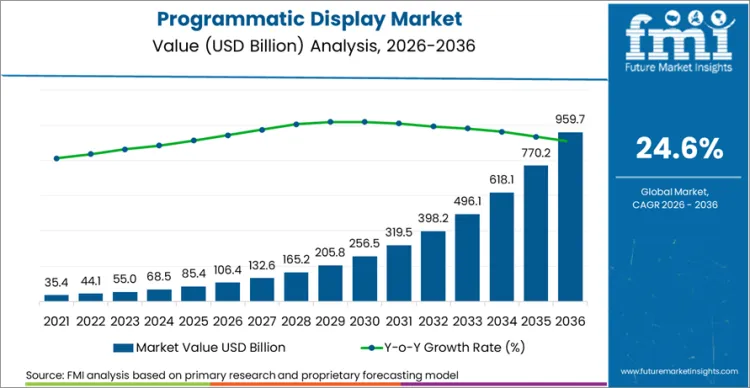
Summary of Programmatic Display Market
What Is Growth Outlook for Programmatic Display Market as per Future Market Insights Projection?
Future Market Insights projects the programmatic display industry to expand at a CAGR of 24.6% from 2026 to 2036, increasing from USD 106.4 Billion in 2026 to USD 959.7 Billion by 2036.
FMI Research Approach: FMI proprietary forecasting model based on digital ad spend migration rates, CTV adoption, and retail media network expansion.
How Do FMI Analysts Perceive Programmatic Display Market to Evolve?
FMI analysts perceive the market evolving toward identity-centric buying where first-party data clean rooms and retail media closed-loop attribution replace probabilistic cookie-based targeting as the primary transaction layer.
FMI Research Approach: IAB programmatic transaction share data and Google Chrome cookie deprecation timeline.
Which Country Holds Largest Share in Global Programmatic Display Market?
The United States holds the largest share of the global programmatic display market by value which is supported by the maturity of its demand-side platform ecosystem and the dominance of CTV inventory.
FMI Research Approach: FMI country-level revenue modeling by DSP transaction volumes and CPM benchmarks.
How Large Will Programmatic Display Market Be by 2036?
The global programmatic display market is projected to reach USD 959.7 Billion by 2036.
FMI Research Approach: FMI long-term revenue forecast derived from global digital advertising growth projections and programmatic penetration rates by channel.
What Is Definition of Programmatic Display Market?
The programmatic display market includes automated buying and selling of digital display advertising inventory through real-time bidding (RTB), private marketplaces (PMPs), and programmatic guaranteed deals across web, mobile, CTV, and DOOH channels.
FMI Research Approach: FMI market taxonomy and inclusion-exclusion framework.
What Are Globally Unique Trends Shaping Programmatic Display Market?
Globally unique trends include the rise of retail media networks capturing over 25% of new programmatic dollars, the transition from dynamic creative optimization (DCO) to generative creative optimization (GCO), and the rapid adoption of supply path optimization (SPO) as a cost control mechanism.
FMI Research Approach: IAB Retail Media Network revenue data and Trade Desk Audience Unlimited pricing framework.
Programmatic Display Market Key Takeaways
| Metric | Details |
|---|---|
| Industry Size (2026) | USD 106.4 Billion |
| Industry Value (2036) | USD 959.7 Billion |
| CAGR (2026 to 2036) | 24.6% |
Source: Future Market Insights (FMI) analysis, based on proprietary forecasting model and primary research
Trend Analysis and Purchasing Criteria across Different End-Use Segments
The industry is witnessing tremendous transformations with the use of AI, machine learning, and real-time bidding (RTB), thus significantly enhancing the effectiveness of advertising. Advertisers are interested in accurate targeting and affordable outreach, leveraging data-driven insights to maximize their ROI to the maximum.
Ad agencies are the major parties concerned with automation and AI strategic decision-making, which are the tools used for optimizing campaign performance along with the adherence to the newly arising privacy regulations. Publishers are hunting for more advertisement revenues through the utilization of premium inventory management and company safety controls, thus confirming that the advertisements go to right audiences.
Technology providers are the backbone of the ecosystem that creates two types of platforms (DSPs & SSPs) which are peg & adapter through programmatic inter-operation. The audience segmentation capabilities, fraud detection, cross-channel compatibility, and data privacy compliance are the major purchasing criteria. The increasing popularity of connected TV (CTV) and mobile advertising has also altered the structure of the industry thus necessitating the development of real-time optimization and Omni channel programmatic schemes for better engagement and monetization.
Contracts and Deals Analysis
| Company | Google LLC |
|---|---|
| Contract/Development Details | Google announced a partnership with a major retail chain to enhance its programmatic display advertising capabilities. This collaboration aims to leverage Google's advanced ad technologies to improve targeted advertising for the retailer's extensive customer base. |
| Date | March 2025 |
| Contract Value (USD Million) | Approximately USD 500 - USD 700 |
| Estimated Renewal Period | 3 - 5 years |
| Company | The Trade Desk, Inc. |
|---|---|
| Contract/Development Details | The Trade Desk secured a contract with a leading global automotive manufacturer to provide programmatic display advertising services. The agreement focuses on utilizing data-driven strategies to reach potential customers more effectively across digital platforms. |
| Date | July 2025 |
| Contract Value (USD Million) | Approximately USD 300 - USD 500 |
| Estimated Renewal Period | 2 - 4 years |
| Company | Adobe Inc. |
|---|---|
| Contract/Development Details | Adobe entered into an agreement with a prominent financial services company to deliver programmatic display solutions through its Advertising Cloud platform. This partnership aims to optimize the company's digital advertising efforts by employing sophisticated audience segmentation and real-time bidding strategies. |
| Date | November 2025 |
| Contract Value (USD Million) | Approximately USD 400 - USD 600 |
| Estimated Renewal Period | 3 - 5 years |
In 2025, the industry experienced significant growth, with major players securing substantial contracts across various industries. Google's collaboration with a major retail chain underscores the increasing demand for advanced ad technologies to enhance customer targeting. The Trade Desk's partnership with a global automotive manufacturer highlights the automotive sector's shift towards data-driven advertising strategies.
Adobe's agreement with a financial services company reflects the financial industry's commitment to optimizing digital advertising through sophisticated platforms. These developments indicate a robust expansion of the industry, as companies across diverse sectors adopt automated and data-centric approaches to reach their target audiences more effectively.
Shifts in the Market from 2021 to 2025 and Future Trends 2026 to 2036
From 2021 to 2025, the industry grew strongly as companies embraced AI-based automation, real-time bidding (RTB), and data-centric ad strategies. The emergence of privacy laws such as GDPR and CCPA forced advertisers to turn towards first-party data solutions and contextual targeting.
Omni channel programmatic advertising accelerated, blending display, mobile, connected TV (CTV), and digital out-of-home (DOOH) platforms for uninterrupted ad placements. But issues of ad fraud, brand safety issues, and lack of transparency drove more adoption of blockchain-based verification and AI-based fraud detection tools.
From 2026 to 2036, artificial intelligence will personalize various things. Quantum mechanics will redefine industry. Sentiments of users will be analysed to allow advertisers to show relevant advertisements. Blockchain will bring more transparency by allowing direct transactions between advertisers and publishers. Privacy-first solutions will ensure a balance between personalization and data protection. AR and VR ads will help immerse consumers, while diffusion will rely on energy-efficient and carbon-free ad campaigns.
Comparative Market Shift Analysis (2021 to 2025 vs. 2026 to 2036)
| 2021 to 2025 | 2026 to 2036 |
|---|---|
| Advertisers adapted to GDPR and CCPA regulations, focusing on first-party data and privacy-compliant targeting. | Blockchain-secured ad transactions, AI-driven compliance automation, and decentralized identity solutions will redefine privacy-compliant advertising. |
| AI and ML optimized ad targeting, real-time bidding, and Omni channel programmatic advertising. | Quantum-enhanced ad targeting, AI-driven generative advertising, and immersive AR/VR ad placements will revolutionize programmatic display. |
| Programmatic advertising enhanced brand awareness, audience engagement, and conversion rates. | AI-powered sentiment analysis, decentralized ad marketplaces, and privacy-first targeting solutions will expand industry applications. |
| Brands used AI-driven audience segmentation, contextual targeting, and cross-device ad personalization. | AI-created dynamic ad copy, interactive AR/VR ad experiences, and blockchain-based ad tracking will increase viewer engagement. |
| AI-powered audience data enhanced ad targeting and conversion monitoring. | Quantum computing-based ad bidding, AI-informed ad placement strategies, and real-time sentiment analysis of user opinions will streamline advertising effectiveness. |
| Industry challenges faced were ad fraud, brand risk safety, and transparency issues with programmatic buying. | Decentralized ad exchanges, blockchain-protected ad supply chains, and AI-based fraud detection will mitigate advertising risks. |
Risk Assessment of the Global Programmatic Display Market
The industry is a multi-thronged risk space which houses risks like data privacy policies, digital advertising fraud, supply chain complexity, and disruptive technologies. The most significant threat that looms over the industry is compliance to the global data privacy laws such as GDPR in Europe, CCPA in California, and the other emerging laws.
The demand-side platforms (DSPs), supply-side platforms (SSPs), ad exchanges, and data management platforms (DMPs) of programmatic advertising comprise a complex supply chain which increases the visibility challenge. The imposition of transparency around the structure of costs, auction mechanics, and data handling can make the inefficiencies visible and can lead to the inefficient spending of ads without having the expected return.
Another issue is the technological obsolescence. The rapid development of artificial intelligence (AI), machine learning, and cookies less tracking methods require advertisers and platforms to work on innovative projects to remain competitive. In case of failure to make necessary changes fast, these traditional methods will become obsolete in the fast-moving programmatic identifying area.
Brand safety is the concern when ads are displayed on unsuitable or low-quality sites. To protect their reputation and credibility, advertisers must adhere to rigorous content filtering, context targeting, and brand protection policies.
Segment-wise Analysis
By Ad Form
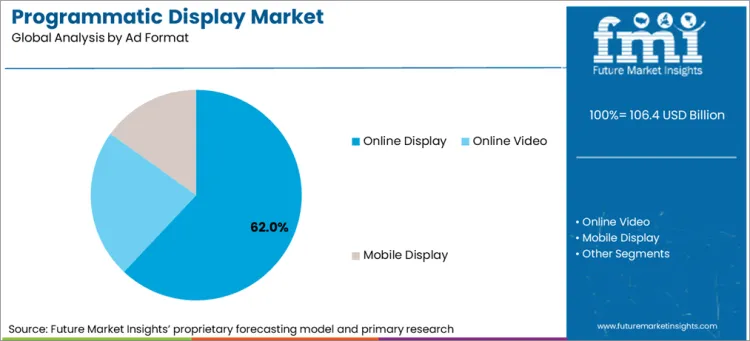
Smartphones are now ubiquitous, and online video as a marketing platform on sites like YouTube, TikTok, and Instagram has become one of the most popular forms of reaching digital marketing firms. Advertise such as Google (YouTube Ads), Meta (Facebook and Instagram Video Ads), and Amazon Advertising are well ahead in the transition by utilizing AI-based advertisement placements by which the targeting precision will be better as well as will help in increasing the return on the investment.
Likewise, the mobile video ad format is set to dominate the industry, contributing 55% of total revenue in 2026. In particular, brands such as Coca-Cola, Nike, or Samsung are betting big on programmatic in-app video ads, leveraging the success of platforms like Netflix (and Disney+ with ads) and mobile gaming platforms (like Unity Ads and AdMob).
The industry is expected to witness sustainable growth in the upcoming years, owing to the increasing adoption of automation, guaranteed ad systems, and the rise in consumption of mobile/online video content over digital platforms.
By Sales channel
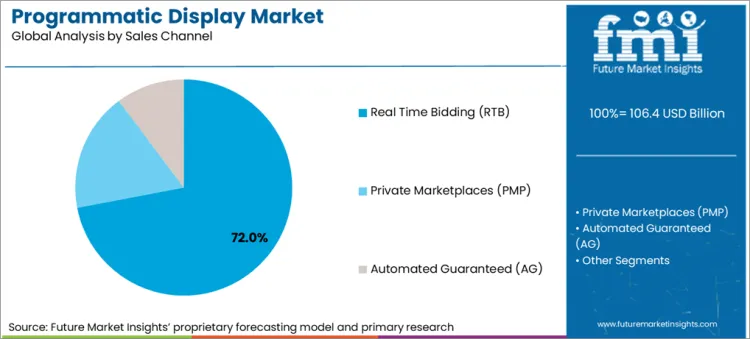
By 2026, automated guaranteed distribution will represent a large share of industry sales. This simplifies direct dealings between advertisers and publishers, reducing the need for manual processes like troubleshooting discrepancies and managing multiple invoices.
With companies such as Google (DV360), The Trade Desk, and Adobe Advertising Cloud pioneering the move toward automated guaranteed deals, advertisers now benefit from greater efficiency and improved negotiating power. This growing automation, in turn, is likely to impact the adoption and provide a significant push to the industry share.
A private marketplace (PMP) is an invitation-only marketplace where suppliers of ad inventory (usually premium publishers) offer inventory to a select group of advertisers. Publishers benefit from greater control over their inventory with platforms like Xandr (Microsoft), Magnite, and PubMatic, which allow them more freedom and flexibility to package and sell ad space as they please.
Brands, including Nike, Coca-Cola, and Procter & Gamble, work with advertisers who use PMPs to secure premium inventory and improve brand safety and ad performance. However, the transparency offered, in addition to reduced ad fraud risk, makes PMPs increasingly preferred across advertisers, propelling their implementation and further data studies claim PMPs to contribute significantly towards overall industry growth.
Country Wise Analysis
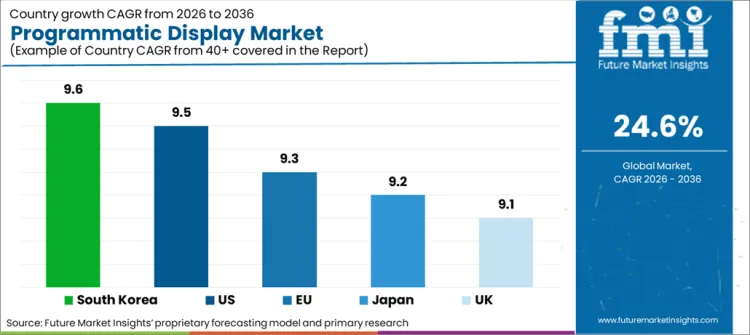
| Countries | CAGR (2026 to 2036) |
|---|---|
| USA | 9.5% |
| UK | 9.1% |
| European Union | 9.3% |
| Japan | 9.2% |
| South Korea | 9.6% |
USA
The USA industry expands considerably by adopting AI-based automation, real-time auctions, and targeting through data by marketers. Organizations design intelligent programmatic platforms to optimize advertisement placement, deliver high audience engagement, and better return on investment.
Increased demand for customized ad experience, Omni channel-based advertisement practices, and dynamic creative optimization propel industry expansion. The USA digital advertising, e-commerce, and media industries leverage programmatic display solutions to enhance campaign delivery and maximum reach. In addition, regulatory requirements encourage businesses to adopt secure and transparent ad-buying solutions. FMI forecasts the USA industry to grow at 9.5% CAGR during the forecast period.
| Key Drivers in the USA | Details |
|---|---|
| Artificial intelligence-based automation | Enhances ad targeting and efficiency on digital media. |
| Real-time bidding | Enhances ad placements and return on investment. |
| Personalized ad experiences | Engage customers with compelling and relevant content. |
| Regulatory laws | Encourages security and openness in advertising transactions. |
UK
The UK industry expands as companies utilize ad placement driven by artificial intelligence to maximize the targeting of audiences and campaign results. Organizations leverage programmatic advertisement solutions for enhanced budget optimization, advertisement pertinence, and conversion.
Growth in digital advertising, immediate data, and programmatic purchases of advertisements accelerate the industry's expansion. The British government has rigorous data privacy laws, and companies spend on secure and transparent programmatic solutions. The video and mobile ad trend also accelerates industry adoption.
| Key Drivers in the UK | Information |
|---|---|
| AI-powered ad placements | It makes campaigns more effective and targeting more accurate. |
| Automated budget optimization | It makes ad spending more effective and conversion rates higher. |
| Data privacy regulation | Drives investment in secure programmatic solutions. |
| Mobile and video ad growth | Improves opportunities for engagement and visibility. |
European Union
The European Union industry expands as business organizations embrace AI-based audience segmenting, real-time auctioning, and data-driven advertising campaigning. Germany, France, and Italy lead the industry by implementing programmatic display advertisements in online marketing campaigns.
The European Union is well-supported by data privacy legislation, and the companies are investing in programmatic solutions that are GDPR compliant. The development of machine learning and predictive analytics also accelerates the increase in programmatic advertising on a cross-industry basis. According to FMI, the European Union's industry is also expected to grow at a 9.3% CAGR during the study period.
| Growth Drivers in the European Union | Information |
|---|---|
| AI-driven audience segmentation | Boosts accuracy of target audience and enhanced campaign performance. |
| GDPR-compliant solutions | Protects data and regulatory compliance. |
| Predictive analytics | Enhances ad personalization and consumer interaction. |
| Real-time bidding | Optimizes ad placement for impact. |
Japan
The Japanese industry expands as business houses adopt AI-powered ad optimization, automated purchases, and cross-channel advertising. Business houses design innovative programmatic ad solutions to expand audience reach, brand remembrance, and engagement rate.
Japan's emphasis on high-precision consumer behavior analysis and high-precision marketing drives programmatic display adoption. Retail, finance, and entertainment sectors spend on AI-based ad campaigns to lead the industry.
| Growth Drivers in Japan | Information |
|---|---|
| AI-based ad optimization | Increases engagement and reach via data insights. |
| Consumer behavior analysis | Directs targeted advertising strategies. |
| Cross-channel ads | Turns brand presence across channels. |
| Industry investments | Retail, finance, and entertainment sectors lead adoption. |
South Korea
The South Korean industry grows incrementally with the rising use of AI-based ad targeting, programmatic video ads, and automated media buying as business-as-usual. Governmental digital transformation projects encourage companies to adopt programmatic advertising.
Advertisers adopt real-time advertising, data analytics, and machine learning processes to improve advertisement performance. Additionally, innovation in connected TV advertising and custom-programmatic practices improves opportunity within the industry. South Korea's industry will expand at a 9.6% CAGR during the study period by FMI.
| Growth Drivers in South Korea | Information |
|---|---|
| Targeting advertisements via AI | Enhances accuracy in segmenting audiences. |
| Programmatic video advertising | Increases engagement and conversion rates. |
| Government digital programs | Facilitates business adoption of programmatic offerings. |
| Connected TV advertising | Expands industry coverage and revenue opportunity. |
Competition Outlook
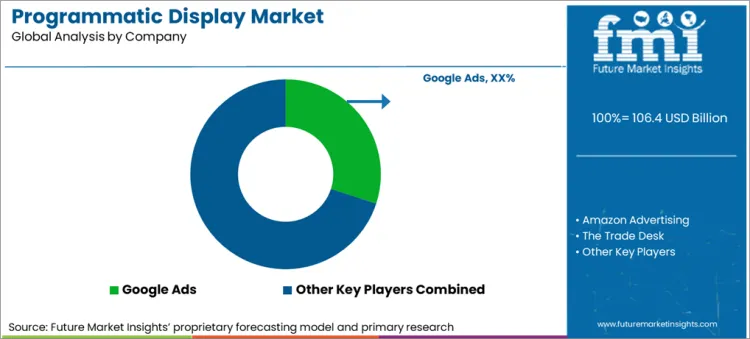
The industry is now growing quickly, with advertisers turning more to automated ad buying to enhance targeting accuracy, increase efficiency, and improve ROI. Some key drivers to this demand include AI bidding technologies, real-time analytics, and data-driven advertisement personalization, which are seeking more intelligent and adaptive advertising solutions.
Industry share leaders like Google, The Trade Desk, Amazon Advertising, Magnite, and Adobe Advertising Cloud command the majority share of the industry thanks to their highly sophisticated demand-side platforms (DSPs) and supply-side platforms (SSPs). These companies are focused on advancing AI-driven ad placements along with predictive analytics and Omni channel programmatic solutions that enable optimal ad performance across web, mobile, video, and connected TV (CTV) environments.
Start-ups and niche solution providers disrupt the players by creating privacy-oriented targeting solutions, contextual advertising models, and blockchain-based transparency tools against the backdrop of recent data privacy regulations like GDPR and CCPA. Mergers and acquisitions across the space combined with integrations with customer data platforms (CDPs) and data management platforms (DMPs) are increasing the competitive pressure.
As cookie-based tracking begins to fade out and privacy-first approaches to advertising begin to take hold, the competitor landscape will favour companies using first-party data strategies, AI-driven contextual targeting, and a bridged cross-channel programmatic execution.
Recent Developments
- In January 2026, the transition from Dynamic Creative Optimization (DCO) to Generative Creative Optimization (GCO) became standard practice as advertisers began using Generative AI to produce thousands of hyper-personalized ad variations in real time.
- In September 2025, The Trade Desk launched 'Audience Unlimited,' a major upgrade to its data market place that offers tiered bulk pricing at 3.3% and 4.4% for third-party data, resetting the economics of audience activation.
- In the first quarter of 2025, Publicis Groupe acquired Lotame, adding 1.6 billion identity profiles to its Epsilon data platform to strengthen its position in cookie-less audience resolution.
Market Share Analysis by Company
| Company Name | Estimated Market Share (%) |
|---|---|
| Google Ads | 25-30% |
| Amazon Advertising | 15-20% |
| The Trade Desk | 12-17% |
| Adobe Advertising Cloud | 8-12% |
| Magnite | 5-9% |
| Other Companies (combined) | 20-30% |
Key Company Offerings and Activities
| Company Name | Key Offerings/Activities |
|---|---|
| Google Ads | Provides AI-powered programmatic ad bidding, real-time analytics, and audience segmentation tools. |
| Amazon Advertising | Develops programmatic advertising solutions for e-commerce brands, leveraging first-party shopping data. |
| The Trade Desk | Specializes in demand-side platform technology, cross-channel programmatic buying, and real-time bidding. |
| Adobe Advertising Cloud | Focuses on AI-driven ad targeting, omnichannel advertising solutions, and automated campaign management. |
| Magnite | Offers supply-side platform solutions, connected TV advertising and publisher monetization tools. |
Key Company Insights
Google Ads (25-30%)
With its AI-powered bidding, automated audience segmentation, and real-time campaign analytics, dominates the industry space.
Amazon Advertising (15-20%)
Industry leaders in e-commerce advertising with a twist on industry solutions have created a wealth of consumer shopping data harnessed for targeted placements.
The Trade Desk (12-17%)
The Trade Desk is a leading technological provider of a demand-side platform, real-time ad bidding, and omnichannel programmatic advertising.
Adobe Advertising Cloud (8-12%)
Adobe Advertising Cloud optimizes digital campaigns, using AI to target consumers and data to place ads.
Magnite (5-9%)
Magnite gives programmatic monetization, supply-side platform technologies, and advanced advertising for connected TV and digital publishers.
Other Key Players (20-30% Combined)
- PubMatic
- Criteo
- MediaMath
- Xandr (Microsoft)
- Verizon Media
Key Market Players
- Google Ads
- Amazon Advertising
- The Trade Desk
- Adobe Advertising Cloud
- Magnite
- PubMatic
- Criteo
- MediaMath
- Xandr (Microsoft)
- Verizon Media
Market Definition
The programmatic display market represents revenue generated from the automated purchase and delivery of digital display advertising impressions across web, mobile app, connected television, and digital out-of-home environments. The market measures the value of impressions transacted through demand-side platforms (DSPs), supply-side platforms (SSPs), and ad exchanges using real-time bidding, private marketplace deals, and programmatic guaranteed arrangements.
Inclusions cover banner ads, native display units, video display (pre-roll, mid-roll, outstream), CTV display inventory, DOOH programmatic placements, and in-app display formats. It includes technology fees for DSPs, SSPs, ad verification, brand safety, and data management platforms used in the programmatic transaction chain.
Exclusions include search advertising (SEM/PPC), social media advertising purchased through walled-garden platforms (Meta, TikTok), influencer marketing fees, and direct insertion order display buys that bypass programmatic infrastructure. Affiliate marketing commissions are outside the scope.
Scope of Report
| Items | Values |
|---|---|
| Quantitative Units (2026) | USD 106.4 Billion |
| Transaction Type | Real-Time Bidding (RTB), Private Marketplace (PMP), Programmatic Guaranteed, Preferred Deals |
| Channel | Web Display, Mobile App, Connected TV (CTV), Digital Out-of-Home (DOOH) |
| Regions Covered | North America, Europe, Asia Pacific, Latin America, Middle East and Africa |
| Key Companies Profiled | The Trade Desk, Google DV360, Publicis Groupe (Epsilon), Magnite, DoubleVerify, Xandr (Microsoft) |
Segmentation
By Ad Format:
By ad format, the industry covers online display, online video, mobile display, and mobile video.
By Sales Channel:
By sales channel, the industry includes real time bidding (RTB), private market places (PMP), and automated guaranteed (AG).
By Region:
Region wise, the industry is segmented into North America, Latin America, Europe, Asia Pacific, and the Middle East & Africa (MEA).
Bibliography
- The Trade Desk Inc. (2025, September). Audience Unlimited data marketplace announcement. The Trade Desk Press Room.
- Publicis Groupe. (2025, Q1). Acquisition of Lotame announcement. Publicis Groupe Investor Relations.
- Interactive Advertising Bureau. (2025). Digital Advertising Revenue Report. IAB/PwC.
- The Trade Desk Inc. (2025, October). Koddi/Gopuff onsite retail media integration announcement. The Trade Desk Press Room.
Frequently Asked Questions
What is the current global market size for Programmatic Display?
The global market is valued at USD 106.4 Billion in 2026, driven by the wholesale migration of advertising budgets into automated digital channels.
What is the projected Compound Annual Growth Rate (CAGR) for the market over the next 10 years?
The market is projected to grow at a CAGR of 24.6% from 2026 to 2036.
Which regions are experiencing the fastest expansion?
Asia Pacific leads growth due to rapid mobile-first ad adoption, while North America maintains the largest absolute spend.
What are the primary market drivers?
CTV inventory expansion and retail media network growth are fueling adoption alongside identity resolution technology investment.
Who are the leading suppliers in the industry?
The Trade Desk, Google DV360, Publicis Groupe (Epsilon), and Magnite are key players, differentiating through data infrastructure scale and supply path optimization.
Preview the report firsthand - request a free sample
Get SampleGet the brochure for pricing and purchase details.
Get PDFTable of Content
- Executive Summary
- Global Market Outlook
- Demand-side Trends
- Supply-side Trends
- Technology Roadmap Analysis
- Analysis and Recommendations
- Market Overview
- Market Coverage / Taxonomy
- Market Definition / Scope / Limitations
- Research Methodology
- Chapter Orientation
- Analytical Lens and Working Hypotheses
- Market Structure, Signals, and Trend Drivers
- Benchmarking and Cross-market Comparability
- Market Sizing, Forecasting, and Opportunity Mapping
- Research Design and Evidence Framework
- Desk Research Programme (Secondary Evidence)
- Company Annual and Sustainability Reports
- Peer-reviewed Journals and Academic Literature
- Corporate Websites, Product Literature, and Technical Notes
- Earnings Decks and Investor Briefings
- Statutory Filings and Regulatory Disclosures
- Technical White Papers and Standards Notes
- Trade Journals, Industry Magazines, and Analyst Briefs
- Conference Proceedings, Webinars, and Seminar Materials
- Government Statistics Portals and Public Data Releases
- Press Releases and Reputable Media Coverage
- Specialist Newsletters and Curated Briefings
- Sector Databases and Reference Repositories
- FMI Internal Proprietary Databases and Historical Market Datasets
- Subscription Datasets and Paid Sources
- Social Channels, Communities, and Digital Listening Inputs
- Additional Desk Sources
- Expert Input and Fieldwork (Primary Evidence)
- Primary Modes
- Qualitative Interviews and Expert Elicitation
- Quantitative Surveys and Structured Data Capture
- Blended Approach
- Why Primary Evidence is Used
- Field Techniques
- Interviews
- Surveys
- Focus Groups
- Observational and In-context Research
- Social and Community Interactions
- Stakeholder Universe Engaged
- C-suite Leaders
- Board Members
- Presidents and Vice Presidents
- R&D and Innovation Heads
- Technical Specialists
- Domain Subject-matter Experts
- Scientists
- Physicians and Other Healthcare Professionals
- Governance, Ethics, and Data Stewardship
- Research Ethics
- Data Integrity and Handling
- Primary Modes
- Tooling, Models, and Reference Databases
- Desk Research Programme (Secondary Evidence)
- Data Engineering and Model Build
- Data Acquisition and Ingestion
- Cleaning, Normalisation, and Verification
- Synthesis, Triangulation, and Analysis
- Quality Assurance and Audit Trail
- Market Background
- Market Dynamics
- Drivers
- Restraints
- Opportunity
- Trends
- Scenario Forecast
- Demand in Optimistic Scenario
- Demand in Likely Scenario
- Demand in Conservative Scenario
- Opportunity Map Analysis
- Product Life Cycle Analysis
- Supply Chain Analysis
- Investment Feasibility Matrix
- Value Chain Analysis
- PESTLE and Porter’s Analysis
- Regulatory Landscape
- Regional Parent Market Outlook
- Production and Consumption Statistics
- Import and Export Statistics
- Market Dynamics
- Global Market Analysis 2021 to 2025 and Forecast, 2026 to 2036
- Historical Market Size Value (USD Million) Analysis, 2021 to 2025
- Current and Future Market Size Value (USD Million) Projections, 2026 to 2036
- Y-o-Y Growth Trend Analysis
- Absolute $ Opportunity Analysis
- Global Market Pricing Analysis 2021 to 2025 and Forecast 2026 to 2036
- Global Market Analysis 2021 to 2025 and Forecast 2026 to 2036, By Ad Format
- Introduction / Key Findings
- Historical Market Size Value (USD Million) Analysis By Ad Format , 2021 to 2025
- Current and Future Market Size Value (USD Million) Analysis and Forecast By Ad Format , 2026 to 2036
- Online Display
- Online Video
- Mobile Display
- Online Display
- Y-o-Y Growth Trend Analysis By Ad Format , 2021 to 2025
- Absolute $ Opportunity Analysis By Ad Format , 2026 to 2036
- Global Market Analysis 2021 to 2025 and Forecast 2026 to 2036, By Sales Channel
- Introduction / Key Findings
- Historical Market Size Value (USD Million) Analysis By Sales Channel, 2021 to 2025
- Current and Future Market Size Value (USD Million) Analysis and Forecast By Sales Channel, 2026 to 2036
- Real Time Bidding (RTB)
- Private Marketplaces (PMP)
- Automated Guaranteed (AG)
- Real Time Bidding (RTB)
- Y-o-Y Growth Trend Analysis By Sales Channel, 2021 to 2025
- Absolute $ Opportunity Analysis By Sales Channel, 2026 to 2036
- Global Market Analysis 2021 to 2025 and Forecast 2026 to 2036, By Region
- Introduction
- Historical Market Size Value (USD Million) Analysis By Region, 2021 to 2025
- Current Market Size Value (USD Million) Analysis and Forecast By Region, 2026 to 2036
- North America
- Latin America
- Western Europe
- Eastern Europe
- East Asia
- South Asia and Pacific
- Middle East & Africa
- Market Attractiveness Analysis By Region
- North America Market Analysis 2021 to 2025 and Forecast 2026 to 2036, By Country
- Historical Market Size Value (USD Million) Trend Analysis By Market Taxonomy, 2021 to 2025
- Market Size Value (USD Million) Forecast By Market Taxonomy, 2026 to 2036
- By Country
- USA
- Canada
- Mexico
- By Ad Format
- By Sales Channel
- By Country
- Market Attractiveness Analysis
- By Country
- By Ad Format
- By Sales Channel
- Key Takeaways
- Latin America Market Analysis 2021 to 2025 and Forecast 2026 to 2036, By Country
- Historical Market Size Value (USD Million) Trend Analysis By Market Taxonomy, 2021 to 2025
- Market Size Value (USD Million) Forecast By Market Taxonomy, 2026 to 2036
- By Country
- Brazil
- Chile
- Rest of Latin America
- By Ad Format
- By Sales Channel
- By Country
- Market Attractiveness Analysis
- By Country
- By Ad Format
- By Sales Channel
- Key Takeaways
- Western Europe Market Analysis 2021 to 2025 and Forecast 2026 to 2036, By Country
- Historical Market Size Value (USD Million) Trend Analysis By Market Taxonomy, 2021 to 2025
- Market Size Value (USD Million) Forecast By Market Taxonomy, 2026 to 2036
- By Country
- Germany
- UK
- Italy
- Spain
- France
- Nordic
- BENELUX
- Rest of Western Europe
- By Ad Format
- By Sales Channel
- By Country
- Market Attractiveness Analysis
- By Country
- By Ad Format
- By Sales Channel
- Key Takeaways
- Eastern Europe Market Analysis 2021 to 2025 and Forecast 2026 to 2036, By Country
- Historical Market Size Value (USD Million) Trend Analysis By Market Taxonomy, 2021 to 2025
- Market Size Value (USD Million) Forecast By Market Taxonomy, 2026 to 2036
- By Country
- Russia
- Poland
- Hungary
- Balkan & Baltic
- Rest of Eastern Europe
- By Ad Format
- By Sales Channel
- By Country
- Market Attractiveness Analysis
- By Country
- By Ad Format
- By Sales Channel
- Key Takeaways
- East Asia Market Analysis 2021 to 2025 and Forecast 2026 to 2036, By Country
- Historical Market Size Value (USD Million) Trend Analysis By Market Taxonomy, 2021 to 2025
- Market Size Value (USD Million) Forecast By Market Taxonomy, 2026 to 2036
- By Country
- China
- Japan
- South Korea
- By Ad Format
- By Sales Channel
- By Country
- Market Attractiveness Analysis
- By Country
- By Ad Format
- By Sales Channel
- Key Takeaways
- South Asia and Pacific Market Analysis 2021 to 2025 and Forecast 2026 to 2036, By Country
- Historical Market Size Value (USD Million) Trend Analysis By Market Taxonomy, 2021 to 2025
- Market Size Value (USD Million) Forecast By Market Taxonomy, 2026 to 2036
- By Country
- India
- ASEAN
- Australia & New Zealand
- Rest of South Asia and Pacific
- By Ad Format
- By Sales Channel
- By Country
- Market Attractiveness Analysis
- By Country
- By Ad Format
- By Sales Channel
- Key Takeaways
- Middle East & Africa Market Analysis 2021 to 2025 and Forecast 2026 to 2036, By Country
- Historical Market Size Value (USD Million) Trend Analysis By Market Taxonomy, 2021 to 2025
- Market Size Value (USD Million) Forecast By Market Taxonomy, 2026 to 2036
- By Country
- Kingdom of Saudi Arabia
- Other GCC Countries
- Turkiye
- South Africa
- Other African Union
- Rest of Middle East & Africa
- By Ad Format
- By Sales Channel
- By Country
- Market Attractiveness Analysis
- By Country
- By Ad Format
- By Sales Channel
- Key Takeaways
- Key Countries Market Analysis
- USA
- Pricing Analysis
- Market Share Analysis, 2025
- By Ad Format
- By Sales Channel
- Canada
- Pricing Analysis
- Market Share Analysis, 2025
- By Ad Format
- By Sales Channel
- Mexico
- Pricing Analysis
- Market Share Analysis, 2025
- By Ad Format
- By Sales Channel
- Brazil
- Pricing Analysis
- Market Share Analysis, 2025
- By Ad Format
- By Sales Channel
- Chile
- Pricing Analysis
- Market Share Analysis, 2025
- By Ad Format
- By Sales Channel
- Germany
- Pricing Analysis
- Market Share Analysis, 2025
- By Ad Format
- By Sales Channel
- UK
- Pricing Analysis
- Market Share Analysis, 2025
- By Ad Format
- By Sales Channel
- Italy
- Pricing Analysis
- Market Share Analysis, 2025
- By Ad Format
- By Sales Channel
- Spain
- Pricing Analysis
- Market Share Analysis, 2025
- By Ad Format
- By Sales Channel
- France
- Pricing Analysis
- Market Share Analysis, 2025
- By Ad Format
- By Sales Channel
- India
- Pricing Analysis
- Market Share Analysis, 2025
- By Ad Format
- By Sales Channel
- ASEAN
- Pricing Analysis
- Market Share Analysis, 2025
- By Ad Format
- By Sales Channel
- Australia & New Zealand
- Pricing Analysis
- Market Share Analysis, 2025
- By Ad Format
- By Sales Channel
- China
- Pricing Analysis
- Market Share Analysis, 2025
- By Ad Format
- By Sales Channel
- Japan
- Pricing Analysis
- Market Share Analysis, 2025
- By Ad Format
- By Sales Channel
- South Korea
- Pricing Analysis
- Market Share Analysis, 2025
- By Ad Format
- By Sales Channel
- Russia
- Pricing Analysis
- Market Share Analysis, 2025
- By Ad Format
- By Sales Channel
- Poland
- Pricing Analysis
- Market Share Analysis, 2025
- By Ad Format
- By Sales Channel
- Hungary
- Pricing Analysis
- Market Share Analysis, 2025
- By Ad Format
- By Sales Channel
- Kingdom of Saudi Arabia
- Pricing Analysis
- Market Share Analysis, 2025
- By Ad Format
- By Sales Channel
- Turkiye
- Pricing Analysis
- Market Share Analysis, 2025
- By Ad Format
- By Sales Channel
- South Africa
- Pricing Analysis
- Market Share Analysis, 2025
- By Ad Format
- By Sales Channel
- USA
- Market Structure Analysis
- Competition Dashboard
- Competition Benchmarking
- Market Share Analysis of Top Players
- By Regional
- By Ad Format
- By Sales Channel
- Competition Analysis
- Competition Deep Dive
- Google Ads
- Overview
- Product Portfolio
- Profitability by Market Segments (Product/Age /Sales Channel/Region)
- Sales Footprint
- Strategy Overview
- Marketing Strategy
- Product Strategy
- Channel Strategy
- Amazon Advertising
- The Trade Desk
- Adobe Advertising Cloud
- Magnite
- Google Ads
- Competition Deep Dive
- Assumptions & Acronyms Used


