

- Industry Size (2026)
- USD 218 Mn
- Forecast (2036)
- USD 1316.4 Mn
- CAGR (2026 to 2036)
- 19.7%
RNA-Directed Foliar Pest Silence Spray Market Forecast and Outlook 2026 to 2036
The RNA-directed foliar pest silence spray market is forecasted to grow from USD 218 million in 2026 to USD 1,316.4 million by 2036, with an impressive CAGR of 19.7%. This market is expanding as growers increasingly adopt RNA interference (RNAi) technology to target and control pests at the genetic level. RNA-based sprays selectively silence essential genes in pests, providing a precise and sustainable alternative to conventional chemical pesticides. By targeting specific pest species, these sprays reduce crop damage and environmental impact, making them a preferred choice for integrated pest management systems. The demand for eco-friendly and low-residue pest control solutions, driven by regulatory pressure and consumer preferences for cleaner agricultural products, is fueling the market’s growth.
Quick Stats for RNA-Directed Foliar Pest Silence Spray Market
- RNA-Directed Foliar Pest Silence Spray Market Value (2026): USD 218 million
- RNA-Directed Foliar Pest Silence Spray Market Forecast Value (2036): USD 1,316.4 million
- RNA-Directed Foliar Pest Silence Spray Market CAGR (2026 to 2036): 19.7%
- Leading Target Pest Category: Chewing Insects (Lepidoptera, Coleoptera) (37%)
- Top RNA Technology Type: dsRNA-based Sprays (44%)
- Key Growth Regions for RNA Spray Market: USA, China, Brazil, India, Australia
- Key Players in RNA Spray Market: Bayer CropScience, Syngenta Group, BASF SE, Corteva Agriscience, GreenLight Biosciences
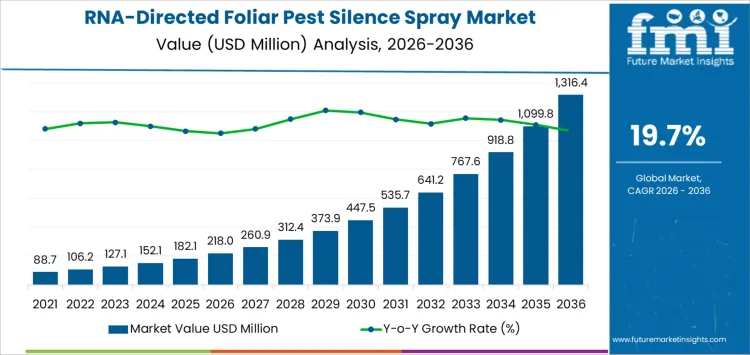
The market is characterized by the dominance of dsRNA-based sprays, which hold a 44% market share due to their proven effectiveness in silencing pest genes responsible for feeding and reproduction. Chewing insects, particularly Lepidoptera and Coleoptera, make up 37% of the market, as these pests are significant threats to crop yields, especially in cereals and cash crops. Technological advancements in formulation and delivery systems are further driving growth, improving the stability and uptake of RNA sprays. Despite challenges such as high development costs, regulatory hurdles, and the need for grower education, the RNA-directed foliar pest silence spray market is poised for strong growth, supported by rising interest in sustainable agriculture and biological pest control solutions.
RNA‑Directed Foliar Pest Silence Spray Market Key Takeaways
| Metric | Value |
|---|---|
| Industry Value (2026) | USD 218 million |
| Forecast Value (2036) | USD 1,316.4 million |
| Forecast CAGR (2026 to 2036) | 19.7% |
How is the Global RNA‑Directed Foliar Pest Silence Spray Sector Advancing?
The global RNA‑directed foliar pest silence spray market is expanding rapidly as agriculture embraces precision biological tools that target pests at the genetic level. These sprays use RNA interference (RNAi) mechanisms to disrupt vital gene expression in specific pests, providing highly targeted pest control without broad‑spectrum chemicals. Traditional pesticides often affect non‑target organisms and contribute to resistance issues in pest populations. RNA‑directed foliar sprays offer a sustainable alternative by precisely silencing key genes in pests, reducing crop damage while minimizing environmental and non‑target impacts.
Demand for these advanced pest control solutions is rising across major crop types including cereals, fruits, vegetables, and high‑value cash crops driven by growers seeking effective, low‑residue, and environmentally responsible options. Regulatory pressure to reduce chemical pesticide use, combined with growing consumer preference for cleaner agricultural products, is accelerating adoption of RNAi‑based sprays. Recent advancements in formulation and delivery technologies are improving stability, uptake, and field performance, enabling these products to function effectively as part of integrated pest management programs.
The RNA‑directed foliar pest silence spray market is poised for strong growth as research continues to expand the range of target pests and improve application efficiency. Challenges such as formulation costs, the need for crop‑ and region‑specific optimization, and grower education on biological pest‑control mechanisms may influence uptake. Despite these barriers, the strong focus on sustainable agriculture, reduced chemical inputs, and precision pest management will drive demand for RNA‑directed pest silence sprays in global crop protection strategies.
What Is the Segment-Wise Analysis for the Global RNA-Directed Foliar Pest Silence Spray Market?
The global RNA-directed foliar pest silence spray market is segmented by target pest category and RNA technology type. Chewing insects (Lepidoptera, Coleoptera) lead the market with a 37% share due to their widespread impact on crops and their susceptibility to RNA-based pest control solutions. In terms of RNA technology types, dsRNA-based sprays dominate the market with a 44% share, owing to their proven effectiveness in silencing specific pest genes.
How Do Chewing Insects (Lepidoptera, Coleoptera) Lead the Global RNA-Directed Foliar Pest Silence Spray Market?
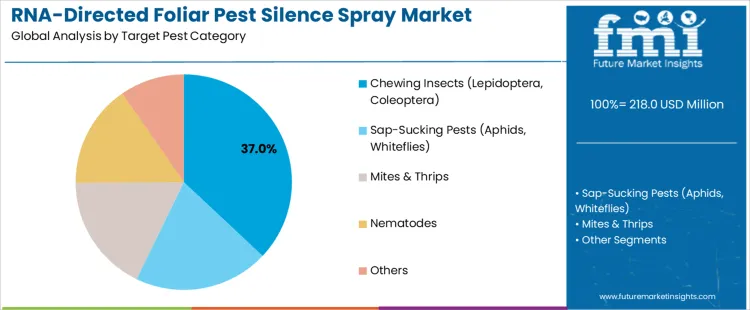
Chewing insects (Lepidoptera, Coleoptera) hold a 37% share in the global RNA-directed foliar pest silence spray market due to their significant impact on crop yields, especially in crops like corn, soybeans, and cotton. These pests, including caterpillars and beetles, damage plant tissues by feeding on them, leading to reduced crop productivity. RNA-based solutions, particularly dsRNA-based sprays, have proven to be highly effective in silencing the genes responsible for their feeding behavior. This targeted approach reduces pest populations and prevents further crop damage. As the agricultural industry increasingly seeks sustainable and environmentally friendly pest control methods, RNA-directed sprays, which offer eco-friendly and specific control, are becoming the preferred choice, driving their dominance in the market for managing chewing insects.
Why Do dsRNA-Based Sprays Hold the Largest Market Share in the Global RNA-Directed Foliar Pest Silence Spray Market?
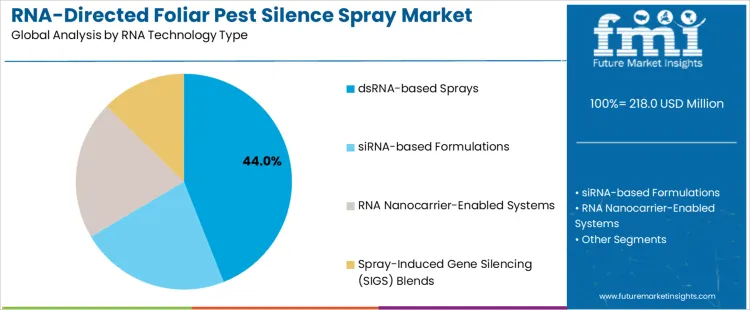
dsRNA-based sprays hold the largest share of 44% in the global RNA-directed foliar pest silence spray market due to their ability to selectively target and silence specific genes in pests, preventing them from feeding and reproducing. Double-stranded RNA (dsRNA) technology offers a precise, eco-friendly pest control solution by targeting specific pests without harming beneficial organisms. This precision reduces the reliance on broad-spectrum chemical pesticides, making dsRNA-based sprays a preferred method for sustainable pest management. Their effectiveness in controlling pests like chewing insects, which are highly damaging to crops, further strengthens their dominant position in the market. As demand for more sustainable and targeted pest management solutions grows, dsRNA technology continues to lead the market in RNA-based pest control.
What Is Shaping the RNA Directed Foliar Pest Silence Spray Market?
The RNA directed foliar pest silence spray market is shaped by advances in biotechnology and precision crop protection. RNA based sprays use double stranded RNA (dsRNA) molecules to trigger RNA interference (RNAi) in target pests, silencing essential genes and reducing pest populations without broad spectrum chemical toxicity. As growers seek alternatives to conventional pesticides due to resistance issues, regulatory restrictions, and sustainability goals, RNA foliar sprays are gaining traction. Improvements in formulation, stability, and delivery technologies that protect RNA molecules on leaf surfaces are accelerating adoption and shaping market growth.
What Challenges Are Limiting Adoption of RNA Directed Foliar Pest Silence Sprays?
Adoption is constrained by high development and production costs, formulation challenges, and regulatory complexity. RNA molecules are inherently unstable in field conditions, requiring advanced encapsulation and adjuvant systems to protect them from degradation by UV, heat, and rain. Regulatory frameworks for RNA biopesticides vary by country, creating uncertainty and delaying approvals. Grower familiarity and confidence can be limited due to the novelty of the technology, with some producers hesitant to replace established pesticides without clear cost benefit data. Large scale field validation and extension support are still developing.
What Key Trends Are Shaping the RNA Directed Foliar Pest Silence Spray Market?
Key trends include the rise of nano formulation and delivery systems that enhance RNA uptake into plant tissues and pest targets, improving efficacy and durability. There is growing integration of digital agriculture tools, such as pest mapping and precision application technologies, which help optimize spray timing and reduce overall usage. Collaborative innovation between biotech firms and major agricultural companies is accelerating product commercialization and distribution. Demand for solutions that support integrated pest management (IPM) and organic farming is increasing. Public private research initiatives are also driving standards, regulatory clarity, and farmer education to expand market adoption.
What is the Growth Outlook for the RNA-Directed Foliar Pest Silence Spray Market by Country?
| Country | CAGR (%) |
|---|---|
| USA | 21.4% |
| China | 20.1% |
| Brazil | 18.6% |
| India | 17.9% |
| Australia | 16.8% |
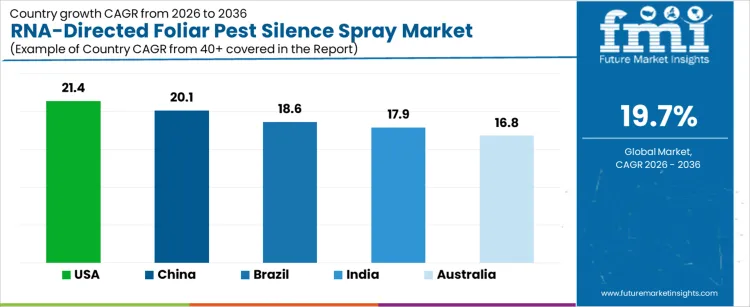
The RNA-directed foliar pest silence spray market is growing at a rapid pace, with the USA leading at a 21.4% CAGR, driven by its focus on innovative agricultural technologies and pest management solutions. China follows closely with 20.1%, supported by its large-scale agricultural industry and demand for sustainable pest control methods. Brazil’s market grows at 18.6%, fueled by its significant agricultural output and the growing need for eco-friendly pest management solutions. India shows steady growth at 17.9%, driven by increasing agricultural challenges and the adoption of biological pest control methods. Australia’s market grows at 16.8%, backed by the need for efficient pest control in its unique agricultural environment.
Why is the USA Leading in the RNA-Directed Foliar Pest Silence Spray Market?
The USA’s RNA-directed foliar pest silence spray market is growing at 21.4%, driven by the country’s strong focus on agricultural innovation and the need for effective, sustainable pest control solutions. As the USA faces increasing challenges from pests, diseases, and environmental stress, RNA-based technologies are gaining traction for their ability to target specific pest species without harming beneficial organisms. The high adoption rate of precision agriculture, along with government incentives to reduce pesticide use, is fueling the demand for RNA-directed foliar pest silence sprays. The USA’s agricultural sector, particularly in crops like corn, soybeans, and fruits, is increasingly turning to these advanced solutions to improve crop yields and minimize pesticide residues. As the market for eco-friendly pest control expands, RNA-directed sprays are set to play a significant role in the future of American agriculture.
What is Driving the Growth of the RNA-Directed Foliar Pest Silence Spray Market in China?
China’s RNA-directed foliar pest silence spray market is growing at 20.1%, supported by the country’s vast agricultural sector and increasing demand for sustainable pest management solutions. As China faces pressure to improve food security and reduce the environmental impact of conventional pesticides, RNA-based technologies offer a more precise and eco-friendly alternative for pest control. These sprays are gaining popularity for their ability to specifically target pests without affecting non-target species. China’s government initiatives to promote more sustainable farming practices and reduce pesticide residues are contributing to the growth of RNA-directed foliar pest silence sprays. As the market for precision agriculture and biological pest control grows, the demand for these sprays is expected to continue to rise.
How is the RNA-Directed Foliar Pest Silence Spray Market Expanding in Brazil?
Brazil’s RNA-directed foliar pest silence spray market is growing at 18.6%, driven by the country’s expansive agricultural sector and the need to improve pest management practices. Brazil, one of the world’s largest producers of crops such as soybeans, coffee, and sugarcane, is facing increasing pressure from pests and diseases, which threaten crop yields. RNA-directed foliar sprays offer a promising solution by targeting specific pests, reducing the use of broad-spectrum chemical pesticides, and ensuring more sustainable pest control. As Brazil continues to focus on enhancing agricultural productivity and reducing pesticide residues, RNA-based pest management technologies are becoming increasingly popular. With a growing focus on biological alternatives and environmental conservation, Brazil’s market for RNA-directed sprays is expected to expand significantly.
What is Contributing to the Growth of the RNA-Directed Foliar Pest Silence Spray Market in India?
India’s RNA-directed foliar pest silence spray market is growing at 17.9%, driven by the country’s heavy reliance on agriculture and the increasing challenges posed by pests and environmental stress. With the agricultural sector facing issues like pest resistance and crop losses due to pests, RNA-based technologies are gaining traction as a more targeted and sustainable pest control solution. RNA-directed foliar sprays are particularly beneficial in regions where chemical pesticide use is restricted or not effective. The Indian government’s push for sustainable farming practices and increased awareness about reducing chemical pesticide use are also fueling market growth. As the demand for crop protection grows, RNA-directed sprays offer an eco-friendly alternative to traditional pest management methods, driving steady growth in India’s market.
What is Driving the Growth of the RNA-Directed Foliar Pest Silence Spray Market in Australia?
Australia’s RNA-directed foliar pest silence spray market is growing at 16.8%, supported by the country’s unique agricultural challenges and a strong emphasis on sustainable farming practices. Australia faces specific pest threats in crops such as wheat, barley, and fruits, making effective pest management crucial for maintaining crop yields. RNA-based sprays are gaining traction due to their ability to target specific pests and reduce the reliance on traditional pesticides. With a growing focus on eco-friendly agricultural technologies and precision farming, the demand for RNA-directed foliar pest silence sprays is on the rise. The Australian government’s support for sustainable agriculture practices is further driving the adoption of these advanced pest control solutions. As the market for biological pest control continues to expand, RNA-directed sprays are expected to play a significant role in Australia’s agricultural future.
How Are Companies Competing in the RNA Directed Foliar Pest Silence Spray Market?
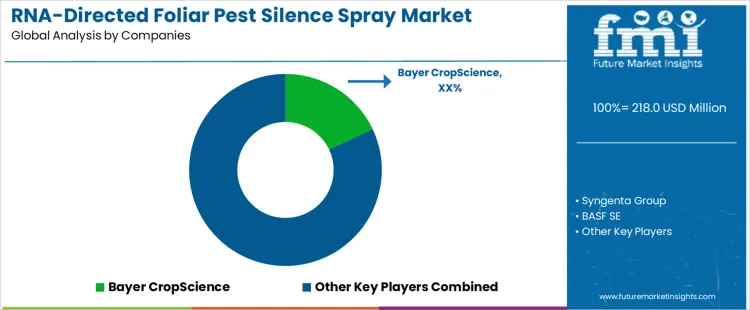
In the RNA directed foliar pest silence spray market Bayer CropScience, Syngenta Group, BASF SE, Corteva Agriscience, Green Light Biosciences, and others are positioned with brochures that emphasize precision pest control powered by RNA interference technology. Bayer CropScience materials describe targeted foliar sprays designed to silence essential pest genes, with performance claims and application guidance that support integration into integrated pest management programs. Trial results are presented to show reduced pest pressure with minimal non target impact. Syngenta Group literature highlights RNA based sprays alongside traditional crop protection solutions, with visual data and explanation of mechanism of action to aid agronomists. Short usage recommendations are included to simplify application timing and spray coverage for key crops.
BASF SE brochures showcase well engineered RNA foliar formulations with emphasis on stability on leaf surfaces and compatibility with existing spray regimes. Technical sections are used to explain how enhanced delivery improves efficacy against resistant pest populations. Corteva Agriscience collateral positions its RNA directed sprays as part of a broader suite of next generation crop protection tools that support sustainability goals, with clear performance charts and crop specific insights. GreenLight Biosciences materials focus on the biological innovation underpinning RNA interference, with product briefs that describe fast uptake and specific pest targeting while minimizing environmental exposure. Others in the market are noted for niche RNA spray technologies, often tailored to specialty crops or region specific pest pressures.
Key Players in RNA-Directed Foliar Pest Silence Spray Market
- Bayer CropScience
- Syngenta Group
- BASF SE
- Corteva Agriscience
- GreenLight Biosciences
- Others
Scope of Report
| Items | Values |
|---|---|
| Quantitative Units (2026) | USD million |
| Target Pest Category | Chewing Insects (Lepidoptera, Coleoptera), Sap-Sucking Pests (Aphids, Whiteflies), Mites & Thrips, Nematodes, Others |
| RNA Technology Type | dsRNA-based Sprays, siRNA-based Formulations, RNA Nanocarrier-Enabled Systems, Spray-Induced Gene Silencing (SIGS) Blends |
| Regions Covered | Asia Pacific, Europe, North America, Latin America, Middle East & Africa |
| Countries Covered | USA, China, Japan, South Korea, India, Australia & New Zealand, ASEAN, Germany, UK, France, Italy, Spain, Nordic, BENELUX, Brazil, Chile, Mexico, Saudi Arabia, Other GCC Countries, Turkey, South Africa, Other African Union |
| Key Companies Profiled | Bayer CropScience, Syngenta Group, BASF SE, Corteva Agriscience, GreenLight Biosciences, Others |
| Additional Attributes | Dollar sales by pest category, RNA technology type, and region; regional CAGR and growth outlook; distribution channels including agrochemical suppliers, biocontrol service providers, and biotech firms; innovation trends in RNA-directed pest control; competitive positioning of global vs regional suppliers. |
RNA-Directed Foliar Pest Silence Spray Market by Segments
Target Pest Category:
- Chewing Insects (Lepidoptera, Coleoptera)
- Sap-Sucking Pests (Aphids, Whiteflies)
- Mites & Thrips
- Nematodes
- Others
RNA Technology Type:
- dsRNA-based Sprays
- siRNA-based Formulations
- RNA Nanocarrier-Enabled Systems
- Spray-Induced Gene Silencing (SIGS) Blends
Region:
- Asia Pacific
- China
- Japan
- South Korea
- India
- Australia & New Zealand
- ASEAN
- Rest of Asia Pacific
- Europe
- Germany
- United Kingdom
- France
- Italy
- Spain
- Nordic
- BENELUX
- Rest of Europe
- North America
- United States
- Canada
- Mexico
- Latin America
- Brazil
- Chile
- Rest of Latin America
- Middle East & Africa
- Kingdom of Saudi Arabia
- Other GCC Countries
- Turkey
- South Africa
- Other African Union
- Rest of Middle East & Africa
Frequently Asked Questions
How big is the RNA-directed foliar pest silence spray market in 2026?
The global RNA-directed foliar pest silence spray market is estimated to be valued at USD 218.0 million in 2026.
What will be the size of RNA-directed foliar pest silence spray market in 2036?
The market size for the RNA-directed foliar pest silence spray market is projected to reach USD 1,316.4 million by 2036.
How much will be the RNA-directed foliar pest silence spray market growth between 2026 and 2036?
The RNA-directed foliar pest silence spray market is expected to grow at a 19.7% CAGR between 2026 and 2036.
What are the key product types in the RNA-directed foliar pest silence spray market?
The key product types in RNA-directed foliar pest silence spray market are chewing insects (lepidoptera, coleoptera), sap-sucking pests (aphids, whiteflies), mites & thrips, nematodes and others.
Which rna technology type segment to contribute significant share in the RNA-directed foliar pest silence spray market in 2026?
In terms of rna technology type, dsRNA-based sprays segment to command 44.0% share in the RNA-directed foliar pest silence spray market in 2026.
Preview the report firsthand - request a free sample
Get SampleGet the brochure for pricing and purchase details.
Get PDFTable of Content
- Executive Summary
- Global Market Outlook
- Demand-side Trends
- Supply-side Trends
- Technology Roadmap Analysis
- Analysis and Recommendations
- Market Overview
- Market Coverage / Taxonomy
- Market Definition / Scope / Limitations
- Market Background
- Market Dynamics
- Drivers
- Restraints
- Opportunity
- Trends
- Scenario Forecast
- Demand in Optimistic Scenario
- Demand in Likely Scenario
- Demand in Conservative Scenario
- Opportunity Map Analysis
- Product Life Cycle Analysis
- Supply Chain Analysis
- Investment Feasibility Matrix
- Value Chain Analysis
- PESTLE and Porter’s Analysis
- Regulatory Landscape
- Regional Parent Market Outlook
- Production and Consumption Statistics
- Import and Export Statistics
- Market Dynamics
- Global Market Analysis 2021 to 2025 and Forecast, 2026 to 2036
- Historical Market Size Value (USD Million) Analysis, 2021 to 2025
- Current and Future Market Size Value (USD Million) Projections, 2026 to 2036
- Y-o-Y Growth Trend Analysis
- Absolute $ Opportunity Analysis
- Global Market Pricing Analysis 2021 to 2025 and Forecast 2026 to 2036
- Global Market Analysis 2021 to 2025 and Forecast 2026 to 2036, By Target Pest Category
- Introduction / Key Findings
- Historical Market Size Value (USD Million) Analysis By Target Pest Category , 2021 to 2025
- Current and Future Market Size Value (USD Million) Analysis and Forecast By Target Pest Category , 2026 to 2036
- Chewing Insects (Lepidoptera, Coleoptera)
- Sap-Sucking Pests (Aphids, Whiteflies)
- Mites & Thrips
- Nematodes
- Others
- Y-o-Y Growth Trend Analysis By Target Pest Category , 2021 to 2025
- Absolute $ Opportunity Analysis By Target Pest Category , 2026 to 2036
- Global Market Analysis 2021 to 2025 and Forecast 2026 to 2036, By RNA Technology Type
- Introduction / Key Findings
- Historical Market Size Value (USD Million) Analysis By RNA Technology Type, 2021 to 2025
- Current and Future Market Size Value (USD Million) Analysis and Forecast By RNA Technology Type, 2026 to 2036
- dsRNA-based Sprays
- siRNA-based Formulations
- RNA Nanocarrier-Enabled Systems
- Spray-Induced Gene Silencing (SIGS) Blends
- Y-o-Y Growth Trend Analysis By RNA Technology Type, 2021 to 2025
- Absolute $ Opportunity Analysis By RNA Technology Type, 2026 to 2036
- Global Market Analysis 2021 to 2025 and Forecast 2026 to 2036, By Region
- Introduction
- Historical Market Size Value (USD Million) Analysis By Region, 2021 to 2025
- Current Market Size Value (USD Million) Analysis and Forecast By Region, 2026 to 2036
- North America
- Latin America
- Western Europe
- Eastern Europe
- East Asia
- South Asia and Pacific
- Middle East & Africa
- Market Attractiveness Analysis By Region
- North America Market Analysis 2021 to 2025 and Forecast 2026 to 2036, By Country
- Historical Market Size Value (USD Million) Trend Analysis By Market Taxonomy, 2021 to 2025
- Market Size Value (USD Million) Forecast By Market Taxonomy, 2026 to 2036
- By Country
- USA
- Canada
- Mexico
- By Target Pest Category
- By RNA Technology Type
- By Country
- Market Attractiveness Analysis
- By Country
- By Target Pest Category
- By RNA Technology Type
- Key Takeaways
- Latin America Market Analysis 2021 to 2025 and Forecast 2026 to 2036, By Country
- Historical Market Size Value (USD Million) Trend Analysis By Market Taxonomy, 2021 to 2025
- Market Size Value (USD Million) Forecast By Market Taxonomy, 2026 to 2036
- By Country
- Brazil
- Chile
- Rest of Latin America
- By Target Pest Category
- By RNA Technology Type
- By Country
- Market Attractiveness Analysis
- By Country
- By Target Pest Category
- By RNA Technology Type
- Key Takeaways
- Western Europe Market Analysis 2021 to 2025 and Forecast 2026 to 2036, By Country
- Historical Market Size Value (USD Million) Trend Analysis By Market Taxonomy, 2021 to 2025
- Market Size Value (USD Million) Forecast By Market Taxonomy, 2026 to 2036
- By Country
- Germany
- UK
- Italy
- Spain
- France
- Nordic
- BENELUX
- Rest of Western Europe
- By Target Pest Category
- By RNA Technology Type
- By Country
- Market Attractiveness Analysis
- By Country
- By Target Pest Category
- By RNA Technology Type
- Key Takeaways
- Eastern Europe Market Analysis 2021 to 2025 and Forecast 2026 to 2036, By Country
- Historical Market Size Value (USD Million) Trend Analysis By Market Taxonomy, 2021 to 2025
- Market Size Value (USD Million) Forecast By Market Taxonomy, 2026 to 2036
- By Country
- Russia
- Poland
- Hungary
- Balkan & Baltic
- Rest of Eastern Europe
- By Target Pest Category
- By RNA Technology Type
- By Country
- Market Attractiveness Analysis
- By Country
- By Target Pest Category
- By RNA Technology Type
- Key Takeaways
- East Asia Market Analysis 2021 to 2025 and Forecast 2026 to 2036, By Country
- Historical Market Size Value (USD Million) Trend Analysis By Market Taxonomy, 2021 to 2025
- Market Size Value (USD Million) Forecast By Market Taxonomy, 2026 to 2036
- By Country
- China
- Japan
- South Korea
- By Target Pest Category
- By RNA Technology Type
- By Country
- Market Attractiveness Analysis
- By Country
- By Target Pest Category
- By RNA Technology Type
- Key Takeaways
- South Asia and Pacific Market Analysis 2021 to 2025 and Forecast 2026 to 2036, By Country
- Historical Market Size Value (USD Million) Trend Analysis By Market Taxonomy, 2021 to 2025
- Market Size Value (USD Million) Forecast By Market Taxonomy, 2026 to 2036
- By Country
- India
- ASEAN
- Australia & New Zealand
- Rest of South Asia and Pacific
- By Target Pest Category
- By RNA Technology Type
- By Country
- Market Attractiveness Analysis
- By Country
- By Target Pest Category
- By RNA Technology Type
- Key Takeaways
- Middle East & Africa Market Analysis 2021 to 2025 and Forecast 2026 to 2036, By Country
- Historical Market Size Value (USD Million) Trend Analysis By Market Taxonomy, 2021 to 2025
- Market Size Value (USD Million) Forecast By Market Taxonomy, 2026 to 2036
- By Country
- Kingdom of Saudi Arabia
- Other GCC Countries
- Turkiye
- South Africa
- Other African Union
- Rest of Middle East & Africa
- By Target Pest Category
- By RNA Technology Type
- By Country
- Market Attractiveness Analysis
- By Country
- By Target Pest Category
- By RNA Technology Type
- Key Takeaways
- Key Countries Market Analysis
- USA
- Pricing Analysis
- Market Share Analysis, 2025
- By Target Pest Category
- By RNA Technology Type
- Canada
- Pricing Analysis
- Market Share Analysis, 2025
- By Target Pest Category
- By RNA Technology Type
- Mexico
- Pricing Analysis
- Market Share Analysis, 2025
- By Target Pest Category
- By RNA Technology Type
- Brazil
- Pricing Analysis
- Market Share Analysis, 2025
- By Target Pest Category
- By RNA Technology Type
- Chile
- Pricing Analysis
- Market Share Analysis, 2025
- By Target Pest Category
- By RNA Technology Type
- Germany
- Pricing Analysis
- Market Share Analysis, 2025
- By Target Pest Category
- By RNA Technology Type
- UK
- Pricing Analysis
- Market Share Analysis, 2025
- By Target Pest Category
- By RNA Technology Type
- Italy
- Pricing Analysis
- Market Share Analysis, 2025
- By Target Pest Category
- By RNA Technology Type
- Spain
- Pricing Analysis
- Market Share Analysis, 2025
- By Target Pest Category
- By RNA Technology Type
- France
- Pricing Analysis
- Market Share Analysis, 2025
- By Target Pest Category
- By RNA Technology Type
- India
- Pricing Analysis
- Market Share Analysis, 2025
- By Target Pest Category
- By RNA Technology Type
- ASEAN
- Pricing Analysis
- Market Share Analysis, 2025
- By Target Pest Category
- By RNA Technology Type
- Australia & New Zealand
- Pricing Analysis
- Market Share Analysis, 2025
- By Target Pest Category
- By RNA Technology Type
- China
- Pricing Analysis
- Market Share Analysis, 2025
- By Target Pest Category
- By RNA Technology Type
- Japan
- Pricing Analysis
- Market Share Analysis, 2025
- By Target Pest Category
- By RNA Technology Type
- South Korea
- Pricing Analysis
- Market Share Analysis, 2025
- By Target Pest Category
- By RNA Technology Type
- Russia
- Pricing Analysis
- Market Share Analysis, 2025
- By Target Pest Category
- By RNA Technology Type
- Poland
- Pricing Analysis
- Market Share Analysis, 2025
- By Target Pest Category
- By RNA Technology Type
- Hungary
- Pricing Analysis
- Market Share Analysis, 2025
- By Target Pest Category
- By RNA Technology Type
- Kingdom of Saudi Arabia
- Pricing Analysis
- Market Share Analysis, 2025
- By Target Pest Category
- By RNA Technology Type
- Turkiye
- Pricing Analysis
- Market Share Analysis, 2025
- By Target Pest Category
- By RNA Technology Type
- South Africa
- Pricing Analysis
- Market Share Analysis, 2025
- By Target Pest Category
- By RNA Technology Type
- USA
- Market Structure Analysis
- Competition Dashboard
- Competition Benchmarking
- Market Share Analysis of Top Players
- By Regional
- By Target Pest Category
- By RNA Technology Type
- Competition Analysis
- Competition Deep Dive
- Bayer CropScience
- Overview
- Product Portfolio
- Profitability by Market Segments (Product/Age /Sales Channel/Region)
- Sales Footprint
- Strategy Overview
- Marketing Strategy
- Product Strategy
- Channel Strategy
- Syngenta Group
- BASF SE
- Corteva Agriscience
- GreenLight Biosciences
- Bayer CropScience
- Competition Deep Dive
- Assumptions & Acronyms Used
- Research Methodology


