

- Market Size (2026)
- USD 66.1 Mn
- Forecast (2036)
- USD 163.9 Mn
- CAGR (2026 to 2036)
- 9.5%
How big is Pesticide Compatibility Additives Market in 2026?
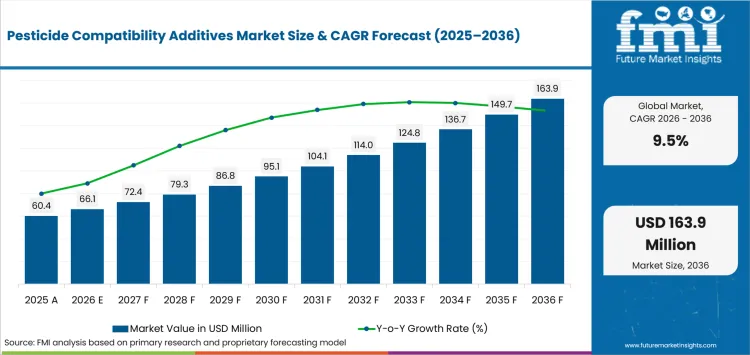
USD 66.1 Million in 2026 and USD 163.9 Million by 2036 at a 9.5% CAGR.
Demand for pesticide compatibility additives is projected to expand from USD 66.1 Million in 2026 to USD 163.9 Million by 2036 at a 9.5% CAGR. The commercial value sits inside the spray operation: water chemistry, agitation, nozzle choice, droplet spectrum and mixing sequence can change whether a valid pesticide program remains stable in the tank and deposits consistently on the target.
The USA Environmental Protection Agency described adjuvants in its October 2025 mitigation menu as non-pesticidal chemicals added to formulations or tank mixes to improve pesticide performance and reduce spray drift. The agency also notes that oil- and polymer-based drift retardants can increase droplet size and reduce fine droplets, linking additive selection directly with application quality and off-target movement management.
Key Takeaways
- Compatibility additives gain value as pesticide programs become more mixture-sensitive and applicators need predictable tank stability, droplet control and deposition across changing field conditions.
- Surfactant-Based products are projected to account for 47.9% of Product Type demand in 2026 because wetting and spreading functions apply across a broad range of foliar pesticide programs.
- Efficacy Enhancement is projected at 44.7% of Function demand in 2026 as buyers link additive spend to retention, coverage and effective delivery of the active ingredient.
- Cereals & Grains are projected at 47.3% of Crop Type demand in 2026 because broad-acre programs magnify the operational cost of uneven application across large treated areas.
- Foliar Tank-Mix is projected at 41.6% of Application Method demand in 2026 because point-of-use dosing lets operators adapt the spray solution to the pesticide mix and local water conditions.
- Agri-Input Distributors are projected at 44.4% of Sales Channel demand in 2026 as additive choice often requires local product access and agronomic guidance close to the spray decision.
- Mixture-specific qualification can slow product switching, while low-volume and UAV spraying create room for additives designed around concentrated mixes and tighter droplet-control requirements.
- WinField United (Land O'Lakes), Brandt, Loveland Products (Nutrien), Oro Agri (Rovensa), Croda, Clariant, Stepan Company and Evonik.
Analyst Perspective
"Pesticide compatibility additives are purchased for what happens after products enter the spray system. Suppliers that can connect chemistry with water quality, droplet behavior, tank stability and practical field support are better placed to serve more complex pesticide programs. UAV and lower-water-volume application will raise the value of formulations that remain stable under concentrated operating conditions."
- Nikhil Kaitwade, Principal Consultant, Future Market Insights
How is the Pesticide Compatibility Additives Market segmented?
The Pesticide Compatibility Additives Market is segmented by Product Type, Function, Crop Type, Application Method, Sales Channel and Region.
Product Type identifies the chemistry platform used to modify spray behavior. Function separates purchases aimed at efficacy, drift control or handling. Crop Type captures differences in treated acreage and spray intensity, while Application Method identifies where the additive enters the spray system. Sales Channel reflects how technical recommendation and product access reach the applicator.
Why does Foliar Tank-Mix lead the Application Method category?
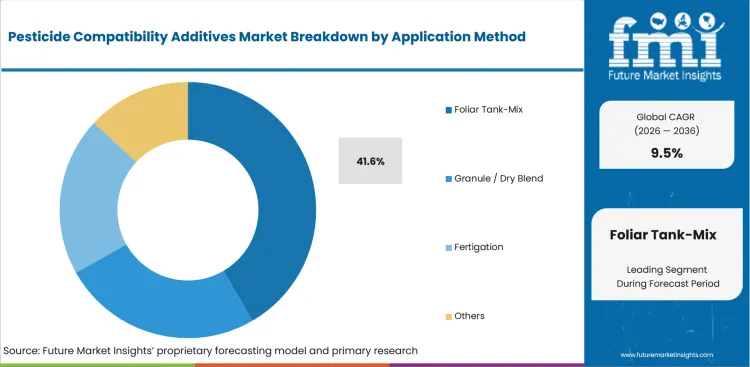
Foliar tank-mix use places the additive at the point where water, pesticide chemistry and application hardware meet. Point-of-use dosing lets the applicator correct or optimize the mixture for the specific spray event. This makes foliar tank mixing a practical commercial route within the broader agricultural adjuvants field, especially when more than one pesticide or water conditioner must remain physically compatible.
- Foliar Tank-Mix is projected to account for 41.6% of Application Method demand in 2026 because it gives operators direct control over the additive dose for the selected pesticide mix, water source and spray setup.
- Stepan positions STEPGROW CT as a compatibility agent for liquid fertilizers, pesticides and combinations of two or more pesticides, illustrating the need to maintain a workable spray mixture when several inputs share one tank.
Why does Surfactant-Based lead the Product Type category?
Surfactant-based additives address a recurring spray problem by lowering surface tension so droplets can wet and spread across plant surfaces more consistently. This broad functional role connects the category with the wider agricultural surfactants space, where wetting, spreading and contact behavior shape foliar application performance across multiple pesticide chemistries.
- Surfactant-Based products are projected to account for 47.9% of Product Type demand in 2026 because their wetting and spreading functions support repeated use across foliar herbicide, fungicide and insecticide programs.
- WinField United explained in 2025 that nonionic surfactants reduce surface tension and are compatible with many herbicide products, giving applicators a flexible way to improve surface contact without changing the active pesticide.
Why does Efficacy Enhancement lead the Function category?
Efficacy enhancement sits close to the economic reason for buying an additive because the buyer wants more of the intended pesticide dose to reach, remain on or penetrate the target. That operating logic overlaps with activator adjuvants used to improve the interaction between the spray solution and the treated surface.
- Efficacy Enhancement is projected to account for 44.7% of Function demand in 2026 because coverage, retention and rainfastness can determine whether an otherwise valid pesticide program performs consistently.
- Clariant introduced Synergen Guard 100 in March 2025 as a renewable-wax nano-emulsion performance booster for biological crop protection, highlighting coverage and rain protection. The development is relevant as biorational pesticides expand the range of active agents that require biocompatible delivery support.
Why do Cereals & Grains lead the Crop Type category?
Cereals and grains create a scale-sensitive use case because pesticide programs often cover broad acreage within limited application windows. A small loss in mixing quality, droplet control or deposition can therefore repeat over many hectares, making repeatable application performance more valuable than in smaller, less frequent spray programs.
- Cereals & Grains are projected to account for 47.3% of Crop Type demand in 2026 because broad-acre treatment magnifies the operational value of consistent per-acre application.
- Japan’s Ministry of Agriculture, Forestry and Fisheries reported that pesticide-spraying drones reduced working time by 61% on average in smart-agriculture demonstrations, showing how large-area crop programs can shift toward faster application systems that require dependable spray behavior.
Why do Agri-Input Distributors lead the Sales Channel category?
Agri-input distributors sit close to both inventory and the field decision that determines which additive enters the tank. Compatibility problems are often product- and condition-specific, so access to an advisor who knows the pesticide program, local water conditions and available formulations can shorten the selection process for growers and applicators.
- Agri-Input Distributors are projected to account for 44.4% of Sales Channel demand in 2026 because local product access is reinforced by agronomic advice at the point of application planning.
- WinField United advised growers in 2025 to plan adjuvant selection with a trusted agronomic advisor, reflecting the importance of local recommendation in a category where spray conditions can change the appropriate product choice.
What are the drivers, restraints and opportunities in the Pesticide Compatibility Additives Market?
Complex pesticide programs support additive demand, mixture-specific qualification limits easy switching and low-volume spraying creates new formulation opportunities.
- Driver: More complex spray programs increase the cost of poor droplet control, weak deposition and tank incompatibility.
- Restraint: Compatibility and crop safety must be established for the intended pesticide mixture and use conditions before adoption can scale.
- Opportunity: Low-volume and UAV spraying require additives that work in more concentrated spray mixtures with tighter drift-control needs.
The main demand driver is the need to protect application quality after the pesticide has been selected. EPA’s 2025 mitigation menu links adjuvants with drift reduction and explains that drift retardants can reduce fine droplets. That makes additive performance relevant to both pesticide efficacy and operating practices intended to reduce off-target movement.
Qualification remains a practical restraint because an additive can behave differently when pesticide chemistry, water quality, fertilizer salts or mixing sequence changes. The UK Health and Safety Executive maintains an Official List for pesticide adjuvants and requires data for the proposed product and pesticide mixtures, showing why market access depends on defined use conditions rather than a generic compatibility claim.
Low-volume application creates a separate opportunity because the same pesticide load is carried in less water and the droplet spectrum can become more sensitive to formulation choices. Rovensa Next’s January 2026 FAUVE project is testing ultra-low-volume drone adjuvant applications, while growth in commercial drones expands the installed base of platforms that can use purpose-designed drift, foam and deposition control.
Which country CAGRs are profiled in the Pesticide Compatibility Additives Market?
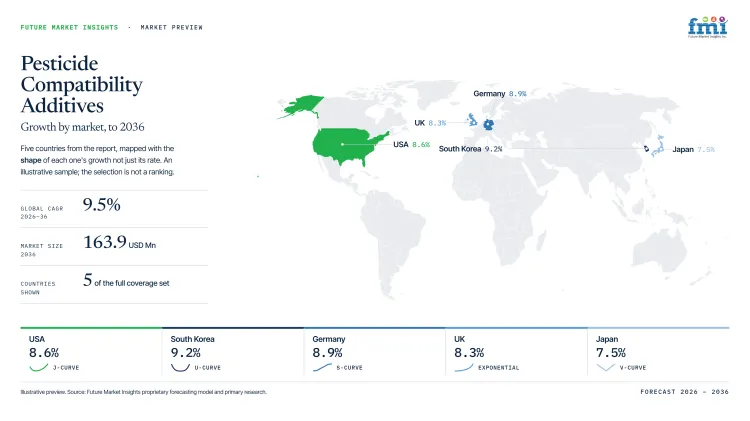
| Country | CAGR (2026-2036) |
|---|---|
| USA | 8.6% |
| UK | 8.3% |
| Germany | 8.9% |
| Japan | 7.5% |
| South Korea | 9.2% |
How do country-level CAGRs compare in the Pesticide Compatibility Additives Market?
The profiled growth rates range from 7.5% in Japan to 9.2% in South Korea. Germany is projected at 8.9%, the USA at 8.6% and the UK at 8.3%. The differences reflect how regulatory pathways, distributor support, pesticide-use practices and adoption of precision spraying change the commercial case for compatibility additives in each country.
- USA: Drift-management requirements and a large retailer-agronomy network keep compatibility and application-performance advice close to the spray decision.
- UK: Official-list conditions make documented product and mixture use important when adjuvant suppliers pursue repeatable commercial adoption.
- Germany: Formal approval and published adjuvant listings create a defined route for products whose authorized uses and mixing partners are clearly specified.
- Japan: Smart-agriculture programs are moving pesticide application toward labor-saving drone systems, raising the importance of stable low-volume spray performance.
- South Korea: Expanding unmanned-aircraft use is accompanied by official guidance on pesticide drift and safe application, supporting demand for application-control know-how.
The full report covers North America, Latin America, Western Europe, Eastern Europe, East Asia, South Asia and Pacific, and the Middle East and Africa, with country-level analysis aligned to local application and distribution conditions.
Country-wise Analysis
- USA is projected to expand at an 8.6% CAGR from 2026 to 2036. EPA’s October 2025 mitigation menu explicitly recognizes adjuvants as a spray-drift mitigation option and explains how oil- and polymer-based drift retardants can enlarge droplets and reduce fines. This gives USA distributors and applicators a clear operating reason to connect additive choice with label-compliant drift management.
- UK is projected to expand at an 8.3% CAGR from 2026 to 2036. The Health and Safety Executive’s Official List defines pesticide adjuvants and the conditions under which listed products may be used. That structure favors suppliers able to support specific pesticide-mixture uses with clear product instructions and channel education.
- Germany is projected to expand at an 8.9% CAGR from 2026 to 2036. The Federal Office of Consumer Protection and Food Safety describes approval for plant-protection adjuvants and publishes approved uses and mixing partners through its listings. Regularly maintained regulatory information increases the value of precise product positioning for distributors and professional applicators.
- Japan is projected to expand at a 7.5% CAGR from 2026 to 2036. The Ministry of Agriculture, Forestry and Fisheries reported 1.097 million hectares of pesticide spraying by drones in fiscal 2023 and a 61% average reduction in working time in demonstration results. As spraying shifts toward faster, lower-water systems, additive performance must remain predictable under concentrated operating conditions.
- South Korea is projected to expand at a 9.2% CAGR from 2026 to 2036. The Rural Development Administration issued educational material for safe pesticide application by unmanned aircraft that addresses drift factors and reduction measures. This operating focus supports technical demand for additives and spray practices that help keep fine droplets and off-target movement under control.
Who are the notable companies in the Pesticide Compatibility Additives Market?
WinField United (Land O'Lakes), Brandt, Loveland Products (Nutrien), Oro Agri (Rovensa), Croda, Clariant, Stepan Company and Evonik are notable companies serving the market.
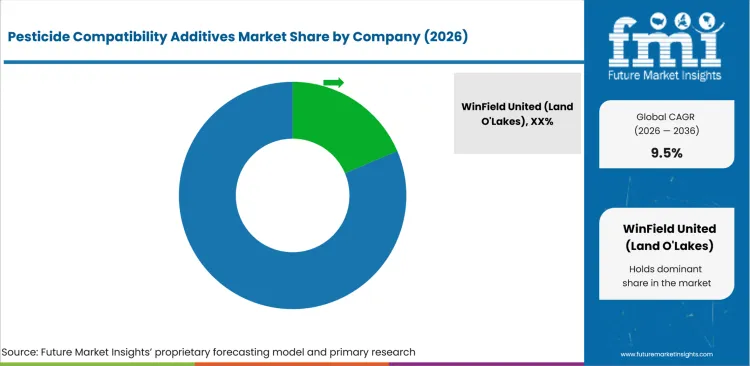
Competition spans farm-facing adjuvant brands, specialty ingredient suppliers and application-engineering providers. The commercial distinction is less about a single chemistry and more about how each supplier combines compatibility support, drift and deposition control, formulation breadth and the route through which technical recommendations reach growers and applicators.
- Farm-facing agronomy and distribution: WinField United (Land O'Lakes), Brandt and Loveland Products (Nutrien).
- Application engineering and specialty formulation: Oro Agri (Rovensa), Croda and Clariant.
- Surfactant and formulation chemistry: Stepan Company and Evonik.
Competitive Benchmarking: Pesticide Compatibility Additives Market
High indicates broad product or technical coverage of the stated capability, while Medium indicates targeted coverage around selected products or application situations. The labels describe the breadth of the observable offering and service proposition; they do not represent market share or a company ranking.
| Company | Tank-Mix Support | Drift & Deposition | Formulation Breadth | Commercial Reach |
|---|---|---|---|---|
| WinField United (Land O'Lakes) | High | High | Medium | North American retailer and field-support route |
| Brandt | Medium | High | Medium | USA production with distributor and international reach |
| Loveland Products (Nutrien) | High | High | Medium | North American crop-input distribution route |
| Oro Agri (Rovensa) | High | High | Medium | Global access through Rovensa crop-solutions channels |
| Croda | Medium | High | High | Global specialty-ingredient and formulation support |
| Clariant | High | High | High | Global crop-solutions and specialty-chemistry platform |
| Stepan Company | High | Medium | High | Multi-region surfactant and formulation supply |
| Evonik | Medium | High | High | Global specialty-additive and application support |
Key Developments in the Pesticide Compatibility Additives Market
- In January 2026, Rovensa Next announced the FAUVE project with UTC to test ultra-low-volume drone adjuvant applications. Early company-reported trials showed reductions in wind drift and fine droplets, making the program relevant to concentrated UAV spray mixtures.
- In 2025, WinField United introduced SuperLock, combining a surfactant crop oil concentrate with drift-reduction technology. The product was positioned for herbicide programs and planned for broad availability in spring 2026.
- In March 2025, Clariant introduced Synergen Guard 100, a renewable-wax nano-emulsion performance booster for biological crop protection designed to support coverage and rain protection.
- In April 2025, BRANDT expanded its product management team around a new portfolio of proprietary adjuvants to be produced at its Specialty Ag Formulations facility in Aurora, Nebraska, increasing internal focus on adjuvant portfolio development.
Key Players in the Pesticide Compatibility Additives Market
Farm-facing agronomy and distribution
- WinField United (Land O'Lakes)
- Brandt
- Loveland Products (Nutrien)
Application engineering and specialty formulation
- Oro Agri (Rovensa)
- Croda
- Clariant
Surfactant and formulation chemistry
- Stepan Company
- Evonik
Pesticide Compatibility Additives Market - Report Scope
| Coverage field | Report scope |
|---|---|
| Market breakdown | By Product Type, Function, Crop Type, Application Method, Sales Channel and Region |
| Quantitative Units | USD Million |
| Market Definition | Revenue from dedicated additives sold for pesticide applications to improve tank-mix compatibility, application performance, droplet behavior, deposition or handling. Finished pesticide revenue and adjacent crop inputs not sold as pesticide compatibility additives are excluded. |
| Regions Covered | North America, Latin America, Western Europe, Eastern Europe, East Asia, South Asia and Pacific, Middle East and Africa |
| Countries Covered | USA, UK, Germany, Japan, South Korea and more than 25 additional countries in the full report |
| Key Companies Profiled | WinField United (Land O'Lakes), Brandt, Loveland Products (Nutrien), Oro Agri (Rovensa), Croda, Clariant, Stepan Company, Evonik |
| Forecast Period | 2026 to 2036 |
| Approach | Hybrid bottom-up and top-down sizing with segment, country and company triangulation across pesticide-use patterns, additive demand signals and channel activity |
Pesticide Compatibility Additives Market - Research Methodology
| Method | Approach |
|---|---|
| Primary Research | FMI research incorporates discussions with additive suppliers, crop-input distributors, formulation specialists, agronomy professionals and application stakeholders to assess purchasing criteria, route-to-market conditions and technology adoption. |
| Desk Research | Regulatory listings, agriculture-agency publications, company product literature, official company announcements and technical information are used to frame market mechanisms, country conditions and competitive activity. |
| Market Sizing and Forecasting | Bottom-up supplier and application estimates are reconciled with top-down pesticide-use, treated-acreage, channel and formulation indicators to size demand and develop the 2026-2036 forecast. |
| Data Validation | Segment assumptions, country growth patterns and competitive observations are triangulated across primary input and independent operating indicators before the final market view is consolidated. |
Pesticide Compatibility Additives Market by Segments
Pesticide Compatibility Additives Market segmented by Product Type:
- Surfactant-Based
- Oil-Based
- Polymer-Based
- Mineral / Carrier-Based
- Others
Pesticide Compatibility Additives Market segmented by Function:
- Efficacy Enhancement
- Loss & Drift Reduction
- Handling & Compatibility
- Others
Pesticide Compatibility Additives Market segmented by Crop Type:
- Cereals & Grains
- Fruits & Vegetables
- Oilseeds & Pulses
- Turf & Ornamentals
- Others
Pesticide Compatibility Additives Market segmented by Application Method:
- Foliar Tank-Mix
- Granule / Dry Blend
- Fertigation
- Others
Pesticide Compatibility Additives Market segmented by Sales Channel:
- Agri-Input Distributors
- Cooperatives
- Agri-Retail Chains
- Online / Direct-to-Farm
- Others
Pesticide Compatibility Additives Market by Region:
- North America
- United States
- Canada
- Latin America
- Brazil
- Mexico
- Argentina
- Chile
- Western Europe
- Germany
- France
- United Kingdom
- Italy
- Spain
- Benelux
- Nordics
- Eastern Europe
- Poland
- Czech Republic
- Romania
- Hungary
- East Asia
- China
- Japan
- South Korea
- South Asia and Pacific
- India
- ASEAN
- Australia and New Zealand
- Middle East and Africa
- GCC Countries
- South Africa
- Türkiye
- Israel
Research Sources and Bibliography
- USA Environmental Protection Agency. (2025, October 30). Mitigation Menu Measure Descriptions.
- Health and Safety Executive. (2024, September 16). Pesticide adjuvants and the Official List.
- Bundesamt für Verbraucherschutz und Lebensmittelsicherheit. (n.d.; accessed August 26, 2026). FAQ Pflanzenschutzmittel: Zusatzstoffe.
- Ministry of Agriculture, Forestry and Fisheries of Japan. (2025). Promotion of Smart Agriculture.
- Rural Development Administration, Republic of Korea. (2023, April 5). Educational materials for safe pesticide application using unmanned aircraft.
- WinField United. (2025). Plan Ahead with Proven Adjuvants in 2026.
- WinField United. (2025). Introducing a Simplified Way to Boost Herbicide Performance.
- BRANDT. (2025, April 15). BRANDT Grows Product Management Team.
- BRANDT. (2025, May 20). How Adjuvants Improve Foliar Herbicide Performance.
- Rovensa Next. (2026, January 27). FAUVE Project Advances Precision Agriculture with Drone Adjuvant Technology.
- Clariant. (2025, March 13). Clariant unveils next-generation crop protection solutions at CAC 2025.
- Croda Agriculture. (n.d.; accessed August 26, 2026). Adjuvants.
- Stepan Company. (n.d.; accessed August 26, 2026). STEPGROW CT Product Bulletin.
- Evonik. (2026, January 17). BREAK-THRU SP 133 Product Information.
- Loveland Products. (2024, September). MISSILE Product Bulletin.
This Report Answers
- How are compatibility and spray-performance requirements reshaping demand for pesticide additives?
- Which product chemistries and functions are most important to application performance?
- How does low-volume and UAV spraying change additive requirements?
- How do regulatory listing and approval conditions influence commercial adoption?
- Why does local technical support matter in pesticide compatibility additive distribution?
- How do growth conditions differ across the USA, UK, Germany, Japan and South Korea?
- Which companies compete through farm-facing support, formulation chemistry and application engineering?
- How are recent product and technology developments changing competitive positioning?
Frequently Asked Questions
How big is the Pesticide Compatibility Additives Market in 2026?
USD 66.1 Million represents the Pesticide Compatibility Additives Market value in 2026. Demand is supported by the need for stable tank mixtures, controlled droplet behavior and consistent pesticide application performance as the market advances toward USD 163.9 Million by 2036.
What is the CAGR of the Pesticide Compatibility Additives Market from 2026 to 2036?
A 9.5% CAGR is projected for the Pesticide Compatibility Additives Market between 2026 and 2036. Growth is supported by more complex pesticide programs, tighter drift-management requirements and increasing use of low-volume application systems.
Which Product Type segment is projected to account for 47.9% of the Pesticide Compatibility Additives Market?
Surfactant-Based products are projected to account for 47.9% of Product Type demand in 2026. Their wetting and spreading functions support use across foliar herbicide, fungicide and insecticide programs where consistent surface contact is required.
How much will the Pesticide Compatibility Additives Market add between 2026 and 2036?
USD 97.8 Million is expected to be added to the Pesticide Compatibility Additives Market between 2026 and 2036. The increase is supported by demand for improved tank compatibility, deposition control and spray performance as pesticide application becomes more technically demanding.
Which companies are active in the Pesticide Compatibility Additives Market?
Eight companies active in the Pesticide Compatibility Additives Market include WinField United (Land O'Lakes), Brandt, Loveland Products (Nutrien), Oro Agri (Rovensa), Croda, Clariant, Stepan Company and Evonik. These companies serve the market through farm-facing adjuvant portfolios, application technologies and specialty formulation chemistry.
Preview the report firsthand - request a free sample
Get SampleGet the brochure for pricing and purchase details.
Get PDFTable of Content
- Key Takeaways
- Market Size and CAGR
- Top Growth Driver
- Fastest Growing Segment
- Leading Region
- Key Companies
- Emerging Opportunities
- Executive Summary
- Global Market Outlook
- Demand-side Trends
- Supply-side Trends
- Technology Roadmap Analysis
- Analysis and Recommendations
- Analyst Perspective (What is happening? Why now? What should investors know?)
- Key Questions Answered
- How large is the market?
- What is the CAGR?
- What are key trends?
- Which region dominates?
- Who are the leaders?
- Market Overview
- Market Coverage / Taxonomy
- Market Definition / Scope / Limitations
- Research Methodology
- Chapter Orientation
- Analytical Lens and Working Hypotheses
- Market Structure, Signals, and Trend Drivers
- Benchmarking and Cross-market Comparability
- Market Sizing, Forecasting, and Opportunity Mapping
- Research Design and Evidence Framework
- Desk Research Programme (Secondary Evidence)
- Expert Input and Fieldwork (Primary Evidence)
- Tooling, Models, and Reference Databases
- Data Engineering and Model Build
- Quality Assurance and Audit Trail
- Market Background
- Market Dynamics (Drivers, Restraints, Opportunity, Trends)
- Scenario Forecast (Optimistic, Likely, Conservative)
- Impact Analysis
- AI Impact
- Sustainability Impact
- Regulatory Impact
- Technology Impact
- Consumer / Buyer Analysis
- Purchase Drivers
- Adoption Barriers
- Buyer Journey
- Opportunity Map Analysis
- Product Life Cycle Analysis
- Supply Chain Analysis
- Investment Feasibility Matrix
- Value Chain Analysis
- PESTLE and Porter's Analysis
- Regulatory Landscape
- Regional Parent Market Outlook
- Production and Consumption Statistics
- Import and Export Statistics
- Global Market Analysis and Forecast, 2021 to 2036
- Historical Market Size Value (USD Million) Analysis, 2021 to 2025
- Current and Future Market Size Value (USD Million) Projections, 2026 to 2036
- Y-o-Y Growth Trend Analysis
- Absolute $ Opportunity Analysis
- Global Market Pricing Analysis, 2021 to 2036
- Global Market Analysis and Forecast, By Product Type, 2021 to 2036
- Introduction / Key Findings
- Historical Market Size Value (USD Million) Analysis By Product Type, 2021 to 2025
- Current and Future Market Size Value (USD Million) Analysis and Forecast By Product Type, 2026 to 2036
- Surfactant-Based
- Oil-Based
- Polymer-Based
- Mineral / Carrier-Based
- Others
- Surfactant-Based
- Y-o-Y Growth Trend Analysis By Product Type, 2021 to 2025
- Absolute $ Opportunity Analysis By Product Type, 2026 to 2036
- Global Market Analysis and Forecast, By Function, 2021 to 2036
- Introduction / Key Findings
- Historical Market Size Value (USD Million) Analysis By Function, 2021 to 2025
- Current and Future Market Size Value (USD Million) Analysis and Forecast By Function, 2026 to 2036
- Efficacy Enhancement
- Loss & Drift Reduction
- Handling & Compatibility
- Others
- Efficacy Enhancement
- Y-o-Y Growth Trend Analysis By Function, 2021 to 2025
- Absolute $ Opportunity Analysis By Function, 2026 to 2036
- Global Market Analysis and Forecast, By Crop Type, 2021 to 2036
- Introduction / Key Findings
- Historical Market Size Value (USD Million) Analysis By Crop Type, 2021 to 2025
- Current and Future Market Size Value (USD Million) Analysis and Forecast By Crop Type, 2026 to 2036
- Cereals & Grains
- Fruits & Vegetables
- Oilseeds & Pulses
- Turf & Ornamentals
- Others
- Cereals & Grains
- Y-o-Y Growth Trend Analysis By Crop Type, 2021 to 2025
- Absolute $ Opportunity Analysis By Crop Type, 2026 to 2036
- Global Market Analysis and Forecast, By Application Method, 2021 to 2036
- Introduction / Key Findings
- Historical Market Size Value (USD Million) Analysis By Application Method, 2021 to 2025
- Current and Future Market Size Value (USD Million) Analysis and Forecast By Application Method, 2026 to 2036
- Foliar Tank-Mix
- Granule / Dry Blend
- Fertigation
- Others
- Foliar Tank-Mix
- Y-o-Y Growth Trend Analysis By Application Method, 2021 to 2025
- Absolute $ Opportunity Analysis By Application Method, 2026 to 2036
- Global Market Analysis and Forecast, By Sales Channel, 2021 to 2036
- Introduction / Key Findings
- Historical Market Size Value (USD Million) Analysis By Sales Channel, 2021 to 2025
- Current and Future Market Size Value (USD Million) Analysis and Forecast By Sales Channel, 2026 to 2036
- Agri-Input Distributors
- Cooperatives
- Agri-Retail Chains
- Online / Direct-to-Farm
- Others
- Agri-Input Distributors
- Y-o-Y Growth Trend Analysis By Sales Channel, 2021 to 2025
- Absolute $ Opportunity Analysis By Sales Channel, 2026 to 2036
- Global Market Analysis and Forecast, By Region, 2021 to 2036
- Introduction
- Historical Market Size Value (USD Million) Analysis By Region, 2021 to 2025
- Current Market Size Value (USD Million) Analysis and Forecast By Region, 2026 to 2036
- North America
- Latin America
- Western Europe
- Eastern Europe
- East Asia
- South Asia and Pacific
- Middle East & Africa
- Market Attractiveness Analysis By Region
- North America Market Analysis and Forecast, By Country, 2021 to 2036
- Historical Market Size Value (USD Million) Trend Analysis By Market Taxonomy, 2021 to 2025
- Market Size Value (USD Million) Forecast By Market Taxonomy, 2026 to 2036
- By Country
- USA
- Canada
- By Product Type
- By Function
- By Crop Type
- By Application Method
- By Sales Channel
- By Country
- Market Attractiveness Analysis
- By Country
- By Product Type
- By Function
- By Crop Type
- By Application Method
- By Sales Channel
- Key Takeaways
- Latin America Market Analysis and Forecast, By Country
- Historical Market Size Value (USD Million) Trend Analysis By Market Taxonomy, 2021 to 2025
- Market Size Value (USD Million) Forecast By Market Taxonomy, 2026 to 2036
- By Country
- Brazil
- Mexico
- Chile
- Rest of Latin America
- By Product Type
- By Function
- By Crop Type
- By Application Method
- By Sales Channel
- By Country
- Market Attractiveness Analysis
- By Country
- By Product Type
- By Function
- By Crop Type
- By Application Method
- By Sales Channel
- Key Takeaways
- Western Europe Market Analysis and Forecast, By Country
- Historical Market Size Value (USD Million) Trend Analysis By Market Taxonomy, 2021 to 2025
- Market Size Value (USD Million) Forecast By Market Taxonomy, 2026 to 2036
- By Country
- Germany
- UK
- Italy
- Spain
- France
- Nordic
- BENELUX
- Rest of Western Europe
- By Product Type
- By Function
- By Crop Type
- By Application Method
- By Sales Channel
- By Country
- Market Attractiveness Analysis
- By Country
- By Product Type
- By Function
- By Crop Type
- By Application Method
- By Sales Channel
- Key Takeaways
- Eastern Europe Market Analysis and Forecast, By Country
- Historical Market Size Value (USD Million) Trend Analysis By Market Taxonomy, 2021 to 2025
- Market Size Value (USD Million) Forecast By Market Taxonomy, 2026 to 2036
- By Country
- Russia
- Poland
- Hungary
- Balkan & Baltic
- Rest of Eastern Europe
- By Product Type
- By Function
- By Crop Type
- By Application Method
- By Sales Channel
- By Country
- Market Attractiveness Analysis
- By Country
- By Product Type
- By Function
- By Crop Type
- By Application Method
- By Sales Channel
- Key Takeaways
- East Asia Market Analysis and Forecast, By Country
- Historical Market Size Value (USD Million) Trend Analysis By Market Taxonomy, 2021 to 2025
- Market Size Value (USD Million) Forecast By Market Taxonomy, 2026 to 2036
- By Country
- China
- Japan
- South Korea
- By Product Type
- By Function
- By Crop Type
- By Application Method
- By Sales Channel
- By Country
- Market Attractiveness Analysis
- By Country
- By Product Type
- By Function
- By Crop Type
- By Application Method
- By Sales Channel
- Key Takeaways
- South Asia and Pacific Market Analysis and Forecast, By Country
- Historical Market Size Value (USD Million) Trend Analysis By Market Taxonomy, 2021 to 2025
- Market Size Value (USD Million) Forecast By Market Taxonomy, 2026 to 2036
- By Country
- India
- ASEAN
- Australia & New Zealand
- Rest of South Asia and Pacific
- By Product Type
- By Function
- By Crop Type
- By Application Method
- By Sales Channel
- By Country
- Market Attractiveness Analysis
- By Country
- By Product Type
- By Function
- By Crop Type
- By Application Method
- By Sales Channel
- Key Takeaways
- Middle East & Africa Market Analysis and Forecast, By Country
- Historical Market Size Value (USD Million) Trend Analysis By Market Taxonomy, 2021 to 2025
- Market Size Value (USD Million) Forecast By Market Taxonomy, 2026 to 2036
- By Country
- Kingdom of Saudi Arabia
- Other GCC Countries
- Türkiye
- South Africa
- Other African Union
- Rest of Middle East & Africa
- By Product Type
- By Function
- By Crop Type
- By Application Method
- By Sales Channel
- By Country
- Market Attractiveness Analysis
- By Country
- By Product Type
- By Function
- By Crop Type
- By Application Method
- By Sales Channel
- Key Takeaways
- Key Countries Market Analysis
- USA
- Pricing Analysis
- Market Share Analysis, 2025
- By Product Type
- By Function
- By Crop Type
- By Application Method
- By Sales Channel
- Canada
- Pricing Analysis
- Market Share Analysis, 2025
- By Product Type
- By Function
- By Crop Type
- By Application Method
- By Sales Channel
- Mexico
- Pricing Analysis
- Market Share Analysis, 2025
- By Product Type
- By Function
- By Crop Type
- By Application Method
- By Sales Channel
- Brazil
- Pricing Analysis
- Market Share Analysis, 2025
- By Product Type
- By Function
- By Crop Type
- By Application Method
- By Sales Channel
- Chile
- Pricing Analysis
- Market Share Analysis, 2025
- By Product Type
- By Function
- By Crop Type
- By Application Method
- By Sales Channel
- Germany
- Pricing Analysis
- Market Share Analysis, 2025
- By Product Type
- By Function
- By Crop Type
- By Application Method
- By Sales Channel
- UK
- Pricing Analysis
- Market Share Analysis, 2025
- By Product Type
- By Function
- By Crop Type
- By Application Method
- By Sales Channel
- Italy
- Pricing Analysis
- Market Share Analysis, 2025
- By Product Type
- By Function
- By Crop Type
- By Application Method
- By Sales Channel
- Spain
- Pricing Analysis
- Market Share Analysis, 2025
- By Product Type
- By Function
- By Crop Type
- By Application Method
- By Sales Channel
- France
- Pricing Analysis
- Market Share Analysis, 2025
- By Product Type
- By Function
- By Crop Type
- By Application Method
- By Sales Channel
- India
- Pricing Analysis
- Market Share Analysis, 2025
- By Product Type
- By Function
- By Crop Type
- By Application Method
- By Sales Channel
- ASEAN
- Pricing Analysis
- Market Share Analysis, 2025
- By Product Type
- By Function
- By Crop Type
- By Application Method
- By Sales Channel
- Australia & New Zealand
- Pricing Analysis
- Market Share Analysis, 2025
- By Product Type
- By Function
- By Crop Type
- By Application Method
- By Sales Channel
- China
- Pricing Analysis
- Market Share Analysis, 2025
- By Product Type
- By Function
- By Crop Type
- By Application Method
- By Sales Channel
- Japan
- Pricing Analysis
- Market Share Analysis, 2025
- By Product Type
- By Function
- By Crop Type
- By Application Method
- By Sales Channel
- South Korea
- Pricing Analysis
- Market Share Analysis, 2025
- By Product Type
- By Function
- By Crop Type
- By Application Method
- By Sales Channel
- Russia
- Pricing Analysis
- Market Share Analysis, 2025
- By Product Type
- By Function
- By Crop Type
- By Application Method
- By Sales Channel
- Poland
- Pricing Analysis
- Market Share Analysis, 2025
- By Product Type
- By Function
- By Crop Type
- By Application Method
- By Sales Channel
- Hungary
- Pricing Analysis
- Market Share Analysis, 2025
- By Product Type
- By Function
- By Crop Type
- By Application Method
- By Sales Channel
- Kingdom of Saudi Arabia
- Pricing Analysis
- Market Share Analysis, 2025
- By Product Type
- By Function
- By Crop Type
- By Application Method
- By Sales Channel
- Türkiye
- Pricing Analysis
- Market Share Analysis, 2025
- By Product Type
- By Function
- By Crop Type
- By Application Method
- By Sales Channel
- South Africa
- Pricing Analysis
- Market Share Analysis, 2025
- By Product Type
- By Function
- By Crop Type
- By Application Method
- By Sales Channel
- USA
- Market Structure Analysis
- Competition Dashboard
- Competition Benchmarking
- Market Share Analysis of Top Players
- By Regional
- By Product Type
- By Function
- By Crop Type
- By Application Method
- By Sales Channel
- Emerging Startups
- Innovation Benchmarking
- Competition Analysis
- Competition Deep Dive
- WinField United (Land O'Lakes)
- Overview
- Product Portfolio
- Profitability by Market Segments
- Sales Footprint
- Strategy Overview
- Marketing Strategy
- Product Strategy
- Channel Strategy
- Brandt
- Loveland Products (Nutrien)
- Oro Agri (Rovensa)
- Croda
- Clariant
- Stepan Company
- Evonik
- WinField United (Land O'Lakes)
- Case Studies
- Success Stories
- Recent Developments
- Competition Deep Dive
- Assumptions & Acronyms Used


