

- Market Size (2026)
- USD 780.6 Mn
- Forecast (2036)
- USD 2970.9 Mn
- CAGR (2026 to 2036)
- 14.3%
How big is the FEC additives market in 2026?
USD 780.6 million in 2026 and USD 2,970.9 million by 2036 at a 14.3% CAGR.
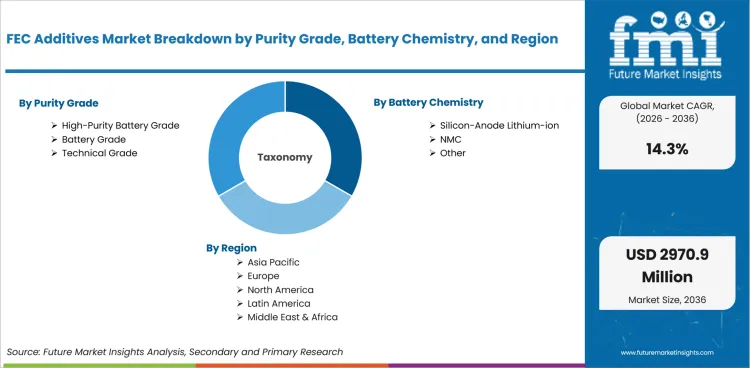
The FEC additives industry value is forecast to grow from USD 682.9 million in 2025 and USD 780.6 million in 2026 to USD 2,970.9 million by 2036, reflecting a 14.3% CAGR from 2026 to 2036. High-Purity Battery Grade is forecast to represent 48.0% share in 2026 because cell makers screen moisture and metal impurities before electrolyte approval. EV Batteries are projected to hold 62.0% share in 2026 as large-format cells convert qualified formulas into recurring supply.
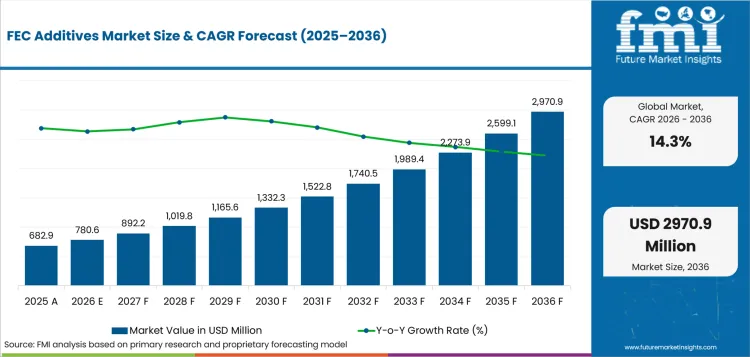
FEC Additives Market Overview: Size and Forecast
- 2025 Market Size: USD 682.9 million
- 2026 Market Size: USD 780.6 million
- 2036 Market Size: USD 2,970.9 million
- Forecast CAGR: 14.3% from 2026 to 2036
- Leading Purity Grade: High-Purity Battery Grade
- High-Purity Battery Grade Share in 2026: 48.0%
- Leading Application: EV Batteries
- EV Batteries Share in 2026: 62.0%
- Fastest-growing Country: China
- China Forecast CAGR: 15.6% from 2026 to 2036
Summary of the FEC Additives Market
- Demand and Growth Drivers
- Silicon-anode qualification is expected to create direct FEC use because expanding anodes require more stable interphase control.
- EV pack volume is projected to support recurring additive demand after cell makers approve final electrolyte formulas.
- Direct technical selling is expected to remain important because additive changes require rapid feedback between labs and plants.
- Electrolyte blends are likely to gain share as buyers prefer pre-qualified packages over separate additive mixing.
- Product and Segment View
- High-Purity Battery Grade is projected to account for 48.0% share in 2026 due to strict moisture and metal impurity limits.
- Silicon-Anode Lithium-ion is estimated to hold 42.0% share in 2026 as silicon expansion increases SEI protection needs.
- EV Batteries are forecast to secure 62.0% share in 2026 because large packs require repeatable electrolyte behavior.
- Electrolyte Blends are expected to represent 58.0% share in 2026 as formulators reduce mixing risk for cell makers.
- Direct to Cell Makers is forecast to hold 67.0% share in 2026 because qualification cycles favor direct technical selling.
- Geography and Competitive Outlook
- China is projected to record 15.6% CAGR from 2026 to 2036 with demand anchored in EV and cell manufacturing scale.
- India is expected to advance at 15.2% CAGR from 2026 to 2036 as EV localization and cell projects mature.
- South Korea is forecast to rise at 14.8% CAGR from 2026 to 2036 through global electrolyte support from Korean suppliers.
- Capchem and Tinci Materials compete through scale and electrolyte integration in China.
- Mitsubishi Chemical, Enchem, and Soulbrain compete through formulation credibility and cell-maker access.
- Analyst Opinion
- Nikhil Kaitwade, Associate Vice President at FMI, observes, “FEC additives are becoming a qualification market before they become a volume market. Buyers are choosing suppliers able to control trace water, metal ions, fluorinated by-products, and batch behavior inside the electrolyte blend. Suppliers with direct cell-maker access and local blending support should hold the advantage.”
Qualification discipline is the main pressure point for FEC suppliers. IEA reported that global electric car output reached nearly 22 million units in 2025. That production base raises the value of additives that can lower early capacity loss and stabilize silicon-rich anodes. Buyers are therefore comparing impurity limits, blend support, and local response time instead of buying only a molecule name.
The FEC additives market is expected to grow through 2036 as lithium-ion battery makers qualify electrolyte additives for silicon-anode, fast-charge, and high-warranty applications.
Which factors support expansion in the FEC additives market?
Market value is supported by EV cell qualification and high-purity electrolyte requirements.
- EV cell makers are increasing additive validation work as global electric car output reached nearly 22 million units in 2025.
- FEC prices are supported by high-purity requirements because buyers need low moisture before electrolyte approval.
- Silicon-anode battery programs raise FEC consumption because higher silicon loading needs more stable SEI formation, especially when cell makers move from lab blends to warranty-backed EV packs.
- Regional supply planning is becoming more important as China held 60% of global EV battery deployment in 2025.
- Electrolyte blend supply creates pricing power when formulators offer FEC with salts and carbonate solvents.
Why is the FEC additives market growing?
Silicon-rich anodes and fast-charge battery designs are raising demand for electrolyte additives with stronger passivation behavior.
FEC demand is driven by wider lithium and lithium-ion battery electrolyte market as cell makers approve additives inside complete formulations. Silicon-anode commercialization is the clearest technical reason for FEC demand. FEC forms a more protective interphase on silicon-bearing anodes than conventional carbonate-only systems. DOE battery research in 2025 continued to emphasize electrolyte additives and fluorinated electrolytes for high-energy batteries. That evidence supports the shift from catalog purchasing to performance-based qualification.
EV battery scale gives FEC a larger use pool after approval. IEA reported nearly 22 million electric cars produced globally in 2025. Demand for specialty solvents for battery electrolyte blending and the battery electrolytes shows why suppliers compete on blend behavior.
How is the FEC additives market segmented?
The FEC additives industry is segmented by purity grade, battery chemistry, application, supply form, and sales channel.
- High-Purity Battery Grade is projected to secure 48.0% share in 2026 because moisture-sensitive electrolyte use requires tighter impurity control.
- Silicon-Anode Lithium-ion is estimated to account for 42.0% share in 2026 as silicon expansion increases passivation stress.
- EV Batteries are forecast to hold 62.0% share in 2026 because automotive packs turn qualified additives into recurring supply.
- Electrolyte Blends are expected to capture 58.0% share in 2026 since cell makers prefer pre-qualified packages.
- Direct to Cell Makers is projected to represent 67.0% share in 2026 because lab and plant feedback must move quickly.
Why does High-Purity Battery Grade dominate the FEC additives market?
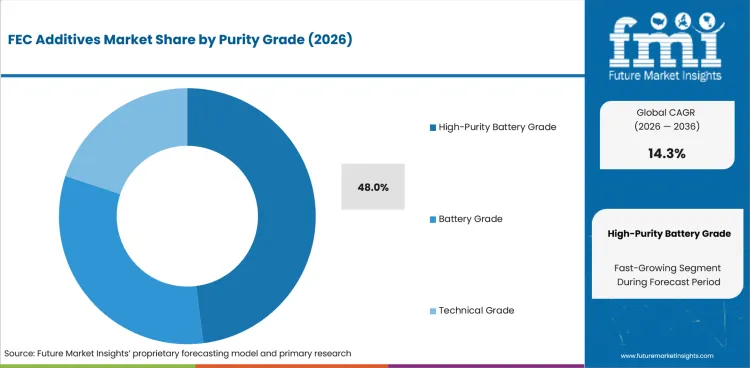
- High-Purity Battery Grade is projected to account for 48.0% share in 2026 because cell makers apply strict water thresholds.
- Technical Grade remains useful for trials but scale supply shifts to battery-grade material after electrolyte specifications are frozen.
Which battery chemistry leads the FEC additives market?
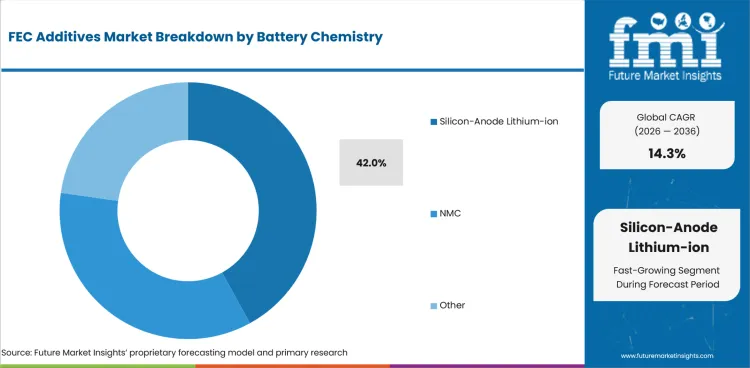
- Silicon-Anode Lithium-ion is estimated to account for 42.0% share in 2026 as FEC stabilizes expanding silicon-rich anodes.
- NMC programs use FEC with co-additives when cathode stability and anode passivation must be balanced together.
Which application leads the FEC additives market?
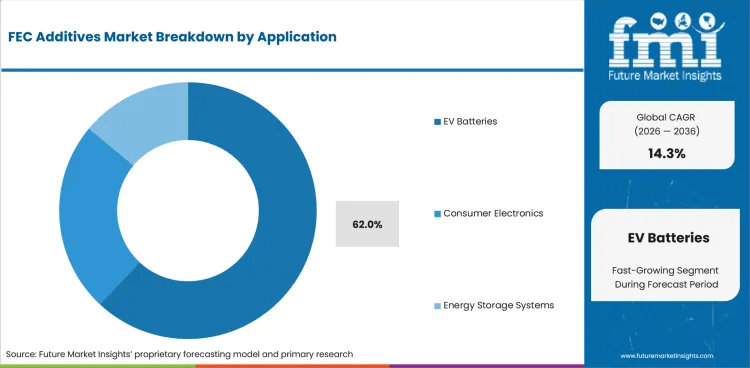
- EV Batteries are anticipated to hold 62.0% share in 2026 as large pack volumes convert qualified formulas into recurring supply.
- Consumer electronics buyers qualify smaller batches faster but automotive warranty exposure gives EV cell makers stronger influence.
Which supply form leads the FEC additives market?
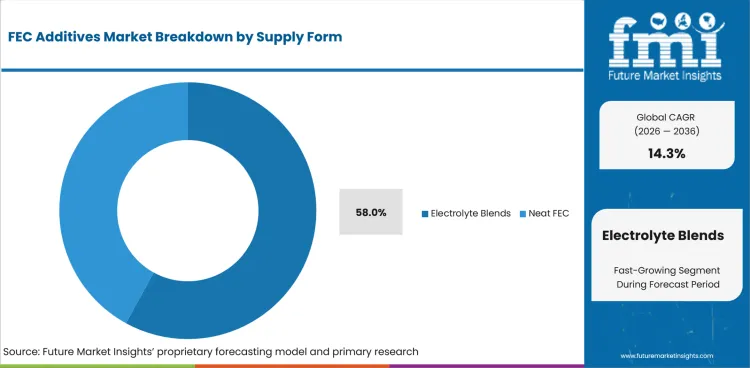
- Electrolyte Blends are expected to represent 58.0% share in 2026 because buyers reduce mixing error and approval time.
- Neat FEC remains important for large formulators that control final solvent ratios and co-additive interactions.
Which sales channel leads the FEC additives market?
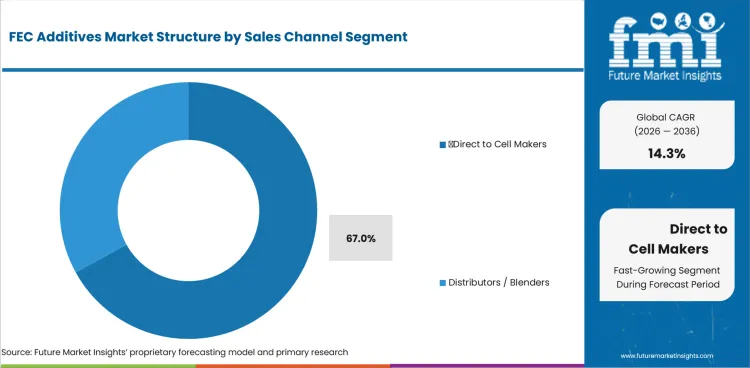
- Direct to Cell Makers is projected to account for 67.0% share in 2026 because approval cycles need rapid technical feedback.
- Distributors and blenders remain relevant for pilot lines and smaller regional customers that lack in-house formulation capacity.
What are the drivers, restraints, and opportunities in the FEC additives market?
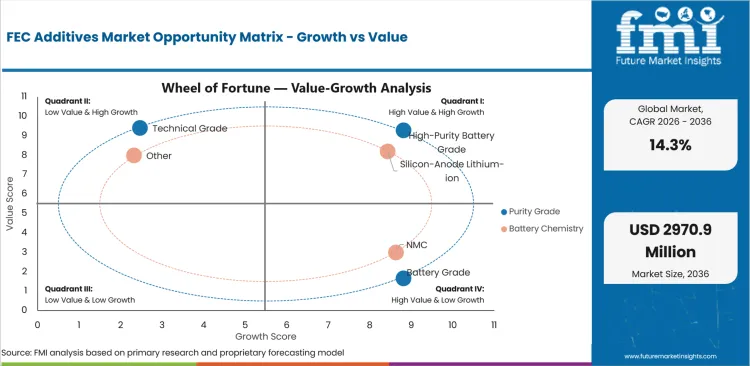
Silicon-anode qualification and EV battery scale support growth while fluorinated feedstock risk limits faster supplier entry.
- Silicon-rich anodes increase electrolyte decomposition risk, so cell makers use FEC to stabilize SEI formation and reduce early-cycle capacity loss.
- Fast-charge warranties push premium EV cell programs to qualify additives that protect cycle life, heat behavior, and customer claims under aggressive charging conditions.
- Local electrolyte blending shortens qualification cycles because formulators can adjust additive dosage near cell plants and resolve technical issues faster.
- Fluorinated chemical handling raises entry barriers because new producers need dedicated safety systems, waste treatment, and trained operators before commercial supply can scale.
- Fluorinated intermediate price swings can make buyers delay orders until cell-validation results and supply contracts justify higher additive exposure.
FEC Additives Market Demand Outlook
Demand outlook is moving toward qualified electrolyte packages that combine FEC with solvents, salts, and co-additives. The main commercial issue is not only additive availability. It is whether suppliers can document purity and repeat batch behavior during cell validation.
Consumer Segmentation and Purchase Behavior Analysis
Battery cell makers and electrolyte formulators form the main buyer pool for FEC additives. EV programs need repeated lot approval because pack warranties can expose formulation defects years after launch. Research buyers purchase smaller quantities but help suppliers enter early chemistry trials.
Which countries are growing fastest in the FEC additives market?
United States 13.8% CAGR, United Kingdom 12.6% CAGR, Germany 13.4% CAGR, France 13.1% CAGR, Japan 12.8% CAGR, China 15.6% CAGR, South Korea 14.8% CAGR, India 15.2% CAGR from 2026 to 2036.
.webp "Top Country Growth Comparison Fec Additives Market Cagr (2026 2036)")
| Country | CAGR |
|---|---|
| United States | 13.8% |
| United Kingdom | 12.6% |
| Germany | 13.4% |
| France | 13.1% |
| Japan | 12.8% |
| China | 15.6% |
| South Korea | 14.8% |
| India | 15.2% |
Source: Future Market Insights, 2026.
How do country-level CAGRs compare in the FEC additives market?
China leads selected country growth while the United Kingdom records the most cautious expansion outlook among profiled markets.
- United States is forecast to record 13.8% CAGR from 2026 to 2036 through domestic cell qualification and local electrolyte support.
- United Kingdom is forecast to record 12.6% CAGR from 2026 to 2036 through EV demand and pilot-scale battery development.
- Germany is forecast to record 13.4% CAGR from 2026 to 2036 through automotive validation and European blend support.
- France is forecast to record 13.1% CAGR from 2026 to 2036 through battery projects and BEV registration demand.
- Japan is forecast to record 12.8% CAGR from 2026 to 2036 through formulation expertise and high-reliability battery demand.
- China is forecast to record 15.6% CAGR from 2026 to 2036 because of cell manufacturing scale and integrated electrolyte suppliers.
- South Korea is forecast to record 14.8% CAGR from 2026 to 2036 supported by global cell-maker expansion and electrolyte supply depth.
- India is forecast to record 15.2% CAGR from 2026 to 2036 supported by EV localization and pilot cell development.
How fast is the FEC additives market growing in United States?
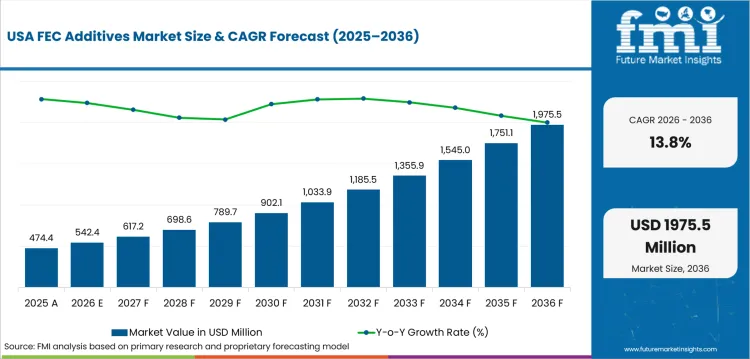
A 13.8% CAGR from 2026 to 2036 reflects that the United States is a qualification-led market where local validation support can matter as much as additive price.
Country Market Snapshot Table
| Parameter | Value |
|---|---|
| Market Size in 2025 (Value) | USD 89.6 million |
| Market Size in 2026 (Value) | USD 102.0 million |
| Market Forecast in 2036 (Value) | USD 371.6 million |
| CAGR (2026 to 2036) | 13.8% |
| Years Considered | 2021 to 2036 |
| Base Year | 2025 |
| Forecast Period | 2026 to 2036 |
| Units Considered | Value (USD million) |
| Leading Sub-Region | Michigan, Georgia, Tennessee, Ohio, California, Nevada |
United States FEC Additives Market Outlook
- United States FEC additive demand is shaped by domestic cell qualification and imported electrolyte know-how. Local validation matters because automotive customers need documented lot history before electrolyte changes.
- Suppliers with USA technical teams are expected to gain share in pilot lines and early gigafactory programs. Fluorinated feedstock exposure remains the main sourcing risk.
Key Growth Drivers
- United States cell makers are expected to test more FEC blends because Argonne reported PEVs reached 9.1% of annual passenger vehicle sales in 2025.
- Domestic sourcing programs support additive qualification because the USA battery supply chain pipeline exceeded 1,100 GWh per year in the latest DOE review.
- Michigan and Georgia electrolyte activity is expected to shorten sample feedback for automotive cell customers.
- Premium EV and storage programs are expected to require tighter moisture control for warranty-sensitive electrolyte packages.
Key Restraints
- United States fluorinated additive buyers remain exposed to imported fluorine inputs because USGS reported 100% fluorspar import reliance in 2024.
- Policy shifts after the EV tax-credit rollback are expected to delay some downstream battery material approvals.
- New producers face permitting and waste-control barriers when fluorinated intermediates are handled at scale.
What makes United States unique
The United States is a qualification-led market where local validation support can matter as much as additive price.
Key Companies
- Soulbrain MI
- Enchem America
- Mitsubishi Chemical America
- Capchem USA
- Koura
Sales & Marketing Channels
- Direct sales to battery cell manufacturers
- Technical supply agreements with electrolyte formulators
- Distributor support for pilot lines
- OEM-backed material qualification routes
- University and national laboratory sample channels
Country Segment Breakdown Table
| Segment | Sub-Segments |
|---|---|
| By Purity Grade | Battery Grade · High-Purity Battery Grade · Technical Grade |
| By Battery Chemistry | Silicon-Anode Lithium-ion · NMC · LFP · Other |
| By Application | EV Batteries · Consumer Electronics · Energy Storage Systems · Other |
| By Supply Form | Neat FEC · Electrolyte Blends |
| By Sales Channel | Direct to Cell Makers · Distributors / Blenders |
| Key Sub-Regions Covered, Battery And Electrolyte Clusters | Michigan · Georgia · Tennessee · Ohio · California · Nevada |
Frequently Asked Questions
How fast is United States FEC additives market growing?
Demand in United States is forecast to grow at 13.8% CAGR from 2026 to 2036.
Who leads United States FEC additives market?
Soulbrain MI and Enchem America are among the relevant companies in the local battery material context.
What is driving adoption in United States FEC additives market?
United States cell makers are expected to test more FEC blends because Argonne reported PEVs reached 9.1% of annual passenger vehicle sales in 2025.
How fast is the FEC additives market growing in United Kingdom?
A 12.6% CAGR from 2026 to 2036 reflects that the United Kingdom is a demand-side qualification market with EV pull and limited public evidence of domestic FEC output.
Country Market Snapshot Table
| Parameter | Value |
|---|---|
| Market Size in 2025 (Value) | USD 24.9 million |
| Market Size in 2026 (Value) | USD 28.0 million |
| Market Forecast in 2036 (Value) | USD 91.7 million |
| CAGR (2026 to 2036) | 12.6% |
| Years Considered | 2021 to 2036 |
| Base Year | 2025 |
| Forecast Period | 2026 to 2036 |
| Units Considered | Value (USD million) |
| Leading Sub-Region | West Midlands, North East England, Oxford-Cambridge corridor, Billingham, London |
United Kingdom FEC Additives Market Outlook
- United Kingdom FEC additive demand is tied to EV penetration and pilot-scale battery development. The country has demand pull but limited public evidence of domestic FEC production.
- Imported neat FEC and regional electrolyte blends are expected to remain the practical route. Technical distributors should serve R&D buyers before large cell volumes scale.
Key Growth Drivers
- United Kingdom additive testing is supported by EV uptake because DfT reported 2,012,000 licensed zero-emission vehicles at the end of 2025.
- Battery electrolyte demand is expected to rise because ONS reported 54% of new car registrations were electric vehicles in September 2025.
- The former Mitsubishi Chemical UK electrolyte asset is expected to keep the country connected to Western electrolyte formulation routes.
- Battery pilot projects are expected to require smaller FEC volumes with full impurity and safety documentation.
Key Restraints
- United Kingdom supply scale remains limited because GOV.UK reported up to 56 GWh of planned EV battery capacity so far.
- Limited domestic FEC manufacturing evidence keeps buyers exposed to imported additive lead times.
- Battery developers may defer premium additive use until larger cell contracts become bankable.
What makes United Kingdom unique
The United Kingdom is a demand-side qualification market with EV pull and limited public evidence of domestic FEC output.
Key Companies
- Mitsubishi Chemical UK
- Green E Origin
- Johnson Matthey
- Ilika plc
- Nyobolt
Sales & Marketing Channels
- Distributor sales to research laboratories
- Direct supply to battery pilot lines
- European electrolyte blender channels
- OEM qualification programs
- Specialty chemical importers
Country Segment Breakdown Table
| Segment | Sub-Segments |
|---|---|
| By Purity Grade | Battery Grade · High-Purity Battery Grade · Technical Grade |
| By Battery Chemistry | Silicon-Anode Lithium-ion · NMC · LFP · Other |
| By Application | EV Batteries · Consumer Electronics · Energy Storage Systems · Other |
| By Supply Form | Neat FEC · Electrolyte Blends |
| By Sales Channel | Direct to Cell Makers · Distributors / Blenders |
| Key Sub-Regions Covered, Battery And Electrolyte Clusters | West Midlands · North East England · Oxford-Cambridge corridor · Billingham · London |
Frequently Asked Questions
How fast is United Kingdom FEC additives market growing?
Demand in United Kingdom is forecast to grow at 12.6% CAGR from 2026 to 2036.
Who leads United Kingdom FEC additives market?
Mitsubishi Chemical UK and Green E Origin are among the relevant companies in the local battery material context.
What is driving adoption in United Kingdom FEC additives market?
United Kingdom additive testing is supported by EV uptake because DfT reported 2,012,000 licensed zero-emission vehicles at the end of 2025.
How fast is the FEC additives market growing in Germany?
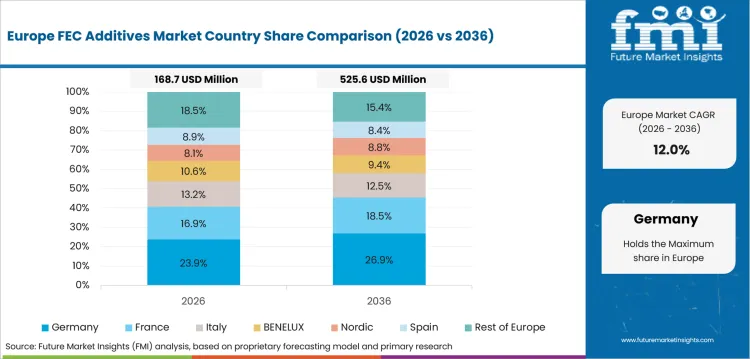
A 13.4% CAGR from 2026 to 2036 reflects that Germany is Europe’s technical buying center for FEC because automotive validation can influence wider regional supplier approval.
Country Market Snapshot Table
| Parameter | Value |
|---|---|
| Market Size in 2025 (Value) | USD 50.3 million |
| Market Size in 2026 (Value) | USD 57.0 million |
| Market Forecast in 2036 (Value) | USD 200.4 million |
| CAGR (2026 to 2036) | 13.4% |
| Years Considered | 2021 to 2036 |
| Base Year | 2025 |
| Forecast Period | 2026 to 2036 |
| Units Considered | Value (USD million) |
| Leading Sub-Region | Stuttgart, Bavaria, Lower Saxony, North Rhine-Westphalia, Berlin-Brandenburg |
Germany FEC Additives Market Outlook
- Germany FEC additive demand is linked to automotive validation standards and European electrolyte localization. Suppliers must document electrochemical behavior before any change reaches production cells.
- Nearby electrolyte capacity is expected to help German buyers reduce qualification delays. Cost pressure in European chemical operations remains a restraint.
Key Growth Drivers
- German validation demand is expected to rise because IEA reported 850,000 electric car sales in 2025.
- German EV demand has a larger base because Destatis reported 380,609 battery-electric car registrations in 2024.
- Automotive cell programs are expected to prefer FEC suppliers with nearby blending and faster technical response.
- Battery trade events in Stuttgart are expected to help additive suppliers meet cell makers and OEM material teams.
Key Restraints
- German electrolyte blending costs face pressure because Eurostat reported non-household electricity prices of EUR 0.2264 per kWh in the second half of 2025.
- Automotive customers often require long validation cycles before changing additive chemistry.
- Domestic FEC producer evidence remains limited compared with China and South Korea.
What makes Germany unique
Germany is Europe’s technical buying center for FEC because automotive validation can influence wider regional supplier approval.
Key Companies
- Capchem Europe
- Mitsubishi Chemical Europe
- LANXESS
- BASF
- Customcells
Sales & Marketing Channels
- Direct automotive cell-maker sales
- Technical seminars and battery trade shows
- European electrolyte blender partnerships
- Specialty chemical distributor supply
- OEM material approval systems
Country Segment Breakdown Table
| Segment | Sub-Segments |
|---|---|
| By Purity Grade | Battery Grade · High-Purity Battery Grade · Technical Grade |
| By Battery Chemistry | Silicon-Anode Lithium-ion · NMC · LFP · Other |
| By Application | EV Batteries · Consumer Electronics · Energy Storage Systems · Other |
| By Supply Form | Neat FEC · Electrolyte Blends |
| By Sales Channel | Direct to Cell Makers · Distributors / Blenders |
| Key Sub-Regions Covered, Battery And Electrolyte Clusters | Stuttgart · Bavaria · Lower Saxony · North Rhine-Westphalia · Berlin-Brandenburg |
Frequently Asked Questions
How fast is Germany FEC additives market growing?
Demand in Germany is forecast to grow at 13.4% CAGR from 2026 to 2036.
Who leads Germany FEC additives market?
Capchem Europe and Mitsubishi Chemical Europe are among the relevant companies in the local battery material context.
What is driving adoption in Germany FEC additives market?
German validation demand is expected to rise because IEA reported 850,000 electric car sales in 2025.
How fast is the FEC additives market growing in France?
A 13.1% CAGR from 2026 to 2036 reflects that France is a project-led market where battery industrial policy can turn imported FEC into regional blend demand.
Country Market Snapshot Table
| Parameter | Value |
|---|---|
| Market Size in 2025 (Value) | USD 33.6 million |
| Market Size in 2026 (Value) | USD 38.0 million |
| Market Forecast in 2036 (Value) | USD 130.1 million |
| CAGR (2026 to 2036) | 13.1% |
| Years Considered | 2021 to 2036 |
| Base Year | 2025 |
| Forecast Period | 2026 to 2036 |
| Units Considered | Value (USD million) |
| Leading Sub-Region | Dunkirk, Hauts-de-France, Auvergne-Rhône-Alpes, Île-de-France, Grand Est |
France FEC Additives Market Outlook
- France FEC additive demand is project-led because battery industrial policy is building new cell and materials ecosystems. Imported additives are expected to feed regional electrolyte blends until local chemical capacity deepens.
- Dunkirk battery activity can convert qualification work into recurring demand if cell plants approve FEC-containing blends. Supplier selection will depend on documentation and delivery reliability.
Key Growth Drivers
- French buyer interest is supported by EV registrations because EAFO reported 363,130 BEVs in France in 2025.
- Electrolyte demand is expected to track fleet charging buildout because France had 163,656 public charging points on March 31, 2025.
- Dunkirk battery projects are expected to raise local need for qualified electrolyte additives and technical sampling.
- European supply-chain rules are expected to increase documentation demand for battery material origin and compliance.
Key Restraints
- French premium additive uptake faces cost pressure because Eurostat reported electricity prices of EUR 0.2059 per kWh in the second half of 2025.
- Domestic FEC production evidence remains thin outside broader electrolyte and battery project plans.
- Project timing can delay material purchases when gigafactory commissioning schedules move.
What makes France unique
France is a project-led market where battery industrial policy can turn imported FEC into regional blend demand.
Key Companies
- Verkor
- Blue Solutions
- Forsee Power
- Enchem France
- Arkema
Sales & Marketing Channels
- Direct sales to gigafactory procurement teams
- European chemical distributors
- Electrolyte blender partnerships
- Government-backed industrial project channels
- Automotive OEM qualification routes
Country Segment Breakdown Table
| Segment | Sub-Segments |
|---|---|
| By Purity Grade | Battery Grade · High-Purity Battery Grade · Technical Grade |
| By Battery Chemistry | Silicon-Anode Lithium-ion · NMC · LFP · Other |
| By Application | EV Batteries · Consumer Electronics · Energy Storage Systems · Other |
| By Supply Form | Neat FEC · Electrolyte Blends |
| By Sales Channel | Direct to Cell Makers · Distributors / Blenders |
| Key Sub-Regions Covered, Battery And Electrolyte Clusters | Dunkirk · Hauts-de-France · Auvergne-Rhône-Alpes · Île-de-France · Grand Est |
Frequently Asked Questions
How fast is France FEC additives market growing?
Demand in France is forecast to grow at 13.1% CAGR from 2026 to 2036.
Who leads France FEC additives market?
Verkor and Blue Solutions are among the relevant companies in the local battery material context.
What is driving adoption in France FEC additives market?
French buyer interest is supported by EV registrations because EAFO reported 363,130 BEVs in France in 2025.
How fast is the FEC additives market growing in Japan?
A 12.8% CAGR from 2026 to 2036 reflects that Japan is a technology-influence market where formulation credibility can outweigh domestic EV volume.
Country Market Snapshot Table
| Parameter | Value |
|---|---|
| Market Size in 2025 (Value) | USD 55.9 million |
| Market Size in 2026 (Value) | USD 63.0 million |
| Market Forecast in 2036 (Value) | USD 210.1 million |
| CAGR (2026 to 2036) | 12.8% |
| Years Considered | 2021 to 2036 |
| Base Year | 2025 |
| Forecast Period | 2026 to 2036 |
| Units Considered | Value (USD million) |
| Leading Sub-Region | Kansai, Chubu, Kanto, Kyushu, Shikoku |
Japan FEC Additives Market Outlook
- Japan FEC additive demand is shaped by formulation know-how rather than domestic EV volume alone. Established chemical suppliers influence high-reliability electrolyte design for lithium-ion batteries.
- The market is expected to favor high-purity additives and long validation cycles. Hybrid preference remains the main restraint on domestic EV-linked volume growth.
Key Growth Drivers
- Japanese high-grade electrolyte work is supported by industrial policy because METI set a 150 GWh per year domestic battery production target for 2030.
- Electrolyte suppliers can target high-reliability cells because IEA reported Japan electric car sales just above 100,000 in 2025.
- Established chemical firms are expected to support interface-control formulations for consumer electronics and automotive cells.
- Long-life battery customers are expected to value FEC purity and co-additive behavior over low spot pricing.
Key Restraints
- Japan volume growth is restrained because the USA International Trade Administration reported EVs were 1.35% of new vehicle sales in 2024.
- Conservative qualification culture can lengthen approval timelines for new additive suppliers.
- Hybrid strength can delay larger domestic FEC demand from battery-electric platforms.
What makes Japan unique
Japan is a technology-influence market where formulation credibility can outweigh domestic EV volume.
Key Companies
- Mitsubishi Chemical
- MU Ionic Solutions
- UBE Corporation
- Tomiyama Pure Chemical
- Panasonic Energy
Sales & Marketing Channels
- Direct supply to cell makers
- Electronics battery material channels
- Technical sampling through chemical distributors
- Joint formulation programs
- OEM battery qualification routes
Country Segment Breakdown Table
| Segment | Sub-Segments |
|---|---|
| By Purity Grade | Battery Grade · High-Purity Battery Grade · Technical Grade |
| By Battery Chemistry | Silicon-Anode Lithium-ion · NMC · LFP · Other |
| By Application | EV Batteries · Consumer Electronics · Energy Storage Systems · Other |
| By Supply Form | Neat FEC · Electrolyte Blends |
| By Sales Channel | Direct to Cell Makers · Distributors / Blenders |
| Key Sub-Regions Covered, Battery And Electrolyte Clusters | Kansai · Chubu · Kanto · Kyushu · Shikoku |
Frequently Asked Questions
How fast is Japan FEC additives market growing?
Demand in Japan is forecast to grow at 12.8% CAGR from 2026 to 2036.
Who leads Japan FEC additives market?
Mitsubishi Chemical and MU Ionic Solutions are among the relevant companies in the local battery material context.
What is driving adoption in Japan FEC additives market?
Japanese high-grade electrolyte work is supported by industrial policy because METI set a 150 GWh per year domestic battery production target for 2030.
How fast is the FEC additives market growing in China?
A 15.6% CAGR from 2026 to 2036 reflects that China is the only selected country with both the largest demand pool and a deep supplier base for electrolyte additives.
Country Market Snapshot Table
| Parameter | Value |
|---|---|
| Market Size in 2025 (Value) | USD 255.2 million |
| Market Size in 2026 (Value) | USD 295.0 million |
| Market Forecast in 2036 (Value) | USD 1,257.2 million |
| CAGR (2026 to 2036) | 15.6% |
| Years Considered | 2021 to 2036 |
| Base Year | 2025 |
| Forecast Period | 2026 to 2036 |
| Units Considered | Value (USD million) |
| Leading Sub-Region | Guangdong, Jiangsu, Zhejiang, Sichuan, Shanghai, Fujian |
China FEC Additives Market Outlook
- China FEC additive demand is anchored by the world’s largest EV and battery production base. Integrated electrolyte suppliers can convert qualification into high recurring volumes faster than import-dependent markets.
- Price pressure remains intense because cell makers demand both scale and lower material cost. Suppliers with fluorinated chemistry depth should defend share through purity and blend control.
Key Growth Drivers
- Chinese demand is expected to lead FEC consumption because SCIO reported 16.626 million NEV units produced in 2025.
- Recurring additive volumes are supported because the State Council projected NEV sales at around 15.5 million units in 2025.
- Integrated electrolyte producers are expected to reduce sourcing friction for major cell manufacturers.
- Silicon-anode and fast-charge programs are expected to raise need for high-purity additive packages.
Key Restraints
- Chinese supplier margins face pressure because IEA reported LFP batteries held over 55% of EV battery deployment in 2025.
- Export customers may require extra documentation on quality systems and fluorinated chemical controls.
- Overseas trade rules can slow shipment planning for battery materials and EV supply chains.
What makes China unique
China is the only selected country with both the largest demand pool and a deep supplier base for electrolyte additives.
Key Companies
- Capchem
- Tinci Materials
- Zhangjiagang Guotai Huarong
- Fujian Blue Ocean
- Shanshan
Sales & Marketing Channels
- Direct contracts with cell makers
- Electrolyte blender supply
- Battery material distributor networks
- OEM qualification programs
- Export channels to Europe and Asia
Country Segment Breakdown Table
| Segment | Sub-Segments |
| By Purity Grade | Battery Grade · High-Purity Battery Grade · Technical Grade |
| By Battery Chemistry | Silicon-Anode Lithium-ion · NMC · LFP · Other |
| By Application | EV Batteries · Consumer Electronics · Energy Storage Systems · Other |
| By Supply Form | Neat FEC · Electrolyte Blends |
| By Sales Channel | Direct to Cell Makers · Distributors / Blenders |
| Key Sub-Regions Covered, Battery And Electrolyte Clusters | Guangdong · Jiangsu · Zhejiang · Sichuan · Shanghai · Fujian |
Frequently Asked Questions
How fast is China FEC additives market growing?
Demand in China is forecast to grow at 15.6% CAGR from 2026 to 2036.
Who leads China FEC additives market?
Capchem and Tinci Materials are among the relevant companies in the local battery material context.
What is driving adoption in China FEC additives market?
Chinese demand is expected to lead FEC consumption because SCIO reported 16.626 million NEV units produced in 2025.
How fast is the FEC additives market growing in South Korea?
A 14.8% CAGR from 2026 to 2036 reflects that South Korea links additive demand to global cell-maker expansion rather than only domestic vehicle sales.
Country Market Snapshot Table
| Parameter | Value |
|---|---|
| Market Size in 2025 (Value) | USD 74.9 million |
| Market Size in 2026 (Value) | USD 86.0 million |
| Market Forecast in 2036 (Value) | USD 341.9 million |
| CAGR (2026 to 2036) | 14.8% |
| Years Considered | 2021 to 2036 |
| Base Year | 2025 |
| Forecast Period | 2026 to 2036 |
| Units Considered | Value (USD million) |
| Leading Sub-Region | Ulsan, Chungcheong, Gyeonggi, Pohang, Jeonbuk |
South Korea FEC Additives Market Outlook
- South Korea FEC additive demand follows Korean cell makers into overseas battery plants. Electrolyte suppliers influence specifications across Korea and export markets.
- The market is expected to value low-moisture processing and global customer support. Domestic vehicle demand is smaller than China but supplier influence is larger than local sales alone.
Key Growth Drivers
- South Korean EV material demand is supported by policy because USA International Trade Administration projected EVs at 20% of total sales by the end of 2025.
- Battery material exports support additive relevance because MOTIE reported secondary battery exports of USD 0.9 billion in March 2026.
- Korean cell makers are expected to require approved electrolyte packages across overseas gigafactories.
- Electrolyte suppliers with global plants are expected to support localized delivery for customer qualification.
Key Restraints
- South Korean suppliers face transparency pressure because KFTC imposed an 11.2 billion won penalty over misleading EV battery information in March 2026.
- Domestic EV demand alone cannot absorb large additive volumes for Korean electrolyte producers.
- Export-oriented battery material suppliers face shifting trade and local-content rules in customer markets.
What makes South Korea unique
South Korea links additive demand to global cell-maker expansion rather than only domestic vehicle sales.
Key Companies
- Enchem
- Soulbrain
- LG Energy Solution
- Samsung SDI
- SK On
Sales & Marketing Channels
- Direct cell-maker contracts
- Overseas plant supply agreements
- Technical co-development with battery producers
- Electrolyte blend supply
- Battery material export channels
Country Segment Breakdown Table
| Segment | Sub-Segments |
|---|---|
| By Purity Grade | Battery Grade · High-Purity Battery Grade · Technical Grade |
| By Battery Chemistry | Silicon-Anode Lithium-ion · NMC · LFP · Other |
| By Application | EV Batteries · Consumer Electronics · Energy Storage Systems · Other |
| By Supply Form | Neat FEC · Electrolyte Blends |
| By Sales Channel | Direct to Cell Makers · Distributors / Blenders |
| Key Sub-Regions Covered, Battery And Electrolyte Clusters | Ulsan · Chungcheong · Gyeonggi · Pohang · Jeonbuk |
Frequently Asked Questions
How fast is South Korea FEC additives market growing?
Demand in South Korea is forecast to grow at 14.8% CAGR from 2026 to 2036.
Who leads South Korea FEC additives market?
Enchem and Soulbrain are among the relevant companies in the local battery material context.
What is driving adoption in South Korea FEC additives market?
South Korean EV material demand is supported by policy because USA International Trade Administration projected EVs at 20% of total sales by the end of 2025.
How fast is the FEC additives market growing in India?
A 15.2% CAGR from 2026 to 2036 reflects that India offers high future growth but starts from a supply-chain development stage rather than a broad electrolyte manufacturing base.
Country Market Snapshot Table
| Parameter | Value |
|---|---|
| Market Size in 2025 (Value) | USD 26.9 million |
| Market Size in 2026 (Value) | USD 31.0 million |
| Market Forecast in 2036 (Value) | USD 127.6 million |
| CAGR (2026 to 2036) | 15.2% |
| Years Considered | 2021 to 2036 |
| Base Year | 2025 |
| Forecast Period | 2026 to 2036 |
| Units Considered | Value (USD million) |
| Leading Sub-Region | Gujarat, Tamil Nadu, Karnataka, Maharashtra, Telangana, Uttar Pradesh |
India FEC Additives Market Outlook
- India FEC additive demand is at an early localization stage. Imported additives and distributor-led sampling are expected to serve pilot cells before domestic electrolyte capacity broadens.
- Two-wheeler electrification creates a large downstream battery pool but premium additive use will depend on cell chemistry and cost targets. High-purity FEC supply is likely to remain import-dependent in the near term.
Key Growth Drivers
- Indian battery-material demand is supported by EV uptake because NITI Aayog reported EV sales rose to 2.08 million in 2024.
- Charging and fleet programs support cell localization because PIB reported 29,277 public EV charging stations as of August 2025.
- Battery manufacturing incentives are expected to raise demand for qualified electrolyte inputs.
- Specialty distributors are expected to support early FEC trials for Indian cell developers.
Key Restraints
- India remains cost sensitive because the Ministry of Heavy Industries reported 10,10,101 electric two-wheeler registrations under PM E-DRIVE in FY 2024-25.
- Local high-purity FEC production evidence is limited in public sources.
- Pack makers may delay premium additive use in low-cost segments until warranty benefits are proven.
What makes India unique
India offers high future growth but starts from a supply-chain development stage rather than a broad electrolyte manufacturing base.
Key Companies
- Amara Raja Advanced Cell Technologies
- Exide Energy Solutions
- Tata Chemicals
- Neogen Chemicals
- Epsilon Advanced Materials
Sales & Marketing Channels
- Importer-led specialty chemical supply
- Distributor sales to battery laboratories
- Direct supply to cell pilot lines
- Government-linked battery manufacturing channels
- OEM and pack-maker qualification routes
Country Segment Breakdown Table
| Segment | Sub-Segments |
|---|---|
| By Purity Grade | Battery Grade · High-Purity Battery Grade · Technical Grade |
| By Battery Chemistry | Silicon-Anode Lithium-ion · NMC · LFP · Other |
| By Application | EV Batteries · Consumer Electronics · Energy Storage Systems · Other |
| By Supply Form | Neat FEC · Electrolyte Blends |
| By Sales Channel | Direct to Cell Makers · Distributors / Blenders |
| Key Sub-Regions Covered, Battery And Electrolyte Clusters | Gujarat · Tamil Nadu · Karnataka · Maharashtra · Telangana · Uttar Pradesh |
Frequently Asked Questions
How fast is India FEC additives market growing?
Demand in India is forecast to grow at 15.2% CAGR from 2026 to 2036.
Who leads India FEC additives market?
Amara Raja Advanced Cell Technologies and Exide Energy Solutions are among the relevant companies in the local battery material context.
What is driving adoption in India FEC additives market?
Indian battery-material demand is supported by EV uptake because NITI Aayog reported EV sales rose to 2.08 million in 2024.
How do top FEC additives companies compare?
| Company | FEC Purity Control | Electrolyte Formulation Depth | Cell-Maker Qualification Access | Geographic Footprint |
|---|---|---|---|---|
| Capchem | High | High | Strong | Global |
| Tinci Materials | High | High | Strong | China and global |
| Mitsubishi Chemical | High | High | Strong | Japan, Europe, and North America |
| Enchem | Medium | High | Strong | Korea, China, Europe, and United States |
| Soulbrain | Medium | High | Strong | Korea and United States |
| UBE Corporation | Medium | Medium | Moderate | Japan and global |
| Zhangjiagang Guotai Huarong | Medium | Medium | Moderate | China and export markets |
| Koura | Low | Medium | Moderate | North America and global |
Source: Future Market Insights competitive analysis, 2026.
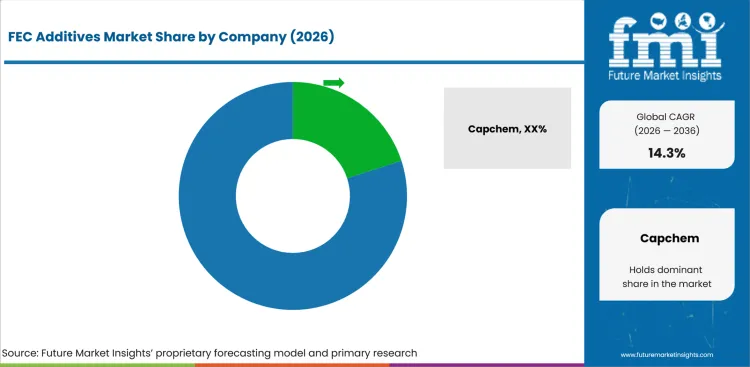
Integrated electrolyte formulators hold the strongest position because they can supply FEC inside complete electrolyte packages. Capchem and Tinci Materials benefit from China scale and direct access to cell makers. Mitsubishi Chemical, Enchem, and Soulbrain compete through formulation support and qualified customer relationships.
Competition is connected to the lithium-ion battery market because cell output controls additive pull. Adjacent work in fluorine-free battery electrolytes can influence substitution risk. The electric vehicle battery market sets the downstream qualification path for electrolyte suppliers.
Key Developments in FEC Additives Market
- In October 2024, Capchem reported that its Poland lithium battery electrolyte capacity of 40,000 tons per year had entered production.
- In May 2025, Capchem attended CIBF2025 with battery chemical products including electrolytes, lithium salts, solvents, and additives.
- In December 2025, Mitsubishi Chemical agreed to transfer USA and UK lithium-ion battery electrolyte manufacturing assets to Green E Origin.
Key Players in the FEC Additives Market
Integrated Electrolyte Formulators
- Capchem
- Tinci Materials
- Mitsubishi Chemical
- Enchem
- Soulbrain
Fluorine-Chain and Material Suppliers
- Koura
- UBE Corporation
- Zhangjiagang Guotai Huarong
Regional Blenders and Distributors
- Fujian Blue Ocean
- TCI Chemicals
FEC Additives Market - Scope & Definition
| Attribute | Detail |
|---|---|
| Market Definition | Fluorinated ethylene carbonate additives used as functional electrolyte components in lithium-ion and adjacent rechargeable battery systems. |
| Functions Covered | Solid-electrolyte interphase support, gas suppression, cycle-life protection, silicon-anode stabilization, fast-charge electrolyte support. |
| Applications Covered | EV batteries, consumer electronics cells, energy storage systems, and pilot-line battery development. |
| End-Use Industries | Battery materials, electric vehicles, consumer electronics, stationary energy storage, and electrolyte formulation. |
| Grades Covered | Battery grade, high-purity battery grade, and technical grade FEC formats. |
| Inclusions | Commercially traded neat FEC, high-purity FEC, technical-grade FEC, and electrolyte blends containing FEC across selected applications and countries. |
| Exclusions | Finished battery packs, base carbonate solvents without FEC, lithium salts sold alone, cathode powders, anode powders, separator coatings, and non-battery fluorinated chemicals. |
FEC Additives Market - Research Methodology
| Method | Description |
|---|---|
| Primary Research | FMI analyst interviews with electrolyte formulators, battery material suppliers, cell makers, distributors, and technical buyers across key markets. |
| Desk Research | Review of EV production data, battery deployment, government statistics, company releases, patents, and technical literature on electrolyte additives. |
| Market Sizing & Forecasting | Bottom-up model using additive consumption intensity, cell chemistry mix, purity pricing, supply form, and country-level electrolyte localization. |
| Data Validation | Cross-verification using battery deployment, electrolyte supplier portfolios, capacity announcements, battery chemistry trends, and buyer qualification behavior. |
FEC Additives Market - Report Scope
| Parameter | Details |
|---|---|
| Forecast period | 2026 to 2036 |
| Historical period | 2021 to 2025 |
| Quantitative unit | Revenue in USD million |
| By purity grade | Battery grade, high-purity battery grade, technical grade |
| By battery chemistry | Silicon-anode lithium-ion, NMC, LFP, other |
| By application | EV batteries, consumer electronics, energy storage systems, other |
| By supply form | Neat FEC, electrolyte blends |
| By sales channel | Direct to cell makers, distributors / blenders |
| Regions covered | North America, Western Europe, East Asia, South Asia and Pacific |
| Countries covered | United States, United Kingdom, Germany, France, Japan, China, South Korea, India |
| Key companies profiled | Capchem, Tinci Materials, Mitsubishi Chemical, UBE Corporation, Soulbrain, Enchem, Koura |
| Approach | Bottom-up product-boundary approach using electrolyte consumption, cell chemistry mix, purity pricing, supply form, and country-level demand |
Source: Future Market Insights, 2026.
FEC Additives Market Breakdown by Purity Grade, Battery Chemistry, Application, Supply Form, Sales Channel, and Region
FEC Additives Market Segmented by Purity Grade
- Battery Grade
- High-Purity Battery Grade
- Technical Grade
FEC Additives Market Segmented by Battery Chemistry
- Silicon-Anode Lithium-ion
- NMC
- LFP
- Other
FEC Additives Market Segmented by Application
- EV Batteries
- Consumer Electronics
- Energy Storage Systems
- Other
FEC Additives Market Segmented by Supply Form
- Neat FEC
- Electrolyte Blends
FEC Additives Market Segmented by Sales Channel
- Direct to Cell Makers
- Distributors / Blenders
FEC Additives Market by Region
- North America
- United States
- Canada
- Europe
- Germany
- United Kingdom
- France
- Italy
- Spain
- Asia Pacific
- China
- Japan
- South Korea
- Taiwan
- Singapore
- Latin America
- Brazil
- Mexico
- Argentina
- Middle East & Africa
- GCC Countries
- South Africa
- Israel
Research Sources and Bibliography
1. International Energy Agency. (2026, May 20). Global EV Outlook 2026. International Energy Agency.
2. International Energy Agency. (2026, May 20). Trends in electric cars. International Energy Agency.
3. International Energy Agency. (2026, May 20). Electric vehicle batteries. International Energy Agency.
4. International Energy Agency. (2026, May 20). Trends in batteries. International Energy Agency.
5. International Energy Agency. (2026, May 20). Manufacturing and trade. International Energy Agency.
6. USA Department of Energy. (2024, December). 2021-2024 four-year review of supply chains for the advanced batteries sector. USA Department of Energy.
7. Argonne National Laboratory. (2026, March 25). Light duty electric drive vehicles monthly sales updates. Argonne National Laboratory.
8. USA Geological Survey. (2026, February). Mineral Commodity Summaries 2026. USA Geological Survey.
9. Department for Transport. (2026, April 29). Vehicle licensing statistics, United Kingdom: 2025. Government of the United Kingdom.
10. Office for National Statistics. (2025, November 6). Economic activity and social change in the UK, real-time indicators. Office for National Statistics.
11. Government of the United Kingdom. (2026, May 8). Invest 2035: The UK’s modern industrial strategy. GOV.UK.
12. European Alternative Fuels Observatory. (2026, January 21). France’s EV market in 2025: Renewed momentum and growing fleet. European Commission.
13. European Alternative Fuels Observatory. (2025, May). Germany: BEV registrations surge by 54% in April 2025. European Commission.
14. Federal Statistical Office of Germany. (2025). Electric cars: Low number of new registrations in Germany. Destatis.
15. Federal Statistical Office of Germany. (2026, June 19). Producer prices in May 2026: +2.2% on May 2025. Destatis.
16. Eurostat. (2026, June). Electricity price statistics. European Commission.
17. Ministry of Economy, Trade and Industry. (2025, August). Strategic Energy Plan. Government of Japan.
18. USA International Trade Administration. (2025, July). Japan electric vehicles market. USA International Trade Administration.
19. Japan Automobile Manufacturers Association. (2025, September 26). The Motor Industry of Japan 2025. Japan Automobile Manufacturers Association.
20. State Council of the People’s Republic of China. (2025, September 13). China sets 2025 auto sales target at 32.3 million units. Government of China.
21. State Council Information Office. (2026, January 15). China’s auto output and sales reach new highs in 2025. Government of China.
22. USA International Trade Administration. (2025, July 21). South Korea electric vehicles EV market. USA International Trade Administration.
23. Ministry of Trade, Industry and Energy. (2026, April 1). March 2026 exports reach record USD 86.1 billion. Government of South Korea.
24. Korea Fair Trade Commission. (2026, March 10). Sanctions against Mercedes-Benz’s improper customer inducement act. Government of South Korea.
25. NITI Aayog. (2025, August 4). Unlocking a USD 200 billion opportunity: Electric vehicles in India. Government of India.
26. Press Information Bureau. (2025, August 1). EV charging stations installed across the country. Government of India.
27. Ministry of Heavy Industries. (2025, April 1). The Ministry of Heavy Industries has successfully achieved sales of more than one million EVs in FY 2024-25. Government of India.
28. USA Department of Energy. (2025, January). Battery R&D. USA Department of Energy.
29. Capchem. (2024, October 11). Capchem attended The Battery Show North America 2024. Capchem.
30. Capchem. (2025, May 23). Capchem attended CIBF2025 with battery chemical technologies. Capchem.
31. Capchem. (2025, June 4). Capchem shines at The Battery Show Europe 2025. Capchem.
32. Mitsubishi Chemical Group. (2025, December 12). Transfer of electrolyte manufacturing assets in the United States and the United Kingdom. Mitsubishi Chemical Group.
33. Royal Society of Chemistry. (2024). A multi-functional electrolyte additive for fast-charging and flame-retardant lithium-ion batteries. Journal of Materials Chemistry A.
This Report Answers
- Market size estimates for 2026 and forecasts through 2036 for the FEC additives market.
- Segment-level demand analysis covering purity grade, chemistry, application, supply form, and sales channel.
- Country-level growth analysis covering the United States, United Kingdom, Germany, France, Japan, China, South Korea, and India.
- Competitive positioning of integrated electrolyte formulators and fluorine-chain material suppliers.
- Source-backed analysis of EV battery demand, electrolyte qualification, and fluorinated input restraints.
Frequently Asked Questions
What is the growth prospect for FEC additives?
FEC additives are forecast to grow at 14.3% CAGR from 2026 to 2036.
Which companies are expected to shape the FEC additives market?
Capchem, Tinci Materials, Mitsubishi Chemical, Enchem, and Soulbrain are expected to shape supplier competition.
Why are cell makers qualifying FEC additives?
Cell makers qualify FEC additives to improve interphase stability in silicon-rich and fast-charge lithium-ion cells.
Which application leads FEC additive demand?
EV batteries lead demand because large-format packs convert qualified electrolyte formulas into recurring supply.
Why is impurity control important in FEC additives?
Impurity control matters because trace water and metals can change gas formation, impedance, and cycle behavior.
Which country is growing fastest in the selected country group?
China is the fastest-growing selected country with a 15.6% CAGR through 2036.
What is included in the FEC additives market?
The market includes neat FEC, battery-grade FEC, high-purity FEC, technical-grade FEC, and FEC-containing electrolyte blends.
What limits wider FEC additive supplier entry?
Fluorinated chemistry handling, waste treatment, purity control, and cell-maker validation requirements limit wider entry.
How are electrolyte blends affecting FEC demand?
Electrolyte blends are raising supplier value because buyers want pre-qualified packages with documented performance behavior.
How does FMI size the FEC additives market?
FMI sizes the market using additive intensity, cell chemistry mix, purity pricing, supply form, and country demand indicators.
Preview the report firsthand - request a free sample
Get SampleGet the brochure for pricing and purchase details.
Get PDFTable of Content
- Key Takeaways
- Market Size and CAGR
- Top Growth Driver
- Fastest Growing Segment
- Leading Region
- Key Companies
- Emerging Opportunities
- Executive Summary
- Global Market Outlook
- Demand-side Trends
- Supply-side Trends
- Technology Roadmap Analysis
- Analysis and Recommendations
- Analyst Perspective (What is happening? Why now? What should investors know?)
- Key Questions Answered
- How large is the market?
- What is the CAGR?
- What are key trends?
- Which region dominates?
- Who are the leaders?
- Market Overview
- Market Coverage / Taxonomy
- Market Definition / Scope / Limitations
- Research Methodology
- Chapter Orientation
- Analytical Lens and Working Hypotheses
- Market Structure, Signals, and Trend Drivers
- Benchmarking and Cross-market Comparability
- Market Sizing, Forecasting, and Opportunity Mapping
- Research Design and Evidence Framework
- Desk Research Programme (Secondary Evidence)
- Expert Input and Fieldwork (Primary Evidence)
- Tooling, Models, and Reference Databases
- Data Engineering and Model Build
- Quality Assurance and Audit Trail
- Market Background
- Market Dynamics (Drivers, Restraints, Opportunity, Trends)
- Scenario Forecast (Optimistic, Likely, Conservative)
- Impact Analysis
- AI Impact
- Sustainability Impact
- Regulatory Impact
- Technology Impact
- Consumer / Buyer Analysis
- Purchase Drivers
- Adoption Barriers
- Buyer Journey
- Opportunity Map Analysis
- Product Life Cycle Analysis
- Supply Chain Analysis
- Investment Feasibility Matrix
- Value Chain Analysis
- PESTLE and Porter's Analysis
- Regulatory Landscape
- Regional Parent Market Outlook
- Production and Consumption Statistics
- Import and Export Statistics
- Global Market Analysis and Forecast, 2021 to 2036
- Historical Market Size Value (USD Million) & Volume (Unit) Analysis, 2021 to 2025
- Current and Future Market Size Value (USD Million) & Volume (Unit) Projections, 2026 to 2036
- Y-o-Y Growth Trend Analysis
- Absolute $ Opportunity Analysis
- Global Market Pricing Analysis, 2021 to 2036
- Global Market Analysis and Forecast, By Purity Grade, 2021 to 2036
- Introduction / Key Findings
- Historical Market Size Value (USD Million) & Volume (Unit) Analysis By Purity Grade, 2021 to 2025
- Current and Future Market Size Value (USD Million) & Volume (Unit) Analysis and Forecast By Purity Grade, 2026 to 2036
- Battery Grade
- High-Purity Battery Grade
- Technical Grade
- Battery Grade
- Y-o-Y Growth Trend Analysis By Purity Grade, 2021 to 2025
- Absolute $ Opportunity Analysis By Purity Grade, 2026 to 2036
- Global Market Analysis and Forecast, By Battery Chemistry, 2021 to 2036
- Introduction / Key Findings
- Historical Market Size Value (USD Million) & Volume (Unit) Analysis By Battery Chemistry, 2021 to 2025
- Current and Future Market Size Value (USD Million) & Volume (Unit) Analysis and Forecast By Battery Chemistry, 2026 to 2036
- Silicon-Anode Lithium-ion
- NMC
- LFP
- Other
- Silicon-Anode Lithium-ion
- Y-o-Y Growth Trend Analysis By Battery Chemistry, 2021 to 2025
- Absolute $ Opportunity Analysis By Battery Chemistry, 2026 to 2036
- Global Market Analysis and Forecast, By Application, 2021 to 2036
- Introduction / Key Findings
- Historical Market Size Value (USD Million) & Volume (Unit) Analysis By Application, 2021 to 2025
- Current and Future Market Size Value (USD Million) & Volume (Unit) Analysis and Forecast By Application, 2026 to 2036
- EV Batteries
- Consumer Electronics
- Energy Storage Systems
- Other
- EV Batteries
- Y-o-Y Growth Trend Analysis By Application, 2021 to 2025
- Absolute $ Opportunity Analysis By Application, 2026 to 2036
- Global Market Analysis and Forecast, By Supply Form, 2021 to 2036
- Introduction / Key Findings
- Historical Market Size Value (USD Million) & Volume (Unit) Analysis By Supply Form, 2021 to 2025
- Current and Future Market Size Value (USD Million) & Volume (Unit) Analysis and Forecast By Supply Form, 2026 to 2036
- Electrolyte Blends
- Neat FEC
- FEC Additives Market Segmented by Sales Channel
- Direct to Cell Makers
- Distributors / Blenders
- Electrolyte Blends
- Y-o-Y Growth Trend Analysis By Supply Form, 2021 to 2025
- Absolute $ Opportunity Analysis By Supply Form, 2026 to 2036
- Global Market Analysis and Forecast, By Region, 2021 to 2036
- Introduction
- Historical Market Size Value (USD Million) & Volume (Unit) Analysis By Region, 2021 to 2025
- Current Market Size Value (USD Million) & Volume (Unit) Analysis and Forecast By Region, 2026 to 2036
- North America
- Latin America
- Western Europe
- Eastern Europe
- East Asia
- South Asia and Pacific
- Middle East & Africa
- Market Attractiveness Analysis By Region
- North America Market Analysis and Forecast, By Country, 2021 to 2036
- Historical Market Size Value (USD Million) & Volume (Unit) Trend Analysis By Market Taxonomy, 2021 to 2025
- Market Size Value (USD Million) & Volume (Unit) Forecast By Market Taxonomy, 2026 to 2036
- By Country
- USA
- Canada
- Mexico
- By Purity Grade
- By Battery Chemistry
- By Application
- By Supply Form
- By Country
- Market Attractiveness Analysis
- By Country
- By Purity Grade
- By Battery Chemistry
- By Application
- By Supply Form
- Key Takeaways
- Latin America Market Analysis and Forecast, By Country
- Historical Market Size Value (USD Million) & Volume (Unit) Trend Analysis By Market Taxonomy, 2021 to 2025
- Market Size Value (USD Million) & Volume (Unit) Forecast By Market Taxonomy, 2026 to 2036
- By Country
- Brazil
- Chile
- Rest of Latin America
- By Purity Grade
- By Battery Chemistry
- By Application
- By Supply Form
- By Country
- Market Attractiveness Analysis
- By Country
- By Purity Grade
- By Battery Chemistry
- By Application
- By Supply Form
- Key Takeaways
- Western Europe Market Analysis and Forecast, By Country
- Historical Market Size Value (USD Million) & Volume (Unit) Trend Analysis By Market Taxonomy, 2021 to 2025
- Market Size Value (USD Million) & Volume (Unit) Forecast By Market Taxonomy, 2026 to 2036
- By Country
- Germany
- UK
- Italy
- Spain
- France
- Nordic
- BENELUX
- Rest of Western Europe
- By Purity Grade
- By Battery Chemistry
- By Application
- By Supply Form
- By Country
- Market Attractiveness Analysis
- By Country
- By Purity Grade
- By Battery Chemistry
- By Application
- By Supply Form
- Key Takeaways
- Eastern Europe Market Analysis and Forecast, By Country
- Historical Market Size Value (USD Million) & Volume (Unit) Trend Analysis By Market Taxonomy, 2021 to 2025
- Market Size Value (USD Million) & Volume (Unit) Forecast By Market Taxonomy, 2026 to 2036
- By Country
- Russia
- Poland
- Hungary
- Balkan & Baltic
- Rest of Eastern Europe
- By Purity Grade
- By Battery Chemistry
- By Application
- By Supply Form
- By Country
- Market Attractiveness Analysis
- By Country
- By Purity Grade
- By Battery Chemistry
- By Application
- By Supply Form
- Key Takeaways
- East Asia Market Analysis and Forecast, By Country
- Historical Market Size Value (USD Million) & Volume (Unit) Trend Analysis By Market Taxonomy, 2021 to 2025
- Market Size Value (USD Million) & Volume (Unit) Forecast By Market Taxonomy, 2026 to 2036
- By Country
- China
- Japan
- South Korea
- By Purity Grade
- By Battery Chemistry
- By Application
- By Supply Form
- By Country
- Market Attractiveness Analysis
- By Country
- By Purity Grade
- By Battery Chemistry
- By Application
- By Supply Form
- Key Takeaways
- South Asia and Pacific Market Analysis and Forecast, By Country
- Historical Market Size Value (USD Million) & Volume (Unit) Trend Analysis By Market Taxonomy, 2021 to 2025
- Market Size Value (USD Million) & Volume (Unit) Forecast By Market Taxonomy, 2026 to 2036
- By Country
- India
- ASEAN
- Australia & New Zealand
- Rest of South Asia and Pacific
- By Purity Grade
- By Battery Chemistry
- By Application
- By Supply Form
- By Country
- Market Attractiveness Analysis
- By Country
- By Purity Grade
- By Battery Chemistry
- By Application
- By Supply Form
- Key Takeaways
- Middle East & Africa Market Analysis and Forecast, By Country
- Historical Market Size Value (USD Million) & Volume (Unit) Trend Analysis By Market Taxonomy, 2021 to 2025
- Market Size Value (USD Million) & Volume (Unit) Forecast By Market Taxonomy, 2026 to 2036
- By Country
- Kingdom of Saudi Arabia
- Other GCC Countries
- Türkiye
- South Africa
- Other African Union
- Rest of Middle East & Africa
- By Purity Grade
- By Battery Chemistry
- By Application
- By Supply Form
- By Country
- Market Attractiveness Analysis
- By Country
- By Purity Grade
- By Battery Chemistry
- By Application
- By Supply Form
- Key Takeaways
- Key Countries Market Analysis
- USA
- Pricing Analysis
- Market Share Analysis, 2025
- By Purity Grade
- By Battery Chemistry
- By Application
- By Supply Form
- Canada
- Pricing Analysis
- Market Share Analysis, 2025
- By Purity Grade
- By Battery Chemistry
- By Application
- By Supply Form
- Mexico
- Pricing Analysis
- Market Share Analysis, 2025
- By Purity Grade
- By Battery Chemistry
- By Application
- By Supply Form
- Brazil
- Pricing Analysis
- Market Share Analysis, 2025
- By Purity Grade
- By Battery Chemistry
- By Application
- By Supply Form
- Chile
- Pricing Analysis
- Market Share Analysis, 2025
- By Purity Grade
- By Battery Chemistry
- By Application
- By Supply Form
- Germany
- Pricing Analysis
- Market Share Analysis, 2025
- By Purity Grade
- By Battery Chemistry
- By Application
- By Supply Form
- UK
- Pricing Analysis
- Market Share Analysis, 2025
- By Purity Grade
- By Battery Chemistry
- By Application
- By Supply Form
- Italy
- Pricing Analysis
- Market Share Analysis, 2025
- By Purity Grade
- By Battery Chemistry
- By Application
- By Supply Form
- Spain
- Pricing Analysis
- Market Share Analysis, 2025
- By Purity Grade
- By Battery Chemistry
- By Application
- By Supply Form
- France
- Pricing Analysis
- Market Share Analysis, 2025
- By Purity Grade
- By Battery Chemistry
- By Application
- By Supply Form
- India
- Pricing Analysis
- Market Share Analysis, 2025
- By Purity Grade
- By Battery Chemistry
- By Application
- By Supply Form
- ASEAN
- Pricing Analysis
- Market Share Analysis, 2025
- By Purity Grade
- By Battery Chemistry
- By Application
- By Supply Form
- Australia & New Zealand
- Pricing Analysis
- Market Share Analysis, 2025
- By Purity Grade
- By Battery Chemistry
- By Application
- By Supply Form
- China
- Pricing Analysis
- Market Share Analysis, 2025
- By Purity Grade
- By Battery Chemistry
- By Application
- By Supply Form
- Japan
- Pricing Analysis
- Market Share Analysis, 2025
- By Purity Grade
- By Battery Chemistry
- By Application
- By Supply Form
- South Korea
- Pricing Analysis
- Market Share Analysis, 2025
- By Purity Grade
- By Battery Chemistry
- By Application
- By Supply Form
- Russia
- Pricing Analysis
- Market Share Analysis, 2025
- By Purity Grade
- By Battery Chemistry
- By Application
- By Supply Form
- Poland
- Pricing Analysis
- Market Share Analysis, 2025
- By Purity Grade
- By Battery Chemistry
- By Application
- By Supply Form
- Hungary
- Pricing Analysis
- Market Share Analysis, 2025
- By Purity Grade
- By Battery Chemistry
- By Application
- By Supply Form
- Kingdom of Saudi Arabia
- Pricing Analysis
- Market Share Analysis, 2025
- By Purity Grade
- By Battery Chemistry
- By Application
- By Supply Form
- Türkiye
- Pricing Analysis
- Market Share Analysis, 2025
- By Purity Grade
- By Battery Chemistry
- By Application
- By Supply Form
- South Africa
- Pricing Analysis
- Market Share Analysis, 2025
- By Purity Grade
- By Battery Chemistry
- By Application
- By Supply Form
- USA
- Market Structure Analysis
- Competition Dashboard
- Competition Benchmarking
- Market Share Analysis of Top Players
- By Regional
- By Purity Grade
- By Battery Chemistry
- By Application
- By Supply Form
- Emerging Startups
- Innovation Benchmarking
- Competition Analysis
- Competition Deep Dive
- Capchem
- Overview
- Product Portfolio
- Profitability by Market Segments (Product/Region/Sales Channel)
- Sales Footprint
- Strategy Overview
- Marketing Strategy
- Product Strategy
- Channel Strategy
- Tinci Materials
- Mitsubishi Chemical
- Enchem
- Soulbrain
- Koura
- UBE Corporation
- Zhangjiagang Guotai Huarong
- Fujian Blue Ocean
- TCI Chemicals
- Capchem
- Case Studies
- Success Stories
- Recent Developments
- Competition Deep Dive
- Assumptions & Acronyms Used


