

- Industry Size (2026)
- USD 150.0 Mn
- Forecast (2036)
- USD 928.8 Mn
- CAGR (2026 to 2036)
- 20.0%
Fluorine Free Battery Electrolytes Market Size, Market Forecast and Outlook By FMI
The fluorine free battery electrolytes market crossed a valuation of USD 125.0 million in 2025. Industry is set to reach USD 150.0 million in 2026 at a CAGR of 20.0% during the forecast. Demand outlook carries the market size to USD 928.8 million through 2036 as continuous stationary power systems mandate completely non-toxic fluid components.
The transition from hazardous fluorinated solvents to benign alternatives forces a complete redesign of the internal cell chemistry. Cell manufacturing engineers facing absolute bans on legacy materials must secure next-generation battery market alternatives that maintain stable voltage windows without generating toxic hydrofluoric acid upon degradation. Facility operators who delay this chemical transition face stranded assets when regional environmental protection agencies finalize their upcoming manufacturing bans. Formulating stable halogen-free conductive fluids requires fundamentally different solvent combinations that standard material suppliers cannot currently produce at scale.
The specific condition triggering self-sustaining growth is the commercialization of high-voltage aqueous electrolytes that match traditional organic performance metrics. Procurement leads at major cell fabrication plants must secure dedicated supply contracts for these new fluid formulations before the 2028 regulatory compliance window closes. Achieving this material transition allows stationary storage operators to deploy utility-scale batteries in dense residential areas without requiring complex fire suppression and containment systems.
Summary of Fluorine Free Battery Electrolytes Market
- Fluorine Free Battery Electrolytes Market Definition
- This sector provides the non-toxic, halogen-free internal conductive materials essential for next-generation rechargeable cells. The market boundary is defined by the strict chemical requirement to replace hazardous legacy salts with environmentally benign alternatives while maintaining necessary ion transport metrics.
- Demand Drivers in the Market
- Pending regulatory bans on polyfluoroalkyl substances force cell designers to abandon traditional fluorinated solvents and specify entirely new chemical architectures.
- Utility operators deploying grid storage in populated areas require completely non-flammable aqueous systems to bypass expensive zoning and fire suppression requirements.
- Raw material supply chain vulnerabilities compel national energy programs to fund the development of localized, alternative chemistries that do not rely on imported specialty fluorochemicals.
- Key Segments Analyzed in the FMI Report
- Sodium-ion: 45.0% share in 2026, driven by utility-scale stationary storage projects rejecting expensive lithium-based architectures.
- Aqueous Solutions: 38.0% share in 2026, as grid operators specify completely non-flammable aqueous battery systems to secure municipal zoning approvals.
- China: 24.5% compound growth, anchored by massive state-funded commercialization of alternative chemistry cell manufacturing facilities.
- Analyst Opinion at FMI
- Nikhil Kaitwade, Principal Consultant for Chemicals and Materials, opines, "In my analysis, I have observed that the true bottleneck in alternative cell commercialization is not cathode design, but achieving high voltage stability in non-fluorinated conductive fluids. Cell engineering teams attempting to use legacy organic solvents without fluorinated additives face severe capacity degradation during continuous cycling. Battery architecture directors who secure access to stable water-in-salt formulations prior to the 2028 regulatory restrictions will capture the dominant share of urban stationary storage contracts."
- Strategic Implications / Executive Takeaways
- Cell fabrication directors must validate the long-term cycling stability of halogen-free fluids through accelerated aging protocols to qualify for utility tenders.
- Chemical raw material suppliers should invest in high-purity specialized salt synthesis to capture the volume migrating away from legacy fluorinated compounds.
- Grid storage project managers must rewrite procurement specifications to mandate non-toxic fluid architectures for all localized residential energy nodes.
- Methodology
- Primary Research: FMI conducted detailed technical interviews with principal electrochemists, materials procurement directors, and grid safety regulators to validate chemical transition timelines.
- Desk Research: Analysts aggregated public chemical restriction drafts, municipal fire code revisions, and corporate sustainability phase-out schedules for hazardous materials.
- Market-Sizing and Forecasting: The model applies a bottom-up methodology starting with pilot-line non-fluorinated cell production metrics and projecting the scale-up rate to gigafactory volumes.
- Data Validation and Update Cycle: Segment forecasts undergo cross-validation against quarterly specialty chemical production volumes from major advanced material synthesis facilities.
Fluorine Free Battery Electrolytes Market Key Takeaways
| Metric | Details |
|---|---|
| Industry Size (2026) | USD 150.0 million |
| Industry Value (2036) | USD 928.8 million |
| CAGR (2026-2036) | 20.0% |
Source: Future Market Insights (FMI) analysis, based on proprietary forecasting model and primary research
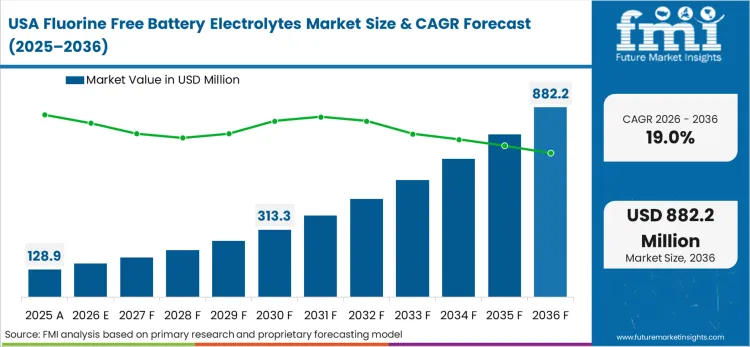
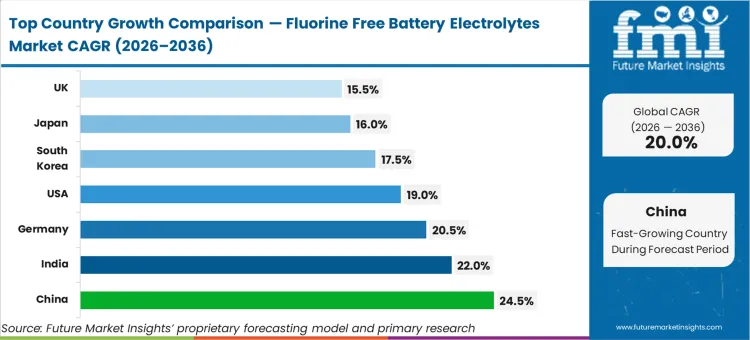
China advances at a 24.5% compound rate driven by aggressive commercialization of grid-scale sodium architectures. India expands at 22.0% as national energy policy prioritizes localized supply chains free from imported legacy salts. Germany posts a 20.5% rate anchored by strict European chemical regulatory frameworks targeting environmental persistence. The USA tracks at 19.0% supported by grid modernization subsidies requiring safe localized energy storage systems deployments. South Korea grows at 17.5% as advanced material science hubs optimize novel ionic liquids. Japan records a 16.0% trajectory focused on high-safety solid-state commercialization. The UK reaches 15.5% as renewable integration projects demand non-flammable storage solutions. This geographic dispersion reflects distinct regional timelines for phasing out hazardous industrial chemicals.
Fluorine Free Battery Electrolytes Market Definition
The fluorine free battery electrolytes market encompasses the specialized conductive fluids, salts, and polymers engineered without fluorine atoms to facilitate ion transport within rechargeable cells. The defining structural boundary is the absolute exclusion of polyfluoroalkyl substances and traditional fluorinated salts, requiring completely novel solvent and solute formulations to maintain electrochemical stability.
Fluorine Free Battery Electrolytes Market Inclusions
The market scope covers water-in-salt aqueous solutions, halogen-free organic solvent mixtures, specialized ionic liquids, and solid polymer materials designed for ion conductivity. It includes battery electrolytes, chemical precursors, safety additives, and stabilizing agents that do not contain fluorine bonds. Equipment used to handle and inject these materials during cell assembly also forms part of the market scope.
Fluorine Free Battery Electrolytes Market Exclusions
Traditional lithium hexafluorophosphate solutions and any electrolyte blend containing fluorinated ethylene carbonate additives are strictly excluded from this valuation. General battery casing materials, external thermal management systems, and raw unrefined lithium or sodium metals fall outside the defined analytical parameters. Standard organic solvents sold for general chemical processing rather than dedicated battery grade applications are omitted.
Fluorine Free Battery Electrolytes Market Research Methodology
- Primary Research: Analysts engaged with battery chemistry directors, utility-scale storage procurement leads, and materials science laboratory managers to map the precise testing gates for new fluid approvals.
- Desk Research: The data collection phase aggregated compliance roadmaps from the European Chemicals Agency, national grid safety mandates, and patent filings for halogen-free conductive materials.
- Market-Sizing and Forecasting: The baseline value derives from a bottom-up aggregation of non-fluorinated solvent shipments, applying region-specific regulatory phase-out curves to project future adoption velocity.
- Data Validation and Update Cycle: Projections are rigorously tested against publicly reported raw material procurement volumes from leading alternative battery original equipment manufacturers.
Segmental Analysis
Fluorine Free Battery Electrolytes Market Analysis by Battery Type
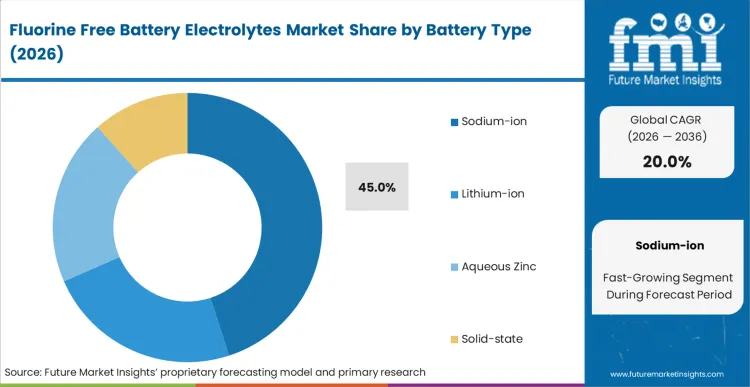
Replacing critical internal fluids requires cell architecture leads to completely redesign electrode interfaces for alternative carrier ions. Sodium-ion captures a 45.0% share in 2026 as grid-scale project developers aggressively shift toward abundant material supply chains. Battery manufacturing engineers formulating these fluids aim to achieve conductivity without relying on expensive fluorinated lithium salts. FMI analysis indicates that sodium compatibility with novel organic and aqueous solvents can support lower overall cell production costs. Securing reliable volumes of sodium-ion battery materials strengthens the position of cell fabricators competing with traditional lithium systems in stationary applications. Cell engineering teams that optimize these material interactions are better placed to meet performance requirements in major utility-scale storage projects.
- Abundant material utilization: Relying on globally available base elements insulates production lines from the volatile pricing constraints of specialized legacy salts.
- Cathode interface stability: Novel halogen-free formulations prevent the rapid dissolution of transition metals during aggressive charge cycles.
- Thermal runaway mitigation: Removing volatile fluorinated compounds fundamentally alters the failure thermodynamics for large-scale energy modules.
Fluorine Free Battery Electrolytes Market Analysis by Electrolyte Material
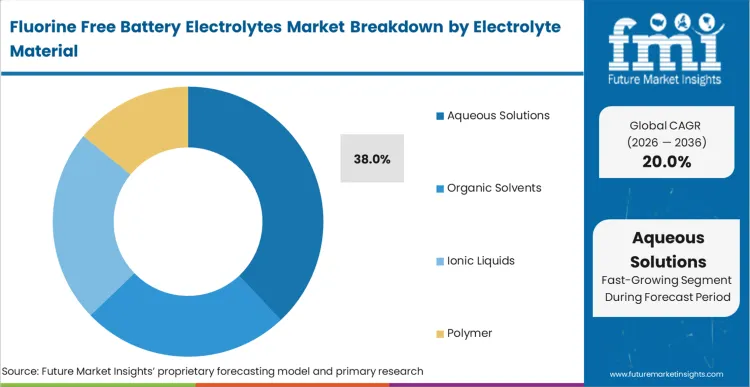
Municipal safety regulators assessing dense urban grid deployments mandate absolute non-flammability for all new energy storage installations. Aqueous Solutions represent a 38.0% share in 2026 because they provide the only chemically impossible-to-ignite fluid architecture available for large format cells. Material science directors utilizing high-concentration water-in-salt mechanisms successfully expand the electrochemical stability window beyond traditional aqueous limits. This breakthrough technology allows facility planners to install grid-scale battery market nodes inside residential structures without triggering complex hazardous material zoning codes. Based on FMI's assessment, the removal of heavy steel fire-containment vessels significantly improves the total volumetric energy density of the complete storage installation. Utility project managers who specify these benign solutions drastically accelerate their site commissioning timelines and reduce insurance liabilities.
- Voltage window expansion: Highly concentrated salt structures alter water molecule activity to prevent hydrogen evolution at elevated operational voltages.
- Zoning code compliance: Inherently safe chemical profiles allow storage project developers to bypass expensive secondary containment construction requirements.
- Manufacturing facility safety: Eliminating toxic off-gassing during the cell filling process reduces the capital expenditure required for factory ventilation systems.
Fluorine Free Battery Electrolytes Market Analysis by End Use
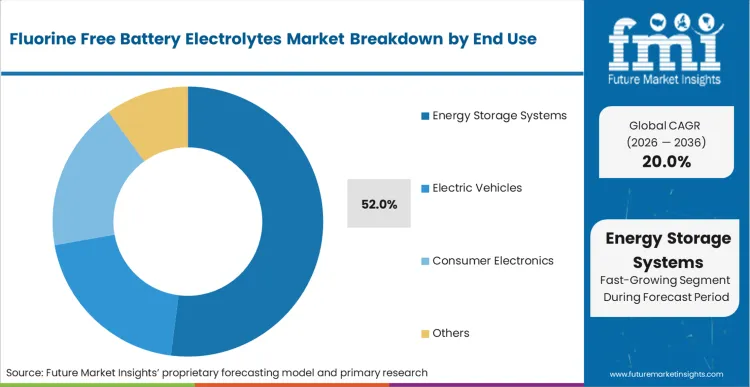
The massive scale of continuous power reserves forces utility planners to prioritize absolute safety and low lifecycle costs over strict weight constraints. Energy Storage Systems account for a 52.0% share in 2026 as grid operators completely reject the liability associated with massive volumes of flammable fluorinated liquids. Energy infrastructure directors standardizing on benign chemical architectures eliminate the risk of catastrophic facility fires that plague legacy lithium installations. Utilizing specialized green energy storage materials guarantees stable performance across extreme outdoor temperature variations without requiring active liquid cooling loops. In FMI's view, removing parasitic thermal management loads directly increases the round-trip efficiency of the entire utility installation. Grid procurement leads who deploy these specialized solutions successfully integrate intermittent renewable generation assets into the baseload infrastructure.
- Lifecycle cost reduction: Eliminating complex active cooling and fire suppression hardware slashes the initial capital expenditure for large storage sites.
- Environmental liability elimination: Completely non-toxic fluid components ensure zero soil contamination risk in the event of a catastrophic casing breach.
- Temperature resilience: Specialized halogen-free mixtures maintain stable ion conductivity during severe winter weather events without freezing or precipitating salts.
Fluorine Free Battery Electrolytes Market Analysis by Sales Channel
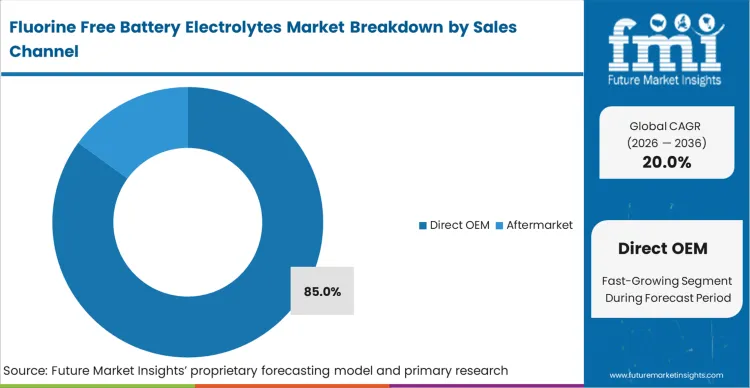
New cell chemistries require exact integration between the conductive fluid and the specific proprietary cathode coatings used by each manufacturer. Direct OEM commands an 85.0% share in 2026 reflecting the absolute necessity for custom fluid formulation during the initial cell design phase. Chemical synthesis directors partnering with primary cell fabricators develop unique additive packages that perfectly match the intended voltage profile of the final battery product. This tight integration ensures that lithium-ion battery materials alternatives perform reliably throughout the multi-year warranty period expected by utility clients. As per FMI's projection, the highly specialized nature of these fluids makes aftermarket substitution technically impossible without destroying the cell. Chemical suppliers who secure these exclusive factory-fill contracts lock in guaranteed volume streams for the entire production lifespan of the cell model.
- Proprietary formulation matching: Custom additive ratios stabilize the solid electrolyte interphase layer on specific proprietary anode materials.
- Volume supply guarantees: Direct pipeline integrations from chemical synthesis plants to cell fabrication floors eliminate contamination risks during bulk transport.
- Warranty performance tracking: Closed-loop supply chains ensure strict quality control over fluid purity to prevent premature cell failure in the field.
Fluorine Free Battery Electrolytes Market Drivers, Restraints, and Opportunities
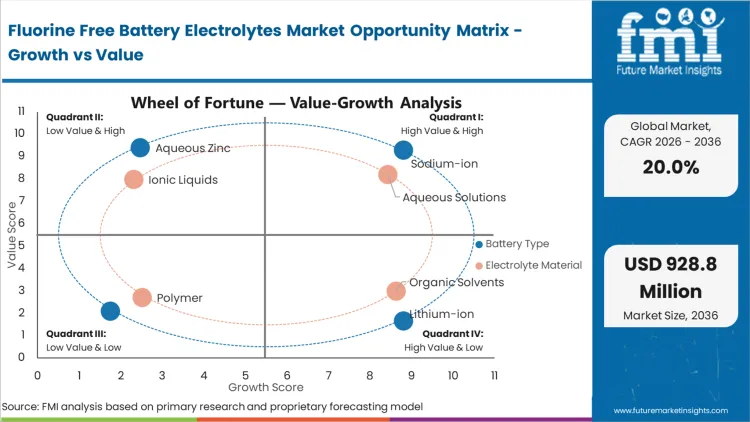
Impending chemical legislation targeting polyfluoroalkyl substances is pushing battery architecture teams to accelerate material substitution programs. This regulatory pressure is reducing the long-term viability of traditional lithium hexafluorophosphate formulations for future production lines. Cell fabrication teams transitioning to halogen-free advanced battery material platforms must secure high-purity alternative salts to maintain line yields. Facilities that delay this transition may face operational disruption as regional environmental agencies finalize hazardous material restriction lists.
The limited voltage stability window of early aqueous and non-fluorinated organic mixtures creates performance constraints for high-energy applications. Chemical engineering teams attempting to match legacy energy density metrics face cycle life degradation as alternative fluids break down under high-voltage stress. To address this constraint, material synthesis teams are refining highly concentrated salt-in-water formulations that suppress parasitic side reactions at electrode interfaces.
Opportunities in the Fluorine Free Battery Electrolytes Market
- Residential Microgrid Integration: Inherently safe aqueous architectures allow energy project developers to install high-capacity storage units directly inside multi-family housing structures. This deployment strategy bypasses the complex fire regulations that currently limit urban renewable energy adoption.
- Extreme Environment Storage: Novel low-freezing-point organic mixtures permit grid operators to deploy robust renewable energy storage nodes in severe sub-zero climates without parasitic heating losses. This capability ensures stable grid support during winter weather emergencies.
- Closed-Loop Material Recovery: Benign chemical profiles enable recycling facility managers to extract valuable metals without handling highly toxic hydrofluoric acid byproducts. This simplified recovery process dramatically improves the underlying economics of end-of-life battery processing.
Regional Analysis
.webp "Top Country Growth Comparison Fluorine Free Battery Electrolytes Market Cagr (2026 2036)")
Based on the regional analysis, the fluorine free battery electrolytes market is segmented into North America, Latin America, Europe, East Asia, South Asia, Oceania and Middle East & Africa across 40 plus countries.
| Country | CAGR (2026 to 2036) |
|---|---|
| China | 24.5% |
| India | 22.0% |
| Germany | 20.5% |
| USA | 19.0% |
| South Korea | 17.5% |
| Japan | 16.0% |
| UK | 15.5% |
Source: Future Market Insights (FMI) analysis, based on proprietary forecasting model and primary research
Asia Pacific Fluorine Free Battery Electrolytes Market Analysis
The massive concentration of global battery manufacturing capacity in Asia Pacific defines the exact speed of alternative chemistry commercialization. Cell fabrication directors overseeing the world's largest gigafactories must establish secure, high-volume supply chains for non-fluorinated salts to shield their operations from raw material price shocks. According to FMI's estimates, the regional push toward localized sodium resources provides the necessary economic foundation to scale these novel fluid architectures rapidly.
- China: China’s state-backed expansion of localized battery supply chains is increasing emphasis on reducing dependence on imported specialized chemicals. Heavy investment in sodium-ion fabrication facilities is creating strong demand for compatible non-fluorinated conductive fluids across large-scale production environments. The rapid deployment of these alternative stationary battery storage systems indicates that domestic production is moving toward commercial viability. This commercialization trend supports a 24.5% CAGR for alternative battery fluids in China. Chemical suppliers that achieve high-purity synthesis at gigawatt scale are strengthening their position in the domestic supply chain.
- India: Supply chain vulnerability in India triggers a national mandate to develop indigenous energy storage technologies independent of constrained global lithium and fluorine networks. Cell engineering teams utilize domestic agricultural and chemical bases to formulate novel conductive polymers and organic solvent blends. The establishment of state-funded pilot lines proves that localized manufacturing of safe, halogen-free cells can meet domestic grid requirements. India's demand for alternative chemistries is rising at a CAGR of 22.0% as the national energy security framework solidifies. Cell architecture leads who qualify these indigenous materials capture the primary procurement allocations for rural electrification projects.
- South Korea: Advanced material science hubs in South Korea are targeting the electrochemical limitations of novel ionic liquids to improve cycling stability. Battery chemistry directors are optimizing complex organic salt structures to surpass the performance of legacy fluorinated systems. Continuous patent activity for ultra-stable cell designs indicates a technical pivot away from volatile legacy architectures. Advanced synthesis optimization sustains a 17.5% CAGR for specialized cell fluids in South Korea. Fluid formulation engineers who solve high-voltage degradation challenges are likely to shape the next generation of premium energy modules.
- Japan: Japan's highly risk-averse industrial culture dictates absolute safety guarantees for all advanced power storage systems deployed in densely populated zones. Materials procurement leads mandate completely solid or non-flammable liquid architectures to eliminate the thermal runaway risks inherent in traditional cell designs. Heavy investment in next-generation smart grid components verifies the national commitment to benign energy infrastructure. This strict safety baseline positions Japan at a 16.0% compound growth rate. Engineering specification directors who eliminate toxic off-gassing protocols receive immediate authorization to supply critical national infrastructure projects.
FMI's report includes extensive coverage of the Asia Pacific chemical sector. The analysis encompasses Australia, Taiwan, and the broader ASEAN manufacturing networks. A defining characteristic across these regions is the aggressive push to secure localized material processing capabilities, forcing grid planners to specify storage systems built on accessible, non-hazardous chemistry.
North America Fluorine Free Battery Electrolytes Market Analysis
North American energy policy is reinforcing the need to reduce reliance on overseas chemical processing networks for critical grid infrastructure. Grid modernization teams advancing large-scale capacity upgrades are prioritizing safer and more localized battery technologies to support variable renewable energy flows. Based on FMI’s assessment, benign aqueous architectures can help utility operators limit dependence on legacy specialized salts and improve supply chain resilience.
- USA: The United States grid reliability framework actively subsidizes the deployment of safe, localized storage technologies that utilize domestic raw material supply chains. Utility project managers mandate non-flammable off-grid energy storage systems to secure rapid zoning approvals for installations in dense urban environments. The successful commissioning of multi-megawatt aqueous battery facilities proves the commercial viability of these halogen-free architectures. The United States advances at a 19.0% compound rate as federal incentives prioritize environmentally benign energy storage infrastructure. Procurement specification leads who deploy these inherently safe systems bypass the costly fire suppression requirements that stall traditional lithium projects.
FMI's report includes comprehensive evaluation of the North American battery materials sector. It features specific analysis of the Canadian and Mexican industrial markets. A prevailing dynamic involves the aggressive integration of cross-border manufacturing hubs, requiring chemical suppliers to provide stable, non-toxic fluid solutions that comply with diverse regional environmental safety mandates.
Europe Fluorine Free Battery Electrolytes Market Analysis
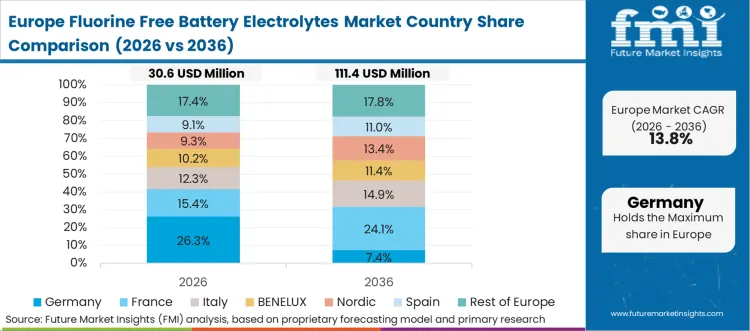
The European Union's comprehensive legislative push to restrict all polyfluoroalkyl substances represents the most powerful structural force reshaping battery chemistry globally. Cell architecture directors redesigning upcoming factory lines must completely eliminate fluorinated binders, salts, and solvent additives to maintain access to the European market. FMI's analysis indicates that this impending regulatory wall forces massive capital investment into alternative water-based and novel organic chemical synthesis.
- Germany: Germany’s strict environmental framework is accelerating the shift away from persistent industrial chemicals across manufacturing sectors. Battery chemistry teams must validate halogen-free fluid formulations before supporting the next phase of factory expansion. The scaling of specialized battery materials recycling centers focused on benign chemistries indicates that this material transition is becoming more established. This regulatory momentum supports a 20.5% annual growth rate for alternative conductive fluids. Cell engineering teams that secure stable fluorine-free formulations are better positioned to support storage system manufacturing within Germany’s industrial base.
- UK: The United Kingdom’s renewable energy integration agenda is increasing the need for localized power reserves near dense residential load centers. Utility network planners deploying advanced portable power station nodes are prioritizing safer, non-toxic cell architectures to align with municipal safety requirements. The shift toward decentralized grid support is encouraging asset operators to move away from flammable legacy systems in favor of more stable alternative chemistries. This urban safety focus supports the UK’s 15.5% CAGR through 2036. Project development teams specifying these low-emission, non-flammable storage units can improve deployment readiness by reducing safety-related approval challenges.
FMI's report includes thorough investigation of the European advanced materials framework. The analysis encompasses France, Italy, Spain, the Nordics, and the Benelux region. A critical structural reality across these nations is the mandatory compliance with strict chemical persistence laws, forcing material scientists to engineer high-performance energy solutions without relying on hazardous legacy compounds.
Competitive Aligners for Market Players
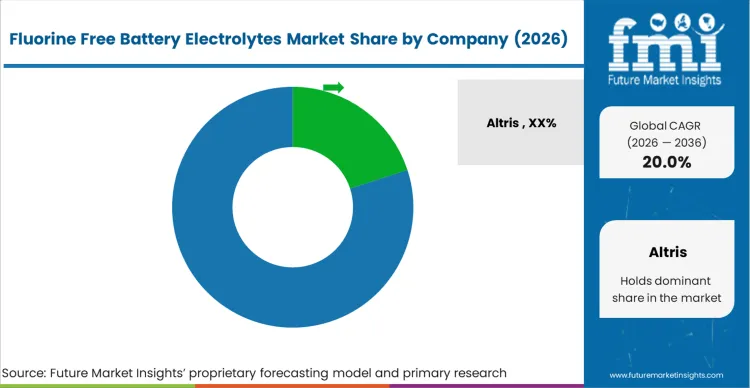
The competitive structure of the fluorine free battery electrolytes market is increasingly shaped by electrolyte purity, safety performance, and the ability to replace fluorinated chemistries without undermining cycle stability or interface reliability. Buyers no longer assess electrolyte suppliers only on conductivity. They increasingly compare vendors on formulation flexibility, compatibility with sodium-ion and other next-generation battery systems, raw material control, and the scalability of cleaner production pathways. This shift is raising the technical threshold across the industry and placing pressure on suppliers that remain tied to conventional fluorinated systems. Altris positions itself around sodium-ion batteries and includes electrolytes within its technology offering, while Solvionic highlights high-purity ionic liquid products for battery and energy storage applications.
Industry participants have already begun aligning themselves around specialized electrolyte development and commercialization. Companies such as Altris, Solvionic, E-Lyte Innovations, HiNa Battery, and Faradion are connected to sodium-ion, advanced electrolyte, or broader next-generation battery development pathways, making them relevant to a market moving toward fluorine-free formulations. E-Lyte states that it develops and produces electrolyte solutions for multiple energy storage systems, while HiNa Battery focuses on sodium-ion batteries for mobility and storage use cases. Faradion remains a notable technology name in sodium-ion batteries, although it is now part of Reliance New Energy Solar, which matters when describing current competitive ownership.
Vendors that embed formulation expertise, chemistry customization, and supply resilience directly into their commercial strategy gain a meaningful advantage. E-Lyte emphasizes bespoke electrolyte development, and its recent supply-chain announcement signals how electrolyte producers are strengthening upstream security as commercialization expands. At the same time, the broader direction of the sector is moving toward fluorine-free and fluorine-reduced systems, especially for sodium-based and next-generation batteries. Suppliers that can connect lab-scale electrochemical performance with manufacturable, cleaner electrolyte systems are likely to set the next competitive baseline. Companies that move slowly on fluorine-free formulation development or fail to secure reliable production pathways risk losing ground as battery manufacturers push for safer and more sustainable chemistries.
Key Players in Fluorine Free Battery Electrolytes Market
- Altris
- Solvionic
- Faradion
- HiNa Battery
- E-Lyte Innovations
- Stella LiTech
Scope of the Report
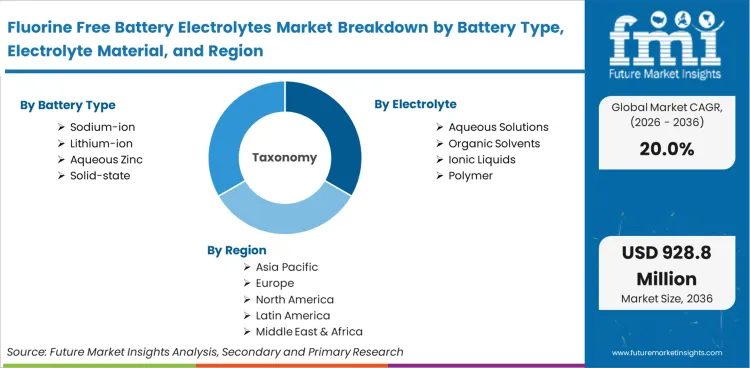
| Metric | Value |
|---|---|
| Quantitative Units | USD 150.0 million to USD 928.8 million, at a CAGR of 20.0% |
| Market Definition | The sector providing non-toxic, halogen-free internal conductive materials engineered to replace hazardous legacy salts in next-generation rechargeable cells. |
| Battery Type Segmentation | Sodium-ion, Lithium-ion, Aqueous Zinc, Solid-state |
| Electrolyte Material Segmentation | Organic Solvents, Aqueous Solutions, Ionic Liquids, Polymer |
| End Use Segmentation | Energy Storage Systems, Electric Vehicles, Consumer Electronics, Others |
| Sales Channel Segmentation | Direct OEM, Aftermarket |
| Regions Covered | North America, Latin America, Europe, East Asia, South Asia, Oceania, Middle East & Africa |
| Countries Covered | China, India, Germany, USA, South Korea, Japan, UK, and 40 plus countries |
| Key Companies Profiled | Altris, Solvionic, Faradion, HiNa Battery, E-Lyte Innovations, Stella LiTech |
| Forecast Period | 2026 to 2036 |
| Approach | The baseline value derives from a bottom-up aggregation of non-fluorinated solvent shipments, applying region-specific regulatory phase-out curves to project future adoption velocity. |
Source: Future Market Insights (FMI) analysis, based on proprietary forecasting model and primary research
Fluorine Free Battery Electrolytes Market Analysis by Segments
Battery Type:
- Sodium-ion
- Lithium-ion
- Aqueous Zinc
- Solid-state
Electrolyte Material:
- Organic Solvents
- Aqueous Solutions
- Ionic Liquids
- Polymer
End Use:
- Energy Storage Systems
- Electric Vehicles
- Consumer Electronics
- Others
Sales Channel:
- Direct OEM
- Aftermarket
Region:
- Asia Pacific
- China
- India
- South Korea
- Japan
- Australia
- ASEAN
- Rest of Asia Pacific
- North America
- USA
- Canada
- Mexico
- Europe
- Germany
- UK
- France
- Italy
- Spain
- Nordics
- Benelux
- Rest of Europe
- Latin America
- Brazil
- Mexico
- Argentina
- Rest of Latin America
- Middle East & Africa
- GCC
- South Africa
- Rest of Middle East & Africa
Bibliography
- International Energy Agency. (2026). Sodium-ion battery momentum grows, but challenges remain.
- European Chemicals Agency. (2024). ECHA and five European countries issue progress update on PFAS restriction.
- European Parliament and Council of the European Union. (2024). Corrigendum to Regulation (EU) 2023/1542 of the European Parliament and of the Council of 12 July 2023 concerning batteries and waste batteries, amending Directive 2008/98/EC and Regulation (EU) 2019/1020 and repealing Directive 2006/66/EC. EUR-Lex.
- International Energy Agency. (2024). Trends in electric vehicle batteries. In Global EV Outlook 2024.
- Wang, P., Qing, H., Zhang, R., & Li, W. (2025). Fluorine-free electrolytes for sustainable lithium batteries: a review. npj Materials Sustainability, 3, Article 32.
- Limachi, C., Rogala, K., Broszkiewicz, M., Cabello, M., Niedzicki, L., Armand, M., & Wieczorek, W. (2024). Development of fluorine-free electrolytes for aqueous-processed olivine-type phosphate cathodes. Molecules, 29(19), 4698.
This bibliography is provided for reader reference. The full FMI report contains the complete reference list with primary research documentation.
This Report Addresses
- Market sizing and quantitative forecast metrics detailing the value expansion of fluorine free battery electrolytes across major battery chemistries through 2036.
- Segmentation analysis mapping adoption patterns across sodium-ion, lithium-ion, aqueous zinc, and solid-state battery formats while evaluating the material constraints influencing electrolyte selection.
- Regional deployment intelligence comparing aggressive alternative chemistry commercialization in Asia Pacific with regulatory-driven material substitution across European and North American battery ecosystems.
- Regulatory compliance assessment analyzing how chemical restriction frameworks, fire safety mandates, and environmental persistence concerns are accelerating the shift away from fluorinated electrolyte systems.
- Competitive posture evaluation tracking how specialized electrolyte developers differentiate through formulation purity, safety performance, sodium-ion compatibility, and scalable non-fluorinated production capabilities.
- Cell engineering strategic guidance defining the formulation priorities, voltage stability requirements, and interface performance standards needed to support next-generation rechargeable battery architectures.
- Supply chain vulnerability analysis identifying the raw material, synthesis, and scale-up bottlenecks that may delay the commercial transition toward halogen-free conductive fluids.
- Custom data delivery formats encompassing interactive dashboards, raw Excel datasets, and comprehensive PDF narrative reports.
Frequently Asked Questions
How large is the demand for fluorine free battery electrolytes in the global market in 2026?
Demand for fluorine free battery electrolytes in the global market is estimated to be valued at USD 150.0 million in 2026.
What will be the market size of fluorine free battery electrolytes in the global market by 2036?
Market size for fluorine free battery electrolytes is projected to reach USD 928.8 million by 2036.
What is the expected demand growth for fluorine free battery electrolytes in the global market between 2026 and 2036?
Demand for fluorine free battery electrolytes is expected to grow at a CAGR of 20.0% between 2026 and 2036.
Which Battery Type is poised to lead global sales by 2026?
Sodium-ion accounts for 45.0% in 2026 as grid-scale project developers shift toward abundant material supply chains and reduce reliance on expensive legacy lithium systems.
How significant is the role of Aqueous Solutions in driving fluorine free battery electrolytes adoption in 2026?
Aqueous Solutions represent 38.0% of segment share as municipal regulators mandate completely non-flammable fluid architectures for new urban energy storage installations.
What is driving demand in China?
China’s state-sponsored expansion of localized battery supply chains and heavy investment in sodium-ion fabrication facilities are driving strong demand for compatible non-fluorinated conductive fluids.
What compliance standards or regulations are referenced for Germany?
Germany’s growth is tied to strict environmental and chemical regulatory frameworks targeting persistent industrial chemicals and accelerating the shift toward halogen-free fluid formulations.
What is the China growth outlook in this report?
China is projected to grow at a CAGR of 24.5% during 2026 to 2036.
Why is North America described as a priority region in this report?
North America is prioritized because grid modernization policy is reinforcing the deployment of safe, localized storage technologies that reduce dependence on overseas chemical processing networks.
What type of demand dominates in North America?
Demand heavily focuses on deploying non-flammable aqueous battery systems that can secure rapid zoning approvals and bypass costly fire suppression requirements.
What is India’s growth outlook in this report?
India is projected to expand at a CAGR of 22.0% during 2026 to 2036.
Does the report cover USA in its regional analysis?
Yes, USA is included within North America under the regional scope of analysis.
What are the sources referred to for analyzing USA?
Federal grid modernization subsidies, municipal fire code revisions, and corporate sustainability phase-out schedules form the analytical basis.
What is the main demand theme linked to USA in its region coverage?
Safe, localized energy storage deployments using non-flammable and non-toxic battery architectures form the central demand theme in the United States.
Does the report cover Germany in its regional analysis?
Yes, Germany is included within Europe under the regional coverage framework.
What is the main Germany related demand theme in its region coverage?
Germany’s demand is shaped by the validation of halogen-free fluid formulations under strict environmental rules governing persistent industrial chemicals.
Which product formats or configurations are strategically important for Asia Pacific supply chains?
High-purity non-fluorinated salts, aqueous electrolyte systems, and localized material processing capabilities are strategically important for Asia Pacific battery supply chains.
What is fluorine free battery electrolytes and what is it mainly used for?
Fluorine free battery electrolytes are non-toxic, halogen-free conductive fluids, salts, and polymers mainly used to facilitate ion transport in next-generation rechargeable cells.
What does fluorine free battery electrolytes mean in this report?
The scope encompasses specialized conductive materials completely devoid of fluorine atoms and excludes traditional fluorinated salts and additives.
What is included in the scope of this fluorine free battery electrolytes report?
The market covers water-in-salt aqueous solutions, halogen-free organic solvent mixtures, ionic liquids, solid polymers, chemical precursors, safety additives, stabilizing agents, and equipment used to handle and inject these materials during cell assembly.
What is excluded from the scope of this report?
Traditional lithium hexafluorophosphate solutions, electrolyte blends containing fluorinated ethylene carbonate additives, battery casing materials, external thermal management systems, raw unrefined lithium or sodium metals, and general-purpose organic solvents are explicitly excluded.
What does market forecast mean on this page?
The market forecast represents a model-based projection built on regulatory phase-out curves, production scale-up assumptions, and battery chemistry adoption trends for strategic planning purposes.
How does FMI build and validate the fluorine free battery electrolytes forecast?
The model applies a bottom-up methodology starting with non-fluorinated solvent shipments and pilot-line production metrics, then cross-validates projections against publicly reported procurement and specialty chemical production volumes.
What does zero reliance on speculative third-party market research mean here?
Primary interviews, public chemical restriction drafts, municipal fire code revisions, patent filings, and verified production data are used instead of unverified syndicated estimates.
Preview the report firsthand - request a free sample
Get SampleGet the brochure for pricing and purchase details.
Get PDFTable of Content
- Executive Summary
- Global Market Outlook
- Demand-side Trends
- Supply-side Trends
- Technology Roadmap Analysis
- Analysis and Recommendations
- Market Overview
- Market Coverage / Taxonomy
- Market Definition / Scope / Limitations
- Research Methodology
- Chapter Orientation
- Analytical Lens and Working Hypotheses
- Market Structure, Signals, and Trend Drivers
- Benchmarking and Cross-market Comparability
- Market Sizing, Forecasting, and Opportunity Mapping
- Research Design and Evidence Framework
- Desk Research Programme (Secondary Evidence)
- Company Annual and Sustainability Reports
- Peer-reviewed Journals and Academic Literature
- Corporate Websites, Product Literature, and Technical Notes
- Earnings Decks and Investor Briefings
- Statutory Filings and Regulatory Disclosures
- Technical White Papers and Standards Notes
- Trade Journals, Industry Magazines, and Analyst Briefs
- Conference Proceedings, Webinars, and Seminar Materials
- Government Statistics Portals and Public Data Releases
- Press Releases and Reputable Media Coverage
- Specialist Newsletters and Curated Briefings
- Sector Databases and Reference Repositories
- FMI Internal Proprietary Databases and Historical Market Datasets
- Subscription Datasets and Paid Sources
- Social Channels, Communities, and Digital Listening Inputs
- Additional Desk Sources
- Expert Input and Fieldwork (Primary Evidence)
- Primary Modes
- Qualitative Interviews and Expert Elicitation
- Quantitative Surveys and Structured Data Capture
- Blended Approach
- Why Primary Evidence is Used
- Field Techniques
- Interviews
- Surveys
- Focus Groups
- Observational and In-context Research
- Social and Community Interactions
- Stakeholder Universe Engaged
- C-suite Leaders
- Board Members
- Presidents and Vice Presidents
- R&D and Innovation Heads
- Technical Specialists
- Domain Subject-matter Experts
- Scientists
- Physicians and Other Healthcare Professionals
- Governance, Ethics, and Data Stewardship
- Research Ethics
- Data Integrity and Handling
- Primary Modes
- Tooling, Models, and Reference Databases
- Desk Research Programme (Secondary Evidence)
- Data Engineering and Model Build
- Data Acquisition and Ingestion
- Cleaning, Normalisation, and Verification
- Synthesis, Triangulation, and Analysis
- Quality Assurance and Audit Trail
- Market Background
- Market Dynamics
- Drivers
- Restraints
- Opportunity
- Trends
- Scenario Forecast
- Demand in Optimistic Scenario
- Demand in Likely Scenario
- Demand in Conservative Scenario
- Opportunity Map Analysis
- Product Life Cycle Analysis
- Supply Chain Analysis
- Investment Feasibility Matrix
- Value Chain Analysis
- PESTLE and Porter’s Analysis
- Regulatory Landscape
- Regional Parent Market Outlook
- Production and Consumption Statistics
- Import and Export Statistics
- Market Dynamics
- Global Market Analysis 2021 to 2025 and Forecast, 2026 to 2036
- Historical Market Size Value (USD Million) Analysis, 2021 to 2025
- Current and Future Market Size Value (USD Million) Projections, 2026 to 2036
- Y-o-Y Growth Trend Analysis
- Absolute $ Opportunity Analysis
- Global Market Pricing Analysis 2021 to 2025 and Forecast 2026 to 2036
- Global Market Analysis 2021 to 2025 and Forecast 2026 to 2036, By Battery Type
- Introduction / Key Findings
- Historical Market Size Value (USD Million) Analysis By Battery Type , 2021 to 2025
- Current and Future Market Size Value (USD Million) Analysis and Forecast By Battery Type , 2026 to 2036
- Sodium-ion
- Lithium-ion
- Aqueous Zinc
- Solid-state
- Sodium-ion
- Y-o-Y Growth Trend Analysis By Battery Type , 2021 to 2025
- Absolute $ Opportunity Analysis By Battery Type , 2026 to 2036
- Global Market Analysis 2021 to 2025 and Forecast 2026 to 2036, By Electrolyte Material
- Introduction / Key Findings
- Historical Market Size Value (USD Million) Analysis By Electrolyte Material, 2021 to 2025
- Current and Future Market Size Value (USD Million) Analysis and Forecast By Electrolyte Material, 2026 to 2036
- Aqueous Solutions
- Organic Solvents
- Ionic Liquids
- Polymer
- Aqueous Solutions
- Y-o-Y Growth Trend Analysis By Electrolyte Material, 2021 to 2025
- Absolute $ Opportunity Analysis By Electrolyte Material, 2026 to 2036
- Global Market Analysis 2021 to 2025 and Forecast 2026 to 2036, By End Use
- Introduction / Key Findings
- Historical Market Size Value (USD Million) Analysis By End Use, 2021 to 2025
- Current and Future Market Size Value (USD Million) Analysis and Forecast By End Use, 2026 to 2036
- Energy Storage Systems
- Electric Vehicles
- Consumer Electronics
- Others
- Energy Storage Systems
- Y-o-Y Growth Trend Analysis By End Use, 2021 to 2025
- Absolute $ Opportunity Analysis By End Use, 2026 to 2036
- Global Market Analysis 2021 to 2025 and Forecast 2026 to 2036, By Sales Channel
- Introduction / Key Findings
- Historical Market Size Value (USD Million) Analysis By Sales Channel, 2021 to 2025
- Current and Future Market Size Value (USD Million) Analysis and Forecast By Sales Channel, 2026 to 2036
- Direct OEM
- Aftermarket
- Direct OEM
- Y-o-Y Growth Trend Analysis By Sales Channel, 2021 to 2025
- Absolute $ Opportunity Analysis By Sales Channel, 2026 to 2036
- Global Market Analysis 2021 to 2025 and Forecast 2026 to 2036, By Region
- Introduction
- Historical Market Size Value (USD Million) Analysis By Region, 2021 to 2025
- Current Market Size Value (USD Million) Analysis and Forecast By Region, 2026 to 2036
- North America
- Latin America
- Western Europe
- Eastern Europe
- East Asia
- South Asia and Pacific
- Middle East & Africa
- Market Attractiveness Analysis By Region
- North America Market Analysis 2021 to 2025 and Forecast 2026 to 2036, By Country
- Historical Market Size Value (USD Million) Trend Analysis By Market Taxonomy, 2021 to 2025
- Market Size Value (USD Million) Forecast By Market Taxonomy, 2026 to 2036
- By Country
- USA
- Canada
- Mexico
- By Battery Type
- By Electrolyte Material
- By End Use
- By Sales Channel
- By Country
- Market Attractiveness Analysis
- By Country
- By Battery Type
- By Electrolyte Material
- By End Use
- By Sales Channel
- Key Takeaways
- Latin America Market Analysis 2021 to 2025 and Forecast 2026 to 2036, By Country
- Historical Market Size Value (USD Million) Trend Analysis By Market Taxonomy, 2021 to 2025
- Market Size Value (USD Million) Forecast By Market Taxonomy, 2026 to 2036
- By Country
- Brazil
- Chile
- Rest of Latin America
- By Battery Type
- By Electrolyte Material
- By End Use
- By Sales Channel
- By Country
- Market Attractiveness Analysis
- By Country
- By Battery Type
- By Electrolyte Material
- By End Use
- By Sales Channel
- Key Takeaways
- Western Europe Market Analysis 2021 to 2025 and Forecast 2026 to 2036, By Country
- Historical Market Size Value (USD Million) Trend Analysis By Market Taxonomy, 2021 to 2025
- Market Size Value (USD Million) Forecast By Market Taxonomy, 2026 to 2036
- By Country
- Germany
- UK
- Italy
- Spain
- France
- Nordic
- BENELUX
- Rest of Western Europe
- By Battery Type
- By Electrolyte Material
- By End Use
- By Sales Channel
- By Country
- Market Attractiveness Analysis
- By Country
- By Battery Type
- By Electrolyte Material
- By End Use
- By Sales Channel
- Key Takeaways
- Eastern Europe Market Analysis 2021 to 2025 and Forecast 2026 to 2036, By Country
- Historical Market Size Value (USD Million) Trend Analysis By Market Taxonomy, 2021 to 2025
- Market Size Value (USD Million) Forecast By Market Taxonomy, 2026 to 2036
- By Country
- Russia
- Poland
- Hungary
- Balkan & Baltic
- Rest of Eastern Europe
- By Battery Type
- By Electrolyte Material
- By End Use
- By Sales Channel
- By Country
- Market Attractiveness Analysis
- By Country
- By Battery Type
- By Electrolyte Material
- By End Use
- By Sales Channel
- Key Takeaways
- East Asia Market Analysis 2021 to 2025 and Forecast 2026 to 2036, By Country
- Historical Market Size Value (USD Million) Trend Analysis By Market Taxonomy, 2021 to 2025
- Market Size Value (USD Million) Forecast By Market Taxonomy, 2026 to 2036
- By Country
- China
- Japan
- South Korea
- By Battery Type
- By Electrolyte Material
- By End Use
- By Sales Channel
- By Country
- Market Attractiveness Analysis
- By Country
- By Battery Type
- By Electrolyte Material
- By End Use
- By Sales Channel
- Key Takeaways
- South Asia and Pacific Market Analysis 2021 to 2025 and Forecast 2026 to 2036, By Country
- Historical Market Size Value (USD Million) Trend Analysis By Market Taxonomy, 2021 to 2025
- Market Size Value (USD Million) Forecast By Market Taxonomy, 2026 to 2036
- By Country
- India
- ASEAN
- Australia & New Zealand
- Rest of South Asia and Pacific
- By Battery Type
- By Electrolyte Material
- By End Use
- By Sales Channel
- By Country
- Market Attractiveness Analysis
- By Country
- By Battery Type
- By Electrolyte Material
- By End Use
- By Sales Channel
- Key Takeaways
- Middle East & Africa Market Analysis 2021 to 2025 and Forecast 2026 to 2036, By Country
- Historical Market Size Value (USD Million) Trend Analysis By Market Taxonomy, 2021 to 2025
- Market Size Value (USD Million) Forecast By Market Taxonomy, 2026 to 2036
- By Country
- Kingdom of Saudi Arabia
- Other GCC Countries
- Turkiye
- South Africa
- Other African Union
- Rest of Middle East & Africa
- By Battery Type
- By Electrolyte Material
- By End Use
- By Sales Channel
- By Country
- Market Attractiveness Analysis
- By Country
- By Battery Type
- By Electrolyte Material
- By End Use
- By Sales Channel
- Key Takeaways
- Key Countries Market Analysis
- USA
- Pricing Analysis
- Market Share Analysis, 2025
- By Battery Type
- By Electrolyte Material
- By End Use
- By Sales Channel
- Canada
- Pricing Analysis
- Market Share Analysis, 2025
- By Battery Type
- By Electrolyte Material
- By End Use
- By Sales Channel
- Mexico
- Pricing Analysis
- Market Share Analysis, 2025
- By Battery Type
- By Electrolyte Material
- By End Use
- By Sales Channel
- Brazil
- Pricing Analysis
- Market Share Analysis, 2025
- By Battery Type
- By Electrolyte Material
- By End Use
- By Sales Channel
- Chile
- Pricing Analysis
- Market Share Analysis, 2025
- By Battery Type
- By Electrolyte Material
- By End Use
- By Sales Channel
- Germany
- Pricing Analysis
- Market Share Analysis, 2025
- By Battery Type
- By Electrolyte Material
- By End Use
- By Sales Channel
- UK
- Pricing Analysis
- Market Share Analysis, 2025
- By Battery Type
- By Electrolyte Material
- By End Use
- By Sales Channel
- Italy
- Pricing Analysis
- Market Share Analysis, 2025
- By Battery Type
- By Electrolyte Material
- By End Use
- By Sales Channel
- Spain
- Pricing Analysis
- Market Share Analysis, 2025
- By Battery Type
- By Electrolyte Material
- By End Use
- By Sales Channel
- France
- Pricing Analysis
- Market Share Analysis, 2025
- By Battery Type
- By Electrolyte Material
- By End Use
- By Sales Channel
- India
- Pricing Analysis
- Market Share Analysis, 2025
- By Battery Type
- By Electrolyte Material
- By End Use
- By Sales Channel
- ASEAN
- Pricing Analysis
- Market Share Analysis, 2025
- By Battery Type
- By Electrolyte Material
- By End Use
- By Sales Channel
- Australia & New Zealand
- Pricing Analysis
- Market Share Analysis, 2025
- By Battery Type
- By Electrolyte Material
- By End Use
- By Sales Channel
- China
- Pricing Analysis
- Market Share Analysis, 2025
- By Battery Type
- By Electrolyte Material
- By End Use
- By Sales Channel
- Japan
- Pricing Analysis
- Market Share Analysis, 2025
- By Battery Type
- By Electrolyte Material
- By End Use
- By Sales Channel
- South Korea
- Pricing Analysis
- Market Share Analysis, 2025
- By Battery Type
- By Electrolyte Material
- By End Use
- By Sales Channel
- Russia
- Pricing Analysis
- Market Share Analysis, 2025
- By Battery Type
- By Electrolyte Material
- By End Use
- By Sales Channel
- Poland
- Pricing Analysis
- Market Share Analysis, 2025
- By Battery Type
- By Electrolyte Material
- By End Use
- By Sales Channel
- Hungary
- Pricing Analysis
- Market Share Analysis, 2025
- By Battery Type
- By Electrolyte Material
- By End Use
- By Sales Channel
- Kingdom of Saudi Arabia
- Pricing Analysis
- Market Share Analysis, 2025
- By Battery Type
- By Electrolyte Material
- By End Use
- By Sales Channel
- Turkiye
- Pricing Analysis
- Market Share Analysis, 2025
- By Battery Type
- By Electrolyte Material
- By End Use
- By Sales Channel
- South Africa
- Pricing Analysis
- Market Share Analysis, 2025
- By Battery Type
- By Electrolyte Material
- By End Use
- By Sales Channel
- USA
- Market Structure Analysis
- Competition Dashboard
- Competition Benchmarking
- Market Share Analysis of Top Players
- By Regional
- By Battery Type
- By Electrolyte Material
- By End Use
- By Sales Channel
- Competition Analysis
- Competition Deep Dive
- Altris
- Overview
- Product Portfolio
- Profitability by Market Segments (Product/Age /Sales Channel/Region)
- Sales Footprint
- Strategy Overview
- Marketing Strategy
- Product Strategy
- Channel Strategy
- Solvionic
- Faradion
- HiNa Battery
- E-Lyte Innovations
- Stella LiTech
- Altris
- Competition Deep Dive
- Assumptions & Acronyms Used


