

- Industry Size (2025)
- USD 25.5 Mn
- Forecast (2035)
- USD 163.5 Mn
- CAGR (2025 to 2035)
- 20.4%
Demand for Battery-free Sensors in USA Forecast and Outlook (2025–2035)
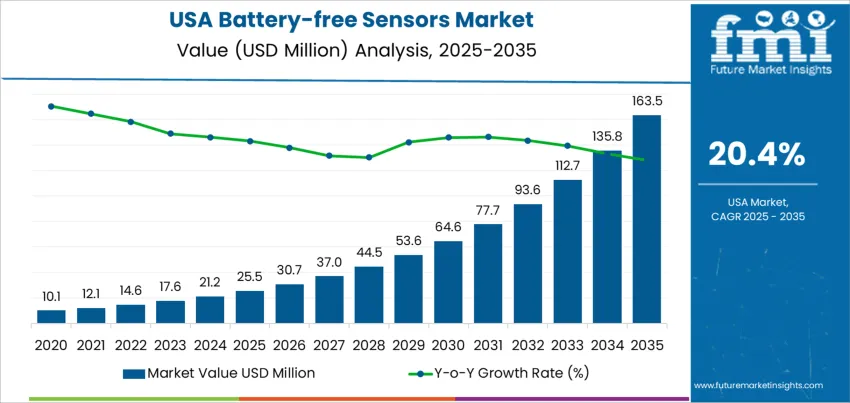
The demand for battery-free sensors in the USA is expected to grow from USD 25.5 million in 2025 to USD 163.5 million by 2035, reflecting a compound annual growth rate (CAGR) of 20.4%. Battery-free sensors, which operate without an external power source and are powered by energy-harvesting technologies (such as vibration, heat, or light), are gaining traction across healthcare, agriculture, manufacturing, and environmental monitoring.
Their ability to provide continuous, low-maintenance, and cost-effective data collection makes them increasingly valuable for applications where traditional battery-powered sensors are impractical or costly to maintain.
Quick Stats of the Demand for Battery-free Sensors in USA
- Demand for Battery-free Sensors in USA Value (2025): USD 25.5 million
- Demand for Battery-free Sensors in USA Forecast Value (2035): USD 163.5 million
- Demand for Battery-free Sensors in USA Forecast CAGR (2025-2035): 20.4%
- Demand for Battery-free Sensors in USA Leading Frequency: Ultra-High Frequency (44%)
- Demand for Battery-free Sensors in USA Key Growth Regions: West USA, South USA, Northeast USA, Midwest USA
- Demand for Battery-free Sensors in USA Key Players: ON Semiconductor, Texas Instruments, STMicroelectronics, Infineon Technologies, EnOcean GmbH
What is the Growth Forecast for the Battery-free Sensor Industry in USA through 2035?
The market will experience strong growth, starting at USD 25.5 million in 2025 and increasing to USD 30.7 million in 2026, USD 37.0 million in 2027, and USD 44.5 million in 2028. By 2029, demand for battery-free sensors will rise to USD 53.6 million, continuing its upward trajectory through the 2030s. By 2035, the demand for battery-free sensors is expected to reach USD 163.5 million, driven by advancements in energy-harvesting technologies, growing demand for sustainable solutions, and expanding applications across multiple industries.
The breakpoint analysis for the battery-free sensor market reveals a significant shift in demand dynamics around 2029. Prior to this, from 2025 to 2028, the market will experience gradual but steady growth as the technology is further developed and adoption increases in niche applications. However, the inflection point, or "breakpoint," is expected to occur after 2028, when the market will see a sharp acceleration in demand. This shift will be driven by advancements in energy harvesting technologies, increased industry awareness, and growing pressure for more sustainable, long-lasting solutions in sectors such as IoT, healthcare, and environmental monitoring.
In the later years of the forecast (2029-2035), the market will continue to expand rapidly, reflecting the maturing of battery-free sensor technology and its increasing mainstream adoption. The combination of technological advancements, cost reductions, and rising demand for sustainable, maintenance-free solutions will contribute to a dramatic surge in market value during this phase. By 2035, demand for battery-free sensors is expected to be significantly higher, driven by widespread applications across industrial and consumer markets.
USA Battery-free Sensors Industry Key Takeaways
| Metric | Value |
|---|---|
| Industry Sales Value (2025) | USD 25.5 million |
| Industry Forecast Value (2035) | USD 163.5 million |
| Industry Forecast CAGR (2025-2035) | 20.4% |
Why is the Demand for Battery-free Sensors in USA Growing?
Demand for battery-free sensors in the USA is rising as companies and institutions increasingly prioritize sustainability, reduced maintenance, and efficient Internet-of-Things (IoT) deployment. Battery-free sensors harvest ambient energy, light, motion, heat or radio waves, to operate, eliminating the need for battery replacement. This makes them attractive for widespread sensor networks where changing batteries would be impractical or costly. As industrial automation, smart buildings, environmental monitoring, logistics and asset-tracking systems expand, battery-free sensors offer a low-maintenance, cost-efficient solution that supports long-term deployments.
At the same time advances in energy-harvesting technology and demand for scalable sensor networks are fueling growth. Improvements in passive radio-frequency, ambient-energy harvesting, and ultra-low-power electronics increase the reliability and versatility of battery-free sensors. Sectors such as manufacturing, warehousing, logistics, smart infrastructure, agriculture and healthcare increasingly adopt these sensors for real-time monitoring, data collection, and automation without ongoing power-supply concerns. As demand for data, connectivity and sustainability continues across sectors, battery-free sensor use in the USA is likely to grow steadily in the coming years.
What Is the Current State of the Demand for Battery-Free Sensors in the USA in Terms of Frequency and Sensor Type?
The demand for battery-free sensors in the USA is primarily driven by frequency and sensor type. The leading frequency type is ultra-high frequency, which accounts for 44% of the market share, while temperature sensors dominate the sensor type segment, capturing 26% of the demand. Battery-free sensors, which harness energy from environmental sources like light, heat, or vibrations, are gaining popularity in various industries, including automotive, healthcare, and environmental monitoring, due to their low maintenance, eco-friendly nature, and ease of integration into IoT systems.
How Are Ultra-High Frequency Sensors Leading the Frequency Demand for Battery-Free Sensors in the USA?
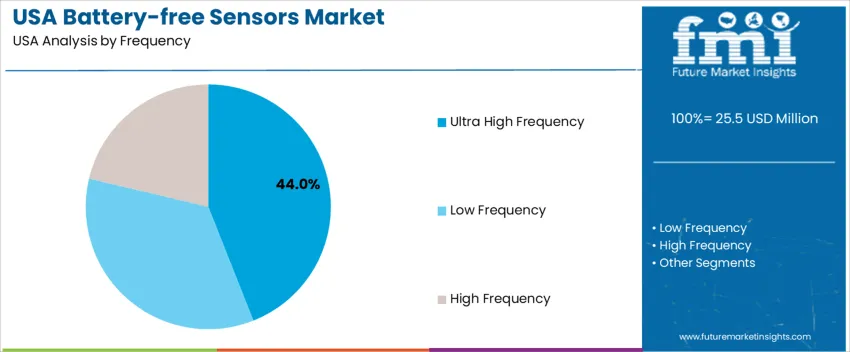
Ultra-high frequency (UHF) sensors lead the frequency demand for battery-free sensors in the USA, holding 44% of the market share. UHF sensors are particularly advantageous in battery-free applications due to their long-range capabilities and their ability to efficiently transfer data over distances without requiring a power source. These sensors are often used in RFID (radio-frequency identification) systems, remote monitoring applications, and supply chain tracking, where energy harvesting from ambient sources is utilized to power the sensor.
The demand for UHF battery-free sensors is driven by the increasing need for wireless communication and real-time data transmission without the need for regular battery replacement. As industries continue to adopt IoT (Internet of Things) solutions for asset tracking, environmental monitoring, and inventory management, UHF sensors offer a scalable, low-cost, and sustainable solution. The growing emphasis on reducing maintenance costs and environmental impact further supports the widespread adoption of ultra-high frequency sensors in battery-free sensor applications.
How Are Temperature Sensors Leading the Sensor Type Demand for Battery-Free Sensors in the USA?
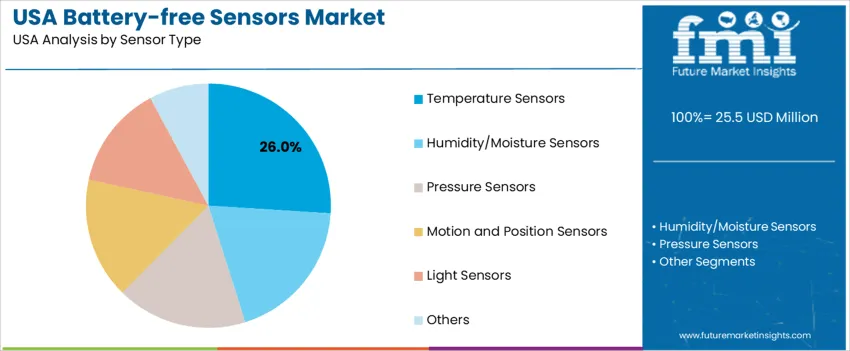
Temperature sensors lead the sensor type demand for battery-free sensors in the USA, capturing 26% of the market share. Temperature sensors are widely used in industrial, automotive, and healthcare applications to monitor temperature without the need for a power source. These sensors are essential in environments where constant monitoring is required, such as in food storage, HVAC systems, and medical devices, ensuring that temperature-sensitive materials and processes are kept within safe ranges.
The demand for temperature sensors is driven by their broad application across sectors that require continuous, non-invasive monitoring. Battery-free temperature sensors provide significant advantages, including lower maintenance costs, extended operational lifespans, and reduced environmental impact compared to traditional powered sensors. As industries seek cost-effective and sustainable solutions for monitoring critical variables, the demand for temperature sensors in battery-free applications will continue to grow, particularly in sectors focused on energy efficiency, environmental monitoring, and process automation.
What is the Demand Dynamics for Battery-Free Sensors in the USA?
Demand for battery-free sensors in the USA is increasing rapidly as businesses, industries, and public infrastructure adopt more IoT-based monitoring systems. Battery-free sensors, which harvest ambient energy such as light, radio frequency, vibration, or thermal gradients instead of relying on replaceable batteries, are valued for being maintenance-free and sustainable. These sensors are used across industrial automation, smart buildings, logistics, environmental monitoring, and other applications where large-scale or hard-to-access deployment is needed. As demand for scalable, low-maintenance sensor networks grows, battery-free sensors are becoming an attractive and increasingly common choice in the USA
What are the Drivers of Demand for Battery-Free Sensors in the USA?
Key drivers for battery-free sensor adoption include the growing deployment of IoT and wireless sensor networks across industries, which creates demand for large numbers of sensors that are cheaper to maintain when they do not require battery replacement or charging. Advances in energy-harvesting and ultra-low-power electronics make these sensors more reliable and economically viable for commercial use. Because these sensors reduce maintenance and waste, they appeal to firms looking for sustainable and cost-efficient solutions.
The expansion of smart infrastructure, including smart factories, environmental monitoring, logistics tracking, smart buildings, and industrial automation, is boosting demand because battery-free sensors support scalable sensor deployment without high upkeep. Demand in sectors such as healthcare monitoring, facility management, environmental sensing, and industrial maintenance also supports uptake of such sensors in the USA.
What are the Restraints on Demand for Battery-Free Sensors in the USA?
Despite strong growth, some factors limit adoption of battery-free sensors. First, energy-harvesting conditions may not always be adequate. In low-light, shielded, or harsh environments, ambient energy may insufficiently power sensors reliably, which limits use cases where continuous or high-precision sensing is crucial. Second, the performance and range of battery-free sensors may lag behind traditional battery-powered sensors for certain applications, such as high-frequency sampling, long-range communication, and high-power sensing.
Third, the upfront cost for developing or installing these sensors, especially if special energy-harvesting modules or infrastructure changes are needed, can be higher than conventional sensors, which may discourage some buyers. Finally, integration challenges, such as compatibility with existing systems, reliability verification, and regulatory or industrial compliance, can slow adoption in regulated sectors or conservative industries.
What are the Key Trends Influencing Demand for Battery-Free Sensors in the USA?
A major trend is the rapid technological improvement in energy-harvesting and low-power electronics that make battery-free sensors more robust and versatile. This supports their use beyond niche applications and into mainstream industrial, commercial, and smart-infrastructure deployments. Another trend is the expansion of IoT, smart buildings, and smart infrastructure. More companies and institutions are deploying large sensor networks for building automation, environmental sensing, asset tracking, and predictive maintenance, where the low-maintenance nature of battery-free sensors is a strong advantage.
There is also growing interest in sustainability and the reduction of electronic waste, which encourages adoption of sensors that do not rely on disposable batteries. Finally, industries such as logistics, manufacturing, environmental monitoring, and facility management are increasingly using battery-free sensors to support large-scale, distributed sensing, enabling scalable deployment even in remote or difficult-to-access spots.
What is the Regional Demand Outlook for Battery-free Sensors in the USA?
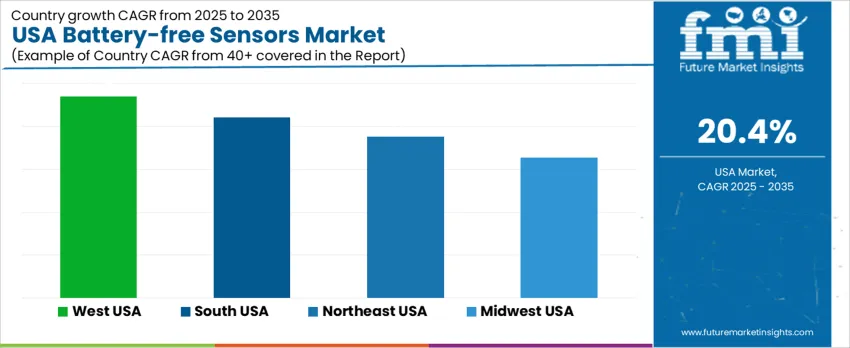
The demand for battery-free sensors in the USA is projected to grow significantly, with the West leading the charge at a CAGR of 23.5%. The South follows at 21%, the Northeast at 18.8%, and the Midwest at 16.3%. These variations reflect the different rates of adoption of sustainable, energy-efficient technologies across sectors such as healthcare, automotive, consumer electronics, and industrial applications. Battery-free sensors, which rely on alternative energy sources like ambient light or vibrations, are gaining traction due to their sustainability benefits and reduced maintenance costs.
| Region | CAGR (%) |
|---|---|
| West USA | 23.5 |
| South USA | 21.0 |
| Northeast USA | 18.8 |
| Midwest USA | 16.3 |
What Drives Demand for Battery-free Sensors in the West USA?
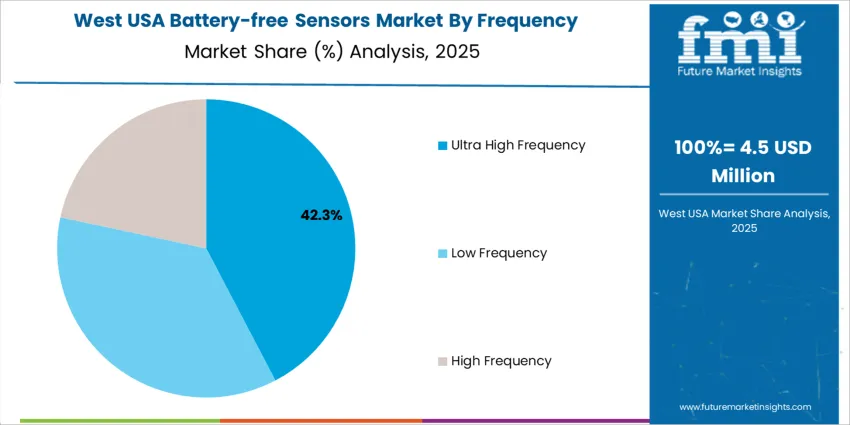
In the West USA, the projected 23.5% annual growth in demand for battery-free sensors is driven by the region's technological innovation and focus on sustainability. The West has a strong presence of tech companies, startups, and research institutions that prioritize energy-efficient solutions and environmental responsibility. Battery-free sensors are increasingly being used in a variety of applications, such as smart homes, healthcare monitoring systems, and industrial IoT devices.
The region's focus on green technologies and reducing energy consumption aligns well with the growth of battery-free sensors. Additionally, the West’s advanced infrastructure in renewable energy and a large population of eco-conscious consumers further contribute to the high demand for these sensors. As industries and consumers look for cost-effective, low-maintenance alternatives to traditional battery-powered devices, the adoption of battery-free sensors is expected to increase rapidly.
Why is Demand for Battery-free Sensors Growing in the South USA?
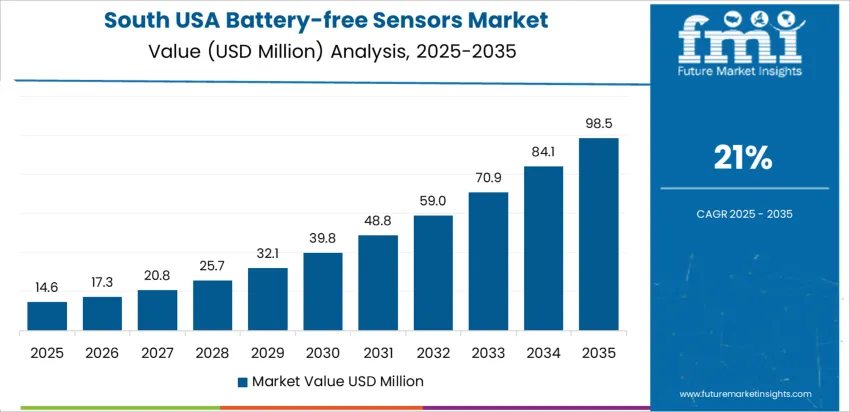
In the South USA, the demand for battery-free sensors is projected to grow at a CAGR of 21%. The region’s expanding manufacturing sector, increasing adoption of smart technologies, and rising focus on sustainability drive the demand for battery-free sensor solutions. Many industries in the South, such as agriculture, automotive, and healthcare, benefit from the advantages offered by battery-free sensors, such as long-lasting performance and reduced maintenance costs.
Battery-free sensors are particularly appealing in remote or off-grid applications, where traditional power sources may be limited. Additionally, the South's growing interest in smart cities, environmental sustainability, and renewable energy solutions supports the adoption of energy-efficient technologies like battery-free sensors. As industries and municipalities across the South seek solutions that minimize energy consumption and reduce environmental impact, the demand for battery-free sensors is expected to continue to rise.
What Supports the Growth of Battery-free Sensors in the Northeast USA?
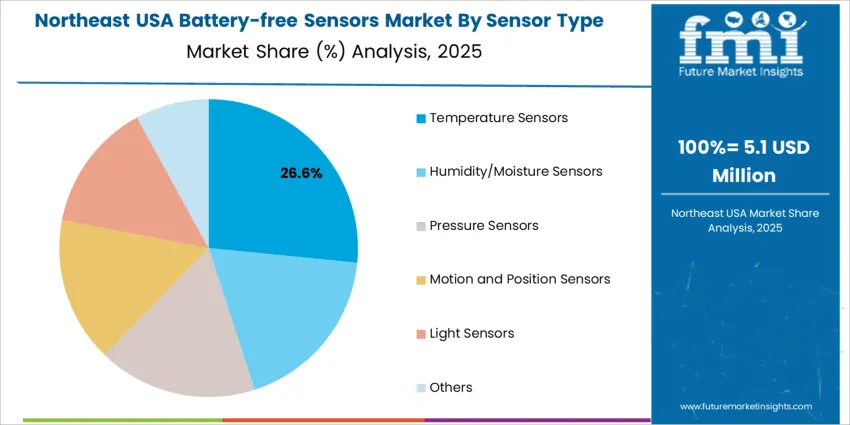
In the Northeast USA, the projected CAGR for battery-free sensors is 18.8%. The region's strong presence of industries in healthcare, manufacturing, and technology, along with an emphasis on reducing environmental impact, supports steady growth in the adoption of battery-free sensor solutions. Healthcare applications, such as patient monitoring systems, benefit from the continuous operation and low-maintenance nature of battery-free sensors.
Additionally, the Northeast’s advanced manufacturing sector, which is increasingly incorporating IoT technologies into industrial processes, also contributes to the growing demand for battery-free sensors. As consumer electronics and home automation systems become more energy-conscious, battery-free sensors are gaining popularity as a means to reduce the need for regular battery replacements. The region’s focus on energy efficiency and sustainability aligns well with the increasing use of battery-free sensors across various industries.
How is Demand for Battery-free Sensors Evolving in the Midwest USA?
In the Midwest USA, the demand for battery-free sensors is projected to grow at a CAGR of 16.3%. While the growth rate is slightly slower compared to other regions, steady adoption of these sensors in industries such as agriculture, healthcare, and automotive is contributing to this upward trend. The Midwest’s agricultural sector, for example, is increasingly adopting sensor technologies for monitoring environmental conditions, crop health, and livestock management, where battery-free solutions are highly beneficial due to their low maintenance and durability.
Similarly, the automotive industry is integrating battery-free sensors into vehicles for applications like tire pressure monitoring and vehicle tracking. As the Midwest continues to embrace energy-efficient and cost-effective solutions in its key industries, the demand for battery-free sensors is expected to increase steadily. Furthermore, as awareness of sustainability grows in the region, the adoption of battery-free technologies will likely gain more momentum.
What is the Competitive Landscape for the Battery-Free Sensor Market in the USA?
Demand for battery-free sensors in the USA has risen sharply as industries and municipalities pursue energy-efficient, maintenance-free sensing solutions. Growth in Internet of Things (IoT), smart infrastructure, automation, logistics, and environmental monitoring drives uptake of sensors that draw power from ambient sources rather than require batteries. Recent studies estimate the global battery-free sensors market at about USD 44.0 million in 2024.
The USA, as part of North America, accounted for a large portion of this demand, reflecting strong adoption in sectors such as industrial automation, healthcare, logistics, and smart buildings. Forecasts indicate the global market may grow to nearly USD 369-370 million by 2033, implying substantial expansion in the USA as well.
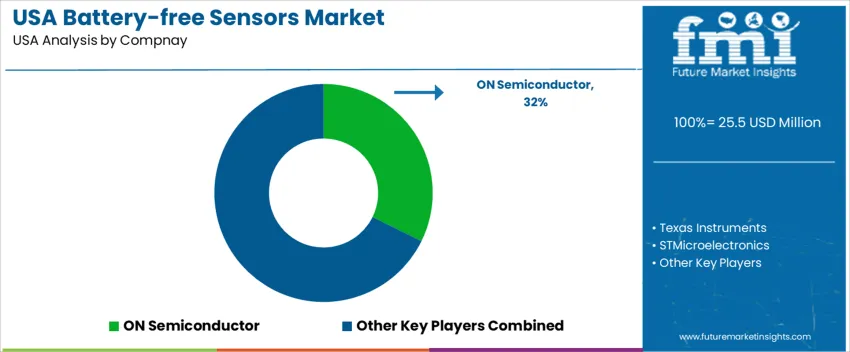
The competitive landscape includes a number of semiconductor and sensor firms. According to your list, ON Semiconductor leads with about 32.3% market share. Other important players are Texas Instruments, STMicroelectronics, Infineon Technologies, and EnOcean GmbH. These companies offer various battery-free solutions including energy-harvesting sensors (RF, thermal, vibration, or photovoltaic), ultra-low-power electronics, and wireless modules for applications such as environmental sensing, asset tracking, smart buildings, and industrial IoT.
Competitive advantage stems from sensor reliability, energy-harvesting efficiency, communication protocol compatibility, ease of integration, and scalability across applications. As demand continues rising, firms focus on innovation, broad application support, and supply reliability to maintain and grow their share.
Key Players of the Battery-free Sensors Industry in USA
- ON Semiconductor
- Texas Instruments
- STMicroelectronics
- Infineon Technologies
- EnOcean GmbH
Scope of the Report
| Items | Details |
|---|---|
| Quantitative Units | USD Million |
| Regions Covered | USA |
| Frequency | Ultra-High Frequency, Low Frequency, High Frequency |
| Sensor Type | Temperature Sensors, Humidity/Moisture Sensors, Pressure Sensors, Motion and Position Sensors, Light Sensors, Others |
| Industry | Automotive, Logistics, Healthcare, Oil & Gas, Food & Beverages, IT & Telecommunications, Others |
| Key Companies Profiled | ON Semiconductor, Texas Instruments, STMicroelectronics, Infineon Technologies, EnOcean GmbH |
| Additional Attributes | Dollar sales by frequency, sensor type, and industry show strong demand for ultra-high frequency sensors, especially in automotive and logistics sectors. Motion and position sensors are also in demand for healthcare and industrial applications. EnOcean GmbH, Texas Instruments, and ON Semiconductor lead the market, offering reliable and efficient battery-free sensor solutions. The market is expected to grow with the increasing adoption of energy-efficient technologies across industries such as automotive, IT, and healthcare. |
Key Segments in the Demand for Battery-free Sensors in USA
Frequency
- Ultra-High Frequency
- Low Frequency
- High Frequency
Sensor Type
- Temperature Sensors
- Humidity/Moisture Sensors
- Pressure Sensors
- Motion and Position Sensors
- Light Sensors
- Others
Industry
- Automotive
- Logistics
- Healthcare
- Oil & Gas
- Food & Beverages
- IT & Telecommunications
- Others
Region
- Northeast USA
- West USA
- Midwest USA
- South USA
Frequently Asked Questions
How big is the demand for battery-free sensors in USA in 2025?
The demand for battery-free sensors in USA is estimated to be valued at USD 25.5 million in 2025.
What will be the size of battery-free sensors in USA in 2035?
The market size for the battery-free sensors in USA is projected to reach USD 163.5 million by 2035.
How much will be the demand for battery-free sensors in USA growth between 2025 and 2035?
The demand for battery-free sensors in USA is expected to grow at a 20.4% CAGR between 2025 and 2035.
What are the key product types in the battery-free sensors in USA?
The key product types in battery-free sensors in USA are ultra high frequency, low frequency and high frequency.
Which sensor type segment is expected to contribute significant share in the battery-free sensors in USA in 2025?
In terms of sensor type, temperature sensors segment is expected to command 26.0% share in the battery-free sensors in USA in 2025.
Preview the report firsthand - request a free sample
Get SampleGet the brochure for pricing and purchase details.
Get PDFTable of Content
- Executive Summary
- USA Market Outlook
- Demand-side Trends
- Supply-side Trends
- Technology Roadmap Analysis
- Analysis and Recommendations
- Market Overview
- Market Coverage / Taxonomy
- Market Definition / Scope / Limitations
- Market Background
- Market Dynamics
- Drivers
- Restraints
- Opportunity
- Trends
- Scenario Forecast
- Demand in Optimistic Scenario
- Demand in Likely Scenario
- Demand in Conservative Scenario
- Opportunity Map Analysis
- Product Life Cycle Analysis
- Supply Chain Analysis
- Investment Feasibility Matrix
- Value Chain Analysis
- PESTLE and Porter’s Analysis
- Regulatory Landscape
- Regional Parent Market Outlook
- Production and Consumption Statistics
- Import and Export Statistics
- Market Dynamics
- USA Market Analysis 2020 to 2024 and Forecast, 2025 to 2035
- Historical Market Size Value (USD Million) Analysis, 2020 to 2024
- Current and Future Market Size Value (USD Million) Projections, 2025 to 2035
- Y-o-Y Growth Trend Analysis
- Absolute $ Opportunity Analysis
- USA Market Pricing Analysis 2020 to 2024 and Forecast 2025 to 2035
- USA Market Analysis 2020 to 2024 and Forecast 2025 to 2035, By Frequency
- Introduction / Key Findings
- Historical Market Size Value (USD Million) Analysis By Frequency , 2020 to 2024
- Current and Future Market Size Value (USD Million) Analysis and Forecast By Frequency , 2025 to 2035
- Ultra High Frequency
- Low Frequency
- High Frequency
- Y-o-Y Growth Trend Analysis By Frequency , 2020 to 2024
- Absolute $ Opportunity Analysis By Frequency , 2025 to 2035
- USA Market Analysis 2020 to 2024 and Forecast 2025 to 2035, By Sensor Type
- Introduction / Key Findings
- Historical Market Size Value (USD Million) Analysis By Sensor Type, 2020 to 2024
- Current and Future Market Size Value (USD Million) Analysis and Forecast By Sensor Type, 2025 to 2035
- Temperature Sensors
- Humidity/Moisture Sensors
- Pressure Sensors
- Motion and Position Sensors
- Light Sensors
- Others
- Y-o-Y Growth Trend Analysis By Sensor Type, 2020 to 2024
- Absolute $ Opportunity Analysis By Sensor Type, 2025 to 2035
- USA Market Analysis 2020 to 2024 and Forecast 2025 to 2035, By Industry
- Introduction / Key Findings
- Historical Market Size Value (USD Million) Analysis By Industry, 2020 to 2024
- Current and Future Market Size Value (USD Million) Analysis and Forecast By Industry, 2025 to 2035
- Automotive
- Logistics
- Healthcare
- Oil & Gas
- Food & Beverages
- IT & Telecommunications
- Others
- Y-o-Y Growth Trend Analysis By Industry, 2020 to 2024
- Absolute $ Opportunity Analysis By Industry, 2025 to 2035
- Market Structure Analysis
- Competition Dashboard
- Competition Benchmarking
- Market Share Analysis of Top Players
- By Regional
- By Frequency
- By Sensor Type
- By Industry
- Competition Analysis
- Competition Deep Dive
- ON Semiconductor
- Overview
- Product Portfolio
- Profitability by Market Segments (Product/Age /Sales Channel/Region)
- Sales Footprint
- Strategy Overview
- Marketing Strategy
- Product Strategy
- Channel Strategy
- Texas Instruments
- STMicroelectronics
- Infineon Technologies
- EnOcean GmbH
- ON Semiconductor
- Competition Deep Dive
- Assumptions & Acronyms Used
- Research Methodology


