

- Industry Size (2025)
- USD 0.7 Bn
- Forecast (2035)
- USD 2.0 Bn
- CAGR (2025 to 2035)
- 11.0%
Demand for Biometric Sensors in USA Forecast and Outlook 2025 to 2035
The demand for biometric sensors in the USA is expected to grow from USD 0.7 billion in 2025 to USD 2.0 billion by 2035, reflecting a compound annual growth rate (CAGR) of 11%. Biometric sensors, which are used to identify individuals based on unique physical or behavioral traits (such as fingerprints, facial recognition, and retina scanning), are increasingly integrated into security systems, smartphones, healthcare applications, and more. The growing need for secure access control, advancements in biometric technology, and the increasing adoption of biometric systems in various industries (including finance, healthcare, and public safety) will drive the steady demand for these sensors.
The market will experience steady growth, starting at USD 0.7 billion in 2025 and increasing to USD 0.8 billion in 2026, USD 0.9 billion in 2027, and USD 1.0 billion in 2028. By 2029, demand for biometric sensors will rise to USD 1.1 billion, continuing its upward trajectory through the 2030s. By 2035, the demand for biometric sensors is expected to reach USD 2.0 billion, supported by advancements in sensor technology, increased integration into consumer devices, and the growing need for secure, contactless identification systems.
Quick Stats of the Demand for Biometric Sensors in USA
- Demand for Biometric Sensors in USA Value (2025): USD 0.7 billion
- Demand for Biometric Sensors in USA Forecast Value (2035): USD 2.0 billion
- Demand for Biometric Sensors in USA Forecast CAGR (2025-2035): 11.0%
- Demand for Biometric Sensors in USA Leading Application: Finger Scan (34%)
- Demand for Biometric Sensors in USA Key Growth Regions: West USA, South USA, Northeast USA, Midwest USA
- Demand for Biometric Sensors in USA Key Players: 3M Cogent Inc., Idex A.S.A, Infineon Technologies, Fulcrum Biometrics, Safran
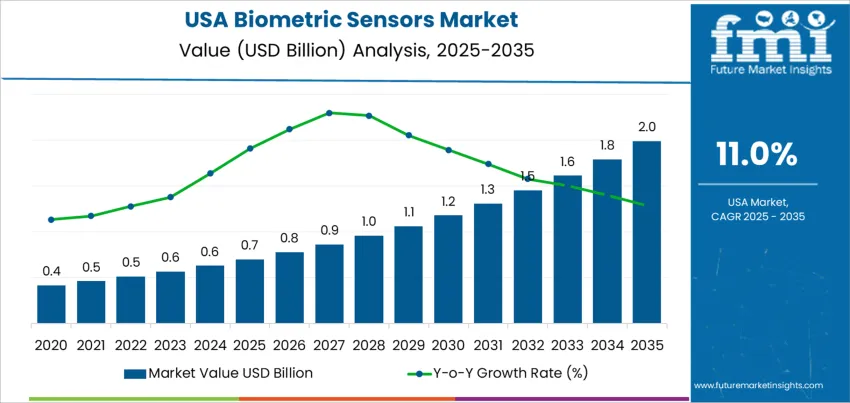
What is the Growth Forecast for the Biometric Sensor Industry in USA through 2035?
The growth contribution index for biometric sensors shows that volume growth will be the primary driver of market expansion, particularly in the early years (2025-2029). As the demand for biometric security and identification systems increases across various sectors, including mobile devices, banking, healthcare, and law enforcement, the market will see a steady rise in the number of biometric sensors deployed. This volume-driven growth will be fueled by the increasing adoption of biometric systems for everyday applications, such as device unlocking, payment authentication, and access control.
Price growth will also contribute to the overall market expansion, particularly in the later years of the forecast period (2029-2035), driven by technological advancements and improvements in sensor accuracy, speed, and convenience. As more advanced biometric sensors are integrated into new applications, the average price per unit may increase, contributing to the overall market value. While volume growth will continue to dominate in the early years, the latter part of the forecast period will likely see a stronger contribution from price growth, as higher-value, more advanced biometric systems become widespread across consumer and enterprise markets.
USA Biometric Sensors Industry Key Takeaways
| Metric | Value |
|---|---|
| Industry Sales Value (2025) | USD 0.7 billion |
| Industry Forecast Value (2035) | USD 2 billion |
| Industry Forecast CAGR (2025-2035) | 11.8% |
Why is the Demand for Biometric Sensors in USA Growing?
Demand for biometric sensors in the USA is rising as security, convenience, and digital identity verification become increasingly important across multiple sectors. Biometric sensors, including fingerprint, facial recognition, iris scan, and other modalities, offer reliable authentication. Their use in consumer electronics, such as smartphones, laptops, and tablets, enterprise access control, banking and financial services, healthcare, and government security systems has expanded significantly. The shift away from traditional passwords or physical keys towards biometric authentication supports demand. As digital payments, mobile banking, remote access, and identity verification needs grow, biometric sensors provide a more secure and user-friendly solution.
At the same time, advances in sensor technology, lower costs, and broader application scope support further adoption. Improvements in accuracy and reliability of fingerprint, face, and iris sensors, along with contactless and multi-factor authentication methods, make biometric solutions more practical. Growth of connected devices, such as smartphones, wearables, and IoT gadgets, also adds to demand for embedded biometric sensors. Industries such as finance, healthcare, and corporate security increasingly require strong identity verification to prevent fraud and unauthorized access. As regulatory and compliance pressures rise, and as organizations and consumers value security, privacy, and convenience, demand for biometric sensors in the USA is likely to continue growing over the coming years.
What Is the Current State of the Demand for Biometric Sensors in the USA in Terms of Product Type and Application?
The demand for biometric sensors in the USA is primarily driven by product type and application. The leading product type is optical sensors, which account for 31% of the market share, while finger scan is the dominant application, capturing 34% of the demand. Biometric sensors are critical for authentication and security systems, widely used in areas such as access control, personal identification, and mobile device security. As the demand for secure, non-invasive authentication systems continues to grow, optical sensors and finger scans remain essential components in biometric applications across various sectors.
How Are Optical Sensors Leading the Product Type Demand for Biometric Sensors in the USA?
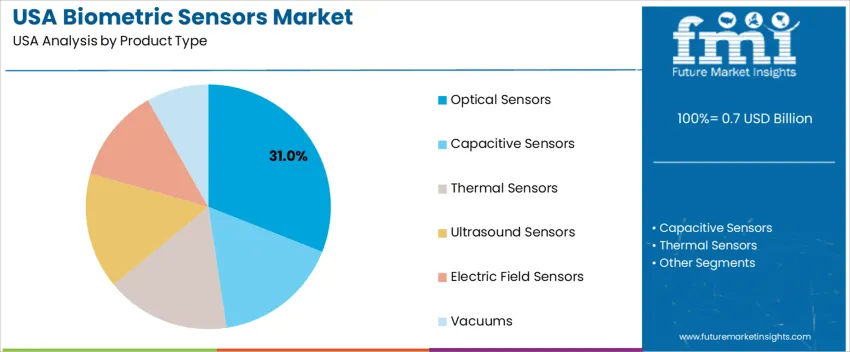
Optical sensors lead the demand for biometric sensors in the USA, holding 31% of the market share. Optical sensors use light-based technology, typically near-infrared, to capture biometric data, such as fingerprints or facial features. These sensors are widely used in fingerprint scanners, face recognition systems, and other biometric applications due to their high accuracy and reliability. Optical sensors are favored for their ability to deliver high-resolution data, ensuring precise identification and authentication.
The demand for optical sensors is driven by their advanced imaging capabilities and widespread adoption in consumer electronics, security systems, and identity verification applications. As businesses and governments focus on enhancing security measures, optical sensors are integral to providing fast, reliable, and non-invasive authentication methods. The growing demand for contactless security solutions, especially in the wake of health concerns and privacy regulations, further supports the continued dominance of optical sensors in the biometric sensor market.
How Is Finger Scan Leading the Application Demand for Biometric Sensors in the USA?
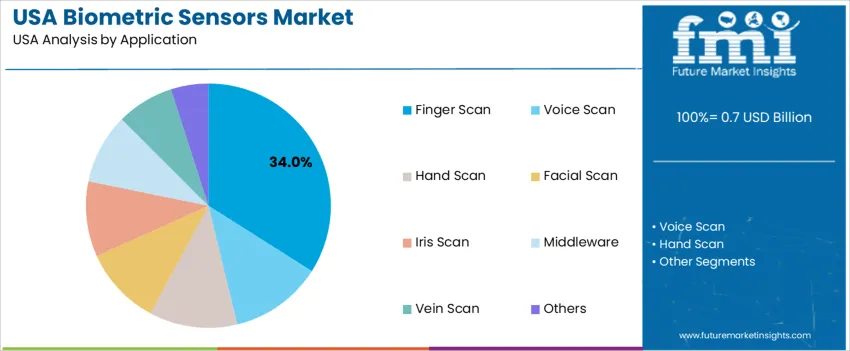
Finger scan leads the application demand for biometric sensors in the USA, capturing 34% of the market share. Fingerprint scanning is one of the most widely used biometric identification methods, offering a secure and efficient means of authentication for various applications, including mobile devices, financial transactions, access control, and law enforcement. Fingerprint scanners are popular because of their accuracy, ease of use, and the fact that fingerprints are unique to each individual, providing a highly secure method of identification.
The demand for finger scan applications is driven by their widespread use in consumer electronics, particularly smartphones and laptops, where fingerprint scanners provide a quick and secure method for unlocking devices or authorizing transactions. Additionally, fingerprint scanning is a key technology in physical security systems for access control in buildings, offices, and secure areas. As the need for secure, convenient authentication grows across various sectors, the demand for finger scan biometric systems is expected to continue expanding, further solidifying their dominance in the biometric sensor market in the USA.
What is the Summary of Demand for Biometric Sensors in the USA?
Demand for biometric sensors in the USA is increasing steadily. These sensors, including fingerprint, facial, iris, voice, and other biometric scanners, are becoming integral to identity verification, security, and health monitoring systems. The demand is driven by growth in sectors like consumer electronics, finance, healthcare, and public safety. Biometric sensors are widely used in devices and systems for authentication, access control, and even wellness monitoring. As technology improves and adoption expands, biometric sensors are increasingly seen as a key component of security and health infrastructure.
What are the Drivers of Demand for Biometric Sensors in the USA?
Demand for biometric sensors is primarily driven by increasing security concerns and the need for robust identity authentication methods in sectors like banking, finance, and enterprise systems. Biometric authentication is preferred over traditional passwords or PINs due to its higher security level. Another driver is the growing use of biometric sensors in consumer electronics like smartphones, wearables, and laptops, where they provide convenient and secure user access. The expansion of health-related applications, such as biometric sensors for health monitoring in wearables, also boosts demand. Furthermore, the adoption of biometric sensors for public safety, law enforcement, and access control in government and private sector facilities increases their usage.
What are the Restraints on Demand for Biometric Sensors in the USA?
Despite growing demand, several factors limit the uptake of biometric sensors. Privacy concerns are a major restraint, as collecting and storing biometric data raises issues around security and consent. Many consumers are wary of the potential misuse of their biometric information, which could lead to data breaches or identity theft. The cost of biometric systems, especially high-quality sensors and the supporting infrastructure, can also be prohibitive for smaller businesses or individuals. Additionally, performance limitations in certain conditions, such as incorrect readings due to environmental factors like lighting or moisture, can reduce the reliability and attractiveness of biometric sensors.
What are the Key Trends Influencing Demand for Biometric Sensors in the USA?
Key trends include the growing shift toward contactless authentication methods, which make biometric sensors even more attractive for secure, fast, and convenient identification. There is also an increasing focus on multi-modal biometric systems that use more than one type of biometric data, such as combining fingerprint and facial recognition, to enhance security and accuracy. The integration of biometric sensors into wearable devices for continuous health monitoring is another important trend, as consumers seek ways to track their health metrics in real time. Additionally, advances in artificial intelligence and machine learning are improving the accuracy and capabilities of biometric systems, leading to broader adoption across sectors.
What is the Regional Demand Outlook for Biometric Sensors in the USA?
The demand for biometric sensors in the USA is projected to grow significantly across all regions, with the West leading at a CAGR of 12.7%. The South follows with a projected growth rate of 11.4%, while the Northeast is forecasted at 10.1% and the Midwest at 8.8%. These regional differences reflect varying rates of adoption across sectors such as healthcare, security, automotive, and consumer electronics, driven by increasing demand for secure authentication and identification technologies. Advancements in sensor technology and the growing application of biometric sensors in everyday devices further fuel this market’s expansion.
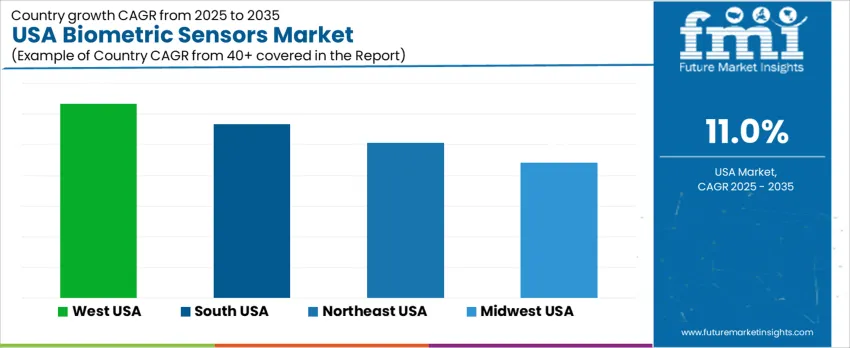
| Region | CAGR (%) |
|---|---|
| West USA | 12.7 |
| South USA | 11.4 |
| Northeast USA | 10.1 |
| Midwest USA | 8.8 |
What Drives Demand for Biometric Sensors in the West USA?
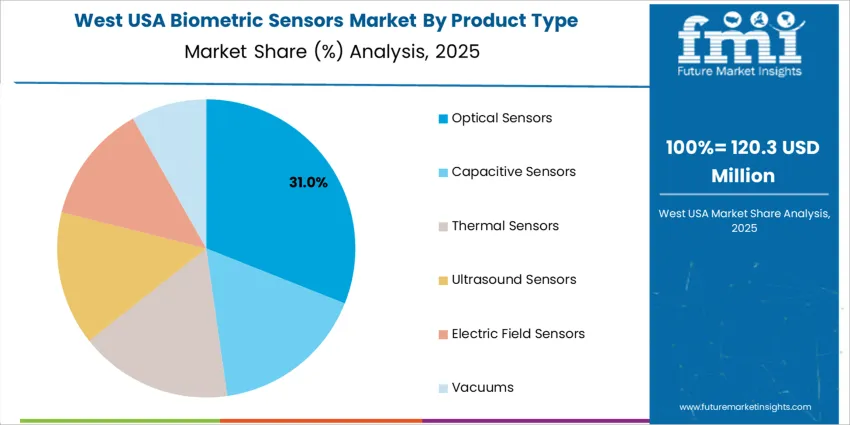
In the West USA, the demand for biometric sensors is projected to grow at a CAGR of 12.7%. The region’s technology-driven economy, with its high concentration of tech companies and startups, significantly contributes to the adoption of biometric sensor technology. The West has been a leader in the implementation of biometric security solutions, especially in sectors like healthcare, personal electronics, and security systems.
As industries such as fintech and cybersecurity increasingly adopt biometrics for secure access and identification, the demand for advanced biometric sensors rises. Moreover, the growing focus on seamless, contactless technologies in consumer devices, such as smartphones, wearables, and laptops, further boosts the adoption of biometric sensors in the West. With California and other West Coast states driving innovation and consumer interest in personal security, the region is expected to maintain strong growth in biometric sensor demand.
Why is Demand for Biometric Sensors Growing in the South USA?
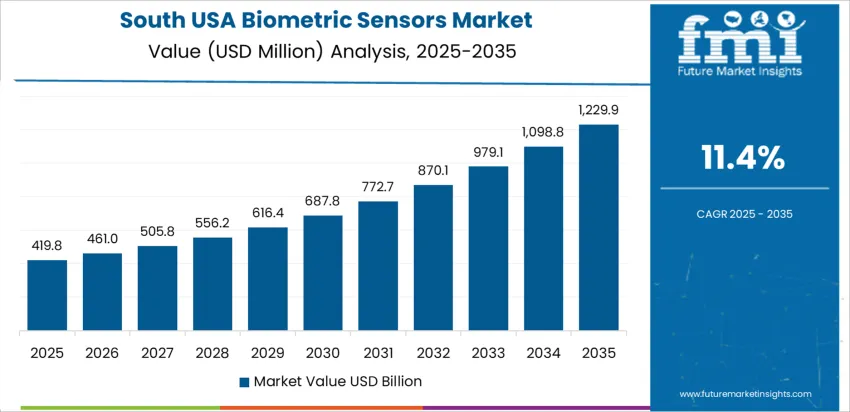
In the South USA, the projected CAGR for biometric sensors is 11.4%, driven by a mix of healthcare applications, security enhancements, and the expansion of smart technologies. As businesses and government institutions adopt biometric systems for secure access and identity verification, demand for biometric sensors in the South increases. The healthcare sector, in particular, plays a significant role in this growth, as hospitals and clinics look to enhance patient and staff security, while also simplifying access control and records management.
Additionally, the rise of smart devices and wearables in the consumer electronics market is contributing to the steady increase in biometric sensor demand. As industries in the South become more digitally connected and security-conscious, the role of biometric sensors in identity authentication and privacy protection becomes ever more critical.
What Supports Growth in Biometric Sensor Demand in the Northeast USA?
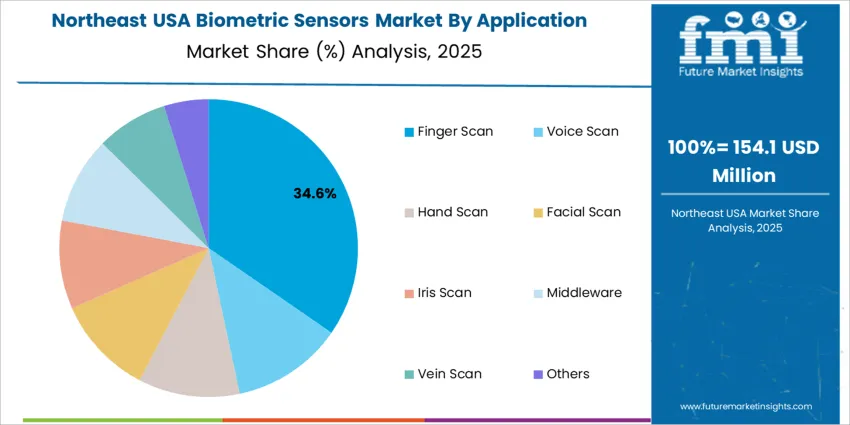
In the Northeast USA, the demand for biometric sensors is expected to grow at a CAGR of 10.1%. The Northeast, home to many financial institutions, healthcare facilities, and government agencies, is seeing an increase in biometric sensor applications for secure access, authentication, and transaction verification. The financial services sector, particularly in areas like New York, has been an early adopter of biometric solutions, using sensors for secure banking and financial transactions.
Additionally, the region’s focus on cybersecurity, data protection, and privacy laws has led to heightened interest in biometric technologies. The healthcare sector is also adopting biometric sensors for patient identification and access control. As consumer interest in personal data security continues to grow, the demand for biometric sensors in the Northeast is expected to remain strong.
How is Demand for Biometric Sensors Evolving in the Midwest USA?
In the Midwest USA, the demand for biometric sensors is projected to grow at a CAGR of 8.8%. While growth is somewhat slower compared to other regions, the Midwest continues to see steady adoption of biometric technologies across industries such as manufacturing, healthcare, and automotive. The region’s manufacturing industry, which increasingly uses biometric systems for access control and workforce management, contributes to this growth.
Similarly, the healthcare sector’s growing use of biometric sensors for patient identification, medical record access, and staff authentication supports demand. As biometric technologies become more accessible and the need for enhanced security and data protection rises, demand for biometric sensors in the Midwest is expected to follow a steady upward trajectory. The adoption of biometric solutions in vehicles for driver identification and security also adds to the market growth in the Midwest.
What is the Competitive Landscape for the Biometric Sensor Market in the USA?
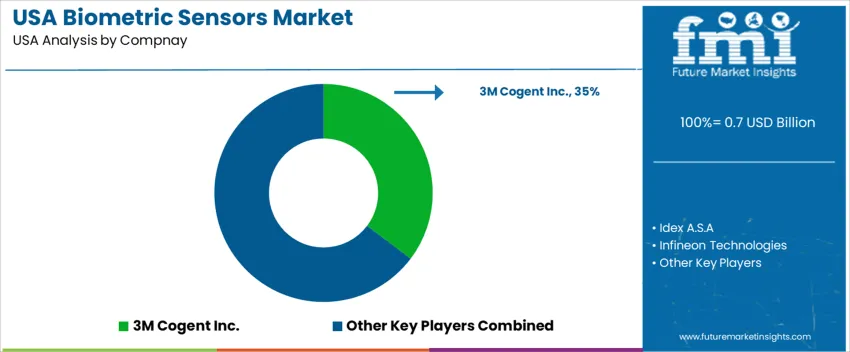
Demand for biometric sensors in the USA has risen sharply in recent years. The growth is driven by expanding use of biometric authentication for security, identity verification, and access control across sectors such as consumer electronics, finance, healthcare, government, and enterprise infrastructure. The broader biometric sensor market is projected to grow substantially through the next decade. For example, one estimate puts the global market growing from roughly USD 9.78 billion in 2025 to about USD 23.01 billion by 2032.
North America, led by the USA, is expected to remain a dominant region. In the USA, rising adoption of biometrics in smartphones, smart devices, secure payments, and physical access systems is reinforcing demand. Reliability, user convenience, and increasing regulatory or security requirements further support this upward trend.
In this competitive field several firms and technology providers compete for share. According to your list, 3M Cogent Inc. holds about 35.3% share among the identified group. Other firms include Idex A.S.A, Infineon Technologies, Fulcrum Biometrics, and Safran. These suppliers and developers differ in product focus, sensor type (optical, capacitive, vein, fingerprint, etc.), application, from consumer electronics to secure access, border control, and enterprise authentication, and in depth of integration (hardware, software, enrolment services).
Some emphasise high-accuracy sensors for enterprise and government use. Others aim at cost-effective modules suitable for mass-market devices. Competitive advantage depends on sensor accuracy, speed, reliability in varied conditions, integration capability, supply reliability, and compliance with privacy or regulatory standards. As biometric technology evolves, including contactless, multimodal, and AI-enhanced systems, competition remains active and dynamic.
Key Players of the Biometric Sensors Industry in USA
- 3M Cogent Inc.
- Idex A.S.A
- Infineon Technologies
- Fulcrum Biometrics
- Safran
Scope of the Report
| Items | Details |
|---|---|
| Quantitative Units | USD Billion |
| Regions Covered | USA |
| Product Type | Optical Sensors, Capacitive Sensors, Thermal Sensors, Ultrasound Sensors, Electric Field Sensors, Vacuums |
| Application | Finger Scan, Voice Scan, Hand Scan, Facial Scan, Iris Scan, Middleware, Vein Scan, Others |
| End-Use Industry | Smart Phones, Consumer Electronics, Smart Watches, Other Smart Gadgets, Automotive, Hospitals, Commercial Centers, Educational Hubs, Research Labs, Banking and Financial Sector |
| Key Companies Profiled | 3M Cogent Inc., Idex A.S.A, Infineon Technologies, Fulcrum Biometrics, Safran |
| Additional Attributes | Dollar sales by product type, application, and end-use industry show strong demand for optical and capacitive biometric sensors, particularly for finger and facial scans. Smart devices, including smartphones, smartwatches, and other gadgets, contribute heavily to sensor demand. The banking and financial sector also sees high adoption of biometric authentication. Companies like 3M Cogent and Safran are major players, offering a range of biometric sensors for various applications. The market is expected to grow with increased demand for secure authentication and the integration of biometric sensors into more consumer and commercial devices. |
Key Segments in the Demand for Biometric Sensors in USA
Product Type
- Optical Sensors
- Capacitive Sensors
- Thermal Sensors
- Ultrasound Sensors
- Electric Field Sensors
- Vacuums
Application
- Finger Scan
- Voice Scan
- Hand Scan
- Facial Scan
- Iris Scan
- Middleware
- Vein Scan
- Others
End-Use Industry
- Smart Phones
- Consumer Electronics
- Smart Watches
- Other Smart Gadgets
- Automotive
- Hospitals
- Commercial Centers
- Educational Hubs
- Research Labs
- Banking and Financial Sector
Region
- Northeast USA
- West USA
- Midwest USA
- South USA
Frequently Asked Questions
How big is the demand for biometric sensors in USA in 2025?
The demand for biometric sensors in USA is estimated to be valued at USD 0.7 billion in 2025.
What will be the size of biometric sensors in USA in 2035?
The market size for the biometric sensors in USA is projected to reach USD 2.0 billion by 2035.
How much will be the demand for biometric sensors in USA growth between 2025 and 2035?
The demand for biometric sensors in USA is expected to grow at a 11.0% CAGR between 2025 and 2035.
What are the key product types in the biometric sensors in USA?
The key product types in biometric sensors in USA are optical sensors, capacitive sensors, thermal sensors, ultrasound sensors, electric field sensors and vacuums.
Which application segment is expected to contribute significant share in the biometric sensors in USA in 2025?
In terms of application, finger scan segment is expected to command 34.0% share in the biometric sensors in USA in 2025.
Preview the report firsthand - request a free sample
Get SampleGet the brochure for pricing and purchase details.
Get PDFTable of Content
- Executive Summary
- USA Market Outlook
- Demand-side Trends
- Supply-side Trends
- Technology Roadmap Analysis
- Analysis and Recommendations
- Market Overview
- Market Coverage / Taxonomy
- Market Definition / Scope / Limitations
- Market Background
- Market Dynamics
- Drivers
- Restraints
- Opportunity
- Trends
- Scenario Forecast
- Demand in Optimistic Scenario
- Demand in Likely Scenario
- Demand in Conservative Scenario
- Opportunity Map Analysis
- Product Life Cycle Analysis
- Supply Chain Analysis
- Investment Feasibility Matrix
- Value Chain Analysis
- PESTLE and Porter’s Analysis
- Regulatory Landscape
- Regional Parent Market Outlook
- Production and Consumption Statistics
- Import and Export Statistics
- Market Dynamics
- USA Market Analysis 2020 to 2024 and Forecast, 2025 to 2035
- Historical Market Size Value (USD Million) Analysis, 2020 to 2024
- Current and Future Market Size Value (USD Million) Projections, 2025 to 2035
- Y-o-Y Growth Trend Analysis
- Absolute $ Opportunity Analysis
- USA Market Pricing Analysis 2020 to 2024 and Forecast 2025 to 2035
- USA Market Analysis 2020 to 2024 and Forecast 2025 to 2035, By Product Type
- Introduction / Key Findings
- Historical Market Size Value (USD Million) Analysis By Product Type , 2020 to 2024
- Current and Future Market Size Value (USD Million) Analysis and Forecast By Product Type , 2025 to 2035
- Optical Sensors
- Capacitive Sensors
- Thermal Sensors
- Ultrasound Sensors
- Electric Field Sensors
- Vacuums
- Y-o-Y Growth Trend Analysis By Product Type , 2020 to 2024
- Absolute $ Opportunity Analysis By Product Type , 2025 to 2035
- USA Market Analysis 2020 to 2024 and Forecast 2025 to 2035, By Application
- Introduction / Key Findings
- Historical Market Size Value (USD Million) Analysis By Application, 2020 to 2024
- Current and Future Market Size Value (USD Million) Analysis and Forecast By Application, 2025 to 2035
- Finger Scan
- Voice Scan
- Hand Scan
- Facial Scan
- Iris Scan
- Middleware
- Vein Scan
- Others
- Y-o-Y Growth Trend Analysis By Application, 2020 to 2024
- Absolute $ Opportunity Analysis By Application, 2025 to 2035
- USA Market Analysis 2020 to 2024 and Forecast 2025 to 2035, By End-Use Industry
- Introduction / Key Findings
- Historical Market Size Value (USD Million) Analysis By End-Use Industry, 2020 to 2024
- Current and Future Market Size Value (USD Million) Analysis and Forecast By End-Use Industry, 2025 to 2035
- Smart Phones
- Consumer Electronics
- Smart Watches
- Other Smart Gadgets
- Automotive
- Hospitals
- Commercial Centers
- Educational Hubs
- Research Labs
- Banking and Financial Sector
- Y-o-Y Growth Trend Analysis By End-Use Industry, 2020 to 2024
- Absolute $ Opportunity Analysis By End-Use Industry, 2025 to 2035
- Market Structure Analysis
- Competition Dashboard
- Competition Benchmarking
- Market Share Analysis of Top Players
- By Regional
- By Product Type
- By Application
- By End-Use Industry
- Competition Analysis
- Competition Deep Dive
- 3M Cogent Inc.
- Overview
- Product Portfolio
- Profitability by Market Segments (Product/Age /Sales Channel/Region)
- Sales Footprint
- Strategy Overview
- Marketing Strategy
- Product Strategy
- Channel Strategy
- Idex A.S.A
- Infineon Technologies
- Fulcrum Biometrics
- Safran
- 3M Cogent Inc.
- Competition Deep Dive
- Assumptions & Acronyms Used
- Research Methodology


