

- Market Size (2026)
- USD 2.3 Bn
- Forecast (2036)
- USD 4.9 Bn
- CAGR (2026 to 2036)
- 7.9%
Specialty Solvents for Battery Electrolyte Blending Market Size, Forecast, and Outlook By FMI
The specialty solvents for battery electrolyte blending market was valued at USD 2.1 billion in 2025. The market value is expected to reach USD 2.3 billion by the end of 2026 and rise at a CAGR of 7.9% through 2036. By 2036, the market is forecast to reach USD 4.9 billion.
Summary of the Specialty Solvents for Battery Electrolyte Blending Market
- Demand and Growth Drivers
- EV cell production backs demand for high-purity carbonate solvents as large battery packs need repeatable electrolyte filling.
- Energy storage projects add solvent pull as long-cycle lithium-ion systems need stable electrolyte blends.
- Moisture control raises entry barriers as electrolyte-grade solvents need tighter handling and storage discipline.
- Product and Segment View
- Conventional Li-ion is projected to hold 66.0% share in 2026 as proven carbonate solvent systems keep approval risk lower for cell makers.
- EV and xEV Batteries are expected to capture 54.0% of end-use application share in 2026, backed by higher electrolyte fill volumes in large automotive packs.
- Carbonate Solvents are estimated to represent 52.0% of solvent type use in 2026 through broad compatibility with lithium-ion electrolyte blends.
- Battery Grade is forecast to make up 72.0% of purity grade sales in 2026 as cell manufacturers require tighter control over moisture and metal impurities.
- Geography and Competitive Outlook
- China is expected to record a CAGR of 9.0% through 2036, backed by cell manufacturing scale and solvent integration.
- Brazil is projected to expand at 8.6% CAGR by 2036, as EV sales and storage planning raise early electrolyte needs.
- Companies combining carbonate chemistry depth with impurity control are strengthening supplier positions during the forecast period.
- Analyst Opinion
- Nikhil Kaitwade, Principal Consultant for Chemical and Materials at FMI, says, “Electrolyte solvent sourcing is becoming a qualification decision for cell makers. Battery plants check impurity control and batch repeatability before approval. EV batteries drive volume while high-voltage cells tighten testing. Carbonate scale and clean storage reduce risk for electrolyte formulators.”
- Specialty Solvents for Battery Electrolyte Blending Market Value Analysis
- The specialty solvents for battery electrolyte blending market is moving from chemical volume supply into a qualified battery-material supply base.
- Adoption is supported by electrolyte evidence needs for EV cells and energy storage batteries.
- Market value is benefiting from deeper use of solvents for battery electrolyte across regulated cell manufacturing programs.
- Demand is supported by solvent purity records meeting electrolyte blending requirements and safer battery formation planning.
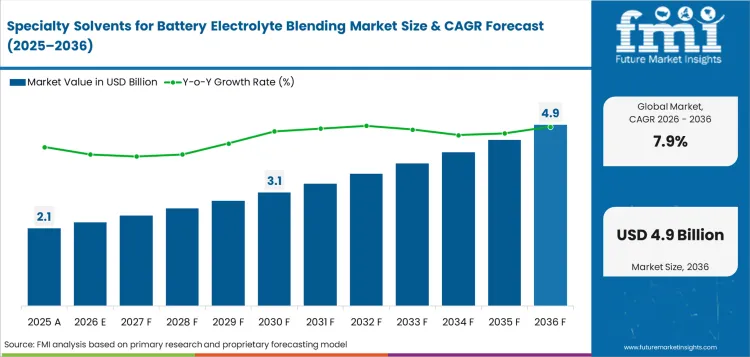
Key Takeaways, Market Size, and Forecast
- Specialty solvents for battery electrolyte blending market is estimated at USD 2.1 billion in 2025.
- By 2036, specialty solvents for battery electrolyte blending market is expected to be worth USD 4.9 billion.
- From 2026 to 2036, demand is projected to expand at a CAGR of 7.9%.
- Market value is projected to create an incremental opportunity of USD 2.6 billion between 2026 and 2036.
- In 2026, conventional Li-ion is expected to account for 66.0% of battery chemistry demand.
- EV and xEV batteries are expected to hold 54.0% of end-use application demand in 2026.
- China and Brazil are among the stronger country markets, with projected CAGRs of 9.0% and 8.6%, respectively.
Battery electrolyte solvent buying is becoming stricter as cell makers focus on moisture control and steady supply. UBE’s February 2025 Louisiana project will add 100,000 tons of DMC and 40,000 tons of EMC each year. Local carbonate supply can help United States electrolyte formulators reduce import risk and plan qualified solvent lots with fewer delays. Price pressure is also affecting solvent selection as battery makers work to lower input costs. In May 2025, IEA stated EV battery demand exceeded 950 GWh in 2024 and pack prices fell 20% in the same year. Lower pack prices push cell makers to question solvent costs and favor producers with strong purity records. Electrolyte formulas are moving beyond standard lithium-ion blends. Capchem’s May 2025 launch included five battery chemical products, including ultra-fast charging LFP electrolyte and sodium-ion battery electrolyte. Broader product coverage makes solvent selection more specific to each battery chemistry and end use.
Specialty Solvents for Battery Electrolyte Blending Market Definition
The Specialty Solvents for Battery Electrolyte Blending Market includes high-purity organic solvents used to dissolve salts and carry additives inside rechargeable battery cells. Scope includes carbonate solvents, ether solvents, fluorinated solvents, sulfone solvents, and solvent blends used in lithium-ion and advanced battery systems. Finished electrolyte salts, cathode powders, anode materials, battery cells, and battery packs are outside market scope.
Specialty Solvents for Battery Electrolyte Blending Market Inclusions
Market scope covers all commercially traded specialty solvents categorized by battery chemistry, including conventional Li-ion, high-voltage systems, sodium-ion, and solid-state cells; solvent type, including carbonate solvents, ether solvents, fluorinated solvents, and sulfone solvents; purity grade, including battery grade, electronic grade, research grade, and industrial grade; blending role, including primary solvent, co-solvent, additive carrier, and safety modifier; and end-use application, including EV and xEV batteries, consumer electronics, energy storage systems, and industrial batteries. Revenue scope covers 2026 to 2036. Key stakeholders include solvent manufacturers, electrolyte formulators, battery cell producers, EV battery suppliers, energy storage system manufacturers, specialty chemical distributors, testing laboratories, raw material suppliers, and regulatory bodies.
Specialty Solvents for Battery Electrolyte Blending Market Exclusions
Scope does not include finished electrolytes, LiPF₆ salts, LiFSI salts, cathode active materials, anode materials, separators, binders, battery cells, or battery recycling chemicals.
Specialty Solvents for Battery Electrolyte Blending Market Research Methodology
- Primary Research: FMI analysts reviewed inputs from solvent producers, electrolyte formulators, cell manufacturers, and specialty chemical distributors in important battery markets.
- Desk Research: Combined data from battery supply chain records, company product portfolios, official energy data, and solvent capacity announcements.
- Market sizing and forecasting: Added solvent use across battery chemistries and end-use groups from the bottom up.
- Data validation: Cross-checked against cell manufacturing capacity, EV battery demand, and company solvent supply coverage.
Why is the Specialty Solvents for Battery Electrolyte Blending Market Growing?
- Cell makers are using high-purity solvents earlier to reduce electrolyte rework before battery formation begins.
- Electrolyte formulators need stable carbonate blends as fast charging increases stress on cell interfaces.
- Manufacturers are qualifying solvent partners with stronger impurity records and storage controls.
EV sales create a practical volume base for electrolyte solvents used in lithium-ion cells. Argonne National Laboratory reported over 1.5 million EVs sold in 2024, with EVs reaching 9.9% of USA vehicle sales during the year. This sales base increases the need for qualified electrolyte materials across cell manufacturing and battery supply chains. Solvent makers with repeatable purity and reliable lot records can secure stronger positions with electrolyte formulators.
Battery manufacturing scale is raising the quality bar for every solvent lot. DOE’s December 2024 advanced battery supply chain review states lithium and other salts are combined with specialized chemical solvents to produce electrolyte. This places solvents inside the core battery component chain instead of a loose chemical input pool. Buyers need traceable batches so cell lines can avoid formation losses and repeat testing.
Market Segmentation Analysis
- Conventional Li-ion is projected to represent 66.0% of battery chemistry use in 2026 as proven cell platforms continue using established electrolyte solvent systems.
- EV and xEV batteries are expected to capture 54.0% of end-use application share in 2026 since large automotive packs require higher electrolyte fill volumes.
- Carbonate solvents are estimated to hold 52.0% of solvent type revenue in 2026 through broad use in lithium-ion electrolyte formulations.
- Battery grade is forecast to make up 72.0% of purity grade sales in 2026 as cell manufacturers require tighter moisture and impurity control.
- Primary solvent is projected to contribute 46.0% of blending role share in 2026 since base solvents carry salts during electrolyte preparation.
Specialty solvents for battery electrolyte blending are divided into five primary segment groups based on battery chemistry, end-use application, solvent type, purity grade, and blending role. Battery chemistry includes Conventional Li-ion, high-voltage systems, sodium-ion, and solid-state cells. End-use application includes EV and xEV batteries, consumer electronics, energy storage systems, and industrial batteries. Solvent type includes carbonate solvents, ether solvents, fluorinated solvents, and sulfone solvents. Purity grade includes battery grade, electronic grade, research grade, and industrial grade. Blending role includes primary solvent, co-solvent, additive carrier, and safety modifier.
Insights into Specialty Solvents for Battery Electrolyte Blending Market by Battery Chemistry
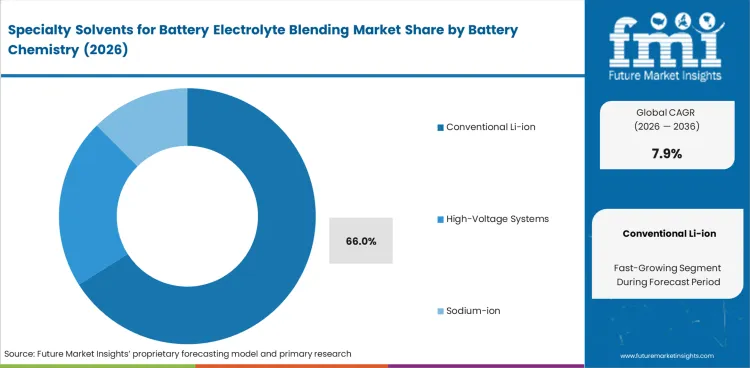
- In 2026, conventional li-ion is estimated to make up 66.0% of the battery chemistry segment globally. Established cell designs use proven carbonate solvent systems with lower qualification risk for electrolyte formulators.
- High-voltage and sodium-ion systems require more tailored solvent packages. Their use improves in programs needing longer cycle life and better thermal control.
Insights into Specialty Solvents for Battery Electrolyte Blending Market by End-use Application
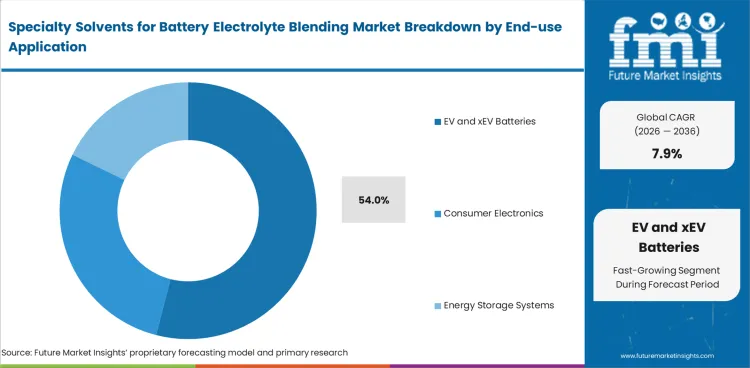
- EV and xEV batteries are projected to account for 54.0% of end-use application demand in 2026. Large automotive packs require higher electrolyte fill volumes across each finished battery system.
- Consumer electronics and storage batteries add steady solvent demand. Their buying patterns rely on cycle-life targets and cell format requirements.
Insights into Specialty Solvents for Battery Electrolyte Blending Market by Solvent Type
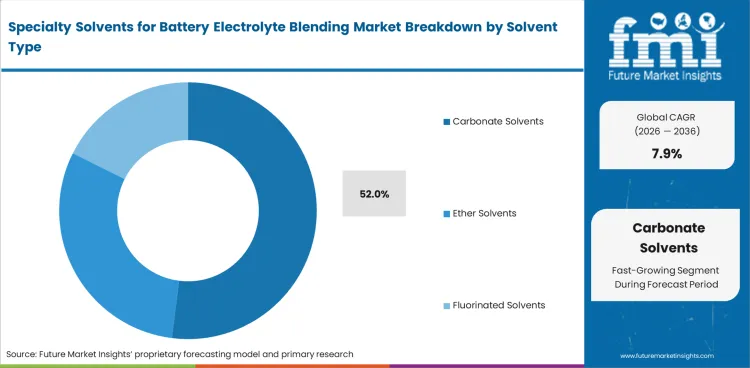
- In 2026, carbonate solvents are estimated to account for 52.0% of solvent type demand. These solvents serve as base carriers in many lithium-ion electrolyte blends.
- Ether and fluorinated solvents address selected advanced battery programs. Their value improves in cells requiring better low-temperature behavior or interface stability.
Insights into Specialty Solvents for Battery Electrolyte Blending Market by Purity Grade
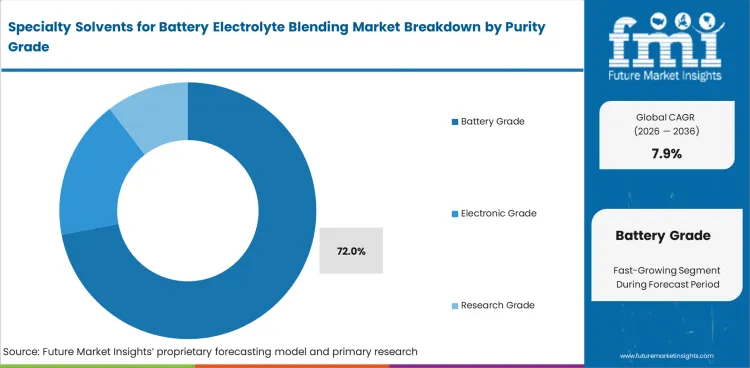
- Battery grade is forecast to hold 72.0% of the purity grade segment in 2026. Cell manufacturers prefer this grade for lower moisture content and tighter metal impurity control.
- Electronic grade and research grade solvents serve pilot lines and formulation trials. Their role is stronger in development work before full cell qualification begins.
Insights into Specialty Solvents for Battery Electrolyte Blending Market by Blending Role
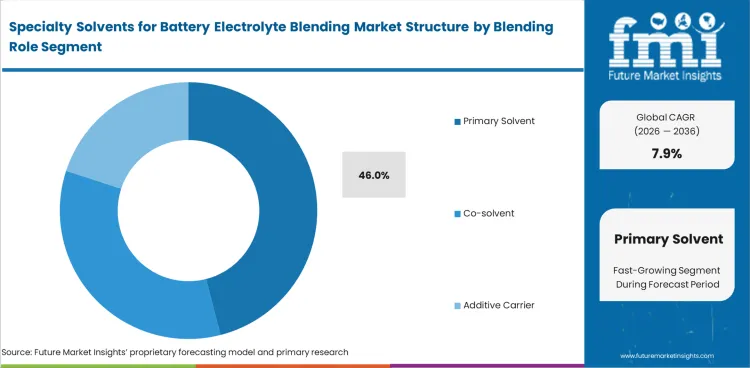
- Primary solvent is projected to account for 46.0% of blending role demand in 2026. Base solvent systems carry lithium salts and define viscosity during electrolyte preparation.
- Co-solvents and safety modifiers serve more specialized blend needs. Their use increases in sodium-ion and high-voltage cells requiring additional stability control.
Specialty Solvents for Battery Electrolyte Blending Market Drivers, Restraints, and Opportunities
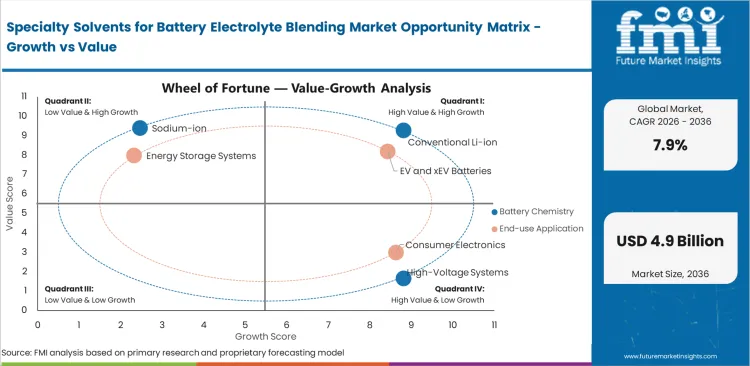
- Fast-charging cell designs increase demand for solvent systems with better interface stability.
- Local battery supply chains improve opportunity for domestic DMC and EMC production.
- Long qualification cycles restrain new solvent use as cell makers avoid chemistry changes after approval.
Specialty solvents for battery electrolyte blending keep expanding as EV batteries and storage systems need high-purity solvent blends with stable moisture and impurity control. Cost pressure and long qualification cycles can slow supplier changes. Demand advances through carbonate solvent scale and advanced electrolyte programs.
Battery Cost Deflation Tightens Solvent Premiums
As per a March 2025 report by IEA, electric car sales rose 25% in 2024 to 17 million units, annual battery demand surpassed 1 TWh, and the average battery electric car pack price fell below USD 100/kWh. In specialty solvents used for electrolyte blending in carbonate systems, pricing shows a two-way effect. Larger battery output supports stronger volume demand while cell makers push cost reductions through procurement. Solvent suppliers face tighter margins for premium pricing and must justify value clearly. They can defend value through low moisture grades and strict impurity control. They can use reliable packaging and strong local supply assurance to compete.
Feedstock Swings Keep Solvent Contracts Fluid
In May 2025, the EIA reported that crude oil prices fell from USD 82/b on January 15, 2025, to USD 75/b on March 31, 2025, and the Mont Belvieu natural gas plant liquids composite price rose 10% quarter-over-quarter to USD 8.10/MMBtu; ethane increased 4%, and propane increased 7%. This matters for electrolyte solvent blending because high-purity carbonate solvents are exposed to petrochemical feedstocks and energy-intensive purification. Buyers may see softer spot sentiment when oil weakens in broader market conditions. Feedstock clauses tied to ethane and propane can keep contract prices firm. Similar clauses linked to natural gas can also support firm contract pricing levels.
Analysis of Specialty Solvents for Battery Electrolyte Blending Market by Key Countries
.webp "Top Country Growth Comparison Specialty Solvents For Battery Electrolyte Blending Market Cagr (2026 2036)")
| Country | CAGR |
|---|---|
| China | 9.0% |
| Brazil | 8.6% |
| USA | 7.5% |
| Germany | 7.4% |
| South Korea | 7.0% |
Source: Future Market Insights, 2026.
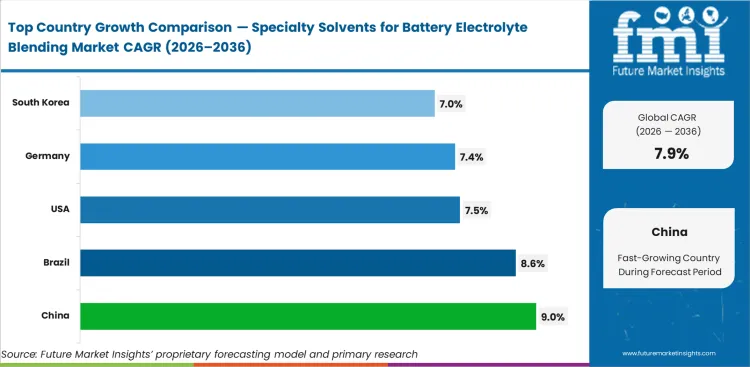
Specialty Solvents for Battery Electrolyte Blending Market CAGR Analysis by Country
- China is forecast to record 9.0% CAGR through 2036, driven by large cell manufacturing capacity and local solvent integration.
- Brazil is expected to expand at 8.6% CAGR as EV uptake and early storage projects build electrolyte demand.
- United States is projected to advance at 7.5% CAGR, with domestic battery plants and storage additions raising solvent requirements.
- Germany is expected to post 7.4% CAGR during the forecast period as EV output and European battery localization lift solvent use.
- South Korea is forecast at 7.0% CAGR, reflecting global battery exports and high-spec electrolyte requirements.
Demand for specialty solvents for battery electrolyte blending is forecast to rise at 7.9% CAGR from 2026 to 2036. Country-level analysis covers major markets contributing to this forecast, with the key markets listed below.
Demand Outlook for Specialty Solvents for Battery Electrolyte Blending Market in China
China’s specialty solvents for battery electrolyte blending industry is projected to record a CAGR of 9.0% through 2036. China held about 85% of global battery manufacturing capacity in 2024, according to IEA. This manufacturing base raises direct demand for China specialty solvents for battery electrolyte blending. Local solvent producers gain from proximity to cell makers using carbonate-heavy electrolyte systems.
- Cell manufacturing scale supports demand for carbonate solvents and battery-grade purification.
- Local electrolyte formulators need moisture-controlled solvent supply for high-volume cell lines.
- High-nickel and fast-charge cells raise demand for more precise co-solvent qualification.
Sales Analysis of Specialty Solvents for Battery Electrolyte Blending Market in Brazil
Specialty solvents for battery electrolyte blending in Brazil are expected to expand at a CAGR of 8.6% during the assessment period. According to IEA, Brazilian electric car sales doubled to 125,000 units in 2024, reaching over 6% sales share. This creates an early demand base for battery electrolyte solvent supply in Brazil. Storage tenders and EV imports can raise future electrolyte blending needs.
- EV sales create early pull for battery service chains and electrolyte-related materials.
- Trade.gov reported a planned BESS tender targeting 2 GW and about 8 GWh of capacity in April 2026.
- Local pack assembly can open distributor-led solvent supply opportunities for qualified importers.
Demand Outlook for Specialty Solvents for Battery Electrolyte Blending Market in the United States
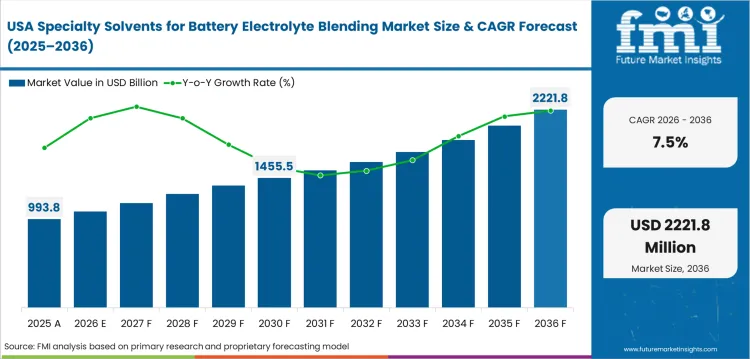
The United States specialty solvents for battery electrolyte blending industry is forecast to expand at a CAGR of 7.5% by 2036. As per EIA’s report developers plan to add 24 GW of utility-scale battery storage in 2026, compared with 15 GW added in 2025. This storage pipeline adds a second demand base beyond EV batteries. USA solvent buyers value domestic DMC and EMC supply as logistics risk affects electrolyte planning.
- Domestic storage additions boost solvent demand through lithium-ion system growth.
- UBE’s Louisiana carbonate plant improves local access to DMC and EMC from 2026.
- Custom electrolyte work strengthens pilot demand before large cell approvals begin.
Opportunity Analysis of Specialty Solvents for Battery Electrolyte Blending Market in Germany
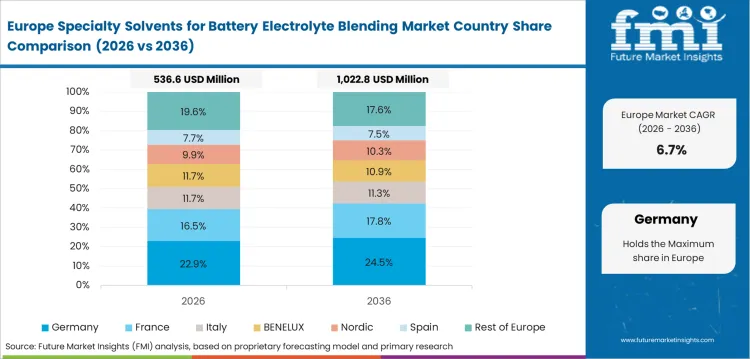
The specialty solvents for battery electrolyte blending segment in Germany is expected to advance at 7.4% CAGR over the forecast years. VDA reported Germany produced 1.67 million electric passenger cars in 2025, including 1.22 million battery-electric vehicles. This production base strengthens demand for Germany specialty solvents for battery electrolyte blending. Premium EV platforms need validated solvent systems with stable quality records.
- Automotive cell programs drive demand for battery-grade solvent documentation.
- European electrolyte localization favors suppliers with local storage and quality certificates.
- Advanced salts such as ultra-high-purity lithium bis(fluorosulfonyl)imide (LiFSI) electrolyte salt raise solvent handling needs.
Future Outlook for Specialty Solvents for Battery Electrolyte Blending Market in South Korea
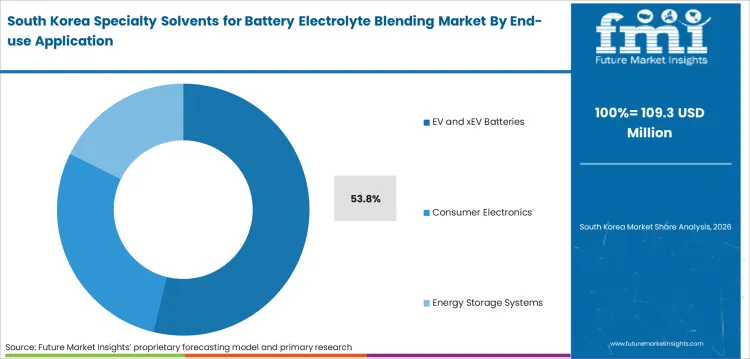
South Korea specialty solvents for battery electrolyte blending industry is expected to post 7.0% CAGR through 2036. IEA noted Korean companies led overseas battery manufacturing capacity with nearly 400 GWh, far above Japan at 60 GWh. This global cell footprint creates demand for South Korea specialty solvents for battery electrolyte blending across qualified overseas plants. Solvent producers serving Korean cell makers need consistent specifications across multiple countries.
- Korean cell makers require solvent partners capable of serving global EV programs.
- Export-oriented battery lines create demand for stable electrolyte inputs across several production bases.
- High-energy-density battery programs keep demand focused on purity and cycle-life evidence.
Competitive Landscape and Strategic Positioning
Specialty Solvents for Battery Electrolyte Blending Market Analysis By Company
- Solvent purity and carbonate scale define supplier selection across large electrolyte supply programs.
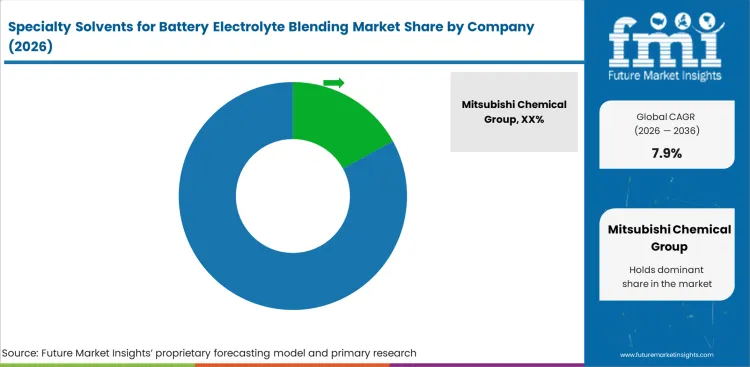
- Mitsubishi Chemical Group holds a strong role through carbonate solvent capability and battery-material quality systems.
- UBE Corporation and Shenzhen Capchem Technology leverage electrolyte solvent depth and broader battery chemical portfolios.
- Specialist providers serve pilot customers through custom electrolyte blends and high-purity solvent handling.
Competition in the specialty solvents for battery electrolyte blending market is shaped by purity control and reliable carbonate solvent supply. Large battery customers assess suppliers on batch consistency and documentation quality before approving long-term solvent sourcing. Mitsubishi Chemical Group has strong standing through specialty chemical depth and battery-material quality control. UBE Corporation adds DMC and EMC scale through its planned USA carbonate plant. Shenzhen Capchem Technology emphasizes electrolyte solvent depth and additive coverage.
Shandong Shida Shenghua Chemical Group strengthens competition through China-based carbonate solvent scale for large battery customers. BASF SE and Lotte Chemical serve adjacent chemical needs across battery electrolyte supply chains. Entry barriers include moisture sensitivity and flammability handling across solvent storage. Long approval cycles also limit supplier switching once cell programs approve a solvent system. Strong impurity control and faster documentation place qualified producers in a better position for EV battery and battery energy storage system applications.
Key Companies in the Specialty Solvents for Battery Electrolyte Blending Market
Key companies and adjacent battery-material suppliers in the specialty solvents for battery electrolyte blending market include:
- Mitsubishi Chemical Group, UBE Corporation, and Mitsui Chemicals have strong carbonate solvent knowledge for battery electrolyte programs.
- Shenzhen Capchem Technology, Shandong Shida Shenghua Chemical Group, and BASF SE serve manufacturers through battery chemical portfolios.
- Lotte Chemical, Kureha Corporation, LCY Chemical Corp., and LG Chem Ltd. hold specialist positions across solvent and battery-material supply.
Competitive Benchmarking: Specialty Solvents for Battery Electrolyte Blending Market
| Company | Carbonate Solvent Depth | Purity Control Capability | Battery Customer Access | Geographic Footprint |
|---|---|---|---|---|
| Mitsubishi Chemical Group | High | High | Strong | Japan-led global network with Asia, Europe, and Americas reach |
| UBE Corporation | High | High | Strong | Japan base with USA DMC and EMC expansion in Louisiana |
| Mitsui Chemicals | Medium | High | Strong | Japan base with offices across North America, Europe, China, Korea, and India |
| Shenzhen Capchem Technology | High | High | Strong | China base with battery chemical presence in Europe and North America |
| Shandong Shida Shenghua Chemical Group | High | Medium | Strong | China-centered carbonate solvent base with global customer exposure |
| BASF SE | Medium | High | Strong | Global chemical network across 93 countries and 234 production sites |
| Lotte Chemical | Medium | Medium | Moderate | South Korea base with Asia-focused chemical and battery material expansion |
| Kureha Corporation | Medium | High | Moderate | Japan base with North American facilities and specialty chemical access |
| LCY Chemical Corp. | Medium | Medium | Moderate | Taiwan base with sites in Taiwan, China, USA, and Canada |
| LG Chem Ltd. | Medium | High | Strong | South Korea base with Asia, Americas, and Europe network |
Source: Future Market Insights, 2026.
Key Developments in Specialty Solvents for Battery Electrolyte Blending Market
- In February 2025, UBE Corporation broke ground on its Louisiana DMC and EMC plant, adding planned local capacity for electrolyte-grade carbonate solvents. The development is relevant to this market because DMC and EMC are used in lithium-ion electrolyte solvent systems.
- In May 2025, Shenzhen Capchem Technology introduced five battery chemical products at CIBF2025. The launch included ultra-fast charging LFP electrolyte and long-life sodium-ion battery electrolyte.
Key Players in the Specialty Solvents for Battery Electrolyte Blending Market
Major Global Players:
- Mitsubishi Chemical Group
- UBE Corporation
- Mitsui Chemicals
- Shenzhen Capchem Technology
- Shandong Shida Shenghua Chemical Group
- BASF SE
- Lotte Chemical
Specialist and Adjacent Players:
- Kureha Corporation
- LCY Chemical Corp.
- LG Chem Ltd.
- Orbia Fluor & Energy Materials (custom electrolyte business)
Report Scope and Coverage
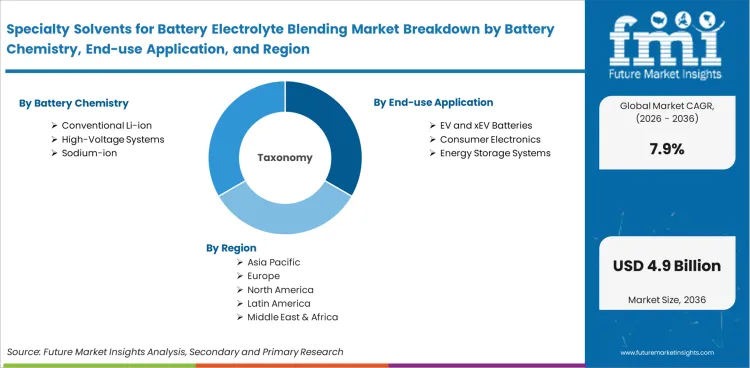
Specialty Solvents for Battery Electrolyte Blending Market Breakdown by Battery Chemistry, End-use Application, Solvent Type, Purity Grade, Blending Role, and Region
| Parameter | Details |
|---|---|
| Quantitative Units | USD 2.3 billion to USD 4.9 billion, at a CAGR of 7.9% |
| Market Definition | High-purity solvents used to prepare electrolyte blends for rechargeable battery cells. |
| Regions Covered | North America, Latin America, Europe, East Asia, South Asia and Pacific, Middle East and Africa |
| Countries Covered | United States, China, Brazil, Germany, South Korea, Japan, India, and 30+ countries |
| Key Companies Profiled | Mitsubishi Chemical Group, UBE Corporation, Mitsui Chemicals, Shenzhen Capchem Technology, Shandong Shida Shenghua Chemical Group, BASF SE, Lotte Chemical, Kureha Corporation, LCY Chemical Corp., LG Chem Ltd. |
| Forecast Period | 2026 to 2036 |
| Approach | Hybrid bottom-up and top-down methodology starting with solvent demand and verified battery use patterns. |
Specialty Solvents for Battery Electrolyte Blending Market by Segments
Specialty Solvents for Battery Electrolyte Blending Market Segmented by Battery Chemistry:
- Conventional Li-ion
- High-Voltage Systems
- Sodium-ion
- Solid-state Cells
Specialty Solvents for Battery Electrolyte Blending Market Segmented by End-use Application:
- EV and xEV Batteries
- Consumer Electronics
- Energy Storage Systems
- Industrial Batteries
Specialty Solvents for Battery Electrolyte Blending Market Segmented by Solvent Type:
- Carbonate Solvents
- Ether Solvents
- Fluorinated Solvents
- Sulfone Solvents
Specialty Solvents for Battery Electrolyte Blending Market Segmented by Purity Grade:
- Battery Grade
- Electronic Grade
- Research Grade
- Industrial Grade
Specialty Solvents for Battery Electrolyte Blending Market Segmented by Blending Role:
- Primary Solvent
- Co-solvent
- Additive Carrier
- Safety Modifier
Specialty Solvents for Battery Electrolyte Blending Market by Region:
- North America
- USA
- Canada
- Mexico
- Latin America
- Brazil
- Chile
- Rest of Latin America
- Europe
- Germany
- United Kingdom
- Italy
- Spain
- France
- Rest of Europe
- East Asia
- China
- Japan
- South Korea
- South Asia and Pacific
- India
- ASEAN
- Australia & New Zealand
- Rest of South Asia and Pacific
- Middle East and Africa
- Kingdom of Saudi Arabia
- Other GCC Countries
- South Africa
- Rest of Middle East and Africa
Research Sources and Bibliography
- 1. Argonne National Laboratory. (2025). EV model availability and sales.
- 2. International Energy Agency. (2025). Global EV Outlook 2025: Electric vehicle batteries.
- 3. International Energy Agency. (2025). Global EV Outlook 2025: Executive summary.
- 4. USA Department of Energy. (2024). 2021-2024 four-year review of supply chains for the advanced batteries sector.
- 5. USA Energy Information Administration. (2026). New USA electric generating capacity expected to reach a record high in 2026.
- 6. Verband der Automobilindustrie. (2026). Production and market in January 2026.
- 7. International Trade Administration. (2025). Brazil energy battery storage auction.
- 8. International Energy Agency. (2025). The battery industry has entered a new phase.
- 9. USA Energy Information Administration. (2025, May 1). Oil prices and refinery margins fell slightly in first quarter of 2025. Today in Energy.
Bibliography uses official government, institutional and trade association sources relevant to battery electrolyte solvent demand.
This Report Answers
- What is the current and future size of the specialty solvents for battery electrolyte blending market?
- How fast is the specialty solvents for battery electrolyte blending market expected to expand between 2026 and 2036?
- Which battery chemistry is expected to lead the market by 2026?
- Which end-use application segment is expected to account for the leading demand by 2026?
- What factors are driving demand for specialty solvents used in battery electrolyte blending globally?
- How are EV batteries influencing demand for carbonate solvent systems?
- Why are battery-grade solvents the main demand base for electrolyte blending?
- How are advanced battery chemistries creating demand for specialized co-solvent systems?
- Which countries are projected to record faster expansion through 2036?
- What is driving market expansion in China and Brazil?
- Who are the key companies active in the specialty solvents for battery electrolyte blending market?
- How does FMI estimate and validate the market forecast?
Frequently Asked Questions
What is the global market demand for specialty solvents for battery electrolyte blending in 2026?
In 2026, global demand for specialty solvents for battery electrolyte blending is expected to be worth USD 2.3 billion.
How big will the market for specialty solvents for battery electrolyte blending be in 2036?
By 2036, the market for specialty solvents for battery electrolyte blending is expected to be worth USD 4.9 billion.
How much is demand for specialty solvents for battery electrolyte blending expected to expand between 2026 and 2036?
Between 2026 and 2036, demand for specialty solvents for battery electrolyte blending is expected to expand at a CAGR of 7.9%.
Which battery chemistry segment is expected to lead globally by 2026?
Conventional Li-ion will make up 66.0% of the battery chemistry segment in 2026.
What is causing demand to rise in China?
China specialty solvents for battery electrolyte blending market is projected to record 9.0% CAGR through 2036, backed by battery cell manufacturing scale.
What is causing demand to rise in Brazil?
Brazil specialty solvents for battery electrolyte blending market is projected to expand at 8.6% CAGR through 2036, backed by EV adoption and storage planning.
What does the specialty solvents for battery electrolyte blending market include?
Specialty solvents for battery electrolyte blending include high-purity organic solvents used to prepare electrolyte blends for rechargeable battery cells.
How does FMI estimate and validate the specialty solvents for battery electrolyte blending forecast?
Forecasting models use a hybrid bottom-up and top-down approach, starting with solvent use and checking it against battery production patterns.
Preview the report firsthand - request a free sample
Get SampleGet the brochure for pricing and purchase details.
Get PDFTable of Content
- Executive Summary
- Global Market Outlook
- Demand-side Trends
- Supply-side Trends
- Technology Roadmap Analysis
- Analysis and Recommendations
- Market Overview
- Market Coverage / Taxonomy
- Market Definition / Scope / Limitations
- Research Methodology
- Chapter Orientation
- Analytical Lens and Working Hypotheses
- Market Structure, Signals, and Trend Drivers
- Benchmarking and Cross-market Comparability
- Market Sizing, Forecasting, and Opportunity Mapping
- Research Design and Evidence Framework
- Desk Research Programme (Secondary Evidence)
- Company Annual and Sustainability Reports
- Peer-reviewed Journals and Academic Literature
- Corporate Websites, Product Literature, and Technical Notes
- Earnings Decks and Investor Briefings
- Statutory Filings and Regulatory Disclosures
- Technical White Papers and Standards Notes
- Trade Journals, Industry Magazines, and Analyst Briefs
- Conference Proceedings, Webinars, and Seminar Materials
- FMI Internal Proprietary Databases and Historical Market Datasets
- Subscription Datasets and Paid Sources
- Social Channels, Communities, and Digital Listening Inputs
- Additional Desk Sources
- Expert Input and Fieldwork (Primary Evidence)
- Primary Modes
- Qualitative Interviews and Expert Elicitation
- Quantitative Surveys and Structured Data Capture
- Blended Approach
- Why Primary Evidence is Used
- Field Techniques
- Interviews
- Surveys
- Focus Groups
- Observational and In-context Research
- Social and Community Interactions
- Stakeholder Universe Engaged
- C-suite Leaders
- Board Members
- Presidents and Vice Presidents
- R&D and Innovation Heads
- Technical Specialists
- Domain Subject-matter Experts
- Scientists
- Physicians and Other Healthcare Professionals
- Governance, Ethics, and Data Stewardship
- Drivers
- Restraints
- Opportunity
- Trends
- Scenario Forecast
- Demand in Optimistic Scenario
- Demand in Likely Scenario
- Demand in Conservative Scenario
- Opportunity Map Analysis
- Product Life Cycle Analysis
- Supply Chain Analysis
- Investment Feasibility Matrix
- Value Chain Analysis
- PESTLE and Porter’s Analysis
- Regulatory Landscape
- Regional Parent Market Outlook
- Production and Consumption Statistics
- Import and Export Statistics
- Primary Modes
- Global Market Analysis 2021 to 2025 and Forecast, 2026 to 2036
- Historical Market Size Value (USD Million) Analysis, 2021 to 2025
- Current and Future Market Size Value (USD Million) Projections, 2026 to 2036
- Y-o-Y Growth Trend Analysis
- Absolute $ Opportunity Analysis
- Global Market Pricing Analysis 2021 to 2025 and Forecast 2026 to 2036
- Global Market Analysis 2021 to 2025 and Forecast 2026 to 2036, By Battery Chemistry
- Introduction / Key Findings
- Historical Market Size Value (USD Million) Analysis By Battery Chemistry , 2021 to 2025
- Current and Future Market Size Value (USD Million) Analysis and Forecast By Battery Chemistry , 2026 to 2036
- Conventional Li-ion
- High-Voltage Systems
- Sodium-ion
- Conventional Li-ion
- Y-o-Y Growth Trend Analysis By Battery Chemistry , 2021 to 2025
- Absolute $ Opportunity Analysis By Battery Chemistry , 2026 to 2036
- Global Market Analysis 2021 to 2025 and Forecast 2026 to 2036, By End-use Application
- Introduction / Key Findings
- Historical Market Size Value (USD Million) Analysis By End-use Application, 2021 to 2025
- Current and Future Market Size Value (USD Million) Analysis and Forecast By End-use Application, 2026 to 2036
- EV and xEV Batteries
- Consumer Electronics
- Energy Storage Systems
- EV and xEV Batteries
- Y-o-Y Growth Trend Analysis By End-use Application, 2021 to 2025
- Absolute $ Opportunity Analysis By End-use Application, 2026 to 2036
- Global Market Analysis 2021 to 2025 and Forecast 2026 to 2036, By Solvent Type
- Introduction / Key Findings
- Historical Market Size Value (USD Million) Analysis By Solvent Type, 2021 to 2025
- Current and Future Market Size Value (USD Million) Analysis and Forecast By Solvent Type, 2026 to 2036
- Carbonate Solvents
- Ether Solvents
- Fluorinated Solvents
- Carbonate Solvents
- Y-o-Y Growth Trend Analysis By Solvent Type, 2021 to 2025
- Absolute $ Opportunity Analysis By Solvent Type, 2026 to 2036
- Global Market Analysis 2021 to 2025 and Forecast 2026 to 2036, By Purity Grade
- Introduction / Key Findings
- Historical Market Size Value (USD Million) Analysis By Purity Grade, 2021 to 2025
- Current and Future Market Size Value (USD Million) Analysis and Forecast By Purity Grade, 2026 to 2036
- Battery Grade
- Electronic Grade
- Research Grade
- Battery Grade
- Y-o-Y Growth Trend Analysis By Purity Grade, 2021 to 2025
- Absolute $ Opportunity Analysis By Purity Grade, 2026 to 2036
- Global Market Analysis 2021 to 2025 and Forecast 2026 to 2036, By Blending Role
- Introduction / Key Findings
- Historical Market Size Value (USD Million) Analysis By Blending Role, 2021 to 2025
- Current and Future Market Size Value (USD Million) Analysis and Forecast By Blending Role, 2026 to 2036
- Primary Solvent
- Co-solvent
- Additive Carrier
- Primary Solvent
- Y-o-Y Growth Trend Analysis By Blending Role, 2021 to 2025
- Absolute $ Opportunity Analysis By Blending Role, 2026 to 2036
- Global Market Analysis 2021 to 2025 and Forecast 2026 to 2036, By Region
- Introduction
- Historical Market Size Value (USD Million) Analysis By Region, 2021 to 2025
- Current Market Size Value (USD Million) Analysis and Forecast By Region, 2026 to 2036
- North America
- Latin America
- Western Europe
- Eastern Europe
- East Asia
- South Asia and Pacific
- Middle East & Africa
- Market Attractiveness Analysis By Region
- North America Market Analysis 2021 to 2025 and Forecast 2026 to 2036, By Country
- Historical Market Size Value (USD Million) Trend Analysis By Market Taxonomy, 2021 to 2025
- Market Size Value (USD Million) Forecast By Market Taxonomy, 2026 to 2036
- By Country
- USA
- Canada
- Mexico
- By Battery Chemistry
- By End-use Application
- By Solvent Type
- By Purity Grade
- By Blending Role
- By Country
- Market Attractiveness Analysis
- By Country
- By Battery Chemistry
- By End-use Application
- By Solvent Type
- By Purity Grade
- By Blending Role
- Key Takeaways
- Latin America Market Analysis 2021 to 2025 and Forecast 2026 to 2036, By Country
- Historical Market Size Value (USD Million) Trend Analysis By Market Taxonomy, 2021 to 2025
- Market Size Value (USD Million) Forecast By Market Taxonomy, 2026 to 2036
- By Country
- Brazil
- Chile
- Rest of Latin America
- By Battery Chemistry
- By End-use Application
- By Solvent Type
- By Purity Grade
- By Blending Role
- By Country
- Market Attractiveness Analysis
- By Country
- By Battery Chemistry
- By End-use Application
- By Solvent Type
- By Purity Grade
- By Blending Role
- Key Takeaways
- Western Europe Market Analysis 2021 to 2025 and Forecast 2026 to 2036, By Country
- Historical Market Size Value (USD Million) Trend Analysis By Market Taxonomy, 2021 to 2025
- Market Size Value (USD Million) Forecast By Market Taxonomy, 2026 to 2036
- By Country
- Germany
- UK
- Italy
- Spain
- France
- Nordic
- BENELUX
- Rest of Western Europe
- By Battery Chemistry
- By End-use Application
- By Solvent Type
- By Purity Grade
- By Blending Role
- By Country
- Market Attractiveness Analysis
- By Country
- By Battery Chemistry
- By End-use Application
- By Solvent Type
- By Purity Grade
- By Blending Role
- Key Takeaways
- Eastern Europe Market Analysis 2021 to 2025 and Forecast 2026 to 2036, By Country
- Historical Market Size Value (USD Million) Trend Analysis By Market Taxonomy, 2021 to 2025
- Market Size Value (USD Million) Forecast By Market Taxonomy, 2026 to 2036
- By Country
- Russia
- Poland
- Hungary
- Balkan & Baltic
- Rest of Eastern Europe
- By Battery Chemistry
- By End-use Application
- By Solvent Type
- By Purity Grade
- By Blending Role
- By Country
- Market Attractiveness Analysis
- By Country
- By Battery Chemistry
- By End-use Application
- By Solvent Type
- By Purity Grade
- By Blending Role
- Key Takeaways
- East Asia Market Analysis 2021 to 2025 and Forecast 2026 to 2036, By Country
- Historical Market Size Value (USD Million) Trend Analysis By Market Taxonomy, 2021 to 2025
- Market Size Value (USD Million) Forecast By Market Taxonomy, 2026 to 2036
- By Country
- China
- Japan
- South Korea
- By Battery Chemistry
- By End-use Application
- By Solvent Type
- By Purity Grade
- By Blending Role
- By Country
- Market Attractiveness Analysis
- By Country
- By Battery Chemistry
- By End-use Application
- By Solvent Type
- By Purity Grade
- By Blending Role
- Key Takeaways
- South Asia and Pacific Market Analysis 2021 to 2025 and Forecast 2026 to 2036, By Country
- Historical Market Size Value (USD Million) Trend Analysis By Market Taxonomy, 2021 to 2025
- Market Size Value (USD Million) Forecast By Market Taxonomy, 2026 to 2036
- By Country
- India
- ASEAN
- Australia & New Zealand
- Rest of South Asia and Pacific
- By Battery Chemistry
- By End-use Application
- By Solvent Type
- By Purity Grade
- By Blending Role
- By Country
- Market Attractiveness Analysis
- By Country
- By Battery Chemistry
- By End-use Application
- By Solvent Type
- By Purity Grade
- By Blending Role
- Key Takeaways
- Middle East & Africa Market Analysis 2021 to 2025 and Forecast 2026 to 2036, By Country
- Historical Market Size Value (USD Million) Trend Analysis By Market Taxonomy, 2021 to 2025
- Market Size Value (USD Million) Forecast By Market Taxonomy, 2026 to 2036
- By Country
- Kingdom of Saudi Arabia
- Other GCC Countries
- Turkiye
- South Africa
- Other African Union
- Rest of Middle East & Africa
- By Battery Chemistry
- By End-use Application
- By Solvent Type
- By Purity Grade
- By Blending Role
- By Country
- Market Attractiveness Analysis
- By Country
- By Battery Chemistry
- By End-use Application
- By Solvent Type
- By Purity Grade
- By Blending Role
- Key Takeaways
- Key Countries Market Analysis
- USA
- Pricing Analysis
- Market Share Analysis, 2025
- By Battery Chemistry
- By End-use Application
- By Solvent Type
- By Purity Grade
- By Blending Role
- Canada
- Pricing Analysis
- Market Share Analysis, 2025
- By Battery Chemistry
- By End-use Application
- By Solvent Type
- By Purity Grade
- By Blending Role
- Mexico
- Pricing Analysis
- Market Share Analysis, 2025
- By Battery Chemistry
- By End-use Application
- By Solvent Type
- By Purity Grade
- By Blending Role
- Brazil
- Pricing Analysis
- Market Share Analysis, 2025
- By Battery Chemistry
- By End-use Application
- By Solvent Type
- By Purity Grade
- By Blending Role
- Chile
- Pricing Analysis
- Market Share Analysis, 2025
- By Battery Chemistry
- By End-use Application
- By Solvent Type
- By Purity Grade
- By Blending Role
- Germany
- Pricing Analysis
- Market Share Analysis, 2025
- By Battery Chemistry
- By End-use Application
- By Solvent Type
- By Purity Grade
- By Blending Role
- UK
- Pricing Analysis
- Market Share Analysis, 2025
- By Battery Chemistry
- By End-use Application
- By Solvent Type
- By Purity Grade
- By Blending Role
- Italy
- Pricing Analysis
- Market Share Analysis, 2025
- By Battery Chemistry
- By End-use Application
- By Solvent Type
- By Purity Grade
- By Blending Role
- Spain
- Pricing Analysis
- Market Share Analysis, 2025
- By Battery Chemistry
- By End-use Application
- By Solvent Type
- By Purity Grade
- By Blending Role
- France
- Pricing Analysis
- Market Share Analysis, 2025
- By Battery Chemistry
- By End-use Application
- By Solvent Type
- By Purity Grade
- By Blending Role
- India
- Pricing Analysis
- Market Share Analysis, 2025
- By Battery Chemistry
- By End-use Application
- By Solvent Type
- By Purity Grade
- By Blending Role
- ASEAN
- Pricing Analysis
- Market Share Analysis, 2025
- By Battery Chemistry
- By End-use Application
- By Solvent Type
- By Purity Grade
- By Blending Role
- Australia & New Zealand
- Pricing Analysis
- Market Share Analysis, 2025
- By Battery Chemistry
- By End-use Application
- By Solvent Type
- By Purity Grade
- By Blending Role
- China
- Pricing Analysis
- Market Share Analysis, 2025
- By Battery Chemistry
- By End-use Application
- By Solvent Type
- By Purity Grade
- By Blending Role
- Japan
- Pricing Analysis
- Market Share Analysis, 2025
- By Battery Chemistry
- By End-use Application
- By Solvent Type
- By Purity Grade
- By Blending Role
- South Korea
- Pricing Analysis
- Market Share Analysis, 2025
- By Battery Chemistry
- By End-use Application
- By Solvent Type
- By Purity Grade
- By Blending Role
- Russia
- Pricing Analysis
- Market Share Analysis, 2025
- By Battery Chemistry
- By End-use Application
- By Solvent Type
- By Purity Grade
- By Blending Role
- Poland
- Pricing Analysis
- Market Share Analysis, 2025
- By Battery Chemistry
- By End-use Application
- By Solvent Type
- By Purity Grade
- By Blending Role
- Hungary
- Pricing Analysis
- Market Share Analysis, 2025
- By Battery Chemistry
- By End-use Application
- By Solvent Type
- By Purity Grade
- By Blending Role
- Kingdom of Saudi Arabia
- Pricing Analysis
- Market Share Analysis, 2025
- By Battery Chemistry
- By End-use Application
- By Solvent Type
- By Purity Grade
- By Blending Role
- Turkiye
- Pricing Analysis
- Market Share Analysis, 2025
- By Battery Chemistry
- By End-use Application
- By Solvent Type
- By Purity Grade
- By Blending Role
- South Africa
- Pricing Analysis
- Market Share Analysis, 2025
- By Battery Chemistry
- By End-use Application
- By Solvent Type
- By Purity Grade
- By Blending Role
- USA
- Market Structure Analysis
- Competition Dashboard
- Competition Benchmarking
- Market Share Analysis of Top Players
- By Regional
- By Battery Chemistry
- By End-use Application
- By Solvent Type
- By Purity Grade
- By Blending Role
- Competition Analysis
- Competition Deep Dive
- Mitsubishi Chemical Group
- Overview
- Product Portfolio
- Profitability by Market Segments (Product/Age /Sales Channel/Region)
- Sales Footprint
- Strategy Overview
- Marketing Strategy
- Product Strategy
- Channel Strategy
- UBE Corporation
- Mitsui Chemicals
- Shenzhen Capchem Technology
- Shandong Shida Shenghua Chemical Group
- BASF SE
- Mitsubishi Chemical Group
- Competition Deep Dive
- Desk Research Programme (Secondary Evidence)
- Assumptions & Acronyms Used


