

- Industry Size (2026)
- USD 2.3 Bn
- Forecast (2036)
- USD 6.8 Bn
- CAGR (2026 to 2036)
- 11.5%
Electrolyte Additive Blends Market Forecast and Outlook 2026 to 2036
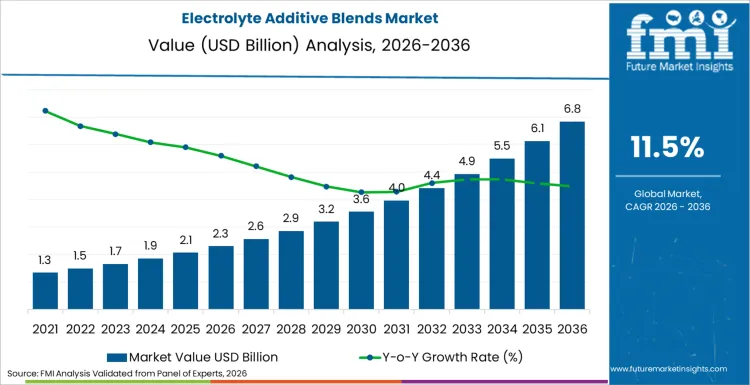
The global electrolyte additive blends market is forecasted to reach USD 2.3 billion in 2026 and expand to USD 6.8 billion by 2036, advancing at a CAGR of 11.5%. As per FMI, this outlook shows a transformation in battery chemistry toward performance-optimized electrolyte systems, where traditional single-component additives are evolving toward multi-functional blend platforms. Expansion is driven by the rising demand for high-voltage tolerance and thermal management, with battery manufacturers and automotive companies embracing specialized additive formulations across energy storage applications globally.
By leveraging advanced chemical engineering and precision blending techniques, producers can now develop additives that offer controlled electrochemical performance and enhanced battery life through improved SEI formation and electrolyte stability. This technological advancement allows for the creation of temperature-resistant formulations with extended cycle life capabilities and reduced capacity fade, effectively addressing battery manufacturer demands for efficient performance enhancement while maintaining electrochemical integrity throughout extended charge-discharge cycles.
Companies are investing significantly in chemistry innovation to enhance battery performance. In June 2023, JE Dunn and Dongwha Electrolyte broke ground for new production facility in Clarksville. “We are excited to invest in Montgomery County for Dongwha Electrolyte’s first manufacturing facility in the United States,” said SooHaeng Lee, Head of Operation for Dongwha Electrolyte USA. “This facility will be key in better positioning our company to serve electric vehicle battery manufacturers in the area and position us for future growth.”
The industry's value proposition is shifting from basic electrolyte enhancement toward comprehensive chemistry solutions that address specific performance requirements. Advanced manufacturers are integrating high-voltage stability systems, thermal management elements, and customizable formulation options to reduce performance limitations while improving battery efficiency. Specialized chemistry providers are gaining preference among battery manufacturers, enabling direct supply partnerships and customized additive solutions across automotive, stationary storage, and consumer electronics channels.
Summary of Electrolyte Additive Blends Market
What is the growth outlook on the electrolyte additive blends market?
Future Market Insights projects the market to grow at an 11.5% CAGR from 2026 to 2036, expanding from USD 2.3 billion to USD 6.8 billion.
FMI research approach: Bottom-up chemistry revenue modeling, material cost analysis, battery manufacturer preference assessment, and additive performance evaluation.
How do FMI analysts perceive the electrolyte additive blends market to evolve?
The market is expected to move from basic additive formulations toward advanced multi-functional blends integrating performance optimization and enhanced electrochemical interface features.
FMI research approach: Chemistry innovation trend analysis, additive technology integration mapping, battery performance demand assessment, and electrochemical stability benchmarking.
Which country holds the largest share in the electrolyte additive blends market?
China accounts for the largest global value share with a projected CAGR of 12.7%.
FMI research approach: Country-level production and consumption modeling, battery industry concentration analysis, chemical sourcing evaluation, and manufacturing capacity assessment.
How large will the electrolyte additive blends market be by 2036?
The global market is forecast to reach USD 6.8 billion by 2036.
FMI research approach: Long-term forecasting by chemistry type and application focus, demand scaling analysis, regional growth validation, and historical consumption patterns.
What is the market definition of electrolyte additive blends?
It covers chemistry solutions designed for controlled enhancement of battery electrolyte performance through specialized formulations across various energy storage applications.
FMI research approach: Product taxonomy validation, application scope mapping, chemistry classification by end-use category, and additive functionality assessment.
What globally unique trends are shaping the electrolyte additive blends market?
Key trends include chemistry innovation adoption, high-voltage stability technology integration, and regulatory compliance advancement for automotive applications.
FMI research approach: Technology adoption tracking, chemistry development analysis, regulatory requirement monitoring, and competitive innovation assessment.
Electrolyte Additive Blends Market Key Takeaways
| Metric | Value |
|---|---|
| Market Value (2026) | USD 2.3 billion |
| Market Forecast Value (2036) | USD 6.8 billion |
| Forecast CAGR (2026-2036) | 11.5% |
Source: Future Market Insights (FMI) analysis, based on proprietary forecasting model and primary research
What is Driving the Demand for Electrolyte Additive Blends?
Demand for electrolyte additive blends is being propelled by the broad battery industry shift toward high-performance formulations and the escalating complexity of energy storage requirements demanding specialized chemistry solutions. The increasing preference for enhanced cycle life and thermal management in electric vehicle, stationary storage, and consumer electronics applications has amplified demand for precision-engineered additive systems that minimize capacity degradation and enhance electrochemical performance.
The regulatory momentum toward battery safety standards, exemplified by updated automotive industry guidelines for energy storage systems, is driving widespread adoption of thermal management additives and safety-enhanced chemistry formulations in battery manufacturing workflows. Manufacturers are responding to these requirements through specialized chemistry features that integrate safety measures without compromising performance. The expanding electric vehicle battery market in emerging economies is shifting production toward cost-effective, high-performance additive solutions, underscoring a sustained demand trajectory rooted in performance optimization and safety-driven purchasing patterns.
How is the Electrolyte Additive Blends Market Segmented?
The electrolyte additive blends market has been segmented based on functional role, chemistry family, battery chemistry, and application. In terms of functional role, the market is divided into SEI-forming additives, high-voltage stabilizers, low-temperature performance additives, and safety/flame-retardant & overcharge additives. By chemistry family, the market includes fluorinated carbonates & salts, phosphate/phosphite-based, sulfonate & borate additives, and other specialty additives. By battery chemistry, the market is segmented into NMC/NCA high-energy cells, LFP & LFP-blend cells, LMO/LCO & others, and next-gen (Si-rich, solid-ready liquids). By application, the market spans EV traction batteries, stationary storage, and consumer & industrial batteries. Regionally, the market encompasses North America, Europe, East Asia, South Asia, Latin America, and Middle East and Africa.
Why Do SEI-Forming Additives Dominate the Electrolyte Additive Blends Market?
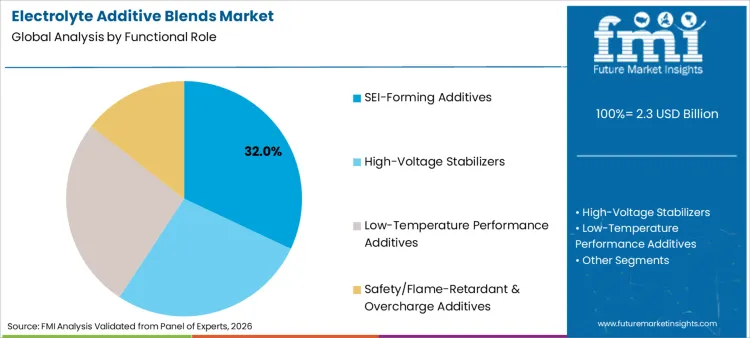
SEI-forming additives continue to lead the market, accounting for 32.0% of the share, driven by their critical role in battery performance optimization, electrochemical stability, and adaptability to various battery chemistry formulations. This additive type offers the performance enhancement needed for advanced battery systems while maintaining durability across different operating conditions, making it essential for electric vehicle, stationary storage, and consumer electronics applications. SEI-forming additives provide manufacturers with chemistry flexibility for custom formulations and performance features while supporting large-scale production requirements.
High-voltage stabilizers capture a significant portion of the market, supporting premium battery positioning where enhanced voltage tolerance and performance optimization are critical factors. Safety/flame-retardant additives remain popular for specific applications requiring thermal management and safety compliance, particularly in automotive and stationary storage segments where performance integrity and safety positioning justify specialized chemistry investments.
How Do Application Requirements Influence Electrolyte Additive Blend Selection?
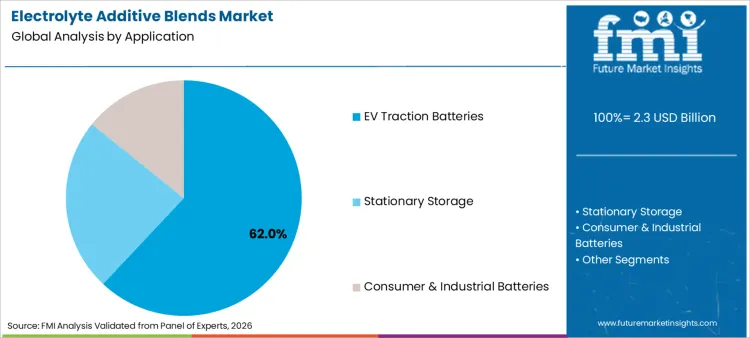
EV traction battery applications stand as the dominant segment, commanding 62.0% of the market share. Electrolyte additive blends remain centered on automotive applications due to the exceptional performance these formulations offer in energy density optimization and thermal management. EV battery systems often require specialized chemistry solutions and enhanced safety features, making advanced additive blends ideal for performance enhancement while maintaining electrochemical stability throughout extended operating cycles.
The market is shaped by the development of automotive-grade chemistry formulations and enhanced performance technologies that require rigorous testing to establish safety compliance and extended operational life. Stationary storage applications demand specialized additives that integrate cycle life optimization and grid-scale performance features to prevent degradation while ensuring consistent energy delivery. Companies are expanding their capabilities to address these specialized requirements. Advanced testing protocols help developers optimize chemistry stability and ensure consistent performance across different operating environments, making these validation services essential for regulatory approval and market acceptance.
How Is Technological Evolution Reshaping Electrolyte Additive Blends?
The electrolyte additive blends sector is shifting from traditional single-component systems to integrated performance platforms that combine electrochemical optimization, thermal management, and safety enhancement. Strategic partnerships between chemistry manufacturers and battery companies are accelerating this transition toward more sophisticated additive solutions. This evolution brings electrolyte additives closer to automotive-grade standards by enabling more predictable performance control and enhanced safety features using advanced chemistry and materials science innovations.
Improved formulation design reduces capacity degradation during charge-discharge cycles and enhances battery performance through more stable electrochemical interfaces and consistent energy delivery. The ability to customize chemistry formulations and incorporate safety features is reshaping product development decisions, allowing manufacturers to address specific regulatory requirements while maintaining performance appeal and production efficiency.
How Is the Electrolyte Additive Blends Market Evolving Globally?
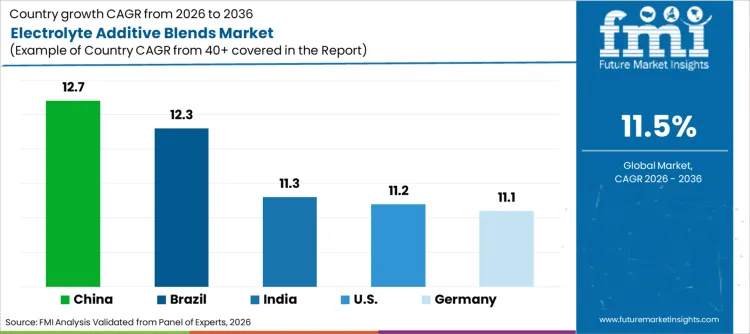
Global demand for electrolyte additive blends is increasing as manufacturers expand battery portfolios while addressing performance requirements, energy density specifications, and safety compliance across automotive, stationary storage, and consumer electronics applications. Growth demonstrates rising adoption of advanced chemistry systems, application-specific formulation positioning, and performance-optimized additive blends across battery companies, chemistry specialists, and automotive manufacturers. Chemistry selection focuses on electrochemical performance, cost efficiency, and safety compliance under various operating scenarios.
China records 12.7% CAGR, Brazil records 12.3% CAGR, India records 11.3% CAGR, Germany records 11.1% CAGR, and USA records 11.2% CAGR. Adoption remains driven by performance requirements and safety compliance rather than volume expansion alone.
| Country | CAGR (2026-2036) |
|---|---|
| China | 12.7% |
| Brazil | 12.3% |
| India | 11.3% |
| USA | 11.2% |
| Germany | 11.1% |
Source: FMI historical analysis and forecast data
China: How is Battery Manufacturing Infrastructure Expansion Driving Market Growth?
The primary driver in China is the significant expansion of electric vehicle manufacturing capabilities and automated battery production infrastructure. With the growth of domestic automotive and energy storage industries, Chinese manufacturing centers are experiencing substantial increases in additive blend demand, making traditional electrolyte formulations insufficient for current production volumes. This has promoted advanced chemistry technology adoption for domestic battery manufacturing to ensure performance quality and operational efficiency.
Driven by this national scale of manufacturing expansion, the Chinese electrolyte additive blends market is set to grow at a 12.7% CAGR during the study period, led by massive demand in automotive and stationary storage sectors. Over the next five years, the most significant opportunity lies in the integration of automated chemistry systems with precision additive formulations. As China targets leadership in battery manufacturing, there is growing demand for cost-effective solutions that support advanced battery chemistry and high-volume production requirements.
Brazil: Is the Electric Vehicle Industry Growth Bolstering Chemistry Standards?
In Brazil, the market is dominated by the evolution toward premium chemistry standards and performance-positioned electric vehicle applications. This performance-first approach is essential for Brazilian manufacturers competing with international battery producers in domestic automotive applications. The Brazilian electrolyte additive blends market is projected to grow at a 12.3% CAGR during the study period.
Over the next five years, the rise of electric vehicle adoption and expanding automotive manufacturing will necessitate high-performance additive solutions for battery and automotive applications. Brazil's growing role as a manufacturing hub for regional electric vehicle brands creates opportunities for cost-effective chemistry solutions that meet international performance standards while addressing local market preferences and cost sensitivity requirements.
India: Will Regulatory Excellence Drive Advanced Additive Adoption?
India's electrolyte additive blends market is shaped by stringent safety regulations and performance-focused manufacturing standards. Indian manufacturers are adopting advanced chemistry technologies that integrate safety assurance with innovative performance features for premium market positioning. The Indian electrolyte additive blends market is expected to grow at an 11.3% CAGR during the study period.
Over the next five years, opportunities exist in developing specialized additives for automotive and premium stationary storage applications. As Indian companies maintain leadership in battery safety and performance, there is significant demand for additives that integrate advanced safety features, regulatory compliance, and premium functionality to serve both domestic and export markets effectively.
Germany: How is Engineering Excellence Reinforcing Advanced Chemistry Demand?
Germany's electrolyte additive blends market is primarily driven by precision engineering capabilities and the rising adoption of high-performance battery chemistry solutions for automotive applications. German manufacturers are shifting toward advanced additive formulations that offer superior electrochemical performance without compromising safety standards. This trend is accelerated by stringent German automotive regulations and the European Battery Regulation, pushing manufacturers to innovate with performance-optimized chemistry designs that integrate enhanced safety features, thereby marrying automotive excellence with electrochemical reliability.
The market is being propelled by the mainstream adoption of premium electric vehicles, a sector expanding beyond luxury segments into mass-market automotive applications. High-profile automotive partnerships have normalized advanced chemistry adoption, proving that manufacturers are willing to invest in premium additive systems that eliminate performance limitations entirely. This shift is further supported by demand for automotive-grade formulations, where advanced electrolyte additives offer performance enhancement while meeting automotive safety standards, effectively merging regulatory compliance with high-performance battery requirements.
USA: How is Innovation Leadership Shaping Premium Additive Development?
The USA market focuses on innovation and specialized applications for automotive and premium energy storage products. This approach emphasizes regulatory compliance and advanced functionality while maintaining competitive positioning in global markets. The USA electrolyte additive blends market is set to grow at an 11.2% CAGR during the study period.
Over the next five years, opportunities lie in developing specialized additives for electric vehicle batteries and premium energy storage formulations. As regulatory requirements become more stringent for automotive applications, there is growing demand for additives that integrate safety features, performance optimization, and automotive-grade functionality while maintaining manufacturing efficiency and cost competitiveness.
Who are the Major Players Active in the Electrolyte Additive Blends Market?
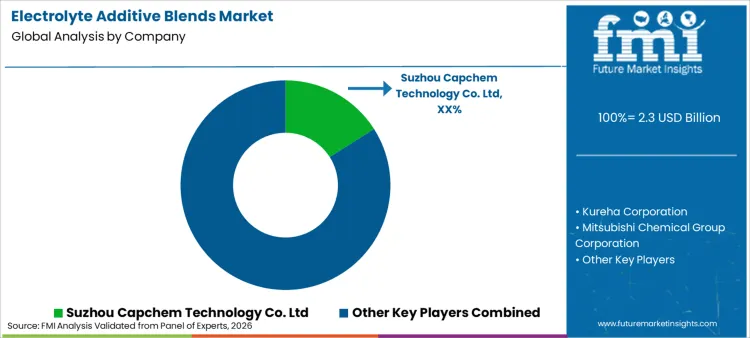
With battery chemistry formulations becoming more sophisticated and safety requirements being more stringent, major players like Suzhou Capchem Technology Co. Ltd, Kureha Corporation, and Mitsubishi Chemical Group Corporation are competing on their ability to offer comprehensive chemistry solutions that integrate electrochemical optimization with safety compliance. These industry leaders are investing in advanced chemistry technologies and material innovations to provide seamless integration capabilities, allowing battery companies to focus on cell development while outsourcing specialized chemistry requirements.
The market is observing distinct regional specialization in competitive strategy. While Asian firms like UBE Corporation and LG Chem maintain leadership through chemistry expertise and proximity to major battery manufacturers, European players like BASF SE are advancing precision chemistry and automated production capabilities. This has created an innovation cycle where chemistry providers are diversifying into specialized applications such as high-voltage additives and thermal management systems to address the complex requirements of automotive and regulated energy storage products.
Key Industry Developments:
- In August 2023, Kureha Corporation unveiled to boost its production capacity for polyvinylidene fluoride (PVDF) at its Iwaki Factory in Fukushima, Japan.
- In May 2023, The Mitsubishi Chemical Group inked a MoU with Koura, an Orbia business to enhance its supply chain capabilities.
Key Players in the Electrolyte Additive Blends Market
- Suzhou Capchem Technology Co. Ltd
- Kureha Corporation
- Mitsubishi Chemical Group Corporation
- BASF SE
- Zhangjiagang Guotai Huarong New Chemical Materials Co. Ltd
- UBE Corporation
- Wanhua Chemical Group Co. Ltd
- LG Chem Ltd
- Shenzhen Capchem Technology Co. Ltd
- Dongwha Electrolyte Co. Ltd
Market Definition
The electrolyte additive blends market refers to the global chemistry applications of specialized additive formulations designed to support controlled enhancement of battery electrolyte performance through advanced chemistry systems. It includes both standard and high-performance additive offerings, with segments that cater to various application requirements such as automotive batteries, stationary storage, and consumer electronics. The market size is measured in USD billion and analyzed over the 2026 to 2036 period.
The electrolyte additive blends market includes chemistry formulations categorized by functional role, chemistry family, and application category, utilized through battery manufacturing and automotive production applications. The market is expanding due to growing demand for enhanced battery performance, chemistry innovation requirements, and evolving manufacturer preferences toward electrochemical optimization and enhanced safety capabilities.
Market Inclusion
Included in the electrolyte additive blends market scope are chemistry formulations categorized by functional role (SEI-forming additives, high-voltage stabilizers, low-temperature performance additives, safety/flame-retardant & overcharge additives), chemistry family (fluorinated carbonates & salts, phosphate/phosphite-based, sulfonate & borate additives, other specialty additives), and application (EV traction batteries, stationary storage, consumer & industrial batteries). The scope includes additive formulations with focus on electrochemical performance, battery optimization, and safety compliance, particularly those marketed through chemistry specialists, battery manufacturers, and automotive companies.
Geographically, the market encompasses key regions such as North America, Europe, East Asia, South Asia, Latin America, and the Middle East and Africa, with country-level analysis for significant markets like China, USA, Germany, Japan, South Korea, Brazil, and India.
Market Exclusion
Excluded from the electrolyte additive blends market scope are non-chemistry enhancement solutions and materials not designed for electrochemical performance optimization, such as basic electrolyte solvents, battery separator materials, and electrode active materials. Additionally, formulations not intended for battery electrolyte applications are not included.
The market excludes non-additive chemistry products, as well as materials that are not marketed as performance-enhancing systems, such as standard electrolyte salts or basic solvent formulations. Products with non-compliant chemistry specifications or those that do not meet regional safety standards for battery applications are outside the market's defined scope.
Scope of the Report
| Items | Values |
|---|---|
| Quantitative Units | USD 2.3 billion |
| Functional Role | SEI-Forming Additives; High-Voltage Stabilizers; Low-Temperature Performance Additives; Safety/Flame-Retardant & Overcharge Additives |
| Chemistry Family | Fluorinated Carbonates & Salts; Phosphate/Phosphite-Based; Sulfonate & Borate Additives; Other Specialty Additives |
| Battery Chemistry | NMC/NCA High-Energy Cells; LFP & LFP-Blend Cells; LMO/LCO & Others; Next-Gen (Si-Rich, Solid-Ready Liquids) |
| Application | EV Traction Batteries; Stationary Storage; Consumer & Industrial Batteries |
| Regions Covered | North America, Europe, East Asia, South Asia, Latin America, Middle East & Africa |
| Countries Covered | China, USA, Germany, Japan, South Korea, Brazil, India, and 40+ countries |
| Key Companies Profiled | Suzhou Capchem Technology Co. Ltd; Kureha Corporation; Mitsubishi Chemical Group Corporation; BASF SE; Zhangjiagang Guotai Huarong New Chemical Materials Co. Ltd; Others |
| Additional Attributes | Revenue analysis by functional role and application; performance in battery applications and electrochemical enhancement capabilities across battery manufacturers, chemistry specialists, and automotive production facilities; chemistry optimization, performance enhancement, and formulation reliability under various operating scenarios; impact on battery performance, cycle life, and electrochemical stability during manufacturing processes; compatibility with battery chemistry and manufacturer preferences; procurement dynamics driven by performance positioning, safety compliance programs, and long-term supply partnerships. |
Electrolyte Additive Blends Market by Segment
Functional Role:
- SEI-Forming Additives
- High-Voltage Stabilizers
- Low-Temperature Performance Additives
- Safety/Flame-Retardant & Overcharge Additives
Chemistry Family:
- Fluorinated Carbonates & Salts
- Phosphate/Phosphite-Based
- Sulfonate & Borate Additives
- Other Specialty Additives
Battery Chemistry:
-
NMC/NCA High-Energy Cells
- LFP & LFP-Blend Cells
- LMO/LCO & Others
- Next-Gen (Si-Rich, Solid-Ready Liquids)
Application:
- EV Traction Batteries
- Stationary Storage
- Consumer & Industrial Batteries
Region:
- East Asia
- China
- Japan
- South Korea
- Taiwan
- Rest of East Asia
- Europe
- Germany
- United Kingdom
- France
- Italy
- Spain
- BENELUX
- Nordic
- Rest of Europe
- North America
- USA
- Canada
- Mexico
- South Asia
- India
- Australia & New Zealand
- Southeast Asia
- Rest of South Asia
- Latin America
- Brazil
- Chile
- Colombia
- Argentina
- Rest of Latin America
- Middle East & Africa
- Kingdom of Saudi Arabia
- Other GCC Countries
- Turkey
- South Africa
- Other African Union
- Rest of Middle East & Africa
Bibliography
- International Energy Agency. (2023). Global EV Outlook 2023: Catching up with climate ambitions. IEA Publications.
- Zhang, H., & co-authors. (2023). Electrolyte additives for lithium-ion batteries: Recent advances and future perspectives. Energy Storage Materials, 58, 201-245.
- Liu, K., & Wang, J. (2024). Advanced electrolyte formulations for next-generation battery applications [PDF]. Journal of Power Sources.
Frequently Asked Questions
How big is the electrolyte additive blends market in 2026?
The global electrolyte additive blends market is estimated to be valued at USD 2.3 billion in 2026.
What will be the size of the electrolyte additive blends market in 2036?
The market size for the electrolyte additive blends market is projected to reach USD 6.8 billion by 2036.
How much will the electrolyte additive blends market grow between 2026 and 2036?
The electrolyte additive blends market is expected to grow at an 11.5% CAGR between 2026 and 2036.
What are the key functional roles in the electrolyte additive blends market?
The key functional roles in the electrolyte additive blends market include SEI-forming additives, high-voltage stabilizers, low-temperature performance additives, and safety/flame-retardant & overcharge additives.
Which application will contribute a significant share in the electrolyte additive blends market in 2026?
In terms of application, the EV traction batteries segment is set to command a 62.0% share in the electrolyte additive blends market in 2026.
Preview the report firsthand - request a free sample
Get SampleGet the brochure for pricing and purchase details.
Get PDFTable of Content
- Executive Summary
- Global Market Outlook
- Demand-side Trends
- Supply-side Trends
- Technology Roadmap Analysis
- Analysis and Recommendations
- Market Overview
- Market Coverage / Taxonomy
- Market Definition / Scope / Limitations
- Market Background
- Market Dynamics
- Drivers
- Restraints
- Opportunity
- Trends
- Scenario Forecast
- Demand in Optimistic Scenario
- Demand in Likely Scenario
- Demand in Conservative Scenario
- Opportunity Map Analysis
- Product Life Cycle Analysis
- Supply Chain Analysis
- Investment Feasibility Matrix
- Value Chain Analysis
- PESTLE and Porter’s Analysis
- Regulatory Landscape
- Regional Parent Market Outlook
- Production and Consumption Statistics
- Import and Export Statistics
- Market Dynamics
- Global Market Analysis 2021 to 2025 and Forecast, 2026 to 2036
- Historical Market Size Value (USD Million) Analysis, 2021 to 2025
- Current and Future Market Size Value (USD Million) Projections, 2026 to 2036
- Y-o-Y Growth Trend Analysis
- Absolute $ Opportunity Analysis
- Global Market Pricing Analysis 2021 to 2025 and Forecast 2026 to 2036
- Global Market Analysis 2021 to 2025 and Forecast 2026 to 2036, By Functional Role
- Introduction / Key Findings
- Historical Market Size Value (USD Million) Analysis By Functional Role , 2021 to 2025
- Current and Future Market Size Value (USD Million) Analysis and Forecast By Functional Role , 2026 to 2036
- SEI-Forming Additives
- High-Voltage Stabilizers
- Low-Temperature Performance Additives
- Safety/Flame-Retardant & Overcharge Additives
- SEI-Forming Additives
- Y-o-Y Growth Trend Analysis By Functional Role , 2021 to 2025
- Absolute $ Opportunity Analysis By Functional Role , 2026 to 2036
- Global Market Analysis 2021 to 2025 and Forecast 2026 to 2036, By Chemistry Family
- Introduction / Key Findings
- Historical Market Size Value (USD Million) Analysis By Chemistry Family, 2021 to 2025
- Current and Future Market Size Value (USD Million) Analysis and Forecast By Chemistry Family, 2026 to 2036
- Fluorinated Carbonates & Salts
- Phosphate/Phosphite-Based
- Sulfonate & Borate Additives
- Other Specialty Additives
- Fluorinated Carbonates & Salts
- Y-o-Y Growth Trend Analysis By Chemistry Family, 2021 to 2025
- Absolute $ Opportunity Analysis By Chemistry Family, 2026 to 2036
- Global Market Analysis 2021 to 2025 and Forecast 2026 to 2036, By Battery Chemistry
- Introduction / Key Findings
- Historical Market Size Value (USD Million) Analysis By Battery Chemistry, 2021 to 2025
- Current and Future Market Size Value (USD Million) Analysis and Forecast By Battery Chemistry, 2026 to 2036
- NMC/NCA High-Energy Cells
- LFP & LFP-Blend Cells
- LMO/LCO & Others
- Next-Gen (Si-Rich, Solid-Ready Liquids)
- NMC/NCA High-Energy Cells
- Y-o-Y Growth Trend Analysis By Battery Chemistry, 2021 to 2025
- Absolute $ Opportunity Analysis By Battery Chemistry, 2026 to 2036
- Global Market Analysis 2021 to 2025 and Forecast 2026 to 2036, By Application
- Introduction / Key Findings
- Historical Market Size Value (USD Million) Analysis By Application, 2021 to 2025
- Current and Future Market Size Value (USD Million) Analysis and Forecast By Application, 2026 to 2036
- EV Traction Batteries
- Stationary Storage
- Consumer & Industrial Batteries
- EV Traction Batteries
- Y-o-Y Growth Trend Analysis By Application, 2021 to 2025
- Absolute $ Opportunity Analysis By Application, 2026 to 2036
- Global Market Analysis 2021 to 2025 and Forecast 2026 to 2036, By Region
- Introduction
- Historical Market Size Value (USD Million) Analysis By Region, 2021 to 2025
- Current Market Size Value (USD Million) Analysis and Forecast By Region, 2026 to 2036
- North America
- Latin America
- Western Europe
- Eastern Europe
- East Asia
- South Asia and Pacific
- Middle East & Africa
- Market Attractiveness Analysis By Region
- North America Market Analysis 2021 to 2025 and Forecast 2026 to 2036, By Country
- Historical Market Size Value (USD Million) Trend Analysis By Market Taxonomy, 2021 to 2025
- Market Size Value (USD Million) Forecast By Market Taxonomy, 2026 to 2036
- By Country
- USA
- Canada
- Mexico
- By Functional Role
- By Chemistry Family
- By Battery Chemistry
- By Application
- By Country
- Market Attractiveness Analysis
- By Country
- By Functional Role
- By Chemistry Family
- By Battery Chemistry
- By Application
- Key Takeaways
- Latin America Market Analysis 2021 to 2025 and Forecast 2026 to 2036, By Country
- Historical Market Size Value (USD Million) Trend Analysis By Market Taxonomy, 2021 to 2025
- Market Size Value (USD Million) Forecast By Market Taxonomy, 2026 to 2036
- By Country
- Brazil
- Chile
- Rest of Latin America
- By Functional Role
- By Chemistry Family
- By Battery Chemistry
- By Application
- By Country
- Market Attractiveness Analysis
- By Country
- By Functional Role
- By Chemistry Family
- By Battery Chemistry
- By Application
- Key Takeaways
- Western Europe Market Analysis 2021 to 2025 and Forecast 2026 to 2036, By Country
- Historical Market Size Value (USD Million) Trend Analysis By Market Taxonomy, 2021 to 2025
- Market Size Value (USD Million) Forecast By Market Taxonomy, 2026 to 2036
- By Country
- Germany
- UK
- Italy
- Spain
- France
- Nordic
- BENELUX
- Rest of Western Europe
- By Functional Role
- By Chemistry Family
- By Battery Chemistry
- By Application
- By Country
- Market Attractiveness Analysis
- By Country
- By Functional Role
- By Chemistry Family
- By Battery Chemistry
- By Application
- Key Takeaways
- Eastern Europe Market Analysis 2021 to 2025 and Forecast 2026 to 2036, By Country
- Historical Market Size Value (USD Million) Trend Analysis By Market Taxonomy, 2021 to 2025
- Market Size Value (USD Million) Forecast By Market Taxonomy, 2026 to 2036
- By Country
- Russia
- Poland
- Hungary
- Balkan & Baltic
- Rest of Eastern Europe
- By Functional Role
- By Chemistry Family
- By Battery Chemistry
- By Application
- By Country
- Market Attractiveness Analysis
- By Country
- By Functional Role
- By Chemistry Family
- By Battery Chemistry
- By Application
- Key Takeaways
- East Asia Market Analysis 2021 to 2025 and Forecast 2026 to 2036, By Country
- Historical Market Size Value (USD Million) Trend Analysis By Market Taxonomy, 2021 to 2025
- Market Size Value (USD Million) Forecast By Market Taxonomy, 2026 to 2036
- By Country
- China
- Japan
- South Korea
- By Functional Role
- By Chemistry Family
- By Battery Chemistry
- By Application
- By Country
- Market Attractiveness Analysis
- By Country
- By Functional Role
- By Chemistry Family
- By Battery Chemistry
- By Application
- Key Takeaways
- South Asia and Pacific Market Analysis 2021 to 2025 and Forecast 2026 to 2036, By Country
- Historical Market Size Value (USD Million) Trend Analysis By Market Taxonomy, 2021 to 2025
- Market Size Value (USD Million) Forecast By Market Taxonomy, 2026 to 2036
- By Country
- India
- ASEAN
- Australia & New Zealand
- Rest of South Asia and Pacific
- By Functional Role
- By Chemistry Family
- By Battery Chemistry
- By Application
- By Country
- Market Attractiveness Analysis
- By Country
- By Functional Role
- By Chemistry Family
- By Battery Chemistry
- By Application
- Key Takeaways
- Middle East & Africa Market Analysis 2021 to 2025 and Forecast 2026 to 2036, By Country
- Historical Market Size Value (USD Million) Trend Analysis By Market Taxonomy, 2021 to 2025
- Market Size Value (USD Million) Forecast By Market Taxonomy, 2026 to 2036
- By Country
- Kingdom of Saudi Arabia
- Other GCC Countries
- Turkiye
- South Africa
- Other African Union
- Rest of Middle East & Africa
- By Functional Role
- By Chemistry Family
- By Battery Chemistry
- By Application
- By Country
- Market Attractiveness Analysis
- By Country
- By Functional Role
- By Chemistry Family
- By Battery Chemistry
- By Application
- Key Takeaways
- Key Countries Market Analysis
- USA
- Pricing Analysis
- Market Share Analysis, 2025
- By Functional Role
- By Chemistry Family
- By Battery Chemistry
- By Application
- Canada
- Pricing Analysis
- Market Share Analysis, 2025
- By Functional Role
- By Chemistry Family
- By Battery Chemistry
- By Application
- Mexico
- Pricing Analysis
- Market Share Analysis, 2025
- By Functional Role
- By Chemistry Family
- By Battery Chemistry
- By Application
- Brazil
- Pricing Analysis
- Market Share Analysis, 2025
- By Functional Role
- By Chemistry Family
- By Battery Chemistry
- By Application
- Chile
- Pricing Analysis
- Market Share Analysis, 2025
- By Functional Role
- By Chemistry Family
- By Battery Chemistry
- By Application
- Germany
- Pricing Analysis
- Market Share Analysis, 2025
- By Functional Role
- By Chemistry Family
- By Battery Chemistry
- By Application
- UK
- Pricing Analysis
- Market Share Analysis, 2025
- By Functional Role
- By Chemistry Family
- By Battery Chemistry
- By Application
- Italy
- Pricing Analysis
- Market Share Analysis, 2025
- By Functional Role
- By Chemistry Family
- By Battery Chemistry
- By Application
- Spain
- Pricing Analysis
- Market Share Analysis, 2025
- By Functional Role
- By Chemistry Family
- By Battery Chemistry
- By Application
- France
- Pricing Analysis
- Market Share Analysis, 2025
- By Functional Role
- By Chemistry Family
- By Battery Chemistry
- By Application
- India
- Pricing Analysis
- Market Share Analysis, 2025
- By Functional Role
- By Chemistry Family
- By Battery Chemistry
- By Application
- ASEAN
- Pricing Analysis
- Market Share Analysis, 2025
- By Functional Role
- By Chemistry Family
- By Battery Chemistry
- By Application
- Australia & New Zealand
- Pricing Analysis
- Market Share Analysis, 2025
- By Functional Role
- By Chemistry Family
- By Battery Chemistry
- By Application
- China
- Pricing Analysis
- Market Share Analysis, 2025
- By Functional Role
- By Chemistry Family
- By Battery Chemistry
- By Application
- Japan
- Pricing Analysis
- Market Share Analysis, 2025
- By Functional Role
- By Chemistry Family
- By Battery Chemistry
- By Application
- South Korea
- Pricing Analysis
- Market Share Analysis, 2025
- By Functional Role
- By Chemistry Family
- By Battery Chemistry
- By Application
- Russia
- Pricing Analysis
- Market Share Analysis, 2025
- By Functional Role
- By Chemistry Family
- By Battery Chemistry
- By Application
- Poland
- Pricing Analysis
- Market Share Analysis, 2025
- By Functional Role
- By Chemistry Family
- By Battery Chemistry
- By Application
- Hungary
- Pricing Analysis
- Market Share Analysis, 2025
- By Functional Role
- By Chemistry Family
- By Battery Chemistry
- By Application
- Kingdom of Saudi Arabia
- Pricing Analysis
- Market Share Analysis, 2025
- By Functional Role
- By Chemistry Family
- By Battery Chemistry
- By Application
- Turkiye
- Pricing Analysis
- Market Share Analysis, 2025
- By Functional Role
- By Chemistry Family
- By Battery Chemistry
- By Application
- South Africa
- Pricing Analysis
- Market Share Analysis, 2025
- By Functional Role
- By Chemistry Family
- By Battery Chemistry
- By Application
- USA
- Market Structure Analysis
- Competition Dashboard
- Competition Benchmarking
- Market Share Analysis of Top Players
- By Regional
- By Functional Role
- By Chemistry Family
- By Battery Chemistry
- By Application
- Competition Analysis
- Competition Deep Dive
- Suzhou Capchem Technology Co. Ltd
- Overview
- Product Portfolio
- Profitability by Market Segments (Product/Age /Sales Channel/Region)
- Sales Footprint
- Strategy Overview
- Marketing Strategy
- Product Strategy
- Channel Strategy
- Kureha Corporation
- Mitsubishi Chemical Group Corporation
- BASF SE
- Zhangjiagang Guotai Huarong New Chemical Materials Co. Ltd
- UBE Corporation
- Wanhua Chemical Group Co. Ltd
- LG Chem Ltd
- Shenzhen Capchem Technology Co. Ltd
- Dongwha Electrolyte Co. Ltd
- Suzhou Capchem Technology Co. Ltd
- Competition Deep Dive
- Assumptions & Acronyms Used
- Research Methodology


