

- Industry Size (2026)
- USD 0.3 Bn
- Forecast (2036)
- USD 4.1 Bn
- CAGR (2026 to 2036)
- 29.9%
Electrolyte Additives for Sodium Ion Batteries Market Size, Market Forecast and Outlook By FMI
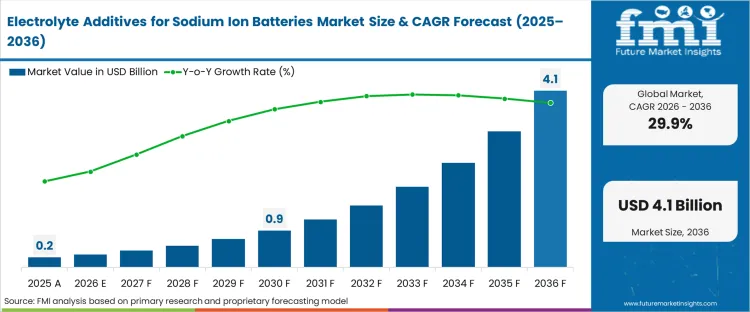
The electrolyte additives for sodium ion batteries market crossed a valuation of USD 0.2 billion in 2025. The industry is expected to reach USD 0.3 billion in 2026 at a CAGR of 29.9% during the forecast period. Demand outlook carries the market valuation to USD 4.1 billion by 2036 as large-scale sodium-ion battery production accelerates and manufacturers adopt specialized additives to stabilize electrolyte interfaces and extend cycle life in grid-scale energy storage systems.
The structural shift from experimental lab-scale cells to commercial gigawatt-hour production forces electrolyte formulators to abandon generic carbonate blends. Battery original equipment manufacturers that delay adopting specific film-forming chemicals face severe capacity degradation and fail to qualify for major utility procurement tenders. This performance gap forces chemical suppliers to engineer custom organophosphorus and fluoroethylene compounds tailored specifically for the larger ionic radius of sodium. Companies failing to deliver proven cycle-life extensions lose access to the most lucrative early-stage supply contracts.
Summary of Electrolyte Additives for Sodium Ion Batteries Market
- Electrolyte Additives for Sodium Ion Batteries Market Definition:
- This market encompasses the specialized trace chemicals added to sodium-ion cell electrolytes to guarantee bounded capacity retention and thermal stability. The boundary is strictly defined by the engineering requirement to stabilize the hard carbon anode and complex cathode structures against rapid degradation during continuous cycling.
- Demand Drivers in the Market:
- Grid storage project developers demand cell lifespans exceeding five thousand cycles, forcing manufacturers to deploy advanced interface-stabilizing chemicals.
- Cold weather performance specifications for commercial fleet applications compel automotive integrators to source additives that prevent low-temperature electrolyte freezing.
- Stringent safety regulations for indoor energy storage systems mandate the inclusion of proprietary flame-retardant compounds to eliminate thermal runaway risks.
- Key Segments Analyzed in the FMI Report:
- Film-Forming Additives: 45.0% share in 2026, driven by the absolute necessity to build a resilient interface on reactive hard carbon surfaces.
- Non-Aqueous Electrolytes: 68.0% share in 2026, reflecting widespread commercialization of organic solvent platforms for high-voltage energy storage.
- China: 34.0% compound growth, propelled by massive gigafactory investments targeting immediate displacement of localized lead-acid systems.
- Analyst Opinion at FMI:
- Nikhil Kaitwade, Principal Consultant for Chemicals and Materials, opines, "In my analysis, I have observed that the true bottleneck in sodium-ion commercialization is not the bulk material cost, but the severe capacity fade caused by unstable solid electrolyte interphases. Investors attempting to scale battery production without securing advanced fluoro-based additive supply chains face unavoidable cell degradation that triggers warranty failures. Procurement directors who secure long-term offtake agreements for specialized film-forming chemicals will find themselves capable of meeting the stringent 5,000-cycle threshold required for grid-scale qualification."
- Strategic Implications / Executive Takeaways:
- Chemical manufacturers must develop proprietary additive blends optimized specifically for polyanionic cathode structures to capture premium pricing margins.
- Gigafactory procurement leads should diversify their additive supply base to avoid production halts caused by regional specialty chemical shortages.
- Battery cell engineers must validate flame-retardant additive compatibility during early prototyping to bypass expensive redesign cycles before mass production.
- Methodology:
- Primary Research: Analysts engaged with battery materials science directors, gigafactory procurement leads, and chemical formulation engineers to map the specific decision gates triggering additive formulation changes.
- Desk Research: The data collection phase aggregated chemical registry filings, proprietary formulations from leading electrolyte manufacturers, and academic performance validation metrics.
- Market-Sizing and Forecasting: The baseline value derives from a bottom-up aggregation of specialized battery chemical shipments, applying cell manufacturing capacity curves to project future adoption velocity.
- Data Validation and Update Cycle: Projections are rigorously tested against publicly reported capital expenditure guidance from major battery chemical conglomerates and gigafactory operators.
The absolute bottleneck in commercializing this technology lies in stabilizing the solid electrolyte interphase on hard carbon surfaces, an inflection point where localized chemical reactions determine full cell viability. Materials science directors must specify optimal additive concentrations before automated pouch cell assembly lines enter continuous operation next year. Once production locks in these proprietary electrolyte recipes, chemical suppliers secure predictable volume off-take agreements extending through the decade.
China posts a 34.0% compound rate and dominates volume deployment through state-backed renewable energy storage mandates. India tracks closely at 31.5% as local automotive conglomerates seek supply chain independence from critical minerals. South Korea expands at 29.0% driven by chemical conglomerates pivoting their existing battery material production lines. The USA grows at 28.5% supported by localized grid modernization funding. Germany advances at 27.0% through regional sustainable mobility initiatives. Japan follows at 25.5% while the UK records a 24.0% rate. This geographic dispersion reflects distinct national strategies to build domestic supply chains completely isolated from traditional lithium constraints.
Electrolyte Additives for Sodium Ion Batteries Market Key Takeaways
| Metric | Details |
|---|---|
| Industry Size (2026) | USD 0.3 billion |
| Industry Value (2036) | USD 4.1 billion |
| CAGR (2026-2036) | 29.9% |
Electrolyte Additives for Sodium Ion Batteries Market Definition
The electrolyte additives for sodium ion batteries market represents the commercial ecosystem of specialized chemical compounds integrated into cell electrolytes to improve electrochemical performance. These chemicals alter the solvation sheath of sodium ions, suppress parasitic reactions at the electrode interface, and prevent thermal runaway. The market strictly covers performance-enhancing trace compounds rather than the bulk solvent or primary sodium salts, focusing on the critical interface engineering required to make sodium-ion systems commercially competitive against legacy architectures.
Electrolyte Additives for Sodium Ion Batteries Market Inclusions
The market scope includes specific organic and inorganic compounds such as fluoroethylene carbonate, vinylene carbonate, and proprietary phosphazene flame retardants designed for sodium-based systems. Specialized solid electrolyte interphase forming agents, overcharge protection shuttles, and solvation modifiers fall completely within the boundaries. Products explicitly engineered to extend the cycle life of sodium-ion batteries and improve low-temperature conductivity are fully incorporated into the valuation model.
Electrolyte Additives for Sodium Ion Batteries Market Exclusions
Standard bulk solvents like propylene carbonate or dimethyl carbonate, along with primary solute salts like sodium hexafluorophosphate, fall entirely outside this specific additive market boundary. Additives exclusively formulated for standard lithium-ion or lead-acid chemistries are explicitly omitted from the valuation. Standalone thermal management hardware, battery management system software, and external safety enclosures are excluded.
Electrolyte Additives for Sodium Ion Batteries Market Research Methodology
- Primary Research: Analysts engaged with battery materials science directors, gigafactory procurement leads, and chemical formulation engineers to map the specific decision gates triggering additive formulation changes.
- Desk Research: The data collection phase aggregated chemical registry filings, proprietary formulations from leading electrolyte manufacturers, and academic performance validation metrics.
- Market-Sizing and Forecasting: The baseline value derives from a bottom-up aggregation of specialized battery chemical shipments, applying cell manufacturing capacity curves to project future adoption velocity.
- Data Validation and Update Cycle: Projections are rigorously tested against publicly reported capital expenditure guidance from major battery chemical conglomerates and gigafactory operators.
Source: Future Market Insights (FMI) analysis, based on proprietary forecasting model and primary research
Segmental Analysis
Electrolyte Additives for Sodium Ion Batteries Market Analysis by Additive Type
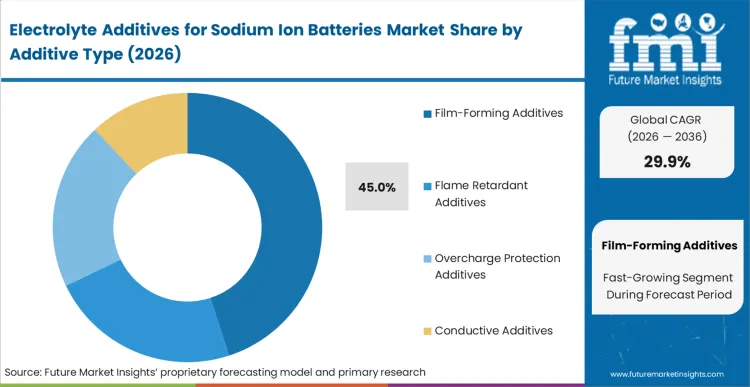
Standard bulk electrolytes failing at the hard carbon interface compel cell designers to deploy complex multi-chemical stabilization strategies. Film-Forming Additives secure a dominant 45.0% share in 2026 as manufacturers prioritize initial cycle efficiency and long-term capacity retention above all other metrics. Battery architects specifying these specific compounds prevent the continuous consumption of active sodium ions during operation. According to FMI's estimates, facilities transitioning to optimized fluoroethylene carbonate blends realize measurable improvements in overall pack longevity. Additive suppliers unable to formulate highly pure interface modifiers risk immediate exclusion from high-volume automotive and grid-storage procurement cycles. The integration of these compounds within solvents for battery electrolyte supply chains accelerates commercial deployment timelines. Procurement specification leads mandating stringent purity thresholds prevent catastrophic cell degradation during the crucial formation cycling phase.
- Interface stability: Complex chemical reduction processes build a protective layer on the anode surface, blocking further solvent decomposition.
- Formation efficiency: Precise dosing limits the irreversible loss of sodium inventory during the very first charge cycle.
- Degradation control: Active sacrificial agents consume trace moisture and hydrofluoric acid before they attack the cathode lattice.
Electrolyte Additives for Sodium Ion Batteries Market Analysis by Electrolyte System
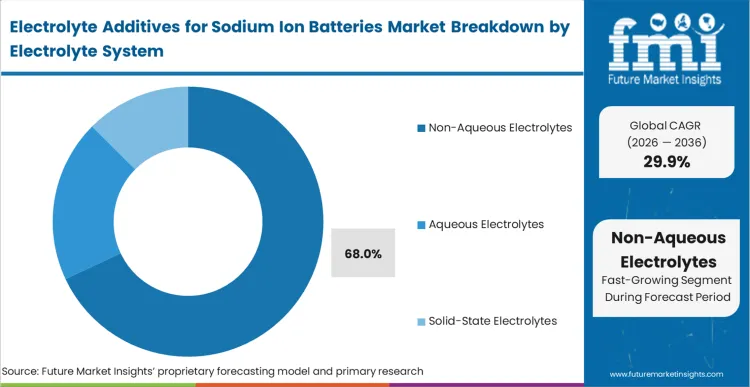
Non-Aqueous Electrolytes hold a 68.0% share in 2026, reflecting the absolute requirement for wide electrochemical voltage windows in modern commercial cells. High-voltage energy storage applications demand organic solvent blends that will not decompose at elevated potentials. In FMI's view, standardizing these organic platforms directly enables higher energy density parity with lithium-iron-phosphate architectures. Cell development teams must validate additive solubility within these non-aqueous environments during early prototype qualification to authorize final production sign-off. The chemical compatibility across mixed carbonate systems forces formulators to rethink traditional additive interaction mechanisms. Suppliers failing to demonstrate seamless integration with established non-aqueous recipes lose priority status in utility-scale battery upgrade cycles. Battery testing engineers measuring extended high-temperature performance metrics secure critical data for commercial warranty underwriting.
- Voltage tolerance: Specialized organic blends permit charging up to 4.0 volts without triggering oxidative electrolyte breakdown.
- Temperature range: Modifiers depress the freezing point of the bulk solvent, allowing continuous operation in severe winter environments.
- Solubility constraints: Formulation engineers balance multiple additive components to ensure complete dissolution without precipitating out inactive salts.
Electrolyte Additives for Sodium Ion Batteries Market Analysis by Battery Chemistry
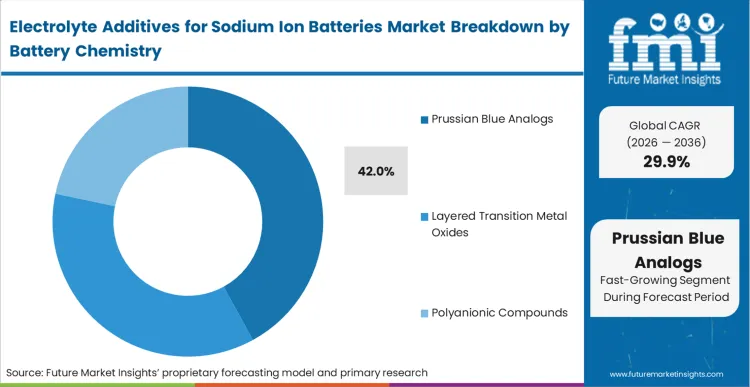
Pilot manufacturing lines scaling up Layered Transition Metal Oxides face strict adherence criteria for moisture control and transition metal dissolution. This specific cathode chemistry captures 42.0% of the market share in 2026. As per FMI's projection, the convergence of high-capacity oxide materials with specialized electrolyte systems amplifies the demand for targeted metal-scavenging additives. Cell chemists operating continuous production facilities reject formulation designs introducing variable gas generation during cycling. Incorporating certified organic chelating agents guarantees that dissolved metal ions do not migrate and destroy the anode solid electrolyte interphase. Chemical distributors failing to provide precise chemical purity documentation lose priority status in critical automotive qualification cycles. Materials compliance officers authenticating these additive supply chains ensure that end-use battery packs maintain strict performance warranties.
- Gas suppression: Specific compounds inhibit the parasitic reactions that generate internal cell pressure and cause pouch swelling.
- Lattice protection: Trace chemicals stabilize the highly reactive cathode surface during deep discharge cycles, preventing structural collapse.
- Metal chelation: Specialized molecules capture dissolved transition metals before they poison the critical anode interphase layer.
Electrolyte Additives for Sodium Ion Batteries Market Analysis by End Use
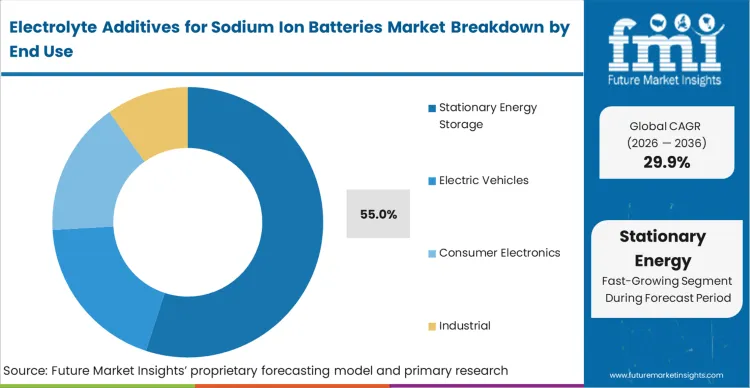
The historic failure of early grid installations created an urgent demand for stationary energy storage systems capable of true decadal lifespans. Stationary Energy Storage emerges as the dominant application area, expected to represent 55.0% of total market share in 2026. Utility network planners integrating distributed renewable energy resources require massive, cost-effective battery banks. FMI's analysis indicates that flattening the energy storage cost curve directly enables real-time grid stabilization applications worldwide. Project development leads must validate multi-year cycle life performance metrics during site acceptance testing to authorize final capital expenditure sign-off. The integration of advanced energy storage sodium ion battery technology forces systems integrators to rethink traditional lithium-based financial models. Infrastructure deployment directors locking in long-term supply agreements protect their projects from future specialty chemical price volatility.
- Cycle longevity: Specialized chemical environments permit thousands of deep daily cycles required for solar and wind energy shifting.
- Safety compliance: Non-flammable additive components satisfy strict urban fire codes for indoor utility installations.
- Cost scaling: Replacing expensive lithium infrastructure with abundant sodium materials lowers the total levelized cost of storage.
Electrolyte Additives for Sodium Ion Batteries Market Drivers, Restraints, and Opportunities
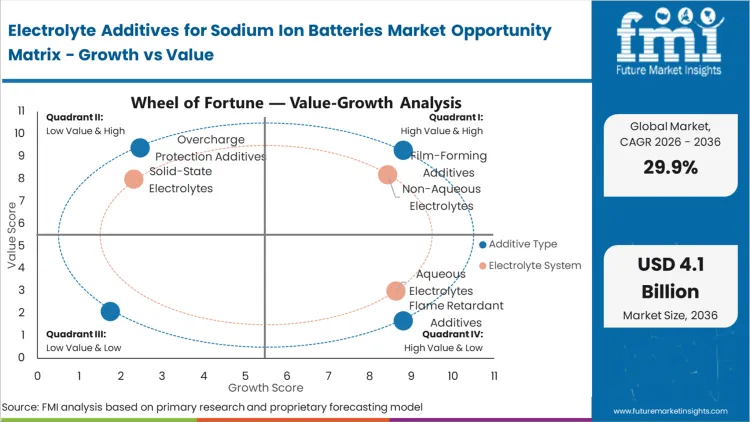
The convergence of global electrification targets and critical mineral shortages forces battery specification leads to extract actionable performance from alternative sodium chemistries. This architectural requirement renders basic, un-optimized electrolytes obsolete. Battery cell manufacturers upgrading pilot lines face a strict binary choice between accepting severe capacity fade or overhauling their internal chemical formulations. Transitioning to highly customized, additive-rich electrolyte blends simplifies thermal management requirements and enables direct deployment in extreme environments. Facilities that fail to modernize their core liquid chemistry layers risk operational blind spots and reduced overall cell life.
The intricate chemical synthesis required to produce ultra-pure fluoro-additives creates steep learning curves for traditional bulk chemical suppliers. Designing cost-effective manufacturing routes for these complex molecules demands specialized organofluorine expertise that most regional chemical facilities lack internally. To mitigate this skill gap, material procurement directors increasingly rely on established, high-tier specialty chemical conglomerates that guarantee parts-per-billion purity levels before physical deployment.
Opportunities in the Electrolyte Additives for Sodium Ion Batteries Market
- Solid-State Integration: Next-generation hybrid polymer electrolytes enable battery architects to run safe, semi-solid architectures directly on standard manufacturing equipment. Cell designers implementing this transition capture immediate market share in high-safety consumer electronics applications.
- Aqueous Formulation Breakthroughs: Upgraded water-based electrolyte bandwidth permits utility engineering teams to deploy massive, low-cost grid storage without requiring expensive dry-room manufacturing environments. This capability prevents massive capital outlays from stalling rural electrification projects.
- Fast-Charging Mobility: Automotive network planners integrating commercial delivery fleets require precise charging phase measurement data. Advanced kinetic-enhancing additives provide the low internal resistance necessary to balance fast charging inputs without triggering lithium-like plating events.
Regional Analysis
Based on the regional analysis, the Electrolyte Additives for Sodium Ion Batteries market is segmented into North America, Latin America, Europe, East Asia, South Asia, Oceania and Middle East & Africa across 40 plus countries.
.webp "Top Country Growth Comparison Electrolyte Additives For Sodium Ion Batteries Market Cagr (2026 2036)")
| Country | CAGR (2026 to 2036) |
|---|---|
| China | 34.0% |
| India | 31.5% |
| South Korea | 29.0% |
| USA | 28.5% |
| Germany | 27.0% |
| Japan | 25.5% |
| UK | 24.0% |
Source: Future Market Insights (FMI) analysis, based on proprietary forecasting model and primary research
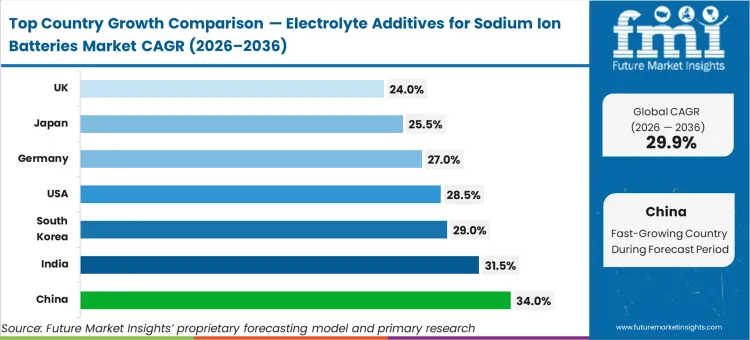
Asia Pacific Electrolyte Additives for Sodium Ion Batteries Market Analysis
Greenfield gigafactory construction across Asia Pacific accelerates the commercial bypass of legacy lithium constraints. Gigafactory capital projects directors constructing new sodium-ion production facilities specify unified, high-performance electrolyte formulations in their initial chemistry blueprints. Based on FMI's assessment, this aggressive volume scale-up entirely eliminates the costly chemical synthesis bottlenecks that plague smaller regional markets. By building massive domestic supply chains, regional asset owners establish highly flexible production environments capable of rapid formulation shifts. The integration of robust chemical manufacturing forms the critical prerequisite for deploying advanced electric vehicle packs.
- China: Massive state subsidies for alternative energy technologies drive relentless expansion of domestic sodium battery supply chains. Intensive competition among local gigafactories forces the rapid iteration and deployment of advanced film-forming formulations to maximize cell longevity. The sheer volume of commercial vehicle production establishes a massive installed base of new battery architectures across the eastern industrial corridor. This mechanism anchors China's 34.0% compound expansion to 2036. Battery cell engineers failing to source ultra-pure additives locally face severe production delays and lost market share.
- South Korea: South Korea's established lithium-ion chemical conglomerates pivot their massive synthesis infrastructure toward sodium-compatible additives. National battery research consortiums mandate zero-defect chemical purity to ensure multi-axis robotic pouch cell lines perform flawlessly. The concentration of advanced chemical synthesis capability necessitates continuous investment in novel organofluorine compounds. South Korea's market demand is rising at a CAGR of 29.0% as this zero-tolerance manufacturing standard becomes the universal procurement baseline. Chemical suppliers targeting the next fab expansion cycle must prove absolute batch consistency before receiving production authorization.
- Japan: Japan's automotive OEM supply chain enforces strict component qualification through stringent safety testing for synchronized production sequences. Every new electrolyte architecture must validate thermal runaway resistance before receiving authorization for series vehicle integration. The domestic specialty chemical sector embeds flame retardant properties directly into the base solvent mixture to maintain global competitive advantage. Specialized formulation expertise anchors Japan's 25.5% compound trajectory to 2036. Component suppliers lacking verified safety testing records forfeit access to the next generation of hybrid vehicle contracts.
FMI's report includes extensive coverage of the Asia Pacific chemical supply landscape. The analysis encompasses regional trading hubs and material processing centers. A primary trend shaping these nations is the rapid localization of precursor chemical synthesis, forcing battery manufacturers to deploy unified procurement architectures to satisfy stringent brand traceability requirements.
South Asia Electrolyte Additives for Sodium Ion Batteries Market Analysis
Industrial modernization mandates across South Asia target the systematic eradication of expensive lithium import dependencies. Control systems engineers leading critical infrastructure overhauls face strict directives to unify disparate stationary storage domains under a single, cost-effective sodium architecture. FMI's research confirms that the renewable energy sectors actively drive this consolidation to secure their supply chain economics against global commodity price shocks. Implementing a standardized, domestic battery industry requires significant capital allocation toward robust chemical infrastructure capable of supporting advanced cell designs.
- India: India's national push toward critical mineral independence triggers a wave of gigafactory investments prioritizing abundant, locally sourced sodium materials. Process engineers must deploy battery networks capable of guaranteeing reliable performance in extreme high-temperature environments. State-level production linked incentives actively fund the establishment of domestic specialty chemical manufacturing hubs. State support mechanisms drive a 31.5% CAGR for the market in India. Chemical vendors lacking documented compliance with rigorous high-temperature stability standards face immediate exclusion from national grid modernization contracts.
FMI's report includes comprehensive evaluation of the South Asian chemical sector. It features specific analysis of regional manufacturing zones. A defining dynamic in these countries involves the integration of cross-border supply chains, which requires standardized testing protocols to coordinate material delivery sequences and maintain synchronized production schedules across multiple facilities.
Europe Electrolyte Additives for Sodium Ion Batteries Market Analysis
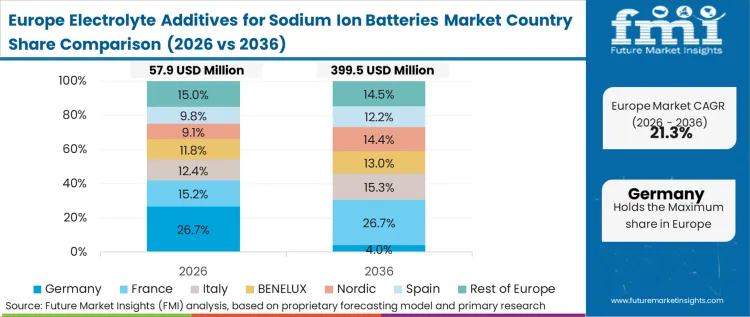
European industrial policy actively penalizes the continued reliance on conflict minerals and highly volatile lithium supply chains. Battery architects redesigning legacy production lines must integrate sustainable, sodium-based chemistries alongside critical recycling infrastructure. This strategic requirement forces the rapid adoption of highly stable electrolyte formulations to guarantee long-term cell viability in commercial applications. The transition requires a complete overhaul of existing supply topologies, shifting from Asian chemical imports to localized, green-synthesized additive production.
- Germany: Germany's automotive OEM supply chain dictates stringent validation criteria for mixed-fleet commercial vehicles deploying alternative battery technologies. Cell systems engineers must demonstrate flawless execution of cold-weather performance tests before receiving authorization to connect new battery packs to commercial delivery vans. The national push for sustainable mobility mandates unified chemical safety layers. Commercial fleet qualification pressure drives a 27.0% annual expansion rate as regional supply networks mature. Chemical infrastructure providers targeting domestic vehicle assembly plant retooling projects must guarantee secure additive supplies prior to the finalization of capital procurement budgets.
- UK: The United Kingdom's energy grid modernization programs require massive stationary storage deployments to balance increasingly volatile offshore wind generation inputs. Utility network planners deploying advanced substation battery systems mandate cell architectures capable of decades-long performance across distributed geographic assets. The shift toward decentralized power generation forces grid operators to abandon legacy lead-acid systems in favor of highly resilient sodium alternatives. National grid storage requirements expand the UK market at a 24.0% CAGR through 2036. Systems integrators unable to demonstrate absolute cell longevity under severe load conditions forfeit qualification for national grid expansion projects.
FMI's report includes thorough investigation of the European battery chemical framework. The analysis encompasses France, Italy, Spain, and the Nordics. A prevailing structural condition across these nations is the mandatory compliance with strict chemical registration directives, forcing asset owners to specify additives that can reliably pass environmental impact assessments.
Competitive Aligners for Market Players
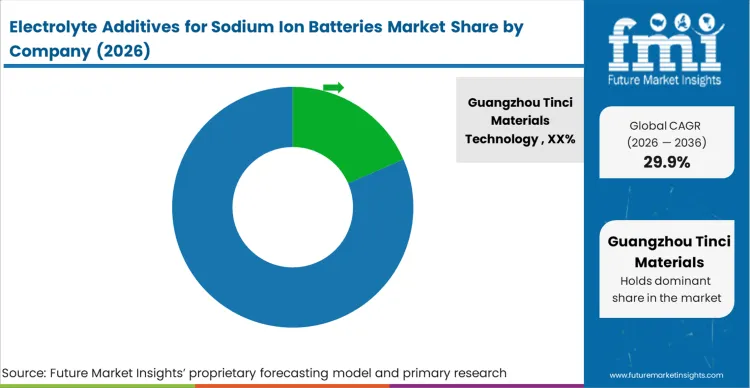
The competitive landscape of the electrolyte additives for sodium ion batteries market is being reshaped by suppliers that can combine scale, purity control, and supply reliability across high-growth battery manufacturing corridors. Instead of accepting fragmented sourcing models, cell manufacturers now prioritize partners capable of delivering electrolyte inputs with consistent quality, validated performance, and regional production flexibility. This shift has raised the performance threshold across the industry, meaning vendors that remain dependent on narrow product portfolios or limited domestic reach risk losing relevance in large EV battery supply programs.
Industry leaders have already begun adapting. Companies such as Guangzhou Tinci Materials Technology, Shenzhen Capchem Technology, Do-Fluoride New Materials, Mitsubishi Chemical Group, and Shanshan Co., Ltd. are strengthening their positions through deep material science capabilities, broader customer integration, and alignment with expanding lithium-ion battery production requirements. As a result, electrolyte material suppliers are now under pressure to improve formulation stability, cost competitiveness, and localization strategies rather than relying only on volume expansion. This creates a new competitive baseline where qualified producers must support both performance consistency and rapid scale-up across regional gigafactory networks.
Vendors embedding upstream integration and process control directly into their operating model gain a significant architectural advantage. Companies such as GFCL EV, Enchem Co., Ltd., and Zhejiang Yongtai Technology benefit from stronger control over raw material linkages, production efficiency, and customer-specific supply coordination. This integration-first approach helps battery manufacturers reduce qualification risks, shorten procurement cycles, and improve supply-chain resilience during capacity ramp-ups. In contrast, material suppliers that are slow to expand technical validation capabilities or secure long-term customer alignment risk losing position during early-stage sourcing decisions.
Growth of cross-regional battery manufacturing ecosystems is also disrupting long-established market structures. With more cell plants emerging across Asia and beyond, procurement teams can now compare suppliers from multiple geographies without being restricted to a single national base. This expanded flexibility allows battery producers to optimize sourcing for performance, cost, and supply continuity instead of remaining locked into one vendor structure. Across the forecast period, competitive strength will increasingly depend on a supplier’s ability to combine scale, formulation expertise, and strategic positioning within the global EV battery materials chain.
Key Players in Electrolyte Additives for Sodium Ion Batteries Market
- Guangzhou Tinci Materials Technology
- Shenzhen Capchem Technology
- Do-Fluoride New Materials
- Mitsubishi Chemical Group
- Shanshan Co., Ltd.
- GFCL EV
- Enchem Co., Ltd.
- Zhejiang Yongtai Technology
Scope of the Report
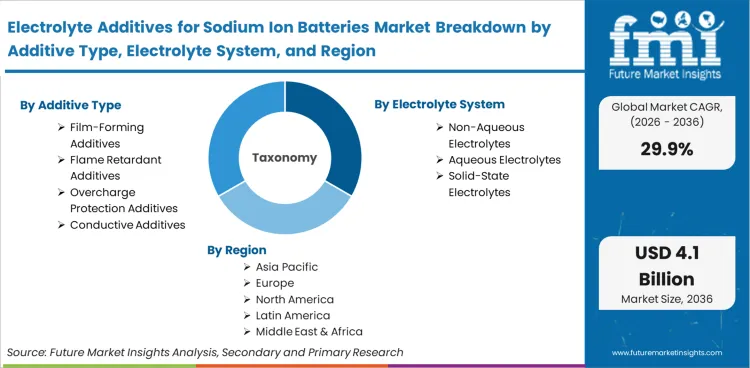
| Metric | Value |
|---|---|
| Quantitative Units | USD 0.3 billion to USD 4.1 billion, at a CAGR of 29.9% |
| Market Definition | The electrolyte additives for sodium ion batteries market represents specialized chemical compounds integrated into cell electrolytes to alter the solvation sheath, suppress parasitic reactions, and prevent thermal runaway. |
| Additive Type Segmentation | Film-Forming Additives, Flame Retardant Additives, Overcharge Protection Additives, Conductive Additives |
| Electrolyte System Segmentation | Aqueous Electrolytes, Non-Aqueous Electrolytes, Solid-State Electrolytes |
| Battery Chemistry Segmentation | Prussian Blue Analogs, Layered Transition Metal Oxides, Polyanionic Compounds |
| End Use Segmentation | Stationary Energy Storage, Electric Vehicles, Consumer Electronics, Industrial |
| Regions Covered | North America, Latin America, Europe, Asia Pacific, South Asia, Oceania, Middle East & Africa |
| Countries Covered | China, India, USA, Germany, South Korea, Japan, UK, and 40 plus countries |
| Key Companies Profiled | Guangzhou Tinci Materials Technology, Shenzhen Capchem Technology, Do-Fluoride New Materials, Mitsubishi Chemical Group, Shanshan Co., Ltd., GFCL EV, Enchem Co., Ltd., and Zhejiang Yongtai Technology |
| Forecast Period | 2026 to 2036 |
| Approach | The baseline value derives from a bottom-up aggregation of specialized battery chemical shipments, applying cell manufacturing capacity curves to project future adoption velocity. |
Source: Future Market Insights (FMI) analysis, based on proprietary forecasting model and primary research
Electrolyte Additives for Sodium Ion Batteries Market Analysis by Segments
Additive Type:
- Film-Forming Additives
- Flame Retardant Additives
- Overcharge Protection Additives
- Conductive Additives
Electrolyte System:
- Aqueous Electrolytes
- Non-Aqueous Electrolytes
- Solid-State Electrolytes
Battery Chemistry:
- Prussian Blue Analogs
- Layered Transition Metal Oxides
- Polyanionic Compounds
End Use:
- Stationary Energy Storage
- Electric Vehicles
- Consumer Electronics
- Industrial
Region:
- North America
- USA
- Canada
- Latin America
- Brazil
- Mexico
- Europe
- Germany
- UK
- France
- Italy
- East Asia
- China
- Japan
- South Korea
- South Asia
- India
- ASEAN
- Oceania
- Australia
- New Zealand
- Middle East & Africa
- GCC
- South Africa
Bibliography
- International Energy Agency. (2026, February 5). Sodium-ion battery installed and announced manufacturing capacity by chemistry and region, 2025 and 2030. IEA.
- USA Department of Energy. (2025, January 9). Charting the path: An Energy Earthshots initiative report. U.S. Department of Energy.
- ACS Applied Materials & Interfaces. (2025). Investigations on electrolyte additives and formation mechanism of sodium-ion batteries. ACS Applied Materials & Interfaces.
- ACS Energy Letters. (2025). Prediction of additive effectiveness in sodium-ion batteries based on reduced-state structures and electrostatic potential distributions. ACS Energy Letters.
- Lahtinen, K., et al. (2026). Synergy or interference? The effect of electrolyte additives and formation protocols in sodium-based electrolyte systems. EES Batteries / RSC.
This bibliography is provided for reader reference. The full FMI report contains the complete reference list with primary source documentation.
This Report Addresses
- Market sizing for the organized electrolyte additives for sodium ion batteries layer
- Forecast demand for specific interface stabilization capability from 2026 to 2036
- Additive Type analysis across Film-Forming Additives, Flame Retardant Additives, Overcharge Protection Additives, Conductive Additives
- Electrolyte System demand patterns across Aqueous Electrolytes, Non-Aqueous Electrolytes, Solid-State Electrolytes
- Regional growth comparisons shaped by national critical mineral independence strategies
- Competitive positioning factors for specialty chemical formulation providers
- Revenue opportunities tied to grid-scale energy storage adjacent value streams
- Strategic implications for gigafactory procurement directors and cell architects
Frequently Asked Questions
How large is the Electrolyte Additives for Sodium Ion Batteries in 2026?
The market for these specialized battery chemicals is estimated to be valued at USD 0.3 billion in 2026. Cell manufacturing engineers scaling up hard carbon anode production lines face severe first-cycle capacity losses, triggering immediate procurement.
What will the Electrolyte Additives for Sodium Ion Batteries be valued at by 2036?
Market size is projected to reach USD 4.1 billion by 2036. The aggressive expansion of stationary energy storage installations directly requires massive volumes of interface-stabilizing chemicals.
What CAGR is projected for Electrolyte Additives for Sodium Ion Batteries from 2026 to 2036?
Demand is expected to grow at a CAGR of 29.9% between 2026 and 2036. This rapid rate is sustained by the structural shift from experimental lab-scale cells to commercial gigawatt-hour production worldwide.
Which Additive Type is poised to lead global sales by 2026?
Film-Forming Additives command 45.0% share in 2026. Battery architects specifying these specific compounds prevent the continuous consumption of active sodium ions during operation.
Which Electrolyte System dominates the market landscape?
Non-Aqueous Electrolytes hold a 68.0% share as high-voltage energy storage applications demand organic solvent blends that will not decompose at elevated potentials.
Which Battery Chemistry accounts for the highest additive consumption?
Layered Transition Metal Oxides capture 42.0% of the market share. The convergence of high-capacity oxide materials with specialized electrolyte systems amplifies the demand for targeted metal-scavenging additives.
How significant is the role of Stationary Energy Storage in driving adoption?
Stationary Energy Storage represents 55.0% of total market share. Utility network planners integrating distributed renewable energy resources require massive, cost-effective battery banks capable of thousands of cycles.
Which application end use provides the most stability for chemical suppliers?
Grid-scale storage provides long-term off-take stability. Utility engineering teams deploying massive installations lock in multi-year chemical procurement contracts.
What operational challenge restrains traditional chemical suppliers?
The intricate chemical synthesis required to produce ultra-pure fluoro-additives creates steep learning curves. Most regional chemical facilities lack the internal organofluorine expertise necessary to reach parts-per-billion purity.
How does solid-state integration create new opportunities?
Next-generation hybrid polymer electrolytes enable battery architects to run safe, semi-solid architectures. Cell designers implementing this transition capture immediate market share in high-safety applications.
Why is fast-charging critical for advanced additive adoption?
Automotive network planners require precise fast-charging capabilities for commercial fleets. Advanced kinetic-enhancing additives provide the low internal resistance necessary to balance fast inputs without cell degradation.
What is driving demand in China?
Massive state subsidies for alternative energy technologies drive relentless expansion of domestic gigafactories. Intensive competition among local manufacturers forces the rapid iteration and deployment of advanced film-forming formulations.
What is China's growth outlook in this report?
China's market is projected to grow at a CAGR of 34.0% through 2036.
What policy framework has accelerated India's battery component buildout?
India's national push toward critical mineral independence triggers gigafactory investments prioritizing abundant, locally sourced sodium materials.
What is India's expected growth rate?
India expands at a CAGR of 31.5% as state-level production linked incentives actively fund the establishment of domestic specialty chemical hubs.
Why is South Korea described as a zero-tolerance manufacturing environment?
South Korea's established lithium-ion chemical conglomerates pivot their massive synthesis infrastructure toward sodium-compatible additives, mandating absolute batch consistency.
How fast is the South Korean market expanding?
South Korea advances at a 29.0% compound rate across the forecast decade.
What compliance standard drives the Japanese market?
Japan's automotive OEM supply chain enforces strict component qualification through stringent safety testing for synchronized production sequences.
What distinguishes the USA market approach from Europe?
The USA market is heavily supported by localized grid modernization funding targeting infrastructure resilience, whereas Europe relies on stringent chemical registration directives and sustainable mobility mandates.
What is the scope of this Electrolyte Additives for Sodium Ion Batteries report?
The market covers performance-enhancing trace compounds rather than the bulk solvent or primary sodium salts. It focuses entirely on the critical interface engineering required to make these systems viable.
What is explicitly excluded from the valuation?
Standard bulk solvents like propylene carbonate and primary solute salts like sodium hexafluorophosphate are omitted. Additives exclusively formulated for standard lithium-ion or lead-acid chemistries fall outside the boundaries.
How does FMI build this specific chemical forecast?
The baseline value derives from a bottom-up aggregation of specialized battery chemical shipments. Analysts apply cell manufacturing capacity curves to project future adoption velocity.
What strategic takeaway defines the next five years for cell architects?
Battery cell engineers must validate flame-retardant additive compatibility during early prototyping. Skipping this step leads to expensive redesign cycles before mass production is authorized.
Why do procurement directors need to diversify their additive supply base?
Relying on single-source specialty chemical imports creates massive supply chain vulnerability. Diversifying guarantees continuous automated pouch cell assembly line operation despite regional trade disruptions.
Preview the report firsthand - request a free sample
Get SampleGet the brochure for pricing and purchase details.
Get PDFTable of Content
- Executive Summary
- Global Market Outlook
- Demand-side Trends
- Supply-side Trends
- Technology Roadmap Analysis
- Analysis and Recommendations
- Market Overview
- Market Coverage / Taxonomy
- Market Definition / Scope / Limitations
- Research Methodology
- Chapter Orientation
- Analytical Lens and Working Hypotheses
- Market Structure, Signals, and Trend Drivers
- Benchmarking and Cross-market Comparability
- Market Sizing, Forecasting, and Opportunity Mapping
- Research Design and Evidence Framework
- Desk Research Programme (Secondary Evidence)
- Company Annual and Sustainability Reports
- Peer-reviewed Journals and Academic Literature
- Corporate Websites, Product Literature, and Technical Notes
- Earnings Decks and Investor Briefings
- Statutory Filings and Regulatory Disclosures
- Technical White Papers and Standards Notes
- Trade Journals, Industry Magazines, and Analyst Briefs
- Conference Proceedings, Webinars, and Seminar Materials
- Government Statistics Portals and Public Data Releases
- Press Releases and Reputable Media Coverage
- Specialist Newsletters and Curated Briefings
- Sector Databases and Reference Repositories
- FMI Internal Proprietary Databases and Historical Market Datasets
- Subscription Datasets and Paid Sources
- Social Channels, Communities, and Digital Listening Inputs
- Additional Desk Sources
- Expert Input and Fieldwork (Primary Evidence)
- Primary Modes
- Qualitative Interviews and Expert Elicitation
- Quantitative Surveys and Structured Data Capture
- Blended Approach
- Why Primary Evidence is Used
- Field Techniques
- Interviews
- Surveys
- Focus Groups
- Observational and In-context Research
- Social and Community Interactions
- Stakeholder Universe Engaged
- C-suite Leaders
- Board Members
- Presidents and Vice Presidents
- R&D and Innovation Heads
- Technical Specialists
- Domain Subject-matter Experts
- Scientists
- Physicians and Other Healthcare Professionals
- Governance, Ethics, and Data Stewardship
- Research Ethics
- Data Integrity and Handling
- Primary Modes
- Tooling, Models, and Reference Databases
- Desk Research Programme (Secondary Evidence)
- Data Engineering and Model Build
- Data Acquisition and Ingestion
- Cleaning, Normalisation, and Verification
- Synthesis, Triangulation, and Analysis
- Quality Assurance and Audit Trail
- Market Background
- Market Dynamics
- Drivers
- Restraints
- Opportunity
- Trends
- Scenario Forecast
- Demand in Optimistic Scenario
- Demand in Likely Scenario
- Demand in Conservative Scenario
- Opportunity Map Analysis
- Product Life Cycle Analysis
- Supply Chain Analysis
- Investment Feasibility Matrix
- Value Chain Analysis
- PESTLE and Porter’s Analysis
- Regulatory Landscape
- Regional Parent Market Outlook
- Production and Consumption Statistics
- Import and Export Statistics
- Market Dynamics
- Global Market Analysis 2021 to 2025 and Forecast, 2026 to 2036
- Historical Market Size Value (USD Million) Analysis, 2021 to 2025
- Current and Future Market Size Value (USD Million) Projections, 2026 to 2036
- Y-o-Y Growth Trend Analysis
- Absolute $ Opportunity Analysis
- Global Market Pricing Analysis 2021 to 2025 and Forecast 2026 to 2036
- Global Market Analysis 2021 to 2025 and Forecast 2026 to 2036, By Additive Type
- Introduction / Key Findings
- Historical Market Size Value (USD Million) Analysis By Additive Type , 2021 to 2025
- Current and Future Market Size Value (USD Million) Analysis and Forecast By Additive Type , 2026 to 2036
- Film-Forming Additives
- Flame Retardant Additives
- Overcharge Protection Additives
- Conductive Additives
- Film-Forming Additives
- Y-o-Y Growth Trend Analysis By Additive Type , 2021 to 2025
- Absolute $ Opportunity Analysis By Additive Type , 2026 to 2036
- Global Market Analysis 2021 to 2025 and Forecast 2026 to 2036, By Electrolyte System
- Introduction / Key Findings
- Historical Market Size Value (USD Million) Analysis By Electrolyte System, 2021 to 2025
- Current and Future Market Size Value (USD Million) Analysis and Forecast By Electrolyte System, 2026 to 2036
- Non-Aqueous Electrolytes
- Aqueous Electrolytes
- Solid-State Electrolytes
- Non-Aqueous Electrolytes
- Y-o-Y Growth Trend Analysis By Electrolyte System, 2021 to 2025
- Absolute $ Opportunity Analysis By Electrolyte System, 2026 to 2036
- Global Market Analysis 2021 to 2025 and Forecast 2026 to 2036, By Battery Chemistry
- Introduction / Key Findings
- Historical Market Size Value (USD Million) Analysis By Battery Chemistry, 2021 to 2025
- Current and Future Market Size Value (USD Million) Analysis and Forecast By Battery Chemistry, 2026 to 2036
- Prussian Blue Analogs
- Layered Transition Metal Oxides
- Polyanionic Compounds
- Prussian Blue Analogs
- Y-o-Y Growth Trend Analysis By Battery Chemistry, 2021 to 2025
- Absolute $ Opportunity Analysis By Battery Chemistry, 2026 to 2036
- Global Market Analysis 2021 to 2025 and Forecast 2026 to 2036, By End Use
- Introduction / Key Findings
- Historical Market Size Value (USD Million) Analysis By End Use, 2021 to 2025
- Current and Future Market Size Value (USD Million) Analysis and Forecast By End Use, 2026 to 2036
- Stationary Energy Storage
- Electric Vehicles
- Consumer Electronics
- Industrial
- Stationary Energy Storage
- Y-o-Y Growth Trend Analysis By End Use, 2021 to 2025
- Absolute $ Opportunity Analysis By End Use, 2026 to 2036
- Global Market Analysis 2021 to 2025 and Forecast 2026 to 2036, By Region
- Introduction
- Historical Market Size Value (USD Million) Analysis By Region, 2021 to 2025
- Current Market Size Value (USD Million) Analysis and Forecast By Region, 2026 to 2036
- North America
- Latin America
- Western Europe
- Eastern Europe
- East Asia
- South Asia and Pacific
- Middle East & Africa
- Market Attractiveness Analysis By Region
- North America Market Analysis 2021 to 2025 and Forecast 2026 to 2036, By Country
- Historical Market Size Value (USD Million) Trend Analysis By Market Taxonomy, 2021 to 2025
- Market Size Value (USD Million) Forecast By Market Taxonomy, 2026 to 2036
- By Country
- USA
- Canada
- Mexico
- By Additive Type
- By Electrolyte System
- By Battery Chemistry
- By End Use
- By Country
- Market Attractiveness Analysis
- By Country
- By Additive Type
- By Electrolyte System
- By Battery Chemistry
- By End Use
- Key Takeaways
- Latin America Market Analysis 2021 to 2025 and Forecast 2026 to 2036, By Country
- Historical Market Size Value (USD Million) Trend Analysis By Market Taxonomy, 2021 to 2025
- Market Size Value (USD Million) Forecast By Market Taxonomy, 2026 to 2036
- By Country
- Brazil
- Chile
- Rest of Latin America
- By Additive Type
- By Electrolyte System
- By Battery Chemistry
- By End Use
- By Country
- Market Attractiveness Analysis
- By Country
- By Additive Type
- By Electrolyte System
- By Battery Chemistry
- By End Use
- Key Takeaways
- Western Europe Market Analysis 2021 to 2025 and Forecast 2026 to 2036, By Country
- Historical Market Size Value (USD Million) Trend Analysis By Market Taxonomy, 2021 to 2025
- Market Size Value (USD Million) Forecast By Market Taxonomy, 2026 to 2036
- By Country
- Germany
- UK
- Italy
- Spain
- France
- Nordic
- BENELUX
- Rest of Western Europe
- By Additive Type
- By Electrolyte System
- By Battery Chemistry
- By End Use
- By Country
- Market Attractiveness Analysis
- By Country
- By Additive Type
- By Electrolyte System
- By Battery Chemistry
- By End Use
- Key Takeaways
- Eastern Europe Market Analysis 2021 to 2025 and Forecast 2026 to 2036, By Country
- Historical Market Size Value (USD Million) Trend Analysis By Market Taxonomy, 2021 to 2025
- Market Size Value (USD Million) Forecast By Market Taxonomy, 2026 to 2036
- By Country
- Russia
- Poland
- Hungary
- Balkan & Baltic
- Rest of Eastern Europe
- By Additive Type
- By Electrolyte System
- By Battery Chemistry
- By End Use
- By Country
- Market Attractiveness Analysis
- By Country
- By Additive Type
- By Electrolyte System
- By Battery Chemistry
- By End Use
- Key Takeaways
- East Asia Market Analysis 2021 to 2025 and Forecast 2026 to 2036, By Country
- Historical Market Size Value (USD Million) Trend Analysis By Market Taxonomy, 2021 to 2025
- Market Size Value (USD Million) Forecast By Market Taxonomy, 2026 to 2036
- By Country
- China
- Japan
- South Korea
- By Additive Type
- By Electrolyte System
- By Battery Chemistry
- By End Use
- By Country
- Market Attractiveness Analysis
- By Country
- By Additive Type
- By Electrolyte System
- By Battery Chemistry
- By End Use
- Key Takeaways
- South Asia and Pacific Market Analysis 2021 to 2025 and Forecast 2026 to 2036, By Country
- Historical Market Size Value (USD Million) Trend Analysis By Market Taxonomy, 2021 to 2025
- Market Size Value (USD Million) Forecast By Market Taxonomy, 2026 to 2036
- By Country
- India
- ASEAN
- Australia & New Zealand
- Rest of South Asia and Pacific
- By Additive Type
- By Electrolyte System
- By Battery Chemistry
- By End Use
- By Country
- Market Attractiveness Analysis
- By Country
- By Additive Type
- By Electrolyte System
- By Battery Chemistry
- By End Use
- Key Takeaways
- Middle East & Africa Market Analysis 2021 to 2025 and Forecast 2026 to 2036, By Country
- Historical Market Size Value (USD Million) Trend Analysis By Market Taxonomy, 2021 to 2025
- Market Size Value (USD Million) Forecast By Market Taxonomy, 2026 to 2036
- By Country
- Kingdom of Saudi Arabia
- Other GCC Countries
- Turkiye
- South Africa
- Other African Union
- Rest of Middle East & Africa
- By Additive Type
- By Electrolyte System
- By Battery Chemistry
- By End Use
- By Country
- Market Attractiveness Analysis
- By Country
- By Additive Type
- By Electrolyte System
- By Battery Chemistry
- By End Use
- Key Takeaways
- Key Countries Market Analysis
- USA
- Pricing Analysis
- Market Share Analysis, 2025
- By Additive Type
- By Electrolyte System
- By Battery Chemistry
- By End Use
- Canada
- Pricing Analysis
- Market Share Analysis, 2025
- By Additive Type
- By Electrolyte System
- By Battery Chemistry
- By End Use
- Mexico
- Pricing Analysis
- Market Share Analysis, 2025
- By Additive Type
- By Electrolyte System
- By Battery Chemistry
- By End Use
- Brazil
- Pricing Analysis
- Market Share Analysis, 2025
- By Additive Type
- By Electrolyte System
- By Battery Chemistry
- By End Use
- Chile
- Pricing Analysis
- Market Share Analysis, 2025
- By Additive Type
- By Electrolyte System
- By Battery Chemistry
- By End Use
- Germany
- Pricing Analysis
- Market Share Analysis, 2025
- By Additive Type
- By Electrolyte System
- By Battery Chemistry
- By End Use
- UK
- Pricing Analysis
- Market Share Analysis, 2025
- By Additive Type
- By Electrolyte System
- By Battery Chemistry
- By End Use
- Italy
- Pricing Analysis
- Market Share Analysis, 2025
- By Additive Type
- By Electrolyte System
- By Battery Chemistry
- By End Use
- Spain
- Pricing Analysis
- Market Share Analysis, 2025
- By Additive Type
- By Electrolyte System
- By Battery Chemistry
- By End Use
- France
- Pricing Analysis
- Market Share Analysis, 2025
- By Additive Type
- By Electrolyte System
- By Battery Chemistry
- By End Use
- India
- Pricing Analysis
- Market Share Analysis, 2025
- By Additive Type
- By Electrolyte System
- By Battery Chemistry
- By End Use
- ASEAN
- Pricing Analysis
- Market Share Analysis, 2025
- By Additive Type
- By Electrolyte System
- By Battery Chemistry
- By End Use
- Australia & New Zealand
- Pricing Analysis
- Market Share Analysis, 2025
- By Additive Type
- By Electrolyte System
- By Battery Chemistry
- By End Use
- China
- Pricing Analysis
- Market Share Analysis, 2025
- By Additive Type
- By Electrolyte System
- By Battery Chemistry
- By End Use
- Japan
- Pricing Analysis
- Market Share Analysis, 2025
- By Additive Type
- By Electrolyte System
- By Battery Chemistry
- By End Use
- South Korea
- Pricing Analysis
- Market Share Analysis, 2025
- By Additive Type
- By Electrolyte System
- By Battery Chemistry
- By End Use
- Russia
- Pricing Analysis
- Market Share Analysis, 2025
- By Additive Type
- By Electrolyte System
- By Battery Chemistry
- By End Use
- Poland
- Pricing Analysis
- Market Share Analysis, 2025
- By Additive Type
- By Electrolyte System
- By Battery Chemistry
- By End Use
- Hungary
- Pricing Analysis
- Market Share Analysis, 2025
- By Additive Type
- By Electrolyte System
- By Battery Chemistry
- By End Use
- Kingdom of Saudi Arabia
- Pricing Analysis
- Market Share Analysis, 2025
- By Additive Type
- By Electrolyte System
- By Battery Chemistry
- By End Use
- Turkiye
- Pricing Analysis
- Market Share Analysis, 2025
- By Additive Type
- By Electrolyte System
- By Battery Chemistry
- By End Use
- South Africa
- Pricing Analysis
- Market Share Analysis, 2025
- By Additive Type
- By Electrolyte System
- By Battery Chemistry
- By End Use
- USA
- Market Structure Analysis
- Competition Dashboard
- Competition Benchmarking
- Market Share Analysis of Top Players
- By Regional
- By Additive Type
- By Electrolyte System
- By Battery Chemistry
- By End Use
- Competition Analysis
- Competition Deep Dive
- Guangzhou Tinci Materials Technology
- Overview
- Product Portfolio
- Profitability by Market Segments (Product/Age /Sales Channel/Region)
- Sales Footprint
- Strategy Overview
- Marketing Strategy
- Product Strategy
- Channel Strategy
- Shenzhen Capchem Technology
- Do-Fluoride New Materials
- Mitsubishi Chemical Group
- Shanshan Co., Ltd.
- GFCL EV
- Enchem Co., Ltd.
- Zhejiang Yongtai Technology
- Guangzhou Tinci Materials Technology
- Competition Deep Dive
- Assumptions & Acronyms Used


