

- Industry Size (2026)
- USD 727.8 Mn
- Forecast (2036)
- USD 1676.1 Mn
- CAGR (2026 to 2036)
- 8.7%
Stabilization and Solidification Additives for Hazardous Waste Market Forecast and Outlook 2026 to 2036
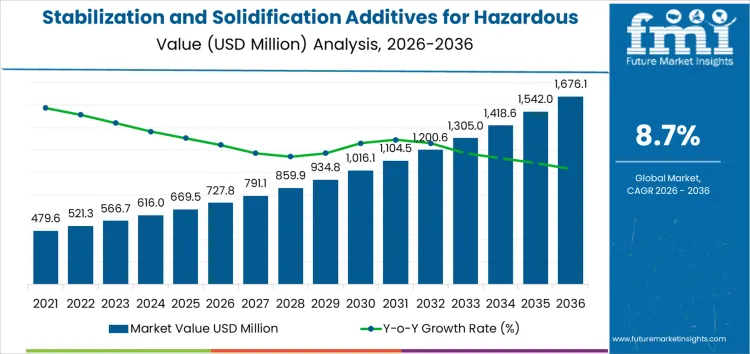
The stabilization and solidification additives for hazardous waste market is expected to grow from USD 727.8 million in 2026 to USD 1,676.1 million by 2036, reflecting a compound annual growth rate (CAGR) of 8.7%. This industry plays a critical role in the management of hazardous waste, ensuring compliance with stringent environmental regulations while offering cost-effective, long-term solutions. As industries face heightened scrutiny over waste disposal practices, the demand for additives that enhance the stability and containment of toxic materials is growing. These additives are integral to minimizing environmental risks and liability, especially in sectors like chemical manufacturing, mining, and energy. The space is increasingly competitive, driven by a mix of established chemical companies and emerging innovators. Stakeholders in this market are focused on offering reliable, scalable solutions that balance regulatory compliance with operational efficiency. With growing regulatory pressure and environmental accountability, this segment is positioned as a key player in the global waste management ecosystem.
Quick Stats of the Stabilization and Solidification Additives for Hazardous Waste Market
- Stabilization and Solidification Additives for Hazardous Waste Market Value (2026): USD 727.8 million
- Stabilization and Solidification Additives for Hazardous Waste Market Forecast Value (2036): USD 1,676.1 million
- Stabilization and Solidification Additives for Hazardous Waste Market Global Forecast CAGR (2026-2036): 8.7%
- Stabilization and Solidification Additives for Hazardous Waste Market Leading Segment: Additive Type (Cementitious Additives – Cement, Fly Ash, Slag) 36%
- Key Growth Regions in Stabilization and Solidification Additives for Hazardous Waste Market: China
- Top Players in Stabilization and Solidification Additives for Hazardous Waste Market: Clean Harbors, Veolia Environmental Services, Remondis Group, SUEZ (Veolia), US Ecology (Republic Services)
What is the Growth Forecast for the Stabilization and Solidification Additives for Hazardous Waste Market through 2036?
The absolute dollar opportunity for the stabilization and solidification additives for hazardous waste market shows consistent growth, with significant gains expected over the next decade. Starting at USD 727.8 million in 2026, the market will increase by approximately USD 64.3 million in 2027, reaching USD 792.1 million. This upward trend will continue, with USD 71.6 million growth expected in 2028, bringing the market to USD 863.7 million.
From 2029 to 2036, the market will experience steady increases in absolute dollar value. By 2030, the market will grow by USD 88.7 million, reaching USD 1,031.6 million, and in 2031, it will increase by USD 99.7 million to USD 1,131.3 million. The market will continue expanding with a similar pace, adding USD 112.1 million in 2032, USD 126.2 million in 2033, and USD 144 million in 2034. The total absolute dollar opportunity from 2026 to 2036, driven by sustained growth, is expected to contribute over USD 950 million in additional market value.
Stabilization and Solidification Additives for Hazardous Waste Market Key Takeaways
| Metric | Value |
|---|---|
| Industry Sales Value (2026) | USD 727.8 million |
| Industry Forecast Value (2036) | USD 1,676.1 million |
| Industry Forecast CAGR (2026-2036) | 8.7% |
What Is Driving the Demand for Stabilization and Solidification Additives for Hazardous Waste Market Globally?
The global demand for stabilization and solidification (S/S) additives for hazardous waste is being driven by stringent environmental regulations, rising industrial waste generation, and the need to manage contaminants in soils, sludges, and process residues safely. S/S additives—such as cementitious binders, pozzolanic materials, and specialised reagents—are used to immobilise hazardous constituents, reduce leachability, and convert waste into a stable matrix suitable for disposal or beneficial reuse. Regulatory frameworks in Europe, North America, and Asia increasingly require demonstrable control of heavy metals, persistent organic pollutants, and other contaminants to protect groundwater and ecosystems, prompting site owners and waste managers to adopt robust S/S solutions. Growth in sectors such as petrochemicals, mining, metal finishing, and power generation contributes to higher volumes of hazardous wastes requiring compliant treatment.
Meanwhile, stricter landfill acceptance criteria and lifecycle waste management policies encourage technologies that improve long term containment and reduce environmental liability. Industry emphasis on risk mitigation, public health protection, and sustainable remediation strategies further reinforces uptake of S/S additives that can deliver predictable performance when integrated with engineered waste management systems.
Future demand for stabilization and solidification additives is expected to grow as sustainability goals, technical expectations, and enforcement actions continue to shape hazardous waste practices worldwide. Advances in additive formulations—such as enhanced pozzolans, polymer modified binders, and reactive mineral blends—are improving contaminant encapsulation, mechanical strength, and durability under varied environmental conditions, broadening application to complex waste streams. Increased adoption of performance based specifications and long term monitoring criteria will reinforce demand for additives that can demonstrate reduced leaching over extended periods and support risk informed closure strategies.
Expansion of brownfield redevelopment and infrastructure renewal projects will bring legacy contamination into focus, driving demand for S/S technologies that minimise excavation and onsite disturbance. Integration of digital monitoring tools and predictive modelling in waste treatment planning will help operators optimise additive selection and dosing, improving cost effectiveness and compliance outcomes. As global industrialisation persists and waste volumes rise, the need for reliable, compliant hazardous waste stabilisation and solidification solutions is anticipated to expand, supported by evolving regulation, technological innovation, and growing emphasis on environmental stewardship.
What are the Leading Segments in the Global Stabilization and Solidification Additives for Hazardous Waste Market?
The global stabilization and solidification additives for hazardous waste market is segmented by additive type and waste type. Among additive types, cementitious additives (cement, fly ash, slag) lead the market, capturing 36% of the share, followed by pozzolanic & mineral additives, polymer-based solidification agents, sulfur-based & reactive additives, and other specialty stabilizers & immobilizers. Cementitious additives are preferred for their ability to provide durable and stable matrices for immobilizing hazardous waste. On the waste type side, heavy metal-contaminated waste dominates the market, holding 34% of the share, followed by industrial chemical sludge & solids, oil & petrochemical waste, radioactive & nuclear waste, and other hazardous mixed waste. The management of heavy metal-contaminated waste is a key focus, given the widespread environmental and health risks posed by such contaminants.
What Drives the Growth of Cementitious Additives (Cement, Fly Ash, Slag) in the Stabilization and Solidification Additives Market?
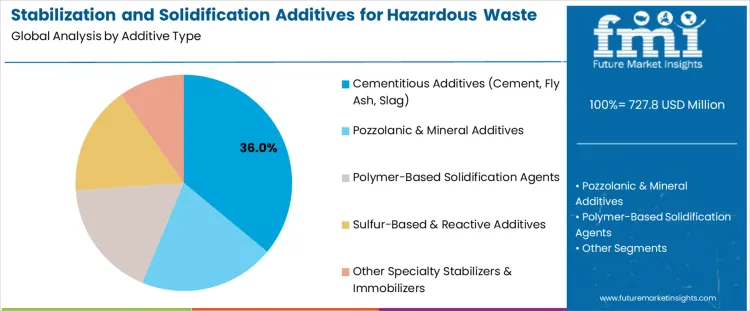
Cementitious additives, including cement, fly ash, and slag, are the leading additive type in the stabilization and solidification additives for hazardous waste market, capturing 36% of the share. These additives are highly valued for their ability to stabilize and solidify hazardous waste, particularly in the context of heavy metal and chemical contamination. Cementitious materials work by creating stable matrices that physically encapsulate waste materials, preventing the leaching of hazardous substances into the environment.
The use of fly ash and slag, which are byproducts of industrial processes, also makes cementitious additives a more sustainable and cost-effective option. As industrial waste management practices evolve to address stricter environmental regulations and sustainability concerns, the demand for cementitious additives has risen, particularly for heavy metal-contaminated waste. The growing focus on long-term environmental protection and the need to manage large volumes of hazardous waste in an effective and permanent manner are expected to drive continued growth in the use of cementitious additives, making them a dominant solution in the market.
What is Driving the Demand for Heavy Metal-Contaminated Waste in the Stabilization and Solidification Additives Market?
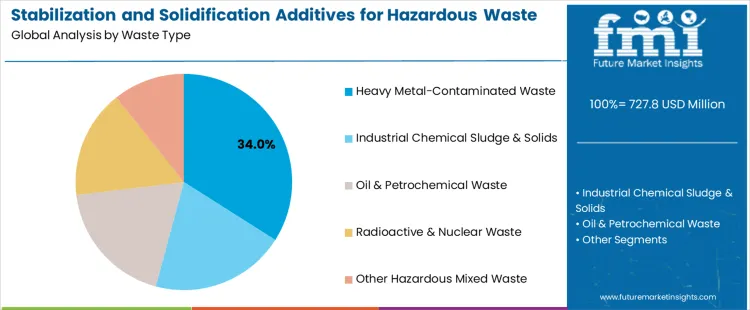
Heavy metal-contaminated waste is the leading waste type in the stabilization and solidification additives for hazardous waste market, holding 34% of the share. This demand is primarily driven by the widespread presence of heavy metals such as lead, mercury, cadmium, and arsenic in industrial waste, particularly in sectors like mining, manufacturing, and electronics. Heavy metals are toxic to humans and the environment, making their proper disposal a critical concern for regulatory bodies and industries worldwide. Stabilization and solidification additives are essential in immobilizing heavy metals, preventing their migration into groundwater and surrounding environments.
The increasing stringency of environmental regulations, coupled with the growing awareness of the dangers posed by heavy metal contamination, is driving the demand for effective waste treatment solutions. Cementitious additives, polymer-based agents, and pozzolanic materials are commonly used to stabilize heavy metal-contaminated waste, ensuring that it can be safely disposed of or stored. As industries and governments seek safer, more sustainable methods of managing hazardous waste, the demand for stabilization and solidification additives for heavy metal-contaminated waste will continue to grow, solidifying this segment as a dominant force in the market.
What are the Key Dynamics in the Global Stabilization and Solidification Additives for Hazardous Waste Market?
The global stabilization and solidification (S/S) additives for hazardous waste market is expanding as industries and environmental agencies adopt robust technologies to treat contaminated soils, sludges, sediments and industrial byproducts. S/S additives chemically and physically bind hazardous constituents-such as heavy metals and organic pollutants-into stable matrices that reduce leachability and environmental risk. Growth is influenced by rising regulatory enforcement of waste management standards, increased brownfield remediation activity, and focus on sustainable waste treatment solutions that support long term containment and land reuse. Adoption occurs across industrial, construction, mining and municipal sectors where safe disposal and compliance are critical.
What are the Key Drivers for the Stabilization and Solidification Additives for Hazardous Waste Market?
Stringent environmental regulations that mandate reduction of contaminant mobility and protection of groundwater and ecosystems are major drivers. Agencies worldwide require treated hazardous waste to meet defined leachate criteria before landfilling or reuse, pushing facilities to implement effective S/S technologies. Growth in infrastructure development, industrial expansion and legacy contamination sites increases hazardous waste volumes that require reliable treatment. Advances in additive chemistries-such as tailored cementitious binders, pozzolanic materials and supplemental reagents-enhance performance and support cost efficient remediation. Corporate sustainability commitments and ESG (environmental, social and governance) priorities also motivate investment in proven additive systems that reduce long term environmental liability.
What are the Restraints for the Stabilization and Solidification Additives for Hazardous Waste Market?
One restraint is the technical challenge of optimizing S/S formulations for diverse waste streams, as effectiveness varies with waste chemistry, moisture content and contaminant type. Designing additives that achieve performance targets without excessive volume increase or reduced structural integrity can require significant testing and formulation expertise. Upfront costs for additive materials and pilot scale validation may deter adoption in budget constrained settings, especially where simple containment methods are perceived as adequate. Variation in regional regulatory frameworks and performance criteria complicates development of universally compliant products, requiring tailored solutions that increase development and compliance costs for suppliers.
What are the Key Trends in the Stabilization and Solidification Additives for Hazardous Waste Market?
A key trend is innovation in engineered additive systems that combine traditional cementitious binders with supplementary materials-such as industrial byproduct pozzolans, lightweight fillers and reactive polymers-to improve performance, reduce shrinkage and lower carbon footprint. Development of formulations that support lower additive dosage while meeting strict leaching standards enhances cost effectiveness. Integration of data driven design tools and predictive modeling helps optimise S/S systems based on waste characteristics, reducing trial and error and accelerating deployment. Growing interest in recovering and reusing treated waste as construction material or engineered fill supports circular economy objectives. Collaboration among additive suppliers, remediation firms and regulators is fostering standardised testing and better demonstration of long term performance for complex hazardous waste applications.
What is the Country-Wise Analysis of the Stabilization and Solidification Additives for Hazardous Waste Market?
The stabilization and solidification additives for hazardous waste market is expected to grow steadily, driven by the increasing demand for safe and efficient methods to treat and dispose of hazardous waste. These additives are used to immobilize or stabilize hazardous materials, preventing the release of toxic substances into the environment and ensuring compliance with environmental regulations. High-growth markets like China and India are seeing strong demand due to rapid industrialization, urbanization, and growing awareness about environmental pollution and waste management. Developed markets such as the United States, Germany, and Canada are also experiencing steady growth, supported by stricter environmental regulations, a focus on sustainability, and increasing investments in waste management infrastructure.
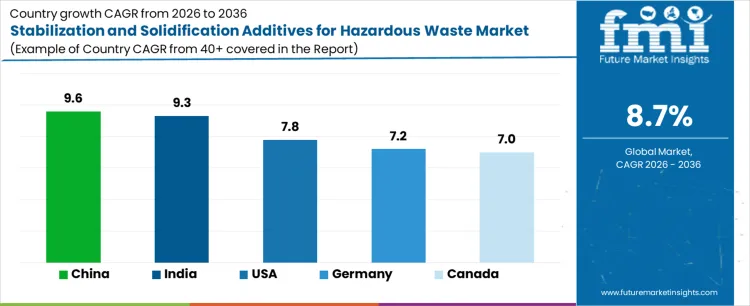
| Country | CAGR (%) |
|---|---|
| China | 9.6 |
| India | 9.3 |
| United States | 7.8 |
| Germany | 7.2 |
| Canada | 7 |
What is the Growth Outlook on the Stabilization and Solidification Additives for Hazardous Waste Market in China?
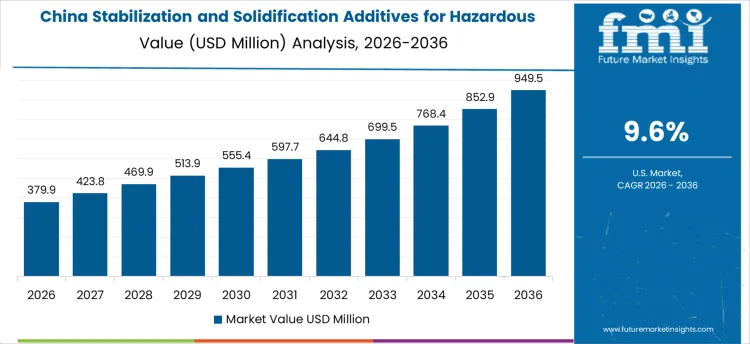
The stabilization and solidification additives for hazardous waste market in China is expected to grow at the highest rate, with a projected CAGR of 9.6%. China’s rapid industrialization, expanding manufacturing base, and large-scale construction projects are contributing to significant hazardous waste generation, creating a strong demand for effective waste treatment solutions. As China continues to focus on improving environmental protection, stricter regulations on waste management and disposal are driving the adoption of stabilization and solidification additives. With increasing government investments in sustainable waste management technologies and growing awareness of environmental issues, the market for these additives is expected to grow steadily. China’s strong commitment to reducing pollution and improving waste management infrastructure will continue to support the market’s growth in the coming years.
What is the Market Outlook on the Stabilization and Solidification Additives for Hazardous Waste Market in India?
The stabilization and solidification additives for hazardous waste market in India is projected to grow steadily, with a projected CAGR of 9.3%. India’s growing industrial base, coupled with challenges related to waste management, is driving demand for effective hazardous waste treatment solutions. As the country faces increasing pressure to manage industrial, agricultural, and urban waste more sustainably, there is a rising need for additives that help stabilize and solidify hazardous materials. The Indian government’s initiatives to improve waste management practices and enforce stricter environmental regulations are expected to further support market growth. With an increasing focus on sustainability and reducing environmental pollution, India is set to see strong demand for these additives in waste disposal and treatment processes.
What is the Growth Forecast for the Stabilization and Solidification Additives for Hazardous Waste Market in the United States?
The stabilization and solidification additives for hazardous waste market in the United States is expected to grow steadily, with a projected CAGR of 7.8%. In the U.S., stricter environmental regulations, increased awareness about hazardous waste management, and the need for more efficient and safe disposal methods are driving the market for stabilization and solidification additives. The U.S. Environmental Protection Agency (EPA) continues to promote the use of environmentally friendly waste treatment technologies, which is encouraging the adoption of these additives in various industries. The rising demand for hazardous waste disposal solutions in sectors such as manufacturing, mining, and construction, as well as the increasing focus on sustainable waste management, is expected to drive continued market growth.
What is the Market Outlook on the Stabilization and Solidification Additives for Hazardous Waste Market in Germany?
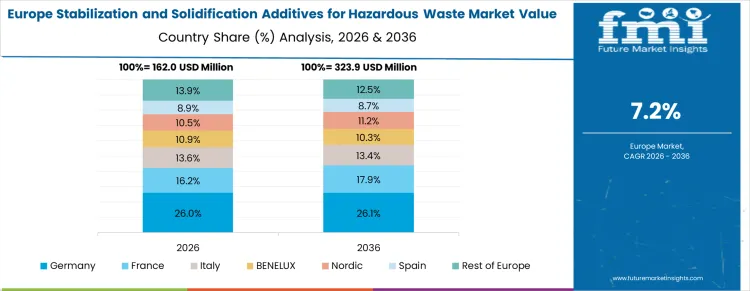
The stabilization and solidification additives for hazardous waste market in Germany is projected to grow at a steady pace, with a projected CAGR of 7.2%. Germany, known for its strict environmental regulations and commitment to sustainability, is driving the adoption of safer and more effective hazardous waste treatment technologies. The German government’s initiatives to reduce industrial waste and improve environmental standards are contributing to the growing demand for stabilization and solidification additives. With increasing awareness of the need to manage hazardous waste more efficiently and sustainably, the market for these additives is expected to continue expanding. Germany’s robust waste management infrastructure and increasing investment in green technologies will support the market’s steady growth.
What are the Growth Prospects for the Stabilization and Solidification Additives for Hazardous Waste Market in Canada?
The stabilization and solidification additives for hazardous waste market in Canada is expected to grow steadily, with a projected CAGR of 7%. Canada’s commitment to environmental protection, coupled with its growing industrial and agricultural sectors, is driving demand for advanced waste management solutions. With increasing environmental regulations and a focus on sustainable industrial practices, the adoption of stabilization and solidification additives is becoming more widespread in Canada. The country’s government policies supporting cleaner waste treatment technologies and improving waste management infrastructure are expected to further drive market growth. Additionally, as Canadian industries continue to adopt more sustainable waste disposal practices, the demand for these additives in hazardous waste management will continue to rise steadily.
What is the Competitive Landscape for the Stabilization and Solidification Additives for Hazardous Waste Market?
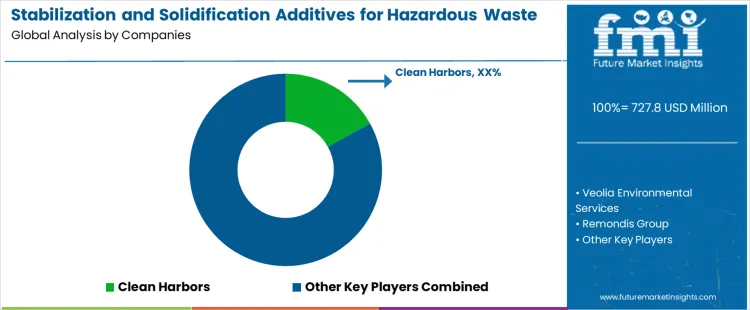
The stabilization and solidification additives for hazardous waste market is growing as industries and governments seek effective solutions for the safe management of hazardous waste. Clean Harbors leads the market with its advanced stabilization and solidification additives, offering high-performance solutions that ensure the safe treatment of hazardous materials, preventing contamination and environmental harm. Their focus on regulatory compliance, safety, and product efficacy has positioned them as a dominant player in the market. Veolia Environmental Services, Remondis Group, and SUEZ (Veolia) are key competitors, each offering specialized additives designed to stabilize and solidify hazardous waste for safe disposal. Veolia Environmental Services provides a wide range of waste management and treatment solutions, while Remondis Group focuses on environmentally responsible technologies. SUEZ (Veolia) emphasizes sustainability in its waste management products, including stabilization additives.
US Ecology (Republic Services) further strengthens the competitive landscape by offering specialized stabilization and solidification solutions designed to treat hazardous waste efficiently. US Ecology provides a range of products aimed at improving waste safety and reducing environmental impact. These companies compete by focusing on product innovation, regulatory compliance, and the ability to meet the growing need for sustainable, safe hazardous waste treatment solutions. The market is expected to continue growing as industries increase efforts to manage hazardous materials safely and in compliance with environmental regulations.
Key Players of the Stabilization and Solidification Additives for Hazardous Waste Market
- Clean Harbors
- Veolia Environmental Services
- Remondis Group
- SUEZ (Veolia)
- US Ecology (Republic Services)
Scope of the Report
| Items | Values |
|---|---|
| Quantitative Units (2025) | USD Million |
| Additive Type | Cementitious Additives (Cement, Fly Ash, Slag), Pozzolanic & Mineral Additives, Polymer-Based Solidification Agents, Sulfur-Based & Reactive Additives, Other Specialty Stabilizers & Immobilizers |
| Waste Type | Heavy Metal-Contaminated Waste, Industrial Chemical Sludge & Solids, Oil & Petrochemical Waste, Radioactive & Nuclear Waste, Other Hazardous Mixed Waste |
| End-Use Sector | Environmental Remediation & Waste Management Firms, Industrial Manufacturing & Chemical Plants, Oil, Gas & Petrochemical Sites, Government & Municipal Waste Handlers, Mining & Metallurgical Waste Treatment |
| Companies | Clean Harbors, Veolia Environmental Services, Remondis Group, SUEZ (Veolia), US Ecology (Republic Services) |
| Regions Covered | North America, Latin America, Western Europe, Eastern Europe, South Asia and Pacific, East Asia, Middle East & Africa |
| Countries Covered | United States, Canada, Mexico, Brazil, Argentina, Germany, France, United Kingdom, Italy, Spain, Netherlands, China, India, Japan, South Korea, ANZ, GCC Countries, South Africa |
| Additional Attributes | Dollar by sales by additive type, waste type, end-use sector, and region. Includes market trends in stabilization and solidification additives for hazardous waste, performance in various waste types, cost-effectiveness, sustainability practices, regulatory compliance, market share and competitive positioning of key companies, and the role of additives in enhancing waste treatment, improving solidification, and supporting the safe disposal of hazardous materials in environmental and industrial sectors. |
Stabilization and Solidification Additives for Hazardous Waste Market Segmentation
Additive Type:
- Cementitious Additives (Cement, Fly Ash, Slag)
- Pozzolanic & Mineral Additives
- Polymer-Based Solidification Agents
- Sulfur-Based & Reactive Additives
- Other Specialty Stabilizers & Immobilizers
Waste Type:
- Heavy Metal-Contaminated Waste
- Industrial Chemical Sludge & Solids
- Oil & Petrochemical Waste
- Radioactive & Nuclear Waste
- Other Hazardous Mixed Waste
End-Use Sector:
- Environmental Remediation & Waste Management Firms
- Industrial Manufacturing & Chemical Plants
- Oil, Gas & Petrochemical Sites
- Government & Municipal Waste Handlers
- Mining & Metallurgical Waste Treatment
Region:
- Asia Pacific
- China
- Japan
- South Korea
- India
- Australia & New Zealand
- ASEAN
- Rest of Asia Pacific
- Europe
- Germany
- United Kingdom
- France
- Italy
- Spain
- Nordic
- BENELUX
- Rest of Europe
- North America
- United States
- Canada
- Mexico
- Latin America
- Brazil
- Chile
- Rest of Latin America
- Middle East & Africa
- Kingdom of Saudi Arabia
- Other GCC Countries
- Turkey
- South Africa
- Other African Union
- Rest of Middle East & Africa
Frequently Asked Questions
How big is the stabilization and solidification additives for hazardous waste market in 2026?
The global stabilization and solidification additives for hazardous waste market is estimated to be valued at USD 727.8 million in 2026.
What will be the size of stabilization and solidification additives for hazardous waste market in 2036?
The market size for the stabilization and solidification additives for hazardous waste market is projected to reach USD 1,676.1 million by 2036.
How much will be the stabilization and solidification additives for hazardous waste market growth between 2026 and 2036?
The stabilization and solidification additives for hazardous waste market is expected to grow at a 8.7% CAGR between 2026 and 2036.
What are the key product types in the stabilization and solidification additives for hazardous waste market?
The key product types in stabilization and solidification additives for hazardous waste market are cementitious additives (cement, fly ash, slag), pozzolanic & mineral additives, polymer-based solidification agents, sulfur-based & reactive additives and other specialty stabilizers & immobilizers.
Which waste type segment to contribute significant share in the stabilization and solidification additives for hazardous waste market in 2026?
In terms of waste type, heavy metal-contaminated waste segment to command 34.0% share in the stabilization and solidification additives for hazardous waste market in 2026.
Preview the report firsthand - request a free sample
Get SampleGet the brochure for pricing and purchase details.
Get PDFTable of Content
- Executive Summary
- Global Market Outlook
- Demand-side Trends
- Supply-side Trends
- Technology Roadmap Analysis
- Analysis and Recommendations
- Market Overview
- Market Coverage / Taxonomy
- Market Definition / Scope / Limitations
- Market Background
- Market Dynamics
- Drivers
- Restraints
- Opportunity
- Trends
- Scenario Forecast
- Demand in Optimistic Scenario
- Demand in Likely Scenario
- Demand in Conservative Scenario
- Opportunity Map Analysis
- Product Life Cycle Analysis
- Supply Chain Analysis
- Investment Feasibility Matrix
- Value Chain Analysis
- PESTLE and Porter’s Analysis
- Regulatory Landscape
- Regional Parent Market Outlook
- Production and Consumption Statistics
- Import and Export Statistics
- Market Dynamics
- Global Market Analysis 2021 to 2025 and Forecast, 2026 to 2036
- Historical Market Size Value (USD Million) Analysis, 2021 to 2025
- Current and Future Market Size Value (USD Million) Projections, 2026 to 2036
- Y-o-Y Growth Trend Analysis
- Absolute $ Opportunity Analysis
- Global Market Pricing Analysis 2021 to 2025 and Forecast 2026 to 2036
- Global Market Analysis 2021 to 2025 and Forecast 2026 to 2036, By Additive Type
- Introduction / Key Findings
- Historical Market Size Value (USD Million) Analysis By Additive Type , 2021 to 2025
- Current and Future Market Size Value (USD Million) Analysis and Forecast By Additive Type , 2026 to 2036
- Cementitious Additives (Cement, Fly Ash, Slag)
- Pozzolanic & Mineral Additives
- Polymer-Based Solidification Agents
- Sulfur-Based & Reactive Additives
- Other Specialty Stabilizers & Immobilizers
- Cementitious Additives (Cement, Fly Ash, Slag)
- Y-o-Y Growth Trend Analysis By Additive Type , 2021 to 2025
- Absolute $ Opportunity Analysis By Additive Type , 2026 to 2036
- Global Market Analysis 2021 to 2025 and Forecast 2026 to 2036, By Waste Type
- Introduction / Key Findings
- Historical Market Size Value (USD Million) Analysis By Waste Type, 2021 to 2025
- Current and Future Market Size Value (USD Million) Analysis and Forecast By Waste Type, 2026 to 2036
- Heavy Metal-Contaminated Waste
- Industrial Chemical Sludge & Solids
- Oil & Petrochemical Waste
- Radioactive & Nuclear Waste
- Other Hazardous Mixed Waste
- Heavy Metal-Contaminated Waste
- Y-o-Y Growth Trend Analysis By Waste Type, 2021 to 2025
- Absolute $ Opportunity Analysis By Waste Type, 2026 to 2036
- Global Market Analysis 2021 to 2025 and Forecast 2026 to 2036, By End-Use Sector
- Introduction / Key Findings
- Historical Market Size Value (USD Million) Analysis By End-Use Sector, 2021 to 2025
- Current and Future Market Size Value (USD Million) Analysis and Forecast By End-Use Sector, 2026 to 2036
- Environmental Remediation & Waste Management Firms
- Industrial Manufacturing & Chemical Plants
- Oil, Gas & Petrochemical Sites
- Government & Municipal Waste Handlers
- Mining & Metallurgical Waste Treatment
- Environmental Remediation & Waste Management Firms
- Y-o-Y Growth Trend Analysis By End-Use Sector, 2021 to 2025
- Absolute $ Opportunity Analysis By End-Use Sector, 2026 to 2036
- Global Market Analysis 2021 to 2025 and Forecast 2026 to 2036, By Region
- Introduction
- Historical Market Size Value (USD Million) Analysis By Region, 2021 to 2025
- Current Market Size Value (USD Million) Analysis and Forecast By Region, 2026 to 2036
- North America
- Latin America
- Western Europe
- Eastern Europe
- East Asia
- South Asia and Pacific
- Middle East & Africa
- Market Attractiveness Analysis By Region
- North America Market Analysis 2021 to 2025 and Forecast 2026 to 2036, By Country
- Historical Market Size Value (USD Million) Trend Analysis By Market Taxonomy, 2021 to 2025
- Market Size Value (USD Million) Forecast By Market Taxonomy, 2026 to 2036
- By Country
- USA
- Canada
- Mexico
- By Additive Type
- By Waste Type
- By End-Use Sector
- By Country
- Market Attractiveness Analysis
- By Country
- By Additive Type
- By Waste Type
- By End-Use Sector
- Key Takeaways
- Latin America Market Analysis 2021 to 2025 and Forecast 2026 to 2036, By Country
- Historical Market Size Value (USD Million) Trend Analysis By Market Taxonomy, 2021 to 2025
- Market Size Value (USD Million) Forecast By Market Taxonomy, 2026 to 2036
- By Country
- Brazil
- Chile
- Rest of Latin America
- By Additive Type
- By Waste Type
- By End-Use Sector
- By Country
- Market Attractiveness Analysis
- By Country
- By Additive Type
- By Waste Type
- By End-Use Sector
- Key Takeaways
- Western Europe Market Analysis 2021 to 2025 and Forecast 2026 to 2036, By Country
- Historical Market Size Value (USD Million) Trend Analysis By Market Taxonomy, 2021 to 2025
- Market Size Value (USD Million) Forecast By Market Taxonomy, 2026 to 2036
- By Country
- Germany
- UK
- Italy
- Spain
- France
- Nordic
- BENELUX
- Rest of Western Europe
- By Additive Type
- By Waste Type
- By End-Use Sector
- By Country
- Market Attractiveness Analysis
- By Country
- By Additive Type
- By Waste Type
- By End-Use Sector
- Key Takeaways
- Eastern Europe Market Analysis 2021 to 2025 and Forecast 2026 to 2036, By Country
- Historical Market Size Value (USD Million) Trend Analysis By Market Taxonomy, 2021 to 2025
- Market Size Value (USD Million) Forecast By Market Taxonomy, 2026 to 2036
- By Country
- Russia
- Poland
- Hungary
- Balkan & Baltic
- Rest of Eastern Europe
- By Additive Type
- By Waste Type
- By End-Use Sector
- By Country
- Market Attractiveness Analysis
- By Country
- By Additive Type
- By Waste Type
- By End-Use Sector
- Key Takeaways
- East Asia Market Analysis 2021 to 2025 and Forecast 2026 to 2036, By Country
- Historical Market Size Value (USD Million) Trend Analysis By Market Taxonomy, 2021 to 2025
- Market Size Value (USD Million) Forecast By Market Taxonomy, 2026 to 2036
- By Country
- China
- Japan
- South Korea
- By Additive Type
- By Waste Type
- By End-Use Sector
- By Country
- Market Attractiveness Analysis
- By Country
- By Additive Type
- By Waste Type
- By End-Use Sector
- Key Takeaways
- South Asia and Pacific Market Analysis 2021 to 2025 and Forecast 2026 to 2036, By Country
- Historical Market Size Value (USD Million) Trend Analysis By Market Taxonomy, 2021 to 2025
- Market Size Value (USD Million) Forecast By Market Taxonomy, 2026 to 2036
- By Country
- India
- ASEAN
- Australia & New Zealand
- Rest of South Asia and Pacific
- By Additive Type
- By Waste Type
- By End-Use Sector
- By Country
- Market Attractiveness Analysis
- By Country
- By Additive Type
- By Waste Type
- By End-Use Sector
- Key Takeaways
- Middle East & Africa Market Analysis 2021 to 2025 and Forecast 2026 to 2036, By Country
- Historical Market Size Value (USD Million) Trend Analysis By Market Taxonomy, 2021 to 2025
- Market Size Value (USD Million) Forecast By Market Taxonomy, 2026 to 2036
- By Country
- Kingdom of Saudi Arabia
- Other GCC Countries
- Turkiye
- South Africa
- Other African Union
- Rest of Middle East & Africa
- By Additive Type
- By Waste Type
- By End-Use Sector
- By Country
- Market Attractiveness Analysis
- By Country
- By Additive Type
- By Waste Type
- By End-Use Sector
- Key Takeaways
- Key Countries Market Analysis
- USA
- Pricing Analysis
- Market Share Analysis, 2025
- By Additive Type
- By Waste Type
- By End-Use Sector
- Canada
- Pricing Analysis
- Market Share Analysis, 2025
- By Additive Type
- By Waste Type
- By End-Use Sector
- Mexico
- Pricing Analysis
- Market Share Analysis, 2025
- By Additive Type
- By Waste Type
- By End-Use Sector
- Brazil
- Pricing Analysis
- Market Share Analysis, 2025
- By Additive Type
- By Waste Type
- By End-Use Sector
- Chile
- Pricing Analysis
- Market Share Analysis, 2025
- By Additive Type
- By Waste Type
- By End-Use Sector
- Germany
- Pricing Analysis
- Market Share Analysis, 2025
- By Additive Type
- By Waste Type
- By End-Use Sector
- UK
- Pricing Analysis
- Market Share Analysis, 2025
- By Additive Type
- By Waste Type
- By End-Use Sector
- Italy
- Pricing Analysis
- Market Share Analysis, 2025
- By Additive Type
- By Waste Type
- By End-Use Sector
- Spain
- Pricing Analysis
- Market Share Analysis, 2025
- By Additive Type
- By Waste Type
- By End-Use Sector
- France
- Pricing Analysis
- Market Share Analysis, 2025
- By Additive Type
- By Waste Type
- By End-Use Sector
- India
- Pricing Analysis
- Market Share Analysis, 2025
- By Additive Type
- By Waste Type
- By End-Use Sector
- ASEAN
- Pricing Analysis
- Market Share Analysis, 2025
- By Additive Type
- By Waste Type
- By End-Use Sector
- Australia & New Zealand
- Pricing Analysis
- Market Share Analysis, 2025
- By Additive Type
- By Waste Type
- By End-Use Sector
- China
- Pricing Analysis
- Market Share Analysis, 2025
- By Additive Type
- By Waste Type
- By End-Use Sector
- Japan
- Pricing Analysis
- Market Share Analysis, 2025
- By Additive Type
- By Waste Type
- By End-Use Sector
- South Korea
- Pricing Analysis
- Market Share Analysis, 2025
- By Additive Type
- By Waste Type
- By End-Use Sector
- Russia
- Pricing Analysis
- Market Share Analysis, 2025
- By Additive Type
- By Waste Type
- By End-Use Sector
- Poland
- Pricing Analysis
- Market Share Analysis, 2025
- By Additive Type
- By Waste Type
- By End-Use Sector
- Hungary
- Pricing Analysis
- Market Share Analysis, 2025
- By Additive Type
- By Waste Type
- By End-Use Sector
- Kingdom of Saudi Arabia
- Pricing Analysis
- Market Share Analysis, 2025
- By Additive Type
- By Waste Type
- By End-Use Sector
- Turkiye
- Pricing Analysis
- Market Share Analysis, 2025
- By Additive Type
- By Waste Type
- By End-Use Sector
- South Africa
- Pricing Analysis
- Market Share Analysis, 2025
- By Additive Type
- By Waste Type
- By End-Use Sector
- USA
- Market Structure Analysis
- Competition Dashboard
- Competition Benchmarking
- Market Share Analysis of Top Players
- By Regional
- By Additive Type
- By Waste Type
- By End-Use Sector
- Competition Analysis
- Competition Deep Dive
- Clean Harbors
- Overview
- Product Portfolio
- Profitability by Market Segments (Product/Age /Sales Channel/Region)
- Sales Footprint
- Strategy Overview
- Marketing Strategy
- Product Strategy
- Channel Strategy
- Veolia Environmental Services
- Remondis Group
- SUEZ (Veolia)
- US Ecology (Republic Services)
- Clean Harbors
- Competition Deep Dive
- Assumptions & Acronyms Used
- Research Methodology


