

- Industry Size (2026)
- USD 658.54 Mn
- Forecast (2036)
- USD 984.21 Mn
- CAGR (2026 to 2036)
- 4.10%
Demand for Friction Modifier Additives in USA Size, Market Forecast and Outlook By FMI
The demand for friction modifier additives in USA was valued at USD 632.60 million in 2025, projected to reach USD 658.54 million in 2026, and is forecast to expand to USD 984.21 million by 2036 at a 4.10% CAGR. Automotive lubricant reformulation driven by ILSAC GF-7 fuel economy standard adoption and the growing fleet of electric vehicles requiring specialized drivetrain lubricants are sustaining friction modifier additive demand across the USA lubricant blending industry. Organic friction modifier chemistries based on glycerol mono-oleate and fatty acid amine compounds are gaining share over traditional molybdenum-based inorganic alternatives in automotive applications where catalytic converter compatibility and lower treatment rates offer formulation cost advantages.
The absolute dollar opportunity of approximately USD 325.67 million over the forecast period reflects measured consumption growth driven by automotive lubricant specification upgrades and industrial machinery energy efficiency optimization programmes. EV drivetrain fluid formulations requiring friction modifier additives tailored to copper and aluminum bearing surface compatibility are creating a new high-value application category. Rail friction modifier consumption remains steady across Class I railroad networks where wheel-rail interface lubrication programmes reduce fuel consumption by 10% to 15% per train-mile on curved track sections.
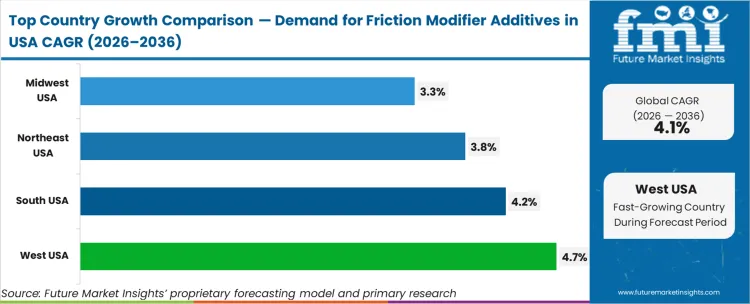
West USA sets the pace at a 4.7% CAGR, driven by the highest EV penetration generating specialized drivetrain lubricant demand and refinery lubricant blending plant concentration. South USA follows at 4.2% supported by petroleum refinery lubricant blending capacity and Gulf Coast chemical manufacturing infrastructure. Northeast USA registers 3.8% driven by industrial lubricant demand and rail network friction modifier consumption. Midwest USA maintains 3.3% supported by automotive OEM factory fill lubricant blending and Class I railroad operations.
Summary of Demand for Friction Modifier Additives in USA
- Demand for Friction Modifier Additives in USA Definition
- Friction modifier additives in USA are specialty chemicals reducing boundary friction in lubricants, comprising organic (fatty acid, GMO) and inorganic (MoS2, graphite) compounds for automotive, industrial, rail, aviation, and power generation applications.
- Demand Drivers in the Market
- ILSAC GF-7 fuel economy standard adoption drives automotive engine oil reformulation requiring upgraded organic friction modifier chemistries that deliver lower boundary friction coefficients at reduced viscosity grades.
- EV drivetrain fluid formulations requiring friction modifiers compatible with copper and aluminum bearing surfaces create a new high-value application category with distinct chemical performance requirements.
- Class I railroad wheel-rail lubrication programmes generating 10% to 15% fuel consumption reduction per train-mile on curved track sustain steady rail friction modifier procurement volumes.
- Key Segments Analyzed in the FMI Report
- Organic by Product Type: 51.0% share in 2026, as organic friction modifiers deliver catalytic converter compatibility and lower treatment rates that offer formulation cost advantages in passenger vehicle engine oil applications.
- Automobile Lubricants by Application: 50.0% share in 2026, reflecting the dominant consumption volume from engine oil, transmission fluid, and drivetrain lubricant blending that constitutes the largest additive procurement category.
- West USA: 4.7% compound growth driven by highest EV penetration generating specialized drivetrain lubricant demand and lubricant blending plant concentration.
- Analyst Opinion at FMI
- Nikhil Kaitwade, Principal Analyst at FMI, Automotive, Chemicals, Industrial Equipment, Oil & Gas, and Service industries., notes thatmarket is experiencing a formulation complexity upgrade cycle where simultaneous ILSAC specification tightening and EV drivetrain lubricant development create parallel demand channels with distinct additive chemistry requirements. Manufacturers who develop friction modifiers optimized for EV-specific bearing and gear surface materials capture the premium pricing tier in a segment that will grow proportionally with the USA electric vehicle fleet. The critical technology risk centers on GF-7 compliance testing timelines, as additive manufacturers must complete engine sequence testing before lubricant blenders can reformulate, creating multi-year development lead times that favour early-stage investment commitment.
- Strategic Implications / Executive Takeaways
- Friction modifier manufacturers must invest in EV drivetrain-specific additive chemistries optimized for copper and aluminum surface compatibility to capture the fastest-growing application segment.
- Lubricant blenders must initiate GF-7 reformulation programmes with pre-qualified friction modifier additives to ensure timely product launch when ILSAC specification effective dates take effect.
- Railroad operations must evaluate next-generation curve lubricant friction modifier formulations with extended re-application intervals to reduce per-mile maintenance costs on high-tonnage corridors.
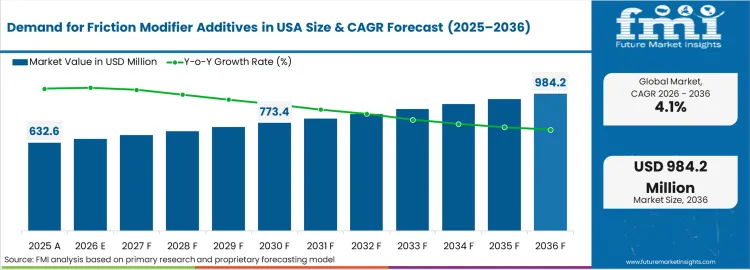
Demand for Friction Modifier Additives in USA Key Takeaways
| Metric | Details |
|---|---|
| Industry Size (2026) | USD 658.54 Million |
| Industry Value (2036) | USD 984.21 Million |
| CAGR (2026-2036) | 4.10% |
Source: Future Market Insights, 2026
Demand for Friction Modifier Additives in USA Definition
Friction modifier additives for the USA. market are specialty chemical compounds blended into lubricant formulations to reduce boundary friction between contacting metal surfaces in automotive, industrial, rail, aviation, and power generation applications. These additives include organic compounds (glycerol mono-oleate, fatty acid amines, phosphorus derivatives) and inorganic compounds (molybdenum dithiocarbamate, graphite, boron nitride) that form low-shear surface films reducing wear, energy consumption, and noise generation.
Demand for Friction Modifier Additives in USA Inclusions
Market scope includes organic friction modifier additives, inorganic friction modifier compounds, multi-functional friction modifier packages, and EV-specific drivetrain friction modifiers. Coverage spans automobile engine oil, transmission fluid, industrial gear oil, rail curve lubricant, aviation turbine oil, and power generation equipment lubricant applications.
Demand for Friction Modifier Additives in USA Exclusions
Base oil stocks, viscosity modifiers, detergent-dispersant additives, anti-wear packages, and pour point depressants without friction modification functionality are excluded. Finished blended lubricant products fall outside analytical parameters.
Demand for Friction Modifier Additives in USA Research Methodology
- Primary Research: Analysts engaged with lubricant blending plant formulators, automotive OEM powertrain lubrication engineers, and friction modifier additive manufacturer application scientists to map the specification and reformulation triggers driving additive procurement.
- Desk Research: Data collection phases aggregated ILSAC lubricant standard revision timelines, EV fleet growth projections, and Class I railroad fuel efficiency programme lubrication data.
- Market-Sizing and Forecasting: Baseline values derive from a bottom-up aggregation of friction modifier additive tonnage consumption multiplied by average per-kilogram prices across product type and application categories, applying USA.-specific automotive reformulation and EV adoption curves.
- Data Validation and Update Cycle: Projections are tested against publicly reported lubricant additive segment revenues from leading specialty chemical companies serving the USA market.
Why is the Demand for Friction Modifier Additives in the USA Growing?
Demand for friction modifier additives in the USA is increasing because automotive manufacturers and lubricant producers seek improved fuel efficiency and lower emissions in vehicles. Friction modifiers reduce internal friction between engine or transmission components, which helps engines run more smoothly and consume less fuel in both new and existing vehicles. Growth in vehicle miles traveled and rising demand for high performance and long life lubricants supports widespread adoption of these additives. Many passenger cars, commercial trucks and heavy-duty fleets benefit from fuel savings and extended maintenance intervals when friction modifiers are used.
Industrial applications also contribute to demand. Machinery with sliding metal interfaces such as compressors, gearboxes and hydraulic systems rely on additive-enhanced lubricants to reduce wear and energy loss. Maintaining efficient operation in manufacturing plants and heavy equipment fleets supports consistent consumption. Constraints include regulatory scrutiny of chemical additives related to environmental and emission standards. Additive formulations must comply with evolving regulations governing engine emissions and lubricant disposal. Some users may delay using additive-enhanced lubricants due to cost sensitivity or uncertainty about real-world performance benefits under varying operating conditions.
Which Product Types and Applications Lead Demand for Friction Modifier Additives in the United States?
Demand for friction modifier additives in the United States supports improved engine efficiency, reduced wear, and enhanced fuel performance across transportation and industrial assets. Automotive lubricants remain essential due to extensive vehicle use and adherence to emissions rules. Blending companies emphasize durability across temperature extremes, heavy-load operation, and high-speed mobility. Formulation trends focus on extended drain intervals, cleaner operation of engine internals, and reduced noise in gear systems. Adoption continues across commercial fleets, rail operations, aviation activities, and large power stations requiring reliable lubrication performance.
By Product Type, Organic Friction Modifiers Hold the Leading Share
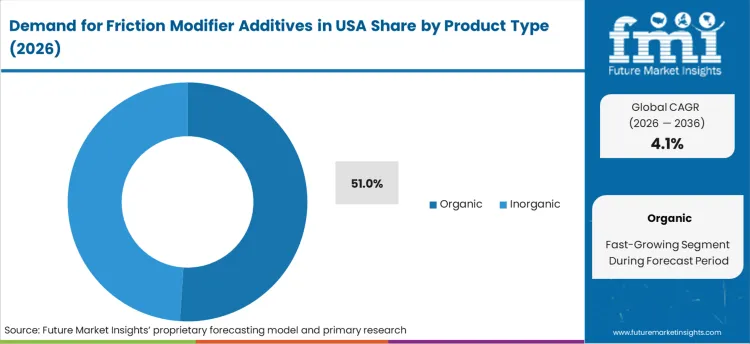
Organic friction modifiers represent 51.0%, driven by compatibility with synthetic oils and growing use in modern engines across gasoline and diesel segments. These compounds support smoother component interaction during frequent cold starts and stop-and-go traffic conditions common in USA cities. Reduced sulfur and phosphorus contents help maintain catalytic converter integrity. Inorganic modifiers account for 49.0%, applied where high thermal stability and mechanical resistance remain priorities. These include molybdenum compounds and metal oxides used in heavy machinery, fleet trucks, and diesel locomotives. Formulations reflect balancing fuel efficiency, long-term wear control, and environmental compliance across diverse lubricant grades in the United States.
Key Points:
- Organics support efficiency and compatibility with advanced engine oils
- Inorganics provide heat-resistant lubrication in demanding conditions
- Adoption aligns with engine protection and emissions rule adherence
By Application, Automobile Lubricants Dominate Use
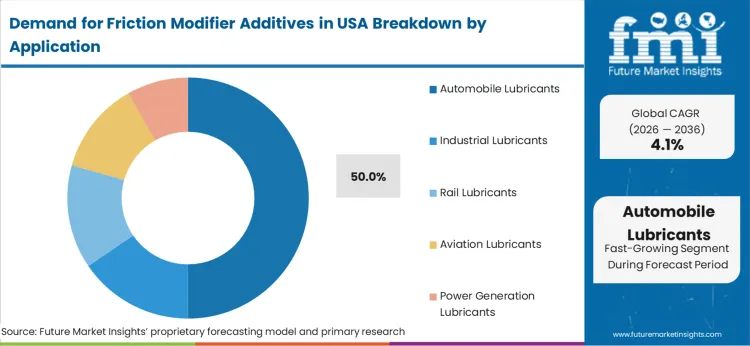
Automobile lubricants account for 50.0%, linked to high passenger car density, long commute patterns, and vehicle service frequency in the United States. Industrial lubricants hold 25.0% due to heavy machinery, manufacturing, and logistics facilities requiring endurance under continuous operation. Rail lubricant usage accounts for 10.0% where extended wheel-rail interaction requires wear reduction. Aviation lubricants represent 8.0%, maintaining performance in high-altitude pressure shifts. Power generation lubricants make up 7.0%, supporting turbines and rotating systems. Application selection reflects operational intensity, component heat exposure, and safety expectations across transportation and energy sectors.
Key Points:
- Automobiles remain the primary source of demand
- Industrial use grows with manufacturing and logistics operations
- Rail, aviation, and energy systems require long-life lubrication control
What are the Key Dynamics in the Friction Modifier Additives Industry?
Growth of commercial transportation needs, rising focus on fuel economy compliance and increased use of high-performance lubricants drive demand.
In the United States, freight movement and personal mobility create ongoing requirements for fuels and lubricants that support engine and drivetrain efficiency. Fleet operators adopt friction modifier additives in engine oils and transmission fluids to reduce mechanical wear and extend maintenance intervals. Fuel economy standards motivate automakers to specify lubricant formulations that help reduce internal energy losses. Construction and agricultural equipment rely on additives that maintain performance during heavy loads and continuous operation. Industrial users seek additives in metalworking fluids that lower friction during machining tasks. These applications maintain steady consumption across automotive, commercial and industrial sectors where equipment uptime and efficiency play important roles.
Variable raw material pricing, additive compatibility concerns and long qualification cycles restrain broader adoption.
Procurement managers evaluate input cost closely when crude oil or specialty chemical prices rise, creating hesitation in industries sensitive to operating expenses. Formulators must ensure that friction modifiers do not disrupt viscosity, oxidation stability or emission control components present in modern engines. Testing and certification require extended evaluation before approval in original equipment or warranty conditions, which slows product transition. Smaller workshops and cost-focused users choose conventional lubricants without premium additive packages, creating uneven demand across end markets. These constraints influence adoption momentum in sectors with strict budget controls.
Shift toward organic molybdenum chemistries, increased emphasis on low-ash and low-sulfur formulations and rising demand from electric powertrain components define key trends.
Suppliers advance organic friction modifiers that support smoother boundary lubrication in high-temperature and high-pressure conditions. Lubricant producers expand low-emission formulations suited for engines with modern aftertreatment systems. Gearboxes in electric vehicles create new demand for additives that control micro-pitting and noise during high-speed operation. Mining, aerospace and wind energy equipment prioritize additive packages that maintain durability while facing continuous stress. Digital monitoring tools track lubricant condition to optimize service intervals while reinforcing use of friction reduction technologies. These developments indicate continued demand for friction modifier additives across the United States supported by performance requirements, regulatory expectations and drivetrain evolution.
Analysis of the Demand for Friction Modifier Additives in the USA by Region
Demand for friction modifier additives in the United States continues to grow as automotive powertrain upgrades, fuel-efficiency targets, and industrial lubrication standards strengthen additive usage across commercial and consumer applications. Blending facilities adopt formulations compatible with low-viscosity engine oils and advanced transmission fluids. OEM service schedules and aftermarket lubricant replacements maintain steady consumption. West USA posts 4.7% CAGR, followed by South USA at 4.2%, Northeast USA at 3.8%, and Midwest USA at 3.3%. Additive selection criteria center on wear protection, thermal stability, and emission-control compatibility to support evolving drivetrain technologies.
.webp "Top Country Growth Comparison Demand For Friction Modifier Additives In Usa Cagr (2026 2036)")
| Region | CAGR (2025-2035) |
|---|---|
| West USA | 4.7% |
| South USA | 4.2% |
| Northeast USA | 3.8% |
| Midwest USA | 3.3% |
How is the West USA driving demand for friction modifier additives?
West USA records 4.7% CAGR, shaped by strong automotive aftermarket channels, high hybrid-vehicle penetration, and lubricant innovation across California and Washington. Consumers adopt engine oils with premium friction reduction to preserve fuel economy under heavy traffic and hilly driving routes. Low-viscosity lubricant standards accelerate integration of molybdenum-based and organic-friction-modifier chemistries. Industrial equipment in logistics and renewable-energy operations require additives that sustain efficiency under high-load conditions. Regional blending sites align product ranges with regulatory compliance mandates. Procurement priorities include additive compatibility with catalytic after-treatment systems and extended oil-life goals observed in long-drain service intervals.
- Hybrid-powertrain USAge influencing additive innovation
- Aftermarket retailers supporting retail lubricant upgrades
- Load-heavy applications guiding additive-quality selection
- Compliance requirements shaping formulation decisions
How is the South USA shaping demand?
South USA grows at 4.2% CAGR, supported by high vehicle ownership in Texas and Florida and strong lubricant demand in freight corridors. Heat and humidity stress powertrain components, increasing reliance on additives that improve anti-wear and film-strength performance. Industrial lubrication for petrochemical, energy, and distribution sectors contributes to continuous additive usage. Local blenders expand portfolios tailored to heavy-duty diesel engines operating across interstate networks. Bulk buyers evaluate formulation stability under elevated temperature exposure.
- Climate impact driving thermal-stable additive requirements
- Fleet operations reinforcing diesel-lubricant consumption
- Bulk supply channels supporting distribution efficiency
- Heat-resistant tribology properties guiding purchase decisions
How is the Northeast USA influencing consumption patterns?
Northeast USA achieves 3.8% CAGR, influenced by dense commuting zones in New York, New Jersey, and Massachusetts where vehicles experience frequent stop-and-go operation. Friction modifier additives address efficiency losses and engine strain under congestion. Passenger-car lubricants integrate balanced additive chemistry for long mileage intervals standard across regional service centers. Cold-weather lubrication challenges enhance interest in formulations that retain film strength at low temperatures. Buyers monitor additive compatibility with emissions equipment installed in modern powertrains.
- Urban road conditions encouraging improved efficiency
- Cold climates affecting viscosity-performance considerations
- Long-drain intervals guiding lubricant procurement
- Emissions-system protection shaping additive selection
How is the Midwest USA supporting steady demand?
Midwest USA posts 3.3% CAGR, driven by industrial manufacturing and agricultural machinery operations across Ohio, Indiana, and Michigan. Heavy equipment relies on additive-rich lubricants to manage friction stress under long operating hours. Pickup trucks and commercial vehicles reinforce steady use of powertrain fluids in fleet workshops. Value-focused maintenance strategies influence purchasing priorities centered on durability and proven wear-reduction performance. Distributor networks maintain consistent additive stock aligned with regional shipment cycles.
- Heavy-equipment usage supporting industrial lubrication needs
- Fleet workshops maintaining recurring additive purchase volume
- Cost-efficient wear-protection requirements influencing decisions
- Distributor coverage sustaining product availability
What is the competitive landscape of demand for friction modifier additives in the United States?
Demand for friction modifier additives in the United States aligns with lubricant formulation needs in automotive engines, heavy-duty vehicles, industrial machinery, and metalworking systems. Performance requirements relate to wear reduction, stable viscosity behavior, corrosion protection, and compatibility with evolving base-oil chemistries used in low-emission powertrains. USA blenders seek verified product consistency, secure domestic supply, and technical support that enables compliance with API and OEM lubricant specifications.
Tianhe Chemicals Group supplies cost-competitive chemistries purchased by regional blenders with budget-sensitive product ranges sold into aftermarket channels. Vanderbilt Chemicals LLC focuses on specialty additives supporting industrial applications with long service intervals and high mechanical stress. Competitive positioning reflects product qualification with USA OEM standards, additive treat-rate efficiency, consistent testing data, and regional warehousing that maintains predictable availability for lubricant producers. Firms demonstrating reliable formulation guidance and sustained quality assurance achieve preferable placement across USA demand for friction-modifier additives.
Key Players in USA Friction Modifier Additives Demand
- Chevron Oronite Company LLC
- Royal Dutch Shell Plc
- Evonik Industries AG
- Tianhe Chemicals Group
- Vanderbilt Chemicals LLC
Scope of the Report
| Metric | Value |
|---|---|
| Quantitative Units | USD 658.54 Million to USD 984.21 Million, at a CAGR of 4.10% |
| Market Definition | Friction modifier additives in USA are specialty chemicals reducing boundary friction in lubricants, comprising organic (fatty acid, GMO) and inorganic (MoS2, graphite) compounds for automotive, industrial, rail, aviation, and power generation applications. |
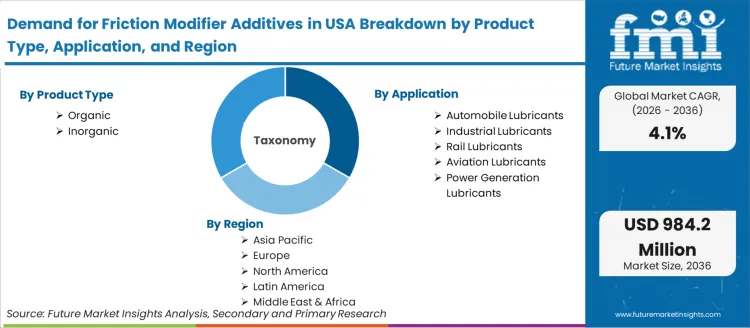
| Segmentation | Product Type: Organic and Inorganic; Application: Automobile Lubricants, Industrial Lubricants, Rail Lubricants, Aviation Lubricants, and Power Generation Lubricants |
| Regions Covered | West USA, South USA, Northeast USA, Midwest USA |
| Key Companies Profiled | Chevron Oronite Company LLC, Royal Dutch Shell Plc, Evonik Industries AG, Tianhe Chemicals Group, Vanderbilt Chemicals LLC |
| Forecast Period | 2026 to 2036 |
| Approach | Forecasting models apply a bottom-up methodology starting with installed base metrics and projecting conversion rates to technology adoption. |
USA Friction Modifier Additives Demand by Segments
Product Type:
- Organic
- Inorganic
Application:
- Automobile Lubricants
- Industrial Lubricants
- Rail Lubricants
- Aviation Lubricants
- Power Generation Lubricants
Region:
- West USA
- South USA
- Northeast USA
- Midwest USA
Bibliography
- International Lubricants Standardization and Approval Committee. (2024). ILSAC GF-7: Minimum Performance Standard for Passenger Car Engine Oils. ILSAC.
- American Petroleum Institute. (2024). API Service Category SP Plus: Engine Oil Performance Requirements Update. API.
- Association of American Railroads. (2024). Rail Fuel Efficiency Programme: Curve Lubrication Best Practices Report. AAR.
- Society of Automotive Engineers. (2024). SAE J2360: Lubricant Requirements for EV Drivetrain Applications. SAE.
- USA Energy Information Administration. (2024). Petroleum Products Supply: Lubricant Production and Additive Consumption Statistics. EIA.
- American Chemistry Council. (2024). Specialty Chemical Industry: Lubricant Additive Market Assessment. ACC.
This bibliography is provided for reader reference. The full FMI report contains the complete reference list with primary research documentation.
This Report Addresses
- Market sizing and quantitative forecast metrics detailing friction modifier additive tonnage consumption and revenues across product type and application categories through 2036.
- Segmentation analysis mapping the organic versus inorganic modifier adoption dynamics driven by ILSAC reformulation and EV drivetrain lubricant development.
- Regional deployment intelligence comparing EV-driven additive demand in the West against automotive OEM factory fill blending in the Midwest and South.
- Regulatory compliance assessment analyzing how ILSAC, API, and SAE lubricant standards drive friction modifier specification requirements and testing timelines.
- Competitive posture evaluation tracking global specialty chemical manufacturers in organic and inorganic friction modifier product positioning.
- Capital project strategic guidance defining the EV drivetrain chemistry and engine sequence testing investment requirements for friction modifier development.
- Supply chain vulnerability analysis identifying specialty chemical raw material pricing and GF-7 testing timeline factors.
- Custom data delivery formats encompassing interactive dashboards, raw Excel datasets, and comprehensive PDF narrative reports.
Frequently Asked Questions
How large is the demand for Friction Modifier Additives in USA in 2026?
Demand is estimated to be valued at USD 658.54 million in 2026.
What will be the market size by 2036?
Market size is projected to reach USD 984.21 million by 2036.
What is the expected CAGR between 2026 and 2036?
Demand is expected to grow at a CAGR of 4.10% between 2026 and 2036.
Which Product Type is poised to lead by 2026?
Organic accounts for 51.0% share delivering catalytic converter compatibility and cost advantages in automotive applications.
How is Automobile Lubricants positioned in 2026?
Automobile Lubricants represents 50.0% share as engine oil and drivetrain fluid blending generates the dominant consumption volume.
What is driving demand in West USA?
Highest EV penetration and lubricant blending concentration fuel the fastest growth at 4.7% CAGR through 2036.
What is included in the scope of this report?
The market covers organic and inorganic friction modifiers for automotive, industrial, rail, aviation, and power generation lubricant applications.
What is excluded from the scope of this report?
Base oils, viscosity modifiers, detergent-dispersants, anti-wear packages, and finished blended lubricants are excluded.
Preview the report firsthand - request a free sample
Get SampleGet the brochure for pricing and purchase details.
Get PDFTable of Content
- Executive Summary
- Global Market Outlook
- Demand-side Trends
- Supply-side Trends
- Technology Roadmap Analysis
- Analysis and Recommendations
- Market Overview
- Market Coverage / Taxonomy
- Market Definition / Scope / Limitations
- Research Methodology
- Chapter Orientation
- Analytical Lens and Working Hypotheses
- Market Structure, Signals, and Trend Drivers
- Benchmarking and Cross-market Comparability
- Market Sizing, Forecasting, and Opportunity Mapping
- Research Design and Evidence Framework
- Desk Research Programme (Secondary Evidence)
- Company Annual and Sustainability Reports
- Peer-reviewed Journals and Academic Literature
- Corporate Websites, Product Literature, and Technical Notes
- Earnings Decks and Investor Briefings
- Statutory Filings and Regulatory Disclosures
- Technical White Papers and Standards Notes
- Trade Journals, Industry Magazines, and Analyst Briefs
- Conference Proceedings, Webinars, and Seminar Materials
- Government Statistics Portals and Public Data Releases
- Press Releases and Reputable Media Coverage
- Specialist Newsletters and Curated Briefings
- Sector Databases and Reference Repositories
- FMI Internal Proprietary Databases and Historical Market Datasets
- Subscription Datasets and Paid Sources
- Social Channels, Communities, and Digital Listening Inputs
- Additional Desk Sources
- Expert Input and Fieldwork (Primary Evidence)
- Primary Modes
- Qualitative Interviews and Expert Elicitation
- Quantitative Surveys and Structured Data Capture
- Blended Approach
- Why Primary Evidence is Used
- Field Techniques
- Interviews
- Surveys
- Focus Groups
- Observational and In-context Research
- Social and Community Interactions
- Stakeholder Universe Engaged
- C-suite Leaders
- Board Members
- Presidents and Vice Presidents
- R&D and Innovation Heads
- Technical Specialists
- Domain Subject-matter Experts
- Scientists
- Physicians and Other Healthcare Professionals
- Governance, Ethics, and Data Stewardship
- Research Ethics
- Data Integrity and Handling
- Primary Modes
- Tooling, Models, and Reference Databases
- Desk Research Programme (Secondary Evidence)
- Data Engineering and Model Build
- Data Acquisition and Ingestion
- Cleaning, Normalisation, and Verification
- Synthesis, Triangulation, and Analysis
- Quality Assurance and Audit Trail
- Market Background
- Market Dynamics
- Drivers
- Restraints
- Opportunity
- Trends
- Scenario Forecast
- Demand in Optimistic Scenario
- Demand in Likely Scenario
- Demand in Conservative Scenario
- Opportunity Map Analysis
- Product Life Cycle Analysis
- Supply Chain Analysis
- Investment Feasibility Matrix
- Value Chain Analysis
- PESTLE and Porter’s Analysis
- Regulatory Landscape
- Regional Parent Market Outlook
- Production and Consumption Statistics
- Import and Export Statistics
- Market Dynamics
- Global Market Analysis 2021 to 2025 and Forecast, 2026 to 2036
- Historical Market Size Value (USD Million) Analysis, 2021 to 2025
- Current and Future Market Size Value (USD Million) Projections, 2026 to 2036
- Y-o-Y Growth Trend Analysis
- Absolute $ Opportunity Analysis
- Global Market Pricing Analysis 2021 to 2025 and Forecast 2026 to 2036
- Global Market Analysis 2021 to 2025 and Forecast 2026 to 2036, By Product Type
- Introduction / Key Findings
- Historical Market Size Value (USD Million) Analysis By Product Type , 2021 to 2025
- Current and Future Market Size Value (USD Million) Analysis and Forecast By Product Type , 2026 to 2036
- Organic
- Inorganic
- Organic
- Y-o-Y Growth Trend Analysis By Product Type , 2021 to 2025
- Absolute $ Opportunity Analysis By Product Type , 2026 to 2036
- Global Market Analysis 2021 to 2025 and Forecast 2026 to 2036, By Application
- Introduction / Key Findings
- Historical Market Size Value (USD Million) Analysis By Application, 2021 to 2025
- Current and Future Market Size Value (USD Million) Analysis and Forecast By Application, 2026 to 2036
- Automobile Lubricants
- Industrial Lubricants
- Rail Lubricants
- Aviation Lubricants
- Power Generation Lubricants
- Automobile Lubricants
- Y-o-Y Growth Trend Analysis By Application, 2021 to 2025
- Absolute $ Opportunity Analysis By Application, 2026 to 2036
- Global Market Analysis 2021 to 2025 and Forecast 2026 to 2036, By Region
- Introduction
- Historical Market Size Value (USD Million) Analysis By Region, 2021 to 2025
- Current Market Size Value (USD Million) Analysis and Forecast By Region, 2026 to 2036
- North America
- Latin America
- Western Europe
- Eastern Europe
- East Asia
- South Asia and Pacific
- Middle East & Africa
- Market Attractiveness Analysis By Region
- North America Market Analysis 2021 to 2025 and Forecast 2026 to 2036, By Country
- Historical Market Size Value (USD Million) Trend Analysis By Market Taxonomy, 2021 to 2025
- Market Size Value (USD Million) Forecast By Market Taxonomy, 2026 to 2036
- By Country
- USA
- Canada
- Mexico
- By Product Type
- By Application
- By Country
- Market Attractiveness Analysis
- By Country
- By Product Type
- By Application
- Key Takeaways
- Latin America Market Analysis 2021 to 2025 and Forecast 2026 to 2036, By Country
- Historical Market Size Value (USD Million) Trend Analysis By Market Taxonomy, 2021 to 2025
- Market Size Value (USD Million) Forecast By Market Taxonomy, 2026 to 2036
- By Country
- Brazil
- Chile
- Rest of Latin America
- By Product Type
- By Application
- By Country
- Market Attractiveness Analysis
- By Country
- By Product Type
- By Application
- Key Takeaways
- Western Europe Market Analysis 2021 to 2025 and Forecast 2026 to 2036, By Country
- Historical Market Size Value (USD Million) Trend Analysis By Market Taxonomy, 2021 to 2025
- Market Size Value (USD Million) Forecast By Market Taxonomy, 2026 to 2036
- By Country
- Germany
- UK
- Italy
- Spain
- France
- Nordic
- BENELUX
- Rest of Western Europe
- By Product Type
- By Application
- By Country
- Market Attractiveness Analysis
- By Country
- By Product Type
- By Application
- Key Takeaways
- Eastern Europe Market Analysis 2021 to 2025 and Forecast 2026 to 2036, By Country
- Historical Market Size Value (USD Million) Trend Analysis By Market Taxonomy, 2021 to 2025
- Market Size Value (USD Million) Forecast By Market Taxonomy, 2026 to 2036
- By Country
- Russia
- Poland
- Hungary
- Balkan & Baltic
- Rest of Eastern Europe
- By Product Type
- By Application
- By Country
- Market Attractiveness Analysis
- By Country
- By Product Type
- By Application
- Key Takeaways
- East Asia Market Analysis 2021 to 2025 and Forecast 2026 to 2036, By Country
- Historical Market Size Value (USD Million) Trend Analysis By Market Taxonomy, 2021 to 2025
- Market Size Value (USD Million) Forecast By Market Taxonomy, 2026 to 2036
- By Country
- China
- Japan
- South Korea
- By Product Type
- By Application
- By Country
- Market Attractiveness Analysis
- By Country
- By Product Type
- By Application
- Key Takeaways
- South Asia and Pacific Market Analysis 2021 to 2025 and Forecast 2026 to 2036, By Country
- Historical Market Size Value (USD Million) Trend Analysis By Market Taxonomy, 2021 to 2025
- Market Size Value (USD Million) Forecast By Market Taxonomy, 2026 to 2036
- By Country
- India
- ASEAN
- Australia & New Zealand
- Rest of South Asia and Pacific
- By Product Type
- By Application
- By Country
- Market Attractiveness Analysis
- By Country
- By Product Type
- By Application
- Key Takeaways
- Middle East & Africa Market Analysis 2021 to 2025 and Forecast 2026 to 2036, By Country
- Historical Market Size Value (USD Million) Trend Analysis By Market Taxonomy, 2021 to 2025
- Market Size Value (USD Million) Forecast By Market Taxonomy, 2026 to 2036
- By Country
- Kingdom of Saudi Arabia
- Other GCC Countries
- Turkiye
- South Africa
- Other African Union
- Rest of Middle East & Africa
- By Product Type
- By Application
- By Country
- Market Attractiveness Analysis
- By Country
- By Product Type
- By Application
- Key Takeaways
- Key Countries Market Analysis
- USA
- Pricing Analysis
- Market Share Analysis, 2025
- By Product Type
- By Application
- Canada
- Pricing Analysis
- Market Share Analysis, 2025
- By Product Type
- By Application
- Mexico
- Pricing Analysis
- Market Share Analysis, 2025
- By Product Type
- By Application
- Brazil
- Pricing Analysis
- Market Share Analysis, 2025
- By Product Type
- By Application
- Chile
- Pricing Analysis
- Market Share Analysis, 2025
- By Product Type
- By Application
- Germany
- Pricing Analysis
- Market Share Analysis, 2025
- By Product Type
- By Application
- UK
- Pricing Analysis
- Market Share Analysis, 2025
- By Product Type
- By Application
- Italy
- Pricing Analysis
- Market Share Analysis, 2025
- By Product Type
- By Application
- Spain
- Pricing Analysis
- Market Share Analysis, 2025
- By Product Type
- By Application
- France
- Pricing Analysis
- Market Share Analysis, 2025
- By Product Type
- By Application
- India
- Pricing Analysis
- Market Share Analysis, 2025
- By Product Type
- By Application
- ASEAN
- Pricing Analysis
- Market Share Analysis, 2025
- By Product Type
- By Application
- Australia & New Zealand
- Pricing Analysis
- Market Share Analysis, 2025
- By Product Type
- By Application
- China
- Pricing Analysis
- Market Share Analysis, 2025
- By Product Type
- By Application
- Japan
- Pricing Analysis
- Market Share Analysis, 2025
- By Product Type
- By Application
- South Korea
- Pricing Analysis
- Market Share Analysis, 2025
- By Product Type
- By Application
- Russia
- Pricing Analysis
- Market Share Analysis, 2025
- By Product Type
- By Application
- Poland
- Pricing Analysis
- Market Share Analysis, 2025
- By Product Type
- By Application
- Hungary
- Pricing Analysis
- Market Share Analysis, 2025
- By Product Type
- By Application
- Kingdom of Saudi Arabia
- Pricing Analysis
- Market Share Analysis, 2025
- By Product Type
- By Application
- Turkiye
- Pricing Analysis
- Market Share Analysis, 2025
- By Product Type
- By Application
- South Africa
- Pricing Analysis
- Market Share Analysis, 2025
- By Product Type
- By Application
- USA
- Market Structure Analysis
- Competition Dashboard
- Competition Benchmarking
- Market Share Analysis of Top Players
- By Regional
- By Product Type
- By Application
- Competition Analysis
- Competition Deep Dive
- Chevron Oronite Company LLC
- Overview
- Product Portfolio
- Profitability by Market Segments (Product/Age /Sales Channel/Region)
- Sales Footprint
- Strategy Overview
- Marketing Strategy
- Product Strategy
- Channel Strategy
- Royal Dutch Shell Plc
- Evonik Industries AG
- Tianhe Chemicals Group
- Vanderbilt Chemicals LLC
- Chevron Oronite Company LLC
- Competition Deep Dive
- Assumptions & Acronyms Used


