

- Industry Size (2026)
- USD 614.5 Mn
- Forecast (2036)
- USD 1098.9 Mn
- CAGR (2026 to 2036)
- 6.0%
Demand for Dishwashing Additives in USA 2026 to 2036
The USA dishwashing additives demand is valued at USD 614.5 million in 2026 and is forecasted to reach USD 1,098.9 million by 2036, reflecting a CAGR of 6.0%. Growth is driven by increased dishwasher penetration, rising preference for premium cleaning performance, and consumer interest in residue-free and eco-conscious formulations. Hard water conditions in several regions further support adoption of rinse aids and performance boosters.
Branded additives lead product usage because they offer optimized formulations for spot reduction, improved drying, and enhanced grease removal. Manufacturers invest in enzymatic blends, plant-based surfactants, and low-impact ingredients that maintain effectiveness while meeting sustainability expectations. Convenience-focused packaging and concentrated formats strengthen household adoption.
The West, South, and Northeast regions reflect strong demand due to high appliance ownership and robust retail distribution networks. Key suppliers include Unilever N.V., Blueland, Bombril, Reckitt Benckiser Group plc, and Church & Dwight Co. Inc. Their strategies focus on environmentally responsible formulations, refillable packaging systems, and performance additives designed to improve compatibility with modern high-efficiency dishwashers.
Quick Stats for USA Dishwashing Additives Demand
- USA Dishwashing Additives Sales Value (2026): USD 614.5 million
- USA Dishwashing Additives Forecast Value (2036): USD 1,098.9 million
- USA Dishwashing Additives Forecast CAGR (2026-2036): 6.0%
- Leading Product Type in USA Dishwashing Additives Demand: Branded Additives
- Key Growth Regions in USA Dishwashing Additives Demand: West USA, South USA, Northeast USA
- Top Players in USA Dishwashing Additives Demand: Unilever N.V., Blueland, Bombril, Reckitt Benckiser Group plc, Church & Dwight Co. Inc.
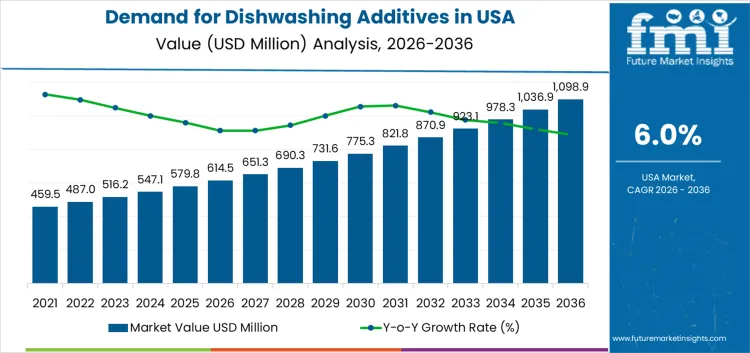
What is the Growth Forecast for Dishwashing Additives Industry in USA through 2036?
Saturation Point Analysis for dishwashing additives in the United States centers on demand progression relative to structural, behavioral, and functional ceilings. Current demand operates below saturation because penetration varies across household and institutional users, and additive usage remains optional within many standard dishwashing routines. Households relying on multifunction detergents limit additive adoption, creating distance from the saturation threshold. Institutional kitchens maintain higher utilization, although procurement practices differ by facility size and cleaning protocol, preventing uniform convergence toward a maximum ceiling.
Functional performance ceilings appear where additives offer limited incremental benefit relative to detergent formulations with integrated rinse agents or water-softening components. These ceilings restrict rapid movement toward saturation because users substitute between product types based on perceived efficiency. Regional water hardness patterns introduce additional constraints because additive value increases only in areas with specific mineral profiles. Price sensitivity shapes another boundary, as households adjust discretionary cleaning purchases during economic tightening. This behavior produces fluctuating movement toward saturation rather than directional progression. Product innovation extends the saturation point slightly because new formulations support specialized tasks, although uptake remains segmented. The environment reflects a mid-level saturation trajectory influenced by functional redundancy, variable institutional adoption, and economic considerations within domestic cleaning practices.
USA Dishwashing Additives Key Takeaways
| Metric | Value |
|---|---|
| USA Dishwashing Additives Sales Value (2026) | USD 614.5 million |
| USA Dishwashing Additives Forecast Value (2036) | USD 1,098.9 million |
| USA Dishwashing Additives Forecast CAGR (2026-2036) | 6.0% |
Why is the Demand for Dishwashing Additives in USA Growing?
Demand for dishwashing additives in the United States grows due to rising use of automatic dishwashers across households and foodservice facilities. Modern appliances require rinse aids, boosters, and detergency enhancers to achieve consistent cleaning under varied water conditions. Hard water regions rely on additives that reduce spotting, scale formation, and film buildup. Growth in energy efficient dishwashers increases the need for formulations that perform effectively at lower temperatures. Households adopt specialized additives to address residue from protein rich and starchy foods that are difficult to remove in short wash cycles.
Commercial kitchens use performance enhancers to maintain hygiene standards during high volume operations. Manufacturers of detergents integrate additive compatible systems that support enzyme stability and controlled surfactant action. E commerce channels expand availability of niche products designed for fragrance free, low residue, and biodegradable requirements. Appliance maintenance programs encourage the use of machine cleaners that prevent internal buildup and extend equipment life. Rising interest in quick cycle modes strengthens demand for boosters that improve cleaning intensity. Growth in compact and multifamily housing increases dishwasher penetration, which increases consumption of related additives across urban regions.
Which Product Type and Application Segments Lead Demand for Dishwashing Additives in USA?
Demand for dishwashing additives in the USA is shaped by cleaning-performance expectations, machine compatibility, and residue-control requirements across residential and commercial environments. Buyers evaluate formulation stability, scaling prevention, and rinse enhancement to support consistent washing outcomes. Distribution reflects detergent system integration, institutional cleaning cycles, and consumer preferences for branded or private-label options.
By Product Type, Branded Additives Account for the Largest Share of Demand
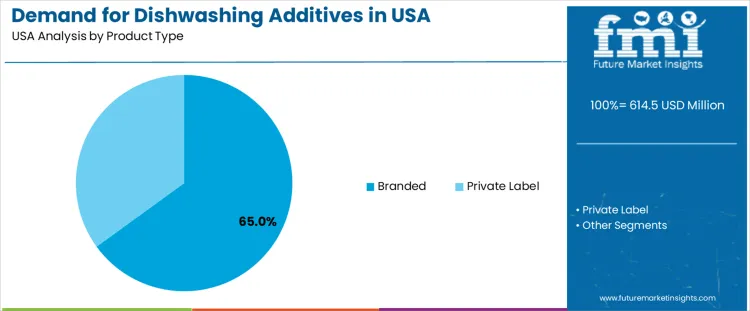
Branded dishwashing additives hold 65.0%, making them the leading product type in USA demand. These products offer established formulation reliability, compatibility with varied dishwasher models, and broader consumer recognition. Manufacturers support innovation in rinse additives, degreasers, and water-softening solutions, which strengthens preference for branded selections. Private-label additives hold 35.0%, serving cost-sensitive buyers and retail chains offering store-brand alternatives with comparable functional performance. Product-type distribution reflects consumer trust in established formulations and purchasing decisions shaped by perceived quality and machine-care benefits.
Key Points:
- Branded additives maintain preference due to reliability and recognition.
- Private-label options serve cost-focused buyers.
- Formulation compatibility influences purchasing patterns.
- Distribution reflects quality perception and cleaning needs.
By Application, Commercial Use Represents the Largest Segment
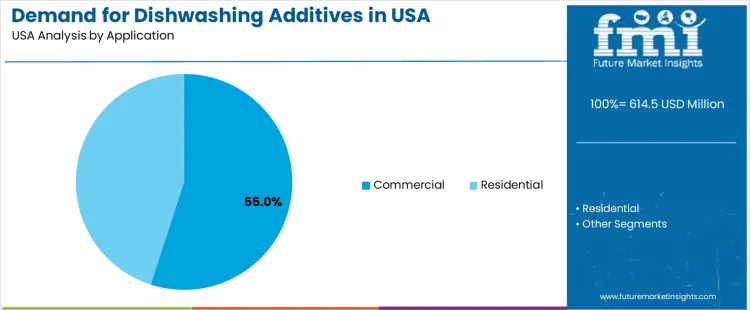
Commercial applications hold 55.0%, making them the leading segment in USA demand for dishwashing additives. High-frequency cleaning cycles in restaurants, institutional kitchens, and catering operations require additives that manage mineral buildup, enhance drying, and support heavy soil removal. These environments depend on consistent dosing and compatibility with industrial dishwashers. Residential use holds 45.0%, driven by household dishwashing needs and interest in rinse aids that improve spot-free drying and reduce detergent residue. Application distribution reflects wash-cycle intensity, maintenance considerations, and machine-load variability in domestic and commercial settings.
Key Points:
- Commercial facilities require additives for high-frequency cleaning.
- Residential users prioritize spot-free results and machine care.
- Additive selection aligns with wash intensity and dishwasher specifications.
- Distribution reflects operational scale and soil-removal needs.
What are the Key Dynamics in the Dishwashing Additives Industry?
Operational cleaning needs, appliance usage patterns, and performance expectations are driving demand. Demand increases as US households and commercial kitchens rely on dishwashers that require additives to improve rinse quality, hardness management, and detergent efficiency. Consumers adopt rinse aids to reduce spotting on glassware in regions with mineral-rich water. Foodservice operators use additives to maintain cleaning consistency across high-volume cycles. Manufacturers of automatic dishwashers recommend compatible additives to support drying performance and prevent scale formation. Retailers report stable sales for boosters used to address residue on cookware and stainless-steel items. Online platforms expand visibility of additive types that support specific cleaning problems. Appliance replacement activity sustains usage across new households.
Price sensitivity, product redundancy concerns, and varying water conditions restrain broader utilization.
Consumers evaluate the added cost of rinse aids and boosters relative to multipurpose detergents that already claim enhanced cleaning capabilities. Several households report uncertainty about the functional difference between detergents and supplemental additives, which reduces routine purchasing. Regional variation in water hardness affects perceived effectiveness, leading to inconsistent user retention. Smaller foodservice operators limit additive use when procurement budgets prioritize detergents and sanitizing agents. Packaging waste considerations influence decisions among environmentally focused buyers. Retailers allocate limited shelf space to niche additives, which restricts product variety in some areas.
Enzymatic formulations, hard-water optimization, and appliance-compatible dosing shape current trends.
US manufacturers expand development of enzymatic and mineral-targeting additives designed to enhance cleaning under lower-temperature wash cycles. Households adopt hard-water boosters that improve clarity on glassware and reduce film on plastics. Appliance makers introduce dishwashers with dosing features that support controlled release of additives. Retail brands promote fragrance-free and dye-free formulations aligned with sensitivity preferences. Foodservice distributors evaluate concentrated additives that reduce storage requirements. E-commerce channels increase adoption of subscription formats for rinse aids and boosters. Sustainability programmes influence interest in biodegradable ingredients and recyclable packaging for additive products.
Analysis of the Demand for Dishwashing Additives in the USA by Region
Demand for dishwashing additives in the USA is increasing due to higher use of automatic dishwashers, broader adoption of performance-boosting formulations, and growing preference for hard-water management solutions. West USA records a CAGR of 6.9% supported by strong appliance penetration and consistent demand for rinse aids and boosters. South USA shows a 6.2% CAGR driven by population growth and increased consumption of household cleaning products. Northeast USA posts a 5.5% CAGR due to dense residential clusters and steady use of additives supporting cleaning efficiency. Midwest USA holds a 4.8% CAGR supported by stable household consumption and routine need for additives in hard-water regions.

| Region | CAGR (2026-2036) |
|---|---|
| West USA | 6.9% |
| South USA | 6.2% |
| Northeast USA | 5.5% |
| Midwest USA | 4.8% |
How is the West USA driving demand for Dishwashing Additives?
West USA drives demand through high adoption of automatic dishwashers and strong consumer interest in enhancing cleaning performance. The region’s CAGR of 6.9% reflects consistent use of rinse aids, degreasing boosters, and water-softening additives across residential and commercial settings. Hard-water pockets within the region support ongoing procurement of formulations designed to reduce spotting and residue. Retail channels maintain broad availability of specialty additives tailored to performance-sensitive users. Hospitality operations rely on stable additive usage to maintain cleaning consistency across high-volume dishwashing cycles. Regional environmental preferences support interest in efficient formulations that reduce water waste through improved cleaning action.
- High penetration of automatic dishwashers
- Use of additives to manage hard-water conditions
- Strong retail availability of specialty products
- Continuous demand from hospitality operations
How is the South USA driving demand for Dishwashing Additives?
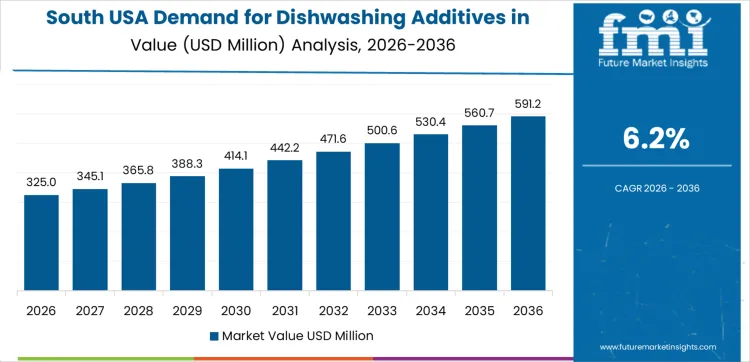
South USA supports rising demand due to population growth, expanding residential construction, and wider circulation of dishwashing appliances. The region’s CAGR of 6.2% reflects steady use of rinse aids and degreasing additives across households seeking improved wash outcomes. Warm climates and high cooking frequency contribute to greater demand for grease-management additives. Retailers stock a broad range of boosters aligned with regional cleaning preferences. Commercial food-service establishments adopt additives to maintain consistent wash cycles in high-utilization environments. Suburban growth areas exhibit predictable purchasing of convenience-oriented dishwashing solutions.
- Expanding residential usage of dishwashing appliances
- High cooking frequency increasing degreasing needs
- Broad retail distribution of dishwashing boosters
- Commercial food-service integration of performance additives
How is the Northeast USA driving demand for Dishwashing Additives?
Northeast USA drives demand due to its dense residential base, strong commercial food-service sector, and steady use of additives designed to maintain cleaning efficiency. The region’s CAGR of 5.5% reflects consistent adoption of rinse aids and anti-spotting formulations that address mineral content and residue challenges. Apartment-based living patterns support strong circulation of dishwashing consumables. Institutional kitchens maintain predictable volumes of additive usage to ensure reliable wash quality. Retailers offer varied product options catering to performance, cost control, and environmental criteria that guide consumer purchasing behavior.
- Dense residential and commercial user base
- Regular use of anti-spotting and residue-control additives
- Institutional kitchens sustaining stable consumption
- Broad product availability across regional retail networks
How is the Midwest USA driving demand for Dishwashing Additives?
Midwest USA maintains stable demand driven by household cleaning habits, strong dishwasher usage across suburban areas, and widespread hard-water conditions. The region’s CAGR of 4.8% reflects routine use of water-softening boosters, rinse aids, and degreasing additives. Households rely on additives to address mineral buildup that affects cleaning performance. Commercial kitchens maintain steady consumption patterns tied to consistent dishwashing cycles. Regional retailers support continuous availability of formulations designed for residue control. Predictable household purchasing contributes to sustained additive circulation.
- Widespread hard-water conditions driving booster use
- Steady residential reliance on rinse aids
- Consistent commercial dishwashing requirements
- Reliable retail distribution across the region
What is the competitive landscape of the demand for dishwashing additives in the USA?
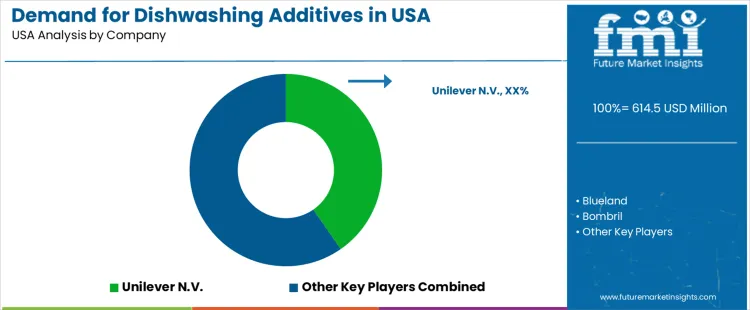
Demand for dishwashing additives in the USA is shaped by requirements for stain removal efficiency, water-softening performance, residue control, and compatibility with both automatic and manual dishwashing formats. Buyers evaluate formulation stability, surfactant effectiveness, enzyme activity, and fragrance profiles suited for household preferences. Procurement teams consider packaging durability, supply reliability, and adherence to regulatory standards governing detergent ingredients. Adoption patterns reflect interest in concentrated formats, reduced environmental impact, and consistent cleaning performance across varied water conditions.
Unilever N.V. holds a dominant position supported by established detergent technologies, extensive distribution coverage, and strong brand recognition in automatic dishwashing additives. Blueland participates with refill-based cleaning systems that emphasize reduced packaging waste and concentrated formats sold through direct-to-consumer channels. Bombril maintains presence through cleaning products distributed via niche retail networks serving targeted consumer groups. Reckitt Benckiser Group contributes detergent and rinse-aid solutions integrated into national retail assortments. Church & Dwight supports demand with trusted household additive brands used across diverse dishwashing routines. Competitive positioning in the United States is shaped by formulation effectiveness, distribution strength, packaging innovation, and alignment with consumer expectations for sustainable cleaning performance.
Key Players in USA Dishwashing Additives Demand
- Unilever N.V.
- Blueland
- Bombril
- Reckitt Benckiser Group plc
- Church & Dwight Co. Inc.
Scope of the Report
| Items | Values |
|---|---|
| Quantitative Units | USD million |
| Product Type | Branded, Private Label |
| Application | Commercial, Residential |
| Form Type | Liquid, Powder, Others |
| Sales Channel | Hypermarkets/Supermarkets, Independent Grocery Stores, Specialty Stores, Wholesalers/Distributors, Online Retailers |
| Regions Covered | West USA, South USA, Northeast USA, Midwest USA |
| Key Companies Profiled | Unilever N.V., Blueland, Bombril, Reckitt Benckiser Group plc, Church & Dwight Co. Inc. |
| Additional Attributes | Dollar sales by product type, application category, form type, and sales channel; regional demand variation across West, South, Northeast, and Midwest USA; competitive landscape of branded versus private-label dishwashing additives; adoption trends in eco-friendly and low-chemical formulations; growth in online replenishment and subscription-based household cleaning products; integration of concentrated and multi-functional additives for enhanced dishwashing performance in residential and commercial settings. |
USA Dishwashing Additives Demand by Segments
Product Type:
- Branded
- Private Label
Application:
- Commercial
- Residential
Form Type:
- Liquid
- Powder
- Others
Sales Channel:
- Hypermarkets/ Supermarkets
- Independent Grocery Stores
- Specialty Stores
- Wholesalers/Distributors
- Online Retailers
Region:
- West USA
- South USA
- Northeast USA
- Midwest USA
Frequently Asked Questions
How big is the demand for dishwashing additives in USA in 2026?
The demand for dishwashing additives in USA is estimated to be valued at USD 614.5 million in 2026.
What will be the size of dishwashing additives in USA in 2036?
The market size for the dishwashing additives in USA is projected to reach USD 1,098.9 million by 2036.
How much will be the demand for dishwashing additives in USA growth between 2026 and 2036?
The demand for dishwashing additives in USA is expected to grow at a 6.0% CAGR between 2026 and 2036.
What are the key product types in the dishwashing additives in USA?
The key product types in dishwashing additives in USA are branded and private label.
Which application segment is expected to contribute significant share in the dishwashing additives in USA in 2026?
In terms of application, commercial segment is expected to command 55.0% share in the dishwashing additives in USA in 2026.
Preview the report firsthand - request a free sample
Get SampleGet the brochure for pricing and purchase details.
Get PDFTable of Content
- Executive Summary
- USA Market Outlook
- Demand-side Trends
- Supply-side Trends
- Technology Roadmap Analysis
- Analysis and Recommendations
- Market Overview
- Market Coverage / Taxonomy
- Market Definition / Scope / Limitations
- Market Background
- Market Dynamics
- Drivers
- Restraints
- Opportunity
- Trends
- Scenario Forecast
- Demand in Optimistic Scenario
- Demand in Likely Scenario
- Demand in Conservative Scenario
- Opportunity Map Analysis
- Product Life Cycle Analysis
- Supply Chain Analysis
- Investment Feasibility Matrix
- Value Chain Analysis
- PESTLE and Porter’s Analysis
- Regulatory Landscape
- Regional Parent Market Outlook
- Production and Consumption Statistics
- Import and Export Statistics
- Market Dynamics
- USA Market Analysis 2020 to 2024 and Forecast, 2025 to 2035
- Historical Market Size Value (USD Million) Analysis, 2020 to 2024
- Current and Future Market Size Value (USD Million) Projections, 2025 to 2035
- Y-o-Y Growth Trend Analysis
- Absolute $ Opportunity Analysis
- USA Market Pricing Analysis 2020 to 2024 and Forecast 2025 to 2035
- USA Market Analysis 2020 to 2024 and Forecast 2025 to 2035, By Product Type
- Introduction / Key Findings
- Historical Market Size Value (USD Million) Analysis By Product Type , 2020 to 2024
- Current and Future Market Size Value (USD Million) Analysis and Forecast By Product Type , 2025 to 2035
- Branded
- Private Label
- Y-o-Y Growth Trend Analysis By Product Type , 2020 to 2024
- Absolute $ Opportunity Analysis By Product Type , 2025 to 2035
- USA Market Analysis 2020 to 2024 and Forecast 2025 to 2035, By Application
- Introduction / Key Findings
- Historical Market Size Value (USD Million) Analysis By Application, 2020 to 2024
- Current and Future Market Size Value (USD Million) Analysis and Forecast By Application, 2025 to 2035
- Commercial
- Residential
- Y-o-Y Growth Trend Analysis By Application, 2020 to 2024
- Absolute $ Opportunity Analysis By Application, 2025 to 2035
- USA Market Analysis 2020 to 2024 and Forecast 2025 to 2035, By Form Type
- Introduction / Key Findings
- Historical Market Size Value (USD Million) Analysis By Form Type, 2020 to 2024
- Current and Future Market Size Value (USD Million) Analysis and Forecast By Form Type, 2025 to 2035
- Liquid
- Powder
- Others
- Y-o-Y Growth Trend Analysis By Form Type, 2020 to 2024
- Absolute $ Opportunity Analysis By Form Type, 2025 to 2035
- USA Market Analysis 2020 to 2024 and Forecast 2025 to 2035, By Sales Channel
- Introduction / Key Findings
- Historical Market Size Value (USD Million) Analysis By Sales Channel, 2020 to 2024
- Current and Future Market Size Value (USD Million) Analysis and Forecast By Sales Channel, 2025 to 2035
- Hypermarkets/ Supermarkets
- Independent Grocery Stores
- Specialty Stores
- Wholesalers/Distributors
- Online Retailers
- Y-o-Y Growth Trend Analysis By Sales Channel, 2020 to 2024
- Absolute $ Opportunity Analysis By Sales Channel, 2025 to 2035
- Market Structure Analysis
- Competition Dashboard
- Competition Benchmarking
- Market Share Analysis of Top Players
- By Regional
- By Product Type
- By Application
- By Form Type
- By Sales Channel
- Competition Analysis
- Competition Deep Dive
- Unilever N.V.
- Overview
- Product Portfolio
- Profitability by Market Segments (Product/Age /Sales Channel/Region)
- Sales Footprint
- Strategy Overview
- Marketing Strategy
- Product Strategy
- Channel Strategy
- Blueland
- Bombril
- Reckitt Benckiser Group plc
- Church & Dwight Co. Inc.
- Unilever N.V.
- Competition Deep Dive
- Assumptions & Acronyms Used
- Research Methodology


