

- Industry Size (2026)
- USD 91.64 Mn
- Forecast (2036)
- SD 125.57 Mn
- CAGR (2026 to 2036)
- 3.20%
Demand for Friction Modifier Additives in Japan Size, Market Forecast and Outlook By FMI
The demand for friction modifier additives in Japan was valued at USD 88.80 million in 2025, projected to reach USD 91.64 million in 2026, and is forecast to expand to USD 125.57 million by 2036 at a 3.20% CAGR. Japan's extensive high-speed and conventional rail network generates sustained demand for rail-specific friction modifier additives that reduce wheel-rail interface wear, minimize noise emissions, and optimize energy efficiency across Shinkansen and commuter rail operations. Automotive engine oil reformulation mandates under tightening JASO fuel economy standards are driving friction modifier additive specification upgrades in engine lubricant formulations.
The absolute dollar opportunity of approximately USD 33.93 million over the forecast period reflects steady consumption driven by rail maintenance programme procurement and automotive lubricant reformulation cycles. Molybdenum disulphide and graphite-based inorganic friction modifiers maintain the largest consumption share in rail applications where extreme pressure performance and long-duration effectiveness are mandatory specifications. Organic friction modifiers based on fatty acid derivatives are capturing share in automotive applications where compatibility with catalytic converter systems and lower treatment rates offer formulation cost advantages.
Kyushu and Okinawa set the pace at a 4.0% CAGR, driven by JR Kyushu rail network maintenance programme additive procurement and regional industrial machinery lubrication demand. Kanto follows at 3.7% supported by JR East Shinkansen and commuter rail friction modifier consumption and the largest automotive lubricant blending plant concentration. Kansai registers 3.3% driven by JR West rail operations and industrial sector demand. Chubu maintains 2.9% supported by automotive industry lubricant reformulation. Tohoku registers 2.5% with rail network maintenance demand. Rest of Japan maintains 2.4%.
Summary of Demand for Friction Modifier Additives in Japan
- Demand for Friction Modifier Additives in Japan Definition
- Friction modifier additives in Japan are specialty chemicals reducing surface friction coefficients in lubricant formulations, comprising inorganic (MoS2, graphite) and organic (fatty acid) compounds for rail, automotive, industrial, and aviation lubrication applications.
- Demand Drivers in the Market
- Japan extensive high-speed and commuter rail network generates sustained friction modifier procurement through maintenance programmes that mandate wheel-rail interface wear reduction and noise minimization across Shinkansen and urban rail operations.
- JASO fuel economy standard tightening drives automotive engine oil reformulation that upgrades friction modifier additive specifications to achieve lower viscosity grade performance targets.
- Industrial machinery energy efficiency programmes incentivize friction modifier adoption in metalworking fluids and gear oils to reduce power consumption across manufacturing facility lubrication systems.
- Key Segments Analyzed in the FMI Report
- InOrganic by Product Type: 51.0% share in 2026, as molybdenum disulphide and graphite-based modifiers deliver the extreme pressure performance and long-duration effectiveness mandatory for rail and heavy industrial applications.
- Rail Lubricants by Application: 50.0% share in 2026, reflecting Japan extensive rail network generating the dominant friction modifier consumption volume through scheduled maintenance and fleet lubrication programmes.
- Kyushu & Okinawa: 4.0% compound growth driven by JR Kyushu maintenance programme procurement and regional industrial machinery lubrication demand.
- Analyst Opinion at FMI
- Nikhil Kaitwade, Principal Analyst at FMI, Automotive, Chemicals, Industrial Equipment, Oil & Gas, and Service industries.The Japanese friction modifier additive market operates in a specification-driven procurement environment where rail operator maintenance standards and automotive lubricant formulation requirements determine product selection rather than brand marketing. Additive manufacturers who maintain JR Group and JASO approved product listings capture the institutional procurement channels that generate recurring consumption. The critical technology risk centers on electric vehicle drivetrain lubrication, as EV transmission fluid friction modifier requirements differ from internal combustion engine oil specifications, compelling additive manufacturers to develop new organic modifier chemistries optimized for EV gear and bearing applications.
- Strategic Implications / Executive Takeaways
- Friction modifier manufacturers must develop EV transmission fluid-optimized organic modifier chemistries to capture the emerging electric vehicle drivetrain lubrication market as Japan automotive electrification accelerates.
- Rail operator maintenance departments must evaluate next-generation friction modifier formulations with extended re-application intervals to reduce per-kilometre maintenance costs on high-traffic rail corridors.
- Automotive lubricant blenders must reformulate engine oil friction modifier packages to meet upcoming JASO fuel economy standard revisions that mandate lower viscosity grades requiring enhanced boundary film performance.
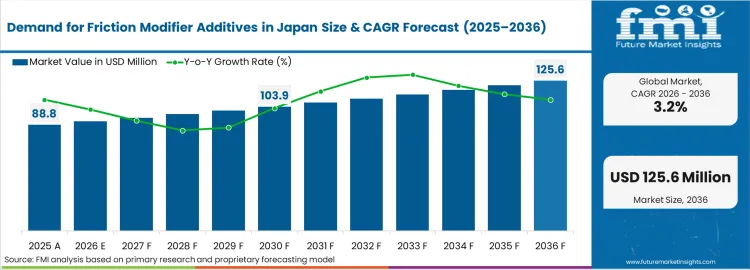
Demand for Friction Modifier Additives in Japan Key Takeaways
| Metric | Details |
|---|---|
| Industry Size (2026) | USD 91.64 Million |
| Industry Value (2036) | USD 125.57 Million |
| CAGR (2026-2036) | 3.20% |
Source: Future Market Insights, 2026
Demand for Friction Modifier Additives in Japan Definition
Friction modifier additives for the Japanese market are specialty chemical compounds blended into lubricant formulations to reduce the coefficient of friction between contacting surfaces in rail, automotive, industrial, aviation, and power generation applications. These additives encompass inorganic compounds (molybdenum disulphide, graphite, boron nitride) and organic compounds (fatty acid esters, amines, phosphorus derivatives) that form low-shear boundary films on metal surfaces to reduce wear, noise, and energy consumption.
Demand for Friction Modifier Additives in Japan Inclusions
Market scope includes inorganic friction modifier additives (MoS2, graphite, boron compounds), organic friction modifier additives (fatty acid derivatives, amine-based compounds, phosphorus-based compounds), and blended multi-functional friction modifier packages. Coverage spans rail lubricant, automotive engine oil, industrial machinery lubricant, aviation lubricant, and power generation equipment lubricant applications.
Demand for Friction Modifier Additives in Japan Exclusions
Base oil stocks, viscosity index improvers, detergent-dispersant additives, anti-wear additives (ZDDP), and corrosion inhibitors without friction modification functionality are excluded. Finished blended lubricant products fall outside analytical parameters.
Demand for Friction Modifier Additives in Japan Research Methodology
- Primary Research: Analysts engaged with rail operator maintenance procurement managers, automotive lubricant blending plant formulators, and friction modifier manufacturer technical sales engineers to map the specification and procurement triggers for additive selection in Japanese lubrication applications.
- Desk Research: Data collection phases aggregated JR Group rail maintenance budget allocations, JASO lubricant standard revision timelines, and automotive lubricant production volume data.
- Market-Sizing and Forecasting: Baseline values derive from a bottom-up aggregation of friction modifier additive tonnage consumption multiplied by average per-kilogram prices across product type and application categories, applying Japan-specific rail maintenance and automotive reformulation curves.
- Data Validation and Update Cycle: Projections are tested against publicly reported lubricant additive segment revenues from leading specialty chemical manufacturers serving the Japanese market.
What Is Driving the Demand for Friction Modifier Additives in Japan Across Historical and Future Growth Cycles?
Demand for friction modifier additives in Japan developed through long standing strength in automotive manufacturing, lubricants blending, and precision machinery production. Automakers adopted friction modifiers to improve fuel economy, stabilize engine performance, and manage wear under compact engine designs. Industrial equipment producers used these additives in gear oils and hydraulic fluids to control heat and reduce surface contact losses. Historical demand followed internal combustion vehicle output, export driven engine production, and steady industrial maintenance cycles. Domestic additive suppliers built close technical partnerships with lubricant formulators and component manufacturers. Product selection emphasized thermal stability, material compatibility, and long drain interval support. Growth aligned with national efficiency standards and continuous refinement of mechanical performance across transport and industrial systems.
Future demand for friction modifier additives in Japan is expected to follow powertrain transition, tighter efficiency targets, and extended equipment operating cycles. Hybrid vehicles, advanced transmissions, and electric drive components create new lubrication profiles that require precise friction control. Industrial automation, robotics, and compact high speed machinery raise demand for additives that stabilize motion under variable loads. Historical growth depended on conventional engine designs and routine lubricant replacement. Future growth centers on longer service intervals, reduced energy loss, and material protection under higher thermal stress. Development priorities include compatibility with low viscosity oils, sensor exposed environments, and sealed lifetime lubrication systems.
What Is the Demand for Friction Modifier Additives in Japan by Product Type and Application?
Demand for friction modifier additives in Japan is shaped by fuel efficiency standards, long equipment service life expectations, and high precision lubricant formulation practices. Organic additives lead by product type due to their compatibility with modern low viscosity lubricant systems. Automobile lubricants lead by application because passenger vehicles and commercial fleets require continuous friction control to meet fuel economy and durability targets. Lubricant blenders, automotive OEM supply chains, and additive distributors drive procurement. Import reliance remains present for specialty organic compounds and intermediate chemicals. Substitution pressure exists across inorganic and hybrid chemistries based on operating temperature and load requirements. Demand stability is supported by a steady vehicle parc size and regular lubricant replacement cycles.
Why do organic additives account for 51% of the demand for friction modifier additives in Japan by product type?
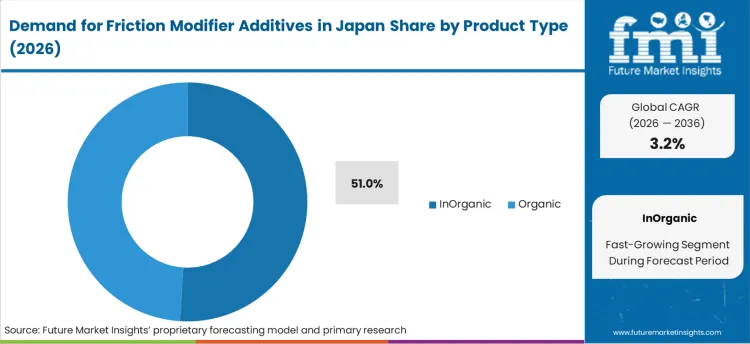
Organic additives account for 51% of the demand for friction modifier additives in Japan by product type, reflecting their suitability for low viscosity engine oils and transmission fluids. Consumption intensity is driven by widespread use in gasoline engines, hybrid vehicles, and continuously variable transmissions. Usage remains stable because organic modifiers deliver consistent friction reduction under moderate temperature and load conditions. Domestic lubricant formulators and additive package suppliers lead procurement. Price sensitivity remains moderate because performance reliability outweighs unit cost variation. Specification control emphasizes molecular stability, thermal degradation resistance, solubility in base oils, and deposit control under extended drain intervals.
Organic friction modifiers also generate steady repeat demand through routine lubricant production and vehicle service intervals. Repeat utilization remains predictable as vehicle ownership cycles remain long and maintenance schedules remain structured. Buyers favor organic chemistries that align with emission control system compatibility and catalyst protection. Margin structure remains controlled under competition between multinational additive suppliers. Regulatory exposure centers on automotive chemical compliance and emissions related material restrictions. Import reliance persists for advanced ester based and fatty acid derivative inputs. Substitution pressure from inorganic additives remains limited to heavy load and high temperature niche applications.
Why do automobile lubricants represent 50.0% of the demand for friction modifier additives in Japan by application?
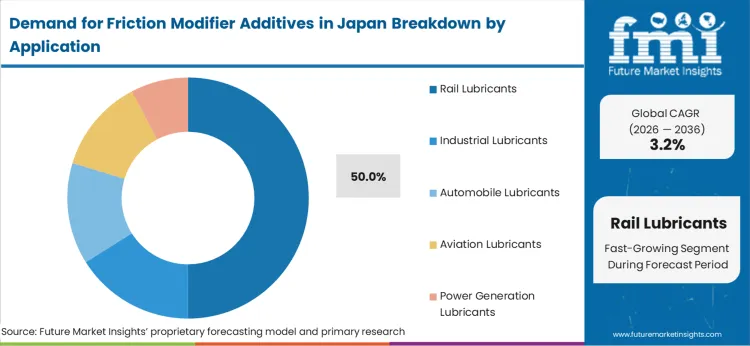
Automobile lubricants represent 50.0% of the demand for friction modifier additives in Japan by application, reflecting the dominant role of the automotive sector in lubricant consumption. Consumption intensity is driven by passenger cars, light commercial vehicles, and fleet based delivery vehicles that require continuous friction management. Usage remains stable because friction modifiers directly influence fuel efficiency, wear reduction, and transmission smoothness. Procurement is dominated by automotive lubricant manufacturers and OEM approved oil suppliers. Price sensitivity remains moderate because friction related performance affects warranty outcomes and vehicle durability. Specification control emphasizes friction coefficient stability, shear resistance, and compatibility with multi grade oil formulations.
Automobile lubricant applications also generate the highest recurring additive demand through periodic oil change cycles. Repeat utilization remains predictable due to mandated maintenance intervals and inspection schedules. Buyers favor additive systems that perform consistently across both urban stop start driving and expressway operation. Margin structure remains controlled under long term supply contracts with oil blenders. Regulatory exposure centers on automotive emissions testing and lubricant performance certification. Import reliance persists for patented friction modifier chemistries. Substitution pressure from alternative surface treatment technologies remains limited due to cost and integration complexity.
What Is Driving the Demand for Friction Modifier Additives in Japan Powertrain Efficiency and Fuel Economy Control?
Demand for friction modifier additives in Japan is shaped by strict fuel efficiency targets, hybrid vehicle dominance, and long engine service expectations. Automakers and lubricant formulators focus on reducing internal mechanical drag across engines, transmissions, and driveline systems. Hybrid powertrains require stable friction behavior during frequent start stop cycles, which raises performance dependence on additive chemistry. Urban congestion and low speed duty cycles elevate boundary lubrication conditions where friction modifiers perform critical roles. OEM approval standards dictate narrow performance windows for wear protection and clutch compatibility. Demand aligns with regulatory fuel economy pressure, drivetrain electrification balance, and durability assurance across passenger and commercial vehicle fleets nationwide.
How Is Hybrid and Transmission Technology Raising Technical Requirements in Japan?
Japan hybrid vehicle penetration alters lubricant behavior through frequent torque transitions and regenerative braking loads. Friction modifier additives must maintain stable coefficient performance under repeated phase change between engine drive and electric assist. Continuously variable transmissions and dual clutch systems demand precise friction control to avoid shudder and engagement loss. OEM testing protocols simulate high cycle durability that narrows formulation tolerance. Additives must remain effective under limited sump volumes and extended drain intervals. This technical environment raises entry barriers for new chemistries. Demand increases through drivetrain modernization rather than through simple engine oil volume growth across vehicle replacement cycles nationwide.
Why Are Industrial Machinery and Factory Automation Supporting Non Automotive Demand in Japan?
Japan manufacturing sector uses friction modifier additives across large machine tool spindles, hydraulic drives, and precision gear assemblies. Robotics factories, semiconductor equipment builders, and heavy press operations rely on smooth sliding performance under micro motion conditions. Stick slip prevention protects surface finish and positional accuracy. Additive demand links to uptime stability and yield protection within automated lines. Lubricant replacement follows predictive maintenance schedules aligned with vibration and temperature tracking. Demand follows capital equipment upgrade programs rather than production volume swings. This industrial base adds non-automotive stability to additive consumption under long machine life expectations across high value production facilities nationwide.
How Do Cost Discipline, Qualification Cycles, and Raw Material Sensitivity Limit Expansion?
Friction modifier additive adoption in Japan faces restraint from extended qualification cycles, strict OEM approvals, and price sensitivity within lubricant supply chains. Automotive approvals require multiyear coexistence testing under full oil formulation systems. Raw material price exposure for esters, organomolybdenum, and specialty surfactants affects contract stability. Blenders resist frequent reformulation due to certification cost and inventory complexity. Environmental review of metal containing modifiers also narrows future options. Smaller lubricant brands face entry limits due to validation burden. These commercial and regulatory boundaries slow rapid adoption despite technical demand tied to drivetrain efficiency, automation reliability, and lifecycle performance control nationwide.
What is the Demand for Friction Modifier Additives in Japan by Region?
.webp "Top Country Growth Comparison Demand For Friction Modifier Additives In Japan Cagr (2026 2036)")
| Region | CAGR (%) |
|---|---|
| Kyushu & Okinawa | 4.0% |
| Kanto | 3.7% |
| Kansai | 3.3% |
| Chubu | 2.9% |
| Tohoku | 2.5% |
| Rest of Japan | 2.4% |
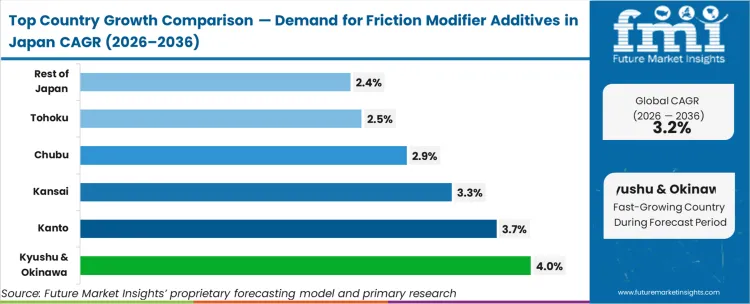
The demand for friction modifier additives in Japan is increasing steadily across automotive and industrial lubricant consumption zones, led by Kyushu and Okinawa at a 4.0% CAGR. Growth in this region is supported by commercial fleet activity, port logistics operations, and steady use of high performance lubricants in marine and transport equipment. Kanto follows at 3.7%, driven by dense vehicle ownership, premium passenger cars, and continuous demand for fuel efficiency focused lubricant formulations. Kansai records 3.3% growth, reflecting stable use in industrial machinery, automotive servicing, and regional manufacturing plants. Chubu at 2.9% shows moderate uptake linked to core automotive production hubs. Tohoku and the Rest of Japan, at 2.5% and 2.4%, reflect slower growth shaped by lower vehicle density, reduced industrial throughput, and longer lubricant replacement cycles.
How Are Marine Transport and Industrial Lubrication Needs Driving Friction Modifier Additive Demand in Kyushu and Okinawa?
Demand for friction modifier additives in Kyushu and Okinawa is advancing at a CAGR of 4.0% through 2035, supported by marine transport activity, port based logistics fleets, and steady industrial machinery usage. Coastal freight movement and fishing vessel maintenance sustain continuous lubricant consumption. Automotive workshops also record stable use of friction modifiers in engine oils and transmission fluids. Growth reflects sustained port operations, rising efficiency requirements in marine engines, and consistent servicing of industrial equipment across shipyards and coastal manufacturing zones.
- Marine fleet maintenance drives lubricant additive usage
- Port logistics fleets support transmission fluid demand
- Shipyard machinery sustains industrial lubricant consumption
- Service workshops anchor steady automotive aftermarket flow
Why Is Dense Vehicle Parc Sustaining Friction Modifier Additive Growth in Kanto?
Demand for friction modifier additives in Kanto is rising at a CAGR of 3.7% through 2035, driven by high passenger vehicle density, fleet based mobility services, and large scale automotive servicing networks. Urban driving conditions increase the need for friction control in stop start traffic cycles. Commercial taxi and delivery fleets rely on high performance lubricants for fuel efficiency and component protection. Growth reflects continuous vehicle turnover, strict emission control maintenance practices, and strong aftermarket penetration of advanced engine and drivetrain oils.
- Taxi and delivery fleets drive high mileage fluid replacement
- Stop start traffic increases friction control requirements
- Large service networks support steady additive throughput
- Fuel efficiency focus sustains premium oil adoption
What Is Supporting Measured Friction Modifier Additive Expansion Across Kansai?
Demand for friction modifier additives in Kansai is progressing at a CAGR of 3.3% through 2035, supported by balanced private vehicle ownership, steady highway usage, and consistent maintenance culture among passenger car users. Kansai shows stable adoption across automotive engine oils and gear lubricants. Industrial usage remains moderate across small manufacturing units. Growth reflects controlled vehicle population growth, routine servicing compliance, and stable demand for durability enhancing additives in mid grade lubricants.
- Routine vehicle servicing sustains steady additive demand
- Highway driving supports drivetrain lubrication needs
- Small manufacturing units apply basic industrial oils
- Mid grade lubricant products dominate usage patterns
How Is Manufacturing Activity Shaping Friction Modifier Additive Demand in Chubu?
Demand for friction modifier additives in Chubu is advancing at a CAGR of 2.9% through 2035, supported by automotive production operations, metal processing facilities, and large scale industrial equipment usage. Chubu plants rely on friction modifiers within hydraulic oils, cutting fluids, and gear lubricants used in continuous production. OEM level lubricant filling also contributes to baseline demand. Growth reflects stable industrial output, ongoing machinery modernization, and consistent need for wear reduction across high load mechanical systems.
- Automotive plants anchor OEM level lubricant consumption
- Metal machining sustains cutting fluid additive usage
- Gear systems rely on friction control under high load
- Machinery modernization supports steady lubricant demand
Why Is Fleet Composition Influencing Friction Modifier Additive Growth in Tohoku?
Demand for friction modifier additives in Tohoku is advancing at a CAGR of 2.5% through 2035, supported by agricultural vehicles, regional freight transport, and steady use across utility machinery. Rural travel patterns and seasonal equipment operation guide lubricant demand cycles. Automotive additive usage remains focused on durability rather than performance enhancement. Growth reflects stable replacement demand for tractors and utility trucks, ongoing road freight movement, and controlled industrial equipment operation across regional processing facilities.
- Agricultural machinery drives seasonal lubricant cycles
- Utility trucks support steady drivetrain fluid usage
- Durability focused oils dominate additive application
- Regional freight supports continuous servicing demand
How Is Local Mobility and Small Industry Shaping Additive Demand in Rest of Japan?
Demand for friction modifier additives in Rest of Japan is advancing at a CAGR of 2.4% through 2035, supported by small city vehicle usage, light commercial fleets, and routine maintenance across utility equipment. These areas show steady reliance on conventional engine oils and basic gear lubricants with limited penetration of premium formulations. Growth remains stable and guided by household servicing habits, light industrial activity, and consistent operation of small transport fleets serving local distribution needs.
- Light commercial fleets sustain steady lubricant turnover
- Conventional engine oils dominate additive applications
- Small workshops support local aftermarket distribution
- Utility equipment operation drives routine fluid replacement
What Is Driving the Demand for Friction Modifier Additives in Japan and Which Companies Shape Lubricant Formulation Access?
The demand for friction modifier additives in Japan is shaped by fuel efficiency targets, hybrid vehicle penetration, and strict emission control standards tied to engine and drivetrain performance. Idemitsu Kosan holds a central domestic position through base oil and additive blending used across passenger car and motorcycle lubricants. ENEOS supports demand through additive integrated lubricant systems supplied to Japanese OEM service networks and fleet operators. Chevron Oronite participates through advanced friction modifiers supplied to premium engine oil formulators and automotive original fill programs. Evonik Industries contributes through specialty ester based additives used in transmission fluids and industrial lubricants. These suppliers influence formulation standards through close collaboration with Japanese automakers and lubricant blenders.
Royal Dutch Shell supports demand through finished lubricant brands and additive technology platforms used in commercial vehicles and industrial machinery. Vanderbilt Chemicals supplies niche sulfur based and organometallic friction modifiers used in specialty grease and heavy duty lubricant applications. Tianhe Chemicals Group participates through cost focused additive packages supplied to private label lubricant producers and export oriented blenders. System selection in Japan is governed by friction stability under stop start driving, oxidation resistance under high temperature, and compatibility with hybrid transmission systems. Buyer preference favors suppliers with domestic technical service teams, engine test data aligned with Japanese standards, and stable long term supply assurance. Demand visibility tracks hybrid vehicle output, motorcycle production cycles, and steady replacement demand in industrial gear and hydraulic oil applications across manufacturing regions.
Key Players in the Friction Modifier Additives Industry in Japan
- Chevron Oronite Company LLC
- Royal Dutch Shell Plc
- Evonik Industries AG
- Tianhe Chemicals Group
- Vanderbilt Chemicals LLC
Scope of the Report
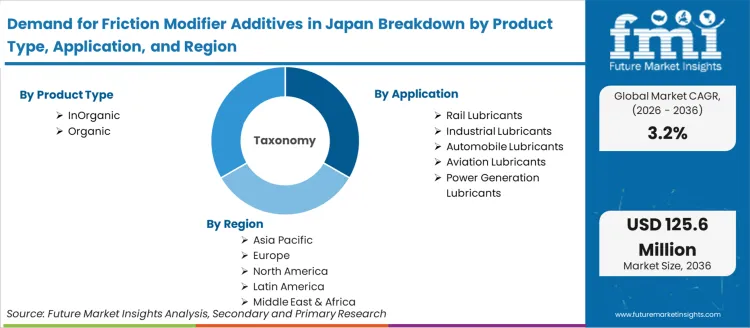
| Metric | Value |
|---|---|
| Quantitative Units | USD 91.64 Million to USD 125.57 Million, at a CAGR of 3.20% |
| Market Definition | Friction modifier additives in Japan are specialty chemicals reducing surface friction coefficients in lubricant formulations, comprising inorganic (MoS2, graphite) and organic (fatty acid) compounds for rail, automotive, industrial, and aviation lubrication applications. |
| Segmentation | Product Type: InOrganic and Organic; Application: Rail Lubricants, Industrial Lubricants, Automobile Lubricants, Aviation Lubricants, and Power Generation Lubricants |
| Regions Covered | Kyushu & Okinawa, Kanto, Kansai, Chubu, Tohoku, Rest of Japan |
| Key Companies Profiled | Chevron Oronite Company LLC, Royal Dutch Shell Plc, Evonik Industries AG, Tianhe Chemicals Group, Vanderbilt Chemicals LLC |
| Forecast Period | 2026 to 2036 |
| Approach | Forecasting models apply a bottom-up methodology starting with installed base metrics and projecting conversion rates to technology adoption. |
Friction Modifier Additives Industry in Japan Segmentation
Product Type:
- Organic
- Inorganic
Application:
- Automobile Lubricants
- Industrial Lubricants
- Rail Lubricants
- Aviation Lubricants
- Power Generation Lubricants
Region:
- Kyushu & Okinawa
- Kanto
- Kansai
- Chubu
- Tohoku
- Rest of Japan
Bibliography
- Japanese Automobile Standards Organization. (2024). JASO M355: Engine Oil Performance Requirements and Friction Modifier Specifications. JASO.
- East Japan Railway Company. (2024). Rail Maintenance Programme: Wheel-Rail Interface Lubrication Standards. JR East.
- Japan Petroleum Institute. (2024). Lubricant Additive Market: Consumption Statistics and Technology Trends. JPI.
- Ministry of Land, Infrastructure, Transport and Tourism. (2024). Rail Safety Standards: Track Maintenance and Lubrication Requirements. MLIT.
- Japan Lubricating Oil Society. (2024). Industrial Lubricant Consumption: Friction Modifier Additive Usage Survey. JLOS.
- National Institute of Advanced Industrial Science and Technology. (2024). Tribology Research: Friction Modifier Performance Evaluation Methods. AIST.
- This bibliography is provided for reader reference. The full FMI report contains the complete reference list with primary research documentation.
This Report Addresses
- Market sizing and quantitative forecast metrics detailing friction modifier additive tonnage consumption and revenues across product type and application categories through 2036.
- Segmentation analysis mapping the organic modifier adoption velocity in automotive applications driven by JASO fuel economy standard reformulation requirements.
- Regional deployment intelligence comparing rail maintenance-driven demand in Kanto and Kyushu against automotive lubricant blending plant consumption in Chubu.
- Regulatory compliance assessment analyzing how JASO, JR Group, and industrial energy efficiency standards drive friction modifier specification requirements.
- Competitive posture evaluation tracking global specialty chemical manufacturers against Japan-based lubricant additive suppliers in rail and automotive segments.
- Capital project strategic guidance defining the EV drivetrain lubricant formulation requirements creating new friction modifier chemistry development investment needs.
- Supply chain vulnerability analysis identifying molybdenum raw material price volatility and specialty chemical manufacturing capacity factors.
- Custom data delivery formats encompassing interactive dashboards, raw Excel datasets, and comprehensive PDF narrative reports.
Frequently Asked Questions
How large is the demand for Friction Modifier Additives in Japan in 2026?
Demand is estimated to be valued at USD 91.64 million in 2026.
What will be the market size by 2036?
Market size is projected to reach USD 125.57 million by 2036.
What is the expected CAGR between 2026 and 2036?
Demand is expected to grow at a CAGR of 3.20% between 2026 and 2036.
Which Product Type is poised to lead by 2026?
InOrganic accounts for 51.0% share as MoS2 and graphite deliver extreme pressure performance for rail and industrial applications.
How is Rail Lubricants positioned by Application in 2026?
Rail Lubricants represents 50.0% share reflecting Japan extensive network generating dominant consumption through maintenance programmes.
What is driving demand in Kyushu & Okinawa?
JR Kyushu maintenance procurement and industrial machinery lubrication fuel the fastest growth at 4.0% CAGR through 2036.
What is included in the scope of this report?
The market covers MoS2, graphite, boron, fatty acid, amine, and phosphorus friction modifiers for rail, automotive, industrial, aviation, and power generation lubricants.
What is excluded from the scope of this report?
Base oils, viscosity improvers, detergent-dispersants, ZDDP anti-wear, corrosion inhibitors, and finished blended lubricants are excluded.
Preview the report firsthand - request a free sample
Get SampleGet the brochure for pricing and purchase details.
Get PDFTable of Content
- Executive Summary
- Global Market Outlook
- Demand-side Trends
- Supply-side Trends
- Technology Roadmap Analysis
- Analysis and Recommendations
- Market Overview
- Market Coverage / Taxonomy
- Market Definition / Scope / Limitations
- Research Methodology
- Chapter Orientation
- Analytical Lens and Working Hypotheses
- Market Structure, Signals, and Trend Drivers
- Benchmarking and Cross-market Comparability
- Market Sizing, Forecasting, and Opportunity Mapping
- Research Design and Evidence Framework
- Desk Research Programme (Secondary Evidence)
- Company Annual and Sustainability Reports
- Peer-reviewed Journals and Academic Literature
- Corporate Websites, Product Literature, and Technical Notes
- Earnings Decks and Investor Briefings
- Statutory Filings and Regulatory Disclosures
- Technical White Papers and Standards Notes
- Trade Journals, Industry Magazines, and Analyst Briefs
- Conference Proceedings, Webinars, and Seminar Materials
- Government Statistics Portals and Public Data Releases
- Press Releases and Reputable Media Coverage
- Specialist Newsletters and Curated Briefings
- Sector Databases and Reference Repositories
- FMI Internal Proprietary Databases and Historical Market Datasets
- Subscription Datasets and Paid Sources
- Social Channels, Communities, and Digital Listening Inputs
- Additional Desk Sources
- Expert Input and Fieldwork (Primary Evidence)
- Primary Modes
- Qualitative Interviews and Expert Elicitation
- Quantitative Surveys and Structured Data Capture
- Blended Approach
- Why Primary Evidence is Used
- Field Techniques
- Interviews
- Surveys
- Focus Groups
- Observational and In-context Research
- Social and Community Interactions
- Stakeholder Universe Engaged
- C-suite Leaders
- Board Members
- Presidents and Vice Presidents
- R&D and Innovation Heads
- Technical Specialists
- Domain Subject-matter Experts
- Scientists
- Physicians and Other Healthcare Professionals
- Governance, Ethics, and Data Stewardship
- Research Ethics
- Data Integrity and Handling
- Primary Modes
- Tooling, Models, and Reference Databases
- Desk Research Programme (Secondary Evidence)
- Data Engineering and Model Build
- Data Acquisition and Ingestion
- Cleaning, Normalisation, and Verification
- Synthesis, Triangulation, and Analysis
- Quality Assurance and Audit Trail
- Market Background
- Market Dynamics
- Drivers
- Restraints
- Opportunity
- Trends
- Scenario Forecast
- Demand in Optimistic Scenario
- Demand in Likely Scenario
- Demand in Conservative Scenario
- Opportunity Map Analysis
- Product Life Cycle Analysis
- Supply Chain Analysis
- Investment Feasibility Matrix
- Value Chain Analysis
- PESTLE and Porter’s Analysis
- Regulatory Landscape
- Regional Parent Market Outlook
- Production and Consumption Statistics
- Import and Export Statistics
- Market Dynamics
- Global Market Analysis 2021 to 2025 and Forecast, 2026 to 2036
- Historical Market Size Value (USD Million) Analysis, 2021 to 2025
- Current and Future Market Size Value (USD Million) Projections, 2026 to 2036
- Y-o-Y Growth Trend Analysis
- Absolute $ Opportunity Analysis
- Global Market Pricing Analysis 2021 to 2025 and Forecast 2026 to 2036
- Global Market Analysis 2021 to 2025 and Forecast 2026 to 2036, By Product Type
- Introduction / Key Findings
- Historical Market Size Value (USD Million) Analysis By Product Type , 2021 to 2025
- Current and Future Market Size Value (USD Million) Analysis and Forecast By Product Type , 2026 to 2036
- InOrganic
- Organic
- InOrganic
- Y-o-Y Growth Trend Analysis By Product Type , 2021 to 2025
- Absolute $ Opportunity Analysis By Product Type , 2026 to 2036
- Global Market Analysis 2021 to 2025 and Forecast 2026 to 2036, By Application
- Introduction / Key Findings
- Historical Market Size Value (USD Million) Analysis By Application, 2021 to 2025
- Current and Future Market Size Value (USD Million) Analysis and Forecast By Application, 2026 to 2036
- Rail Lubricants
- Industrial Lubricants
- Automobile Lubricants
- Aviation Lubricants
- Power Generation Lubricants
- Rail Lubricants
- Y-o-Y Growth Trend Analysis By Application, 2021 to 2025
- Absolute $ Opportunity Analysis By Application, 2026 to 2036
- Global Market Analysis 2021 to 2025 and Forecast 2026 to 2036, By Region
- Introduction
- Historical Market Size Value (USD Million) Analysis By Region, 2021 to 2025
- Current Market Size Value (USD Million) Analysis and Forecast By Region, 2026 to 2036
- North America
- Latin America
- Western Europe
- Eastern Europe
- East Asia
- South Asia and Pacific
- Middle East & Africa
- Market Attractiveness Analysis By Region
- North America Market Analysis 2021 to 2025 and Forecast 2026 to 2036, By Country
- Historical Market Size Value (USD Million) Trend Analysis By Market Taxonomy, 2021 to 2025
- Market Size Value (USD Million) Forecast By Market Taxonomy, 2026 to 2036
- By Country
- USA
- Canada
- Mexico
- By Product Type
- By Application
- By Country
- Market Attractiveness Analysis
- By Country
- By Product Type
- By Application
- Key Takeaways
- Latin America Market Analysis 2021 to 2025 and Forecast 2026 to 2036, By Country
- Historical Market Size Value (USD Million) Trend Analysis By Market Taxonomy, 2021 to 2025
- Market Size Value (USD Million) Forecast By Market Taxonomy, 2026 to 2036
- By Country
- Brazil
- Chile
- Rest of Latin America
- By Product Type
- By Application
- By Country
- Market Attractiveness Analysis
- By Country
- By Product Type
- By Application
- Key Takeaways
- Western Europe Market Analysis 2021 to 2025 and Forecast 2026 to 2036, By Country
- Historical Market Size Value (USD Million) Trend Analysis By Market Taxonomy, 2021 to 2025
- Market Size Value (USD Million) Forecast By Market Taxonomy, 2026 to 2036
- By Country
- Germany
- UK
- Italy
- Spain
- France
- Nordic
- BENELUX
- Rest of Western Europe
- By Product Type
- By Application
- By Country
- Market Attractiveness Analysis
- By Country
- By Product Type
- By Application
- Key Takeaways
- Eastern Europe Market Analysis 2021 to 2025 and Forecast 2026 to 2036, By Country
- Historical Market Size Value (USD Million) Trend Analysis By Market Taxonomy, 2021 to 2025
- Market Size Value (USD Million) Forecast By Market Taxonomy, 2026 to 2036
- By Country
- Russia
- Poland
- Hungary
- Balkan & Baltic
- Rest of Eastern Europe
- By Product Type
- By Application
- By Country
- Market Attractiveness Analysis
- By Country
- By Product Type
- By Application
- Key Takeaways
- East Asia Market Analysis 2021 to 2025 and Forecast 2026 to 2036, By Country
- Historical Market Size Value (USD Million) Trend Analysis By Market Taxonomy, 2021 to 2025
- Market Size Value (USD Million) Forecast By Market Taxonomy, 2026 to 2036
- By Country
- China
- Japan
- South Korea
- By Product Type
- By Application
- By Country
- Market Attractiveness Analysis
- By Country
- By Product Type
- By Application
- Key Takeaways
- South Asia and Pacific Market Analysis 2021 to 2025 and Forecast 2026 to 2036, By Country
- Historical Market Size Value (USD Million) Trend Analysis By Market Taxonomy, 2021 to 2025
- Market Size Value (USD Million) Forecast By Market Taxonomy, 2026 to 2036
- By Country
- India
- ASEAN
- Australia & New Zealand
- Rest of South Asia and Pacific
- By Product Type
- By Application
- By Country
- Market Attractiveness Analysis
- By Country
- By Product Type
- By Application
- Key Takeaways
- Middle East & Africa Market Analysis 2021 to 2025 and Forecast 2026 to 2036, By Country
- Historical Market Size Value (USD Million) Trend Analysis By Market Taxonomy, 2021 to 2025
- Market Size Value (USD Million) Forecast By Market Taxonomy, 2026 to 2036
- By Country
- Kingdom of Saudi Arabia
- Other GCC Countries
- Turkiye
- South Africa
- Other African Union
- Rest of Middle East & Africa
- By Product Type
- By Application
- By Country
- Market Attractiveness Analysis
- By Country
- By Product Type
- By Application
- Key Takeaways
- Key Countries Market Analysis
- USA
- Pricing Analysis
- Market Share Analysis, 2025
- By Product Type
- By Application
- Canada
- Pricing Analysis
- Market Share Analysis, 2025
- By Product Type
- By Application
- Mexico
- Pricing Analysis
- Market Share Analysis, 2025
- By Product Type
- By Application
- Brazil
- Pricing Analysis
- Market Share Analysis, 2025
- By Product Type
- By Application
- Chile
- Pricing Analysis
- Market Share Analysis, 2025
- By Product Type
- By Application
- Germany
- Pricing Analysis
- Market Share Analysis, 2025
- By Product Type
- By Application
- UK
- Pricing Analysis
- Market Share Analysis, 2025
- By Product Type
- By Application
- Italy
- Pricing Analysis
- Market Share Analysis, 2025
- By Product Type
- By Application
- Spain
- Pricing Analysis
- Market Share Analysis, 2025
- By Product Type
- By Application
- France
- Pricing Analysis
- Market Share Analysis, 2025
- By Product Type
- By Application
- India
- Pricing Analysis
- Market Share Analysis, 2025
- By Product Type
- By Application
- ASEAN
- Pricing Analysis
- Market Share Analysis, 2025
- By Product Type
- By Application
- Australia & New Zealand
- Pricing Analysis
- Market Share Analysis, 2025
- By Product Type
- By Application
- China
- Pricing Analysis
- Market Share Analysis, 2025
- By Product Type
- By Application
- Japan
- Pricing Analysis
- Market Share Analysis, 2025
- By Product Type
- By Application
- South Korea
- Pricing Analysis
- Market Share Analysis, 2025
- By Product Type
- By Application
- Russia
- Pricing Analysis
- Market Share Analysis, 2025
- By Product Type
- By Application
- Poland
- Pricing Analysis
- Market Share Analysis, 2025
- By Product Type
- By Application
- Hungary
- Pricing Analysis
- Market Share Analysis, 2025
- By Product Type
- By Application
- Kingdom of Saudi Arabia
- Pricing Analysis
- Market Share Analysis, 2025
- By Product Type
- By Application
- Turkiye
- Pricing Analysis
- Market Share Analysis, 2025
- By Product Type
- By Application
- South Africa
- Pricing Analysis
- Market Share Analysis, 2025
- By Product Type
- By Application
- USA
- Market Structure Analysis
- Competition Dashboard
- Competition Benchmarking
- Market Share Analysis of Top Players
- By Regional
- By Product Type
- By Application
- Competition Analysis
- Competition Deep Dive
- Chevron Oronite Company LLC
- Overview
- Product Portfolio
- Profitability by Market Segments (Product/Age /Sales Channel/Region)
- Sales Footprint
- Strategy Overview
- Marketing Strategy
- Product Strategy
- Channel Strategy
- Royal Dutch Shell Plc
- Evonik Industries AG
- Tianhe Chemicals Group
- Vanderbilt Chemicals LLC
- Chevron Oronite Company LLC
- Competition Deep Dive
- Assumptions & Acronyms Used


