

- Industry Size (2026)
- USD 2.3 Bn
- Forecast (2036)
- USD 4.9 Bn
- CAGR (2026 to 2036)
- 7.80%
Solvents for Battery Electrolyte Market Forecast and Outlook 2026 to 2036
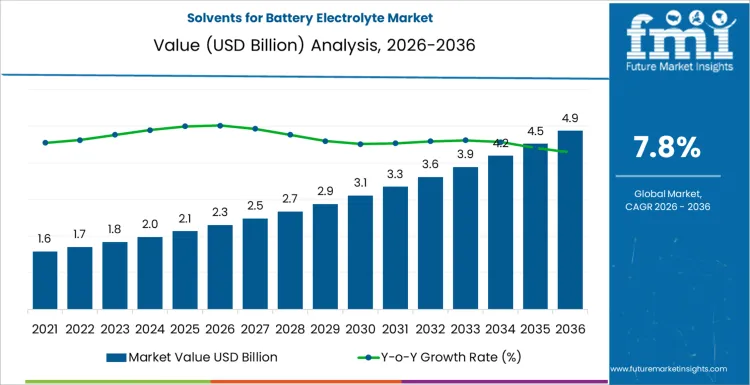
In 2026, the solvents for battery electrolyte market stands at USD 2.3 billion and is expected to expand to USD 4.9 billion by 2036 at a CAGR of 7.80%. Financial outcomes in this market are governed by production precision rather than capacity alone. High-purity processing requirements introduce elevated fixed costs that concentrate margins among technically advanced producers. Although carbonate solvents are widely produced, electrolyte-grade specifications materially narrow the competitive field.
Pricing leverage is maintained through long-term offtake agreements that prioritize supply security over short-term cost optimization. Buyer behavior is characterized by conservative qualification protocols, where electrolyte changes carry direct performance and safety risks. As a result, vendor substitution is limited once a solvent system is approved. Over the forecast period, value accrual favors incumbents with entrenched customer relationships and validated quality systems, while incremental volume growth delivers comparatively weaker returns to non-qualified or peripheral suppliers.
Quick Stats for Solvents for Battery Electrolyte Market
- Solvents for Battery Electrolyte Market Value (2026): USD 2.3 Billion
- Solvents for Battery Electrolyte Market Forecast Value (2036): USD 4.9 Billion
- Solvents for Battery Electrolyte Market Forecast CAGR 2026 to 2036: 7.80%
- Leading Battery Chemistry in Solvents for Battery Electrolyte Market: Conventional Lithium-Ion Chemistries (66% share)
- Key Growth Regions in Solvents for Battery Electrolyte Market: Asia Pacific, Europe, North America, Latin America, Middle East & Africa
- Top Key Players in Solvents for Battery Electrolyte Market: Mitsubishi Chemical Group, UBE Corporation, Mitsui Chemicals, Shenzhen Capchem Technology, Shandong Shida Shenghua Chemical Group, BASF SE, Lotte Chemical, Kureha Corporation, LCY Chemical Corp., LG Chem Ltd.
Solvents for Battery Electrolyte Market Key Takeaways
| Metric | Value |
|---|---|
| Solvents for Battery Electrolyte Market Value (2026) | USD 2.3 Billion |
| Solvents for Battery Electrolyte Market Forecast Value (2036) | USD 4.9 Billion |
| Solvents for Battery Electrolyte Market Forecast CAGR 2026 to 2036 | 7.80% |
How are Battery Performance, Safety, and Fast-Charging Requirements Driving the Solvents for Battery Electrolyte Market?
The solvents for battery electrolyte market is expanding as lithium-ion and next-generation battery technologies push for higher energy density, faster charging, and improved operational safety. Electrolyte solvents play a critical role in ion transport, electrode interface stability, and thermal behavior within battery cells. Growth in electric vehicles, energy storage systems, and portable electronics is increasing demand for solvent systems that support wide electrochemical stability windows while maintaining low viscosity and high dielectric constants. As battery manufacturers scale production, solvent consistency and purity are becoming central to cell performance and reliability.
Formulation optimization and compatibility with evolving battery chemistries are key factors influencing solvent selection. End users evaluate electrolyte solvents based on ionic conductivity, temperature performance, and interaction with lithium salts and electrode materials. Carbonate-based solvents such as ethylene carbonate, dimethyl carbonate, and diethyl carbonate remain widely used, while emerging co-solvents and fluorinated formulations are being adopted to improve cycle life and high-voltage stability. The ability of solvents to support stable solid electrolyte interphase (SEI) formation is particularly important for fast-charging batteries and high-nickel cathode systems.
Regulatory requirements and supply chain considerations are further shaping market dynamics. Safety standards related to flammability, toxicity, and thermal runaway mitigation are driving innovation in solvent chemistry, including the development of low-flammability and high-purity formulations. At the same time, battery manufacturers are prioritizing secure, scalable supply of electrolyte-grade solvents to support gigafactory expansion. For solvent producers, competitive advantage increasingly depends on high-purity production capabilities, close collaboration with battery developers, and the ability to tailor solvent systems for next-generation battery platforms positioning electrolyte solvents as a critical input in the global energy storage ecosystem.
How is Demand Distributed across Battery Chemistries and End-Use Applications in the Solvents for Battery Electrolyte Market?
The solvents for battery electrolytes market is categorized by battery chemistry and end-use application, highlighting how electrolyte formulation requirements differ by cell design and usage profile. By battery chemistry, conventional lithium-ion systems dominate consumption, reflecting their widespread deployment across mobility and electronics platforms. High-voltage and high-nickel systems, along with next-generation and specialty chemistries, represent smaller but technically demanding segments. By end-use application, EV and xEV batteries account for the largest share, followed by consumer and IT batteries, stationary storage, and other niche uses where electrolyte stability and performance consistency are critical.
Why Do Conventional Li-Ion Chemistries Dominate Solvent Consumption In The Battery Electrolyte Market?
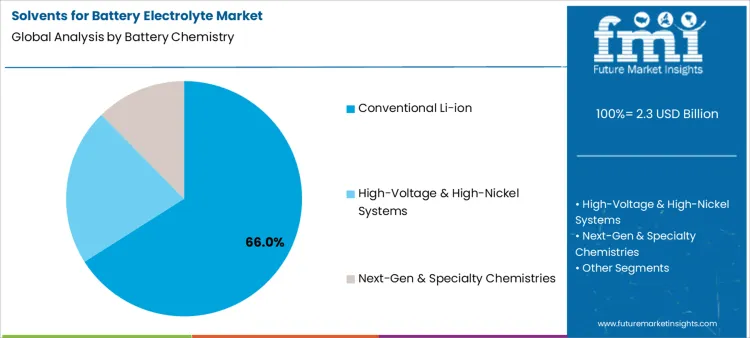
Conventional lithium-ion chemistries account for 66% share of the solvents for battery electrolyte market because they remain the dominant platform for large-scale commercial battery production. These chemistries rely on proven carbonate-based solvent systems that deliver stable ionic conductivity, reliable cycle life, and predictable electrochemical behavior. Battery manufacturers prefer established solvent blends because they are fully validated across safety, performance, and manufacturing parameters. Mature global supply chains and standardized formulations reduce qualification risk and support high-volume cell production. Conventional lithium-ion batteries are widely used across electric vehicles, consumer electronics, and industrial applications, driving sustained solvent demand. This combination of technological maturity, manufacturing scale, and reliability explains why conventional lithium-ion chemistries consume the majority of electrolyte solvents.
Why Do EV And xEV Batteries Represent the Largest End-Use Segment for Battery Electrolyte Solvents?
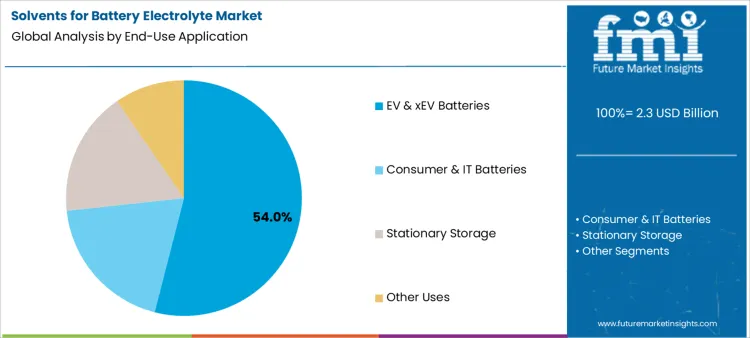
EV and xEV batteries hold 54% share of the solvents for battery electrolyte market because electric vehicle battery packs require significantly larger electrolyte volumes than consumer electronics. Each vehicle battery contains hundreds to thousands of cells, increasing solvent usage per unit produced. Automakers demand electrolyte formulations that support long cycle life, fast charging capability, and thermal stability under high load conditions. Rising electric vehicle production volumes directly translate into higher solvent consumption at gigafactory scale. Expansion of battery manufacturing capacity across regions further amplifies demand. These volume-intensive production characteristics and strict performance requirements explain why EV and xEV batteries remain the leading end-use segment for electrolyte solvents.
What Are the Key Dynamics of the Solvents for Battery Electrolyte Market?
The solvents for battery electrolyte market is driven by rapid growth in lithium-ion battery production for electric vehicles, energy storage systems, and consumer electronics. Electrolyte solvents such as carbonates, ethers, and emerging solvent systems enable ion transport between electrodes while influencing battery safety, energy density, cycle life, and low-temperature performance. Increasing demand for higher-performing and safer batteries is pushing solvent selection toward formulations that balance electrochemical stability, conductivity, and compatibility with advanced electrode materials. For electrolyte suppliers and cell manufacturers, solvent purity, consistency, thermal stability, and supply reliability are key factors influencing material qualification and long-term procurement.
How Do Application Trends and Industry Requirements Shape This Market?
Application trends and industry requirements are shaping the solvents for battery electrolyte market as battery chemistries evolve toward higher voltage, higher energy density, and faster charging performance. In electric vehicle batteries, solvents must support wide operating temperature ranges while minimizing degradation and gas generation. Energy storage systems require long cycle life and thermal robustness, driving demand for solvent blends optimized for stability and safety. Growth in silicon-rich anodes and high-nickel cathodes increases the need for solvents that form stable solid electrolyte interphases and resist oxidative decomposition. Manufacturers prioritize solvents compatible with existing electrolyte formulations and scalable production processes to ensure cost-effective deployment.
Why Do Safety, Stability, and Qualification Challenges Restrain Market Growth?
Safety, stability, and qualification challenges restrain growth in the solvents for battery electrolyte market due to the stringent performance and regulatory requirements of battery systems. Many conventional solvents are flammable and sensitive to moisture, requiring careful handling and high-purity processing environments. Introducing new solvent chemistries involves extensive testing for electrochemical stability, compatibility with cell components, and long-term cycling performance. Lengthy qualification cycles, combined with conservative risk management by battery manufacturers, slow adoption of novel solvents despite potential performance advantages. Supply chain constraints and price volatility for high-purity solvents further add to procurement and scaling challenges.
How is the Solvents for Battery Electrolyte Market Growing across Key Countries?
The solvents for battery electrolyte market is expanding steadily as lithium-ion battery production scales across electric vehicles, energy storage systems, and consumer electronics. Electrolyte solvents such as carbonates and advanced co-solvent blends-play a critical role in ion transport, electrochemical stability, and battery safety. Country-wise growth varies depending on battery cell manufacturing capacity, EV penetration, and investment in localized battery supply chains. High-growth markets are driven by rapid cell capacity additions and platform upgrades, while mature regions focus on solvent purity, consistency, and compatibility with next-generation battery chemistries.
| Country | CAGR (%) |
|---|---|
| China | 9.0 |
| Brazil | 8.6 |
| USA | 7.5 |
| Germany | 7.4 |
| South Korea | 7.0 |
Why is China Leading the Solvents for Battery Electrolyte Market?
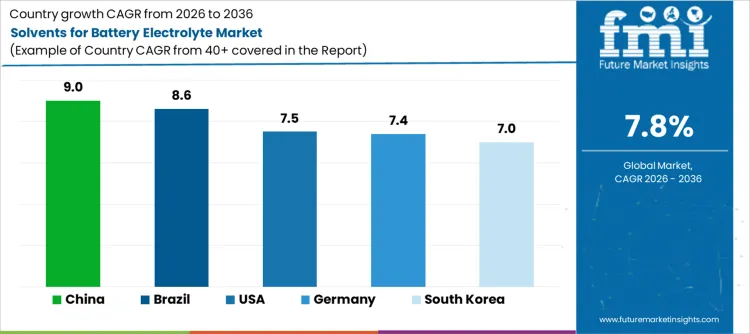
China’s solvents for battery electrolyte market is expanding at a CAGR of 9.0% during 2026 to 2036, driven by the country’s dominant position in lithium-ion battery cell manufacturing. Large-scale production of EV batteries, stationary energy storage systems, and consumer electronics batteries continues to generate strong demand for high-purity electrolytes solvents. Growth is particularly strong in carbonate solvents used in lithium-ion chemistries supporting fast charging and high energy density. Chinese battery manufacturers prioritize solvents with low moisture content, stable electrochemical windows, and consistent impurity control to ensure cell safety and cycle life. Domestic chemical producers benefit from close integration with battery manufacturers, enabling rapid scale-up and localized supply. As battery designs evolve toward higher nickel cathodes and silicon-enhanced anodes, solvent formulation complexity is increasing. Procurement decisions emphasize solvent purity, supply reliability, and compatibility with evolving electrolyte formulations.
Why is Brazil Emerging as a High-Growth Market for Battery Electrolyte Solvents?
Brazil’s solvents for battery electrolyte market is growing at a CAGR of 8.6% during 2026 to 2036, supported by increasing investment in EV assembly, energy storage projects, and localized battery pack manufacturing. While Brazil does not yet host large-scale cell manufacturing comparable to Asia, demand is rising for electrolyte solvents used in battery assembly, module integration, and stationary storage systems. Brazilian buyers value solvents that deliver stable electrochemical performance and compatibility with widely used lithium-ion chemistries. Adoption is strongest in grid-scale storage, electric buses, and emerging EV supply chains serving domestic and regional markets. Cost efficiency and supply availability remain important considerations. Procurement decisions often favor suppliers with regional distribution capabilities and technical support for electrolyte formulation. Market growth is supported by gradual expansion of battery manufacturing activity, increasing deployment of renewable-linked energy storage, and rising adoption of electrified transportation.
What is Driving Demand for Battery Electrolyte Solvents in the United States?
The United States solvents for battery electrolyte market is expanding at a CAGR of 7.5% during 2026 to 2036, driven by rapid growth in domestic battery manufacturing and EV production. Large investments in gigafactories and energy storage systems are increasing demand for high-purity electrolyte solvents used in advanced lithium-ion batteries. USA. battery producers emphasize solvent consistency, ultra-low moisture levels, and reliable supply chains to support high-volume cell production. Demand is strongest in EV batteries and stationary storage systems designed for long cycle life and high safety standards. Solvent selection is closely linked to performance requirements and qualification timelines. Procurement decisions prioritize long-term supply agreements, technical documentation, and compliance with battery manufacturing standards. Market growth is reinforced by continued expansion of domestic battery capacity and integration of localized electrolyte supply chains.
How is Germany Supporting Growth in the Solvents for Battery Electrolyte Market?
Germany’s solvents for battery electrolyte market is growing at a CAGR of 7.4% during 2026 to 2036, supported by strong demand from EV battery manufacturing and automotive electrification. German battery producers focus on precision manufacturing, safety, and long-term performance, driving demand for high-quality electrolyte solvents. Buyers prioritize solvents with consistent purity, controlled impurity profiles, and compatibility with advanced cathode and anode materials. Demand is concentrated in automotive battery cells and premium EV platforms rather than mass-volume consumer electronics. Procurement decisions favor suppliers with certified quality systems, detailed technical validation, and reliable European supply. Market growth is reinforced by Germany’s leadership in automotive engineering and continued investment in battery production infrastructure.
How is South Korea Expanding Use of Solvents for Battery Electrolytes?
South Korea’s solvents for battery electrolyte market is expanding at a CAGR of 7.0% during 2026 to 2036, driven by strong demand from global battery manufacturers supplying EV and energy storage markets. South Korean producers are leaders in high-energy-density lithium-ion batteries, requiring precise electrolyte solvent formulations. Buyers emphasize solvent purity, electrochemical stability, and compatibility with fast-charging battery designs. Adoption is strongest in export-oriented battery production serving automotive OEMs worldwide. Procurement decisions are influenced by supplier reliability, ability to meet tight quality specifications, and consistency across large production volumes. Market growth is supported by continued expansion of battery manufacturing capacity and ongoing innovation in electrolyte formulations.
How Are Companies Competing in the Solvents for Battery Electrolyte Market?
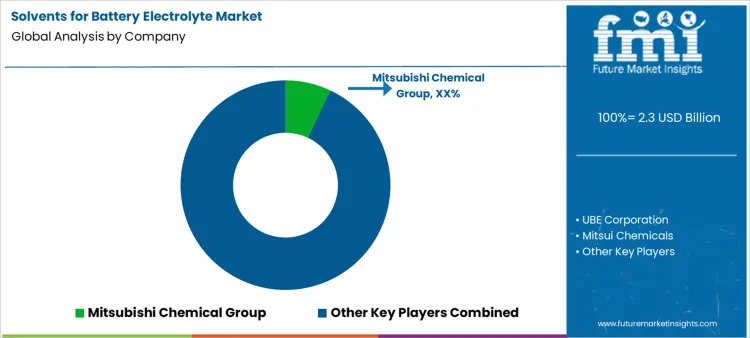
Competition in the solvents for battery electrolyte market is driven by purity, low impurity footprints (especially water and metal ions), and compatibility with high-energy lithium-ion chemistries attributes that matter to battery cell makers, EV OEMs, and energy storage system designers. Electrolyte solvents must enable high ionic conductivity, thermal stability, and wide electrochemical windows without facilitating unwanted side reactions. Mitsubishi Chemical Group positions its battery solvent portfolio with product literature that emphasizes ultra-low impurity levels and consistent supply quality, supporting high-capacity cathode materials and fast-charging regimes. UBE Corporation competes through high-purity carbonate solvents tailored for demanding cell formulations, highlighting strict moisture control and reproducible transport properties.
Japanese and broader Asian chemical producers differentiate through advanced processing and large-scale capacity. Mitsui Chemicals focuses on consistent solvent performance across multi-layer cathode systems, while Kureha Corporation emphasizes polymerizable and high-stability solvent platforms that support next-generation electrolytes. LG Chem Ltd. leverages integrated cell production experience to align solvent specifications with overall cell design, promoting tailored performance for high-energy and long-life battery applications.
Emerging and regional players add competitive breadth with targeted formulations and cost-effective supply. Shenzhen Capchem Technology and Shandong Shida Shenghua Chemical Group compete through scalable carbonate and ester solvent lines optimized for Chinese battery supply chains. BASF SE brings global scale and formulation expertise to support diverse cell chemistries. Lotte Chemical and LCY Chemical Corp. differentiate through consistent quality and regional supply reliability. Across suppliers, competitive advantage is defined by ultra-high purity, solvent stability under cell conditions, and alignment with evolving battery performance targets rather than price alone.
Key Players in Solvents for Battery Electrolyte Market
- Mitsubishi Chemical Group
- UBE Corporation
- Mitsui Chemicals
- Shenzhen Capchem Technology
- Shandong Shida Shenghua Chemical Group
- BASF SE
- Lotte Chemical
- Kureha Corporation
- LCY Chemical Corp.
- LG Chem Ltd.
Scope of Report
| Attribute | Details |
|---|---|
| Market Size Unit | USD Billion |
| Battery Chemistry Covered | Conventional Li-ion, High-Voltage & High-Nickel Systems, Next-Gen & Specialty Chemistries |
| End-Use Application Covered | EV & xEV Batteries, Consumer & IT Batteries, Stationary Storage, Other Uses |
| Countries Covered | China, Japan, South Korea, India, Australia & New Zealand, ASEAN, Rest of Asia Pacific, Germany, United Kingdom, France, Italy, Spain, Nordic, BENELUX, Rest of Europe, United States, Canada, Mexico, Brazil, Chile, Rest of Latin America, Kingdom of Saudi Arabia, Other GCC Countries, Turkey, South Africa, Other African Union, Rest of Middle East & Africa |
| Regions Covered | Asia Pacific, Europe, North America, Latin America, Middle East & Africa |
| Key Companies Profiled | Mitsubishi Chemical Group, UBE Corporation, Mitsui Chemicals, Shenzhen Capchem Technology, Shandong Shida Shenghua Chemical Group, BASF SE, Lotte Chemical, Kureha Corporation, LCY Chemical Corp., LG Chem Ltd. |
| Additional Attributes | Dollar sales of battery electrolyte solvents are analyzed by battery chemistry and end-use application across automotive, consumer electronics, and stationary energy storage systems. The scope evaluates solvent purity, electrochemical stability window, dielectric constant, viscosity, and compatibility with lithium salts and advanced additives. Country-level analysis reflects EV production growth, battery manufacturing capacity expansion, safety and performance regulations, and the shift toward high-voltage, high-energy-density, and next-generation battery technologies. |
Solvents for Battery Electrolyte Market by Key Segments
Battery Chemistry
- Conventional Li-ion
- High-Voltage & High-Nickel Systems
- Next-Gen & Specialty Chemistries
End-Use Application
- EV & xEV Batteries
- Consumer & IT Batteries
- Stationary Storage
- Other Uses
Region
- Asia Pacific
- China
- Japan
- South Korea
- India
- Australia & New Zealand
- ASEAN
- Rest of Asia Pacific
- Europe
- Germany
- United Kingdom
- France
- Italy
- Spain
- Nordic
- BENELUX
- Rest of Europe
- North America
- United States
- Canada
- Mexico
- Latin America
- Brazil
- Chile
- Rest of Latin America
- Middle East & Africa
- Kingdom of Saudi Arabia
- Other GCC Countries
- Turkey
- South Africa
- Other African Union
- Rest of Middle East & Africa
Bibliography
- International Energy Agency. (2023). Global EV outlook 2023: Catching up with climate ambitions. IEA.
- International Energy Agency. (2024). Energy storage market report 2024. IEA.
- Zhang, Z., et al. (2024). Carbonate‑based electrolyte solvents for high‑energy lithium‑ion batteries: Stability and safety considerations.
- International Organization for Standardization. (2024). Road vehicles - Rechargeable energy storage systems - Safety requirements (ISO 6469‑1:2024). ISO.
- National Renewable Energy Laboratory. (2024). Advanced electrolyte materials for lithium‑ion batteries. USA. Department of Energy.
Frequently Asked Questions
How big is the solvents for battery electrolyte market in 2026?
The global solvents for battery electrolyte market is estimated to be valued at USD 2.3 billion in 2026.
What will be the size of solvents for battery electrolyte market in 2036?
The market size for the solvents for battery electrolyte market is projected to reach USD 4.9 billion by 2036.
How much will be the solvents for battery electrolyte market growth between 2026 and 2036?
The solvents for battery electrolyte market is expected to grow at a 7.8% CAGR between 2026 and 2036.
What are the key product types in the solvents for battery electrolyte market?
The key product types in solvents for battery electrolyte market are conventional li-ion, high-voltage & high-nickel systems and next-gen & specialty chemistries.
Which end-use application segment to contribute significant share in the solvents for battery electrolyte market in 2026?
In terms of end-use application, ev & xev batteries segment to command 54.0% share in the solvents for battery electrolyte market in 2026.
Preview the report firsthand - request a free sample
Get SampleGet the brochure for pricing and purchase details.
Get PDFTable of Content
- Executive Summary
- Global Market Outlook
- Demand-side Trends
- Supply-side Trends
- Technology Roadmap Analysis
- Analysis and Recommendations
- Market Overview
- Market Coverage / Taxonomy
- Market Definition / Scope / Limitations
- Market Background
- Market Dynamics
- Drivers
- Restraints
- Opportunity
- Trends
- Scenario Forecast
- Demand in Optimistic Scenario
- Demand in Likely Scenario
- Demand in Conservative Scenario
- Opportunity Map Analysis
- Product Life Cycle Analysis
- Supply Chain Analysis
- Investment Feasibility Matrix
- Value Chain Analysis
- PESTLE and Porter’s Analysis
- Regulatory Landscape
- Regional Parent Market Outlook
- Production and Consumption Statistics
- Import and Export Statistics
- Market Dynamics
- Global Market Analysis 2021 to 2025 and Forecast, 2026 to 2036
- Historical Market Size Value (USD Million) Analysis, 2021 to 2025
- Current and Future Market Size Value (USD Million) Projections, 2026 to 2036
- Y-o-Y Growth Trend Analysis
- Absolute $ Opportunity Analysis
- Global Market Pricing Analysis 2021 to 2025 and Forecast 2026 to 2036
- Global Market Analysis 2021 to 2025 and Forecast 2026 to 2036, By Battery Chemistry
- Introduction / Key Findings
- Historical Market Size Value (USD Million) Analysis By Battery Chemistry, 2021 to 2025
- Current and Future Market Size Value (USD Million) Analysis and Forecast By Battery Chemistry, 2026 to 2036
- Conventional Li-ion
- High-Voltage & High-Nickel Systems
- Next-Gen & Specialty Chemistries
- Conventional Li-ion
- Y-o-Y Growth Trend Analysis By Battery Chemistry, 2021 to 2025
- Absolute $ Opportunity Analysis By Battery Chemistry, 2026 to 2036
- Global Market Analysis 2021 to 2025 and Forecast 2026 to 2036, By End-Use Application
- Introduction / Key Findings
- Historical Market Size Value (USD Million) Analysis By End-Use Application, 2021 to 2025
- Current and Future Market Size Value (USD Million) Analysis and Forecast By End-Use Application, 2026 to 2036
- EV & xEV Batteries
- Consumer & IT Batteries
- Stationary Storage
- Other Uses
- EV & xEV Batteries
- Y-o-Y Growth Trend Analysis By End-Use Application, 2021 to 2025
- Absolute $ Opportunity Analysis By End-Use Application, 2026 to 2036
- Global Market Analysis 2021 to 2025 and Forecast 2026 to 2036, By Region
- Introduction
- Historical Market Size Value (USD Million) Analysis By Region, 2021 to 2025
- Current Market Size Value (USD Million) Analysis and Forecast By Region, 2026 to 2036
- North America
- Latin America
- Western Europe
- Eastern Europe
- East Asia
- South Asia and Pacific
- Middle East & Africa
- Market Attractiveness Analysis By Region
- North America Market Analysis 2021 to 2025 and Forecast 2026 to 2036, By Country
- Historical Market Size Value (USD Million) Trend Analysis By Market Taxonomy, 2021 to 2025
- Market Size Value (USD Million) Forecast By Market Taxonomy, 2026 to 2036
- By Country
- USA
- Canada
- Mexico
- By Battery Chemistry
- By End-Use Application
- By Country
- Market Attractiveness Analysis
- By Country
- By Battery Chemistry
- By End-Use Application
- Key Takeaways
- Latin America Market Analysis 2021 to 2025 and Forecast 2026 to 2036, By Country
- Historical Market Size Value (USD Million) Trend Analysis By Market Taxonomy, 2021 to 2025
- Market Size Value (USD Million) Forecast By Market Taxonomy, 2026 to 2036
- By Country
- Brazil
- Chile
- Rest of Latin America
- By Battery Chemistry
- By End-Use Application
- By Country
- Market Attractiveness Analysis
- By Country
- By Battery Chemistry
- By End-Use Application
- Key Takeaways
- Western Europe Market Analysis 2021 to 2025 and Forecast 2026 to 2036, By Country
- Historical Market Size Value (USD Million) Trend Analysis By Market Taxonomy, 2021 to 2025
- Market Size Value (USD Million) Forecast By Market Taxonomy, 2026 to 2036
- By Country
- Germany
- UK
- Italy
- Spain
- France
- Nordic
- BENELUX
- Rest of Western Europe
- By Battery Chemistry
- By End-Use Application
- By Country
- Market Attractiveness Analysis
- By Country
- By Battery Chemistry
- By End-Use Application
- Key Takeaways
- Eastern Europe Market Analysis 2021 to 2025 and Forecast 2026 to 2036, By Country
- Historical Market Size Value (USD Million) Trend Analysis By Market Taxonomy, 2021 to 2025
- Market Size Value (USD Million) Forecast By Market Taxonomy, 2026 to 2036
- By Country
- Russia
- Poland
- Hungary
- Balkan & Baltic
- Rest of Eastern Europe
- By Battery Chemistry
- By End-Use Application
- By Country
- Market Attractiveness Analysis
- By Country
- By Battery Chemistry
- By End-Use Application
- Key Takeaways
- East Asia Market Analysis 2021 to 2025 and Forecast 2026 to 2036, By Country
- Historical Market Size Value (USD Million) Trend Analysis By Market Taxonomy, 2021 to 2025
- Market Size Value (USD Million) Forecast By Market Taxonomy, 2026 to 2036
- By Country
- China
- Japan
- South Korea
- By Battery Chemistry
- By End-Use Application
- By Country
- Market Attractiveness Analysis
- By Country
- By Battery Chemistry
- By End-Use Application
- Key Takeaways
- South Asia and Pacific Market Analysis 2021 to 2025 and Forecast 2026 to 2036, By Country
- Historical Market Size Value (USD Million) Trend Analysis By Market Taxonomy, 2021 to 2025
- Market Size Value (USD Million) Forecast By Market Taxonomy, 2026 to 2036
- By Country
- India
- ASEAN
- Australia & New Zealand
- Rest of South Asia and Pacific
- By Battery Chemistry
- By End-Use Application
- By Country
- Market Attractiveness Analysis
- By Country
- By Battery Chemistry
- By End-Use Application
- Key Takeaways
- Middle East & Africa Market Analysis 2021 to 2025 and Forecast 2026 to 2036, By Country
- Historical Market Size Value (USD Million) Trend Analysis By Market Taxonomy, 2021 to 2025
- Market Size Value (USD Million) Forecast By Market Taxonomy, 2026 to 2036
- By Country
- Kingdom of Saudi Arabia
- Other GCC Countries
- Turkiye
- South Africa
- Other African Union
- Rest of Middle East & Africa
- By Battery Chemistry
- By End-Use Application
- By Country
- Market Attractiveness Analysis
- By Country
- By Battery Chemistry
- By End-Use Application
- Key Takeaways
- Key Countries Market Analysis
- USA
- Pricing Analysis
- Market Share Analysis, 2025
- By Battery Chemistry
- By End-Use Application
- Canada
- Pricing Analysis
- Market Share Analysis, 2025
- By Battery Chemistry
- By End-Use Application
- Mexico
- Pricing Analysis
- Market Share Analysis, 2025
- By Battery Chemistry
- By End-Use Application
- Brazil
- Pricing Analysis
- Market Share Analysis, 2025
- By Battery Chemistry
- By End-Use Application
- Chile
- Pricing Analysis
- Market Share Analysis, 2025
- By Battery Chemistry
- By End-Use Application
- Germany
- Pricing Analysis
- Market Share Analysis, 2025
- By Battery Chemistry
- By End-Use Application
- UK
- Pricing Analysis
- Market Share Analysis, 2025
- By Battery Chemistry
- By End-Use Application
- Italy
- Pricing Analysis
- Market Share Analysis, 2025
- By Battery Chemistry
- By End-Use Application
- Spain
- Pricing Analysis
- Market Share Analysis, 2025
- By Battery Chemistry
- By End-Use Application
- France
- Pricing Analysis
- Market Share Analysis, 2025
- By Battery Chemistry
- By End-Use Application
- India
- Pricing Analysis
- Market Share Analysis, 2025
- By Battery Chemistry
- By End-Use Application
- ASEAN
- Pricing Analysis
- Market Share Analysis, 2025
- By Battery Chemistry
- By End-Use Application
- Australia & New Zealand
- Pricing Analysis
- Market Share Analysis, 2025
- By Battery Chemistry
- By End-Use Application
- China
- Pricing Analysis
- Market Share Analysis, 2025
- By Battery Chemistry
- By End-Use Application
- Japan
- Pricing Analysis
- Market Share Analysis, 2025
- By Battery Chemistry
- By End-Use Application
- South Korea
- Pricing Analysis
- Market Share Analysis, 2025
- By Battery Chemistry
- By End-Use Application
- Russia
- Pricing Analysis
- Market Share Analysis, 2025
- By Battery Chemistry
- By End-Use Application
- Poland
- Pricing Analysis
- Market Share Analysis, 2025
- By Battery Chemistry
- By End-Use Application
- Hungary
- Pricing Analysis
- Market Share Analysis, 2025
- By Battery Chemistry
- By End-Use Application
- Kingdom of Saudi Arabia
- Pricing Analysis
- Market Share Analysis, 2025
- By Battery Chemistry
- By End-Use Application
- Turkiye
- Pricing Analysis
- Market Share Analysis, 2025
- By Battery Chemistry
- By End-Use Application
- South Africa
- Pricing Analysis
- Market Share Analysis, 2025
- By Battery Chemistry
- By End-Use Application
- USA
- Market Structure Analysis
- Competition Dashboard
- Competition Benchmarking
- Market Share Analysis of Top Players
- By Regional
- By Battery Chemistry
- By End-Use Application
- Competition Analysis
- Competition Deep Dive
- Mitsubishi Chemical Group
- Overview
- Product Portfolio
- Profitability by Market Segments (Product/Age /Sales Channel/Region)
- Sales Footprint
- Strategy Overview
- Marketing Strategy
- Product Strategy
- Channel Strategy
- UBE Corporation
- Mitsui Chemicals
- Shenzhen Capchem Technology
- Shandong Shida Shenghua Chemical Group
- BASF SE
- Lotte Chemical
- Kureha Corporation
- LCY Chemical Corp.
- LG Chem Ltd.
- Mitsubishi Chemical Group
- Competition Deep Dive
- Assumptions & Acronyms Used
- Research Methodology


