

- Market Size (2026)
- USD 0.3 Bn
- Forecast (2036)
- USD 2.0 Bn
- CAGR (2026 to 2036)
- 21.2%
Additively Manufactured Drivetrain Brackets and Housings Market Size, Forecast, and Outlook By FMI
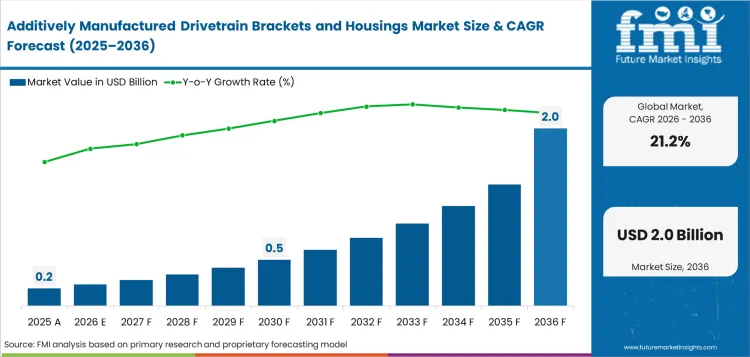
In 2025, the additively manufactured drivetrain brackets and housings market value stood at USD 0.2 billion and is forecast to reach USD 0.3 billion in 2026. Industry is forecast to reach USD 2.0 billion by 2036 at 21.2% CAGR.
Summary of Additively Manufactured Drivetrain Brackets and Housings Market
- Demand and Growth Drivers
- EV drive units need compact mounting and heat path designs for dense underbody packaging.
- Lightweighting economics improve as printed brackets combine ribs and mounting points into fewer machined pieces.
- Qualification demand is rising as ISO and ASTM metal AM rules improve confidence in finished part testing.
- Product and Segment View
- Drivetrain brackets are forecast to represent 54.0% share in 2026, as mounting parts enter print qualification before housings.
- Aluminum alloys are forecast to hold 56.0% share in 2026 as EV programs value lower mass around drive modules.
- OEM programs are forecast to capture 82.0% share in 2026 as drivetrain parts need design authority and validation records.
- Geography and Competitive Outlook
- China is forecast to record 23.5% CAGR by 2036 as EV output and local metal AM capacity support pilot production.
- India is forecast to expand at 22.8% CAGR by 2036, led by local EV programs raising demand for qualified lightweight parts.
- EOS GmbH and 3D Systems influence platform supply, and BMW Group shows how captive AM centers test vehicle part pathways.
- Analyst Opinion
- Nikhil Kaitwade, Principal Consultant for Industrial Automation at FMI, observes, “Drivetrain brackets and housings will transition to additive manufacturing when tangible performance gains outweigh legacy manufacturing comfort. Program interest emerges the moment weight reduction and proven qualification appear within one reliable part file. Suppliers who can consistently deliver repeatable metal properties will lead the next phase of automotive metal printing.”
- Additively Manufactured Drivetrain Brackets and Housings Market Value Analysis
- Market value is estimated to rise from prototype brackets toward low-volume drivetrain programs with documented load cases.
- OEM spending is tied to laser capacity and post-print machining as bracket flatness affects assembly fit.
- Formed and cast parts remain cost benchmarks, so printed parts must justify value through consolidation and weight savings.
- Demand is supported by EV powertrain and electric vehicle drive motor programs needing compact housings near drive modules.
Key Takeaways, Market Size, and Forecast
- The additively manufactured drivetrain brackets and housings industry was valued at USD 0.2 billion in 2025.
- By 2036, market value is forecast to rise to USD 2.0 billion.
- From 2026 to 2036, sector is forecast to expand at 21.2% CAGR.
- Industry revenue is forecast to create an incremental opportunity of USD 1.7 billion between 2026 and 2036.
- OEM programs are set to account for 82.0% share of sales channel value in 2026.
- Aluminum alloys are forecast to represent 56.0% share of material value in 2026.
- China is forecast to expand at 23.5% CAGR by 2036. India follows at 22.8% CAGR across the forecast period.
Weight and stiffness requirements are pushing drivetrain engineers beyond traditional cast housings and machined brackets, especially in specialized EV programs. A 2025 World Electric Vehicle Journal study showed that an optimized additively manufactured gearbox housing can achieve around 21% weight reduction, although with a slight 5% increase in torsional deformation. This highlights how 3D‑printed components can deliver meaningful weight savings while maintaining acceptable structural performance for defined load applications.
Industry examples reinforce this trend. In June 2024, Bugatti reported a 45% reduction in suspension weight using 3D‑printed aluminum arms and uprights, demonstrating the viability of additive manufacturing for load‑bearing automotive structures. Such proven use cases provide OEM engineers greater confidence in adopting these technologies.
Additively Manufactured Drivetrain Brackets and Housings Market Definition
Scope covers metal and reinforced polymer drivetrain brackets. Scope covers motor housings and e-axle carriers made by additive manufacturing. Gearbox housings are included if the printed part carries drivetrain load. Revenue includes printed parts sold to vehicle OEMs and Tier 1 driveline suppliers. Finishing steps such as heat treatment and machining are included if sold with the printed part.
Additively Manufactured Drivetrain Brackets and Housings Market Inclusions
Scope includes powder bed fusion and directed energy deposition routes used for drivetrain brackets and housings. Binder jetting and hybrid print machining routes are included for qualified metal parts. Aluminum and steel parts are included. Titanium parts are included for premium or motorsport programs. Polymer composite brackets are included only if fitted around drivetrain or powertrain systems. Captive OEM production is counted at internal transfer value if part volumes can be estimated.
Additively Manufactured Drivetrain Brackets and Housings Market Exclusions
Scope excludes prototype styling parts and non-drivetrain brackets. Tooling jigs and robot grippers are excluded unless used as evidence for production readiness. Conventional cast housings, stamped brackets and machined billet parts are excluded unless additive manufacturing creates the near-net part. Engine internals and battery enclosures sit outside core scope.
Additively Manufactured Drivetrain Brackets and Housings Market Research Methodology
- Primary Research: FMI analysts reviewed metal AM service models, drivetrain supplier qualification steps and OEM part approval workflows.
- Desk Research: Official vehicle output data, AM standards and company announcements were used to validate addressable production signals.
- Market Sizing and Forecasting: Forecasts were checked using both top-down data from automotive 3D printing and bottom-up estimates of part values.
- Data Validation: Checks compared printer capacity, vehicle output and part qualification barriers across major drivetrain manufacturing countries.
Why is the Additively Manufactured Drivetrain Brackets and Housings Market Growing?
- EV drive modules place brackets close to motors and inverters, so compact printed shapes help manage space and heat.
- Metal AM supports low-volume performance programs as part changes can integrate through digital files before costly tooling.
- Vehicle weight targets support printed brackets and housings as automakers look for lighter drivetrain parts with tested strength.
Metal additive manufacturing adoption is rising as part strength and process control improve. National Institute of Standards and Technology stated in November 2024 that powder bed fusion builds metal parts by melting and fusing powder layers with a laser or electron beam. ANSI and America Makes reported in April 2026 that additive manufacturing still has 141.0 standardization gaps across lifecycle areas. Qualification remains a cost barrier for drivetrain brackets and housings. Suppliers with process records and machining proof have clearer paths to OEM release work.
Electric drive layouts are drawing interest in compact bracket and housing designs. EV powertrain programs need parts placed around motors and compact drive units. A 2025 World Electric Vehicle Journal study on an electric vehicle gearbox housing reported about 21.0% weight reduction with about 5.0% greater torsional deformation. Bugatti reported in June 2024, 3D-printed aluminum suspension arms and uprights saved 45.0% suspension weight compared to Chiron. Additive manufacturing with metal powders is likely to gain early use in premium and pilot EV platforms as redesign speed and tooling cost shape sourcing decisions.
Market Segmentation Analysis
- OEM programs are forecast to capture 82.0% share in 2026, as drivetrain parts require release authority and traceable validation files.
- Aluminum alloys are forecast to account for 56.0% share in 2026 as EV and hybrid brackets need lower mass around motor mounts.
- Drivetrain brackets are forecast to hold 54.0% share in 2026 since smaller load-bearing parts qualify faster than complete housings.
- EV platforms are forecast to represent 48.0% share in 2026, as electric drive modules create new bracket and e-axle carrier needs.
- Powder bed fusion is forecast to capture 45.0% share in 2026, as brackets require precise features and repeatable dense metal properties.
Market segmentation is divided into five primary groups based on component type and manufacturing process in the first view. Material explains alloy choice and qualification burden. Vehicle platform shows whether printed parts fit EV, hybrid or performance vehicle programs. Sales channel separates OEM direct programs from specialist aftermarket and motorsport orders. Component type separates brackets from motor housings and e-axle carriers. Manufacturing process explains how suppliers balance feature detail, build size and post-print machining. Hybrid additive manufacturing machines are important for suppliers combining print and finish work.
Insights into Additively Manufactured Drivetrain Brackets and Housings Market by Component Type
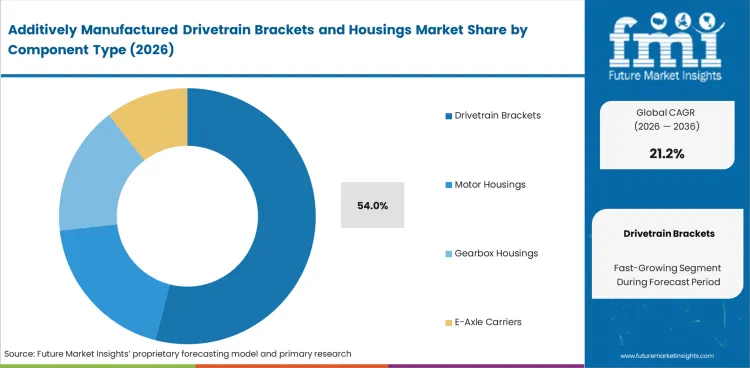
- Drivetrain brackets are forecast to account for 54.0% share in 2026 as compact mounting parts offer a lower qualification burden than sealed housings.
- Motor housings draw attention in EV programs since cooling channels and cable paths can be combined into printed geometry after validation.
Insights into Additively Manufactured Drivetrain Brackets and Housings Market by Manufacturing Process
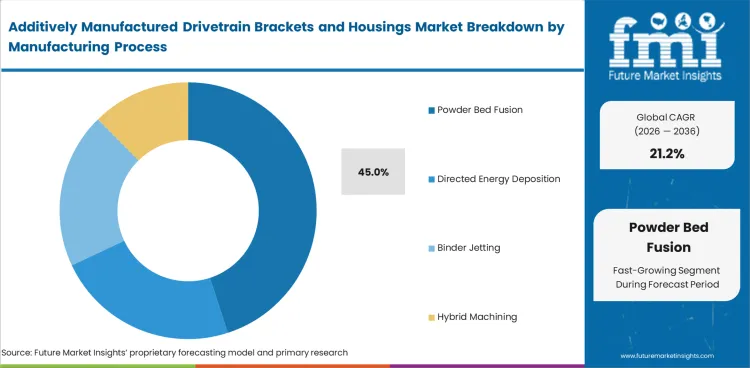
- Powder bed fusion is forecast to hold 45.0% share in 2026, led by laser-based metal printing suiting tight mounting features and thin reinforced ribs.
- Directed energy deposition is used for larger housings as wire or powder feed routes can build near-net shapes for later machining.
Insights into Additively Manufactured Drivetrain Brackets and Housings Market by Material
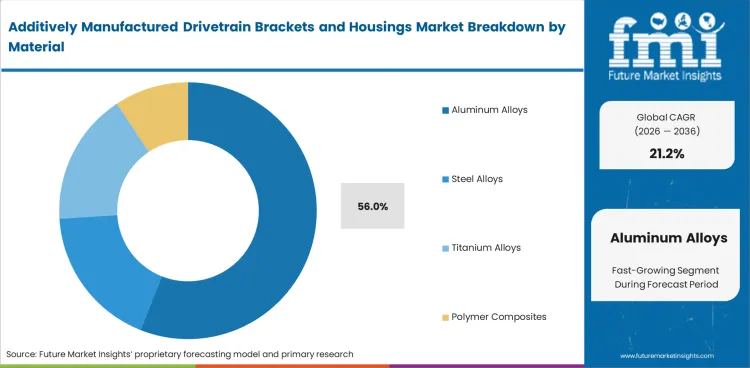
- Aluminum alloys are forecast to capture 56.0% share in 2026, as drivetrain brackets need lighter mass and useful corrosion performance.
- Steel alloys serve selective applications in bracket service as torque loads and thread durability outweigh mass saving.
Insights into Additively Manufactured Drivetrain Brackets and Housings Market by Vehicle Platform
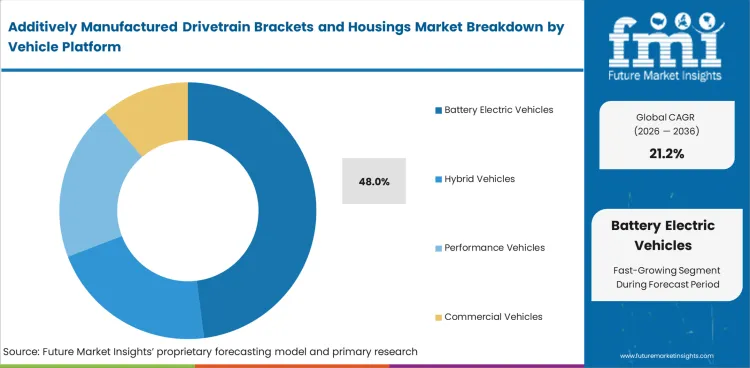
- EV platforms are forecast to account for 48.0% share in 2026 as e-drive packaging creates new brackets and compact housings.
- Performance vehicles keep printed drivetrain parts visible as low-volumes and fast design changes suit additive production economics.
Insights into Additively Manufactured Drivetrain Brackets and Housings Market by Sales Channel
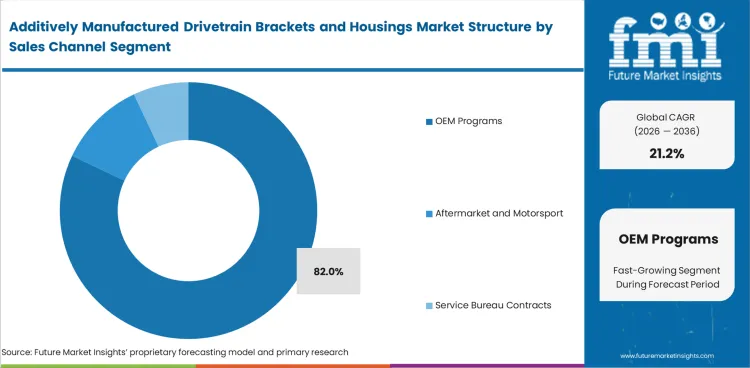
- OEM programs are forecast to account for 82.0% share in 2026 since drivetrain parts need direct engineering release and test documentation.
- Aftermarket and motorsport orders remain useful for suppliers proving bracket designs before formal vehicle platform use.
Additively Manufactured Drivetrain Brackets and Housings Market Drivers, Restraints and Opportunities
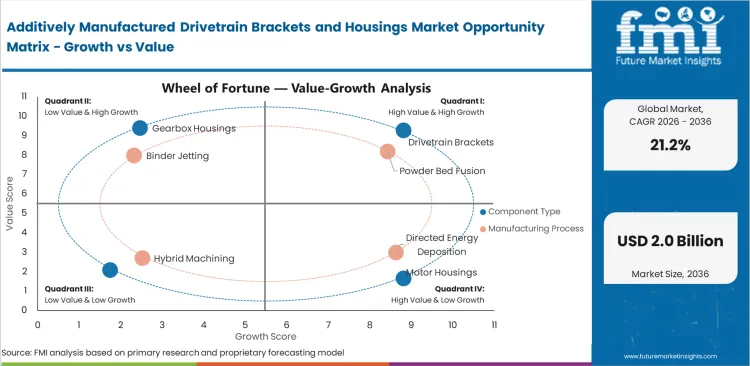
- Topology optimized mounts make printed brackets more useful as automakers seek lighter drivetrain support parts with less wasted metal.
- Qualification cost can slow housing adoption as fatigue checks and sealing tests extend release work for load-bearing vehicle parts.
- Electric vehicle e-axle growth creates room for printed carriers and brackets around compact motor gearbox units.
Growth is forecast to be driven by rising EV packaging pressure and production-ready metal AM capacity. BMW Group advanced WAAM work at its Additive Manufacturing Campus in March 2024 for metallic vehicle components and tools. EOS launched the M 290 1kW platform in March 2024 with serial production in mind. 3D Systems and Precision Resource announced a July 2024 partnership for high-criticality metal AM applications covering automotive and heavy-duty components. Company releases indicate a shift from prototype printing toward qualified production routes. Drivetrain brackets are likely to be integrated first as release work is simpler than sealed housings.
Installed Units and Replacement Cycle Analysis
Recurring qualification updates are a stronger adoption indicator compared to replacement in this sector. Printed drivetrain brackets and housings are not routine wear parts. Program demand starts once a vehicle platform approves the part file and print route. Finishing plans then complete release work through machining and inspection. Michigan recorded USD 10.5 billion in motor vehicle parts manufacturing exports in 2024, showing the scale of conventional parts competition. Deep conventional supply raises the proof burden for printed parts. AM suppliers must prove clear weight savings, part consolidation or lead time gains before program release.
Production Capacity and Supplier Footprint Analysis
Supplier footprint will depend on printer fleet depth and post-print finishing strength. Nikon opened a 90,000-square-foot AM technology center in Long Beach in July 2024 for metal AM scaling. BMW Group reported over 400,000 3D-printed parts per year across its global network in October 2024. These signals indicate how additive manufacturing with metal powders moves from lab work toward industrial supply. Automotive metal demand keeps attention on conventional alloy supply and transmission components set the cost benchmark for printed housings and brackets. Iron powder supply affects binder jetting economics for steel drivetrain hardware.
Analysis of Additively Manufactured Drivetrain Brackets and Housings Market by Key Countries
.webp "Top Country Growth Comparison Additively Manufactured Drivetrain Brackets And Housings Market Cagr (2026 2036)")
| Country | CAGR |
|---|---|
| China | 23.5% |
| India | 22.8% |
| United States | 20.4% |
| South Korea | 19.6% |
| Germany | 19.2% |
| Mexico | 18.5% |
| Japan | 17.8% |
Source: Future Market Insights, 2026.
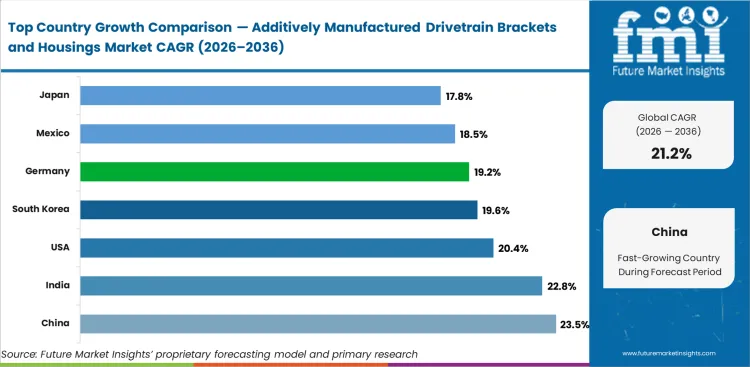
Additively Manufactured Drivetrain Brackets and Housings Market CAGR Analysis by Country
- China is forecast to record 23.5% CAGR by 2036 as EV output and local AM capacity support faster qualification work.
- India is forecast to expand at 22.8% CAGR by 2036 as EV manufacturing policy and local component programs support adoption.
- United States is forecast to expand at 20.4% CAGR by 2036 as automotive parts clusters use metal AM services.
- South Korea is forecast to advance at 19.6% CAGR by 2036 as domestic EV suppliers test compact drivetrain hardware.
- Germany is forecast to rise at 19.2% CAGR by 2036 as premium vehicle engineering and captive AM centers support adoption.
- Mexico is forecast to record 18.5% CAGR by 2036 as North American vehicle assembly creates nearshoring interest.
- Japan is forecast to post 17.8% CAGR by 2036 as quality checks keep adoption measured and technically selective.
Country performance differs by EV output and print qualification depth. China and India exceed the global rate as EV production scale creates wider test programs.
Demand Outlook for Additively Manufactured Drivetrain Brackets and Housings in China
Demand in China is forecast to record 23.5% CAGR by 2036 as new energy vehicle output creates wider programs for printed drivetrain hardware. National Bureau of Statistics data recorded 16.5 million new energy vehicles produced in 2025 with 25.1% annual growth. Production scale gives suppliers a clear route to test brackets across electric drive modules. Local qualification will depend on proof of powder consistency and post-print machining repeatability.
- EV drive module makers can test printed brackets in short platform cycles before broader program acceptance.
- Local metal AM capacity improves sampling speed for housings requiring design changes during vehicle launch work.
- Cost screens remain strict as casting and machining suppliers compete aggressively for mainstream vehicle programs.
Demand Analysis of Additively Manufactured Drivetrain Brackets and Housings in India
Industry in India is forecast to expand at 22.8% CAGR by 2036 as electric vehicle policy and parts localization raise the value of qualified local manufacturing. Government data recorded 53.8 lakh passenger vehicles produced during January to December 2025. Component makers are forecast to use printed brackets first in development and low-volume applications. Wider housing use will need stable alloy supply and testing capacity.
- Domestic EV programs create scope for lightweight drivetrain brackets in two-wheeler and passenger vehicle platforms.
- Advanced automotive technology incentives support supplier investment in components with local value addition.
- Printed housings will need expanded lab access for fatigue and dimensional checks before wider release.
Opportunity Analysis of Additively Manufactured Drivetrain Brackets and Housings in United States
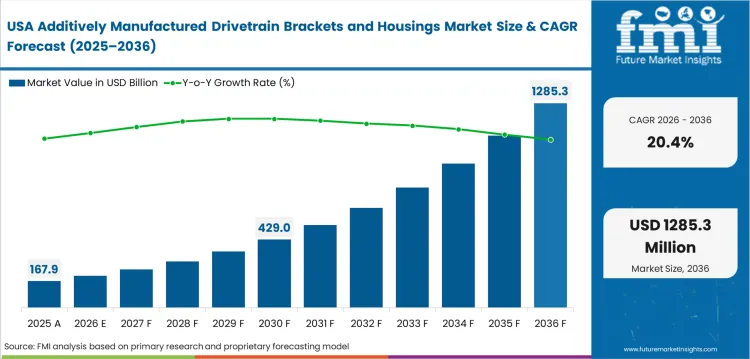
The market in United States is forecast to expand at 20.4% CAGR by 2036 as metal AM services operate near automotive engineering and parts clusters. SelectUSA cited 10.6 million motor vehicles produced in the country during 2024. Production scale supports qualification work for brackets tied to EV and performance programs. Supplier opportunity will depend on fast design iteration and clear documentation for OEM release.
- Automotive parts clusters give AM suppliers access to engineering teams and validation labs.
- USMCA rules keep attention on domestic parts value and traceable component sourcing.
- Aftermarket performance users can support early printed bracket orders before high volume OEM use.
Sales Analysis of Additively Manufactured Drivetrain Brackets and Housings in South Korea
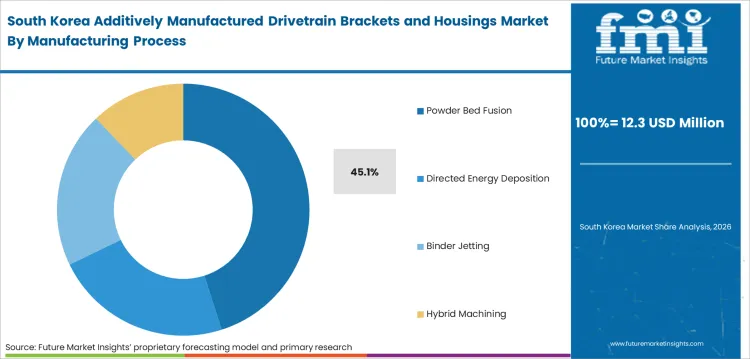
Sales in South Korea are forecast to advance at 19.6% CAGR by 2036 since domestic automakers focus on compact electric drive layouts. Korea Automobile and Mobility Association data for December 2024 provides a regular view of production and export activity. Drivetrain brackets can enter design validation around e-drive modules before larger housings. Supplier competition will depend on repeatable aluminum processing and machining accuracy.
- Domestic EV platform depth creates practical demand for compact motor mounts and e-axle support parts.
- Export-oriented vehicle programs make documentation and repeatability important for printed part acceptance.
- Larger housing adoption will depend on thermal design proof and sealing tests for drive modules.
Demand Outlook for Additively Manufactured Drivetrain Brackets and Housings in Germany
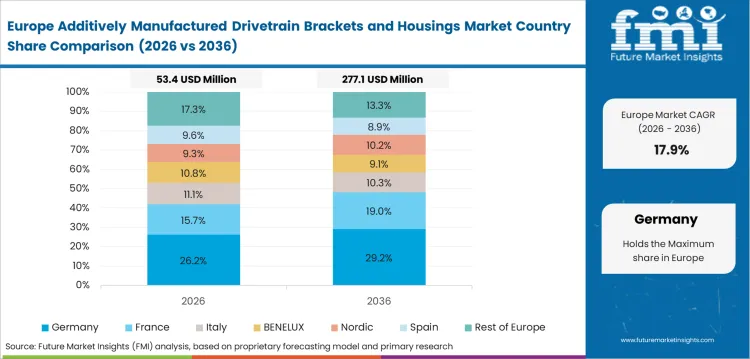
Sector in Germany is forecast to rise at 19.2% CAGR by 2036 as premium engineering teams test metal AM for vehicle parts and tools. BMW Group reported more than 300,000.0 parts printed at its Additive Manufacturing Campus in 2023. Captive knowledge gives German OEMs a clearer route from prototype to qualified part. External suppliers must match documentation standards used inside such centers.
- Premium vehicle programs can absorb higher part costs if printed brackets lower mass or consolidate assemblies.
- German AM centers help build trust in process control and finished part testing.
- Transmission and e-axle suppliers will compare printed housing value against cast aluminum routes.
Future Outlook for Additively Manufactured Drivetrain Brackets and Housings in Mexico
The market in Mexico is forecast to record 18.5% CAGR by 2036 as North American vehicle assembly and parts exports create nearshoring interest. INEGI recorded 355.5 thousand light vehicles produced in September 2025 and 314.7 thousand exported. Export intensity makes local AM useful for fixtures first and selected drivetrain parts later. Printed brackets will need cost proof against established stamping and machining suppliers.
- Nearshoring supports faster part sampling for programs serving United States vehicle assembly chains.
- Export requirements raise the value of traceable production files and repeatable inspection routines.
- Local housing demand will expand first around niche EV and performance vehicle programs.
In-depth Analysis of Additively Manufactured Drivetrain Brackets and Housings in Japan
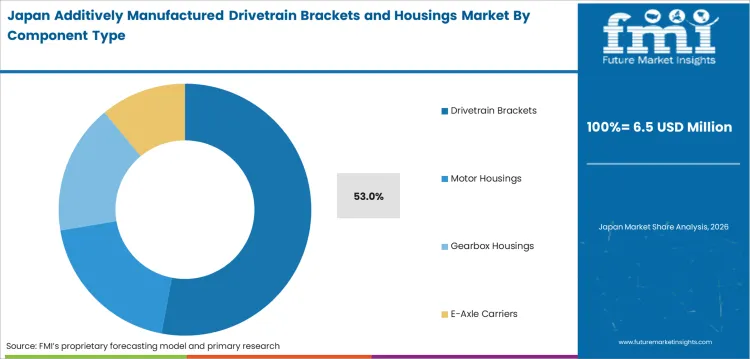
Industry in Japan is forecast to post 17.8% CAGR by 2036 as stringent quality habits keep adoption selective. Japan metal AM use is forecast to focus on drivetrain parts with clear engineering value instead of broad substitution. Ministry of Economy, Trade and Industry production releases identified motor vehicles among industries contributing to monthly output changes in 2025. Printed brackets will need long test cycles before routine production use.
- Japanese suppliers are likely to favor parts with clear weight savings and stable repeatability records.
- Hybrid and EV drivetrain programs create selective routes for compact motor housings and mounts.
- Quality screening keeps adoption measured and supports premium printed parts with strong test files.
Competitive Landscape and Strategic Positioning
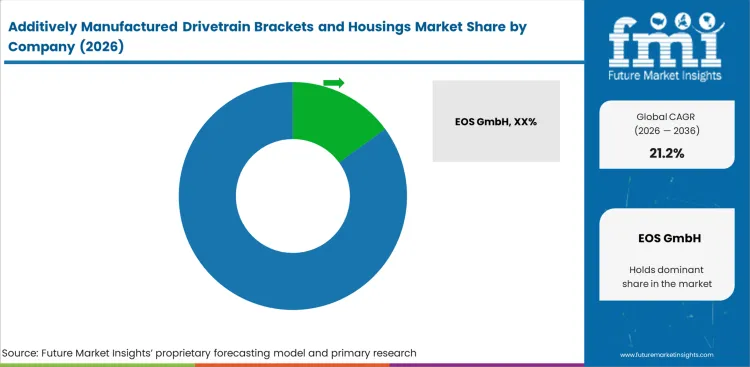
- Machine platform suppliers hold an advantage as bracket and housing programs depend on stable build sizes and repeatable output.
- Software and workflow firms draw manufacturer interest by improving build preparation and print parameter control.
- OEM captive centers remain important as vehicle makers keep sensitive drivetrain designs close to engineering teams.
Competition outlook in the industry is influenced by offering printed drivetrain parts that can meet release needs. 3D Systems with EOS and Nikon SLM Solutions supply metal AM platforms used by service providers and industrial manufacturers. Materialise and Renishaw support repeatable metal printing through software and build processor routes. Corrosion-resistant axle components and drivetrain components serve as benchmarks for conventional durability. Printed part suppliers must prove that bracket geometry and housing functions can handle drivetrain load needs.
Specialist AM service firms and OEM captive centers are forecast to share early demand. Divergent Technologies uses a digital production model built around designed metal structures. BMW Group shows how captive AM centers can qualify internal vehicle components and tools. Automotive performance parts support low-volume channels. Off-highway EV components create another demand route for rugged drivetrain brackets. Lightweight automotive body panels show how mass saving remains a vehicle-wide design target. Suppliers with alloy proof and design release support are well placed for early programs.
Key Companies in the Additively Manufactured Drivetrain Brackets and Housings Market
Competition is clearer by role as machine platform suppliers and captive vehicle engineering centers serving different needs.
- Metal AM Platform Suppliers: EOS GmbH, 3D Systems and Nikon SLM Solutions support printed metal part production through powder bed fusion systems and process support.
- Workflow and Software Specialists: Materialise and Renishaw support build preparation, parameter control and repeatable production workflows for metal AM users.
- Vehicle and Digital Production Specialists: BMW Group, Divergent Technologies and GKN Additive link printed part design to automotive qualification and production needs.
Competitive Benchmarking: Additively Manufactured Drivetrain Brackets and Housings Market
| Company | Drivetrain Part Fit | Metal Qualification Depth | Production Workflow Reach | Geographic Footprint |
|---|---|---|---|---|
| EOS GmbH | High | Strong | High | Germany and global metal AM users |
| 3D Systems | High | Strong | High | United States and global industrial users |
| Nikon SLM Solutions | High | Strong | Medium | Germany and United States scaling support |
| Materialise | Medium | Strong | High | Belgium centered software and service reach |
| Renishaw | Medium | Strong | Medium | United Kingdom centered metal AM users |
| BMW Group | Medium | Strong | Strong | Captive German vehicle programs |
| Divergent Technologies | High | Strong | Medium | United States digital production model |
| GKN Additive | Medium | Medium | Medium | Automotive and industrial metal AM supply |
Source: Future Market Insights competitive analysis, 2026. Ratings reflect relative positioning based on drivetrain part fit, metal qualification depth and production workflow reach.
Key Developments in Additively Manufactured Drivetrain Brackets and Housings Market
- In March 2024, EOS launched the EOS M 290 1kW metal AM system with serial production focus.
- In July 2024, 3D Systems and Precision Resource announced a metal AM partnership covering high-criticality automotive and heavy-duty components.
- In September 2025, Divergent Technologies announced a USD 290.0 million Series E round to scale its digital manufacturing platform.
Key Players in the Additively Manufactured Drivetrain Brackets and Housings Market
Major Global Players:
- EOS GmbH
- 3D Systems
- Nikon SLM Solutions
- Materialise
- Renishaw
- GKN Additive
Specialist and Automotive Players:
- BMW Group Additive Manufacturing Campus
- Divergent Technologies
- Precision Resource
- i3D MFG
- Incodema3D
- WeAreAM
Report Scope and Coverage
| Parameter | Details |
|---|---|
| Quantitative Units | USD 0.3 billion to USD 2.0 billion at 21.2% CAGR |
| Market Definition | Printed drivetrain brackets, motor housings, gearbox housings, e-axle carriers |
| Component Type | Drivetrain brackets, motor housings, gearbox housings, e-axle carriers |
| Manufacturing Process | Powder bed fusion, directed energy deposition, binder jetting, hybrid machining |
| Material | Aluminum alloys, steel alloys, titanium alloys, polymer composites |
| Vehicle Platform | Battery electric vehicles, hybrid vehicles, performance vehicles, commercial vehicles |
| Sales Channel | OEM programs, aftermarket and motorsport, service bureau contracts |
| Regions Covered | North America, Latin America, Western Europe, Eastern Europe, East Asia, South Asia and Pacific, Middle East and Africa |
| Countries Covered | United States, China, Germany, Japan, South Korea, India, Mexico |
| Key Companies Profiled | EOS GmbH, 3D Systems, Nikon SLM Solutions, Materialise, Renishaw, BMW Group |
| Forecast Period | 2026 to 2036 |
| Approach | Top-down parent checks, bottom-up part value estimates, supplier evidence, qualification screens |
Source: Future Market Insights, 2026.
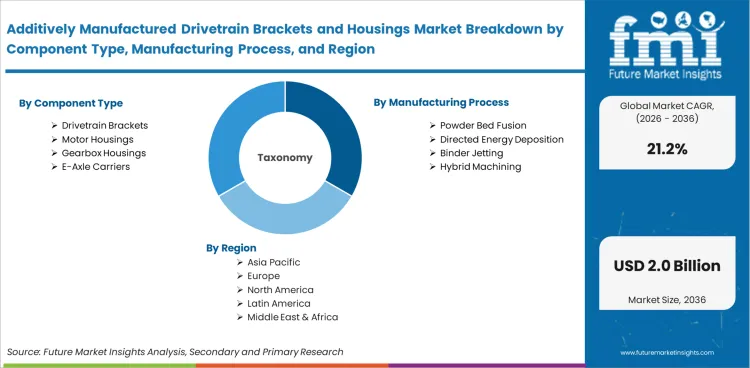
Additively Manufactured Drivetrain Brackets and Housings Market Breakdown by Component Type, Manufacturing Process, Material, Vehicle Platform, Sales Channel and Region
Additively Manufactured Drivetrain Brackets and Housings Market Segmented by Component Type:
- Drivetrain Brackets
- Motor Housings
- Gearbox Housings
- E-Axle Carriers
Additively Manufactured Drivetrain Brackets and Housings Market Segmented by Manufacturing Process:
- Powder Bed Fusion
- Directed Energy Deposition
- Binder Jetting
- Hybrid Machining
Additively Manufactured Drivetrain Brackets and Housings Market Segmented by Material:
- Aluminum Alloys
- Steel Alloys
- Titanium Alloys
- Polymer Composites
Additively Manufactured Drivetrain Brackets and Housings Market Segmented by Vehicle Platform:
- Battery Electric Vehicles
- Hybrid Vehicles
- Performance Vehicles
- Commercial Vehicles
Additively Manufactured Drivetrain Brackets and Housings Market Segmented by Sales Channel:
- OEM Programs
- Aftermarket and Motorsport
- Service Bureau Contracts
Additively Manufactured Drivetrain Brackets and Housings Market by Region:
- North America
- United States
- Canada
- Mexico
- Latin America
- Brazil
- Argentina
- Rest of Latin America
- Western Europe
- Germany
- United Kingdom
- France
- Italy
- Spain
- Rest of Western Europe
- Eastern Europe
- Poland
- Czech Republic
- Romania
- Rest of Eastern Europe
- East Asia
- China
- Japan
- South Korea
- South Asia and Pacific
- India
- ASEAN
- Australia and New Zealand
- Rest of South Asia and Pacific
- Middle East and Africa
- Saudi Arabia
- United Arab Emirates
- South Africa
- Rest of Middle East and Africa
Research Sources and Bibliography
- American National Standards Institute. (2026, April 29). Additive manufacturing standards: New progress report tracks gaps in a fast-growing industry.
- BMW Group. (2024, March 20). BMW Group with “live wire” to innovative production of vehicle components in WAAM process.
- BMW Group. (2024, May 23). BMW Group expands use of 3D-printed, customised robot grippers.
- Bugatti. (2024, June 21). The Bugatti Tourbillon: An automotive icon “Pour l’Éternité”.
- Bureau of Labor Statistics. (2025, July 18). Motor vehicle parts manufacturing top six in 2024.
- Divergent Technologies. (2025, September 15). Divergent raises $290 million Series E financing.
- EOS GmbH. (2024, March 14). EOS launches its EOS M 290 1kW metal AM system.
- EOS GmbH. (2024, September 23). EOS assembles EOS M 290 in Texas.
- Jäger, S., & Linde, T. (2025). Design and cost evaluation of additively manufactured electric vehicle gearbox housings. World Electric Vehicle Journal, 16(10), 552.
- Materialise. (2024, June 24). Materialise and nTop partner to push the boundaries of what’s possible with additive manufacturing.
- National Bureau of Statistics of China. (2026, February 28). Statistical communiqué of the People’s Republic of China on the 2025 national economic and social development.
- National Institute of Standards and Technology. (2024, November 13). Powder bed fusion.
- Nikon Corporation. (2024, July 29). Nikon unveils Nikon AM Technology Center in Long Beach, California.
- 3D Systems. (2024, July 8). 3D Systems and Precision Resource announce strategic partnership to advance metal additive manufacturing.
- USA International Trade Commission. (2025, July 1). USITC releases second report on the economic impact and operation of the USMCA automotive rules of origin.
Bibliography uses government sources, official company evidence and non-commercial trade data relevant to the market.
This Report Answers
- What is the current and future size of the additively manufactured drivetrain brackets and housings market?
- How fast is the additively manufactured drivetrain brackets and housings market expected to expand between 2026 and 2036?
- Which material is expected to account for the leading additively manufactured drivetrain brackets and housings share in 2026?
- Which sales channel is projected to account for the leading additively manufactured drivetrain brackets and housings share in 2026?
- Why are aluminum alloys important for additively manufactured drivetrain brackets and housings demand?
- How does powder bed fusion support additively manufactured drivetrain brackets and housings adoption?
- Which countries are projected to record faster expansion during the forecast period?
- Who are the main companies active in additively manufactured drivetrain brackets and housings supply?
- How does FMI define the additively manufactured drivetrain brackets and housings market scope?
- How does FMI estimate and validate the additively manufactured drivetrain brackets and housings forecast?
Frequently Asked Questions
What is the global market demand for additively manufactured drivetrain brackets and housings in 2026?
In 2026, additively manufactured drivetrain brackets and housings industry value is forecast to exceed USD 0.3 billion as EV programs widen printed part testing.
How big will the additively manufactured drivetrain brackets and housings market be in 2036?
By 2036, additively manufactured drivetrain brackets and housings industry is forecast to reach USD 2.0 billion as qualified metal printing expands.
How much is demand for additively manufactured drivetrain brackets and housings expected to expand between 2026 and 2036?
The sector is forecast to expand at 21.2% CAGR by 2036 as drivetrain brackets move into low-volume production.
Which material is expected to lead additively manufactured drivetrain brackets and housings demand by 2026?
Aluminum alloys are forecast to represent 56.0% share in 2026 as lighter drivetrain mounts integrate EV and hybrid packaging requirements.
Which sales channel is expected to lead additively manufactured drivetrain brackets and housings demand in 2026?
OEM programs are forecast to account for 82.0% share in 2026, as drivetrain parts need direct release and validation files.
Which country is forecast to grow fastest in additively manufactured drivetrain brackets and housings?
China is forecast to record 23.5% CAGR by 2036 as EV output and local metal AM capacity support part qualification.
What does the additively manufactured drivetrain brackets and housings market include?
Scope includes printed drivetrain brackets and motor housings. E-axle carriers are included. Finishing steps count if sold with the printed part.
How does FMI estimate the additively manufactured drivetrain brackets and housings market forecast?
FMI uses parent market checks, part value estimates and supplier evidence to validate forecast size and segment shares.
Why is powder bed fusion important in additively manufactured drivetrain brackets and housings?
Powder bed fusion supports dense metal brackets with tight features. Process control makes it useful for load-bearing drivetrain mounting points.
Who uses additively manufactured drivetrain brackets and housings?
Main users include vehicle OEMs and Tier 1 drivetrain suppliers. Performance builders and motorsport programs complete the early buyer group.
Preview the report firsthand - request a free sample
Get SampleGet the brochure for pricing and purchase details.
Get PDFTable of Content
- Executive Summary
- Global Market Outlook
- Demand-side Trends
- Supply-side Trends
- Technology Roadmap Analysis
- Analysis and Recommendations
- Market Overview
- Market Coverage / Taxonomy
- Market Definition / Scope / Limitations
- Research Methodology
- Chapter Orientation
- Analytical Lens and Working Hypotheses
- Market Structure, Signals, and Trend Drivers
- Benchmarking and Cross-market Comparability
- Market Sizing, Forecasting, and Opportunity Mapping
- Research Design and Evidence Framework
- Desk Research Programme (Secondary Evidence)
- Company Annual and Sustainability Reports
- Peer-reviewed Journals and Academic Literature
- Corporate Websites, Product Literature, and Technical Notes
- Earnings Decks and Investor Briefings
- Statutory Filings and Regulatory Disclosures
- Specialist Newsletters and Curated Briefings
- Sector Databases and Reference Repositories
- FMI Internal Proprietary Databases and Historical Market Datasets
- Subscription Datasets and Paid Sources
- Social Channels, Communities, and Digital Listening Inputs
- Additional Desk Sources
- Expert Input and Fieldwork (Primary Evidence)
- Primary Modes
- Qualitative Interviews and Expert Elicitation
- Quantitative Surveys and Structured Data Capture
- Blended Approach
- Why Primary Evidence is Used
- Field Techniques
- Interviews
- Surveys
- Focus Groups
- Observational and In-context Research
- Social and Community Interactions
- Stakeholder Universe Engaged
- C-suite Leaders
- Board Members
- Presidents and Vice Presidents
- R&D and Innovation Heads
- Technical Specialists
- Domain Subject-matter Experts
- Scientists
- Physicians and Other Healthcare Professionals
- Governance, Ethics, and Data Stewardship
- Research Ethics
- Data Integrity and Handling
- Primary Modes
- Tooling, Models, and Reference Databases
- Desk Research Programme (Secondary Evidence)
- Data Engineering and Model Build
- Data Acquisition and Ingestion
- Cleaning, Normalisation, and Verification
- Synthesis, Triangulation, and Analysis
- Quality Assurance and Audit Trail
- Market Background
- Market Dynamics
- Drivers
- Restraints
- Value Chain Analysis
- PESTLE and Porter’s Analysis
- Regulatory Landscape
- Regional Parent Market Outlook
- Production and Consumption Statistics
- Import and Export Statistics
- Global Market Analysis 2021 to 2025 and Forecast, 2026 to 2036
- Historical Market Size Value (USD Million) Analysis, 2021 to 2025
- Current and Future Market Size Value (USD Million) Projections, 2026 to 2036
- Y-o-Y Growth Trend Analysis
- Absolute $ Opportunity Analysis
- Global Market Pricing Analysis 2021 to 2025 and Forecast 2026 to 2036
- Global Market Analysis 2021 to 2025 and Forecast 2026 to 2036, By Component Type
- Introduction / Key Findings
- Historical Market Size Value (USD Million) Analysis By Component Type , 2021 to 2025
- Current and Future Market Size Value (USD Million) Analysis and Forecast By Component Type , 2026 to 2036
- Drivetrain Brackets
- Motor Housings
- Gearbox Housings
- E-Axle Carriers
- Drivetrain Brackets
- Y-o-Y Growth Trend Analysis By Component Type , 2021 to 2025
- Absolute $ Opportunity Analysis By Component Type , 2026 to 2036
- Global Market Analysis 2021 to 2025 and Forecast 2026 to 2036, By Manufacturing Process
- Introduction / Key Findings
- Historical Market Size Value (USD Million) Analysis By Manufacturing Process, 2021 to 2025
- Current and Future Market Size Value (USD Million) Analysis and Forecast By Manufacturing Process, 2026 to 2036
- Powder Bed Fusion
- Directed Energy Deposition
- Binder Jetting
- Hybrid Machining
- Powder Bed Fusion
- Y-o-Y Growth Trend Analysis By Manufacturing Process, 2021 to 2025
- Absolute $ Opportunity Analysis By Manufacturing Process, 2026 to 2036
- Global Market Analysis 2021 to 2025 and Forecast 2026 to 2036, By Material
- Introduction / Key Findings
- Historical Market Size Value (USD Million) Analysis By Material, 2021 to 2025
- Current and Future Market Size Value (USD Million) Analysis and Forecast By Material, 2026 to 2036
- Aluminum Alloys
- Steel Alloys
- Titanium Alloys
- Polymer Composites
- Aluminum Alloys
- Y-o-Y Growth Trend Analysis By Material, 2021 to 2025
- Absolute $ Opportunity Analysis By Material, 2026 to 2036
- Global Market Analysis 2021 to 2025 and Forecast 2026 to 2036, By Vehicle Platform
- Introduction / Key Findings
- Historical Market Size Value (USD Million) Analysis By Vehicle Platform, 2021 to 2025
- Current and Future Market Size Value (USD Million) Analysis and Forecast By Vehicle Platform, 2026 to 2036
- Battery Electric Vehicles
- Hybrid Vehicles
- Performance Vehicles
- Commercial Vehicles
- Battery Electric Vehicles
- Y-o-Y Growth Trend Analysis By Vehicle Platform, 2021 to 2025
- Absolute $ Opportunity Analysis By Vehicle Platform, 2026 to 2036
- Global Market Analysis 2021 to 2025 and Forecast 2026 to 2036, By Sales Channel
- Introduction / Key Findings
- Historical Market Size Value (USD Million) Analysis By Sales Channel, 2021 to 2025
- Current and Future Market Size Value (USD Million) Analysis and Forecast By Sales Channel, 2026 to 2036
- OEM Programs
- Aftermarket and Motorsport
- Service Bureau Contracts
- OEM Programs
- Y-o-Y Growth Trend Analysis By Sales Channel, 2021 to 2025
- Absolute $ Opportunity Analysis By Sales Channel, 2026 to 2036
- Global Market Analysis 2021 to 2025 and Forecast 2026 to 2036, By Region
- Introduction
- Historical Market Size Value (USD Million) Analysis By Region, 2021 to 2025
- Current Market Size Value (USD Million) Analysis and Forecast By Region, 2026 to 2036
- North America
- Latin America
- Western Europe
- Eastern Europe
- East Asia
- South Asia and Pacific
- Middle East & Africa
- Market Attractiveness Analysis By Region
- North America Market Analysis 2021 to 2025 and Forecast 2026 to 2036, By Country
- Historical Market Size Value (USD Million) Trend Analysis By Market Taxonomy, 2021 to 2025
- Market Size Value (USD Million) Forecast By Market Taxonomy, 2026 to 2036
- By Country
- USA
- Canada
- Mexico
- By Component Type
- By Manufacturing Process
- By Material
- By Vehicle Platform
- By Sales Channel
- By Country
- Market Attractiveness Analysis
- By Country
- By Component Type
- By Manufacturing Process
- By Material
- By Vehicle Platform
- By Sales Channel
- Key Takeaways
- Latin America Market Analysis 2021 to 2025 and Forecast 2026 to 2036, By Country
- Historical Market Size Value (USD Million) Trend Analysis By Market Taxonomy, 2021 to 2025
- Market Size Value (USD Million) Forecast By Market Taxonomy, 2026 to 2036
- By Country
- Brazil
- Chile
- Rest of Latin America
- By Component Type
- By Manufacturing Process
- By Material
- By Vehicle Platform
- By Sales Channel
- By Country
- Market Attractiveness Analysis
- By Country
- By Component Type
- By Manufacturing Process
- By Material
- By Vehicle Platform
- By Sales Channel
- Key Takeaways
- Western Europe Market Analysis 2021 to 2025 and Forecast 2026 to 2036, By Country
- Historical Market Size Value (USD Million) Trend Analysis By Market Taxonomy, 2021 to 2025
- Market Size Value (USD Million) Forecast By Market Taxonomy, 2026 to 2036
- By Country
- Germany
- UK
- Italy
- Spain
- France
- Nordic
- BENELUX
- Rest of Western Europe
- By Component Type
- By Manufacturing Process
- By Material
- By Vehicle Platform
- By Sales Channel
- By Country
- Market Attractiveness Analysis
- By Country
- By Component Type
- By Manufacturing Process
- By Material
- By Vehicle Platform
- By Sales Channel
- Key Takeaways
- Eastern Europe Market Analysis 2021 to 2025 and Forecast 2026 to 2036, By Country
- Historical Market Size Value (USD Million) Trend Analysis By Market Taxonomy, 2021 to 2025
- Market Size Value (USD Million) Forecast By Market Taxonomy, 2026 to 2036
- By Country
- Russia
- Poland
- Hungary
- Balkan & Baltic
- Rest of Eastern Europe
- By Component Type
- By Manufacturing Process
- By Material
- By Vehicle Platform
- By Sales Channel
- By Country
- Market Attractiveness Analysis
- By Country
- By Component Type
- By Manufacturing Process
- By Material
- By Vehicle Platform
- By Sales Channel
- Key Takeaways
- East Asia Market Analysis 2021 to 2025 and Forecast 2026 to 2036, By Country
- Historical Market Size Value (USD Million) Trend Analysis By Market Taxonomy, 2021 to 2025
- Market Size Value (USD Million) Forecast By Market Taxonomy, 2026 to 2036
- By Country
- China
- Japan
- South Korea
- By Component Type
- By Manufacturing Process
- By Material
- By Vehicle Platform
- By Sales Channel
- By Country
- Market Attractiveness Analysis
- By Country
- By Component Type
- By Manufacturing Process
- By Material
- By Vehicle Platform
- By Sales Channel
- Key Takeaways
- South Asia and Pacific Market Analysis 2021 to 2025 and Forecast 2026 to 2036, By Country
- Historical Market Size Value (USD Million) Trend Analysis By Market Taxonomy, 2021 to 2025
- Market Size Value (USD Million) Forecast By Market Taxonomy, 2026 to 2036
- By Country
- India
- ASEAN
- Australia & New Zealand
- Rest of South Asia and Pacific
- By Component Type
- By Manufacturing Process
- By Material
- By Vehicle Platform
- By Sales Channel
- By Country
- Market Attractiveness Analysis
- By Country
- By Component Type
- By Manufacturing Process
- By Material
- By Vehicle Platform
- By Sales Channel
- Key Takeaways
- Middle East & Africa Market Analysis 2021 to 2025 and Forecast 2026 to 2036, By Country
- Historical Market Size Value (USD Million) Trend Analysis By Market Taxonomy, 2021 to 2025
- Market Size Value (USD Million) Forecast By Market Taxonomy, 2026 to 2036
- By Country
- Kingdom of Saudi Arabia
- Other GCC Countries
- Turkiye
- South Africa
- Other African Union
- Rest of Middle East & Africa
- By Component Type
- By Manufacturing Process
- By Material
- By Vehicle Platform
- By Sales Channel
- By Country
- Market Attractiveness Analysis
- By Country
- By Component Type
- By Manufacturing Process
- By Material
- By Vehicle Platform
- By Sales Channel
- Key Takeaways
- Key Countries Market Analysis
- USA
- Pricing Analysis
- Market Share Analysis, 2025
- By Component Type
- By Manufacturing Process
- By Material
- By Vehicle Platform
- By Sales Channel
- Canada
- Pricing Analysis
- Market Share Analysis, 2025
- By Component Type
- By Manufacturing Process
- By Material
- By Vehicle Platform
- By Sales Channel
- Mexico
- Pricing Analysis
- Market Share Analysis, 2025
- By Component Type
- By Manufacturing Process
- By Material
- By Vehicle Platform
- By Sales Channel
- Brazil
- Pricing Analysis
- Market Share Analysis, 2025
- By Component Type
- By Manufacturing Process
- By Material
- By Vehicle Platform
- By Sales Channel
- Chile
- Pricing Analysis
- Market Share Analysis, 2025
- By Component Type
- By Manufacturing Process
- By Material
- By Vehicle Platform
- By Sales Channel
- Germany
- Pricing Analysis
- Market Share Analysis, 2025
- By Component Type
- By Manufacturing Process
- By Material
- By Vehicle Platform
- By Sales Channel
- UK
- Pricing Analysis
- Market Share Analysis, 2025
- By Component Type
- By Manufacturing Process
- By Material
- By Vehicle Platform
- By Sales Channel
- Italy
- Pricing Analysis
- Market Share Analysis, 2025
- By Component Type
- By Manufacturing Process
- By Material
- By Vehicle Platform
- By Sales Channel
- Spain
- Pricing Analysis
- Market Share Analysis, 2025
- By Component Type
- By Manufacturing Process
- By Material
- By Vehicle Platform
- By Sales Channel
- France
- Pricing Analysis
- Market Share Analysis, 2025
- By Component Type
- By Manufacturing Process
- By Material
- By Vehicle Platform
- By Sales Channel
- India
- Pricing Analysis
- Market Share Analysis, 2025
- By Component Type
- By Manufacturing Process
- By Material
- By Vehicle Platform
- By Sales Channel
- ASEAN
- Pricing Analysis
- Market Share Analysis, 2025
- By Component Type
- By Manufacturing Process
- By Material
- By Vehicle Platform
- By Sales Channel
- Australia & New Zealand
- Pricing Analysis
- Market Share Analysis, 2025
- By Component Type
- By Manufacturing Process
- By Material
- By Vehicle Platform
- By Sales Channel
- China
- Pricing Analysis
- Market Share Analysis, 2025
- By Component Type
- By Manufacturing Process
- By Material
- By Vehicle Platform
- By Sales Channel
- Japan
- Pricing Analysis
- Market Share Analysis, 2025
- By Component Type
- By Manufacturing Process
- By Material
- By Vehicle Platform
- By Sales Channel
- South Korea
- Pricing Analysis
- Market Share Analysis, 2025
- By Component Type
- By Manufacturing Process
- By Material
- By Vehicle Platform
- By Sales Channel
- Russia
- Pricing Analysis
- Market Share Analysis, 2025
- By Component Type
- By Manufacturing Process
- By Material
- By Vehicle Platform
- By Sales Channel
- Poland
- Pricing Analysis
- Market Share Analysis, 2025
- By Component Type
- By Manufacturing Process
- By Material
- By Vehicle Platform
- By Sales Channel
- Hungary
- Pricing Analysis
- Market Share Analysis, 2025
- By Component Type
- By Manufacturing Process
- By Material
- By Vehicle Platform
- By Sales Channel
- Kingdom of Saudi Arabia
- Pricing Analysis
- Market Share Analysis, 2025
- By Component Type
- By Manufacturing Process
- By Material
- By Vehicle Platform
- By Sales Channel
- Turkiye
- Pricing Analysis
- Market Share Analysis, 2025
- By Component Type
- By Manufacturing Process
- By Material
- By Vehicle Platform
- By Sales Channel
- South Africa
- Pricing Analysis
- Market Share Analysis, 2025
- By Component Type
- By Manufacturing Process
- By Material
- By Vehicle Platform
- By Sales Channel
- USA
- Market Structure Analysis
- Competition Dashboard
- Competition Benchmarking
- Market Share Analysis of Top Players
- By Regional
- By Component Type
- By Manufacturing Process
- By Material
- By Vehicle Platform
- By Sales Channel
- Competition Analysis
- Competition Deep Dive
- EOS GmbH
- Overview
- Product Portfolio
- Profitability by Market Segments (Product/Age /Sales Channel/Region)
- Sales Footprint
- Strategy Overview
- Marketing Strategy
- Product Strategy
- Channel Strategy
- 3D Systems
- Nikon SLM Solutions
- Materialise
- Renishaw
- BMW Group
- Divergent Technologies
- GKN Additive
- EOS GmbH
- Competition Deep Dive
- Market Dynamics
- Assumptions & Acronyms Used


